Gi and no-gi jiu jitsu in Windham: Which style should you choose
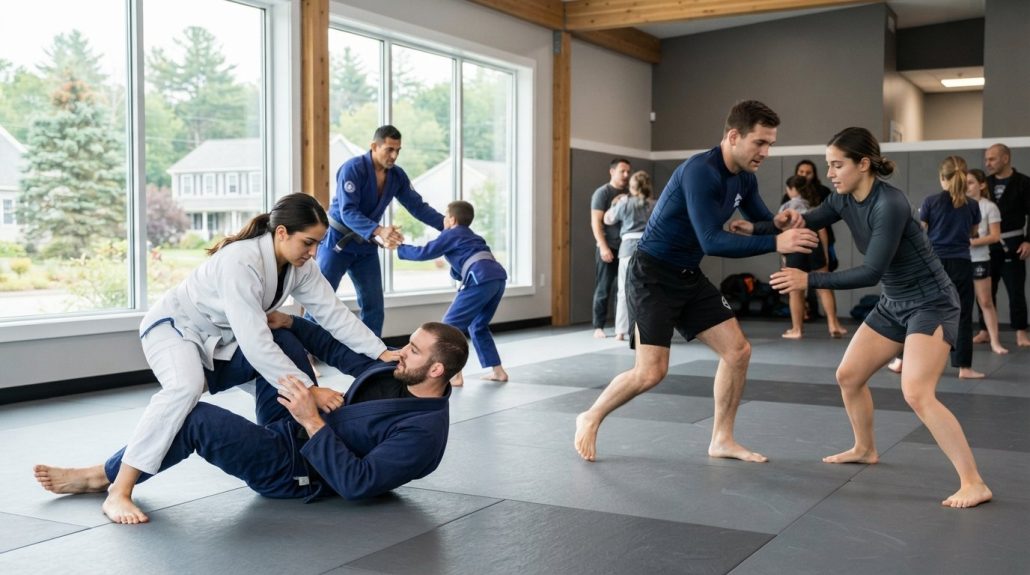
Brazilian Jiu-Jitsu is a grappling martial art focused on controlling an opponent and using technique to create opportunities to submit them. Choosing gi and no-gi jiu jitsu in Windham depends on the training experience you want: gi practice uses a uniform for grips, while no-gi is practised in athletic clothing and relies more on body control. Both styles build practical grappling skills.
The uniform changes how a round feels. In gi, grips on the sleeves, collar, and pants shape the pace and techniques. Without those grips, no-gi encourages a quicker, more adaptable approach. Neither style is automatically the better choice for every beginner.
If you’re new, you may wonder which style will feel more comfortable or whether you need to choose just one. This guide explains Brazilian Jiu-Jitsu, compares gi and no-gi training, and offers practical ways to decide where to begin. You’ll also learn how to try a first class and take a useful next step.
Key Takeaways
- Brazilian Jiu-Jitsu uses grappling, control, and technique, making it a skill-building practice for beginners as well as experienced students.
- Gi training uses uniform grips, while no-gi relies more on body control and movement; each style develops different strengths.
- Choose a starting style based on what you want to practice, then consider trying both to broaden your grappling skills.
- A free introductory class offers a practical way to experience training and see how the learning environment feels.
- Compare the styles by clothing, grip opportunities, pace, and the techniques you’re most interested in learning.
What is Brazilian Jiu-Jitsu?
Brazilian Jiu-Jitsu (BJJ) is a grappling martial art focused on position, control, and submissions. In Windham, choosing a class means comparing uniform-based gi training with no-gi, then finding sessions that fit your routine.
BJJ traces its family tradition to 1925 and brothers Carlos and Hélio Gracie. Students practise movement, escapes, and control with a training partner, building skills through guided instruction and practice. Beginners can expect to learn techniques progressively; it may take about 6 months to start feeling more familiar with what to do in training.
Windham gyms can be compared by instructor experience, student reviews, and the classes listed on their schedules. Look for clear information about beginner instruction and whether classes are offered in gi, no-gi, or both; those details show how each program fits your goals.
The schedule is the practical way to see when each format is taught. “Gi” and “no-gi” describe training styles, not an academy’s timetable, so check the listed classes rather than assuming every program teaches both.
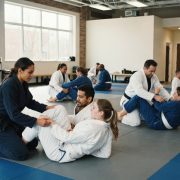
Children can begin at age 4, and adults can also train Brazilian Jiu-Jitsu. Beginners and experienced students can work on appropriate techniques at their own pace, while the learning environment and class structure help determine which session suits each student.
New students should learn to tap, communicate discomfort, and follow the instructor’s guidance during partner practice. Strains, bruises, and joint stress can occur, especially when someone resists a position or moves beyond their control. Careful practice and respectful partners help reduce avoidable risks.
Gi Jiu-Jitsu Classes
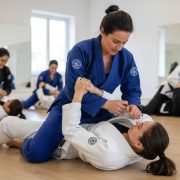
Gi classes use a uniform, giving students fabric grips to practise during drills and sparring. This changes how they manage distance and practise escapes compared with no-gi, where those grips aren’t available. For beginners, gi training offers clear opportunities to practise grip control alongside core grappling positions. Check the schedule to see when gi classes take place.
No-Gi Jiu-Jitsu Classes
No-gi classes are practised without the traditional uniform, so students focus on controlling the body rather than gripping sleeves or collars. The format changes the available grips and the pace of transitions, making it a useful comparison with gi training. Beginners can experience the style in a free introductory class and follow the instructor’s guidance.
Trial and introductory classes give newcomers a way to experience instruction before choosing a regular program. An introductory class is offered free, and membership pricing depends on the program and enrollment details; the price is provided after a quote request. Ask about the factors that shape the quote, such as the selected program and enrollment arrangement.
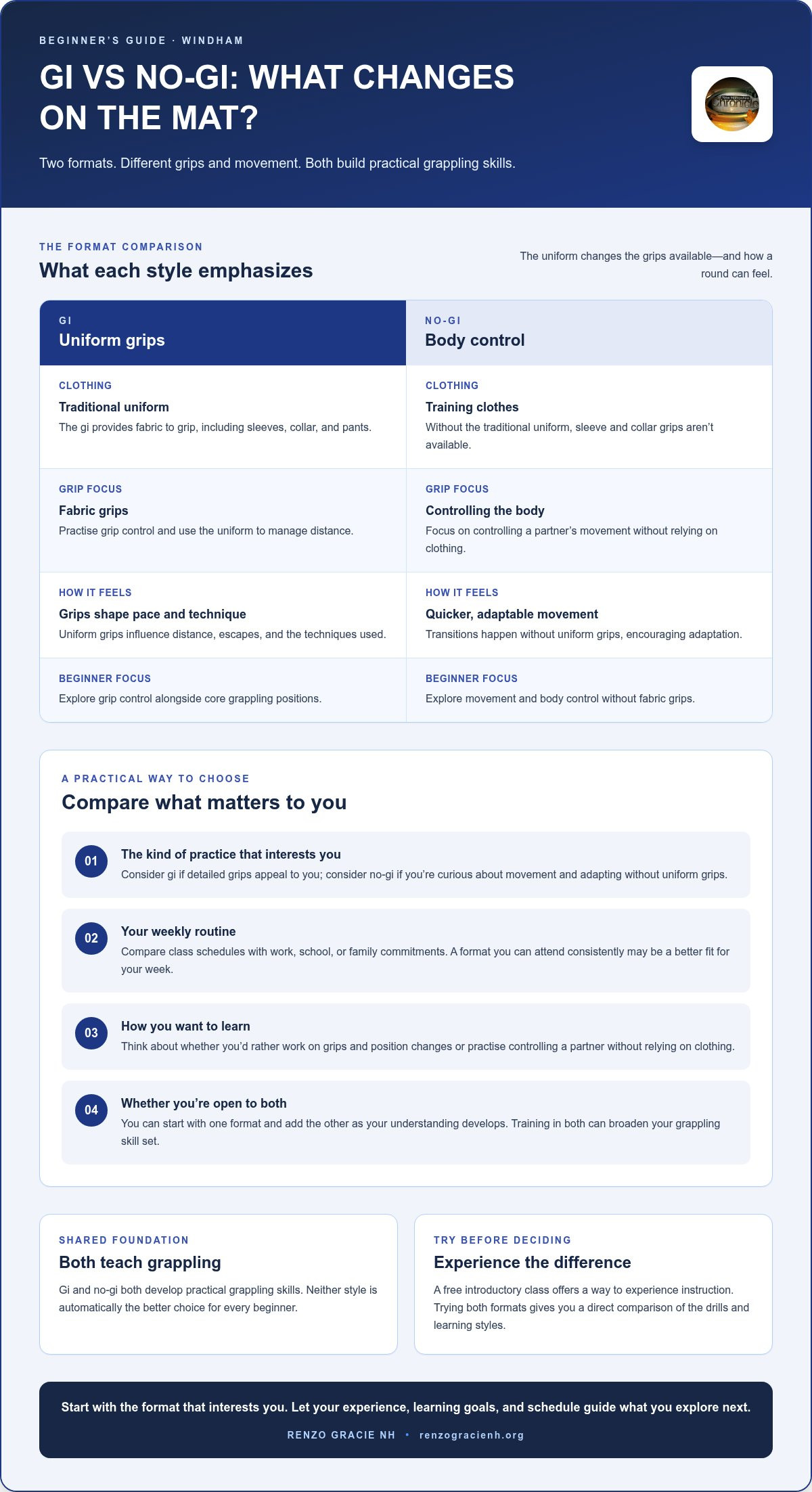
| Option | Clothing | Grip focus | Useful comparison |
|---|---|---|---|
| Gi | Traditional uniform | Fabric grips | Practise control using uniform grips |
| No-gi | Training clothes | Body control | Practise without uniform grips |
Choose the format that matches your interests and routine, then try a free introductory class to experience the training before deciding on regular practice.
Choosing a style as a beginner
Your first choice doesn’t have to define your entire Jiu-Jitsu journey. For beginners exploring gi and no-gi jiu jitsu in Windham, a useful starting point is a style that suits your interests, comfort, and routine.
Start with what you want to learn. Gi practice lets students use uniform grips, while no-gi asks them to control movement without holding sleeves or collars. Those differences shape how techniques feel, but both formats teach grappling fundamentals. Beginning with the style that appeals to you can make your first steps feel more straightforward.
Use these questions to make a practical choice:
- What kind of practice sounds engaging? If working through detailed grips interests you, consider gi. If you’re curious about movement and adapting without uniform grips, try no-gi.
- What fits your routine? Compare class schedules with your work, school, or family commitments. A style you can attend consistently is more useful than one that looks appealing but clashes with your week.
- How do you want to learn? Think about whether you’d rather explore grips and position changes or focus on controlling a partner’s body without relying on clothing.
- Are you open to both? Training in gi and no-gi can build a more well-rounded grappling skill set. You can start with one format, then add the other as your understanding develops.
You don’t have to treat the choice as permanent. You might prefer gi after trying it, then discover that no-gi offers a different challenge. Trying both gives you a direct comparison: notice which explanations make sense, which drills hold your attention, and how each format fits your goals.
After class, jot down a few observations. Did you enjoy working through grip sequences, practising movement without fabric grips, or seeing how a technique connects to a position? These details can help you choose your next session based on experience rather than assumptions.
Consistency matters more than choosing a style that sounds impressive. If you’re new, focus first on understanding instructions, practising control, and becoming comfortable with partner drills. A free introductory class can provide a low-pressure way to experience a session and decide what to explore next. Try an introductory class as a practical first step.
Free trial membership
A free introductory class lets you experience Brazilian Jiu-Jitsu before deciding whether regular training suits you. Use the session to understand the class structure, follow instruction, and notice how gi and no-gi practice differ. You don’t need to arrive with techniques memorized. Focus on each part of the class and consider what questions will guide your next step.
Make the visit useful with a few simple actions:
- Choose a goal. Decide whether you want to see how BJJ works, compare gi and no-gi, or explore training for yourself or your child. A clear goal helps you pay attention to the right details.
- Ask which format the class covers. Gi practice uses grips on the uniform; no-gi practice relies on controlling the body without those grips. Knowing the format beforehand helps you understand the movements being taught.
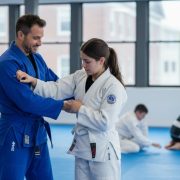
- Follow the instructor’s directions. Watch how a technique is demonstrated, then focus on the key movement during practice. If a step is confusing, ask for clarification rather than guessing or forcing the motion.
- Reflect after class. Note what felt engaging, what you learned, and whether the class pace suited you. For example, you might enjoy the problem-solving involved in controlling position or want to experience the other format.
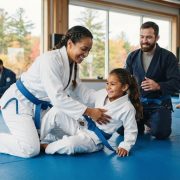
A trial visit can also help families consider children’s training. Children can begin Brazilian Jiu-Jitsu at age 4, and an introductory class gives a parent and child a chance to see how instruction feels. Consider whether the child can follow directions, take part in the activities, and feel comfortable learning alongside others. Those observations are more useful than expecting a beginner to understand every technique immediately.
For adults, a first visit can clarify practical questions about class routines and learning expectations. Ask how instruction introduces core movements, how students practise with partners, and which sessions cover gi or no-gi. These questions help you match your goals with a format and schedule that support regular attendance.
Afterward, compare your notes rather than judging the experience by one unfamiliar movement. If you’re still deciding between formats, use a later session to experience the other style. A free introductory class is a practical first step toward seeing how Brazilian Jiu-Jitsu works in person.
Gi and no-gi differences
Gi and no-gi differ in the grips available, the techniques emphasized, and the feel of practice. Gi training uses grips on sleeves, collars, and pants, including grip fighting and collar chokes. No-gi removes those uniform grips and emphasizes underhooks, overhooks, and body control. Competition rules vary by ruleset, so techniques and permitted actions depend on the event.
For gi, wear a Brazilian Jiu-Jitsu uniform, commonly called a gi. No-gi classes use athletic training clothes instead, without the traditional jacket and pants. A fitted shirt and shorts allow movement without relying on fabric grips. Follow the instructor’s clothing guidance for either session.
These equipment differences change how students solve familiar grappling problems. In gi, a sleeve grip can help control a partner’s arm, while a collar grip can support a choke technique. In no-gi, students work to control the arm or upper body directly. The goal may involve similar positions, but the path to them changes.
The pace and skills emphasized also differ. Gi develops precision and patience as students manage grips and work through grip fighting. No-gi emphasizes speed and adaptability, with underhooks, overhooks, and body control playing a central role. These are different training emphases, not a measure of which style is harder or more effective.
- Grip options: Gi offers grips on sleeves, collars, and pants. No-gi relies on body control and positions such as underhooks or overhooks.
- Common technique focus: Gi includes grip fighting and collar chokes. No-gi training builds control without using uniform fabric.
- Training qualities: Gi practice develops precision and patience. No-gi encourages speed and adaptability.
- Clothing: Gi uses a martial arts uniform. No-gi uses athletic clothing suitable for grappling practice.
A useful beginner comparison is to practise the same goal in both formats. For example, try controlling an opponent’s arm with a gi sleeve grip, then explore how body positioning replaces that grip in no-gi. Notice the instructor’s explanation, the available controls, and how each approach feels in practice.
You don’t need to master techniques before joining a class. Start by learning how grips or body positions work, then build one movement at a time. If you want well-rounded grappling skills, training in both gi and no-gi gives you experience with different control methods. Choose based on your interests and the classes that fit your routine.
Gi jiu-jitsu
Gi training uses a Brazilian Jiu-Jitsu uniform, giving students grips on the sleeves, collar, and pants. These grips change how partners manage distance and control movement. A sleeve grip, for example, can help limit an opponent’s arm; a collar grip can help set up a collar choke. Learning to use and remove grips is central to gi practice.
Grip fighting is a skill in its own right. Instead of grabbing fabric at random, students learn to make deliberate choices: establish a useful grip, prevent an opponent from controlling their uniform, then use the position to advance or defend. Each choice affects what happens next. The process rewards precision and patience, since rushing can surrender control or create an opening for the other person.
For a beginner, one useful way to understand the gi is to follow a single sequence:
- Notice the grip. Identify whether your partner holds a sleeve, collar, or pant leg.
- Understand its purpose. Consider how that grip may limit movement or help control distance.
- Practise a response. Follow the instructor’s technique for clearing, changing, or using the grip.
- Connect the movement. Apply the grip or escape within the position being taught.
This sequence makes a busy exchange easier to read. A collar grip, for instance, isn’t just a hold to memorize. It’s a control point that can connect to a defensive response, a position change, or a collar choke. Understanding those connections helps explain why hand placement and timing matter.
Gi training gives students several ways to control a partner. Sleeve, collar, and pant grips each affect movement differently, so students practise adapting their choices to the position. A grip that helps maintain control may need to change when a partner moves. Paying attention to those shifts makes practice more purposeful.
Because uniform grips affect the available techniques, gi sessions feel different from no-gi practice. Students use fabric as part of the problem-solving process rather than relying only on direct body control. This can appeal to learners who enjoy careful transitions and tactical decisions. It doesn’t make gi automatically the better starting point: interest and class fit matter, too.
On your first visit, focus on following the grip sequence rather than trying to remember every technique. Ask for a demonstration if a sleeve or collar position is unclear, then practise the movement at a controlled pace. To experience Brazilian Jiu-Jitsu in person, start with a free introductory class.
Renzo Gracie NH: Adult Jiu Jitsu Program
Renzo Gracie NH offers an Adult Jiu Jitsu Program for adults who want to build grappling skills through structured martial arts training. If you’re comparing gi and no-gi, a free introductory class offers a practical first step and a chance to experience Brazilian Jiu-Jitsu in person.
Training can support progress in technique, focus, and confidence, whether you’re new to the sport or returning after time away. Families can explore the Kids Jiu Jitsu Program, and law enforcement professionals can take part in specialized Law Enforcement Jiu-Jitsu Training.
Choose a starting point that fits your goals, then explore the Free Introductory Class. Visit renzogracienh.org to learn more or get in touch with Renzo Gracie NH.
Take Your First Step on the Mat
Your next step doesn’t need to be a permanent choice between styles. Explore gi and no-gi jiu jitsu in Windham to discover how you learn best: notice what interests you, build comfort with the fundamentals, and let your goals shape your practice. Progress starts with showing up ready to learn.
Renzo Gracie NH offers an Adult Jiu Jitsu Program, a Kids Jiu Jitsu Program, and Law Enforcement Jiu-Jitsu Training for students with different goals. To get started, book a free introductory class and experience the training for yourself.
Contact Renzo Gracie NH to learn more and decide what starting your training could look like. You don’t need to have everything figured out before you begin. Bring your curiosity, take one step, and keep building from there.
Frequently Asked Questions
Gi vs No-Gi Jiu-Jitsu: What’s the Difference?
Gi uses a uniform that creates grip options; no-gi uses athletic clothing and relies on direct body control. This changes how you approach familiar situations. For example, a gi student might work to clear a sleeve grip, while a no-gi student focuses on breaking an underhook. When comparing classes, notice how clothing changes the available controls rather than expecting both formats to feel identical.
Which Should You Choose – Gi or No-Gi?
Choose the format that matches your interests and the classes you can attend consistently. Gi may suit you if you enjoy deliberate grip exchanges; no-gi may appeal if you’re drawn to movement without uniform grips. You can also train in both over time. For gi and no-gi jiu jitsu in Windham, base your first choice on the techniques you want to learn and the class times that fit your routine.
Which Should a Beginner Start With?
Beginners can start with either format, learning basic positions and following instruction in their first classes. Choose based on what you want to experience, such as grip problem-solving in gi or controlling movement without clothing grips in no-gi. You don’t need prior grappling experience. Keep your first goal simple: understand the lesson, practise the movements carefully, and notice what you’d like to explore next.
What are the gi and no-gi class schedules at Windham jiu-jitsu gyms?
Class times vary by program and format, so use the schedule to find gi or no-gi sessions that fit your routine. Renzo Gracie NH offers adult and kids’ Jiu-Jitsu programs, with classes on varied days and at varied times at its Windham, Exeter, and Manchester locations. Before planning your week, identify the sessions that suit your age group and preferred style. This can help you build a regular training rhythm around work, school, or family commitments.
How much do gi and no-gi jiu-jitsu classes cost in Windham?
Class pricing depends on the program and enrollment details, and is provided after a quote request. The cost factors include which program you choose and the enrollment arrangement. Gi and no-gi describe training formats, so focus first on which class fits your goals and routine. Renzo Gracie NH also offers a free introductory class, giving new students a way to experience instruction before deciding about ongoing training.
Do Windham jiu-jitsu gyms offer trial classes or drop-in options?
Renzo Gracie NH offers new students a free introductory class to experience its curriculum without commitment. The class gives you a chance to take part in instruction and see how a session feels before deciding about continued training. A drop-in usually means attending an individual regular class, which differs from an introductory visit. The free introductory class is a clear starting point for a first experience.
How do Windham jiu-jitsu gyms compare by instructors, reviews, and class offerings?
Compare instructor experience, student reviews, and schedules. Look for clear beginner instruction and check whether each gym lists gi classes, no-gi classes, or both.