Martial Arts for Stress Relief: A Practical Guide for Adults

What if stress relief came from focused practice, not fighting harder? When work and daily demands keep your mind switched on, another repetitive workout may not appeal, and stepping into a combat-sport setting can feel intimidating. Yet martial arts for stress relief adults can approach at their own pace may offer a structured way to move, concentrate, and make steady progress.

It’s reasonable to wonder whether training can help you manage stress, and whether you need to be fit or experienced before you begin. You don’t. Brazilian Jiu-Jitsu asks you to focus on movement, technique, and the moment in front of you. Practice can build fitness and confidence over time, but it isn’t a treatment for stress-related or mental health conditions. It may become one meaningful part of a balanced routine.

This guide explains how martial arts may support stress management, what to look for in a welcoming training environment, and how to start without rushing. At Renzo Gracie NH, adults of different skill levels can learn in a supportive setting, with a complimentary introductory class as a low-pressure first step.

Key Takeaways

  • Set realistic expectations: martial arts may support wellbeing, but it isn’t a guaranteed stress remedy or a substitute for mental health care.
  • Compare solo exercise with group training to find the routine and level of interaction that suit you.
  • Use a simple try-and-reflect plan to explore martial arts for stress relief adults can sustain, adjusting effort to your comfort and recovery.
  • Brazilian Jiu-Jitsu is grappling-based skill practice, and participation doesn’t require a goal of competing.
  • Learn what structured adult Brazilian Jiu-Jitsu looks like at Renzo Gracie NH, led by Professor Kevin Landry, a sixth-degree black belt under Renzo Gracie.

Can Martial Arts Help Adults Manage Stress? Start With Realistic Expectations

Work can end for the day while your mind keeps replaying deadlines, decisions, and unfinished tasks. An activity that creates a clear break may help, but stress relief isn’t automatic, and no single routine suits everyone. The question behind “martial arts for stress relief adults” is best answered with realistic expectations: training may support wellbeing, but results depend on your experience and circumstances.

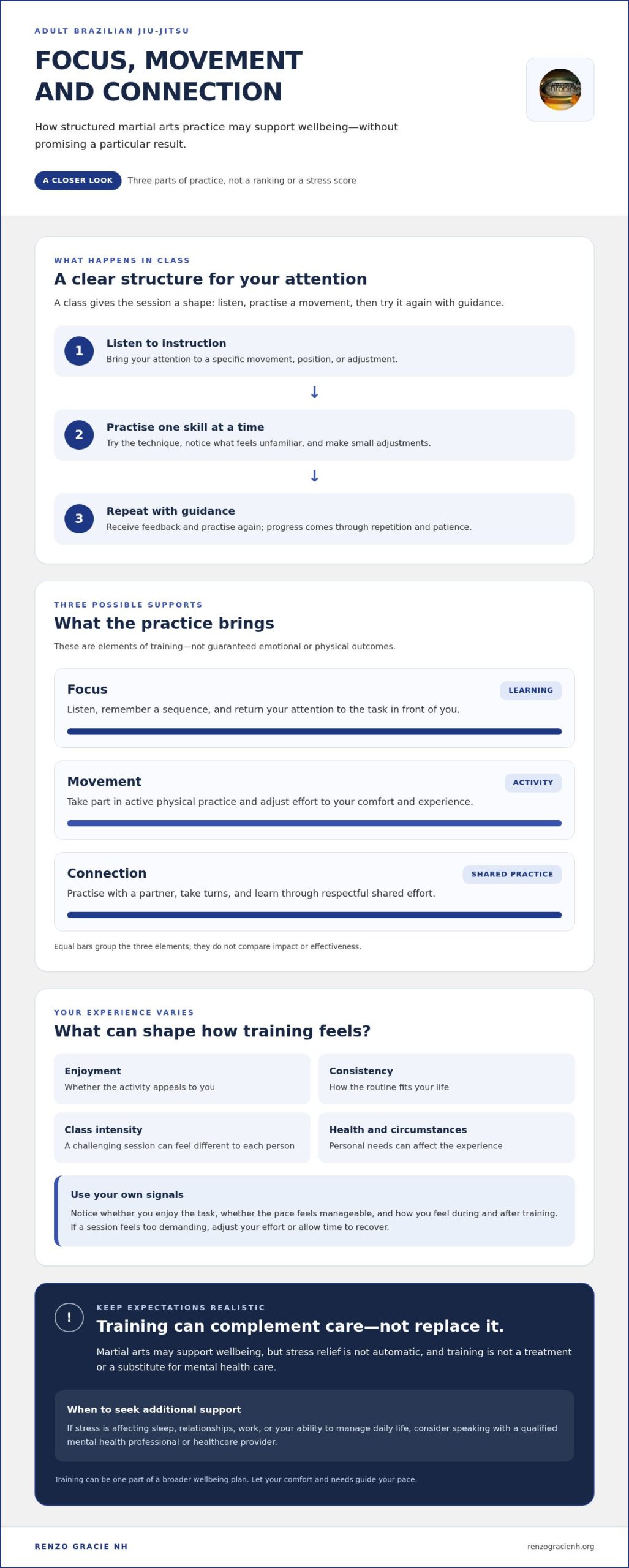
A class gives you a set time to move, listen, and practise a skill alongside other people. Following an instructor’s directions gives your attention something specific to return to, such as learning a movement or adjusting your balance. That focus may help some students feel more present during training. Enjoyment, consistency, class intensity, health, and personal circumstances all shape the experience. A challenging session may energize one person and feel like too much for another.

Martial arts can complement, but not replace, mental health care. The Martial arts therapy overview discusses martial arts as a complementary approach, not a substitute for appropriate professional support. Think of training as one possible part of caring for your wellbeing, not a treatment or a promise that distress will go away.

What adults may gain from a structured martial arts class

Structure can make it easier to get started when motivation is low. Instead of planning every part of a workout yourself, you follow instruction and practise one skill at a time. Shared practice also brings interaction with instructors and classmates, which may feel encouraging if you enjoy learning with others. These are potential supports, not guaranteed emotional or physical outcomes. Progress might simply mean becoming more familiar with a movement or feeling more at ease in class.

Notice how the routine feels during and after training. Do you enjoy having a task to concentrate on? Is the pace manageable? Those observations are more useful than expecting every class to leave you calm, energized, or confident. If the session feels too demanding, adjust your effort or allow time to recover so the activity remains sustainable.

When stress may need support beyond exercise

Exercise can be one piece of self-care, but persistent or overwhelming distress deserves attention beyond a training routine. If stress is affecting sleep, relationships, work, or your ability to manage daily life, consider speaking with a qualified mental health professional or healthcare provider. Reaching out isn’t a sign that you’ve failed to cope. It’s a practical way to get support that fits your needs.

You can still explore martial arts if it feels appropriate. Keep expectations flexible, choose a manageable pace, and treat practice as an addition to your broader wellbeing plan. If you already have care or guidance, training doesn’t need to replace it. Let your comfort and needs guide the decision.

How Martial Arts Training Can Create Focus, Movement, and Connection

A martial arts class gives the session a clear shape: listen to an instructor, practise a movement, then try it again with guidance. In Brazilian Jiu-Jitsu, that might mean learning to move from one position to another or respond to a partner’s movement. The task is specific and immediate, giving your attention somewhere to land while you’re on the mat.

Three possible benefits are worth separating: focus from learning, movement from physical practice, and connection from shared training. They may contribute to a sense of wellbeing, but they aren’t medical effects or guaranteed stress relief. Your experience depends on your preferences, comfort, and the pace of instruction.

Focused practice: one task at a time

Skill practice asks you to listen, remember a sequence, and make small adjustments. If a technique feels unfamiliar, you can try it, receive a correction, and practise again. That cycle gives the class a clear focus without requiring you to master everything at once. Progress comes through repetition and patience, not an instant transformation.

The physical side matters too. Classes involve movement and active participation, while you can adjust effort to suit your comfort and experience. A beginner’s goal might be as simple as following the instruction and getting a feel for a new movement. Some people enjoy combining mental attention with physical activity; others prefer a different routine. Either response is valid.

Training with other people can build connection

Partner practice makes learning interactive. You take turns practising a movement, pay attention to your partner, and respond to the instructor’s feedback. Ideally, this is cooperation rather than a contest: each person helps create a respectful space to learn, make mistakes, and improve. Shared effort can make a class feel welcoming, especially when students are encouraged to learn at different levels.

That interaction may offer a sense of belonging if you value learning alongside others, but community isn’t a guaranteed cure for loneliness or distress. Some adults enjoy a group setting; others need time to feel comfortable. Notice whether the atmosphere supports respectful practice and whether you feel able to ask questions and learn at your own pace.

These elements can work together without promising a particular result. A focused task occupies your attention, movement makes training active, and a partner turns practice into a shared experience. The appeal of martial arts for stress relief adults can sustain may come from that steady combination, not from fighting harder or expecting every class to change how they feel.

To experience guided practice firsthand, explore adult Brazilian Jiu-Jitsu training at Renzo Gracie NH, where instruction supports skill development and personal progress.

Brazilian Jiu-Jitsu or Solo Exercise: Which Stress-Relief Routine Fits You?

A solo walk, a strength workout, and a Brazilian Jiu-Jitsu class all involve movement, but they ask different things of you. A class follows an instructor’s plan and includes interaction; exercising alone lets you set the pace and choose what to do. Neither is automatically better for stress management. The right fit depends on what helps you show up and feel comfortable.

What makes Brazilian Jiu-Jitsu different from solo workouts?

Brazilian Jiu-Jitsu is grappling-based skill practice. Students learn coached movements and practise them with a partner, responding to another person rather than following a fixed solo routine. That adds an interactive, problem-solving element to exercise. You don’t need to compete: you can approach training as a way to learn and practise, with participation focused on your own goals.

Solo exercise offers a different kind of flexibility. You might walk a familiar route or follow your own strength routine without coordinating with a class or partner. Use this comparison to consider which setting feels more motivating and manageable:

Fit factor Brazilian Jiu-Jitsu class Solo exercise
Structure Instructor-led skills and practice You choose the activity and pace
Interaction Partner practice and group learning Usually independent
Variety New movements and problem-solving Depends on the routine you choose
Good fit if you prefer Guidance and shared practice Independence and control

Choose a routine that suits your comfort and schedule

Think about the kind of structure you’re most likely to return to. If you enjoy guided learning and don’t mind practising with a partner, a martial arts class may hold your interest. If you prefer quiet movement or full control over your pace, solo exercise may suit you better. You can also combine them, choosing different activities on different days according to your energy and schedule.

Partner practice may feel unfamiliar at first. Notice how the instruction, pace, and shared practice feel as you learn. A supportive beginner setting can help you approach new movements gradually. For a closer look at what starting can involve, explore this adult beginner Jiu-Jitsu guide.

The best routine is one you can attend consistently and safely. For adults considering martial arts for stress relief, personal fit matters more than choosing the activity that sounds most intense. Start with what feels manageable, then consider whether it’s enjoyable enough to become part of your life.
Martial Arts for Stress Relief: A Practical Guide for Adults

How to Try Martial Arts for Stress Relief Without Overcommitting

You don’t need to commit to a demanding routine to find out whether martial arts suits you. Treat the first step as an experiment: set a simple intention, try an introductory class, and notice how the experience fits your life. A measured approach helps you explore martial arts for stress relief adults can sustain without expecting quick results or pushing past your comfort.

Set a personal goal and a realistic first step

Start with a reason that matters to you. You might want to learn a new skill, add regular movement to your week, or try a focused group activity. Then decide what would make your first month feel worthwhile. That could mean showing up for a class, learning a basic movement, or simply feeling more familiar with the training environment. Keep the goal personal; there’s no universal schedule or timeline for progress.

Use this five-step plan to begin:

  1. Identify your goal. Choose one practical reason for trying a class.
  2. Choose a beginner-friendly setting. Look for clear instruction and an atmosphere where newcomers can learn at their own pace.
  3. Try one class. Focus on listening and experiencing the basics, rather than judging your ability.
  4. Reflect afterward. Consider what felt engaging, challenging, or uncomfortable, and how you felt after the session.
  5. Decide what comes next. Continue, adjust your approach, or take more time before choosing.

Make a first class feel more approachable

Being new is reason enough to ask for guidance. Tell the instructor you’re a beginner and share any comfort concerns that could affect your participation. If a movement feels unfamiliar, ask for clarification rather than forcing your way through it. Listening, observing a demonstration, and practising fundamentals are meaningful parts of learning, even if everything doesn’t click on the first attempt.

A complimentary introductory class at Renzo Gracie NH gives adults a low-pressure way to experience Brazilian Jiu-Jitsu instruction. Read more about the free introductory Jiu-Jitsu class in New Hampshire as you consider your first visit.

Keep your starting pace manageable, and adjust your effort based on how you feel during practice and how well you recover afterward. Soreness, nerves, or difficulty with an unfamiliar movement are useful reasons to speak up and talk with the instructor. If you have individual health concerns, follow advice from a qualified professional about what activity is appropriate for you.

When you’re ready to try it, explore a complimentary introductory class and experience adult Brazilian Jiu-Jitsu in a supportive setting.

Explore Adult Brazilian Jiu-Jitsu at Renzo Gracie NH

A practical approach to martial arts for stress relief adults can sustain begins with a good fit: clear instruction, steady skill development, and a training environment where newcomers can learn without pressure to prove themselves. Renzo Gracie NH offers adult Brazilian Jiu-Jitsu instruction for different skill levels, with an emphasis on personal development and supportive practice. Training can provide structure and a new skill to work on, though each person’s experience is their own.

A supportive place to build skills at your own pace

Brazilian Jiu-Jitsu develops through practice. Students work on movements and techniques over time, building familiarity step by step rather than needing to know everything on day one. That process can give adults a meaningful focus as they learn, while respecting that people arrive with different backgrounds, comfort levels, and reasons for training.

Respect and encouragement matter in a learning environment. Partner practice is an opportunity to develop skills together, not a demand to compete or show toughness. Students can concentrate on understanding instruction, practising fundamentals, and making progress at a manageable pace. Consistency can help learning develop, but there are no guaranteed results for stress, fitness, confidence, or mental health.

Instruction is led by Professor Kevin Landry, a sixth-degree black belt under Renzo Gracie who has taught in the region for over two decades. His experience provides a foundation for adult students as they work through the discipline’s techniques and principles. Whether you’re new to Brazilian Jiu-Jitsu or have experience in another setting, learning and personal development remain central to practice.

Take a first step with a complimentary introductory class

Reading about a class can only tell you so much. A complimentary introductory class lets you experience the teaching environment firsthand and decide how the instruction and practice feel. Approach the first visit as an opportunity to observe, learn, and get familiar with Brazilian Jiu-Jitsu. You don’t need prior experience or a long-term commitment already decided.

Renzo Gracie NH serves adults in Windham, Manchester, and Exeter, New Hampshire. If you’re in one of these communities and curious about adding structured skill practice to your routine, try an introductory class and see how the environment feels. Start at a welcoming pace, then decide what you’d like to do next.

Choose a First Step That Fits Your Life

You don’t need to decide today whether martial arts will become a long-term routine. Let curiosity lead: try a class, notice how the instruction and pace feel, and give yourself room to make an informed choice. For adults exploring martial arts for stress relief, the most useful next step is one that feels manageable and supports steady participation, without expecting a guaranteed change in how you feel.

At Renzo Gracie NH, adult Brazilian Jiu-Jitsu is taught by Professor Kevin Landry, a sixth-degree black belt under Renzo Gracie with over two decades of teaching experience in the region. A complimentary introductory class lets new students experience the training environment firsthand, without needing to have everything figured out before stepping onto the mat.

Ready to explore at your own pace? Try a complimentary introductory Jiu-Jitsu class at Renzo Gracie NH in Windham, serving students from Windham, Manchester, and Exeter. Take the first step toward learning something new.

Frequently Asked Questions

Can martial arts help adults manage stress?

Yes, martial arts may help adults manage stress as a structured activity, but the experience varies and training isn’t a treatment. The phrase “martial arts for stress relief adults” is best understood as a search for a routine, not a promise of a particular result. After class, notice whether you feel engaged, fatigued, or unsettled. That check-in can help you decide whether the activity suits you.

Is Brazilian Jiu-Jitsu a good martial art for stress relief?

Brazilian Jiu-Jitsu may suit adults who enjoy learning through movement and problem-solving, though it won’t be everyone’s preferred activity. Consider whether you leave class interested in practising again, rather than judging the session by whether you felt instantly relaxed. If close partner contact or grappling feels uncomfortable, that preference matters. A solo activity may be a better personal fit.

Can I start martial arts as an adult with no experience?

Yes. You can begin without prior martial arts experience; introductory instruction helps you learn basic movements, terminology, and class expectations. You don’t need to arrive already fit or know the techniques. Adults in Windham, Manchester, and Exeter can start with an introductory class, listen closely, and ask for clarification when a direction is unfamiliar. Focus on learning how class works, not keeping up with experienced students.

How often should adults train martial arts for stress relief?

There’s no single weekly schedule that suits every adult. Consider your existing commitments and recovery needs, then choose a pace you can maintain without making training another source of pressure. Keep a brief note of attendance, energy, and soreness over time. If you routinely skip because the plan feels too demanding, scale back and reassess rather than treating missed sessions as a failure.

What happens if martial arts training feels too intense?

If a session feels too intense, pause and tell the instructor what you’re experiencing. You can ask to see a technique again, take a break, or reduce your effort. Speaking up is part of training responsibly. Unfamiliar movements may feel awkward, but pain or concerning symptoms shouldn’t be ignored. For persistent pain, injury, or individual health concerns, stop and follow advice from a qualified healthcare professional.

Does martial arts replace therapy or medical care for anxiety?

No. Martial arts may be one part of a broader wellbeing routine, but it doesn’t diagnose or treat anxiety and can’t replace therapy, medical care, or prescribed treatment. If anxiety is disrupting sleep, work, relationships, or daily tasks, speak with a qualified mental health professional or healthcare provider. Continue any existing care as advised, and consider training only as an additional activity that fits your needs.

Is Brazilian Jiu-Jitsu competitive, or can adults train without competing?

Adults can practise Brazilian Jiu-Jitsu without making competition a goal. Training can focus on learning techniques, understanding positions, and developing skills at your own pace, rather than preparing for a tournament. If you’re unsure what to expect, share your personal goals with the instructor early. That conversation can help you understand how class practice relates to what you hope to learn.
Social Skills for Shy Kids in Windham: Parent’s Guide

What if helping a shy child connect starts with less pressure, not more? If your child hangs back from group activities, it’s natural to want to help while also wondering whether encouragement might feel overwhelming. Building social skills for shy kids Windham parents can support often begins with small, familiar chances to listen, take turns, and join in at a comfortable pace.

This guide offers practical ways to make everyday communication more manageable and help your child explore peer activities without expecting them to become outgoing overnight. You’ll learn how to notice their comfort level, encourage low-pressure practice, and consider whether a structured activity could be a good fit. Brazilian Jiu-Jitsu brings children together around shared practice, with opportunities to listen, take turns, and interact as they learn. At Renzo Gracie NH in Windham, children can explore Jiu-Jitsu in a supportive setting. Small steps count.

Key Takeaways

  • Quietness is a temperament, not a flaw to fix. Social skills can be practiced without asking a child to become more outgoing.
  • For building social skills for shy kids Windham parents can start with one manageable interaction and adjust to the child’s comfort.
  • Compare informal play, small-group activities, and structured classes to find the right balance of predictability and peer interaction for your child.
  • Use a simple plan: notice what feels comfortable, choose one skill to practice, then reflect and adjust without setting a deadline for change.
  • Shared tasks in children’s Brazilian Jiu-Jitsu offer opportunities to listen, take turns, and interact with peers. Each child’s experience is individual.

What Does Building Social Skills Mean for a Shy Child in Windham?

Social skills are learnable behaviors that help children communicate, connect, and take part with other people. They include listening, taking turns, joining play, expressing needs, and noticing how others respond. These abilities develop through everyday experience, not by changing a child’s personality. The Social skills overview describes the broad range of behaviors involved in interacting with others. For parents, a practical starting point is to identify specific actions a child can try.

A quiet temperament isn’t a problem to solve. A child may prefer observing before joining in, enjoy one-on-one conversation more than a busy group, or need time to warm up to unfamiliar people. The aim of building social skills for shy kids Windham parents support is not to make a child louder or constantly sociable. It’s to help them communicate and participate in ways that feel manageable and true to who they are.

Comfort can change with the setting, the people present, how familiar an activity feels, and the size of the group. A child who speaks freely with cousins might be quiet at a new club, then become more engaged after watching for a while. Notice these differences without treating any one moment as a measure of ability. They can help you identify where your child feels comfortable enough to practice.

How can parents tell when a child feels socially hesitant?

Look for observable moments: your child waits near a game before joining, answers quietly in a new group, or checks your face before speaking to someone unfamiliar. These can be ordinary signs of caution. Notice whether your child settles after observing or remains distressed, and whether the same difficulty appears in familiar and unfamiliar settings. Rather than labeling the behavior, identify situations where connection already comes more easily, such as chatting with one trusted friend or playing alongside a sibling.

Which social skills can children practise in everyday moments?

Everyday interactions offer small, low-pressure practice. Before a playdate, you might rehearse a greeting or the words, “Can I join?” At dinner, model listening and responding by asking a question about someone’s day. Keep the focus on one skill at a time, then give your child room to try it without demanding a perfect performance.

Children can also practice saying, “I need help,” or “I don’t want to do that,” so they can ask for support and set boundaries. A short pause in conversation is normal; you can show that nobody has to rush to fill every silence. For parents in Windham, Manchester, and Exeter, building social skills for shy kids can start with these ordinary exchanges at home, then grow through familiar activities at the child’s pace.

How Low-Pressure Practice Helps Shy Kids Build Social Confidence

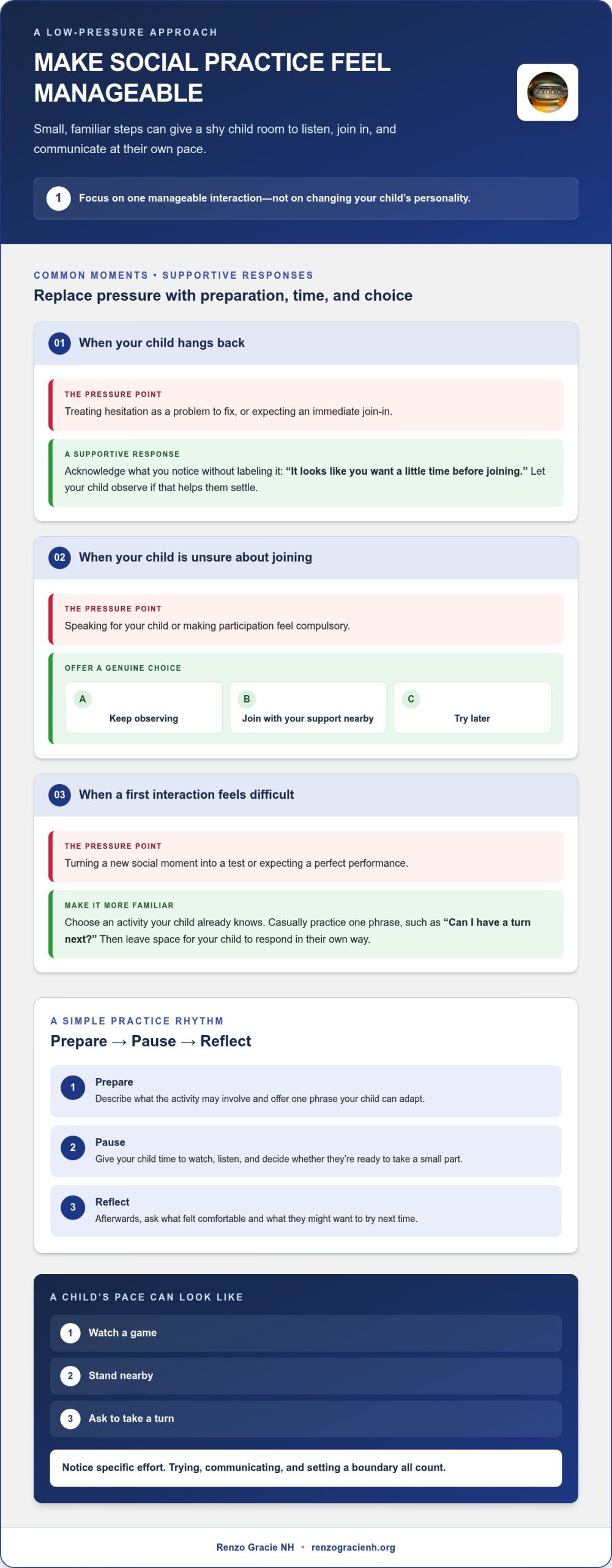
Social confidence can grow through small experiences that feel manageable, not through pressure to perform. A child might first watch a game, then stand nearby, and later ask to take a turn. That gradual path gives them room to understand what’s happening and choose how to participate. Building social skills for shy kids Windham families can support means valuing each step, even when it looks modest from the outside.

Repeated, low-pressure practice gives children chances to rehearse social behaviors and become more familiar with using them. Familiarity doesn’t mean every interaction will feel easy, and it doesn’t require a child to become more outgoing. Progress might simply mean trying a greeting or staying with an activity a little longer.

Your role is to prepare and encourage, not to speak for your child or decide that they must join. Model a phrase, explain what to expect, then leave space for them to respond in their own way. The New York State Department of Health’s Understanding Social-Emotional Development in Children discusses how interactions with caregivers contribute to children’s social-emotional development. Everyday exchanges can offer a calm place to practice.

How can parents make a first interaction feel manageable?

Choose an activity your child already knows, then agree on one small, clear goal. At a familiar playground, that might mean watching a game and asking, “Can I have a turn next?” Before visiting, practice the words casually, without turning them into a test. Once there, let your child observe first if that helps them settle. They can decide when to try the phrase or choose another small step.

A simple progression can keep practice supportive:

  • Prepare: Describe what the activity may involve and offer one phrase your child can adapt.
  • Pause: Give them time to watch, listen, and decide whether they’re ready to take a small part.
  • Reflect: Afterwards, ask what felt comfortable and what they might want to try next time.

How should adults respond when a child hangs back?

Start by acknowledging what you notice without attaching a label: “It looks like you want a little time before joining.” Then offer a genuine choice: keep observing, join with your support nearby, or try later. This respects the child’s feelings while keeping participation possible. Avoid speaking on their behalf unless they need help, and don’t make praise depend on being bold or chatty.

Notice specific effort instead: “You waited, then asked for a turn,” or “You told me you needed help.” These observations show that trying, communicating, and setting a boundary all count. A structured children’s Brazilian Jiu-Jitsu class is one shared activity to explore at the child’s pace. At Renzo Gracie NH, children learn alongside others in a supportive setting. Let your child’s experience guide the next step.

Which Activities Give Shy Children Helpful Ways to Practise Social Skills?

Different activities offer different kinds of social practice. Informal play can feel flexible and familiar; a small-group activity may give children a shared focus; a structured class can make the sequence of activities easier to anticipate. None is automatically the best choice. For building social skills for shy kids, families in Windham, Manchester, and Exeter can consider their child’s interests, comfort, and response to each setting, then start with an approachable option.

What can informal play and small groups offer?

Familiar play gives children chances to interact without making conversation the main event. Building a game together, sharing materials, or taking turns on the swings can prompt a child to initiate, respond, and negotiate naturally. A smaller or familiar group may feel more manageable for some children, while others enjoy the energy of a larger activity. Watch your child’s cues rather than assuming one group size suits everyone.

Setting Social practice Possible considerations
Informal play with a familiar peer Greeting, sharing, taking turns, and suggesting what to play Flexible and familiar, though the interaction may change direction quickly
Small-group activity Listening, waiting, contributing an idea, and cooperating around a shared task A shared focus can ease conversation, but comfort depends on the group and activity
Structured class Following instructions, taking turns, and interacting during organized practice A clear routine may help some children; a new setting or activity can take time to get used to

How can a structured class support social practice?

A class with planned instruction and shared activities may give children a clear reason to listen and take part. The activity itself provides a focus, so interaction doesn’t have to rely on spontaneous conversation. A child can observe first, follow along, and engage at a comfortable pace as they become familiar with the setting.

Brazilian Jiu-Jitsu is one option, not a guaranteed route to social confidence or a substitute for every child’s preferred activity. It includes partner practice, which creates opportunities to take turns, pay attention to another person, and work through a shared task. Renzo Gracie NH offers kids’ Jiu-Jitsu instruction in New Hampshire in a supportive environment. New students can try a complimentary introductory class, giving families a chance to experience the setting together.

After any activity, notice more than whether your child spoke a lot. Did they seem curious, settle in after watching, or want to return? Their comfort and interest can help guide the next choice. The best fit is a setting where they can participate without feeling pushed, whether that’s a familiar playdate, a small group, or structured practice.

Social Skills for Shy Kids in Windham: Parent's Guide

Step-by-Step Social Skills Plan for Your Child’s Pace

A simple plan keeps practice focused on what your child is ready to try, rather than on a deadline or a checklist of social milestones. Families in Windham, Manchester, and Exeter can use ordinary moments at home, on the playground, or during a familiar family gathering. Start with observation, agree on one small action, and let your child’s response shape what comes next. Keep the aim clear: offer practice, not pressure.

  • 1. Notice comfort. Pay attention to where your child seems at ease, who they naturally engage with, and what happens just before they hang back. This helps you choose a setting that feels familiar enough for practice.
  • 2. Choose one skill. Ask your child what feels manageable. It might be greeting a peer, taking a turn, asking one question, or telling someone they need help. One goal is plenty.
  • 3. Practice together. Try the words at home through a short role-play, or model the interaction yourself. Keep it casual and give your child room to adapt the phrase to their own voice.
  • 4. Reflect without grading. After the moment, ask what felt comfortable, tricky, or enjoyable. Listen without turning the answer into a review of whether they “did it right.”
  • 5. Adjust the next chance. Repeat the same small step in a familiar setting, make it easier, or pause and try another time. Let your child’s feedback and observed comfort guide the pace.

How do you choose a realistic first social goal?

Make the goal small enough that your child can picture doing it. Ask, “What would feel okay to try?” If they aren’t sure, offer a few options, such as saying hello, asking to take a turn, or asking one question about a game. Agree that observing first is also allowed. The goal can change if the setting feels different than expected.

How can parents review progress without adding pressure?

Choose a calm moment afterward and ask open questions: “What part felt easiest?” or “Was there anything you’d like to do differently next time?” Recognize an attempt, a request for help, or a clear boundary, even if a conversation didn’t follow. If your child says the interaction felt too hard, treat that as useful feedback and make the next opportunity more manageable.

Progress is a child’s willingness to try a manageable step, not how popular, talkative, or instantly comfortable they seem. That’s a helpful measure for building social skills for shy kids in Windham without comparing one child’s pace to another’s.

A shared activity may be a useful next step if your child is interested in learning through movement and practice with others. Renzo Gracie NH’s complimentary introductory class lets families experience children’s Brazilian Jiu-Jitsu instruction together.

How Renzo Gracie NH Can Give Shy Kids a Supportive Place to Practise

A structured activity can be a useful next step when a child enjoys learning through movement or shared tasks. At Renzo Gracie NH, children’s Brazilian Jiu-Jitsu instruction takes place in a community-oriented setting. Partner practice gives students a shared activity and opportunities to listen, take turns, and work alongside someone else. Each child’s experience is individual; participation doesn’t guarantee friendships or a particular social outcome.

For families thinking about building social skills for shy kids in Windham, fit matters more than whether a child appears outgoing on the first day. Consider whether your child shows interest in the activity, feels respected in the environment, and can approach participation at a comfortable pace. Technical development, fitness, and personal growth are part of the instruction’s aims. Respect and supportive participation help shape the experience.

What can families expect from a children’s Jiu-Jitsu setting?

Brazilian Jiu-Jitsu is a martial art, so children learn physical techniques as well as practice alongside others. Shared instruction and partner work give a child a task to focus on, rather than requiring them to start a conversation without a reason. This may suit a child who prefers doing an activity together before talking more freely. A parent and child Jiu-Jitsu guide for Windham also explores how training can create shared family time.

How can a family take a comfortable first step?

Before trying an activity, talk with your child about what interests them and what feels uncertain. They may wonder what the class will be like, whether they’ll know anyone, or what happens if they feel nervous. Listen without dismissing the concern. You can explain that trying something new doesn’t require immediate confidence, and that asking for help or taking time to get comfortable is okay.

During an introduction, stay attentive to your child’s cues. If they’re hesitant, help them put a concern into words so they can get support from the instructor. Observing before joining may also feel like a manageable first step, depending on the child and the setting. Afterwards, ask what they noticed: Did the activity interest them? Did they feel comfortable enough to try part of it? Their answers can help you decide whether to continue, pause, or revisit the idea later.

A complimentary introductory class gives new students a chance to experience children’s Jiu-Jitsu instruction without making the first visit a test of confidence. Keep the focus on what your child notices and how they feel about the activity.

Keep the Next Step Small and Child-Led

Social confidence doesn’t need to look like being the first to speak or joining every group. A child’s next step might be choosing one activity, knowing they can take time to settle in, or sharing afterward what they liked. Let their interests help guide the choice. For building social skills for shy kids, Windham families can keep progress personal: focus on what feels possible for this child, not how their participation compares with someone else’s.

That approach leaves room for curiosity to grow. If your child shows interest in Brazilian Jiu-Jitsu, explore the activity together and let them decide what they’re comfortable trying. Professor Kevin Landry has taught in the region for over two decades and teaches children at Renzo Gracie NH.

A first visit can be a chance to explore, not a test your child has to pass. Let your child’s experience shape what comes next.

Frequently Asked Questions

Is shyness the same as social anxiety in children?

No. Shyness can describe a child’s cautious or reserved response in some social situations, while social anxiety involves more intense, ongoing fear or distress that can interfere with daily life. A child’s quietness alone doesn’t establish a diagnosis. If social situations consistently cause significant distress or keep your child from activities they want to do, discuss what you’re noticing with a pediatrician or qualified mental health professional.

Can shy kids make friends without becoming more outgoing?

Yes. Friendship doesn’t require a big personality or a wide circle of peers. A child may feel happiest connecting with one classmate through a shared interest, such as drawing, building, or playing a favorite game. You can support that connection by making space for unhurried time together and letting your child choose how much they want to talk. Quiet companionship can be meaningful, too.

How can I help my child join a group without forcing them?

Plan the arrival together rather than pushing for immediate participation. Before a gathering, agree on a comfortable first step, such as staying near you while they get used to the room. You might also choose a signal your child can use if they need a pause. Avoid announcing that they’re shy to the group; let them decide what they want to share about themselves.

What social skills should shy children practise first?

Start with a skill that would help in a situation your child wants to handle. That could be asking an adult for help finding a game, saying “No thanks” when they don’t want to join, or responding when another child speaks to them. For building social skills for shy kids, Windham parents can choose one useful phrase to practice at home, then let the child adapt it in their own words.

Can Brazilian Jiu-Jitsu help a shy child practise interacting with peers?

It can offer opportunities to practice interaction through a shared physical activity, including listening to instruction and working with a partner. Whether it feels like a good fit depends on the child’s interest and comfort with the setting and activity. Brazilian Jiu-Jitsu isn’t a guaranteed way to make friends or change a child’s temperament. Families in Windham, Manchester, and Exeter can consider how their child responds to the experience.

How long does it take for a shy child to feel more comfortable socially?

There’s no set timeline. Comfort may vary with the people, activity, and setting, and a child may feel at ease one day but hesitant the next. Instead of tracking a deadline, notice whether they’re beginning to approach an activity, communicate what they need, or recover more comfortably after an uncertain moment. If concern persists or grows, consider discussing it with a qualified professional.

Should I tell an instructor that my child is shy before a first class?

Yes, if you think the context will help the instructor welcome your child thoughtfully. Share specific observations rather than a label: for example, your child may need time to watch before joining or feel more comfortable when instructions are clear. You can also tell your child what you plan to share and invite them to add their own thoughts. That helps make the first class a more informed experience.

Ready to explore a shared activity at your child’s pace? Book a complimentary introductory class at Renzo Gracie NH and let your child’s experience guide the next step.

BJJ for Child Confidence and Discipline: What Parents Should Know

Could a grappling sport help your child grow in confidence without encouraging aggression? It’s a fair question, especially if your child is shy, energetic, or unsure about trying something new. BJJ for child confidence and discipline is less about winning and more about practising focus, respect, patience, and problem-solving with others.

Progress often shows up in small moments before it appears in a belt: listening to an instructor, trying again after a difficult drill, or feeling more comfortable joining in. These changes aren’t guaranteed, and competition results aren’t the only measure of growth. A supportive, structured environment matters, too.

This article explains what children practise in Brazilian Jiu-Jitsu, what realistic signs of growing confidence and discipline can look like, and how you can support your child’s learning without pressure. At Renzo Gracie NH, children can experience training in a complimentary introductory class. The academy serves families in Windham, Manchester, and Exeter, and a first visit can simply be a chance to see how the setting feels.

Key Takeaways

  • BJJ for child confidence and discipline is best understood through everyday practice: trying, listening, learning from mistakes, and showing respect.
  • Look for observable signs of progress, such as joining warm-ups, accepting coaching, or returning to a challenging activity, rather than relying only on belts or competition results.
  • Support your child by asking about effort and learning, and make room for frustration without pressuring them to prove toughness.
  • A structured, encouraging training environment helps children practise skills with guidance and respect for their partners.
  • Families in Windham, Manchester, and Exeter can explore children’s instruction at Renzo Gracie NH, where Professor Kevin Landry brings over two decades of regional teaching experience.

How BJJ can support a child’s confidence and discipline

Brazilian Jiu-Jitsu can give children opportunities to practise confidence and discipline, but it can’t promise a particular personality change or outcome. In a structured class, children learn skills through guided movement and partner practice. Brazilian Jiu-Jitsu is a grappling martial art; Brazilian Jiu-Jitsu on Wikipedia offers background on its history and principles.

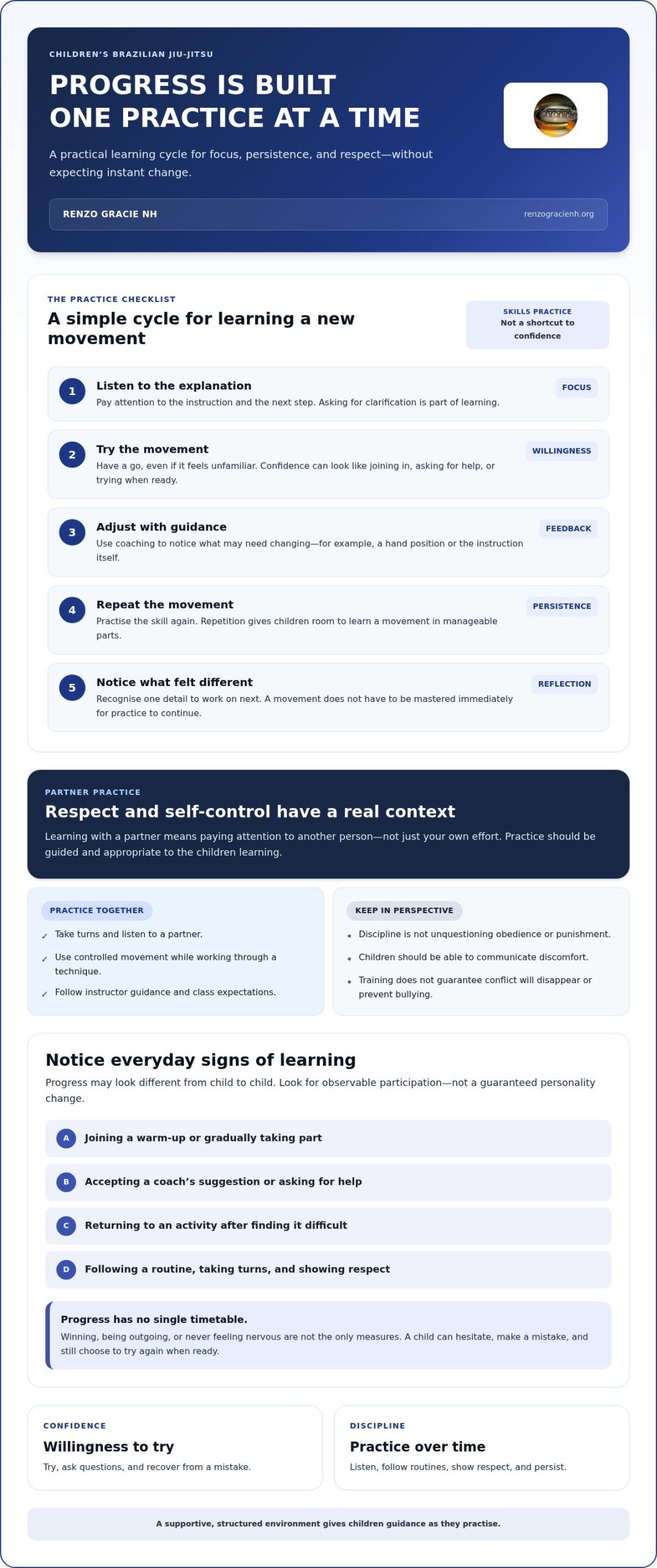
For parents, the distinction matters. Confidence is the willingness to try, ask questions, and recover from a mistake; discipline is the practice of listening, following routines, showing respect, and persisting. These skills can support each other, but they aren’t the same. A child might eagerly attempt a new movement and still need reminders to wait their turn. That’s a chance to practise, not a contradiction.

What confidence can look like on the mat

Confidence doesn’t have to be loud. One child may gradually join a warm-up; another may watch an unfamiliar movement first, then try it, or ask an instructor for help when a step feels confusing. Each is a practical sign of willingness to participate and learn.

Children express confidence in different ways and at different paces. It isn’t measured by winning, being outgoing, or never feeling nervous. A child can hesitate, make a mistake, and still build confidence by choosing to try again when ready.

What discipline means in a children’s BJJ class

Following instructions, practising a routine, and paying attention to the next step give children a chance to exercise focus and self-management. Repetition is part of learning: listen, practise, notice what needs adjusting, and try again. These habits take time, and children may need guidance along the way.

Partner practice adds another layer. Taking turns, listening to a partner, and using controlled movement help children practise patience and respect while learning together. The goal isn’t to move carelessly or overpower someone. Training should be guided and appropriate to the child.

Discipline also isn’t unquestioning obedience or punishment. Children should be able to ask for clarification, communicate discomfort, and learn why class expectations matter. BJJ for child confidence and discipline is about practising useful choices in a supportive setting, not expecting instant changes beyond the mat.

How Brazilian Jiu-Jitsu practice builds confidence and discipline step by step

Growth comes through practice, not a sudden transformation. A child learning a new movement can follow a simple cycle: listen to an explanation, try the movement, adjust with guidance, repeat it, and notice what felt different. Each turn through that cycle gives them a chance to focus, respond to feedback, and take another step.

Brazilian Jiu-Jitsu is skills practice, not a shortcut to confidence. Techniques involve solving movement problems, such as how to create space, find balance, or respond to a partner’s position. The emphasis is on learning and applying technique, not simply relying on physical dominance. A child who doesn’t get a movement right immediately can still make progress by noticing one detail and trying again.

Small challenges help children practise persistence

Unfamiliar movements can take time to understand. Breaking a skill into manageable parts and repeating it gives a child room to learn without needing to master everything at once. A coach can help treat a mistake as useful feedback: perhaps the child needs to adjust a hand position or listen to the instruction again. That approach can encourage curiosity instead of making one imperfect attempt feel like failure.

Children respond to challenges in different ways. Some may be ready to try again right away; others may need a pause or more guidance. The aim is to support learning at a suitable pace, not to push every child toward the same response.

Partner practice gives respect and self-control a real context

Practising with a partner makes cooperation part of the learning. Children take turns, pay attention to each other, and use controlled movement as they work through a technique. They learn that training depends on a partner’s participation and comfort, not just their own effort.

Partner work needs appropriate supervision. Instructors guide practice so it’s suitable for the children learning, with clear expectations around respect and control. These habits can be practised on the mat, but they don’t guarantee that conflict will disappear or prevent bullying.

For parents exploring BJJ for child confidence and discipline, the useful question isn’t whether one class will change a child. Consider whether the learning process gives them supportive opportunities to listen, work through difficulty, and practise with respect. Families can learn more about children’s Brazilian Jiu-Jitsu instruction at Renzo Gracie NH.

What a child’s BJJ progress may look like: and what it cannot promise

Progress in Brazilian Jiu-Jitsu doesn’t follow one timetable, and it isn’t always easy to spot from the sidelines. A child might first watch before joining in, then take part in a warm-up, accept a coach’s suggestion, or return to an activity after finding it difficult. These are observable signs of participation and learning, not proof of a guaranteed change in personality.

Confidence doesn’t have to mean becoming outspoken, winning rounds, or never feeling nervous. For one child, it may look like asking a question; for another, it may mean calmly saying they need a break. Temperament, comfort, attendance, and individual experiences all shape how progress appears. Compare your child with their own earlier behaviour, not with other students.

Signs of progress parents can notice over time

Look for small shifts in participation, focus, respectful communication, and willingness to try. The table offers examples of behaviours that may emerge over time. These are possibilities, not a checklist every child should meet on a set schedule.

Stage Observable behaviours
Early Watches or joins part of a warm-up; follows a familiar instruction with support.
Developing Takes part more readily; listens to coaching or communicates a question, concern, or need for a break.
Ongoing Returns to an activity after difficulty; shows focus, respectful communication, or more willingness to try an unfamiliar task.

A child expressing discomfort is also communicating meaningfully, not failing at discipline. Notice the effort behind a behaviour and ask what felt manageable or challenging, rather than measuring progress by belts or competition results alone.

Does BJJ make children aggressive or confident overnight?

No class can guarantee a change in behaviour or self-esteem. Training should involve supervised skill practice with clear expectations, not encouragement to start fights. The purpose is to learn within a structured setting and treat partners with care. BJJ for child confidence and discipline is a practice opportunity, not an instant fix or a promise that conflict will disappear.

If your child seems worried, frustrated, or uncomfortable, talk calmly with them about what they’re experiencing. You can also share concerns with their instructors so the conversation stays focused on your child’s comfort and learning. Progress is personal, so give it room to take its own shape.

BJJ for Child Confidence and Discipline: What Parents Should Know

How parents can reinforce confidence and discipline beyond BJJ class

A few thoughtful questions after class can help your child notice their own effort without turning training into a performance review. Keep the conversation relaxed and let them choose what to share. You might ask, “What felt challenging today?” or “Was there anything you understood better after trying it again?”

Specific praise can make effort visible: “You listened carefully to that instruction,” or “I noticed you gave your partner room to try.” This recognizes focus and consideration, not just a result. Avoid comparing your child with a sibling or classmate, and don’t use training as punishment. Those approaches can make practice feel like a test instead of a place to learn.

Praise effort and reflection rather than winning

Children don’t need to win a round to have something worth celebrating. Notice a respectful choice, a question asked, or an attempt made after a difficult moment. If your child isn’t ready to talk, don’t press for a lesson or a positive takeaway. A quiet ride home can be enough; you can check in another time.

Respond supportively when a child feels nervous or frustrated

New activities can take time to feel familiar. If your child seems frustrated, start by listening rather than urging them to tough it out. Try, “What part felt hard?” or “Was there something you enjoyed?” This makes room for an honest answer, including mixed feelings. Avoid framing fear or discomfort as weakness, and don’t require a child to prove they’re brave by pushing past what feels manageable.

To notice gradual change, keep a few simple observations over time: whether your child joins in, asks for help, communicates a boundary, or seems comfortable returning. These notes aren’t a scorecard. They can help you see patterns and talk with your child or instructor if something concerns you.

For more information about the kids BJJ program in New Hampshire, explore the children’s program details. If sharing an activity as a family feels like a good fit, learn about parent and child Jiu-Jitsu. Families ready to take a first step can book a complimentary introductory class and let their child experience the training without pressure to make a long-term commitment.

Explore children’s BJJ at Renzo Gracie NH in Windham and nearby communities

For families considering BJJ for child confidence and discipline, a supportive place to learn matters. Renzo Gracie NH offers children’s Brazilian Jiu-Jitsu instruction in a structured setting focused on personal development. Children have room to learn and practise without treating confidence or discipline as guaranteed results.

Instruction is led by Professor Kevin Landry, a sixth-degree black belt under Renzo Gracie who has taught in the region for over two decades. His experience and the academy’s community-minded approach give families a local setting to explore the habits discussed in this guide. Renzo Gracie NH serves families in Windham, Manchester, and Exeter.

A supportive local setting for children learning BJJ

Structure can help make a new activity feel more approachable. Children have instruction to follow, skills to practise, and expectations around learning respectfully with others. An encouraging environment gives them space to engage at their own pace, while parents can notice individual effort rather than expect a particular outcome.

Explore the kids Jiu-Jitsu guide for New Hampshire families to learn more about children’s training at Renzo Gracie NH and how it may fit your family.

A low-pressure first step for parents and children

Reading about a class can only tell you so much. A complimentary introductory class gives a new student the opportunity to experience training and gives parents a chance to see how their child responds to the setting. There’s no need to decide in advance what the experience should prove. Treat it as a first look and a chance to learn together.

For more information about what to expect, read how to try Jiu-Jitsu free in New Hampshire. If your family is ready to take that first step, you’re warmly invited to book a free introductory class and let your child experience the academy for themselves.

Take a thoughtful first step with your child

BJJ for child confidence and discipline is best viewed as practice, not a promise of instant change. Children can work on listening, trying unfamiliar skills, respecting partners, and finding their way through mistakes. Progress may be quiet: joining in, asking for help, or choosing to try again. Parents can support that learning by praising effort and keeping conversations open, without comparing their child with others or expecting a particular outcome.

At Renzo Gracie NH, children learn in a structured, supportive setting. Professor Kevin Landry, a sixth-degree black belt under Renzo Gracie, has taught in the region for over two decades. New students can begin with a complimentary introductory class, a low-pressure opportunity to experience training and see how it feels.

Book a complimentary introductory class and take the first step at your child’s pace. Every small effort can be a meaningful part of learning, and your family can discover together whether Jiu-Jitsu feels like a good fit.

Frequently Asked Questions

Can BJJ help a shy child become more confident?

Brazilian Jiu-Jitsu can give a shy child chances to practise participating, trying unfamiliar movements, and asking for help, but it can’t guarantee a change in temperament or self-esteem. Confidence may show quietly, such as joining a warm-up after watching or returning to an activity after a pause. Let your child progress at their own pace, and recognize effort rather than expecting them to become outgoing or fearless.

Does Brazilian Jiu-Jitsu teach children discipline?

BJJ gives children opportunities to practise habits associated with discipline, including listening to instructions, following class routines, taking turns, and showing respect to training partners. Repeating skills can also help them practise focus and persistence. These are learning opportunities, not automatic results. A supportive class should allow children to ask questions and communicate discomfort; discipline isn’t unquestioning obedience or punishment.

Will BJJ make my child aggressive?

BJJ training shouldn’t encourage children to start fights. Brazilian Jiu-Jitsu is a grappling martial art, and children practise skills within a structured class with guidance and expectations around respect and control. No activity can promise how a child will behave in every situation. Talk with your child about using skills responsibly, and share any concerns about their experience with their instructor.

At what age can a child start Brazilian Jiu-Jitsu?

Renzo Gracie NH’s Kids Jiu-Jitsu program is for children ages 3 and up. The academy also has a Little Gracies program for ages 3 to 5. Age alone doesn’t show whether a child feels ready, so consider their comfort with trying a new activity and following simple instruction. A complimentary introductory class can help your family experience the setting before deciding on next steps.

How long does it take for a child to build confidence through BJJ?

There’s no set timeline, and BJJ can’t guarantee that a child will become more confident. Progress depends on the child, their comfort, attendance, and individual experiences. Rather than waiting for a dramatic change, notice small signs over time: participating more readily, asking questions, accepting coaching, or returning to a challenge. Compare your child’s progress with their own earlier experience, not with classmates.

What should parents look for in a kids’ BJJ class?

Look for clear instruction, age-appropriate and supervised practice, and consistent expectations for respect and controlled movement with partners. Notice whether your child has room to ask questions, express discomfort, and learn without pressure to win. A structured, encouraging environment can support learning, though no class can promise a particular outcome. At Renzo Gracie NH, children’s instruction is offered in Windham, Manchester, and Exeter.

Can parents train BJJ with their child at Renzo Gracie NH?

Yes. Renzo Gracie NH offers family training so parents and children can engage in Jiu-Jitsu together. Shared training can give families time to learn alongside one another, while each person develops at their own pace. The academy serves families in Windham, Manchester, and Exeter. New students can begin with a complimentary introductory class to experience training before choosing their next step.

My Child Isn’t Competitive: What Sports Can They Play in NH?

What if the best sport for your child isn’t the one that keeps score, but the one that makes them want to come back? If you’re wondering, “my child is not competitive what sports can they play NH?” you’re not alone. Organized sports can feel intense to a child who would rather learn at their own pace or enjoy being active without focusing on winning.

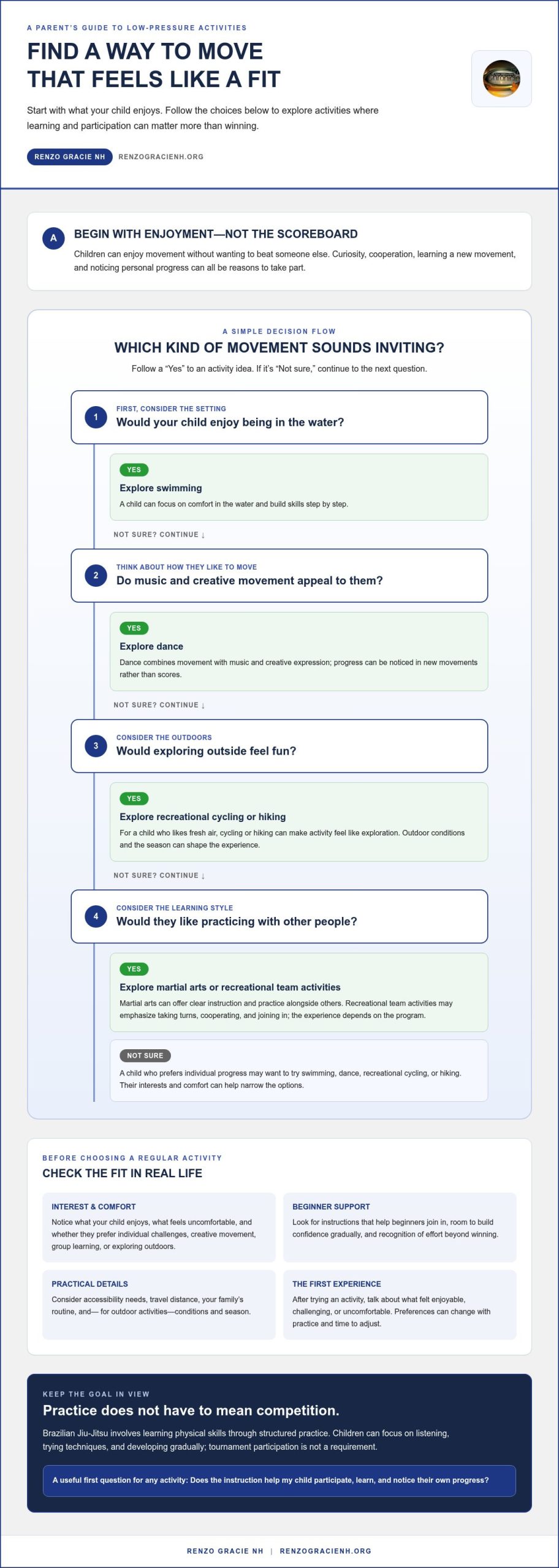
There are plenty of ways for children to move, learn, and build skills without making competition the main goal. Swimming, dance, biking, hiking, and martial arts each offer different ways to explore movement. The right fit depends on what your child enjoys and how the activity is taught.

This guide compares options and shares practical ways to choose an activity based on your child’s interests, comfort, and readiness to try something new. You’ll also learn how kids’ Brazilian Jiu-Jitsu can involve structured practice, respect, and steady skill development. Families in Windham, Manchester, and Exeter can explore a free introductory class at Renzo Gracie NH.

Key Takeaways

  • Children can enjoy being active without enjoying competition. Curiosity, cooperation, and personal progress can be rewarding goals.
  • Swimming, dance, hiking, recreational cycling, and martial arts offer different ways for children to move and build skills.
  • If you’re asking “my child is not competitive what sports can they play NH,” compare activities by your child’s interests, comfort, and preferred pace.
  • Brazilian Jiu-Jitsu offers structured practice and gradual skill-building. Practicing the sport doesn’t mean a child must enter tournaments.
  • Use a first experience to see how your child responds. Notice the clarity of instruction, beginner support, and participation expectations, then talk about it together.

What if my child isn’t competitive? Start with enjoyment, not winning

A child can love being active without wanting to beat someone else. They might enjoy learning a new movement, solving a physical challenge, spending time with a group, or simply getting outside. Competition is only one kind of motivation. Curiosity, cooperation, and the satisfaction of noticing personal progress can keep a child engaged, too.

For families asking, “my child is not competitive what sports can they play NH,” start with what your child enjoys rather than a sport’s reputation. Youth sports include a range of school and organized activities, and the atmosphere can differ from one program to another. A low-pressure activity puts participation and learning ahead of rankings, even if it still has rules, practice, and friendly challenges.

How to recognize what your child enjoys

Notice how your child chooses to spend active time. Do they like creative movement, working with others, individual challenges, or exploring outdoors? Ask open questions such as, “What part felt fun?” or “Was anything uncomfortable?” Listen without steering them toward your preferred answer. Hesitation can tell you something about the activity or setting; it doesn’t mean your child lacks motivation or ability.

Preferences can change, too. A child who feels unsure in a new setting may become more comfortable with practice, supportive instruction, or simply more time to adjust. Give them room to revise their opinion as they gain experience.

What low-pressure sports can look like

Look for beginner-friendly instruction, flexible participation, and ways to recognize effort beyond a score. A recreational activity can still have structure: children may follow rules, repeat skills, and try friendly challenges. The difference is that a child’s value in the group isn’t reduced to a result or ranking.

  • Notice whether instructions help beginners join in and learn step by step.
  • Consider whether there is room for your child to build confidence gradually.
  • Look for ways to recognize progress beyond winning, such as learning a skill or trying again.

When possible, give your child a chance to experience an activity before making a longer-term commitment. Afterward, talk about what felt enjoyable, challenging, or uncomfortable. Their response can help you decide whether to continue, try a different setting, or explore another kind of movement. Start with interest, then build from there.

Which noncompetitive sports and activities can children try in New Hampshire?

There’s no single right fit. Swimming, dance, hiking, recreational cycling, and martial arts each offer a different way to move and learn. Some children enjoy practicing a skill independently; others feel more at ease learning alongside a group. Since programs vary, consider the activity’s format as well as its name. The Physical Activity Guidelines for Americans offer a useful reminder that finding enjoyable ways to be active matters.

Activities for children who prefer individual progress

Swimming can let a child focus on comfort in the water and build skills step by step. Dance combines movement with music and creative expression, with progress often measured in new movements rather than scores. For a child who likes fresh air, recreational cycling or hiking can make activity feel like exploration. Consider your child’s interests, comfort, accessibility needs, and the practical details of getting to and participating in the activity.

Activities for children who like learning with others

Some recreational team activities emphasize taking turns, cooperating, and joining in instead of making the score the main event. Martial arts offer another group setting. Brazilian Jiu-Jitsu involves learning physical skills through structured practice, and children can focus on listening, trying techniques, and developing gradually without treating tournament participation as a requirement. Learn more about kids’ Jiu-Jitsu in New Hampshire.

Keep the New Hampshire setting in mind. Swimming or dance can provide indoor activity, while hiking and cycling are often shaped by outdoor conditions and the season. Travel distance and your family’s routine matter, too. An activity your child enjoys and can attend consistently may be easier to sustain than one that makes the schedule stressful. For families in Windham, Manchester, and Exeter, think about how the trip fits into the rest of the week.

  • Solo or self-paced: Swimming, dance, cycling, or hiking can give children space to notice their own progress.
  • Small-group learning: Martial arts may suit a child who likes clear instruction and practicing alongside others.
  • Group participation: Recreational team activities can offer cooperation and shared play, with the experience depending on the program.

If you’re wondering, “my child is not competitive what sports can they play NH,” let your child’s interests guide the first try, then see how the setting feels in practice. Families curious about Brazilian Jiu-Jitsu can explore a free introductory class at Renzo Gracie NH.

Could Brazilian Jiu-Jitsu suit a child who isn’t competitive?

It could, especially if your child enjoys movement, learning how things work, and practicing alongside others. Brazilian Jiu-Jitsu is a structured martial art where students learn physical techniques and work with training partners. A child can take part in practice without entering tournaments. Training the sport and choosing to compete are separate decisions.

That distinction can reassure parents asking, “my child is not competitive what sports can they play NH?” Competition doesn’t have to be the reason a child tries Jiu-Jitsu. They might be interested in remembering a sequence, working through a physical challenge, or learning to practice respectfully with a partner. Children respond differently, so notice how your child feels during and after the experience.

What children can learn through Jiu-Jitsu practice

Instruction suited to a child’s age and skill level can introduce movements and techniques gradually, giving students a chance to watch, try, and practice. Learning alongside partners also makes respect and attentive communication part of the experience. Over time, a child may notice progress in recalling a technique or persisting through a difficult drill. Those are meaningful signs of effort, whether or not winning is a goal.

Structured practice can create opportunities to work on focus, perseverance, and personal development, but no two children respond in exactly the same way. Some may enjoy the physical problem-solving; others may need time to feel comfortable with a new activity or partner. Let their interest develop at its own pace.

How to tell whether the setting feels right

During an introductory experience, notice whether instructions are clear, welcoming, and suitable for beginners. Does your child have room to listen and try without feeling rushed? Afterward, ask what they liked, what felt unfamiliar, and whether they’d be interested in returning. Their comfort and willingness to try again are useful signals, even if they’re still unsure.

At Renzo Gracie NH, children learn in a safe environment with instruction suited to different ages and skill levels. New students can experience a complimentary introductory class before making a longer-term decision. If learning together appeals to your family, explore parent and child Jiu-Jitsu in Windham as another way to consider family participation.

My Child Isn’t Competitive: What Sports Can They Play in NH?

How New Hampshire parents can choose an activity that fits their child

A good fit starts with listening, then trying an activity without treating the first visit as a test. If you’re asking, “my child is not competitive what sports can they play NH?” focus on what your child enjoys, how the environment feels, and whether the activity works for your family’s routine. A child who dislikes scorekeeping may still enjoy a particular sport, while another may be reacting to a setting that feels unfamiliar or pressured.

Questions to ask before trying a sport

Start with a few open questions: Does your child prefer moving individually or with a group? Do they enjoy outdoor activity, creative movement, or learning skills step by step? Ask what they hope to get from the activity, such as having fun, learning something new, or being active with others, rather than focusing on winning. Then weigh practical factors like travel time, seasonal routines, schedule, equipment, and family commitments.

For families near Windham, Manchester, or Exeter, the drive and fit with the rest of the week can shape whether an activity feels manageable. Keep expectations simple: identify a possible match, try it, and talk about the experience together.

A simple way to review the first experience

Afterward, ask what felt enjoyable, what felt challenging, and whether anything seemed worth trying again. Give your child time to think; one nervous first moment may reflect the new setting rather than a firm dislike. If discomfort or pressure keeps coming up, consider whether a different activity, pace, or environment might suit them better.

Pay attention to the experience as a whole. Clear, welcoming instruction and support for beginners can help a child understand what to do, while appropriate participation expectations leave room to learn gradually. At Renzo Gracie NH, kids’ Brazilian Jiu-Jitsu instruction is suited to different ages and skill levels, with an emphasis on personal development in a safe learning environment. Children may respond differently, so notice their comfort and interest instead of assuming one activity will fit every child.

For a low-pressure way to experience kids’ Jiu-Jitsu, book a free introductory class at Renzo Gracie NH. A first visit can help your family decide together whether the activity feels like a promising next step.

A welcoming first step: explore kids’ Jiu-Jitsu at Renzo Gracie NH

For a child who likes moving, learning new skills, and working with others, Brazilian Jiu-Jitsu may be worth exploring. At Renzo Gracie NH, kids learn in a safe environment with instruction suited to different ages and skill levels. The focus includes personal development, so competition doesn’t have to be the measure of whether the activity is worthwhile.

Trying a class can make the idea more familiar. Renzo Gracie NH offers new students a complimentary introductory class, giving your child a chance to experience the activity before your family makes a longer-term commitment. A first visit is simply a chance to learn what the class feels like.

What families can consider before an introductory class

Before attending, talk together about what interests your child and what they may be unsure about. They might be curious about learning techniques or worried about joining a new group. Let them know they can focus on trying, listening, and noticing how the experience feels. They don’t need to decide whether they want to compete.

Afterward, ask what felt comfortable, what sparked curiosity, and whether they’d like to learn more. One visit doesn’t have to settle the question. A child can explore an activity, take time to reflect, and decide what feels right for them.

Keep the focus on your child’s own progress

With consistent practice, children have opportunities to notice their effort and developing skills, such as remembering a movement or giving a challenging task another try. Progress looks different for each student. Comparing a child’s pace, athletic ability, or results with someone else can distract from the learning that’s happening. Instead, recognize small steps and the willingness to keep practicing.

Brazilian Jiu-Jitsu can offer a structured setting for working on focus, respect, and perseverance, though every child’s experience is their own. Explore how Jiu-Jitsu supports children’s development to learn more about the ways practice can contribute to personal growth.

If you’re still asking, “my child is not competitive what sports can they play NH?” consider a first experience that centers on learning rather than winning. Renzo Gracie NH’s complimentary introductory class offers a welcoming way to see whether kids’ Jiu-Jitsu interests your child. Try a free Jiu-Jitsu class in New Hampshire, and let your child take the first step at their own pace.

Choose a first step that fits your child

The right activity is one your child feels curious about, not necessarily the one with the most trophies. Swimming, dance, hiking, cycling, and martial arts offer different ways to move, learn, and make progress. Ask what feels enjoyable, consider your family’s routine, and let a first experience guide the next decision.

If you’re still wondering, “my child is not competitive what sports can they play NH?” Brazilian Jiu-Jitsu may be one option to explore. Practice can center on learning skills and steady personal progress, while competition remains a separate choice. At Renzo Gracie NH, children learn in a safe environment with instruction suited to different ages and skill levels. Professor Kevin Landry, a sixth-degree black belt under Renzo Gracie, has taught in the region for more than two decades.

A complimentary introductory class gives new students a chance to experience Jiu-Jitsu before making a longer-term commitment. Notice what your child enjoys, how comfortable they feel, and whether they’re interested in learning more. Try a free introductory Jiu-Jitsu class at Renzo Gracie NH, and let your child take their next step at their own pace.

Frequently Asked Questions

Is Brazilian Jiu-Jitsu a good sport for a child who does not like competition?

Brazilian Jiu-Jitsu may suit a child who enjoys movement, structured learning, and practicing skills with others. Competition doesn’t have to be the reason a child begins martial arts; families can focus on participation and personal progress. Every child responds differently, so notice how your child feels during an introductory experience and whether they’re curious about continuing. A welcoming first step can help you assess the fit without deciding everything in advance.

What sports are good for kids who are not competitive?

Swimming, dance, hiking, recreational cycling, and martial arts may appeal to children for different reasons. Some emphasize individual skill-building, while others offer group connection without making winning the main goal. If you’re asking, “my child is not competitive what sports can they play NH?” start with their interests, then consider the activity’s learning environment, your family’s routine, and options near Windham, Manchester, or Exeter.

Can my child do Jiu-Jitsu without entering tournaments?

Yes, a child can explore Brazilian Jiu-Jitsu for instruction, movement, and skill development without making tournament participation the goal. Ask what they enjoy about practice and notice their comfort and interest as they learn. Training in a structured martial art and choosing to compete are separate decisions.

How do I know if my child is ready to try a sport?

A child doesn’t need confidence or prior experience to try an activity. Curiosity, or a willingness to explore something new with your support, can be enough to take a first step. Talk about what to expect, acknowledge that it’s normal to feel nervous, and give them time to reflect afterward. One introductory class or session can help your family assess the fit, but one visit doesn’t have to settle the decision.

What can my child do if they dislike team sports?

Consider activities with more individual skill practice, such as swimming, dance, hiking, or martial arts. Individual focus doesn’t mean a child has to learn alone; instruction and practice can still happen in a group setting. Ask what they dislike about team sports. It may be the scorekeeping, group size, pace, or a particular experience, and understanding the concern can help you find a more comfortable activity.

Are martial arts too aggressive for a child who is not competitive?

Not necessarily. Martial arts vary, and Brazilian Jiu-Jitsu instruction can focus on learning, control, respect, and appropriate partner practice rather than winning. A child’s experience depends on the class environment and teaching approach. During an introductory class, notice whether beginners receive clear guidance and whether your child seems comfortable and interested in returning. At Renzo Gracie NH, kids learn in a safe environment with instruction suited to different ages and skill levels.

What should New Hampshire parents consider when choosing an activity?

Think about your child’s interests, the activity’s learning environment, travel time, and your family’s schedule. In New Hampshire, seasonal routines can also shape the choice: consider whether an indoor activity or outdoor option fits your plans as the weather and daylight change. Families near Windham, Manchester, and Exeter may find that a manageable commute makes participation easier. Try an introductory session, then ask your child how it felt before deciding what comes next.

Non-Athletic Kids’ Activities in Manchester: Parent Guide

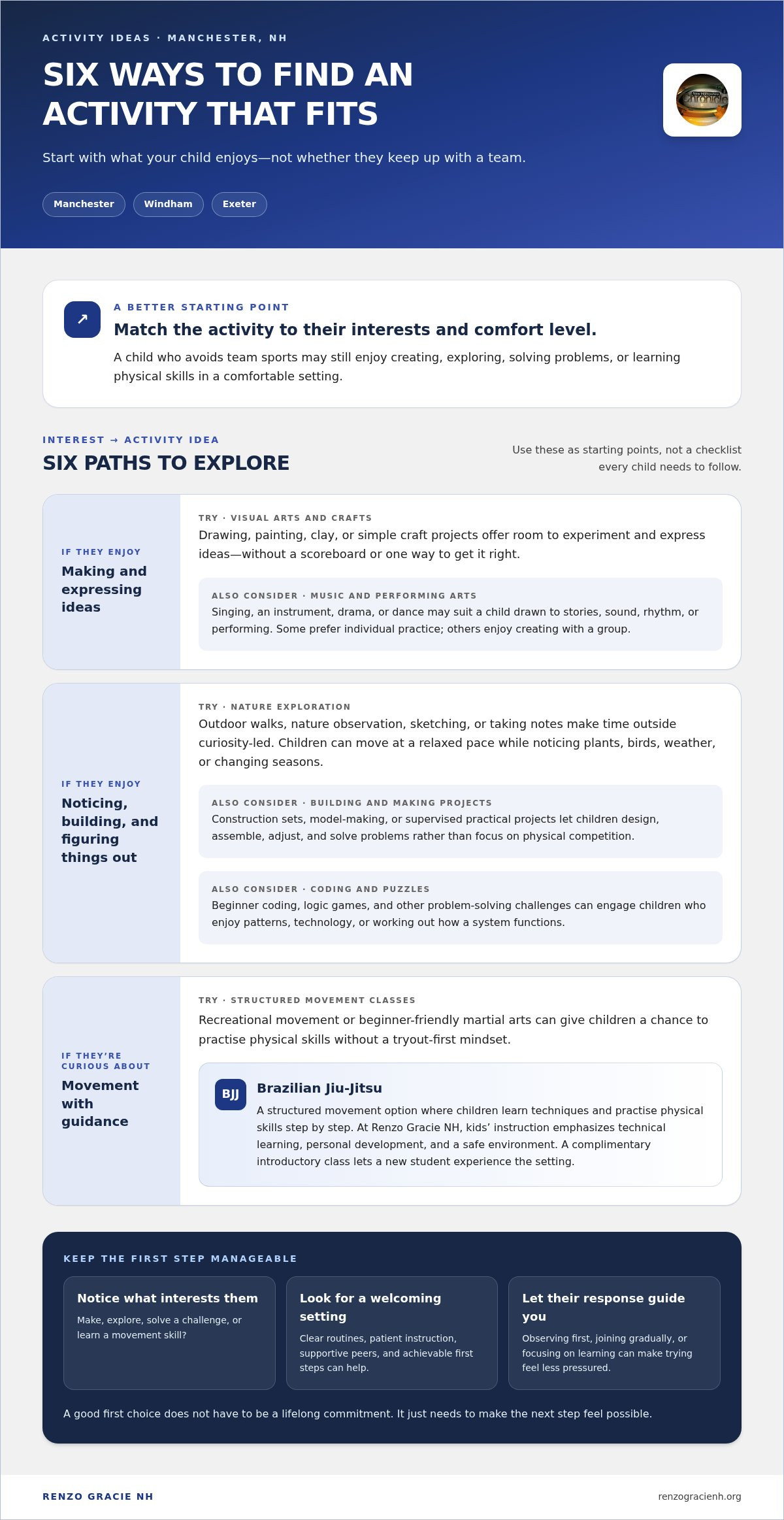
What if your child doesn’t need to become more athletic to find an activity they enjoy? If you’re searching for activities for non-athletic child Manchester families can explore, start with your child’s interests, not their ability to keep up with a team. A welcoming setting and the chance to learn at their own pace can make trying something new feel more manageable.

It’s understandable to worry that sports might feel too competitive or intimidating, or that avoiding them means missing out on movement and connection. But children can explore creative and skill-based activities, as well as structured movement such as Brazilian Jiu-Jitsu.

This guide focuses on Manchester, New Hampshire, and nearby Windham and Exeter. You’ll find activity ideas, ways to try something without pressure, and practical signs to look for when choosing a setting. At Renzo Gracie NH, children’s Jiu-Jitsu instruction emphasizes technical learning, personal development, and a safe environment. New students can experience the setting in a complimentary introductory class.

Key Takeaways

  • Start with your child’s interests and comfort level, rather than treating “non-athletic” as a fixed label.
  • Explore creative, nature-based, building, and movement activities to find options that suit your child.
  • Compare activities by structure, movement, group setting, and competition level to identify a comfortable fit.
  • Use a simple four-step approach to explore activities for non-athletic child Manchester families can consider, from discussing interests to reflecting after a first try.
  • Consider kids’ Brazilian Jiu-Jitsu as one structured movement option focused on technical learning and personal development.

Activities for a Non-Athletic Child in Manchester: Start With the Child, Not the Label

“Non-athletic” can sound like a fixed description, but it may simply reflect a child’s current interests or confidence. A child who avoids team sports may still enjoy moving, learning physical skills, or being active in a setting that feels comfortable. For families in Manchester, Windham, and Exeter, the goal is not to push a child into a particular mould. It’s to find an inviting place to begin.

What parents may mean by “non-athletic”

Low interest in competition isn’t the same as limited coordination, stamina, or physical ability. A child might feel self-conscious, dislike unfamiliar settings, or worry about making mistakes in front of others. Notice what they enjoy and what feels difficult without turning today’s hesitation into a permanent label. Understanding child development can help put changing interests and confidence into perspective.

Try specific, low-pressure questions: Would you rather make something, explore outside, solve a challenge, or learn a movement skill? Their answers can point toward creative activities, nature exploration, building projects, or structured movement. Each offers a different way to participate, from expressing ideas to practising coordination or spending time with others.

What makes an activity feel welcoming

Look for clear routines, patient instruction, supportive peers, and achievable first steps. Some children settle more easily when they know what to expect; others prefer choice and room to explore. An environment where mistakes are treated as part of learning can make trying something new feel less intimidating. No single activity suits every child, so let their response guide you.

A low-pressure activity is one a hesitant child can try without being pushed to perform, compete, or commit before they feel ready. That might mean observing first, joining in gradually, or focusing on learning rather than winning.

Movement doesn’t have to begin with a traditional team sport. Brazilian Jiu-Jitsu is a structured movement activity where children learn techniques and practise physical skills. At Renzo Gracie NH, kids’ instruction for different ages and skill levels emphasizes technical learning, personal development, and a safe environment. A complimentary introductory class lets a new student experience the setting.

When comparing activities for non-athletic child Manchester families might consider, begin with fit. Does the format interest your child? Does the pace feel manageable? A good first choice doesn’t need to be a lifelong commitment. It just needs to make the next step feel possible.

Six Activity Ideas for Non-Athletic Children Around Manchester

Families in Manchester, Windham, and Exeter can look beyond traditional team sports when exploring a child’s interests. These ideas range from quiet, hands-on pursuits to structured movement. Use them as starting points, not a checklist every child needs to follow.

  • Visual arts and crafts: Drawing, painting, clay, or simple craft projects give children who enjoy making things a chance to experiment and express ideas. There’s no scoreboard or single way to get it right.
  • Music and performing arts: Singing, learning an instrument, drama, or dance may appeal to children who enjoy stories, sound, rhythm, or performing. Some prefer individual practice; others like creating alongside a group.
  • Nature exploration: Outdoor walks, nature observation, or sketching and taking notes can turn time outside into a curiosity-led activity. Children can move at a relaxed pace while noticing plants, birds, weather, or changing seasons.
  • Building and making projects: Construction sets, model-making, or supervised practical projects can suit children who like designing, assembling, and seeing how things work. The focus is on trying, adjusting, and solving problems rather than physical competition.
  • Coding and puzzles: Beginner coding activities, logic games, and educational STEM platforms like Maker & Coder can engage children who enjoy patterns, technology, or figuring out how a system works. Choose a format that leaves room to ask questions and experiment.
  • Structured movement classes: Recreational movement or beginner-friendly martial arts can help children practise physical skills without a tryout-first mindset. Brazilian Jiu-Jitsu introduces guided movement and technique step by step. Children can begin learning without arriving with competition experience.

For each option, consider your child’s age, interests, and access needs alongside the activity’s format. Would they prefer a small creative task, time outdoors, a clear sequence to follow, or room to explore? An activity can be worthwhile even if it isn’t athletic in the usual sense: creating, problem-solving, moving, and connecting all offer ways to learn and participate.

For families curious about movement, Renzo Gracie NH’s kids’ Brazilian Jiu-Jitsu program emphasizes technical learning, fitness, and personal development in a safe environment. A complimentary introductory class gives a new student a chance to experience the setting. Explore the kids’ Brazilian Jiu-Jitsu program as one of several activities for non-athletic child Manchester families might consider.

How to Compare Activities When Your Child Is Hesitant

Compare how an activity may feel to your child, not just how it looks on paper. Consider what holds their interest, whether they’re comfortable in groups, if they like clear instructions, how much movement is involved, and whether competition is central. These questions help Manchester-area families shortlist options without assuming one format will suit every child.

Factor Questions to consider Possible fit
Interest What does your child enjoy doing already? Creative projects for makers; movement or practical challenges for active explorers.
Group setting Would they prefer working alone, with a few peers, or in a class? Individual projects, small-group activities, or instructor-led classes.
Structure Do they like knowing what happens next? A predictable routine may reassure some children; open-ended tasks may suit others.
Movement Would they enjoy gentle movement, active practice, or a mostly seated activity? Choose a level and style that feels approachable to them.
Competition Does winning motivate them, or make participation feel stressful? Look for an emphasis on learning and personal progress if competition is off-putting.

Which activity format may fit your child?

An individual creative project offers space to focus quietly. A small-group activity provides company without making the whole class feel like an audience, while an instructor-led class offers guidance and shared routines. A predictable format may comfort a child who likes knowing what comes next; another may be more engaged when there’s room to make choices. Preferences can shift after trying an activity, so treat the first impression as useful information, not a final verdict.

Does martial arts have to be aggressive or competitive?

Not necessarily. Brazilian Jiu-Jitsu can be taught as guided technical practice, with children learning movements and techniques through instruction. At Renzo Gracie NH, kids’ instruction emphasizes technical learning, fitness, personal development, and a safe environment. Respect and control are part of practising with others, and children can develop skills at their own pace. The key question is whether the teaching environment helps your child feel comfortable enough to participate, not whether martial arts matches a stereotype.

The right activity is one your child can approach with interest and growing comfort, not one that asks them to prove they’re athletic. Use the comparison as a conversation starter, then let your child’s response help guide the next step.

Non-Athletic Kids' Activities in Manchester: Parent Guide

A Low-Pressure Four-Step Plan for Trying a New Activity

A new activity can feel like a big leap when your child is unsure. Make the first step smaller. This approach can help families in Manchester, Windham, and Exeter explore activities their children may enjoy while giving the child a say in what happens next.

  1. Talk about interests. Start with what your child likes doing, not what you think they should try. Ask whether they’d rather make something, solve a puzzle, spend time outdoors, or learn a movement skill. Keep the conversation curious, not persuasive.
  2. Shortlist a few options. Choose activities that match those interests and compare the setting, pace, and level of structure. Explain what a first visit might involve, then let your child ask questions or help choose.
  3. Try an introduction. Agree on a manageable first goal, such as watching, joining in for part of the session, or learning one new movement. Renzo Gracie NH offers new students a complimentary introductory class for children’s Brazilian Jiu-Jitsu. It gives a child a chance to experience a guided movement class without treating the first visit as a test of toughness or talent.
  4. Reflect and decide together. Afterward, ask what felt fun, unfamiliar, comfortable, or challenging. Find out whether your child would like to return, try a little more, or explore a different kind of activity.

Prepare for the first visit without adding pressure

Explain the activity in plain language and be honest about what your child may see or do. Let them know it’s okay to feel nervous and that they don’t need to impress anyone. A small goal gives the visit a gentle focus while leaving room to observe and get comfortable at their own pace.

Review the experience together

Uncertainty in a first session doesn’t always mean an activity is a poor fit. A new room, unfamiliar people, or instructions to learn can take time to get used to. Notice whether these are ordinary first-session nerves or a persistent sense that the environment doesn’t suit your child. Trying an activity more than once can give you a fuller picture while still taking your child’s feedback seriously.

Observe your child’s response before deciding whether an activity is the right fit. Interest, comfort, and willingness to return can guide the next step, whether that means continuing, pausing, or choosing another category. To explore a first step into movement, book a complimentary introductory class.

Manchester Families: Consider Kids’ Brazilian Jiu-Jitsu as One Welcoming Option

Not every child wants to join a team or compete. For families in Manchester, Windham, and Exeter exploring activities for non-athletic child Manchester searches may bring to mind, kids’ Brazilian Jiu-Jitsu is one structured movement option. At Renzo Gracie NH, children learn techniques and develop physical skills in an environment that emphasizes personal development and safety. The program is for children of different ages and skill levels.

What children can experience in a kids’ Jiu-Jitsu class

Instruction offers a clear framework for learning: listen, practise guided movement, and work on techniques step by step. For a child who prefers knowing what to expect, structured teaching can make a new activity easier to understand. The focus is on learning, not arriving with a particular level of fitness or confidence.

Practice also gives children opportunities to work on focus, persistence, respect, and cooperation. These are skills they can practise as they learn and interact with others, not guaranteed outcomes. Progress looks different for each child. One may enjoy mastering a movement; another may need time to get familiar with the class setting. The aim is learning at an individual pace, not pressure to perform.

Families interested in how Jiu-Jitsu can contribute to a child’s development can also read Kids Jiu Jitsu New Hampshire: Empowering Your Child Through Brazilian Jiu Jitsu. It offers another perspective on the experience and the personal growth that instruction is designed to support.

A first step for Manchester-area families

Renzo Gracie NH serves families in Manchester, Windham, Exeter, and nearby New Hampshire communities. A complimentary introductory class gives a new student a chance to experience the setting and see how a guided movement activity feels. Keep the first visit simple: your child can notice the routine, get familiar with the learning environment, and decide how they feel about trying it.

Brazilian Jiu-Jitsu won’t be the right answer for every child, but it can offer a purposeful alternative to a conventional team-sport format. It combines movement, technical learning, and personal development. If your child is curious, explore a complimentary introductory class and take that first step together.

Choose a First Step That Feels Right for Your Child

The right activity doesn’t depend on a child already seeing themselves as athletic. Start with their interests, then consider how the setting, structure, and pace feel. Creative projects, outdoor exploration, problem-solving, and guided movement all offer ways to learn, connect, and grow. Let your child’s response to trying something new help shape what comes next.

For families exploring activities for non-athletic child Manchester options, kids’ Brazilian Jiu-Jitsu is one structured movement choice. Renzo Gracie NH offers instruction for different ages and skill levels, emphasizing technical learning, personal development, and a safe environment. New students can begin with a complimentary introductory class to experience the setting before deciding whether to continue.

Explore a complimentary introductory class for your child at Renzo Gracie NH, and take the next step at a pace that feels comfortable for your family.

Frequently Asked Questions

What activities are good for a child who does not like sports?

Children who dislike team sports may enjoy art, music, crafts, building projects, nature exploration, or a beginner-friendly movement class. Start with interests they already show, such as drawing, solving puzzles, or spending time outdoors, then consider whether they prefer individual activities or learning with a group. Families searching for activities for non-athletic child Manchester options can use a low-pressure introduction to see what feels enjoyable. Preferences may change over time.

How can I encourage my child to try an activity without pressuring them?

Offer a few choices and explain what a first visit might involve. Let your child help choose, then agree on a small goal, such as observing the class or trying one new skill. Afterward, ask what felt interesting or comfortable. One hesitant session doesn’t have to settle the question. Give your child room to consider another try, take a pause, or explore a different kind of activity.

Can a non-athletic child enjoy martial arts?

Yes. A child doesn’t need to identify as athletic to explore Brazilian Jiu-Jitsu. It involves learning techniques through guided practice, with skills developing over time. The class structure and the child’s comfort are important parts of the experience. Renzo Gracie NH offers kids’ instruction for different ages and skill levels, and a complimentary introductory class lets a new student experience the setting before deciding whether it feels like a good fit.

Is Brazilian Jiu-Jitsu aggressive for children?

Brazilian Jiu-Jitsu is a grappling martial art, but children’s instruction at Renzo Gracie NH emphasizes technique, personal development, and a safe environment. Children respond differently to physical activities, so notice whether your child seems comfortable with the teaching environment and talk together afterward about what felt enjoyable, unfamiliar, or challenging.

How do I know if an activity is a good fit for my child?

Look beyond whether your child succeeds straight away. Notice whether they feel welcomed, understand what to do, and show curiosity about returning. Ask what they enjoyed and what felt difficult. A good fit may offer a workable balance of structure, challenge, and choice. If your child remains uncomfortable after trying it, take their feedback seriously and consider another activity or format.

What activities can Manchester, NH families try for a child who is not sporty?

Families can explore creative classes, hands-on projects, nature activities, and beginner-friendly movement programs. Renzo Gracie NH serves families in Windham, Manchester, and Exeter with kids’ Brazilian Jiu-Jitsu instruction. The best starting point depends on a child’s interests and comfort. A complimentary introductory class gives Manchester-area families a chance to experience the academy and consider whether this structured movement activity suits their child.

Law Enforcement Subject Control Training: Practical Guide

Choosing subject control training law enforcement officers can use in professional practice means looking beyond a list of techniques. Does the training help participants notice changes, make decisions, and practise control skills in a supervised setting? Grappling practice can develop useful skills, but applying them in a professional context takes structured instruction that keeps safety and judgment in focus.

That distinction matters. Officers with different backgrounds and experience levels need room to learn, practise, and improve without assuming one technique or outcome fits every encounter. Effective training connects movement with decision-making. It gives participants opportunities to work through changing practice situations while respecting the demands of professional work.

This guide explains what structured subject-control practice can develop and what to look for when assessing whether instruction suits your needs. It also explores how Brazilian Jiu-Jitsu can support grappling, control, and decision-making through consistent practice. For officers in Windham, Manchester, and Exeter, Renzo Gracie NH offers specialized Law Enforcement Jiu-Jitsu training led by Professor Kevin Landry, a sixth-degree black belt under Renzo Gracie who has taught in the region for over two decades. Read on to learn how to assess training and take a practical next step.

Key Takeaways

  • Understand what structured subject-control practice can help develop, and why it complements rather than replaces policy, legal instruction, and sound judgment.
  • See how coached Brazilian Jiu-Jitsu practice can build grappling skills through progressive, controlled training with active partners.
  • Assess subject control training law enforcement programs by looking at coaching, progression, supervision, safety, and professional relevance.
  • Prepare to train with clear goals, instructor guidance, and a plan to share relevant experience or limitations privately.
  • Explore specialized Law Enforcement Jiu-Jitsu training at Renzo Gracie NH, led by Professor Kevin Landry, a sixth-degree black belt with over two decades of regional teaching experience.

What Subject Control Training for Law Enforcement Is Designed to Develop

Subject control training is supervised practice in managing physical encounters and developing skills to guide, stabilize, or restrain a person when appropriate. It isn’t a single technique or named system. Its purpose is to help officers practise movement, control, communication, and decision-making in a structured setting. When assessing subject control training law enforcement officers can apply in practice, focus on the quality and relevance of the practice, not the number of techniques covered.

Training can support professional development, but it doesn’t replace department policy, legal instruction, or sound judgment. Officers must operate within their agency’s rules and applicable requirements. A general overview of the Use of Force Continuum can provide context for how force options are discussed, but it isn’t a substitute for an officer’s department-specific direction.

Professional defensive-tactics development also has a different purpose from general fitness, sport competition, or academy certification. Fitness may improve conditioning, while competition tests performance within its own rules. Neither, by itself, establishes readiness for professional encounters. Subject-control practice develops skills in a coached environment and helps participants consider how those skills relate to an officer’s role.

How subject control training differs from general martial arts

Professional context shapes training goals, communication, and practice scenarios. Brazilian Jiu-Jitsu offers grappling-based practice in which partners work through changing positions and learn to manage balance, space, and control. That can be a useful foundation for skill development, but it doesn’t cover every situation an officer may face. Sport rules and competition success aren’t proof of operational readiness. Training needs to be understood alongside policy and professional judgment.

Who may benefit from professional control training?

Sworn officers can use structured practice to develop or revisit physical control skills. Beginners may need time to learn basic movement and get comfortable training with a partner. Experienced practitioners may focus on refining skills or working toward new learning goals. Training coordinators and agencies can assess whether instruction supports their development priorities. Individual departments determine the policies and training requirements that apply to their personnel.

How Brazilian Jiu-Jitsu Practice Can Build Subject Control Skills

Brazilian Jiu-Jitsu gives students a structured way to practise grappling with an active partner rather than repeating movements in isolation. As partners shift position or respond differently, students practise noticing changes, adjusting their balance, and staying composed. That can support physical control skills as well as communication and decision-making. Practice won’t make every encounter predictable, but coaching and clear safety expectations give learners a way to work through changing conditions.

A review in The Sport Journal on the utility of martial arts in American policing examines research on martial arts, including Brazilian Jiu-Jitsu, in law enforcement. The practical takeaway is to treat grappling as a method of practice, not a guarantee of a particular outcome. Subject control training law enforcement officers take part in should connect physical skills to professional context and sound judgment.

From fundamentals to adaptable practice

Learning can progress in stages. Students first work to understand a movement or position, then practise it with instructor guidance, and later apply the idea in controlled partner drills. Foundational movement and positioning create a base for more complex practice. As a partner offers measured resistance, the student must notice what changes and adapt instead of relying on a memorized sequence.

Resistance-based practice differs from rehearsing alone because a partner’s changing responses require the learner to observe, adjust, and make decisions in the moment. That doesn’t mean training should become a test of force or speed. Instructor direction and an agreed pace help keep practice purposeful and controlled.

Safety, judgment, and professional context

Good practice needs supervision, clear expectations, and communication between partners. Students should know how to pause or ask for guidance, and instructors should be able to adjust practice for different experience levels. Composure matters, too: physical skill is only one part of responding thoughtfully under pressure.

For officers, grappling practice must remain connected to professional responsibilities. Training should reinforce communication and decision-making, not frame force as the first resort. Agency policy and applicable law govern officers’ actions. Martial arts practice cannot replace either. Officers in Windham, Manchester, and Exeter can explore Law Enforcement Jiu-Jitsu training at Renzo Gracie NH, where Professor Kevin Landry brings more than two decades of regional teaching experience.

How to Evaluate Subject Control Training for Law Enforcement

A useful program should make its teaching approach clear. Look for details you can assess, such as the instructor’s experience, how skills are introduced, and how practice is supervised. Claims about confidence or performance may sound appealing, but they don’t tell you whether the curriculum is structured or relevant to your agency’s needs.

Use these criteria to guide a practical evaluation. They’re prompts for assessing instruction, not a ranking system or a promise of results.

Area What to look for What to verify
Coaching Clear explanations, demonstrations, and room for questions. Who leads instruction and what relevant experience they bring.
Progression Skills build from foundational movements toward more complex practice. How the program describes its learning sequence.
Supervised practice Students have coached opportunities to practise and receive feedback. How instruction is supervised and how students get guidance.
Safety Controlled practice, clear expectations, and respect for training partners. How the instructor communicates safety expectations and manages practice.
Professional relevance Training acknowledges the demands and context of law enforcement work. How the program describes its relevance, without treating practice as a substitute for policy.

Look for structure, not guarantees

A well-organized academy can explain how instruction works, how students progress, and how practice is guided. It should welcome participants with varied experience and make it possible to ask questions without pressure. These are qualities you can observe. Claims that a method guarantees control or prepares every officer for every encounter aren’t a reliable way to assess instruction.

When comparing subject control training law enforcement officers may consider, separate specific details from broad promotional claims. Instructor background, teaching experience, and a clearly explained training structure are concrete points to consider. Promised outcomes don’t prove that a program suits a particular officer or agency.

Consider safety and agency fit

Consider whether instructors emphasize controlled practice and care for training partners, and whether they explain how physical skills relate to responsible professional conduct. Applying skills in practice is an ongoing learning process, not automatic readiness for every situation. An agency should assess how the training relates to its goals and aligns with existing policy. Department approval and policy alignment are agency-specific decisions.

Quick checklist: “Can I understand who teaches, how skills progress, how practice is supervised, what safety expectations apply, and how my agency will assess relevance and policy alignment?”

Law Enforcement Subject Control Training: Practical Guide

How Officers Can Prepare for Subject Control Training

You don’t need a grappling background to arrive ready to learn. Approach subject control training with curiosity, consistency, and a willingness to follow coaching. Preparation isn’t about proving what you already know. It’s about setting a clear learning goal and participating responsibly.

Before the first session

Start with a practical goal, such as becoming more comfortable with grappling fundamentals or gaining experience in structured partner practice. Keep it focused. A specific goal gives you something useful to reflect on afterward without expecting mastery from one session.

  • Share relevant information privately. Let the instructor know about your previous training experience and any physical limitations that may affect participation. This helps them guide your learning appropriately.
  • Understand safety expectations. Listen to the instructor’s guidance, follow the agreed pace, and speak up if you’re unsure how to participate safely.
  • Follow gear guidance. Wear or bring the training gear the academy requests. Don’t assume equipment from another activity is appropriate.
  • Keep agency guidance in view. Treat practice as skill development, not permission to create or use new procedures. Your department’s policy and applicable law continue to govern your professional actions.

During and after practice

Stay engaged with the coaching. If a movement, drill, or safety expectation isn’t clear, pause and ask for clarification rather than guessing. Good learning depends on communication, patience, and respect for your training partner. Beginners and experienced practitioners alike benefit from being coachable.

After practice, take a few minutes to reflect. What felt unfamiliar? Which fundamentals would you like to revisit? Note questions for a future session or for discussion through the appropriate channels at your agency. This simple habit helps turn a single class into an ongoing learning process.

Training can support professional development, but it doesn’t establish instant mastery or automatically prepare anyone for every encounter. Use what you learn as a starting point for continued practice, and keep agency guidance central when considering how it relates to your role.

Ready to build grappling fundamentals through coached practice? Explore Law Enforcement Jiu-Jitsu training at Renzo Gracie NH.

Explore Law Enforcement Jiu-Jitsu Training in Southern New Hampshire

For officers in Windham, Manchester, and Exeter, Renzo Gracie NH offers a local way to explore Brazilian Jiu-Jitsu through specialized Law Enforcement Jiu-Jitsu training. The instruction connects coached grappling practice with professional defensive-tactics development, giving officers a structured setting to continue learning. It supports ongoing education and does not replace agency training, policy, or sound professional judgment.

What makes Renzo Gracie NH relevant to officers

Renzo Gracie NH is owned and operated by Professor Kevin Landry, a sixth-degree black belt under Renzo Gracie who has taught in the region for over two decades. His experience informs the academy’s specialized instruction. Students can build familiarity with grappling and control through practice while developing at an individual pace in a disciplined, supportive environment. Training can contribute to ongoing skill development, but it can’t promise a particular result or prepare someone for every situation.

Learn more about the academy’s law enforcement Jiu-Jitsu training overview to understand how this instruction relates to officers’ professional development.

A practical next step for New Hampshire officers

A first class can help you experience the instruction and decide how Brazilian Jiu-Jitsu practice fits your learning goals. Renzo Gracie NH offers new students a complimentary introductory class, providing a low-pressure opportunity to step onto the mat, learn, and get a feel for the training environment. You don’t need prior grappling experience. A willingness to listen, practise, and ask questions is a useful place to start.

For more background on the principles behind the academy’s approach, explore the Renzo Gracie teaching philosophy. Whether you’re beginning or adding to years of practice, progress comes through consistent learning. Keep professional judgment central, and align skills development with your agency’s policies and guidance.

Build Skills Through Consistent, Responsible Practice

Effective subject control training law enforcement officers can use is about more than memorizing techniques. Look for coached, progressive practice that develops grappling, communication, and composure while keeping safety and professional context in view. Agency policy, applicable law, and sound judgment must continue to guide officers’ actions.

Brazilian Jiu-Jitsu offers a structured way to practise with active partners and learn through steady repetition. The right starting point isn’t prior experience. It’s a willingness to listen, ask questions, and keep learning.

Renzo Gracie NH offers specialized Law Enforcement Jiu-Jitsu training led by Professor Kevin Landry, a sixth-degree black belt under Renzo Gracie who has taught in the region for over two decades. Officers in Windham, Manchester, and Exeter can explore Law Enforcement Jiu-Jitsu training as a practical next step. Build at your own pace, stay aligned with your agency’s guidance, and keep moving forward with purpose.

Frequently Asked Questions

What is subject control training for law enforcement?

Subject control training for law enforcement is supervised professional skills development for managing physical encounters. It can include communication, controlled partner practice, and reflection on how decisions relate to professional responsibilities. Training isn’t legal authorization, a replacement for department instruction, or a guarantee of any outcome. Programs differ, so officers should understand the instructor’s approach and learning goals while keeping agency policy central.

How can Brazilian Jiu-Jitsu help with subject control training?

Brazilian Jiu-Jitsu can provide coached grappling practice that builds familiarity with balance, positioning, and adapting as a partner responds. Progressive instruction lets students explore movement and control in a supervised setting, with safety expectations guiding practice. This can support skill development, but it doesn’t make every encounter predictable or replace department training. The value is in continued learning, not in assuming practice guarantees a particular result.

Is Jiu-Jitsu training appropriate for law enforcement officers with no grappling experience?

Yes. Officers new to grappling can learn foundational movements through progressive instruction, though each person develops at a different pace. Tell the instructor privately about relevant experience and any physical limitations that could affect participation. Follow the class’s safety guidance, ask questions, and focus on learning rather than keeping up with more experienced partners. A beginner mindset and consistent practice can help make training productive from the start.

What should a law enforcement subject control training program include?

A useful program should make its learning goals clear and offer knowledgeable instruction, progressive practice, supervised drills, partner-safety expectations, and opportunities to ask questions. For subject control training law enforcement officers consider, relevance depends on the officer’s role and agency requirements. Departments should assess the program against their policies and training priorities. A general checklist can guide that review, but it can’t replace agency-level evaluation or approval.

Can Jiu-Jitsu training replace department defensive tactics training?

No. Jiu-Jitsu should be treated as additional coached grappling practice, not a replacement for department instruction, policy, legal education, or required qualifications. It can support ongoing skill development, but agencies determine which training applies to their officers and how outside practice fits their requirements. Keep professional decisions grounded in department guidance and applicable law. Training on the mat doesn’t authorize new procedures or guarantee readiness for every encounter.

How should officers prepare for their first subject control training session?

Before your first session, choose a realistic learning goal, follow the academy’s guidance on what to wear or bring, and privately share relevant experience or physical limitations with the instructor. Pay close attention to safety directions, and ask for clarification if a movement or drill is unclear. Treat the session as an introduction to structured practice. It isn’t proof of operational readiness or mastery, but it can help you identify what to keep learning.

Where can New Hampshire officers find law enforcement Jiu-Jitsu training?

Renzo Gracie NH offers specialized Law Enforcement Jiu-Jitsu training for officers interested in grappling and subject-control practice. Officers in Windham, Manchester, and Exeter can explore the academy as a local training option. New students can experience the instruction through a complimentary introductory class. Take that first step to learn, ask questions, and see how coached Jiu-Jitsu practice can support ongoing development alongside agency guidance.

Alternatives to Team Sports for Kids in Windham

What if belonging matters more than winning? If you’re looking for an alternative to team sports for kids Windham families can explore activities that keep children moving and connected without making team performance the focus. A child who dislikes tryouts, rigid positions, or the pressure of competition may still enjoy learning alongside others and working toward personal goals.

The right fit depends on your child’s interests and temperament. Art can encourage creativity and self-expression; music and theater build performance skills and collaboration; dance offers movement and shared practice. Kids’ Jiu-Jitsu brings together fitness, technical learning, focus, and individual progress in a structured group setting. Each activity offers a different balance of physical effort, social connection, and commitment.

This guide compares options for families in Windham, Manchester, and Exeter, with practical ways to weigh those differences. You’ll also learn how Renzo Gracie NH’s kids’ program combines personal growth with shared practice. New students can start with a complimentary introductory class. Rather than force a team-sport fit, begin with what helps your child feel curious, capable, and ready to learn.

Key Takeaways

  • An alternative to team sports for kids Windham families consider can still offer movement, skill-building, and connection without team-game results at the center.
  • Compare martial arts, swimming, gymnastics, dance, racquet sports, and arts activities by the experience each offers and the interests it may suit.
  • Jiu-Jitsu develops individual skills through instruction and practice with peers, so children can learn together without team competition.
  • Use a simple selection process to weigh your child’s preferences, travel, routine, participation style, and overall family fit.
  • Kids’ Jiu-Jitsu at Renzo Gracie NH emphasizes technical learning, fitness, and personal development. New students can try a complimentary introductory class.

Why Windham Families Seek Team Sports Alternatives

Children don’t all enjoy competition in the same way. One may love the energy of a game and working toward a shared score, while another would rather learn at their own pace, create something, or move without the pressure of a crowd. A child’s response can also depend on the sport, the group, and how practice is organized. Disliking one team sport doesn’t necessarily mean they dislike movement, instruction, or spending time with other kids.

A team-sport alternative is an organized activity that isn’t centered on team-game results. It can still involve practice, goals, and peers. The broader Youth sports overview describes how participation can support physical and emotional well-being as well as social connection. Families can look for those opportunities in different formats, choosing what feels engaging and manageable for their child.

For parents comparing an alternative to team sports for kids Windham, the goal isn’t to find the most impressive activity or fill every afternoon. Look for a good match: something the child wants to return to, that fits the family’s routine, and that gives them room to build confidence through practice.

What might a child want beyond team competition?

Start with what your child enjoys, not just what they’re trying to avoid. They may prefer individual progress, smaller groups, creative expression, or varied movement. Some children feel more at ease when an instructor explains a skill and they can work toward a personal goal, rather than waiting for game day or worrying about a team result.

Ask open questions such as, “Which parts of practice do you like?” or “Would you rather make something, learn a skill, or try different movements?” Their answers can help you compare activities without deciding for them. Keep the conversation practical, too. A routine that feels interesting and manageable is easier to fit into family life.

What can a structured activity still offer?

Individual progress doesn’t mean practicing alone. Regular instruction gives children a routine, guidance as they learn, and opportunities for encouragement from instructors and peers. In activities such as martial arts, a child can work on personal skills while learning alongside training partners. The shared experience can build connection without making a team score the measure of progress.

The format can be individual; the experience can still be shared. That distinction helps families look beyond “team or no team” and focus on whether an activity offers the right balance of instruction, movement, social contact, and personal goals.

Team-Sport Alternatives for Kids Near Windham: Compare Activity Types

There’s more than one way for a child to move, learn, and connect with peers. Compare the activity’s format with what your child enjoys, then consider options in Windham and nearby Manchester or Exeter. The table can help you narrow the choice by the experience each activity typically involves and the interests it may suit.

Activity Format and typical experience May suit a child who enjoys
Martial arts Instructor-led skill learning and personal progress, often practiced alongside partners. Clear guidance, focused goals, and learning with others without team-game results.
Swimming Skill-focused movement in the water, with progress centered on developing ability. Practicing individual skills and being active in a different setting.
Gymnastics Movement and skill practice guided by instruction. Trying physical challenges and building skills step by step.
Dance Learning movement and routines, sometimes in a group setting. Music, expressive movement, and practicing choreography with others.
Individual racquet sports Practice and play centered on a child’s own skill development, sometimes against an opponent. Coordination, focused repetition, and visible progress in specific skills.
Arts and music Creative instruction and projects focused on making, performing, or learning an art form. Self-expression, imagination, and developing creative skills.
Outdoor recreation Broad activities outside, from informal exploration to organized skill practice. Fresh air, flexible movement, and time outdoors.

Movement-based options beyond team games

Martial arts combine instruction and personal skill development with shared practice. In kids’ Jiu-Jitsu at Renzo Gracie NH, children work on technical learning, fitness, and personal development in a structured setting. Each child works toward individual progress while practicing with others. Families exploring an alternative to team sports for kids Windham can compare this format with swimming and gymnastics, which also emphasize learning movement skills rather than team-game results. Dance may appeal to children drawn to music and expressive movement, while racquet sports may suit those who like focused practice and developing specific skills.

Creative and outdoor activities for different interests

Arts and music offer a creative path for children more interested in drawing, making, playing an instrument, or performing than in sports. Outdoor recreation brings movement and exploration without necessarily involving a formal team structure. These options differ in physical activity, creative focus, routine, and social interaction. If instructor-led movement and shared practice sound like a promising fit, explore kids’ Jiu-Jitsu at Renzo Gracie NH as a local option.

Alternatives to Team Sports for Kids in Windham

Is Jiu-Jitsu a Social Alternative to Team Sports for Kids?

Yes. An activity doesn’t need teams or a shared scoreboard to help a child learn alongside peers. Brazilian Jiu-Jitsu combines individual skill development with instruction and practice partners, creating a shared class experience while each student works on personal progress. That may suit a child who wants connection but doesn’t enjoy team-game pressure.

How Brazilian Jiu-Jitsu combines individual progress and group learning

In a structured martial arts class, students receive instruction, practice movement skills, and learn with others. At Renzo Gracie NH, kids’ instruction emphasizes technical learning, fitness, and personal development. These are built through practice over time, not instant results or promises.

In Jiu-Jitsu, progress is measured by the skills a student develops, not a team’s position on a scoreboard. Training partners make learning interactive, while each child’s development remains personal. That balance can offer a sense of community without making winning or team performance the focus.

What parents should consider about fit and comfort

Jiu-Jitsu involves learning movement skills with an instructor and training partners, so consider whether your child feels comfortable with physical contact and shared practice. A child may need time to get used to a new routine, listen to instruction, and participate in a structured class. Their curiosity and comfort matter more than whether the activity sounds like a good fit on paper.

Talk with your child about what they’d like to try and what feels manageable. If they’re interested but unsure, a complimentary introductory class at Renzo Gracie NH lets your family experience the class before deciding whether it feels right. It’s one way to explore an alternative to team sports for kids Windham that brings together personal goals, guided learning, and shared practice.

How to Choose a Kids’ Activity in Windham That Fits Your Child

The best choice isn’t always the most familiar activity. Connect your child’s interests with a routine your family can sustain, and treat a first visit as a chance to learn rather than a test they need to pass.

  1. Ask your child. Find out what they’d like to try and what they want less of, such as game-day pressure or a crowded practice.
  2. Identify their preferences. Do they enjoy individual goals, creative practice, movement, or learning with peers? Consider their comfort with competition, physical contact, performing, and structured instruction.
  3. Compare activity formats. Look at how much time is spent moving, creating, listening to instruction, or practicing with others. A child who prefers guided skill-building may enjoy a different format than one drawn to open-ended creative activities.
  4. Try a class or introductory experience. Decide what you hope to learn: whether your child feels comfortable, understands the activity, and shows interest in participating again.
  5. Reflect together. Ask what felt fun, challenging, or uncomfortable. One first impression is useful information, not a fixed label about your child’s personality or abilities.

Match the activity to your child’s preferences

Think beyond “sports or no sports.” A child may want plenty of movement but prefer personal goals to team competition, or enjoy working with peers but feel uneasy about performing in front of an audience. Preferences can also change with experience. Listen closely, and let your child’s responses guide the next choice rather than deciding that one activity defines what they will or won’t enjoy.

Practical fit matters too. Consider travel from Windham, how an activity fits around school and family routines, and whether its participation style feels manageable. A promising option should work for the child and the household, not just sound appealing in theory.

Make the first experience low-pressure

Before a trial, agree on a modest goal: notice how the class is taught, whether your child feels welcomed, and whether they’re curious to return. Don’t expect immediate mastery. New routines and skills take time, and a child may need space to decide how they feel afterward.

For families considering Jiu-Jitsu, Renzo Gracie NH offers a complimentary introductory class for new students. Book a complimentary kids’ Jiu-Jitsu introductory class and use the experience to see whether the setting feels right for your child.

Try Kids’ Jiu-Jitsu at Renzo Gracie NH in Windham

For families comparing team sports with martial arts, Renzo Gracie NH offers a structured Brazilian Jiu-Jitsu program for children in Windham, with additional locations in Manchester and Exeter. It’s a local option for kids who prefer developing their own skills while learning alongside other students, rather than focusing on team-game results.

What kids can explore through Jiu-Jitsu

Children’s instruction emphasizes technical learning, fitness, and personal development. Through guided practice, students can explore movement, learn techniques, and work toward individual progress in a shared class setting. The focus is on learning and growth, with each child progressing through practice at their own pace.

Professor Kevin Landry, the academy’s owner and instructor, is a sixth-degree black belt under Renzo Gracie and has taught in the region for over two decades. His experience informs instruction in a program designed around children’s learning and development.

Jiu-Jitsu is a partner-based activity, so it includes physical contact as students practice with others. That’s an important part of deciding whether the format fits your child. If family participation is part of what you’re looking for, Renzo Gracie NH also has family Jiu-Jitsu options to explore.

Take a simple first step in Windham

A first class can help your family get a feel for the instruction and environment, without expecting your child to master new skills right away. Notice whether they seem comfortable taking part, respond to the structure, and show interest in trying again. Their impressions matter; the goal is to discover a good fit, not force one.

If you’re considering an alternative to team sports for kids Windham families can explore, start with a complimentary introductory class for your child at Renzo Gracie NH.

Find an Activity That Helps Your Child Grow

The right activity is one your child feels curious about and comfortable returning to. Swimming, dance, creative pursuits, and martial arts all offer different ways to develop skills and connect with others. An alternative to team sports for kids Windham families explore can still provide structure and shared learning without making game results the goal.

Kids’ Brazilian Jiu-Jitsu at Renzo Gracie NH emphasizes technical learning, fitness, and personal development in a structured setting. With locations in Windham, Manchester, and Exeter, families can explore an option close to home. Owner and instructor Professor Kevin Landry has taught in the region for over two decades.

A first class is a simple way to see how your child responds to the activity and its routine. Renzo Gracie NH offers a complimentary introductory class for new students. Book your child’s free introductory Jiu-Jitsu class and let them discover whether the mat feels like a place to learn, move, and grow.

Frequently Asked Questions

Is Brazilian Jiu-Jitsu a good alternative to team sports for kids?

It can suit children who enjoy learning movement skills and making individual progress in a structured group setting. Brazilian Jiu-Jitsu isn’t a team game, but students learn from instructors and practice alongside others. Whether it suits your child depends on their interests and comfort with partner practice. An introductory class lets your family experience the format before deciding if it feels right.

Can kids make friends in an activity that is not a team sport?

Yes. Team competition is only one way children can spend time with peers. Group classes, shared practice, and learning alongside other students create opportunities for connection. The experience varies by activity and child, so notice whether your child seems comfortable participating and interested in returning. Social connection doesn’t have to depend on team performance.

What are some alternatives to team sports for kids in Windham?

Families can compare martial arts, swimming, gymnastics, dance, individual racquet sports, creative activities, and outdoor recreation. Each offers a different mix of movement, instruction, personal goals, and group participation. In Windham, Manchester, and Exeter, consider travel and the fit with your child’s interests and family routine as you narrow down options.

Is Jiu-Jitsu safe for children who are new to martial arts?

A child’s comfort, the class environment, and appropriate instruction all matter when trying a new physical activity. Brazilian Jiu-Jitsu involves partner practice, so consider whether your child is comfortable learning movement skills with others. An introductory class gives your family a chance to experience the setting and observe your child’s response before deciding about ongoing participation. Their comfort and willingness to take part are important considerations.

How do I know which activity will suit my child?

Start by asking what your child enjoys and what they’d like to try. Compare options by activity style, structure, social setting, travel from Windham, and fit with your family’s routine. After an introductory experience, notice whether your child seemed engaged and comfortable and whether they want to return. Their response can guide your next step without treating one experience as a final verdict.

Can a child try Jiu-Jitsu before joining Renzo Gracie NH?

Yes. Renzo Gracie NH offers new students a complimentary introductory class, so families can experience Brazilian Jiu-Jitsu before deciding whether to continue. The class gives you a chance to see how your child responds to the structured group activity and its instruction. Keep the first visit low-pressure: focus on their comfort, interest, and curiosity about learning more. Renzo Gracie NH serves families in Windham, Manchester, and Exeter.

Structured Martial Arts Curriculum in NH: How to Choose in 2026

What if the clearest sign of a good martial arts school isn’t the style it advertises, but how well it explains what students will learn next? Program descriptions can sound alike, so families searching for a structured martial arts curriculum NH schools offer should look beyond beginner-friendly claims and ask how instruction builds over time.

A welcoming first class is a good start, but you’ll also want to know whether instruction suits the student’s age and experience, how beginners are supported, and what they can work toward next. A thoughtful curriculum makes learning easier to follow, from foundational skills to greater focus, confidence, and perseverance.

This guide explains what progression can look like and gives you practical questions for comparing New Hampshire programs. You’ll learn what to observe in an introductory class, how to assess age-appropriate instruction, and which details to confirm before signing up. Whether you’re considering training in Windham, Manchester, or Exeter, the goal is to find an encouraging program with a path forward for you or your family.

Key Takeaways

  • A structured martial arts curriculum NH families can evaluate should make learning goals and next steps clear without promising a fixed belt timeline.
  • In Brazilian Jiu-Jitsu, repetition, partner practice, and instructor feedback can help students reinforce foundational skills over time.
  • Compare local programs by asking how instructors welcome beginners, adapt instruction to different experience levels, and support age-appropriate learning.
  • Use an introductory visit to observe teaching clarity, safety expectations, training culture, and whether the schedule works for your family.
  • Renzo Gracie NH offers adult and kids Jiu-Jitsu programs. Professor Kevin Landry, a sixth-degree black belt, has more than two decades of local teaching experience.

What Does a Structured Martial Arts Curriculum in NH Actually Include?

A structured curriculum organizes instruction around clear learning goals, with practice that builds over time. Students should be able to understand what they’re practising, how it connects to earlier lessons, and what they can continue developing. That does not mean every student follows the same pace or should be promised a particular belt timeline.

In Brazilian Jiu-Jitsu, learning can involve technique, body movement, problem-solving, and respectful practice with a partner. A class might introduce a position or movement, explain its purpose, and give students a chance to practise it with guidance. The goal isn’t identical outcomes for everyone. Useful structure helps instructors support learning and safe practice while recognizing that each student develops at their own pace.

What makes martial arts instruction feel progressive?

Progress often comes from revisiting foundational movements as students gain familiarity and control. An instructor might demonstrate a technique, guide students through repetition, then offer a manageable practice situation where they can explore when or how to use it. That sequence lets students ask questions, receive feedback, and connect the movement to a broader skill.

Ranks may be one part of a school’s progression system, but they don’t tell the whole story. A belt is not a universal timetable or a guarantee of mastery. Ask each school how it explains its own progression and what instructors consider when assessing development. Clear answers should help you understand what students work on, not promise how quickly anyone will advance.

How can a curriculum support different ages and goals?

Age-appropriate instruction involves more than choosing which techniques to teach. Instructors can adjust explanations, practice expectations, and partner activities to suit students’ ages, experience, and readiness. Children may benefit from clear guidance that encourages listening, respect, and perseverance. Adults may have different goals and starting points. Specialized professional training is a distinct context, so ask how it differs from a general adult class.

Renzo Gracie NH offers Brazilian Jiu-Jitsu training for adults and children, as well as family training and specialized Law Enforcement Jiu-Jitsu training. These programs serve different participants, so ask about current formats, age groupings, and how instruction is adapted. Specific answers make it easier to judge whether a program fits your needs, rather than relying on a description alone.

How Brazilian Jiu-Jitsu Skills Can Build Step by Step in NH

Brazilian Jiu-Jitsu learning can move from body awareness to controlled practice, then to making choices in changing situations. This is a general way to think about skill development, not a description of any one academy’s syllabus. In a structured martial arts curriculum NH students may encounter, the purpose is to connect practice with learning goals while recognizing that individuals progress at different rates.

From foundational movement to controlled practice

Early practice may focus on balance, movement, position, and basic grappling concepts. These foundations help students notice where their bodies and their partners are, rather than trying to memorize techniques without understanding the situation.

Coached partner drills can give each movement a clear purpose. An instructor demonstrates, students practise with guidance, and feedback helps them make adjustments. Beginners should know how to communicate with a partner, what level of effort is expected, and when to pause or ask for help. Clear expectations make practice more manageable and respectful for everyone.

Consistent practice gives students opportunities to revisit foundational skills and build on them over time.

How practice can develop decision-making

Once students become familiar with basic movements, instructors may introduce guided scenarios that ask them to notice a position, consider their options, and respond with control. The emphasis is on thoughtful problem-solving, not simply reacting quickly. For example, a student might practise adjusting their balance or changing position while a partner offers appropriate, cooperative resistance.

These exercises can give learners practice staying composed when a situation feels unfamiliar, but they can’t guarantee how someone will respond in every real-world conflict. Technique practice should take place in supervised, controlled training, with instructors making expectations and boundaries clear. For children, calm, step-by-step instruction can support focus and self-management. Understood.org discusses how martial arts can emphasize self-control and concentration.

Look for feedback that explains what to adjust and why, rather than treating repetition as a test of who can move fastest. Students may need different amounts of practice before a skill feels familiar, and schools may use different ways to assess progress. Ask how instructors support beginners and adapt practice as experience grows. To explore local Brazilian Jiu-Jitsu training, learn more about Renzo Gracie NH.

How to Evaluate a Martial Arts Curriculum in Windham, Manchester, or Exeter

School descriptions often use similar language, so compare what instructors teach and how they guide learners. Use the questions below to assess a structured martial arts curriculum NH programs describe. Confirm current classes, age groupings, schedules, and other details directly with each school, whether you’re looking in Windham, Manchester, or Exeter.

What to compare Questions to ask or observe
Beginner onboarding What should a new student expect during the first few classes? Are instructions and partner expectations explained before practice?
Age fit Which programs are currently available for the student’s age and goals? Do instructors adjust explanations and activities for different learners?
Instruction Can you follow the instructor’s explanations? Do they demonstrate, check understanding, and offer useful feedback?
Progression How does the school explain progress? What support is available when a student finds a skill challenging?
Training culture Do students treat partners with respect? Does the class balance discipline with encouragement and attention to safety?

Questions to ask during a school visit

Ask how instructors guide beginners when they share a learning environment with more experienced students. A useful answer should explain how new students receive appropriate instruction, rather than leaving them to work things out alone. Ask how instructors help students through challenges and communicate progress. Confirm which programs are currently available for the learner’s age and goals, because program names alone don’t explain how a class is taught.

Signs the learning environment may fit your goals

If the school allows it, watch a class or use an introductory visit to notice whether coaching is clear, respectful, and attentive. Look for considerate partner interactions, instructors who respond to questions, and opportunities for beginners to learn without pressure to keep up at any cost. A positive training culture can be disciplined and focused while still making students feel welcome.

Separate what you can verify from promotional language. Ask what a first class involves, how students practise and receive feedback, which age groups are currently served, and what schedules are available. Then compare the answers. If a school highlights a particular outcome, ask how instruction supports it rather than assuming every student will have the same experience.

Consider the practical journey, too. A program that looks appealing on paper needs to fit your household’s routine. Compare travel to Windham, Manchester, and Exeter with class times confirmed by each school. The right fit brings together an appropriate teaching approach, a respectful student culture, and workable logistics.

Structured Martial Arts Curriculum in NH: How to Choose in 2026

A Practical Checklist for Choosing Structured Martial Arts Classes in NH

A first visit can tell you more than a program description. Use this checklist to assess whether the instruction, class culture, and practical details fit the student, whether they’re an adult, a child, or a family exploring training together.

What to notice in a first class

Before you visit, ask what a new student should expect and confirm the current class format, schedule, and any preparation needed. During the visit, notice whether the instructor explains drills clearly, demonstrates what students should do, and sets expectations. Observe how partners are paired and whether practice is supervised. Afterward, ask the prospective student how comfortable they felt, what questions they still have, and whether they’d like to learn more.

  • Teaching clarity: Could a beginner follow the explanation and understand the purpose of the practice?
  • Safety expectations: Were students shown how to practise respectfully and seek guidance?
  • Curriculum answers: Can instructors explain how learners build skills and receive feedback without promising identical results or timelines?
  • Schedule practicality: Do the confirmed class times and travel work with your household’s routine?

Adults considering Brazilian Jiu-Jitsu can use this guide to starting adult Jiu-Jitsu in NH to prepare questions. Parents can also review information about kids Jiu-Jitsu in New Hampshire, then confirm current program details directly with the academy.

How to compare programs for a family

Adult and child goals may differ, so ask how instructors account for each learner’s age and experience. Don’t assume family members train in the same class or format. If you hope to practise together, ask whether parent-child training is currently available and what participation involves. For family-specific context, see this guide to parent and child Jiu-Jitsu in Windham.

Compare your notes. A structured martial arts curriculum NH families can evaluate with confidence should come with clear answers about learning, supervision, and fit, not just appealing promises. To explore the academy’s Brazilian Jiu-Jitsu training and introductory class, find out how to experience Renzo Gracie NH.

Explore Renzo Gracie NH’s Brazilian Jiu-Jitsu Programs and Next Steps

Choosing a school is easier when you can connect its teaching approach to your own goals. Renzo Gracie NH is a Brazilian Jiu-Jitsu academy offering training for adults and children, family training, and specialized Law Enforcement Jiu-Jitsu training for professional defensive tactics. The academy is owned and operated by Professor Kevin Landry, a sixth-degree black belt under Renzo Gracie who has taught in the region for more than two decades.

That experience gives you useful context, but your next step is to ask how instruction and progression work for the person who plans to attend. A structured martial arts curriculum NH students can grow with should be understandable to newcomers. Instructors should be able to explain class expectations and how students receive guidance as they learn.

What to ask Renzo Gracie NH about its curriculum

Bring a few direct questions to your introductory visit. Ask which current class may suit your age, experience, and goals, and how instructors help students understand their progress. You can also ask what partner practice involves, how students are guided to train safely, and what support is available when a new skill feels challenging.

Confirm current schedules, age groupings, class formats, and program details with the academy rather than assuming they’re available or unchanged. If you’re exploring professional defensive tactics, ask specifically about the current law-enforcement training program and whether it fits your needs.

Take a low-pressure first step in New Hampshire

A complimentary introductory class gives new students a chance to experience instruction and decide whether the environment feels like a good fit. Use the visit to notice how directions are explained, how questions are handled, and how instructors guide partner practice. You don’t need to arrive with all the answers. Start by sharing what you hope to learn.

Before you go, note your questions about class fit, learning progression, and practical expectations. Afterward, consider whether the instruction felt clear and welcoming, and whether you can picture continuing to learn there. You can read more about the complimentary Jiu-Jitsu introductory class as you consider a first visit.

Every student’s path is personal. If you’re ready to explore your options, explore Renzo Gracie NH and ask about a suitable starting point for you or your family.

Take Your Next Step Toward Steady Progress

A strong martial arts program makes learning goals clear, builds skills through purposeful practice, and adapts instruction to students’ ages and experience. As you compare a structured martial arts curriculum NH schools offer, look beyond polished descriptions. Ask how instructors explain progress, guide safe practice, and help beginners find their footing.

Renzo Gracie NH teaches Brazilian Jiu-Jitsu to adults and children, and offers family training and specialized Law Enforcement Jiu-Jitsu training. Professor Kevin Landry, a sixth-degree black belt under Renzo Gracie, has taught in the region for more than two decades. New students can experience the instruction and ask about program fit in a complimentary introductory class.

Try a complimentary introductory class and discover whether Renzo Gracie NH is the right fit. Bring your questions, notice how the teaching feels, and take the next step at a pace that works for you.

Frequently Asked Questions

What should a structured martial arts curriculum include?

A structured martial arts curriculum should have clear learning goals, planned instruction, and practice that builds skills progressively. In Brazilian Jiu-Jitsu, that may mean connecting movement and positioning with technique, partner practice, and problem-solving. Instructors should explain how students develop and receive feedback, while keeping practice respectful and safe. Progress doesn’t have to follow a fixed timeline, and students shouldn’t be promised identical outcomes.

How do beginners progress in Brazilian Jiu-Jitsu?

Beginners often start by learning basic movement, balance, positioning, and grappling concepts, then reinforce them through coached repetition and partner drills. As they gain familiarity, instructors may introduce guided practice that helps students recognize options and apply skills with control. Progress depends on the individual and the school’s approach, so ask how instructors support new students and explain development. There’s no universal timetable for learning or promotion.

Can children and adults follow the same martial arts curriculum?

Children and adults may learn the same martial art, but instruction and expectations should suit each learner’s age, experience, and goals. Instructors can adapt explanations, practice activities, and partner guidance so students can participate appropriately. Renzo Gracie NH offers Brazilian Jiu-Jitsu programs for adults and children, but don’t assume they share a class or format. Ask the academy which current program best fits each family member.

How can I compare martial arts programs in New Hampshire?

Compare how schools welcome beginners, explain instruction, support safe partner practice, and communicate progress. Visit or ask questions at programs in Windham, Manchester, Exeter, or nearby communities, and confirm current age groupings, class formats, and schedules directly. Notice whether instructors adapt practice for different experience levels and whether the training culture feels respectful and encouraging. Clear answers about what students can expect are more useful than broad promotional promises.

Is Brazilian Jiu-Jitsu suitable for someone with no martial arts experience?

Brazilian Jiu-Jitsu can be a starting point for people with no previous martial arts experience. Beginners can ask how the school introduces foundational movement, explains partner expectations, and supports students who need time to become comfortable. You don’t need to know what to do on day one. Contact the academy to confirm which current class suits your experience and goals before attending.

What should I expect from a first martial arts class at Renzo Gracie NH?

New students can begin with a complimentary introductory class at Renzo Gracie NH. Contact the academy beforehand to confirm the current format, schedule, and what to bring, since those details may change. During your visit, notice whether instructions are clear, partner practice is guided, and you feel comfortable asking questions. The class is an opportunity to experience the environment and ask how the program may fit your goals.

Does Renzo Gracie NH offer family martial arts training?

Yes. Renzo Gracie NH offers family training alongside Brazilian Jiu-Jitsu programs for adults and children. Ask the academy how current family training is organized, whether family members participate together, and which options suit your ages and goals. Don’t assume every class is shared. For families in Windham, Manchester, Exeter, and surrounding communities, confirming the format and schedule directly can help you decide whether training fits your routine.

Police Training in Windham, NH: A Guide for Officers

The most useful police training programs Windham officers can explore are not necessarily the ones making the biggest claims. Look for instruction that connects to your professional goals, welcomes questions, and supports steady skill development.

It’s reasonable to ask whether a martial arts class will address the demands of officer work or focus mainly on sport. This guide explains how to compare local options, what to ask about defensive-tactics instruction, and how to assess whether a program fits your needs. Training can help build practical skills, but it does not replace required academy or in-service training.

We’ll cover curriculum, instructor experience, coaching style, and the training environment. In Windham, Renzo Gracie NH offers specialized Law Enforcement Jiu-Jitsu training. The academy is led by Professor Kevin Landry, a sixth-degree black belt under Renzo Gracie who has taught in the region for over two decades. You’ll also find questions to ask before enrolling and learn how a complimentary introductory class can help you experience the academy and discuss professional relevance with an instructor.

Key Takeaways

  • Compare police training programs Windham by professional relevance, instructor background, class format, and practical travel needs.
  • Learn how Brazilian Jiu-Jitsu’s positional grappling and controlled practice may relate to defensive-tactics training, and confirm which topics a program actually teaches.
  • Ask focused questions about your goals, curriculum, schedule, eligibility, and first visit to assess whether a program fits.
  • Consider how specialized law-enforcement instruction differs from general martial arts classes, without assuming one approach suits every officer.
  • Explore Renzo Gracie NH’s Law Enforcement Jiu-Jitsu training and consider a complimentary introductory class as a low-pressure way to experience the environment.

What should officers expect from police training programs in Windham?

For this guide, a police training program means skills instruction officers can assess for relevance to their professional responsibilities. The key question is not simply whether a class teaches martial arts. Consider whether its approach and coaching connect to the goals you bring to training. A useful definition: Law-enforcement Jiu-Jitsu training applies grappling concepts to professional skills practice, with the curriculum and its relevance confirmed directly with the instructor.

Specialized officer-focused instruction and general martial arts classes can both offer structured learning, but their teaching priorities may differ. Ask what each class is designed to cover instead of assuming a general class addresses the same professional questions. Renzo Gracie NH offers specialized Law Enforcement Jiu-Jitsu training. Confirm the specific topics currently included before deciding whether it meets your needs.

What makes training relevant to law enforcement work?

Start with the topics you want to evaluate, such as grappling, control, and decision-making during physical practice. Ask how the instructor relates training to officers’ professional responsibilities and explains the context for practicing a skill. The use of force continuum can provide a general reference point for that discussion, but it does not establish what a particular academy teaches. Verify curriculum details with the provider.

Who might be looking for officer-focused training near Windham?

An individual officer may be exploring personal development, while a supervisor may be comparing options for a team. Officers with different levels of experience can ask whether the instruction suits their background and verify participation requirements before making plans. For a single student or a group, fit depends on goals, travel, and whether class times work with job schedules.

Location matters, too. Renzo Gracie NH has academies in Windham, Exeter, and Manchester, so compare which location is practical for your commute. Check current schedules, eligibility, and enrollment details with the academy rather than assuming every location offers the same format or availability.

When comparing police training programs Windham officers can access, look beyond the label. Ask what skills are covered, how instruction is coached, and whether the instructor can explain the program’s professional relevance. Clear answers help you decide on a next step without expecting a class to replace required agency or state training.

How does law-enforcement Jiu-Jitsu training build practical grappling skills?

Brazilian Jiu-Jitsu develops grappling through positional practice. Students work from different positions, learn how movement changes them, and repeat skills with a partner under an instructor’s guidance. For officers, one aspect to explore is the opportunity to study control and physical decision-making in a structured setting. This general description is not a promise about what any specific class covers. Ask the academy which parts of its current curriculum are intended for law-enforcement training.

Practice and feedback are important parts of learning. Repeating a movement gives students opportunities to refine it, while an instructor can clarify details and adjust instruction as needed. That makes coaching style part of your evaluation, not an afterthought. Practising a skill in class does not guarantee performance or an outcome in a real incident. Assess the training alongside agency policies and professional responsibilities.

Which training elements should officers ask about?

Ask about the program’s stated focus. How does it address grappling, control techniques, and defensive tactics? Which of those subjects are included in the current curriculum? Find out how partner practice is introduced and adapted for participants with different experience levels. These questions help distinguish a law-enforcement-focused program from general martial arts instruction, without assuming either is automatically the right fit.

How can officers assess coaching and training culture?

Ask about instructor experience and how the instructor approaches professional training needs. During a visit, notice whether directions are clear, questions are welcomed, and practice is controlled and respectful. These details can help you judge whether the learning environment supports steady development. The U.S. Department of Justice’s overview of Police Training offers broader context on training beyond recruit instruction. A class visit lets you assess the specific coaching in front of you.

Renzo Gracie NH offers specialized Law Enforcement Jiu-Jitsu training. Professor Kevin Landry, the academy’s owner and operator, is a sixth-degree black belt under Renzo Gracie and has taught in the region for over two decades. This background provides useful context, but officers should still ask how the current program aligns with their goals and confirm curriculum topics directly with the academy.

To explore the program, review the Law Enforcement Jiu-Jitsu training information and use it as a starting point for questions about curriculum, coaching, and fit. A direct conversation can help you decide whether to take the next step.

How can officers compare police training programs near Windham?

Use the same questions for every option. A consistent comparison helps separate professional relevance from broad promotional language and brings practical considerations, such as travel and work commitments, into view. For police training programs Windham officers are considering, compare details directly with each provider rather than assuming similar labels mean similar instruction.

What to compare Questions to ask How to assess fit
Professional relevance Which law-enforcement defensive-tactics topics are part of the current instruction? How does the program relate to officers’ professional needs? Look for clear answers about the actual curriculum, not just general claims about practical training.
Instructor background What experience does the instructor bring, and how do they approach training for officers? Consider whether their experience and communication style match your goals and expectations.
Training format How is instruction structured? How are participants with different experience levels and goals accommodated? Ask what you can observe or try before enrolling, and confirm participation requirements.
Location and access Which location and current class times are available? How would the trip fit your routine? Compare travel from Windham with options in Manchester or Exeter based on your starting point and schedule.

What questions help assess professional relevance?

Ask which defensive-tactics subjects are included in the current program, how instruction responds to different experience levels, and whether you can observe or experience a class before deciding. Invite the instructor to explain how the training connects to your professional goals. Specific answers help you judge relevance. Broad assurances alone do not show what you’ll actually practise.

How should officers weigh coaching, format, and location?

Instructor background matters, as does the ability to explain and coach material clearly. Consider whether the available format fits your work commitments and whether regular travel is realistic. Renzo Gracie NH has academies in Windham, Exeter, and Manchester, giving officers locations to compare. Do not assume schedules or program details are identical at each one.

Renzo Gracie NH offers a complimentary introductory class for new students. It can be a low-pressure opportunity to experience the training environment and discuss professional fit with an instructor. Confirm the current booking process, eligibility, class schedule, and participation requirements directly with the academy.

Before enrolling as an individual or exploring options for a team, verify whether any agency arrangements apply. Do not assume a program is agency-approved or that a particular schedule or curriculum is available. A direct conversation can clarify the details and help you choose a next step.

Police Training in Windham, NH: A Guide for Officers

What should officers verify before joining a Windham-area training program?

A little preparation makes it easier to assess whether a program suits your goals. Before committing, check five things: what you want to learn, what the current curriculum covers, whether the schedule fits, who is eligible to participate, and what to expect on a first visit. Explain your professional context and ask the instructor whether the program is an appropriate fit.

  • Goals: Identify the skills or learning experience you’re looking for.
  • Curriculum: Ask which defensive-tactics topics are currently included.
  • Schedule: Confirm current class times directly with the academy.
  • Eligibility: Check participation requirements, including any relevant experience expectations.
  • First visit: Verify sign-up details and what the introductory class involves.

Do not assume a private training program carries agency approval or professional credit. If either matters to you, confirm it with the academy and your agency before enrolling. Ask for clear information about any applicable arrangements rather than relying on general promotional language.

What should prospective students ask before a first class?

For Renzo Gracie NH’s complimentary introductory class, confirm the current booking process and participation requirements in advance. Ask what to wear and bring, where and when to arrive, and whether the session includes observation, active participation, or both. Details can change, so get current guidance from the academy rather than making assumptions.

A first-class guide can also help you think through general preparation if you’re new to the training environment. It does not replace checking the academy’s own instructions for your visit.

How can officers set realistic training goals?

Focus on learning and consistent practice, not guaranteed results in real-world encounters. Before attending, consider your existing experience, what you hope to work on, and any relevant limitations you’d like the instructor to understand. Sharing that context helps you ask more useful questions about whether the class fits your needs.

Use the first session to observe the instruction, the training environment, and your own comfort level. You do not need to decide everything at once. A considered first visit can show whether the coaching and approach suit your goals.

Ready to check the details for a first visit? Ask Renzo Gracie NH about its introductory class, including current scheduling, participation requirements, and how to get started.

Explore law-enforcement Jiu-Jitsu training with Renzo Gracie NH

For officers comparing police training programs Windham has to offer, Renzo Gracie NH is a local academy with specialized Law Enforcement Jiu-Jitsu training. The program focuses on professional defensive tactics, grappling, control techniques, and officer safety. These are topics to ask about, not a guarantee of particular results or a substitute for agency training.

Professor Kevin Landry owns and operates the academy. He is a sixth-degree black belt under Renzo Gracie and has taught in the region for over two decades. This background gives prospective students useful context, but the right fit still depends on an officer’s goals, experience, and questions.

What can officers learn by exploring the program?

A conversation with the academy can help officers understand how its instruction approaches grappling, control, and defensive-tactics training. Ask which topics are part of the current curriculum, how the program relates to your professional needs, and whether your experience level is a fit. For more detail, look for the academy’s Law Enforcement Jiu Jitsu Training article. Confirm current program information directly, since curriculum and participation details may change.

Keep the distinction clear: exploring a training discipline can support learning and practice, but no class can promise a particular outcome in a real-world incident. Officers should also check with their agency about whether outside instruction meets internal requirements. Do not assume the program carries agency approval or professional credit.

What is a simple next step for Windham-area officers?

Start with the questions that matter to you. Ask about fit, eligibility, current scheduling, and which defensive-tactics topics are covered. If you’re unsure what a first visit involves, confirm the booking process and participation requirements before making plans. A brief conversation can clarify whether it makes sense to explore further.

New students can try a complimentary introductory class, a low-pressure way to experience the training environment and speak with an instructor. Use the visit to assess the atmosphere and ask questions. It is not a commitment to enroll or a promise of specific results. Take a measured first step and decide from there.

Explore a complimentary introductory class and ask Renzo Gracie NH about current scheduling, eligibility, and program fit.

Take a thoughtful next step in your training

Choosing among police training programs Windham officers can access starts with fit, not hype. Compare how instruction relates to professional goals, ask which defensive-tactics topics are currently covered, and confirm the schedule, eligibility, and any agency requirements directly. These checks support an informed choice without expecting a martial arts class to guarantee real-world outcomes.

Renzo Gracie NH offers specialized Law Enforcement Jiu-Jitsu training focused on professional defensive tactics. Professor Kevin Landry, a sixth-degree black belt under Renzo Gracie, has taught in the region for over two decades. New students can experience the academy through a complimentary introductory class and ask about curriculum, coaching, and personal fit.

Start with a conversation and take the time you need to assess the environment. Explore a complimentary introductory class and confirm current scheduling and participation details with the academy. Steady progress begins with a well-informed first step.

Frequently Asked Questions

What do police training programs near Windham typically teach?

Police training programs near Windham can differ in purpose and curriculum. A law-enforcement-focused Jiu-Jitsu program may address professional defensive tactics, grappling, and control, while a general martial arts class may have broader goals. Renzo Gracie NH offers specialized Law Enforcement Jiu-Jitsu training, but officers should ask which specific topics are currently included. Confirming the curriculum directly helps you assess whether it aligns with your goals.

Is Brazilian Jiu-Jitsu useful for law-enforcement defensive-tactics training?

Brazilian Jiu-Jitsu is a discipline officers can explore for grappling and control practice, including structured work with an instructor and training partners. Its relevance depends on the program’s curriculum and how instructors connect practice to professional needs. It cannot guarantee a particular result in a real incident or replace agency training. Ask what the class covers and how the instruction relates to your goals before deciding whether it’s a good fit.

Can officers with no Jiu-Jitsu experience join a law-enforcement program?

Ask the academy directly whether prior Jiu-Jitsu experience is required. Confirm Renzo Gracie NH’s current eligibility requirements and approach to participants with different experience levels before attending. Share your background and goals with an instructor so they can explain whether the program may suit you and what to expect. If you’re new to grappling, ask how partner practice is introduced and what participation involves.

How do I compare police training programs in Windham, Manchester, and Exeter?

Compare current curriculum, instructor experience, class format, eligibility, schedule, and travel practicality. Renzo Gracie NH has academies in Windham, Manchester, and Exeter, so consider which location best fits your commute and routine. Do not assume each location has identical schedules or program details. Ask the provider specific questions about the instruction and visit arrangements, then weigh the answers against your professional goals and available time.

Do law-enforcement Jiu-Jitsu classes provide certification or agency credit?

Do not assume a private Jiu-Jitsu class provides law-enforcement certification, agency approval, or professional credit. Confirm directly with the academy whether any such recognition applies, and check with your agency about its requirements before relying on outside instruction for credit. Renzo Gracie NH offers specialized Law Enforcement Jiu-Jitsu training, but prospective students should verify any certification or agency arrangements rather than infer them from the program’s focus.

What should I expect at a first police training class?

First-visit details depend on the academy and class, so confirm them in advance. Ask what to wear and bring, where and when to arrive, whether you’ll observe or participate, and whether there are participation requirements. You can also explain your experience and goals to the instructor and assess whether the coaching and environment feel comfortable. Check current scheduling and sign-up details directly before making plans.

Is there a complimentary introductory class at Renzo Gracie NH?

Yes. New students can try a complimentary introductory class at Renzo Gracie NH. It’s a low-pressure way to experience the training environment and ask whether the Law Enforcement Jiu-Jitsu program fits your goals. Confirm the current booking process, schedule, eligibility, and participation requirements with the academy before attending. Use the visit to ask about curriculum details rather than assuming which defensive-tactics topics are included.

Adult BJJ Training in Manchester, NH: Find Your Fit in 2026

What if your first Brazilian Jiu-Jitsu class is less about keeping up and more about finding the right coach and pace? If you’re comparing options for adult BJJ training Manchester NH, you may be wondering what beginners do, whether your fitness or age will hold you back, and how to choose an academy from a few online posts.

You don’t need to arrive fit, experienced, or certain BJJ is for you. Start by finding out what a beginner class involves: how the instructor explains techniques, what partner practice looks like, and whether you can ask questions or pause when needed. Coaching and class culture matter as much as the schedule.

This guide explains what to expect in adult BJJ and gives you practical questions for comparing training options around Manchester, Windham, and Exeter. It also introduces Renzo Gracie NH, where Professor Kevin Landry, a sixth-degree black belt under Renzo Gracie with over two decades of regional teaching experience, leads instruction. A complimentary introductory class lets you experience the teaching and training environment before deciding what feels right.

Key Takeaways

  • Adult BJJ training Manchester NH can be a way to learn grappling skills, add movement to your routine, and connect with a training community.
  • Look for instruction that explains fundamentals, allows time for guided practice, and makes room for questions and feedback.
  • Before your first class, ask how beginners are supported and how to share your experience, comfort level, or relevant concerns.
  • Compare options in Manchester, Windham, and Exeter by confirming locations and class times, class format, beginner guidance, and trial options.
  • Renzo Gracie NH offers a complimentary introductory class, so you can experience the teaching and training environment firsthand.

Adult BJJ Training Near Manchester, NH: What to Look For

Brazilian Jiu-Jitsu (BJJ) is a grappling martial art that uses positioning, control, and technique to manage an opponent, often on the ground. Unlike striking-based martial arts, its central practice is not punches or kicks. For a neutral overview of its history and principles, see Brazilian Jiu-Jitsu.

Adults take up BJJ for different reasons: learning a physical skill, adding movement to their routine, developing confidence through practice, or joining a community. The right academy depends on your goals and how its instruction fits your needs. Class formats and beginner support vary, so don’t rely on a listing or social post alone. Ask how a class is organized and what a new student will do.

What happens in an adult Brazilian Jiu-Jitsu class?

A class may include an instructor’s explanation, partner practice of a technique, and supervised drills that help students connect the steps. The balance varies by academy and class. Don’t assume every session includes live sparring or follows the same format. Ask what to expect in your first class, how partners are selected, and whether you can observe or pause if you need clarification.

Which goals can adult BJJ training support?

With regular practice, students can work on grappling skills, coordination, movement, and steady personal progress. What you gain depends on attendance, your individual needs, and the instruction. Progress isn’t identical for everyone, and competition doesn’t have to be your goal. If you’re new to training, this adult beginners’ BJJ guide offers more context on getting started.

As you compare options for adult BJJ training Manchester NH, use your goals to guide the questions you ask:

  • Skill: How are fundamentals introduced and revisited?
  • Fitness and comfort: Can you tell the instructor about your experience and needs?
  • Community: How does the academy help new adult students feel included and supported?

Clear answers help you assess whether the training environment could fit your needs before you commit to a routine.

How Adult BJJ Training Builds Skills from Fundamentals to Practice

Skill-building in Brazilian Jiu-Jitsu often follows a learning loop: understand a position, practise its details, then try applying them in a suitable drill. For example, a coach might explain how to maintain balance and create space from a position before students repeat the movement with a partner. A drill may then add a response from the partner, helping students explore when and why to use the movement.

Consistent practice helps connect individual techniques into skills you can recognize and apply. Repetition makes movements more familiar, while instructor feedback can highlight adjustments to posture or timing. Over time, separate pieces of instruction may begin to fit together. The pace varies, and progress is personal. For a newer student, a useful measure may be better understanding or control, not whether they perform like a classmate with years of experience.

Why fundamentals matter for adult beginners

Core positions and basic movement provide a foundation for more complex techniques. Learning to stay balanced, create space, and move with control can make later lessons easier to follow. Academies may organize fundamentals differently, so ask how instructors introduce foundational material and whether beginners get help when a lesson builds on earlier skills. There’s no single curriculum or advancement timeline that applies everywhere.

How to think about drilling and live practice

In a cooperative drill, partners repeat a technique to understand its steps. More dynamic practice asks students to respond as a partner moves or resists, and the pace can vary. Ask how partners are matched, how instructors manage intensity, and what options beginners have if they’re not ready for a particular exercise. Sparring isn’t necessarily part of every class, and it may not be the right first step for every student.

Training goals can include learning new movement and building confidence through steady practice, but experiences differ. The University of Bath has announced research on BJJ’s mental health benefits; the announcement describes a study, not a guaranteed outcome for individual students. Ask what instruction looks like in practice, then decide whether the pace and guidance suit you.

If you’re exploring adult BJJ training Manchester NH, learn more about adult Jiu-Jitsu instruction at Renzo Gracie NH and consider how its approach aligns with your goals.

Worried Adult BJJ Will Be Too Intense? How to Judge the Training Fit

You don’t need prior martial arts experience to ask about starting Brazilian Jiu-Jitsu. Nor do you have to reach a particular fitness level before talking with an instructor. Adults begin with different backgrounds, needs, and comfort levels, so find out how a class welcomes newcomers and what choices you have during practice.

Training intensity and comfort can vary by class, partner, and activity. Before participating, tell the instructor about relevant concerns and ask what adjustments may be possible. If you have a health limitation, discuss it with a qualified health professional and the academy before deciding how to take part. You can also ask whether it’s possible to pause or observe an exercise rather than push through uncertainty.

Can adults start BJJ without being in shape?

People begin with different fitness levels, and there’s no single starting point that suits everyone. Ask whether instruction can be introduced gradually and explain any concerns that could affect your participation. You don’t need to prove your fitness before asking about a first class. A direct conversation helps you understand what to expect without relying on promises about results or assuming every student follows the same pace.

What makes a training environment feel supportive?

Look for observable signs, not just welcoming language in a listing. Do instructors explain techniques clearly and invite questions? Do partners communicate about pace and respect each other’s comfort? If you visit, ask whether you can watch a class or pause during an activity. The response to those questions can tell you more than a short social post.

Before choosing adult BJJ training Manchester NH, consider asking:

  • For beginners: How are new students introduced to class activities?
  • For comfort: What can I do if an exercise feels too intense or I need a break?
  • For partner work: How are partners matched, and how do students agree on pace?
  • For personal needs: Who should I speak with about a health limitation or concern?

Clear, respectful answers can help you judge whether the environment fits your needs. You’re not expected to know everything before you start. You can ask questions, set boundaries, and decide what feels manageable.

Adult BJJ Training in Manchester, NH: Find Your Fit in 2026

Compare Manchester-Area Adult BJJ Academies with These Questions

A short listing can help you find options, but it may not show what training will actually feel like. Ask the same questions of each academy, then compare the answers with your commute, the instructor’s experience, and how clearly staff communicate with prospective students. If you’re considering Manchester, Windham, or Exeter, verify each academy’s current location and adult schedule directly, since online details may change.

What to compare What to confirm Academy notes
Location and commute Where are adult classes held, and is the trip practical for your routine? Record address and travel time
Adult class times Which current classes are open to adults, and do the times work for you? Record confirmed days and times
Beginner guidance Can beginners join, and how are first classes introduced? Note the explanation
Class format What instruction, partner practice, or other activities should you expect? Note how the class is structured
Trial options Can you try a class, and what are the booking steps or participation requirements? Record confirmed details

Questions to ask before choosing an adult BJJ class

Get practical details before you visit: ask what to wear, what to bring, and whether there’s anything to know before participating. Find out how instructors pair students for practice and help partners agree on an appropriate pace. If you have a specific concern, ask who to speak with before class. Clear answers help you prepare and decide whether the setup feels comfortable.

How to assess coaching and academy culture

Look for evidence, not just promotional language. Do instructors explain techniques clearly, pay attention during practice, and make room for questions? Notice whether partners communicate respectfully and follow the instructor’s guidance. You can ask about the instructor’s experience and how lessons support students at different levels. Compare what you’re told with what you observe during a visit.

For adult BJJ training Manchester NH, a practical fit means a workable commute, suitable class times, thoughtful beginner guidance, and an atmosphere where you feel comfortable learning. Renzo Gracie NH offers a complimentary introductory class. Read the free introductory Jiu-Jitsu class guide to learn more, or explore training at Renzo Gracie NH as one option.

Try Adult BJJ Training at Renzo Gracie NH

Once you’ve compared class format, coaching, location, and training culture, an introductory class can help you experience an academy for yourself. Renzo Gracie NH offers adults a complimentary introductory class to explore Brazilian Jiu-Jitsu before deciding whether to continue.

Instruction is led by Professor Kevin Landry, a sixth-degree black belt under Renzo Gracie who has taught in the region for over two decades. His experience and lineage are useful context as you evaluate the guidance you’re looking for. Before visiting, confirm the current class location, schedule, booking steps, and participation requirements directly with Renzo Gracie NH.

What to learn during an introductory class

Notice how techniques are explained, how the class is structured, and how instructors respond to questions. Ask which adult classes suit your experience and goals, and what to expect as a new student. You don’t need to arrive with all the answers. Use the class to gather firsthand information and see whether the approach feels like a fit.

Before you go, contact the academy to confirm attendance details. Ask what to wear or bring, where to arrive, and whether you should take any steps before joining the class. Current details matter, so check directly rather than relying on an older online post.

Take your next step with confidence

A good choice should work for your day-to-day life, not just look appealing online. Consider whether the location is convenient, instruction is clear, the class format feels suitable, and students treat one another with respect. Weigh those observations against your goals and comfort level. You don’t need to commit to a long-term plan before you know what the training environment is like.

If you’re considering adult BJJ training Manchester NH, Renzo Gracie NH invites you to take a low-pressure first step and see how the academy feels in person. Learn about a free introductory Jiu-Jitsu class, then confirm current details with the academy before making plans. One visit can help you decide what to ask next and whether you’d like to continue exploring.

Take Your First Step Toward Training

Choosing adult BJJ training Manchester NH means looking beyond a nearby class. Look for clear instruction, beginner guidance, a class format that feels manageable, and a respectful training culture. Skill develops through practice at your own pace, not by measuring yourself against experienced classmates.

Renzo Gracie NH offers a complimentary introductory class, giving you a chance to experience the teaching and training environment before deciding what comes next. Professor Kevin Landry, a sixth-degree black belt under Renzo Gracie, has taught in the region for over two decades. His experience and lineage provide context as you evaluate the instruction, while your goals and comfort can guide your decision.

Before visiting, confirm the current location, adult class schedule, and introductory-class booking details directly with the academy. Renzo Gracie NH serves students in Windham, Manchester, and Exeter. Explore Renzo Gracie NH and take the first step. Bring your questions, stay curious, and give yourself room to grow.

Frequently Asked Questions

Is adult BJJ suitable for beginners?

Yes, adults can start BJJ as beginners, even without previous martial arts experience. Before joining, ask how the academy teaches foundational movements, explains class expectations, and makes room for questions. Find out whether new students can join the current adult schedule and which class may suit their experience. Training formats differ, so talk with the instructor about your goals and any concerns before taking part.

Can I start BJJ if I am not very fit?

You can ask an academy about starting at your current fitness level rather than assuming you must reach a particular level first. Tell the instructor about relevant limitations, then ask how training intensity and partner work are managed. Fitness and comfort vary from person to person, so there isn’t one standard starting point. For health-related concerns, consult a qualified professional and discuss practical participation questions with the academy.

What should I wear to my first adult BJJ class?

Check with the academy before choosing what to wear, because clothing requirements may depend on the class format. Ask whether you need a uniform, what’s appropriate for an introductory class, and whether you should bring water or anything else. Confirm the current guidance directly rather than buying equipment in advance or assuming every school has the same expectations. That check can help you arrive prepared and focus on learning.

How often should an adult train BJJ?

The right training frequency depends on your schedule, recovery, experience, and goals. Ask the instructor what adult class options are available and how you might build a routine that feels sustainable. You can begin with a manageable commitment, notice how your body and schedule respond, and adjust over time. There’s no single attendance pattern that suits every student, so choose a pace that supports consistent participation.

Is adult BJJ only for people who want to compete?

No, competition isn’t the only reason adults train Brazilian Jiu-Jitsu. Students may want to learn a skill, add movement to their routine, build confidence through practice, or join a community. Class expectations and programs differ by academy, so ask whether adult training supports recreational students as well as competitors. Look for instruction and a class environment that align with what you hope to gain.

How can I compare adult BJJ classes in Manchester, NH?

Compare current locations and class times, beginner guidance, instructor experience, class structure, and the atmosphere you observe during a visit. Ask the same questions at each academy, then consider the commute and how the schedule fits your routine. Online listings can help you discover adult BJJ training Manchester NH options, but confirm details directly with each school. Renzo Gracie NH serves Windham, Manchester, and Exeter, so verify current class information before planning a visit.

Does Renzo Gracie NH offer a free introductory class for adults?

Yes, Renzo Gracie NH offers new students a complimentary introductory class. Contact the academy to confirm the current booking process, location, schedule, and any preparation guidance before attending. Use the visit to ask about adult classes, beginner support, and how instruction is structured. Professor Kevin Landry, a sixth-degree black belt under Renzo Gracie who has taught in the region for over two decades, leads the instruction. Consider whether the teaching and environment fit your goals.