Kids Jiu Jitsu for ADHD in Windham: Skills and Safe Practice
Could a structured martial arts class give a child with ADHD a positive way to practise focus and self-control? Kids jiu jitsu for ADHD in Windham combines movement, repeated drills, and partner practice, giving children opportunities to work on listening, remembering sequences, and managing impulses. It is a way to practise skills through activity, not a treatment for ADHD.
Potential benefits are only part of the decision. Consider your child’s readiness to follow coaching, comfort with partner practice, and whether the class environment feels supportive. This guide explains how jiu jitsu may support attention, movement memory, and emotional control, and what families in Windham can look for in a class. You’ll also learn how structured instruction and gradual skill-building can help a child participate at a manageable pace.
Key Takeaways
- Look for instruction that breaks techniques into manageable steps and gives children room to learn at different paces.
- Repeated movement drills can help children practise listening, attention, and remembering sequences in an active setting.
- Clear partner rules, controlled practice, and recognizing when to pause are central to safer training.
- Age alone doesn’t determine readiness; a child’s comfort with coaching, movement, and group practice also matters.
Class safety and instruction for different abilities
Structured Brazilian Jiu-Jitsu classes combine movement, drills, and partner activities. For children with ADHD, a predictable routine and clear coaching can make each activity easier to follow.
Predictable Routines and Transitions
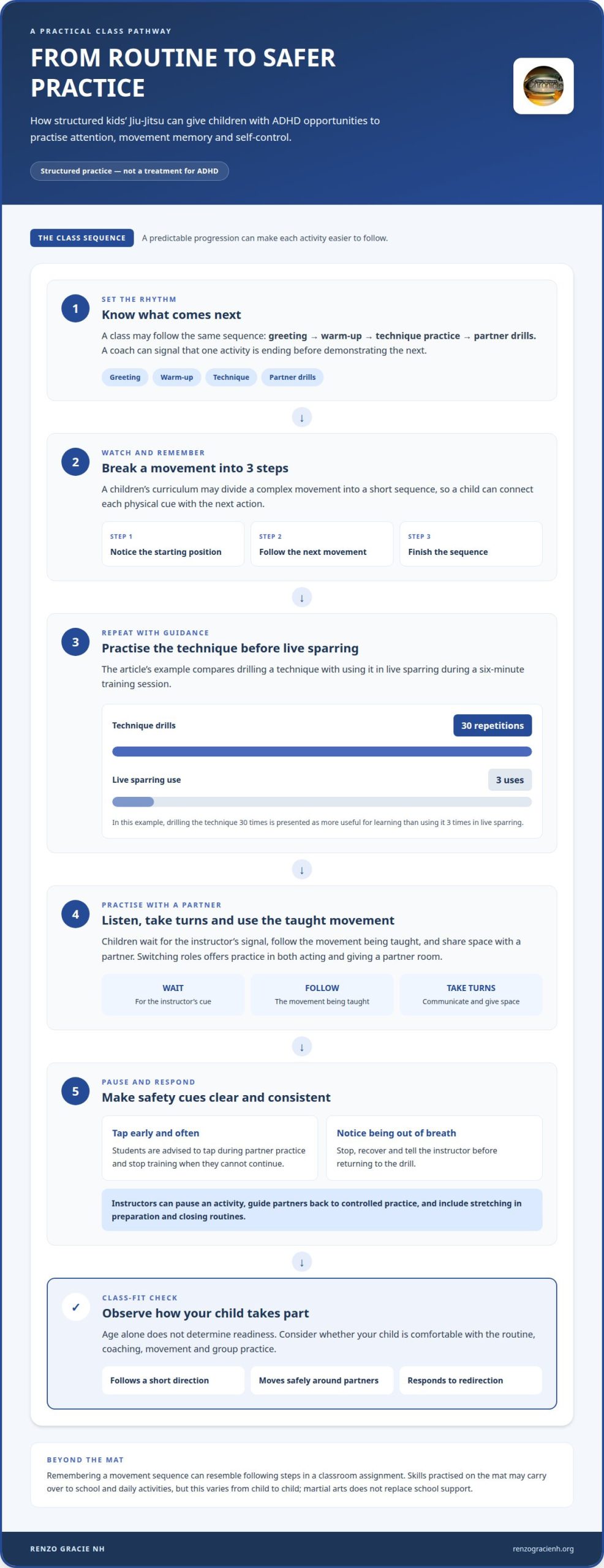
A predictable routine might follow the same sequence each class: greeting, warm-up, technique practice, and partner drills. Knowing what comes next can help children prepare for transitions and refocus on the instructor. For example, a coach might signal that warm-up is ending before demonstrating a technique. Consistent cues help children anticipate changes and rejoin the group.
How Instructors Assess Class Fit
Class fit means how well a child can take part in group instruction and activities. An instructor can observe whether the child follows a short direction, moves safely around partners, and responds to redirection during a drill. Families exploring kids jiu jitsu for ADHD in Windham can consider whether their child seems comfortable with the routine, coaching cues, and pace. These practical signs help families assess whether the class suits their child.
Structured Instruction for Different Abilities
Structured instruction presents a technique in manageable parts before children practise it. A coach can demonstrate a movement, explain its steps, then guide students through repetition and partner drills. In a six-minute Brazilian Jiu-Jitsu training session, drilling a technique 30 times is presented as more useful for learning than using it three times in live sparring. The example shows how controlled repetition gives a child time to focus on the movement before facing sparring’s added unpredictability.
Questions About Instructor Experience
Parents can ask how instructors give directions, support transitions, and redirect a child who loses focus. They can also ask how partner activities are supervised and how students signal that they need to pause. For families considering kids jiu jitsu for ADHD in Windham, concrete examples of teaching approaches can clarify what class participation involves. The answers can help parents decide whether the approach feels right for their child.
School-related skills such as memorizing movements
Brazilian Jiu-Jitsu gives children movement sequences to watch, remember, and practise. A children’s curriculum may break complex movements into 3-step sequences, making the order easier to recall: notice the starting position, follow the next movement, then finish the sequence. Each repetition gives a child another chance to connect a physical cue with the next action. That practice can engage attention and movement memory.
Skills practised on the mat may carry over to school and daily activities, though this varies from child to child. Remembering a sequence, for example, is similar to following steps in a classroom assignment. A child can practise listening to one direction, completing it, and moving to the next. Martial arts does not replace school support, but repeated practice offers a concrete setting to work on persistence and recall.
Mat etiquette gives children practical ways to practise listening: pause when the instructor speaks, wait for a turn, and follow a partner’s instructions. A coach might ask students to face the demonstration, listen, and begin practising only when cued. Clear expectations help children see how attention and respectful behavior support learning together.
Coached activities create opportunities to practise problem-solving. If a movement does not work as expected, the instructor can prompt a child to recall the demonstrated steps and try again. The process is simple: notice the challenge, remember the instruction, and adjust the next attempt. It emphasizes thoughtful effort rather than speed.
Partner drills also offer opportunities to practise social skills. Children take turns, communicate, and respond to another person’s movement. For instance, partners can switch roles after practising a technique, learning both how to act and how to give space. Respect and cooperation become part of the physical task.
Families exploring structured practice can learn more about kids’ Jiu-Jitsu classes and how coached movement supports skill-building.
Impulse control and safe partner practice
Partner drills let children practise controlling their movement while responding to another person. Clear coaching is important: safe participation depends on following instructions and knowing when to pause.
Impulse Control During Partner Practice
In a partner drill, impulse control means pausing, listening, and using only the movement being taught. A child waits for the instructor’s signal before beginning, then follows the technique rather than adding an unpractised move. This gives self-control a practical role: the child manages their actions while sharing space with a partner.
Focus and Self-Control
Focus and self-control involve directing attention to the instructor and regulating effort during practice. A child listens to a cue, performs the taught movement, and pauses when the drill ends. Repeating this pattern makes discipline part of the activity, not just an abstract instruction. Martial arts also combines movement and fitness in a structured physical activity.
Safety cues should be simple and consistent. Students are advised to tap early and often during partner practice and stop training when they cannot continue. These actions give children clear ways to communicate a limit. An instructor can reinforce the cue, pause the activity, and guide partners back to controlled practice.
Breathing can be another useful signal. Feeling out of breath may indicate tension during Brazilian Jiu-Jitsu training. A child who notices this can stop, recover, and tell the instructor before returning to the drill. It is not a test of toughness, but a chance to notice physical signals and respond thoughtfully.
Stretching is also advised to help avoid injuries. Instructors can include it in the class’s preparation and closing routine, while reminding children to move within their comfort. Coached partner drills, tapping, pausing when needed, and stretching are practical safety practices for families to look for in a children’s class.
Kids jiu jitsu age range
There is no single age that determines whether a child is ready for jiu jitsu. Look instead for practical signs: can the child join a group, respond to an instructor’s direction, and take part in movement without quickly losing interest? These observations are more useful than choosing a class based on age alone.
Consider how your child handles a short sequence of activities. Can they listen, try a demonstrated skill, and pause when the instructor signals? A child who needs reminders may still benefit from a structured class when coaching is clear and activities suit their ability. Comfort with close partner practice matters too, because jiu jitsu involves learning movements with another student.
For children with ADHD, a suitable starting point depends on attention, coordination, comfort with touch, and response to group directions. A child who enjoys active tasks may engage with movement-based learning, while a child who feels uneasy about partner contact may need time to become comfortable. The key question is whether the class’s pace and instruction support safe participation.
When comparing kids’ jiu jitsu with karate or taekwondo, focus on the activities your child will practise. Jiu jitsu involves close-range grappling and partner-based defense; karate and taekwondo commonly teach striking techniques and forms. A child who enjoys hands-on, cooperative drills may find grappling engaging. A child drawn to practising strikes or set forms may prefer another style.
Rather than using age as the only measure, consider your child’s readiness for instruction, movement, and shared practice. An instructor can observe how a student follows cues, manages transitions, and responds to partners. Those signs offer a more useful starting point than assuming every child of a certain age is ready for the same class.
Explore children’s Jiu-Jitsu instruction as a way to see whether coached grappling suits your child’s interests and readiness.
Renzo Gracie NH: Kids Jiu Jitsu Program
Renzo Gracie NH offers a Kids Jiu Jitsu Program for families considering structured martial arts practice in Windham, Manchester, and Exeter. It may suit a child interested in movement, coached skill-building, and learning alongside others. Jiu jitsu is not an ADHD treatment, but class activities can give children opportunities to practise focus, movement memory, and impulse control.
A Free Introductory Class lets your child experience the training environment while you observe how they respond to instruction and partner practice. Notice whether the activities feel engaging and manageable, and share relevant needs with the instructor so you can begin with clear communication. Every child’s progress is individual, and the right choice depends on your child’s interests and readiness.
If you’d like to discuss the Kids Jiu Jitsu Program, contact Renzo Gracie NH.
Take the Next Step at Your Child’s Pace
If you’re considering kids jiu jitsu for ADHD in Windham, start by thinking about what helps your child feel ready to learn. Consider where they engage best, how they respond to new group activities, and what would make a first class approachable. Sharing those priorities with Renzo Gracie NH can help your family take a thoughtful first step.
Martial arts is not a quick fix, and your child’s progress should not be measured against another child’s. Focus instead on whether your child feels comfortable participating and wants to return. Even a small sign of interest can help guide your decision.
If you’d like to talk about your child’s next step, contact Renzo Gracie NH. A supportive beginning can open the door to learning, confidence, and steady personal growth.
Frequently Asked Questions
Does Martial Arts Help Kids With ADHD?
Martial arts can give children with ADHD a structured setting to practise attention, movement memory, and emotional control. A child can listen to a coach’s cue, practise a technique, and pause when the activity changes. These experiences may support skill-building, but martial arts is not an ADHD treatment and should not replace care or support a child already receives.
What age can kids start jiu-jitsu classes in Windham, New Hampshire?
Readiness matters more than a specific starting age. Consider whether your child can join a group activity, respond to coaching, and feel comfortable with partner practice. A child who needs reminders may still participate when the class pace and instructor’s guidance support safe engagement. These signs can help you decide whether a class is a good fit.
Do local jiu-jitsu schools offer ADHD-friendly coaching or accommodations?
Instructors can make classes easier to follow with practical teaching choices, such as giving one direction at a time, demonstrating movements, and allowing a child to pause. These approaches can support participation without assuming every child needs the same help. Parents can explain what works for their child, such as a brief cue before transitions or space to reset.
How can jiu-jitsu help children with ADHD, and what does research say?
Jiu-jitsu may offer active practice in listening, remembering movement sequences, and managing behavior with a partner. A randomized trial of judo training involved 57 children with ADHD, but that number alone doesn’t show whether training improved symptoms. Judo and Brazilian Jiu-Jitsu are different activities, so the trial shouldn’t be treated as proof that jiu-jitsu treats ADHD.
What are the safety risks and precautions for children with ADHD in jiu-jitsu?
Partner practice involves physical contact, movement, and close attention to coaching, so impulsive actions or fatigue can affect safe participation. Children should use only techniques taught in class, tap early to signal a partner to stop, and pause training if they cannot continue. Tell the instructor about relevant needs before class so the coach can guide your child’s participation appropriately.