Posts

Martial Arts Classes for Families in Exeter

A first class doesn’t have to start with experience. Martial arts for families in Exeter can be a welcoming starting point for children, teens, and adults, and complete beginners can join without prior experience. The right class gives each family member room to learn at a comfortable pace.

It’s natural to want an activity that builds skills as well as confidence and focus. This guide explores what families can expect from martial arts classes in Exeter, with a closer look at kids’ Brazilian Jiu-Jitsu and how structured practice can support young learners. You’ll also learn what to consider when choosing a class and what a first step into training can look like.

Key Takeaways

  • Compare classes by age group and learning approach to find a comfortable entry point for each family member.
  • Look for structured practice that gives children opportunities to work on focus, respect, and steady progress.
  • Explore how kids’ Brazilian Jiu-Jitsu introduces young learners to martial arts through guided practice.
  • Consider a free introductory class as a practical first step toward trying training for yourself or your child.

Martial arts classes for children, teens, and adults

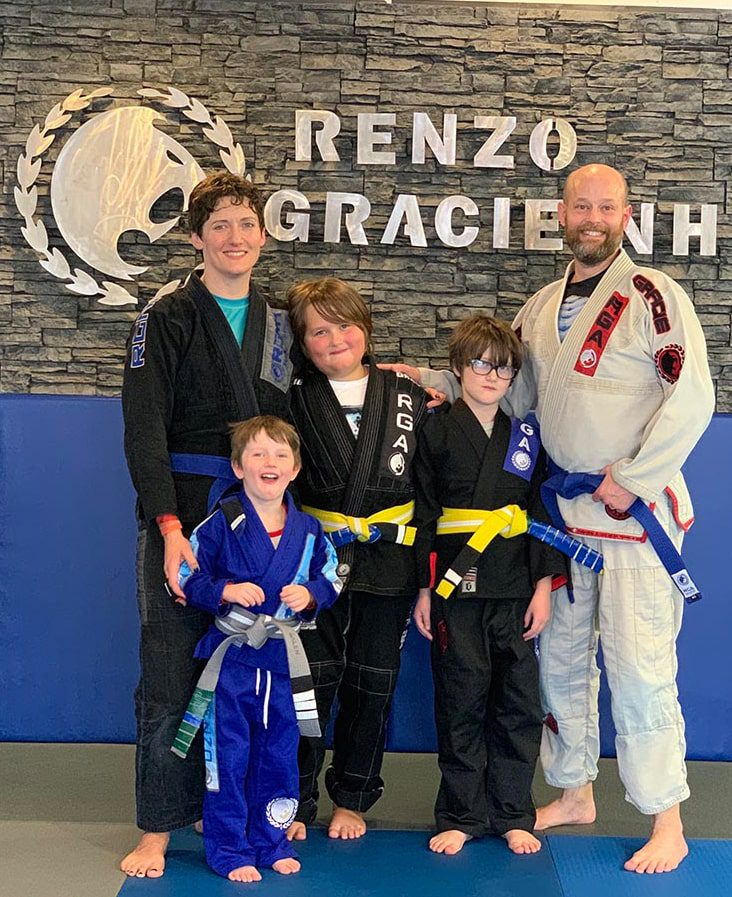
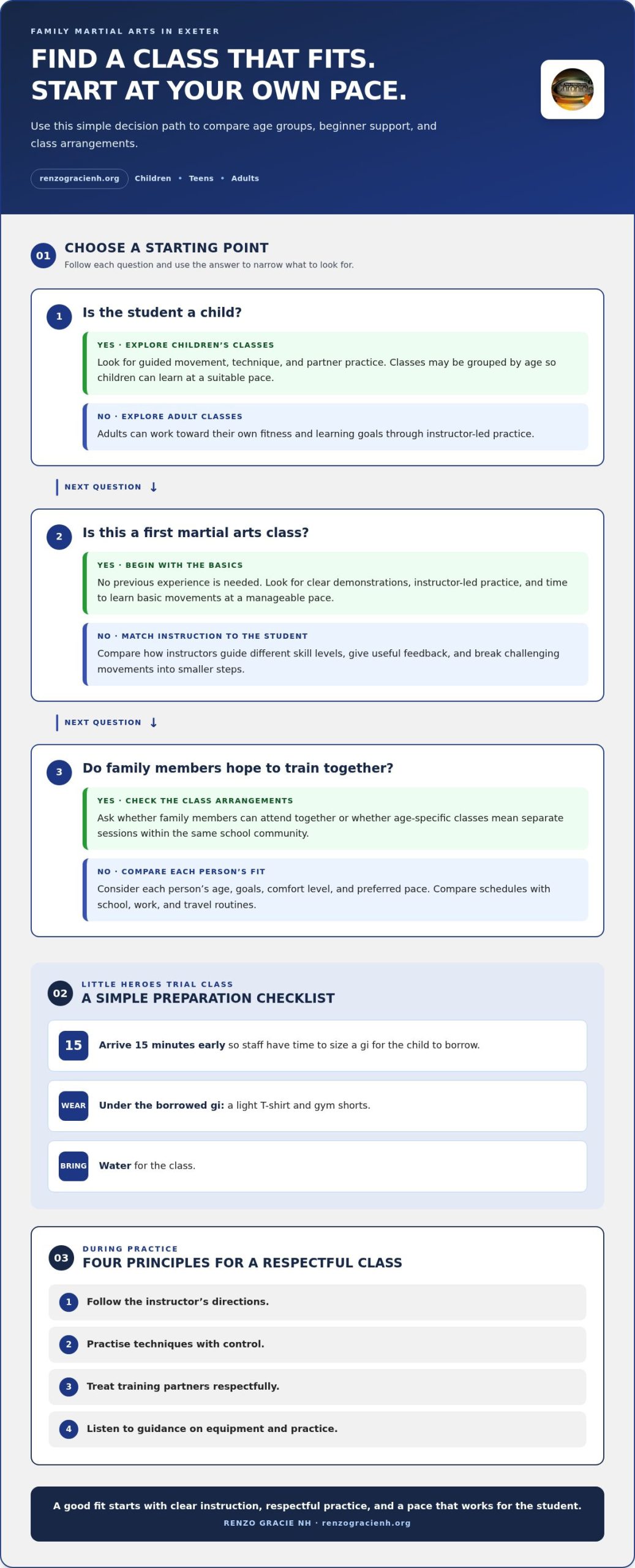
Martial arts for families in Exeter can include Brazilian Jiu-Jitsu, with options for children and adults. Complete beginners can start without previous experience, learning basic movements through instructor-led practice. Classes may group students by age, so family members can develop skills at a pace that suits them.

Children’s classes introduce movement and partner practice, while adults can work toward their own fitness and learning goals. Brazilian Jiu-Jitsu is one style families can explore. To find a suitable school, consider the age groups taught, how instructors guide beginners, and whether family members can train together or attend separate classes.

Families exploring martial arts for families in Exeter can also make the first visit easier with a little planning. A free introductory class offers a chance to experience instruction before choosing whether to continue. Plan the route and parking before leaving, and allow time to arrive without rushing. Compare class locations and schedules with the family’s usual school, work, and travel routines.

Beginner Brazilian Jiu-Jitsu for Children

Beginner Brazilian Jiu-Jitsu introduces children to movement, technique, and partner practice through guided instruction. During a Little Heroes trial class, arrive 15 minutes early so staff can size a gi to borrow. Children should wear a light T-shirt and gym shorts under the gi, and bring water. These simple steps help families prepare for the class.

Family Class Safety and Equipment

Follow the instructor’s directions, practise techniques with control, and treat training partners respectfully. For the Little Heroes trial, children wear the borrowed gi over a light T-shirt and gym shorts and bring water. Listen to the instructor’s guidance on equipment and practice throughout class.

A separate consideration when comparing activities is how uncommon professional league selection is for children who play team sports. The page states that an average of 168 children are drafted into professional leagues for every 1 million U.S. children ages 8-12 who play team sports, and gives the proportion of children drafted into professional leagues as 0.00016%. These figures provide context, but families can choose classes for learning, enjoyment, and fitness rather than professional outcomes.

Confidence, discipline, and focus

A structured class gives children and adults clear tasks to practise and improve. Remembering a movement sequence or following a partner drill makes progress easier to see.

Fitness and Confidence Benefits

Martial arts combines movement, technique, and focus, so students can develop fitness while learning. A beginner might practise a basic movement, repeat it, and apply the instructor’s feedback. That visible progress can build confidence through effort rather than comparison with others.

For children, discipline can mean listening to instructions, taking turns, and focusing on the next drill. Adults may value the concentration needed to learn a technique after a busy day. Look for classes where instructors explain activities clearly and students have time to practise at a manageable pace.

Personal Growth and Self-Defense

Self-belief grows through repeated chances to try, adjust, and keep going. A student struggling to remember a sequence, for example, can practise each movement separately before joining the full drill. This process supports patience and perseverance in training, at school, and at work.

Self-defense instruction can introduce practical skills alongside awareness, control, and respect for training partners. It cannot promise that a student will prevent every threat. Look for responsible teaching that emphasizes controlled practice, and make sure beginners understand how to follow directions before attempting unfamiliar movements.

To explore a structured approach to Brazilian Jiu-Jitsu, families can review Brazilian Jiu-Jitsu training as one possible next step.
Martial Arts Classes for Families in Exeter

Instruction for different ages and skill levels

Good instruction gives students a clear next step, whether they’re new or experienced. In Exeter, families can look for classes that support age-appropriate learning and individual progress.

Watch how instructors demonstrate a skill, explain it, and guide practice. A child learning a movement might practise it slowly before using it in a partner drill. Teens and adults may be ready for more complex sequences, but beginners still need clear explanations and time to build skills gradually.

When choosing a martial arts school in Exeter, look for age-appropriate teaching, respectful communication, and support for different skill levels. Notice whether instructions are clear and students receive useful feedback during class.

An instructor needs to know both the technique and how to teach it. Look for information about their martial arts background and experience with the age group your family member would join. Effective teaching breaks challenging movements into smaller steps instead of expecting students to master them immediately.

Consider background checks separately when evaluating a school. Review its stated screening practices rather than assuming a title or training history explains them. Also notice how instructors supervise practice, help students who need support, and set expectations for respectful behavior. These details offer practical insight into the learning environment.

Families hoping to share martial arts as family time can compare class arrangements alongside teaching style. Some family members may train in age-specific classes while building skills within the same school community. Consider each person’s goals, comfort level, and preferred pace, then choose instruction that supports steady learning and character development without treating beginners as though they should already know the movements.

Kids’ Brazilian Jiu-Jitsu

Brazilian Jiu-Jitsu teaches grappling, positioning, and control, often with practice on the ground. Children can explore these ideas through guided movement and partner drills, such as moving from one position to another. The focus is on learning technique, not relying on size or strength alone.

Good teaching breaks unfamiliar movements into manageable steps. An instructor might demonstrate a movement, have students practise it slowly, then offer feedback. Children learn to listen, take turns, and work respectfully with partners. Parents can look for clear explanations and practice suited to the group’s age and experience.

New students don’t need to know the techniques before they arrive. They can follow demonstrations, learn class routines, and ask for help when a movement feels unfamiliar. Progress comes through repetition: a child may learn a position first, then practise moving between positions. This gradual approach gives beginners a clear starting point.

Before choosing a program, consider what your child wants from an academy. A child who enjoys movement and problem-solving may like learning how position and timing affect a partner drill. Consider whether the class supports respectful practice and steady participation to help decide if the teaching approach suits your child.

Brazilian Jiu-Jitsu can offer children a structured way to develop skills, focus, and confidence through practice with other members. The clearest takeaway is to look beyond the style’s name: notice how instructors explain techniques, guide partner work, and help beginners participate. To explore a kids’ Brazilian Jiu-Jitsu class, take the next step and arrange an introduction.

Renzo Gracie NH: Adult Jiu Jitsu Program

Renzo Gracie NH is a next step for Exeter adults who want to begin Brazilian Jiu-Jitsu through a dedicated Adult Jiu Jitsu Program. Families can also explore the Kids Jiu Jitsu Program, making it possible for adults and children to pursue training within the same academy community. A Free Introductory Class offers a practical way to experience instruction before deciding whether to continue. The right time to start is when you’re ready to learn, practise consistently, and build skills at your own pace. The academy also provides Law Enforcement Jiu-Jitsu Training for that professional audience. For a welcoming first step, visit Renzo Gracie NH to learn about its introductory class.

Take the First Step Toward Training Together

Choosing martial arts for families in Exeter can start a shared routine while each person follows individual goals and progress. Decide what matters most to your household, whether that’s a new challenge for an adult, a positive activity for a child, or training connected to professional duties. Then explore the class that fits and experience what getting started is like.

Renzo Gracie NH offers an Adult Jiu Jitsu Program, a Kids Jiu Jitsu Program, and Law Enforcement Jiu-Jitsu Training. Each offers a different starting point, so the whole family doesn’t need to follow the same path. Begin by showing up, learning, and returning to practise.

If you’re ready to explore your next step, contact Renzo Gracie NH. Start at your own pace, and let each class be an opportunity to grow.

Frequently Asked Questions

What are the age requirements for family martial arts classes in Exeter?

Exeter programs include separate Jiu-Jitsu instruction for children and adults, rather than one age cutoff for every student. A child would begin with the Kids Jiu Jitsu Program, while an adult can choose the Adult Jiu Jitsu Program. New students can use the free introductory class to experience the instruction and see which program fits their stage of life.

What are the class schedules and locations for Exeter family martial arts schools?

Renzo Gracie NH has academy locations in Exeter, Windham, and Manchester, New Hampshire, with classes on varied days and at varied times. Choose a location that fits your regular travel and school or work routines. Consider the drive and find a class time your family can attend consistently.
BJJ classes for older adults in Windham

You’re not too old to start Brazilian Jiu-Jitsu: people can begin at 20, 40, or 70. BJJ for older adults in Windham can start with fundamentals and controlled practice, while hard rolling waits until you’re ready.

It’s understandable to wonder whether age, fitness, or experience will make your first class difficult. BJJ doesn’t have to start with intense sparring. Patient practice can help you learn at a steady pace and become more comfortable with movement and technique.

Here, you’ll learn how beginners can approach training safely, which class times may fit an older student, and how often to train. You’ll also see how Brazilian Jiu-Jitsu can build confidence and practical self-defense skills through technique, focus, and consistent progress.

Key Takeaways

  • You’re not too old to begin Brazilian Jiu-Jitsu; adults can start at different ages and progress at a pace that suits them.
  • Plan for two to three classes a week, and consider morning or midday sessions for a calmer, technique-focused start.
  • Build a steady foundation before adding more demanding drills; early training can focus on fundamentals without hard rolling.
  • Learn how movement, balance, and technique can support fitness while helping you develop practical self-defense skills.
  • Expect confidence to grow through patient practice, problem-solving, and small milestones along the way.

Which class times work best for older beginners?

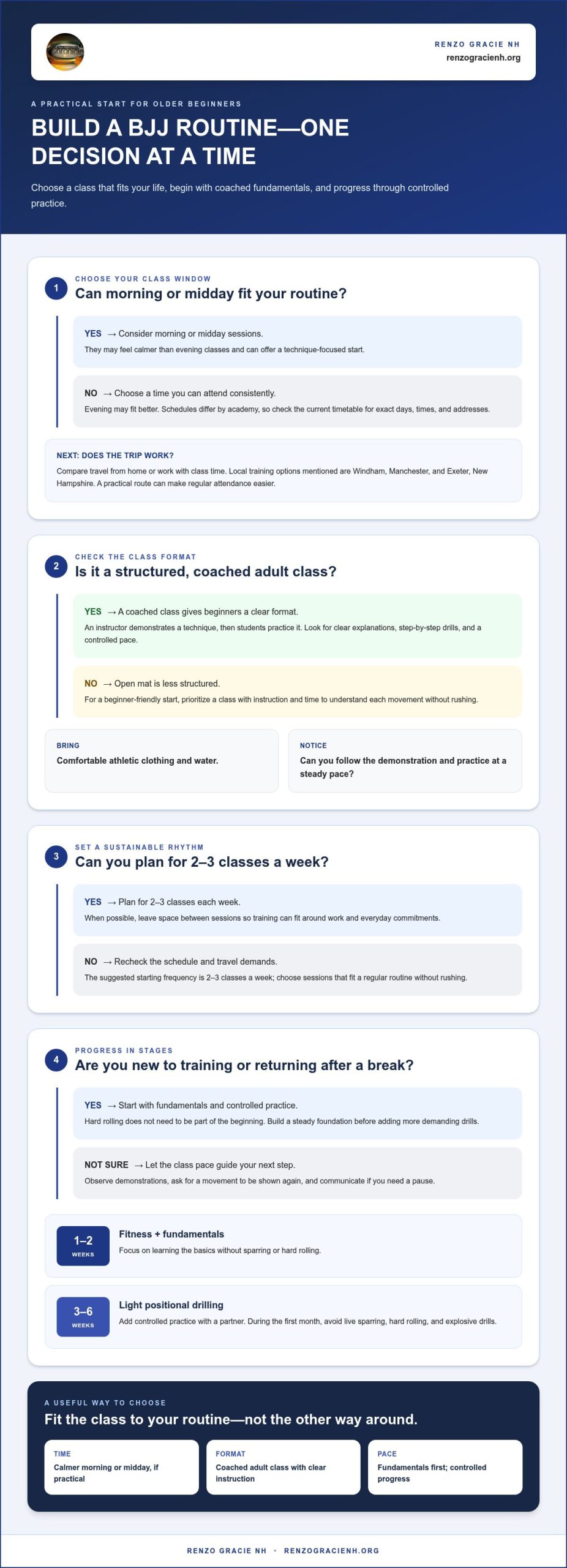
Morning and midday sessions may feel calmer than evening classes. The best time for an older beginner is one that fits a regular routine and allows you to arrive without rushing.

Class Schedules and Locations

For local training, focus on Windham, Manchester, and Exeter, New Hampshire. Compare the trip from home or work with the class time, and consider whether the route makes regular attendance practical. Morning and midday sessions are often calmer than evening classes, but schedules differ by academy. Use each school’s current timetable for exact days, times, and address details.

The suggested starting frequency is two to three classes a week. Choose sessions with space between them when possible, so you can fit practice around work and everyday commitments. Check travel time as well as the timetable; a convenient class is easier to keep in your routine.

Beginner-Friendly Adult Classes

Start with a structured adult class rather than open mat. In a coached session, an instructor demonstrates a technique before students practice it; open mat is less structured. Look for clear explanations, step-by-step drills, and a controlled pace that gives beginners time to understand each movement.

For your first class, wear comfortable athletic clothing and bring a water bottle. Notice whether demonstrations are easy to follow and whether you have time to practice each technique without rushing.

To choose between BJJ, judo, and other martial arts around Windham, compare the training focus and class format. Brazilian Jiu-Jitsu emphasizes grappling and ground positions, while judo focuses on throws and stand-up grappling. Consider which skills interest you and which schedule fits your routine.

Older beginners can ease into training with a staged approach. During the first month, avoid live sparring, hard rolling, and explosive drills. The first phase, weeks 1 to 2, focuses on fitness and fundamentals without sparring or hard rolling. Weeks 3 to 6 add light positional drilling with a controlled partner.

When reading reviews, look for specific comments about instructor explanations, how beginners are treated, and cleanliness in the training space. A review describing a class or facility offers more useful detail than a general rating alone. Consider those observations alongside location and schedule when choosing where to train.

For your first visit, allow time to find the training space and get ready. Comfortable athletic clothes and water are practical basics. The class gives you a chance to observe, listen, and learn the format before deciding whether it suits you.

Confidence and personal growth

Confidence in martial arts often grows through small, observable steps, not a sudden change in personality. You might first remember a position, then follow a partner drill, and later recognize when a familiar technique fits. Each step gives you something specific to build on. You’re learning how to respond, not proving you can overpower someone.

Brazilian Jiu-Jitsu asks you to solve movement problems while staying attentive to another person. For example, when a partner shifts their weight, you adjust your position and look for a safer angle. Practice encourages you to think ahead, remember sequences, and adapt when your partner changes their response. These are skills developed one decision at a time.

Progress can take patience. It may take about 6 months of training to start feeling like you know what to do. That doesn’t mean every class feels easy or that learning follows a fixed timetable. A useful measure is whether a technique or sequence feels more familiar than it did before. Small gains in focus and recall count.

Try a simple reflection after class. Write down one technique you remember, one part that challenged you, and one question for your next session. You might note that a movement made more sense after you practiced it slowly. This creates a clear record of what you’re learning, rather than a judgment of your ability.

Friendship can grow through the shared work of learning. Partners take turns practicing, respect each other’s pace, and repeat a sequence until it makes sense. If you forget a step, ask to see the movement again; if you need a pause, communicate that clearly. Respectful practice makes cooperation part of the lesson.

  • Choose one learning goal: remember a position or movement.
  • Notice one adjustment: identify how your partner’s movement changed your response.
  • Record one question: bring it into a later class.

Keep the focus on consistency and attention, not comparison with younger students or experienced teammates. BJJ for older adults in Windham can be a way to practice problem-solving, patience, and confidence alongside other students. If you’re ready to make that learning part of your routine, explore a structured place to train.

What is Brazilian Jiu-Jitsu?

Brazilian Jiu-Jitsu is a grappling martial art built around movement, positioning, and technique. In class, partners practice controlling positions and responding to changes on the mat.

Fitness Benefits

A Brazilian Jiu-Jitsu class combines learning techniques with active practice. For example, a student might move from a seated position, practice a controlled escape, then reset and repeat the sequence. This varied movement works the body in different ways rather than relying on one repeated motion. Grappling practice also engages muscles as students maintain posture and adjust their positions.

Mobility and Conditioning

Jiu-Jitsu movements involve stability, posture, and awareness of body mechanics. For example, students may shift their weight while maintaining balance during a partner drill. Classes also include movement, rolling, and grappling, which can challenge muscles and joints and involve mobility. The effort depends on the drill, its pace, and how actively a student participates.

Fitness develops through repeated actions, not just hard rounds. You might practice getting up from the mat, changing direction, or holding a stable position while a partner applies controlled pressure. Each movement calls for coordination and attention. Maintaining posture as you move also helps you understand how balance changes in different positions.

Conditioning in BJJ is part of learning technique. A sequence may require you to move, pause, listen to a correction, and repeat the movement with better control. This makes class physically active while keeping the focus on learning. Beginners can work on clean, deliberate movement instead of trying to match an experienced partner’s pace.

To understand how training feels, notice how often you move, which positions challenge your balance, and whether you can follow a technique while staying controlled. These observations can help you describe your current fitness and identify movements to practice. If turning from your side feels unfamiliar, for instance, you can work on that movement gradually.

Brazilian Jiu-Jitsu can support fitness by combining movement with practical problem-solving. The physical demands vary with each technique and drill, so focus on posture, coordination, and effort rather than treating every class as a test. The goal is purposeful practice: learn the movement, understand its mechanics, and build familiarity through repetition.

BJJ classes for older adults in Windham

Practical self-defense

Brazilian Jiu-Jitsu teaches grappling skills for situations where people are close together. Students practice recognizing positions, managing balance, and working toward an escape. Drills help you understand a technique and its limits, but real situations may not unfold like practice. Self-defense also involves noticing risk and choosing a safe opportunity to leave.

Technique matters because BJJ emphasizes leverage and position rather than relying on excessive physical strength. For example, you can learn to shift your weight and create space instead of pushing directly against a partner’s force. This gives beginners a problem to solve: identify what is restricting movement, then practice a controlled response. Repetition helps make the sequence more familiar.

Mat drills can include weight shifts, sweeps, and escapes from different positions. A sweep changes the balance between partners, while an escape helps a student move out of a position that limits movement. During instruction, break each action into smaller steps: notice your partner’s position, move with control, and reset when asked. This makes the learning process concrete.

Grappling practice also teaches awareness of distance and body position. If a partner shifts their weight, you can feel the change and adjust rather than relying on a memorized response. This practice develops attention to movement. It also highlights an important distinction: a technique practiced with a cooperative partner can’t guarantee how an unpredictable encounter will unfold.

For older beginners, controlled drills make it easier to focus on the mechanics of defense before adding pressure. You can practice moving from a restricted position, maintaining balance, and creating space. Hard rolling and live sparring aren’t required to understand a basic technique. Instructors demonstrate movements, guide slow repetitions, and help students notice how posture and timing affect the result.

Practical self-defense skills are best learned as options, not as a promise that one move solves every problem. In class, you might learn an escape, repeat it from both sides, then practice recognizing the position that calls for it. If a response feels unclear, pause and ask to see the movement again so you can focus on understanding.

  • Notice the position: identify what is limiting movement.
  • Use technique: practice a weight shift or escape with control.
  • Reset and repeat: refine the sequence before increasing pressure.

This step-by-step approach connects learning with practical defense while keeping training focused on skill. Through repetition, students build familiarity with positions, changes in balance, and controlled escapes. The value lies in understanding what a technique asks your body to do, then practicing that response attentively with a partner. Each drill develops awareness and decision-making alongside grappling fundamentals.

BJJ for older adults

People aged 20, 40, or 70 can start Brazilian Jiu-Jitsu. Age alone doesn’t define whether training is suitable; experience, current condition, and the way practice is introduced matter. An older beginner can start by learning positions and basic movement, then build skills through controlled partner drills. The practical takeaway is simple: begin with fundamentals, not a test of toughness.

For students over 40, the approach should leave room to learn before attempting hard rolling. During the first month, older beginners are advised to skip live sparring, hard rolling, and explosive drills. That creates space to learn how a movement works, understand a partner’s position, and practice at a manageable pace. If you have a serious injury, consult a doctor before training.

A gradual plan makes the early learning steps clear. The suggested first phase lasts weeks 1 to 2 and focuses on fitness and fundamentals without sparring or hard rolling. In weeks 3 to 6, the next phase adds light positional drilling with a controlled partner. Students can focus on one position at a time, such as practicing how to move from a restricted position.

The suggested third phase runs from weeks 7 to 12. It may include light structured rolling or controlled pad rounds if the trainee feels well. These are stages, not a demand to advance on a fixed date. A useful decision at each step is whether you can follow the technique, maintain control, and recover comfortably before adding a more demanding drill.

  • Start with fundamentals: learn positions and movement before sparring.
  • Build control: practice a technique slowly with a partner.
  • Progress deliberately: add challenge as your skills and comfort develop.

Brazilian Jiu-Jitsu also involves problem-solving and mental engagement. Remembering a sequence, noticing a partner’s weight shift, and choosing a response keep your mind involved alongside physical practice. Progress includes more than completing a drill: it also means recognizing the situation and understanding why a technique fits.

Make your first goal specific: learn one position, ask for a controlled repetition, and notice what changes your balance. Then build from that foundation instead of measuring yourself against younger students or experienced teammates. To put those fundamentals into practice, explore the Adult Jiu Jitsu Program.

Renzo Gracie NH: Adult Jiu Jitsu Program

Renzo Gracie NH offers an Adult Jiu Jitsu Program for adults ready to turn interest into structured training. If you’re considering BJJ for older adults in Windham, the free introductory class is a practical way to experience the instruction before building a routine.

Bring questions about learning the fundamentals, training at a steady pace, and developing grappling skills. Start with a practical first step, then decide how Brazilian Jiu-Jitsu fits your goals. Training is also a chance to build skills alongside a supportive community of students.

Visit renzogracienh.org to learn more about the Adult Jiu Jitsu Program or the Free Introductory Class.

Make your next step a steady one

Starting something new doesn’t require a perfect plan. Choose a manageable first step, then let your experience guide what comes next. If you’re exploring BJJ for older adults in Windham, consider what you want from training, such as learning practical skills, building confidence, or joining a regular activity. A clear personal goal can help you focus on your progress instead of comparing yourself with others.

Renzo Gracie NH offers an Adult Jiu Jitsu Program, a Kids Jiu Jitsu Program, and Law Enforcement Jiu-Jitsu Training. Each serves different students and goals, while the adult program is the place to explore your own training. Give yourself room to learn at your pace and take pride in each new skill.

Ready to take a first step? Contact Renzo Gracie NH and explore where your training can begin. Your progress starts with showing up.

Frequently Asked Questions

Are you too old to start martial arts?

No, age alone doesn’t prevent someone from beginning martial arts. People aged 20, 40, or 70 can start Brazilian Jiu-Jitsu, with training adjusted through fundamentals and controlled practice. Consider your goals, current abilities, and comfort with movement when choosing how to begin. For an older beginner, learning techniques carefully is a more useful starting point than trying to keep pace with experienced students.

Can I train with an old injury or joint problem?

An old injury or joint problem calls for thoughtful planning before training. If you have a serious injury, consult a doctor before starting. Be ready to describe which movements cause discomfort, such as turning, kneeling, or bearing weight through an arm. This helps you understand which movements need attention in class. Don’t treat discomfort as a challenge to push through; prioritize controlled movement and clear communication.

How often should an older adult train?

Two to three sessions a week is the suggested starting frequency for older beginners. For example, choose spaced-out days that leave time for rest between classes, rather than stacking sessions together. Keep the schedule manageable alongside work, family, and other physical activity. If you’re learning several techniques, consistency matters more than cramming practice into one demanding week. Track attendance and energy to see whether your routine feels sustainable.

Is 50 too old to start jiu-jitsu?

No, 50 isn’t too old to begin jiu-jitsu. People can start at different ages, including 40 and 70, and focus first on learning foundational movements. A new student at 50 can set a practical goal, such as remembering a position or moving with control during a drill. Progress comes from practicing skills deliberately, not from matching a younger student’s speed or experience.

Is BJJ safe for seniors and people over 40?

Brazilian Jiu-Jitsu includes physical contact, so how training is introduced matters. People over 40 can learn the art, while older beginners are advised to avoid live sparring, hard rolling, and explosive drills during their first month. Start with fundamentals and controlled practice. Serious injuries call for medical advice before training. Clear limits, careful movement, and attention to how each drill feels help guide participation.

What Happens During Your First BJJ Class?

A first class generally introduces basic movements and techniques through instruction and practice. You may watch a demonstration, try a movement, then repeat it with a partner at a controlled pace. As a beginner, focus on understanding the position rather than performing quickly. Comfortable athletic clothing and a water bottle are practical items to bring. Expect to learn gradually, with time to follow each step.

Do Windham-area BJJ gyms have beginner-friendly or age-specific programs for older adults?

In Windham, New Hampshire, Renzo Gracie NH offers adult Jiu-Jitsu instruction for different experience levels. Beginners can build a foundation through adult training without assuming a separate age-specific class. Adults in nearby Manchester and Exeter can also explore the academy’s adult program. Consider whether the instruction includes fundamentals and controlled practice suited to your experience and goals.

What should older adults expect at their first BJJ class?

Expect to listen, observe, and practice basic movements; no prior experience is needed. For instance, an instructor may demonstrate a position before students repeat it in a partner drill. Wear comfortable athletic clothing and bring water. Before class, think about what you want to learn, such as how a movement works or how to maintain balance. Renzo Gracie NH offers new students a free introductory class.

Adult BJJ Training in Manchester, NH: Find Your Fit in 2026

What if your first Brazilian Jiu-Jitsu class is less about keeping up and more about finding the right coach and pace? If you’re comparing options for adult BJJ training Manchester NH, you may be wondering what beginners do, whether your fitness or age will hold you back, and how to choose an academy from a few online posts.

You don’t need to arrive fit, experienced, or certain BJJ is for you. Start by finding out what a beginner class involves: how the instructor explains techniques, what partner practice looks like, and whether you can ask questions or pause when needed. Coaching and class culture matter as much as the schedule.

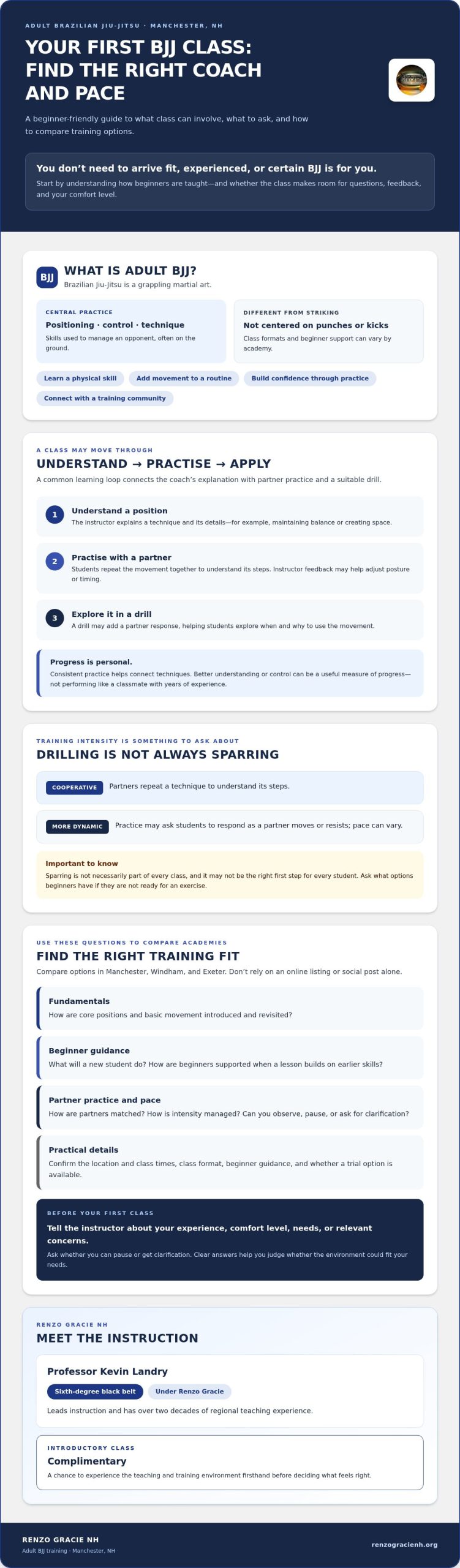
This guide explains what to expect in adult BJJ and gives you practical questions for comparing training options around Manchester, Windham, and Exeter. It also introduces Renzo Gracie NH, where Professor Kevin Landry, a sixth-degree black belt under Renzo Gracie with over two decades of regional teaching experience, leads instruction. A complimentary introductory class lets you experience the teaching and training environment before deciding what feels right.

Key Takeaways

  • Adult BJJ training Manchester NH can be a way to learn grappling skills, add movement to your routine, and connect with a training community.
  • Look for instruction that explains fundamentals, allows time for guided practice, and makes room for questions and feedback.
  • Before your first class, ask how beginners are supported and how to share your experience, comfort level, or relevant concerns.
  • Compare options in Manchester, Windham, and Exeter by confirming locations and class times, class format, beginner guidance, and trial options.
  • Renzo Gracie NH offers a complimentary introductory class, so you can experience the teaching and training environment firsthand.

Adult BJJ Training Near Manchester, NH: What to Look For

Brazilian Jiu-Jitsu (BJJ) is a grappling martial art that uses positioning, control, and technique to manage an opponent, often on the ground. Unlike striking-based martial arts, its central practice is not punches or kicks. For a neutral overview of its history and principles, see Brazilian Jiu-Jitsu.

Adults take up BJJ for different reasons: learning a physical skill, adding movement to their routine, developing confidence through practice, or joining a community. The right academy depends on your goals and how its instruction fits your needs. Class formats and beginner support vary, so don’t rely on a listing or social post alone. Ask how a class is organized and what a new student will do.

What happens in an adult Brazilian Jiu-Jitsu class?

A class may include an instructor’s explanation, partner practice of a technique, and supervised drills that help students connect the steps. The balance varies by academy and class. Don’t assume every session includes live sparring or follows the same format. Ask what to expect in your first class, how partners are selected, and whether you can observe or pause if you need clarification.

Which goals can adult BJJ training support?

With regular practice, students can work on grappling skills, coordination, movement, and steady personal progress. What you gain depends on attendance, your individual needs, and the instruction. Progress isn’t identical for everyone, and competition doesn’t have to be your goal. If you’re new to training, this adult beginners’ BJJ guide offers more context on getting started.

As you compare options for adult BJJ training Manchester NH, use your goals to guide the questions you ask:

  • Skill: How are fundamentals introduced and revisited?
  • Fitness and comfort: Can you tell the instructor about your experience and needs?
  • Community: How does the academy help new adult students feel included and supported?

Clear answers help you assess whether the training environment could fit your needs before you commit to a routine.

How Adult BJJ Training Builds Skills from Fundamentals to Practice

Skill-building in Brazilian Jiu-Jitsu often follows a learning loop: understand a position, practise its details, then try applying them in a suitable drill. For example, a coach might explain how to maintain balance and create space from a position before students repeat the movement with a partner. A drill may then add a response from the partner, helping students explore when and why to use the movement.

Consistent practice helps connect individual techniques into skills you can recognize and apply. Repetition makes movements more familiar, while instructor feedback can highlight adjustments to posture or timing. Over time, separate pieces of instruction may begin to fit together. The pace varies, and progress is personal. For a newer student, a useful measure may be better understanding or control, not whether they perform like a classmate with years of experience.

Why fundamentals matter for adult beginners

Core positions and basic movement provide a foundation for more complex techniques. Learning to stay balanced, create space, and move with control can make later lessons easier to follow. Academies may organize fundamentals differently, so ask how instructors introduce foundational material and whether beginners get help when a lesson builds on earlier skills. There’s no single curriculum or advancement timeline that applies everywhere.

How to think about drilling and live practice

In a cooperative drill, partners repeat a technique to understand its steps. More dynamic practice asks students to respond as a partner moves or resists, and the pace can vary. Ask how partners are matched, how instructors manage intensity, and what options beginners have if they’re not ready for a particular exercise. Sparring isn’t necessarily part of every class, and it may not be the right first step for every student.

Training goals can include learning new movement and building confidence through steady practice, but experiences differ. The University of Bath has announced research on BJJ’s mental health benefits; the announcement describes a study, not a guaranteed outcome for individual students. Ask what instruction looks like in practice, then decide whether the pace and guidance suit you.

If you’re exploring adult BJJ training Manchester NH, learn more about adult Jiu-Jitsu instruction at Renzo Gracie NH and consider how its approach aligns with your goals.

Worried Adult BJJ Will Be Too Intense? How to Judge the Training Fit

You don’t need prior martial arts experience to ask about starting Brazilian Jiu-Jitsu. Nor do you have to reach a particular fitness level before talking with an instructor. Adults begin with different backgrounds, needs, and comfort levels, so find out how a class welcomes newcomers and what choices you have during practice.

Training intensity and comfort can vary by class, partner, and activity. Before participating, tell the instructor about relevant concerns and ask what adjustments may be possible. If you have a health limitation, discuss it with a qualified health professional and the academy before deciding how to take part. You can also ask whether it’s possible to pause or observe an exercise rather than push through uncertainty.

Can adults start BJJ without being in shape?

People begin with different fitness levels, and there’s no single starting point that suits everyone. Ask whether instruction can be introduced gradually and explain any concerns that could affect your participation. You don’t need to prove your fitness before asking about a first class. A direct conversation helps you understand what to expect without relying on promises about results or assuming every student follows the same pace.

What makes a training environment feel supportive?

Look for observable signs, not just welcoming language in a listing. Do instructors explain techniques clearly and invite questions? Do partners communicate about pace and respect each other’s comfort? If you visit, ask whether you can watch a class or pause during an activity. The response to those questions can tell you more than a short social post.

Before choosing adult BJJ training Manchester NH, consider asking:

  • For beginners: How are new students introduced to class activities?
  • For comfort: What can I do if an exercise feels too intense or I need a break?
  • For partner work: How are partners matched, and how do students agree on pace?
  • For personal needs: Who should I speak with about a health limitation or concern?

Clear, respectful answers can help you judge whether the environment fits your needs. You’re not expected to know everything before you start. You can ask questions, set boundaries, and decide what feels manageable.

Adult BJJ Training in Manchester, NH: Find Your Fit in 2026

Compare Manchester-Area Adult BJJ Academies with These Questions

A short listing can help you find options, but it may not show what training will actually feel like. Ask the same questions of each academy, then compare the answers with your commute, the instructor’s experience, and how clearly staff communicate with prospective students. If you’re considering Manchester, Windham, or Exeter, verify each academy’s current location and adult schedule directly, since online details may change.

What to compare What to confirm Academy notes
Location and commute Where are adult classes held, and is the trip practical for your routine? Record address and travel time
Adult class times Which current classes are open to adults, and do the times work for you? Record confirmed days and times
Beginner guidance Can beginners join, and how are first classes introduced? Note the explanation
Class format What instruction, partner practice, or other activities should you expect? Note how the class is structured
Trial options Can you try a class, and what are the booking steps or participation requirements? Record confirmed details

Questions to ask before choosing an adult BJJ class

Get practical details before you visit: ask what to wear, what to bring, and whether there’s anything to know before participating. Find out how instructors pair students for practice and help partners agree on an appropriate pace. If you have a specific concern, ask who to speak with before class. Clear answers help you prepare and decide whether the setup feels comfortable.

How to assess coaching and academy culture

Look for evidence, not just promotional language. Do instructors explain techniques clearly, pay attention during practice, and make room for questions? Notice whether partners communicate respectfully and follow the instructor’s guidance. You can ask about the instructor’s experience and how lessons support students at different levels. Compare what you’re told with what you observe during a visit.

For adult BJJ training Manchester NH, a practical fit means a workable commute, suitable class times, thoughtful beginner guidance, and an atmosphere where you feel comfortable learning. Renzo Gracie NH offers a complimentary introductory class. Read the free introductory Jiu-Jitsu class guide to learn more, or explore training at Renzo Gracie NH as one option.

Try Adult BJJ Training at Renzo Gracie NH

Once you’ve compared class format, coaching, location, and training culture, an introductory class can help you experience an academy for yourself. Renzo Gracie NH offers adults a complimentary introductory class to explore Brazilian Jiu-Jitsu before deciding whether to continue.

Instruction is led by Professor Kevin Landry, a sixth-degree black belt under Renzo Gracie who has taught in the region for over two decades. His experience and lineage are useful context as you evaluate the guidance you’re looking for. Before visiting, confirm the current class location, schedule, booking steps, and participation requirements directly with Renzo Gracie NH.

What to learn during an introductory class

Notice how techniques are explained, how the class is structured, and how instructors respond to questions. Ask which adult classes suit your experience and goals, and what to expect as a new student. You don’t need to arrive with all the answers. Use the class to gather firsthand information and see whether the approach feels like a fit.

Before you go, contact the academy to confirm attendance details. Ask what to wear or bring, where to arrive, and whether you should take any steps before joining the class. Current details matter, so check directly rather than relying on an older online post.

Take your next step with confidence

A good choice should work for your day-to-day life, not just look appealing online. Consider whether the location is convenient, instruction is clear, the class format feels suitable, and students treat one another with respect. Weigh those observations against your goals and comfort level. You don’t need to commit to a long-term plan before you know what the training environment is like.

If you’re considering adult BJJ training Manchester NH, Renzo Gracie NH invites you to take a low-pressure first step and see how the academy feels in person. Learn about a free introductory Jiu-Jitsu class, then confirm current details with the academy before making plans. One visit can help you decide what to ask next and whether you’d like to continue exploring.

Take Your First Step Toward Training

Choosing adult BJJ training Manchester NH means looking beyond a nearby class. Look for clear instruction, beginner guidance, a class format that feels manageable, and a respectful training culture. Skill develops through practice at your own pace, not by measuring yourself against experienced classmates.

Renzo Gracie NH offers a complimentary introductory class, giving you a chance to experience the teaching and training environment before deciding what comes next. Professor Kevin Landry, a sixth-degree black belt under Renzo Gracie, has taught in the region for over two decades. His experience and lineage provide context as you evaluate the instruction, while your goals and comfort can guide your decision.

Before visiting, confirm the current location, adult class schedule, and introductory-class booking details directly with the academy. Renzo Gracie NH serves students in Windham, Manchester, and Exeter. Explore Renzo Gracie NH and take the first step. Bring your questions, stay curious, and give yourself room to grow.

Frequently Asked Questions

Is adult BJJ suitable for beginners?

Yes, adults can start BJJ as beginners, even without previous martial arts experience. Before joining, ask how the academy teaches foundational movements, explains class expectations, and makes room for questions. Find out whether new students can join the current adult schedule and which class may suit their experience. Training formats differ, so talk with the instructor about your goals and any concerns before taking part.

Can I start BJJ if I am not very fit?

You can ask an academy about starting at your current fitness level rather than assuming you must reach a particular level first. Tell the instructor about relevant limitations, then ask how training intensity and partner work are managed. Fitness and comfort vary from person to person, so there isn’t one standard starting point. For health-related concerns, consult a qualified professional and discuss practical participation questions with the academy.

What should I wear to my first adult BJJ class?

Check with the academy before choosing what to wear, because clothing requirements may depend on the class format. Ask whether you need a uniform, what’s appropriate for an introductory class, and whether you should bring water or anything else. Confirm the current guidance directly rather than buying equipment in advance or assuming every school has the same expectations. That check can help you arrive prepared and focus on learning.

How often should an adult train BJJ?

The right training frequency depends on your schedule, recovery, experience, and goals. Ask the instructor what adult class options are available and how you might build a routine that feels sustainable. You can begin with a manageable commitment, notice how your body and schedule respond, and adjust over time. There’s no single attendance pattern that suits every student, so choose a pace that supports consistent participation.

Is adult BJJ only for people who want to compete?

No, competition isn’t the only reason adults train Brazilian Jiu-Jitsu. Students may want to learn a skill, add movement to their routine, build confidence through practice, or join a community. Class expectations and programs differ by academy, so ask whether adult training supports recreational students as well as competitors. Look for instruction and a class environment that align with what you hope to gain.

How can I compare adult BJJ classes in Manchester, NH?

Compare current locations and class times, beginner guidance, instructor experience, class structure, and the atmosphere you observe during a visit. Ask the same questions at each academy, then consider the commute and how the schedule fits your routine. Online listings can help you discover adult BJJ training Manchester NH options, but confirm details directly with each school. Renzo Gracie NH serves Windham, Manchester, and Exeter, so verify current class information before planning a visit.

Does Renzo Gracie NH offer a free introductory class for adults?

Yes, Renzo Gracie NH offers new students a complimentary introductory class. Contact the academy to confirm the current booking process, location, schedule, and any preparation guidance before attending. Use the visit to ask about adult classes, beginner support, and how instruction is structured. Professor Kevin Landry, a sixth-degree black belt under Renzo Gracie who has taught in the region for over two decades, leads the instruction. Consider whether the teaching and environment fit your goals.