Preparing for My First BJJ Stripe Test in NH: When to Test
A first BJJ stripe isn’t earned on a fixed calendar date. When preparing for my first BJJ stripe test in NH, treat month three as a point when techniques may start clicking and month six as a time when progress may be easier to see, not as automatic test dates. Readiness depends on the skills you can demonstrate, your training habits, and your instructor’s feedback.
It’s natural to wonder whether you’re progressing quickly enough, especially when every class brings something new to learn. This guide explains how timing can offer context without defining readiness, what feedback and consistent practice can reveal, and how a stripe evaluation may assess fundamental skills. You’ll have a clearer sense of where you are in your training and what to focus on next.
Key Takeaways
- Use your instructor’s feedback and the skills you can demonstrate to judge readiness, rather than relying on time alone.
- Notice how consistently you apply fundamentals with different training partners; steady progress matters more than trying to impress.
- Ask what to focus on next. If you don’t pass, feedback can clarify what you need to develop for a stripe.
- Prepare for an evaluation of core skills, including guard passes, sweeps, transitions, and positional techniques.
Expected timeline for earning a first white belt stripe
Students may not earn a stripe if they haven’t consistently demonstrated the expected fundamentals or need more practice applying them. A stripe reflects demonstrated progress, not time served alone. If you’re preparing for your first BJJ stripe test in NH, use the evaluation criteria and your instructor’s feedback to guide your expectations.
First Stripe Timing
First-stripe timing is the period between starting white-belt training and demonstrating the skills expected at that stage. Around month three, techniques may start clicking; by month six, students may recognize their progress more clearly. These are reference points, not test dates. As you prepare for your first BJJ stripe test in NH, use them to reflect on your development rather than predict promotion.
There’s no single calendar schedule for earning stripes or reaching blue belt. Progress depends on the skills you demonstrate and the academy’s approach. A new white belt revisits fundamental movements, learns how positions connect, and gradually applies techniques with partners. Comparing your progress with classmates can distract from what you’re learning. Your instructor’s assessment is a more relevant measure of your development.
Technical Requirements and Curriculum
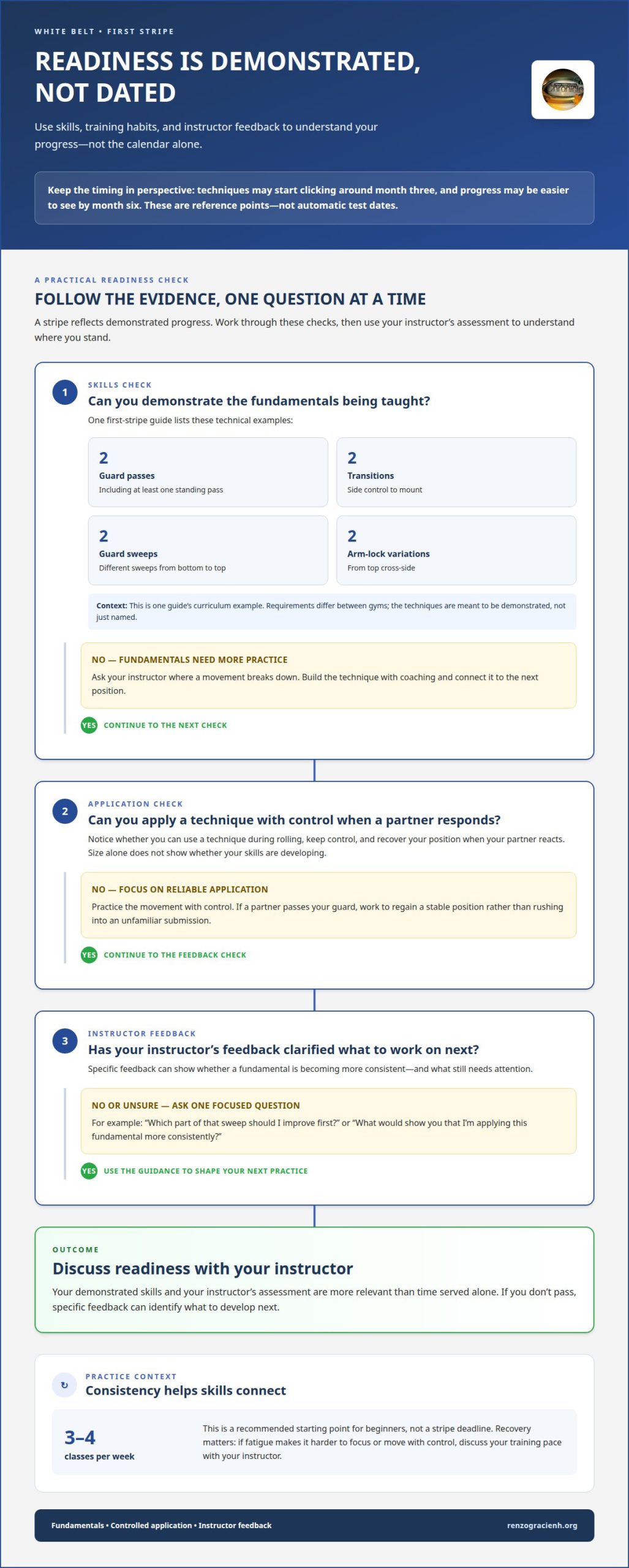
A first-stripe curriculum builds core techniques for moving between positions and responding with control. One first-stripe guide calls for two technical guard passes, including at least one standing pass, and two transitions from side control to mount. It also includes two different guard sweeps from bottom to top and two arm-lock variations from top cross-side.
Coaching helps students understand the purpose of each movement, rather than simply memorize a sequence. For example, practice can connect a guard pass to a stable position, then work on a controlled transition. During the first year, white belts can prioritize fundamentals and build reliable technique. An instructor can identify where a movement breaks down and guide practice toward a more connected skill set.
Observing instructors and training partners
Watch how instructors demonstrate a position, correct details, and adjust practice when a movement isn’t working. During rolling, notice whether you can apply a technique with control, then recover your position when your partner responds. A technical partner may submit a beginner despite weighing 50 pounds less, so size alone doesn’t show whether your skills are developing.
Training frequency also shapes what you retain. Three to four classes per week is a recommended starting point for beginners, but recovery matters: if fatigue makes it harder to focus or move with control, discuss your training pace with your instructor. Consistent attendance helps you revisit techniques and receive coaching over time. Missing practice can make it harder to connect a move from one class with a position encountered later.
Keep your gear clean. Wash your gi after every class, and shower before and after training. For a stripe test, wear your usual clean training gi and bring your belt; arrive ready to follow your instructor’s directions. These simple habits support a respectful training environment and let you focus on the evaluation.
During live rolling, prioritize learning over winning each exchange. For example, if a partner passes your guard, work to regain a stable position instead of rushing into an unfamiliar submission. Pay attention to how instructors respond to your movement and how experienced partners offer resistance. Their reactions can show whether your technique works under pressure, while staying composed helps keep practice constructive.
If you’re building a steady routine, coached Jiu-Jitsu training can give you regular opportunities to practice with guidance. Show up consistently, keep your gear clean, and use each round to learn something specific.
Asking questions and seeking feedback
Specific feedback can turn a stripe result into a clear training focus. Students who don’t pass receive feedback on what they need to do to earn the stripe. Use that guidance to identify a fundamental skill to work on, rather than treating the result as a judgment of your potential.
Ask questions that clarify the movement, not just whether it looked right. For example, if a sweep stalls, ask which part of its mechanics needs attention: your setup, balance, or timing. Then try the correction during practice and ask whether it addressed the issue. One focused question gives you a practical next step.
- “Which part of that sweep should I improve first?”
- “What should I do when my partner blocks the first attempt?”
- “Can you show me where my balance shifted?”
- “What would show you that I’m applying this fundamental more consistently?”
Feedback is most useful when you connect it to a specific example. If an instructor notes that your guard pass loses control near the end, remember that moment and focus your next practice on maintaining position through the transition. Everyone learns at a different pace, so compare your work with the criteria being taught, not another student’s progress.
After receiving feedback, restate the key point in your own words. For instance, say, “I need to keep my base stable before moving past the guard,” then practice that detail in a controlled drill. If the same difficulty comes up again, describe what happened and ask for another adjustment. This gives your instructor a clear example to respond to and helps you track whether the correction carries into live training.
Not passing on the first attempt doesn’t leave you guessing. Use your instructor’s specific guidance to shape your next practice, then ask how your progress compares with the target.
Stripe test format and evaluation
A stripe evaluation checks whether a student can demonstrate foundational Brazilian jiu-jitsu skills, not just name techniques. The format may combine technical demonstrations with movement between positions, helping an instructor assess mechanics, control, and understanding during grappling. The takeaway: prepare to show how techniques work, not only recall their names.
Requirements differ between gyms because each sets its own curriculum and assessment approach. An affiliation may provide shared guidance across its academies, while a local instructor can shape an evaluation around the skills taught in class. Ask which techniques and criteria apply at your academy, then use the answer to focus your practice.
One first-stripe test guide includes two technical guard passes, with at least one standing pass. It also lists two ways to move from side control to mount, two guard sweeps from bottom to top, and two arm-lock variations from top cross-side. These examples show why an evaluation may involve skills from several positions rather than one isolated move.
For each technique, focus on clear steps: establish the position, control your movement, and complete the transition with purpose. A guard pass, for example, should involve more than moving forward; you need to work through the guard into a stable position. An escape or sweep should also reflect the mechanics taught in class. Instructor feedback helps identify which detail needs more practice.
Do BJJ gyms charge a fee for stripe tests? There isn’t one universal fee; whether an evaluation has a separate charge depends on the gym’s policy. The test format and any related cost are separate questions, so understand both before test day.
Want structured practice with instructor guidance? Explore Jiu-Jitsu training and keep building the skills an evaluation may assess.
Renzo Gracie NH
Renzo Gracie NH can help you build your Jiu-Jitsu skills through structured instruction and ongoing practice. If you’re unsure what to focus on before a first stripe evaluation, use your training to develop fundamentals, apply techniques, and learn from instructor feedback. The Adult Jiu Jitsu Program supports adult students, while the Kids Jiu Jitsu Program provides instruction for children. Law enforcement professionals can also explore Law Enforcement Jiu-Jitsu Training. New students can begin with a Free Introductory Class to experience training and consider their next step. A stripe is one milestone in a longer learning journey, and consistent coaching can help you keep progressing beyond it. If you’d like to discuss getting started, contact Renzo Gracie NH.
Keep building beyond your first stripe
A stripe can mark progress, but your next goal can be broader: becoming a more thoughtful, capable training partner. If you’re preparing for your first BJJ stripe test in NH, choose a personal focus to keep learning after the evaluation, such as staying composed during transitions or applying a technique with better control. Small, deliberate goals give each class a purpose.
Renzo Gracie NH offers an Adult Jiu Jitsu Program, a Kids Jiu Jitsu Program, and Law Enforcement Jiu-Jitsu Training, with instruction suited to different student needs. Whether you’re beginning your own practice, supporting a child’s interest, or developing skills for professional training, start with a consistent learning routine.
Contact Renzo Gracie NH to talk about getting started. Keep showing up, stay curious, and take pride in every step forward.
Frequently Asked Questions
WHEN WILL I BE READY FOR MY FIRST STRIPE?
You’re ready when you can demonstrate the skills your instructor expects and apply them with control. Techniques may start clicking around month three, while month six can make your progress easier to recognize. Treat these as useful checkpoints, not deadlines. For example, notice whether you can follow a familiar movement sequence when your partner changes position, rather than relying on a calendar.
WHAT HAPPENS WHEN I GET TO THIS POINT?
Once your instructor considers you ready, you may be evaluated on the fundamentals taught in class. Students who pass are awarded their stripe at the front of the class. Afterward, keep training and work on applying those skills in new situations. A stripe marks progress, while continued practice helps you build toward your next learning goal.
What are the requirements for a first BJJ stripe test for a white belt?
Requirements depend on your academy’s curriculum, but a first-stripe guide may include guard passing, sweeps, transitions, and positional techniques. For instance, it lists two guard passes, two bottom-to-top sweeps, two side-control-to-mount transitions, and two arm-lock variations from top cross-side. Use your instructor’s stated criteria as the standard for your evaluation.
What techniques should I know before my first BJJ stripe test?
Be prepared to show fundamental movements from more than one position. A first-stripe guide includes a standing guard pass, a sweep from bottom, a transition from side control to mount, and arm-lock variations from top cross-side. The goal isn’t to rush through a sequence. Demonstrate each technique with control, and be ready to repeat it if your instructor asks.
How do BJJ stripe tests work, and what should I expect?
A stripe test evaluates whether you can demonstrate techniques and understand how they connect to positions. Expect to show movements from the curriculum, such as passing guard or transitioning from side control. Your instructor assesses your execution and may offer feedback about areas to keep developing. Focus on listening to each prompt and showing your understanding, rather than trying to make every movement look advanced.
How long does it usually take to earn a first BJJ stripe?
There’s no single timeline that applies to every student. Around month three, techniques may begin to click; by month six, you may see your progress more clearly. These milestones don’t determine promotion. Your development depends on what you’ve learned and can demonstrate, so use these time points to reflect on your training, not to measure yourself against another white belt.