Posts

BJJ Training for New Hampshire Police: 2026 Dates and Costs

The academy calendar is only one part of BJJ training for NH police standards in 2026. New Hampshire Full-Time Officer Academy class 204 is scheduled for August 24 through December 15, 2026, while officers must complete at least 24 hours of annual in-service training. That annual requirement is separate from defensive tactics training.

For agencies planning professional instruction, practical details matter: how course dates fit the training calendar, what in-service options are available, and how a program’s scope and instruction time shape its cost. The price depends on the case and is provided after a quote request.

This article explains the 2026 dates and cost factors, outlines the annual training framework, and considers reported field applications and injury concerns without treating training as a substitute for agency policy. You’ll come away with a clearer picture of where Brazilian Jiu-Jitsu may fit into officer development and what to consider when planning instruction.

Key Takeaways

  • Use the class 204 schedule, August 24 through December 15, 2026, as a planning reference for academy-related training.
  • According to New Hampshire Police Standards and Training Council, all New Hampshire academy recruits and law package officers must pass the Cooper’s test at the 35th percentile.
  • Compare in-service training options by how their instruction fits agency needs, training schedules, and cost factors.
  • Explore how reported field applications and injury considerations inform the way agencies assess defensive tactics and BJJ instruction.

2026 Course dates and costs

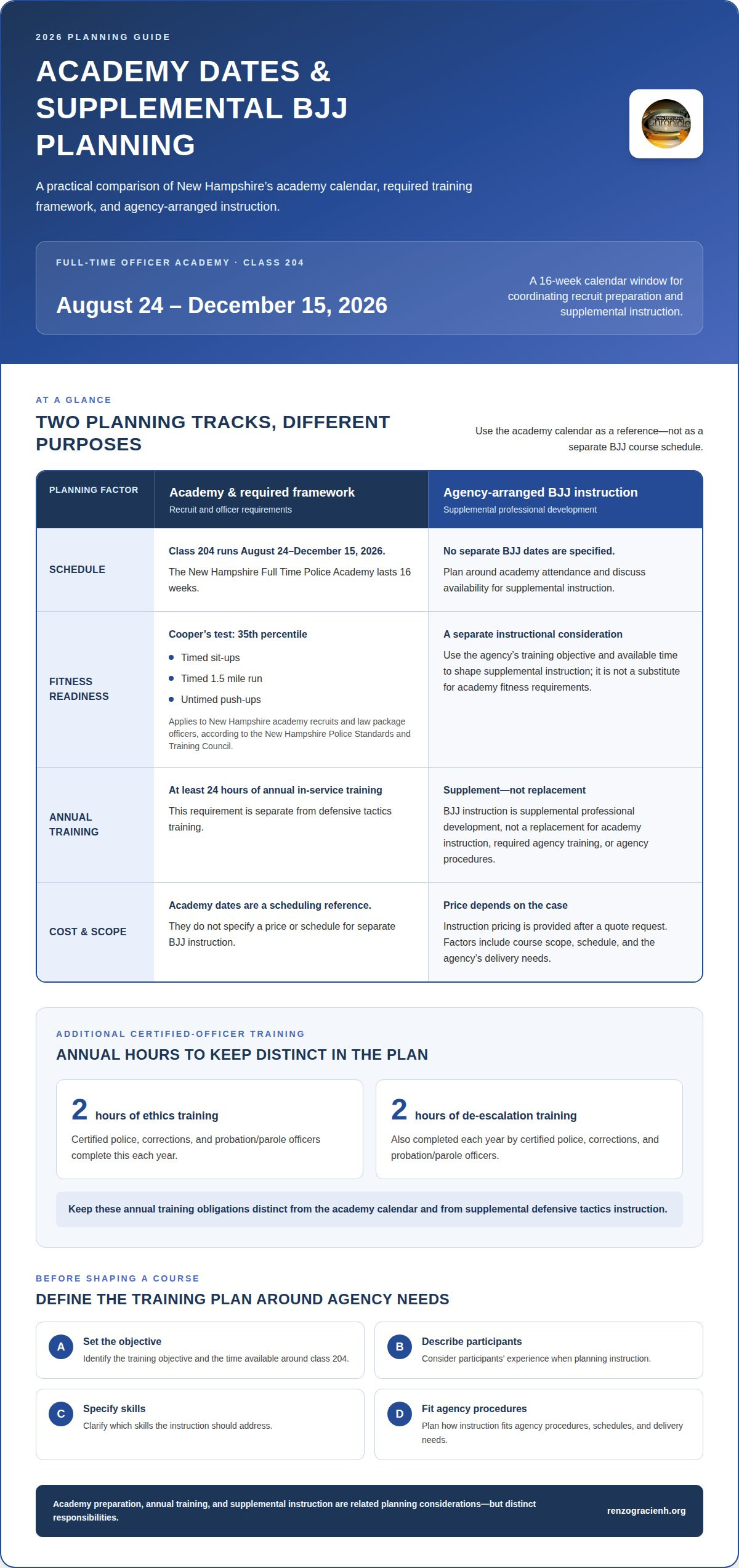
New Hampshire Full-Time Officer Academy class 204 is scheduled for August 24 through December 15, 2026. Its calendar helps agencies plan recruit preparation and supplemental instruction around academy attendance. The New Hampshire Full Time Police Academy lasts 16 weeks, so class 204 occupies a substantial part of the year. These dates identify the academy class, not a separate schedule for Brazilian Jiu-Jitsu instruction.

Fitness readiness is another part of recruit planning. All New Hampshire academy recruits and law package officers must pass the Cooper’s test at the 35th percentile, according to New Hampshire Police Standards and Training Council. The standardized test includes timed sit-ups, a timed 1.5 mile run, and untimed push-ups. For agencies planning BJJ training for NH police standards 2026, this fitness milestone can help shape a broader preparation calendar, while remaining distinct from supplemental defensive tactics instruction.

Academy scheduling and the cost of separate BJJ instruction are different planning questions. The price for agency-arranged instruction depends on the case and is given after a quote request. Cost factors include the scope of instruction, the schedule, and the agency’s delivery needs. A focused session and a broader training plan call for different instructional approaches. A budget should reflect the objectives the agency wants the course to address.

Start planning BJJ training for NH police standards 2026 by identifying the training objective and time available around class 204. Define the participants’ experience, the skills instruction should address, and how it will fit agency procedures. These details help shape course design and cost, while clarifying that BJJ is supplemental professional development, not a replacement for academy instruction or required agency training. A defined objective makes scheduling and budget discussions more concrete.

The published academy window remains 08/24/2026 – 12/15/2026, a reference for coordinating supplemental instruction with class 204. Agencies can use that window when discussing availability.

Reported field-application effectiveness and injuries

BJJ and police defensive tactics courses serve related but different purposes. New Hampshire academy instruction includes scenario-based learning and practical skills demonstrations, while grappling practice can help officers rehearse control positions against resistance. BJJ should complement academy instruction, not replace agency procedures or establish compliance with state standards.

When reviewing field applications, assess the task involved rather than treating a technique as effective on its own. For example, an incident report might describe an officer maintaining position, controlling an arm, or moving from a clinch to a restraint. Ask whether control was achieved, whether force could be reduced, and whether the response fit the circumstances and agency policy. One incident cannot show that a method will work in every encounter.

Skills relevant to control include balance and distance management, clinch positioning, transitions to stable pins, and maintaining control without relying on strikes. These skills may create time and space for clear verbal directions. A hold alone is not de-escalation: communication, judgment, and the ability to stop or adjust remain essential.

Injury assessment also requires care. Training injuries can involve falls, joint stress, or collisions, while field incidents have different conditions and risks. Compare the setting, the action being practiced, partner size and experience, fatigue, and whether an instructor can pause or modify a drill. Training records can distinguish practice injuries from field injuries and help identify recurring causes, such as uncontrolled takedowns or excessive resistance.

  • Useful review: record the control objective, technique, outcome, force used, and any injury.
  • Safer practice: use controlled resistance, clear stop signals, and instruction that adjusts to skill level.

Agencies seeking structured grappling practice can explore professional jiu-jitsu instruction as a supplement to scenario-based training. Reviewing both successful applications and injury patterns helps keep the focus on sound judgment, controlled practice, and policy-aligned skills.
BJJ Training for New Hampshire Police: 2026 Dates and Costs

What defensive tactics and use-of-force training do New Hampshire police recruits receive?

New Hampshire Police Academy instruction combines academic learning, scenario-based exercises, skill building, written exams, and practical demonstrations. Recruits study principles, apply skills in scenarios, and demonstrate practical performance. This approach goes beyond memorizing rules: trainees must show what they can do during assessed learning. The curriculum details described here do not specify individual defensive tactics techniques, so distinguish documented training methods from assumptions about particular holds.

Use-of-force preparation is best understood through this combined structure. A scenario may require a recruit to assess a situation, communicate, select a response, and demonstrate a relevant skill. Written exams assess academic learning, while practical demonstrations assess performance. Together, these methods evaluate decision-making as well as execution. Supplemental grappling instruction does not replace academy requirements or agency policies.

Annual in-service obligations are a separate part of the picture. New Hampshire officers must complete at least 24 hours of annual in-service training, separate from defensive tactics, firearms, and first aid. Certified police, corrections, and probation/parole officers also complete 2 hours of ethics training and 2 hours of de-escalation training each year. Certified officers complete 1 hour of mental health training each year. These requirements clarify that the annual total and defensive tactics training are distinct.

  • Academy learning: academic material, scenarios, skill building, written exams, and practical demonstrations.
  • Annual in-service: 24 hours, separate from defensive tactics, firearms, and first aid.
  • Specified annual subjects: ethics, de-escalation, and mental health training.

For an agency, map these training needs separately. Identify which instruction addresses academic knowledge, scenario decisions, physical skills, and annual subjects. This helps supervisors plan supplemental grappling practice without counting it as a substitute for required instruction. It also keeps evaluation focused: a written exam, a scenario, and a practical demonstration assess different abilities. Clear records can show which objective each session addresses.

Which BJJ gyms near New Hampshire police academies offer law enforcement training?

The New Hampshire Police Academy is the state’s basic training setting, but its location alone does not identify a suitable BJJ program. A good fit depends on whether instruction addresses professional defensive tactics, works with agency scheduling, and complements department procedures. A general grappling class and law-enforcement training may have different aims.

For an agency comparing training options, start with the objective. A team seeking stronger control in close-contact encounters may need practice with positioning, transitions, and controlled restraint. A team working on communication alongside physical skills needs practice that includes verbal direction and decision-making. Let the objective shape the content, rather than choosing only by distance from the academy.

Next, consider how instruction connects with the academy’s training approach. New Hampshire recruits encounter academic learning, scenarios, skill building, written exams, and practical demonstrations. Assess supplemental grappling practice by how clearly it relates to applied skills. Keep it distinct from academy requirements and agency policy. This helps an agency plan relevant training without treating a gym class as state certification.

Before setting a schedule, define the participants, their experience, the skills to address, and the agency procedures that frame the training. These details help determine whether instruction suits recruits, experienced officers, or a mixed group. They also give instructors a basis for adapting examples and resistance levels. Clear objectives make training more relevant than proximity alone.

  • Fit: professional defensive tactics, not just general grappling practice.
  • Application: examples tied to control, transitions, communication, and agency procedures.
  • Planning: a defined group, training objective, and schedule.

To explore a program focused on law enforcement needs, review law enforcement training options and consider how they can support agency goals.

Renzo Gracie NH: Law Enforcement Jiu-Jitsu Training

Renzo Gracie NH offers Law Enforcement Jiu-Jitsu Training for professionals seeking structured Brazilian Jiu-Jitsu practice. It can complement academy instruction and agency procedures for agencies or officers looking to develop grappling skills. The training is distinct from state certification and required academy coursework.

For individual development, the Adult Jiu Jitsu Program provides ongoing practice to build skills. Adults can start with a Free Introductory Class to experience instruction. Families can also explore the Kids Jiu Jitsu Program.

If professional defensive tactics training is your focus, contact Renzo Gracie NH about Law Enforcement Jiu-Jitsu Training in Windham, Manchester, or Exeter.

Build a Training Plan That Moves Forward

Lasting progress comes from turning training goals into consistent practice. A thoughtful approach to BJJ training for NH police standards in 2026 starts with a clear purpose: develop practical grappling skills that complement agency instruction and support sound judgment. From there, agencies can shape a plan around the needs of their officers and the role training should play in professional development.

Renzo Gracie NH offers Law Enforcement Jiu-Jitsu Training, as well as Adult Jiu Jitsu and Kids Jiu Jitsu programs. These programs support personal skill development and family participation in the academy community, while keeping professional training distinct from state requirements.

If you’re ready to explore a training path for your agency or personal development, contact Renzo Gracie NH. Take the next step with focus, build steadily, and keep learning.

Frequently Asked Questions

Do New Hampshire police academies require or recommend Brazilian jiu-jitsu training?

The New Hampshire academy standards described here do not identify Brazilian Jiu-Jitsu as a standalone recruit requirement or recommendation. BJJ can provide supplemental practice, while academy assessments and agency policies remain separate. An agency considering extra grappling instruction can first define its objective, such as improving officers’ positional awareness in close-contact situations. Departments in Windham, Manchester, and Exeter can use that objective to guide local training plans.

What are the injury risks of BJJ training for police recruits, and how can they be reduced?

Grappling can cause strains, joint irritation, or impact injuries, particularly when partners use uncontrolled resistance or lose balance during transitions. Gradual progression, appropriate partner matching, instructor oversight, and permission to pause a drill can help reduce risk. Recruits should promptly communicate discomfort rather than push through it. If an injury occurs, stop training and seek appropriate medical guidance before returning to practice.

Can New Hampshire officers receive department funding or training credit for BJJ classes?

BJJ is supplemental professional development, not a substitute for required instruction. Annual in-service training remains separate from defensive tactics, and this article provides no basis for department funding or BJJ training credit.
Preparing for My First BJJ Stripe Test in NH: When to Test

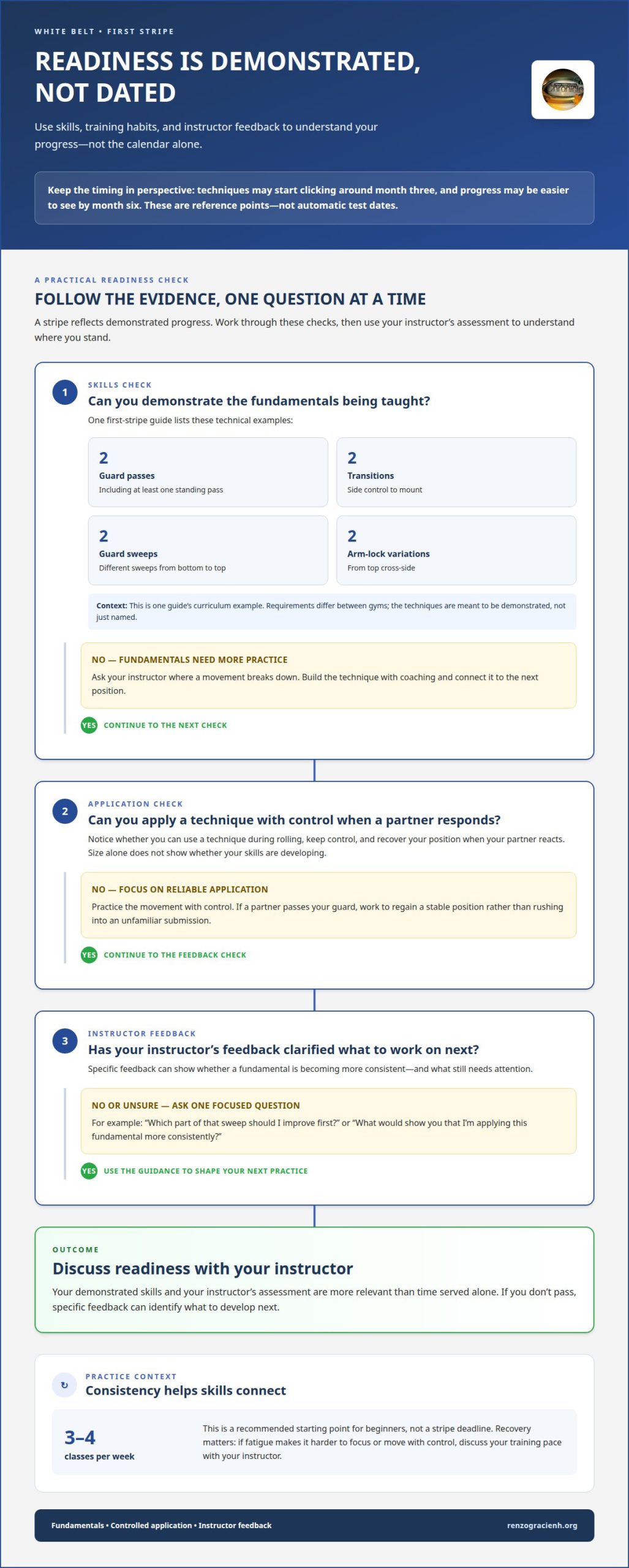
A first BJJ stripe isn’t earned on a fixed calendar date. When preparing for my first BJJ stripe test in NH, treat month three as a point when techniques may start clicking and month six as a time when progress may be easier to see, not as automatic test dates. Readiness depends on the skills you can demonstrate, your training habits, and your instructor’s feedback.

It’s natural to wonder whether you’re progressing quickly enough, especially when every class brings something new to learn. This guide explains how timing can offer context without defining readiness, what feedback and consistent practice can reveal, and how a stripe evaluation may assess fundamental skills. You’ll have a clearer sense of where you are in your training and what to focus on next.

Key Takeaways

  • Use your instructor’s feedback and the skills you can demonstrate to judge readiness, rather than relying on time alone.
  • Notice how consistently you apply fundamentals with different training partners; steady progress matters more than trying to impress.
  • Ask what to focus on next. If you don’t pass, feedback can clarify what you need to develop for a stripe.
  • Prepare for an evaluation of core skills, including guard passes, sweeps, transitions, and positional techniques.

Expected timeline for earning a first white belt stripe

Students may not earn a stripe if they haven’t consistently demonstrated the expected fundamentals or need more practice applying them. A stripe reflects demonstrated progress, not time served alone. If you’re preparing for your first BJJ stripe test in NH, use the evaluation criteria and your instructor’s feedback to guide your expectations.

First Stripe Timing

First-stripe timing is the period between starting white-belt training and demonstrating the skills expected at that stage. Around month three, techniques may start clicking; by month six, students may recognize their progress more clearly. These are reference points, not test dates. As you prepare for your first BJJ stripe test in NH, use them to reflect on your development rather than predict promotion.

There’s no single calendar schedule for earning stripes or reaching blue belt. Progress depends on the skills you demonstrate and the academy’s approach. A new white belt revisits fundamental movements, learns how positions connect, and gradually applies techniques with partners. Comparing your progress with classmates can distract from what you’re learning. Your instructor’s assessment is a more relevant measure of your development.

Technical Requirements and Curriculum

A first-stripe curriculum builds core techniques for moving between positions and responding with control. One first-stripe guide calls for two technical guard passes, including at least one standing pass, and two transitions from side control to mount. It also includes two different guard sweeps from bottom to top and two arm-lock variations from top cross-side.

Coaching helps students understand the purpose of each movement, rather than simply memorize a sequence. For example, practice can connect a guard pass to a stable position, then work on a controlled transition. During the first year, white belts can prioritize fundamentals and build reliable technique. An instructor can identify where a movement breaks down and guide practice toward a more connected skill set.

Observing instructors and training partners

Watch how instructors demonstrate a position, correct details, and adjust practice when a movement isn’t working. During rolling, notice whether you can apply a technique with control, then recover your position when your partner responds. A technical partner may submit a beginner despite weighing 50 pounds less, so size alone doesn’t show whether your skills are developing.

Training frequency also shapes what you retain. Three to four classes per week is a recommended starting point for beginners, but recovery matters: if fatigue makes it harder to focus or move with control, discuss your training pace with your instructor. Consistent attendance helps you revisit techniques and receive coaching over time. Missing practice can make it harder to connect a move from one class with a position encountered later.

Keep your gear clean. Wash your gi after every class, and shower before and after training. For a stripe test, wear your usual clean training gi and bring your belt; arrive ready to follow your instructor’s directions. These simple habits support a respectful training environment and let you focus on the evaluation.

During live rolling, prioritize learning over winning each exchange. For example, if a partner passes your guard, work to regain a stable position instead of rushing into an unfamiliar submission. Pay attention to how instructors respond to your movement and how experienced partners offer resistance. Their reactions can show whether your technique works under pressure, while staying composed helps keep practice constructive.

If you’re building a steady routine, coached Jiu-Jitsu training can give you regular opportunities to practice with guidance. Show up consistently, keep your gear clean, and use each round to learn something specific.

Asking questions and seeking feedback

Specific feedback can turn a stripe result into a clear training focus. Students who don’t pass receive feedback on what they need to do to earn the stripe. Use that guidance to identify a fundamental skill to work on, rather than treating the result as a judgment of your potential.

Ask questions that clarify the movement, not just whether it looked right. For example, if a sweep stalls, ask which part of its mechanics needs attention: your setup, balance, or timing. Then try the correction during practice and ask whether it addressed the issue. One focused question gives you a practical next step.

  • “Which part of that sweep should I improve first?”
  • “What should I do when my partner blocks the first attempt?”
  • “Can you show me where my balance shifted?”
  • “What would show you that I’m applying this fundamental more consistently?”

Feedback is most useful when you connect it to a specific example. If an instructor notes that your guard pass loses control near the end, remember that moment and focus your next practice on maintaining position through the transition. Everyone learns at a different pace, so compare your work with the criteria being taught, not another student’s progress.

After receiving feedback, restate the key point in your own words. For instance, say, “I need to keep my base stable before moving past the guard,” then practice that detail in a controlled drill. If the same difficulty comes up again, describe what happened and ask for another adjustment. This gives your instructor a clear example to respond to and helps you track whether the correction carries into live training.

Not passing on the first attempt doesn’t leave you guessing. Use your instructor’s specific guidance to shape your next practice, then ask how your progress compares with the target.

Preparing for My First BJJ Stripe Test in NH: When to Test

Stripe test format and evaluation

A stripe evaluation checks whether a student can demonstrate foundational Brazilian jiu-jitsu skills, not just name techniques. The format may combine technical demonstrations with movement between positions, helping an instructor assess mechanics, control, and understanding during grappling. The takeaway: prepare to show how techniques work, not only recall their names.

Requirements differ between gyms because each sets its own curriculum and assessment approach. An affiliation may provide shared guidance across its academies, while a local instructor can shape an evaluation around the skills taught in class. Ask which techniques and criteria apply at your academy, then use the answer to focus your practice.

One first-stripe test guide includes two technical guard passes, with at least one standing pass. It also lists two ways to move from side control to mount, two guard sweeps from bottom to top, and two arm-lock variations from top cross-side. These examples show why an evaluation may involve skills from several positions rather than one isolated move.

For each technique, focus on clear steps: establish the position, control your movement, and complete the transition with purpose. A guard pass, for example, should involve more than moving forward; you need to work through the guard into a stable position. An escape or sweep should also reflect the mechanics taught in class. Instructor feedback helps identify which detail needs more practice.

Do BJJ gyms charge a fee for stripe tests? There isn’t one universal fee; whether an evaluation has a separate charge depends on the gym’s policy. The test format and any related cost are separate questions, so understand both before test day.

Want structured practice with instructor guidance? Explore Jiu-Jitsu training and keep building the skills an evaluation may assess.

Renzo Gracie NH

Renzo Gracie NH can help you build your Jiu-Jitsu skills through structured instruction and ongoing practice. If you’re unsure what to focus on before a first stripe evaluation, use your training to develop fundamentals, apply techniques, and learn from instructor feedback. The Adult Jiu Jitsu Program supports adult students, while the Kids Jiu Jitsu Program provides instruction for children. Law enforcement professionals can also explore Law Enforcement Jiu-Jitsu Training. New students can begin with a Free Introductory Class to experience training and consider their next step. A stripe is one milestone in a longer learning journey, and consistent coaching can help you keep progressing beyond it. If you’d like to discuss getting started, contact Renzo Gracie NH.

Keep building beyond your first stripe

A stripe can mark progress, but your next goal can be broader: becoming a more thoughtful, capable training partner. If you’re preparing for your first BJJ stripe test in NH, choose a personal focus to keep learning after the evaluation, such as staying composed during transitions or applying a technique with better control. Small, deliberate goals give each class a purpose.

Renzo Gracie NH offers an Adult Jiu Jitsu Program, a Kids Jiu Jitsu Program, and Law Enforcement Jiu-Jitsu Training, with instruction suited to different student needs. Whether you’re beginning your own practice, supporting a child’s interest, or developing skills for professional training, start with a consistent learning routine.

Contact Renzo Gracie NH to talk about getting started. Keep showing up, stay curious, and take pride in every step forward.

Frequently Asked Questions

WHEN WILL I BE READY FOR MY FIRST STRIPE?

You’re ready when you can demonstrate the skills your instructor expects and apply them with control. Techniques may start clicking around month three, while month six can make your progress easier to recognize. Treat these as useful checkpoints, not deadlines. For example, notice whether you can follow a familiar movement sequence when your partner changes position, rather than relying on a calendar.

WHAT HAPPENS WHEN I GET TO THIS POINT?

Once your instructor considers you ready, you may be evaluated on the fundamentals taught in class. Students who pass are awarded their stripe at the front of the class. Afterward, keep training and work on applying those skills in new situations. A stripe marks progress, while continued practice helps you build toward your next learning goal.

What are the requirements for a first BJJ stripe test for a white belt?

Requirements depend on your academy’s curriculum, but a first-stripe guide may include guard passing, sweeps, transitions, and positional techniques. For instance, it lists two guard passes, two bottom-to-top sweeps, two side-control-to-mount transitions, and two arm-lock variations from top cross-side. Use your instructor’s stated criteria as the standard for your evaluation.

What techniques should I know before my first BJJ stripe test?

Be prepared to show fundamental movements from more than one position. A first-stripe guide includes a standing guard pass, a sweep from bottom, a transition from side control to mount, and arm-lock variations from top cross-side. The goal isn’t to rush through a sequence. Demonstrate each technique with control, and be ready to repeat it if your instructor asks.

How do BJJ stripe tests work, and what should I expect?

A stripe test evaluates whether you can demonstrate techniques and understand how they connect to positions. Expect to show movements from the curriculum, such as passing guard or transitioning from side control. Your instructor assesses your execution and may offer feedback about areas to keep developing. Focus on listening to each prompt and showing your understanding, rather than trying to make every movement look advanced.

How long does it usually take to earn a first BJJ stripe?

There’s no single timeline that applies to every student. Around month three, techniques may begin to click; by month six, you may see your progress more clearly. These milestones don’t determine promotion. Your development depends on what you’ve learned and can demonstrate, so use these time points to reflect on your training, not to measure yourself against another white belt.

Adult BJJ Classes in Manchester for Beginners

You don’t need to get fit before starting Brazilian Jiu-Jitsu. Adult BJJ classes in Manchester offer beginners a structured way to learn the fundamentals, practise at a manageable pace and build confidence step by step.

It’s natural to wonder whether you’ll keep up or know what to do on your first day. Beginner-friendly instruction breaks learning into clear skills, so you can focus on each movement without needing to have everything figured out right away.

This guide explains how adult classes introduce core techniques, support steady progress and help newcomers get comfortable with training. You’ll also learn what to expect in class and how to prepare for your first session. Progress begins with showing up, learning alongside others and building from one lesson to the next.

Key Takeaways

  • Beginner instruction can break Brazilian Jiu-Jitsu into clear techniques, helping you focus on learning one step at a time.
  • A structured class gives newcomers a way to follow the lesson and build skills without prior experience.
  • Understanding how adult training works can help you feel more prepared for practice with training partners.
  • Choosing comfortable athletic clothing and knowing what to expect can make your first class feel more straightforward.

Beginner-friendly instruction and paced progression

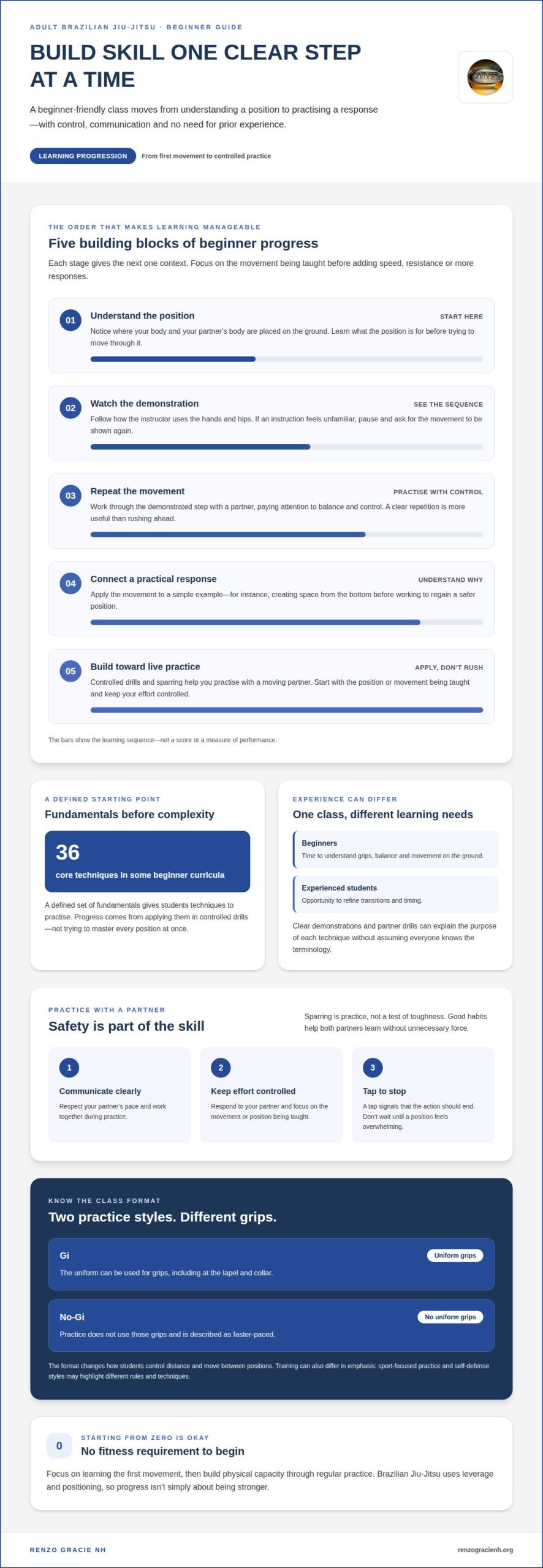
Beginner Brazilian Jiu-Jitsu develops through clear instruction, repeated practice and gradually more complex ground skills. A well-structured class lets adults learn techniques before adding speed or resistance.

Beginner and Experienced Class Options

Look for instruction that distinguishes foundational learning from advanced practice. A beginner needs time to understand grips, balance and movement on the ground, while an experienced practitioner can refine transitions and timing. Some beginner curricula teach 36 core techniques, giving students a defined set of fundamentals to practise. Progress then comes from applying those techniques in controlled drills, not from trying to master every position at once.

Adult classes may include students with different experience levels. Co-ed means adults of different genders train in the same class. Look for clear demonstrations and partner drills that explain the purpose of each technique. A progressive class builds from basic movement toward connected skills rather than assuming everyone already knows the terminology.

Safety and Sparring for Beginners

Partner practice helps you understand how techniques work with another person. Students in these BJJ classes regularly spar, so beginners should understand the format and purpose of each round. Sparring is practice, not a test of toughness. Start with the movement or position being taught, and keep your effort controlled so you can respond to your partner.

Good training habits include communicating clearly, respecting your partner’s pace and tapping when you need to stop. A tap signals that the action should end, so don’t wait until a position feels overwhelming. Focus on safe posture and the technique being practised. This discipline helps both partners learn while avoiding unnecessary force during ground work.

Guidance for a First Class

In your first class, follow the instructor’s demonstration before trying a technique. Watch how the hands and hips move, then practise the same sequence with a partner. If a position or instruction feels unfamiliar, pause and ask for the movement to be shown again. One clear repetition is more useful than rushing through steps you don’t yet understand.

There are no fitness requirements for starting beginner Brazilian Jiu-Jitsu classes. Focus on learning the first movement, then build physical capacity through regular practice. Treat your first lesson as the start of a journey: listen, practise the demonstrated technique and notice which detail you want to work on next time.

Structured classes for students with no experience

A structured Brazilian Jiu-Jitsu class gives new students a clear path through unfamiliar movements. Instead of treating every technique as separate, instruction can connect a position, its purpose and a practical response. For example, a lesson might introduce how to create space from the bottom before practising how to regain a safer position. That sequence helps you understand why each movement matters.

Progression should make sense at every level. Beginners need explanations and repeated practice, while experienced students can work on timing, transitions or different responses to the same position. In a supportive class, those differences are part of the learning environment, not a reason to rush. Respect between partners matters, especially when one student is learning a movement and another already knows it.

  • Learn the position: Identify where your body and your partner’s body are placed on the ground.
  • Practise the movement: Repeat the demonstrated step with attention to balance and control.
  • Connect the response: Apply the movement to a simple example, such as creating space during defense.

This structure builds understanding alongside physical strength. First, focus on the right sequence; then develop coordination and confidence through practice. Brazilian Jiu-Jitsu uses leverage and positioning, so progress isn’t simply about being stronger. The key discipline is learning to make a useful decision from the position you’re in.

For a first visit, an introductory class offers a practical way to experience the teaching and class environment. You can see how instructions are presented, how partners work together and whether the pace helps you follow each step. If you’re ready to begin, the Free Introductory Class is a natural place to start.

Adult BJJ Classes in Manchester for Beginners

Adult Brazilian Jiu-Jitsu classes

Brazilian Jiu-Jitsu is a martial art focused largely on ground grappling. Adults learn how positioning, holds, throws and submission techniques affect an encounter with an opponent. A class might connect these skills through a practical example: use a throw to reach the ground, establish control, then practise a suitable response. The goal is to understand how the skills fit together, not just memorise names.

Instructors may teach techniques through Gi or No-Gi practice, which use different grips. Gi training uses the uniform for grips, including at the lapel and collar. No-Gi practice doesn’t use those grips and is described as faster-paced. The choice changes how students control distance and move between positions, so beginners benefit from knowing which style a class follows.

Training also varies by purpose. Sport-focused practice and self-defense styles can emphasize different rules and techniques. In either setting, students regularly spar, applying skills with a moving partner rather than relying only on a cooperative demonstration. Sparring gives you a chance to recognize positions, respond to an opponent and see which techniques need more practice.

  • Observe the focus: Notice whether the lesson emphasizes sport grappling or self-defense skills.
  • Follow the format: Learn whether the class uses Gi grips or No-Gi movement.
  • Apply one technique: Practise the demonstrated sequence before adding other responses.

Start by focusing on one position and its purpose. For example, practise maintaining control before attempting a transition. This makes it easier to notice details: where balance shifts, how a grip affects movement and when a partner creates space. Adult BJJ classes in Manchester can introduce these skills progressively, helping you connect technique, timing and respect during training.

Brazilian Jiu-Jitsu develops through consistent practice, not one perfect round. Treat each sparring exchange as information: identify the position, recall the technique and choose a response. With that focus, adults can build a broader understanding of martial arts while learning to train thoughtfully with different partners.

What should beginners bring or wear to their first adult BJJ class?

Choose clothing that lets you bend, step and move comfortably during Brazilian Jiu-Jitsu practice. For No-Gi training, practitioners wear athletic clothing, such as shorts and a rash guard, instead of a uniform. This is a straightforward starting point for preparing for a class without a kimono.

The class format affects what you wear. Gi practice uses a uniform, while No-Gi practice uses athletic clothing. Shorts and a rash guard are examples of suitable No-Gi attire. Choose clothing that stays comfortable as you move through drills, change levels and practise positions on the ground.

Pack a few practical items before your visit so you can focus on instruction rather than searching through your bag:

  • Athletic clothing: Bring shorts and a rash guard for No-Gi practice.
  • Water: A water bottle gives you something to drink between activities.
  • A towel: Keep one with your belongings for after physical practice.
  • A change of clothes: Pack a clean outfit for the trip home.

Before leaving, follow a simple routine: set out your clothing, pack your personal items and arrive ready to listen. For example, if the class uses No-Gi practice, choose shorts and a rash guard rather than a uniform. Once training begins, focus on the instructor’s directions, especially when moving from a demonstration to partner practice.

Comfort matters more than buying specialized gear before you know the class format. Start with suitable athletic clothing for No-Gi practice and the practical items you already use for exercise. You can then learn how the class is structured and which movements feel comfortable as you build your skills.

Ready to take a first step? Try the Free Introductory Class and experience adult Brazilian Jiu-Jitsu instruction in person.

Renzo Gracie NH: Adult Jiu Jitsu Program

Renzo Gracie NH offers an Adult Jiu Jitsu Program for adults who are ready to learn Brazilian Jiu-Jitsu or develop their skills further. Structured instruction provides a clear next step, from learning techniques to practising with training partners.

If you’re new to training, the Free Introductory Class lets you experience instruction before deciding how you’d like to continue. It’s a chance to see how a class feels and whether the learning environment suits your goals. Adults with children can also explore the Kids Jiu Jitsu Program, while Law Enforcement Jiu-Jitsu Training serves a distinct professional purpose.

Choose the Adult Jiu Jitsu Program when you’re ready to develop your practice through adult instruction. To get started, contact Renzo Gracie NH about a free introductory class.

Take your first step on the mat

Your first class can begin a steady practice shaped by what you want to learn and how you choose to progress. If you’re considering adult BJJ classes in Manchester, take one practical next step: connect with an instructor and decide whether starting now fits your goals.

Renzo Gracie NH offers an Adult Jiu Jitsu Program, a Kids Jiu Jitsu Program and Law Enforcement Jiu-Jitsu Training. These programs serve different students and purposes, while giving adults a clear path to begin training. You don’t need to plan every detail of your long-term journey before you start.

Contact Renzo Gracie NH to discuss getting started. Bring your curiosity, take the first step, and let your skills grow through practice.

Frequently Asked Questions

What age, fitness, or experience requirements do Manchester BJJ classes have?

Beginner classes have no fitness requirement, and you don’t need prior Brazilian Jiu-Jitsu experience to begin. Adult instruction is for adults, while children can join the separate Kids Jiu Jitsu Program. If you’re new to training in Manchester, the Free Introductory Class offers a first look before you decide whether to continue.

What safety rules and injury risks should adults know before starting BJJ in Manchester?

Brazilian Jiu-Jitsu is close-contact physical training, so bumps or strains are possible. Follow the instructor’s directions, avoid forcing a movement, and pause if you feel pain or become unwell. Tell the instructor about an injury or physical limitation before training so they understand what may affect your participation. Keep practice controlled and communicate clearly with your partner.

Which Manchester gyms offer beginner-friendly adult BJJ classes?

Gracie Jiu-Jitsu Manchester offers an adult beginner program that teaches 36 core techniques in a fun, cooperative environment.

Where are adult BJJ gyms located in Manchester, and how accessible are they by public transport?

Gracie Jiu-Jitsu Manchester is located at 371 South Willow Street, Manchester, New Hampshire 03103. Public transport access is not described.

Renzo Gracie Jiu Jitsu: The Legacy, Philosophy, and Training in NH

What if the most effective way to find inner calm was through a “science of control” on the mats? Most newcomers worry that martial arts schools are filled with aggressive “meathead” cultures or high injury risks. You want practical skills without the ego. We believe training should be a path to empowerment, not a source of intimidation. By choosing renzo gracie jiu jitsu, you’re stepping into a legacy that values technical precision and mutual respect above all else. It’s a sophisticated system designed for everyone.

You’re about to discover the world-renowned Renzo Gracie Jiu Jitsu lineage and how its unique philosophy of discipline is taught right here in New Hampshire. We’ll look at the prestigious history of this art and how Professor Kevin Landry implements it across our Exeter, Windham, and Manchester locations. You’ll learn about our supportive environment, our dedicated programs for kids and adults, and why our “One Membership, Three Locations” policy makes elite training accessible. Let’s explore how this practice builds strength, focus, and a true sense of community.

Key Takeaways

  • Learn how renzo gracie jiu jitsu prioritizes technical efficiency and leverage, making it accessible for practitioners of all sizes and fitness levels.
  • Understand the “Science of Control” philosophy that focuses on positional mastery to ensure safety and effectiveness in every session.
  • Discover how specialized programs for adults, kids, and law enforcement professionals build character alongside practical self-defense skills.
  • Explore the unique benefits of “Family Time” sessions that allow parents and children to grow together in a supportive, community-focused environment.
  • Identify the simple steps to start your training journey with a free introductory class at our Windham, Manchester, or Exeter academies.

The Renzo Gracie Lineage: A Legacy of Excellence on the Mat

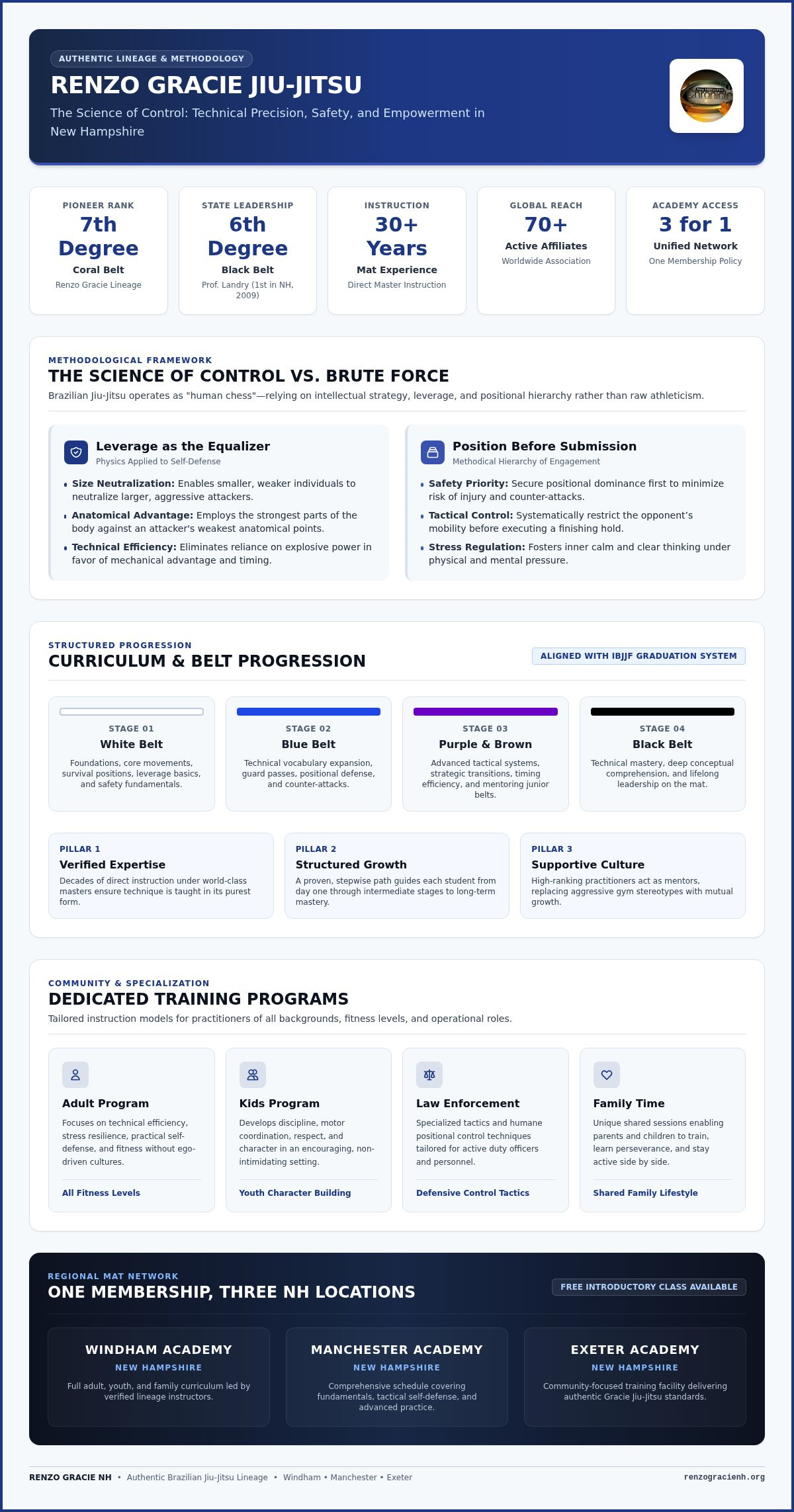
The history of martial arts changed forever when the Gracie family introduced Brazilian Jiu-Jitsu to the world. It wasn’t just a new way to fight; it was a fundamental shift in how we understand human movement and self-defense. The renzo gracie jiu jitsu methodology emphasizes technical efficiency over raw power. This approach ensures that a smaller, weaker person can successfully defend themselves against a larger attacker by using leverage and timing. It’s about working smarter, using physics to neutralize aggression.

Who is Renzo Gracie?

A 7th-degree coral belt and pioneer in mixed martial arts, Renzo Gracie didn’t just inherit a legacy; he evolved it. He moved the art forward by blending traditional roots with a modern, analytical approach to coaching. His philosophy centers on being a “supportive partner” to everyone on the mat. This creates a culture where students aren’t just training partners but a collective unit striving for personal growth. Today, the Renzo Gracie Association spans more than 70 active affiliate academies worldwide, each maintaining these high standards of instruction and community.

Bringing the Legacy to New Hampshire

Lineage matters. It acts as a seal of quality, ensuring the techniques you learn are both authentic and effective. In New Hampshire, this prestigious connection is led by Professor Kevin Landry. As a 6th-degree black belt under Renzo himself, Professor Landry was the first to receive this rank in the state back in 2009. He brings over 30 years of mat experience to our communities in Windham, Manchester, and Exeter. Choosing an academy with a direct link to the source ensures you’re learning renzo gracie jiu jitsu in its purest form.

Why does this lineage benefit you as a student?

  • Verified Expertise: You’re learning from instructors who have spent decades training directly under world-class masters.
  • Structured Growth: The curriculum follows a proven path from your first day as a white belt to long-term mastery.
  • Community Support: You join a global network of practitioners who share values of respect and perseverance.

For over two decades, Professor Landry has been building a culture of disciplined confidence across the region. It’s a legacy of excellence that prioritizes your safety and individual progress. When you step onto the mats here, you aren’t just joining a gym. You’re becoming part of a history that spans generations and continues to evolve every day.

The Science of Control: Why the Renzo Gracie System Works

Brazilian Jiu-Jitsu is frequently described as “human chess.” It represents a tactical system where intellectual strategy and technical precision triumph over raw athleticism. The renzo gracie jiu jitsu method teaches you to prioritize positional dominance before attempting a submission. This “position before submission” rule ensures you remain safe while neutralizing a threat. It’s a methodical approach to self-defense that builds both physical skill and mental resilience.

Technical Proficiency Over Power

Leverage is the ultimate equalizer on the mat. It allows a smaller student to control a much larger opponent by using the strongest parts of their body against the weakest points of an attacker’s frame. To ensure consistent progress, we utilize a structured curriculum that guides you through every stage of development. This progression is aligned with the global standards of the IBJJF belt graduation system, providing a clear roadmap from your first day as a white belt through to long-term mastery. The Renzo Gracie teaching philosophy maintains a perfect balance between the deep roots of tradition and the effectiveness of modern innovation.

A Supportive Environment for All Ages

Forget the “tough guy” stereotypes often found in combat sports gyms. Our academies project a sense of quiet authority rather than aggressive bravado. We’ve built a culture where the highest-ranking students act as the most helpful mentors to those just starting out. This community-driven approach is why so many families choose to train together. It creates a shared lifestyle of health and perseverance. When everyone is invested in each other’s success, the results are transformative for the entire group.

Beyond the physical mechanics, mastering the mechanics of renzo gracie jiu jitsu provides a sense of empowerment. You learn to stay calm under pressure. This focus translates directly to everyday life, helping professionals and students alike manage stress with a steady mind. It isn’t just about what happens during a training session. It’s about the person you become through the process of evolving your skills. If you’re ready to see this community in action, you can explore our program details to see which of our New Hampshire locations works best for you.

Training Programs: From Fundamentals to Specialized Tactics

Training in renzo gracie jiu jitsu provides more than just physical exercise. It offers a structured path toward self-mastery for every member of the family. Whether you want to improve your physical health or learn essential life skills, our programs are designed to meet you where you are. We focus on the individual’s growth within a supportive group setting, ensuring that every student feels valued and challenged in equal measure.

Adult and Kids Jiu Jitsu NH

Get fit. Stay safe. Evolve daily. Our jiu jitsu for beginners adults NH program is the perfect entry point for those seeking a functional workout that delivers real-world results. You won’t find the boring repetition of a traditional gym here. Instead, you’ll engage in a “staccato-then-flow” rhythm where high-energy drills are followed by deep technical instruction. This keeps the mind sharp and the body active, allowing you to develop fitness and self-defense skills simultaneously.

For younger students, our kids jiu jitsu New Hampshire classes emphasize respect and resilience. We don’t just teach children how to grapple; we teach them how to handle difficult situations with poise. Bullying prevention is a core pillar of our youth curriculum. By learning to control an opponent without the need for striking, kids gain a sense of quiet authority that helps them navigate the challenges of school and life with confidence. It’s about building character on and off the mats.

Law Enforcement Defensive Tactics

Officer safety is paramount. Our specialized law enforcement jiu jitsu training provides NH officers with the tools they need to manage subjects safely and effectively. In cities like Manchester and towns like Windham, police officers face unpredictable situations every day. We focus on positional control and subject management techniques that prioritize de-escalation and professional safety. These are practical, real-world grappling skills designed for the unique demands of modern law enforcement, focusing on control rather than impact.

We believe the family that trains together grows together. Our “Family Time” sessions are a unique way to bond while building a shared lifestyle of health. Parents and children share the mat, learning the same principles of perseverance and focus. It turns a solo hobby into a collective journey, reinforcing the values of the renzo gracie jiu jitsu system within the home. This shared experience creates lasting memories and a common language of discipline and respect.

Renzo Gracie Jiu Jitsu: The Legacy, Philosophy, and Training in NH

Why Choose Renzo Gracie NH for Your Family?

Southern New Hampshire families often look for activities that offer more than just physical exercise. They seek a community where values like respect and perseverance are reinforced. Practicing renzo gracie jiu jitsu together allows parents and children to align their goals in a way that few other activities can. Renzo Gracie NH serves as this vital hub for families in Exeter, Manchester, and Windham. We believe that the academy should be an extension of the home. Here, the mats become a place where every family member can find their own path to personal evolution. It’s a supportive environment that replaces the typical “gym” atmosphere with one of mutual growth and quiet authority.

Strengthening Bonds on the Mat

Training shouldn’t be a spectator sport for parents. Watching from the sidelines is fine, but participating creates a much deeper connection. We offer specialized parent and child jiu jitsu Windham sessions to bridge the generational gap. Imagine the impact of learning a complex technical system alongside your son or daughter. You both face the same challenges. You both celebrate the same milestones. This shared journey moves the family dynamic away from individual screen time and toward a unified pursuit of vitality. It’s about building a shared lifestyle of health that lasts a lifetime.

Overcoming Challenges Together

The world can be a difficult place for a growing child. They face social pressures and the reality of bullying. Our renzo gracie jiu jitsu curriculum provides them with a “science of control” to navigate these issues safely. We teach kids that true strength lies in de-escalation and positional dominance rather than aggression. They discover their own potential through the discipline of the mat. This process builds a level of confidence that is visible in their posture and their focus at school.

When parents and children train in the same system, they develop a common language of respect. The lessons learned during a tough session, like how to stay calm under pressure, become part of the family’s daily toolkit. This isn’t just about martial arts. It’s about the long-term impact on how your family interacts and overcomes obstacles as a team. If you’re looking for a way to strengthen your family unit while gaining practical skills, book a free introductory class for your family and see how we can help you grow together.

Starting Your Journey: The Path to Mastery in New Hampshire

Begin today. The hardest part is walking through the door. We’ve made the first step simple so you can focus on your evolution. To get started, you can Try Jiu Jitsu free in New Hampshire at any of our three academies. This introductory session is designed to remove the mystery and show you exactly how renzo gracie jiu jitsu fits into your lifestyle. Whether you choose our Windham, Manchester, or Exeter location, you’ll find a professional environment that prioritizes your safety and individual progress. You don’t have to be an athlete to start. You just need the willingness to learn.

Your First Class: No Ego, Just Growth

Show up. Suit up. Step forward. Your first session is a guided introduction to the fundamentals of movement and control. You’ll work directly with an instructor or a senior student who acts as a supportive partner, ensuring you understand the basic mechanics of leverage without feeling overwhelmed. Wear comfortable athletic clothing like shorts and a t-shirt; we’ll handle the rest. We focus on building a foundation of disciplined confidence from the very first minute. You don’t need to be in peak physical condition to start your journey; the mats are where you build your fitness, not where you prove it. It’s a low-pressure way to experience the “science of control” firsthand.

Joining the Renzo Gracie NH Community

Flexible training. Proven results. Once you’ve completed your intro session, choosing a membership is the next step toward long-term mastery. Our “One Membership, Three Locations” policy gives you the flexibility to train in Windham, Manchester, or Exeter on a single plan. This is perfect for commuters or families who need a schedule that adapts to their busy lives. You’ll have access to the combined expertise of our coaching staff, all under the guidance of Professor Kevin Landry. His 6th-degree black belt pedigree ensures that every class you attend maintains the high standards of the global Renzo Gracie Association.

Progression is a steady climb. You’ll move from the white belt fundamentals program into more advanced technical systems at a pace that respects your individual development. Along the way, you’ll find a community that celebrates your small wins and supports you through every challenge. This is an invitation to evolve through the world’s most effective martial art. By joining our community, you aren’t just signing up for a class. You’re committing to a lifestyle of vitality, respect, and constant improvement. We’re here to guide you every step of the way.

Step Onto the Mat and Evolve Your Potential

Begin your evolution. Embracing the renzo gracie jiu jitsu lifestyle is about more than just learning to grapple; it’s a commitment to personal growth and family vitality. You’ve discovered how the “Science of Control” prioritizes technical mastery and safety over raw strength. Our academies in Windham, Manchester, and Exeter provide a professional, welcoming home for students of every skill level. We move away from the intimidating gym culture to focus on your individual success and the strength found in our collective effort.

Under the expert guidance of 6th-degree black belt Professor Kevin Landry, you’ll gain access to a prestigious world-class pedigree. As a direct Renzo Gracie Association affiliate, we take pride in offering specialized programs for adults, kids, and law enforcement professionals. We focus on building character, resilience, and practical self-defense skills within a supportive community. It’s about the joy of daily progress and the steady momentum of your personal journey. Your path to mastery starts with a single step forward. Are you ready to discover your true potential in a safe, family-oriented environment? Claim Your Free Introductory Jiu Jitsu Class in NH Today! and experience the transformative power of our training firsthand. We look forward to seeing you on the mats soon.

Frequently Asked Questions

Is Renzo Gracie Jiu Jitsu suitable for beginners with no experience?

Yes, absolutely. Most of our students start with zero background in martial arts. We specialize in introducing new practitioners to the art through a structured fundamentals curriculum. This ensures you learn the basic mechanics of control and leverage in a safe, ego-free environment. Whether you’re in Manchester or Windham, our instructors guide you through every movement. It’s a supportive journey designed to build your confidence and focus from your very first day on the mats.

What is the difference between Renzo Gracie Jiu Jitsu and other BJJ styles?

The Renzo Gracie system focuses on technical efficiency and the “science of control” rather than raw athleticism. While some styles prioritize sport competition, our lineage emphasizes positional dominance and real-world self-defense. This approach makes renzo gracie jiu jitsu effective for everyone, regardless of size or strength. By prioritizing leverage and timing, we ensure that students can successfully manage larger opponents while minimizing the risk of injury during training sessions.

Do I need to be in shape before I start training BJJ in NH?

No, you don’t need to be in peak condition to begin. You train to get in shape; you don’t get in shape to train. Our classes in Exeter and Manchester are designed to build your vitality and strength as you learn. The “staccato-then-flow” rhythm of our sessions ensures that you get a functional workout that adapts to your current fitness level. You’ll discover that your endurance improves naturally as you master the techniques.

Are there age limits for the adult or kids Jiu Jitsu programs?

We welcome practitioners of almost any age. Our kids program typically starts around age five, focusing on respect and bullying prevention. For adults, there is no upper age limit. Many of our students in Windham and the surrounding areas start training well into their 40s or 50s. We believe jiu jitsu is a lifelong journey of personal evolution. Our instructors adjust the pace to ensure every individual trains safely according to their capabilities.

How does the Law Enforcement Jiu-Jitsu training differ from standard classes?

Our specialized law enforcement jiu jitsu training focuses strictly on subject control and defensive tactics. Unlike standard classes that might include sport-specific transitions, these sessions prioritize officer safety and de-escalation. We teach techniques designed to manage a subject effectively without the need for striking. This professional curriculum is tailored to the unique legal and physical requirements faced by officers in Manchester and throughout Southern New Hampshire. It’s about practical, real-world professional safety and subject management.

What should I bring to my first free introductory class at Renzo Gracie NH?

You just need comfortable athletic wear and a positive attitude. We recommend wearing a t-shirt and shorts or leggings without zippers or pockets. Bring a water bottle to stay hydrated during the session. When you arrive at our Exeter or Windham academies, our staff will guide you through the check-in process. We provide all the necessary guidance for your first experience. It’s a low-pressure way to see if our community is the right fit.

How often should I train BJJ to see real progress?

Most students see consistent growth by training two to three times per week. This frequency allows you to retain technical details while giving your body time to recover. Consistency is the key to mastering renzo gracie jiu jitsu over the long term. Our flexible schedule across three locations makes it easier to maintain a steady momentum. As you progress, you might find yourself wanting to spend more time on the mats to refine your skills and build strength.

Can parents and children really train together in the same session?

Yes, our “Family Time” sessions are specifically designed for this purpose. These classes allow parents and children to share the mat and learn together in a supportive environment. It’s a unique bonding experience that builds a shared lifestyle of health and perseverance. By training together in Windham or Manchester, families develop a common language of respect and focus. It turns a typical after-school activity into a collective pursuit of excellence for the entire household.