Posts

BJJ for Child Confidence and Discipline: What Parents Should Know

Could a grappling sport help your child grow in confidence without encouraging aggression? It’s a fair question, especially if your child is shy, energetic, or unsure about trying something new. BJJ for child confidence and discipline is less about winning and more about practising focus, respect, patience, and problem-solving with others.

Progress often shows up in small moments before it appears in a belt: listening to an instructor, trying again after a difficult drill, or feeling more comfortable joining in. These changes aren’t guaranteed, and competition results aren’t the only measure of growth. A supportive, structured environment matters, too.

This article explains what children practise in Brazilian Jiu-Jitsu, what realistic signs of growing confidence and discipline can look like, and how you can support your child’s learning without pressure. At Renzo Gracie NH, children can experience training in a complimentary introductory class. The academy serves families in Windham, Manchester, and Exeter, and a first visit can simply be a chance to see how the setting feels.

Key Takeaways

  • BJJ for child confidence and discipline is best understood through everyday practice: trying, listening, learning from mistakes, and showing respect.
  • Look for observable signs of progress, such as joining warm-ups, accepting coaching, or returning to a challenging activity, rather than relying only on belts or competition results.
  • Support your child by asking about effort and learning, and make room for frustration without pressuring them to prove toughness.
  • A structured, encouraging training environment helps children practise skills with guidance and respect for their partners.
  • Families in Windham, Manchester, and Exeter can explore children’s instruction at Renzo Gracie NH, where Professor Kevin Landry brings over two decades of regional teaching experience.

How BJJ can support a child’s confidence and discipline

Brazilian Jiu-Jitsu can give children opportunities to practise confidence and discipline, but it can’t promise a particular personality change or outcome. In a structured class, children learn skills through guided movement and partner practice. Brazilian Jiu-Jitsu is a grappling martial art; Brazilian Jiu-Jitsu on Wikipedia offers background on its history and principles.

For parents, the distinction matters. Confidence is the willingness to try, ask questions, and recover from a mistake; discipline is the practice of listening, following routines, showing respect, and persisting. These skills can support each other, but they aren’t the same. A child might eagerly attempt a new movement and still need reminders to wait their turn. That’s a chance to practise, not a contradiction.

What confidence can look like on the mat

Confidence doesn’t have to be loud. One child may gradually join a warm-up; another may watch an unfamiliar movement first, then try it, or ask an instructor for help when a step feels confusing. Each is a practical sign of willingness to participate and learn.

Children express confidence in different ways and at different paces. It isn’t measured by winning, being outgoing, or never feeling nervous. A child can hesitate, make a mistake, and still build confidence by choosing to try again when ready.

What discipline means in a children’s BJJ class

Following instructions, practising a routine, and paying attention to the next step give children a chance to exercise focus and self-management. Repetition is part of learning: listen, practise, notice what needs adjusting, and try again. These habits take time, and children may need guidance along the way.

Partner practice adds another layer. Taking turns, listening to a partner, and using controlled movement help children practise patience and respect while learning together. The goal isn’t to move carelessly or overpower someone. Training should be guided and appropriate to the child.

Discipline also isn’t unquestioning obedience or punishment. Children should be able to ask for clarification, communicate discomfort, and learn why class expectations matter. BJJ for child confidence and discipline is about practising useful choices in a supportive setting, not expecting instant changes beyond the mat.

How Brazilian Jiu-Jitsu practice builds confidence and discipline step by step

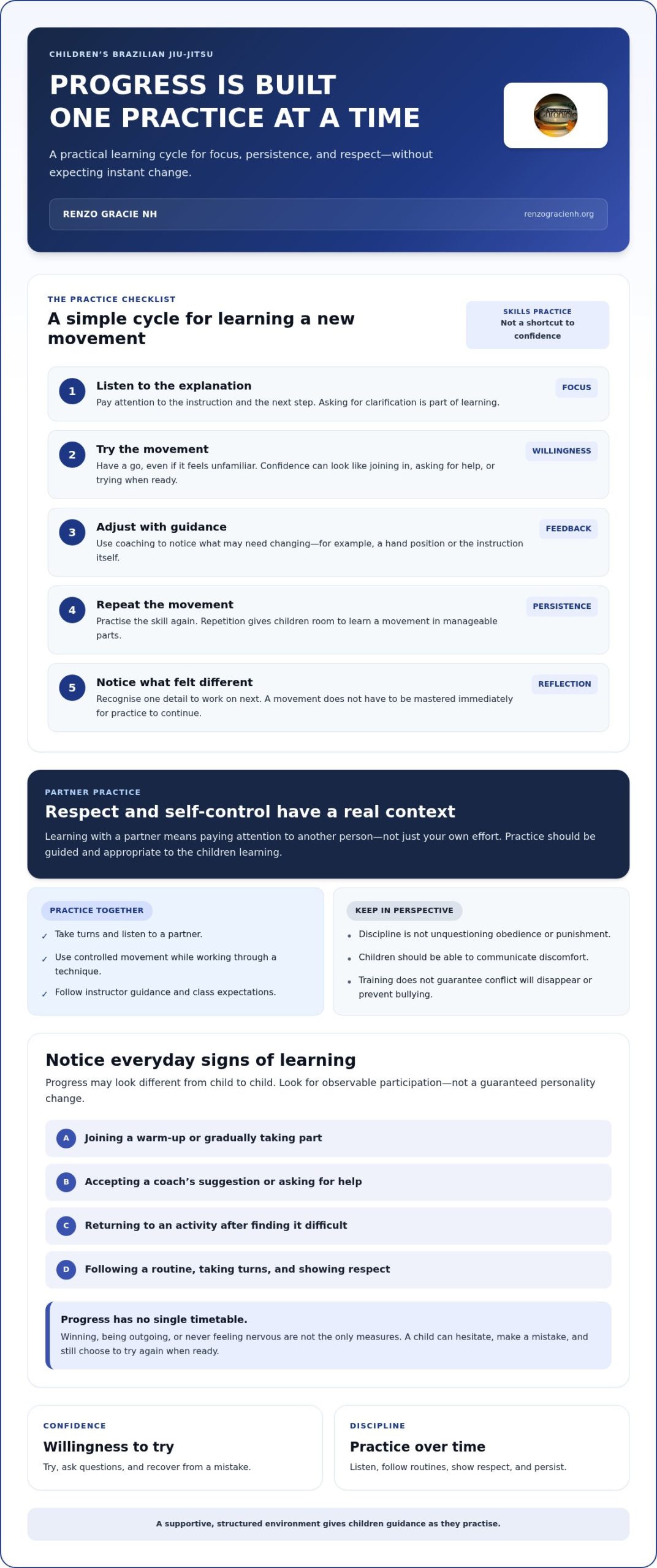
Growth comes through practice, not a sudden transformation. A child learning a new movement can follow a simple cycle: listen to an explanation, try the movement, adjust with guidance, repeat it, and notice what felt different. Each turn through that cycle gives them a chance to focus, respond to feedback, and take another step.

Brazilian Jiu-Jitsu is skills practice, not a shortcut to confidence. Techniques involve solving movement problems, such as how to create space, find balance, or respond to a partner’s position. The emphasis is on learning and applying technique, not simply relying on physical dominance. A child who doesn’t get a movement right immediately can still make progress by noticing one detail and trying again.

Small challenges help children practise persistence

Unfamiliar movements can take time to understand. Breaking a skill into manageable parts and repeating it gives a child room to learn without needing to master everything at once. A coach can help treat a mistake as useful feedback: perhaps the child needs to adjust a hand position or listen to the instruction again. That approach can encourage curiosity instead of making one imperfect attempt feel like failure.

Children respond to challenges in different ways. Some may be ready to try again right away; others may need a pause or more guidance. The aim is to support learning at a suitable pace, not to push every child toward the same response.

Partner practice gives respect and self-control a real context

Practising with a partner makes cooperation part of the learning. Children take turns, pay attention to each other, and use controlled movement as they work through a technique. They learn that training depends on a partner’s participation and comfort, not just their own effort.

Partner work needs appropriate supervision. Instructors guide practice so it’s suitable for the children learning, with clear expectations around respect and control. These habits can be practised on the mat, but they don’t guarantee that conflict will disappear or prevent bullying.

For parents exploring BJJ for child confidence and discipline, the useful question isn’t whether one class will change a child. Consider whether the learning process gives them supportive opportunities to listen, work through difficulty, and practise with respect. Families can learn more about children’s Brazilian Jiu-Jitsu instruction at Renzo Gracie NH.

What a child’s BJJ progress may look like: and what it cannot promise

Progress in Brazilian Jiu-Jitsu doesn’t follow one timetable, and it isn’t always easy to spot from the sidelines. A child might first watch before joining in, then take part in a warm-up, accept a coach’s suggestion, or return to an activity after finding it difficult. These are observable signs of participation and learning, not proof of a guaranteed change in personality.

Confidence doesn’t have to mean becoming outspoken, winning rounds, or never feeling nervous. For one child, it may look like asking a question; for another, it may mean calmly saying they need a break. Temperament, comfort, attendance, and individual experiences all shape how progress appears. Compare your child with their own earlier behaviour, not with other students.

Signs of progress parents can notice over time

Look for small shifts in participation, focus, respectful communication, and willingness to try. The table offers examples of behaviours that may emerge over time. These are possibilities, not a checklist every child should meet on a set schedule.

Stage Observable behaviours
Early Watches or joins part of a warm-up; follows a familiar instruction with support.
Developing Takes part more readily; listens to coaching or communicates a question, concern, or need for a break.
Ongoing Returns to an activity after difficulty; shows focus, respectful communication, or more willingness to try an unfamiliar task.

A child expressing discomfort is also communicating meaningfully, not failing at discipline. Notice the effort behind a behaviour and ask what felt manageable or challenging, rather than measuring progress by belts or competition results alone.

Does BJJ make children aggressive or confident overnight?

No class can guarantee a change in behaviour or self-esteem. Training should involve supervised skill practice with clear expectations, not encouragement to start fights. The purpose is to learn within a structured setting and treat partners with care. BJJ for child confidence and discipline is a practice opportunity, not an instant fix or a promise that conflict will disappear.

If your child seems worried, frustrated, or uncomfortable, talk calmly with them about what they’re experiencing. You can also share concerns with their instructors so the conversation stays focused on your child’s comfort and learning. Progress is personal, so give it room to take its own shape.
BJJ for Child Confidence and Discipline: What Parents Should Know

How parents can reinforce confidence and discipline beyond BJJ class

A few thoughtful questions after class can help your child notice their own effort without turning training into a performance review. Keep the conversation relaxed and let them choose what to share. You might ask, “What felt challenging today?” or “Was there anything you understood better after trying it again?”

Specific praise can make effort visible: “You listened carefully to that instruction,” or “I noticed you gave your partner room to try.” This recognizes focus and consideration, not just a result. Avoid comparing your child with a sibling or classmate, and don’t use training as punishment. Those approaches can make practice feel like a test instead of a place to learn.

Praise effort and reflection rather than winning

Children don’t need to win a round to have something worth celebrating. Notice a respectful choice, a question asked, or an attempt made after a difficult moment. If your child isn’t ready to talk, don’t press for a lesson or a positive takeaway. A quiet ride home can be enough; you can check in another time.

Respond supportively when a child feels nervous or frustrated

New activities can take time to feel familiar. If your child seems frustrated, start by listening rather than urging them to tough it out. Try, “What part felt hard?” or “Was there something you enjoyed?” This makes room for an honest answer, including mixed feelings. Avoid framing fear or discomfort as weakness, and don’t require a child to prove they’re brave by pushing past what feels manageable.

To notice gradual change, keep a few simple observations over time: whether your child joins in, asks for help, communicates a boundary, or seems comfortable returning. These notes aren’t a scorecard. They can help you see patterns and talk with your child or instructor if something concerns you.

For more information about the kids BJJ program in New Hampshire, explore the children’s program details. If sharing an activity as a family feels like a good fit, learn about parent and child Jiu-Jitsu. Families ready to take a first step can book a complimentary introductory class and let their child experience the training without pressure to make a long-term commitment.

Explore children’s BJJ at Renzo Gracie NH in Windham and nearby communities

For families considering BJJ for child confidence and discipline, a supportive place to learn matters. Renzo Gracie NH offers children’s Brazilian Jiu-Jitsu instruction in a structured setting focused on personal development. Children have room to learn and practise without treating confidence or discipline as guaranteed results.

Instruction is led by Professor Kevin Landry, a sixth-degree black belt under Renzo Gracie who has taught in the region for over two decades. His experience and the academy’s community-minded approach give families a local setting to explore the habits discussed in this guide. Renzo Gracie NH serves families in Windham, Manchester, and Exeter.

A supportive local setting for children learning BJJ

Structure can help make a new activity feel more approachable. Children have instruction to follow, skills to practise, and expectations around learning respectfully with others. An encouraging environment gives them space to engage at their own pace, while parents can notice individual effort rather than expect a particular outcome.

Explore the kids Jiu-Jitsu guide for New Hampshire families to learn more about children’s training at Renzo Gracie NH and how it may fit your family.

A low-pressure first step for parents and children

Reading about a class can only tell you so much. A complimentary introductory class gives a new student the opportunity to experience training and gives parents a chance to see how their child responds to the setting. There’s no need to decide in advance what the experience should prove. Treat it as a first look and a chance to learn together.

For more information about what to expect, read how to try Jiu-Jitsu free in New Hampshire. If your family is ready to take that first step, you’re warmly invited to book a free introductory class and let your child experience the academy for themselves.

Take a thoughtful first step with your child

BJJ for child confidence and discipline is best viewed as practice, not a promise of instant change. Children can work on listening, trying unfamiliar skills, respecting partners, and finding their way through mistakes. Progress may be quiet: joining in, asking for help, or choosing to try again. Parents can support that learning by praising effort and keeping conversations open, without comparing their child with others or expecting a particular outcome.

At Renzo Gracie NH, children learn in a structured, supportive setting. Professor Kevin Landry, a sixth-degree black belt under Renzo Gracie, has taught in the region for over two decades. New students can begin with a complimentary introductory class, a low-pressure opportunity to experience training and see how it feels.

Book a complimentary introductory class and take the first step at your child’s pace. Every small effort can be a meaningful part of learning, and your family can discover together whether Jiu-Jitsu feels like a good fit.

Frequently Asked Questions

Can BJJ help a shy child become more confident?

Brazilian Jiu-Jitsu can give a shy child chances to practise participating, trying unfamiliar movements, and asking for help, but it can’t guarantee a change in temperament or self-esteem. Confidence may show quietly, such as joining a warm-up after watching or returning to an activity after a pause. Let your child progress at their own pace, and recognize effort rather than expecting them to become outgoing or fearless.

Does Brazilian Jiu-Jitsu teach children discipline?

BJJ gives children opportunities to practise habits associated with discipline, including listening to instructions, following class routines, taking turns, and showing respect to training partners. Repeating skills can also help them practise focus and persistence. These are learning opportunities, not automatic results. A supportive class should allow children to ask questions and communicate discomfort; discipline isn’t unquestioning obedience or punishment.

Will BJJ make my child aggressive?

BJJ training shouldn’t encourage children to start fights. Brazilian Jiu-Jitsu is a grappling martial art, and children practise skills within a structured class with guidance and expectations around respect and control. No activity can promise how a child will behave in every situation. Talk with your child about using skills responsibly, and share any concerns about their experience with their instructor.

At what age can a child start Brazilian Jiu-Jitsu?

Renzo Gracie NH’s Kids Jiu-Jitsu program is for children ages 3 and up. The academy also has a Little Gracies program for ages 3 to 5. Age alone doesn’t show whether a child feels ready, so consider their comfort with trying a new activity and following simple instruction. A complimentary introductory class can help your family experience the setting before deciding on next steps.

How long does it take for a child to build confidence through BJJ?

There’s no set timeline, and BJJ can’t guarantee that a child will become more confident. Progress depends on the child, their comfort, attendance, and individual experiences. Rather than waiting for a dramatic change, notice small signs over time: participating more readily, asking questions, accepting coaching, or returning to a challenge. Compare your child’s progress with their own earlier experience, not with classmates.

What should parents look for in a kids’ BJJ class?

Look for clear instruction, age-appropriate and supervised practice, and consistent expectations for respect and controlled movement with partners. Notice whether your child has room to ask questions, express discomfort, and learn without pressure to win. A structured, encouraging environment can support learning, though no class can promise a particular outcome. At Renzo Gracie NH, children’s instruction is offered in Windham, Manchester, and Exeter.

Can parents train BJJ with their child at Renzo Gracie NH?

Yes. Renzo Gracie NH offers family training so parents and children can engage in Jiu-Jitsu together. Shared training can give families time to learn alongside one another, while each person develops at their own pace. The academy serves families in Windham, Manchester, and Exeter. New students can begin with a complimentary introductory class to experience training before choosing their next step.

Anti-Bullying Classes for Kids in Exeter: Empowering Your Child Through Jiu-Jitsu

What if the most effective way to stop a bully isn’t a punch, but a conversation backed by unshakable confidence? For many parents, the fear of a child being physically or emotionally hurt is a weight that is hard to carry. You want them to be safe. You feel the frustration of slow school responses and the worry that traditional martial arts might turn your child into an aggressor. At Renzo Gracie NH, we offer a different approach. Our anti-bullying classes for kids Exeter provide a supportive environment where children learn that true power comes from discipline, not violence.

We believe in building character alongside physical skill. Discover how Brazilian Jiu-Jitsu provides your child with the verbal and physical tools to stop bullying without resorting to unnecessary force. This article explores how we teach students to set clear boundaries and develop the focus needed to de-escalate conflict. You will learn how your child can gain the physical techniques to stay safe if a situation turns physical, all while improving their self-esteem. It’s about transformation. We help your child evolve from a potential target into a confident, respectful individual who knows their own strength and value.

Key Takeaways

  • Learn why traditional school anti-bullying policies are often reactive and how a proactive mindset helps your child identify a power imbalance before it escalates.
  • Discover why anti-bullying classes for kids Exeter focus on the “control and negotiate” philosophy of Brazilian Jiu-Jitsu to resolve conflicts without resorting to violence.
  • Compare the benefits of individual accountability in martial arts against standard school programs to see how personal empowerment builds genuine confidence.
  • Identify the essential qualities of a high-quality academy, from the instructor’s lineage to a supportive environment that prioritizes your family’s well-being.
  • See how a specialized curriculum can transform your child’s focus and discipline, helping them evolve into a resilient and respectful leader.

The Reality of Bullying in Exeter Schools: Why Policy Isn’t Always Enough

Bullying is a cycle. A repeated pattern of harm. The reality of bullying involves a clear power imbalance where physical, verbal, or social aggression is used to isolate a child. While most schools in the Exeter region maintain strict anti-bullying policies, these frameworks are often reactive. They provide a path for discipline after an incident occurs, but they rarely stop the initial hurt. By 2026, the psychological toll on youth has become more complex, manifesting as increased anxiety and a reluctance to engage in school activities. Relying solely on administrative responses isn’t enough to protect a child’s well-being. True safety begins with building internal resilience.

Understanding the Exeter Bullying Landscape

The playground is only the beginning. Aggression often follows children home through social media or waits for them at quiet bus stops. Bullying is distinct from “normal” peer conflict because it is targeted and persistent. It leaves the victim feeling powerless. Many children hesitate to report these incidents to teachers or parents. They fear that speaking up will lead to retaliation or that the adults in their lives won’t be able to intervene effectively. This silence allows the aggressor to maintain control. Our anti-bullying classes for kids Exeter empower children to break this silence by fostering the self-assurance needed to set boundaries early.

The Limits of Traditional Anti-Bullying Seminars

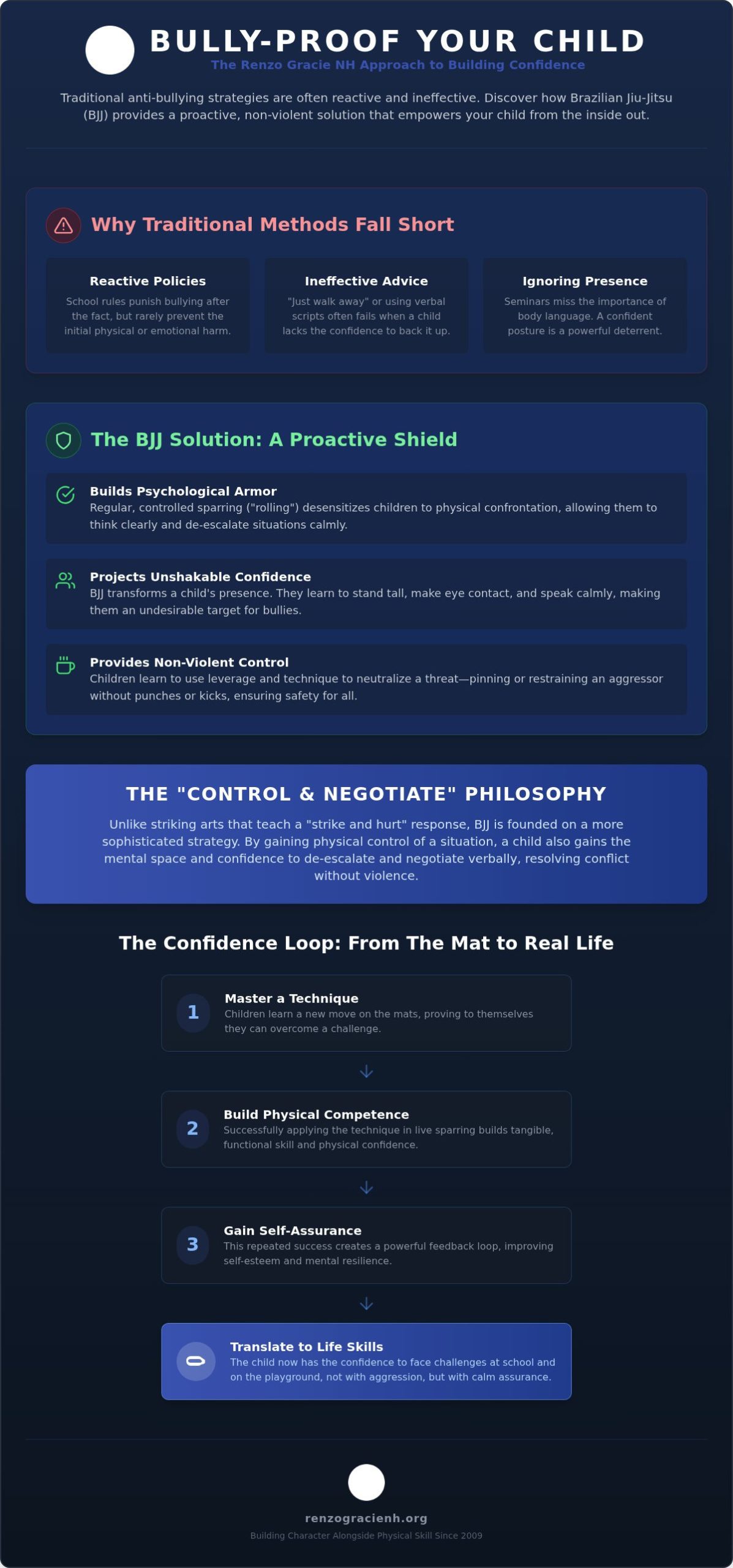
“Just walk away.” It’s common advice. It’s also frequently ineffective. When a child faces a significant power imbalance, walking away without confidence can actually invite more aggression. Traditional school seminars often focus on verbal scripts that fail in the heat of a real-world confrontation. They ignore the vital role of body language. A child who carries themselves with slumped shoulders and avoids eye contact is often perceived as an easy target. We focus on a transformation toward disciplined confidence. This isn’t about teaching your child to be the aggressor. Instead, we help them evolve their presence. A child who stands tall, maintains eye contact, and speaks with a calm, steady voice is far less likely to be targeted. By shifting from a state of vulnerability to one of quiet strength, children learn to navigate their social world with a sense of security that no school policy can provide on its own.

How Brazilian Jiu-Jitsu (BJJ) Provides a Non-Violent Solution

Leverage over force. Technique over temper. This is the foundation of Brazilian Jiu-Jitsu. Unlike traditional martial arts that focus on high-impact striking, BJJ teaches children to use an opponent’s momentum against them. It replaces the “strike and hurt” mentality with a more sophisticated “control and negotiate” strategy. This shift is vital for parents researching anti-bullying classes for kids Exeter. It ensures your child has the means to stay safe without becoming a bully themselves. When a child knows they can physically control a situation, the urge to lash out disappears.

Regular sparring, or “rolling,” acts as psychological armor. By facing controlled, physical challenges every day, children become desensitized to the panic often triggered by a confrontation. They learn to breathe. They learn to think. This mental clarity allows them to use verbal assertiveness to de-escalate a situation before a single hand is laid on them. By removing the fear of the unknown, we give children the space to find their voice.

Control Without Conflict: The BJJ Method

Safety starts with closing the distance. By moving closer to an aggressor, a child can neutralize the power of a punch or a shove. BJJ provides specific techniques to pin or restrain a larger peer without causing injury. It is a method of gentle restraint. This is exactly why BJJ is the gold standard for law enforcement training; it prioritizes safety for all parties involved. By mastering these holds, children gain the ultimate peace of mind. They know they can handle a situation if it escalates, which ironically makes them less likely to feel the need to fight.

The ‘Confidence Loop’ in Kids Martial Arts

Every mastered technique builds a new layer of self-assurance. When a child learns to escape a difficult position on the mats, they realize they can overcome obstacles in the classroom and on the playground. This physical competence feeds directly into their ability to speak up. They find their voice because they no longer fear the physical consequences of standing their ground. Brazilian Jiu-Jitsu is a tool for peace, not a weapon for war. As they evolve, their newfound posture and eye contact often stop bullying before it even begins. You can see this transformation firsthand by exploring our Kids Jiu Jitsu Program and watching your child’s self-esteem grow.

Martial Arts vs. School Programs: A Parent’s Comparison

Institutional policies are necessary. They set the rules for behavior and establish consequences for those who break them. However, these programs are fundamentally passive. They rely on the presence of an authority figure to intervene. When you enroll your child in anti-bullying classes for kids Exeter, you’re investing in an active form of protection. You’re giving them a set of tools that they carry within themselves, regardless of whether a teacher is watching. This internal resilience is the difference between a child who waits for help and a child who knows how to handle a difficult situation with poise.

While team sports offer community, Brazilian Jiu-Jitsu (BJJ) provides a unique level of individual accountability. In a crowded school hallway or on a football pitch, it’s easy for a child to blend into the background. On the mats, there is nowhere to hide. This environment forces a student to take ownership of their progress, building a brand of discipline that translates directly to the classroom. They learn that respect is earned through hard work and that perseverance is the only path to mastery. These are long-term character benefits that extend far beyond the gym walls.

Active Empowerment vs. Passive Protection

Teaching a child to protect themselves is a lifelong gift. School policies are a safety net, but they often have holes, especially in unsupervised areas like playgrounds or bus stops. At Renzo Gracie NH, we foster a supportive partner environment. We move away from the intimidating atmosphere of traditional combat sports to focus on collective growth. Your child becomes part of a community that values their safety as much as their technical skill. This supportive network helps them discover their potential in a way that a crowded school environment simply cannot match.

The Myth of the ‘Aggressive Martial Artist’

There is a common worry that martial arts will make a child more aggressive. In reality, the opposite is true. Aggression is often a mask for insecurity. Children who know they can defend themselves have nothing to prove to their peers. They don’t need to use force to feel powerful because they already possess a quiet, disciplined confidence. Our curriculum focuses heavily on humility and respect. Every class begins and ends with a bow, reinforcing the idea that the skills learned are for protection and personal evolution, never for intimidation. To see how this philosophy changes lives, explore our guide on Kids Jiu Jitsu New Hampshire: Empowering Your Child Through Brazilian Jiu Jitsu. When a child feels secure in their abilities, they become the person who stops a conflict, not the one who starts it.

Anti-Bullying Classes for Kids in Exeter: Empowering Your Child Through Jiu-Jitsu

What to Look for in an Exeter Anti-Bullying Program

Choosing the right environment is a critical decision for any parent. Not all martial arts schools are created equal. When searching for anti-bullying classes for kids Exeter, you need a program that balances technical excellence with a nurturing, supportive atmosphere. It’s not just about the physical space; it’s about the philosophy that guides every lesson. A high-quality program should focus on building a child’s character as much as their physical ability to stay safe.

Safety standards are non-negotiable. The facility should maintain clean mats and provide constant supervision during all sparring sessions. Furthermore, the curriculum must be structured for age-appropriate groups to ensure that a five-year-old and a twelve-year-old are both learning at a pace that suits their development. Look for a school that explicitly includes verbal de-escalation in their training. Self-defense begins with the ability to speak clearly and set boundaries before a situation ever turns physical.

The Importance of Quality Instruction

Lineage matters. It serves as a guarantee that the techniques your child learns are proven, effective, and safe. Learning from a world-class lineage like Renzo Gracie provides a direct link to the highest standards of the art. Professor Kevin Landry, a 6th-degree black belt with over two decades of teaching experience, brings a level of expertise that is rare in the NH region. This depth of knowledge ensures that every student receives professional instruction tailored to their individual progress. Before signing up your child, ask the instructor about their specific experience with children and how they handle different learning styles within the class.

Evaluating the Academy Culture

The atmosphere of the academy should project a blend of quiet authority and warm inclusivity. It shouldn’t feel like an intimidating fight club; it should feel like a place for growth. A supportive partner environment is essential for beginners to feel comfortable as they discover their potential. At Renzo Gracie NH, we prioritize the well-being of the individual and the family unit above all else. We believe that family time and community are the foundations of success. You can experience this welcoming culture firsthand when you Try Jiu Jitsu Free in New Hampshire: Your Path to Confidence and Skill. This risk-free trial allows you to gauge the fit for your child without any initial commitment.

A free introductory class is the gold standard for evaluating a program. It gives you the chance to see how the instructors interact with the students and whether the curriculum emphasizes respect and perseverance. If you’re ready to see how disciplined confidence can transform your child’s life, book a free introductory class at our academy today.

Starting Your Child’s Journey at Renzo Gracie NH

Renzo Gracie NH stands as the premier choice for families seeking anti-bullying classes for kids Exeter. We understand that the decision to start a martial arts journey is about more than just physical activity. It’s about finding a sanctuary where your child can grow. Our academy serves the Exeter and Windham region with a commitment to excellence that is rooted in a world-class legacy. We don’t just teach children how to defend themselves. We provide a roadmap for them to become the best versions of themselves through discipline and respect.

Our long-term vision goes beyond the mats. We are building a community of confident, respectful leaders who carry the values of jiu-jitsu into their schools and homes. By focusing on the individual needs of every student, we ensure that the lessons learned during training have a lasting impact on their character. This is where transformation begins. Your child will evolve from a hesitant beginner into a resilient individual who understands the value of hard work and collective effort.

A Supportive Environment for Growth

Classes at our academy are purposefully tailored for different age groups and skill levels. This structure ensures that the curriculum remains engaging and safe for everyone. We prioritize personal progress over winning competitions. While we celebrate technical mastery, we value the “joy of the journey” above all else. Many NH parents have shared testimonials describing the incredible transformation they’ve seen in their children. They report improved focus in school and a significant boost in self-esteem. This growth happens because we provide a space where it’s safe to fail, learn, and try again. It’s about building a foundation of strength that lasts a lifetime.

Take the First Step: The Free Intro Class

Preparing for your child’s first class is simple. All they need to bring is comfortable athletic wear and a positive attitude. We provide the professional instruction and the welcoming community. Our free introductory class is designed to be a “no-commitment” way for you to discover if our Kids Jiu Jitsu Program is the right fit for your family. You will have the opportunity to meet Professor Kevin Landry and see our supportive partner culture in action. We believe that once you see the staccato-then-flow rhythm of our classes, you’ll understand why so many Exeter families trust us with their child’s development. Don’t wait for a conflict to happen before taking action. Schedule your child’s free introductory class at Renzo Gracie NH today!

Empower Your Child’s Future with Disciplined Confidence

Empower your child with more than just a list of rules. You’ve discovered how Brazilian Jiu-Jitsu shifts the focus from reactive reporting to proactive resilience. By mastering the “control and negotiate” method, children gain the ability to stop aggression without becoming aggressors themselves. This internal strength is a gift that lasts long after they leave the school hallway. It’s a tool for peace that they carry within.

Choosing anti-bullying classes for kids Exeter means joining a community that prioritizes your family’s success. With 6th-degree black belt instruction and over 20 years of local NH experience, we provide a family-first culture where every student is encouraged to evolve at their own pace. We focus on building character through respect and perseverance. It’s time to help your child discover their own strength in a safe, professional environment.

Are you ready to see your child stand taller? Take the first step toward their personal growth today. We invite you to experience our supportive academy firsthand. Claim Your Child’s Free Introductory Class in Exeter Today and watch them develop the skills they need to thrive. We look forward to welcoming your family into our community.

Frequently Asked Questions

Will martial arts classes make my child more aggressive or a bully themselves?

Martial arts training at Renzo Gracie NH actually decreases aggression. When children realize they possess the tools to handle a physical confrontation, they no longer feel the need to prove their strength through bullying. Our curriculum emphasizes humility and respect above all else. We teach students that their skills are for protection, not intimidation. This newfound sense of security allows them to remain calm and composed in stressful social situations.

My child is very shy; will they feel overwhelmed in a Jiu-Jitsu class?

We understand that a new environment can be intimidating. Our academy is designed to be a supportive partner for every student, especially those who are naturally reserved. Instructors use a methodical approach to ensure no child feels overwhelmed. By focusing on small, personal victories, shy children gradually build the “confidence loop” needed to find their voice. They discover that the mats are a safe place to grow at their own steady pace.

What is the best age for a child to start anti-bullying classes in Exeter?

Most children are ready to begin their journey around age five or six. At this stage, they have the coordination and focus to benefit from our structured anti-bullying classes for kids Exeter. However, we offer programs tailored to various age groups and developmental stages. The best way to gauge readiness is through our free introductory class. This allows your child to experience the atmosphere and technical instruction without any initial pressure or commitment.

How long does it take for a child to build real self-defense confidence?

Confidence begins to evolve from the very first session. While mastering complex techniques takes consistent practice over several months, the psychological shift happens much faster. Students quickly learn to maintain eye contact and stand with a more disciplined posture. These subtle changes in body language often deter bullies before a conflict even begins. True self-defense competence is a steady progression where every class adds a new layer of resilience and self-assurance.

Is Brazilian Jiu-Jitsu safer than other martial arts like Karate or Taekwondo?

Brazilian Jiu-Jitsu is often called “the gentle art” because it lacks the high-impact strikes found in Karate or Taekwondo. Instead of teaching children to punch or kick, we focus on leverage and ground-based control. This makes it a safer alternative for young practitioners. It’s the same reason BJJ is the preferred method for law enforcement training. It allows a person to neutralize a threat without causing unnecessary injury to themselves or others.

Does the Renzo Gracie NH program include verbal de-escalation techniques?

Yes, verbal de-escalation is a core component of our curriculum. We believe that the best way to win a fight is to avoid it entirely. Our anti-bullying classes for kids Exeter teach students specific verbal scripts to set boundaries and de-escalate tension. By combining these communication skills with physical competence, children learn to “control and negotiate.” This holistic approach ensures they have the presence of mind to resolve conflicts peacefully whenever possible.

Can parents watch the classes, or is there a family training option?

We prioritize the family unit and offer dedicated family time sessions. Parents are always welcome to watch their children train from our designated viewing areas. We believe that a supportive community starts with transparency and parental involvement. Seeing your child’s progress firsthand helps reinforce the values of perseverance and respect at home. Our academy serves as a bridge where families can grow together through the shared challenge of mastering a new skill.

What should my child wear to their first anti-bullying class?

For the free introductory class, your child should wear comfortable athletic clothing without zippers or buttons. A simple T-shirt and shorts or leggings are perfect. We want the focus to be on the joy of discovery rather than the gear. Once they decide to continue their journey in our Kids Jiu Jitsu Program, we will provide guidance on the traditional uniform. Just bring a positive attitude and a willingness to learn something new.