Posts

Help my child with focus in Manchester through routines and skills

A child’s focus isn’t simply a matter of trying harder. Consistent routines, manageable tasks and chances to practise attention can make it easier to get started and stay with an activity. If you’re looking for ways to help your child focus in Manchester, begin with predictable patterns and skills they can build over time.

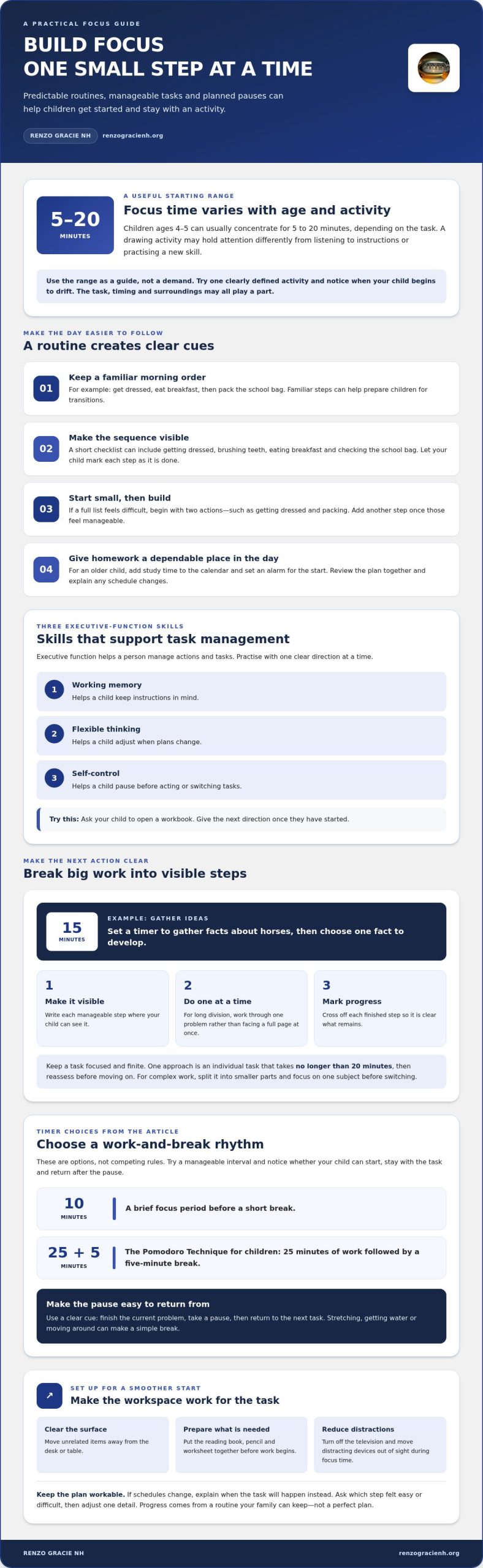
It can be frustrating when your child seems easily distracted, especially when schoolwork or everyday tasks need their attention. Focus varies with a child’s age and the activity: children ages 4-5 can usually concentrate for 5 to 20 minutes, depending on the task. Shorter, clearly defined periods of work may be a more supportive starting point than expecting a child to concentrate for a long stretch.

This article explains how steady routines and practical focus and executive-function skills can support your child’s attention. You’ll find ways to break tasks into smaller steps, plan focused work with breaks, and create achievable routines at home. Small steps and steady practice can help your child grow in confidence and focus.

Key Takeaways

  • Use predictable daily routines to give your child clearer cues for when it’s time to focus, work and take a break.
  • Make challenging tasks easier to begin by dividing them into smaller steps and reducing distractions in the workspace.
  • Build focus and executive-function skills through practical habits that support planning, working memory and self-control.
  • Explore whether a structured activity such as Renzo Gracie NH’s Kids Jiu Jitsu Program could complement the skills your child practises at home.

1. Consistent daily routines

A predictable routine gives children clearer cues about what happens next. That structure can reduce stress and support concentration when school, homework, and activities compete for attention. If you’re looking for ways to help your child with focus in Manchester, start with a few dependable points in the day. Choose a morning sequence, such as getting dressed, eating breakfast, and packing a school bag. Keep the order familiar, even if the timing shifts. This helps your child prepare for transitions instead of processing several new instructions at once.

Make the morning sequence visible with a short checklist near the door or breakfast table. List getting dressed, brushing teeth, eating breakfast, and checking the school bag. Ask your child to mark each step when it’s done. This encourages organization and gives them an active role in the routine. If the full list feels difficult, start with two actions, such as getting dressed and packing. Add another step once those feel manageable. A useful routine helps your child act more independently.

Homework is easier to approach when it has a familiar place in the day. For an older child, add study time to the calendar and set an alarm to mark the start. Your child might study at the same time each day, with planned breaks. That steady cue helps distinguish homework from other activities. Review the calendar together so your child knows when work begins and what comes next. If school schedules change, adjust the plan and explain the new timing.

Choose focus periods based on your child’s age and the task. Children ages 4-5 can usually concentrate for 5 to 20 minutes, depending on the activity. A drawing exercise may hold attention differently from listening to instructions or practising a new skill. Try one clearly defined activity, then notice when your child begins to drift. That observation can guide your next choice. Don’t assume every lapse means unwillingness; the challenge, timing and surroundings may all play a part.

Plan pauses before frustration builds. After a set period of homework, invite your child to stretch, get water, or move around before returning. Downtime gives children a chance to process what they’ve learned. Make the break’s ending clear: finish the current problem, take a pause, then return to the next task. If you’re wondering how to help your child focus in Manchester, a predictable restart can be as useful as a predictable beginning. Keep the pause simple so returning to work feels manageable.

Set up a familiar homework space as a cue that it’s time to work. Clear unrelated items from the desk or table, then put out only the materials needed for the current task. Turn off the television and move distracting devices out of sight during focus time. For example, place the reading book, pencil, and worksheet together before your child sits down. With fewer distractions, your child can begin without searching for materials or deciding what to do first.

Keep routines steady while making room for changes. If a school event disrupts the usual homework time, tell your child when the task will happen instead. At the end of the day, ask which step felt easy and which felt difficult. Use the answer to adjust one detail, such as preparing the school bag before bed or moving homework earlier. These small changes help your child build workable habits through practice. Progress comes from a routine your family can keep, not a perfect plan.
Help my child with focus in Manchester through routines and skills

With adhd

ADHD can affect attention, impulse control, and activity levels, making schoolwork and home tasks harder to manage. Inattention is a main symptom and may make concentration difficult at school and at home. A child may also hyperfocus on a favorite activity, then struggle to shift attention when it ends. Notice situations that create friction, such as starting homework, following several directions, or stopping a game. These examples can help you choose practical supports instead of relying on reminders to “try harder.”

Executive function refers to skills that help a person manage actions and tasks. Its three main skills are working memory, flexible thinking, and self-control. Working memory helps a child keep instructions in mind, while flexible thinking helps them adjust when plans change. Self-control helps them pause before acting or switching tasks. Practise these skills by giving one clear direction at a time. For example, ask your child to open a workbook, then give the next instruction once they’ve started.

Break a large assignment into visible, manageable steps. If a child needs to write facts about horses, set a 15-minute timer to gather ideas, then choose one fact to develop. A fourth grader facing long division can work through one problem at a time, rather than seeing a full page as one overwhelming task. Smaller steps make it easier to begin and create clear points of progress. Let your child cross off each finished step to see what remains.

Keep each homework task focused and finite. One approach is to choose an individual task that takes no longer than twenty minutes, then reassess before moving on. If an assignment is complex, divide it into smaller parts, such as reading a question, identifying the needed information, and writing one answer. Ask your child to work on one subject before switching to another. This limits competing demands and helps them focus on the next specific action.

Timers can make focus periods easier to understand, but choose a method that fits your child. A 10-minute timer offers a brief work period before a short break. The Pomodoro Technique for children uses 25-minute work periods followed by a five-minute break. These are options, not competing rules. Try a manageable interval, then notice whether your child can start, stay with the task and return after the pause. Use breaks for stretching, water or movement, rather than another demanding activity.

Practise attention away from homework, too. Read a short passage together, then ask your child to recall a detail or explain what happened. This gives them a low-pressure chance to practise patience and sustained attention. Before a challenging part of a task, take a few deep breaths together and name the first step. You can also make learning active by adding movement or a simple game. For example, have your child stand and stretch between completed problems.

Notice and reinforce specific efforts, such as starting a task, finishing a step, or returning after a break. A reward can recognize the action without expecting perfect concentration. Say, “You came back and finished the next problem,” so your child knows what they did well. If focus difficulties persist or your child seems unusually distracted, talk with their pediatrician. A professional ADHD evaluation takes a few hours. Share concrete examples from home and school to describe what you’re observing.

Read passages together and ask questions about what your child has read. This practice can encourage patience and sustained attention. Keep the questions connected to the passage, giving your child time to think and respond before moving on.

ADHD’s three main symptoms are inattention, impulsivity, and hyperactivity. Attention demands can continue throughout the day: school requires students to concentrate for long stretches, and older children may have activities that require even more focus. A child may concentrate intensely on a particular interest yet find it difficult to shift attention, making transitions challenging. When a task feels difficult to approach, make its smaller steps clear. Breaking challenging work into manageable pieces gives a child an approachable starting point. Completing those steps can build confidence and motivation, helping the child feel ready to continue. Make the next action clear and progress visible instead of presenting a large task all at once. These supports can help with schoolwork and other activities that require sustained focus. For older children and adolescents who need further guidance in group or social environments, programs like Social Skills Australia offer evidence-based training tailored to navigating life with ADHD.

Renzo Gracie NH: Adult Jiu Jitsu Program

Renzo Gracie NH offers a Kids Jiu Jitsu Program for families seeking structured martial arts practice alongside home routines. Learning and practising Jiu Jitsu involves following instruction, taking turns, and working through skills step by step. These activities give children opportunities to practise attention and perseverance in a group setting, though they don’t replace an ADHD evaluation or individualized support.

If your child is interested in trying a structured activity, the Free Introductory Class is a way to experience the program. Parents can consider whether the class suits their child’s interests and needs. Adults who want to train can also join Renzo Gracie NH’s Adult Jiu Jitsu Program.

Contact Renzo Gracie NH or visit renzogracienh.org to learn more.

Choose a supportive next step

Progress can begin with one practical choice: notice which settings help your child feel ready to participate, then build from there. A steady home routine and a structured activity can complement each other, giving your child different opportunities to practise attention, patience, and persistence. Focus on their experience, including what they enjoy and what feels challenging, rather than expecting every day to look the same.

If you’re looking for ways to help your child focus in Manchester, consider whether a welcoming group activity could complement the skills you’re building at home. Renzo Gracie NH’s Kids Jiu Jitsu Program may suit a child interested in learning through martial arts. The next step is one your family can approach with confidence and realistic expectations.

Contact Renzo Gracie NH to learn more, and keep encouraging your child’s progress one step at a time.

Frequently Asked Questions

Why Can’t My Child Focus?

A child may have trouble focusing when a task feels confusing, uninteresting, or demanding, or takes place amid distractions. Attention can also vary with rest and setting: a child might manage a hands-on activity but lose track during a long verbal explanation. Note when focus is hardest, including the subject, time, and surroundings. If difficulties persist across settings, discuss your observations with your child’s pediatrician.

What practical strategies help a child improve focus at home and school?

Coordinate simple, consistent cues with your child’s teacher. For example, ask whether the teacher can give a brief transition notice before independent work, then use a similar cue at home before starting a chore. Agree on one neutral reminder, such as “What’s your next step?” instead of repeating several directions. Afterward, notice together which cue helped your child return to the task, and share that observation between home and school.

Preschool Martial Arts in Manchester NH: Early Development

What if the best place for your high-energy three-year-old to learn self-control isn’t a quiet classroom, but a padded mat? Most parents in the Queen City know the feeling of watching their child bounce off the walls with endless vitality. You want an outlet that burns energy while building character. It’s natural to worry that martial arts might encourage aggression or make a child too “tough” before they even start kindergarten. However, the right preschool martial arts Manchester NH program does the exact opposite. It provides a structured, non-striking environment where that restless spirit is transformed into purposeful movement and genuine respect.

We understand that you want your child to feel safe and capable as they approach their school years. Discover how specialized Brazilian Jiu-Jitsu programs for 3 to 5 year olds build physical literacy, focus, and quiet confidence without the need for kicks or punches. This article explores how our curriculum improves listening at home, develops essential gross motor skills, and fosters a supportive community for the entire family. We’ll preview the journey from high-energy play to disciplined growth, showing you why a “physical playground with a purpose” is the safest foundation for your child’s future.

Key Takeaways

  • Build physical literacy. Learn how functional movement patterns develop coordination during these critical early years.
  • Safety through grappling. Understand why non-striking martial arts offer a more intuitive foundation for preschoolers than traditional styles.
  • Focus beyond the mat. Discover how to transform high energy into “listening first” habits that help at home and in school.
  • Find the best fit. Identify the safety standards and instructor ratios essential for the top preschool martial arts Manchester NH schools.
  • Expert guidance. Explore how world-class lineage and a supportive community create a space where your child can truly evolve.

The Benefits of Preschool Martial Arts in Manchester NH

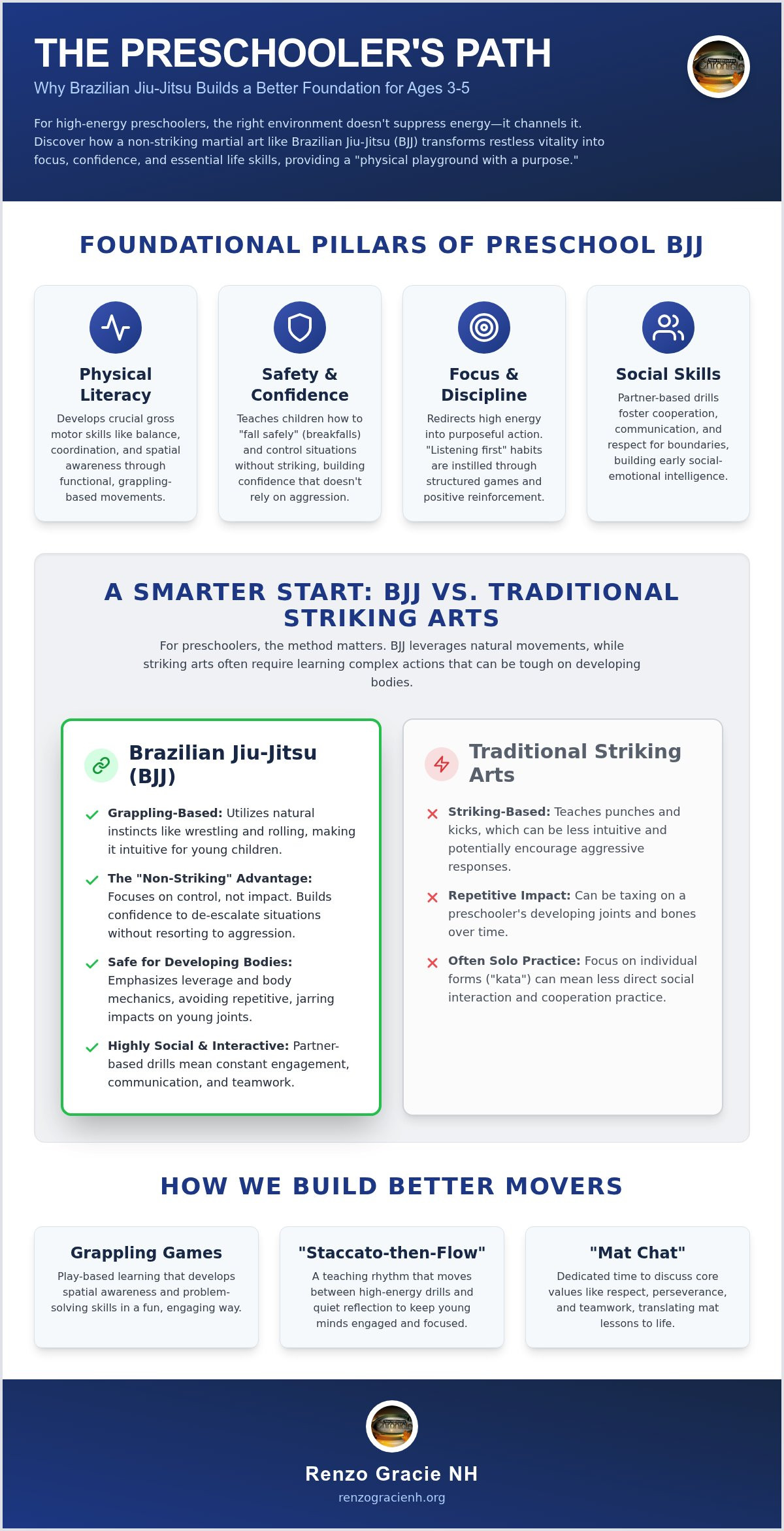
Beyond the physical, these sessions instill “listening first” habits. We move away from the rigid, intimidating atmosphere of traditional combat sports. Instead, we create a supportive community where focus is rewarded. Through partner-based drills, students develop early social-emotional intelligence by learning to respect boundaries and cooperate with their peers. This structured play provides a gentle introduction to discipline that feels like a game but builds a foundation of character.

Physical Literacy for 3-5 Year Olds

Balance. Coordination. Resilience. These are the pillars of a preschooler’s physical growth. In our Kids Jiu Jitsu Program, we focus on “falling safely” through breakfalls. This specific skill reduces the risk of childhood injuries by teaching children how to distribute impact correctly. We use grappling-based games to develop spatial awareness, helping kids understand where their bodies are in relation to others. This isn’t just exercise. It’s a way to build a stronger, more capable child who feels at home in their own skin.

Focus and Discipline in a High-Energy Environment

Harness the chaos. We don’t try to suppress a child’s natural energy. We aim to redirect it. Our instructors use a “staccato-then-flow” rhythm to keep young minds engaged, moving quickly between high-energy drills and quiet moments of reflection. During our “Mat Chat,” we discuss core values like perseverance and respect, ensuring these lessons stick long after the gi comes off. By using positive reinforcement, we turn raw energy into focused effort. This approach ensures that the discipline learned on the mats translates directly to the classroom and the dinner table. It’s a steady progression toward self-mastery, led by a supportive guide who values the individual’s success.

BJJ vs. Karate: Which is Best for Your Preschooler?

Children are built for movement. When looking for preschool martial arts Manchester NH, you’ll likely see many Karate schools. While these have their merits, grappling is often a more natural fit for the 3 to 5 age range. Think about how your child plays at home. They wrestle. They roll on the carpet. They engage in “rough and tumble” play that is essential for their development. Brazilian Jiu-Jitsu (BJJ) takes those natural instincts and gives them structure. It turns a tumble into a technique. This makes the learning process feel less like a chore and more like a discovery.

Safety is our quiet authority. Striking based arts require repetitive impact that can be taxing on developing joints. BJJ, however, relies on body mechanics and leverage. It’s a safe, controlled environment where children learn to navigate physical challenges without the jarring impact of kicks or punches. This non-violent approach allows kids to handle conflict by controlling an opponent’s movement rather than resorting to aggression. It’s about confidence, not combat.

The “Non-Striking” Advantage

Many parents worry that martial arts will make their child more aggressive. It’s a valid concern. However, by removing the striking element, we remove the “hit first” instinct. Instead, our students learn to neutralize a situation through body control. They learn that they have the power to stay safe without causing harm. This builds a unique kind of confidence. A child who knows they can control a situation doesn’t feel the need to escalate it. They stay calm. They use their words first, knowing they have the physical literacy to protect themselves if necessary. This is true empowerment that doesn’t rely on raw power or violence.

Social Interaction on the Mat

In many traditional schools, children spend a lot of time standing in lines performing solo forms or “kata.” Our approach is different. Because Jiu-Jitsu is partner based, children are constantly interacting. They learn to communicate, to wait their turn, and to trust their teammates. It’s a collective effort. We believe this community aspect is vital for early development, which is why our “Family Time” sessions are so popular with Manchester parents. It’s not just a class; it’s a way for the whole family to bond through shared progress. You can experience this supportive environment firsthand by signing up for a free introductory class to see how our Kids Jiu Jitsu Program fits your family’s needs.

The Renzo Gracie NH Difference: World-Class Lineage in NH

Excellence starts with heritage. When you search for preschool martial arts Manchester NH, you’ll find several local options, but lineage is the true guarantee of quality. The legacy of Renzo Gracie represents a philosophy of technical mastery and warm inclusivity that has shaped modern martial arts. By bringing your child into this lineage, you ensure they build a foundation rooted in a globally recognized system. It’s the difference between a temporary hobby and a lifelong skill set. We act as the expert in the room, providing a prestigious path for your child’s evolution.

Leadership defines the mat. Professor Kevin Landry is a 6th-degree black belt under Renzo Gracie, bringing over 20 years of teaching experience to the New Hampshire region. This level of expertise is a rarity. It means your child is guided by an authoritative mentor who understands the deep nuances of physical development. We don’t just teach moves; we cultivate a sense of disciplined confidence. This professional approach ensures that every session is safe, productive, and focused on the individual success of the student. We prioritize the well-being of your family above all else.

Expert Instruction for Young Minds

Teaching a three-year-old requires a specific touch. It’s about translating complex body mechanics into games and movements that make sense to a preschooler. Professor Landry has spent decades refining a curriculum designed specifically for youth development. Our instructors are experts at adapting these techniques, ensuring that every child feels capable and empowered. This structured martial arts curriculum NH provides a clear roadmap for growth. We focus on the joy of personal progress rather than just competition. This steady progression helps children discover their own potential in a supportive environment.

A Community-First Academy

Character counts. We’ve moved away from the aggressive stereotypes often associated with combat sports. Our academy is a warm, inclusive space where everyone is welcome. We prioritize the strength found in collective effort. By fostering a jiu jitsu community New Hampshire families truly value, we create a sense of belonging that extends beyond the mats. We act as a supportive partner for Manchester parents, helping to build character traits like respect and perseverance. It’s a place for growth, vitality, and the long-term success of the entire family unit. Join a community that values hard work and mutual respect.

Preschool Martial Arts in Manchester NH: Early Development

Choosing the Right Preschool Martial Arts School in Manchester

Choose with care. The facility you select for preschool martial arts Manchester NH becomes an extension of your parenting team. It’s not just about the mats; it’s about the mentorship. Start by observing the atmosphere. Is the gym a “fight club” designed for seasoned competitors, or is it a “family academy” where young children are greeted with smiles? A professional space should prioritize cleanliness and high-quality mat safety. We maintain strict instructor-to-student ratios to ensure every three-year-old receives the attention they need to thrive. This creates a secure environment where raw energy is channeled into positive growth.

Never sign a contract blindly. A reputable school should always offer a demo session. This allows you to see how your child reacts to the structure and the instructors before making any commitment. We believe in transparency, especially regarding our martial arts membership NH options. You deserve to know exactly what to expect from the very first day. We focus on building a supportive partner relationship with families. This ensures the transition from preschool play to big kid classes is a steady, natural progression.

What to Look for During Your First Visit

Watch the interaction. Do the instructors get down on the child’s level? Effective teaching for preschoolers requires engagement and genuine joy. You want to see students who are excited to be there, not intimidated by the environment. Look for a facility that values personal progress over raw competition. This focus on character development is what sets a world-class academy apart. It ensures your child builds vitality and perseverance while having fun on the mat.

Location and Accessibility

Convenience matters for busy parents. If you’re balancing a commute between Manchester, Windham, or Exeter, finding a gym that fits your route is essential. Our class schedules are designed with preschool families in mind, making it easier to integrate jiu jitsu Manchester NH into your daily routine. We offer family-friendly time slots that respect your schedule. This consistency helps martial arts become a reliable part of your lifestyle rather than a logistical burden. Ready to see the difference for yourself? Join us for a free introductory class and experience our supportive community firsthand.

Your Child’s First Class: Preparation and Expectations

Preparation is the key to confidence. When you bring your child to their first session of preschool martial arts Manchester NH, we want the experience to be seamless. There is no need to worry about specialized uniforms on day one. Simply have your child wear comfortable, breathable athletic gear like shorts and a t-shirt. We recommend arriving about 15 minutes early. This gives your little one time to explore the facility, meet our instructors, and watch the older students train. It’s a gentle way to normalize the environment and settle any nerves before the class begins.

First day jitters are natural. Some children run straight to the mat, while others prefer to watch from the sidelines for a few minutes. We respect that pace. Our instructors act as a supportive guide, using a low-pressure approach to help shy children integrate into the group. We prioritize the joy of personal progress over immediate performance. This welcoming atmosphere is the heart of our free introductory class, where we focus on making a positive first impression that lasts a lifetime.

Step-by-Step: The First 45 Minutes

The class follows a purposeful rhythm. We begin with a warm-up that feels like a series of games but actually focuses on functional movements like bear crawls and crab walks. These drills build the physical literacy we discussed earlier. Next, we move into the technical lesson. We teach one simple technique centered on body control or leverage, ensuring the move is safe and age-appropriate. We conclude with a brief wrap-up where we reinforce the “lesson of the day,” such as focus or perseverance. This ensures your child leaves the mat feeling empowered and proud of their effort.

Building a Long-Term Habit

Consistency creates character. Success on the mat doesn’t happen overnight; it’s a steady progression. You don’t need to be an expert to support your child’s training. Simply asking them what they learned or praising their focus at home makes a significant impact. As they grow, they will eventually transition into our broader kids jiu jitsu New Hampshire program. This journey from preschool play to disciplined mastery is a collective effort between our academy and your family. We are here to ensure that martial arts becomes a reliable and rewarding part of your child’s lifestyle.

Empower Your Child’s Future Today

Building a foundation for your child starts with a single step onto the mat. You’ve discovered how the right program builds focus, physical literacy, and non-violent conflict resolution. Brazilian Jiu-Jitsu offers a safe, intuitive environment for three to five year olds to thrive. By choosing preschool martial arts Manchester NH at a dedicated academy, you’re investing in your child’s character and long-term vitality. This isn’t just about exercise. It’s about giving your child the tools to navigate the world with quiet authority and respect.

Our academy provides the weight of a world-class Renzo Gracie lineage. Led by 6th-degree black belt Kevin Landry, our instructors act as supportive partners for your entire family. We pride ourselves on a warm, inclusive atmosphere that prioritizes personal progress over competition. It’s time to see the transformation for yourself. We invite you to experience our supportive community firsthand. Claim Your Child’s Free Introductory Class Today! We look forward to helping your child discover their potential and evolve into a confident, disciplined individual.

Frequently Asked Questions

Is my 3-year-old really ready for martial arts classes?

Yes, children as young as three are ready for the specialized preschool martial arts Manchester NH curriculum we provide. At this age, the focus is on physical literacy and “listening first” habits rather than complex combat techniques. We use functional movement patterns disguised as games to build coordination and spatial awareness. It’s a supportive environment where your child can explore their potential and develop foundational social skills alongside their peers.

Will Brazilian Jiu-Jitsu make my child more aggressive?

No, Brazilian Jiu-Jitsu (BJJ) actually helps decrease aggression by building genuine self-confidence. Because BJJ is a non-striking art, children learn to resolve conflicts through control and leverage rather than hitting or kicking. A child who feels capable and secure doesn’t feel the need to prove themselves through violence. We prioritize respect and perseverance on the mat, teaching students that strength is found in discipline and collective effort.

What is the difference between BJJ and Karate for preschoolers?

The primary difference lies in the method of interaction. Karate focuses on striking with hands and feet, while BJJ is a grappling-based art that mimics natural “rough and tumble” play. For preschoolers, grappling is often more intuitive and safer for developing joints. It allows children to neutralize a situation without escalating to violence. Our Kids Jiu Jitsu Program emphasizes non-violent control, making it a “physical playground with a purpose” for young learners.

How much do preschool martial arts classes cost in Manchester NH?

Tuition for preschool martial arts Manchester NH programs typically follows a recurring membership model. Rates can vary based on the specific program and the number of sessions your family chooses to attend. We believe in transparency and encourage you to visit our facility to discuss the best fit for your needs. This allows us to provide a detailed overview of our membership options while you experience our supportive, family-oriented atmosphere firsthand.

What should my child wear to their first BJJ class?

For the first session, your child should wear comfortable athletic clothing that allows for a full range of motion. Simple shorts and a t-shirt are perfect. We want the initial experience to be low-pressure and welcoming. As your child progresses and decides to continue their journey with us, we will provide guidance on the traditional uniform, or “gi,” used in our Kids Jiu Jitsu Program. It’s about the joy of progress.

Can parents watch the classes at Renzo Gracie NH?

Yes, we encourage parents to stay and watch their children train. We are a community-first academy that values the involvement of the entire family unit. Watching your child grow and overcome challenges on the mat is a rewarding experience. We also offer dedicated “Family Time” sessions where parents and children can engage in the curriculum together, fostering stronger bonds and shared progress within our professional and supportive environment.

How do you handle children who have trouble following directions?

We view every challenge as an opportunity for growth. Our instructors are experienced at working with high-energy preschoolers who may struggle with focus. We use a “staccato-then-flow” rhythm to keep students engaged, alternating between active drills and quiet “Mat Chats.” By using positive reinforcement and structured play, we help children evolve their listening skills. We act as an authoritative mentor, guiding them toward self-discipline with patience and warmth.

Is there a free trial for the preschool program?

Yes, we offer a free introductory class for all new students. This allows your child to experience the mat and meet our instructors without any initial commitment. It’s the perfect way for you to see our world-class lineage and supportive atmosphere in action. You can tour the facility, meet Professor Kevin Landry, and see how our curriculum builds vitality and confidence in a safe, clean, and professional setting.