Police Defensive Tactics Training in Windham: Core Skills
Control matters more than confrontation. Police defensive tactics training in Windham covers de-escalation alongside control holds, takedowns, strikes, and blocks, building a range of responses for challenging encounters. These tactics are designed to help officers gain compliance during arrests, reduce unnecessary force, and prevent injuries to officers and suspects.
Physical techniques are only part of the picture. Officers also need to recognize when communication may lower tension and how to use physical control with discipline when an encounter demands it. Training brings these skills together so responses can be deliberate rather than reactive.
This article explains the core skills involved, how they fit into defensive tactics training, and how Law Enforcement Jiu-Jitsu applies grappling and control to professional practice. It also outlines what officers and agencies in Windham, Manchester, and Exeter can consider when choosing training.
Key Takeaways
- See how control holds, takedowns, strikes, and blocks fit into a broader approach to managing physical encounters.
- Understand why de-escalation is an important part of defensive tactics, not a separate skill.
- Learn how disciplined defensive tactics can support compliance while helping reduce unnecessary force and injury risk.
- Explore how Law Enforcement Jiu-Jitsu training can build practical control skills through Renzo Gracie NH.
Control holds, takedowns, strikes, and blocks
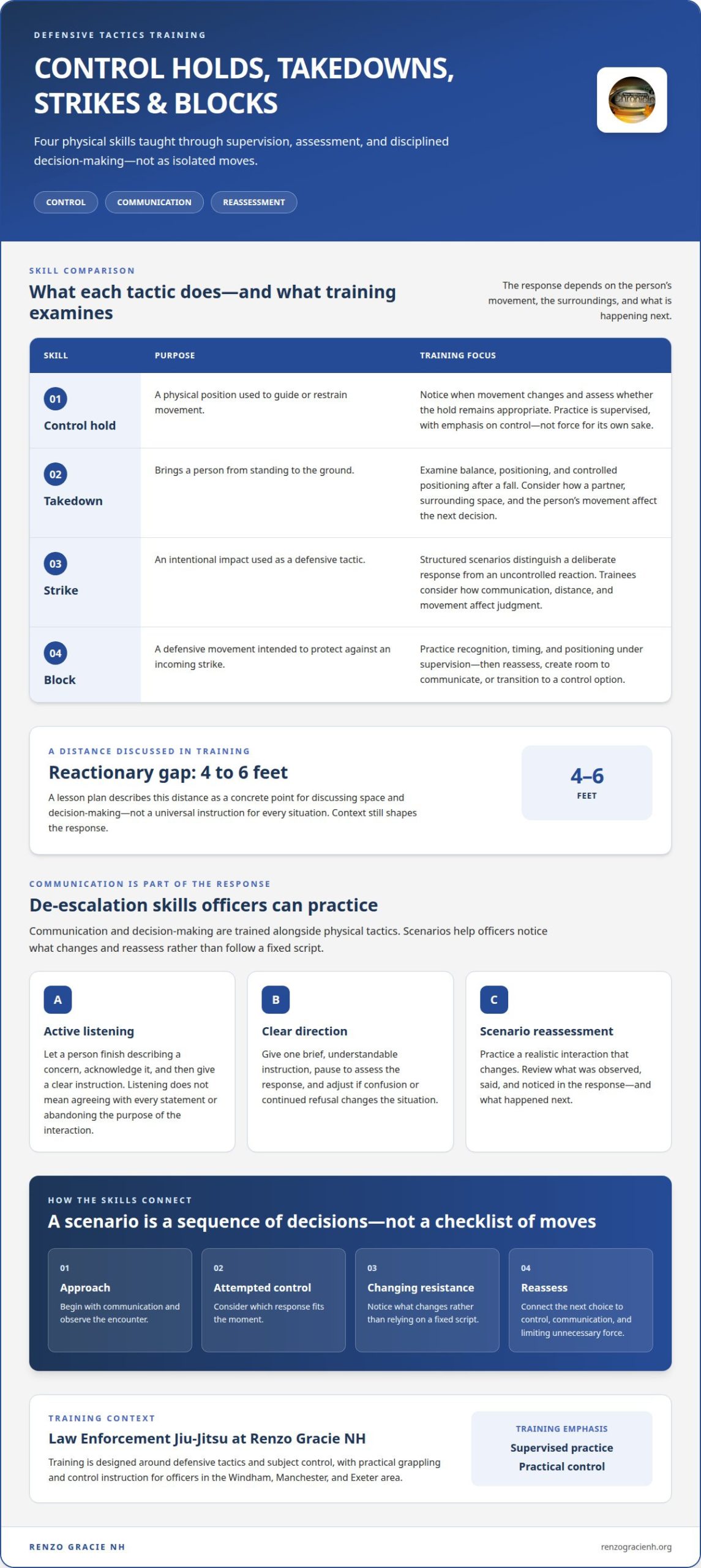
A control hold is a physical position used to guide or restrain movement. In training, officers learn how holds relate to control, communication, and the situation unfolding. For example, an instructor may ask a trainee to recognize when a person’s movement changes, then assess whether a hold remains appropriate. The emphasis is on supervised practice, not force for its own sake. Defensive tactics are designed to help officers gain compliance during arrests, reduce unnecessary force, and prevent injuries to officers and suspects.
A takedown brings a person from standing to the ground. Professional instruction can examine balance, positioning, and what happens immediately after a fall. A scenario might begin with a standing encounter and progress to controlled positioning on the ground. Officers can then consider how their partner, the surrounding space, and the person’s movement affect the next decision. A takedown is not an isolated action: training connects it to control and continued assessment.
A strike is an intentional impact used as a defensive tactic. Training should distinguish its purpose from an uncontrolled reaction, using structured scenarios to build judgment. An instructor can present a changing encounter and ask trainees to identify how communication, distance, and movement affect their response. A lesson plan describes a reactionary gap of 4 to 6 feet. That distance provides a concrete point for discussing space and decision-making, not a universal instruction for every situation. Context still shapes how an officer responds.
A block is a defensive movement intended to protect against an incoming strike. In class, trainees can practice recognizing a movement and responding under supervision. A partner drill lets an instructor observe timing and positioning without treating practice as a real confrontation. The goal is to connect defense with what follows: reassessing movement, creating room to communicate, or transitioning to a control option. Blocks are most useful as part of a broader response, not as standalone techniques.
These skills work as a sequence, not a checklist of moves. An instructor may build a scenario from an approach to attempted control, then introduce a change in resistance. Trainees examine which response fits each moment. This structure connects holds, takedowns, strikes, and blocks with deliberate decision-making and limiting unnecessary force. It also gives instructors a chance to discuss choices before, during, and after physical contact.
When choosing nearby training, officers can look for supervised practice, clear instruction, and a focus on practical grappling and control. Renzo Gracie NH provides Law Enforcement Jiu-Jitsu Training for officers in the Windham, Manchester, and Exeter area. The training is designed around defensive tactics and subject control.
De-escalation
De-escalation is communication and decision-making intended to lower tension during an encounter. Training might begin with a scenario in which a person refuses a direction and the officer must decide how to respond. An instructor can assess tone, word choice, timing, and whether directions are clear. The exercise connects communication to judgment before physical tactics become necessary. Trainees can then review what changed the encounter and what they might handle differently.
Active listening means paying close attention to understand what a person is saying. A trainee might let someone finish describing a concern, acknowledge it, and then give a clear instruction. Listening does not mean agreeing with every statement or abandoning the purpose of the interaction. It creates an opportunity to communicate without adding needless friction. Instructors can repeat a scenario with different wording so trainees notice how a calm, direct response affects the exchange.
Clear direction is a brief, understandable statement of what needs to happen next. A trainee might replace several rapid commands with one specific instruction, then pause to assess the response. The instructor can introduce confusion or continued refusal and ask the trainee to adjust. This practice builds deliberate choices under pressure and helps distinguish between repeating a direction mechanically and responding to what is happening.
Scenario training is structured practice built around a realistic interaction and changing responses. An instructor might set up a disagreement, have a trainee begin with communication, then introduce a new detail. The trainee must reassess rather than follow a fixed script. Afterward, the instructor can review the sequence: what the trainee observed, said, and noticed in the response, and what happened next. This makes decisions easier to examine and discuss.
Useful practice also includes discussing when to change approach. Trainees can consider signs that communication is helping, such as a person answering a question or following a direction, and what changes when communication does not resolve the encounter. The aim is not to promise that words will work every time. Scenarios give officers a chance to stay attentive, choose measured language, and reassess as circumstances change.
Instructors can make de-escalation practice more specific by changing one element at a time. For instance, a scenario can use a different opening statement, a longer pause, or a clearer direction. Trainees can compare how each choice affects the interaction. A focused review turns broad ideas like calm communication into observable choices officers can discuss and refine.
A De-Escalation Practitioner Course was scheduled in Bay St Louis, Mississippi, on January 14th, 2027. A De-Escalation Practitioner Course was also scheduled in Burnet, Texas, on March 4, 2027. These scheduled courses provide specific occasions for practitioners to develop and examine their approaches to communication and decision-making during encounters.
Defensive tactics
Defensive tactics are trained responses for managing physical encounters. They combine judgment, positioning, communication, and controlled physical skills. In a scenario, an officer might reassess a changing situation before choosing a response. The goal is disciplined decision-making, not memorizing moves without context. Law Enforcement Jiu-Jitsu Training at Renzo Gracie NH focuses on practical grappling and control for officers in Windham, Manchester, and Exeter.
A training standard describes the methods and expectations used in instruction. Officers should relate their practice to the requirements their department applies. Certification depends on the particular course and credential; no single certification applies universally to every course. A useful program explains its learning objectives, instructor-led practice, and how skills are assessed. This helps officers connect training content with their department’s expectations.
Course access depends on the intended participants and format. Law Enforcement Jiu-Jitsu Training at Renzo Gracie NH is designed for law-enforcement personnel. Those seeking general martial arts instruction can choose the Adult Jiu Jitsu Program or Kids Jiu Jitsu Program instead. The distinction matters: professional defensive tactics training addresses job-related grappling and control, while general classes serve different goals.
For courses near Windham, the organizer sets the venue and schedule. Choose by matching the announced location and dates with the intended audience and training focus. A nearby course may serve agency personnel, public participants, or a defined group. Its listing should make those practical details clear, including whether the content covers hands-on defensive tactics. Scheduling and location are set by each course organizer.
Physical practice carries risks, including accidental contact, loss of balance, or discomfort during partner drills. A responsible class manages those risks through instructor supervision, controlled practice, and clear directions. An instructor can demonstrate a movement slowly before trainees practice with a partner. Participants should know how to pause practice and report discomfort. Partners should follow the instructor’s pace rather than add unscripted resistance.
Safety depends on structure throughout a session, not only at the start. Instructors can explain each drill’s purpose, demonstrate the movement, and observe trainees as they practice. If a scenario changes, they can stop and reset before continuing. A partner exercise might begin with a slow, predictable movement and progress as trainees show control. These steps keep practice focused on learning and limit unnecessary intensity.
Scenario review adds another layer of discipline. After a drill, trainees can identify what they observed, which response they chose, and what changed next. An instructor might ask whether a trainee maintained balance while guiding a partner through a controlled movement. This review connects technique with judgment and gives instructors a basis for coaching. Officers considering police defensive tactics training in Windham can look for this kind of guided reflection.
The lesson plan cites Tennessee v. Garner, 471 U.S. 105 S Ct. (1985), in its force-continuum section. Lt. Nahrwold completed a week-long Effective Fitness Combatives instructor course.
Renzo Gracie NH: Law Enforcement Jiu-Jitsu Training
Renzo Gracie NH offers Law Enforcement Jiu-Jitsu Training for officers seeking structured practice in physical control skills. It provides a focused next step for readers looking to develop those skills through guided Jiu-Jitsu training. The training complements broader defensive tactics by giving officers an opportunity to build and refine practical control techniques.
Adults interested in training outside a law-enforcement context can explore the Adult Jiu Jitsu Program. Families can also consider the Kids Jiu Jitsu Program or train together in family Jiu-Jitsu sessions. A Free Introductory Class lets new students experience instruction before choosing a program. Each option serves a different goal, whether you’re seeking professional defensive tactics, adult training, or a family activity.
To learn more about training options, contact Renzo Gracie NH.
Build the Next Step Into Your Training
Professional growth comes from choosing practice that fits your role and goals. For officers exploring police defensive tactics training in Windham, Law Enforcement Jiu-Jitsu Training at Renzo Gracie NH develops practical grappling and control skills. Adults and families can pursue their own goals through the Adult Jiu Jitsu Program, Kids Jiu Jitsu Program, or family training.
Consider what you want training to support: professional development, personal growth, or shared family time. A clear goal helps make the next step manageable, whether you’re building on existing experience or starting something new. For professionals looking to broaden their skill sets alongside physical training—such as refining written communication and media skills through the College of Media and Publishing—specialized vocational coursework offers a flexible path forward. Renzo Gracie NH offers a free introductory class for new students to experience its instruction.
If you’re ready to explore a training path that fits, contact Renzo Gracie NH. Take the next step at your own pace, and keep building with focus and confidence.
Frequently Asked Questions
What techniques and topics are covered in the training?
Training covers de-escalation, control holds, takedowns, strikes, blocks, and defensive tactics. It also connects these skills through decision-making, so officers can respond to changing circumstances rather than treat techniques as isolated drills. For example, a training discussion might consider how an encounter shifts from standing control to ground positioning, and what the officer should reassess as that situation changes.