Police training for controlling resisting subjects in Exeter
Control begins before a takedown. Police training for controlling resisting subjects in Exeter should build sound judgment alongside practical defensive tactics, including verbal skills, standing control, takedowns, and ground control. Under the federal standard described by the United States Government Publishing Office, force is assessed from the perspective of a reasonable officer at the scene, including the reality of split-second decisions.
Officers need preparation for difficult moments: a subject may resist, circumstances can change quickly, and an approach that works in one situation may not fit another. This article explains what single-officer takedown training can address, how restraint and control choices fit into the picture, and when disengaging to consider less-lethal tools may be part of the decision. It also covers defensive tactics and combatives training, focusing on disciplined skills, clear judgment, and safer control rather than strength alone.
Key Takeaways
- Learn what factors shape single-officer apprehension training and how instructors can build control skills for changing situations.
- Understand how restraint practices can support controlled, deliberate responses while keeping the circumstances of each encounter in view.
- Explore when creating distance and transitioning to less-lethal tools may be considered as part of a broader response.
- See how defensive tactics and combatives training can develop practical skills, judgment, and confidence through structured practice.
1. Single-officer apprehension and takedowns
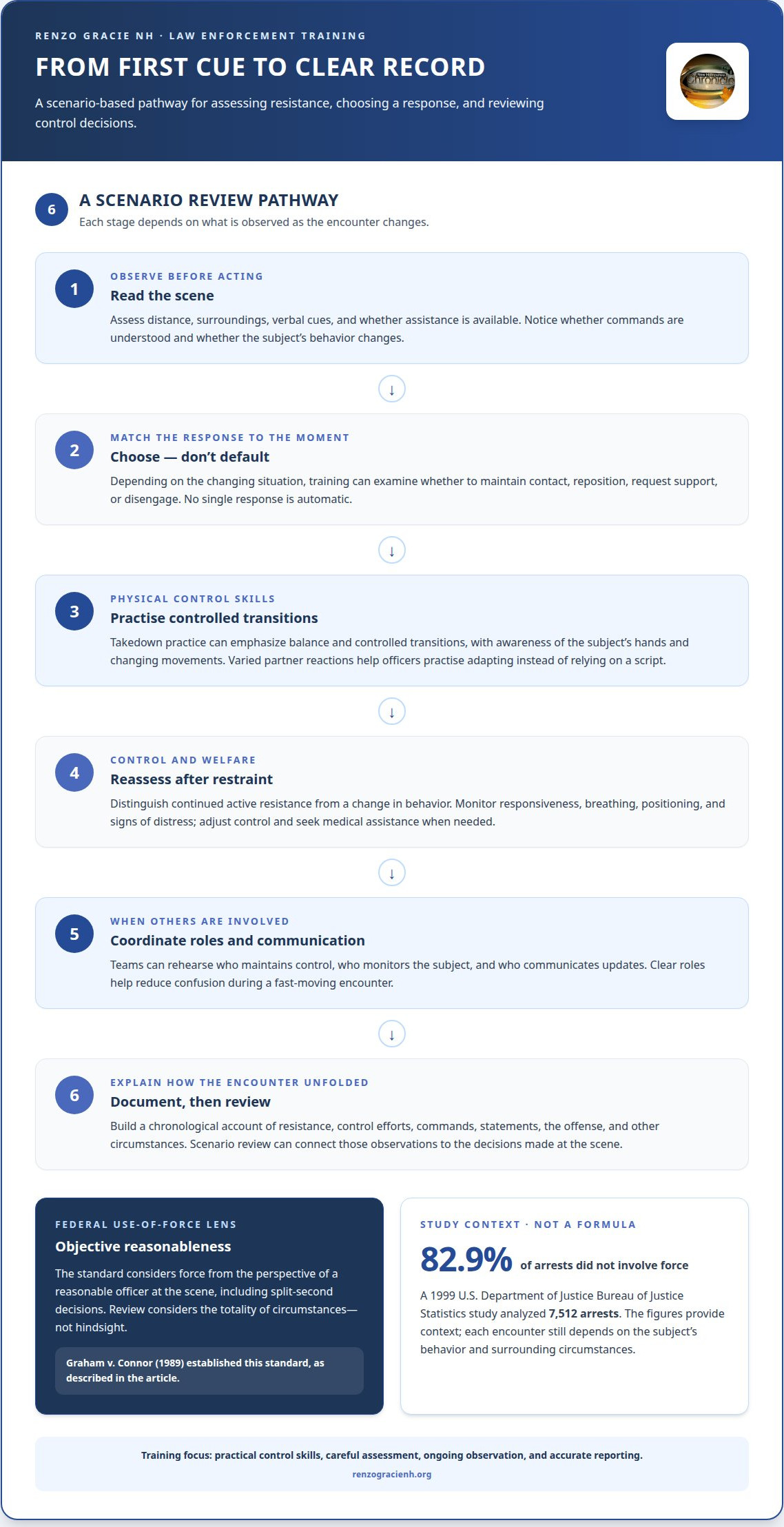
In Exeter, federal use-of-force analysis centers on objective reasonableness. According to the United States Government Publishing Office, federal law judges force from a reasonable officer’s perspective at the scene, including split-second decisions about necessary force. The U.S. Supreme Court established this standard in Graham v. Connor (1989). Courts consider the totality of circumstances, not hindsight. That framework guides federal review of encounters in New Hampshire.
A 1999 U.S. Department of Justice Bureau of Justice Statistics study analyzed 7,512 arrests. It found that 82.9% of arrests did not involve force. Those figures offer context, not a formula for an individual encounter. Each scenario calls for attention to the subject’s behavior and the surrounding circumstances.
Single-officer training should develop judgment before rehearsing a takedown. Instructors can present a resisting-subject scenario and assess how an officer reads it. Relevant details include distance, surroundings, verbal cues, and whether assistance is available. The officer must notice when resistance changes or commands are understood. Training can then examine whether maintaining contact, repositioning, requesting support, or disengaging fits the changing situation. No single response should be treated as automatic.
Takedown practice can focus on balance and controlled transitions, while building awareness of the subject’s hands and changing movements. Training partners can vary their posture and reactions so officers practise adapting instead of following a scripted response. Instructors can pause a scenario at a decision point and ask which observed facts shaped the officer’s next choice. This connects physical practice with clear, deliberate reasoning.
Documentation is also part of apprehension training. Reports should describe the subject’s resistance and the officer’s control efforts, as well as commands, statements, the offense, and other circumstances. A chronological account helps explain how the encounter unfolded. Scenario review can connect those observations to the decisions made at the scene. Strong single-officer preparation combines practical control skills, careful assessment, and accurate reporting.
For review, Graham v. Connor directs attention to what a reasonable officer could perceive at the scene, not a reconstruction shaped by hindsight. A record that places resistance, control efforts, commands, statements, the offense, and surrounding circumstances in sequence can make the account easier to assess.
2. Benefits of restraint practices
A clear restraint plan gives officers a consistent framework when control is needed. In a training scenario, officers can practise moving from verbal direction to physical restraint while reassessing the subject’s behavior. This helps keep decisions deliberate and gives instructors a basis for reviewing whether each action matched what happened.
Restraint carries risks, including injury and breathing compromise. Positional asphyxia refers to breathing being restricted by a person’s position or restraint. Officers train to monitor the subject, reassess positioning, respond to signs of distress, and seek medical assistance when needed. The subject’s condition and the changing scene remain important throughout control.
Practice can make these checks part of the response, rather than an afterthought. For example, an instructor can pause a scenario after a subject is restrained and ask officers to assess responsiveness and breathing. Officers can then practise communicating concerns, adjusting control, and requesting assistance under their agency’s procedures. Repeating these decision points builds attention to both restraint and welfare.
Consistent restraint practices can also support team coordination. Officers can rehearse who maintains control, who monitors the subject, and who communicates updates. Clear roles reduce confusion during a fast-moving encounter. Scenario review can identify missed commands or difficult transitions, giving the team specific points to improve in later practice.
Training should distinguish active resistance from a change in behavior. A person who stops resisting may need a different response from someone who continues to struggle. Instructors can vary reactions so officers practise reassessing instead of automatically continuing the same control. For police training for controlling resisting subjects in Exeter, restraint practice is most useful when it combines controlled technique, ongoing observation, communication, and a clear response to distress.
3. Disengaging to use less-lethal tools
Federal law’s use-of-force benchmark is objective reasonableness. According to the United States Government Publishing Office, force is assessed from a reasonable officer’s perspective at the scene, including split-second decisions. This provides a legal framework for considering force, but does not describe Exeter Police Department’s internal de-escalation or tool-deployment policies.
Disengagement can create space to reassess a changing encounter. Training scenarios can ask officers to recognize when continued close contact is unnecessary, communicate clearly, and consider whether another response is appropriate. The decision depends on the subject’s actions, the surroundings, and the immediate risks. A change in behavior may affect which response makes sense.
Less-lethal options discussed in defensive-tactics training include electronic control devices and O.C. spray. Practice should focus on decision-making, not just familiarity with tools. Instructors can present a scenario where an actively resisting person changes position or begins following commands. Officers can then explain whether creating distance, continuing verbal direction, or considering a tool fits the new circumstances. The scenario should also examine what happens after the choice.
Training can include communication before and after disengagement. Officers rehearse giving clear commands, coordinating with other responding officers, and reassessing the subject’s behavior. For example, a partner may maintain observation while another officer communicates, depending on the scenario and agency procedures. When staffing permits, the article’s recommended 2:1 officer-to-arrestee ratio can inform scenario planning. It is not a substitute for assessing the encounter as it unfolds.
Review matters. After each exercise, instructors can ask what changed, which options were considered, and how the decision aligned with observed behavior. This keeps attention on judgment rather than treating any tool as an automatic answer. Officers seeking structured practice can explore law enforcement defensive-tactics training to develop these decisions through coached scenarios.
4. Law enforcement defensive tactics and combatives training
The municipal police agency serving Exeter, New Hampshire, is the Exeter Police Department. The information here describes general defensive-tactics training, not the department’s specific curriculum. To learn how Exeter addresses de-escalation, crisis intervention, and mental-health emergencies, request its relevant training policies and curriculum records.
An active resister is an arrestee showing resistive behavior to avoid physical control. Training can develop verbal skills for seeking compliance, standing control, takedowns, and ground control. It can also cover electronic control devices and O.C. spray. The choice depends on observed behavior and circumstances, not a single automatic sequence.
A practical curriculum tests judgment as well as movement. Instructors can change a scenario as an arrestee shifts from resisting to following commands. Officers then practise reassessing, communicating, and adapting their response. Training also recommends a 2:1 ratio of officers to arrestees when making an arrest, when possible. Staffing and circumstances shape whether that approach is feasible.
Combatives practice can help officers rehearse balance, positioning, and control during close contact. EF Combatives conducted a study on police officers’ responses to underhooks spanning 2023-2025. That example highlights a useful training focus: officers need to recognize common points of contact and respond with control, not rely on strength alone. Scenario review can connect each movement to the decisions behind it.
For Exeter Police Department use-of-force policies, training records, or incident reports, make a written records inquiry to the department. Identify the records sought and, for an incident, include available identifying details. This gives staff a focused request to process. For practical, coached defensive-tactics practice, explore law enforcement Jiu-Jitsu training.
Verbal skills provide a way to seek compliance, while the preferred approach is to control an arrestee while standing rather than fighting on the ground. Standing control, takedowns, and ground control are reasonable measures for controlling an actively resisting arrestee, as are electronic control devices and O.C. spray. These options should be considered in light of the goal of gaining control, without treating any single measure as required in every situation.
Renzo Gracie NH: Law Enforcement Jiu-Jitsu Training
Renzo Gracie NH offers Law Enforcement Jiu-Jitsu Training for officers seeking coached defensive-tactics practice alongside agency instruction. It’s a relevant next step for officers who want to keep developing control skills through structured martial arts training. Jiu-Jitsu practice can complement, but doesn’t replace, department policies, legal instruction, or agency-specific procedures.
The focus is continued learning: building disciplined movement, composure, and practical skill through instruction. Officers can consider this training as part of a broader professional development plan, while agencies remain responsible for their policies and operational standards. Renzo Gracie NH also offers adult and kids Jiu Jitsu programs, along with a Free Introductory Class.
For a straightforward next step, contact Renzo Gracie NH about Law Enforcement Jiu-Jitsu Training.
Build your next stage of professional practice
Skills develop through thoughtful practice over time. For officers considering police training for controlling resisting subjects in Exeter, a useful next step is to identify which decisions and movements would benefit from continued coaching. This focus can connect training to professional goals while keeping agency policies and procedures central.
Law Enforcement Jiu-Jitsu Training offers a setting to keep developing composure, control, and disciplined movement through instruction. The aim is steady progress, not a shortcut: build a stronger foundation, reflect on what you learn, and carry that commitment into your professional development.
Start a conversation with Renzo Gracie NH about training that fits your goals. Take the next step with focus, curiosity, and confidence.