BJJ for Child Focus and Respect: 2026 Parent’s Guide
The average child’s attention span has plummeted to just 27.1 seconds, a stark reality in our hyper-connected 2026 world. It’s exhausting to watch your child struggle with focus while digital distractions pull them in every direction. You aren’t alone in feeling that traditional discipline often fails to compete with a screen. We understand the worry that comes with short attention spans and the fear that a lack of respect might lead to social isolation or declining grades.
Brazilian Jiu-Jitsu offers a powerful, physical solution. By using BJJ for child focus and respect, your child learns to engage in “human chess” where every move requires presence and purpose. This guide explores how structured, family-oriented training at Renzo Gracie NH transforms childhood distraction into disciplined confidence. You’ll discover how these physical habits lead to better listening at home and the calm strength needed to handle social pressure with ease. We will show you exactly how this journey from the mat to the classroom builds a foundation for lifelong success and character development.
Key Takeaways
- Discover how Brazilian Jiu-Jitsu serves as a physical antidote to digital overstimulation by requiring total presence and active problem-solving during every session.
- Learn why the “human chess” approach to training builds the specific neural pathways your child needs to sustain attention and follow multi-step instructions in school.
- Explore how BJJ for child focus and respect replaces empty praise with earned stripes, teaching kids to value hard work and the importance of peer hierarchy.
- See how mat-based etiquette translates into “desk discipline,” helping Southern NH students handle social pressure and teacher feedback with quiet authority.
- Find out how family-oriented training under the guidance of 6th-degree black belt Professor Kevin Landry creates a shared language of growth for both parents and children.
The Modern Focus Crisis: Why Traditional Activities Often Fall Short
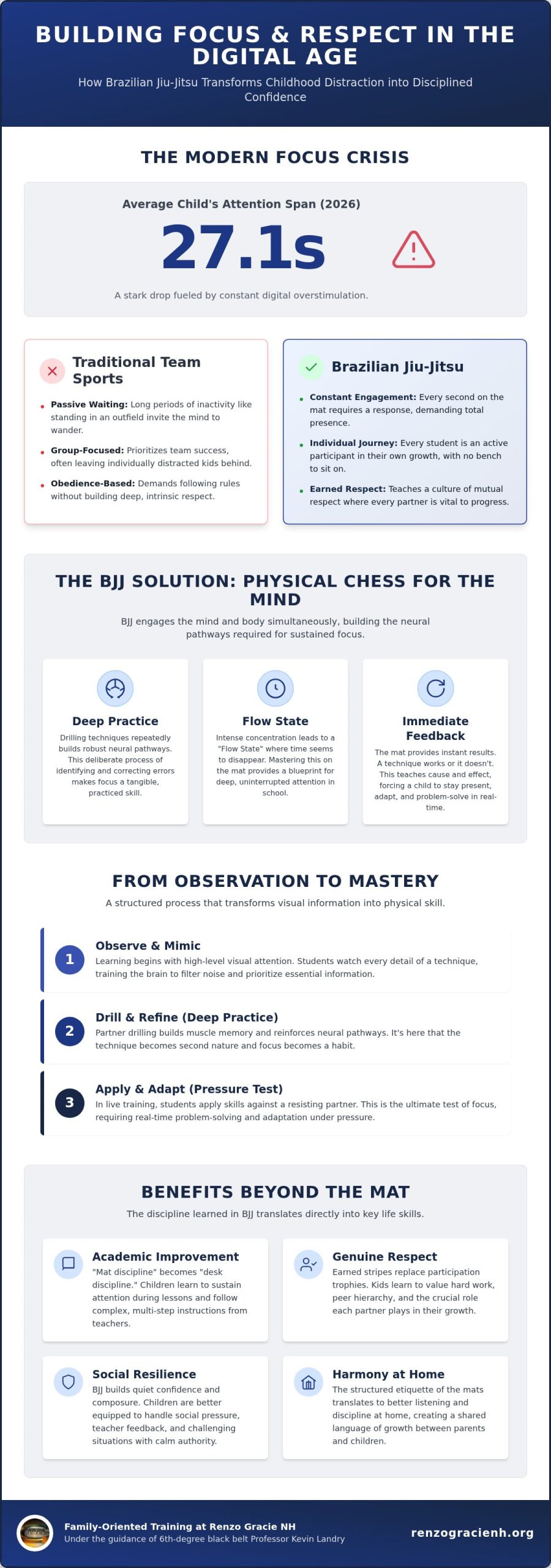
The world moves fast. Screens flicker. Notifications buzz. For a child growing up in 2026, the constant hum of digital overstimulation makes sustained attention feel like a lost art. Recent data shows that the average attention span for children has dropped to just 27.1 seconds. This isn’t just a phase; it’s a fundamental shift in how young minds process the world. When parents look for solutions, they often turn to traditional sports, yet these activities frequently reinforce the very distractions they aim to cure.
True focus is the intentional application of mental energy toward a specific physical goal. We use a “staccato-then-flow” rhythm. Short bursts. Intense instruction. These are followed by periods of fluid movement where children apply what they’ve learned in real-time. This structure mirrors how children naturally learn, helping them bridge the gap between high-energy action and calm concentration. If you’re wondering What is Brazilian Jiu-Jitsu? and how it helps, it’s a grappling-based martial art that turns physical movement into a problem-solving exercise. Using BJJ for child focus and respect provides a tangible way to practice staying “in the zone” long after the screen is turned off.
The Limits of Team Sports for Distracted Children
Standing in the outfield of a baseball diamond or waiting for the ball in soccer invites the mind to wander. For a child already struggling with focus, “waiting your turn” becomes an invitation to zone out. Team sports often prioritize the group’s success over the individual’s engagement, leaving distracted kids behind. Jiu-Jitsu is different. It’s a constant engagement. Every second on the mat requires a response to a partner’s movement. It is an individual journey, but it happens within a deeply supportive community. There’s no bench to sit on; every student is an active participant in their own growth.
Respect vs. Obedience: A Crucial Distinction
Many traditional activities demand obedience through fear of authority or the hollow promise of a participation trophy. These methods rarely build genuine character. In our academy, we prioritize a “supportive partner” environment where children learn to value the skills of their peers. They don’t just follow rules because they’re told to; they follow them because they see the results of discipline in action. Respect on the mats is the quiet recognition that every training partner is an essential mirror for one’s own progress and shared growth. This approach ensures that BJJ for child focus and respect becomes a lifelong habit rather than a temporary performance. To further support these values in schools, many educators explore High School Assemblies that focus on building resilience and mental strength in the next generation.
Brazilian Jiu-Jitsu is often called “human chess.” It’s a fitting title. Unlike activities that rely on rote memorization, BJJ forces the brain to solve physical puzzles in real-time. This simultaneous engagement of mind and body is the secret to BJJ for child focus and respect. When a child is on the mats, they can’t simply go through the motions. They must be present. Every grip and every shift in weight requires a conscious decision, preventing the mind from wandering toward digital distractions.
The science behind this is known as “Deep Practice.” By drilling specific techniques repeatedly, students build robust neural pathways. This isn’t mindless repetition. It’s a deliberate process of identifying errors and correcting them instantly. The immediate feedback of the mats ensures that focus isn’t just an abstract concept; it’s a survival mechanism for the task at hand. This intense concentration often leads to a “Flow State,” a mental zone where time seems to disappear. Mastering this state on the mats gives children a blueprint for approaching schoolwork with the same level of deep, uninterrupted attention.
Step 1: Observation and Mimicry
Learning begins with high-level visual attention. When a coach demonstrates a technique, students must observe every detail. They watch the placement of a hand. They note the angle of a hip. Under the guidance of a 6th-degree black belt like Professor Kevin Landry, children learn to break down these complex movements into manageable “chunks.” This process of observation and mimicry trains the brain to filter out background noise and prioritize essential information. It’s a vital skill for any student who needs to follow multi-step instructions in a busy classroom.
Step 2: The Pressure Test
True focus is tested under pressure. Once a child understands a move, they must apply it while a partner offers resistance. This “controlled pressure” is where character is forged. Children learn to manage “frustration signals” when a move doesn’t work perfectly the first time. They stay calm. They breathe. They think through the problem rather than reacting with emotion. This helps cement the role of BJJ for child focus and respect as a practical tool for daily life. This ability to maintain composure under minor physical stress prepares kids for the real-world anxiety of exam days or social challenges. If you are ready to see this transformation in action, consider starting with a free introductory class to experience our supportive environment firsthand.
The Culture of Respect: Why BJJ is Different
Respect on the mats isn’t about rigid obedience. It’s about shared growth. While many youth activities hand out awards for simply showing up, Brazilian Jiu-Jitsu requires effort. You earn your place. This merit-based system is the foundation of BJJ for child focus and respect. Children learn quickly that a stripe on their belt represents hours of disciplined work, not a participation trophy. This distinction builds a genuine sense of self-worth that no hollow praise can match.
The “Mat Etiquette” serves as a daily reminder of this culture. It begins with a bow. It continues with a handshake. These aren’t just traditions; they are habits of honor. When a child taps out or respects a partner’s tap, they are practicing the ultimate form of consent and boundary-setting. They learn that power comes with responsibility. This environment is shaped by the Renzo Gracie teaching philosophy, which prioritizes mentorship over intimidation.
The Bow and the Handshake: Habits of Honor
Physical rituals translate into mental habits. Every class at Renzo Gracie NH starts and ends with a sign of mutual respect. Professor Kevin Landry, a 6th-degree black belt with over 20 years of experience, models this quiet authority every day. He doesn’t need to shout to be heard. His presence teaches children that true strength is calm and inclusive. Students learn to respect peers of all sizes and backgrounds, understanding that every partner offers a unique lesson in their own development. This consistent modeling helps children internalize respect as a natural way of interacting with the world.
Confidence that Neutralizes Bullying Without Violence
True confidence is quiet. It doesn’t need to brag. Our kids jiu jitsu New Hampshire programs focus on an “Anti-Bully” mindset that starts with self-respect. When a child knows they can protect themselves, they no longer feel the need to prove it through aggression. They learn de-escalation naturally. There is a beautiful irony in BJJ: the more skilled a child becomes, the less they feel the need to fight. They carry themselves with a disciplined confidence that often prevents conflict before it even begins. This is the heart of how we use BJJ for child focus and respect to prepare children for the social pressures of the real world.
From the Mat to the Classroom: Real-World Benefits for NH Students
Martial arts training shouldn’t stay in the gym. It should follow your child home. It should go to school. The true power of BJJ for child focus and respect lies in its ability to translate “Mat Discipline” into “Desk Discipline.” In local schools across Southern New Hampshire, teachers often notice a specific type of student. They are the ones who can sit still, listen intently, and follow multi-step instructions without needing constant reminders. This isn’t a happy accident. It’s the result of hours spent on the mats learning to absorb complex techniques under the guidance of Professor Kevin Landry.
Emotional regulation is another critical crossover. When a child faces a difficult math problem or a challenging reading assignment, they often feel the same “frustration signals” they experience during a tough sparring session. Because they’ve practiced staying calm under physical pressure, they don’t shut down. They breathe. They analyze the problem. They apply the same problem-solving mindset to their schoolwork that they use to escape a hold on the mats. This resilience creates a community of high-achieving peers who value effort over easy wins.
Improving Performance in Windham and Manchester Schools
Parents in Windham and Manchester frequently report significant improvements in their children’s report cards after just a few months of training. This shift happens because BJJ fosters a “growth mindset.” A difficult guard pass is just like a complex long-division problem. Both require patience and a willingness to fail before succeeding. By adopting a “staccato-then-flow” study habit, students learn to work with intense focus for short bursts before taking a moment to reflect. This rhythmic approach to learning prevents burnout and keeps their mental energy high throughout the school day. For students aiming to apply this disciplined focus to advanced academics, you can learn more about Learning Voyage Education Centre and their specialized science programs.
For students in Exeter, the academy serves as a vital “third place” outside of the pressures of home and school. It is a sanctuary where they are judged solely by their character and their perseverance. This supportive community has a profound impact on a child’s self-image, replacing the anxiety of social media with the confidence of physical competence. Brazilian Jiu-Jitsu serves as a vital social anchor for developing children, providing a grounded community that values character over popularity. If you want to see your child build this level of confidence, sign up for a free introductory class and experience our community firsthand.
Start Your Family Journey at Renzo Gracie NH in Windham
Choosing the right environment is the first step toward transformation. At Renzo Gracie NH, we offer more than just a training facility; we provide a community built on over 20 years of local mentorship and a world-class lineage. Professor Kevin Landry, a 6th-degree black belt, leads our programs with a focus on quiet authority and warm inclusivity. This isn’t an intimidating combat sport atmosphere. It is a place for growth. By choosing BJJ for child focus and respect, you are placing your child in a professional setting where their personal success and safety are the absolute priorities.
One of the most unique aspects of our academy is our dedicated family time. While many programs focus solely on the child, we believe the best results happen when the family unit evolves together. Our parent and child jiu jitsu Windham sessions offer a rare opportunity for shared struggle and shared victory. You don’t just watch from the sidelines; you experience the journey alongside them. This creates a shared language of perseverance that strengthens your bond long after you leave the mats.
The Renzo Gracie Legacy in Southern New Hampshire
We bring world-class standards directly to Windham, Manchester, and Exeter. Our lineage is prestigious, yet our approach remains grounded and accessible for families. We prioritize technical proficiency and personal safety above all else, ensuring that every student feels secure as they learn. We aren’t just teaching moves. We are building the next generation of NH leaders. These are children who carry themselves with disciplined confidence and a deep-seated respect for their community, their peers, and themselves.
Your First Step: The Free Intro Class
Every journey begins with a single step. We offer a free introductory class to help you and your child discover the benefits of training without any pressure. During this session, we assess your child’s current focus level and specific needs. We understand that beginners can be nervous. Our onboarding process is designed to be supportive and encouraging, ensuring every child feels like they belong from day one. It’s the perfect way to see how BJJ for child focus and respect works in real-time. Book your child’s free intro session today and start your family’s evolution.
Take Your First Step Toward Lasting Transformation
The journey from childhood distraction to disciplined focus starts on the mat. You’ve seen how Brazilian Jiu-Jitsu acts as a physical antidote to the digital noise of 2026. It replaces the passivity of screens with the active engagement of “human chess.” By choosing BJJ for child focus and respect, you’re giving your child a lifelong blueprint for emotional regulation and social resilience. This isn’t just about learning to grapple; it’s about building a foundation of character that carries over into Windham classrooms and home life alike.
Our academy offers a welcoming, professional environment led by 6th-degree black belt Kevin Landry. With over 20 years of local NH teaching experience and the weight of the prestigious Renzo Gracie world-class lineage, we’re here to support your family’s growth. Don’t wait for focus to happen by accident. Claim Your Child’s Free Introductory BJJ Class in Windham today. We look forward to welcoming you into our community and watching your child evolve with quiet confidence and strength.
Frequently Asked Questions
Is Jiu-Jitsu too aggressive for a child who is already high-energy?
Brazilian Jiu-Jitsu is a non-violent martial art that focuses on control rather than striking. For a high-energy child in Windham, it provides a structured outlet to channel that intensity into technical mastery. Instead of aggression, they learn “human chess,” which requires them to slow down and think. This mental engagement naturally calms the nervous system, teaching them how to use their energy with purpose and restraint on and off the mats.
How many times a week should my child train to see improvements in focus?
Most parents in Manchester and Exeter see a noticeable shift in their child’s concentration by attending classes two to three times per week. Consistency is the key to mastering BJJ for child focus and respect. Regular attendance allows the “staccato-then-flow” rhythm of our curriculum to become a physical habit. This steady schedule helps children build the neural pathways needed to sustain attention during long school days and complex homework assignments.
What if my child is very shy or has never done sports before?
Our academy is a supportive environment designed for growth, not just competition. If your child is shy or has never played sports, they’ll find a welcoming community that values their individual progress. We don’t throw beginners into deep water. Instead, we use a methodical onboarding process that builds their confidence one step at a time. Many of our most dedicated students started as nervous beginners before discovering their own inner strength.
Will BJJ help my child with their school grades and behavior?
Yes, the “mat discipline” learned at Renzo Gracie NH directly translates to “desk discipline” in the classroom. By practicing emotional regulation during difficult training sessions, children learn to stay calm when faced with a tough math problem or a long reading task. Teachers often report that students who train in BJJ show improved listening skills and a greater ability to follow multi-step instructions without becoming frustrated or distracted.
At what age can children start the BJJ program at Renzo Gracie NH?
We offer programs for children of various ages and skill levels at our Windham, Manchester, and Exeter locations. Because every child develops at their own pace, we recommend starting with a free introductory class to assess their readiness and focus level. This allows our instructors, led by Professor Kevin Landry, to ensure your child is placed in a group where they can thrive, feel safe, and begin their journey with confidence.
Do parents have to participate in the ‘Family Time’ sessions?
Participation in our dedicated family time sessions is entirely optional, though many parents find it to be a powerful bonding experience. These sessions allow you to step onto the mat and experience the curriculum alongside your child. It creates a shared language of perseverance and growth. If you prefer to watch, you’re always welcome to observe your child’s progress from the sidelines as they build their skills with their peers.
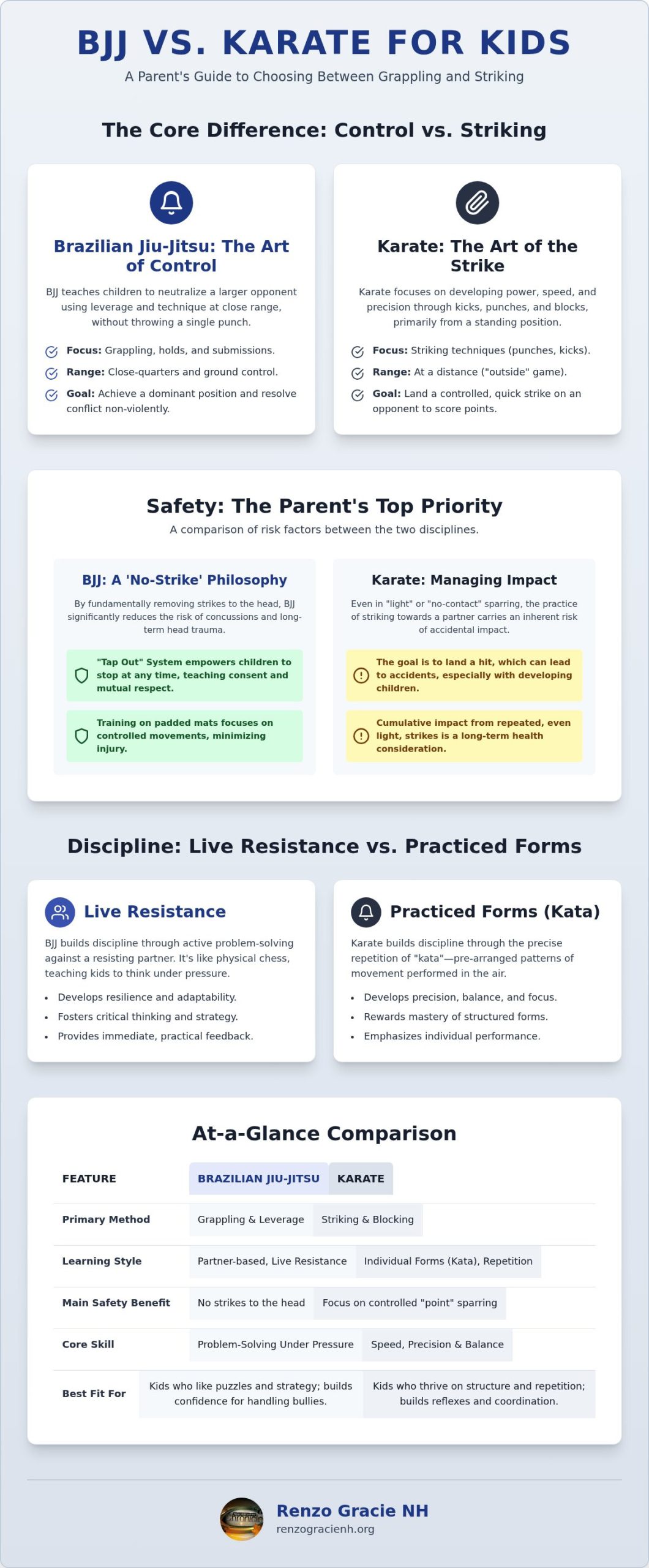
How does BJJ differ from Karate or Tae Kwon Do regarding respect?
While Karate and Tae Kwon Do often focus on solo forms or katas, BJJ is a partnership-based art that emphasizes leverage and technique. Respect isn’t just a set of rigid rules; it’s a functional necessity. Children learn to respect the “tap,” which is a physical signal of boundaries and consent. This is how BJJ for child focus and respect builds character through shared struggle and mutual support rather than participation trophies.
What should my child wear to their first free introductory class?
For the first free introductory class, your child should wear comfortable athletic clothing without zippers or buttons. A simple t-shirt and shorts or leggings are perfect. We train on specialized mats, so no shoes are required during the session. This low-pressure start allows them to focus on the movement and the community. We’ll provide all the necessary guidance and equipment information if you decide to continue with our full Kids Jiu Jitsu Program.