BJJ vs. Wrestling for Self-Defense: Which Builds More Practical Skills?
What if a useful self-defense skill is not a takedown or submission, but knowing when to stay standing and how to create a chance to get away? That’s the practical question behind BJJ vs wrestling for self defense, and the answer is not as simple as naming one style the winner.
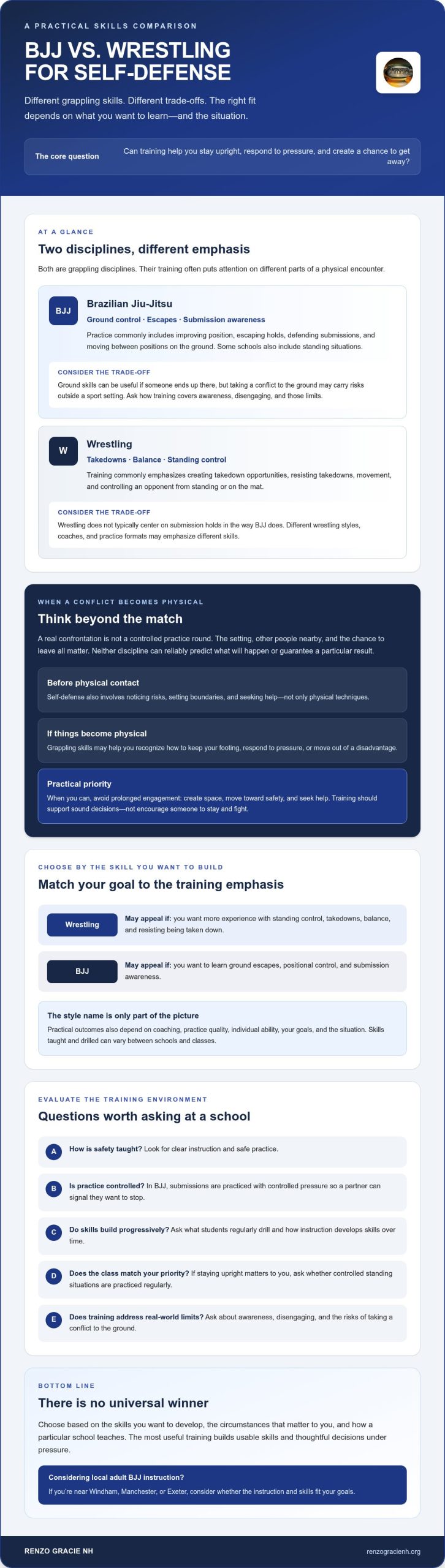
Wrestling builds skills for takedowns, balance, and controlling where an encounter goes. Brazilian Jiu-Jitsu develops ground control, escapes, and submission awareness. Ground skills can feel risky outside a sport setting, and neither discipline can predict every real-world situation.
This comparison explains what each discipline can teach, where its limits matter, and how your goals and circumstances can guide your choice. It also covers what to look for in a training environment, including progressive instruction and safe practice. Rather than choosing by reputation, look for training that helps you build usable skills and make thoughtful decisions under pressure.
Key Takeaways
- Compare wrestling’s emphasis on takedowns and staying upright with BJJ’s focus on ground control, escapes, and submission awareness.
- Use the BJJ vs wrestling for self defense comparison to weigh each discipline’s strengths and limitations against your goals and circumstances.
- Practical outcomes depend on coaching, practice quality, individual ability, and the situation, not just the style name.
- When evaluating a school, ask how instructors teach safety, controlled practice, and skills that build progressively.
- If you’re near Windham, Manchester, or Exeter, consider whether local adult BJJ instruction fits the skills you want to develop.
BJJ vs wrestling for self defense: what is the real difference?
Claims about which style “works better” can make the choice seem harder than it is. Brazilian Jiu-Jitsu (BJJ) and wrestling are both grappling disciplines, but they tend to emphasize different skills. Grappling broadly includes ways of controlling or overcoming an opponent through holds, takedowns, and ground techniques. The balance of those skills depends on the discipline and how it’s taught.
Self-defense also involves choices before and beyond physical techniques: noticing risks, setting boundaries, seeking help, and creating a chance to leave. Training can develop useful responses if a situation becomes physical, but no martial art can predict or control every circumstance. For BJJ vs wrestling for self defense, usefulness depends on your goals, the focus and quality of your practice, and the situation you may face.
What Brazilian Jiu-Jitsu trains
BJJ teaches practitioners to work for control, improve their position, and move between positions while grappling. On the ground, students practice escaping holds, regaining a more advantageous position, and applying submissions with controlled pressure so a partner can signal they want to stop. Training may also include standing situations, such as responding to a grab or moving into a takedown, though the amount of stand-up work varies by school.
Sport practice often centers on scoring, controlling an opponent, or submitting a resisting training partner within match rules. That practice builds grappling skills, but it is not the same as broader personal-safety preparation. Ask how a school addresses awareness, disengaging, and the limits of taking a conflict to the ground.
What wrestling trains
Wrestling commonly emphasizes takedowns, balance, movement, and controlling an opponent from standing or on the mat. Wrestlers learn to create opportunities to bring someone down and to resist being taken down. These skills may help a person stay upright or manage distance during a physical encounter. Wrestling does not typically center on submission holds in the way BJJ does.
Wrestling styles have different rules and techniques, so they shouldn’t be treated as identical. A class’s emphasis can also vary with the coach, curriculum, and practice format. Look beyond the style label: ask which skills students regularly drill and how they practice them safely.
Neither discipline is a universal answer. Someone seeking more experience with standing control may value wrestling’s emphasis on takedowns and balance. Someone wanting to learn ground escapes and positional control may be drawn to BJJ. Consider which skills you want to build, then explore how a particular school teaches them.
How BJJ and wrestling skills may apply when a conflict becomes physical
Grappling skills become relevant when people get close, grab one another, or lose balance. Training can help you recognize how to keep your footing, respond to pressure, or move out of a disadvantage. But a real confrontation is not a controlled match. The setting, other people nearby, and the chance to leave all matter. Neither BJJ nor wrestling can reliably predict what will happen or guarantee a particular result.
Outside supervised training, a practical priority is to avoid prolonged engagement if you can. Creating space, moving toward safety, and seeking help may matter more than winning a grappling exchange. Training is most useful when it supports sound decisions, not when it encourages someone to stay and fight.
Standing control, takedowns, and staying upright
Wrestling places substantial emphasis on takedowns: changing levels, moving for position, and bringing a resisting partner to the mat. It also develops balance and the ability to resist being taken down. Those skills may help someone stay upright or recover balance when grabbed. Organized wrestling includes different styles and rules; USA Wrestling is a useful starting point for learning about the sport’s organized disciplines.
BJJ may include standing entries and defensive work, but the amount varies by school and class format. Training rules shape what partners practice repeatedly. If staying upright is a priority, ask whether classes regularly include controlled standing situations rather than assuming every grappling program gives them equal attention.
Ground control, escapes, and submissions
If someone does end up on the ground, BJJ training commonly gives students practice moving between positions, escaping from underneath a partner, and defending against submissions. Repetition with a training partner helps students develop options under pressure, but a supervised practice round is not a reliable model of every real-world encounter.
Wrestling also develops ground control, including holding a partner in place or working for a pin under the rules of a given style. That emphasis differs from BJJ submission instruction. Either way, a ground exchange can limit movement and awareness of what’s happening around you. Outside the training room, getting free and leaving may be a more practical goal than maintaining control.
For BJJ vs wrestling for self defense, consider which skills you want to practice and how a school prepares students to use them thoughtfully. If you’re curious about building BJJ skills through guided practice, explore local Jiu-Jitsu training and ask how instruction progresses from basic movement to more challenging practice.
BJJ or wrestling for self-defense: compare strengths, limits, and trade-offs
Compare the skills each style tends to emphasize rather than asking which would always win. In the wider discussion of wrestling vs. BJJ for self-defense, you’ll find different opinions. A style label alone cannot account for the person training, the instructor, or the circumstances.
| Area | Wrestling | Brazilian Jiu-Jitsu |
|---|---|---|
| Standing skills | Often emphasizes takedowns, balance, movement, and resisting takedowns. | May include standing entries and defense; the amount varies by school and training format. |
| Ground skills | Can develop control and pinning skills within the rules of a wrestling style. | Commonly practices positional control, transitions, escapes, and submission awareness. |
| Training focus | Typically centers on bringing an opponent down and controlling them. | Often includes learning to move between positions and respond to holds on the ground. |
| Important limit | Training rules may not cover every self-defense concern or scenario. | Ground-focused practice may not prepare someone for every standing or environmental risk. |
These are general tendencies, not guarantees about every class. Coaching, practice quality, your abilities, and the situation all shape what you can apply. A sport setting also differs from an uncontrolled encounter. Multiple people, a weapon, striking, or hard surfaces can sharply change the risks. Prioritize avoiding danger and getting away whenever possible, rather than treating a physical confrontation as a match.
Which style may fit your primary training goal?
If you want to focus on takedown defense, balance, and standing control, wrestling practice may fit your goals. If you want to develop ground escapes, positional awareness, and recognition of submissions, BJJ may be a better match. For broader grappling development, explore whether cross-training is accessible, but don’t assume a school offers both. Ask what its classes actually cover.
What neither style can promise
Training can’t guarantee safety or a predictable outcome. Sport proficiency is only one part of personal safety; awareness, setting boundaries, de-escalation, and deciding when to leave matter too. No hypothetical matchup can settle which discipline is universally better. Choose based on the skills you want to build and the quality of instruction you can practice with consistently.
How to choose self-defense training that fits your situation
Start with your own goals, not a promise that one style prepares you for every situation. Think about what you want to develop: basic grappling confidence, fitness, standing control, ground escapes, or skills related to your work. Then look for instruction that supports steady progress in a respectful, structured, and safe environment.
Use this sequence to assess a school:
- Clarify your goals. Decide which skills matter most and how often you can realistically train.
- Observe a class. Notice whether instructors explain techniques clearly, supervise practice, and treat students with respect.
- Try a class. Pay attention to how beginners are welcomed and whether you can ask questions or communicate your limits.
- Assess the fit. Consider whether the teaching approach, training environment, and class expectations suit you well enough to attend consistently.
Consistent, thoughtful practice is more useful than a style label that promises too much. If you’re new to BJJ, the adult BJJ beginner guide can help you understand what starting training may involve.
Questions to ask before choosing a class
Ask how beginners learn fundamentals and progress to live, supervised practice. How do instructors manage intensity, pair training partners, and respond when someone needs to pause? Ask whether the curriculum fits your goals, whether that’s personal fitness, grappling skills, or professional development. Clear answers help you assess the learning environment beyond its style name.
When professional defensive-tactics training is relevant
Civilian training goals may differ from the needs of law-enforcement officers, whose occupational responsibilities and agency policies shape their training requirements. Officers can learn more about law-enforcement Jiu-Jitsu training while confirming any requirements directly with their agency. An academy program should not be treated as a substitute for agency instruction or standards.
If you’re weighing BJJ vs wrestling for self defense and want to explore BJJ instruction locally, ask about Renzo Gracie NH’s complimentary introductory class. Explore an introductory Jiu-Jitsu class and use the visit to see whether the instruction and training environment fit your goals.
Explore BJJ training near Windham, Manchester, and Exeter, New Hampshire
BJJ and wrestling develop different grappling skills, and neither is a universal winner for self-defense. Wrestling often emphasizes takedowns and staying upright; BJJ commonly focuses on ground positioning, escapes, and submission awareness. Your best fit depends on the skills you want to build and the instruction you can practice consistently.
For adults in Windham, Manchester, and Exeter, Renzo Gracie NH’s adult Jiu-Jitsu program offers a local way to explore BJJ. A first visit can show you how instruction works in practice, beyond what any style label promises.
What a first step at a BJJ academy can clarify
Before class, share your goals and any previous training with the instructor. Ask how beginners learn fundamentals, how practice progresses, and what students can do if they need to slow down or pause. During the visit, notice whether explanations are clear, practice is supervised, and students treat one another with respect.
An introductory class is a chance to experience the teaching approach and training culture, not a test of how quickly you can master a skill. Progress develops through consistent practice over time. Use the visit to decide whether the environment feels like a place where you can learn, ask questions, and keep building confidence.
Take the next step at Renzo Gracie NH
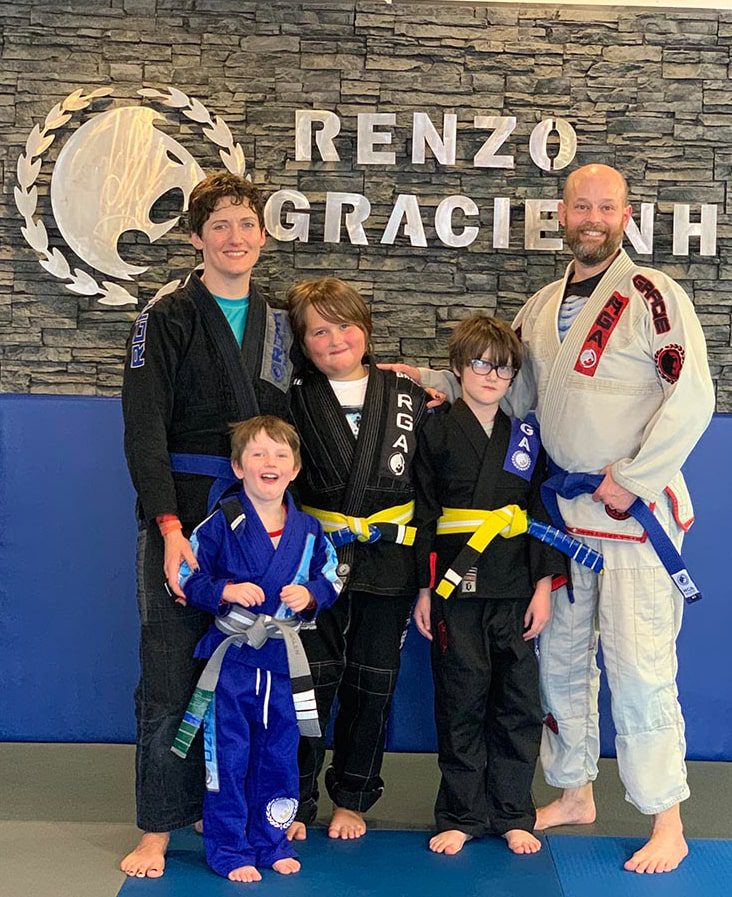
Renzo Gracie NH serves students across Windham, Manchester, and Exeter. Professor Kevin Landry, a sixth-degree black belt under Renzo Gracie, has taught in the region for over two decades. Adults can explore Brazilian Jiu-Jitsu through ongoing instruction. People with professional law-enforcement responsibilities may also want to learn about the academy’s specialized law-enforcement Jiu-Jitsu training and consider how it relates to their agency’s requirements.
If you’re weighing BJJ vs wrestling for self defense, an introductory class can help you experience BJJ instruction and ask questions in person. It won’t settle every comparison or replace ongoing practice, but it’s a practical way to learn more. Book a complimentary introductory class, and confirm current class details when you reach out.
Build practical skills through training that fits your goals
The answer to BJJ vs wrestling for self defense depends on which skills you want to develop and the quality of instruction you can practice consistently. Wrestling often emphasizes takedowns and staying upright, while Brazilian Jiu-Jitsu commonly builds ground control, escapes, and submission awareness. Neither prepares you for every situation, so awareness, sound decisions, and creating a chance to leave remain essential.
If you’re near Windham, Manchester, or Exeter, Renzo Gracie NH offers adult Jiu-Jitsu training led by Professor Kevin Landry, a sixth-degree black belt under Renzo Gracie who has taught in the region for over two decades. Specialized Jiu-Jitsu training is also available for law-enforcement professionals.
Curious whether BJJ is right for you? Try a complimentary introductory class at Renzo Gracie NH to meet the instructors, ask questions, and experience the training environment. Contact the academy to get started.
Frequently Asked Questions
Is BJJ or wrestling better for self-defense?
Neither is universally better for self-defense. Wrestling commonly emphasizes takedowns, balance, and control, while Brazilian Jiu-Jitsu often develops ground positioning, escapes, and submission awareness. The BJJ vs wrestling for self defense choice depends on your goals, the instruction you receive, and the circumstances. Neither guarantees safety. Awareness, de-escalation, and recognizing a safe opportunity to leave are also key parts of practical personal-safety planning.
Can wrestling help you defend yourself?
Wrestling can build balance, movement, takedown defense, and the ability to control another person’s position. These skills may help in some physical encounters, such as responding to a grab or working to stay upright. But wrestling practice alone doesn’t address every self-defense concern. Rules and coaching vary, and real situations are unpredictable. Treat wrestling as one way to develop skills, not as a guarantee or complete personal-safety plan.
Can BJJ help in a real-life self-defense situation?
BJJ can help students practice positional control, escapes, and responses to grappling pressure with a resisting partner. How those skills transfer depends on the student, the quality of practice, and the circumstances. A sport class can’t represent every real-world factor. Build skills and composure through ongoing training, while keeping awareness and de-escalation in mind. If it’s safe to do so, creating distance and leaving should take priority over continuing a confrontation.
Is BJJ effective if a confrontation stays standing?
BJJ is known for ground grappling, but some schools also teach standing positions, takedowns, and responses to someone closing distance. The amount of standing practice varies by academy, instructor, and class. Ask what the curriculum covers and how often students practice those situations in a controlled way. Don’t assume every BJJ program has the same focus, and remember that no standing technique can guarantee a particular outcome.
What is the main difference between BJJ and wrestling?
Both are grappling disciplines, but their training emphases often differ. Wrestling commonly focuses on takedowns, balance, positional control, and pins. BJJ commonly develops ground transitions, escapes, positional control, and submissions. Rules, coaching, and class format shape what students actually practice, so these are general distinctions rather than promises about every school. If you’re comparing programs, ask about the curriculum instead of relying on the style name alone.
Should I learn BJJ and wrestling for self-defense?
Training in both may broaden your grappling experience if suitable instruction is accessible and you have time to attend consistently. It isn’t essential for everyone, and adding more classes shouldn’t come at the expense of learning fundamentals well. Consider your goals, schedule, coaching quality, and whether practice is supervised and appropriately paced. Whatever you train, awareness, de-escalation, and avoiding danger remain important parts of personal safety.
How do I choose a BJJ class for practical self-defense in New Hampshire?
Look for qualified instruction, respectful training partners, progressive beginner teaching, and supervised practice suited to your experience. Ask whether classes include standing situations, escapes, and clear safety guidance. If you’re near Windham, Manchester, or Exeter, contact Renzo Gracie NH to ask about its adult Jiu-Jitsu program and complimentary introductory class. Confirm current class details directly, then use your visit to see whether the teaching approach and environment fit your goals.