BJJ Training for New Hampshire Police: 2026 Dates and Costs
The academy calendar is only one part of BJJ training for NH police standards in 2026. New Hampshire Full-Time Officer Academy class 204 is scheduled for August 24 through December 15, 2026, while officers must complete at least 24 hours of annual in-service training. That annual requirement is separate from defensive tactics training.
For agencies planning professional instruction, practical details matter: how course dates fit the training calendar, what in-service options are available, and how a program’s scope and instruction time shape its cost. The price depends on the case and is provided after a quote request.
This article explains the 2026 dates and cost factors, outlines the annual training framework, and considers reported field applications and injury concerns without treating training as a substitute for agency policy. You’ll come away with a clearer picture of where Brazilian Jiu-Jitsu may fit into officer development and what to consider when planning instruction.
Key Takeaways
- Use the class 204 schedule, August 24 through December 15, 2026, as a planning reference for academy-related training.
- According to New Hampshire Police Standards and Training Council, all New Hampshire academy recruits and law package officers must pass the Cooper’s test at the 35th percentile.
- Compare in-service training options by how their instruction fits agency needs, training schedules, and cost factors.
- Explore how reported field applications and injury considerations inform the way agencies assess defensive tactics and BJJ instruction.
2026 Course dates and costs
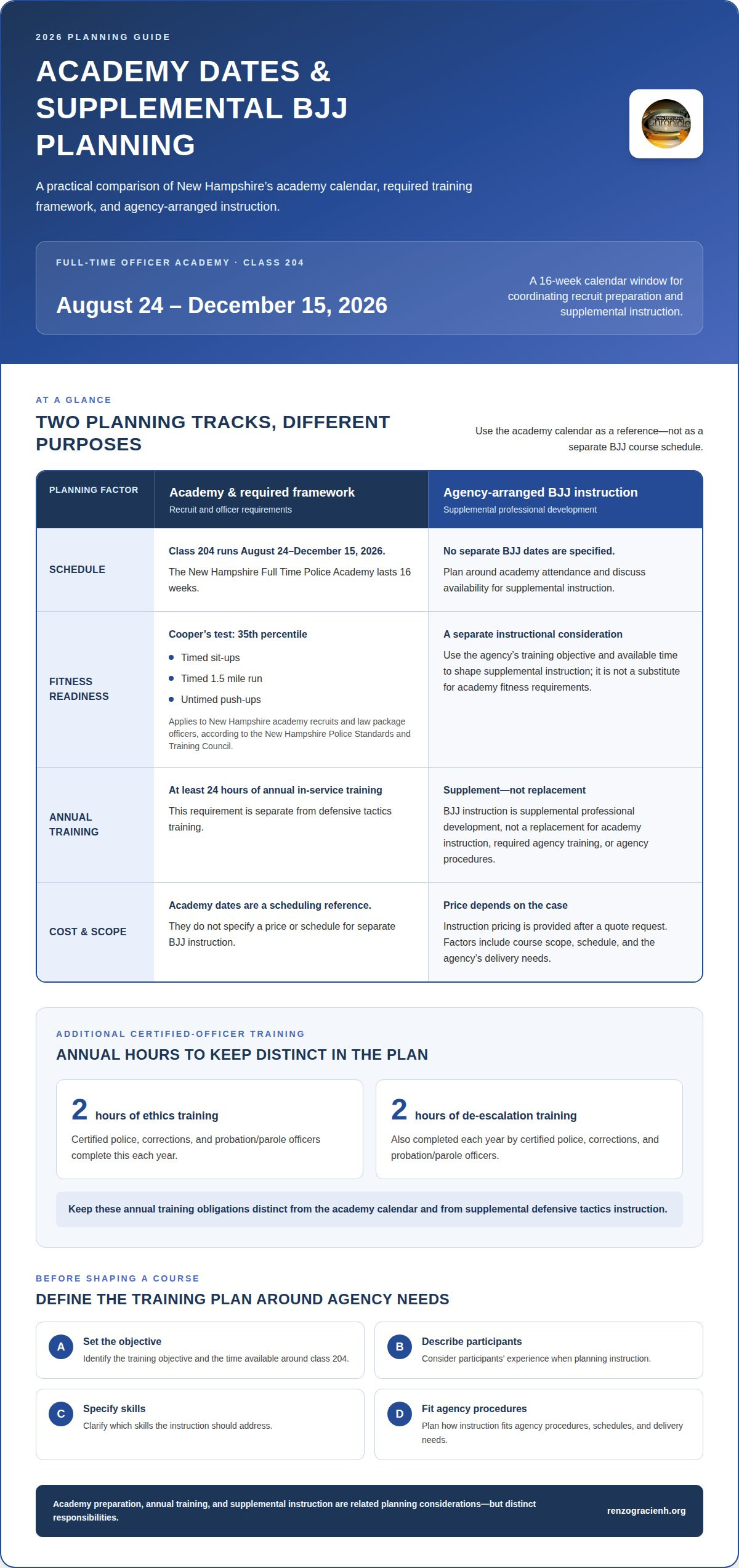
New Hampshire Full-Time Officer Academy class 204 is scheduled for August 24 through December 15, 2026. Its calendar helps agencies plan recruit preparation and supplemental instruction around academy attendance. The New Hampshire Full Time Police Academy lasts 16 weeks, so class 204 occupies a substantial part of the year. These dates identify the academy class, not a separate schedule for Brazilian Jiu-Jitsu instruction.
Fitness readiness is another part of recruit planning. All New Hampshire academy recruits and law package officers must pass the Cooper’s test at the 35th percentile, according to New Hampshire Police Standards and Training Council. The standardized test includes timed sit-ups, a timed 1.5 mile run, and untimed push-ups. For agencies planning BJJ training for NH police standards 2026, this fitness milestone can help shape a broader preparation calendar, while remaining distinct from supplemental defensive tactics instruction.
Academy scheduling and the cost of separate BJJ instruction are different planning questions. The price for agency-arranged instruction depends on the case and is given after a quote request. Cost factors include the scope of instruction, the schedule, and the agency’s delivery needs. A focused session and a broader training plan call for different instructional approaches. A budget should reflect the objectives the agency wants the course to address.
Start planning BJJ training for NH police standards 2026 by identifying the training objective and time available around class 204. Define the participants’ experience, the skills instruction should address, and how it will fit agency procedures. These details help shape course design and cost, while clarifying that BJJ is supplemental professional development, not a replacement for academy instruction or required agency training. A defined objective makes scheduling and budget discussions more concrete.
The published academy window remains 08/24/2026 – 12/15/2026, a reference for coordinating supplemental instruction with class 204. Agencies can use that window when discussing availability.
Reported field-application effectiveness and injuries
BJJ and police defensive tactics courses serve related but different purposes. New Hampshire academy instruction includes scenario-based learning and practical skills demonstrations, while grappling practice can help officers rehearse control positions against resistance. BJJ should complement academy instruction, not replace agency procedures or establish compliance with state standards.
When reviewing field applications, assess the task involved rather than treating a technique as effective on its own. For example, an incident report might describe an officer maintaining position, controlling an arm, or moving from a clinch to a restraint. Ask whether control was achieved, whether force could be reduced, and whether the response fit the circumstances and agency policy. One incident cannot show that a method will work in every encounter.
Skills relevant to control include balance and distance management, clinch positioning, transitions to stable pins, and maintaining control without relying on strikes. These skills may create time and space for clear verbal directions. A hold alone is not de-escalation: communication, judgment, and the ability to stop or adjust remain essential.
Injury assessment also requires care. Training injuries can involve falls, joint stress, or collisions, while field incidents have different conditions and risks. Compare the setting, the action being practiced, partner size and experience, fatigue, and whether an instructor can pause or modify a drill. Training records can distinguish practice injuries from field injuries and help identify recurring causes, such as uncontrolled takedowns or excessive resistance.
- Useful review: record the control objective, technique, outcome, force used, and any injury.
- Safer practice: use controlled resistance, clear stop signals, and instruction that adjusts to skill level.
Agencies seeking structured grappling practice can explore professional jiu-jitsu instruction as a supplement to scenario-based training. Reviewing both successful applications and injury patterns helps keep the focus on sound judgment, controlled practice, and policy-aligned skills.
What defensive tactics and use-of-force training do New Hampshire police recruits receive?
New Hampshire Police Academy instruction combines academic learning, scenario-based exercises, skill building, written exams, and practical demonstrations. Recruits study principles, apply skills in scenarios, and demonstrate practical performance. This approach goes beyond memorizing rules: trainees must show what they can do during assessed learning. The curriculum details described here do not specify individual defensive tactics techniques, so distinguish documented training methods from assumptions about particular holds.
Use-of-force preparation is best understood through this combined structure. A scenario may require a recruit to assess a situation, communicate, select a response, and demonstrate a relevant skill. Written exams assess academic learning, while practical demonstrations assess performance. Together, these methods evaluate decision-making as well as execution. Supplemental grappling instruction does not replace academy requirements or agency policies.
Annual in-service obligations are a separate part of the picture. New Hampshire officers must complete at least 24 hours of annual in-service training, separate from defensive tactics, firearms, and first aid. Certified police, corrections, and probation/parole officers also complete 2 hours of ethics training and 2 hours of de-escalation training each year. Certified officers complete 1 hour of mental health training each year. These requirements clarify that the annual total and defensive tactics training are distinct.
- Academy learning: academic material, scenarios, skill building, written exams, and practical demonstrations.
- Annual in-service: 24 hours, separate from defensive tactics, firearms, and first aid.
- Specified annual subjects: ethics, de-escalation, and mental health training.
For an agency, map these training needs separately. Identify which instruction addresses academic knowledge, scenario decisions, physical skills, and annual subjects. This helps supervisors plan supplemental grappling practice without counting it as a substitute for required instruction. It also keeps evaluation focused: a written exam, a scenario, and a practical demonstration assess different abilities. Clear records can show which objective each session addresses.
Which BJJ gyms near New Hampshire police academies offer law enforcement training?
The New Hampshire Police Academy is the state’s basic training setting, but its location alone does not identify a suitable BJJ program. A good fit depends on whether instruction addresses professional defensive tactics, works with agency scheduling, and complements department procedures. A general grappling class and law-enforcement training may have different aims.
For an agency comparing training options, start with the objective. A team seeking stronger control in close-contact encounters may need practice with positioning, transitions, and controlled restraint. A team working on communication alongside physical skills needs practice that includes verbal direction and decision-making. Let the objective shape the content, rather than choosing only by distance from the academy.
Next, consider how instruction connects with the academy’s training approach. New Hampshire recruits encounter academic learning, scenarios, skill building, written exams, and practical demonstrations. Assess supplemental grappling practice by how clearly it relates to applied skills. Keep it distinct from academy requirements and agency policy. This helps an agency plan relevant training without treating a gym class as state certification.
Before setting a schedule, define the participants, their experience, the skills to address, and the agency procedures that frame the training. These details help determine whether instruction suits recruits, experienced officers, or a mixed group. They also give instructors a basis for adapting examples and resistance levels. Clear objectives make training more relevant than proximity alone.
- Fit: professional defensive tactics, not just general grappling practice.
- Application: examples tied to control, transitions, communication, and agency procedures.
- Planning: a defined group, training objective, and schedule.
To explore a program focused on law enforcement needs, review law enforcement training options and consider how they can support agency goals.
Renzo Gracie NH: Law Enforcement Jiu-Jitsu Training
Renzo Gracie NH offers Law Enforcement Jiu-Jitsu Training for professionals seeking structured Brazilian Jiu-Jitsu practice. It can complement academy instruction and agency procedures for agencies or officers looking to develop grappling skills. The training is distinct from state certification and required academy coursework.
For individual development, the Adult Jiu Jitsu Program provides ongoing practice to build skills. Adults can start with a Free Introductory Class to experience instruction. Families can also explore the Kids Jiu Jitsu Program.
If professional defensive tactics training is your focus, contact Renzo Gracie NH about Law Enforcement Jiu-Jitsu Training in Windham, Manchester, or Exeter.
Build a Training Plan That Moves Forward
Lasting progress comes from turning training goals into consistent practice. A thoughtful approach to BJJ training for NH police standards in 2026 starts with a clear purpose: develop practical grappling skills that complement agency instruction and support sound judgment. From there, agencies can shape a plan around the needs of their officers and the role training should play in professional development.
Renzo Gracie NH offers Law Enforcement Jiu-Jitsu Training, as well as Adult Jiu Jitsu and Kids Jiu Jitsu programs. These programs support personal skill development and family participation in the academy community, while keeping professional training distinct from state requirements.
If you’re ready to explore a training path for your agency or personal development, contact Renzo Gracie NH. Take the next step with focus, build steadily, and keep learning.
Frequently Asked Questions
Do New Hampshire police academies require or recommend Brazilian jiu-jitsu training?
The New Hampshire academy standards described here do not identify Brazilian Jiu-Jitsu as a standalone recruit requirement or recommendation. BJJ can provide supplemental practice, while academy assessments and agency policies remain separate. An agency considering extra grappling instruction can first define its objective, such as improving officers’ positional awareness in close-contact situations. Departments in Windham, Manchester, and Exeter can use that objective to guide local training plans.
What are the injury risks of BJJ training for police recruits, and how can they be reduced?
Grappling can cause strains, joint irritation, or impact injuries, particularly when partners use uncontrolled resistance or lose balance during transitions. Gradual progression, appropriate partner matching, instructor oversight, and permission to pause a drill can help reduce risk. Recruits should promptly communicate discomfort rather than push through it. If an injury occurs, stop training and seek appropriate medical guidance before returning to practice.
Can New Hampshire officers receive department funding or training credit for BJJ classes?
BJJ is supplemental professional development, not a substitute for required instruction. Annual in-service training remains separate from defensive tactics, and this article provides no basis for department funding or BJJ training credit.