The History of BJJ: From Ancient Roots to the Renzo Gracie Legacy
Size doesn’t dictate safety. Technique does. It’s natural to feel intimidated by martial arts culture or skeptical about whether these moves work for smaller people. You might find yourself confused by the split between traditional Japanese roots and the modern mats of Brazil. As you look into bjj history, you’ll start to see how the difference between ancient tradition and modern refinement created a technical system where leverage beats weight every single time. It’s about empowering the individual through logic rather than just raw athletic ability.
Discover the fascinating evolution of Brazilian Jiu-Jitsu and how a century of refinement created the world’s most effective self-defense system. You’re going to see exactly how the “smaller man wins” philosophy transformed from a bold theory into a global standard of personal empowerment. This journey traces the art from its ancient origins through the legendary Gracie family to the modern Renzo Gracie legacy. We’ll preview the technical milestones that shaped the sport, helping you recognize BJJ as a sophisticated system designed for your personal growth, discipline, and lasting confidence. It’s a lineage built on respect and the quiet strength of a supportive community.
Key Takeaways
- Trace the journey of the “Gentle Art” from ancient Japanese battlefields to its transformative arrival in Brazil under Mitsuyo Maeda.
- See how Hélio Gracie’s focus on leverage over brute strength created a system where a smaller person can successfully defend against a much larger opponent.
- Examine the pivotal role Renzo Gracie played in bjj history, bridging the gap between traditional family roots and modern technical excellence.
- Understand the global shift that occurred after UFC 1, proving that technical precision is more effective than raw aggression in real-world scenarios.
- Discover how Renzo Gracie NH preserves this pure lineage through Professor Kevin Landry’s two decades of teaching and commitment to community growth.
The Origins of the Gentle Art: From Japan to Brazil
The story begins on the battlefields of feudal Japan. Samurai developed Jujutsu as a way to defend themselves when disarmed, focusing on pins and joint locks to neutralize armored opponents. Over time, these lethal techniques evolved. Kano Jigoro eventually refined the art into Kodokan Judo, emphasizing technical leverage and safety. This shift allowed practitioners to train with full intensity without constant injury. In 1914, a master named Mitsuyo “Count Koma” Maeda arrived in Brazil. He carried with him a deep knowledge of this evolving craft. Understanding the History of Brazilian Jiu-Jitsu requires looking at how Maeda’s travels across the globe tested and refined these methods in real-world matches.
“Jiu-Jitsu” literally translates to “The Gentle Art.” This name is more than a simple translation; it’s a philosophy of empowerment. It suggests that you don’t meet force with force. Instead, you yield, redirect, and use your opponent’s momentum against them. This core principle makes the art accessible to everyone, regardless of their size or starting strength. It’s the foundation of everything we build today. By prioritizing logic over power, the art offers a path for personal growth that doesn’t rely on being the biggest person in the room.
The Meeting of Maeda and Carlos Gracie
Tradition met transformation in the city of Belém. Carlos Gracie, a teenager looking for direction, encountered Maeda during a public demonstration of the art’s effectiveness. Maeda began teaching Carlos, but the lessons went beyond traditional forms. They focused on live sparring and practical application. Maeda’s global travels transformed a localized martial art into a versatile combat system that bridged continents and cultures. This exposure to diverse fighting styles convinced Carlos that the art must be adaptable to survive. It was no longer just about following a script; it was about discovering what actually worked in a struggle.
The Birth of the “Gracie” System
Innovation sparked a new era in 1925. Carlos moved to Rio de Janeiro and opened the first Gracie Academy, marking a pivotal moment in bjj history. He wasn’t just teaching moves. He was building a lifestyle. The early “Gracie Way” integrated technical training with specific nutrition and healthy habits to ensure longevity and vitality. While Japanese predecessors often prioritized standing throws, the Brazilian system began to lean into the ground game. This focus on survival and technical purity allowed the art to evolve into a unique discipline. It became a system that valued efficiency and perseverance above all else, setting the stage for the supportive community we see today.
The Hélio Gracie Evolution: Refining Technique for the Smaller Person
Hélio Gracie changed everything because he had to. Unlike his brothers, he was physically slight, which meant he couldn’t rely on explosive energy or raw power. This frailty became his greatest strength. It forced him to analyze every movement through the lens of pure physics. He realized that a smaller person could overcome a larger opponent by using the body as a series of levers and fulcrums. This pivot is a defining turning point in bjj history, shifting the focus from athleticism to pure technical efficiency. It transformed a martial art into a science of survival that anyone can learn.
Confidence came through testing. The family issued the “Gracie Challenge,” inviting martial artists from all backgrounds to test their skills against this new system. These matches weren’t about ego; they were about proving that bjj history was rooted in reality. By consistently defeating larger, stronger opponents, the Gracies established their art as the premier system for self-defense. It became clear that technical precision beats brute force every time. This era proved that discipline and focus are the ultimate equalizers on the mat.
The Mechanics of Leverage
The innovation moved the fight from the feet to the floor. Standing throws require a specific type of athleticism that can be difficult for smaller practitioners to maintain. By focusing on ground-based control, Hélio neutralized the weight advantage of his peers. The “Guard” position became the revolutionary heart of the system. It turned the bottom position into an offensive platform rather than a place of defeat. This technical shift is exactly what makes jiu jitsu for beginners adults NH so effective for those just starting their journey. You don’t need to be an athlete to begin; you just need to understand the mechanics of control.
Proving the System in the Ring
One of the most famous moments occurred when Hélio faced the legendary Japanese judoka Masahiko Kimura. Kimura outweighed Hélio by nearly 80 pounds. While Hélio eventually lost the match, his ability to survive against such a formidable master for so long shocked the world. This encounter emphasized that Modernizing the Legacy requires constant refinement and the humility to learn from every defeat. The psychological impact was massive. Practitioners realized that with the right technique, the fear of size disappears. If you’re ready to build that kind of confidence, you can experience our community firsthand through our introductory programs.
The Renzo Gracie Influence: Modernizing the Legacy
Renzo Gracie represents the evolution of the art. While the previous generation proved that the system worked for survival, Renzo showed how it could dominate in a modern, multi-disciplinary arena. He stands as the essential bridge between traditional family roots and the fast-paced world of professional Mixed Martial Arts. His influence transformed bjj history by proving that a legacy is only as strong as its ability to adapt. Renzo didn’t just inherit a system; he expanded it. He looked beyond the traditional curriculum to incorporate effective elements from wrestling and leg locking systems, creating a more complete grappling framework.
The opening of the Renzo Gracie Academy in New York City served as a global catalyst. It wasn’t merely a place to train; it became a world-class laboratory for technical innovation. Renzo’s reputation as an influential teacher stems from his unique blend of elite skill and infectious positivity. He moved the art away from the “secretive” culture of the past toward a model of transparency and professional instruction. This shift allowed the art to flourish in a modern urban environment, making high-level technical knowledge accessible to everyone from professional athletes to local families.
Innovation and the “NYC Style”
Professionalism defines the Renzo Gracie approach. The “NYC Style” moved training out of gritty backrooms and into clean, organized, and inclusive environments. This modernization was about more than just aesthetics. It involved developing a systematic way to teach complex grappling concepts so that any student could see a clear path to mastery. This is why the Renzo Gracie teaching philosophy remains the gold standard globally. It prioritizes logic, safety, and a supportive community over ego or aggression.
Lineage and Technical Purity
Lineage provides a roadmap for quality. Training under a direct Renzo Gracie black belt ensures that the technical purity of the art remains intact. It’s a form of quality control that guarantees every move you learn has been tested at the highest levels of competition. This commitment to excellence translates perfectly into specialized programs, such as kids jiu jitsu New Hampshire. Renzo’s charisma and coaching style emphasize that the mat is a place for joy and personal progress. By maintaining this direct connection to the source, we ensure that the next generation of practitioners grows with the same focus, respect, and technical precision that defined the founders.
Global Expansion: From the First UFC to Law Enforcement
1993 was the year everything changed. Royce Gracie entered the first Ultimate Fighting Championship (UFC) and systematically defeated larger, more aggressive opponents. He didn’t use strikes or brute force. Instead, he used the technical leverage we’ve discussed in previous chapters. This moment is a landmark in bjj history because it stripped away the mystery of combat. It proved that a technical system designed for the smaller person could overcome any style. The art was no longer a hidden family tradition; it became the essential foundation for Mixed Martial Arts worldwide.
The success of the Gracie family in the cage led to a realization in the professional world. If these techniques worked against elite fighters, they could work in high-stress situations for first responders. This marked the transition of the art into the gold standard for real-world self-defense. Today, elite military units and police departments across the globe integrate these movements into their standard training. It’s about control, not damage. This evolution reflects a shift toward technical precision and discipline in professional environments.
BJJ in the Professional World
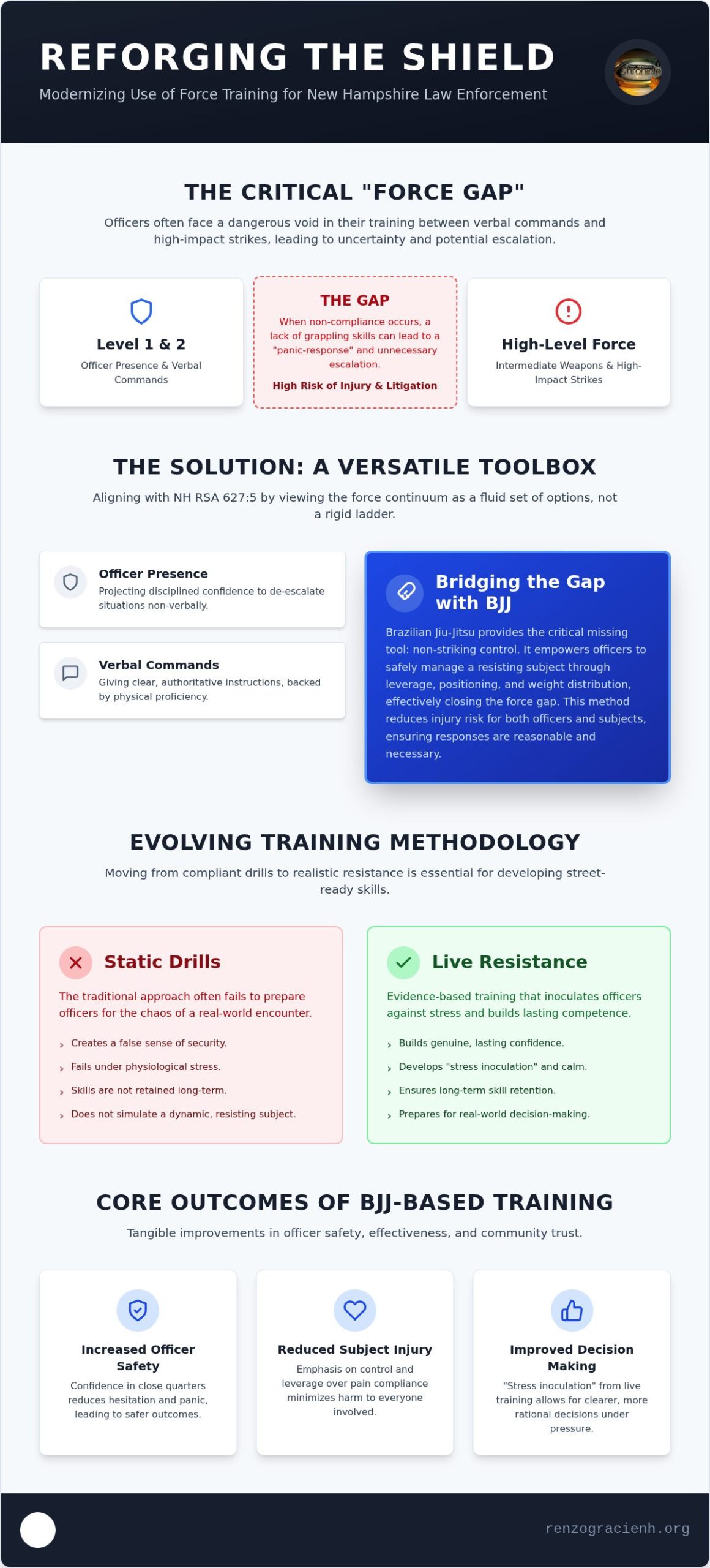
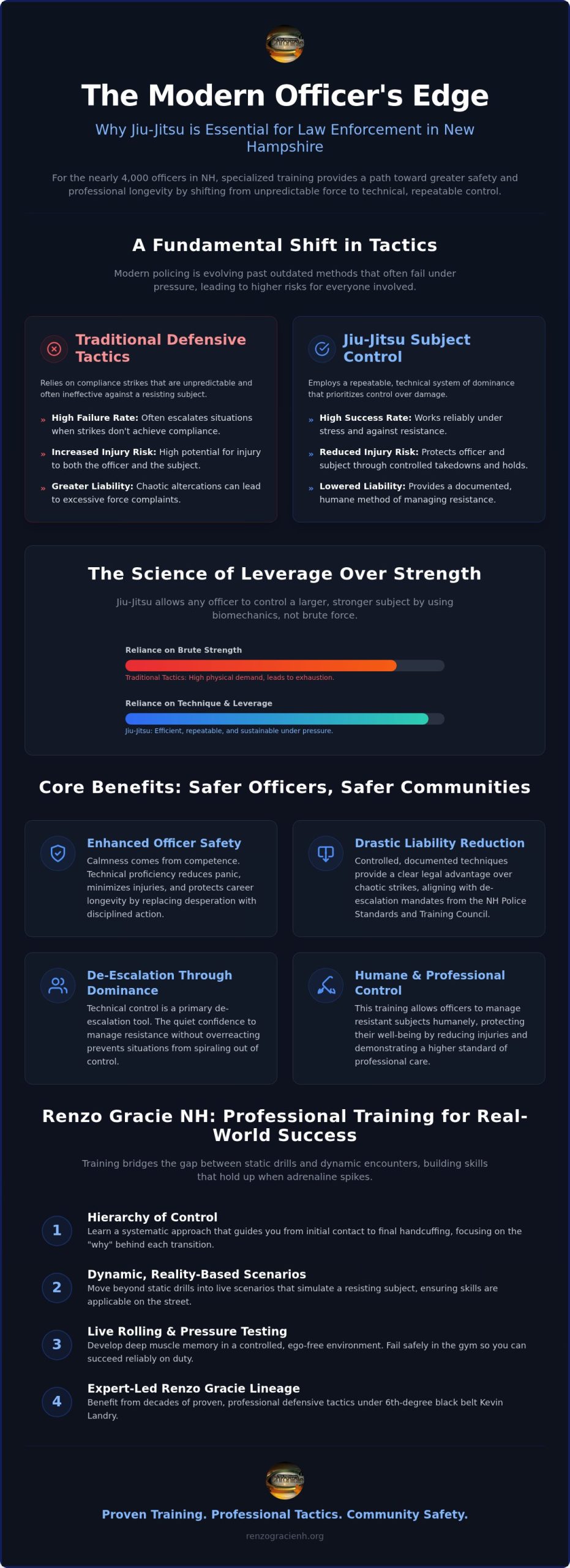
Modern agencies now prioritize law enforcement jiu jitsu training to ensure safety and effectiveness. Control-based grappling offers the safest option for both officers and subjects because it allows for the de-escalation of physical conflict without relying on striking. Bjj history informs modern defensive tactics by providing a proven roadmap for managing distance and securing a subject with minimal risk of injury. It’s a professional approach to a difficult and necessary job.
The Sport vs. Self-Defense Debate
As the art grows, a debate often arises between sport competition and practical survival. Many modern schools focus purely on winning medals. However, the Renzo Gracie lineage maintains a “Self-Defense First” mindset. This means every technique is taught with the understanding that it must work in a real-world scenario, not just under a specific set of sport rules. We value competitive success, but we never sacrifice the practical application that makes the art life-saving. If you’re ready to see how these techniques apply to your life, start your journey with a free introductory class today.
Bringing the Legacy to New Hampshire: Renzo Gracie NH
History isn’t just something that happened in Brazil or New York; it’s being written right here in our local community. Professor Kevin Landry, a 6th-degree black belt under Renzo Gracie himself, has spent over two decades building a foundation of technical excellence in the New Hampshire region. This isn’t just about opening a gym. It’s about transplanting a century of technical refinement and cultural respect into the local soil. By establishing Renzo Gracie NH, Professor Landry created a hub where the global narrative of bjj history meets the personal aspirations of local families. He brought a world-class standard to our neighborhoods, ensuring that the art remains accessible and pure.
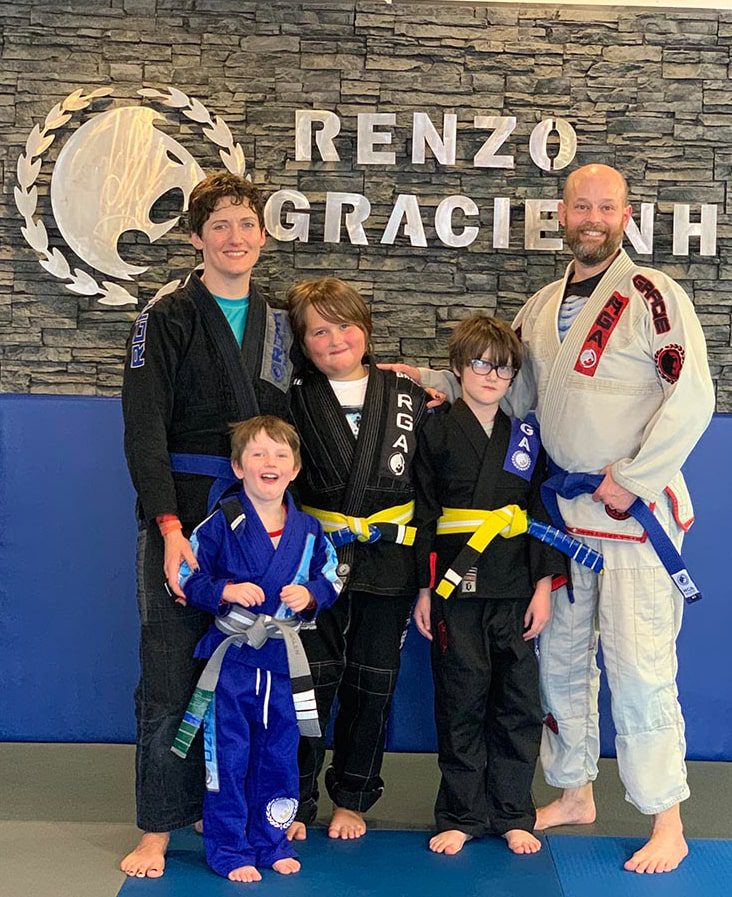
We focus on a “Family First” atmosphere. This reflects the original community spirit seen in the early days of the Gracie family, where the mat was a place for collective growth rather than just solo glory. Whether you’re training in Windham, Manchester, or Exeter, you’re stepping into an environment that values your individual progress and your family’s well-being. It’s a supportive partnership that prioritizes discipline and character development alongside physical skill. This culture of inclusivity ensures that everyone, from kids to law enforcement officers, feels welcome and empowered to grow.
The Kevin Landry Connection
Training directly under a 6th-degree black belt ensures a standard of instruction that is rare to find. Kevin Landry’s journey in the NH region began around 2004, creating a lineage that now spans generations of students. This local expertise means you aren’t just learning moves from a manual; you’re receiving wisdom passed down through a direct, verified line. This connection to the source is vital when you book your first jiu jitsu class. It ensures that your foundation is built on technical purity and a supportive culture from your very first day on the mats.
Your Place in BJJ History
You have a seat at the table. Every time you step onto the mat, you become a part of the living lineage that started on ancient Japanese battlefields and evolved through the streets of Rio. Programs like our parent and child jiu jitsu Windham sessions carry this torch forward, allowing families to grow stronger together while building lasting bonds. You aren’t just studying bjj history as a distant subject; you’re actively training it. Join us to discover how your own story of transformation fits into this prestigious legacy. The journey toward confidence and technical mastery is a consistent and reliable part of a healthy lifestyle.
Begin Your Chapter in the Gentle Art
The journey from ancient battlefields to the modern mats of New Hampshire is a testament to the power of human innovation. You now see how bjj history is defined by the constant pursuit of efficiency over ego. This art empowers the smaller individual by turning physics into a personal shield. It’s a legacy of respect and perseverance that welcomes everyone, regardless of age or starting ability. You’ve discovered how a century of refinement created a system that prioritizes technical logic over raw athletic power.
You don’t have to be an athlete to begin. You just need the desire to grow. By training under 6th-degree black belt Kevin Landry, you gain access to a direct lineage that traces back to the legendary Renzo Gracie himself. We provide a supportive, family-oriented environment where your personal progress is our primary focus. This is your opportunity to transform your health and confidence within a prestigious tradition. It’s time to write your own chapter in this story. Start your own BJJ journey with a Free Introductory Class at Renzo Gracie NH! We are ready to help you discover your full potential on the mats.
Frequently Asked Questions
What is the difference between Japanese and Brazilian Jiu-Jitsu?
Japanese Jiu-Jitsu focuses on standing throws and traditional forms. Brazilian Jiu-Jitsu emphasizes ground fighting and technical leverage. It’s about finishing a struggle through control and submissions rather than just takedowns. This shift is a major part of bjj history. It allows a smaller person to survive against a larger opponent by neutralizing weight on the ground. We teach these specific mechanics to ensure every student feels safe and capable in any situation.
Who is the founder of Brazilian Jiu-Jitsu?
Carlos and Hélio Gracie are the primary founders. Carlos learned the art from Mitsuyo Maeda and opened the first academy in 1925. Hélio refined the techniques because he was physically slight and couldn’t rely on brute strength. This innovation created the modern system we use today. It transformed a martial art into a technical science. Their combined vision ensured the art remained practical, effective, and focused on personal growth for individuals of all sizes.
Why is the Gracie family so famous in martial arts?
The family gained fame by proving their system’s effectiveness in open challenges. They invited practitioners of all styles to test their skills in real matches. These victories showed that technical precision beats size and aggression. This reputation grew significantly after Royce Gracie won the first UFC in 1993. Their commitment to technical purity and family values has made them the most influential name in the world of martial arts, focusing on empowerment through logic.
How did Renzo Gracie change BJJ history?
Renzo Gracie modernized the art by making it more professional and open-minded. He integrated effective techniques from wrestling and leg locking systems to create a more versatile curriculum. His academy in New York City became a global hub for technical innovation. Renzo moved the art away from secrecy toward a model of transparent, high-quality instruction. This shift is a pivotal moment in bjj history, making elite knowledge accessible to families and professionals alike.
Is BJJ history relevant for someone who just wants to get in shape?
Understanding the art’s roots provides a sense of purpose beyond just burning calories. You aren’t just doing a workout; you’re engaging in a technical system designed for longevity. The focus on leverage over brute force means you can train safely for years. This makes it an ideal way to get in shape while developing mental focus and discipline. It turns a standard fitness routine into a journey of personal empowerment and lasting character building.
What does the Renzo Gracie lineage mean for a student in NH?
Lineage is a guarantee of quality. Training at Renzo Gracie NH means you’re learning from Professor Kevin Landry, who earned his 6th-degree black belt directly from Renzo. This connection ensures the techniques you learn in Windham, Manchester, or Exeter are technically pure and battle-tested. You aren’t just getting a generic class. You’re joining a prestigious tradition that values respect and community. It’s about building a legacy of personal success for every family member.
When did BJJ first come to the United States?
Rorion Gracie brought the art to the United States in the late 1970s, teaching out of his garage in California. However, the art exploded in popularity in 1993 after the first UFC event. This global exposure proved the system’s dominance to a massive audience. Since then, the art has grown from a niche practice into a mainstream lifestyle. It’s now the foundation for modern defensive tactics and competitive grappling programs across the country.
Why is BJJ considered the most effective martial art for self-defense?
It focuses on the most common scenario: the fight going to the ground. Most physical altercations end up in a grappling situation where weight and strength usually dictate the outcome. This art uses leverage and distance management to neutralize those advantages. It allows you to control a subject without having to rely on striking or aggression. This makes it the gold standard for personal safety and professional law enforcement training in New Hampshire.