Posts

BJJ vs Karate for Kids NH: Best Martial Art 2026

What if the most effective way to protect your child isn’t teaching them how to throw a punch, but how to stop one? Real confidence isn’t built by striking the air. It’s forged through live-tested control and leverage. You want your child to stand tall. You likely worry about the risk of head injuries in contact sports or that repetitive “katas” won’t actually help during a real playground struggle. It’s a common concern for families exploring BJJ vs Karate for kids NH. You need a solution that balances physical intensity with a safe, supportive environment.

We understand that choosing a martial art is a significant decision for your family’s journey. This guide breaks down the fundamental differences between the “gentle art” of Brazilian Jiu-Jitsu and traditional striking disciplines. We promise to show you how grappling provides a safe, high-energy outlet that develops discipline without the need for aggressive punching or kicking. We will compare safety profiles, practical effectiveness, and the unique community culture found in Southern New Hampshire academies so you can choose the best path for your child’s growth.

Key Takeaways

  • Understand the core differences between striking and grappling when evaluating BJJ vs Karate for kids NH for your family’s specific needs.
  • Learn how Brazilian Jiu-Jitsu protects developing brains by focusing on leverage and pins rather than the repetitive head impacts found in striking-based arts.
  • Discover why the “problem-solving” nature of live-resistance training builds more functional discipline and focus than memorizing traditional solo forms.
  • Find out how “control and negotiate” strategies allow children to handle playground bullies effectively without violating school zero-tolerance policies.
  • See how a welcoming community environment led by expert mentorship fosters personal growth and makes martial arts a consistent part of a healthy lifestyle.

BJJ vs Karate for Kids in NH: The Fundamental Difference

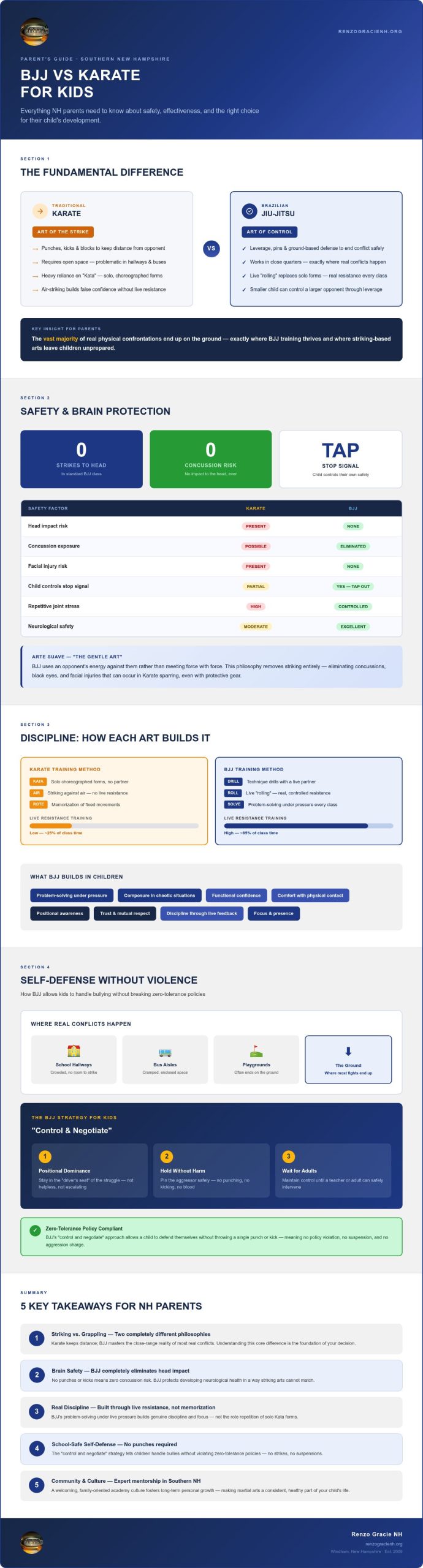
Choosing the right martial art for your child in Southern New Hampshire is about more than picking a weekend activity. It’s about selecting a foundation for their confidence and safety. In 2026, the landscape of youth sports is shifting toward functional, real-world skills. The BJJ vs Karate for kids NH debate highlights two very different philosophies. Karate is the traditional “Art of the Strike.” It focuses on speed, punches, kicks, and blocks to keep an opponent at a distance. Brazilian Jiu-Jitsu is the “Art of Control.” It focuses on leverage, pins, and ground-based defense to end a conflict safely. Brazilian Jiu-Jitsu is a sophisticated system where a smaller child can neutralize a larger, stronger opponent without having to use damaging force.

Striking: High Energy but Distance-Dependent

Karate relies on keeping space. It is built on the idea of landing precise movements from a distance to deter an aggressor. While this builds excellent coordination and explosive power, it presents a significant challenge in the real world. Think about where most childhood conflicts happen. It’s usually a crowded school hallway, a cramped bus aisle, or a busy playground. There is rarely enough room to throw a clean kick or a perfect punch. Many traditional Karate programs also spend a majority of their time on “Kata.” These are solo, choreographed movements against the air. While beautiful to watch, “air-striking” can lead to a false sense of security. It doesn’t teach a child how to react when a peer actually grabs their shirt or pulls them close.

Grappling: The Reality of the “Schoolyard Scuffle”

Real physical struggles look very different from a movie fight. Observation and data show that the vast majority of physical confrontations eventually end up on the ground. This is exactly where grappling thrives. Brazilian Jiu-Jitsu teaches children how to stay safe and calm when someone grabs them or tries to tackle them to the grass. Instead of escalating a situation with a strike, kids jiu jitsu New Hampshire programs prioritize positional dominance. They learn how to be in the “driver’s seat” of a struggle.

This “ground-up” approach ensures your child isn’t helpless if they fall. It transforms a chaotic scuffle into a manageable event. By mastering leverage, a child can hold an aggressor down and wait for an adult to intervene. When comparing BJJ vs Karate for kids NH, parents must decide if they want their child to focus on keeping distance or mastering the close-range reality of most struggles. Training should mirror reality. BJJ replaces solo forms with live, controlled “rolling.” This builds a level of comfort with physical contact that striking-based arts often miss, ensuring that your child remains composed when it matters most.

Safety and Impact: Protecting Developing Brains

Safety is the first priority for any parent in Southern New Hampshire. When evaluating BJJ vs Karate for kids NH, the most critical factor is often the risk of injury. Striking-based arts like Karate involve repetitive impact. Even with protective gear, the jarring force of punches and kicks can pose hidden risks to a child’s developing brain. Jiu-Jitsu eliminates this specific danger entirely. There are no strikes to the head or body in a standard BJJ class. Instead, the focus is on controlled movements and mutual respect. We prioritize the long-term neurological health of our students by keeping the training ground-based and impact-free.

The “tap out” system is the cornerstone of safety in our academy. It teaches children that they are in control of their own boundaries. If a child feels uncomfortable or caught in a hold, a simple tap ends the interaction immediately. This creates a culture of trust rather than “tough guy” aggression. At Renzo Gracie NH, our mats in Windham are designed for safety, but our culture of care is what truly protects our students. We build physical literacy without the need for combat-style violence.

The “No Striking” Advantage

Brazilian Jiu-Jitsu is often called “The Gentle Art” or Arte Suave. This name reflects its core philosophy: using an opponent’s energy against them rather than meeting force with force. By removing striking, we remove the risk of concussions, black eyes, and facial injuries that can happen in Karate sparring. Training focuses on joint safety and positional control. Children learn to move with purpose and precision. This approach builds strength and vitality without the neurological toll of repetitive impact. It’s a modern, clean approach to a traditional craft that values the individual’s well-being above all else.

Developing “Mat Sense” and Spatial Awareness

BJJ does more than teach defense; it improves a child’s proprioception, or their awareness of their body in space. This “mat sense” is a vital form of physical literacy. One of the first things a student learns is how to fall safely. These “break-falling” techniques are essential for preventing everyday injuries on the playground or during other sports. While Karate often focuses on rigid forms, BJJ creates a disciplined confidence through constant, safe interaction with others. If you are curious about how this “gentle art” can benefit your family, you can start with a free introductory class to see our safety protocols in action. This hands-on experience allows parents to see how we prioritize the well-being of every child while building their physical strength.

Discipline Through Resistance: BJJ vs Karate for Kids NH

Discipline isn’t just about following orders. It’s about how we react when things get difficult. When comparing BJJ vs Karate for kids NH, the method of teaching this discipline varies wildly between the two arts. Karate relies heavily on Kata. These are solo performances where students repeat movements against an imaginary opponent. Brazilian Jiu-Jitsu uses “rolling.” This is live, controlled grappling where a partner is actively trying to move, escape, or counter. This creates a physical chess match. Every training session is a series of puzzles to solve. By navigating physical discomfort in a safe environment, children learn to maintain a steady mind when faced with external stress.

Practicing against a resisting partner builds a level of focus that hitting the air simply cannot match. It requires a student to be present and reactive. They must learn to anticipate their partner’s next move while managing their own energy. This live interaction transforms a workout into a deep lesson in perseverance and grit. It moves the student from memorization to true understanding.

The Myth of the “Air Form”

Repeating movements in the air can build coordination. However, it often fails when a real opponent moves unexpectedly. Real-world skills require “aliveness.” This means practicing against someone who is actually resisting and adapting. The Renzo Gracie teaching philosophy emphasizes functional skill over choreography. We want our students to know their techniques work because they’ve tested them on the mats, not just in their imagination. This builds a genuine sense of accomplishment that isn’t based on a belt color, but on actual ability.

Resilience on the Mats, Success in the Classroom

There’s a direct link between physical problem-solving and academic focus. When a child learns to untangle a complex grappling position, they are training their brain to stay focused on a difficult task. This is a powerful outlet for children with high energy or ADHD. It gives them a productive way to channel their vitality into something structured. They also learn grit. In our academy, “losing” a round isn’t a failure; it’s a chance to learn and evolve. This mindset carries over into school, helping them handle difficult tests or social challenges with a calm, steady momentum. They discover that progress comes from collective effort and personal persistence.
BJJ vs Karate for Kids NH: Best Martial Art 2026

Self-Defense Without Violence: A Guide for NH Parents

When weighing BJJ vs Karate for kids NH, parents must consider the reality of modern school environments. Most Southern New Hampshire schools enforce strict zero-tolerance policies. If your child throws a punch to defend themselves, they often face the same suspension as the bully. Karate’s striking-based approach can inadvertently put your child’s academic record at risk. Brazilian Jiu-Jitsu offers a different path: the “Control and Negotiate” strategy. This method allows a child to end a struggle without throwing a single strike. They learn to neutralize the threat, maintain a safe position, and wait for an adult to intervene. It is a non-violent resolution to a physical conflict.

This approach empowers the shy or smaller child. They don’t need to be aggressive to be safe. By focusing on technical proficiency, they gain the confidence to stand their ground. Practical self-defense starts with knowing what to do when a bully grabs a shirt or a backpack. We practice these specific scenarios until the response is second nature. Your child learns to stay calm, break the grip, and move to a position of safety. It’s about practical protection in the places they spend their time every day.

Stopping the Bully, Saving the Student

De-escalation is the first line of defense. We teach children to use their voice and posture to project a “Quiet Authority.” This disciplined confidence often stops a conflict before it ever becomes physical. If a situation does escalate, BJJ provides the tools for physical neutralization. This is exactly why BJJ is the primary martial art used in Law Enforcement Jiu-Jitsu Training across the region. Officers must control individuals without causing unnecessary harm. We bring those same professional-grade tactics to our youth students. It’s about ending the fight responsibly. This focus on control ensures your child remains the “good kid” in the eyes of school administrators while staying completely safe.

Size Doesn’t Matter: The Power of Leverage

Size shouldn’t be the deciding factor in a child’s safety. Many schoolyard struggles involve a larger peer using their weight to intimidate others. This is where the science of the lever becomes a child’s best friend. BJJ makes physics work for the smaller student. By understanding weight distribution and leverage, a smaller child can easily manage a much larger aggressor. They discover how to use their legs, which are the strongest muscles in the body, to control an opponent’s upper body. Real-world examples include escaping a headlock or preventing a tackle on the playground. This technical mastery builds a sense of empowerment that size can never provide. Ready to see the difference for yourself? Sign up for a Free Introductory Class and watch your child discover their own strength.

The Renzo Gracie NH Experience: Building Family Legacies

When families look at BJJ vs Karate for kids NH, they often find generic programs that lack deep roots. Renzo Gracie NH is different. It is led by Professor Kevin Landry, a 6th-degree black belt under Renzo Gracie himself. With over 20 years of experience teaching in the NH region, he has built a supportive community that extends far beyond the mats in Windham. This isn’t just a gym; it’s a place where families from Manchester to Exeter come to evolve together. We prioritize the personal success of the individual and the family unit above all else. Our environment is a place for growth rather than just competition.

Lineage and Authority in Southern NH

Lineage matters. The Renzo Gracie name is world-renowned for quality, respect, and technical excellence. When you compare BJJ vs Karate for kids NH, the distinction in instruction quality becomes clear. Many traditional martial arts schools operate as franchises with revolving instructors who may only have a surface-level understanding of the craft. A dedicated BJJ academy offers a consistent, high-level curriculum that honors its prestigious heritage. This authority ensures that your child is learning the most effective techniques from a true expert in the room. It projects a sense of disciplined confidence that is welcoming to individuals of all skill levels.

A Curriculum for the Whole Family

We believe martial arts should be a shared journey. Our unique “Family Time” sessions allow parents and kids to train together, creating a powerful bond through collective effort. This parent and child jiu jitsu Windham program builds a shared language of discipline and focus. You aren’t just dropping your child off; you are building a lifestyle of health and vitality as a unit. It transforms the family dynamic by replacing passive screen time with active, purposeful engagement. You discover the joy of personal progress alongside those you love most. This shared experience fosters a sense of perseverance that strengthens the home environment.

Getting started is simple. We offer a modern, clean, and professional approach to a traditional craft, ensuring that every individual feels supported from their first day. Discover why so many families choose our community-led approach over traditional alternatives. You can try jiu jitsu free New Hampshire with an introductory class designed to show you the “gentle art” in action. Join us and start building your family’s legacy of strength and perseverance today.

Equipping Your Child for a Lifetime of Confidence

Confidence is a choice. It’s the result of consistent, purposeful effort. When you weigh BJJ vs Karate for kids NH, you’re choosing a path that prioritizes neurological safety and practical, non-violent resolution. You’ve seen how grappling allows a child to handle pressure without the need for aggressive striking. It’s a modern approach for families who value discipline and well-being. Under the guidance of Professor Kevin Landry, a 6th-degree black belt with over 20 years of local instruction, your child will find more than just a class. They’ll find a supportive, family-first community dedicated to their personal growth.

The journey from the first day to long-term mastery begins with a single step. We invite you to see our academy in action and feel the difference of a professional, welcoming environment. Claim Your Child’s Free Introductory Class at Renzo Gracie NH Today! We look forward to being a supportive partner in your child’s development and helping them discover their own strength and vitality.

Frequently Asked Questions

Is BJJ too aggressive for a shy child?

Brazilian Jiu-Jitsu is actually one of the best activities for a shy child because it focuses on mutual respect and cooperation rather than aggression. Unlike striking arts where a child might feel intimidated by being hit, BJJ is a gentle art that uses controlled grappling. Our instructors create a supportive environment where students build confidence at their own pace. This gradual exposure to physical problem-solving helps shy children discover their own strength without feeling overwhelmed.

What is the best age for a child to start BJJ in NH?

Most children are ready to begin their journey around the age of five or six. At this stage, they have developed the motor skills and attention span necessary to follow basic instructions. However, every child is unique. We focus on physical literacy and coordination for our youngest students to ensure they enjoy the process. Starting early helps them build a foundation of discipline and spatial awareness that serves them throughout their school years.

Will my child get hurt doing BJJ compared to Karate?

If you’re evaluating BJJ vs Karate for kids NH, BJJ is often the safer choice for long-term health. Because there are no strikes to the head or body, the risk of concussions and facial injuries is significantly lower. We prioritize joint safety and controlled movements during every session. Our tap out system ensures that every student is in control of their own boundaries. This focus on safety allows children to train with high energy.

How does BJJ help with bullying if they aren’t taught to punch?

BJJ teaches children to neutralize a bully’s aggression through leverage and positional control rather than violence. Instead of escalating a situation with a punch, a student learns how to close the distance and hold an aggressor safely until help arrives. This control and negotiate strategy is highly effective for playground struggles. It allows your child to stay safe and resolve the conflict without violating school policies or causing unnecessary injury to others in the process.

Do I need to be in shape to start the family sessions at Renzo Gracie NH?

You don’t need to be in peak physical condition to join our family sessions. The training itself is designed to help you build strength, flexibility, and vitality over time. We welcome total beginners of all fitness levels and ages. Our instructors provide a steady, methodical progression that allows you to move at your own pace. The collective effort of training alongside your child provides the motivation you need to stay consistent and healthy.

What should my child wear to their first free introductory class?

For their first free introductory class, your child should wear comfortable athletic clothing that allows for a full range of motion. A simple t-shirt and shorts or leggings without zippers or buttons are perfect. We recommend avoiding anything with pockets or loose strings that could get caught during training. Since BJJ is practiced on clean, padded mats, your child will be training barefoot. We provide all the necessary guidance to ensure they feel prepared and welcomed.

How many times a week should my child train for the best results?

For the best results in skill development and character growth, we recommend that children train two to three times per week. Consistency is the key to mastering the physical chess of Jiu-Jitsu. This schedule allows them to retain what they’ve learned while still leaving plenty of time for schoolwork and other activities. Regular attendance helps them build strong bonds with their teammates and ensures they feel like a reliable part of our community.

Is BJJ better than Karate for kids with ADHD or focus issues?

Many parents find that BJJ vs Karate for kids NH is a clear choice for children with ADHD or focus issues. BJJ requires constant engagement with a partner, which provides immediate feedback and keeps a child’s mind focused on the task at hand. The problem-solving nature of grappling acts as a productive outlet for high energy. It transforms restless movement into purposeful action. This helps improve academic focus by teaching the brain to stay calm.
BJJ vs Karate for Kids in NH: Which is Best for You?

The safest way to teach your child to defend themselves might involve never throwing a single punch. It sounds counterintuitive; however, many families are discovering that the most effective self-defense starts with leverage rather than striking. You want your child to stand tall. You want them to face challenges with quiet confidence. When weighing BJJ vs Karate for kids NH, the decision often centers on finding a balance between physical safety and real-world skill.

We know the struggle of searching through endless local options and worrying about your child’s well-being in a contact sport. You deserve a program that builds character without encouraging aggression. This article explores the critical differences between striking and grappling to help you choose the most empowering martial art for your child in Southern New Hampshire. We will look at safety protocols, focus-building techniques, and how a supportive community creates a space where your whole family can grow together. Discover how the right environment can turn a struggle with focus into a journey of personal mastery.

Key Takeaways

  • Learn the fundamental difference between striking and grappling. You’ll see why leverage and control provide a more practical defensive foundation than punches or kicks.
  • Prioritize your child’s safety with a “no striking” approach. We explain how the “tap out” system eliminates head trauma risks while building deep respect between partners.
  • Build functional discipline through live resistance. Discover why practicing with a partner offers more immediate growth for focus and resilience than repeating forms in the air.
  • When evaluating BJJ vs Karate for kids NH, look for a community that supports the whole family. Find out how unique “Family Time” sessions and world-class instruction create a lasting bond.
  • Match the martial art to your child’s specific personality and energy. Our guide helps you identify the best environment to transform their confidence and social skills.

Striking vs. Grappling: The Core Difference for NH Parents

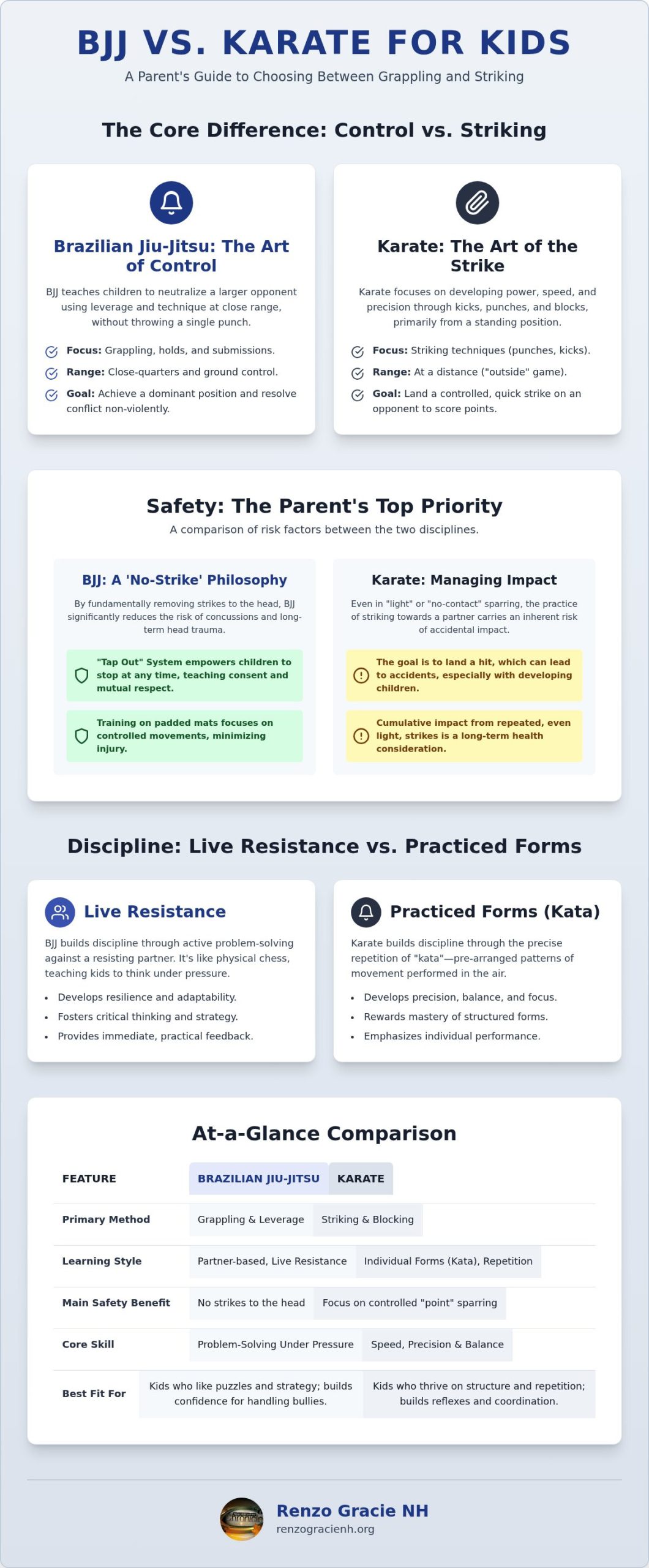
Choosing the right martial art for your child is a major decision. It involves safety. It requires trust. When you begin comparing BJJ vs Karate for kids NH, you’ll quickly notice two fundamentally different ways of moving. One teaches your child to defend themselves from a distance using strikes; the other empowers them to navigate a conflict through close-range control. Understanding this split is the first step in finding the perfect environment for your family’s needs.

Consider how children actually move during a confrontation. They rarely stand at arm’s length to trade blows like professional boxers. Instead, most childhood altercations naturally transition into a clinch or end up on the ground. This is where the concept of “distance” becomes a critical factor. While Karate prepares a child for the “outside” game, Brazilian Jiu-Jitsu (BJJ) provides the essential tools for the “inside” game. It’s a strategic shift from high-impact aggression to methodical, tactical control.

Karate: The Art of the Strike

Traditional karate is built on the foundation of the strike. Students spend significant time practicing “kata,” which are structured patterns of movement performed in the air. These forms help develop speed, precision, and a strong sense of standing defense. It’s a highly disciplined approach. Many traditional schools focus on point-sparring, where the goal is to land a quick, controlled touch on an opponent to score. This builds excellent reflexes and balance, emphasizing the ability to stay on one’s feet and maintain a safe gap between themselves and a potential threat.

BJJ: The Art of Control

BJJ takes a different path entirely. It’s often called the “gentle art” because it doesn’t rely on punching or kicking to resolve a conflict. Instead, students learn various grappling techniques designed to neutralize a larger or stronger opponent using leverage. The focus is on closing the distance and staying safe in close quarters. By securing a hold or controlling a person’s movement on the ground, a child can stop a bully without ever having to throw a punch. This focus on non-violent resolution is a hallmark of the discipline.

This approach functions as physical chess for a young, developing mind. Every move requires a calculated response. Every challenge has a logical solution. It’s a purposeful way of teaching a child to think clearly under pressure. Rather than reacting with a strike, they learn to evolve their position, find an opening, and resolve the conflict through disciplined persistence. This builds a type of confidence that carries over into the classroom and beyond. It turns a stressful moment into a problem that can be solved with patience and skill.

Safety and Impact: Why BJJ is Often the ‘Gentler’ Choice

Safety is the number one concern for parents. It’s the first question we hear. When you research BJJ vs Karate for kids NH, the most significant difference lies in how children handle physical contact. Karate is built on striking. BJJ is built on grappling. By removing the striking element, BJJ essentially eliminates the risk of concussions and repetitive head trauma that can occur in sports focused on punches and kicks. It’s a fundamental shift in how we protect a child’s developing brain.

The injury profile in jiu-jitsu is typically much lower than in striking-based arts. While any physical activity involves some risk, BJJ training focuses on controlled movements on a padded mat. You might see the occasional scrape or a minor bruise, but these are far different from the cumulative impact of being hit in the head or torso. This controlled environment allows children to practice with intensity while keeping their long-term health as the top priority.

The Reality of Head Impact in Striking Arts

Many traditional schools advertise “non-contact” or “light-contact” sparring. While this sounds reassuring, accidents happen when kids are encouraged to throw strikes toward a partner’s head or chest. Southern NH parents are increasingly moving away from these high-impact risks for younger children. In a striking environment, the goal is often to land a hit. In a BJJ environment, the goal is to control a position. This shift in focus creates a much safer training floor where the primary focus is on technique rather than force.

How BJJ Training Prioritizes Joint Safety

The science of leverage is what makes BJJ effective. A student learns to use their entire body weight against a single limb of their opponent. It’s about efficiency. This doesn’t require aggression; it requires technique. Professional instructors supervise every “rolling” session to ensure children are moving with care and respect. The “tap” is the ultimate safety valve that allows any student to stop the action instantly the moment they feel uncomfortable or caught in a submission.

This culture of mutual respect serves as a powerful mental health intervention for growing children. It teaches them that they are in control of their own boundaries. They learn when to push themselves and when to acknowledge their partner’s skill. This creates a supportive community where safety is a shared responsibility. If you’re looking for a place where your child can grow without the fear of injury, consider visiting our Kids Jiu Jitsu Program to see how we prioritize a gentle, controlled atmosphere. It’s about building resilience through smart, safe training.

Discipline Beyond the Air: Live Resistance vs. Practiced Forms

Practice makes permanent. But what are they practicing? When comparing BJJ vs Karate for kids NH, the most visible difference is how students spend their time on the mat. In many traditional settings, children spend hours striking the air. In a grappling environment, they spend that time interacting with a real, resisting partner. This creates a feedback loop that “air forms” simply cannot replicate. It’s the difference between reading about a bicycle and actually feeling the balance required to ride one.

This interactive approach builds a type of functional discipline that is rooted in reality. A child doesn’t just learn to follow instructions; they learn to solve problems in real-time. They receive immediate feedback. If a movement is incorrect, the technique doesn’t work. This honest environment encourages a child to look for solutions rather than waiting for a teacher to provide the answer. It transforms the learning process into a journey of discovery and personal growth.

The Problem with ‘Air Forms’ (Kata)

Kata involves memorizing a sequence of movements against an imaginary opponent. It looks impressive and builds coordination. However, it often leads to a false sense of security. A child might master a pattern in the air but freeze when a real person grabs their shirt or pushes them. There is a massive disconnect between a memorized dance and a dynamic encounter. BJJ replaces this rote memorization with active experimentation. Instead of pretending, students are doing. They learn what works because they feel the physical results of their choices.

Building Resilience Through Live Sparring

Real discipline is forged under pressure. In our Kids Jiu Jitsu New Hampshire program, we focus on “rolling,” which is our form of live sparring. It isn’t about fighting; it’s about staying calm while someone else is trying to control your movement. A child learns to breathe. They learn to think. They learn to “fail forward” in a safe, supportive environment where every mistake is viewed as a lesson.

When a technique doesn’t work, the feedback is instant. They don’t wait for a grade or a certificate. They adjust their hips, change their grip, and try again. This builds a resilient mindset that translates directly to the classroom. If a math problem is difficult, they don’t quit. They’ve already learned on the mats that obstacles are just puzzles waiting for a solution. It’s about building character through earned progression rather than handed-out trophies. This avoids the “Black Belt Factory” myth by ensuring every stripe on their belt represents a genuine, tested skill.

BJJ vs Karate for Kids in NH: Which is Best for You?

Choosing the Right Fit for Your Child’s Personality

Every child brings a unique spark to the mats. As a parent, you aren’t just looking for an after-school activity; you’re looking for a catalyst for growth. When you weigh the options of BJJ vs Karate for kids NH, it’s helpful to look past the uniforms and focus on how the specific movements match your child’s temperament. Some children need a place to channel intense energy, while others need a safe space to find their voice. Identifying these needs helps you choose between a sport that rewards memorization and one that demands creative problem-solving.

The goal isn’t just about earning a belt. It’s about developing life skills that stay with them long after they leave the gym. Whether your child is naturally outgoing or more reserved, the structure of the class plays a vital role in their development. You want an environment that challenges them without overwhelming them, fostering a sense of disciplined confidence that carries over into their schoolwork and social lives.

The Best Martial Art for High-Energy Kids

High-output movement is the heart of jiu-jitsu. If your child seems to have endless energy, traditional karate might feel restrictive with its focus on standing still and practicing repetitive forms. BJJ “rolling” provides a massive physical outlet that channels that intensity into something productive. NH pediatricians frequently recommend our Kids Jiu Jitsu Program for children with ADHD because the “physical chess” of grappling requires intense mental focus. To execute a complex sequence, a child must be fully present. It isn’t just about moving; it’s about moving with a specific purpose.

This exhaustive physical outlet does more than just tire them out. It teaches them how to regulate their own energy levels. They learn when to explode with power and when to conserve their strength for a tactical transition. This self-regulation is a core benefit that helps high-energy children find balance in their daily routines.

Empowering the Shy or Quiet Child

For the child who tends to stay in the background, physical mastery is a game-changer. Confidence isn’t something you can teach through a lecture. It has to be earned through tangible action. In our supportive community, we prioritize a non-intimidating atmosphere where “ego” is left at the door. Your child will discover that they don’t need to be the loudest person in the room to be the most capable. BJJ turns “I can’t” into “I just did” through the simple, undeniable physics of leverage.

As they realize they can control a situation using technique rather than size, their internal dialogue begins to shift. They start to trust their own capabilities. This newfound confidence often leads to better participation in class and a stronger ability to stand up for themselves. We invite you to see this transformation firsthand by signing up for a Free Introductory Class. It’s the best way to see how our instructors guide every child toward their own personal success.

The Renzo Gracie NH Experience: Building Resilience in Southern NH

Lineage matters. It’s the difference between a passing trend and a deep-rooted tradition. Renzo Gracie NH brings a prestigious legacy to Southern New Hampshire. Led by Professor Kevin Landry, a 6th-degree black belt with over 20 years of teaching experience in the region, our academy offers more than just a place to exercise. We offer a sanctuary for personal evolution. When you evaluate BJJ vs Karate for kids NH, the quality of mentorship and the depth of the community often become the deciding factors. We take pride in serving families across Windham, Manchester, and Exeter with a world-class curriculum that prioritizes individual growth over competitive ego.

A Supportive Community for Every NH Family

Traditional martial arts often focus solely on the individual student. We focus on the family unit. Our unique “Family Time” sessions allow parents and children to step onto the mats together, bridging the gap between generations through shared effort and mutual respect. It’s a supportive environment. We’ve intentionally moved away from the “intimidating combat gym” stereotype to foster a family-first atmosphere where everyone feels welcome. Our structured curriculum is designed for long-term development, ensuring that every student progresses at a pace that builds genuine skill. For more details on how these sessions strengthen the household bond, visit our page on Parent and Child Jiu Jitsu Windham.

Practical Self-Defense Without Violence

True confidence doesn’t need to be loud. It doesn’t need to be aggressive. Our “Bully-Proof” philosophy centers on neutralizing threats without the need for high-impact violence. We teach our students to use their words as their primary tool for de-escalation. BJJ serves as the ultimate “defensive tactic” to be used only when necessary. By learning how to control a situation through leverage and positioning, children gain the security of knowing they can protect themselves without having to throw a punch. This approach is a key reason why the choice of BJJ vs Karate for kids NH often leads parents to our doors. This mindset transforms how they interact with the world around them.

We invite you to witness the Renzo Gracie NH difference firsthand. Watch our instructors guide students through complex problems with patience and expertise. Feel the energy of a community that celebrates every small victory. You can begin this journey today by booking a free introductory class. It’s a risk-free opportunity to see how we build resilience, one student at a time. Join a legacy that values hard work, discipline, and the success of the whole family.

Start Your Child’s Journey Toward Confidence and Safety

Choosing between martial arts is about more than just picking an after-school activity; it’s about selecting a foundation for your child’s future resilience. We’ve explored how the “gentle art” of Brazilian Jiu-Jitsu prioritizes long-term health by removing high-impact striking while building a practical set of defensive skills. Unlike memorizing patterns in the air, grappling offers immediate, functional feedback through live problem-solving. This interactive environment is why the debate of BJJ vs Karate for kids NH often leads families to choose the mats over the striking floor.

At Renzo Gracie NH, we bring over 20 years of experience and the expertise of 6th-degree black belt Kevin Landry to every session. Our unique family training sessions ensure that your child’s growth is supported by a community that values the whole household. Whether you are in Windham, Manchester, or Exeter, we are here to help your child find their voice and their strength. Claim Your Child’s Free Introductory BJJ Class in NH Today! We look forward to welcoming you to the mats and helping your family discover the power of collective effort and personal mastery.

Frequently Asked Questions

Is Brazilian Jiu-Jitsu safe for a 5-year-old?

Yes, BJJ is highly safe for 5-year-olds because it focuses on body awareness rather than combat. At this age, classes emphasize coordination and basic positions through games. Because there is no striking, the risk of head injury is virtually non-existent. We prioritize a controlled environment where young children learn to listen and follow directions. This builds physical confidence while keeping them perfectly safe on the mats.

Will my child have to compete in BJJ tournaments?

Competition is entirely optional and never a requirement for progression in our program. Many of our students enjoy training purely for self-defense and the supportive community. While tournaments are available for those who want to test their skills in a structured environment, our primary goal is your child’s personal development. We focus on building resilience on the mats that they can use in their everyday lives. It’s their journey.

How is BJJ different from the karate schools I see in local NH strip malls?

The main difference lies in the application of technique against a resisting partner. When comparing BJJ vs Karate for kids NH, you’ll find that many local karate schools focus on “air forms” or memorized patterns. BJJ is a dynamic, interactive art. Students learn how to control a person’s movement through leverage. This provides a more practical foundation for real-world self-defense than striking the air.

What should my child wear to their first BJJ class at Renzo Gracie NH?

Your child should wear comfortable athletic clothing, such as a t-shirt and shorts without zippers or pockets. We recommend avoiding anything with buttons that could catch on the mats. Once they decide to continue their journey, they’ll transition into a traditional jiu-jitsu uniform called a Gi. We provide a clean, professional space. Just bring a water bottle and a positive attitude for their first session.

Can parents and children train at the same time?

Yes, our unique “Family Time” sessions are designed specifically for parents and children to train together. These classes allow you to bond with your child while learning the same defensive tactics side-by-side. It’s a powerful way to lead by example. Instead of sitting on the sidelines, you become a supportive partner in their progress. This shared experience strengthens the household bond and encourages a healthy lifestyle for everyone.

How does BJJ help with bullying if there is no punching or kicking?

BJJ empowers children to neutralize a threat by controlling the bully’s movement rather than escalating the violence. By using leverage to secure a position, a child can stop an altercation without causing harm. This ability to bully-proof themselves builds a quiet confidence. They don’t need to strike because they know they can stay safe. This often de-escalates situations before they even begin. It’s about resolution without aggression.

How long does it take for a child to see progress in BJJ?

Most parents notice an improvement in their child’s focus and coordination within the first few weeks. Physical mastery takes time, but the mental shifts happen quickly. They learn to breathe through challenges and stay calm under pressure. Every class builds upon the last. As they earn stripes on their belt, you’ll see a steady progression in their ability to solve problems and face new obstacles with confidence. Growth is a consistent momentum.

Is BJJ better than karate for a child with ADHD?

BJJ is often highly effective for children with ADHD because it requires constant, high-output mental and physical engagement. There is no standing still. Every session is a puzzle that demands total focus. When evaluating BJJ vs Karate for kids NH, parents often find that the immediate feedback of grappling keeps their child engaged. This “physical chess” helps channel excess energy into a structured activity that striking arts often struggle to match.