Reduce Officer and Suspect Injuries Training NH With Safer Arrest Tactics
Safer arrests start with preparation, not force alone. A study found that officers trained in arrest procedures, tactics, and use of force sustained less severe injuries. In New Hampshire, training to reduce officer and suspect injuries means pairing practical tactics with a consistent safety culture and clear injury-prevention policies.
That focus matters. Training should build sound decision-making and controlled responses, while safety practices help instructors and officers recognize risks before they cause harm. Injury prevention isn’t a single technique; it’s an ongoing part of how an agency prepares, trains, and learns.
This article explains how arrest tactics, officer safety culture, and training policies can support safer outcomes. You’ll learn what effective defensive-tactics instruction can include, how agencies can use injury tracking and near-miss reporting, and how specialized law-enforcement Jiu-Jitsu training can fit into a broader approach.
Key Takeaways
- Practice arrest procedures and use-of-force tactics with controlled decision-making in mind; Weare Police Department policy cites New Hampshire RSA 33-A:3-a for records retention.
- Strengthen safety culture by briefing participants on training objectives and written safety guidance, then learning from near misses.
- Build defensive-tactics skills progressively, starting without resistance and adding light resistance while giving trainees a clear way to stop unsafe action.
- Use de-escalation as part of a broader injury-prevention approach, alongside practical tactics, ongoing training, and agency safety policies.
1. Arrest procedures, tactics, and use-of-force training
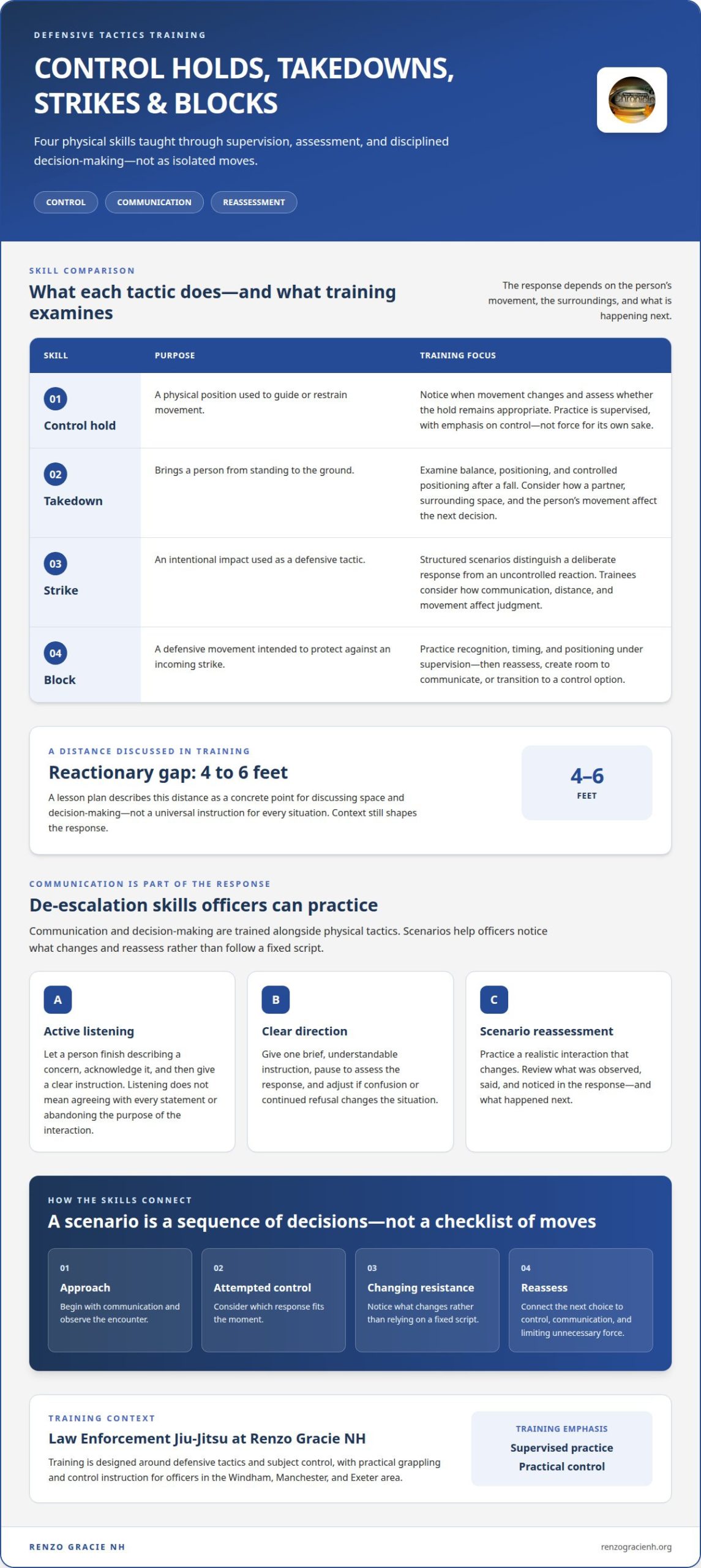
Arrest training should connect communication, control tactics, and use-of-force decisions in one practical sequence. Officers need to recognize changing behavior, give clear directions, and choose a response that fits the encounter. The legal framework matters: Graham v. Connor, 490 U.S. 386 (1989), is the case the Weare Police Department policy uses to frame force reasonableness. Training scenarios can help officers practice assessing circumstances and adjusting their response as those circumstances change.
Crisis intervention training emphasizes communication and de-escalation, while traditional use-of-force training prepares officers to make tactical decisions when physical intervention may be needed. The available facts provide no comparable injury-rate figures for these approaches, so they don’t show that one results in fewer injuries. Training can instead combine communication practice with sound arrest procedures and controlled tactics, giving officers more than one response to consider.
Prone restraint raises a specific safety concern: positional asphyxia. During an arrest, a person’s position and the surrounding circumstances can contribute to that risk, so officers need to recognize and address contributing factors. New Hampshire RSA 627:5 is cited in Weare Police Department policy in connection with deadly-force restrictions. That legal context reinforces why training should include clear decision points, continued observation, and prompt action when a person’s condition or position creates concern.
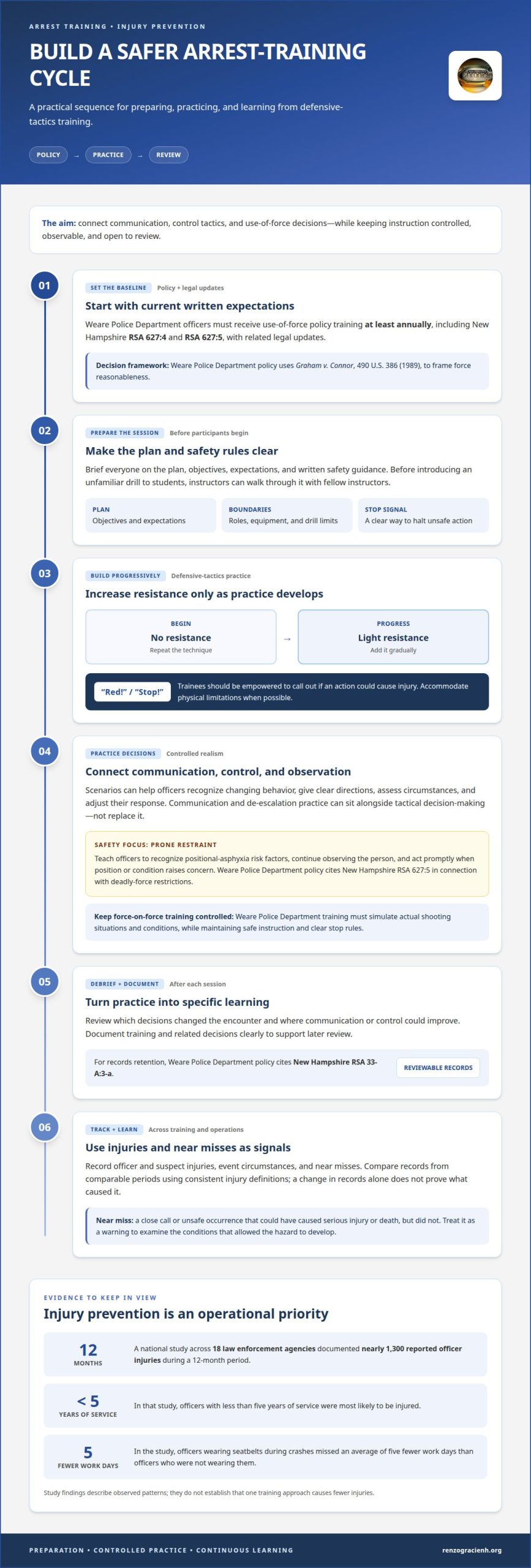
Force-on-force training should make realistic decisions possible without treating realism as permission for uncontrolled contact. Before a scenario, instructors can explain the plan, objectives, expectations, and written safety rules. They can walk through unfamiliar drills with fellow instructors first, then build practice gradually and stop an unsafe action immediately. Training should also include debriefing: identify which decisions changed the encounter and where control or communication could improve. For records retention, Weare Police Department policy cites New Hampshire RSA 33-A:3-a. Clear documentation can support review of training and related decisions.
The Weare Police Department policy frames force reasonableness using Graham v. Connor, 490 U.S. 386 (1989), while practice should reflect operational demands officers may face. Weare Police Department use-of-force training must simulate actual shooting situations and conditions, connecting legal judgment to realistic decision-making without relaxing safe, controlled instruction.
2. Officer injury prevention and safety culture
A 12-month national study across 18 law enforcement agencies documented nearly 1,300 reported officer injuries. Officers with less than five years of service were most likely to be injured. These findings make injury prevention an operational priority, not simply a training-room concern.
Safety starts before class. Trainers should brief everyone on the plan, objectives, expectations, and written safety guidelines. They should also walk through new drills with fellow instructors before using them with students. A controlled scenario can feel realistic, but its boundaries, equipment, roles, and stop signal need to be clear. Instructors should adjust an exercise when a trainee’s physical limitations affect safe participation.
Traffic safety belongs in the same prevention effort. In the study, officers wearing seatbelts during crashes missed an average of five fewer work days than officers who weren’t wearing them. Agencies can reinforce seatbelt use with routine reminders and supervisor modeling. They can also review vehicle-related injuries alongside training injuries, rather than treating road safety as a separate concern.
A near miss is a close call or unsafe occurrence that could have caused serious injury or death, but didn’t. Recording these events can reveal hazards before someone is injured. For before-and-after evaluation, a professional training provider can help an agency use consistent injury definitions and compare records from comparable periods. The agency should track officer and suspect injuries, along with event circumstances, to identify patterns without treating every change as proof of cause.
Safety culture grows through repeated practice and honest review. Agencies can combine injury records, near-miss reports, and debriefs to guide future sessions. For additional skills practice, consider structured grappling training as one element within an agency’s broader safety approach.
A near miss is a close call or unsafe occurrence that could have resulted in serious injury or death if the chain of events had not been interrupted by good fortune. Treating that interruption as a warning, rather than proof that the situation was safe, keeps attention on the conditions that allowed the hazard to develop.
3. Injury prevention policies and training
Effective policy connects written expectations with regular practice and review. Weare Police Department officers must receive use-of-force policy training at least annually, including New Hampshire RSA 627:4 and RSA 627:5. Training must also include legal updates related to those statutes. This recurring structure gives agencies a practical opportunity to review whether instruction reflects current policy and whether scenarios help officers apply it consistently.
Defensive-tactics instruction should build control progressively. Trainers can begin with repeated practice without resistance, then gradually add light resistance. Trainees should be empowered to call “Red!” or “Stop!” if an action could cause injury. Instructors should accommodate physical limitations when possible and review new drills, courses, and scenarios with fellow instructors before using them with students. These steps make safety part of lesson design.
Policy also needs follow-through. Weare Police Department annual use-of-force training reports required by NHPSTC must be submitted by January 15 for the previous year. Agencies can pair reporting with consistent tracking of on-duty injuries. Reviewing patterns helps supervisors identify recurring risks and adjust procedures or training. Near-miss records can add context by highlighting hazards even when no injury occurred. This supports efforts to reduce officer and suspect injuries through training in NH.
Are there New Hampshire grants for police injury-prevention training? Funding depends on each program’s eligibility rules and allowable expenses. Agencies can connect proposals to clear objectives and documented safety needs, such as progressive instruction or instructor review. A funding decision and an injury evaluation serve different purposes: grants support eligible costs, while consistent records help agencies assess whether prevention practices need adjustment. Training to reduce officer and suspect injuries in NH can be evaluated more meaningfully when agencies define the outcomes they’ll track before instruction begins.
Agencies can strengthen prevention by connecting policy review, skill development, and injury tracking. Repeated practice gives officers opportunities to build control skills and understand the expectations that guide their decisions.
4. Effectiveness of de-escalation in reducing injuries
De-escalation training gives officers practical ways to slow an encounter before physical control becomes necessary. An officer might create space, use a calm tone, listen, and offer clear choices. These actions can ease immediate pressure and help a person understand what is expected. Injury prevention depends on how officers read the situation and adapt, not on using the same script in every encounter.
Effective instruction turns those principles into decisions officers can rehearse. In a scenario involving a distressed person who refuses directions, an officer can practice using concise language, allowing time for a response, and adjusting distance. Instructors can then change the person’s behavior and ask the trainee to reassess. This develops flexible judgment rather than a memorized sequence. Debriefing should identify which words or actions helped maintain control and which increased tension.
Agencies can assess training by examining encounter records alongside injury outcomes. Track injuries to officers and people encountered separately, and review circumstances such as resistance, communication, and the tactics used. A change in injury counts alone doesn’t explain why outcomes changed. Supervisors should consider whether officers had opportunities to use de-escalation, whether policy supported those options, and whether training reflected real encounter conditions.
De-escalation doesn’t replace tactical preparation. Some encounters still require physical intervention, so training should help officers transition from communication to proportionate control while continuing to monitor safety. For example, a scenario can begin with verbal direction, add resistance, and require officers to reassess before choosing a response. That progression connects communication skills with practical decision-making. Agencies seeking to develop controlled defensive skills can explore practical Jiu-Jitsu training as one part of broader preparation. A complete evaluation considers both the choices officers make and the injuries recorded afterward.
Renzo Gracie NH: Law Enforcement Jiu-Jitsu Training
Renzo Gracie NH offers Law Enforcement Jiu-Jitsu Training for officers seeking practical defensive-tactics instruction. It can complement agency policies and scenario training by providing a structured setting to develop control skills and disciplined responses. Use it as an additional training resource, not a replacement for department procedures or use-of-force instruction.
Agencies can consider this training to build hands-on skills alongside communication, de-escalation, and injury-prevention practices. The focus remains on learning and progression, supporting broader preparation rather than promising specific outcomes. Officers interested in exploring the program can start with a Free Introductory Class.
For a practical next step in defensive-tactics development, contact Renzo Gracie NH.
Build Safer Skills Through Continued Practice
Lasting progress comes from treating training as an ongoing part of professional development. Agencies can keep strengthening officers’ decision-making under pressure while creating opportunities to learn from practice and experience. A thoughtful approach to reducing officer and suspect injuries through training in NH depends on steady skill-building, clear expectations, and a commitment to improvement.
For officers who want to develop practical defensive skills, Renzo Gracie NH offers Law Enforcement Jiu-Jitsu Training. Adult Jiu Jitsu and Kids Jiu Jitsu programs also provide opportunities for personal growth and shared family time. Each program serves a different need, with disciplined practice at its core.
Take a positive next step at a pace that fits your goals. Contact Renzo Gracie NH to learn about training options and keep building confidence through practice.
Frequently Asked Questions
What New Hampshire police training programs reduce injuries to officers and suspects?
Programs that combine communication, crisis intervention, sound arrest decisions, and practical control skills can support injury prevention. For example, a scenario can ask officers to respond to a distressed person, communicate clearly, and adjust tactics as behavior changes. Agencies can also consider Law Enforcement Jiu-Jitsu Training in New Hampshire to develop grappling and control skills alongside department policies and instruction.
What training teaches officers safer restraint and handcuffing techniques?
Agency-led defensive-tactics training should teach restraint and handcuffing within department procedures, with controlled practice and clear safety limits. Renzo Gracie NH’s Law Enforcement Jiu-Jitsu Training focuses on specialized grappling and control techniques for law enforcement. It can complement agency instruction by helping officers develop practical control skills, while agencies remain responsible for teaching their own policies and handcuffing procedures.