Posts

How to Start BJJ as an Adult: A Calm, Step-by-Step Guide

What if you don’t need to get fit or learn a martial art before stepping onto the mat? If you’re wondering how to start BJJ as an adult, the first step is simply showing up ready to learn. It’s understandable to worry about being older, out of shape, inexperienced, or unsure what a beginner class will involve. Brazilian Jiu-Jitsu is a skill you build over time, not a test you have to pass on day one.

This guide explains how to prepare for a first class, start at a manageable pace, and develop a routine that fits adult life. You’ll learn what to expect as a beginner, how to approach physical effort and safety, and why consistency matters more than arriving with experience. In Southern New Hampshire, Renzo Gracie NH offers adult instruction in a supportive learning environment. Instruction is led by Professor Kevin Landry, a sixth-degree black belt under Renzo Gracie who has taught in the region for over two decades. New students can begin with a complimentary introductory class.

Key Takeaways

  • Understand what BJJ involves and how to get comfortable with close-contact training one step at a time.
  • Learn a practical progression from basic movement and positions to connecting techniques through repetition.
  • See how to start BJJ as an adult without needing to match younger students or arrive already fit.
  • Build a flexible preparation and recovery routine around gradual conditioning, sleep, hydration, and rest.
  • Explore adult instruction at Renzo Gracie NH, led by Professor Kevin Landry, who has taught in the region for over two decades.

How to Start BJJ as an Adult When You Feel Out of Place

Walking into a close-contact martial art for the first time can feel unfamiliar. You may wonder where to stand, whether you’ll understand the movements, or what it will be like to train with someone you’ve just met. That uncertainty is normal. Brazilian Jiu-Jitsu (BJJ) is a grappling martial art built around positioning, control, and technique. The aim is to learn how to move and respond thoughtfully, not to arrive already knowing what to do. For a broader overview of its history and practice, see Brazilian Jiu-Jitsu.

You can begin without a martial arts background. You’ll learn foundational movements and concepts through instruction and practice. For your first class, focus on listening, trying each movement, and asking for clarification when you need it. Class format and intensity can vary, so don’t treat every session as a test. Concentrate on the task in front of you instead of trying to master everything at once.

Your starting point is your current fitness, not a standard you must meet before you’re allowed to learn. General conditioning can support training, but BJJ skills develop through practice on the mat. Repetition helps you coordinate your body, recognize positions, and apply techniques with more control. Begin within your comfort level, communicate about limitations, and give yourself room to learn.

Do adults need experience or athletic fitness before starting BJJ?

No prior experience is needed. Instructors introduce movements and concepts progressively, while students build familiarity through repetition. Fitness and skill are related, but they aren’t the same thing. Being winded during an unfamiliar activity doesn’t mean you’re failing to learn, and being fit doesn’t automatically make a new technique feel natural.

Use your first sessions to notice how your body responds. If a movement feels confusing, slow down and focus on its parts. If you feel unusually tired or uncomfortable, pause and communicate. Training isn’t a contest to push through every sensation. A steady, attentive approach gives you more opportunity to learn than trying to match someone else’s pace.

What does progress look like for a new adult student?

Early progress may be quieter than you expect. You might remember where to place your hands, move with better coordination, or recognize a basic position such as guard or mount. These are meaningful steps: they show that you’re connecting the instructor’s explanation with what you feel during practice.

Measure progress against your earlier sessions, not the reactions of experienced training partners. After class, try naming one movement you understand more clearly and one question you want to revisit. Attendance, recovery, prior experience, and individual circumstances all affect how quickly skills take shape, so there’s no universal timetable. Stay curious, rest when you need to, and let familiarity grow through consistent effort.

How Adult Beginners Learn BJJ: Build Skills Before Chasing Speed

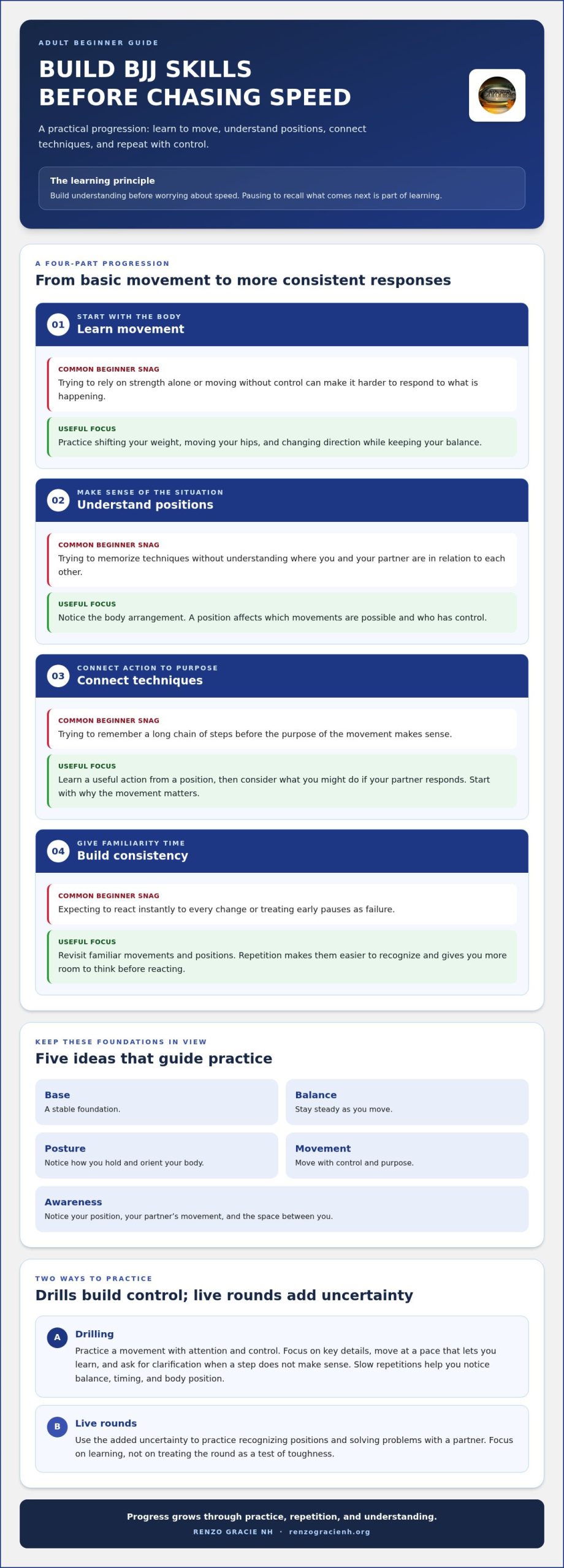
Learning BJJ is less like memorizing a long routine and more like building a set of connected decisions. First, learn to move with control. Then make sense of positions, practice techniques that work from those positions, and repeat them until the pieces become more familiar. This gradual sequence is a practical answer to how to start BJJ as an adult: build understanding before worrying about speed.

  1. Learn movement. Practice shifting your weight, moving your hips, and changing direction without losing balance. These actions help you respond to what’s happening instead of relying on strength alone.
  2. Understand positions. Notice where you and your partner are in relation to each other. A position is a body arrangement that affects which movements are possible and who has control.
  3. Connect techniques. Once you understand a position, learn a useful action from there and consider what you might do if your partner responds. Start with the purpose of the movement, not a long chain of steps.
  4. Build consistency. Revisit familiar movements and positions over time. Repetition makes them easier to recognize, giving you more room to think before you react.

At first, you may need to pause and recall what comes next. That’s part of learning. With repetition, you can begin to recognize the position that calls for a movement instead of trying to react instantly to every change. The Renzo Gracie teaching philosophy offers context for an approach centered on the principles and technical development behind the art. Good instruction connects what a technique does with why it works, making the movement easier to understand and adapt.

Which foundational BJJ skills should beginners focus on first?

Pay attention to base, balance, posture, movement, and awareness. Base means having a stable foundation; posture is how you hold and orient your body. Awareness means noticing your position, your partner’s movement, and the space between you. These concepts can guide your practice even as individual techniques change. Understanding why a position matters is often more useful than trying to memorize a lengthy sequence without context.

How should beginners approach drills and sparring?

Drilling gives you a chance to practice a movement with attention and control. Focus on the instructor’s key details, move at a pace that lets you learn, and ask for clarification if a step doesn’t make sense. Slow repetitions are useful: they help you notice balance, timing, and where your body should be.

Live rounds have a different purpose. They add uncertainty, so you can practice recognizing positions and solving problems with a partner. They aren’t a test of toughness or a requirement to win. Speak up about pace and comfort, and listen when your partner or instructor communicates. Renzo Gracie NH’s adult Brazilian Jiu-Jitsu training provides a place to learn and practice in a supportive setting.

Adult BJJ Myths: Age, Fitness, and the Fear of Falling Behind

You don’t have to keep pace with younger students or match the experience of people who’ve trained for years. Starting as an adult means beginning from your own baseline and learning at a pace that lets you stay attentive. Some days you may need more time to understand a movement; on other days, a familiar position may make more sense. Neither experience means you don’t belong.

Adapting is part of training, not a failure to train. You can pause, ask for a slower pace, or explain a limitation to your instructor or partner. That’s different from ignoring fatigue, pain, or a movement that doesn’t feel right just to prove you’re tough. Controlled pace and clear communication matter more than proving toughness; they help you stay present and make training more sustainable.

Is it too late to start Brazilian Jiu-Jitsu as an adult?

There isn’t a single age when learning has to stop, but every student’s experience is individual. Age, past activity, recovery, and personal circumstances can shape what training feels like. Patience and repeatable fundamentals let you build familiarity without expecting instant results. Learn the movement in front of you, revisit it, and allow your understanding to develop over time.

If you’re considering how to start BJJ as an adult, the useful question isn’t whether you can keep up with someone else. It’s whether you can approach practice with attention, communicate what you need, and return when your circumstances allow. Progress can be gradual and doesn’t need to look identical from one person to the next.

Do you have to be fit, strong, or competitive to belong?

No. You can become more familiar with training as you build a routine; strength or athletic experience isn’t an entry requirement. You also don’t have to compete. Some students choose competition, while others focus on learning, personal development, or practicing with a community. Competition is a personal choice, not a required measure of commitment or progress.

Before training, share relevant limitations with your instructor, including movements you need to approach carefully. Clear, practical information helps others understand how to work with you. During practice, pay attention to your body and speak up if the pace or movement feels wrong. Adjusting your effort is a skill, too.

A sustainable start doesn’t depend on winning rounds or having every class feel easy. It can mean showing up, learning one detail, and leaving with enough energy to return when it fits your life. Give yourself permission to be new. Your training is yours to build, one considered step at a time.
How to Start BJJ as an Adult: A Calm, Step-by-Step Guide

A Practical Adult BJJ Starting Plan: Prepare, Train, and Recover

A sustainable start doesn’t require a perfect schedule or intense preparation. It takes a plan you can adjust as you learn how training fits into your life. If you’re deciding how to start BJJ as an adult, think in small steps: choose a realistic class rhythm, prepare for each session, and make time to recover before deciding whether to add more.

  1. Choose a manageable starting cadence. Look at your work, family, and other commitments, then choose a pace you can realistically maintain. There’s no universal weekly schedule for every adult. Consistency over time is more useful than an ambitious first week that makes training difficult to fit into your routine.
  2. Prepare with simple habits. Prioritize sleep, drink water regularly, and arrive ready to focus. If you want to work on general conditioning outside class, build gradually rather than piling on extra effort all at once. The goal is to support training, not exhaust yourself before it begins.
  3. Set a short process goal. Choose something you can work on, such as attending consistently when life allows, remembering one movement, or asking a question about a position. Process goals keep your attention on learning rather than a belt deadline or an outcome you can’t control.
  4. Review and adjust. After class, note your energy, soreness, and what you learned. Rest as needed, and use those observations to decide whether your current routine feels manageable before increasing it.

How can adults make a manageable training routine?

Start with a rhythm that respects your actual week, not an ideal version of it. A busy stretch at work or extra family responsibilities may call for a lighter routine; a more settled period may leave room for more practice. Before adding sessions, consider whether you’re recovering well and staying attentive during training. Scaling back is useful information, not a failure.

Sleep and hydration are straightforward parts of preparation and recovery. Make room for rest after training, too. Your body and schedule both need time to adjust to a new activity. For more related guidance, the adult BJJ beginner guide can help you explore the early stages of learning.

What mindset and habits help beginners keep learning?

Ask concise questions when an instruction or position is unclear. For example, ask where your weight should be or what the movement is meant to accomplish. A focused question gives you one detail to work with instead of leaving you to guess through the whole technique.

Measure progress against your own earlier effort. Perhaps you remembered a movement more easily or felt less unsure about what to do next. Those observations are more useful than comparing your pace with another student’s. Rest and adjustment belong in a sustainable practice; they help you return ready to learn.

A complimentary introductory class at Renzo Gracie NH is one way to experience adult Brazilian Jiu-Jitsu training.

Start Adult BJJ at Renzo Gracie NH: Take One Welcoming First Step

You don’t need to have every part of your training plan figured out before you begin. Once you understand that BJJ develops through steady practice, the next step is finding instruction where you can learn, ask questions, and build at your own pace. Renzo Gracie NH offers adult Brazilian Jiu-Jitsu instruction for different skill levels in a supportive training environment focused on technical development and personal growth.

Instruction is led by Professor Kevin Landry, a sixth-degree black belt under Renzo Gracie who has taught in the region for over two decades. For a beginner, clear explanations, respectful practice, and the ability to ask questions can make it easier to understand what to work on and turn confusion into useful feedback.

What can an adult beginner look for in supportive instruction?

Look for an environment where learning is treated as a process, not a test of athletic ability. You should be able to focus on the lesson, communicate about your comfort level, and work through techniques without feeling that you must already know the answers. At Renzo Gracie NH, adult instruction welcomes students at different skill levels, giving beginners room to develop foundational understanding as they train.

How can you take a low-pressure first step in Southern New Hampshire?

Renzo Gracie NH’s complimentary introductory class gives new students an opportunity to experience training before deciding on next steps. It can help you see what instruction feels like and consider how the environment fits your goals. For adults in Windham, Manchester, and Exeter, the academy offers a local starting point in Southern New Hampshire.

Keep your first visit simple. Arrive ready to listen, take the class one instruction at a time, and give yourself permission to be new. You don’t have to decide on a long-term commitment based on one session. Instead, notice whether the teaching helps you follow along, whether you feel comfortable asking questions, and what you’d like to learn next. Those observations can help you decide whether to continue.

If you’ve been wondering how to start BJJ as an adult, take the next step at a manageable pace. A free introductory class is a chance to experience adult Jiu-Jitsu training at Renzo Gracie NH.

Make Your First Step Count

You don’t need to map out months of training before you begin. Let your first class be a chance to experience the learning environment, notice how instruction feels, and decide what you’d like to explore next. There’s no need to arrive with a polished goal or a promise to keep going. Curiosity is enough to start.

If you’re still asking how to start BJJ as an adult, choose one manageable action: set aside time to try a class, then reflect on what felt welcoming, challenging, or worth learning more about. The right next step is one that suits your life and gives you room to grow at your own pace.

New students can experience training through a complimentary introductory class at Renzo Gracie NH. Explore a free introductory class and take your first step toward Brazilian Jiu-Jitsu in Windham, with the academy also serving adults in Manchester and Exeter.

Frequently Asked Questions

Can I start BJJ as an adult with no martial arts experience?

Yes, you can begin without prior martial arts experience. In your first classes, unfamiliar terms and movements may take time to absorb, so focus on one instruction at a time instead of trying to remember everything. For example, if an instructor explains a hand placement, practice that detail before worrying about the whole technique. Questions are part of learning, and your growing understanding is a better measure than comparing yourself with others.

Is 40 too old to start Brazilian Jiu-Jitsu?

No, age alone doesn’t decide whether you can begin. Your activity history, goals, and physical needs are individual, so tell the instructor about relevant limitations and follow guidance that fits your situation. You can train without competing, and there’s no need to treat another student’s pace as a standard. If you have a health concern or uncertainty about exercise, speak with a qualified healthcare professional before taking part.

Do I need to lose weight or get in shape before starting BJJ?

No, you don’t need to reach a target weight or fitness level first. A beginner class can introduce you to the effort and movements involved, and you can build familiarity over time. Choose a manageable pace, let the instructor know if you need to modify an activity, and notice how you feel afterward. If you have a medical condition or specific concerns about exercise, seek advice from a healthcare professional before beginning.

Do adults have to compete in Brazilian Jiu-Jitsu?

No, competition is optional. Adults can take part for the challenge of learning grappling, skill development, physical activity, or the structure of regular practice with others. If you’re not interested in tournaments, you can still set meaningful goals, such as understanding a position or improving a movement. Be clear about what you hope to get from training so you and your instructor can keep your focus aligned with your reasons for learning.

What should I wear to my first adult BJJ class?

Follow the clothing guidance provided for your introductory class, since requirements can vary by session. If you’re told to wear athletic clothing, choose clean, comfortable items that let you move freely and don’t have zippers, hard parts, or sharp accessories. Remove jewelry and trim your nails before class. You don’t need to purchase specialized equipment before you know what’s expected for your first session.

How often should a beginner train BJJ each week?

There’s no single weekly schedule that works for every adult. Choose a cadence that fits your commitments and leaves enough room for recovery, then see how it feels in practice. If you’re commuting from Windham, Manchester, or Exeter, account for travel time when planning a routine you can maintain. If your energy or soreness makes your current plan difficult, adjust before adding more sessions.

Is Brazilian Jiu-Jitsu safe for adult beginners?

BJJ is a physical, close-contact activity, so it isn’t risk-free. Follow the instructor’s directions, keep your partner informed about your comfort level, and stop if something feels wrong. Share relevant injuries or limitations before participating so the instructor understands what you need to be mindful of. If you have an injury, a medical condition, or uncertainty about exercise, consult an appropriate healthcare professional before training.


BJJ Belt Progression in New Hampshire: Your Guide to the Renzo Gracie Curriculum

What if the color around your waist was more than just a piece of fabric, but a verified map of your personal growth? It’s natural to feel a bit lost when you first step onto the mats. You might worry about falling into a “belt factory” where ranks are sold rather than earned, or perhaps you’re confused by how stripes differ between the kids and adult programs. That anxiety about being “stuck” at white belt without a clear direction is something almost every practitioner feels at the start.

We’re here to clear the fog. This guide provides the exact roadmap for BJJ belt progression New Hampshire students can expect when training under the world-renowned Renzo Gracie curriculum. You’ll discover how our structured approach ensures technical legitimacy, how to balance your training with a busy Southern New Hampshire lifestyle, and what it truly takes to move from your first day to technical mastery. Progress is a partnership. We provide the path, and you provide the work.

Key Takeaways

  • Master the standards. Understand how our curriculum blends global IBJJF rules with Renzo Gracie lineage requirements to ensure your rank is earned and respected.
  • Track your growth. Learn the five essential pillars of BJJ belt progression New Hampshire instructors use to evaluate your technical skill and mat maturity.
  • Empower your family. Discover how the youth progression system uses frequent milestones to build character and discipline in a supportive environment.
  • Train with confidence. Gain peace of mind knowing that every stripe is a reflection of real skill, protecting you from the “belt factory” mentality.
  • Maintain your momentum. Find out how our unique multi-location training model in Southern NH ensures you never have to miss a session due to a busy schedule.

The Foundation of BJJ Belt Progression in New Hampshire

Mastery takes time. It is a marathon, not a sprint. When you begin your journey, it’s easy to focus solely on the destination, but every hour on the mat contributes to a journey of personal evolution. The BJJ belt progression New Hampshire students experience at our academy is built on a foundation of transparency and high standards. We believe that a belt should represent more than just time spent in the building; it should reflect a genuine transformation in how you move, think, and interact with your community.

Our system follows the global Brazilian jiu-jitsu ranking system, but we don’t stop there. We add lineage-specific technical requirements that push our students to excel beyond basic expectations. To ensure no one feels overwhelmed or overlooked, we utilize a structured martial arts curriculum NH practitioners can rely on for clear direction. This roadmap is built on four core pillars that define a Renzo Gracie martial artist:

  • Technique: Deeply understanding the mechanics and logic behind every movement.
  • Consistency: Showing up regularly to build muscle memory and mental fortitude, even on tough days.
  • Live Application: Demonstrating the ability to use techniques effectively and calmly during live sparring sessions.
  • Character: Displaying respect, humility, and a steadfast commitment to the success and safety of your training partners.

Why Lineage Matters for Your Belt Rank

Lineage is your martial arts DNA. It tells the world who taught you and what standards they held you to. A belt earned from a Renzo Gracie affiliate carries weight globally because it represents a commitment to technical excellence. Training under Professor Kevin Landry, a 6th-degree black belt, provides a direct link to the source of Gracie Jiu-Jitsu. This connection ensures the techniques you learn aren’t just theories; they are battle-tested and authentic methods passed down through generations of practitioners. When you wear our patch, you carry a legacy of disciplined confidence that is recognized in any gym in the world.

The Role of Stripes in the Promotion Process

Small wins lead to big victories. Stripes serve as incremental milestones between belt ranks to maintain motivation and recognize steady progress. In our academy, adults typically earn four stripes before they are considered for the next belt color. These aren’t just participation markers. They recognize consistent attendance and the gradual accumulation of technical knowledge. They help you visualize your growth, turning the long road to black belt into a series of achievable steps. Each stripe is a signal to yourself and your professors that you are evolving into a more capable and focused martial artist.

The Student’s Checklist: 5 Pillars of Promotion at Renzo Gracie NH

Progression is not a transaction. You won’t find a price tag on a belt in our academies because rank is earned through sweat, dedication, and technical evolution. This transparency is essential for BJJ belt progression New Hampshire students who want to avoid “belt factories” and build a legitimate skill set. While our standards align with the IBJJF Graduation Guidelines, our professors look for a specific quality called mat maturity. This is the ability to train with intensity while prioritizing the safety of your teammates. Use this checklist to gauge your readiness for the next level.

Technical Proficiency and Curriculum Mastery

Show the technique. Prove the logic. To move forward, you must demonstrate fundamental escapes, sweeps, and submissions appropriate for your current rank. Technical mastery is the ability to use leverage over strength. It isn’t enough to know the moves; you must perform them under pressure against a resisting partner. If you’re curious about how these techniques are taught, you can see them first-hand during a Free Introductory Class at any of our locations.

Consistency and Mat Time

Show up. Keep rolling. Consistency is the secret sauce that makes the curriculum click into place. We typically look for students training at least 2 to 3 times per week consistently over several months. Mat time builds the muscle memory necessary for advanced grappling, allowing your body to react before your mind has to think. To help you stay on track, you can leverage our three Southern NH academies in Windham, Exeter, and Manchester, making it easier to fit training into a busy lifestyle.

Character and Community Contribution

Character on the mat reflects character off the mat. Respect and humility are mandatory in our community. We look for supportive training partners who go out of their way to make beginners feel welcome. Participating in academy events and our dedicated family time sessions strengthens your bond with the curriculum and your teammates. A Renzo Gracie student isn’t just a fighter; they are a leader and a supportive partner who elevates everyone around them. This holistic approach ensures that as your BJJ belt progression New Hampshire journey continues, you grow as much in spirit as you do in skill. Families who want to deepen this shared commitment can explore our family jiu jitsu classes NH guide to find the membership structure that best fits your household’s goals and schedule.

Adult Belt Ranks: From Survival to Mastery

The road is long. The rewards are permanent. At our academies, we view the belt system as a reflection of your internal growth rather than just a status symbol. Each rank represents a distinct psychological and physical shift in your development. You don’t just “get” a belt; you become the person who deserves to wear it. The BJJ belt progression New Hampshire students follow is designed to build a complete martial artist, capable of handling both the rigors of the mat and the challenges of a busy lifestyle.

Every belt is a chapter in a book you are writing with your own body. From the initial struggle of the white belt to the refined expertise of the black belt, the journey is unique to every individual. Our curriculum ensures that your evolution is steady, purposeful, and grounded in the prestigious Renzo Gracie lineage. We prioritize growth over speed, ensuring that when you earn your next rank, you have the skills to back it up in any situation.

White and Blue Belts: Building the Foundation

The white belt is the survival phase. It’s about learning to breathe when things get heavy and moving efficiently when you’d rather freeze. You are building the core mechanics of the Renzo Gracie curriculum, focusing on defensive posture and basic escapes. For those who need these skills for professional safety, our law enforcement jiu jitsu training helps officers fast-track the defensive tactics required at this early stage.

Once you’ve survived the initial fire, you reach the blue belt. This is the technical phase. You begin to develop a personal game, moving from just defending to launching your own offensive sequences. Promotion to blue is often the most significant milestone for new students because it marks the transition from novice to practitioner. It’s the point where the movements start to feel like a second language.

Purple, Brown, and Black Belts: The Advanced Journey

As you move into the upper ranks, the focus shifts from what you do to how you do it. The BJJ belt progression New Hampshire practitioners experience at these levels is deeply personal and highly technical.

  • Purple Belt: The artist phase. You’ve mastered the basics, so now you refine your timing and transitions. You begin to see the “flow” of the roll and use your opponent’s momentum against them.
  • Brown Belt: The specialist phase. You tighten every remaining hole in your game. This is where you become a true expert in specific positions, refining your style until it’s nearly impossible to penetrate.
  • Black Belt: The beginning of a new journey. A black belt isn’t the end of the road; it’s the start of a deeper refinement. It’s about teaching, giving back to the community, and realizing that mastery is a lifelong pursuit.

This methodical approach ensures that by the time you reach the advanced ranks, you have the disciplined confidence of a leader. You’ve evolved from someone just trying to survive into someone who can guide others through their own transformation. The journey is challenging, but the person you become along the way is the greatest reward.

BJJ Belt Progression in New Hampshire: Your Guide to the Renzo Gracie Curriculum

The Youth Progression Path: Building Character in NH

Empower your child. Build a foundation of discipline that lasts a lifetime. For young practitioners, the BJJ belt progression New Hampshire families find at our academies is specifically designed to provide frequent positive reinforcement. While the adult journey is a long-term marathon, children benefit from more frequent milestones to keep them engaged and motivated. This is why the youth system utilizes additional colors, including Grey, Yellow, Orange, and Green. Each new belt represents a step forward in technical skill, but more importantly, it marks a leap in personal responsibility and self-confidence.

The Kids Belt Order and Timelines

The journey begins at White and moves quickly into the Grey belt ranks. This first step is crucial; it shows that the child has mastered basic mat etiquette, follows instructions, and understands fundamental movements. As they progress through Yellow, Orange, and Green belts, they evolve into intermediate and advanced youth practitioners who often lead drills and mentor newer students. However, mat skill is only half the battle. We believe that character is the ultimate goal. Promotion depends heavily on behavior at home and school, ensuring that the respect they show their professors translates to respect for parents and teachers.

Why a Structured Curriculum Matters for Children

Structure creates security. In our Manchester and Windham locations, children thrive because they have clear goals and a predictable path to success. Our youth curriculum focuses heavily on “bully prevention” by teaching kids how to handle conflict with poise. We don’t just teach them how to fight; we teach them how to avoid a fight through confidence and verbal de-escalation. By learning they can defend themselves if necessary, they no longer feel the need to prove anything through aggression.

Transitioning to the adult system at age 16 is a major rite of passage in our community. It’s the moment a young adult takes everything they’ve learned in the youth ranks and applies it to the wider world of adult grappling. Parents often see this checklist in action during our dedicated family training sessions, where the whole unit grows together. Families looking to deepen that connection even further can explore our parent and child jiu jitsu Windham program, which turns individual goals into a shared victory on the mat. If you’re ready to see how this structure can transform your child’s life, you can sign up for our Kids Jiu Jitsu Program to get started.

Elevating Your Training with Renzo Gracie NH

Ready to start? The first step is the hardest, but we make it the easiest. You’ve seen the roadmap, from the survival of the white belt to the mastery of the black belt. Now, it’s time to put your feet on the path. The BJJ belt progression New Hampshire students experience at our academies is unique because we provide more than just a gym; we provide a network. We believe that your environment dictates your growth, and we’ve built an environment designed for your success.

Our “1 Membership, 3 Locations” model is a game-changer for Southern New Hampshire practitioners. Life is busy. Commutes can be long. By offering access to our academies in Windham, Exeter, and Manchester under a single membership, we remove the obstacles that usually stall progress. This flexibility allows for maximum mat time. It ensures you stay consistent with the requirements we discussed in the pillars of promotion. When you join our community, you aren’t just a member of one school; you are part of a regional family that trains together, evolves together, and celebrates every stripe together. If you’re weighing your options and want to understand exactly what a membership includes for your whole household, our complete guide to family jiu jitsu classes NH families rely on breaks down every detail to help you make the right choice.

Training Across Windham, Manchester, and Exeter

Access to more instructors and a wider variety of training partners directly speeds up your technical development. In our system, you aren’t limited to one set of eyes or one style of rolling. You’ll experience different coaching styles while following the same unified Renzo Gracie curriculum. This exposure helps you troubleshoot your game more effectively. It leads to a more robust and adaptable skill set. Flexible schedules across three towns mean you never have to miss a promotion-eligible class because of a late meeting or a family commitment. You have the freedom to follow the path at your own pace, supported by a world-class team.

Your First Step Toward the Black Belt

No experience? No problem. We designed our beginner programs for the absolute novice. You don’t need to be “in shape” to start; jiu-jitsu will get you in shape. When you walk through our doors, you’ll meet Professor Kevin Landry and see the culture of our academy firsthand. It is a place of disciplined confidence and mutual respect. We prioritize your well-being and personal success above all else. You won’t find any aggressive egos here, only supportive partners who want to see you reach your full potential.

The journey of a thousand miles begins with a single roll. You can start your journey today with a try jiu jitsu free New Hampshire introductory class. Claim your free intro session today and discover the transformation that awaits you on the mats.

Your Journey to Mastery Starts Now

The path from white belt to black belt is more than just a series of promotions; it’s a commitment to becoming the best version of yourself. You’ve seen how our structured curriculum removes the guesswork, ensuring every stripe you earn is a legitimate reflection of your hard work. By following the direct Renzo Gracie lineage under the guidance of 6th-degree Black Belt Kevin Landry, you’re joining a tradition of technical excellence. This clear roadmap for BJJ belt progression New Hampshire students ensures that your growth is steady, purposeful, and recognized worldwide. You don’t have to wonder where you stand because the pillars of promotion are transparent and fair.

Don’t let uncertainty hold you back from the mats. With three convenient Southern NH locations in Windham, Exeter, and Manchester, expert instruction is always within reach. Whether you’re looking to build character in your children or discover your own physical potential, the first step is waiting for you. It’s time to stop wondering and start doing. Claim Your Free Introductory BJJ Class in NH Today! We’re ready to welcome you into our community and support your evolution every step of the way. We’ll see you on the mats.

Frequently Asked Questions

How long does it take to get a blue belt at Renzo Gracie NH?

It typically takes between 12 and 24 months of consistent training to earn a blue belt. This timeline varies based on your individual dedication and how quickly you master the fundamental curriculum. We prioritize technical proficiency over simply checking a box on a calendar to ensure you’re truly ready for the next level.

Do I have to compete in tournaments to get promoted?

Competition is not a requirement for promotion at our academies. While we encourage students to test their skills in tournaments to gain experience, we recognize that everyone’s journey is different. We focus on your technical growth, mat maturity, and contributions to the community rather than your tournament record.

What is the difference between the kids and adults belt systems?

The youth system uses a broader spectrum of colors to provide children with more frequent milestones. While adults move from white to blue, children progress through grey, yellow, orange, and green belts. This approach maintains motivation and rewards character development alongside physical skill as they grow toward the adult ranks.

How often should I train if I want to progress steadily?

Training 2 to 3 times per week is the ideal frequency for steady BJJ belt progression New Hampshire students. This schedule allows you to build muscle memory and retain technical knowledge without burning out. Consistency over several months is always more valuable than training every day for a short burst.

Are there testing fees for belt promotions in your NH academies?

We do not sell ranks or charge for the privilege of testing for your next belt. Our promotions are based entirely on merit, technical skill, and character. We believe that a belt should be earned through hard work on the mats rather than a financial transaction.

What happens to my rank if I move to New Hampshire from another BJJ school?

We respect the work you’ve put in at other academies and generally honor your current rank. When you join us, our professors will observe your movement and technical knowledge to ensure you’re comfortable with the Renzo Gracie curriculum. It’s about finding the right starting point for your continued growth in our community.

Can I train at all three locations (Windham, Exeter, Manchester) with one membership?

Yes, your membership grants you full access to our academies in Windham, Exeter, and Manchester. This unique model allows you to follow the same curriculum regardless of which Southern NH location fits your schedule on a given day. It’s the best way to ensure you never miss a class.

Is there a minimum age for the adult belt system?

The transition to the adult belt system typically occurs at age 16. This is a significant rite of passage where a student moves from the youth ranks into the standard adult progression path. It marks a shift toward deeper technical refinement and greater responsibility within the academy.