Posts

BJJ Training for New Hampshire Police: 2026 Dates and Costs

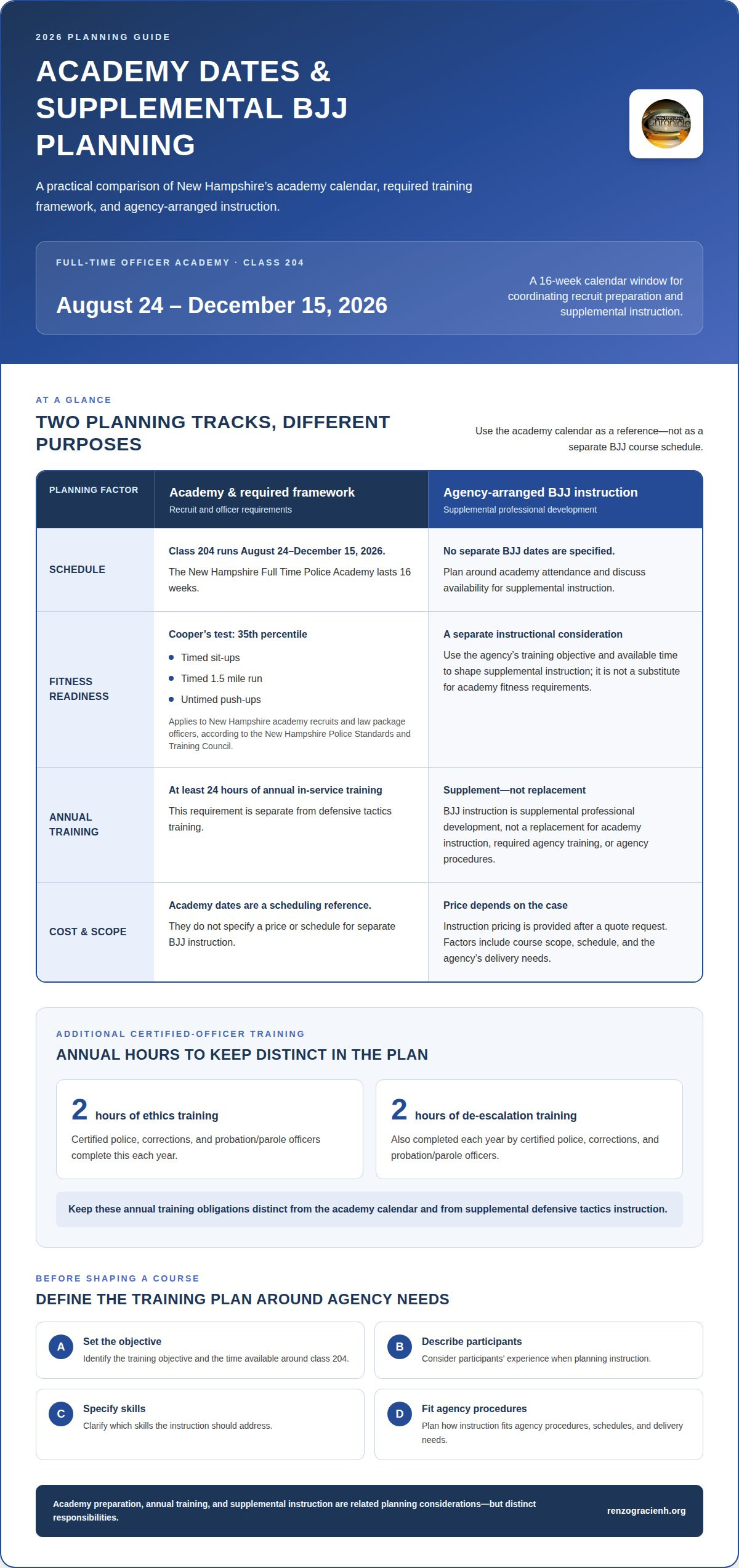
The academy calendar is only one part of BJJ training for NH police standards in 2026. New Hampshire Full-Time Officer Academy class 204 is scheduled for August 24 through December 15, 2026, while officers must complete at least 24 hours of annual in-service training. That annual requirement is separate from defensive tactics training.

For agencies planning professional instruction, practical details matter: how course dates fit the training calendar, what in-service options are available, and how a program’s scope and instruction time shape its cost. The price depends on the case and is provided after a quote request.

This article explains the 2026 dates and cost factors, outlines the annual training framework, and considers reported field applications and injury concerns without treating training as a substitute for agency policy. You’ll come away with a clearer picture of where Brazilian Jiu-Jitsu may fit into officer development and what to consider when planning instruction.

Key Takeaways

  • Use the class 204 schedule, August 24 through December 15, 2026, as a planning reference for academy-related training.
  • According to New Hampshire Police Standards and Training Council, all New Hampshire academy recruits and law package officers must pass the Cooper’s test at the 35th percentile.
  • Compare in-service training options by how their instruction fits agency needs, training schedules, and cost factors.
  • Explore how reported field applications and injury considerations inform the way agencies assess defensive tactics and BJJ instruction.

2026 Course dates and costs

New Hampshire Full-Time Officer Academy class 204 is scheduled for August 24 through December 15, 2026. Its calendar helps agencies plan recruit preparation and supplemental instruction around academy attendance. The New Hampshire Full Time Police Academy lasts 16 weeks, so class 204 occupies a substantial part of the year. These dates identify the academy class, not a separate schedule for Brazilian Jiu-Jitsu instruction.

Fitness readiness is another part of recruit planning. All New Hampshire academy recruits and law package officers must pass the Cooper’s test at the 35th percentile, according to New Hampshire Police Standards and Training Council. The standardized test includes timed sit-ups, a timed 1.5 mile run, and untimed push-ups. For agencies planning BJJ training for NH police standards 2026, this fitness milestone can help shape a broader preparation calendar, while remaining distinct from supplemental defensive tactics instruction.

Academy scheduling and the cost of separate BJJ instruction are different planning questions. The price for agency-arranged instruction depends on the case and is given after a quote request. Cost factors include the scope of instruction, the schedule, and the agency’s delivery needs. A focused session and a broader training plan call for different instructional approaches. A budget should reflect the objectives the agency wants the course to address.

Start planning BJJ training for NH police standards 2026 by identifying the training objective and time available around class 204. Define the participants’ experience, the skills instruction should address, and how it will fit agency procedures. These details help shape course design and cost, while clarifying that BJJ is supplemental professional development, not a replacement for academy instruction or required agency training. A defined objective makes scheduling and budget discussions more concrete.

The published academy window remains 08/24/2026 – 12/15/2026, a reference for coordinating supplemental instruction with class 204. Agencies can use that window when discussing availability.

Reported field-application effectiveness and injuries

BJJ and police defensive tactics courses serve related but different purposes. New Hampshire academy instruction includes scenario-based learning and practical skills demonstrations, while grappling practice can help officers rehearse control positions against resistance. BJJ should complement academy instruction, not replace agency procedures or establish compliance with state standards.

When reviewing field applications, assess the task involved rather than treating a technique as effective on its own. For example, an incident report might describe an officer maintaining position, controlling an arm, or moving from a clinch to a restraint. Ask whether control was achieved, whether force could be reduced, and whether the response fit the circumstances and agency policy. One incident cannot show that a method will work in every encounter.

Skills relevant to control include balance and distance management, clinch positioning, transitions to stable pins, and maintaining control without relying on strikes. These skills may create time and space for clear verbal directions. A hold alone is not de-escalation: communication, judgment, and the ability to stop or adjust remain essential.

Injury assessment also requires care. Training injuries can involve falls, joint stress, or collisions, while field incidents have different conditions and risks. Compare the setting, the action being practiced, partner size and experience, fatigue, and whether an instructor can pause or modify a drill. Training records can distinguish practice injuries from field injuries and help identify recurring causes, such as uncontrolled takedowns or excessive resistance.

  • Useful review: record the control objective, technique, outcome, force used, and any injury.
  • Safer practice: use controlled resistance, clear stop signals, and instruction that adjusts to skill level.

Agencies seeking structured grappling practice can explore professional jiu-jitsu instruction as a supplement to scenario-based training. Reviewing both successful applications and injury patterns helps keep the focus on sound judgment, controlled practice, and policy-aligned skills.
BJJ Training for New Hampshire Police: 2026 Dates and Costs

What defensive tactics and use-of-force training do New Hampshire police recruits receive?

New Hampshire Police Academy instruction combines academic learning, scenario-based exercises, skill building, written exams, and practical demonstrations. Recruits study principles, apply skills in scenarios, and demonstrate practical performance. This approach goes beyond memorizing rules: trainees must show what they can do during assessed learning. The curriculum details described here do not specify individual defensive tactics techniques, so distinguish documented training methods from assumptions about particular holds.

Use-of-force preparation is best understood through this combined structure. A scenario may require a recruit to assess a situation, communicate, select a response, and demonstrate a relevant skill. Written exams assess academic learning, while practical demonstrations assess performance. Together, these methods evaluate decision-making as well as execution. Supplemental grappling instruction does not replace academy requirements or agency policies.

Annual in-service obligations are a separate part of the picture. New Hampshire officers must complete at least 24 hours of annual in-service training, separate from defensive tactics, firearms, and first aid. Certified police, corrections, and probation/parole officers also complete 2 hours of ethics training and 2 hours of de-escalation training each year. Certified officers complete 1 hour of mental health training each year. These requirements clarify that the annual total and defensive tactics training are distinct.

  • Academy learning: academic material, scenarios, skill building, written exams, and practical demonstrations.
  • Annual in-service: 24 hours, separate from defensive tactics, firearms, and first aid.
  • Specified annual subjects: ethics, de-escalation, and mental health training.

For an agency, map these training needs separately. Identify which instruction addresses academic knowledge, scenario decisions, physical skills, and annual subjects. This helps supervisors plan supplemental grappling practice without counting it as a substitute for required instruction. It also keeps evaluation focused: a written exam, a scenario, and a practical demonstration assess different abilities. Clear records can show which objective each session addresses.

Which BJJ gyms near New Hampshire police academies offer law enforcement training?

The New Hampshire Police Academy is the state’s basic training setting, but its location alone does not identify a suitable BJJ program. A good fit depends on whether instruction addresses professional defensive tactics, works with agency scheduling, and complements department procedures. A general grappling class and law-enforcement training may have different aims.

For an agency comparing training options, start with the objective. A team seeking stronger control in close-contact encounters may need practice with positioning, transitions, and controlled restraint. A team working on communication alongside physical skills needs practice that includes verbal direction and decision-making. Let the objective shape the content, rather than choosing only by distance from the academy.

Next, consider how instruction connects with the academy’s training approach. New Hampshire recruits encounter academic learning, scenarios, skill building, written exams, and practical demonstrations. Assess supplemental grappling practice by how clearly it relates to applied skills. Keep it distinct from academy requirements and agency policy. This helps an agency plan relevant training without treating a gym class as state certification.

Before setting a schedule, define the participants, their experience, the skills to address, and the agency procedures that frame the training. These details help determine whether instruction suits recruits, experienced officers, or a mixed group. They also give instructors a basis for adapting examples and resistance levels. Clear objectives make training more relevant than proximity alone.

  • Fit: professional defensive tactics, not just general grappling practice.
  • Application: examples tied to control, transitions, communication, and agency procedures.
  • Planning: a defined group, training objective, and schedule.

To explore a program focused on law enforcement needs, review law enforcement training options and consider how they can support agency goals.

Renzo Gracie NH: Law Enforcement Jiu-Jitsu Training

Renzo Gracie NH offers Law Enforcement Jiu-Jitsu Training for professionals seeking structured Brazilian Jiu-Jitsu practice. It can complement academy instruction and agency procedures for agencies or officers looking to develop grappling skills. The training is distinct from state certification and required academy coursework.

For individual development, the Adult Jiu Jitsu Program provides ongoing practice to build skills. Adults can start with a Free Introductory Class to experience instruction. Families can also explore the Kids Jiu Jitsu Program.

If professional defensive tactics training is your focus, contact Renzo Gracie NH about Law Enforcement Jiu-Jitsu Training in Windham, Manchester, or Exeter.

Build a Training Plan That Moves Forward

Lasting progress comes from turning training goals into consistent practice. A thoughtful approach to BJJ training for NH police standards in 2026 starts with a clear purpose: develop practical grappling skills that complement agency instruction and support sound judgment. From there, agencies can shape a plan around the needs of their officers and the role training should play in professional development.

Renzo Gracie NH offers Law Enforcement Jiu-Jitsu Training, as well as Adult Jiu Jitsu and Kids Jiu Jitsu programs. These programs support personal skill development and family participation in the academy community, while keeping professional training distinct from state requirements.

If you’re ready to explore a training path for your agency or personal development, contact Renzo Gracie NH. Take the next step with focus, build steadily, and keep learning.

Frequently Asked Questions

Do New Hampshire police academies require or recommend Brazilian jiu-jitsu training?

The New Hampshire academy standards described here do not identify Brazilian Jiu-Jitsu as a standalone recruit requirement or recommendation. BJJ can provide supplemental practice, while academy assessments and agency policies remain separate. An agency considering extra grappling instruction can first define its objective, such as improving officers’ positional awareness in close-contact situations. Departments in Windham, Manchester, and Exeter can use that objective to guide local training plans.

What are the injury risks of BJJ training for police recruits, and how can they be reduced?

Grappling can cause strains, joint irritation, or impact injuries, particularly when partners use uncontrolled resistance or lose balance during transitions. Gradual progression, appropriate partner matching, instructor oversight, and permission to pause a drill can help reduce risk. Recruits should promptly communicate discomfort rather than push through it. If an injury occurs, stop training and seek appropriate medical guidance before returning to practice.

Can New Hampshire officers receive department funding or training credit for BJJ classes?

BJJ is supplemental professional development, not a substitute for required instruction. Annual in-service training remains separate from defensive tactics, and this article provides no basis for department funding or BJJ training credit.

BJJ for NH Police Safety: Enhancing Tactics in 2026

What if the most effective tool on your belt isn’t a piece of equipment, but a set of skills that allows you to control a situation without ever escalating it? You understand the weight of the badge and the split-second decisions that define your shift. It’s a reality where the fear of injury or use-of-force liability can be just as taxing as the physical confrontation itself. Investing in BJJ for police officer safety NH provides you with a proven system to manage these high-pressure moments with calm, disciplined confidence.

We believe that every officer deserves to feel secure in their ability to protect themselves and their community. This guide will show you how Brazilian Jiu-Jitsu offers practical techniques to control larger subjects while significantly reducing the risk of injury for everyone involved. You’ll discover how this training builds the mental resilience needed to handle burnout and the specific ways a specialized curriculum can supplement your annual in-service requirements. From the mats in Windham to the streets of Manchester, we are here to help you evolve your tactical approach for 2026 and beyond.

Key Takeaways

  • Shift your perspective on defensive tactics. Learn why grappling-based systems are becoming the standard for minimizing injury risks for both officers and subjects.
  • Gain technical confidence. Master the clinch and positional dominance to control larger subjects effectively without relying on pure physical strength.
  • Enhance your tactical toolkit. Discover how BJJ for police officer safety NH provides a reliable bridge between verbal de-escalation and the use of force.
  • Build mental resilience. Training in a disciplined, supportive environment helps you manage job-related stress while sharpening your physical readiness for the field.
  • Start your journey. Find out how specialized Law Enforcement Jiu-Jitsu Training at Renzo Gracie NH accommodates rotating schedules, starting with a free introductory class.

Why BJJ is Essential for Police Officer Safety in New Hampshire

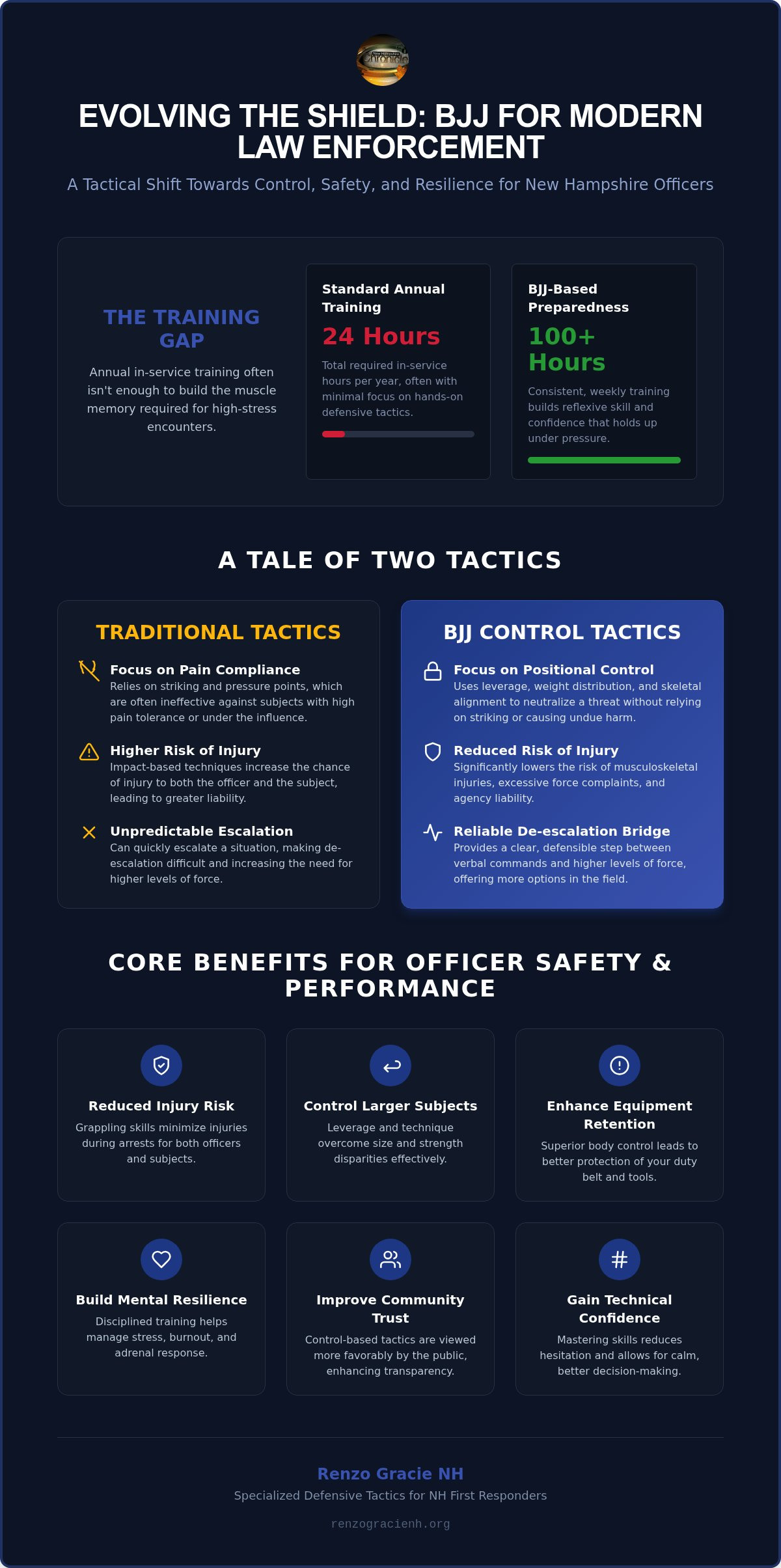
Policing in New Hampshire is changing. It’s more demanding than ever. As we move through 2026, the expectations for how law enforcement officers handle physical encounters have reached a new peak of scrutiny. Traditional defensive tactics often rely on striking or pain compliance, which can be unpredictable and high-risk. Brazilian Jiu-Jitsu offers a different path. It provides a comprehensive system of Grappling that prioritizes leverage and control over impact. This shift is fundamental for BJJ for police officer safety NH because it allows an officer to neutralize a threat without escalating to a higher level of force.

Safety starts with confidence. When you know you can handle a physical struggle, your panic levels drop. This mental clarity is vital. High-stress situations often lead to an “adrenaline dump” that can impair fine motor skills; however, the gross motor movements found in Jiu-Jitsu remain effective. By staying calm, you make better decisions. You reduce the risk of excessive force complaints. Most importantly, you ensure that both you and the subject go home safely.

The Shift Toward Control-Based Tactics in 2026

The era of relying solely on pain compliance is fading. In 2026, the focus has shifted toward positional control. Techniques that involve joint locks or pressure points can often fail against subjects with high pain tolerances or those under the influence of substances. BJJ techniques align perfectly with the “minimum necessary force” doctrine by using weight distribution and skeletal alignment to immobilize a subject. This approach reduces civilian injury and significantly lowers agency liability—a priority often emphasized by legal experts like Botelho Law Group. It’s about being a professional who can resolve a conflict with disciplined precision rather than chaos.

Addressing the NH Training Gap

Standard training isn’t enough. While New Hampshire requires 24 hours of annual in-service training, these hours often exclude deep dives into defensive tactics. A single eight-hour block once a year cannot build the muscle memory required for a life-threatening encounter. Consistent, weekly practice is the only way to ensure your skills work when you’re exhausted or surprised. Renzo Gracie NH supports the law enforcement jiu jitsu training pillar by providing a local, expert-led environment where officers can sharpen their skills year-round. We bridge the gap between academy basics and the complex realities of BJJ for police officer safety NH through repetition and realistic sparring.

  • Reduced Injury Risk: Officers trained in grappling are less likely to suffer musculoskeletal injuries during arrests.
  • Enhanced Equipment Retention: Better control of your own body leads to better protection of your belt and tools.
  • Community Trust: Transparent, control-based tactics look better to the public and build long-term trust.

Mastering Subject Control: Key Techniques for Field Safety

The streets of New Hampshire don’t offer second chances. When a verbal encounter turns physical, your heart rate spikes. This staccato burst of adrenaline can either lead to panic or, with the right training, a purposeful flow of action. Mastering BJJ for police officer safety NH is about more than just “winning” a fight. It’s about achieving total subject control through refined technical skill. By understanding how to move your body relative to another person, you gain the ability to dictate the pace of an encounter. This physical competency is the ultimate de-escalation tool. When you aren’t afraid of the struggle, you don’t overreact.

Clinch work is the foundation of field safety. It allows you to close the distance safely while protecting your head and equipment. A well-executed takedown isn’t about slamming someone to the pavement. It’s about a controlled transition to the ground that keeps you on top and in charge. This methodical approach is a hallmark of the training provided under Professor Kevin Landry, ensuring that every movement is purposeful and legally defensible.

The Science of Positional Dominance

Control is a science. In a sport setting, “The Guard” is often an offensive position. For an officer, it’s a survival shell. It’s where you protect your face and your firearm until you can sweep the subject or stand back up. Positional dominance means using weight distribution instead of raw muscle. When you utilize Side Control or the Mount, you aren’t just holding someone down; you’re using your skeletal structure to make them carry your weight. This exhausts the subject and creates a safer window for handcuffing. Research in a narrative review on the utility of martial arts confirms that these grappling skills significantly improve decision-making during use-of-force incidents.

Weapon Retention in Close Quarters

Your duty belt is a liability if you don’t know how to protect it during a scuffle. BJJ builds an acute sense of body awareness that is impossible to replicate in a lecture hall. You learn to feel where a subject’s hands are moving before you even see them. Specific drills focus on maintaining holster security while grappling. We teach you how to transition from a physical struggle to a safe handcuffing position while keeping your weapon side away from the threat. This level of technical proficiency ensures that your focus remains on the subject, not just your gear. It’s the core of BJJ for police officer safety NH. If you’re ready to see these techniques in action, consider visiting a Renzo Gracie NH academy to experience a session firsthand.

BJJ vs. Traditional Police Training: Closing the Defensive Tactics Gap

Academy training provides a vital foundation. It introduces the basics of law, procedure, and initial tactics. However, many standard defensive tactics blocks rely heavily on compliance-based drills. In these scenarios, your training partner allows you to execute a technique to demonstrate understanding. The street is different. A resisting subject doesn’t care about your technique. They care about escape or assault. This is where BJJ for police officer safety NH becomes the critical missing link in modern policing. It moves beyond theory into the raw reality of physical resistance.

Strike-based systems often fail when the adrenaline dump hits. Fine motor skills vanish. Panic sets in. Brazilian Jiu-Jitsu focuses on gross motor movements and leverage, which remain reliable even when your heart is racing. By training at Renzo Gracie NH, you learn to manage the chaos of a real struggle. You don’t just learn a move; you learn how to apply it against someone who is actively trying to stop you. This is the Renzo Gracie difference. It is a lineage built on practical, battle-tested efficiency that prioritizes what actually works when the stakes are highest.

The Problem with Compliance-Based Training

Static drills often create a false sense of security. If you only practice against a partner who is playing along, you’ll be unprepared for the explosive energy of a violent encounter. Rolling, or live sparring, is what builds true mental resilience. It forces you to solve physical problems under intense pressure. Live training is the gold standard for officer readiness because it allows you to practice at full speed without the risk of significant injury. This constant exposure to resistance ensures that your reactions are instinctive rather than calculated. You stop overthinking and start responding.

Building these instinctive reactions is a core focus for elite tactical organizations worldwide. Groups like the British Krav Maga Association also champion this level of professional, pressure-tested training to ensure that officers are prepared for the physical and mental demands of the field.

Reducing the Risk of Excessive Force

Fear is the primary driver of excessive force. When an officer feels they are losing control of a situation, they often over-rely on intermediate weapons or striking to regain the upper hand. BJJ provides the technical ability to hold a subject securely without causing unnecessary harm. This disciplined confidence radiates to the subject. Often, when a person feels they are completely controlled by a professional who isn’t panicking, their own will to fight diminishes. This technical proficiency is a core component of BJJ for police officer safety NH. You aren’t just protecting yourself; you’re protecting the department’s reputation and the community’s trust.

  • Battle-Tested Efficiency: Our curriculum is modified for the modern NH law enforcement landscape.
  • Reduced Panic: Physical competency leads to a calmer mind and better de-escalation.
  • Safe Repetition: Unlike striking, you can practice grappling consistently without accruing head trauma or injury.

BJJ for NH Police Safety: Enhancing Tactics in 2026

Practical Steps to Start Law Enforcement Grappling in NH

Taking the first step into a martial arts academy can feel more daunting than a midnight traffic stop. You might worry about the culture or whether your schedule can even accommodate training. At Renzo Gracie NH, we understand the specific demands placed on New Hampshire law enforcement. Whether you are patrolling in Manchester, Exeter, or Windham, your time is a precious resource. This is why our BJJ for police officer safety NH programs are designed to be accessible and supportive for busy professionals.

You don’t need a Gi to get started. Many new students overthink the gear requirements before they even step on the mat. For your initial sessions, simple athletic wear like a t-shirt and shorts is all you need. We provide the environment and the expertise; you just provide the willingness to learn. This low-pressure entry point ensures that you can focus on the techniques rather than the equipment. It’s about building a foundation of skill, not accumulating gear.

Balancing the Badge and the Mat

Shift work is the reality of the job. We know that a standard 9-to-5 training schedule doesn’t work for everyone in the field. Our academies offer various class times to ensure you can find a slot that fits, whether you’re coming off a double or preparing for a night shift. Beyond the physical tactics, training serves as a vital outlet for decompression. It’s a place to leave the stress of the road behind and focus on personal growth. By prioritizing your own development, you’re encouraging a culture of safety and resilience within your entire department. It’s a way to stay sharp while staying healthy.

Your First Class at Renzo Gracie NH

When you walk through our doors, you’ll find an atmosphere of disciplined confidence. Professor Kevin Landry, a 6th-degree black belt with over two decades of experience in NH, leads a team dedicated to your success. The environment is professional yet welcoming, moving away from the “tough guy” tropes often found in combat sports. We are your supportive partners in this journey. You’ll likely see fellow first responders on the mats, creating a community of peers who understand your daily challenges. If you’re ready to see how these skills translate to your duty, you can try jiu jitsu free in New Hampshire through our introductory program. It’s a risk-free way to discover the benefits of BJJ for police officer safety NH and start building your tactical foundation today. Visit renzogracienh.org to view our current class schedules and take the first step toward a safer, more confident career.

Renzo Gracie NH: Specialized Defensive Tactics for NH First Responders

Renzo Gracie NH isn’t just a gym. It’s a sanctuary for professionals who face the toughest days. With locations in Windham, Manchester, and Exeter, we’ve built a network of support that spans Southern New Hampshire. We specialize in BJJ for police officer safety NH by offering a curriculum that reflects the realities of 2026 policing. Every technique is vetted for legal defensibility and physical efficiency. It’s about giving you the tools to succeed in the field while ensuring you return home to your loved ones every night. We believe that your safety is the foundation of your service.

Our approach is methodical. We move from high-level tactical theory to the practical details of every grip and transition. This ensures that when you’re on duty, your response is instinctive. You don’t have to second-guess your training because it has been forged through realistic, live resistance. This steady momentum in your training translates to a calm, purposeful presence on the street. It’s the difference between reacting with fear and responding with disciplined confidence.

The Landry Legacy in Southern New Hampshire

Professor Kevin Landry leads with quiet authority. As a 6th-degree black belt under the legendary Renzo Gracie, he brings a world-class lineage directly to our local community. He has taught in New Hampshire for over two decades. Thousands of students have evolved under his guidance, discovering the transformative power of Jiu-Jitsu. This depth of experience is why local officers trust us with more than just their own tactical training. Many choose to bring their families into the fold, enrolling their children in kids jiu jitsu New Hampshire programs to build the same respect, perseverance, and focus they value on the force.

Beyond Tactics: A Community for Wellness

The badge is heavy. Carrying the weight of public safety takes a toll on both the mind and the body. Our academy provides a space for true wellness and decompression. It’s a place where you can step out of your role as an authority figure and simply be a student again. There is a profound psychological benefit to focusing on the complex physical puzzle of grappling; it forces the stressors of the shift to fade into the background. We prioritize family time and the personal success of every individual. By investing in BJJ for police officer safety NH, you join a supportive community that respects your service and prioritizes your long-term vitality. Protect yourself so you can continue to protect others. We are ready to be your partner in this journey.

Elevate Your Tactical Readiness Today

The landscape of law enforcement in 2026 demands a higher standard of physical and mental preparation. You’ve seen how Brazilian Jiu-Jitsu bridges the gap between academy basics and the unpredictable reality of the street. By focusing on positional dominance and leverage, you gain the ability to control encounters without the need for excessive striking. This technical proficiency is the core of BJJ for police officer safety NH, providing you with the calm, disciplined confidence needed to handle high-pressure situations with professional precision.

It’s time to move beyond static drills and embrace a training system that works when the adrenaline hits. Led by 6th-Degree Black Belt Kevin Landry, our academy has been serving NH for over 20 years with a specialized LE-specific curriculum that prioritizes your well-being. We invite you to join our growing community of first responders in Manchester, Windham, and Exeter. You’ll find that the mats are a place for growth, focus, and the strength found in collective effort. Take the first step toward a safer career today.

Claim Your Free Introductory Law Enforcement BJJ Class Today!

We look forward to seeing you on the mats and helping you build a safer, more resilient future for yourself and your community.

Frequently Asked Questions

Is BJJ training at Renzo Gracie NH POST-certified in New Hampshire?

You should consult your department’s training coordinator regarding specific credit, as New Hampshire’s 24-hour annual in-service requirement under Administrative Rule Pol 403.01 has historically excluded defensive tactics from mandatory hours. However, many agencies recognize the immense value of supplemental training for field readiness. We focus on providing the practical skills that keep you safe, regardless of how the administrative hours are logged.

I’ve never done martial arts before; is it too late to start for my career?

It’s never too late to begin your journey on the mats. Our academy welcomes beginners of all ages and fitness levels, focusing on personal progress rather than intense competition. You’ll find a supportive environment where the goal is to build your confidence and technical skill at a pace that respects your professional experience and physical starting point.

How does BJJ help with weapon retention during a struggle?

BJJ enhances weapon retention by developing an acute sense of body awareness during a physical struggle. You’ll learn specific drills to keep your holster secure while using your legs and hips to create distance or maintain control. This training teaches you to feel a subject’s movement toward your belt before you even see their hands, allowing for a proactive and secure response.

Do I need to be in peak physical condition to start training?

You don’t need to be an athlete to start your first class. Brazilian Jiu-Jitsu is known as the “gentle art” because it relies on leverage and technique rather than raw athletic power. You’ll find that your conditioning improves naturally as you train. Our instructors ensure that the intensity is manageable, allowing you to evolve your fitness while you master the technical aspects of the art.

Are the techniques taught at Renzo Gracie NH street-legal for use-of-force?

Our curriculum is specifically modified to align with modern use-of-force standards that prioritize de-escalation and the preservation of life. These techniques focus on positional control, which reduces the need for striking and lowers the risk of injury to both the officer and the subject. By using skeletal alignment and weight distribution, you can safely resolve a conflict within the bounds of legal and departmental policy.

What is the difference between sport BJJ and the law enforcement program?

The primary difference lies in the objective of the encounter. While sport BJJ focuses on scoring points or achieving a submission in a controlled environment, our law enforcement training prioritizes subject control, weapon retention, and safe transitions to handcuffing. We strip away techniques that leave you vulnerable to strikes or weapon grabs, focusing entirely on what works when you’re wearing a duty belt and a vest.

Can I train if I work a rotating shift at a local NH department?

We offer flexible scheduling across our Windham, Manchester, and Exeter locations to accommodate the rotating shifts common in New Hampshire law enforcement. Consistency is key to BJJ for police officer safety NH, so we provide various morning and evening options to ensure you can train regardless of your current assignment. Our goal is to be a reliable partner in your long-term professional development.

How many days a week should an officer train to see results?

Training two to three days per week is generally the sweet spot for building reliable muscle memory. This frequency allows you to retain complex techniques while giving your body time to recover from the physical demands of the job. Even one consistent day a week is better than none, as the goal is to keep these life-saving skills sharp and ready for the moment they’re needed most.