Officer Control Techniques Training: Advanced Defensive Tactics for Law Enforcement
What if safer subject control depends less on strength and more on position, leverage, and timing? In a fast-moving encounter, officer control techniques training can help officers develop options for managing resistance without relying only on pain compliance, which may not produce the intended response when adrenaline is high.
Physical confrontations are unpredictable. Officers must make decisions while considering their own safety, the subject’s well-being, and the risk of using excessive force. Practical skills need to work against active resistance, not just in a cooperative drill. This article explains how grappling mechanics can support subject management while leaving room for de-escalation and sound judgment.
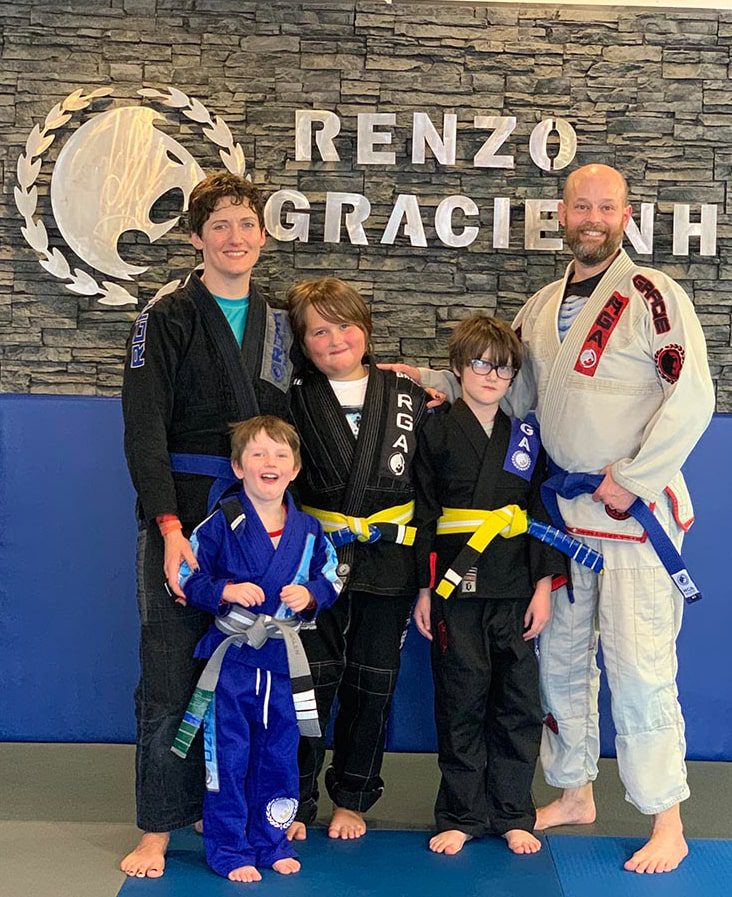
You’ll learn why leverage matters, how Jiu-Jitsu principles can inform defensive tactics, and how consistent practice can build confidence. At Renzo Gracie NH, Professor Kevin Landry, a 6th-degree black belt with more than 20 years of teaching experience, leads specialized Law Enforcement Jiu-Jitsu training focused on practical grappling and control. The aim is disciplined skill: purposeful control, considered decisions, and readiness when an encounter becomes physical.
Key Takeaways
- Learn how positioning and leverage can support controlled subject management without relying solely on pain compliance.
- Explore core grappling mechanics, including the three-points-of-control principle for ground encounters.
- See how officer control techniques training can complement de-escalation and help officers make deliberate decisions under pressure.
- Understand why consistent practice can help build confidence and improve retention beyond infrequent defensive tactics refreshers.
- Discover how Renzo Gracie NH’s specialized Law Enforcement Jiu-Jitsu training, led by Professor Kevin Landry, applies practical grappling to officer safety.
Understanding Officer Control Techniques in Modern Policing
Officer control techniques use leverage, body position, and movement to manage a subject while working to maintain a stable encounter. The goal isn’t to overpower someone through strength alone. It’s to create control that can be adjusted as behavior changes, with every decision guided by department policy and the circumstances at hand.
This approach offers options beyond relying mainly on pain compliance, which may not produce the intended response when a person is highly agitated or affected by adrenaline. Positional control focuses on balance, distance, and limiting harmful movement. That doesn’t mean every encounter calls for grappling. It means officers can develop additional responses and choose one that fits the situation, rather than treating every physical encounter as a contest of force.
The Evolution of Defensive Tactics
Striking-based tactics may have a place in defensive training, particularly when an officer must respond to an immediate threat. They may be less suited to maintaining control once an officer is close to a subject or both are on the ground. Grappling-based methods teach officers to manage position, stabilize movement, and work toward a controlled outcome without relying on strength alone.
Under stress, people often fall back on practiced actions. Skills therefore need to be repeated, with attention to positioning and decision-making, rather than demonstrated just once. Law enforcement jiu jitsu training can help officers build practical grappling habits that support career-long skill development. Brazilian Jiu-Jitsu emphasizes leverage, control, and working through resistance. Its usefulness depends on thoughtful instruction and practice suited to professional responsibilities.
De-escalation Through Physical Competence
Physical skill and de-escalation can work together. An officer who knows how to manage position and movement may feel less pressure to use unnecessary force when a situation becomes physical. Supervised practice against active resistance also gives officers opportunities to make decisions under pressure. The aim is composure, not aggression.
Technical subject control is the ability to guide or limit a person’s movement through positioning and leverage without causing unnecessary harm.
Live grappling lets officers experience the discomfort and unpredictability of close contact in a controlled training environment. They can practice identifying when a position is stable, when it is failing, and when to reassess instead of relying on a memorized sequence. Training can’t guarantee a particular outcome in the field, but it can help officers develop judgment and more measured options.
Effective officer control techniques training develops more than a physical response. It connects mechanics to restraint, awareness, and adaptation. As technical proficiency grows, officers can practice managing resistance without moving prematurely to a higher level of force, while still responding to the risks present in the encounter.
Core BJJ Mechanics for Subject Control and Management
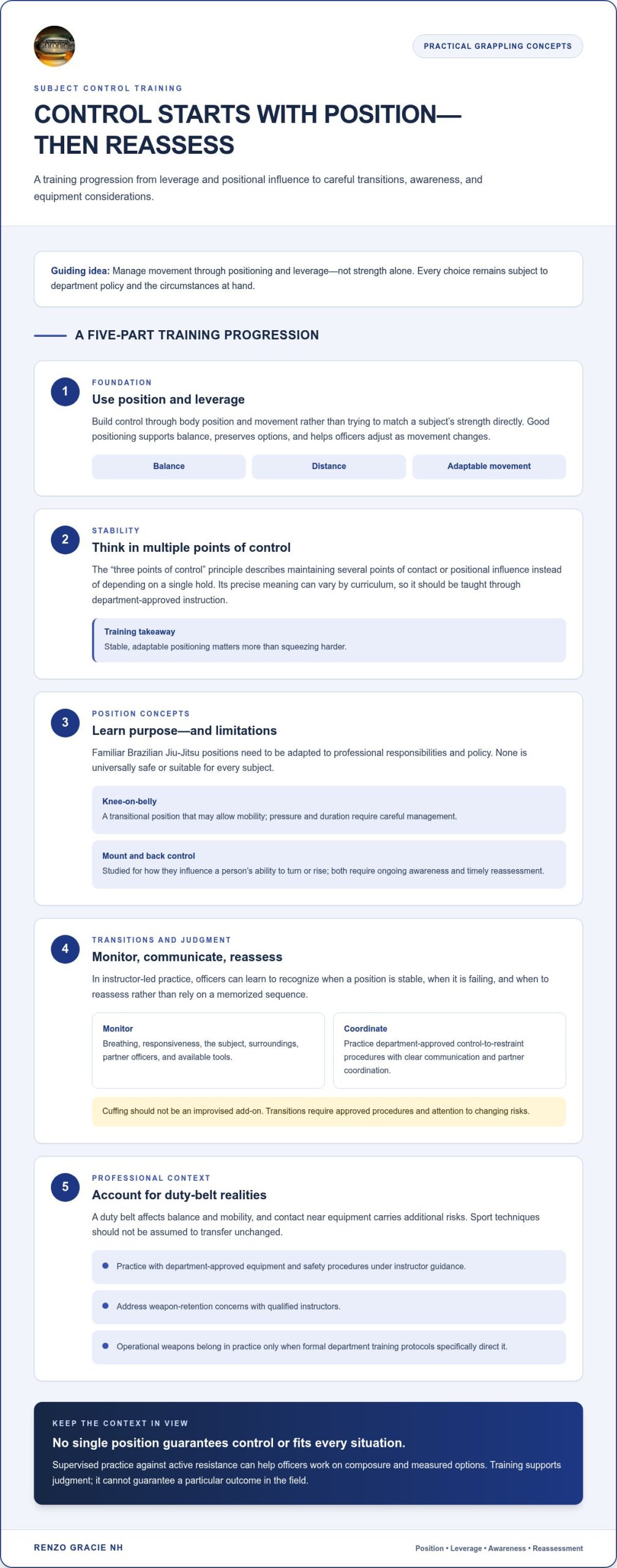
Leverage can help an officer manage resistance without matching a subject’s strength directly. Good positioning supports balance, preserves options, and makes it easier to adjust as movement changes. No single position guarantees control or suits every situation. In practice, officers should avoid relying on one grip or one source of pressure, while staying alert to the subject, surroundings, partner officers, and available tools.
“Three points of control” is sometimes used as a training principle for maintaining several points of contact or positional influence rather than depending on a single hold. The precise meaning can vary by curriculum, so officers should learn and apply the principle through department-approved instruction. The broader lesson is that stable, adaptable positioning matters more than squeezing harder.
Positions as Training Concepts
Knee-on-belly, mount, and back control are familiar Brazilian Jiu-Jitsu positions, but police training must adapt them to professional responsibilities and policy. None should be treated as universally safe or suitable for every subject. An instructor can explain each position’s purpose and limitations, show how to monitor breathing and responsiveness, and guide practice through controlled transitions.
For example, knee-on-belly is a transitional position that may allow mobility, but pressure and duration require careful management. Mount and back control are often studied for how they influence a person’s ability to turn or rise. They also require ongoing awareness and timely reassessment. Cuffing shouldn’t be an improvised add-on. Officers need to practice approved procedures for moving from control to restraint, with clear communication, partner coordination, and attention to changing risks.
Training With Duty-Belt Considerations
A duty belt affects balance and mobility, and contact near equipment carries additional risks. Officers should account for those differences through instructor-led practice rather than assume sport techniques transfer unchanged. Training should use department-approved equipment and safety procedures, with weapon-retention concerns addressed by qualified instructors. Never introduce operational weapons into practice unless the department’s formal training protocols specifically direct it.
- Practice in suitable training gear so its weight and fit don’t come as a surprise.
- Use controlled drills to notice how equipment affects movement and positioning.
- Pause to check awareness, communication, and partner coordination before progressing.
The Federal Law Enforcement Training Centers’ FLETC Law Enforcement Control Tactics Instructor Training Program reflects the importance of instructor preparation, injury prevention, and sound control-tactics training. A well-designed curriculum connects physical mechanics to decision-making. It doesn’t treat positions as shortcuts or promises of a particular outcome.
Officers in Windham, Manchester, and Exeter can explore Law Enforcement Jiu-Jitsu training at Renzo Gracie NH, where practical grappling and subject management are central to the specialized curriculum.
Subject Control Training: Safety, Legality, and Effectiveness
Jiu-Jitsu can give officers more ways to manage physical resistance, but a technique isn’t automatically lawful or appropriate simply because it is taught in training. A force continuum may help organize response options, yet officers must follow applicable law, department policy, and the facts of each encounter. In the United States, the central legal question is objective reasonableness, as established in Graham v. Connor. Technical skill can support sound decisions, but it can’t replace them.
That distinction matters when considering whether BJJ is too dangerous for police work. Any physical control method can cause injury if misapplied, sustained unnecessarily, or used without regard to the subject’s condition. Grappling isn’t risk-free. Training should set clear safety standards, practice controlled application and release, teach officers to recognize changes in a person’s condition, and follow department protocols. Evaluate a technique by its purpose, execution, duration, and the circumstances around its use.
Force Standards and Technical Proficiency
Grappling can expand an officer’s options for what some agencies call “soft empty-hand” control, such as guiding movement or stabilizing a person without immediately resorting to strikes. The applicable force framework varies by agency, so officers should connect each skill to their own policy and instruction. The Renzo Gracie teaching philosophy emphasizes discipline and control, values that matter when a trained response must remain measured.
Body-camera footage may document an officer’s actions, but a response that looks technical isn’t automatically lawful, and video may not capture every relevant detail. Officers should focus on conduct they can explain: what threat they perceived, why they acted, how they monitored the person, and whether they adjusted or stopped as circumstances changed. Good officer control techniques training connects those decisions to physical practice instead of treating mechanics as a substitute for judgment.
Injury Prevention and the Duty to Intervene
Struggles can strain an officer’s shoulders, knees, or back, especially when balance breaks down or movement becomes uncontrolled. Grappling practice can teach safer alignment, base, and transitions, though it can’t eliminate injury risk. The same care applies to subjects: restraint should be purposeful, monitored, and consistent with policy. Officers should remain attentive to distress and prepared to reassess. “Clean control” means disciplined, proportionate action, not a guarantee of injury-free restraint.
Subject management is the ethical application of physical restraint to address a person’s behavior while respecting their safety and dignity.
Modern policing standards also recognize a duty to intervene when an officer observes another officer using excessive force. Technical training can help partners communicate, recognize when a hold is becoming unsafe, and act promptly to prevent or stop harmful conduct. Clear roles and scenario practice help make intervention less dependent on guesswork in a tense moment. The goal is shared responsibility: protect the public, support colleagues, and keep every response accountable.
Implementing a Sustainable Training Routine for Officers
A defensive tactic practiced once and then left untouched may be hard to recall under pressure. Annual refreshers can reinforce procedures, but long gaps make it harder to retain physical skills that depend on timing, balance, and adapting to resistance. Regular practice gives officers opportunities to revisit fundamentals, get feedback, and build confidence over time. The aim isn’t to add another source of burnout. It’s to practice consistently enough to support retention and realistically enough to connect training with the job.
Consistency Over Intensity
Two hours a week can serve as a planning target for officers who can fit it into their lives, not a universal rule or guarantee of proficiency. A steady, manageable routine may be easier to maintain than occasional exhausting sessions. Coordinate practice with rest, work demands, and family commitments. Favor focused instruction and safe, supervised drilling over making every class an all-out test.
There’s a learning curve. Officers new to the mat may feel uncomfortable being beginners, especially in front of colleagues. Approach training with curiosity: ask questions, focus on one skill at a time, and treat controlled resistance as feedback rather than a measure of personal worth. Rank isn’t the point. A “blue belt” can mark progress as a student, but it isn’t a universal baseline for police competence. Agency standards and demonstrated job-relevant skills matter more than belt color.
Adults starting from the beginning can explore adult Jiu-Jitsu for beginners in New Hampshire to see how a new student can build skills step by step.
Choosing a Supportive Training Environment
Look for instruction with credible lineage, clear safety practices, and a curriculum designed with law enforcement needs in mind. Training should welcome questions and scale drills thoughtfully, so officers can develop skills without unnecessary intensity. At Renzo Gracie NH, specialized Law Enforcement Jiu-Jitsu training is led by Professor Kevin Landry, a 6th-degree black belt under Renzo Gracie with more than 20 years of teaching experience.
Training alongside civilian students can expose officers to partners with varied movement, sizes, and experience. That variety can help officers practice responding to different kinds of resistance while instructors keep the learning environment controlled. It doesn’t replace department-specific scenarios or policy instruction. It can complement them by building adaptable grappling fundamentals.
For officers balancing shifts, training, and home life, sustainability also means making room for recovery and family time. A routine that fits real responsibilities is more likely to last than an ambitious plan that becomes another burden. Renzo Gracie NH offers specialized Law Enforcement Jiu-Jitsu training and a free introductory class for new students to experience the academy and its approach.
Specialized Law Enforcement Jiu-Jitsu at Renzo Gracie NH
Officers in Windham, Manchester, and Exeter can build practical grappling skills through specialized Law Enforcement Jiu-Jitsu training at Renzo Gracie NH. The curriculum focuses on defensive tactics, officer safety, and professional subject management. It connects Jiu-Jitsu principles to law enforcement demands, with an emphasis on developing technical skill in a supportive learning environment.
Instruction is led by Professor Kevin Landry, a 6th-degree black belt under Renzo Gracie with more than 20 years of teaching experience. Officers can work through foundational movements, refine control mechanics, and develop at a pace suited to their experience. The focus is practical progress, not proving who is strongest.
A Curriculum Built for the Street
Clinch work, takedown defense, and ground subject management are useful areas for law enforcement officers to understand because physical encounters can move quickly between standing and ground positions. Training can help officers explore how balance, movement, and control relate across those transitions. Skills should be practiced under instruction and connected to department policies, with attention to safety and decision-making. They aren’t scripts for every encounter.
Realistic practice also means responding thoughtfully as a partner’s movement changes. Scenario-based drills can connect techniques to communication, awareness, and reassessment when they are designed and supervised appropriately. The goal is to develop adaptable judgment alongside physical capability.
Training can also become part of a routine beyond work. A consistent activity can give officers a constructive way to focus, learn, and connect with a community while making space for family commitments and life off duty. Jiu-Jitsu isn’t a substitute for professional mental health support, but sustainable practice can be one positive part of an officer’s broader approach to personal well-being.
Join the Southern New Hampshire Training Community
Renzo Gracie NH welcomes officers from Windham, Manchester, Exeter, and the surrounding region to specialized training centered on practical grappling and control. A shared learning environment can encourage respect and steady development, whether an officer is new to Jiu-Jitsu or building on previous experience. Students can focus on fundamentals, ask questions, and improve through coached practice.
You don’t need mat experience to start. A free introductory class gives new students the opportunity to experience the academy and its approach to training. It’s a practical first step for officers considering how officer control techniques training can fit into their ongoing development.
Build practical skills through coached Jiu-Jitsu training at Renzo Gracie NH in Southern New Hampshire.
Build the Next Step Into Your Training
Progress in officer control techniques training comes from continuing to learn and returning to practice consistently. Make the next step practical: identify a skill you want to develop, make time for supervised practice, and apply what you learn in a way that aligns with department policies.
You don’t need to arrive with experience or have every answer before you begin. A first class lets you experience the training environment, ask questions, and consider how Jiu-Jitsu could fit your goals. At Renzo Gracie NH, specialized law enforcement instruction is led by Kevin Landry, a 6th-degree black belt. Officers in Windham, Manchester, and Exeter can explore a focused way to develop practical skills and disciplined confidence.
Book your free introductory class at Renzo Gracie NH and take a practical first step toward developing your skills through coached training.
Frequently Asked Questions
What are the most effective officer control techniques?
The most effective techniques are those that fit the subject’s behavior, the immediate risks, and department policy. No single hold works in every encounter. In officer control techniques training, officers can practice recognizing when to create distance, stabilize movement, or disengage and reassess. A subject actively pulling away may call for a different response than someone who is no longer resisting. Continued observation and timely adjustment are essential.
Is Brazilian Jiu-Jitsu safe for law enforcement officers to use?
Brazilian Jiu-Jitsu can be trained and applied with safety in mind, but no physical control method is risk-free. Safety depends on appropriate instruction, gradual practice, awareness of a person’s condition, and compliance with agency policy. During training, partners should communicate discomfort or injury, and instructors should adjust the drill. In the field, officers need to assess the person and circumstances continually rather than assume a practiced technique is automatically safe or suitable.
How long does it take for a police officer to become proficient in BJJ?
There’s no fixed timeline for proficiency. Progress depends on training consistency, the skills being assessed, and how well those skills transfer to an officer’s duties. Set practical learning goals with an instructor, such as maintaining balance as a partner moves or recognizing when a position is unstable. Belt rank alone doesn’t establish readiness for law enforcement work. Job-specific practice and department standards remain important.
Can BJJ techniques be used while wearing a full duty belt?
Some grappling principles can inform training in duty gear, but techniques may need adjustment because a belt affects movement and carries equipment that requires careful protection. Officers should practice only in a controlled setting using department-approved equipment and safety procedures. A qualified instructor can help identify how gear changes balance and mobility, without treating sport practice as a direct substitute for agency-specific weapon-retention training. Follow department protocols for any training involving duty equipment.
Does Renzo Gracie NH offer specific classes for law enforcement?
Yes. Renzo Gracie NH offers specialized Law Enforcement Jiu-Jitsu training focused on professional defensive tactics, grappling, and subject management. The program serves officers in Windham, Manchester, and Exeter. New students can begin with a free introductory class to experience the training environment and understand the program’s approach.
How do these techniques help with de-escalation in the field?
Training can help officers feel more prepared to manage close-contact resistance, which may support calmer decisions when an encounter becomes physical. An officer who recognizes a stable position may have more opportunity to communicate and reassess instead of reacting hastily to every movement. Physical skill doesn’t replace verbal de-escalation or sound judgment. It can add options while the officer continues to follow policy and respond to the specific situation.
What is the “Knee on Belly” position in subject control?
Knee on belly is a transitional grappling position in which an officer places a knee across a person’s torso while maintaining balance and mobility. It isn’t a universal solution or a position to hold without reassessment. Training should emphasize controlled application, monitoring the person’s condition, and following approved procedures for moving to another position or restraint. Officers should learn its risks and limitations from qualified instructors, not rely on a brief description alone.
Are these techniques compliant with New Hampshire use-of-force standards?
No technique is automatically compliant simply because it comes from Jiu-Jitsu training. Whether force is appropriate depends on the circumstances, applicable law, and department policy. Officers serving in Windham, Manchester, Exeter, and elsewhere in New Hampshire should use only tactics they’re trained and authorized to apply, and document and report incidents according to agency procedures. This FAQ isn’t legal advice; officers should rely on current official guidance and department instruction.