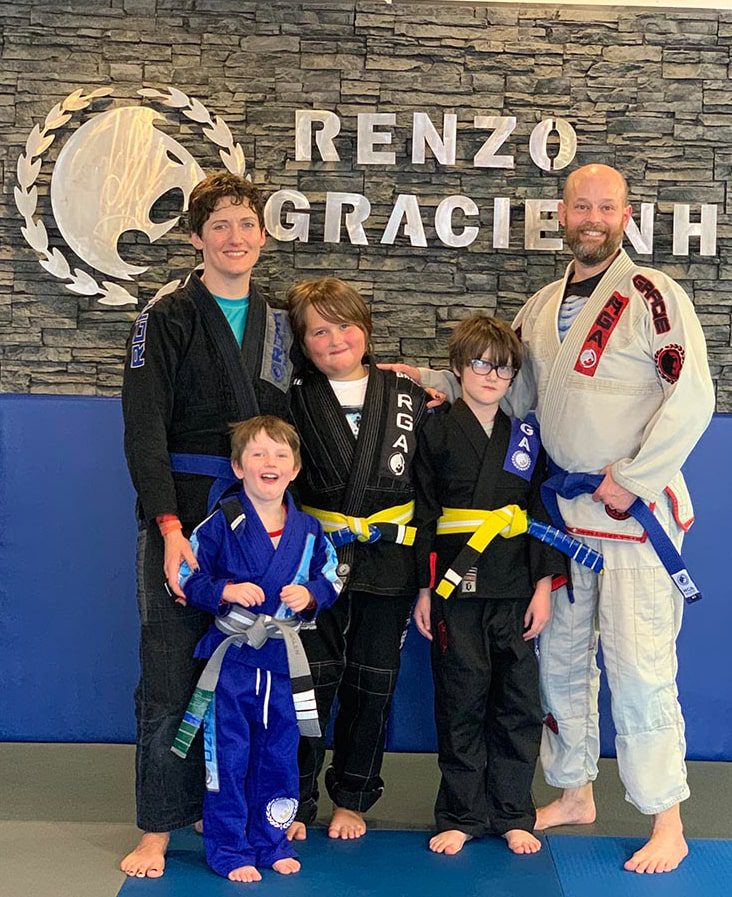
Parent-Child Martial Arts in New Hampshire: 2026 Guide
What if the best seat at your child’s sports practice isn’t on the bleachers, but right beside them on the mat? With New Hampshire leading the nation in youth sports participation at over 74 percent, countless parents spend their weeknights scrolling on phones and waiting for the final whistle. Choosing parent child martial arts New Hampshire families can practice together turns that idle sideline time into an active, inspiring partnership.
Between hectic school schedules and digital distractions, finding a shared hobby that bridges the generational gap can feel almost impossible. You want practical self-defense skills and healthy athletic habits, but you also need a safe, ego-free environment that protects growing joints and adult bodies alike. Training side by side builds mutual trust, authentic discipline, and lifelong confidence. This guide breaks down how cooperative martial arts programs work, what safety standards to look for, and how to find the premier family-focused academies across Southern New Hampshire.
Key Takeaways
- Step off the bleachers and onto the mat to replace passive screen time with cooperative partner drills that build mutual trust and emotional resilience.
- Understand why Brazilian Jiu-Jitsu offers a safer alternative to striking sports by focusing on body control and leverage rather than high-impact collisions.
- Explore typical class structures, from joint-friendly mobility warm-ups to progressive technical drills where parents and kids learn practical self-defense side by side.
- Discover essential criteria for choosing parent child martial arts New Hampshire academies, including verified instructor lineage and hospital-grade facility hygiene.
- Learn how multi-academy access across Windham, Manchester, and Exeter simplifies training schedules for active Southern New Hampshire families.
The Modern Family Dilemma: Why Parents and Kids in New Hampshire Need Shared Mats
Every weeknight across New England, the scene repeats itself. Exhausted parents sit hunched on hard aluminum bleachers, illuminated only by the glow of their smartphones while their kids run drills on a distant field. We become passive chauffeurs. We shuttle our children between activities, offer critiques on the car ride home, and completely miss out on genuine, shared physical connection. Modern life routinely isolates families into separate digital silos, even when everyone is under the same roof.
Cooperative movement rewrites that dynamic entirely. When you step onto the training canvas together, the bleacher divide evaporates. Practicing martial arts as a family triggers physical releases of oxytocin through positive, trust-based contact. It breaks down generational barriers, replacing isolated screen fatigue with active problem-solving. Through dedicated parent child martial arts New Hampshire programs, families discover a refreshing counterbalance to the frantic pace of modern life.
Breaking Away from the Sideline Parenting Trap
Sideline parenting places adults in the role of spectator or critic. Step onto the mat, and that hierarchy shifts. Active participation turns routine physical fitness into an inspiring collaborative pursuit. Children rarely get to see their parents face a steep learning curve in real time. When your child watches you struggle with a complex guard pass, ask questions, and try again, something remarkable happens. Vulnerability normalizes healthy failure. It shows them that learning is an ongoing, lifelong adventure rather than something that ends with childhood. For fathers looking to cultivate this kind of engaged dynamic from the start, resources like GreatDad.com offer practical advice on navigating active parenting and fostering meaningful bonds.
Developing Shared Emotional Resilience and Trust
Grappling disciplines demand absolute presence. You cannot check work emails while defending a sweep or coordinating hip movement with a training partner. This shared focus creates lasting benefits for the entire household:
- Deep non-verbal communication: Partner drilling requires listening through physical feedback, timing, and weight distribution.
- Cooperative problem-solving: Working through technical puzzles teaches families how to stay calm and support each other under pressure.
- A common athletic language: Shared training replaces routine small talk with animated dinner-table discussions about balance, leverage, and personal breakthroughs.
Encountering difficult techniques side by side builds quiet grit. When a parent and child navigate a demanding drill, overcome fatigue, and earn small technical victories together, they forge mutual respect. That authentic bond outlasts any trophy on a bedroom shelf.
Why Brazilian Jiu-Jitsu Outperforms Traditional Striking Arts for Family Bonding
Most people picturing martial arts imagine flying side kicks, wooden boards snapping, and protective sparring pads. While striking arts build discipline, they introduce concussive impact that makes true parent-child sparring nearly impossible. You cannot trade full-speed punches with your ten-year-old safely. Brazilian Jiu-Jitsu (BJJ) changes the dynamic entirely by replacing high-velocity strikes with body mechanics, angles, and ground control.
Grappling allows two people of vastly different sizes to train with genuine physical resistance at full pace without causing harm. It provides the ultimate foundation for families seeking realistic self-defense alongside meaningful bonding.
Grappling Mechanics vs. Striking Impact for Developing Bodies
Striking disciplines involve repetitive forces that rightfully concern health-conscious parents. BJJ eliminates concussive head trauma from training sessions. Instead, practitioners utilize joint alignment, balance, and leverage to manage distance and neutralize aggression. Medical researchers examining the developmental benefits of play emphasize that close physical cooperation fosters emotional regulation and spatial awareness without harmful strain.
Reviewing curriculum models like kids jiu jitsu New Hampshire programs demonstrate how gentle, controlled pressure teaches body awareness. The presence of the tap-out rule ensures that either partner can stop a drill instantly, keeping training safe and encouraging continuous progress.
The Physical Chess Analogy: Solving Movement Puzzles as a Team
Practitioners often call Jiu-Jitsu “human chess.” Every position presents an intellectual puzzle where technique consistently trumps raw strength. A nimble child can use flexibility and hip mobility to out-maneuver an adult, leveling the biological playing field. This balance makes parent child martial arts New Hampshire classes uniquely collaborative:
- Adaptive resistance: Parents learn to calibrate their physical pressure, giving children realistic resistance without relying on adult strength.
- Tactical problem-solving: Escaping a pin or setting up an armlock requires strategic thinking, turning each round into a shared logic game.
- Shared milestones: Discovering how to execute an escape together creates genuine pride that builds confidence across both generations.
If you’re eager to see how this technical problem-solving works on the mats, you can visit Renzo Gracie NH to observe how families train together in a supportive setting.
What to Expect in a Family Martial Arts Class: Structure, Safety, and Progression
Walking onto a martial arts mat for the first time brings natural anticipation. Parents often wonder whether they will be able to keep up, or if their children will find the training environment intimidating. High-level family programs are built to remove that hesitation from day one. Rather than aggressive combat drills, classes follow an intentional structure centered on technical clarity, mutual safety, and shared joy.
Quality academies create an ego-free room where safety comes first. Expert coaches watch every repetition, ensuring that partners move with control while learning practical self-defense mechanics side by side.
The Daily Mat Flow: From Warm-Up to Technical Drilling
Every session follows a methodical sequence designed to build confidence step by step:
- Dynamic movement warm-ups: Classes start with natural ground mobility exercises like bear crawls, hip escapes, and posture resets that warm adult joints safely while developing agility in young students.
- Bite-sized technical instruction: Coaches break complex movements into two- or three-step sequences, explaining the biomechanics so both minds can absorb the details.
- Cooperative partner practice: Parents and children alternate between playing the active student executing the technique and serving as the supportive, steady base.
- Positional games: Sessions finish with light, objective-based challenges, like keeping balance inside the guard, allowing both partners to test concepts playfully.
Managing Size and Strength Disparities Safely
A sixty-pound child cannot absorb the full weight of a two-hundred-pound adult. Professional academies handle this disparity through strict weight-distribution guidelines. Coaches teach adults how to post their hands and knees to bear their own mass during top control drills, protecting developing bodies from unnecessary pressure.
Equally critical is the universal tap-out rule. Tapping the mat or saying “tap” out loud halts any sequence instantly. This gives both parent and child full bodily autonomy during every drill. For parents stepping onto the mats without previous athletic experience, reviewing jiu jitsu for beginners adults NH resources helps set clear expectations around pacing and physical recovery.
When selecting premier parent child martial arts New Hampshire programs, look for rooms where control outranks raw speed. A measured training environment guarantees that both generations look forward to lacing up their gear week after week.
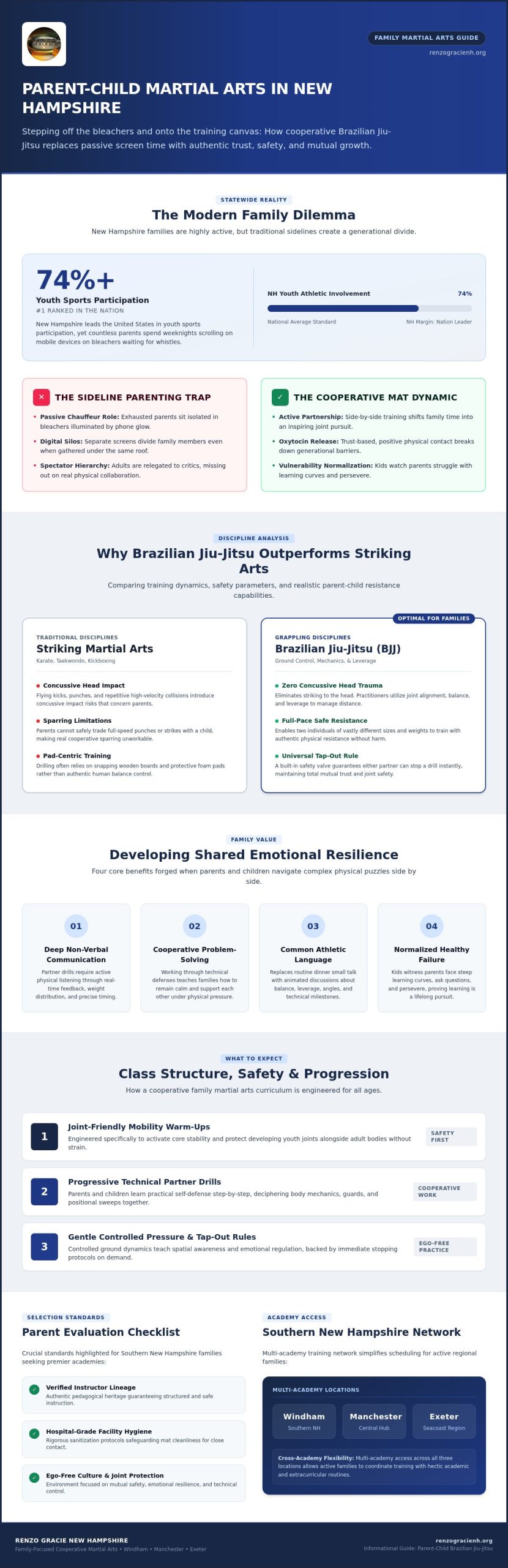
Evaluating Family Martial Arts Academies in Southern New Hampshire: A Parent Checklist
Selecting the right academy shapes your family’s athletic experience for years. With nearly 40 percent of all martial arts participants under the age of 18, plenty of schools market youth and family programs. Yet operational standards vary wildly from one facility to another. Choosing quality parent child martial arts New Hampshire programs requires looking past marketing slogans and assessing how a school runs its daily classes.
Every reputable academy should welcome your questions about safety, instruction quality, and cleanliness. Use this targeted checklist to evaluate potential training homes across Southern New Hampshire.
Lineage, Experience, and Instructor Pedigree
Instructional pedigree matters. It directly influences whether techniques are technically sound, safe, and street-effective. Look into the head instructor’s background:
- Direct lineage: Verify who awarded the instructor their black belt. Authentic Brazilian Jiu-Jitsu traces its lineage directly back to respected masters.
- Teaching tenure: Seek head instructors with decades of coaching experience rather than recent graduates running commercial operations.
- Coaching temperament: An exceptional mentor leads with humility, patience, and encouraging correction rather than intimidation or ego.
Facility Cleanliness, Community Culture, and Multi-Location Access
Physical environments speak volumes. Mat cleanliness should follow hospital-grade sanitation protocols, with daily disinfecting routines to protect against common skin infections and seasonal viruses. Walk through the locker rooms and viewing areas. Clean, well-ventilated spaces reflect a staff that takes student safety seriously.
Observe the room’s culture during busy transition windows. Do current parents and students welcome beginners with warmth, or does the school feel insular? An inclusive, cooperative culture ensures your family feels supported from the moment you step through the door.
Logistical convenience is equally vital. Southern New Hampshire families frequently commute between work, school, and extracurricular commitments. Academies offering reciprocal mat access across sister locations grant enormous flexibility, ensuring hectic schedules never derail training momentum. If you’re ready to evaluate a welcoming, multi-facility school firsthand, you can explore trial opportunities at Renzo Gracie NH and see authentic coaching in person.
Begin Your Family Journey with Renzo Gracie NH: Windham, Manchester, and Exeter
Taking up a martial discipline should empower your entire household. At Renzo Gracie NH, training is designed to build character, coordination, and lasting family connections across all age groups. Through dedicated Family Time sessions, parents and children step onto the mats together, turning weekly fitness routines into an engaging shared ritual. One membership grants complete training access across our Windham, Manchester, and Exeter academies, ensuring your family stays consistent no matter where daily work and school commutes take you.
Our curriculum removes the intimidation often tied to combat sports. We focus on personal progress, technical precision, and an ego-free atmosphere where every family member thrives at their own speed.
World-Class Heritage Led by Professor Kevin Landry
Authentic lineage forms the bedrock of our coaching philosophy. Head instructor Professor Kevin Landry brings over two decades of regional teaching experience to Southern New Hampshire. As a 6th-degree black belt under the legendary Master Renzo Gracie, Professor Landry instills the values of humility, perseverance, and mutual respect into every session. His focus centers on multi-generational growth, ensuring that adults and children learn practical leverage without aggressive ego displays. Local households can review our guide on parent and child jiu jitsu Windham to discover how these cooperative principles come to life in our classes.
Taking the First Step: The Free Introductory Class Experience
Stepping into a new academy should feel welcoming, never overwhelming. That is why your journey starts with a guided orientation:
- Personalized movement introduction: We walk your family through essential mat safety, fundamental body mechanics, and basic partner etiquette.
- Calm, supportive environment: You get to explore the academy, meet the coaching staff, and ask questions without any high-pressure sales tactics.
- Hands-on experience: Try genuine techniques together so you can feel how controlled leverage replaces raw strength firsthand.
Finding the right fit for parent child martial arts New Hampshire programs starts by experiencing the community directly. You can take that initial step by scheduling your free introductory class today, and discover how stepping onto the mats together elevates confidence and connection across your entire household.
Step Off the Sidelines and Transform Your Family Bond
Trading the bleachers for the mat changes everything. Instead of cheering from a distance, you become an active partner in your child’s physical and emotional growth. Brazilian Jiu-Jitsu eliminates high-impact collisions, giving families a safe, leverage-based martial art that builds real-world confidence, mutual respect, and lasting habits. It turns routine weekly exercise into an empowering adventure you conquer as a team.
Choosing the right program sets the tone for your family’s journey. At Renzo Gracie NH, Professor Kevin Landry brings over twenty years of dedicated instruction under master Renzo Gracie to every class. With one membership granting your household complete access across our Windham, Manchester, and Exeter locations, finding time for quality parent child martial arts New Hampshire training has never been more achievable. Take the leap together. Claim your family’s free introductory class today, step onto the mats, and discover what your family can accomplish side by side.
Frequently Asked Questions
Can parents and children really train together in the same martial arts class?
Yes, parents and children train together directly during dedicated Family Time sessions. Classes focus on cooperative partner drilling rather than aggressive collisions. Adults learn how to provide balanced resistance while kids practice real leverage and control. This structure turns parent child martial arts New Hampshire training into a collaborative bonding activity where both generations practice identical self-defense fundamentals simultaneously.
What if I am out of shape or have zero prior martial arts experience?
You don’t need any prior martial arts experience or baseline fitness level to begin. Classes are designed to meet you exactly where you are today. Dynamic warm-ups and step-by-step drills let you adjust your pace as your stamina develops. You’ll build functional mobility, core strength, and cardiovascular health alongside your child in an ego-free, supportive environment where personal growth matters far more than athletic background.
At what age can my child begin participating in family martial arts programs?
Children can typically start participating in family training sessions around age four or five. At this stage of development, kids possess the attention span and gross motor control needed to follow basic movement cues and partner safety rules. Our instructors structure drills through engaging, game-like exercises that teach positional balance while keeping young minds energized and focused. Older kids and teens also train alongside their parents seamlessly. For families with infants who want to explore gentle physical connection before martial arts, early developmental practices like baby yoga from Mother And More provide a wonderful example of how movement can strengthen family bonding from the earliest months.
How does Brazilian Jiu-Jitsu differ from traditional Karate or Taekwondo for children?
Brazilian Jiu-Jitsu relies on ground control and leverage rather than punches and kicks. Traditional disciplines like Karate and Taekwondo focus heavily on high-speed strikes and katas, which carry concussion risks during sparring and offer limited control against bullies. BJJ gives children practical tools to neutralize physical conflict without violence. They learn how to close distance, control an aggressor on the ground, and hold a position safely until help arrives.
Is sparring safe for growing children training alongside adult partners?
Yes, sparring and drilling are exceptionally safe because adult partners prioritize control over force. Coaches instruct parents to post their own weight, eliminating heavy pressure on young joints. Every student learns the universal tap-out rule on day one, which halts any drill immediately. These safety standards make parent child martial arts New Hampshire classes a controlled, positive experience where kids practice realistic self-defense moves without fear of injury.
What gear or uniform do my child and I need for our first class?
You only need comfortable, athletic clothing without pockets, buttons, or zippers for your first class. A standard t-shirt and athletic pants or leggings work perfectly on the mat. We train barefoot on sanitized mats, so no special shoes are required. Bring a water bottle and an open mindset. Our academy provides all necessary orientation, and traditional uniforms can be explored once your family decides to commit long-term.
How do family memberships work across the Windham, Manchester, and Exeter locations?
One membership grants your household full reciprocal training privileges across our Windham, Manchester, and Exeter academies. This multi-academy footprint is built specifically for busy Southern New Hampshire families. If an after-school event or work schedule pulls you toward another town, you can attend class at whichever academy fits your evening routine. You get consistent, high-level instruction led by Professor Kevin Landry’s curriculum without worrying about separate facility fees.