Posts

Grappling for law enforcement credibility in Manchester through officer control

Officer credibility depends on more than authority; it also rests on how control is applied. Grappling can support law enforcement credibility in Manchester by helping officers practise controlled, technique-led responses while developing communication and respect through training. It may contribute to more composed interactions, although access, time and consistent practice can be real barriers.

Officers need practical skills for tense encounters, but training also has to fit demanding schedules and professional responsibilities. Brazilian Jiu-Jitsu offers structured practice in close-contact control, strategic thinking and restraint. Shared training can also give officers and community members opportunities to build familiarity through respectful interaction.

This article explains how grappling can support officer control and credibility, what it may contribute to community relations, and why Jiu-Jitsu training can be difficult to establish and sustain. You’ll also see how professional law enforcement Jiu-Jitsu instruction can fit into that picture, with a clear view of its value and limits.

Key Takeaways

  • See how grappling can help officers practise control through technique and restraint in close-contact situations.
  • Explore how shared martial arts training may create opportunities for stronger relationships between officers and community members.
  • Understand why scheduling and sustained access to training can make Jiu-Jitsu programs difficult to maintain.
  • Compare the roles Brazilian Jiu-Jitsu and wrestling can play in police grappling training.

Grappling and Brazilian Jiu-Jitsu for officer control

Brazilian Jiu-Jitsu (BJJ) and wrestling help officers practise control in close-contact situations. Grappling for law enforcement credibility in Manchester is relevant because training can develop technique, restraint and decision-making alongside physical skills.

Grappling Systems in Police Training

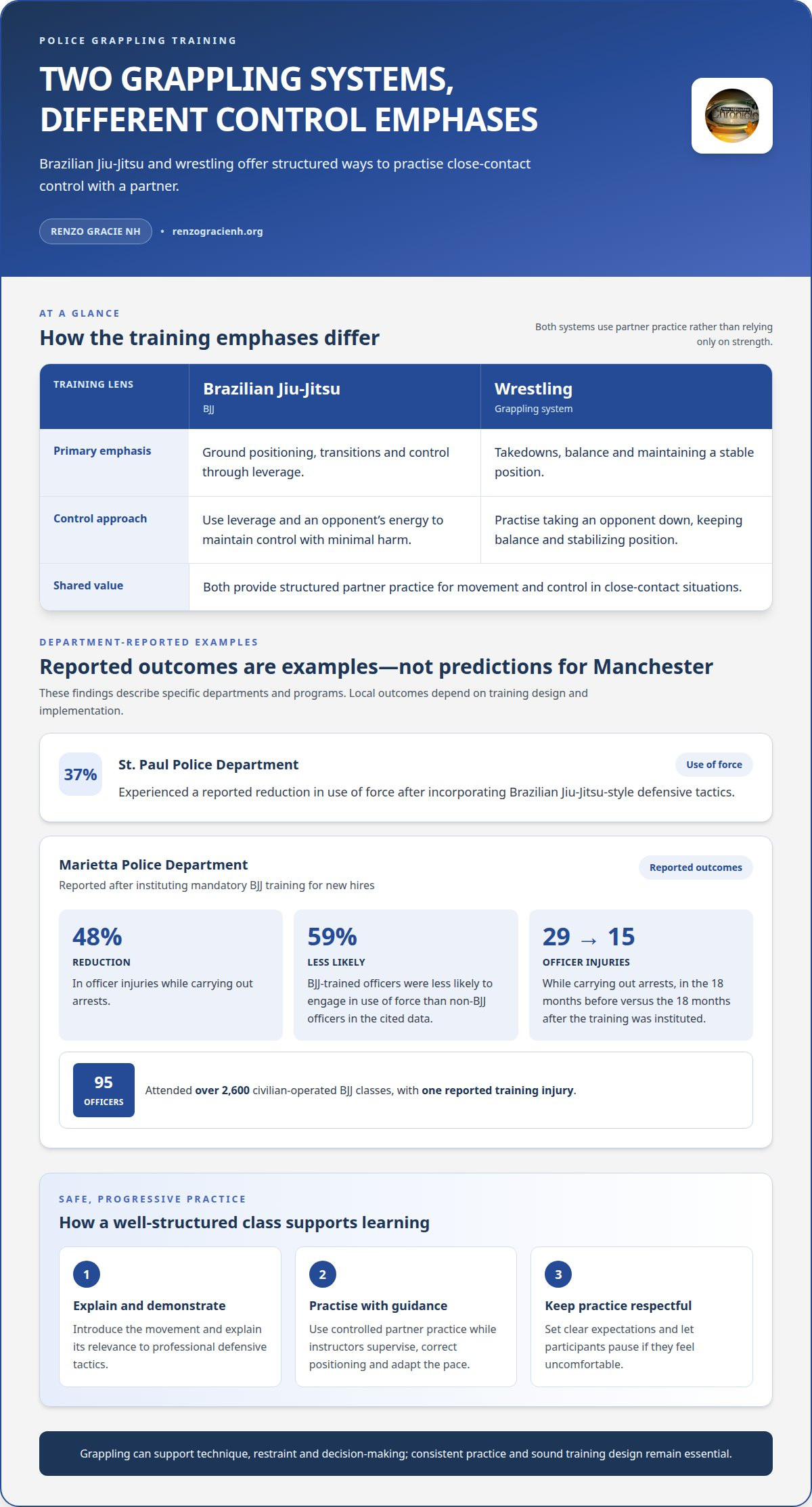
BJJ teaches ground positioning, transitions and control through leverage. Wrestling emphasizes takedowns, balance and maintaining a stable position. Both give officers structured ways to practise movement with a partner instead of relying only on strength.

Research offers a useful example, not a prediction for Manchester: St. Paul Police Department experienced a 37 percent reduction in use of force after incorporating Brazilian Jiu Jitsu-style defensive tactics. This finding supports examining grappling as one element of officer preparation, while recognizing that local outcomes depend on training design and implementation.

Officers in Manchester can train in law enforcement Jiu-Jitsu at Renzo Gracie NH. Grappling for law enforcement credibility in Manchester is best approached as practical skill-building, with instruction connected to professional defensive tactics rather than competition alone.

Instructor Qualifications and Training Risks

Useful instruction demonstrates grappling techniques progressively and explains their relevance to professional defensive tactics. Officers need to understand each movement’s purpose and how controlled practice can support sound judgment.

Partner drills involve physical contact and can carry injury risk. Instructors can reduce avoidable risk by explaining expectations, supervising practice, adapting the pace to participants’ experience and allowing anyone to pause if uncomfortable.

A well-structured class introduces and demonstrates a movement before guiding controlled partner practice. Officers build familiarity step by step as instructors correct positioning and reinforce safe conduct. This keeps technique and care central to training.

Brazilian Jiu-Jitsu teaches officers to use an opponent’s energy to maintain control with minimal harm. Marietta Police Department reported a 48% reduction in officer injuries while carrying out arrests after instituting mandatory BJJ training for new hires. It also reported that BJJ-trained officers were 59% less likely to engage in use of force than non-BJJ officers in the cited data.

Marietta Police Department reported 29 officers injured while carrying out arrests in the 18 months before mandatory BJJ training for new hires, compared with 15 in the 18 months after instituting it. The department also reported that 95 officers attended over 2,600 civilian-operated BJJ classes with one reported training injury.

Martial arts and community relations

Martial arts classes can create shared experiences between officers and residents outside enforcement settings. For grappling for law enforcement credibility in Manchester, part of the value lies in meeting as training partners, learning to communicate, cooperate and respect boundaries.

Community Trust in Police Training

Police training can support community trust when it reflects respect and accountability. In a shared class, an officer and a civilian might take turns practising a basic movement, listen to coaching and adjust their approach to a partner. These everyday interactions create a setting for conversation that differs from an official encounter.

Instructors help shape the environment by setting clear expectations. They can welcome beginners, explain how partners should communicate during drills and model respectful correction. For example, a coach can pause practice when someone seems uncertain, then show how partners can restart with agreement and care.

Officer Credibility Through Grappling

Grappling can contribute to credibility when officers show patience and self-control while learning with others. The aim of grappling for law enforcement credibility in Manchester is not to replace public engagement, but to create opportunities to demonstrate discipline and respect through shared practice.

Credibility develops through repeated, observable conduct. An officer who listens to a partner, accepts feedback and follows class expectations demonstrates respect in a practical setting. Residents can also see that training involves cooperation, not simply physical dominance. Those experiences may build familiarity, while trust still depends on officers’ conduct across their wider responsibilities.

For departments considering grappling for law enforcement credibility in Manchester, a community class can feel more inclusive when instruction stays focused on learning and participation is welcoming. Coaches can pair participants thoughtfully, explain drills in everyday language and make room for questions. These choices help people with different experience levels take part.

Officers interested in training that values respectful practice can explore community-centered Jiu-Jitsu training as one way to learn alongside others.
Grappling for law enforcement credibility in Manchester through officer control

Barriers to officer Jiu-Jitsu training

Officer Jiu-Jitsu training can be hard to sustain when shift patterns, staffing needs and court duties compete with scheduled practice. In Manchester, rotating rosters may make regular attendance difficult. Departments need to consider how sessions fit different shifts, how officers can revisit missed instruction and how practice can be scheduled without disrupting essential coverage.

Skill development also depends on continuity. An introductory session can present a movement, but applying it smoothly takes coached repetition. For example, an officer might learn a control position in class, then need further guided practice to recognize when to adjust positioning. Gaps between sessions can make it harder to build familiarity.

Physical readiness can affect participation, too. Grappling involves close contact and partner movement, so training needs clear instruction and supervised drills. An officer returning after an injury, for example, may need to adjust participation with the instructor instead of matching a partner’s pace. Planning for different experience and readiness levels helps make practice accessible.

Departments also need to define what training should accomplish. A program focused on sport competition may not meet the needs of officers seeking professional defensive tactics. Instructors and department leaders can align class objectives with job-relevant control, communication and decision-making, then review whether practice supports those goals.

Access is another practical consideration. Travel time, class schedules and competing duties can affect attendance for officers based in Manchester, Windham or Exeter. A consistent schedule and clear communication about session content can help departments plan participation. Training is easier to sustain when officers understand each class’s purpose and supervisors can account for it alongside other responsibilities.

Which grappling systems are commonly used in police training, such as Brazilian jiu-jitsu or wrestling?

Police grappling curricula may draw on Brazilian Jiu-Jitsu (BJJ), wrestling or elements of both. BJJ develops ground positioning, transitions and control through leverage. Wrestling focuses on takedowns, balance and maintaining a stable position. The distinction matters because each system develops different skills for close-contact situations.

A BJJ drill might teach an officer to move from a standing encounter into a controlled position on the ground. Wrestling practice can help officers work on balance and takedowns. Both involve responding to a partner’s movement, giving training a dynamic quality that solo practice cannot replicate.

Choosing a system depends on what a department wants its defensive tactics program to emphasize. BJJ offers structured practice in ground control and positional transitions. Wrestling develops movement, balance and takedown skills. A program combining both can draw on their different strengths, with instructors connecting each drill to professional objectives.

For officers, the label matters less than how clearly instruction connects techniques to job-relevant scenarios. A session can move from an explained technique to supervised partner practice, then discuss where the skill fits within an encounter. For example, officers can practise maintaining balance during a standing exchange before working on how positioning changes on the ground.

In Manchester, a suitable training approach should give officers a clear progression, from foundational movement to more complex partner drills. Instructors can explain the purpose of each technique and keep practice focused on control rather than competition. That structure helps departments evaluate whether BJJ, wrestling or a blend best fits their training priorities. To explore law enforcement Jiu-Jitsu training, consider a program focused on professional defensive tactics.

Brazilian Jiu-Jitsu training for police includes takedown techniques intended to help officers maintain control in tense situations, while emphasizing technique over aggression. Officer training also focuses on discipline, empathy, de-escalation and communication. Brazilian Jiu-Jitsu schools can serve as shared spaces where police and diverse community members build relationships through training.

Marietta Police Department officers trained in BJJ used Tasers in 54% of use-of-force incidents, compared with 77% for officers who did not train in BJJ, a difference of 23%. Adopt a Cop partners with local Brazilian Jiu-Jitsu academies to provide officers with free training for 12 to 18 months.

Renzo Gracie NH: Law Enforcement Jiu-Jitsu Training

Renzo Gracie NH offers Law Enforcement Jiu-Jitsu Training for officers seeking focused practice in professional defensive tactics. It is a practical next step for departments or individuals looking to develop grappling skills through structured instruction.

Training can help officers develop control, composure and practical movement for close-contact situations. The Adult Jiu Jitsu Program also offers adults a way to develop skills through ongoing practice, while the Kids Jiu Jitsu Program gives children a welcoming introduction to Jiu-Jitsu.

To experience the training before deciding on a next step, take a Free Introductory Class at Renzo Gracie NH. Contact the academy to discuss Jiu-Jitsu training that fits your goals.

Build the next stage of officer training

Credibility grows through habits officers can carry from practice into daily service. Consider how training can fit department priorities, support ongoing skill development and encourage thoughtful, controlled decision-making. For departments pursuing grappling for law enforcement credibility in Manchester, consistent training can connect physical practice with professional responsibilities.

Progress takes time and purposeful instruction. Officers develop skills through steady practice, while departments consider how training aligns with operational needs. The goal is not simply to learn techniques, but to build confidence, discipline and sound judgment that can support respectful interactions.

Renzo Gracie NH offers Law Enforcement Jiu-Jitsu Training for officers seeking professional defensive tactics instruction. Contact Renzo Gracie NH to discuss training and explore a thoughtful next step for your goals.

Frequently Asked Questions

What does grappling training for law enforcement involve?

Law enforcement Jiu-Jitsu involves coached Brazilian Jiu-Jitsu practice focused on defensive tactics and control. An instructor may demonstrate a movement, then guide officers as they practise it with a partner at a controlled pace. For example, officers can work on staying balanced while changing position during a close-contact drill. The emphasis is professional skill development, not competition.

How can a training provider help Manchester officers enroll in grappling training or arrange a department program?

A training provider can explain its law enforcement instruction and discuss how it relates to officers’ defensive tactics goals. Renzo Gracie NH offers Law Enforcement Jiu-Jitsu Training for officers in the Manchester area. An individual officer or department representative can contact the academy to discuss training needs and determine whether the program is a suitable next step for their team.

Manchester, NH Police Grappling Training Guide

What can grappling practice add to an officer’s professional toolkit? For those exploring police grappling training Manchester, the key is finding instruction that connects Brazilian Jiu-Jitsu with professional defensive-tactics development in a setting where beginners and experienced students can learn with confidence.

It’s reasonable to want training that feels relevant to the work, not simply a general martial-arts class. Grappling practice offers a structured way to build familiarity with control-focused movement and defensive tactics. It can complement agency policies and instruction, not replace them. Start by identifying your learning goals, then compare them with a program’s stated focus and location.

This guide explains how Brazilian Jiu-Jitsu can support professional development, what to look for in a local program, and how to explore law-enforcement instruction in Manchester, NH. Renzo Gracie NH offers specialized Law Enforcement Jiu-Jitsu Training at its Manchester academy, alongside a supportive community and instruction led by Professor Kevin Landry, a sixth-degree black belt under Renzo Gracie. A free introductory class gives new students a way to experience the academy and consider whether the training fits their goals.

Key Takeaways

  • Learn how Brazilian Jiu-Jitsu grappling practice relates to control-focused professional development, without assuming it guarantees workplace outcomes.
  • Assess a program by comparing your professional goals with its stated focus, location, and learning environment.
  • Explore what to look for in police grappling training Manchester officers can access through a local academy.
  • See how Renzo Gracie NH’s specialized Law Enforcement Jiu-Jitsu Training fits within its Manchester, Windham, and Exeter locations.
  • Take a first step with a free introductory class for new students at Renzo Gracie NH.

Why Police Grappling Training in Manchester Matters for Professional Readiness

Professional readiness involves more than knowing what to do in theory. Officers may seek structured practice to become more familiar with grappling situations, explore control-focused movement, and reflect on how they respond under pressure. Practice provides a setting for guided learning, but it cannot predict how a real-world encounter will unfold.

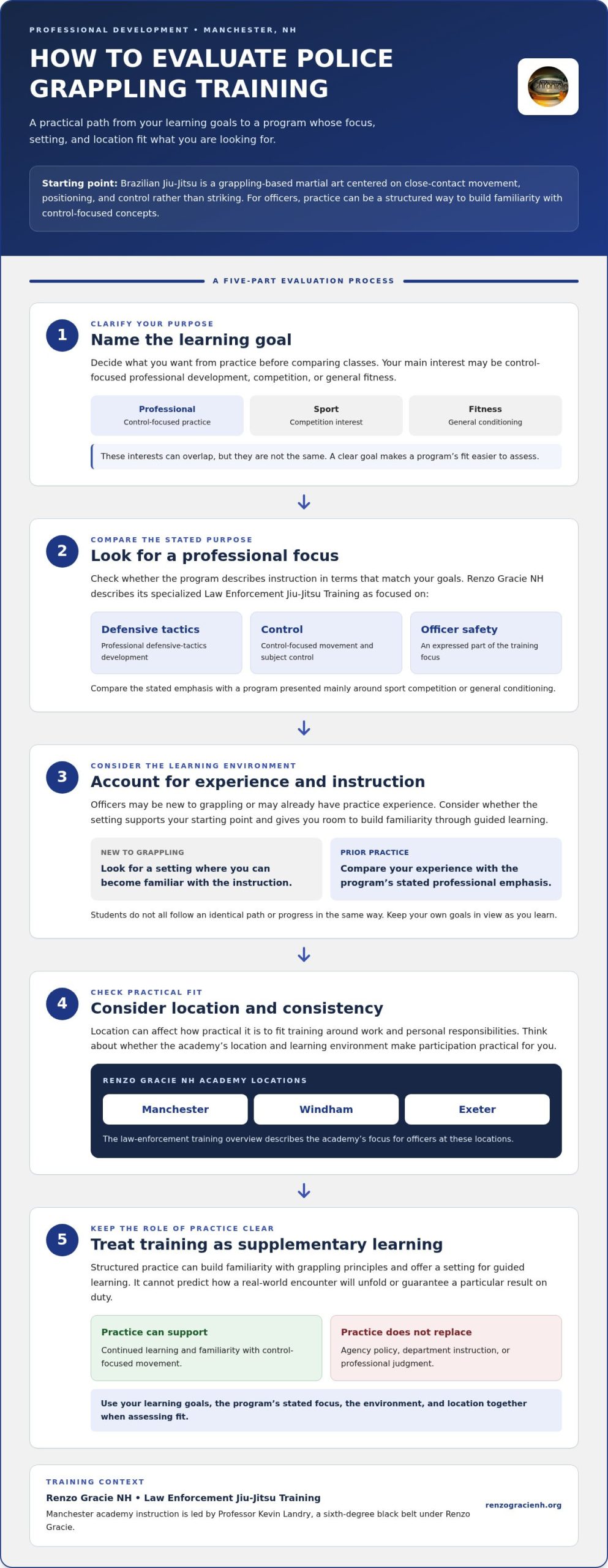
Police grappling training is structured practice in grappling principles that can build familiarity with control and defensive tactics. Renzo Gracie NH’s Law Enforcement Jiu-Jitsu Training focuses on defensive tactics, control, and officer safety. It supports continued learning, while agency training and policies remain essential to professional responsibilities.

For someone searching for police grappling training Manchester, the useful question is not simply whether a class involves martial arts. Compare the program’s stated purpose with the professional development you want to pursue. Consider, too, whether its location and learning environment make it practical for you to participate consistently.

What officers may be looking for in grappling practice

One officer may be interested in control-focused practice as a professional development goal, while another may be drawn to competition or general fitness. These interests can overlap, but they are not the same. Being clear about your main goal makes it easier to assess whether a program’s stated focus matches what you want from training. Experience also varies: some officers are new to grappling, while others have practiced before.

Brazilian Jiu-Jitsu is a grappling-based martial art. For a general introduction to its background and approach, see Brazilian Jiu-Jitsu. For law-enforcement learners, the academy’s stated emphasis is an important point of comparison. Renzo Gracie NH describes its specialized training in terms of professional defensive tactics, control, and officer safety. That focus distinguishes it from a program presented mainly around sport competition or general conditioning, without promising a particular result on duty.

Why a local Manchester, NH option can matter

Location affects how practical it is to fit training around work and personal responsibilities. Manchester is one of Renzo Gracie NH’s three New Hampshire academy locations, alongside Windham and Exeter. The law-enforcement Jiu-Jitsu training overview describes the academy’s focus for officers at these locations.

Use the program’s stated purpose to clarify what you want from practice. You might be seeking an introduction to grappling, continued Jiu-Jitsu practice, or instruction focused on professional defensive tactics. These are useful distinctions to make before starting. Officers bring different levels of experience, and a supportive learning environment gives students room to build familiarity over time while keeping their own goals in view.

How Brazilian Jiu-Jitsu Grappling Practice Relates to Law Enforcement

Brazilian Jiu-Jitsu is a grappling-based martial art, so practice centers on close-contact movement, positioning, and control rather than striking. For law-enforcement learners, this connection makes grappling worth exploring as a structured way to become more familiar with control-focused concepts. It does not determine how an officer should respond in a particular situation or guarantee a specific result on the job.

Grappling practice can support professional development by giving officers a place to build familiarity with control-focused movement over time. Renzo Gracie NH’s specialized law-enforcement training focuses on defensive tactics and subject control. The emphasis is on learning through practice, not treating a martial-arts class as a substitute for department instruction.

From martial-arts practice to professional learning

Guided practice gives students a setting to explore grappling concepts and develop familiarity over time. It can also prompt reflection on how control-focused movement relates to their learning goals. These are broad areas of learning, not a description of specific drills or techniques taught at the academy.

The professional relevance lies in the program’s stated focus on defensive tactics and subject control. Officers can consider how that focus connects with their own development goals while keeping the role of practice in perspective. This is supplementary learning; a martial-arts program does not replace agency policy, department instruction, or professional judgment.

Experience level and a supportive learning environment

Students arrive with different backgrounds. Renzo Gracie NH provides Jiu-Jitsu instruction for different experience levels, making the academy relevant to people who are new to Brazilian Jiu-Jitsu as well as those with prior practice. If grappling is unfamiliar, an introductory class can help you get a feel for the setting and the instruction.

Students do not all follow an identical path or progress in the same way. Approach training with a clear personal goal, consider the academy’s stated professional focus, and build your understanding gradually. The point is not to assume that a general martial-arts experience maps directly onto every work setting. It is to take part in structured practice with a realistic sense of its role.

For officers considering police grappling training Manchester, this distinction helps set expectations: Jiu-Jitsu practice is a learning opportunity, while agency policies and department training guide professional responsibilities. Renzo Gracie NH’s Jiu-Jitsu programs offer a local place to explore instruction within a supportive academy community.

Manchester, NH Police Grappling Training Guide

How to Evaluate Police Grappling Training Near Manchester

Compare a program’s stated focus with what you want to learn. For officers, that means distinguishing professional development goals from general fitness or competition interests, then weighing location and learning environment. This simple framework makes a search for police grappling training Manchester more focused and practical.

Consideration What to look for Renzo Gracie NH
Training goal A clearly stated purpose that aligns with your learning priorities. Offers specialized Law Enforcement Jiu-Jitsu Training.
Relevance to law enforcement A connection to professional defensive tactics and control, without promises about workplace outcomes. Its law-enforcement training focuses on defensive tactics, control, and officer safety.
Location A location that makes participation practical to consider. Academies are in Manchester, Windham, and Exeter, New Hampshire.
Learning environment An atmosphere and level of instruction that feel approachable for your experience. The academy emphasizes a supportive community and clean, state-of-the-art facilities, with Jiu-Jitsu instruction for different experience levels.

Questions that clarify whether training matches your goals

Start with the program’s stated focus. Is it designed for law-enforcement defensive tactics, or does it emphasize something else? Next, consider whether the learning environment feels approachable for your experience level, especially if grappling is new to you. Finally, name the skill or area of learning you want to explore. A clear goal helps you assess the fit, while keeping in mind that no class can guarantee how practice will translate to a particular workplace situation.

Location and learning environment in the Manchester area

Convenient access can make regular participation easier to consider. Renzo Gracie NH’s Manchester academy is one of its New Hampshire locations, with additional academies in Windham and Exeter. The academy describes its facilities as clean and state-of-the-art and emphasizes a supportive community. These details help you compare the setting alongside the program’s professional focus and location.

Bring your own priorities to the comparison. If your main interest is professional defensive-tactics development, the academy’s stated law-enforcement focus is directly relevant. If you are mainly looking for general conditioning or competition, consider that distinction when deciding what you want from a program. The goal is to match the purpose, location, and learning environment with your needs. Renzo Gracie NH offers specialized instruction in Manchester, with its Windham and Exeter academies providing additional New Hampshire locations.

A Practical Way to Explore Grappling Training as a Manchester Officer

Start by deciding what you want to learn, then review the local academy’s program information and experience the setting. This sequence makes it easier to approach police grappling training Manchester with a clear purpose, whether you are new to Jiu-Jitsu or already have grappling experience. Keep the role of training in perspective: it can complement professional development, but it does not replace department instruction or policy.

  1. Identify your goals. Decide what you want to explore, such as learning about grappling practice or pursuing training with a law-enforcement focus.
  2. Review academy information. Compare the program’s stated purpose, location, and learning environment with your priorities.
  3. Choose a first step. An introductory class lets you experience the academy and consider whether its instruction and atmosphere fit your goals.

Turn professional goals into a clear starting point

Make your goal specific enough to guide your decision. You might want to learn about Jiu-Jitsu as a new discipline, or you may be looking for practice connected to professional defensive tactics. Note any questions about the law-enforcement training before attending. A short list helps you focus your exploration without assuming that practice guarantees a particular outcome on duty.

Use the introductory class to experience the academy

Renzo Gracie NH offers a free introductory class to new students. It provides an opportunity to experience the academy as you consider your next step. If you are unfamiliar with Jiu-Jitsu, use the class to get a sense of the setting and reflect on whether the instruction and atmosphere suit your goals.

Before attending, read the free Jiu-Jitsu trial class guide for information about trying a class. Think about what you want to learn from the experience: you might want a clearer sense of the academy, a better understanding of its Jiu-Jitsu instruction, or a chance to consider whether its professional focus aligns with your priorities.

Start with your goal, learn about the academy, and use the introductory opportunity to make an informed decision. If you’re ready to begin, try a free introductory Jiu-Jitsu class at Renzo Gracie NH.

Explore Law Enforcement Grappling Training at Renzo Gracie NH in Manchester

For officers seeking a local program with a professional focus, Renzo Gracie NH offers specialized Law Enforcement Jiu-Jitsu Training in Manchester. Its stated emphasis on defensive tactics, control, and officer safety gives officers a clear starting point for exploring how grappling practice may complement professional development. Training provides practice, not a guarantee of how a situation will unfold or a replacement for agency policy and instruction.

The Manchester academy is part of Renzo Gracie NH’s three-location New Hampshire network. The academy also has locations in Windham and Exeter. For someone searching for police grappling training Manchester, the key local detail is that specialized law-enforcement instruction is offered at the Manchester academy, within a broader New Hampshire academy community.

A New Hampshire academy with a Renzo Gracie connection

Professor Kevin Landry leads instruction at Renzo Gracie NH. He is a sixth-degree black belt under Renzo Gracie, a lineage connection that provides context for the academy’s Jiu-Jitsu background. The academy has also been featured on NH Chronicle.

These details help put the local program in context, but the central question is whether its law-enforcement focus aligns with your learning goals. The professional emphasis and instructor background provide useful information as you consider whether the academy’s approach suits you. Each student’s experience and development are individual.

Take the next step in Manchester

You do not need prior Jiu-Jitsu experience to explore an introductory class. Renzo Gracie NH offers a free trial class to new students, giving you an opportunity to experience the academy before deciding whether to continue. Consider what you want to learn, then reflect on whether the environment and program’s stated focus fit your goals.

Start by exploring the academy’s Law Enforcement Jiu-Jitsu Training and keeping your professional development goals in view. A trial class offers a practical first step, while your department’s policies and instruction remain essential guides for professional responsibilities.

Explore training at Renzo Gracie NH and take the first step with a free trial class.

Take the Next Step in Your Professional Development

Approach grappling practice with a clear purpose. Consider what you want to learn, how structured practice could complement your development, and what would help you feel comfortable getting started. Ongoing learning and reflection can help you build familiarity over time.

If you’re considering police grappling training Manchester, let your goals guide your next move. You do not need to have everything figured out before beginning. A first class can help you understand whether this kind of training fits your interests and professional learning priorities.

Explore law-enforcement Jiu-Jitsu training at Renzo Gracie NH and take a first step toward continued learning.

Frequently Asked Questions

Is police grappling training relevant for officers with no Brazilian Jiu-Jitsu experience?

Yes. Renzo Gracie NH offers Jiu-Jitsu instruction for different experience levels, along with specialized training for law enforcement. If you are new to grappling, approach it as a learning process and focus on becoming familiar with the practice over time. Your starting experience is one part of your learning journey; students may progress at different rates.

Can Brazilian Jiu-Jitsu training support law-enforcement subject-control learning?

It can provide a setting for learning related to subject control. Renzo Gracie NH describes its law-enforcement training as focused on professional defensive tactics, officer safety, and subject control. That focus can help you judge whether the program aligns with your learning goals. Training does not guarantee specific workplace results and does not replace your agency’s policies, instruction, or professional judgment.

How is law-enforcement grappling training different from general Jiu-Jitsu instruction?

The distinction is the stated professional focus. Renzo Gracie NH offers specialized Law Enforcement Jiu-Jitsu Training for professional defensive tactics, alongside broader Jiu-Jitsu programs. This matters if your goal is to explore grappling as part of professional development rather than approach it solely as a general martial-arts activity. The focus does not imply a particular class format or guarantee a result on the job.

Where can police officers find grappling training in Manchester, New Hampshire?

Renzo Gracie NH’s Manchester academy offers law-enforcement Jiu-Jitsu training for officers. The academy also has locations in Windham and Exeter, New Hampshire. If you are considering police grappling training Manchester, compare how the professional focus and location fit your goals and routine.

Does police grappling training replace department defensive-tactics instruction?

No. Brazilian Jiu-Jitsu training can be additional skill development, not a replacement for department instruction, policies, or professional judgment. Continue to follow the training and procedures established by your department. Outside practice can offer a place to learn and build familiarity, while agency guidance remains central to professional responsibilities.

Can new students try a class at Renzo Gracie NH before committing?

Yes. Renzo Gracie NH offers a free trial class to new students. It gives you an introductory opportunity to experience the academy and consider whether its approach fits your goals. Use the class to get a sense of the environment and decide whether you would like to continue exploring Jiu-Jitsu.

Try a free introductory class at Renzo Gracie NH and explore law-enforcement Jiu-Jitsu training in Manchester, with additional academy locations in Windham and Exeter.