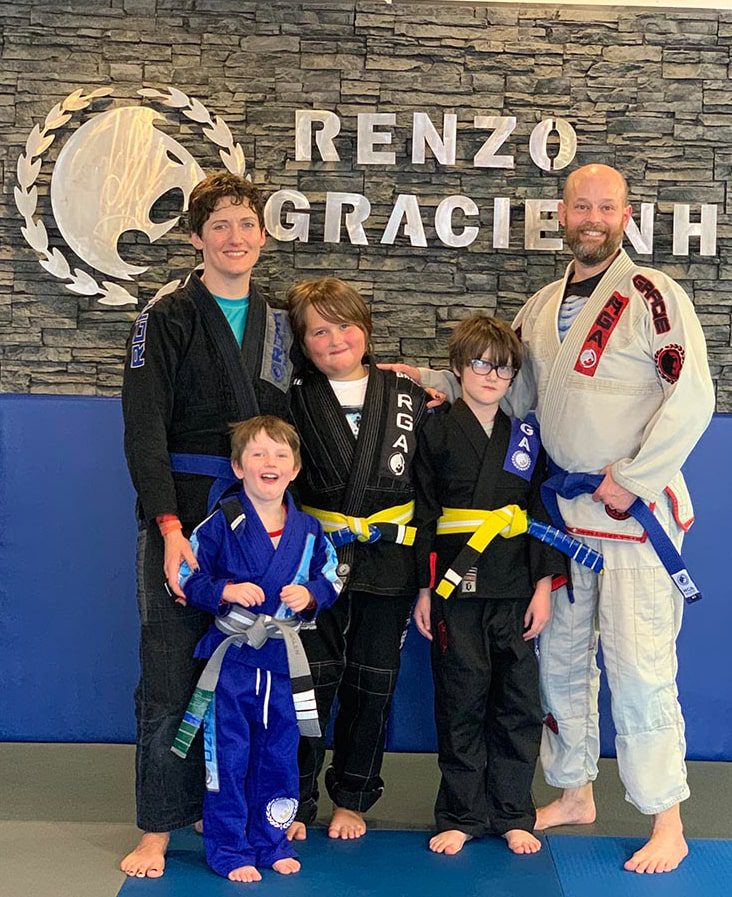
Mastering Officer Subject Control Techniques in Exeter: A Modern BJJ Approach
What if the most effective way to de-escalate a physical confrontation isn’t a strike or a tool, but a calm, technical grip? It’s a question that changes the way we look at modern policing. Every officer in the Seacoast area knows the heavy tension of a close-quarters struggle. It’s a high-stakes moment where a single split-second decision can lead to a career-altering injury or a complex lawsuit. You deserve to feel certain in those moments.
Confidence comes from competence. This guide explores how specialized Brazilian Jiu-Jitsu training provides the foundation for superior officer subject control techniques Exeter departments can rely on to protect both the public and their personnel. By focusing on leverage over luck, you’ll discover how to reduce liability and increase your personal safety during every arrest. We’ll examine the practical mechanics of grappling, the importance of a reputable lineage, and how these skills translate directly from the mats to the streets of New Hampshire.
Key Takeaways
- Understand why modern policing is moving away from unreliable pain compliance toward mechanical control to ensure more consistent outcomes.
- Learn how grappling-based techniques like the clinch help you safely close the distance and neutralize threats without relying on high-impact strikes.
- Discover how mastering specialized officer subject control techniques Exeter departments can access will significantly reduce your risk of injury and legal liability.
- Gain insights from the prestigious Renzo Gracie lineage and Professor Kevin Landry’s two decades of experience training law enforcement professionals.
- Explore how regular, lineage-backed training builds the disciplined confidence needed to handle close-quarters struggles with calm authority and professional poise.
The Evolution of Subject Control Techniques for NH Law Enforcement
The landscape of policing in 2026 demands a sophisticated approach to physical encounters. Traditional methods often relied on striking or pain, but modern standards prioritize safety for everyone involved. Within this framework, subject control is the ability to restrain a suspect using leverage rather than impact. This shift toward mechanical control is why many Exeter departments are re-evaluating their defensive tactics. By focusing on officer subject control techniques Exeter professionals can apply with precision, agencies are reducing the likelihood of catastrophic injuries during arrests.
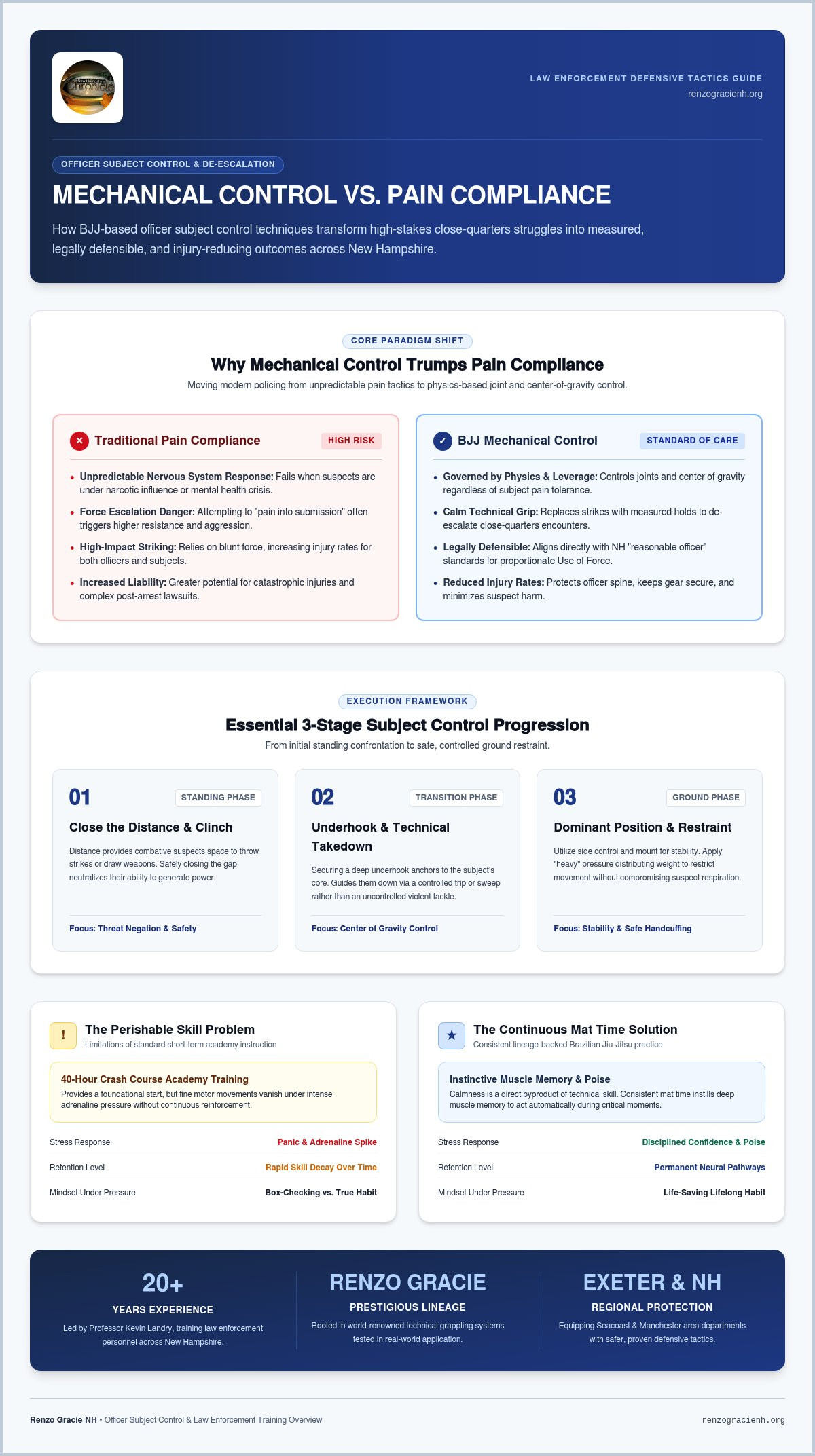
Pain compliance is inherently unpredictable. If a subject is under the influence of narcotics or experiencing a mental health crisis, their nervous system may not respond to pain as expected. In these high-arousal states, trying to “pain them into submission” often leads to escalating force. Mechanical control, rooted in the principles of Brazilian jiu-jitsu, focuses on controlling the subject’s joints and center of gravity. It works regardless of the subject’s pain tolerance. It’s about physics, not aggression.
De-escalation Through Technical Proficiency
Calmness is a byproduct of skill. When an officer lacks confidence in their close-quarters abilities, the panic response often takes over during a struggle. This adrenaline spike can lead to excessive force. Technical proficiency allows an officer to remain composed. In New Hampshire, the legal standard for Use of Force often hinges on what a reasonable officer would do in a similar situation. Having a deep toolbox of officer subject control techniques Exeter training provides ensures that the response is measured, controlled, and legally defensible.
The Limitations of Traditional Defensive Tactics
Short-term training creates a false sense of security. A 40-hour crash course at an academy is a start, but these are highly perishable skills. Without consistent practice, the fine motor movements required for effective restraint vanish under pressure. This is the perishable skill problem facing many agencies today. Transitioning to a consistent training culture is essential. It moves the needle from checking a box to building genuine, life-saving habits that stay with an officer throughout their career. Consistent mat time builds the muscle memory needed to act instinctively when it matters most.
Essential BJJ-Based Control Techniques Every Officer Needs
Effective subject control starts before the ground is ever reached. It’s a system of movements designed to keep you safe while neutralizing a threat. In a high-stress encounter, you don’t have time to second-guess your grip. You need muscle memory. By integrating officer subject control techniques Exeter officers can practice in a controlled environment, you build the ability to act instinctively. These techniques aren’t about winning a fight; they’re about ending a confrontation safely and professionally.
The foundation of this approach is the clinch. When a suspect becomes combative, distance is your enemy. A suspect with space can throw strikes or reach for weapons. Closing that gap safely is the first priority. Once you’re inside, you negate their ability to generate power. From there, a controlled transition to the ground allows you to maintain dominance until backup arrives. This isn’t about a violent tackle. It’s about a measured, technical descent that protects both your spine and the suspect’s well-being.
The Clinch and Takedown Hierarchy
Control the center. Win the encounter. The underhook is the gold standard for managing a suspect’s center of gravity. By securing a deep underhook, you anchor yourself to their core, making it nearly impossible for them to turn into you or pull away. This position allows you to guide the subject to the ground using leverage rather than raw strength. A technical takedown focuses on a slow, controlled trip or sweep. This method ensures you don’t land on your own head or lose your equipment during the transition. If you’re looking to sharpen these skills, exploring a free introductory class is a great way to see how these mechanics work in real-time.
Dominant Position and Handcuffing Transitions
Once on the ground, the goal is stability. Side control and the mount are the most effective positions for maintaining dominance while awaiting backup. The key is “heavy” pressure. You want to distribute your weight in a way that makes movement difficult for the suspect, but you must do so without restricting their breathing. This balance is critical for reducing liability and ensuring subject safety.
The “Gift Wrap” is perhaps the most valuable tool for the modern officer. By isolating one of the subject’s arms across their own chest, you create a powerful lever that limits their mobility and exposes their back. This position makes the transition to standard-issue handcuffs significantly smoother. It allows you to maintain officer subject control techniques Exeter training has refined, keeping the suspect pinned while you safely access your restraints. You stay in control. The suspect stays restrained. Everyone goes home safe.
Why Grappling Proficiency Trumps Traditional Pain Compliance
Pain compliance has long been a staple of defensive tactics, but it carries a significant flaw. It relies entirely on the subject’s ability to feel and respond to discomfort. In the field, officers frequently encounter individuals in high-arousal states, whether due to a mental health crisis or chemical impairment. For these subjects, pain is often a secondary concern or completely ignored. This is the “Pain Compliance Trap.” When a suspect doesn’t respond to a joint lock or a pressure point, the officer’s natural instinct is often to increase the pressure or escalate force. This leads to unnecessary injury and a breakdown in de-escalation.
Mechanical advantage offers a more reliable alternative. By using officer subject control techniques Exeter training provides, you focus on the skeletal system rather than the nervous system. Leverage doesn’t care about a subject’s adrenaline levels. If you control the levers of the body, you control the person. This approach drastically reduces injury rates for both the officer and the subject. It replaces explosive, high-impact movements with steady, technical restraint. This creates a safer environment for everyone involved in the encounter.
The Science of Mechanical Control
In Brazilian Jiu-Jitsu, every movement is a study in physics. Using your entire body weight against a single joint or using a limb as a fulcrum allows a smaller officer to control a much larger subject. Controlling the head and hips is essential. If the head cannot move, the body cannot follow. If the hips are pinned, the subject cannot generate the power needed to stand or strike. This level of technicality eliminates the need for “striking to submit,” which often creates poor optics and high legal liability. Technical control looks like professional restraint; striking looks like a fight.
Liability Reduction for Exeter Departments
Modern policing happens under the constant lens of the bodycam. When an officer uses officer subject control techniques Exeter programs emphasize, the footage tells a story of composure. Instead of a chaotic struggle that can be misinterpreted as excessive force, the camera captures a methodical application of leverage. This supports a “de-escalation first” policy by proving the officer used technical, non-lethal options to gain compliance. Departments that prioritize grappling proficiency often see a decrease in litigation. The physical evidence of the arrest shows clear, disciplined control rather than a desperate brawl. Staying calm when a situation goes to the ground isn’t just a physical skill; it’s a legal safeguard.
Implementing Subject Control Training in the Exeter and Manchester Region
Access is often the biggest hurdle to professional development. For officers serving in the Seacoast and Southern New Hampshire, finding high-level instruction shouldn’t require a long commute to a major city. Local training hubs in Exeter, Manchester, and Windham now provide the infrastructure needed to master officer subject control techniques Exeter departments require for modern safety standards. Having a reputable academy nearby means you can refine your skills without sacrificing your limited time off between shifts.
Building a “department-approved” training culture starts with individual initiative. When one officer shows improved composure and technical skill during a difficult arrest, others take notice. This bottom-up approach to training creates a safer environment for the entire squad. It moves the conversation from mandatory minimums to a culture of excellence and mutual support. You aren’t just training for yourself; you’re training for the partner who relies on you in a crisis.
Local Access to Expert Instruction
Quality matters. Training with a 6th-degree black belt like Professor Kevin Landry offers a level of expertise that is rare even in major metropolitan areas. With over two decades of teaching experience in the region, he provides a lineage-backed curriculum specifically adapted for the needs of law enforcement. Renzo Gracie NH serves as a vital resource for the Southern NH community. It is a place where officers from various jurisdictions can network and share experiences on the mats. This shared environment builds a common language of safety and control that transcends individual department borders.
Consistency and the Training Journey
A one-off seminar is a great start, but it isn’t a solution. Proficiency is built through a steady, weekly rhythm. We understand that shift work is demanding and unpredictable. However, integrating even one or two consistent sessions into your routine creates a foundation of disciplined confidence that doesn’t fade when the adrenaline spikes. This long-term commitment turns a perishable skill into a permanent asset. It’s about moving from “knowing” a technique to “owning” it. If you’re ready to see how this training fits your professional goals, you can sign up for a Free Introductory Class to vet the curriculum and meet our community of practitioners.
Specialized Law Enforcement Training at Renzo Gracie NH
Lineage is the backbone of effective training. The Renzo Gracie name is synonymous with the practical application of Jiu-Jitsu in real-world scenarios. It’s not about points or medals; it’s about what works when the stakes are highest. At Renzo Gracie NH, we take this legacy and apply it directly to the officer subject control techniques Exeter law enforcement professionals require. Professor Kevin Landry, a 6th-degree black belt under Renzo Gracie, leads this mission. His two decades of experience in the region ensures that the techniques taught are battle-tested and legally sound. You aren’t just learning moves. You’re inheriting a system of control.
A specialized LE session at our Windham academy is methodical. We begin with foundational movements that mirror the physical demands of your shift. We then transition into technical drills that focus on the specific challenges of subject control. You’ll practice closing the distance, securing a clinch, and guiding a subject to the ground while maintaining total awareness of your surroundings. It’s a purposeful progression. This steady momentum reinforces the idea that these skills are a consistent and reliable part of your professional lifestyle. You’ll leave the mat feeling empowered and prepared.
The Renzo Gracie NH Difference
We offer a supportive, ego-free environment. This is crucial for professional development. In our specialized sessions, the focus shifts entirely from sport-based competition to duty-centric survival and control. We call this “Street” or “Duty” BJJ. We teach you how to manage a subject while wearing a full duty belt, prioritizing weapon retention and situational awareness. You get direct access to 6th-degree black belt expertise in every session. It’s about building a community of professionals who are dedicated to safety and excellence. We move away from the aggressive atmosphere of combat sports to focus on disciplined confidence.
Getting Started Today
The path to mastery begins with a single step. We invite you to sign up for a free introductory class to experience our training methodology firsthand. This is a risk-free way for you and your colleagues to vet our curriculum. We also offer departmental training options and group sessions for local agencies looking to modernize their defensive tactics. By mastering these officer subject control techniques Exeter officers can significantly enhance their safety and confidence on the job. Join us in Windham and discover the empowerment that comes from technical proficiency and a lineage of excellence.
Elevating Professional Safety Across the Seacoast
Mastery is a journey; it isn’t a destination. You’ve seen how shifting from unpredictable pain compliance to reliable mechanical advantage fundamentally changes the nature of a struggle. By prioritizing leverage and technical proficiency, you protect yourself, the subject, and your professional reputation. Implementing modern officer subject control techniques Exeter training provides ensures that every encounter is handled with composed authority rather than desperate force.
True confidence grows through consistent mat time with mentors who understand your unique challenges. Professor Kevin Landry, a 6th-degree Renzo Gracie Black Belt, has spent over 20 years serving the Windham, Manchester, and Exeter communities with a specialized law enforcement curriculum designed for real-world duty. It’s time to evolve your skillset alongside a community dedicated to excellence. Book Your Free Introductory Law Enforcement Class at Renzo Gracie NH today to experience the difference technical proficiency makes. We’re ready to help you build the disciplined confidence you need to stay safe on every shift.
Frequently Asked Questions
How do officer subject control techniques differ from sport Jiu-Jitsu?
Law enforcement training focuses on control and restraint rather than scoring points or hunting for submissions. While sport BJJ allows for risky transitions, officer subject control techniques Exeter professionals use prioritize weapon retention and situational awareness. We emphasize maintaining a dominant position while awaiting backup. This approach ensures you aren’t over-extending yourself in a way that creates a vulnerability during a real-world arrest or physical struggle.
Can BJJ training in Exeter count toward my department’s required training hours?
Many departments in New Hampshire recognize specialized defensive tactics training when it’s led by a qualified instructor. Since Professor Kevin Landry is a 6th-degree black belt with over two decades of experience, his curriculum carries significant weight. You should check with your specific training officer in Exeter or Manchester to confirm how these hours apply toward your annual requirements. We provide the documentation needed to verify your consistent attendance and progress.
What happens if a suspect is much larger than the officer during subject control?
Brazilian Jiu-Jitsu is specifically designed to allow a smaller person to control a much larger, stronger adversary through leverage and fulcrums. By focusing on the subject’s skeletal structure rather than trying to overpower their muscles, you can gain compliance effectively. This mechanical advantage is the core of our Law Enforcement Jiu-Jitsu Training. It ensures that your success doesn’t depend on being the biggest person in the room during a struggle.
Is BJJ-based training safe for older officers or those with previous injuries?
Yes, this training is highly adaptable for officers at any stage of their career. We focus on technical efficiency and quiet authority rather than explosive athleticism. This methodical approach reduces the physical toll on your body while increasing your tactical effectiveness. Our environment is supportive and ego-free, allowing you to train at a pace that respects your physical limits while still building the skills necessary for professional safety.
How long does it take to become proficient in basic officer control techniques?
Basic proficiency in core control movements can often be achieved within a few months of consistent, twice-weekly training. You’ll start feeling more composed in close-quarters situations almost immediately after learning fundamental clinch and posture concepts. However, true mastery of officer subject control techniques Exeter departments value is a long-term commitment. Regular practice ensures these movements become instinctive muscle memory that won’t fail you under the high stress of a real-world encounter.
Do I need to wear a full Gi for law enforcement jiu-jitsu training?
We primarily focus on Duty BJJ, which mirrors the clothing and equipment you wear on the job. While traditional Gi training offers excellent technical foundations, LE-specific sessions often utilize standard tactical attire or No-Gi gear. This helps you understand how grips change when you aren’t grabbing a heavy cotton uniform. Training in gear that approximates your daily uniform ensures your skills translate seamlessly from the mat to the street.
Is the Renzo Gracie NH program open to all law enforcement agencies in New Hampshire?
Our program is open to all law enforcement, first responders, and military personnel throughout the region. We regularly welcome officers from Windham, Manchester, and Exeter who are looking to enhance their defensive tactics. This diversity creates a unique networking opportunity where professionals can share insights and experiences. Building a shared language of technical control across different agencies improves regional safety and cooperation during multi-jurisdictional incidents or mutual aid calls.
Can these techniques be used while wearing a full duty belt?
Yes, our specialized curriculum explicitly accounts for the presence of a full duty belt. We teach you how to maintain dominant positions without your equipment becoming an obstacle or a liability. Weapon retention is integrated into every control technique we practice. Learning how to move and grapple while protecting your sidearm and other tools is a critical component of professional Law Enforcement Jiu-Jitsu Training at our academy.