Posts

BJJ for Child Confidence and Discipline: What Parents Should Know

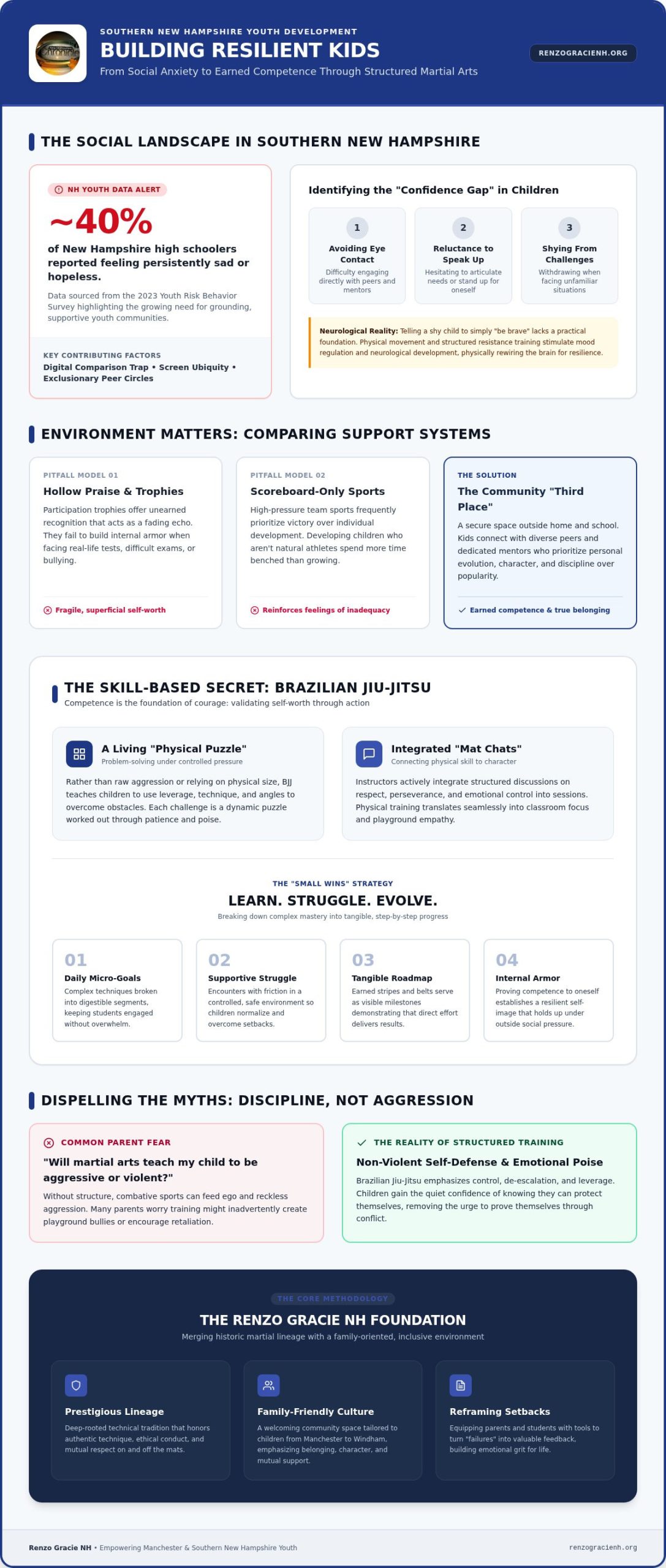
Could a grappling sport help your child grow in confidence without encouraging aggression? It’s a fair question, especially if your child is shy, energetic, or unsure about trying something new. BJJ for child confidence and discipline is less about winning and more about practising focus, respect, patience, and problem-solving with others.

Progress often shows up in small moments before it appears in a belt: listening to an instructor, trying again after a difficult drill, or feeling more comfortable joining in. These changes aren’t guaranteed, and competition results aren’t the only measure of growth. A supportive, structured environment matters, too.

This article explains what children practise in Brazilian Jiu-Jitsu, what realistic signs of growing confidence and discipline can look like, and how you can support your child’s learning without pressure. At Renzo Gracie NH, children can experience training in a complimentary introductory class. The academy serves families in Windham, Manchester, and Exeter, and a first visit can simply be a chance to see how the setting feels.

Key Takeaways

  • BJJ for child confidence and discipline is best understood through everyday practice: trying, listening, learning from mistakes, and showing respect.
  • Look for observable signs of progress, such as joining warm-ups, accepting coaching, or returning to a challenging activity, rather than relying only on belts or competition results.
  • Support your child by asking about effort and learning, and make room for frustration without pressuring them to prove toughness.
  • A structured, encouraging training environment helps children practise skills with guidance and respect for their partners.
  • Families in Windham, Manchester, and Exeter can explore children’s instruction at Renzo Gracie NH, where Professor Kevin Landry brings over two decades of regional teaching experience.

How BJJ can support a child’s confidence and discipline

Brazilian Jiu-Jitsu can give children opportunities to practise confidence and discipline, but it can’t promise a particular personality change or outcome. In a structured class, children learn skills through guided movement and partner practice. Brazilian Jiu-Jitsu is a grappling martial art; Brazilian Jiu-Jitsu on Wikipedia offers background on its history and principles.

For parents, the distinction matters. Confidence is the willingness to try, ask questions, and recover from a mistake; discipline is the practice of listening, following routines, showing respect, and persisting. These skills can support each other, but they aren’t the same. A child might eagerly attempt a new movement and still need reminders to wait their turn. That’s a chance to practise, not a contradiction.

What confidence can look like on the mat

Confidence doesn’t have to be loud. One child may gradually join a warm-up; another may watch an unfamiliar movement first, then try it, or ask an instructor for help when a step feels confusing. Each is a practical sign of willingness to participate and learn.

Children express confidence in different ways and at different paces. It isn’t measured by winning, being outgoing, or never feeling nervous. A child can hesitate, make a mistake, and still build confidence by choosing to try again when ready.

What discipline means in a children’s BJJ class

Following instructions, practising a routine, and paying attention to the next step give children a chance to exercise focus and self-management. Repetition is part of learning: listen, practise, notice what needs adjusting, and try again. These habits take time, and children may need guidance along the way.

Partner practice adds another layer. Taking turns, listening to a partner, and using controlled movement help children practise patience and respect while learning together. The goal isn’t to move carelessly or overpower someone. Training should be guided and appropriate to the child.

Discipline also isn’t unquestioning obedience or punishment. Children should be able to ask for clarification, communicate discomfort, and learn why class expectations matter. BJJ for child confidence and discipline is about practising useful choices in a supportive setting, not expecting instant changes beyond the mat.

How Brazilian Jiu-Jitsu practice builds confidence and discipline step by step

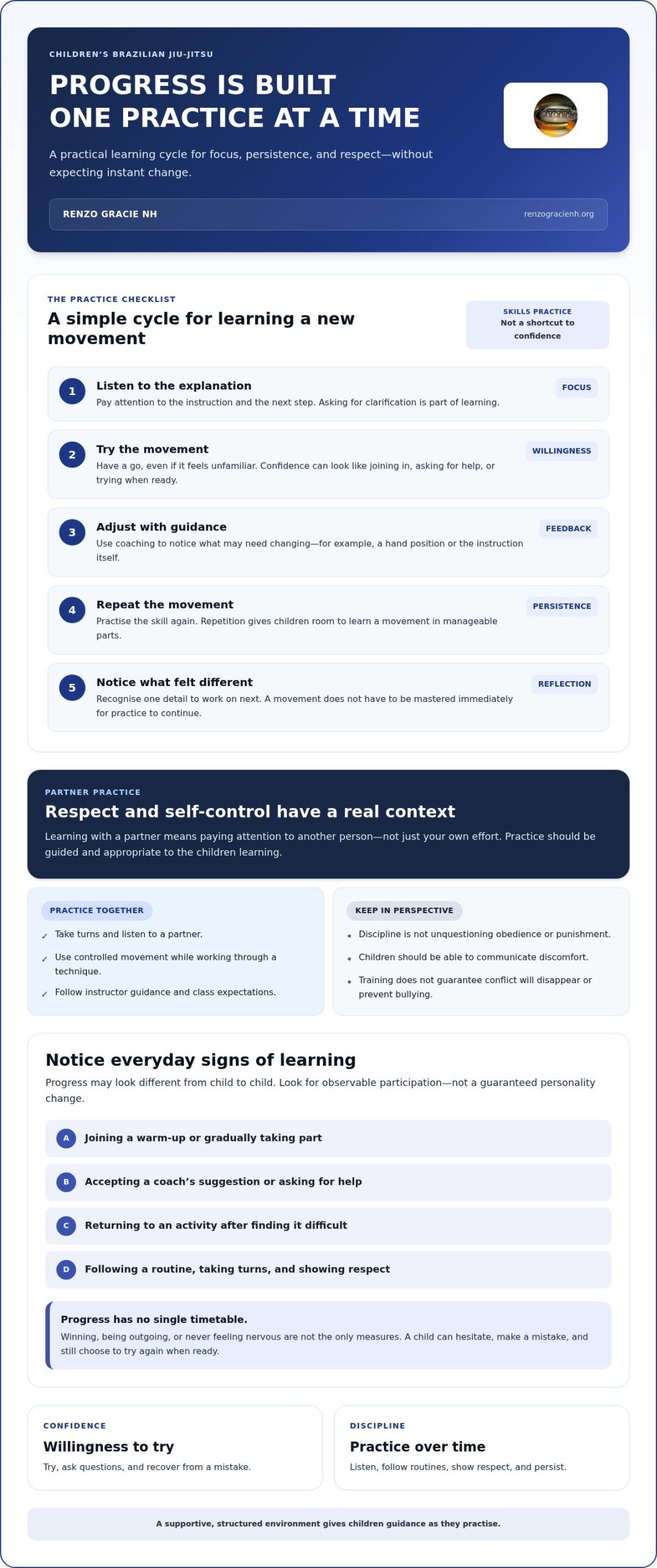
Growth comes through practice, not a sudden transformation. A child learning a new movement can follow a simple cycle: listen to an explanation, try the movement, adjust with guidance, repeat it, and notice what felt different. Each turn through that cycle gives them a chance to focus, respond to feedback, and take another step.

Brazilian Jiu-Jitsu is skills practice, not a shortcut to confidence. Techniques involve solving movement problems, such as how to create space, find balance, or respond to a partner’s position. The emphasis is on learning and applying technique, not simply relying on physical dominance. A child who doesn’t get a movement right immediately can still make progress by noticing one detail and trying again.

Small challenges help children practise persistence

Unfamiliar movements can take time to understand. Breaking a skill into manageable parts and repeating it gives a child room to learn without needing to master everything at once. A coach can help treat a mistake as useful feedback: perhaps the child needs to adjust a hand position or listen to the instruction again. That approach can encourage curiosity instead of making one imperfect attempt feel like failure.

Children respond to challenges in different ways. Some may be ready to try again right away; others may need a pause or more guidance. The aim is to support learning at a suitable pace, not to push every child toward the same response.

Partner practice gives respect and self-control a real context

Practising with a partner makes cooperation part of the learning. Children take turns, pay attention to each other, and use controlled movement as they work through a technique. They learn that training depends on a partner’s participation and comfort, not just their own effort.

Partner work needs appropriate supervision. Instructors guide practice so it’s suitable for the children learning, with clear expectations around respect and control. These habits can be practised on the mat, but they don’t guarantee that conflict will disappear or prevent bullying.

For parents exploring BJJ for child confidence and discipline, the useful question isn’t whether one class will change a child. Consider whether the learning process gives them supportive opportunities to listen, work through difficulty, and practise with respect. Families can learn more about children’s Brazilian Jiu-Jitsu instruction at Renzo Gracie NH.

What a child’s BJJ progress may look like: and what it cannot promise

Progress in Brazilian Jiu-Jitsu doesn’t follow one timetable, and it isn’t always easy to spot from the sidelines. A child might first watch before joining in, then take part in a warm-up, accept a coach’s suggestion, or return to an activity after finding it difficult. These are observable signs of participation and learning, not proof of a guaranteed change in personality.

Confidence doesn’t have to mean becoming outspoken, winning rounds, or never feeling nervous. For one child, it may look like asking a question; for another, it may mean calmly saying they need a break. Temperament, comfort, attendance, and individual experiences all shape how progress appears. Compare your child with their own earlier behaviour, not with other students.

Signs of progress parents can notice over time

Look for small shifts in participation, focus, respectful communication, and willingness to try. The table offers examples of behaviours that may emerge over time. These are possibilities, not a checklist every child should meet on a set schedule.

Stage Observable behaviours
Early Watches or joins part of a warm-up; follows a familiar instruction with support.
Developing Takes part more readily; listens to coaching or communicates a question, concern, or need for a break.
Ongoing Returns to an activity after difficulty; shows focus, respectful communication, or more willingness to try an unfamiliar task.

A child expressing discomfort is also communicating meaningfully, not failing at discipline. Notice the effort behind a behaviour and ask what felt manageable or challenging, rather than measuring progress by belts or competition results alone.

Does BJJ make children aggressive or confident overnight?

No class can guarantee a change in behaviour or self-esteem. Training should involve supervised skill practice with clear expectations, not encouragement to start fights. The purpose is to learn within a structured setting and treat partners with care. BJJ for child confidence and discipline is a practice opportunity, not an instant fix or a promise that conflict will disappear.

If your child seems worried, frustrated, or uncomfortable, talk calmly with them about what they’re experiencing. You can also share concerns with their instructors so the conversation stays focused on your child’s comfort and learning. Progress is personal, so give it room to take its own shape.
BJJ for Child Confidence and Discipline: What Parents Should Know

How parents can reinforce confidence and discipline beyond BJJ class

A few thoughtful questions after class can help your child notice their own effort without turning training into a performance review. Keep the conversation relaxed and let them choose what to share. You might ask, “What felt challenging today?” or “Was there anything you understood better after trying it again?”

Specific praise can make effort visible: “You listened carefully to that instruction,” or “I noticed you gave your partner room to try.” This recognizes focus and consideration, not just a result. Avoid comparing your child with a sibling or classmate, and don’t use training as punishment. Those approaches can make practice feel like a test instead of a place to learn.

Praise effort and reflection rather than winning

Children don’t need to win a round to have something worth celebrating. Notice a respectful choice, a question asked, or an attempt made after a difficult moment. If your child isn’t ready to talk, don’t press for a lesson or a positive takeaway. A quiet ride home can be enough; you can check in another time.

Respond supportively when a child feels nervous or frustrated

New activities can take time to feel familiar. If your child seems frustrated, start by listening rather than urging them to tough it out. Try, “What part felt hard?” or “Was there something you enjoyed?” This makes room for an honest answer, including mixed feelings. Avoid framing fear or discomfort as weakness, and don’t require a child to prove they’re brave by pushing past what feels manageable.

To notice gradual change, keep a few simple observations over time: whether your child joins in, asks for help, communicates a boundary, or seems comfortable returning. These notes aren’t a scorecard. They can help you see patterns and talk with your child or instructor if something concerns you.

For more information about the kids BJJ program in New Hampshire, explore the children’s program details. If sharing an activity as a family feels like a good fit, learn about parent and child Jiu-Jitsu. Families ready to take a first step can book a complimentary introductory class and let their child experience the training without pressure to make a long-term commitment.

Explore children’s BJJ at Renzo Gracie NH in Windham and nearby communities

For families considering BJJ for child confidence and discipline, a supportive place to learn matters. Renzo Gracie NH offers children’s Brazilian Jiu-Jitsu instruction in a structured setting focused on personal development. Children have room to learn and practise without treating confidence or discipline as guaranteed results.

Instruction is led by Professor Kevin Landry, a sixth-degree black belt under Renzo Gracie who has taught in the region for over two decades. His experience and the academy’s community-minded approach give families a local setting to explore the habits discussed in this guide. Renzo Gracie NH serves families in Windham, Manchester, and Exeter.

A supportive local setting for children learning BJJ

Structure can help make a new activity feel more approachable. Children have instruction to follow, skills to practise, and expectations around learning respectfully with others. An encouraging environment gives them space to engage at their own pace, while parents can notice individual effort rather than expect a particular outcome.

Explore the kids Jiu-Jitsu guide for New Hampshire families to learn more about children’s training at Renzo Gracie NH and how it may fit your family.

A low-pressure first step for parents and children

Reading about a class can only tell you so much. A complimentary introductory class gives a new student the opportunity to experience training and gives parents a chance to see how their child responds to the setting. There’s no need to decide in advance what the experience should prove. Treat it as a first look and a chance to learn together.

For more information about what to expect, read how to try Jiu-Jitsu free in New Hampshire. If your family is ready to take that first step, you’re warmly invited to book a free introductory class and let your child experience the academy for themselves.

Take a thoughtful first step with your child

BJJ for child confidence and discipline is best viewed as practice, not a promise of instant change. Children can work on listening, trying unfamiliar skills, respecting partners, and finding their way through mistakes. Progress may be quiet: joining in, asking for help, or choosing to try again. Parents can support that learning by praising effort and keeping conversations open, without comparing their child with others or expecting a particular outcome.

At Renzo Gracie NH, children learn in a structured, supportive setting. Professor Kevin Landry, a sixth-degree black belt under Renzo Gracie, has taught in the region for over two decades. New students can begin with a complimentary introductory class, a low-pressure opportunity to experience training and see how it feels.

Book a complimentary introductory class and take the first step at your child’s pace. Every small effort can be a meaningful part of learning, and your family can discover together whether Jiu-Jitsu feels like a good fit.

Frequently Asked Questions

Can BJJ help a shy child become more confident?

Brazilian Jiu-Jitsu can give a shy child chances to practise participating, trying unfamiliar movements, and asking for help, but it can’t guarantee a change in temperament or self-esteem. Confidence may show quietly, such as joining a warm-up after watching or returning to an activity after a pause. Let your child progress at their own pace, and recognize effort rather than expecting them to become outgoing or fearless.

Does Brazilian Jiu-Jitsu teach children discipline?

BJJ gives children opportunities to practise habits associated with discipline, including listening to instructions, following class routines, taking turns, and showing respect to training partners. Repeating skills can also help them practise focus and persistence. These are learning opportunities, not automatic results. A supportive class should allow children to ask questions and communicate discomfort; discipline isn’t unquestioning obedience or punishment.

Will BJJ make my child aggressive?

BJJ training shouldn’t encourage children to start fights. Brazilian Jiu-Jitsu is a grappling martial art, and children practise skills within a structured class with guidance and expectations around respect and control. No activity can promise how a child will behave in every situation. Talk with your child about using skills responsibly, and share any concerns about their experience with their instructor.

At what age can a child start Brazilian Jiu-Jitsu?

Renzo Gracie NH’s Kids Jiu-Jitsu program is for children ages 3 and up. The academy also has a Little Gracies program for ages 3 to 5. Age alone doesn’t show whether a child feels ready, so consider their comfort with trying a new activity and following simple instruction. A complimentary introductory class can help your family experience the setting before deciding on next steps.

How long does it take for a child to build confidence through BJJ?

There’s no set timeline, and BJJ can’t guarantee that a child will become more confident. Progress depends on the child, their comfort, attendance, and individual experiences. Rather than waiting for a dramatic change, notice small signs over time: participating more readily, asking questions, accepting coaching, or returning to a challenge. Compare your child’s progress with their own earlier experience, not with classmates.

What should parents look for in a kids’ BJJ class?

Look for clear instruction, age-appropriate and supervised practice, and consistent expectations for respect and controlled movement with partners. Notice whether your child has room to ask questions, express discomfort, and learn without pressure to win. A structured, encouraging environment can support learning, though no class can promise a particular outcome. At Renzo Gracie NH, children’s instruction is offered in Windham, Manchester, and Exeter.

Can parents train BJJ with their child at Renzo Gracie NH?

Yes. Renzo Gracie NH offers family training so parents and children can engage in Jiu-Jitsu together. Shared training can give families time to learn alongside one another, while each person develops at their own pace. The academy serves families in Windham, Manchester, and Exeter. New students can begin with a complimentary introductory class to experience training before choosing their next step.
Alternatives to Team Sports for Kids in Windham

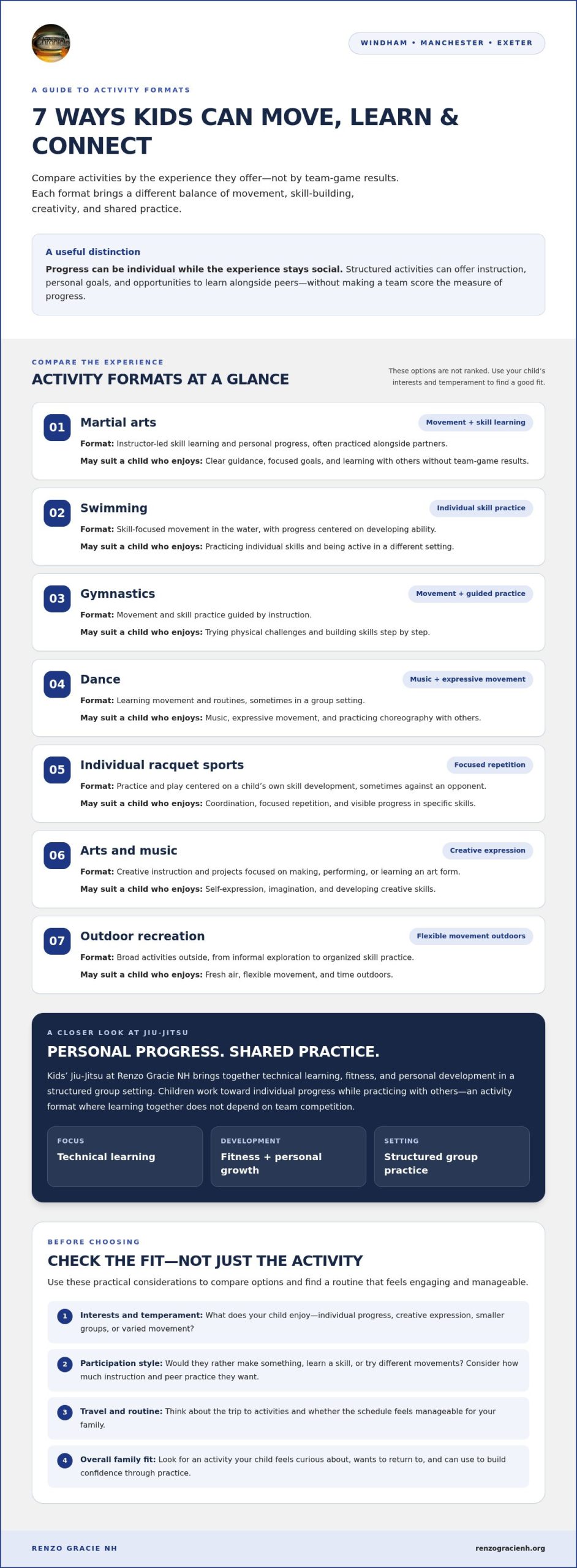
What if belonging matters more than winning? If you’re looking for an alternative to team sports for kids Windham families can explore activities that keep children moving and connected without making team performance the focus. A child who dislikes tryouts, rigid positions, or the pressure of competition may still enjoy learning alongside others and working toward personal goals.

The right fit depends on your child’s interests and temperament. Art can encourage creativity and self-expression; music and theater build performance skills and collaboration; dance offers movement and shared practice. Kids’ Jiu-Jitsu brings together fitness, technical learning, focus, and individual progress in a structured group setting. Each activity offers a different balance of physical effort, social connection, and commitment.

This guide compares options for families in Windham, Manchester, and Exeter, with practical ways to weigh those differences. You’ll also learn how Renzo Gracie NH’s kids’ program combines personal growth with shared practice. New students can start with a complimentary introductory class. Rather than force a team-sport fit, begin with what helps your child feel curious, capable, and ready to learn.

Key Takeaways

  • An alternative to team sports for kids Windham families consider can still offer movement, skill-building, and connection without team-game results at the center.
  • Compare martial arts, swimming, gymnastics, dance, racquet sports, and arts activities by the experience each offers and the interests it may suit.
  • Jiu-Jitsu develops individual skills through instruction and practice with peers, so children can learn together without team competition.
  • Use a simple selection process to weigh your child’s preferences, travel, routine, participation style, and overall family fit.
  • Kids’ Jiu-Jitsu at Renzo Gracie NH emphasizes technical learning, fitness, and personal development. New students can try a complimentary introductory class.

Why Windham Families Seek Team Sports Alternatives

Children don’t all enjoy competition in the same way. One may love the energy of a game and working toward a shared score, while another would rather learn at their own pace, create something, or move without the pressure of a crowd. A child’s response can also depend on the sport, the group, and how practice is organized. Disliking one team sport doesn’t necessarily mean they dislike movement, instruction, or spending time with other kids.

A team-sport alternative is an organized activity that isn’t centered on team-game results. It can still involve practice, goals, and peers. The broader Youth sports overview describes how participation can support physical and emotional well-being as well as social connection. Families can look for those opportunities in different formats, choosing what feels engaging and manageable for their child.

For parents comparing an alternative to team sports for kids Windham, the goal isn’t to find the most impressive activity or fill every afternoon. Look for a good match: something the child wants to return to, that fits the family’s routine, and that gives them room to build confidence through practice.

What might a child want beyond team competition?

Start with what your child enjoys, not just what they’re trying to avoid. They may prefer individual progress, smaller groups, creative expression, or varied movement. Some children feel more at ease when an instructor explains a skill and they can work toward a personal goal, rather than waiting for game day or worrying about a team result.

Ask open questions such as, “Which parts of practice do you like?” or “Would you rather make something, learn a skill, or try different movements?” Their answers can help you compare activities without deciding for them. Keep the conversation practical, too. A routine that feels interesting and manageable is easier to fit into family life.

What can a structured activity still offer?

Individual progress doesn’t mean practicing alone. Regular instruction gives children a routine, guidance as they learn, and opportunities for encouragement from instructors and peers. In activities such as martial arts, a child can work on personal skills while learning alongside training partners. The shared experience can build connection without making a team score the measure of progress.

The format can be individual; the experience can still be shared. That distinction helps families look beyond “team or no team” and focus on whether an activity offers the right balance of instruction, movement, social contact, and personal goals.

Team-Sport Alternatives for Kids Near Windham: Compare Activity Types

There’s more than one way for a child to move, learn, and connect with peers. Compare the activity’s format with what your child enjoys, then consider options in Windham and nearby Manchester or Exeter. The table can help you narrow the choice by the experience each activity typically involves and the interests it may suit.

Activity Format and typical experience May suit a child who enjoys
Martial arts Instructor-led skill learning and personal progress, often practiced alongside partners. Clear guidance, focused goals, and learning with others without team-game results.
Swimming Skill-focused movement in the water, with progress centered on developing ability. Practicing individual skills and being active in a different setting.
Gymnastics Movement and skill practice guided by instruction. Trying physical challenges and building skills step by step.
Dance Learning movement and routines, sometimes in a group setting. Music, expressive movement, and practicing choreography with others.
Individual racquet sports Practice and play centered on a child’s own skill development, sometimes against an opponent. Coordination, focused repetition, and visible progress in specific skills.
Arts and music Creative instruction and projects focused on making, performing, or learning an art form. Self-expression, imagination, and developing creative skills.
Outdoor recreation Broad activities outside, from informal exploration to organized skill practice. Fresh air, flexible movement, and time outdoors.

Movement-based options beyond team games

Martial arts combine instruction and personal skill development with shared practice. In kids’ Jiu-Jitsu at Renzo Gracie NH, children work on technical learning, fitness, and personal development in a structured setting. Each child works toward individual progress while practicing with others. Families exploring an alternative to team sports for kids Windham can compare this format with swimming and gymnastics, which also emphasize learning movement skills rather than team-game results. Dance may appeal to children drawn to music and expressive movement, while racquet sports may suit those who like focused practice and developing specific skills.

Creative and outdoor activities for different interests

Arts and music offer a creative path for children more interested in drawing, making, playing an instrument, or performing than in sports. Outdoor recreation brings movement and exploration without necessarily involving a formal team structure. These options differ in physical activity, creative focus, routine, and social interaction. If instructor-led movement and shared practice sound like a promising fit, explore kids’ Jiu-Jitsu at Renzo Gracie NH as a local option.

Alternatives to Team Sports for Kids in Windham

Is Jiu-Jitsu a Social Alternative to Team Sports for Kids?

Yes. An activity doesn’t need teams or a shared scoreboard to help a child learn alongside peers. Brazilian Jiu-Jitsu combines individual skill development with instruction and practice partners, creating a shared class experience while each student works on personal progress. That may suit a child who wants connection but doesn’t enjoy team-game pressure.

How Brazilian Jiu-Jitsu combines individual progress and group learning

In a structured martial arts class, students receive instruction, practice movement skills, and learn with others. At Renzo Gracie NH, kids’ instruction emphasizes technical learning, fitness, and personal development. These are built through practice over time, not instant results or promises.

In Jiu-Jitsu, progress is measured by the skills a student develops, not a team’s position on a scoreboard. Training partners make learning interactive, while each child’s development remains personal. That balance can offer a sense of community without making winning or team performance the focus.

What parents should consider about fit and comfort

Jiu-Jitsu involves learning movement skills with an instructor and training partners, so consider whether your child feels comfortable with physical contact and shared practice. A child may need time to get used to a new routine, listen to instruction, and participate in a structured class. Their curiosity and comfort matter more than whether the activity sounds like a good fit on paper.

Talk with your child about what they’d like to try and what feels manageable. If they’re interested but unsure, a complimentary introductory class at Renzo Gracie NH lets your family experience the class before deciding whether it feels right. It’s one way to explore an alternative to team sports for kids Windham that brings together personal goals, guided learning, and shared practice.

How to Choose a Kids’ Activity in Windham That Fits Your Child

The best choice isn’t always the most familiar activity. Connect your child’s interests with a routine your family can sustain, and treat a first visit as a chance to learn rather than a test they need to pass.

  1. Ask your child. Find out what they’d like to try and what they want less of, such as game-day pressure or a crowded practice.
  2. Identify their preferences. Do they enjoy individual goals, creative practice, movement, or learning with peers? Consider their comfort with competition, physical contact, performing, and structured instruction.
  3. Compare activity formats. Look at how much time is spent moving, creating, listening to instruction, or practicing with others. A child who prefers guided skill-building may enjoy a different format than one drawn to open-ended creative activities.
  4. Try a class or introductory experience. Decide what you hope to learn: whether your child feels comfortable, understands the activity, and shows interest in participating again.
  5. Reflect together. Ask what felt fun, challenging, or uncomfortable. One first impression is useful information, not a fixed label about your child’s personality or abilities.

Match the activity to your child’s preferences

Think beyond “sports or no sports.” A child may want plenty of movement but prefer personal goals to team competition, or enjoy working with peers but feel uneasy about performing in front of an audience. Preferences can also change with experience. Listen closely, and let your child’s responses guide the next choice rather than deciding that one activity defines what they will or won’t enjoy.

Practical fit matters too. Consider travel from Windham, how an activity fits around school and family routines, and whether its participation style feels manageable. A promising option should work for the child and the household, not just sound appealing in theory.

Make the first experience low-pressure

Before a trial, agree on a modest goal: notice how the class is taught, whether your child feels welcomed, and whether they’re curious to return. Don’t expect immediate mastery. New routines and skills take time, and a child may need space to decide how they feel afterward.

For families considering Jiu-Jitsu, Renzo Gracie NH offers a complimentary introductory class for new students. Book a complimentary kids’ Jiu-Jitsu introductory class and use the experience to see whether the setting feels right for your child.

Try Kids’ Jiu-Jitsu at Renzo Gracie NH in Windham

For families comparing team sports with martial arts, Renzo Gracie NH offers a structured Brazilian Jiu-Jitsu program for children in Windham, with additional locations in Manchester and Exeter. It’s a local option for kids who prefer developing their own skills while learning alongside other students, rather than focusing on team-game results.

What kids can explore through Jiu-Jitsu

Children’s instruction emphasizes technical learning, fitness, and personal development. Through guided practice, students can explore movement, learn techniques, and work toward individual progress in a shared class setting. The focus is on learning and growth, with each child progressing through practice at their own pace.

Professor Kevin Landry, the academy’s owner and instructor, is a sixth-degree black belt under Renzo Gracie and has taught in the region for over two decades. His experience informs instruction in a program designed around children’s learning and development.

Jiu-Jitsu is a partner-based activity, so it includes physical contact as students practice with others. That’s an important part of deciding whether the format fits your child. If family participation is part of what you’re looking for, Renzo Gracie NH also has family Jiu-Jitsu options to explore.

Take a simple first step in Windham

A first class can help your family get a feel for the instruction and environment, without expecting your child to master new skills right away. Notice whether they seem comfortable taking part, respond to the structure, and show interest in trying again. Their impressions matter; the goal is to discover a good fit, not force one.

If you’re considering an alternative to team sports for kids Windham families can explore, start with a complimentary introductory class for your child at Renzo Gracie NH.

Find an Activity That Helps Your Child Grow

The right activity is one your child feels curious about and comfortable returning to. Swimming, dance, creative pursuits, and martial arts all offer different ways to develop skills and connect with others. An alternative to team sports for kids Windham families explore can still provide structure and shared learning without making game results the goal.

Kids’ Brazilian Jiu-Jitsu at Renzo Gracie NH emphasizes technical learning, fitness, and personal development in a structured setting. With locations in Windham, Manchester, and Exeter, families can explore an option close to home. Owner and instructor Professor Kevin Landry has taught in the region for over two decades.

A first class is a simple way to see how your child responds to the activity and its routine. Renzo Gracie NH offers a complimentary introductory class for new students. Book your child’s free introductory Jiu-Jitsu class and let them discover whether the mat feels like a place to learn, move, and grow.

Frequently Asked Questions

Is Brazilian Jiu-Jitsu a good alternative to team sports for kids?

It can suit children who enjoy learning movement skills and making individual progress in a structured group setting. Brazilian Jiu-Jitsu isn’t a team game, but students learn from instructors and practice alongside others. Whether it suits your child depends on their interests and comfort with partner practice. An introductory class lets your family experience the format before deciding if it feels right.

Can kids make friends in an activity that is not a team sport?

Yes. Team competition is only one way children can spend time with peers. Group classes, shared practice, and learning alongside other students create opportunities for connection. The experience varies by activity and child, so notice whether your child seems comfortable participating and interested in returning. Social connection doesn’t have to depend on team performance.

What are some alternatives to team sports for kids in Windham?

Families can compare martial arts, swimming, gymnastics, dance, individual racquet sports, creative activities, and outdoor recreation. Each offers a different mix of movement, instruction, personal goals, and group participation. In Windham, Manchester, and Exeter, consider travel and the fit with your child’s interests and family routine as you narrow down options.

Is Jiu-Jitsu safe for children who are new to martial arts?

A child’s comfort, the class environment, and appropriate instruction all matter when trying a new physical activity. Brazilian Jiu-Jitsu involves partner practice, so consider whether your child is comfortable learning movement skills with others. An introductory class gives your family a chance to experience the setting and observe your child’s response before deciding about ongoing participation. Their comfort and willingness to take part are important considerations.

How do I know which activity will suit my child?

Start by asking what your child enjoys and what they’d like to try. Compare options by activity style, structure, social setting, travel from Windham, and fit with your family’s routine. After an introductory experience, notice whether your child seemed engaged and comfortable and whether they want to return. Their response can guide your next step without treating one experience as a final verdict.

Can a child try Jiu-Jitsu before joining Renzo Gracie NH?

Yes. Renzo Gracie NH offers new students a complimentary introductory class, so families can experience Brazilian Jiu-Jitsu before deciding whether to continue. The class gives you a chance to see how your child responds to the structured group activity and its instruction. Keep the first visit low-pressure: focus on their comfort, interest, and curiosity about learning more. Renzo Gracie NH serves families in Windham, Manchester, and Exeter.

Structured Martial Arts Curriculum in NH: How to Choose in 2026

What if the clearest sign of a good martial arts school isn’t the style it advertises, but how well it explains what students will learn next? Program descriptions can sound alike, so families searching for a structured martial arts curriculum NH schools offer should look beyond beginner-friendly claims and ask how instruction builds over time.

A welcoming first class is a good start, but you’ll also want to know whether instruction suits the student’s age and experience, how beginners are supported, and what they can work toward next. A thoughtful curriculum makes learning easier to follow, from foundational skills to greater focus, confidence, and perseverance.

This guide explains what progression can look like and gives you practical questions for comparing New Hampshire programs. You’ll learn what to observe in an introductory class, how to assess age-appropriate instruction, and which details to confirm before signing up. Whether you’re considering training in Windham, Manchester, or Exeter, the goal is to find an encouraging program with a path forward for you or your family.

Key Takeaways

  • A structured martial arts curriculum NH families can evaluate should make learning goals and next steps clear without promising a fixed belt timeline.
  • In Brazilian Jiu-Jitsu, repetition, partner practice, and instructor feedback can help students reinforce foundational skills over time.
  • Compare local programs by asking how instructors welcome beginners, adapt instruction to different experience levels, and support age-appropriate learning.
  • Use an introductory visit to observe teaching clarity, safety expectations, training culture, and whether the schedule works for your family.
  • Renzo Gracie NH offers adult and kids Jiu-Jitsu programs. Professor Kevin Landry, a sixth-degree black belt, has more than two decades of local teaching experience.

What Does a Structured Martial Arts Curriculum in NH Actually Include?

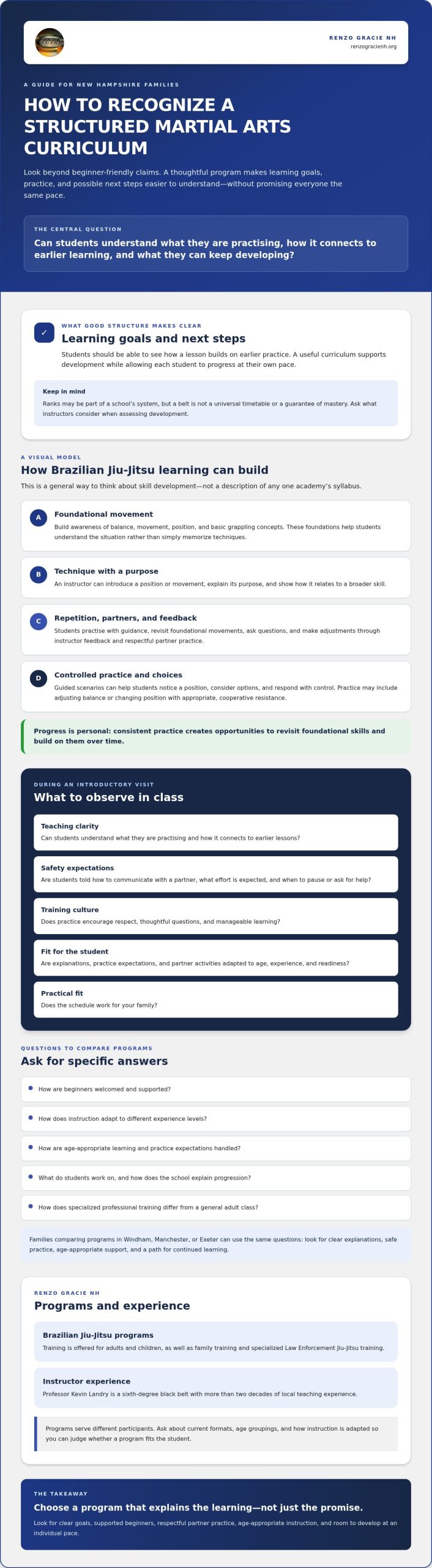
A structured curriculum organizes instruction around clear learning goals, with practice that builds over time. Students should be able to understand what they’re practising, how it connects to earlier lessons, and what they can continue developing. That does not mean every student follows the same pace or should be promised a particular belt timeline.

In Brazilian Jiu-Jitsu, learning can involve technique, body movement, problem-solving, and respectful practice with a partner. A class might introduce a position or movement, explain its purpose, and give students a chance to practise it with guidance. The goal isn’t identical outcomes for everyone. Useful structure helps instructors support learning and safe practice while recognizing that each student develops at their own pace.

What makes martial arts instruction feel progressive?

Progress often comes from revisiting foundational movements as students gain familiarity and control. An instructor might demonstrate a technique, guide students through repetition, then offer a manageable practice situation where they can explore when or how to use it. That sequence lets students ask questions, receive feedback, and connect the movement to a broader skill.

Ranks may be one part of a school’s progression system, but they don’t tell the whole story. A belt is not a universal timetable or a guarantee of mastery. Ask each school how it explains its own progression and what instructors consider when assessing development. Clear answers should help you understand what students work on, not promise how quickly anyone will advance.

How can a curriculum support different ages and goals?

Age-appropriate instruction involves more than choosing which techniques to teach. Instructors can adjust explanations, practice expectations, and partner activities to suit students’ ages, experience, and readiness. Children may benefit from clear guidance that encourages listening, respect, and perseverance. Adults may have different goals and starting points. Specialized professional training is a distinct context, so ask how it differs from a general adult class.

Renzo Gracie NH offers Brazilian Jiu-Jitsu training for adults and children, as well as family training and specialized Law Enforcement Jiu-Jitsu training. These programs serve different participants, so ask about current formats, age groupings, and how instruction is adapted. Specific answers make it easier to judge whether a program fits your needs, rather than relying on a description alone.

How Brazilian Jiu-Jitsu Skills Can Build Step by Step in NH

Brazilian Jiu-Jitsu learning can move from body awareness to controlled practice, then to making choices in changing situations. This is a general way to think about skill development, not a description of any one academy’s syllabus. In a structured martial arts curriculum NH students may encounter, the purpose is to connect practice with learning goals while recognizing that individuals progress at different rates.

From foundational movement to controlled practice

Early practice may focus on balance, movement, position, and basic grappling concepts. These foundations help students notice where their bodies and their partners are, rather than trying to memorize techniques without understanding the situation.

Coached partner drills can give each movement a clear purpose. An instructor demonstrates, students practise with guidance, and feedback helps them make adjustments. Beginners should know how to communicate with a partner, what level of effort is expected, and when to pause or ask for help. Clear expectations make practice more manageable and respectful for everyone.

Consistent practice gives students opportunities to revisit foundational skills and build on them over time.

How practice can develop decision-making

Once students become familiar with basic movements, instructors may introduce guided scenarios that ask them to notice a position, consider their options, and respond with control. The emphasis is on thoughtful problem-solving, not simply reacting quickly. For example, a student might practise adjusting their balance or changing position while a partner offers appropriate, cooperative resistance.

These exercises can give learners practice staying composed when a situation feels unfamiliar, but they can’t guarantee how someone will respond in every real-world conflict. Technique practice should take place in supervised, controlled training, with instructors making expectations and boundaries clear. For children, calm, step-by-step instruction can support focus and self-management. Understood.org discusses how martial arts can emphasize self-control and concentration.

Look for feedback that explains what to adjust and why, rather than treating repetition as a test of who can move fastest. Students may need different amounts of practice before a skill feels familiar, and schools may use different ways to assess progress. Ask how instructors support beginners and adapt practice as experience grows. To explore local Brazilian Jiu-Jitsu training, learn more about Renzo Gracie NH.

How to Evaluate a Martial Arts Curriculum in Windham, Manchester, or Exeter

School descriptions often use similar language, so compare what instructors teach and how they guide learners. Use the questions below to assess a structured martial arts curriculum NH programs describe. Confirm current classes, age groupings, schedules, and other details directly with each school, whether you’re looking in Windham, Manchester, or Exeter.

What to compare Questions to ask or observe
Beginner onboarding What should a new student expect during the first few classes? Are instructions and partner expectations explained before practice?
Age fit Which programs are currently available for the student’s age and goals? Do instructors adjust explanations and activities for different learners?
Instruction Can you follow the instructor’s explanations? Do they demonstrate, check understanding, and offer useful feedback?
Progression How does the school explain progress? What support is available when a student finds a skill challenging?
Training culture Do students treat partners with respect? Does the class balance discipline with encouragement and attention to safety?

Questions to ask during a school visit

Ask how instructors guide beginners when they share a learning environment with more experienced students. A useful answer should explain how new students receive appropriate instruction, rather than leaving them to work things out alone. Ask how instructors help students through challenges and communicate progress. Confirm which programs are currently available for the learner’s age and goals, because program names alone don’t explain how a class is taught.

Signs the learning environment may fit your goals

If the school allows it, watch a class or use an introductory visit to notice whether coaching is clear, respectful, and attentive. Look for considerate partner interactions, instructors who respond to questions, and opportunities for beginners to learn without pressure to keep up at any cost. A positive training culture can be disciplined and focused while still making students feel welcome.

Separate what you can verify from promotional language. Ask what a first class involves, how students practise and receive feedback, which age groups are currently served, and what schedules are available. Then compare the answers. If a school highlights a particular outcome, ask how instruction supports it rather than assuming every student will have the same experience.

Consider the practical journey, too. A program that looks appealing on paper needs to fit your household’s routine. Compare travel to Windham, Manchester, and Exeter with class times confirmed by each school. The right fit brings together an appropriate teaching approach, a respectful student culture, and workable logistics.

Structured Martial Arts Curriculum in NH: How to Choose in 2026

A Practical Checklist for Choosing Structured Martial Arts Classes in NH

A first visit can tell you more than a program description. Use this checklist to assess whether the instruction, class culture, and practical details fit the student, whether they’re an adult, a child, or a family exploring training together.

What to notice in a first class

Before you visit, ask what a new student should expect and confirm the current class format, schedule, and any preparation needed. During the visit, notice whether the instructor explains drills clearly, demonstrates what students should do, and sets expectations. Observe how partners are paired and whether practice is supervised. Afterward, ask the prospective student how comfortable they felt, what questions they still have, and whether they’d like to learn more.

  • Teaching clarity: Could a beginner follow the explanation and understand the purpose of the practice?
  • Safety expectations: Were students shown how to practise respectfully and seek guidance?
  • Curriculum answers: Can instructors explain how learners build skills and receive feedback without promising identical results or timelines?
  • Schedule practicality: Do the confirmed class times and travel work with your household’s routine?

Adults considering Brazilian Jiu-Jitsu can use this guide to starting adult Jiu-Jitsu in NH to prepare questions. Parents can also review information about kids Jiu-Jitsu in New Hampshire, then confirm current program details directly with the academy.

How to compare programs for a family

Adult and child goals may differ, so ask how instructors account for each learner’s age and experience. Don’t assume family members train in the same class or format. If you hope to practise together, ask whether parent-child training is currently available and what participation involves. For family-specific context, see this guide to parent and child Jiu-Jitsu in Windham.

Compare your notes. A structured martial arts curriculum NH families can evaluate with confidence should come with clear answers about learning, supervision, and fit, not just appealing promises. To explore the academy’s Brazilian Jiu-Jitsu training and introductory class, find out how to experience Renzo Gracie NH.

Explore Renzo Gracie NH’s Brazilian Jiu-Jitsu Programs and Next Steps

Choosing a school is easier when you can connect its teaching approach to your own goals. Renzo Gracie NH is a Brazilian Jiu-Jitsu academy offering training for adults and children, family training, and specialized Law Enforcement Jiu-Jitsu training for professional defensive tactics. The academy is owned and operated by Professor Kevin Landry, a sixth-degree black belt under Renzo Gracie who has taught in the region for more than two decades.

That experience gives you useful context, but your next step is to ask how instruction and progression work for the person who plans to attend. A structured martial arts curriculum NH students can grow with should be understandable to newcomers. Instructors should be able to explain class expectations and how students receive guidance as they learn.

What to ask Renzo Gracie NH about its curriculum

Bring a few direct questions to your introductory visit. Ask which current class may suit your age, experience, and goals, and how instructors help students understand their progress. You can also ask what partner practice involves, how students are guided to train safely, and what support is available when a new skill feels challenging.

Confirm current schedules, age groupings, class formats, and program details with the academy rather than assuming they’re available or unchanged. If you’re exploring professional defensive tactics, ask specifically about the current law-enforcement training program and whether it fits your needs.

Take a low-pressure first step in New Hampshire

A complimentary introductory class gives new students a chance to experience instruction and decide whether the environment feels like a good fit. Use the visit to notice how directions are explained, how questions are handled, and how instructors guide partner practice. You don’t need to arrive with all the answers. Start by sharing what you hope to learn.

Before you go, note your questions about class fit, learning progression, and practical expectations. Afterward, consider whether the instruction felt clear and welcoming, and whether you can picture continuing to learn there. You can read more about the complimentary Jiu-Jitsu introductory class as you consider a first visit.

Every student’s path is personal. If you’re ready to explore your options, explore Renzo Gracie NH and ask about a suitable starting point for you or your family.

Take Your Next Step Toward Steady Progress

A strong martial arts program makes learning goals clear, builds skills through purposeful practice, and adapts instruction to students’ ages and experience. As you compare a structured martial arts curriculum NH schools offer, look beyond polished descriptions. Ask how instructors explain progress, guide safe practice, and help beginners find their footing.

Renzo Gracie NH teaches Brazilian Jiu-Jitsu to adults and children, and offers family training and specialized Law Enforcement Jiu-Jitsu training. Professor Kevin Landry, a sixth-degree black belt under Renzo Gracie, has taught in the region for more than two decades. New students can experience the instruction and ask about program fit in a complimentary introductory class.

Try a complimentary introductory class and discover whether Renzo Gracie NH is the right fit. Bring your questions, notice how the teaching feels, and take the next step at a pace that works for you.

Frequently Asked Questions

What should a structured martial arts curriculum include?

A structured martial arts curriculum should have clear learning goals, planned instruction, and practice that builds skills progressively. In Brazilian Jiu-Jitsu, that may mean connecting movement and positioning with technique, partner practice, and problem-solving. Instructors should explain how students develop and receive feedback, while keeping practice respectful and safe. Progress doesn’t have to follow a fixed timeline, and students shouldn’t be promised identical outcomes.

How do beginners progress in Brazilian Jiu-Jitsu?

Beginners often start by learning basic movement, balance, positioning, and grappling concepts, then reinforce them through coached repetition and partner drills. As they gain familiarity, instructors may introduce guided practice that helps students recognize options and apply skills with control. Progress depends on the individual and the school’s approach, so ask how instructors support new students and explain development. There’s no universal timetable for learning or promotion.

Can children and adults follow the same martial arts curriculum?

Children and adults may learn the same martial art, but instruction and expectations should suit each learner’s age, experience, and goals. Instructors can adapt explanations, practice activities, and partner guidance so students can participate appropriately. Renzo Gracie NH offers Brazilian Jiu-Jitsu programs for adults and children, but don’t assume they share a class or format. Ask the academy which current program best fits each family member.

How can I compare martial arts programs in New Hampshire?

Compare how schools welcome beginners, explain instruction, support safe partner practice, and communicate progress. Visit or ask questions at programs in Windham, Manchester, Exeter, or nearby communities, and confirm current age groupings, class formats, and schedules directly. Notice whether instructors adapt practice for different experience levels and whether the training culture feels respectful and encouraging. Clear answers about what students can expect are more useful than broad promotional promises.

Is Brazilian Jiu-Jitsu suitable for someone with no martial arts experience?

Brazilian Jiu-Jitsu can be a starting point for people with no previous martial arts experience. Beginners can ask how the school introduces foundational movement, explains partner expectations, and supports students who need time to become comfortable. You don’t need to know what to do on day one. Contact the academy to confirm which current class suits your experience and goals before attending.

What should I expect from a first martial arts class at Renzo Gracie NH?

New students can begin with a complimentary introductory class at Renzo Gracie NH. Contact the academy beforehand to confirm the current format, schedule, and what to bring, since those details may change. During your visit, notice whether instructions are clear, partner practice is guided, and you feel comfortable asking questions. The class is an opportunity to experience the environment and ask how the program may fit your goals.

Does Renzo Gracie NH offer family martial arts training?

Yes. Renzo Gracie NH offers family training alongside Brazilian Jiu-Jitsu programs for adults and children. Ask the academy how current family training is organized, whether family members participate together, and which options suit your ages and goals. Don’t assume every class is shared. For families in Windham, Manchester, Exeter, and surrounding communities, confirming the format and schedule directly can help you decide whether training fits your routine.

Police Training in Windham, NH: A Guide for Officers

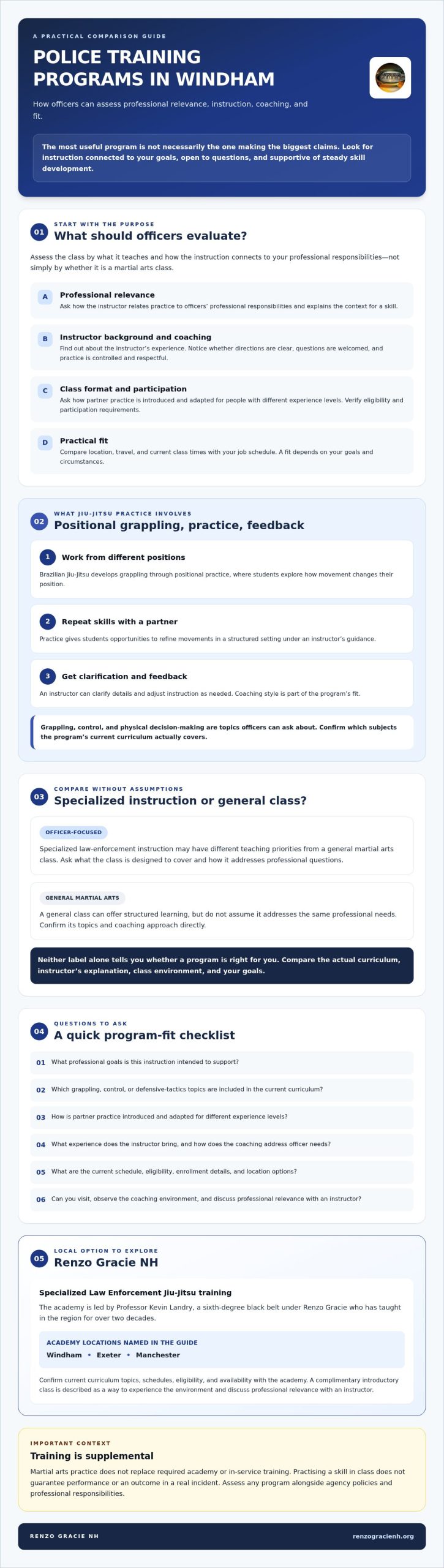
The most useful police training programs Windham officers can explore are not necessarily the ones making the biggest claims. Look for instruction that connects to your professional goals, welcomes questions, and supports steady skill development.

It’s reasonable to ask whether a martial arts class will address the demands of officer work or focus mainly on sport. This guide explains how to compare local options, what to ask about defensive-tactics instruction, and how to assess whether a program fits your needs. Training can help build practical skills, but it does not replace required academy or in-service training.

We’ll cover curriculum, instructor experience, coaching style, and the training environment. In Windham, Renzo Gracie NH offers specialized Law Enforcement Jiu-Jitsu training. The academy is led by Professor Kevin Landry, a sixth-degree black belt under Renzo Gracie who has taught in the region for over two decades. You’ll also find questions to ask before enrolling and learn how a complimentary introductory class can help you experience the academy and discuss professional relevance with an instructor.

Key Takeaways

  • Compare police training programs Windham by professional relevance, instructor background, class format, and practical travel needs.
  • Learn how Brazilian Jiu-Jitsu’s positional grappling and controlled practice may relate to defensive-tactics training, and confirm which topics a program actually teaches.
  • Ask focused questions about your goals, curriculum, schedule, eligibility, and first visit to assess whether a program fits.
  • Consider how specialized law-enforcement instruction differs from general martial arts classes, without assuming one approach suits every officer.
  • Explore Renzo Gracie NH’s Law Enforcement Jiu-Jitsu training and consider a complimentary introductory class as a low-pressure way to experience the environment.

What should officers expect from police training programs in Windham?

For this guide, a police training program means skills instruction officers can assess for relevance to their professional responsibilities. The key question is not simply whether a class teaches martial arts. Consider whether its approach and coaching connect to the goals you bring to training. A useful definition: Law-enforcement Jiu-Jitsu training applies grappling concepts to professional skills practice, with the curriculum and its relevance confirmed directly with the instructor.

Specialized officer-focused instruction and general martial arts classes can both offer structured learning, but their teaching priorities may differ. Ask what each class is designed to cover instead of assuming a general class addresses the same professional questions. Renzo Gracie NH offers specialized Law Enforcement Jiu-Jitsu training. Confirm the specific topics currently included before deciding whether it meets your needs.

What makes training relevant to law enforcement work?

Start with the topics you want to evaluate, such as grappling, control, and decision-making during physical practice. Ask how the instructor relates training to officers’ professional responsibilities and explains the context for practicing a skill. The use of force continuum can provide a general reference point for that discussion, but it does not establish what a particular academy teaches. Verify curriculum details with the provider.

Who might be looking for officer-focused training near Windham?

An individual officer may be exploring personal development, while a supervisor may be comparing options for a team. Officers with different levels of experience can ask whether the instruction suits their background and verify participation requirements before making plans. For a single student or a group, fit depends on goals, travel, and whether class times work with job schedules.

Location matters, too. Renzo Gracie NH has academies in Windham, Exeter, and Manchester, so compare which location is practical for your commute. Check current schedules, eligibility, and enrollment details with the academy rather than assuming every location offers the same format or availability.

When comparing police training programs Windham officers can access, look beyond the label. Ask what skills are covered, how instruction is coached, and whether the instructor can explain the program’s professional relevance. Clear answers help you decide on a next step without expecting a class to replace required agency or state training.

How does law-enforcement Jiu-Jitsu training build practical grappling skills?

Brazilian Jiu-Jitsu develops grappling through positional practice. Students work from different positions, learn how movement changes them, and repeat skills with a partner under an instructor’s guidance. For officers, one aspect to explore is the opportunity to study control and physical decision-making in a structured setting. This general description is not a promise about what any specific class covers. Ask the academy which parts of its current curriculum are intended for law-enforcement training.

Practice and feedback are important parts of learning. Repeating a movement gives students opportunities to refine it, while an instructor can clarify details and adjust instruction as needed. That makes coaching style part of your evaluation, not an afterthought. Practising a skill in class does not guarantee performance or an outcome in a real incident. Assess the training alongside agency policies and professional responsibilities.

Which training elements should officers ask about?

Ask about the program’s stated focus. How does it address grappling, control techniques, and defensive tactics? Which of those subjects are included in the current curriculum? Find out how partner practice is introduced and adapted for participants with different experience levels. These questions help distinguish a law-enforcement-focused program from general martial arts instruction, without assuming either is automatically the right fit.

How can officers assess coaching and training culture?

Ask about instructor experience and how the instructor approaches professional training needs. During a visit, notice whether directions are clear, questions are welcomed, and practice is controlled and respectful. These details can help you judge whether the learning environment supports steady development. The U.S. Department of Justice’s overview of Police Training offers broader context on training beyond recruit instruction. A class visit lets you assess the specific coaching in front of you.

Renzo Gracie NH offers specialized Law Enforcement Jiu-Jitsu training. Professor Kevin Landry, the academy’s owner and operator, is a sixth-degree black belt under Renzo Gracie and has taught in the region for over two decades. This background provides useful context, but officers should still ask how the current program aligns with their goals and confirm curriculum topics directly with the academy.

To explore the program, review the Law Enforcement Jiu-Jitsu training information and use it as a starting point for questions about curriculum, coaching, and fit. A direct conversation can help you decide whether to take the next step.

How can officers compare police training programs near Windham?

Use the same questions for every option. A consistent comparison helps separate professional relevance from broad promotional language and brings practical considerations, such as travel and work commitments, into view. For police training programs Windham officers are considering, compare details directly with each provider rather than assuming similar labels mean similar instruction.

What to compare Questions to ask How to assess fit
Professional relevance Which law-enforcement defensive-tactics topics are part of the current instruction? How does the program relate to officers’ professional needs? Look for clear answers about the actual curriculum, not just general claims about practical training.
Instructor background What experience does the instructor bring, and how do they approach training for officers? Consider whether their experience and communication style match your goals and expectations.
Training format How is instruction structured? How are participants with different experience levels and goals accommodated? Ask what you can observe or try before enrolling, and confirm participation requirements.
Location and access Which location and current class times are available? How would the trip fit your routine? Compare travel from Windham with options in Manchester or Exeter based on your starting point and schedule.

What questions help assess professional relevance?

Ask which defensive-tactics subjects are included in the current program, how instruction responds to different experience levels, and whether you can observe or experience a class before deciding. Invite the instructor to explain how the training connects to your professional goals. Specific answers help you judge relevance. Broad assurances alone do not show what you’ll actually practise.

How should officers weigh coaching, format, and location?

Instructor background matters, as does the ability to explain and coach material clearly. Consider whether the available format fits your work commitments and whether regular travel is realistic. Renzo Gracie NH has academies in Windham, Exeter, and Manchester, giving officers locations to compare. Do not assume schedules or program details are identical at each one.

Renzo Gracie NH offers a complimentary introductory class for new students. It can be a low-pressure opportunity to experience the training environment and discuss professional fit with an instructor. Confirm the current booking process, eligibility, class schedule, and participation requirements directly with the academy.

Before enrolling as an individual or exploring options for a team, verify whether any agency arrangements apply. Do not assume a program is agency-approved or that a particular schedule or curriculum is available. A direct conversation can clarify the details and help you choose a next step.

Police Training in Windham, NH: A Guide for Officers

What should officers verify before joining a Windham-area training program?

A little preparation makes it easier to assess whether a program suits your goals. Before committing, check five things: what you want to learn, what the current curriculum covers, whether the schedule fits, who is eligible to participate, and what to expect on a first visit. Explain your professional context and ask the instructor whether the program is an appropriate fit.

  • Goals: Identify the skills or learning experience you’re looking for.
  • Curriculum: Ask which defensive-tactics topics are currently included.
  • Schedule: Confirm current class times directly with the academy.
  • Eligibility: Check participation requirements, including any relevant experience expectations.
  • First visit: Verify sign-up details and what the introductory class involves.

Do not assume a private training program carries agency approval or professional credit. If either matters to you, confirm it with the academy and your agency before enrolling. Ask for clear information about any applicable arrangements rather than relying on general promotional language.

What should prospective students ask before a first class?

For Renzo Gracie NH’s complimentary introductory class, confirm the current booking process and participation requirements in advance. Ask what to wear and bring, where and when to arrive, and whether the session includes observation, active participation, or both. Details can change, so get current guidance from the academy rather than making assumptions.

A first-class guide can also help you think through general preparation if you’re new to the training environment. It does not replace checking the academy’s own instructions for your visit.

How can officers set realistic training goals?

Focus on learning and consistent practice, not guaranteed results in real-world encounters. Before attending, consider your existing experience, what you hope to work on, and any relevant limitations you’d like the instructor to understand. Sharing that context helps you ask more useful questions about whether the class fits your needs.

Use the first session to observe the instruction, the training environment, and your own comfort level. You do not need to decide everything at once. A considered first visit can show whether the coaching and approach suit your goals.

Ready to check the details for a first visit? Ask Renzo Gracie NH about its introductory class, including current scheduling, participation requirements, and how to get started.

Explore law-enforcement Jiu-Jitsu training with Renzo Gracie NH

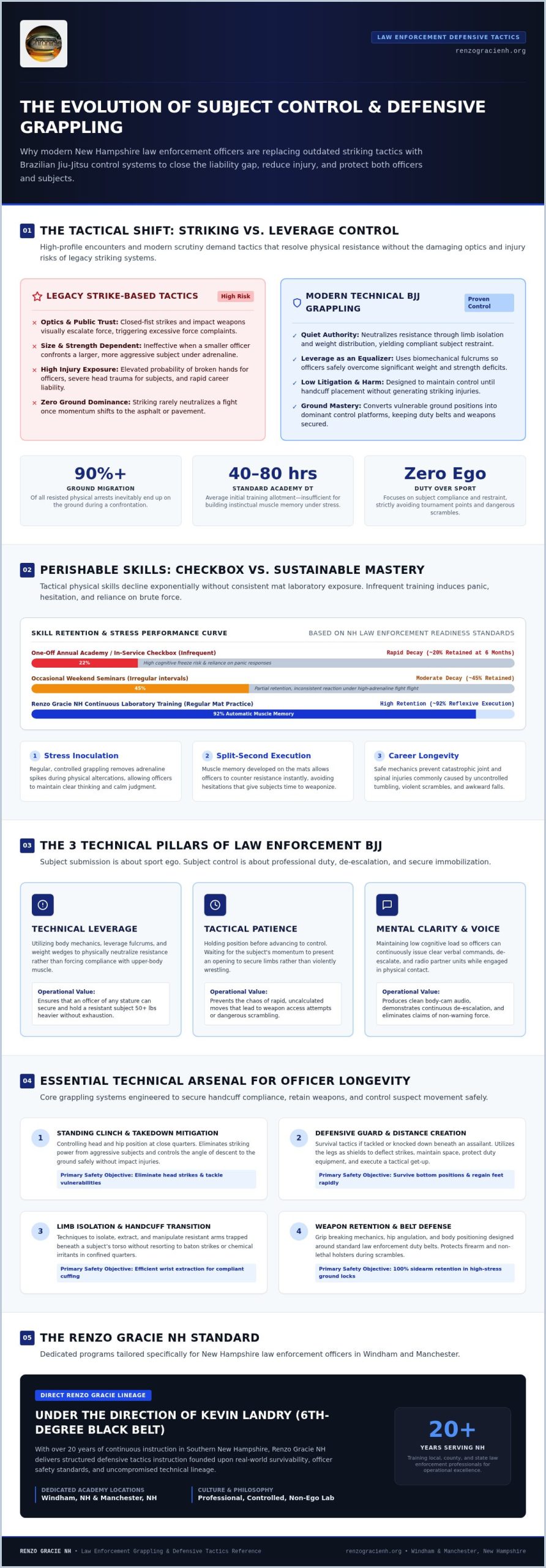
For officers comparing police training programs Windham has to offer, Renzo Gracie NH is a local academy with specialized Law Enforcement Jiu-Jitsu training. The program focuses on professional defensive tactics, grappling, control techniques, and officer safety. These are topics to ask about, not a guarantee of particular results or a substitute for agency training.

Professor Kevin Landry owns and operates the academy. He is a sixth-degree black belt under Renzo Gracie and has taught in the region for over two decades. This background gives prospective students useful context, but the right fit still depends on an officer’s goals, experience, and questions.

What can officers learn by exploring the program?

A conversation with the academy can help officers understand how its instruction approaches grappling, control, and defensive-tactics training. Ask which topics are part of the current curriculum, how the program relates to your professional needs, and whether your experience level is a fit. For more detail, look for the academy’s Law Enforcement Jiu Jitsu Training article. Confirm current program information directly, since curriculum and participation details may change.

Keep the distinction clear: exploring a training discipline can support learning and practice, but no class can promise a particular outcome in a real-world incident. Officers should also check with their agency about whether outside instruction meets internal requirements. Do not assume the program carries agency approval or professional credit.

What is a simple next step for Windham-area officers?

Start with the questions that matter to you. Ask about fit, eligibility, current scheduling, and which defensive-tactics topics are covered. If you’re unsure what a first visit involves, confirm the booking process and participation requirements before making plans. A brief conversation can clarify whether it makes sense to explore further.

New students can try a complimentary introductory class, a low-pressure way to experience the training environment and speak with an instructor. Use the visit to assess the atmosphere and ask questions. It is not a commitment to enroll or a promise of specific results. Take a measured first step and decide from there.

Explore a complimentary introductory class and ask Renzo Gracie NH about current scheduling, eligibility, and program fit.

Take a thoughtful next step in your training

Choosing among police training programs Windham officers can access starts with fit, not hype. Compare how instruction relates to professional goals, ask which defensive-tactics topics are currently covered, and confirm the schedule, eligibility, and any agency requirements directly. These checks support an informed choice without expecting a martial arts class to guarantee real-world outcomes.

Renzo Gracie NH offers specialized Law Enforcement Jiu-Jitsu training focused on professional defensive tactics. Professor Kevin Landry, a sixth-degree black belt under Renzo Gracie, has taught in the region for over two decades. New students can experience the academy through a complimentary introductory class and ask about curriculum, coaching, and personal fit.

Start with a conversation and take the time you need to assess the environment. Explore a complimentary introductory class and confirm current scheduling and participation details with the academy. Steady progress begins with a well-informed first step.

Frequently Asked Questions

What do police training programs near Windham typically teach?

Police training programs near Windham can differ in purpose and curriculum. A law-enforcement-focused Jiu-Jitsu program may address professional defensive tactics, grappling, and control, while a general martial arts class may have broader goals. Renzo Gracie NH offers specialized Law Enforcement Jiu-Jitsu training, but officers should ask which specific topics are currently included. Confirming the curriculum directly helps you assess whether it aligns with your goals.

Is Brazilian Jiu-Jitsu useful for law-enforcement defensive-tactics training?

Brazilian Jiu-Jitsu is a discipline officers can explore for grappling and control practice, including structured work with an instructor and training partners. Its relevance depends on the program’s curriculum and how instructors connect practice to professional needs. It cannot guarantee a particular result in a real incident or replace agency training. Ask what the class covers and how the instruction relates to your goals before deciding whether it’s a good fit.

Can officers with no Jiu-Jitsu experience join a law-enforcement program?

Ask the academy directly whether prior Jiu-Jitsu experience is required. Confirm Renzo Gracie NH’s current eligibility requirements and approach to participants with different experience levels before attending. Share your background and goals with an instructor so they can explain whether the program may suit you and what to expect. If you’re new to grappling, ask how partner practice is introduced and what participation involves.

How do I compare police training programs in Windham, Manchester, and Exeter?

Compare current curriculum, instructor experience, class format, eligibility, schedule, and travel practicality. Renzo Gracie NH has academies in Windham, Manchester, and Exeter, so consider which location best fits your commute and routine. Do not assume each location has identical schedules or program details. Ask the provider specific questions about the instruction and visit arrangements, then weigh the answers against your professional goals and available time.

Do law-enforcement Jiu-Jitsu classes provide certification or agency credit?

Do not assume a private Jiu-Jitsu class provides law-enforcement certification, agency approval, or professional credit. Confirm directly with the academy whether any such recognition applies, and check with your agency about its requirements before relying on outside instruction for credit. Renzo Gracie NH offers specialized Law Enforcement Jiu-Jitsu training, but prospective students should verify any certification or agency arrangements rather than infer them from the program’s focus.

What should I expect at a first police training class?

First-visit details depend on the academy and class, so confirm them in advance. Ask what to wear and bring, where and when to arrive, whether you’ll observe or participate, and whether there are participation requirements. You can also explain your experience and goals to the instructor and assess whether the coaching and environment feel comfortable. Check current scheduling and sign-up details directly before making plans.

Is there a complimentary introductory class at Renzo Gracie NH?

Yes. New students can try a complimentary introductory class at Renzo Gracie NH. It’s a low-pressure way to experience the training environment and ask whether the Law Enforcement Jiu-Jitsu program fits your goals. Confirm the current booking process, schedule, eligibility, and participation requirements with the academy before attending. Use the visit to ask about curriculum details rather than assuming which defensive-tactics topics are included.

Adult BJJ Training in Manchester, NH: Find Your Fit in 2026

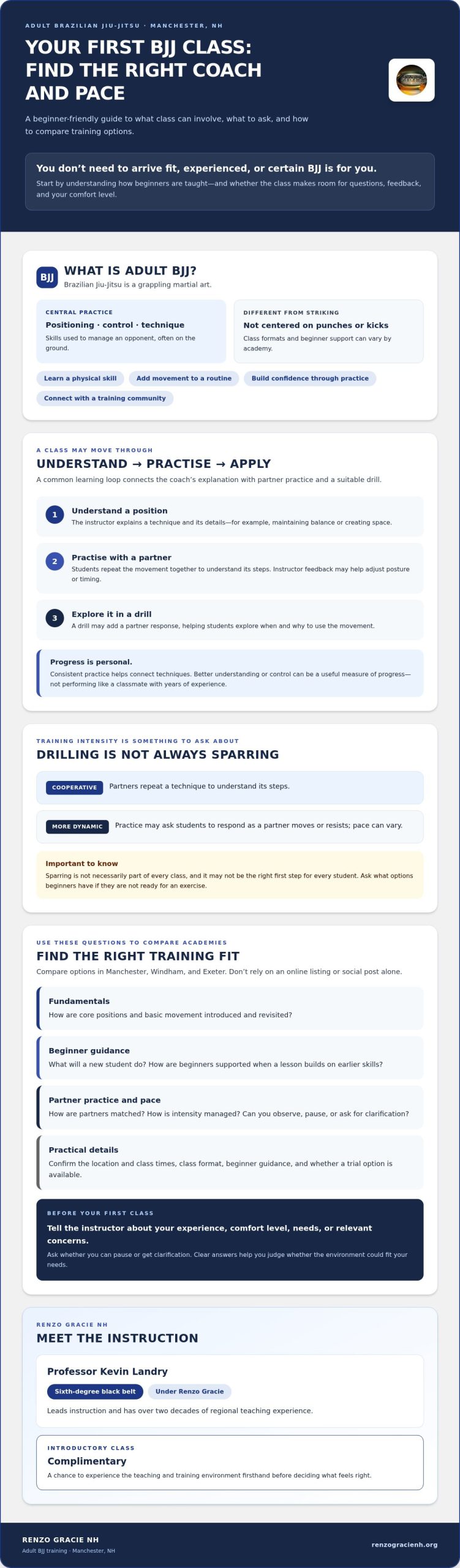
What if your first Brazilian Jiu-Jitsu class is less about keeping up and more about finding the right coach and pace? If you’re comparing options for adult BJJ training Manchester NH, you may be wondering what beginners do, whether your fitness or age will hold you back, and how to choose an academy from a few online posts.

You don’t need to arrive fit, experienced, or certain BJJ is for you. Start by finding out what a beginner class involves: how the instructor explains techniques, what partner practice looks like, and whether you can ask questions or pause when needed. Coaching and class culture matter as much as the schedule.

This guide explains what to expect in adult BJJ and gives you practical questions for comparing training options around Manchester, Windham, and Exeter. It also introduces Renzo Gracie NH, where Professor Kevin Landry, a sixth-degree black belt under Renzo Gracie with over two decades of regional teaching experience, leads instruction. A complimentary introductory class lets you experience the teaching and training environment before deciding what feels right.

Key Takeaways

  • Adult BJJ training Manchester NH can be a way to learn grappling skills, add movement to your routine, and connect with a training community.
  • Look for instruction that explains fundamentals, allows time for guided practice, and makes room for questions and feedback.
  • Before your first class, ask how beginners are supported and how to share your experience, comfort level, or relevant concerns.
  • Compare options in Manchester, Windham, and Exeter by confirming locations and class times, class format, beginner guidance, and trial options.
  • Renzo Gracie NH offers a complimentary introductory class, so you can experience the teaching and training environment firsthand.

Adult BJJ Training Near Manchester, NH: What to Look For

Brazilian Jiu-Jitsu (BJJ) is a grappling martial art that uses positioning, control, and technique to manage an opponent, often on the ground. Unlike striking-based martial arts, its central practice is not punches or kicks. For a neutral overview of its history and principles, see Brazilian Jiu-Jitsu.

Adults take up BJJ for different reasons: learning a physical skill, adding movement to their routine, developing confidence through practice, or joining a community. The right academy depends on your goals and how its instruction fits your needs. Class formats and beginner support vary, so don’t rely on a listing or social post alone. Ask how a class is organized and what a new student will do.

What happens in an adult Brazilian Jiu-Jitsu class?

A class may include an instructor’s explanation, partner practice of a technique, and supervised drills that help students connect the steps. The balance varies by academy and class. Don’t assume every session includes live sparring or follows the same format. Ask what to expect in your first class, how partners are selected, and whether you can observe or pause if you need clarification.

Which goals can adult BJJ training support?

With regular practice, students can work on grappling skills, coordination, movement, and steady personal progress. What you gain depends on attendance, your individual needs, and the instruction. Progress isn’t identical for everyone, and competition doesn’t have to be your goal. If you’re new to training, this adult beginners’ BJJ guide offers more context on getting started.

As you compare options for adult BJJ training Manchester NH, use your goals to guide the questions you ask:

  • Skill: How are fundamentals introduced and revisited?
  • Fitness and comfort: Can you tell the instructor about your experience and needs?
  • Community: How does the academy help new adult students feel included and supported?

Clear answers help you assess whether the training environment could fit your needs before you commit to a routine.

How Adult BJJ Training Builds Skills from Fundamentals to Practice

Skill-building in Brazilian Jiu-Jitsu often follows a learning loop: understand a position, practise its details, then try applying them in a suitable drill. For example, a coach might explain how to maintain balance and create space from a position before students repeat the movement with a partner. A drill may then add a response from the partner, helping students explore when and why to use the movement.

Consistent practice helps connect individual techniques into skills you can recognize and apply. Repetition makes movements more familiar, while instructor feedback can highlight adjustments to posture or timing. Over time, separate pieces of instruction may begin to fit together. The pace varies, and progress is personal. For a newer student, a useful measure may be better understanding or control, not whether they perform like a classmate with years of experience.

Why fundamentals matter for adult beginners

Core positions and basic movement provide a foundation for more complex techniques. Learning to stay balanced, create space, and move with control can make later lessons easier to follow. Academies may organize fundamentals differently, so ask how instructors introduce foundational material and whether beginners get help when a lesson builds on earlier skills. There’s no single curriculum or advancement timeline that applies everywhere.

How to think about drilling and live practice

In a cooperative drill, partners repeat a technique to understand its steps. More dynamic practice asks students to respond as a partner moves or resists, and the pace can vary. Ask how partners are matched, how instructors manage intensity, and what options beginners have if they’re not ready for a particular exercise. Sparring isn’t necessarily part of every class, and it may not be the right first step for every student.

Training goals can include learning new movement and building confidence through steady practice, but experiences differ. The University of Bath has announced research on BJJ’s mental health benefits; the announcement describes a study, not a guaranteed outcome for individual students. Ask what instruction looks like in practice, then decide whether the pace and guidance suit you.

If you’re exploring adult BJJ training Manchester NH, learn more about adult Jiu-Jitsu instruction at Renzo Gracie NH and consider how its approach aligns with your goals.

Worried Adult BJJ Will Be Too Intense? How to Judge the Training Fit

You don’t need prior martial arts experience to ask about starting Brazilian Jiu-Jitsu. Nor do you have to reach a particular fitness level before talking with an instructor. Adults begin with different backgrounds, needs, and comfort levels, so find out how a class welcomes newcomers and what choices you have during practice.

Training intensity and comfort can vary by class, partner, and activity. Before participating, tell the instructor about relevant concerns and ask what adjustments may be possible. If you have a health limitation, discuss it with a qualified health professional and the academy before deciding how to take part. You can also ask whether it’s possible to pause or observe an exercise rather than push through uncertainty.

Can adults start BJJ without being in shape?

People begin with different fitness levels, and there’s no single starting point that suits everyone. Ask whether instruction can be introduced gradually and explain any concerns that could affect your participation. You don’t need to prove your fitness before asking about a first class. A direct conversation helps you understand what to expect without relying on promises about results or assuming every student follows the same pace.

What makes a training environment feel supportive?

Look for observable signs, not just welcoming language in a listing. Do instructors explain techniques clearly and invite questions? Do partners communicate about pace and respect each other’s comfort? If you visit, ask whether you can watch a class or pause during an activity. The response to those questions can tell you more than a short social post.

Before choosing adult BJJ training Manchester NH, consider asking:

  • For beginners: How are new students introduced to class activities?
  • For comfort: What can I do if an exercise feels too intense or I need a break?
  • For partner work: How are partners matched, and how do students agree on pace?
  • For personal needs: Who should I speak with about a health limitation or concern?

Clear, respectful answers can help you judge whether the environment fits your needs. You’re not expected to know everything before you start. You can ask questions, set boundaries, and decide what feels manageable.

Adult BJJ Training in Manchester, NH: Find Your Fit in 2026

Compare Manchester-Area Adult BJJ Academies with These Questions

A short listing can help you find options, but it may not show what training will actually feel like. Ask the same questions of each academy, then compare the answers with your commute, the instructor’s experience, and how clearly staff communicate with prospective students. If you’re considering Manchester, Windham, or Exeter, verify each academy’s current location and adult schedule directly, since online details may change.

What to compare What to confirm Academy notes
Location and commute Where are adult classes held, and is the trip practical for your routine? Record address and travel time
Adult class times Which current classes are open to adults, and do the times work for you? Record confirmed days and times
Beginner guidance Can beginners join, and how are first classes introduced? Note the explanation
Class format What instruction, partner practice, or other activities should you expect? Note how the class is structured
Trial options Can you try a class, and what are the booking steps or participation requirements? Record confirmed details

Questions to ask before choosing an adult BJJ class

Get practical details before you visit: ask what to wear, what to bring, and whether there’s anything to know before participating. Find out how instructors pair students for practice and help partners agree on an appropriate pace. If you have a specific concern, ask who to speak with before class. Clear answers help you prepare and decide whether the setup feels comfortable.

How to assess coaching and academy culture

Look for evidence, not just promotional language. Do instructors explain techniques clearly, pay attention during practice, and make room for questions? Notice whether partners communicate respectfully and follow the instructor’s guidance. You can ask about the instructor’s experience and how lessons support students at different levels. Compare what you’re told with what you observe during a visit.

For adult BJJ training Manchester NH, a practical fit means a workable commute, suitable class times, thoughtful beginner guidance, and an atmosphere where you feel comfortable learning. Renzo Gracie NH offers a complimentary introductory class. Read the free introductory Jiu-Jitsu class guide to learn more, or explore training at Renzo Gracie NH as one option.

Try Adult BJJ Training at Renzo Gracie NH

Once you’ve compared class format, coaching, location, and training culture, an introductory class can help you experience an academy for yourself. Renzo Gracie NH offers adults a complimentary introductory class to explore Brazilian Jiu-Jitsu before deciding whether to continue.

Instruction is led by Professor Kevin Landry, a sixth-degree black belt under Renzo Gracie who has taught in the region for over two decades. His experience and lineage are useful context as you evaluate the guidance you’re looking for. Before visiting, confirm the current class location, schedule, booking steps, and participation requirements directly with Renzo Gracie NH.

What to learn during an introductory class

Notice how techniques are explained, how the class is structured, and how instructors respond to questions. Ask which adult classes suit your experience and goals, and what to expect as a new student. You don’t need to arrive with all the answers. Use the class to gather firsthand information and see whether the approach feels like a fit.

Before you go, contact the academy to confirm attendance details. Ask what to wear or bring, where to arrive, and whether you should take any steps before joining the class. Current details matter, so check directly rather than relying on an older online post.

Take your next step with confidence

A good choice should work for your day-to-day life, not just look appealing online. Consider whether the location is convenient, instruction is clear, the class format feels suitable, and students treat one another with respect. Weigh those observations against your goals and comfort level. You don’t need to commit to a long-term plan before you know what the training environment is like.

If you’re considering adult BJJ training Manchester NH, Renzo Gracie NH invites you to take a low-pressure first step and see how the academy feels in person. Learn about a free introductory Jiu-Jitsu class, then confirm current details with the academy before making plans. One visit can help you decide what to ask next and whether you’d like to continue exploring.

Take Your First Step Toward Training

Choosing adult BJJ training Manchester NH means looking beyond a nearby class. Look for clear instruction, beginner guidance, a class format that feels manageable, and a respectful training culture. Skill develops through practice at your own pace, not by measuring yourself against experienced classmates.

Renzo Gracie NH offers a complimentary introductory class, giving you a chance to experience the teaching and training environment before deciding what comes next. Professor Kevin Landry, a sixth-degree black belt under Renzo Gracie, has taught in the region for over two decades. His experience and lineage provide context as you evaluate the instruction, while your goals and comfort can guide your decision.

Before visiting, confirm the current location, adult class schedule, and introductory-class booking details directly with the academy. Renzo Gracie NH serves students in Windham, Manchester, and Exeter. Explore Renzo Gracie NH and take the first step. Bring your questions, stay curious, and give yourself room to grow.

Frequently Asked Questions

Is adult BJJ suitable for beginners?

Yes, adults can start BJJ as beginners, even without previous martial arts experience. Before joining, ask how the academy teaches foundational movements, explains class expectations, and makes room for questions. Find out whether new students can join the current adult schedule and which class may suit their experience. Training formats differ, so talk with the instructor about your goals and any concerns before taking part.

Can I start BJJ if I am not very fit?

You can ask an academy about starting at your current fitness level rather than assuming you must reach a particular level first. Tell the instructor about relevant limitations, then ask how training intensity and partner work are managed. Fitness and comfort vary from person to person, so there isn’t one standard starting point. For health-related concerns, consult a qualified professional and discuss practical participation questions with the academy.

What should I wear to my first adult BJJ class?

Check with the academy before choosing what to wear, because clothing requirements may depend on the class format. Ask whether you need a uniform, what’s appropriate for an introductory class, and whether you should bring water or anything else. Confirm the current guidance directly rather than buying equipment in advance or assuming every school has the same expectations. That check can help you arrive prepared and focus on learning.

How often should an adult train BJJ?

The right training frequency depends on your schedule, recovery, experience, and goals. Ask the instructor what adult class options are available and how you might build a routine that feels sustainable. You can begin with a manageable commitment, notice how your body and schedule respond, and adjust over time. There’s no single attendance pattern that suits every student, so choose a pace that supports consistent participation.

Is adult BJJ only for people who want to compete?

No, competition isn’t the only reason adults train Brazilian Jiu-Jitsu. Students may want to learn a skill, add movement to their routine, build confidence through practice, or join a community. Class expectations and programs differ by academy, so ask whether adult training supports recreational students as well as competitors. Look for instruction and a class environment that align with what you hope to gain.

How can I compare adult BJJ classes in Manchester, NH?

Compare current locations and class times, beginner guidance, instructor experience, class structure, and the atmosphere you observe during a visit. Ask the same questions at each academy, then consider the commute and how the schedule fits your routine. Online listings can help you discover adult BJJ training Manchester NH options, but confirm details directly with each school. Renzo Gracie NH serves Windham, Manchester, and Exeter, so verify current class information before planning a visit.

Does Renzo Gracie NH offer a free introductory class for adults?

Yes, Renzo Gracie NH offers new students a complimentary introductory class. Contact the academy to confirm the current booking process, location, schedule, and any preparation guidance before attending. Use the visit to ask about adult classes, beginner support, and how instruction is structured. Professor Kevin Landry, a sixth-degree black belt under Renzo Gracie who has taught in the region for over two decades, leads the instruction. Consider whether the teaching and environment fit your goals.

Father-Son Martial Arts Classes in Windham: A 2026 Buying Guide

What makes a good father-son martial arts program? It is not necessarily one where you do every drill side by side. If you’re searching for father son martial arts classes Windham, you’ll want to know whether you and your son can train together, particularly if one of you is new or younger.

A good fit makes room for different experience levels and gives both students a chance to build skills and focus at a comfortable pace. Renzo Gracie NH offers Brazilian Jiu-Jitsu programs for adults and kids, plus dedicated family time sessions for parents and children. Ask which format suits your family and whether you can attend the same session.

This guide covers what to compare before joining, including class structure, beginner support, instruction, schedule, and location. It also explains what to ask before a complimentary introductory class, so you can assess the teaching and atmosphere in person. A little preparation can make the first visit easier and help you decide whether training fits your family’s routine.

Key Takeaways

  • Compare father son martial arts classes Windham by checking whether sessions are shared or age-specific and whether the format suits both students.
  • Consider each person’s fitness, confidence, and learning needs when asking about instruction and beginner support.
  • Use a first Brazilian Jiu-Jitsu class to assess the fit, not to test your athletic ability.
  • Before visiting, contact the academy to confirm the current location, schedule, suitable session, and what to bring.
  • Renzo Gracie NH offers adult and kids Jiu-Jitsu programs, family time sessions, and a complimentary introductory class for new students.

What to look for in father son martial arts classes Windham

A shared activity can mean more than making the same trip to class. Look for a setting where you and your son can learn, build discipline, and make progress while accounting for your different needs. Renzo Gracie NH’s martial arts offering is Brazilian Jiu-Jitsu. For a beginner overview of its history and core concepts, see Brazilian Jiu-Jitsu.

As you compare father son martial arts classes Windham, ask practical questions: Can you participate in the same session? Is the instruction appropriate for both of you? Do the age and experience requirements fit? How are beginners introduced to class? Can your family manage the schedule and trip from Windham, Manchester, or Exeter? A website can introduce a program, but direct questions and an introductory visit give you a better sense of the fit.

Does father-son training mean every class is shared?

Not necessarily. Renzo Gracie NH offers adult and kids Jiu-Jitsu programs, as well as dedicated family time sessions for parents and children. These are distinct formats, so don’t assume every adult and kids class combines family members or follows a mixed-age curriculum. Contact the academy to ask whether a father and son can attend the same session, who is eligible, and what the current format and availability are.

What makes a program feel welcoming to beginners?

Look for clear class expectations, respectful communication, and room to learn gradually. Ask how instructors orient a first-time adult and child, and how they account for differences in confidence, fitness, and learning pace. For more on the family-training idea, read parent and child Jiu-Jitsu in Windham.

Before deciding, ask about details that affect the day-to-day fit:

  • Shared participation: Is there a session where both of you can train together?
  • Instruction: How are techniques and class expectations explained to new students?
  • Age and experience fit: Which program or session is appropriate for your son and for you?
  • Beginner support: What should each of you expect during an introductory class?
  • Travel: Which current location and schedule would work for your family?

Confirm session details directly rather than assuming a class listing describes a shared experience. Choose a format that feels welcoming and workable for both of you.

How to compare class structure, instruction, and fit for both students

Compare more than whether a class sounds fun. A father and son may differ in fitness, confidence, attention, and learning pace, so ask how the program accommodates each person. Brazilian Jiu-Jitsu is a grappling-based martial art in which students learn with a partner, using control, positioning, and technique.

What to compare Questions to ask What to look for
Shared-session format Can a parent and child participate in the same session? A clear explanation of whether the session is designed for families or whether adult and kids classes are separate.
Age suitability Which program or session is appropriate for each of us? Guidance that accounts for your son’s age and each student’s experience.
Instruction How are techniques and class expectations explained? Clear teaching, respectful communication, and room to ask questions.
Beginner onboarding What should a first-time student expect? A straightforward introduction to class routines and the learning environment.

Questions to ask about teaching and student development

Ask how instructors explain a new technique, check that students understand it, and set expectations for working with partners. You can also ask how training encourages respect, perseverance, focus, and physical development. Professor Kevin Landry, a sixth-degree black belt under Renzo Gracie, has taught in the region for over two decades. For additional parent-focused considerations, review guidance from the American Academy of Pediatrics on choosing an instructor and understanding martial arts participation.

How to assess whether one program suits two different learners

Renzo Gracie NH offers adult and kids Jiu-Jitsu programs, as well as dedicated family time sessions. Ask how these options differ and whether a shared session suits both of you. If one of you wants a slower introduction or is ready to move at a different pace, ask how instructors handle that difference. The overview of kids Jiu-Jitsu in New Hampshire may help you consider what matters for your child.

When evaluating father son martial arts classes Windham, look for a good fit rather than expecting identical progress. Explore the academy’s programs and family-training information on Renzo Gracie NH’s website, then confirm current session details directly.

Is Brazilian Jiu-Jitsu too intense for a father-son first class?

A first class is not a test of athletic ability. It is a chance to understand what participation involves and decide whether the setting suits both of you. Renzo Gracie NH offers adult and kids Jiu-Jitsu programs, along with dedicated family time sessions. Ask which format and pace are appropriate for your family rather than assuming every option will suit every pair.

Training together can give you a shared goal and a chance to encourage each other, but it also calls for attention to different ages, comfort levels, and expectations. One of you may be eager to move quickly while the other needs time to observe or ask questions. Treat that as useful information, not a reason to push through discomfort. A complimentary introductory class can help you assess the experience before deciding what to do next.

What beginners can ask before stepping onto the mat

Before attending, ask what a new student can expect, whether prior experience is needed, and how instructors help participants who need time to get comfortable. Mention any health concerns or physical limitations, and ask about your son’s age and readiness. Clear answers can help both of you understand the class expectations and decide what feels appropriate.

How to decide whether training together is the right fit

Talk about what each of you wants from the activity. You might want to learn together, while your son may be more interested in movement, making progress at his own pace, or trying something new. Shared training is a better fit when both of you are willing to take part in movement and instruction, even if your reasons differ.

If one of you feels unsure, ask whether an adult or kids program would be a better starting point and what options exist if you prefer different paces. Renzo Gracie NH offers separate adult and kids programs as well as family time sessions. Don’t assume every class combines ages or suits every pair. Confirm the format and its suitability with the academy before attending.

If you’re considering father son martial arts classes Windham, start with an honest conversation about goals, comfort, and expectations. Use the introductory class to see how the experience works for each of you, then decide together whether to continue.

Father-Son Martial Arts Classes in Windham: A 2026 Buying Guide

Plan a first visit to a father-son martial arts class near Windham

Preparing ahead can make a first visit more comfortable. Before traveling from Windham, confirm details directly with the academy rather than relying on listings that may not reflect current arrangements. Bring your questions, too. Each of you can note what you hope to learn and anything that would help you feel at ease.

What to clarify before traveling from Windham

Check the current venue and schedule, whether a family time session is available, and whether father and son can attend the same session. Ask if both of you need to register or complete forms in advance. Confirm what to bring instead of guessing about clothing or equipment requirements.

  1. Contact the academy. Explain that you’re interested in attending as a father-son pair and ask which format may fit.
  2. Confirm the session. Verify the current location, schedule, family-session availability, and attendance requirements.
  3. Ask what to bring. Check for clothing or equipment instructions for an introductory visit.
  4. Arrive ready to learn. Keep your goals and questions handy, and allow time to observe and understand the class.

What to observe during the introductory experience

Notice whether the instructor’s directions are understandable and interactions feel respectful. Can each of you ask questions? Do you both feel comfortable following along, or would one of you benefit from a different format or pace? These observations help you assess the experience without treating the visit as a test of skill.

For more detail about a first visit, read what to expect at a first Jiu-Jitsu class. You can also use Renzo Gracie NH’s complimentary introductory class to see how the setting feels for both of you. For families comparing father son martial arts classes Windham, confirming the details first can make the first step more straightforward.

Explore father-son Jiu-Jitsu training with Renzo Gracie NH

Renzo Gracie NH offers adult and kids Brazilian Jiu-Jitsu programs, dedicated family time sessions for parents and children, and a complimentary introductory class for new students. You can ask about a shared session or find out whether separate adult and kids programs better meet your needs. The right option depends on your son’s age and experience, your goals, and the current class format.

The academy serves Windham, Manchester, and Exeter, New Hampshire. Before setting out, confirm which location is appropriate for the session you’re considering. A convenient location matters, but so does finding a format that feels welcoming and workable for both people. Shared training can offer time together through a structured activity, while separate programs can allow each family member to learn at a suitable pace.

What to confirm with the academy before choosing

Ask whether the current family time session suits both the father’s and son’s ages and experience levels, and whether you can participate together. Confirm the current schedule and location, enrollment steps, and what to wear or bring. Checking directly is more reliable than assuming an online listing is current. If you’re comparing father son martial arts classes Windham, clear answers help you decide based on fit rather than guesswork.

Take the next step together

Before contacting the academy, talk about what each of you hopes to learn. One of you may look forward to the physical challenge, while the other is curious about technique or simply wants to share an activity. Those different reasons can help start a useful conversation with the instructor.

Professor Kevin Landry is a sixth-degree black belt under Renzo Gracie and has taught in the region for over two decades. That experience offers context as you explore the academy, but a first visit lets you make your own assessment of the teaching and atmosphere. Ask about current family-session arrangements and whether an introductory class suits both of you. You can book a complimentary introductory class and take the first step together.

Take the First Step Toward Training Together

Choosing father son martial arts classes Windham comes down to finding a format that works for both of you. Compare how sessions are structured, ask how beginners are supported, and confirm the current schedule and location before traveling. You don’t need matching goals or experience levels to share an activity, but the class should feel appropriate for each of you.

Renzo Gracie NH offers adult and kids Jiu-Jitsu programs, dedicated family time sessions for parents and children, and a complimentary introductory class for new students. Ask whether the current family session suits your son’s age and experience and whether you can participate together. Professor Kevin Landry is a sixth-degree black belt under Renzo Gracie and has taught in the region for over two decades.

Start by talking about what each of you hopes to learn. Then try a complimentary introductory class together and see how it feels. A shared first step can help you explore a meaningful activity and new goals to work toward together.

Frequently Asked Questions

Can fathers and sons take martial arts classes together in Windham?

Yes. Renzo Gracie NH offers dedicated family time sessions for parents and children, alongside separate adult and kids Brazilian Jiu-Jitsu programs. Whether a father and son can attend the same session depends on the current format, eligibility, and schedule, so confirm those details with the academy. Families searching for father son martial arts classes Windham should also verify the location before traveling.

Is Brazilian Jiu-Jitsu suitable for a father and son who are beginners?

It may suit beginners, but each person’s comfort, age, and needs matter. Renzo Gracie NH provides adult and kids instruction for different skill levels, though no specific experience or outcome is guaranteed. Ask what a new student can expect, how instructors introduce class expectations, and whether an introductory class is appropriate for both of you. Use the visit to assess the teaching and atmosphere at your own pace.

What should we look for when choosing father-son martial arts classes?

Compare whether the class is shared or age-specific, how instructors explain techniques, and what support beginners receive. Consider whether your son’s age and your own experience fit the format, then ask how instructors respond to different confidence, fitness, and learning needs. Also confirm the current schedule, venue, and travel arrangements for the location that works for your family.

Do father and son need to attend the same Jiu-Jitsu class?

No. Renzo Gracie NH offers adult and kids Jiu-Jitsu programs as well as dedicated family time sessions. These are different options, and not every class combines adults and children. Ask which format suits both of you, whether you can participate together, and what the current schedule and eligibility requirements are. Separate classes may be a better fit if your ages or preferred learning paces differ.

What happens during a first father-son martial arts class?

The experience depends on the session, so ask the academy what to expect before attending. A complimentary introductory class can help you understand the format, meet the instructor, and see whether the setting feels right for both of you. Find out how new students are introduced to class expectations and what participation involves. Notice whether instructions are clear and whether you both feel comfortable asking questions.

What should a father and son bring to their first Jiu-Jitsu class?

Ask the academy what to wear or bring before your visit, since requirements can depend on the session. Check whether either of you needs to register or complete forms in advance, and confirm any equipment instructions rather than making assumptions. If either student has a health or comfort concern, mention it when contacting the academy so you can discuss whether the class is a suitable fit.

Does Renzo Gracie NH offer father-son martial arts classes near Windham?

Renzo Gracie NH offers adult and kids Brazilian Jiu-Jitsu programs, dedicated family time sessions for parents and children, and a complimentary introductory class for new students. The academy serves Windham, Manchester, and Exeter, New Hampshire. Ask whether a current family session suits your son’s age and experience and whether you can attend together.

Building Confidence in Manchester Kids: A Parent’s Guide

Confidence isn’t a personality trait; it’s a byproduct of competence earned through structured, supportive struggle. Stand tall. Speak up. Find strength. These are the building blocks of a resilient child, yet finding the right environment to help build confidence in kids Manchester can feel like a daunting task for any parent. You likely worry about the impact of bullying or the exclusionary nature of traditional competitive sports. You want your child to feel safe, but you don’t want to encourage aggression.

It’s a delicate balance. You want a supportive community where your child feels they belong while learning to navigate life’s challenges with poise. This guide shows you how structured martial arts training transforms self-esteem through discipline and respect. We’ll explore how Renzo Gracie NH uses a prestigious lineage and a warm, inclusive atmosphere to help children evolve into their best selves. Discover how practical self-defense skills, a focus on family values, and a community of mentors create a foundation for lasting success.

Key Takeaways

  • Learn why structured martial arts is a powerful tool to build confidence in kids Manchester by replacing social anxiety with earned competence.
  • Discover how Brazilian Jiu-Jitsu functions as a physical puzzle, teaching children to solve problems under pressure and develop grit.
  • Understand the philosophy of discipline and respect that ensures martial arts training builds character rather than encouraging aggression.
  • Get practical tips on how to reframe “failures” as lessons at home to support your child’s growth and resilience.
  • Explore the Renzo Gracie NH difference, where a prestigious lineage meets a professional, family-friendly environment designed for transformation.

Why Building Confidence in Kids is a Top Priority for Manchester Parents

The world has changed. Screens are everywhere, and social media creates a relentless comparison trap for our youth. In New Hampshire, recent data from the 2023 Youth Risk Behavior Survey highlights a sobering reality: approximately 40% of high schoolers reported feeling persistently sad or hopeless. This isn’t just a statistic; it’s a call to action for every parent trying to build confidence in kids Manchester. Genuine self-worth isn’t found in a digital like or a participation trophy. It’s earned through effort, persistence, and the courage to try again after a setback. Participation trophies are hollow. They don’t provide the internal armor a child needs to face a bully or a difficult exam.

Many families are now moving away from high-pressure team sports. While these activities have value, they often prioritize the scoreboard over the individual. A child who isn’t a natural athlete might spend more time on the bench than on the field, which can unintentionally reinforce feelings of inadequacy. Instead, parents are seeking programs that emphasize individual growth and personal evolution. They want an environment where their child is seen, heard, and challenged to grow at their own pace.

The Social Landscape for Youth in Southern New Hampshire

Social anxiety is rising in local elementary and middle schools. From Manchester to Windham, children often feel the weight of social circles that can be exclusionary or high-pressure. To counter this, kids need a “third place.” They need a community outside of home and school where they feel a true sense of belonging. Community-based programs provide this anchor. They offer a space where a child can develop a stable sense of self-esteem by interacting with diverse peers and mentors who value character over popularity. When a child feels they belong to something bigger than themselves, their resilience naturally grows.

Identifying the “Confidence Gap” in Your Child

How do you know if your child is struggling? Look for the signs. They might avoid eye contact, hesitate to speak up, or shy away from new experiences. Simply telling a shy child to “be brave” rarely works because it lacks a practical foundation. True confidence requires a neurological shift. Physical movement and structured training regulate mood and stimulate neurological development. When a child learns to move their body with purpose, their brain begins to rewire for resilience. This is why we focus on movement as a tool for life. To build confidence in kids Manchester, we must give them the physical and mental tools to stand tall in any situation.

The Skill-Based Secret: How Brazilian Jiu-Jitsu Builds Lasting Self-Esteem

Competence is the foundation of courage. When a child masters a difficult technique, they prove their own worth to themselves through action rather than words. This internal validation is the most effective way to build confidence in kids Manchester. Brazilian Jiu-Jitsu (BJJ) functions as a series of physical puzzles. A child learns to navigate these challenges under mild, controlled pressure, using leverage and technique to overcome obstacles. This process transforms how they view their own capabilities.

Our kids jiu jitsu New Hampshire program prioritizes technical mastery because understanding the “how” and “why” builds a deep sense of self-belief. We don’t just teach movements; we teach problem-solving. During our “mat chats,” instructors integrate essential life lessons regarding respect and perseverance into the physical training. This ensures that the lessons learned on the mat translate directly to the classroom and the playground. You can explore our curriculum to see how we balance physical skill with character development.

The “Small Wins” Strategy

Learn. Struggle. Evolve. We break down complex movements into small, achievable daily goals to keep students motivated and engaged. Earning stripes and belts serves as a tangible roadmap for their progress, teaching the immense value of long-term persistence. This structured advancement helps children see that hard work leads to real results. Earned success is an internal lighthouse, while empty praise is just a fading echo.

Non-Violent Self-Defense: The Ultimate Safety Net

One of the most effective ways to build confidence in kids Manchester is to provide them with a safety net that doesn’t rely on aggression. BJJ focuses on controlling a situation without throwing a single punch or kick. This ability to neutralize a conflict through grappling gives a child immense psychological power. When the fear of physical confrontation is removed, the need to act out of aggression disappears. Instead, children become more peaceful and patient. They gain the quiet authority to stand their ground with words, knowing they have the skills to protect themselves if it ever becomes necessary.

Dispelling the Myths: Why Martial Arts Focuses on Discipline, Not Aggression

Violence is not the goal. Control is. A common concern for parents is that martial arts might turn their child into a bully or encourage aggressive behavior. The reality is quite the opposite. When we work to build confidence in kids Manchester, we focus heavily on emotional regulation and restraint. A child who knows they can handle themselves doesn’t feel the need to posture or intimidate others. They move with a quiet assurance that makes conflict less likely, not more.

The Renzo Gracie philosophy is built on respect for your partners and instructors above all else. This isn’t about fighting; it’s about mutual growth. The mat provides a controlled environment where every session requires intense focus and discipline. By learning to navigate physical pressure without panic, children reduce impulsive behaviors in their daily lives. They learn to breathe, think, and react with purpose rather than emotion. This disciplined confidence is what allows a child to walk away from a confrontation rather than escalating it.

The Role of the Professor and Mentors

Leadership starts at the top. Professor Kevin Landry, a 6th-degree black belt under Renzo Gracie, brings over two decades of teaching experience to the Manchester, Windham, and Exeter region. This depth of expertise allows him to set a calm, authoritative tone that filters down through every mentor and student. In our classes, mentors use a “Lead by Example” approach. They show boys and girls that true strength is found in patience and perseverance. Having positive role models who value character over combat helps children understand that martial arts is a path toward becoming a better person, not just a better athlete.

Safety Standards and the Training Environment

Safety is the foundation of our academy. Brazilian Jiu-Jitsu is widely regarded as one of the safest martial arts for children because it lacks striking. There are no punches or kicks; instead, the focus is on leverage, positioning, and control. This significantly reduces the risk of injury while still providing a rigorous physical workout. A vital lesson in our curriculum is the concept of “tapping out.” This simple act is a lesson in mutual respect and safety. It is a contract between training partners that ensures everyone remains protected. We maintain a professional and welcoming atmosphere where even the most timid children feel safe to explore their limits. To build confidence in kids Manchester, we provide a space where the fear of getting hurt is replaced by the joy of personal progress.

Building Confidence in Manchester Kids: A Parent's Guide

A Parent’s Guide to Raising Resilient Children in Southern New Hampshire

Resilience starts at home. To build confidence in kids Manchester, parents must bridge the gap between the academy and everyday life. It isn’t enough to just drop them off at the mat; you must become a partner in their personal evolution. When your child faces a setback, reframe the conversation. Instead of focusing on the “loss,” discuss the lesson learned. This shift in mindset transforms a moment of frustration into a building block for future success. Every struggle is just data for the next attempt.

Consistency is the engine of progress. Show up. Stay the course. Evolve. While it’s tempting to skip a session when schedules get busy, showing up is 90% of the battle. Discipline is forged in the moments when we choose to honor our commitments even when we feel tired. To avoid burnout, ensure your child has a balanced schedule that allows them to fully engage with their training without feeling overwhelmed. If you’re unsure how your child will react to the environment, you can try jiu jitsu free New Hampshire to see how the program fits into your family’s routine.

Supporting Your Child’s BJJ Journey

Challenges on the mat are opportunities in disguise. When your child struggles with a new technique, offer support rather than immediate solutions. We recommend the “Five-Minute Rule” for the ride home: wait five minutes before discussing the class to allow your child to process their experience. This prevents them from feeling critiqued during a vulnerable moment. Celebrate progress that isn’t tied to the color of their belt. Acknowledge their focus, their willingness to help a partner, and their perseverance through a difficult drill. These are the traits that matter most in the long run.

Integrating BJJ into a Healthy Manchester Lifestyle

Growth is a collective effort. By connecting with other parents in the Manchester and Windham community, you create a supportive network that reinforces the values taught at the academy. You’ll likely notice that the focus and discipline learned during training translate directly to improved school performance and better concentration. For families looking to bond, our “Family Time” sessions offer a unique opportunity to grow and learn together on the mat. Ready to begin your journey? Schedule your first class today and join our thriving Southern New Hampshire community.

The Renzo Gracie NH Difference: Empowering Manchester’s Youth

Excellence is a choice. When you select a martial arts academy, you aren’t just choosing a place for your child to exercise; you’re choosing a prestigious lineage. The Renzo Gracie name carries a global reputation for technical brilliance and character development. By joining an academy with such deep roots, your child becomes part of a world-class association that values excellence in every detail. We maintain a clean, professional, and family-friendly facility that reflects these high standards. It’s an environment where children feel safe to push their boundaries and discover what they’re truly capable of. To build confidence in kids Manchester, we ensure every student receives instruction tailored to their specific age and skill level, ensuring the curriculum is always engaging and age-appropriate.

Joining our Kids Jiu Jitsu Program provides long-term benefits that extend far beyond physical fitness. Students develop a sense of identity and pride by being part of a team that pursues mastery. This steady progression mirrors the journey of life, teaching them that consistent effort leads to significant transformation. We provide the tools for them to evolve into leaders who are both physically capable and mentally resilient.

A Legacy of Excellence in Windham

History matters. Professor Kevin Landry, a 6th-degree black belt, has spent over two decades teaching in the Southern New Hampshire region, fostering a community that spans generations. While generic franchise gyms often prioritize high-volume memberships, our focus remains on the individual student and the family unit. We prioritize “Family Time” sessions to create a local community of support that extends far beyond the mat. This deep commitment to the Manchester and Windham area is why families choose Renzo Gracie NH when they want a supportive partner in their child’s development.

Your Child’s First Step to Confidence

Start today. The path to resilience begins with a single step. During your child’s Free Introductory Class, we focus on making them feel comfortable and welcome from the moment they walk through the door. We introduce new students to the group gradually, ensuring they aren’t overwhelmed by the new environment. They’ll meet their instructors, learn the basic movements, and begin to understand the rhythm of a class. It’s a low-pressure way to see how we build confidence in kids Manchester through disciplined, supportive training. Start your child’s journey toward confidence today!

Empower Your Child’s Future Today

Resilience is a skill. It’s built through consistent effort, expert mentorship, and a community that values character above all else. We’ve seen how Brazilian Jiu-Jitsu provides a safe, non-aggressive roadmap for children to evolve into their best selves. By replacing social anxiety with earned competence, your child gains the tools to navigate life’s challenges with poise. To build confidence in kids Manchester, you need a partner who combines world-class standards with deep local roots.

Renzo Gracie NH offers the prestige of a world-renowned lineage led by a 6th-degree black belt. With over 20 years of local teaching experience, Professor Kevin Landry provides the stable, authoritative guidance your child needs to thrive. This isn’t just about physical training; it’s about joining a legacy of excellence that prioritizes your family’s success. Your child’s transformation starts with a single step on the mat. Book your child’s Free Introductory Class at Renzo Gracie NH! We’re ready to help your child stand tall, speak up, and discover their true potential.

Frequently Asked Questions

Is my child too young to start Jiu-Jitsu in Manchester?

Start early. Our Little Gracies program welcomes children as young as 3 to 5 years old to begin their journey. We focus on movement, coordination, and building basic social skills through age-appropriate activities. Starting young helps build confidence in kids Manchester by establishing a foundation of physical literacy before they enter elementary school. Every child progresses at their own pace in a supportive, low-pressure environment designed for early success and personal evolution.

Will martial arts make my child more aggressive or likely to fight?

Quite the opposite. Brazilian Jiu-Jitsu is a defensive art that prioritizes control and leverage over striking or aggression. Our curriculum emphasizes non-violent conflict resolution and emotional regulation. When a child knows they can protect themselves, the need to prove it through fighting disappears. We cultivate a sense of disciplined confidence that allows students to remain calm and peaceful even when faced with high-pressure social situations or potential conflict in their daily lives.

How many times a week should my child attend classes to see results?

Consistency drives progress. We generally recommend that children attend classes two to three times per week to see steady improvement in their skills and self-esteem. This frequency allows them to retain new techniques while maintaining a healthy balance with schoolwork and other activities. Showing up regularly is the most important factor in their evolution. It helps them build a reliable routine and fosters a deep sense of belonging within our local Manchester and Windham community.

What if my child is very shy or has never done sports before?

Welcome home. Many of our most successful students started as shy individuals with no prior athletic experience. We specialize in introducing new students to the group without overwhelming them. Our instructors act as supportive mentors who guide each child through their first steps with patience and warmth. We focus on personal progress rather than competition, ensuring that even the most timid children feel safe to discover their inner strength and gradually find their unique voice.

Do I need to buy a lot of expensive equipment to get started?

Getting started is simple. You don’t need a significant investment in equipment to begin your child’s training journey. For the free introductory class, comfortable athletic wear is all that’s required. Once they join the Kids Jiu Jitsu Program, a standard uniform, or gi, is the primary piece of equipment needed. We prioritize accessibility for families in the Manchester area, ensuring that the focus remains on personal growth and learning rather than expensive gear or hidden costs.

How does BJJ help with focus and schoolwork?

Focus is a muscle. Training requires intense concentration to master complex physical puzzles and technical movements. This level of mental engagement translates directly to the classroom. Students learn the value of perseverance and the importance of paying attention to detail, which helps improve their academic performance and study habits. By practicing these skills on the mat, they develop the mental discipline necessary to build confidence in kids Manchester and excel in their schoolwork and daily responsibilities.

Can parents watch the classes at Renzo Gracie NH?

Absolutely. We encourage parents to stay and watch their children train in our clean and professional facility. Transparency is a core part of our family-friendly atmosphere. Seeing your child’s progress firsthand allows you to become a supportive partner in their development. It also helps you connect with other local families in the Windham and Manchester region. We believe that building a strong community of parents is just as important as the training itself for long-term success.

What makes Renzo Gracie NH different from other Manchester martial arts schools?

Lineage and leadership. We are led by Professor Kevin Landry, a 6th-degree black belt with over two decades of local teaching experience. Unlike generic franchise gyms, we offer the prestigious Renzo Gracie lineage and a curriculum focused strictly on Brazilian Jiu-Jitsu. We don’t offer Muay Thai, Kickboxing, or Yoga. Our focus is entirely on providing world-class BJJ instruction in a supportive, ego-free environment that prioritizes the well-being and personal growth of every individual student and family unit.

Law Enforcement Grappling Training in New Hampshire: Professional Subject Control for 2026

Subject control isn’t a theory you can memorize from a manual. It’s a perishable physical skill that requires a laboratory, not just a lecture. You likely realize that “checkbox” academy sessions often fall short during a high-stress encounter. Finding professional law enforcement grappling training New Hampshire officers can rely on is the first step toward true operational confidence. You want to go home safe. You want the subject to remain unharmed. Still, the fear of liability or injury often weighs heavy during every shift. It’s a difficult balance to maintain without the right tools.

We believe that confidence on the street comes from consistent time on the mat. Our specialized Brazilian Jiu-Jitsu curriculum at Renzo Gracie NH provides the technical skills needed to manage subjects with quiet authority and precise control. This approach moves beyond basic defensive tactics to offer a professional environment where you can evolve and grow. In this article, we’ll explore how technical mastery reduces the need for excessive force, protects your career, and connects you with a community of like-minded professionals dedicated to safety and excellence.

Key Takeaways

  • Learn why shifting from striking to control-based grappling is essential for reducing excessive force claims and closing the liability gap.
  • Discover the Renzo Gracie philosophy of technical mastery over aggression, using leverage to achieve subject compliance without escalating violence.
  • Understand why the consistent law enforcement grappling training New Hampshire academies provide is superior to one-off seminars for building reliable muscle memory.
  • Identify the core techniques, such as clinches and defensive guard positions, that protect officer safety and ensure career longevity.
  • Find out how to begin your journey with specialized programs in Windham and Manchester designed specifically for the unique needs of the law enforcement community.

The Evolution of Defensive Tactics: Why Grappling is Essential for NH Officers

Policing has changed. The old ways of striking-based defense are fading. Modern officers need control. They need technical precision. This shift isn’t just about efficiency; it’s about survival. High-profile incidents have created a “liability gap” where traditional tactics might be seen as excessive force. Technical grappling bridges this gap. It allows for subject control without the optics of striking. Research from various agencies suggests that a vast majority of physical arrests eventually move to the ground. If you aren’t comfortable there, you’re at a disadvantage. Professional law enforcement grappling training New Hampshire programs provide the laboratory needed to master these high-stress encounters.

Moving Beyond the Academy Checkbox

The academy provides a foundation. It’s often just 40 to 80 hours of defensive tactics. That’s a checkbox, not a solution. Real-world survival requires more. Under stress, your brain defaults to what is most familiar. If you only train once a year, you’ll hesitate. You might rely on brute strength when technique would be safer. This leads to injuries for both you and the subject. Perishable skills in NH law enforcement standards are technical physical abilities that rapidly decline in effectiveness unless they are reinforced through regular, high-fidelity practice. Consistency is the only way to build the muscle memory required for split-second decision-making.

Subject Control vs. Subject Submission

There is a massive difference between winning a fight and securing a subject. One is about ego; the other is about professional duty. Brazilian Jiu-Jitsu offers a middle ground. It sits perfectly on the use-of-force continuum. You don’t need to be the strongest person in the room to be the most effective. Leverage is the great equalizer. It allows you to maintain officer safety while ensuring the subject remains unharmed during the transition to handcuffs. This approach focuses on:

  • Technical Leverage: Using body mechanics to control a larger, stronger individual.
  • Patience: Waiting for the right moment to secure a limb rather than forcing a move.
  • Clarity: Maintaining a calm mind so you can communicate and de-escalate even while in physical contact.

By prioritizing control over submission, you reduce the risk of injury and the likelihood of litigation. It’s about being a professional who can handle any situation with disciplined confidence. This evolution in training ensures you have the tools to manage resistance safely and effectively, protecting your career and your community simultaneously.

The Renzo Gracie Lineage: Applying Brazilian Jiu-Jitsu to Law Enforcement

Law Enforcement Jiu-Jitsu isn’t about sport. It is the application of BJJ leverage and control to achieve subject compliance safely. This distinction is critical. While sport BJJ focuses on points or submissions, the Renzo Gracie philosophy prioritizes efficiency, patience, and technical mastery over raw aggression. The Gracie name is synonymous with the most effective defensive tactics in the world because it was built on the reality of real-world encounters. For officers seeking the most reliable law enforcement grappling training New Hampshire has to offer, this lineage provides a blueprint for managing resistance without escalating force.

Kevin Landry: A Legacy of Excellence in NH

Expertise matters. Kevin Landry, a 6th-degree black belt under Renzo Gracie, has spent over 20 years teaching in the Manchester and Windham regions. This level of experience is rare. Training under a 6th-degree black belt ensures technical precision that simply cannot be found in weekend seminars. This is why our law enforcement grappling training New Hampshire program is the preferred choice for local professionals. The atmosphere at Renzo Gracie NH reflects this depth. It is professional and disciplined. Unlike “fighter-centric” gyms that focus on competition, our academy is a supportive environment designed for growth. We prioritize the well-being of the officer and the community.

The Science of Leverage for Officer Safety

Physics doesn’t lie. Brazilian Jiu-Jitsu is often called “human chess” because it uses strategy and leverage to overcome physical disadvantages. This is vital for officer safety. It allows a smaller officer to control a significantly larger or more aggressive subject with minimal risk of injury. By understanding body mechanics, you can maintain a calm mind during high-intensity calls. You don’t need to be the strongest person on the scene. You just need to be the most technical.

Our specialized Law Enforcement Jiu Jitsu Training focuses on these high-percentage techniques. This training transforms physical encounters into manageable situations. It builds the disciplined confidence required to resolve conflict with minimal force. If you’re ready to evolve your skillset, you can discover the benefits of a professional environment by visiting one of our locations.

Academy Training vs. One-Off Seminars: Building Sustainable Skills

High-intensity weekend seminars often promise total preparation in forty-eight hours. It’s a compelling sell. For the professional officer, this is often a “Seminar Trap” that fails to produce lasting muscle memory. Real competence isn’t built in a frantic weekend. It’s forged in a laboratory environment where you can test, fail, and refine your skills against resisting partners in a controlled setting. This is why the consistent law enforcement grappling training New Hampshire academies provide is the primary predictor of how you’ll perform when the adrenaline hits. You need a place to practice safely before the stakes are high.

The Problem with “Checkbox” Training

Certificates don’t stop a resisting subject. One-off training sessions often create a false sense of security that can be dangerous on the street. The biological reality is that complex motor skills begin to degrade significantly over six to twelve months without regular reinforcement. To reach “unconscious competence,” you need more than a piece of paper. You need mat time. Consistent practice ensures that your response to a ground encounter is reflexive rather than hesitant, allowing you to focus on communication and de-escalation while your body handles the physical control.

Why Local Training in Windham and Manchester Matters

Consistency requires accessibility. Integrating training into a demanding patrol schedule is only possible when the academy is part of your local community. Training at our locations in Windham and Manchester allows you to build a professional network with peers from Exeter and other surrounding departments. You aren’t just learning techniques; you’re building a community of like-minded professionals who value safety and technical excellence. If you’re new to the mat, our Jiu Jitsu for Beginners Adults NH guide offers a clear path to starting your journey. Having a local home for your law enforcement grappling training New Hampshire means your skills stay sharp year-round. It turns a perishable skill into a permanent professional asset.

Law Enforcement Grappling Training in New Hampshire: Professional Subject Control for 2026

Key Grappling Techniques for Safer Subject Control and Officer Longevity

Technical proficiency is the foundation of safety. It isn’t about being a “fighter.” It’s about being a professional. Our law enforcement grappling training New Hampshire curriculum focuses on high-percentage movements that work under the weight of a duty belt. These techniques are designed for the street, not the cage. We prioritize closing the distance safely through clinches and takedowns. This allows you to neutralize strikes and move a subject to the ground without causing unnecessary trauma to either party. If the encounter goes to the mat, you need a plan. The guard acts as your defensive shield if you’re knocked to your back, keeping the subject away from your tools while you create space to stand. Every movement we teach is built around weapon retention. If you don’t know how to grapple, you don’t truly know how to protect your sidearm during a struggle.

The Importance of Positional Hierarchy

Position before submission. In a law enforcement context, “submission” means a safe cuffing. We teach a specific hierarchy of control: Mount, Side Control, and Back Control. Each position offers a different level of visibility and subject management. You must maintain situational awareness even while engaged. You need to see the subject’s hands and the surrounding environment simultaneously. This prevents tunnel vision and protects you from external threats. Back Control is the safest position for an officer to manage a subject because it provides total control of the subject’s hips and shoulders while keeping the officer away from potential strikes or bites. This technical leverage allows you to achieve compliance through pressure rather than strikes.

De-escalation Through Technical Superiority

Panic is the enemy. Technique is the cure. When you know you can handle a physical confrontation, your heart rate stays lower. You think more clearly. This technical superiority allows you to remain calm even when a subject becomes combative. It reduces the “panic response” that often leads to an unnecessary or excessive use of force. You don’t have to overreact when you have the skills to respond with precision. This disciplined confidence is a powerful tool for de-escalation. It projects an air of quiet authority that can often settle a situation before it turns violent. By investing in your physical skills, you’re also investing in your emotional control on duty.

If you’re ready to build this level of professional confidence, view our Law Enforcement Jiu-Jitsu Training programs and start your journey today.

Start Your Training at Renzo Gracie NH: Specialized Programs in Windham and Manchester

You’ve recognized the need for technical mastery. You understand the liability of outdated tactics. Now, it’s time to step onto the mat. At Renzo Gracie NH, we don’t just teach techniques; we offer a dedicated partnership for your professional growth. Our law enforcement grappling training New Hampshire program is designed to respect your body and your career. We know you can’t afford to be sidelined by a training injury. That’s why our environment is professional, methodical, and focused on longevity. You’ll find a room full of professionals who share your goals and your challenges.

Walking into your first class shouldn’t be intimidating. We pride ourselves on a welcoming, inclusive atmosphere that values growth over competition. You’ll be guided through the fundamentals in a way that builds confidence immediately. We focus on the joy of personal progress. Every session is an opportunity to discover new levels of strength and vitality. Our instructors act as authoritative mentors, ensuring you have the support needed to master complex skills at your own pace.

A Curriculum Built for Professionals

We focus on what works on the street. Our curriculum moves beyond sport-only Brazilian Jiu-Jitsu to prioritize practical defensive tactics. This means training in a way that accounts for your duty belt, your uniform, and the legal constraints of your profession. Professor Kevin Landry, a 6th-degree black belt with over 20 years of experience, oversees all LE-specific instruction to ensure the highest level of technical precision. You won’t find high-ego atmospheres here. Instead, you’ll find an inclusive environment where every student is a supportive partner in your evolution. If you’re ready to see the difference for yourself, you can Try Jiu Jitsu Free in New Hampshire and experience our professional environment first-hand.

Join the Southern NH Law Enforcement Community

Training shouldn’t be an isolated event. It should be a gateway to a stronger professional network. Our academies in Windham and Manchester serve as hubs for officers from Exeter, Manchester, and beyond. This creates a unique opportunity for networking and camaraderie that extends far beyond the mat. By training together, you build a shared language of control and safety that benefits the entire region. We are committed to the success of the individual and the community. Disciplined martial arts training fosters the focus and perseverance needed for a long, healthy career. This is your chance to join a community of like-minded professionals dedicated to excellence. Your journey toward greater confidence and safety begins with a single step. Book Your Free Introductory Class Today and discover how specialized training can transform your approach to subject control.

Elevate Your Professional Standards and Officer Safety

The landscape of policing demands a higher level of technical proficiency. You’ve seen how moving beyond “checkbox” training leads to safer outcomes for both you and the public. By prioritizing leverage over brute force, you reduce the risk of injury and protect your career from unnecessary liability. Consistent practice is the only way to transform these perishable skills into permanent reflexes. It’s about being prepared before the encounter begins.

Our specialized law enforcement grappling training New Hampshire program provides the laboratory environment needed to master subject control under the guidance of 6th-degree black belt Kevin Landry. We’ve proudly served the Windham, Manchester, and Exeter regions for over 20 years with a curriculum specifically built for the realities of the street. This isn’t just about learning techniques; it’s about joining a supportive community that values your physical health and professional success. You deserve a training environment that respects your role as a first responder.

Refine your skills. Protect your career. Claim Your Free Introductory Law Enforcement Class at Renzo Gracie NH and discover the difference that elite instruction makes. Your evolution as an officer starts today. We look forward to seeing you on the mat.

Frequently Asked Questions

Is BJJ training safe for older officers or those with previous injuries?

Brazilian Jiu-Jitsu is exceptionally safe for older officers because it prioritizes technical leverage over explosive athleticism. We focus on controlled movements that minimize impact on joints and previous injuries. Our instructors work with you to adapt techniques to your physical needs. This approach ensures you stay on the mat and on duty. Many of our students start later in life to rediscover their vitality and physical confidence in a supportive environment.

How does Renzo Gracie NH’s program differ from standard police defensive tactics?

Our program differs from standard academy training by providing a continuous laboratory environment rather than a one-time checkbox session. Standard defensive tactics often rely on striking or compliance-based drills that fail under real-world stress. We focus on high-fidelity law enforcement grappling training New Hampshire officers can use to manage resisting subjects. This technical mastery allows for safer control without the need for high-impact strikes that often lead to injuries or liability.

Do I need any previous martial arts experience to join the LE program?

You don’t need any prior martial arts experience to begin our specialized program. We start with the absolute fundamentals of body mechanics and positional control. Every officer begins as a beginner. Our curriculum is designed to be accessible for everyone regardless of their background. You’ll join a community of peers who are all working toward the same goal of professional excellence and improved safety during subject encounters.

How often should an officer train to maintain effective subject control skills?

Training twice a week is the recommended minimum to maintain effective subject control skills and prevent skill degradation. Physical techniques are perishable. They require regular reinforcement to remain reflexive during high-stress calls. Consistent mat time ensures you don’t have to think about your next move when a situation turns physical. This steady momentum builds the unconscious competence required to keep yourself and the subject safe during a struggle.

Can I use these techniques within the current use-of-force guidelines in NH?

These techniques fit perfectly within New Hampshire use-of-force guidelines because they focus on control rather than injury. Jiu-Jitsu provides a technical middle ground on the force continuum. It allows you to secure a subject using leverage and pressure instead of relying on strikes or intermediate weapons. This professional approach reduces the likelihood of excessive force claims. It gives you the tools to resolve resistance with the least amount of force necessary.

What equipment do I need for my first Law Enforcement grappling class?

For your first class, you only need comfortable athletic wear like a t-shirt and shorts without pockets or zippers. We provide a professional and clean environment for all our students. As you progress, you might choose to invest in a traditional Gi or specific training gear. We’ll guide you through those choices when the time comes. Just bring a water bottle and a willingness to learn during your free introductory session.

Are there specific classes for police officers, or do I train with the general adult population?

We offer specialized law enforcement grappling training New Hampshire professionals find valuable alongside our general adult programs. Training with the general population allows you to test your skills against different body types and strength levels. This variety is essential for real-world preparation. However, we also hold sessions that focus specifically on the unique needs of officers, such as weapon retention and duty belt considerations. You get the benefit of both worlds.

How does jiu-jitsu help with weapon retention during a struggle?

Jiu-Jitsu is the foundation of effective weapon retention because it teaches you how to control your own body and the subject’s position simultaneously. If you can’t control the person’s hips or hands, you can’t guarantee your sidearm is secure. Grappling skills allow you to maintain a dominant position where your tools are protected. You’ll learn how to clear an opponent’s grip and create space even when you’re pinned on the ground.

BJJ for Child Focus and Respect: 2026 Parent’s Guide

The average child’s attention span has plummeted to just 27.1 seconds, a stark reality in our hyper-connected 2026 world. It’s exhausting to watch your child struggle with focus while digital distractions pull them in every direction. You aren’t alone in feeling that traditional discipline often fails to compete with a screen. We understand the worry that comes with short attention spans and the fear that a lack of respect might lead to social isolation or declining grades.

Brazilian Jiu-Jitsu offers a powerful, physical solution. By using BJJ for child focus and respect, your child learns to engage in “human chess” where every move requires presence and purpose. This guide explores how structured, family-oriented training at Renzo Gracie NH transforms childhood distraction into disciplined confidence. You’ll discover how these physical habits lead to better listening at home and the calm strength needed to handle social pressure with ease. We will show you exactly how this journey from the mat to the classroom builds a foundation for lifelong success and character development.

Key Takeaways

  • Discover how Brazilian Jiu-Jitsu serves as a physical antidote to digital overstimulation by requiring total presence and active problem-solving during every session.
  • Learn why the “human chess” approach to training builds the specific neural pathways your child needs to sustain attention and follow multi-step instructions in school.
  • Explore how BJJ for child focus and respect replaces empty praise with earned stripes, teaching kids to value hard work and the importance of peer hierarchy.
  • See how mat-based etiquette translates into “desk discipline,” helping Southern NH students handle social pressure and teacher feedback with quiet authority.
  • Find out how family-oriented training under the guidance of 6th-degree black belt Professor Kevin Landry creates a shared language of growth for both parents and children.

The Modern Focus Crisis: Why Traditional Activities Often Fall Short

The world moves fast. Screens flicker. Notifications buzz. For a child growing up in 2026, the constant hum of digital overstimulation makes sustained attention feel like a lost art. Recent data shows that the average attention span for children has dropped to just 27.1 seconds. This isn’t just a phase; it’s a fundamental shift in how young minds process the world. When parents look for solutions, they often turn to traditional sports, yet these activities frequently reinforce the very distractions they aim to cure.

True focus is the intentional application of mental energy toward a specific physical goal. We use a “staccato-then-flow” rhythm. Short bursts. Intense instruction. These are followed by periods of fluid movement where children apply what they’ve learned in real-time. This structure mirrors how children naturally learn, helping them bridge the gap between high-energy action and calm concentration. If you’re wondering What is Brazilian Jiu-Jitsu? and how it helps, it’s a grappling-based martial art that turns physical movement into a problem-solving exercise. Using BJJ for child focus and respect provides a tangible way to practice staying “in the zone” long after the screen is turned off.

The Limits of Team Sports for Distracted Children

Standing in the outfield of a baseball diamond or waiting for the ball in soccer invites the mind to wander. For a child already struggling with focus, “waiting your turn” becomes an invitation to zone out. Team sports often prioritize the group’s success over the individual’s engagement, leaving distracted kids behind. Jiu-Jitsu is different. It’s a constant engagement. Every second on the mat requires a response to a partner’s movement. It is an individual journey, but it happens within a deeply supportive community. There’s no bench to sit on; every student is an active participant in their own growth.

Respect vs. Obedience: A Crucial Distinction

Many traditional activities demand obedience through fear of authority or the hollow promise of a participation trophy. These methods rarely build genuine character. In our academy, we prioritize a “supportive partner” environment where children learn to value the skills of their peers. They don’t just follow rules because they’re told to; they follow them because they see the results of discipline in action. Respect on the mats is the quiet recognition that every training partner is an essential mirror for one’s own progress and shared growth. This approach ensures that BJJ for child focus and respect becomes a lifelong habit rather than a temporary performance. To further support these values in schools, many educators explore High School Assemblies that focus on building resilience and mental strength in the next generation.

Brazilian Jiu-Jitsu is often called “human chess.” It’s a fitting title. Unlike activities that rely on rote memorization, BJJ forces the brain to solve physical puzzles in real-time. This simultaneous engagement of mind and body is the secret to BJJ for child focus and respect. When a child is on the mats, they can’t simply go through the motions. They must be present. Every grip and every shift in weight requires a conscious decision, preventing the mind from wandering toward digital distractions.

The science behind this is known as “Deep Practice.” By drilling specific techniques repeatedly, students build robust neural pathways. This isn’t mindless repetition. It’s a deliberate process of identifying errors and correcting them instantly. The immediate feedback of the mats ensures that focus isn’t just an abstract concept; it’s a survival mechanism for the task at hand. This intense concentration often leads to a “Flow State,” a mental zone where time seems to disappear. Mastering this state on the mats gives children a blueprint for approaching schoolwork with the same level of deep, uninterrupted attention.

Step 1: Observation and Mimicry

Learning begins with high-level visual attention. When a coach demonstrates a technique, students must observe every detail. They watch the placement of a hand. They note the angle of a hip. Under the guidance of a 6th-degree black belt like Professor Kevin Landry, children learn to break down these complex movements into manageable “chunks.” This process of observation and mimicry trains the brain to filter out background noise and prioritize essential information. It’s a vital skill for any student who needs to follow multi-step instructions in a busy classroom.

Step 2: The Pressure Test

True focus is tested under pressure. Once a child understands a move, they must apply it while a partner offers resistance. This “controlled pressure” is where character is forged. Children learn to manage “frustration signals” when a move doesn’t work perfectly the first time. They stay calm. They breathe. They think through the problem rather than reacting with emotion. This helps cement the role of BJJ for child focus and respect as a practical tool for daily life. This ability to maintain composure under minor physical stress prepares kids for the real-world anxiety of exam days or social challenges. If you are ready to see this transformation in action, consider starting with a free introductory class to experience our supportive environment firsthand.

The Culture of Respect: Why BJJ is Different

Respect on the mats isn’t about rigid obedience. It’s about shared growth. While many youth activities hand out awards for simply showing up, Brazilian Jiu-Jitsu requires effort. You earn your place. This merit-based system is the foundation of BJJ for child focus and respect. Children learn quickly that a stripe on their belt represents hours of disciplined work, not a participation trophy. This distinction builds a genuine sense of self-worth that no hollow praise can match.

The “Mat Etiquette” serves as a daily reminder of this culture. It begins with a bow. It continues with a handshake. These aren’t just traditions; they are habits of honor. When a child taps out or respects a partner’s tap, they are practicing the ultimate form of consent and boundary-setting. They learn that power comes with responsibility. This environment is shaped by the Renzo Gracie teaching philosophy, which prioritizes mentorship over intimidation.

The Bow and the Handshake: Habits of Honor

Physical rituals translate into mental habits. Every class at Renzo Gracie NH starts and ends with a sign of mutual respect. Professor Kevin Landry, a 6th-degree black belt with over 20 years of experience, models this quiet authority every day. He doesn’t need to shout to be heard. His presence teaches children that true strength is calm and inclusive. Students learn to respect peers of all sizes and backgrounds, understanding that every partner offers a unique lesson in their own development. This consistent modeling helps children internalize respect as a natural way of interacting with the world.

Confidence that Neutralizes Bullying Without Violence

True confidence is quiet. It doesn’t need to brag. Our kids jiu jitsu New Hampshire programs focus on an “Anti-Bully” mindset that starts with self-respect. When a child knows they can protect themselves, they no longer feel the need to prove it through aggression. They learn de-escalation naturally. There is a beautiful irony in BJJ: the more skilled a child becomes, the less they feel the need to fight. They carry themselves with a disciplined confidence that often prevents conflict before it even begins. This is the heart of how we use BJJ for child focus and respect to prepare children for the social pressures of the real world.

BJJ for Child Focus and Respect: 2026 Parent's Guide

From the Mat to the Classroom: Real-World Benefits for NH Students

Martial arts training shouldn’t stay in the gym. It should follow your child home. It should go to school. The true power of BJJ for child focus and respect lies in its ability to translate “Mat Discipline” into “Desk Discipline.” In local schools across Southern New Hampshire, teachers often notice a specific type of student. They are the ones who can sit still, listen intently, and follow multi-step instructions without needing constant reminders. This isn’t a happy accident. It’s the result of hours spent on the mats learning to absorb complex techniques under the guidance of Professor Kevin Landry.

Emotional regulation is another critical crossover. When a child faces a difficult math problem or a challenging reading assignment, they often feel the same “frustration signals” they experience during a tough sparring session. Because they’ve practiced staying calm under physical pressure, they don’t shut down. They breathe. They analyze the problem. They apply the same problem-solving mindset to their schoolwork that they use to escape a hold on the mats. This resilience creates a community of high-achieving peers who value effort over easy wins.

Improving Performance in Windham and Manchester Schools

Parents in Windham and Manchester frequently report significant improvements in their children’s report cards after just a few months of training. This shift happens because BJJ fosters a “growth mindset.” A difficult guard pass is just like a complex long-division problem. Both require patience and a willingness to fail before succeeding. By adopting a “staccato-then-flow” study habit, students learn to work with intense focus for short bursts before taking a moment to reflect. This rhythmic approach to learning prevents burnout and keeps their mental energy high throughout the school day. For students aiming to apply this disciplined focus to advanced academics, you can learn more about Learning Voyage Education Centre and their specialized science programs.

For students in Exeter, the academy serves as a vital “third place” outside of the pressures of home and school. It is a sanctuary where they are judged solely by their character and their perseverance. This supportive community has a profound impact on a child’s self-image, replacing the anxiety of social media with the confidence of physical competence. Brazilian Jiu-Jitsu serves as a vital social anchor for developing children, providing a grounded community that values character over popularity. If you want to see your child build this level of confidence, sign up for a free introductory class and experience our community firsthand.

Start Your Family Journey at Renzo Gracie NH in Windham

Choosing the right environment is the first step toward transformation. At Renzo Gracie NH, we offer more than just a training facility; we provide a community built on over 20 years of local mentorship and a world-class lineage. Professor Kevin Landry, a 6th-degree black belt, leads our programs with a focus on quiet authority and warm inclusivity. This isn’t an intimidating combat sport atmosphere. It is a place for growth. By choosing BJJ for child focus and respect, you are placing your child in a professional setting where their personal success and safety are the absolute priorities.

One of the most unique aspects of our academy is our dedicated family time. While many programs focus solely on the child, we believe the best results happen when the family unit evolves together. Our parent and child jiu jitsu Windham sessions offer a rare opportunity for shared struggle and shared victory. You don’t just watch from the sidelines; you experience the journey alongside them. This creates a shared language of perseverance that strengthens your bond long after you leave the mats.

The Renzo Gracie Legacy in Southern New Hampshire

We bring world-class standards directly to Windham, Manchester, and Exeter. Our lineage is prestigious, yet our approach remains grounded and accessible for families. We prioritize technical proficiency and personal safety above all else, ensuring that every student feels secure as they learn. We aren’t just teaching moves. We are building the next generation of NH leaders. These are children who carry themselves with disciplined confidence and a deep-seated respect for their community, their peers, and themselves.

Your First Step: The Free Intro Class

Every journey begins with a single step. We offer a free introductory class to help you and your child discover the benefits of training without any pressure. During this session, we assess your child’s current focus level and specific needs. We understand that beginners can be nervous. Our onboarding process is designed to be supportive and encouraging, ensuring every child feels like they belong from day one. It’s the perfect way to see how BJJ for child focus and respect works in real-time. Book your child’s free intro session today and start your family’s evolution.

Take Your First Step Toward Lasting Transformation

The journey from childhood distraction to disciplined focus starts on the mat. You’ve seen how Brazilian Jiu-Jitsu acts as a physical antidote to the digital noise of 2026. It replaces the passivity of screens with the active engagement of “human chess.” By choosing BJJ for child focus and respect, you’re giving your child a lifelong blueprint for emotional regulation and social resilience. This isn’t just about learning to grapple; it’s about building a foundation of character that carries over into Windham classrooms and home life alike.

Our academy offers a welcoming, professional environment led by 6th-degree black belt Kevin Landry. With over 20 years of local NH teaching experience and the weight of the prestigious Renzo Gracie world-class lineage, we’re here to support your family’s growth. Don’t wait for focus to happen by accident. Claim Your Child’s Free Introductory BJJ Class in Windham today. We look forward to welcoming you into our community and watching your child evolve with quiet confidence and strength.

Frequently Asked Questions

Is Jiu-Jitsu too aggressive for a child who is already high-energy?

Brazilian Jiu-Jitsu is a non-violent martial art that focuses on control rather than striking. For a high-energy child in Windham, it provides a structured outlet to channel that intensity into technical mastery. Instead of aggression, they learn “human chess,” which requires them to slow down and think. This mental engagement naturally calms the nervous system, teaching them how to use their energy with purpose and restraint on and off the mats.

How many times a week should my child train to see improvements in focus?

Most parents in Manchester and Exeter see a noticeable shift in their child’s concentration by attending classes two to three times per week. Consistency is the key to mastering BJJ for child focus and respect. Regular attendance allows the “staccato-then-flow” rhythm of our curriculum to become a physical habit. This steady schedule helps children build the neural pathways needed to sustain attention during long school days and complex homework assignments.

What if my child is very shy or has never done sports before?

Our academy is a supportive environment designed for growth, not just competition. If your child is shy or has never played sports, they’ll find a welcoming community that values their individual progress. We don’t throw beginners into deep water. Instead, we use a methodical onboarding process that builds their confidence one step at a time. Many of our most dedicated students started as nervous beginners before discovering their own inner strength.

Will BJJ help my child with their school grades and behavior?

Yes, the “mat discipline” learned at Renzo Gracie NH directly translates to “desk discipline” in the classroom. By practicing emotional regulation during difficult training sessions, children learn to stay calm when faced with a tough math problem or a long reading task. Teachers often report that students who train in BJJ show improved listening skills and a greater ability to follow multi-step instructions without becoming frustrated or distracted.

At what age can children start the BJJ program at Renzo Gracie NH?

We offer programs for children of various ages and skill levels at our Windham, Manchester, and Exeter locations. Because every child develops at their own pace, we recommend starting with a free introductory class to assess their readiness and focus level. This allows our instructors, led by Professor Kevin Landry, to ensure your child is placed in a group where they can thrive, feel safe, and begin their journey with confidence.

Do parents have to participate in the ‘Family Time’ sessions?

Participation in our dedicated family time sessions is entirely optional, though many parents find it to be a powerful bonding experience. These sessions allow you to step onto the mat and experience the curriculum alongside your child. It creates a shared language of perseverance and growth. If you prefer to watch, you’re always welcome to observe your child’s progress from the sidelines as they build their skills with their peers.

How does BJJ differ from Karate or Tae Kwon Do regarding respect?

While Karate and Tae Kwon Do often focus on solo forms or katas, BJJ is a partnership-based art that emphasizes leverage and technique. Respect isn’t just a set of rigid rules; it’s a functional necessity. Children learn to respect the “tap,” which is a physical signal of boundaries and consent. This is how BJJ for child focus and respect builds character through shared struggle and mutual support rather than participation trophies.

What should my child wear to their first free introductory class?

For the first free introductory class, your child should wear comfortable athletic clothing without zippers or buttons. A simple t-shirt and shorts or leggings are perfect. We train on specialized mats, so no shoes are required during the session. This low-pressure start allows them to focus on the movement and the community. We’ll provide all the necessary guidance and equipment information if you decide to continue with our full Kids Jiu Jitsu Program.

The BJJ Belt System in NH: Your Roadmap to Mastery and Character

What if the colored piece of cotton around your waist was actually a mirror reflecting your inner growth rather than just a trophy for your wall? It’s a powerful shift in perspective. Many newcomers look at the BJJ belt system NH and see a confusing, intimidating mountain to climb. You might fear getting stuck as a “forever white belt” or worry that the environment is too aggressive for your family. These feelings are normal, but they shouldn’t hold you back from starting your journey.

We agree that clarity is the foundation of confidence. At Renzo Gracie NH, we’ve built a structured, merit-based roadmap that removes the guesswork from your progression. Led by 6th-degree black belt Professor Kevin Landry, our programs focus on transforming beginners into disciplined martial artists through steady, earned milestones. You’ll learn exactly how our adult and youth ranking systems work, ensuring you feel supported at every step. This guide explores the requirements for each belt, the timeline for mastery, and how our community-focused approach turns every class into an opportunity for personal evolution.

Key Takeaways

  • Understand how the BJJ belt system NH works as a true meritocracy where rank is earned through technical skill, live application, and personal character.
  • Explore the 13-belt youth progression designed to build discipline and non-violent conflict resolution skills for children in Southern New Hampshire.
  • Learn about the “Renzo Gracie Standard” and why Professor Kevin Landry’s 6th-degree black belt expertise ensures a high-quality, ego-free training environment.
  • Discover the transition from the adult “survival” phase at white belt to the technical mastery required for a blue belt.
  • Find out how to take the first step with a low-pressure, free introductory class focused on discovery and community.

Decoding the BJJ Belt System in NH: More Than Just Colors

Success on the mats isn’t about how many classes you’ve attended. It’s about who you’ve become. The BJJ belt system NH practitioners encounter at our academies is a true meritocracy. Your rank is a reflection of technical knowledge, the ability to apply that knowledge during live rolling, and your personal character. Unlike many martial arts where belts are awarded every few months, a BJJ promotion can take years of consistent effort. This makes every new stripe or belt a significant life milestone. It represents hundreds of hours of problem-solving and perseverance.

We teach the “Gentle Art” philosophy. This means we prioritize leverage and technique over brute strength. By training under a 6th-degree black belt like Professor Kevin Landry, you’re tapping into a prestigious lineage that values efficiency. You’ll learn that a smaller, more technical student can effectively control a larger opponent. This focus on skill over size is what makes our community so inclusive and empowering for everyone. It’s not about being the strongest person in the room; it’s about being the most technical.

The Hierarchy of Ranks: Adults vs. Youth

Understanding the Brazilian jiu-jitsu ranking system is essential for setting realistic goals. Adults follow a path of five primary colors: White, Blue, Purple, Brown, and Black. Each stage represents a different level of strategic mastery. For students under 16, we use a more frequent 13-belt system. This includes White, Grey, Yellow, Orange, and Green belts, often with white, solid, or black stripes. This structure keeps younger students motivated by providing shorter, attainable goals that reward their growth. For those who dedicate their entire lives to the art, the Coral and Red belts serve as the ultimate symbols of lifelong devotion and mastery.

Why a Structured Curriculum Matters

A clear roadmap is your best defense against the “plateau effect.” Without a plan, it’s easy to feel like you aren’t making progress. Our structured curriculum provides incremental goals that keep you moving forward. This isn’t just about learning moves; it’s about safety. By following the BJJ belt system NH standards, we ensure that students are paired with partners of appropriate skill levels. This creates a common language within the Renzo Gracie NH community. You’ll always know what’s expected of you. You’ll always have a clear path toward your next level of personal evolution.

The Adult Ranking Path: From Survival to Strategic Mastery

The adult journey through the BJJ belt system NH is far more than a checklist of techniques. It’s a profound psychological evolution. You don’t just learn how to grapple; you change how you respond to pressure. This path is divided into distinct phases that mirror your personal growth on and off the mats. It’s a steady progression from chaos to calm, moving from the frantic energy of a beginner to the calculated precision of an expert.

  • White Belt: The Survival phase. You learn to move, breathe, and understand basic positions while under duress.
  • Blue Belt: The Technical phase. You develop a wide repertoire of escapes and submissions, building your defensive foundation.
  • Purple Belt: The Refinement phase. Techniques begin to connect into a fluid, personal game tailored to your unique body type and strengths.
  • Brown Belt: The Pressure phase. You master the weight and efficiency of a high-level grappler, using minimal effort for maximum impact.
  • Black Belt: The New Beginning. You achieve a deep understanding of the art while remaining a humble, lifelong student.

White to Blue: The Toughest Two Years

Breathe. Move. Survive. The white belt is arguably the most important rank in your entire journey. It’s the foundation of everything that follows. During these first two years, your primary challenge isn’t physical; it’s mental. You must overcome your ego and the fear of tapping out. At Renzo Gracie NH, we foster an environment where tapping is seen as a learning tool rather than a defeat. This shift in perspective is what allows you to evolve. For those looking to take their first step, our guide on Jiu Jitsu for Beginners Adults NH: Your Guide to Starting BJJ in 2026 provides the perfect starting point for this transformation.

Mastering the Advanced Ranks

As you progress, the focus shifts toward mentorship and precision. The purple belt is often considered the academic rank. This is where students begin to teach and mentor lower ranks, which deepens their own technical grasp through explanation. The transition to brown belt is about sharpening every tool in your kit for the ultimate test of efficiency. Finally, earning a black belt under the Renzo Gracie name means you represent a prestigious lineage of excellence. We strictly follow the IBJJF Graduation Guidelines to ensure every promotion is earned through merit, character, and time. If you’re ready to see where you fit in the BJJ belt system NH, you can visit our academy to observe a class and experience our community firsthand.

Youth Progression: Building Discipline in Southern New Hampshire

Character isn’t a destination. It’s a habit. For children, the BJJ belt system NH families find at our academies is designed to cultivate this habit through a specialized 13-belt journey. This system includes White, Grey, Yellow, Orange, and Green belts, each featuring white, solid, and black variations. This granular approach ensures that young practitioners aren’t waiting years for a sense of achievement. Instead, they’re constantly hitting small milestones that reinforce the value of their hard work and dedication. By breaking the path into smaller steps, we help children build the resilience needed to tackle challenges both on and off the mats.

Our curriculum emphasizes non-violent conflict resolution. We teach children that true confidence comes from knowing they can defend themselves, which often prevents the need for physical confrontation entirely. This is a vital tool for students in NH schools who may face bullying. When a child carries themselves with the disciplined confidence of a martial artist, they become less likely targets for peer aggression. We also believe in the power of community. Parents play a central role in this process, standing as partners in their child’s evolution. We celebrate every promotion together, turning individual progress into a shared family victory. For families interested in tracking overall athletic performance, VR1 offers specialized evaluation and development programs that can support a child’s growth in any sport.

Immediate feedback. Positive reinforcement. Stripes are the rhythmic bursts of motivation that keep a child engaged. These small markers on a belt provide a visual record of effort and behavior rather than just technical skill. We use this system to teach children that consistency is the only true secret to success. It’s about showing up when you’re tired and giving your best effort every single day. To learn more about how we foster this growth, explore our guide on Kids Jiu Jitsu New Hampshire: Empowering Your Child Through Brazilian Jiu Jitsu. This foundation of perseverance will serve them for the rest of their lives.

Transitioning to Adult Ranks

What happens when a student turns 16? This is a significant rite of passage in the BJJ belt system NH. At this age, a dedicated youth student transitions into the adult ranking path, often moving directly to a blue belt if they’ve reached the Green belt level. This provides them with a massive technical head start as they enter adulthood. They’ve already spent years internalizing the “Gentle Art” under the guidance of a 6th-degree black belt like Professor Kevin Landry. We also encourage families to grow together through our “Family Time” sessions. These classes allow parents to train alongside their children, creating a unique bond built on mutual respect and shared physical activity.

The BJJ Belt System in NH: Your Roadmap to Mastery and Character

The Renzo Gracie Standard: What it Takes to Earn Your Rank

Earn your rank. At Renzo Gracie NH, a belt isn’t a gift; it’s a certification of your actual abilities. We maintain the “Renzo Gracie Standard,” a rigorous but supportive benchmark for every student. This ensures that when you wear a specific color, you possess the skills to back it up. Technical proficiency is the first pillar. You must demonstrate the core curriculum for your rank with precision. However, knowing a move is only half the battle. You must also prove live application. Can you perform under the “stress” of a live roll? This real-world testing is what makes the BJJ belt system NH so respected across the region.

Consistency is your greatest ally. Whether you train in Windham, Manchester, or Exeter, regular attendance is mandatory for growth. We look for students who show up, put in the work, and support their teammates. Character and respect are non-negotiable. How you treat your partners on the mats reflects your readiness for the next level. Every promotion at our academy carries the weight of a legitimate lineage. Your belt is verified by Professor Kevin Landry, a 6th-degree black belt under Renzo Gracie himself. This level of expertise ensures that your progress meets international standards of excellence and remains grounded in the roots of the art.

Law Enforcement Standards and Progression

For New Hampshire officers, rank isn’t about sport; it’s about safety. Our Law Enforcement Jiu Jitsu Training: Defensive Tactics for NH Officers focuses on subject control rather than scoring points. Progression for first responders emphasizes effective, non-escalatory techniques that protect both the officer and the subject. This specialized track ensures that defensive tactics are practical and legally defensible in the field. It provides a roadmap for officers to stay sharp and safe during high-pressure encounters.

The Role of Stripes in Adult Ranking

Small steps lead to big jumps. Stripes serve as vital markers of progress between major belt colors. We utilize a “four-stripe” system to signal when a student is approaching their next promotion. These stripes aren’t just for show. They represent a deepening of your technical knowledge and mat time. Sometimes, a student might stay at a specific rank longer than others. This isn’t a setback. It’s a commitment to true mastery. We want you to be a “strong” belt at every level, ensuring you never feel overwhelmed when you finally move up. Ready to start your journey? Claim your free introductory class today and see how our structured approach can transform your life.

Starting Your Journey: The Path to Your First Stripe in NH

Your first day isn’t a test. It’s an invitation. Many people hesitate to start because they worry about being the “least skilled” person in the room. Forget that fear. At Renzo Gracie NH, the first step into the BJJ belt system NH is about discovery, not performance. You aren’t expected to know the moves. You’re expected to be curious. We strip away the ego and replace it with a focus on pure learning. It’s a supportive environment where every senior student remembers exactly what it felt like to be in your shoes.

Our introductory class is designed to be low-pressure. It’s your chance to walk through our facilities in Windham, Manchester, or Exeter and meet our world-class instructors. You’ll see firsthand that the mats are a place for growth, not just competition. During your first six months, focus on small, realistic goals. Don’t worry about the black belt yet. Focus on understanding the basic movements and building a support network with fellow beginners across Southern NH. These are the people who will become your training partners and eventually your lifelong friends. You are all evolving together.

Finding Your Home Academy

Culture matters. The environment where you train will dictate your long-term success. You need a space that is professional, clean, and welcoming to everyone from parents to first responders. The Renzo Gracie NH environment is built on mutual respect and the pursuit of excellence. We provide a structured path that ensures you never feel lost within the BJJ belt system NH. We prioritize your well-being and personal success above all else. To see if our community is the right fit for your lifestyle, you can Try Jiu Jitsu Free in New Hampshire: Your Path to Confidence and Skill. It’s the best way to experience our “supportive partner” philosophy firsthand.

Your Blueprint for Success

  • Step 1: Book your free introductory session. This is the only hurdle between you and a more disciplined version of yourself.
  • Step 2: Focus on attendance over perfection. The students who reach the highest ranks are the ones who simply keep showing up, even when the techniques feel complex.
  • Step 3: Embrace the community and the Renzo Gracie legacy. You’re joining a prestigious lineage that values your character and personal evolution.

Your journey toward that first stripe starts with a single, courageous decision. We’re here to guide you through every milestone, ensuring you have the tools and the confidence to master the art and yourself.

Begin Your Evolution on the Mats Today

The journey through the BJJ belt system NH is a purposeful marathon of personal growth and technical refinement. This merit-based roadmap transforms beginners into disciplined martial artists by focusing on technique, consistency, and character. Whether you’re a parent looking to empower your child, an adult seeking a new challenge, or a law enforcement officer refining defensive tactics, our academy provides the structure you need to succeed. Training under the direct guidance of 6th-degree black belt Professor Kevin Landry means you’re joining a prestigious Renzo Gracie lineage recognized worldwide. We pride ourselves on fostering a supportive, family-friendly community that prioritizes your success above all else. Don’t let the fear of being new stop you from discovering your potential. Take the first step toward your own transformation by booking your first session. Claim Your Free Introductory BJJ Class at Renzo Gracie NH Today! We look forward to welcoming you and your family to the team.

Frequently Asked Questions

How long does it take to get a blue belt in NH?

It typically takes between one and two years of consistent training to earn a blue belt. This timeline follows the standards set by the International Brazilian Jiu-Jitsu Federation. At our academies in Windham, Manchester, and Exeter, we focus on your ability to survive and defend yourself. Your progress depends on your attendance and your grasp of the fundamental curriculum. It’s about building a solid foundation that will support your entire future in the art.

Is the BJJ belt system different for kids and adults?

Yes, the ranking paths are distinct to keep students engaged at different life stages. Adults follow five primary colors while the youth BJJ belt system NH features thirteen belts. This includes Grey, Yellow, Orange, and Green belts with various stripe patterns. This granular approach provides children with more frequent milestones. It celebrates their growth and keeps them motivated as they develop discipline and non-violent conflict resolution skills in a supportive environment.

Do I need to be in shape to start my BJJ belt journey?

You don’t need to be in peak physical condition to begin your journey. Brazilian Jiu-Jitsu is designed to use leverage and technique rather than brute strength, making it accessible for everyone. You actually get in shape by training. Our introductory classes are low-pressure and focus on basic movements and breathing. As you progress through the ranks, your stamina and strength will improve naturally alongside your technical skills on the mats.

How often do belt promotions happen at Renzo Gracie NH?

Promotions at Renzo Gracie NH are strictly merit-based rather than following a fixed schedule. Professor Kevin Landry and our instructors look for technical proficiency, live application, and consistent character. We don’t “sell” belts; you earn them through hard work and dedication. Some students may move faster while others take more time to master specific positions. This approach ensures that every rank you achieve is a true reflection of your skills and personal evolution.

Are stripes mandatory before getting a new belt?

Stripes are the primary way we track your progress between major belt colors. In the adult BJJ belt system NH, students typically earn four stripes before becoming eligible for their next belt. These markers provide immediate feedback and help you see your incremental growth. While they aren’t a legal requirement, they are a vital part of our curriculum. They ensure you’ve spent enough time refining your techniques before moving into a more advanced and challenging rank.

Can law enforcement officers get specialized credit for their training?

Law enforcement officers follow a specialized curriculum that prioritizes defensive tactics and subject control. While the technical requirements for belts remain high, the training is tailored to real-world safety and officer survival. This specialized track ensures that the skills you learn are practical for the field. We focus on non-escalatory control techniques that protect both the officer and the public. This makes the training directly applicable to your professional duties in Southern New Hampshire.

What is the highest rank in Brazilian Jiu-Jitsu?

The 10th-degree red belt is the highest possible rank, though it is traditionally reserved for the pioneers of the art. For most practitioners, the journey culminates in the black belt and its subsequent degrees. Earning a black belt under a 6th-degree black belt like Professor Kevin Landry is a significant achievement. It represents a deep understanding of the art. Even at this level, our instructors emphasize that a black belt is simply a new beginning for a lifelong student.

Will my rank from another BJJ school carry over to Renzo Gracie NH?

We generally recognize ranks earned at other legitimate Brazilian Jiu-Jitsu schools. When you join our community in Windham, Manchester, or Exeter, Professor Kevin Landry will assess your current technical proficiency. This ensures your skills align with the Renzo Gracie standard. We want you to feel confident and capable at your current rank. Our goal is to integrate you seamlessly into our supportive environment so you can continue your journey toward mastery without missing a beat.