De-Escalation Techniques for Law Enforcement NH: Integrating BJJ and Verbal Tactics
The most effective weapon in a high-stress encounter isn’t found in a holster. It is the disciplined confidence that allows an officer to remain calm when a situation turns volatile. You face immense pressure every day. Between the fear of excessive force litigation and the physiological tunnel vision of a crisis, the stakes couldn’t be higher. We understand that maintaining control is about more than just compliance; it’s about coming home safe. Mastering de-escalation techniques for law enforcement NH requires a shift in perspective. It means moving from a reactive mindset to one of tactical patience and steady resolve.
You can transform how you handle conflict by bridging the gap between verbal communication and physical subject control. This article explores how integrating Brazilian Jiu-Jitsu with proven communication strategies creates a foundation for safer outcomes. We’ll show you how to build the physical confidence necessary to avoid over-reliance on weapons while staying fully compliant with the New Hampshire Police Standards and Training Council’s annual mandates. You’ll discover practical ways to resolve tension without injury, ensuring both officer safety and community trust. Let’s explore the path toward professional mastery and personal growth.
Key Takeaways
- Learn how to meet the latest 2026 New Hampshire policing mandates by viewing de-escalation as a proactive tactical choice rather than just a policy requirement.
- Discover how building physical confidence through Brazilian Jiu-Jitsu allows you to maintain “Tactical Patience” and resolve conflicts verbally without fear.
- Understand the critical synergy between verbal communication and physical subject control to close the “Action vs. Reaction” gap in the field.
- Master effective de-escalation techniques for law enforcement NH that utilize non-aggressive postures to keep both officers and subjects safe.
- Explore the specialized Law Enforcement Jiu-Jitsu (LEJJ) program led by 6th-degree black belt Kevin Landry, tailored for professional defensive tactics.
De-Escalation in New Hampshire: Meeting Modern Policing Standards
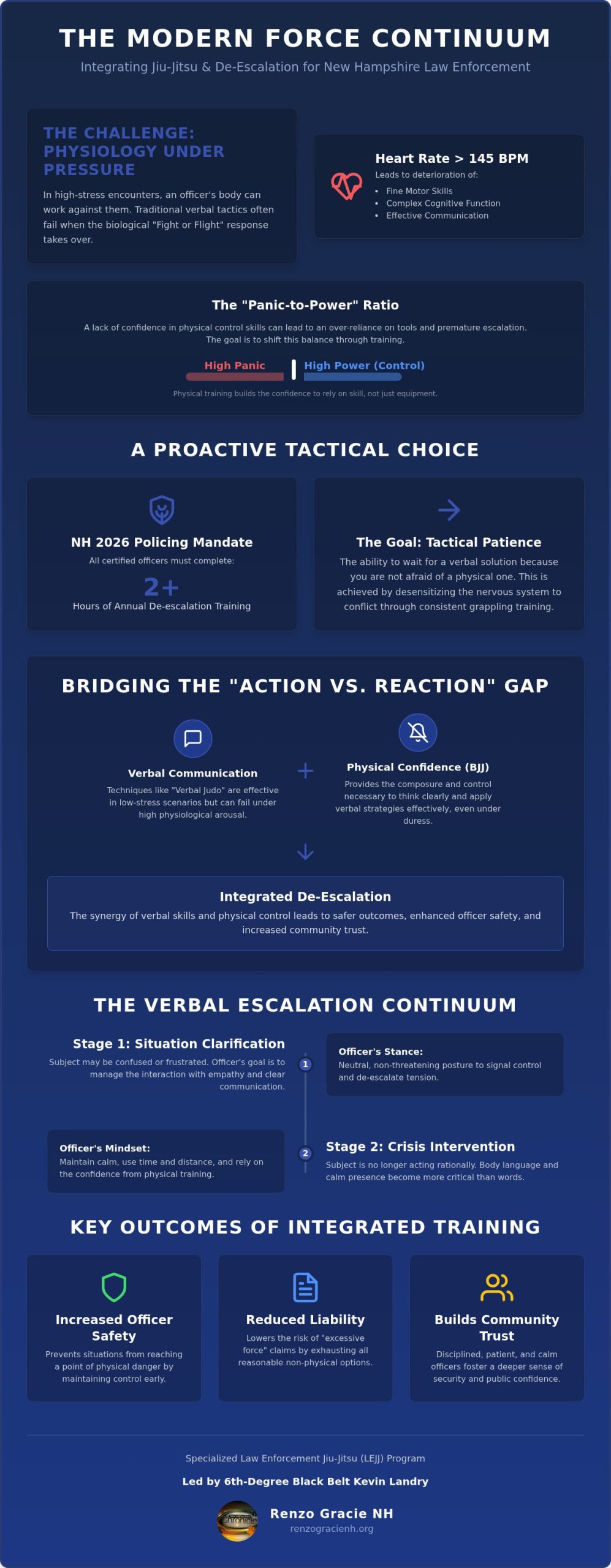
De-escalation isn’t a passive retreat or a sign of weakness. It’s a proactive tactical choice. In the high-pressure environment of active patrol, choosing to lower the temperature of an encounter is often the most courageous and professional action an officer can take. Effective De-escalation involves using time, distance, and communication to stabilize a situation before it requires physical force. As of August 2026, the New Hampshire Police Standards and Training Council (PSTC) requires all certified officers to complete at least two hours of annual training focused on these skills. This mandate reflects a broader commitment to modern policing standards that prioritize the preservation of life and the safety of everyone involved.
Many officers find that traditional “Verbal Judo” models fall short when a subject’s arousal level spikes. When adrenaline surges and tunnel vision sets in, complex verbal scripts often vanish. You need more than just words. You need a foundation that allows you to think clearly while under physical threat. This is where the modern force continuum evolves. It’s no longer just a linear ladder of escalating violence. Instead, it’s a dynamic framework where de-escalation remains the central hub, guiding every decision from your initial presence to the moment physical control becomes necessary.
The Verbal Escalation Continuum in NH
NH training bodies identify clear stages of verbal aggression that you encounter daily. It begins with “Situation Clarification,” where a citizen might simply be confused or frustrated by an interaction. If not managed with empathy, this can quickly transition into “Crisis Intervention,” where the subject is no longer acting rationally. During these shifts, your body language speaks louder than your voice. Maintaining a neutral, non-threatening posture is a core component of successful community policing. It signals that you are in control of yourself, which helps the subject regain control of their own emotions.
Regulatory Pressures and Community Trust
Implementing robust de-escalation techniques for law enforcement NH is a powerful way to reduce department liability. By exhausting all reasonable non-physical options, you significantly lower the risk of “excessive force” claims that can damage a career or a department’s reputation. This commitment to professional growth builds lasting trust in communities like Manchester and Exeter. When residents see officers who are disciplined, patient, and calm, they feel a deeper sense of security. De-escalation is a strategic tool designed to maximize officer safety by preventing a situation from ever reaching the point of physical danger.
The Psychology of Calm: Why Physical Confidence Prevents Escalation
When your heart rate climbs above 145 beats per minute, fine motor skills and complex cognitive functions begin to deteriorate. This is the physiological reality of the “Fight or Flight” response. For an officer on a high-arousal call, this biological surge makes it nearly impossible to access the empathetic, rational parts of the brain needed for effective communication. If you feel physically vulnerable, your body prioritizes survival over dialogue. This often leads to a high “Panic-to-Power” ratio, where a lack of confidence in one’s physical control leads to an over-reliance on tools or early escalation.
Building true proficiency in de-escalation techniques for law enforcement NH starts with managing these internal chemical spikes. Consistent grappling training helps desensitize the nervous system to physical proximity and conflict. By reducing cortisol and adrenaline spikes through controlled exposure, you gain “Tactical Patience.” This is the ability to wait for a verbal solution because you aren’t afraid of a physical one. This level of preparedness aligns with the standards highlighted in the Law Enforcement De-Escalation Training Act of 2022 (LEDTA), which emphasizes using the least amount of force necessary to safely resolve a situation.
Officer Presence and Tactical Confidence
True confidence is quiet. It doesn’t need to be aggressive or intimidating to be effective. When you possess the skills to control a subject through grappling, your stance naturally becomes less threatening and more stable. Fear-based policing often manifests as a rigid, aggressive posture that unintentionally signals a threat to the subject. This cycle of mutual fear is what drives rapid escalation. By focusing on physical preparedness, you support your own mental wellness, ensuring you arrive at every call with a clear head and a steady hand.
The Link Between Grappling and Verbal Clarity
A subject can sense when an officer’s body stiffens. This physical tension is a universal signal for an impending fight, which often causes the subject to escalate in response. By applying Brazilian Jiu-Jitsu “Flow” concepts, you learn to remain adaptable and relaxed even when a situation is unpredictable. This physical relaxation keeps your mind open to verbal solutions. If you are interested in developing this level of professional poise, exploring Law Enforcement Jiu-Jitsu Training is a vital step. You’ll find that when you master your body, you master the room. It is much easier to lead a community toward peace when you are already at peace with your own capabilities.
Comparing De-Escalation Models: Verbal Judo vs. Brazilian Jiu-Jitsu
Traditional de-escalation models often rely on a critical assumption: the subject is willing and able to listen. Verbal-only strategies, like the classic Verbal Judo approach, are excellent for managing compliant or slightly agitated individuals. However, these models can falter when a subject is experiencing a severe mental health crisis or is under the influence of narcotics. In these moments, logic disappears. Relying solely on “Command Presence” can even backfire. A rigid, authoritative stance may be perceived as a challenge, unintentionally triggering a physical confrontation that neither party wants. True mastery of de-escalation techniques for law enforcement NH requires an integrated model that blends verbal skills with the physical confidence of Brazilian Jiu-Jitsu.
The “Action vs. Reaction” gap is a constant danger in the field. If an officer only has verbal tools, they are forced to react to a subject’s physical aggression after it has already begun. This delay often leads to higher levels of force than necessary. By integrating grappling, you close this gap. You gain a “fail-safe” that allows you to stay in the conversation longer because you know exactly how to protect yourself if the dialogue fails. This proactive approach is a cornerstone of Gracie Survival Tactics (GST), which teaches officers how to maintain a safe distance and control a subject without immediately resorting to weapons or striking.
The KODIAK Model vs. Tactical Grappling
Many NH departments utilize the KODIAK model, which emphasizes four stages: Safety, Relationship, Calmness, and Solution. While these stages are vital, the “Safety” component is often the hardest to maintain. When you lack physical control skills, your primary way to ensure safety is often to draw a tool, which immediately escalates the scene’s tension. Tactical grappling provides a middle ground. It allows you to fulfill the “Safety” stage through superior positioning and clinch work. This physical stability makes it much easier to transition back to verbal negotiation, as you aren’t fighting for your own survival while trying to find a solution.
Reducing the Need for Striking
Brazilian Jiu-Jitsu is known as the “gentle art” because it focuses on leverage and control rather than impact. In modern policing, the liability difference between a strike and a controlled takedown is massive. Strikes often lead to broken bones, lacerations, and high-profile use-of-force reviews. A controlled clinch or a guided takedown, however, allows for subject control with a significantly lower risk of injury. The primary goal of Law Enforcement Jiu-Jitsu (LEJJ) is to minimize injury to both the officer and the subject during every encounter. This focus on preservation of life aligns perfectly with current NH use-of-force policies and community expectations.
5 Essential BJJ-Based De-Escalation Techniques for NH Officers
True de-escalation is the art of giving a subject every opportunity to comply while ensuring they never have the opportunity to harm you. Integrating physical mechanics into your daily routine is the key to this tactical confidence. It is about being prepared, not aggressive. By utilizing these de-escalation techniques for law enforcement NH, you create a buffer of safety that benefits everyone involved. These skills allow you to remain calm and professional even when a situation becomes volatile. When you understand the mechanics of balance and leverage, you don’t need to shout to be heard. You lead through disciplined presence.
Distance Management and the Interview Stance
Distance is your best friend. In Brazilian Jiu-Jitsu, we teach that if a subject can’t touch you, they can’t hurt you. Maintaining a “Reactionary Gap” of six to eight feet gives you the time necessary to process information and react to sudden movements. To support this, you should adopt the “Interview Stance,” often called “The Fence.” This involves keeping your feet staggered for balance while your hands remain open and at chest level. It is a non-threatening posture that signals a willingness to talk, yet it places your hands in the perfect position to block a strike or initiate a clinch if the situation turns physical. This tactical space reduces the subject’s anxiety while keeping you ready for anything.
The Clinch and Subject Control
When verbal negotiation fails, you need a way to stop aggression without resorting to striking. The “Seatbelt Clinch” is a fundamental BJJ technique that allows you to neutralize a subject’s movement by controlling their torso and arms. This position minimizes the subject’s ability to reach for weapons or throw punches. Transitioning from a verbal refusal to a physical control position should be a smooth, guided movement rather than an explosive collision. This reduces the risk of injury for both parties. Whether you are working a busy night in Manchester or a local call in Exeter, these skills provide the tactical patience you need while waiting for backup to arrive. You stay in control without escalating the violence.
Mastering these movements requires consistent practice and professional guidance. You can build the confidence to handle any encounter by training with experts who understand the unique needs of your profession. Start your journey toward tactical mastery by enrolling in our Law Enforcement Jiu-Jitsu Training at Renzo Gracie NH today.
- Distance Management: Using the reactionary gap to buy time and maintain calm.
- The Interview Stance: An open-handed, de-escalatory posture that is ready for defense.
- The Seatbelt Clinch: Neutralizing a subject’s upper body to prevent strikes.
- Guided Takedowns: Using leverage to bring a subject to the ground safely.
- Subject Control (The Pin): Maintaining a dominant, safe position until backup arrives.
Advancing Law Enforcement Jiu-Jitsu Training at Renzo Gracie NH
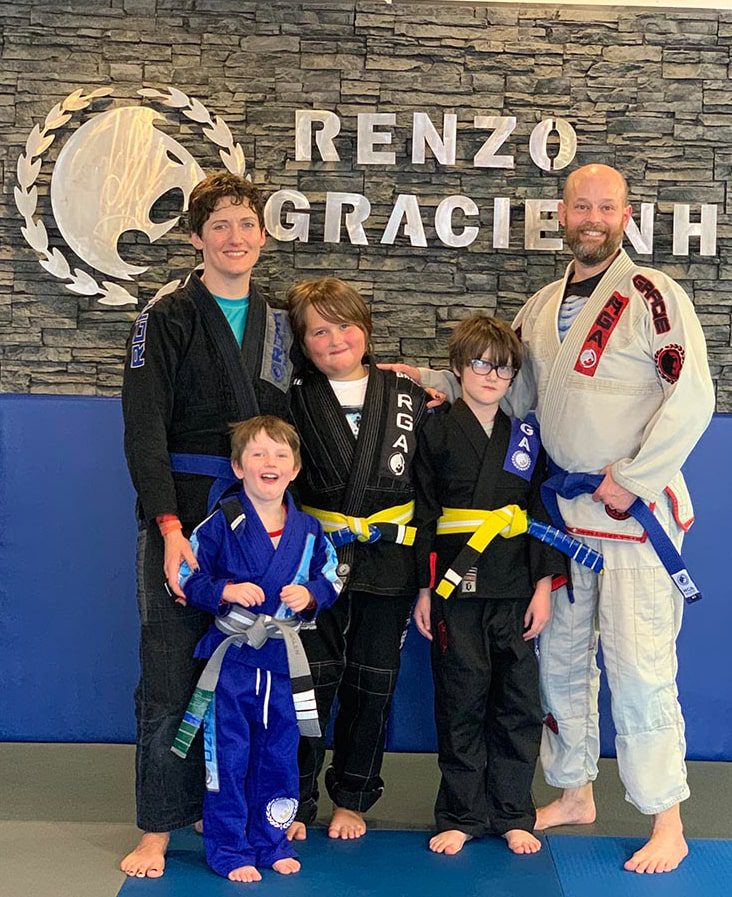
Classroom learning provides the theory, but the mat provides the mastery. At Renzo Gracie NH, we believe that true tactical confidence is built through consistent, high-quality practice. Our specialized Law Enforcement Jiu-Jitsu (LEJJ) program in Windham is designed to bridge the gap between policy and performance. Led by Professor Kevin Landry, a 6th-degree black belt with over 20 years of teaching experience in New Hampshire, our academy offers a level of expertise that is rare in the region. We provide a professional yet inclusive environment where officers from all backgrounds can evolve their skills. You don’t just learn a set of moves here. You join a community dedicated to excellence and personal growth. We invite you to experience this firsthand by attending a free introductory class to see how our curriculum fits your professional needs.
Tailored Curriculum for Professional Defensive Tactics
One-off seminars often fail because they don’t allow for the development of muscle memory. Mastery of de-escalation techniques for law enforcement NH requires recurring mat time to ensure that your reactions are instinctive and calm under pressure. Our LEJJ curriculum is specifically tailored for the modern officer. We focus on critical areas such as subject control, weapon retention, and ground survival. These aren’t just sport techniques; they are life-saving defensive tactics designed for the street. By training regularly, you ensure that your body knows what to do even when your mind is under extreme stress. Many of our officers also find that training becomes a family affair. If you’re interested in bringing the same level of discipline and focus to your household, explore our Kids Jiu Jitsu New Hampshire program for your children.
Join the NH Law Enforcement BJJ Community
Training with fellow officers creates a unique bond of trust and mutual respect. Our academy serves as a hub for the NH law enforcement community, providing a safe and structured environment to sharpen your skills. We understand the unique pressures of the job. Our sessions are designed to build vitality and resilience, helping you manage the physical and mental toll of patrol work. Whether you are looking for an individual membership or a department-wide training solution, we offer flexible options for agencies across Southern New Hampshire, including Manchester and Exeter. We are your supportive partner in professional development. Take the next step in your tactical journey and discover the empowerment that comes with disciplined practice. Contact Renzo Gracie NH today to schedule your LEJJ session and start building the confidence that keeps our communities safe.
Empower Your Patrol with Tactical Confidence
True mastery in the field isn’t just about what you say; it’s about the quiet confidence you project when you know you can handle any situation. By integrating specialized de-escalation techniques for law enforcement NH, you move beyond basic compliance and into a space of professional excellence. You’ve seen how physical preparedness through Brazilian Jiu-Jitsu allows for greater verbal clarity and a reduced reliance on weapons. This synergy protects you, the subject, and the community you serve. It transforms your approach from reactive to proactive, ensuring you remain the expert in the room during every encounter.
At Renzo Gracie NH, we are proud to offer a specialized LEJJ curriculum that carries the prestigious legacy of the Renzo Gracie Association. Under the guidance of 6th-degree black belt Kevin Landry, who brings over 20 years of NH instructional experience, you’ll develop the essential subject control skills needed for modern policing. We invite you to start your Law Enforcement Jiu-Jitsu journey with a free intro class at Renzo Gracie NH today. Building these skills is a marathon, not a sprint. We’re here to be your supportive partner every step of the way. Stay safe, stay focused, and keep growing.
Frequently Asked Questions
What are the 4 pillars of de-escalation for law enforcement?
The four pillars of de-escalation are time, distance, cover, and communication. By maximizing these elements, you create the space needed to avoid a physical confrontation. Time allows for better decision-making; distance creates a safety buffer; cover provides protection; and communication serves to build rapport or gain compliance. Mastering these pillars ensures that you use the least amount of force necessary while maintaining absolute control over the scene’s progression and outcome.
Is de-escalation training mandatory for police officers in New Hampshire?
Yes, de-escalation training is mandatory for all certified police, corrections, and probation officers in the state. According to the New Hampshire Police Standards and Training Council (PSTC), officers must complete at least two hours of annual de-escalation training. This is part of the broader 24-hour annual in-service requirement. Staying current with de-escalation techniques for law enforcement NH is essential for maintaining certification and meeting modern community policing standards.
How does Brazilian Jiu-Jitsu help with de-escalation?
Brazilian Jiu-Jitsu provides the physical confidence needed to remain calm during high-stress encounters. When you know you can control a subject through grappling, you’re less likely to experience the panic that leads to premature escalation or an over-reliance on weapons. This “tactical poise” allows you to stay in the verbal negotiation phase longer. It bridges the gap between words and force, providing a safe middle ground for subject control and officer safety.
What is the “tactical patience” concept in de-escalation?
Tactical patience is the ability to slow down an encounter and wait for a peaceful resolution. It’s built on the foundation of being physically prepared for any outcome. If you aren’t afraid of a physical confrontation, you don’t feel the need to rush to a “win” or force immediate compliance through aggression. This mindset allows you to use time as a tool, effectively lowering the emotional temperature of a crisis before taking action.
Can BJJ techniques reduce the risk of excessive force lawsuits?
Yes, BJJ techniques significantly reduce liability by prioritizing control over impact. Traditional defensive tactics often rely on strikes, which frequently lead to injuries like broken bones or lacerations. These injuries often trigger “excessive force” litigation. In contrast, BJJ focuses on leverage, clinch work, and safe takedowns. By using de-escalation techniques for law enforcement NH that emphasize subject control without injury, departments can lower their risk of high-profile lawsuits and community backlash.
What are the most common verbal de-escalation triggers to avoid?
Common triggers include using sarcasm, ordering a subject to “calm down,” or needlessly challenging their authority. Phrases that sound dismissive or condescending often escalate a subject’s arousal level rather than lowering it. You should also avoid invading a subject’s personal space too early, as this can trigger a defensive “fight” response. Instead, focus on active listening and empathetic responses that validate the subject’s feelings without necessarily agreeing with their actions or demands.
Does Renzo Gracie NH offer private training for police departments?
Renzo Gracie NH offers specialized Law Enforcement Jiu-Jitsu (LEJJ) training for both individual officers and entire departments. Our curriculum is led by Professor Kevin Landry, a 6th-degree black belt with over two decades of experience teaching in New Hampshire. We can tailor sessions to meet the specific needs of your agency, focusing on ground survival, weapon retention, and subject control. These professional sessions are designed to build the muscle memory required for safe, effective de-escalation.
How often should officers practice de-escalation and defensive tactics?
While state mandates require two hours annually, true proficiency requires consistent practice. Perishable skills like grappling and high-stress communication fade without regular use. We recommend that officers engage in mat time at least once or twice a week to maintain their “tactical edge.” Regular training ensures that your de-escalation responses are instinctive rather than forced. This consistent effort builds the long-term vitality and resilience needed for a successful career in law enforcement.