Posts

Preparing for My First BJJ Stripe Test in NH: When to Test

A first BJJ stripe isn’t earned on a fixed calendar date. When preparing for my first BJJ stripe test in NH, treat month three as a point when techniques may start clicking and month six as a time when progress may be easier to see, not as automatic test dates. Readiness depends on the skills you can demonstrate, your training habits, and your instructor’s feedback.

It’s natural to wonder whether you’re progressing quickly enough, especially when every class brings something new to learn. This guide explains how timing can offer context without defining readiness, what feedback and consistent practice can reveal, and how a stripe evaluation may assess fundamental skills. You’ll have a clearer sense of where you are in your training and what to focus on next.

Key Takeaways

  • Use your instructor’s feedback and the skills you can demonstrate to judge readiness, rather than relying on time alone.
  • Notice how consistently you apply fundamentals with different training partners; steady progress matters more than trying to impress.
  • Ask what to focus on next. If you don’t pass, feedback can clarify what you need to develop for a stripe.
  • Prepare for an evaluation of core skills, including guard passes, sweeps, transitions, and positional techniques.

Expected timeline for earning a first white belt stripe

Students may not earn a stripe if they haven’t consistently demonstrated the expected fundamentals or need more practice applying them. A stripe reflects demonstrated progress, not time served alone. If you’re preparing for your first BJJ stripe test in NH, use the evaluation criteria and your instructor’s feedback to guide your expectations.

First Stripe Timing

First-stripe timing is the period between starting white-belt training and demonstrating the skills expected at that stage. Around month three, techniques may start clicking; by month six, students may recognize their progress more clearly. These are reference points, not test dates. As you prepare for your first BJJ stripe test in NH, use them to reflect on your development rather than predict promotion.

There’s no single calendar schedule for earning stripes or reaching blue belt. Progress depends on the skills you demonstrate and the academy’s approach. A new white belt revisits fundamental movements, learns how positions connect, and gradually applies techniques with partners. Comparing your progress with classmates can distract from what you’re learning. Your instructor’s assessment is a more relevant measure of your development.

Technical Requirements and Curriculum

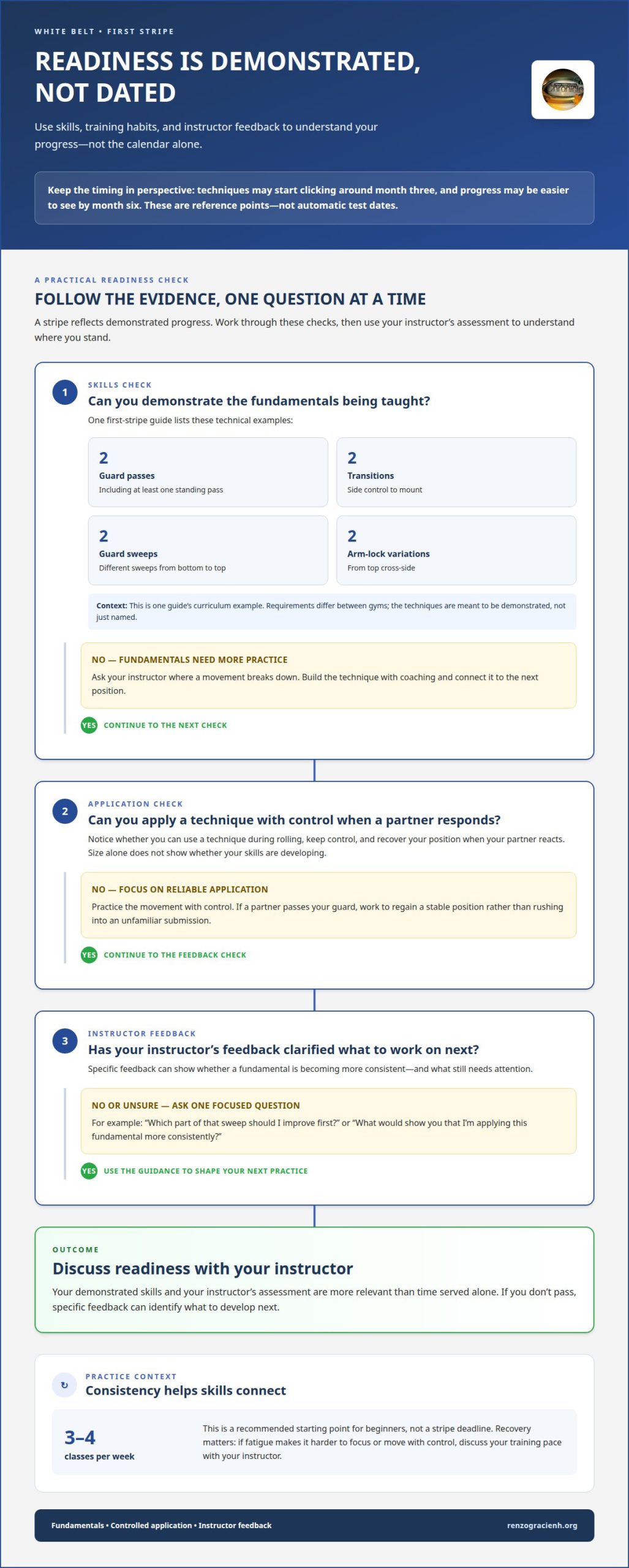
A first-stripe curriculum builds core techniques for moving between positions and responding with control. One first-stripe guide calls for two technical guard passes, including at least one standing pass, and two transitions from side control to mount. It also includes two different guard sweeps from bottom to top and two arm-lock variations from top cross-side.

Coaching helps students understand the purpose of each movement, rather than simply memorize a sequence. For example, practice can connect a guard pass to a stable position, then work on a controlled transition. During the first year, white belts can prioritize fundamentals and build reliable technique. An instructor can identify where a movement breaks down and guide practice toward a more connected skill set.

Observing instructors and training partners

Watch how instructors demonstrate a position, correct details, and adjust practice when a movement isn’t working. During rolling, notice whether you can apply a technique with control, then recover your position when your partner responds. A technical partner may submit a beginner despite weighing 50 pounds less, so size alone doesn’t show whether your skills are developing.

Training frequency also shapes what you retain. Three to four classes per week is a recommended starting point for beginners, but recovery matters: if fatigue makes it harder to focus or move with control, discuss your training pace with your instructor. Consistent attendance helps you revisit techniques and receive coaching over time. Missing practice can make it harder to connect a move from one class with a position encountered later.

Keep your gear clean. Wash your gi after every class, and shower before and after training. For a stripe test, wear your usual clean training gi and bring your belt; arrive ready to follow your instructor’s directions. These simple habits support a respectful training environment and let you focus on the evaluation.

During live rolling, prioritize learning over winning each exchange. For example, if a partner passes your guard, work to regain a stable position instead of rushing into an unfamiliar submission. Pay attention to how instructors respond to your movement and how experienced partners offer resistance. Their reactions can show whether your technique works under pressure, while staying composed helps keep practice constructive.

If you’re building a steady routine, coached Jiu-Jitsu training can give you regular opportunities to practice with guidance. Show up consistently, keep your gear clean, and use each round to learn something specific.

Asking questions and seeking feedback

Specific feedback can turn a stripe result into a clear training focus. Students who don’t pass receive feedback on what they need to do to earn the stripe. Use that guidance to identify a fundamental skill to work on, rather than treating the result as a judgment of your potential.

Ask questions that clarify the movement, not just whether it looked right. For example, if a sweep stalls, ask which part of its mechanics needs attention: your setup, balance, or timing. Then try the correction during practice and ask whether it addressed the issue. One focused question gives you a practical next step.

  • “Which part of that sweep should I improve first?”
  • “What should I do when my partner blocks the first attempt?”
  • “Can you show me where my balance shifted?”
  • “What would show you that I’m applying this fundamental more consistently?”

Feedback is most useful when you connect it to a specific example. If an instructor notes that your guard pass loses control near the end, remember that moment and focus your next practice on maintaining position through the transition. Everyone learns at a different pace, so compare your work with the criteria being taught, not another student’s progress.

After receiving feedback, restate the key point in your own words. For instance, say, “I need to keep my base stable before moving past the guard,” then practice that detail in a controlled drill. If the same difficulty comes up again, describe what happened and ask for another adjustment. This gives your instructor a clear example to respond to and helps you track whether the correction carries into live training.

Not passing on the first attempt doesn’t leave you guessing. Use your instructor’s specific guidance to shape your next practice, then ask how your progress compares with the target.
Preparing for My First BJJ Stripe Test in NH: When to Test

Stripe test format and evaluation

A stripe evaluation checks whether a student can demonstrate foundational Brazilian jiu-jitsu skills, not just name techniques. The format may combine technical demonstrations with movement between positions, helping an instructor assess mechanics, control, and understanding during grappling. The takeaway: prepare to show how techniques work, not only recall their names.

Requirements differ between gyms because each sets its own curriculum and assessment approach. An affiliation may provide shared guidance across its academies, while a local instructor can shape an evaluation around the skills taught in class. Ask which techniques and criteria apply at your academy, then use the answer to focus your practice.

One first-stripe test guide includes two technical guard passes, with at least one standing pass. It also lists two ways to move from side control to mount, two guard sweeps from bottom to top, and two arm-lock variations from top cross-side. These examples show why an evaluation may involve skills from several positions rather than one isolated move.

For each technique, focus on clear steps: establish the position, control your movement, and complete the transition with purpose. A guard pass, for example, should involve more than moving forward; you need to work through the guard into a stable position. An escape or sweep should also reflect the mechanics taught in class. Instructor feedback helps identify which detail needs more practice.

Do BJJ gyms charge a fee for stripe tests? There isn’t one universal fee; whether an evaluation has a separate charge depends on the gym’s policy. The test format and any related cost are separate questions, so understand both before test day.

Want structured practice with instructor guidance? Explore Jiu-Jitsu training and keep building the skills an evaluation may assess.

Renzo Gracie NH

Renzo Gracie NH can help you build your Jiu-Jitsu skills through structured instruction and ongoing practice. If you’re unsure what to focus on before a first stripe evaluation, use your training to develop fundamentals, apply techniques, and learn from instructor feedback. The Adult Jiu Jitsu Program supports adult students, while the Kids Jiu Jitsu Program provides instruction for children. Law enforcement professionals can also explore Law Enforcement Jiu-Jitsu Training. New students can begin with a Free Introductory Class to experience training and consider their next step. A stripe is one milestone in a longer learning journey, and consistent coaching can help you keep progressing beyond it. If you’d like to discuss getting started, contact Renzo Gracie NH.

Keep building beyond your first stripe

A stripe can mark progress, but your next goal can be broader: becoming a more thoughtful, capable training partner. If you’re preparing for your first BJJ stripe test in NH, choose a personal focus to keep learning after the evaluation, such as staying composed during transitions or applying a technique with better control. Small, deliberate goals give each class a purpose.

Renzo Gracie NH offers an Adult Jiu Jitsu Program, a Kids Jiu Jitsu Program, and Law Enforcement Jiu-Jitsu Training, with instruction suited to different student needs. Whether you’re beginning your own practice, supporting a child’s interest, or developing skills for professional training, start with a consistent learning routine.

Contact Renzo Gracie NH to talk about getting started. Keep showing up, stay curious, and take pride in every step forward.

Frequently Asked Questions

WHEN WILL I BE READY FOR MY FIRST STRIPE?

You’re ready when you can demonstrate the skills your instructor expects and apply them with control. Techniques may start clicking around month three, while month six can make your progress easier to recognize. Treat these as useful checkpoints, not deadlines. For example, notice whether you can follow a familiar movement sequence when your partner changes position, rather than relying on a calendar.

WHAT HAPPENS WHEN I GET TO THIS POINT?

Once your instructor considers you ready, you may be evaluated on the fundamentals taught in class. Students who pass are awarded their stripe at the front of the class. Afterward, keep training and work on applying those skills in new situations. A stripe marks progress, while continued practice helps you build toward your next learning goal.

What are the requirements for a first BJJ stripe test for a white belt?

Requirements depend on your academy’s curriculum, but a first-stripe guide may include guard passing, sweeps, transitions, and positional techniques. For instance, it lists two guard passes, two bottom-to-top sweeps, two side-control-to-mount transitions, and two arm-lock variations from top cross-side. Use your instructor’s stated criteria as the standard for your evaluation.

What techniques should I know before my first BJJ stripe test?

Be prepared to show fundamental movements from more than one position. A first-stripe guide includes a standing guard pass, a sweep from bottom, a transition from side control to mount, and arm-lock variations from top cross-side. The goal isn’t to rush through a sequence. Demonstrate each technique with control, and be ready to repeat it if your instructor asks.

How do BJJ stripe tests work, and what should I expect?

A stripe test evaluates whether you can demonstrate techniques and understand how they connect to positions. Expect to show movements from the curriculum, such as passing guard or transitioning from side control. Your instructor assesses your execution and may offer feedback about areas to keep developing. Focus on listening to each prompt and showing your understanding, rather than trying to make every movement look advanced.

How long does it usually take to earn a first BJJ stripe?

There’s no single timeline that applies to every student. Around month three, techniques may begin to click; by month six, you may see your progress more clearly. These milestones don’t determine promotion. Your development depends on what you’ve learned and can demonstrate, so use these time points to reflect on your training, not to measure yourself against another white belt.

The BJJ Belt System Explained: Your Path to Mastery in 2026

What if the white belt around your waist isn’t a sign of what you lack, but a symbol of the courage it took to start? It’s common to feel like a “forever white belt” when you first begin. You see a sea of colors and stripes, and the path forward often feels like a mystery. This guide offers the BJJ belt system explained to clear away that confusion. We want you to feel empowered, not intimidated, as you look toward your future on the mats.

You’re likely wondering how long it takes to reach blue belt or how the kids’ ranking differs from the adult curriculum. It’s a journey of disciplined confidence. We’ll explore the specific requirements for 2026, the meaning behind each rank, and the realistic timelines for your personal evolution. Whether you’re a parent looking at our kids’ programs or an adult ready for your first free introductory class, you’ll find a clear map for your progress. This is about more than just a piece of fabric. It’s about the grit, respect, and community that build a true martial artist from the ground up.

Key Takeaways

  • Understand how the ranking system acts as a structured map for your personal evolution and technical proficiency.
  • Discover the unique focus of each rank, from the foundational survival skills of a white belt to the refined mastery of the advanced levels.
  • Gain clarity with the BJJ belt system explained, focusing on how technical skill and dedicated mat time lead to earned promotions.
  • See how a structured curriculum and age-appropriate rankings support growth in both our Adult and Kids Jiu Jitsu Programs.
  • Recognize that every rank represents a commitment to perseverance, character development, and the strength of the collective team.

Understanding the Brazilian Jiu-Jitsu Ranking System

The Brazilian Jiu-Jitsu ranking system is more than a way to hold your jacket together. It’s a visual diary of every hour spent sweating on the mats. In 2026, the BJJ belt system explained remains the gold standard for measuring progress in martial arts. It balances technical proficiency with consistent mat time. You aren’t just learning moves; you’re building a lifestyle. Mastery requires both the mental capacity to understand complex leverage and the physical grit to show up when you’re tired.

Progress isn’t a straight line. It’s a series of bursts. You might spend weeks feeling like you’re drowning, only for a specific sweep or submission to suddenly click. This “staccato-then-flow” rhythm defines the journey. Rapid growth is often followed by long plateaus where your skills solidify under the surface. These quiet periods are where true character is built. You learn to trust the process even when the next stripe feels miles away. When you see the BJJ belt system explained in its full context, you realize it’s a roadmap for a decade-long transformation.

Lineage provides the foundation for your growth. At Renzo Gracie NH, you’re training under Professor Kevin Landry, a 6th-degree black belt with over two decades of experience. This connection to Renzo Gracie ensures the quality of instruction is rooted in a prestigious history. While the traditional kimono has evolved into modern Gi and No-Gi standards, the core values remain unchanged. Whether you’re wearing a traditional Gi or modern athletic gear, the belt you earn represents the same standard of excellence.

The Philosophy of the Belt

A belt is a tool for personal discovery. It’s about evolving your character alongside your physical skills. We maintain a balance of quiet authority and warm inclusivity. Every promotion is a celebration of your perseverance. The goal isn’t just to defeat an opponent. It’s about personal progress and the joy of finding strength in a supportive community. You’ll find that as your rank increases, your sense of responsibility to your teammates grows with it.

Adult vs. Youth Ranking Systems

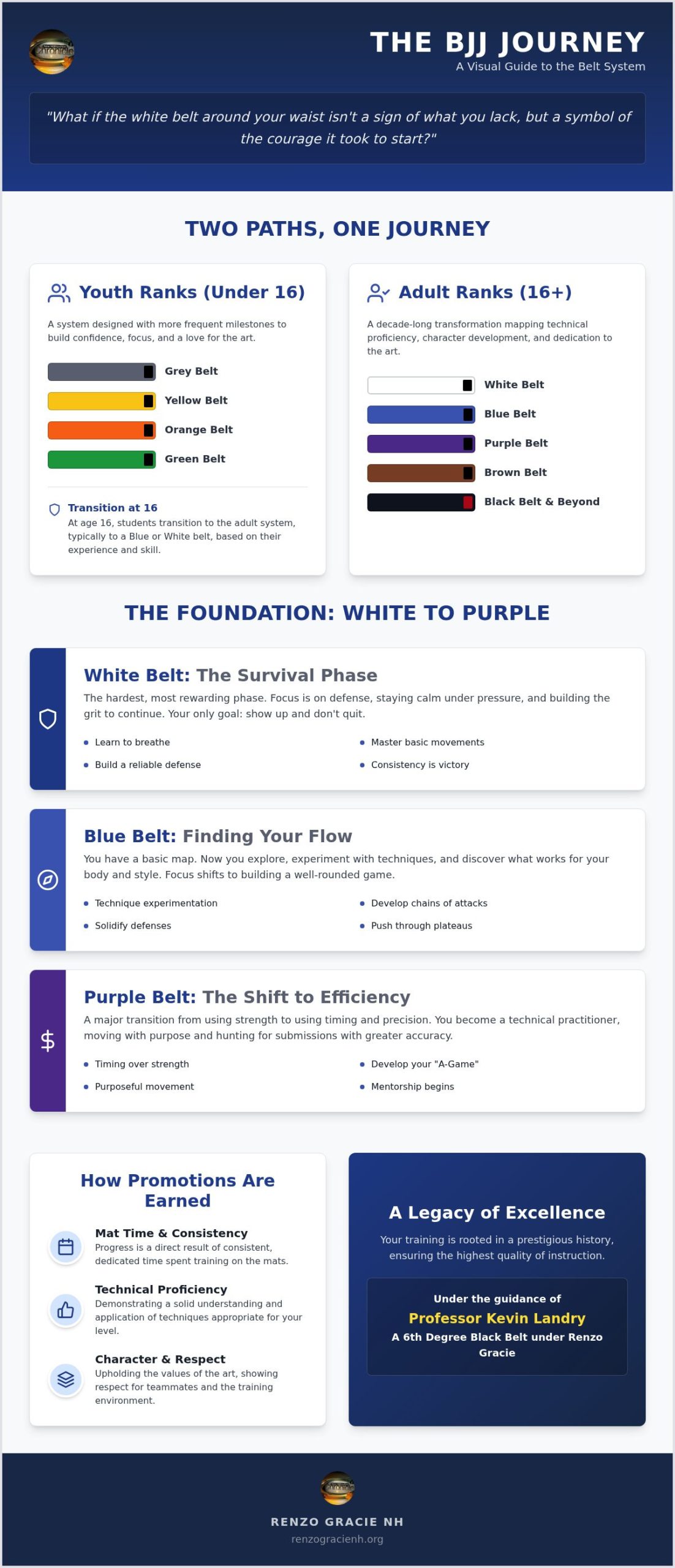
Children and adults walk different paths. Students under 16 follow a specialized color sequence including Grey, Yellow, Orange, and Green. This youth system provides more frequent milestones to build a child’s confidence and focus. It keeps them engaged while teaching the value of hard work. The requirements for these ranks focus on movement, coordination, and basic safety. Once a student turns 16, they transition seamlessly into the adult ranks. They carry their years of discipline with them as they enter the adult tiers based on their previous experience and age.

The Foundation: From White Belt to Purple Belt

The first few years on the mats are deeply transformative. You aren’t just learning how to move your body. You’re retooling how your brain handles stress. While the journey to a black belt can take 8 to 15 years, these early ranks set the pace for your lifelong practice. This is the heart of the BJJ belt system explained through the lens of personal growth. At Renzo Gracie NH, we prioritize a supportive community that anchors you through these demanding early stages. Growth happens together. We move away from the aggressive atmosphere of typical combat sports and focus on disciplined confidence instead.

White Belt: Embracing the Survival Phase

Survival is your first goal. You’ll spend most of your time underneath larger opponents, learning how to breathe while under pressure. It’s about discovering basic movements like the bridge and the shrimp. Focus on holding positions and understanding leverage. The white belt is the foundation of all future mastery. Beginners should prioritize consistency over “winning” rounds. If you showed up and didn’t quit, you won. This phase builds the grit needed for the years ahead. It’s often the hardest rank because everything is new and confusing. Your focus should be on building a reliable defense and learning how to stay calm when things get difficult.

Blue and Purple: Finding Your Flow

The blue belt introduces experimentation. You have a basic map now. Now, you start to explore which techniques fit your body type and personality. A key blue belt requirement is developing a well-rounded defense. You can’t attack effectively if you’re terrified of being swept. This is often where the “Blue Belt Blues” hit, a mental hurdle where progress feels slow. Our structured martial arts curriculum helps you push through these plateaus by providing clear milestones. You’ll start to see the BJJ belt system explained not as a series of hurdles, but as a steady evolution of your own potential.

Transitioning to purple belt marks a shift toward efficiency. You stop using raw strength. You start using timing. You become a “technical” player who moves with purpose. This is also where you begin to mentor others. Leadership skills emerge naturally as you help newer students navigate the same struggles you once faced. It’s a cycle of growth that strengthens the whole team. If you’re ready to begin this evolution, you can start with a free introductory class at one of our locations. Every expert was once a beginner who refused to give up.

The Advanced Ranks: Brown, Black, and the Coral Belts

Precision matters here. You’ve spent years building your foundation. Now, you refine the details. The advanced ranks represent a shift from learning what to do to understanding why you do it. This is where the BJJ belt system explained moves beyond simple mechanics and into the realm of true mastery. You aren’t just a practitioner anymore. You’re a representative of a prestigious lineage. Training within the Renzo Gracie NH community means your progress is guided by a 6th-degree black belt, ensuring every detail of your game is sharpened to the highest standard.

Brown Belt: The Final Refinement

The brown belt is the phase of sharpening the sword. You identify the smallest holes in your technical game and close them. It’s a period of deep introspection and technical efficiency. At this level, many students begin the transition into becoming instructors. This requires a shift in perspective. You’re no longer just looking at how a move works for you, but how to communicate it to others. This evolution is central to the Renzo Gracie teaching philosophy, where the goal is to empower every individual on the mats. You learn to see the art through a wider lens while maintaining the technical edge of an expert.

The Black Belt and Beyond

Reaching a black belt isn’t the finish line. It’s a new beginning. It represents at least a decade of disciplined confidence and thousands of hours of dedicated mat time. A black belt is simply a white belt who never gave up. At this level, you become a true student of the art, realizing how much more there is to discover. The significance of degrees on the black belt is a major part of the BJJ belt system explained. For instance, Professor Kevin Landry holds a 6th-degree black belt under Renzo Gracie. This represents over two decades of teaching and a profound contribution to the martial arts community. Each degree is a testament to perseverance and a life dedicated to the well-being of others.

Dedication reaches its peak with the “Coral Belts.” These are awarded for extraordinary service and time. The Red/Black belt is earned after 31 years as an active black belt, followed by the Red/White belt after another seven years. Finally, the Red Belt stands as the highest possible honor in BJJ. It’s reserved for grandmasters who have shaped the history of the sport. These ranks remind us that the journey is infinite. It’s a path of constant growth, respect, and strength found in collective effort. Whether you’re a brown belt refining your sweeps or a black belt starting a new chapter, the journey remains about the joy of personal progress.

The BJJ Belt System Explained: Your Path to Mastery in 2026

Promotion Criteria: Stripes, Consistency, and Technical Skill

Earned, not given. This is the heart of the BJJ belt system explained at our academies. Promotions are never based on a simple checklist or a membership anniversary. Instead, they represent a holistic evaluation of your development within the Renzo Gracie Association standards. We look for technical proficiency. This means you can execute moves under pressure without relying on raw strength. It’s about using leverage and timing to overcome resistance. If you can stay calm and technical during a difficult round, you’re showing the signs of a true martial artist.

Consistency is the engine of progress. You have to be a reliable part of the NH community to truly evolve. We notice who shows up on the rainy days and who stays late to help a teammate. Your character and attitude are just as important as your guard pass. Respect for your partners and perseverance through tough plateaus are the traits that define our students. Sparring performance also plays a key role. You must demonstrate the ability to apply techniques safely and effectively against a resisting partner, proving that your skills are functional and controlled.

The Meaning of Stripes

Stripes are the milestones of your journey. These small pieces of tape on the black bar of your belt indicate your progress between major ranks. Most students earn four stripes before they’re considered for the next belt color. They serve as a vital motivational tool during the long years of training. When you receive a stripe, it’s a direct signal from your instructor that your dedication is paying off. This feedback loop helps you stay focused on the BJJ belt system explained as a series of achievable, short-term goals.

How Long Does it Take to Get Promoted?

Mastery is a marathon. For most practitioners, reaching a black belt takes between 10 and 12 years of consistent effort. Some individuals with previous grappling experience or exceptional dedication might move faster. Others might take longer due to life commitments or injuries. It’s your own race. The timeline matters less than the person you become along the way. If you’re ready to start your own path, book your free introductory class at one of our locations in Windham, Manchester, or Exeter today. Every rank you earn is a testament to the disciplined confidence you’ve built on the mats.

Start Your Journey at Renzo Gracie NH

Mastery starts with a single step. At Renzo Gracie NH, we provide the environment you need to succeed. Our academies in Windham, Manchester, and Exeter are built on a foundation of respect and collective effort. We move away from the intimidating atmosphere often associated with combat sports. Instead, we offer a place for growth and disciplined confidence. Whether you’re looking for our Adult Jiu Jitsu Program, our Kids Jiu Jitsu Program, or specialized Law Enforcement Jiu-Jitsu Training, you’ll find a community that supports your evolution. Having the BJJ belt system explained is just the beginning of your story. It’s a map for a transformation that impacts every area of your life.

A Lineage of Excellence in Southern New Hampshire

Southern New Hampshire is home to a world-class lineage. Training here means learning from Professor Kevin Landry, a 6th-degree black belt with deep local roots and over two decades of experience. For those seeking jiu jitsu for beginners adults NH, we offer a structured curriculum that prioritizes your safety and steady progress. We also specialize in a kids jiu jitsu New Hampshire program, focusing on building focus, character, and perseverance in the next generation. This isn’t just about physical strength. It’s about developing the vitality and mental toughness that carry over into school, work, and family life. You’re joining a prestigious legacy that values the success of every individual and the family unit above all else.

Your First Step: The Free Introductory Class

Your journey begins today. We invite you to try jiu jitsu free in New Hampshire through our introductory session. You can expect a safe, no-pressure introduction to the fundamental movements of the art. We’ll guide you through the basics with the care of a supportive partner, ensuring you feel welcomed from the moment you walk through our doors. There’s no need to feel anxious about requirements or rankings. We’re here to help you navigate the BJJ belt system explained in this guide as you step onto the mats for the first time. Visit us at our Windham location or book your session online to discover your own potential. The path to mastery is long, but it starts with the courage to begin.

Your Evolution Starts on the Mats

Precision matters. Having the BJJ belt system explained provides the clarity you need to navigate the years of dedication required for true mastery. This journey is a marathon of personal discovery where technical proficiency meets disciplined confidence. You aren’t just earning stripes; you’re building a legacy of respect and perseverance. At Renzo Gracie NH, we offer world-class 6th-Degree Black Belt instruction within a supportive, family-friendly community. We also provide specialized law enforcement training to empower those who serve our local towns. Your potential is limitless when you have the right partners by your side. Every expert began as a white belt who refused to quit.

Claim Your Free Introductory BJJ Class in Windham Today

The mats are waiting for you. Step forward with confidence and start your own path to excellence today.

Frequently Asked Questions

How long does it take to get a blue belt in BJJ?

Reaching a blue belt typically takes one to two years of consistent training. This timeline varies based on how often you attend classes and your ability to retain the fundamental movements. It’s the first major milestone in the BJJ belt system explained to new students. You’ll focus on escapes and basic positions. Consistency is the most important factor. We value the grit it takes to show up and stay disciplined on the mats.

Do children have the same belt system as adults?

Children follow a different color sequence to keep them motivated and engaged. Students under 16 move through Grey, Yellow, Orange, and Green belts before entering the adult system. These ranks include more frequent milestones. This helps build a child’s confidence and focus during their early years. Once they turn 16, they transition into the adult ranks based on their experience. It’s a structured path designed for long-term success and character development.

What is a coral belt in Brazilian Jiu-Jitsu?

A coral belt is an elite rank awarded to master-level practitioners who have been active black belts for decades. The Red and Black belt is awarded after 31 years at black belt, while the Red and White belt follows seven years later. These ranks represent a lifetime of dedication to the art. They are symbols of profound technical knowledge and contribution to the global Jiu-Jitsu community. It’s the pinnacle of a lifelong journey.

Do I need to compete to get promoted in BJJ?

Competition is not a mandatory requirement for promotion at our academy. While we encourage students to test their skills in a tournament setting, we prioritize technical proficiency and character. You must demonstrate that you can apply techniques safely and effectively against a resisting partner during regular class sparring. Your progress is measured by your own evolution and commitment to the team. We value personal growth and disciplined confidence over winning gold medals.

What are the stripes on a BJJ belt for?

Stripes act as intermediate milestones between major belt colors. Most ranks require four stripes before you’re eligible for the next belt. They are a vital part of the BJJ belt system explained as they provide feedback on your technical progress. Receiving a stripe is a signal from your instructor that your hard work is being recognized. It keeps you motivated during the long periods between belt promotions and reinforces your commitment to the art.

Can I start BJJ if I am over 40 years old?

You can absolutely start Jiu-Jitsu if you are over 40. We have many students who begin their journey later in life and find immense value in the practice. Our environment is supportive and focuses on technical leverage rather than raw athleticism. You’ll learn to move efficiently while building strength and vitality. It’s about personal progress at your own pace. We prioritize your well-being and longevity on the mats through safe, professional instruction.

What happens if I lose my belt or forget it for class?

Forgetting your belt is a common mistake, but it’s important to treat your uniform with respect. If you forget it, you should inform your instructor before class begins. We often have spare belts available to borrow so you can still participate in the session. Consistency and discipline are core values of our academy. Bringing your full gear is part of the professional mindset we encourage in every student to ensure a productive training environment.

Is there a test for every belt promotion at Renzo Gracie NH?

We don’t rely on a single high-pressure test for promotions. Instead, Professor Kevin Landry and our instructors use ongoing evaluation to track your progress. We look at your technical skill, mat time, and how you treat your teammates. This ensures that every promotion is a true reflection of your growth as a martial artist. You earn your rank through daily effort, perseverance, and a commitment to our structured curriculum in a supportive environment.