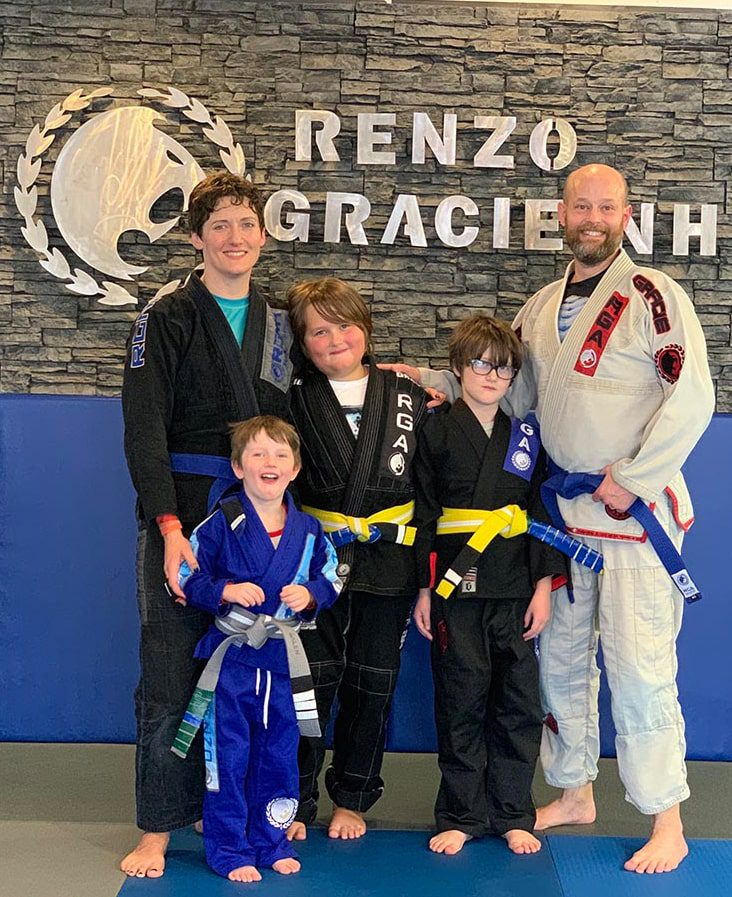
BJJ classes for older adults in Windham
You’re not too old to start Brazilian Jiu-Jitsu: people can begin at 20, 40, or 70. BJJ for older adults in Windham can start with fundamentals and controlled practice, while hard rolling waits until you’re ready.
It’s understandable to wonder whether age, fitness, or experience will make your first class difficult. BJJ doesn’t have to start with intense sparring. Patient practice can help you learn at a steady pace and become more comfortable with movement and technique.
Here, you’ll learn how beginners can approach training safely, which class times may fit an older student, and how often to train. You’ll also see how Brazilian Jiu-Jitsu can build confidence and practical self-defense skills through technique, focus, and consistent progress.
Key Takeaways
- You’re not too old to begin Brazilian Jiu-Jitsu; adults can start at different ages and progress at a pace that suits them.
- Plan for two to three classes a week, and consider morning or midday sessions for a calmer, technique-focused start.
- Build a steady foundation before adding more demanding drills; early training can focus on fundamentals without hard rolling.
- Learn how movement, balance, and technique can support fitness while helping you develop practical self-defense skills.
- Expect confidence to grow through patient practice, problem-solving, and small milestones along the way.
Which class times work best for older beginners?
Morning and midday sessions may feel calmer than evening classes. The best time for an older beginner is one that fits a regular routine and allows you to arrive without rushing.
Class Schedules and Locations
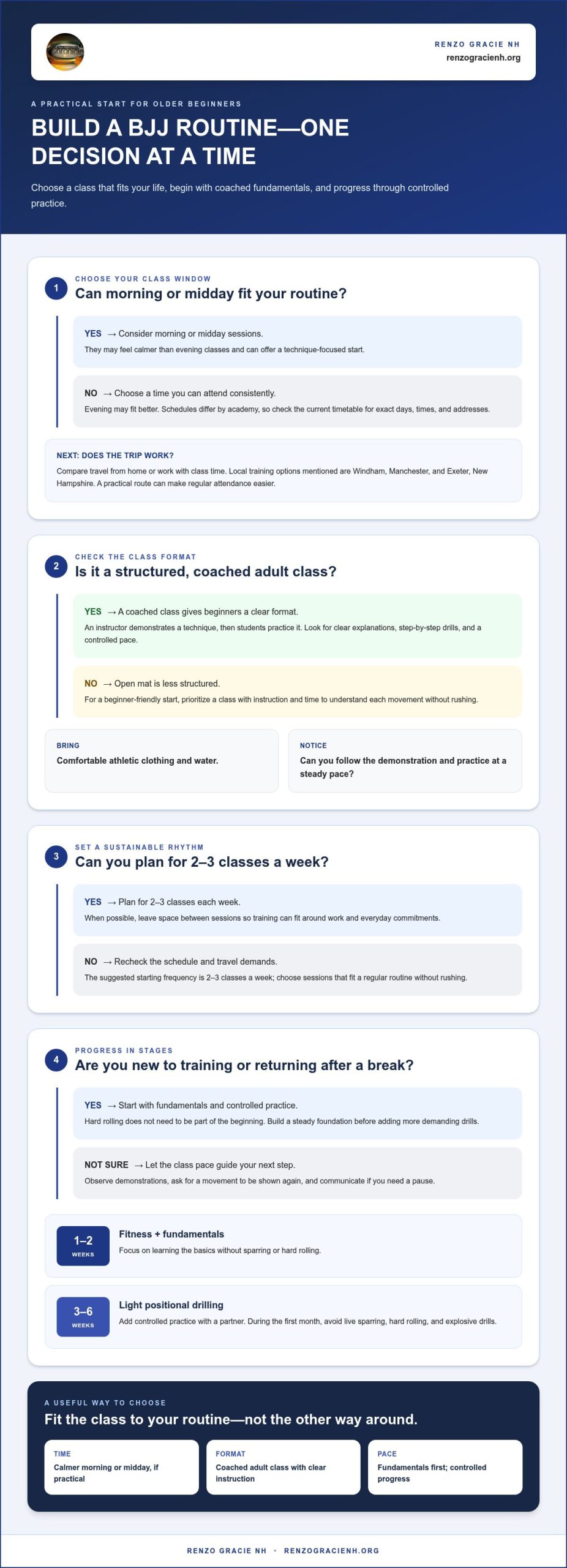
For local training, focus on Windham, Manchester, and Exeter, New Hampshire. Compare the trip from home or work with the class time, and consider whether the route makes regular attendance practical. Morning and midday sessions are often calmer than evening classes, but schedules differ by academy. Use each school’s current timetable for exact days, times, and address details.
The suggested starting frequency is two to three classes a week. Choose sessions with space between them when possible, so you can fit practice around work and everyday commitments. Check travel time as well as the timetable; a convenient class is easier to keep in your routine.
Beginner-Friendly Adult Classes
Start with a structured adult class rather than open mat. In a coached session, an instructor demonstrates a technique before students practice it; open mat is less structured. Look for clear explanations, step-by-step drills, and a controlled pace that gives beginners time to understand each movement.
For your first class, wear comfortable athletic clothing and bring a water bottle. Notice whether demonstrations are easy to follow and whether you have time to practice each technique without rushing.
To choose between BJJ, judo, and other martial arts around Windham, compare the training focus and class format. Brazilian Jiu-Jitsu emphasizes grappling and ground positions, while judo focuses on throws and stand-up grappling. Consider which skills interest you and which schedule fits your routine.
Older beginners can ease into training with a staged approach. During the first month, avoid live sparring, hard rolling, and explosive drills. The first phase, weeks 1 to 2, focuses on fitness and fundamentals without sparring or hard rolling. Weeks 3 to 6 add light positional drilling with a controlled partner.
When reading reviews, look for specific comments about instructor explanations, how beginners are treated, and cleanliness in the training space. A review describing a class or facility offers more useful detail than a general rating alone. Consider those observations alongside location and schedule when choosing where to train.
For your first visit, allow time to find the training space and get ready. Comfortable athletic clothes and water are practical basics. The class gives you a chance to observe, listen, and learn the format before deciding whether it suits you.
Confidence and personal growth
Confidence in martial arts often grows through small, observable steps, not a sudden change in personality. You might first remember a position, then follow a partner drill, and later recognize when a familiar technique fits. Each step gives you something specific to build on. You’re learning how to respond, not proving you can overpower someone.
Brazilian Jiu-Jitsu asks you to solve movement problems while staying attentive to another person. For example, when a partner shifts their weight, you adjust your position and look for a safer angle. Practice encourages you to think ahead, remember sequences, and adapt when your partner changes their response. These are skills developed one decision at a time.
Progress can take patience. It may take about 6 months of training to start feeling like you know what to do. That doesn’t mean every class feels easy or that learning follows a fixed timetable. A useful measure is whether a technique or sequence feels more familiar than it did before. Small gains in focus and recall count.
Try a simple reflection after class. Write down one technique you remember, one part that challenged you, and one question for your next session. You might note that a movement made more sense after you practiced it slowly. This creates a clear record of what you’re learning, rather than a judgment of your ability.
Friendship can grow through the shared work of learning. Partners take turns practicing, respect each other’s pace, and repeat a sequence until it makes sense. If you forget a step, ask to see the movement again; if you need a pause, communicate that clearly. Respectful practice makes cooperation part of the lesson.
- Choose one learning goal: remember a position or movement.
- Notice one adjustment: identify how your partner’s movement changed your response.
- Record one question: bring it into a later class.
Keep the focus on consistency and attention, not comparison with younger students or experienced teammates. BJJ for older adults in Windham can be a way to practice problem-solving, patience, and confidence alongside other students. If you’re ready to make that learning part of your routine, explore a structured place to train.
What is Brazilian Jiu-Jitsu?
Brazilian Jiu-Jitsu is a grappling martial art built around movement, positioning, and technique. In class, partners practice controlling positions and responding to changes on the mat.
Fitness Benefits
A Brazilian Jiu-Jitsu class combines learning techniques with active practice. For example, a student might move from a seated position, practice a controlled escape, then reset and repeat the sequence. This varied movement works the body in different ways rather than relying on one repeated motion. Grappling practice also engages muscles as students maintain posture and adjust their positions.
Mobility and Conditioning
Jiu-Jitsu movements involve stability, posture, and awareness of body mechanics. For example, students may shift their weight while maintaining balance during a partner drill. Classes also include movement, rolling, and grappling, which can challenge muscles and joints and involve mobility. The effort depends on the drill, its pace, and how actively a student participates.
Fitness develops through repeated actions, not just hard rounds. You might practice getting up from the mat, changing direction, or holding a stable position while a partner applies controlled pressure. Each movement calls for coordination and attention. Maintaining posture as you move also helps you understand how balance changes in different positions.
Conditioning in BJJ is part of learning technique. A sequence may require you to move, pause, listen to a correction, and repeat the movement with better control. This makes class physically active while keeping the focus on learning. Beginners can work on clean, deliberate movement instead of trying to match an experienced partner’s pace.
To understand how training feels, notice how often you move, which positions challenge your balance, and whether you can follow a technique while staying controlled. These observations can help you describe your current fitness and identify movements to practice. If turning from your side feels unfamiliar, for instance, you can work on that movement gradually.
Brazilian Jiu-Jitsu can support fitness by combining movement with practical problem-solving. The physical demands vary with each technique and drill, so focus on posture, coordination, and effort rather than treating every class as a test. The goal is purposeful practice: learn the movement, understand its mechanics, and build familiarity through repetition.
Practical self-defense
Brazilian Jiu-Jitsu teaches grappling skills for situations where people are close together. Students practice recognizing positions, managing balance, and working toward an escape. Drills help you understand a technique and its limits, but real situations may not unfold like practice. Self-defense also involves noticing risk and choosing a safe opportunity to leave.
Technique matters because BJJ emphasizes leverage and position rather than relying on excessive physical strength. For example, you can learn to shift your weight and create space instead of pushing directly against a partner’s force. This gives beginners a problem to solve: identify what is restricting movement, then practice a controlled response. Repetition helps make the sequence more familiar.
Mat drills can include weight shifts, sweeps, and escapes from different positions. A sweep changes the balance between partners, while an escape helps a student move out of a position that limits movement. During instruction, break each action into smaller steps: notice your partner’s position, move with control, and reset when asked. This makes the learning process concrete.
Grappling practice also teaches awareness of distance and body position. If a partner shifts their weight, you can feel the change and adjust rather than relying on a memorized response. This practice develops attention to movement. It also highlights an important distinction: a technique practiced with a cooperative partner can’t guarantee how an unpredictable encounter will unfold.
For older beginners, controlled drills make it easier to focus on the mechanics of defense before adding pressure. You can practice moving from a restricted position, maintaining balance, and creating space. Hard rolling and live sparring aren’t required to understand a basic technique. Instructors demonstrate movements, guide slow repetitions, and help students notice how posture and timing affect the result.
Practical self-defense skills are best learned as options, not as a promise that one move solves every problem. In class, you might learn an escape, repeat it from both sides, then practice recognizing the position that calls for it. If a response feels unclear, pause and ask to see the movement again so you can focus on understanding.
- Notice the position: identify what is limiting movement.
- Use technique: practice a weight shift or escape with control.
- Reset and repeat: refine the sequence before increasing pressure.
This step-by-step approach connects learning with practical defense while keeping training focused on skill. Through repetition, students build familiarity with positions, changes in balance, and controlled escapes. The value lies in understanding what a technique asks your body to do, then practicing that response attentively with a partner. Each drill develops awareness and decision-making alongside grappling fundamentals.
BJJ for older adults
People aged 20, 40, or 70 can start Brazilian Jiu-Jitsu. Age alone doesn’t define whether training is suitable; experience, current condition, and the way practice is introduced matter. An older beginner can start by learning positions and basic movement, then build skills through controlled partner drills. The practical takeaway is simple: begin with fundamentals, not a test of toughness.
For students over 40, the approach should leave room to learn before attempting hard rolling. During the first month, older beginners are advised to skip live sparring, hard rolling, and explosive drills. That creates space to learn how a movement works, understand a partner’s position, and practice at a manageable pace. If you have a serious injury, consult a doctor before training.
A gradual plan makes the early learning steps clear. The suggested first phase lasts weeks 1 to 2 and focuses on fitness and fundamentals without sparring or hard rolling. In weeks 3 to 6, the next phase adds light positional drilling with a controlled partner. Students can focus on one position at a time, such as practicing how to move from a restricted position.
The suggested third phase runs from weeks 7 to 12. It may include light structured rolling or controlled pad rounds if the trainee feels well. These are stages, not a demand to advance on a fixed date. A useful decision at each step is whether you can follow the technique, maintain control, and recover comfortably before adding a more demanding drill.
- Start with fundamentals: learn positions and movement before sparring.
- Build control: practice a technique slowly with a partner.
- Progress deliberately: add challenge as your skills and comfort develop.
Brazilian Jiu-Jitsu also involves problem-solving and mental engagement. Remembering a sequence, noticing a partner’s weight shift, and choosing a response keep your mind involved alongside physical practice. Progress includes more than completing a drill: it also means recognizing the situation and understanding why a technique fits.
Make your first goal specific: learn one position, ask for a controlled repetition, and notice what changes your balance. Then build from that foundation instead of measuring yourself against younger students or experienced teammates. To put those fundamentals into practice, explore the Adult Jiu Jitsu Program.
Renzo Gracie NH: Adult Jiu Jitsu Program
Renzo Gracie NH offers an Adult Jiu Jitsu Program for adults ready to turn interest into structured training. If you’re considering BJJ for older adults in Windham, the free introductory class is a practical way to experience the instruction before building a routine.
Bring questions about learning the fundamentals, training at a steady pace, and developing grappling skills. Start with a practical first step, then decide how Brazilian Jiu-Jitsu fits your goals. Training is also a chance to build skills alongside a supportive community of students.
Visit renzogracienh.org to learn more about the Adult Jiu Jitsu Program or the Free Introductory Class.
Make your next step a steady one
Starting something new doesn’t require a perfect plan. Choose a manageable first step, then let your experience guide what comes next. If you’re exploring BJJ for older adults in Windham, consider what you want from training, such as learning practical skills, building confidence, or joining a regular activity. A clear personal goal can help you focus on your progress instead of comparing yourself with others.
Renzo Gracie NH offers an Adult Jiu Jitsu Program, a Kids Jiu Jitsu Program, and Law Enforcement Jiu-Jitsu Training. Each serves different students and goals, while the adult program is the place to explore your own training. Give yourself room to learn at your pace and take pride in each new skill.
Ready to take a first step? Contact Renzo Gracie NH and explore where your training can begin. Your progress starts with showing up.
Frequently Asked Questions
Are you too old to start martial arts?
No, age alone doesn’t prevent someone from beginning martial arts. People aged 20, 40, or 70 can start Brazilian Jiu-Jitsu, with training adjusted through fundamentals and controlled practice. Consider your goals, current abilities, and comfort with movement when choosing how to begin. For an older beginner, learning techniques carefully is a more useful starting point than trying to keep pace with experienced students.
Can I train with an old injury or joint problem?
An old injury or joint problem calls for thoughtful planning before training. If you have a serious injury, consult a doctor before starting. Be ready to describe which movements cause discomfort, such as turning, kneeling, or bearing weight through an arm. This helps you understand which movements need attention in class. Don’t treat discomfort as a challenge to push through; prioritize controlled movement and clear communication.
How often should an older adult train?
Two to three sessions a week is the suggested starting frequency for older beginners. For example, choose spaced-out days that leave time for rest between classes, rather than stacking sessions together. Keep the schedule manageable alongside work, family, and other physical activity. If you’re learning several techniques, consistency matters more than cramming practice into one demanding week. Track attendance and energy to see whether your routine feels sustainable.
Is 50 too old to start jiu-jitsu?
No, 50 isn’t too old to begin jiu-jitsu. People can start at different ages, including 40 and 70, and focus first on learning foundational movements. A new student at 50 can set a practical goal, such as remembering a position or moving with control during a drill. Progress comes from practicing skills deliberately, not from matching a younger student’s speed or experience.
Is BJJ safe for seniors and people over 40?
Brazilian Jiu-Jitsu includes physical contact, so how training is introduced matters. People over 40 can learn the art, while older beginners are advised to avoid live sparring, hard rolling, and explosive drills during their first month. Start with fundamentals and controlled practice. Serious injuries call for medical advice before training. Clear limits, careful movement, and attention to how each drill feels help guide participation.
What Happens During Your First BJJ Class?
A first class generally introduces basic movements and techniques through instruction and practice. You may watch a demonstration, try a movement, then repeat it with a partner at a controlled pace. As a beginner, focus on understanding the position rather than performing quickly. Comfortable athletic clothing and a water bottle are practical items to bring. Expect to learn gradually, with time to follow each step.
Do Windham-area BJJ gyms have beginner-friendly or age-specific programs for older adults?
In Windham, New Hampshire, Renzo Gracie NH offers adult Jiu-Jitsu instruction for different experience levels. Beginners can build a foundation through adult training without assuming a separate age-specific class. Adults in nearby Manchester and Exeter can also explore the academy’s adult program. Consider whether the instruction includes fundamentals and controlled practice suited to your experience and goals.
What should older adults expect at their first BJJ class?
Expect to listen, observe, and practice basic movements; no prior experience is needed. For instance, an instructor may demonstrate a position before students repeat it in a partner drill. Wear comfortable athletic clothing and bring water. Before class, think about what you want to learn, such as how a movement works or how to maintain balance. Renzo Gracie NH offers new students a free introductory class.