Posts

Kids Jiu Jitsu for ADHD in Windham: Skills and Safe Practice

Could a structured martial arts class give a child with ADHD a positive way to practise focus and self-control? Kids jiu jitsu for ADHD in Windham combines movement, repeated drills, and partner practice, giving children opportunities to work on listening, remembering sequences, and managing impulses. It is a way to practise skills through activity, not a treatment for ADHD.

Potential benefits are only part of the decision. Consider your child’s readiness to follow coaching, comfort with partner practice, and whether the class environment feels supportive. This guide explains how jiu jitsu may support attention, movement memory, and emotional control, and what families in Windham can look for in a class. You’ll also learn how structured instruction and gradual skill-building can help a child participate at a manageable pace.

Key Takeaways

  • Look for instruction that breaks techniques into manageable steps and gives children room to learn at different paces.
  • Repeated movement drills can help children practise listening, attention, and remembering sequences in an active setting.
  • Clear partner rules, controlled practice, and recognizing when to pause are central to safer training.
  • Age alone doesn’t determine readiness; a child’s comfort with coaching, movement, and group practice also matters.

Class safety and instruction for different abilities

Structured Brazilian Jiu-Jitsu classes combine movement, drills, and partner activities. For children with ADHD, a predictable routine and clear coaching can make each activity easier to follow.

Predictable Routines and Transitions

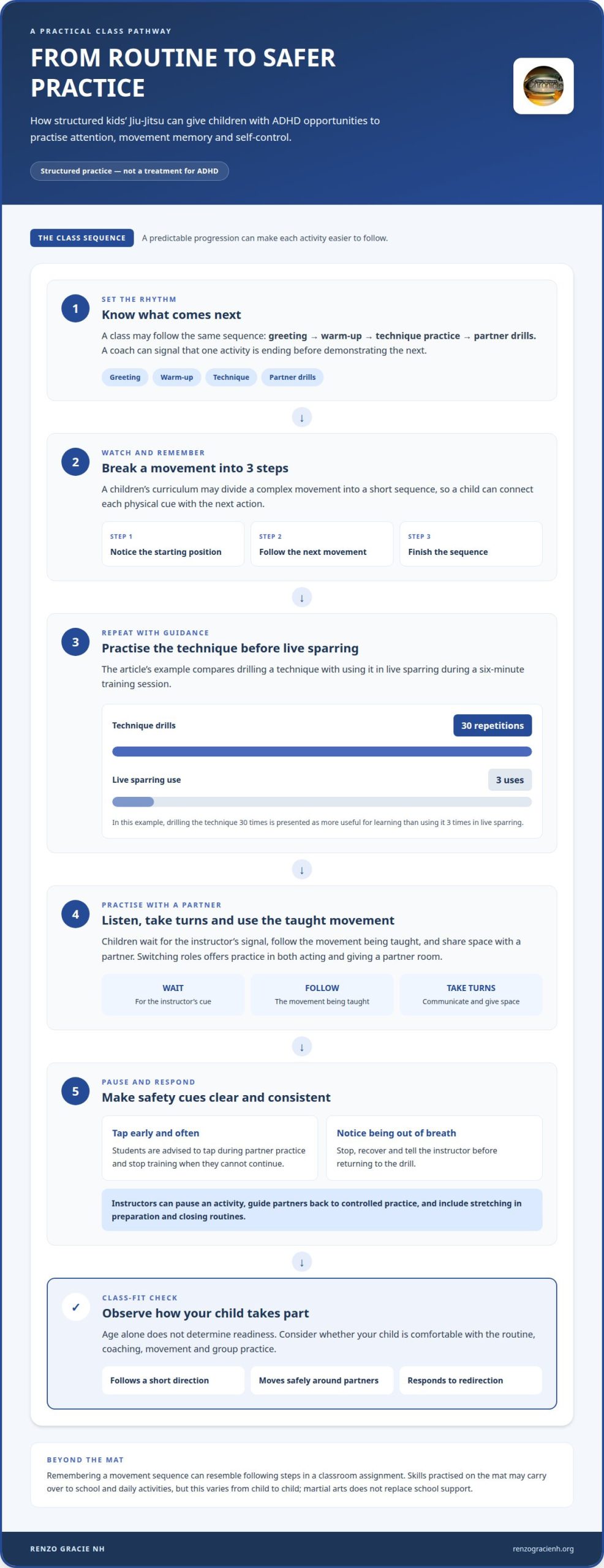
A predictable routine might follow the same sequence each class: greeting, warm-up, technique practice, and partner drills. Knowing what comes next can help children prepare for transitions and refocus on the instructor. For example, a coach might signal that warm-up is ending before demonstrating a technique. Consistent cues help children anticipate changes and rejoin the group.

How Instructors Assess Class Fit

Class fit means how well a child can take part in group instruction and activities. An instructor can observe whether the child follows a short direction, moves safely around partners, and responds to redirection during a drill. Families exploring kids jiu jitsu for ADHD in Windham can consider whether their child seems comfortable with the routine, coaching cues, and pace. These practical signs help families assess whether the class suits their child.

Structured Instruction for Different Abilities

Structured instruction presents a technique in manageable parts before children practise it. A coach can demonstrate a movement, explain its steps, then guide students through repetition and partner drills. In a six-minute Brazilian Jiu-Jitsu training session, drilling a technique 30 times is presented as more useful for learning than using it three times in live sparring. The example shows how controlled repetition gives a child time to focus on the movement before facing sparring’s added unpredictability.

Questions About Instructor Experience

Parents can ask how instructors give directions, support transitions, and redirect a child who loses focus. They can also ask how partner activities are supervised and how students signal that they need to pause. For families considering kids jiu jitsu for ADHD in Windham, concrete examples of teaching approaches can clarify what class participation involves. The answers can help parents decide whether the approach feels right for their child.

Brazilian Jiu-Jitsu gives children movement sequences to watch, remember, and practise. A children’s curriculum may break complex movements into 3-step sequences, making the order easier to recall: notice the starting position, follow the next movement, then finish the sequence. Each repetition gives a child another chance to connect a physical cue with the next action. That practice can engage attention and movement memory.

Skills practised on the mat may carry over to school and daily activities, though this varies from child to child. Remembering a sequence, for example, is similar to following steps in a classroom assignment. A child can practise listening to one direction, completing it, and moving to the next. Martial arts does not replace school support, but repeated practice offers a concrete setting to work on persistence and recall.

Mat etiquette gives children practical ways to practise listening: pause when the instructor speaks, wait for a turn, and follow a partner’s instructions. A coach might ask students to face the demonstration, listen, and begin practising only when cued. Clear expectations help children see how attention and respectful behavior support learning together.

Coached activities create opportunities to practise problem-solving. If a movement does not work as expected, the instructor can prompt a child to recall the demonstrated steps and try again. The process is simple: notice the challenge, remember the instruction, and adjust the next attempt. It emphasizes thoughtful effort rather than speed.

Partner drills also offer opportunities to practise social skills. Children take turns, communicate, and respond to another person’s movement. For instance, partners can switch roles after practising a technique, learning both how to act and how to give space. Respect and cooperation become part of the physical task.

Families exploring structured practice can learn more about kids’ Jiu-Jitsu classes and how coached movement supports skill-building.
Kids Jiu Jitsu for ADHD in Windham: Skills and Safe Practice

Impulse control and safe partner practice

Partner drills let children practise controlling their movement while responding to another person. Clear coaching is important: safe participation depends on following instructions and knowing when to pause.

Impulse Control During Partner Practice

In a partner drill, impulse control means pausing, listening, and using only the movement being taught. A child waits for the instructor’s signal before beginning, then follows the technique rather than adding an unpractised move. This gives self-control a practical role: the child manages their actions while sharing space with a partner.

Focus and Self-Control

Focus and self-control involve directing attention to the instructor and regulating effort during practice. A child listens to a cue, performs the taught movement, and pauses when the drill ends. Repeating this pattern makes discipline part of the activity, not just an abstract instruction. Martial arts also combines movement and fitness in a structured physical activity.

Safety cues should be simple and consistent. Students are advised to tap early and often during partner practice and stop training when they cannot continue. These actions give children clear ways to communicate a limit. An instructor can reinforce the cue, pause the activity, and guide partners back to controlled practice.

Breathing can be another useful signal. Feeling out of breath may indicate tension during Brazilian Jiu-Jitsu training. A child who notices this can stop, recover, and tell the instructor before returning to the drill. It is not a test of toughness, but a chance to notice physical signals and respond thoughtfully.

Stretching is also advised to help avoid injuries. Instructors can include it in the class’s preparation and closing routine, while reminding children to move within their comfort. Coached partner drills, tapping, pausing when needed, and stretching are practical safety practices for families to look for in a children’s class.

Kids jiu jitsu age range

There is no single age that determines whether a child is ready for jiu jitsu. Look instead for practical signs: can the child join a group, respond to an instructor’s direction, and take part in movement without quickly losing interest? These observations are more useful than choosing a class based on age alone.

Consider how your child handles a short sequence of activities. Can they listen, try a demonstrated skill, and pause when the instructor signals? A child who needs reminders may still benefit from a structured class when coaching is clear and activities suit their ability. Comfort with close partner practice matters too, because jiu jitsu involves learning movements with another student.

For children with ADHD, a suitable starting point depends on attention, coordination, comfort with touch, and response to group directions. A child who enjoys active tasks may engage with movement-based learning, while a child who feels uneasy about partner contact may need time to become comfortable. The key question is whether the class’s pace and instruction support safe participation.

When comparing kids’ jiu jitsu with karate or taekwondo, focus on the activities your child will practise. Jiu jitsu involves close-range grappling and partner-based defense; karate and taekwondo commonly teach striking techniques and forms. A child who enjoys hands-on, cooperative drills may find grappling engaging. A child drawn to practising strikes or set forms may prefer another style.

Rather than using age as the only measure, consider your child’s readiness for instruction, movement, and shared practice. An instructor can observe how a student follows cues, manages transitions, and responds to partners. Those signs offer a more useful starting point than assuming every child of a certain age is ready for the same class.

Explore children’s Jiu-Jitsu instruction as a way to see whether coached grappling suits your child’s interests and readiness.

Renzo Gracie NH: Kids Jiu Jitsu Program

Renzo Gracie NH offers a Kids Jiu Jitsu Program for families considering structured martial arts practice in Windham, Manchester, and Exeter. It may suit a child interested in movement, coached skill-building, and learning alongside others. Jiu jitsu is not an ADHD treatment, but class activities can give children opportunities to practise focus, movement memory, and impulse control.

A Free Introductory Class lets your child experience the training environment while you observe how they respond to instruction and partner practice. Notice whether the activities feel engaging and manageable, and share relevant needs with the instructor so you can begin with clear communication. Every child’s progress is individual, and the right choice depends on your child’s interests and readiness.

If you’d like to discuss the Kids Jiu Jitsu Program, contact Renzo Gracie NH.

Take the Next Step at Your Child’s Pace

If you’re considering kids jiu jitsu for ADHD in Windham, start by thinking about what helps your child feel ready to learn. Consider where they engage best, how they respond to new group activities, and what would make a first class approachable. Sharing those priorities with Renzo Gracie NH can help your family take a thoughtful first step.

Martial arts is not a quick fix, and your child’s progress should not be measured against another child’s. Focus instead on whether your child feels comfortable participating and wants to return. Even a small sign of interest can help guide your decision.

If you’d like to talk about your child’s next step, contact Renzo Gracie NH. A supportive beginning can open the door to learning, confidence, and steady personal growth.

Frequently Asked Questions

Does Martial Arts Help Kids With ADHD?

Martial arts can give children with ADHD a structured setting to practise attention, movement memory, and emotional control. A child can listen to a coach’s cue, practise a technique, and pause when the activity changes. These experiences may support skill-building, but martial arts is not an ADHD treatment and should not replace care or support a child already receives.

What age can kids start jiu-jitsu classes in Windham, New Hampshire?

Readiness matters more than a specific starting age. Consider whether your child can join a group activity, respond to coaching, and feel comfortable with partner practice. A child who needs reminders may still participate when the class pace and instructor’s guidance support safe engagement. These signs can help you decide whether a class is a good fit.

Do local jiu-jitsu schools offer ADHD-friendly coaching or accommodations?

Instructors can make classes easier to follow with practical teaching choices, such as giving one direction at a time, demonstrating movements, and allowing a child to pause. These approaches can support participation without assuming every child needs the same help. Parents can explain what works for their child, such as a brief cue before transitions or space to reset.

How can jiu-jitsu help children with ADHD, and what does research say?

Jiu-jitsu may offer active practice in listening, remembering movement sequences, and managing behavior with a partner. A randomized trial of judo training involved 57 children with ADHD, but that number alone doesn’t show whether training improved symptoms. Judo and Brazilian Jiu-Jitsu are different activities, so the trial shouldn’t be treated as proof that jiu-jitsu treats ADHD.

What are the safety risks and precautions for children with ADHD in jiu-jitsu?

Partner practice involves physical contact, movement, and close attention to coaching, so impulsive actions or fatigue can affect safe participation. Children should use only techniques taught in class, tap early to signal a partner to stop, and pause training if they cannot continue. Tell the instructor about relevant needs before class so the coach can guide your child’s participation appropriately.
Managing work stress with exercise Windham: ways to support mood and ease stress

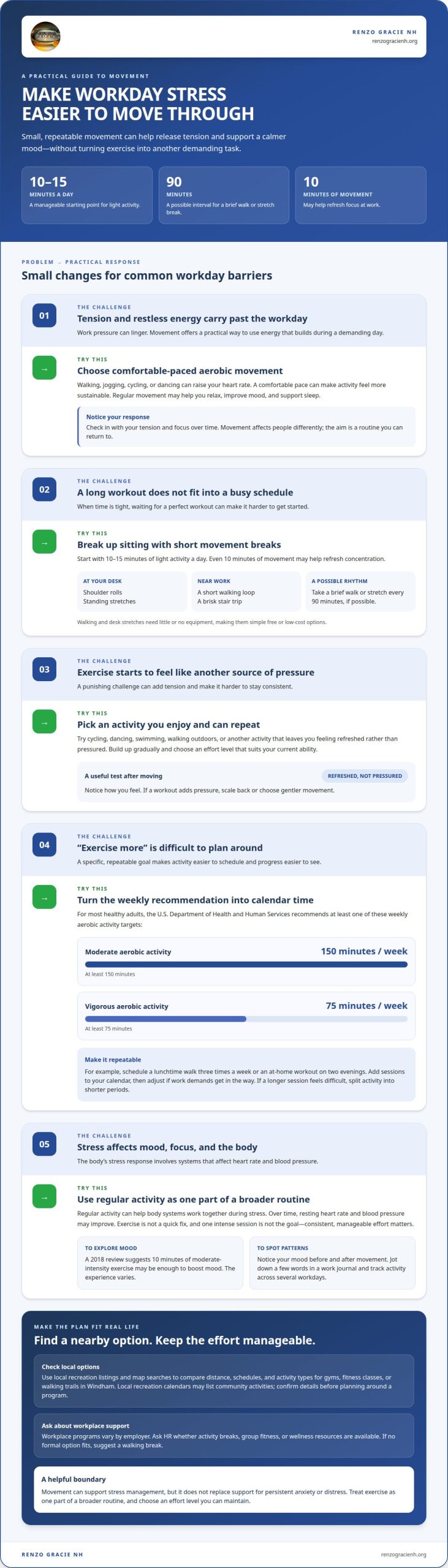
Exercise can support the body’s response to stress, not just use up restless energy. For people managing work stress with exercise in Windham, starting with 10-15 minutes of light activity a day can be a practical first step. Regular movement may help you feel calmer, improve mood and clear your mind.

Work pressure can affect how you feel long after the workday ends. It makes sense to choose an activity that helps release tension and feels manageable, rather than adding another demanding task to your schedule.

Here, you’ll learn how movement can affect mood and the body’s stress response, how to choose activities you enjoy, and how to set realistic goals. Small steps count. The right routine is one you can fit into your life and return to regularly.

Key Takeaways

  • Use movement as one practical way to release tension and support a calmer mood.
  • Choose an activity you enjoy, then build a routine that fits your workday and life.
  • Set a manageable starting goal and increase your activity gradually to support consistency.
  • Learn how exercise can influence mood and the body’s response to stress.

1. How does exercise help with stress?

Aerobic exercise gives your body a practical way to use energy that can build during a demanding workday. Walking, jogging, cycling, and dancing raise your heart rate. A comfortable pace can make movement feel sustainable. Regular activity can help you relax, improve your mood, and support sleep, which stress and anxiety can disrupt.

Cardio may also influence how your body responds to pressure. With regular activity, the body’s systems can work together more effectively during stress, and resting heart rate and blood pressure may improve. It isn’t a quick fix: choose a routine you can repeat and notice how movement affects your focus and tension over time.

Start small. Light physical activity for 10-15 minutes a day can be an approachable first step. A walk around the block, a brisk trip up and down stairs, or quick desk stretches can break up prolonged sitting. A short activity break can also refresh concentration; even 10 minutes of movement may help you focus at work.

Quick workday options include shoulder rolls, standing stretches, and a short walking loop near your workplace. If possible, take a brief walk or stretch every 90 minutes to reset your body and attention.

To find gyms, fitness classes, or walking trails in Windham, use local recreation listings and map searches to identify nearby options. Compare distance, schedules, and activity types to find a good fit for your workday.

Walking and desk stretches need little or no equipment, making them simple options for free or low-cost exercise. Local recreation calendars may also list community activities. Confirm the details before planning around a program.

Workplace exercise programs vary by employer, whether in corporate offices or on active project sites managed by firms like Pronamic Construction Limited. Ask your HR team whether your workplace offers activity breaks, group fitness, or wellness resources. If no formal option fits, suggest a walking break.

Movement can help release stress, but it doesn’t replace support for persistent anxiety or distress. Treat exercise as one part of a broader routine, and choose an effort level you can maintain.

2. Choosing enjoyable activities and setting exercise goals

You’re more likely to make an enjoyable activity part of your routine. Try cycling, dancing, swimming, or walking outdoors, then notice which leaves you feeling refreshed rather than pressured. Enjoyment matters: a punishing challenge can add tension and make it harder to stay consistent.

For a weekly target, most healthy adults should get at least 150 minutes of moderate aerobic activity weekly, according to the U.S. Department of Health and Human Services. Most healthy adults should get at least 75 minutes of vigorous aerobic activity weekly, according to the U.S. Department of Health and Human Services. Choose an effort level that suits your current ability, and build up gradually if you’re starting out.

Turn the recommendation into a clear action. For example, schedule a lunchtime walk three times a week or an at-home workout on two evenings. Add the sessions to your calendar, then adjust the plan if work demands get in the way. A specific, repeatable goal makes progress easier to see than a broad intention to “exercise more.”

Regular physical activity can support mental health by reducing symptoms of anxiety and depression associated with high stress. It may also help build resilience: following a manageable plan gives you a steady practice for responding to everyday challenges. Outdoor activity offers a change of scene, while mindful movement encourages you to focus on your breathing and body position.

Choose a goal that leaves room for real life. If a longer session feels difficult, split activity into shorter periods and keep returning to your routine. If you’re drawn to coached, structured practice, the Adult Jiu Jitsu Program offers one way to engage with regular physical activity.

Managing work stress with exercise Windham: ways to support mood and ease stress

3. Endorphins and mood

Movement can affect mood through changes in brain chemicals, including endorphins. These chemicals are associated with feeling better after activity, though the experience varies. A 2018 review suggests that 10 minutes of moderate-intensity exercise may be enough to boost mood. A brisk walk between work tasks is one practical way to test how movement affects your own feeling.

Keep the effort manageable. For example, walk at a pace that raises your breathing while still allowing you to talk. Notice your mood before and after, then jot down a few words in a work journal. This can help you identify whether walking, cycling, or another activity supports your concentration and eases tension.

Exercise may also influence hormones involved in the body’s stress response. Regular activity can lower stress hormone levels over time, but it won’t switch off stress immediately. A consistent routine matters more than one intense session. Choose a familiar option, such as a lunchtime walk, and repeat it often enough to notice patterns.

Chronic stress can affect mood and make recovery feel harder. Physical activity can be one helpful part of managing that strain, but it isn’t a substitute for mental health care when distress persists. If a workout leaves you feeling more energized, use that response to shape a routine you can maintain. If it adds pressure, scale back or choose gentler movement.

For an American worker with a packed calendar, a short movement break may feel more realistic than a long workout. Try walking outside, taking the stairs, or stretching after a demanding meeting. Track your activity and mood across several workdays. That record can help you see which choices support your wellbeing and which changes are worth keeping.

4. Exercise and the body’s stress response

Stress activates several body systems, including those that affect heart rate and blood pressure. Regular physical activity can help these systems work together during a stress response. Over time, exercise can also lower resting heart rate and blood pressure, supporting a healthier baseline between demanding work moments.

Imagine a tense meeting followed by a brisk walk. Your breathing and heart rate rise during movement, then settle as you recover. That shift gives you a chance to notice physical tension and bring your attention back to the present. A gentle pace is enough to begin. Fitness grows through consistent effort, not one punishing workout.

Choose movement you can repeat regularly. Walking after work, dancing to music at home, or taking a strength-focused session can all provide structured activity. The best choice is one that fits your schedule without adding another source of pressure. Track how you feel before and after, then use that response to adjust your routine.

For a simple reset, pause after a stressful work block and take a short walk. Let your breathing find a steady rhythm, relax your shoulders, and return with a clearer sense of your stress levels. This won’t remove a difficult workload, but it can interrupt the cycle of sitting tensely and carrying that tension into your next task.

Exercise supports the body’s stress response; it doesn’t replace changes that address ongoing workplace strain. If structured movement helps you stay engaged, try a Free Introductory Class as a first step toward regular practice.

Renzo Gracie NH

Renzo Gracie NH offers structured Brazilian Jiu-Jitsu training as an active way to build a consistent movement routine. Adults looking for coached physical activity can use the Adult Jiu Jitsu Program to practice focus, discipline, and steady progress. Try a free introductory class to experience the training before deciding whether it fits your goals.

Jiu-Jitsu isn’t a substitute for aerobic exercise or mental health care, but structured practice may suit people who want to learn skills while moving. Families can also explore the Kids Jiu Jitsu Program, and Law Enforcement Jiu-Jitsu Training is designed for professional defensive tactics.

If you’re ready to explore whether training fits your routine, contact Renzo Gracie NH.

Make your next step one you can sustain

A routine should support your wellbeing, not become another work demand. For managing work stress with exercise in Windham, choose movement that fits your energy, schedule, and goals, then give yourself room to build consistency. Progress can mean finding an activity you look forward to and making space for it in everyday life.

Renzo Gracie NH offers structured Jiu-Jitsu programs for adults and children, along with Law Enforcement Jiu-Jitsu Training. These programs provide purposeful, guided physical practice. Your needs and circumstances will shape which activity feels like a good fit.

If you’d like to explore whether training could support your routine, contact Renzo Gracie NH today. Take the next step at your own pace and keep building a routine that works for you.

Frequently Asked Questions

How does exercise help with stress?

Exercise gives you a structured way to shift attention away from work pressure and reconnect with your body. For managing work stress with exercise in Windham, choose an activity that fits your energy after work, then notice how you feel afterward. That can help you decide whether to repeat the activity or try a different pace or movement.

What are effective exercises for managing work stress?

Walking, running, cycling, and dancing are accessible ways to raise your heart rate and break up a sedentary day. Choose what suits your preferences and setting: a walk may fit an outdoor break, while dancing at home can make movement feel less like another task. The most useful activity is one you can return to without making your schedule harder.

How often and how long should adults exercise to reduce stress?

The U.S. Department of Health and Human Services recommends that most healthy adults get at least 150 minutes of moderate aerobic activity weekly, or at least 75 minutes of vigorous aerobic activity weekly. You can distribute activity across your schedule rather than completing it all at once. For example, make a weekly calendar and reserve realistic windows that suit your workload and energy.

How does exercise help relieve work-related stress and anxiety?

Physical activity can improve mood and may reduce symptoms of mild anxiety and depression. It can also shift your focus after a demanding work situation. For example, take a walk after logging off and notice whether your breathing and thoughts settle. Exercise can support wellbeing, but persistent or overwhelming anxiety needs attention beyond a workout routine.

What precautions should people take before exercising to manage stress?

If you haven’t exercised for some time or have health concerns, speak with a healthcare professional before starting a new exercise plan. Begin at a manageable effort and build gradually, rather than turning a stressful week into an intense training challenge. Pay attention to how your body responds, and adjust your plan if the pace feels uncomfortable.

How can beginners build an exercise routine around a demanding work schedule?

Connect movement to an existing part of your day, such as walking after a regular meeting or stretching before leaving your desk. Add the activity to your calendar and choose a backup for especially busy days, such as a short walk near work. A flexible plan helps you maintain momentum without treating a missed session as failure.

Physical Fitness Training for Windham Kids

For families exploring physical fitness for kids in Windham, regular movement helps children develop strength, endurance, agility, and confidence. A balanced routine can combine active play with guided practice, giving kids room to learn skills and notice their progress. Consistency matters more than making every session intense.

Exercise should feel enjoyable as well as worthwhile. Kids are more likely to keep moving when activities let them try, focus, and improve at their own pace. Here’s how physical activity can support fitness and confidence, what to look for in a structured program, and how Jiu Jitsu gives children a way to build skills through movement and practice.

Key Takeaways

  • Choose activities that let children practise, improve, and notice their progress to support confidence as well as fitness.
  • Look for varied movement that develops strength, endurance, and agility without making every activity feel like a test.
  • Compare local options by the kind of instruction and activity they provide, then consider which setting best fits your child.
  • For families interested in structured martial arts practice, a kids’ Jiu Jitsu program can offer an active way to build skills and perseverance.

Confidence-building through exercise

Families considering physical fitness for kids in Windham can build confidence through achievable challenges. A child who learns a movement, follows a sequence, or keeps trying after a mistake can see their progress. Start with one clear task, such as balancing briefly on one foot. Let your child repeat it and notice what changes.

Choose activities that let children practise a skill, not just compete for a score. For example, a child learning to move around cones can focus on control before speed. Give specific feedback by praising careful footwork, patient effort, or remembering the next step. Avoid comparing siblings or classmates; everyone starts from a different place and progresses at their own pace.

Schedules and registration deadlines depend on each program’s calendar and enrollment period. Families can plan by reviewing the schedule, noting the deadline, and registering before the stated cutoff.

Safety rules and age requirements vary by activity and program. Look for clear supervision, age groupings, and guidance on adapting movements. Beginners should understand how to stop and ask for help.

Class and youth-sport prices depend on activity format, instruction, and enrollment terms, with a quote provided after a request. For free or low-cost movement, families can begin with walks, playground games, or simple movement challenges at home.

Facilities and equipment depend on the activity. A class might use open floor space, mats, cones, or balls. Read the program description to find out what participants need to bring.

To register, compare your child’s age and interests with the program’s stated group, then follow its enrollment steps. Keep the schedule and registration confirmation together so your family can prepare for the first session.

Strength, endurance, and agility training

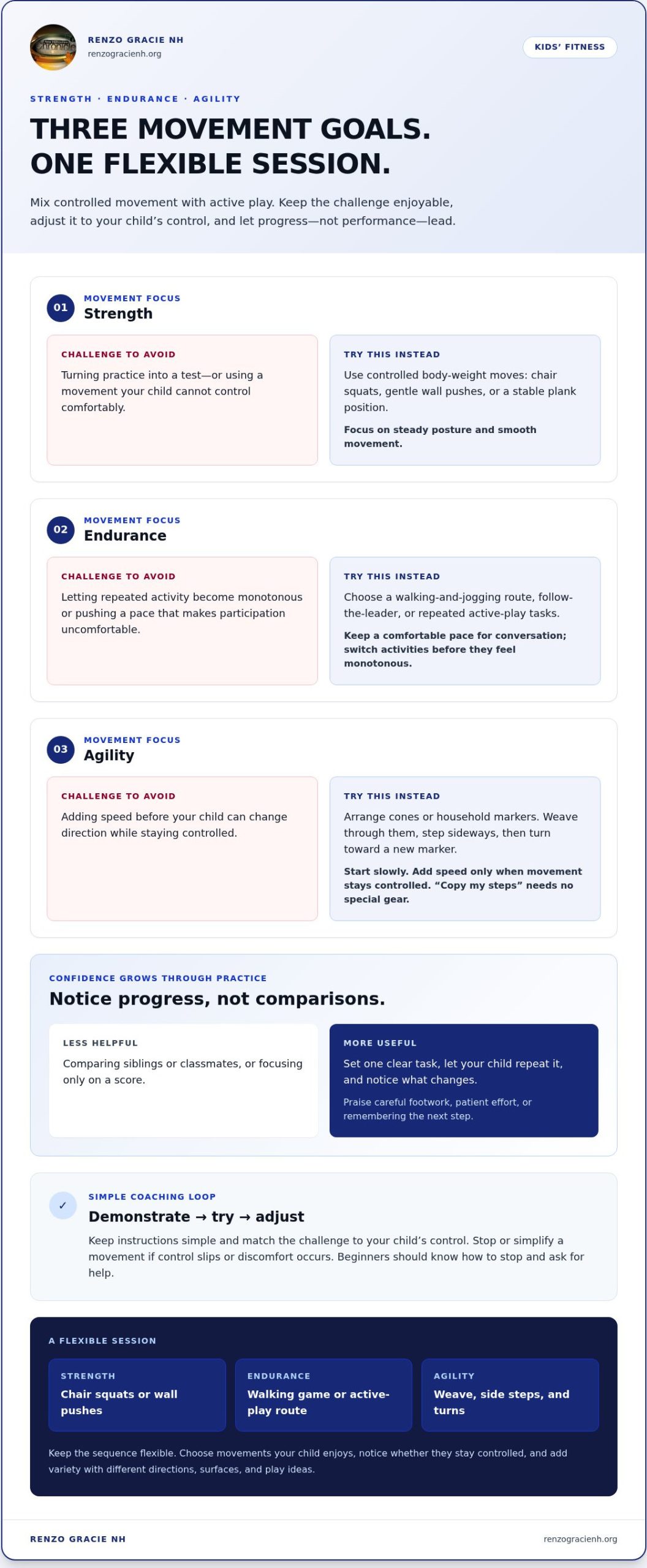
A balanced activity session can develop strength, endurance, and agility through different movements. Children might practise body-weight squats, play a brisk walking game, then change direction around cones. Each activity develops a distinct movement skill. Keep instructions simple: demonstrate the movement, let children try, then adjust the challenge to match their control.

Strength practice can use controlled movements rather than heavy equipment. A child might squat to touch a chair, push gently against a wall, or hold a stable plank position. Focus on steady posture and smooth movement. Stop or simplify the task if your child loses control or feels discomfort. These examples are starting points, not a performance test.

Endurance activities keep children moving through repeated play. Try a walking-and-jogging route, a follow-the-leader game, or a series of active tasks in a safe space. Let your child move at a pace that allows comfortable participation and conversation. Switch activities before they become monotonous, such as moving from a short route to a ball game.

Agility involves balance, coordination, and changing direction. Set out cones or household markers with enough space between them. Ask your child to weave through, step sideways, then turn toward a new marker. Start slowly and add speed only when movements stay controlled. A “copy my steps” game makes changing direction engaging without special gear.

To make a simple session, choose one movement for each goal:

  • Strength: practise chair squats or wall pushes with careful form.
  • Endurance: use a walking game or repeated active-play route.
  • Agility: weave around markers, then practise side steps and turns.

Keep the sequence flexible. One child may enjoy repeating the cone course, while another prefers a ball game. Notice whether the movement stays controlled and enjoyable, then add variety with different directions, surfaces, and play ideas.

Physical Fitness Training for Windham Kids

Which gyms, recreation centers, and community organizations in Windham offer fitness for children?

Families in Windham can compare children’s fitness options by setting and activity. Start with town recreation listings, school sports information, and youth-program descriptions from nearby gyms. These sources help distinguish organized classes from seasonal team sports and informal community activities. For example, a movement class may focus on instruction, while a team program includes practice and games.

Use a short comparison before choosing. Note the program name, activity, age group, schedule, registration period, and equipment needs. Then match those details to your child’s interests and your family’s routine. A child who enjoys learning movement skills may prefer a coached class, while a child who likes group play may enjoy a team activity.

Windham parents can also compare the activities themselves. Gym-based programs may focus on structured exercise or martial arts. Recreation and community programs may offer seasonal sports, active games, or group activities. These categories help organize a local search, but review each program’s current description before deciding.

  • For skill instruction: compare class descriptions and how activities are taught.
  • For team play: look for information about practices, games, and participation expectations.
  • For flexible movement: consider open community activities or family-friendly recreation.

Before registering, read the full listing for age guidance, supervision, location, schedule, and enrollment steps. A clear description should explain what children do during sessions, such as running drills, practising ball skills, or learning coordinated movements. If two options seem similar, compare the activity format and how comfortable your child feels with group instruction.

Build your shortlist around fit, not labels. A gym, recreation program, or community group can support fitness when its activities suit your child’s interests and abilities. A child who prefers individual skill practice may enjoy a different setting from one motivated by team games. Comparing program details side by side makes the choice more practical.

Schedules and registration periods vary by program. Check each current listing for class times and enrollment steps before choosing.

Families can explore town recreation listings, school sports programs, and youth offerings at nearby gyms. Options may include structured exercise or martial arts, seasonal team sports, active games, and other community activities.

Options include gym-based settings for structured exercise or martial arts, as well as recreation and community activities such as sports and active games. Equipment needs vary by program, so check its listing.

Ages for kids’ fitness programs in Windham?

There is no single age cutoff for every children’s fitness program in Windham. Each program sets its own age groups, so eligibility depends on the activity and enrollment criteria. Find the age range in the program description and compare it with your child’s age before planning to register.

Age is only one factor when choosing a suitable class. Consider whether the activity expects children to follow group directions, take turns, and practise a sequence. A beginner movement class, for example, may involve copying simple actions, while a team sport may require listening during drills and sharing play space. These examples can help you assess fit, but they do not determine eligibility.

Use this practical sequence:

  1. Find the program’s stated age group and enrollment rules.
  2. Compare the activity format with your child’s interests and experience.
  3. Review the schedule and registration details before enrolling.

For siblings in different age groups, check each child’s eligibility separately. A shared activity may suit one sibling but not another, depending on the program’s age groups and class structure. Don’t assume a child can join an older or younger group because of prior experience. Follow the program’s stated placement process.

Children’s activity preferences can change as they grow. A child who enjoys movement games may later want structured skill practice or team play. Read the program description when considering a new activity, since age groups and formats differ. Ask your child what they hope to learn, whether that’s coordination, ball skills, or following a new routine.

Families exploring martial arts can review children’s Jiu Jitsu class options alongside other activities. Compare the listed age group and class format with your child’s needs. That simple step helps families identify a fitting next activity without assuming every program welcomes the same ages.

Renzo Gracie NH: Adult Jiu Jitsu Program

Renzo Gracie NH offers a Kids Jiu Jitsu Program for families seeking structured martial arts training alongside other fitness activities. Jiu Jitsu gives children opportunities to learn movements, follow instruction, and build skills through consistent practice. The Adult Jiu Jitsu Program gives parents a way to pursue training and make martial arts part of family life.

Families can start with a Free Introductory Class to experience the training before deciding whether it fits their goals. It may suit parents looking for a movement-based activity that emphasizes practice and personal progress rather than conventional youth sports.

To explore the programs or arrange an introductory class, visit renzogracienh.org.

Make movement part of the next chapter

Start with one practical step: talk with your child about an activity they’d like to try, then make room for it in your family routine. Their interests may shift as they gain experience, so treat fitness as an ongoing journey, not a one-time decision. Regular practice gives children space to discover what motivates them and what they want to work toward.

For families considering physical fitness for kids in Windham through martial arts, start by talking about your child’s goals, comfort, and learning style. Renzo Gracie NH also offers an Adult Jiu Jitsu Program and Law Enforcement Jiu-Jitsu Training alongside its kids’ program, serving different training needs in the community.

Take the next step at a pace that feels right for your family. Contact Renzo Gracie NH to explore whether its programs fit your goals. Every new skill begins with showing up and being willing to learn.

Frequently Asked Questions

What kids’ fitness programs are available in Windham, New Hampshire?

Renzo Gracie NH offers a Kids Jiu Jitsu Program in Windham, New Hampshire. Families interested in martial arts can try a Free Introductory Class and experience the program. It gives children a chance to see whether learning Jiu Jitsu feels engaging and suits their interests. If you’re considering other activities, compare each program’s format and enrollment details with your child’s preferences.

What youth sports and physical activity programs are available in Windham, New Hampshire?

Renzo Gracie NH’s Kids Jiu Jitsu Program is a local option for structured physical activity, giving children a martial arts setting for learning and practice. To compare it with other youth activities in Windham, review current program descriptions for activity, age group, schedule, and enrollment process. Choose an option that matches what your child wants to learn and enjoy.

What safety rules, supervision, and age requirements apply to kids’ fitness programs in Windham?

Safety rules and age requirements vary by activity and program. Look for clear supervision, age groupings, and guidance on adapting movements. Beginners should know how to stop and ask for help.

Are there free or low-cost physical activity programs for children in Windham?

Families can start with free or low-cost movement, including walks, playground games, or simple movement challenges at home.