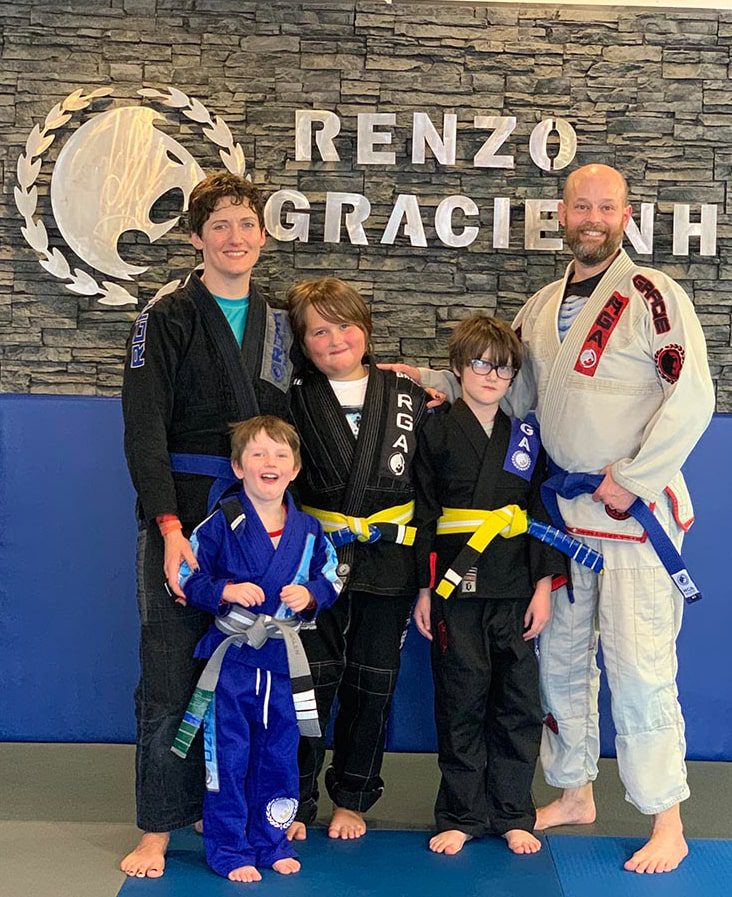
Martial Arts for Child Discipline in Exeter: Parent Guide
What if discipline grew through encouragement and steady practice, not fear or punishment? If you’re exploring martial arts for child discipline Exeter families can access, you may be wondering whether a class can help your child practise focus and self-control without feeling too strict or aggressive. The teaching environment matters.
Brazilian Jiu-Jitsu gives children a structured activity where they can practise listening, patience and persistence. Progress takes time, and no class can promise a particular change in behaviour. Consistent coaching can give children opportunities to work on these skills one step at a time.
This guide explains what constructive discipline can look like on the mat and what to observe when comparing supportive programmes near Exeter. You’ll find practical questions to ask about coaching and class culture, plus a low-pressure way to experience children’s Brazilian Jiu-Jitsu at Renzo Gracie NH, which serves the Exeter area. Start by looking for a setting where your child feels safe, welcomed and ready to learn.
Key Takeaways
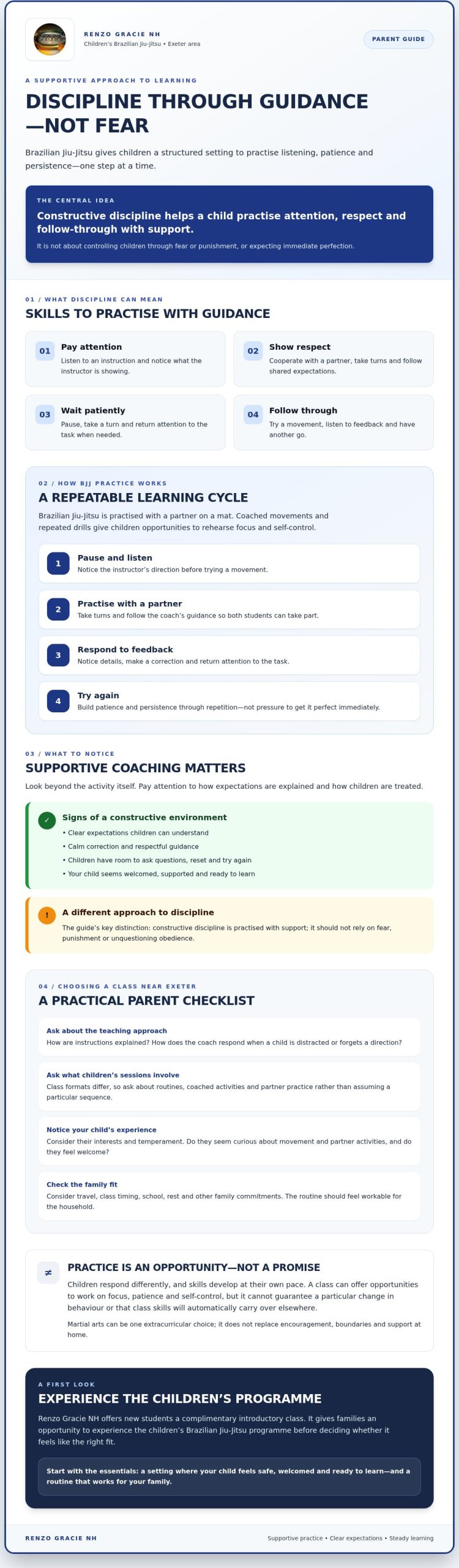
- Constructive discipline means practising attention, respect, patience and follow-through with guidance, not relying on fear or punishment.
- In Brazilian Jiu-Jitsu, coached partner practice and repeated drills give children opportunities to listen, focus and practise self-control.
- When comparing martial arts for child discipline Exeter options, look for clear expectations and calm correction, and notice whether your child feels welcomed and supported.
- Visit a class, ask about the teaching approach and consider whether travel and timing fit your family’s routine.
- Renzo Gracie NH offers a complimentary introductory class for new students, giving families a chance to experience the children’s programme before deciding.
What Does Martial Arts Discipline Mean for Exeter Kids?
Parents usually want positive structure, not a class where children are controlled through fear. In a supportive martial arts setting, discipline is something a child practises with guidance: paying attention, showing respect, waiting patiently and following through on a task. It should help children understand expectations and make thoughtful choices, not simply teach them to obey without question.
Self-discipline is the ability to guide your own attention and actions, with support, rather than comply out of fear. Clear boundaries and respectful coaching can give children room to learn, ask questions and try again. No activity can guarantee a particular change in behaviour. Children respond differently, and their skills develop at their own pace.
What can a child practise during a martial arts class?
In a coached activity such as Brazilian Jiu-Jitsu, children may practise listening to instructions before trying a movement, taking turns with a partner and returning their attention to a task when it feels challenging. These small moments connect an instruction with an action, giving children a chance to practise following through.
Physical skills take repetition. A child might try a movement several times, pause to listen to feedback, then have another go. That process offers practice in patience and persistence. It doesn’t mean every child will respond in the same way, or that skills practised in class will automatically carry over elsewhere. They’re skills to work on, not promised outcomes.
Why Exeter-area parents may consider a structured activity
For Exeter families considering martial arts for child discipline, a local programme is one possible extracurricular choice, alongside any other activity that suits the child. A class can offer a regular setting to practise skills with an instructor and peers, but it isn’t a substitute for the encouragement, boundaries and support children receive at home.
Start with your child. Are they curious about movement and partner activities, or would a quieter pursuit suit them better? Consider their temperament, what they enjoy and how a class would fit around school, rest and family commitments. A good choice should feel workable for the whole household, not like another source of pressure.
Martial arts schools can bring together physical practice and social learning. For background on that broader role, read this overview of how to choose a children’s martial arts class. As you explore classes near Exeter, focus on whether the setting feels welcoming and expectations are explained clearly. The goal is a positive opportunity to learn, not a promise that one activity will solve every challenge.
How Brazilian Jiu-Jitsu Classes Can Practise Focus and Self-Control
Brazilian Jiu-Jitsu (BJJ) is a martial art practised with a partner on a mat. Children learn coached movements and positions through instruction and practice, rather than simply watching a demonstration. Each activity asks them to notice what the instructor is showing, listen to the next direction and try to apply it.
Structured practice gives children opportunities to rehearse self-control: pause, listen, follow guidance and try again. That doesn’t mean every child will find it easy straight away. A child may need reminders to wait their turn or return their attention to the task. Progress in focus and confidence can look different for each student.
How routines and repetition support learning
Familiar routines can help children understand what to expect, but class formats differ. Ask the school what its children’s sessions involve rather than assuming a particular sequence. During a coached activity, a child might listen to one instruction, practise a movement, then pause for the next step. Breaking a task into manageable parts gives them a chance to concentrate and build persistence through repetition.
Repeating a movement isn’t about getting it perfect immediately. It’s a way to notice details, respond to feedback and make another attempt. Some children may become comfortable with the process quickly; others may need more time. A class can provide practice, but it can’t promise a specific result.
How partner practice can teach respect
Working with a partner calls for cooperation. Children need to listen to directions, take turns and follow the instructor’s guidance so both students can take part. A coach can set expectations for respectful behaviour, reinforce them during practice and help children reset if they become distracted or forget a direction.
As a parent, look for explanations children can understand and guidance that stays calm and clear. Ask how the instructor introduces partner activities and responds when a child needs help. Don’t assume every class uses the same approach; the school should be able to describe its own format.
For parents exploring martial arts for child discipline Exeter offers, Brazilian Jiu-Jitsu may be worth considering if their child is interested in active, coached learning. Renzo Gracie NH offers a children’s Brazilian Jiu-Jitsu programme for families in the Exeter area. To learn more about its children’s Brazilian Jiu-Jitsu programme, ask the academy how its current classes are structured and what a new student can expect.
Healthy Discipline or Harsh Coaching? What Parents Should Look For
Structure can help children learn, but it shouldn’t depend on humiliation, intimidation or punishment. A coach can set firm expectations while speaking respectfully, explaining what to do and correcting mistakes without shaming a child. When comparing martial arts for child discipline Exeter classes, look at the instructor’s everyday interactions, not just the school’s promises.
| Supportive structure | Fear-based control |
|---|---|
| Instructions are clear, with expectations children can understand. | Rules feel unclear, or children are expected to comply without explanation. |
| Corrections focus on the action and offer a chance to try again. | Mistakes bring ridicule, threats or public embarrassment. |
| Coaches address distraction calmly and guide the child back to the task. | Intimidation or punishment is used to force attention. |
| Respect is shown in how instructors speak to children and partners. | Harsh language or disrespect is treated as normal coaching. |
Signs of a supportive children’s martial arts class
During a visit, notice whether directions are easy to follow and expectations seem suited to the children taking part. If a child loses focus or struggles with an activity, watch how the instructor responds. Do they explain the next step or give the child a moment to reset? These observations can help you understand the class, but they don’t guarantee what every session will be like. Ask the academy directly about its approach and any policies or procedures you want to understand.
Pay attention to the atmosphere, too. Children don’t need to look perfectly confident or attentive throughout a class, but you should be able to see whether they’re treated with patience and respect. Your child’s comfort matters.
Questions to ask before enrolling
Specific questions can help you understand what a class is really like. You might ask:
- How do you introduce beginners to class routines and partner activities?
- How do instructors respond when a child makes a mistake, feels frustrated or loses focus?
- How do you adapt your guidance when children learn at different paces?
- Can I discuss my child’s individual needs with an instructor before they take part?
Listen to how the answers are explained, then compare them with what you observed. If something feels uncomfortable, ask for clarification rather than assuming. A supportive class should make space for parents’ questions and give children a chance to learn without being made afraid of getting it wrong.
How to Choose a Children’s Martial Arts Class Near Exeter
The style matters, but so does the way it’s taught and whether the class works for your child and family. Use this checklist to compare options around Exeter, then let your child’s experience help guide the decision.
- Identify your child’s goals. Ask what interests them: learning new movements, being active or trying something with other children. Include them in the choice while keeping expectations realistic.
- Check the practical fit. Find out the programme’s current age range, class schedule and arrangements for beginners. Consider travel from Exeter, journey time and how the class fits around school, rest and family routines. Don’t assume a school is located in Exeter; confirm its address and what’s convenient for you.
- Visit and observe. Notice how the instructor explains activities and communicates with children. Does your child seem comfortable watching, asking questions or joining in at their own pace?
- Ask about the teaching approach. Find out how beginners are introduced to class routines and partner activities. Ask how instructors respond to mistakes, frustration and different learning speeds.
- Review the experience together. After the visit, ask your child what felt enjoyable or difficult. Consider their response alongside your observations, rather than judging the class by its martial art name alone.
Match the programme to your child and family
A class that sounds appealing on paper still needs to suit your child’s interests and your weekly routine. Confirm current details directly with the academy, including age eligibility, timings and what a beginner should expect. If you’re considering Brazilian Jiu-Jitsu, read about the children’s Brazilian Jiu-Jitsu programme as one option for families in the Exeter area.
Use an introductory visit to assess the fit
An introductory visit can help you and your child get a feel for the setting before making a decision. Watch how the class is explained, whether your child seems at ease and how the instructor responds to questions. If family participation matters to your decision, you can also explore information about parent-and-child Jiu-Jitsu training.
Renzo Gracie NH offers a complimentary introductory class for new students. Find out about the introductory class and current arrangements to see whether it could be a comfortable first step for your family.
A Supportive First Step for Exeter Families Exploring Jiu-Jitsu
If you’re considering martial arts for child discipline, Exeter families can explore Renzo Gracie NH’s children’s Brazilian Jiu-Jitsu programme as one possible fit. Structured classes can give children opportunities to practise listening, patience and persistence, but they’re not a guaranteed solution to behaviour concerns. The right choice depends on your child’s interests and how they feel in the learning environment.
Professor Kevin Landry, a sixth-degree black belt under Renzo Gracie, has taught in the region for more than two decades. That experience offers useful context about the instructor, but no credential can promise a particular result for an individual child. Use a first visit to learn about the teaching approach and decide whether the programme feels right for your family.
What parents can discuss before a first class
Before booking, tell the academy whether your child has tried Brazilian Jiu-Jitsu before, what interests them and what, if anything, makes them nervous. Ask whether the current children’s class is suitable for your child, what the schedule is, how beginners take part and what parents should expect during a first visit. Confirm booking details, too. If you have questions about clothing or what to bring, ask the academy rather than guessing.
Families interested in sharing the activity can read more about family martial arts and shared training. Check directly with the academy about what participation involves and whether it fits your family’s needs.
Try a class and decide together
An introductory class is a chance to experience the setting, not a test of your child’s discipline. Notice what feels welcoming, challenging or unclear to them, and ask for their impressions afterward. A child may be excited, uncertain or quiet on a first visit. Their response can help you decide what questions to ask next without expecting an immediate transformation.
Renzo Gracie NH offers new students a complimentary introductory class. Ask the academy about availability and booking details before making plans.
Take a Supportive First Step
Healthy discipline is practised through clear guidance, patience and respectful coaching, not fear. A children’s Brazilian Jiu-Jitsu class can give your child opportunities to work on listening, focus and self-control, but every child’s experience is different. As you compare martial arts for child discipline Exeter options, look beyond the style and consider how the instructor communicates and whether the class feels like a good fit for your family.
At Renzo Gracie NH, Professor Kevin Landry is a sixth-degree black belt under Renzo Gracie and has taught in the region for more than two decades. His experience provides helpful context as you explore the children’s programme, but it can’t guarantee a particular outcome for your child.
New students are offered a complimentary introductory class. Confirm current availability and booking details, then use the visit to see how your child responds and ask the questions that matter to your family. Arrange a complimentary introductory class and take the next step at your own pace.
Frequently Asked Questions
Can martial arts help a child develop discipline?
Martial arts can give children opportunities to practise focus, patience, respect and follow-through, but results vary from child to child. Brazilian Jiu-Jitsu classes involve listening to instructions, trying coached movements and working with others. For families considering martial arts for child discipline Exeter programmes, look for an instructor who explains expectations clearly and corrects mistakes respectfully. Treat the class as one possible way to practise these skills, not a guaranteed fix for behaviour concerns.
Is Brazilian Jiu-Jitsu a good martial art for children?
Brazilian Jiu-Jitsu may suit children who enjoy active, coached learning and practising movements with a partner. Classes can offer opportunities to listen, take turns and persist through repeated practice. Whether it’s a good fit depends on the child’s interests, the instructor’s approach and the programme’s expectations. Families in Windham, Manchester and Exeter can ask how beginners take part, observe a class if possible and consider how their child feels about the experience.
What age can a child start martial arts in Exeter, NH?
Starting ages vary by school and programme, so confirm the current age range directly with the academy you’re considering. Renzo Gracie NH offers a children’s Brazilian Jiu-Jitsu programme, but families should ask whether their child is eligible and what the class involves. If you’re travelling from Exeter, Windham or Manchester, check the class schedule and location too, so the programme fits your child’s needs and your family routine.
Will martial arts make my child more obedient?
No class can promise that a child will become more obedient or that their behaviour will change in a particular way. A supportive martial arts class focuses on practising attention, respect and self-control through guidance, not unquestioning compliance. Ask how instructors handle mistakes, frustration or a child losing focus. Keep your expectations realistic, and consider martial arts as one activity that may provide practice alongside the support and boundaries your child receives at home.
How can I tell if a children’s martial arts class is supportive?
Look for clear directions, respectful communication and expectations children can understand. During a visit, notice how the instructor responds when a child struggles, makes a mistake or loses focus. Calm, specific guidance can help you judge the teaching style, but ask the academy directly about its class format and any concerns you have. Trust your observations, too: consider whether your child seems comfortable asking questions and taking part at their own pace.
Can my child try a martial arts class before joining?
Yes. Renzo Gracie NH offers new students a complimentary introductory class, giving families in the Exeter, Windham and Manchester area a chance to experience the children’s Brazilian Jiu-Jitsu programme before deciding. Confirm current availability, booking details, class suitability and what your child should expect directly with the academy. Afterward, ask your child what felt welcoming, challenging or unclear. One class is an introduction, not a test of discipline or a promise of results.