Posts

Positive Outlets for Kids in Exeter, NH: A 2026 Family Guide

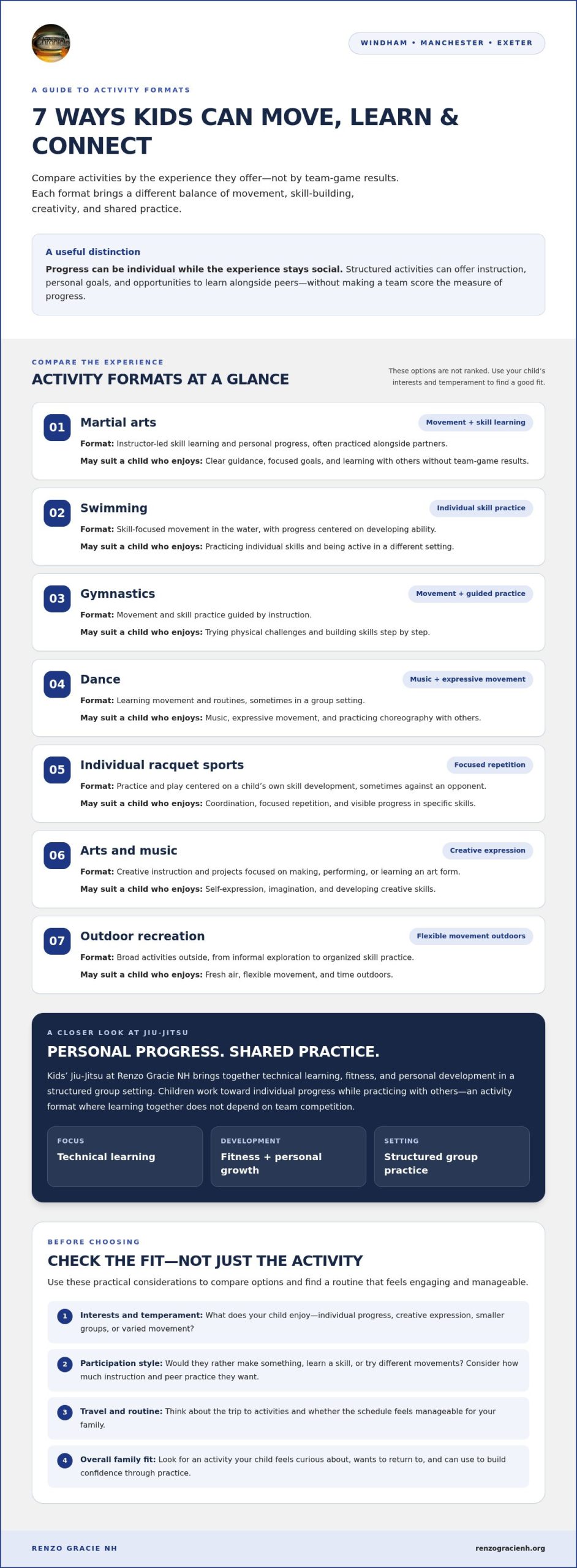
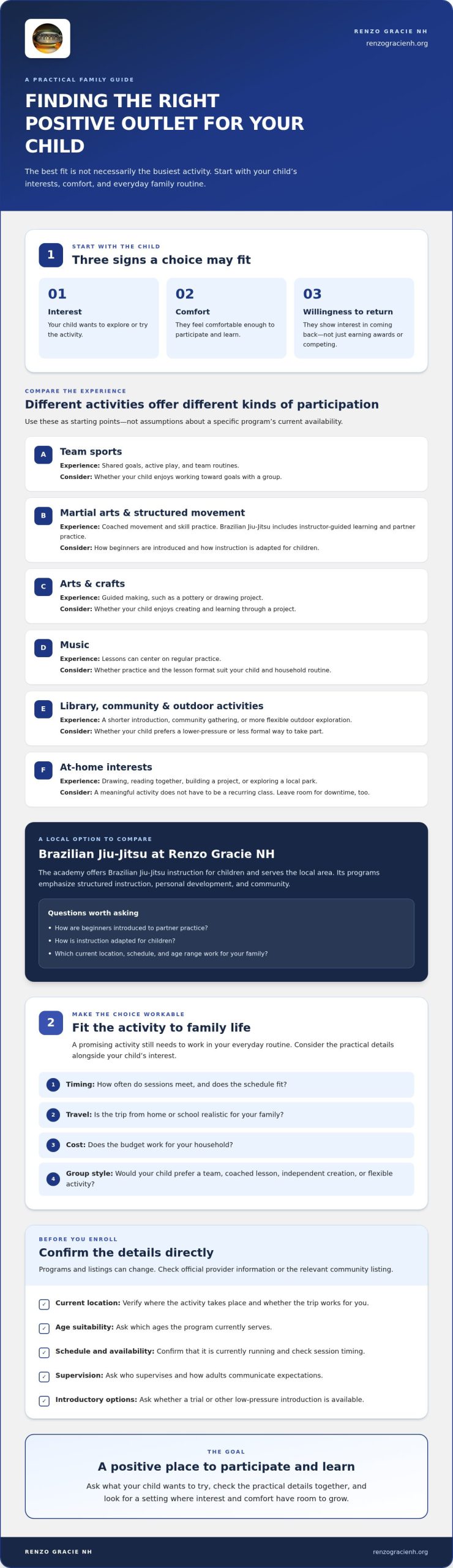
The busiest schedule isn’t always the best fit. The right positive outlets for kids Exeter families consider should match a child’s interests, comfort, and everyday routine. Sports, creative classes, music, and martial arts offer different experiences, so it helps to compare what each involves before choosing.

A child who enjoys teamwork may thrive in a different setting from one who prefers making things or learning at their own pace. Even an appealing activity needs to work with your family’s schedule, travel, and budget. Start by asking what your child wants to try, then look at the practical details together.

This guide compares activities near Exeter by the experience they offer and the children they may suit. Options range from team sports and arts programs to music lessons and kids’ Brazilian Jiu-Jitsu, which includes structured instruction and group participation. Use the questions throughout to check current schedules, age ranges, location, supervision, and introductory opportunities before signing up. The goal isn’t to find the most popular activity. It’s to find a positive place where your child wants to participate and learn.

Key Takeaways

  • Use your child’s interests, comfort, and willingness to return as practical signs of a good activity fit.
  • Compare creative classes, music, sports, and structured movement without assuming one type suits every child.
  • Consider group style, travel, timing, and family routine alongside the activity itself.
  • Among the positive outlets for kids Exeter families can explore, Brazilian Jiu-Jitsu at Renzo Gracie NH is one option to compare with others.
  • Before enrolling, ask providers about current location, age suitability, schedule, supervision, and trial arrangements.

What makes a positive outlet for kids in Exeter?

A positive outlet is a constructive, age-appropriate way for a child to explore an interest, practice skills, and spend time in an encouraging setting. It could be a recurring class, a seasonal team, a club, a one-time workshop, or an activity at home or outdoors. Regular sessions can help a child settle into a routine, while an occasional outing can be a lower-pressure way to try something new.

There’s no single best choice. One child may enjoy clear instruction and group goals; another may prefer creating independently or joining in now and then. The Positive Youth Development approach centers young people’s strengths and potential. In everyday terms, notice whether your child enjoys the experience, feels comfortable enough to participate, and is willing to return. Awards and competition aren’t the only signs of progress.

How to recognize an activity that supports a child

Look for clear expectations, adults who communicate respectfully, and room for children to learn at different paces. A supportive setting can offer a challenge without making a child feel they must keep up with others. Ask what your child hopes to try, learn, or experience. Their answers can help you narrow the options and identify any concerns to discuss with the provider.

For families searching “positive outlets for kids Exeter,” the goal isn’t to choose based on reputation alone. Look for a setting where your child’s interest and comfort have room to grow.

Why local fit matters for Exeter families

Even a promising program needs to work in everyday life. Consider the actual trip from home or school, how often sessions meet, and whether the timing fits your routine. A listing in a nearby town doesn’t automatically mean the location or travel time will be convenient.

Check the provider’s official information or the relevant community-program listing. Confirm where the activity takes place, whether it’s currently running, and which ages it serves. Exeter-area families considering children’s Brazilian Jiu-Jitsu should verify the current training location that works for them, along with the schedule and age suitability. Checking these details first can help you decide whether the activity is realistic for your family.

Positive activities for kids near Exeter: options worth comparing

Families looking for positive outlets for kids Exeter offers can compare different experiences rather than assuming every child needs a scheduled class. The categories below are options to investigate, not a guarantee that a particular program is currently running or available nearby. Confirm each provider’s location, current offerings, and age eligibility through official information before making plans.

Movement, martial arts, and team activities

Youth sports may suit children who enjoy shared goals, active play, and team routines. Martial arts offer coached movement and skill practice, while outdoor recreation can give kids more room to explore at a less formal pace. Consider whether your child prefers a coach-led lesson, a team environment, or flexible outdoor activity.

Brazilian Jiu-Jitsu is one structured movement option to explore. It combines instructor-guided learning with partner practice, so parents can ask how beginners are introduced to activities and how instruction is adapted for children. Renzo Gracie NH offers Brazilian Jiu-Jitsu instruction for children and serves the local area. Families should confirm the current location that suits Exeter, the children’s schedule, and age suitability. The academy’s programs emphasize structured instruction, personal development, and community.

Creative, community, and interest-led activities

For a child drawn to making, performing, or discovering, check official local listings for arts and crafts, music, library activities, and community programs. A pottery or drawing class may involve a guided project; music lessons can center on regular practice; a library event or community gathering may offer a shorter introduction. Confirm dates and enrollment details directly instead of assuming a listing from another season still applies in 2026.

Some children prefer flexibility. Drawing at home, reading together, building a project, or exploring a local park can be meaningful without a recurring class. Leave room for downtime, too. The American Academy of Child and Adolescent Psychiatry offers guidance on striking the right balance between activities and a child’s other needs.

As you compare options, consider both what your child is likely to enjoy and what your household can sustain. If structured Brazilian Jiu-Jitsu is on your list, review Renzo Gracie NH’s children’s program information, then confirm the current location and details before planning a visit.

How to compare kids’ activities in Exeter by personality and priorities

A directory can help you find possibilities, but your child’s temperament and your family’s routine determine what belongs on the shortlist. Use this comparison as a starting point, then verify details directly with each provider. “Not listed” means the current schedule or trial arrangement needs checking, not necessarily that an option is unavailable.

Activity type Child interest Group setting Schedule Trial availability
Brazilian Jiu-Jitsu Coached movement and learning through practice Instructor-led, with partner practice Confirm current class times and location Ask the provider
Team sports Active play and shared goals Team-based, with coaching Check season and weekly commitment Ask about a trial or introductory option
Arts or music Creating, performing, or building a skill Class-based or individual instruction Confirm session dates and frequency Ask whether a first visit is possible
Outdoor or community activities Exploring, socializing, or flexible recreation May be guided, group-based, or informal Check event details or plan your own pace Depends on the activity

Fit means a match between a child’s interest, comfort, practical access, and a supportive setting. Keep that in mind as you compare positive outlets for kids Exeter families are considering.

Match the activity to your child’s interests

For a child who seeks movement, compare coached classes, team sports, and outdoor options. A child who enjoys quieter or creative pursuits may prefer arts, music, reading, or a community activity. Invite your child to help shortlist possibilities, then confirm age suitability, supervision, logistics, and whether the activity is a good match.

Compare structure, social setting, and commitment

Ask whether the experience is instructor-led, team-based, drop-in, or independently paced. Compare travel time, schedule, equipment needs, and trial opportunities using current details. Structured coaching provides guidance and a planned learning environment; open-ended recreation can allow more flexibility. Neither is automatically better. Consider what helps your child feel ready to participate and what your family can sustain.

Martial arts can differ in format and atmosphere, and Brazilian Jiu-Jitsu shouldn’t be treated as a synonym for aggression. It’s a coached activity that includes partner practice. Parents can ask how instructors explain expectations, supervise practice, and support beginners. Families considering this option can read this guide to kids’ Jiu-Jitsu, then confirm the current class location, schedule, age suitability, and introductory-class details directly with the academy.

Positive Outlets for Kids in Exeter, NH: A 2026 Family Guide

What Exeter parents should check before signing up

A promising activity should make sense on paper and feel workable in person. Contact the provider to confirm the current location, age suitability, schedule, supervision arrangements, and whether a trial or introductory visit is available. Listings can help you discover options, but they may not reflect current program details.

Use this checklist to guide the conversation:

  • Who leads the sessions? Ask who works with children and how expectations are explained.
  • How are beginners welcomed? Find out what a first session involves and how a child can join at their own pace.
  • What should we bring? Confirm clothing, equipment, or supplies directly with the provider.
  • What’s the commitment? Ask about attendance expectations, session frequency, and whether make-up options are available.
  • Can a caregiver observe? Check whether a parent can watch or accompany the child during an introductory visit.

Pay attention to more than the answers. Notice whether staff communicate clearly, respond respectfully to questions, and help children understand what to do. These observations can help you assess the setting without assuming policies or standards that you haven’t confirmed.

Use a trial to assess real-world fit

If a provider offers a trial or introductory visit, use it to see how the activity feels for your child. Afterward, ask what was enjoyable, confusing, or uncomfortable. A child may need time to warm up, so consider their perspective alongside what you observed instead of judging the experience by one moment alone.

Then test the practical side. Consider the actual commute, session timing, and how the activity fits around school, rest, and other family commitments. A good experience that’s difficult to reach or sustain may not work for your household. Families who value learning together may also find this overview of parent-and-child Jiu-Jitsu useful; confirm current location and arrangements with the provider.

As you compare positive outlets for kids Exeter families can consider, check the details before committing. Families interested in Brazilian Jiu-Jitsu can ask Renzo Gracie NH about a complimentary introductory class and verify the suitable location, age range, schedule, and visit arrangements directly.

Consider Renzo Gracie NH among Exeter-area kids’ outlets

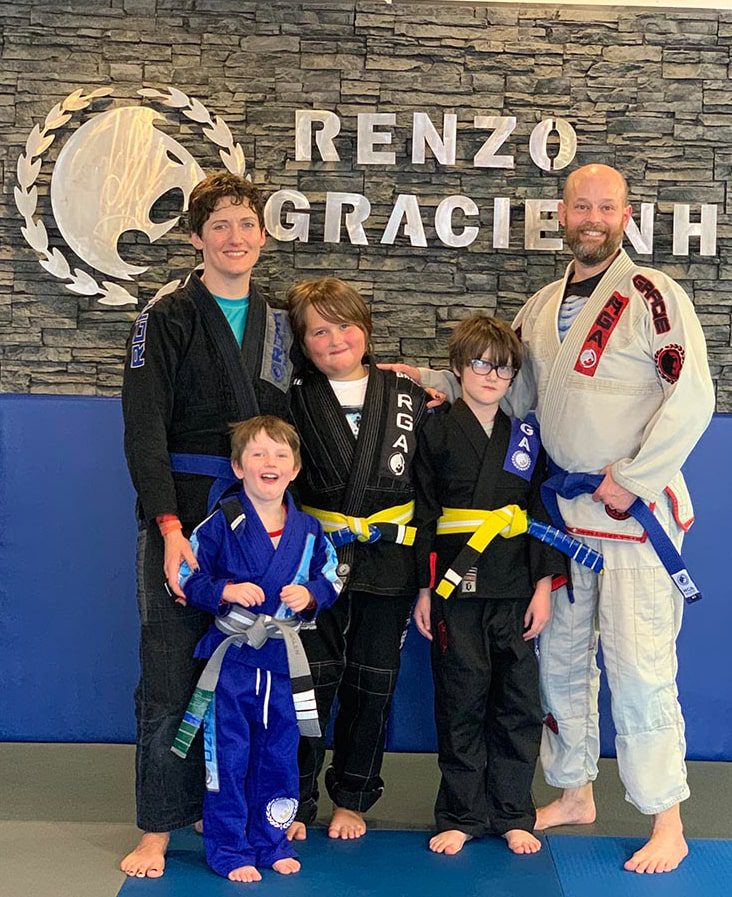
For families comparing positive outlets for kids Exeter offers, Renzo Gracie NH is one option if a child is interested in structured Brazilian Jiu-Jitsu. The academy provides instruction for children and adults, with an emphasis on personal development and community. It won’t be the right fit for every child, but it may suit a young learner who enjoys active practice, clear instruction, and learning alongside others.

Instruction is led by Professor Kevin Landry, a sixth-degree black belt under Renzo Gracie who has taught in the region for over two decades. Parents can ask the team what a child’s first experience involves and whether the teaching approach and group setting feel right for their family. As with any activity, consider the practical details as well as your child’s interest.

What families can explore through kids’ Brazilian Jiu-Jitsu

Brazilian Jiu-Jitsu offers coached movement, skill development, and structured group participation. Children practice with partners as part of learning, so parents can ask how beginners are introduced to activities and how expectations are communicated. These are experiences to explore, not promised results. Each child’s response depends on their interests, comfort, and willingness to participate.

Family participation may also be worth discussing if shared training time matters to your household. Renzo Gracie NH offers instruction for children and adults; ask the academy what family training could look like in practice. This overview of parent-and-child Jiu-Jitsu provides additional context for families considering that approach.

Choose a simple next step near Exeter

Before planning a visit, contact the academy to confirm which current location best suits your household. Check the children’s class schedule, age suitability, travel time, and what an introductory visit involves. Renzo Gracie NH offers a complimentary introductory class for new students. Confirm current arrangements directly rather than relying on older listings or assumptions about availability.

A first visit can help you see whether the setting feels welcoming and the activity interests your child. Afterward, ask what they enjoyed, what questions they still have, and whether they’d like to return. Explore Renzo Gracie NH and ask about a first visit, the suitable location for Exeter-area families, and current introductory-class details.

Choose an activity your child is ready to explore

The best positive outlets for kids Exeter families can consider aren’t necessarily the most competitive or structured. Start with what interests your child, then weigh their comfort, the setting, and the practical fit for your household. Before signing up, confirm current age requirements, schedules, locations, and introductory arrangements directly with the provider.

If structured Brazilian Jiu-Jitsu is on your shortlist, Renzo Gracie NH is one option to explore. Professor Kevin Landry, a sixth-degree black belt under Renzo Gracie, has taught in the region for over two decades. Exeter-area families should ask which current location is suitable and verify the children’s class schedule and introductory-class details.

Explore Renzo Gracie NH and ask about a complimentary introductory class to learn whether a first visit could suit your family. Every child’s interests are different. Take the next step at a pace that feels right, and give your child room to discover what they enjoy.

Frequently Asked Questions

What are positive outlets for kids in Exeter, NH?

Positive outlets are constructive, age-appropriate ways for children to explore interests, practice skills, and connect with others. Exeter-area families can investigate youth sports, arts and music, library or community activities, outdoor recreation, and structured movement such as Brazilian Jiu-Jitsu. Programs and locations can change, so check official listings and confirm availability, age suitability, and travel details with each provider in Exeter, Windham, or Manchester.

Which activities help children build skills and stay engaged?

Activities that invite children to participate and practice at a comfortable pace can support skill development and ongoing interest. A team sport may appeal to a child who enjoys shared goals, while music or art can suit someone drawn to creative practice. Coached activities such as Brazilian Jiu-Jitsu include guided movement and partner practice. For families in Exeter, Windham, and Manchester, the right choice depends on the child’s interests and the program’s current details.

How do I choose an extracurricular activity that fits my child?

Start by asking what your child hopes to try, learn, or experience, then shortlist options together. Compare the setting, group format, schedule, travel time, and whether a first visit is possible. Notice whether your child seems comfortable and interested, not just whether an activity sounds impressive. Exeter-area families should confirm current program details directly, including age eligibility and location, before deciding whether the commitment works for their household.

Is Brazilian Jiu-Jitsu a good activity for kids?

Brazilian Jiu-Jitsu may suit children who enjoy active, instructor-led learning and partner practice, but it isn’t the right fit for every child. Ask how the program explains expectations and introduces beginners to sessions. Check the children’s class structure, age suitability, and introductory arrangements. Families in Exeter, Windham, or Manchester can use a visit to assess whether the setting feels comfortable for their child.

Can children try a martial arts class before enrolling?

Renzo Gracie NH offers new students a complimentary introductory class, including families considering the kids’ Brazilian Jiu-Jitsu program. Contact the academy to confirm current arrangements, which location suits your household, the appropriate age range, and what a first visit involves. Families from Exeter, Windham, and Manchester can use the visit to ask questions and see whether the instruction and setting feel like a promising fit before making a commitment.

What should I ask before signing my child up for an activity?

Ask who leads sessions, how beginners are welcomed, what children should bring, and how often the activity meets. Confirm the current location, age eligibility, supervision arrangements, attendance expectations, equipment needs, and whether a parent can observe or accompany a child during an introductory visit. For programs around Exeter, Windham, and Manchester, verify details directly with the provider rather than relying on an older listing or assuming a nearby location is convenient.

Does Renzo Gracie NH offer kids’ Jiu-Jitsu near Exeter?

Yes. Renzo Gracie NH offers Brazilian Jiu-Jitsu instruction for children and serves the Exeter, Windham, and Manchester area. Professor Kevin Landry, the owner and instructor, is a sixth-degree black belt under Renzo Gracie and has taught in the region for over two decades. Exeter families should contact the academy to confirm the most suitable current location, children’s class schedule, age suitability, and introductory-class details.

Parent-Child Martial Arts in New Hampshire: 2026 Guide

What if the best seat at your child’s sports practice isn’t on the bleachers, but right beside them on the mat? With New Hampshire leading the nation in youth sports participation at over 74 percent, countless parents spend their weeknights scrolling on phones and waiting for the final whistle. Choosing parent child martial arts New Hampshire families can practice together turns that idle sideline time into an active, inspiring partnership.

Between hectic school schedules and digital distractions, finding a shared hobby that bridges the generational gap can feel almost impossible. You want practical self-defense skills and healthy athletic habits, but you also need a safe, ego-free environment that protects growing joints and adult bodies alike. Training side by side builds mutual trust, authentic discipline, and lifelong confidence. This guide breaks down how cooperative martial arts programs work, what safety standards to look for, and how to find the premier family-focused academies across Southern New Hampshire.

Key Takeaways

  • Step off the bleachers and onto the mat to replace passive screen time with cooperative partner drills that build mutual trust and emotional resilience.
  • Understand why Brazilian Jiu-Jitsu offers a safer alternative to striking sports by focusing on body control and leverage rather than high-impact collisions.
  • Explore typical class structures, from joint-friendly mobility warm-ups to progressive technical drills where parents and kids learn practical self-defense side by side.
  • Discover essential criteria for choosing parent child martial arts New Hampshire academies, including verified instructor lineage and hospital-grade facility hygiene.
  • Learn how multi-academy access across Windham, Manchester, and Exeter simplifies training schedules for active Southern New Hampshire families.

The Modern Family Dilemma: Why Parents and Kids in New Hampshire Need Shared Mats

Every weeknight across New England, the scene repeats itself. Exhausted parents sit hunched on hard aluminum bleachers, illuminated only by the glow of their smartphones while their kids run drills on a distant field. We become passive chauffeurs. We shuttle our children between activities, offer critiques on the car ride home, and completely miss out on genuine, shared physical connection. Modern life routinely isolates families into separate digital silos, even when everyone is under the same roof.

Cooperative movement rewrites that dynamic entirely. When you step onto the training canvas together, the bleacher divide evaporates. Practicing martial arts as a family triggers physical releases of oxytocin through positive, trust-based contact. It breaks down generational barriers, replacing isolated screen fatigue with active problem-solving. Through dedicated parent child martial arts New Hampshire programs, families discover a refreshing counterbalance to the frantic pace of modern life.

Breaking Away from the Sideline Parenting Trap

Sideline parenting places adults in the role of spectator or critic. Step onto the mat, and that hierarchy shifts. Active participation turns routine physical fitness into an inspiring collaborative pursuit. Children rarely get to see their parents face a steep learning curve in real time. When your child watches you struggle with a complex guard pass, ask questions, and try again, something remarkable happens. Vulnerability normalizes healthy failure. It shows them that learning is an ongoing, lifelong adventure rather than something that ends with childhood. For fathers looking to cultivate this kind of engaged dynamic from the start, resources like GreatDad.com offer practical advice on navigating active parenting and fostering meaningful bonds.

Developing Shared Emotional Resilience and Trust

Grappling disciplines demand absolute presence. You cannot check work emails while defending a sweep or coordinating hip movement with a training partner. This shared focus creates lasting benefits for the entire household:

  • Deep non-verbal communication: Partner drilling requires listening through physical feedback, timing, and weight distribution.
  • Cooperative problem-solving: Working through technical puzzles teaches families how to stay calm and support each other under pressure.
  • A common athletic language: Shared training replaces routine small talk with animated dinner-table discussions about balance, leverage, and personal breakthroughs.

Encountering difficult techniques side by side builds quiet grit. When a parent and child navigate a demanding drill, overcome fatigue, and earn small technical victories together, they forge mutual respect. That authentic bond outlasts any trophy on a bedroom shelf.

Why Brazilian Jiu-Jitsu Outperforms Traditional Striking Arts for Family Bonding

Most people picturing martial arts imagine flying side kicks, wooden boards snapping, and protective sparring pads. While striking arts build discipline, they introduce concussive impact that makes true parent-child sparring nearly impossible. You cannot trade full-speed punches with your ten-year-old safely. Brazilian Jiu-Jitsu (BJJ) changes the dynamic entirely by replacing high-velocity strikes with body mechanics, angles, and ground control.

Grappling allows two people of vastly different sizes to train with genuine physical resistance at full pace without causing harm. It provides the ultimate foundation for families seeking realistic self-defense alongside meaningful bonding.

Grappling Mechanics vs. Striking Impact for Developing Bodies

Striking disciplines involve repetitive forces that rightfully concern health-conscious parents. BJJ eliminates concussive head trauma from training sessions. Instead, practitioners utilize joint alignment, balance, and leverage to manage distance and neutralize aggression. Medical researchers examining the developmental benefits of play emphasize that close physical cooperation fosters emotional regulation and spatial awareness without harmful strain.

Reviewing curriculum models like kids jiu jitsu New Hampshire programs demonstrate how gentle, controlled pressure teaches body awareness. The presence of the tap-out rule ensures that either partner can stop a drill instantly, keeping training safe and encouraging continuous progress.

The Physical Chess Analogy: Solving Movement Puzzles as a Team

Practitioners often call Jiu-Jitsu “human chess.” Every position presents an intellectual puzzle where technique consistently trumps raw strength. A nimble child can use flexibility and hip mobility to out-maneuver an adult, leveling the biological playing field. This balance makes parent child martial arts New Hampshire classes uniquely collaborative:

  • Adaptive resistance: Parents learn to calibrate their physical pressure, giving children realistic resistance without relying on adult strength.
  • Tactical problem-solving: Escaping a pin or setting up an armlock requires strategic thinking, turning each round into a shared logic game.
  • Shared milestones: Discovering how to execute an escape together creates genuine pride that builds confidence across both generations.

If you’re eager to see how this technical problem-solving works on the mats, you can visit Renzo Gracie NH to observe how families train together in a supportive setting.

What to Expect in a Family Martial Arts Class: Structure, Safety, and Progression

Walking onto a martial arts mat for the first time brings natural anticipation. Parents often wonder whether they will be able to keep up, or if their children will find the training environment intimidating. High-level family programs are built to remove that hesitation from day one. Rather than aggressive combat drills, classes follow an intentional structure centered on technical clarity, mutual safety, and shared joy.

Quality academies create an ego-free room where safety comes first. Expert coaches watch every repetition, ensuring that partners move with control while learning practical self-defense mechanics side by side.

The Daily Mat Flow: From Warm-Up to Technical Drilling

Every session follows a methodical sequence designed to build confidence step by step:

  • Dynamic movement warm-ups: Classes start with natural ground mobility exercises like bear crawls, hip escapes, and posture resets that warm adult joints safely while developing agility in young students.
  • Bite-sized technical instruction: Coaches break complex movements into two- or three-step sequences, explaining the biomechanics so both minds can absorb the details.
  • Cooperative partner practice: Parents and children alternate between playing the active student executing the technique and serving as the supportive, steady base.
  • Positional games: Sessions finish with light, objective-based challenges, like keeping balance inside the guard, allowing both partners to test concepts playfully.

Managing Size and Strength Disparities Safely

A sixty-pound child cannot absorb the full weight of a two-hundred-pound adult. Professional academies handle this disparity through strict weight-distribution guidelines. Coaches teach adults how to post their hands and knees to bear their own mass during top control drills, protecting developing bodies from unnecessary pressure.

Equally critical is the universal tap-out rule. Tapping the mat or saying “tap” out loud halts any sequence instantly. This gives both parent and child full bodily autonomy during every drill. For parents stepping onto the mats without previous athletic experience, reviewing jiu jitsu for beginners adults NH resources helps set clear expectations around pacing and physical recovery.

When selecting premier parent child martial arts New Hampshire programs, look for rooms where control outranks raw speed. A measured training environment guarantees that both generations look forward to lacing up their gear week after week.

Parent-Child Martial Arts in New Hampshire: 2026 Guide

Evaluating Family Martial Arts Academies in Southern New Hampshire: A Parent Checklist

Selecting the right academy shapes your family’s athletic experience for years. With nearly 40 percent of all martial arts participants under the age of 18, plenty of schools market youth and family programs. Yet operational standards vary wildly from one facility to another. Choosing quality parent child martial arts New Hampshire programs requires looking past marketing slogans and assessing how a school runs its daily classes.

Every reputable academy should welcome your questions about safety, instruction quality, and cleanliness. Use this targeted checklist to evaluate potential training homes across Southern New Hampshire.

Lineage, Experience, and Instructor Pedigree

Instructional pedigree matters. It directly influences whether techniques are technically sound, safe, and street-effective. Look into the head instructor’s background:

  • Direct lineage: Verify who awarded the instructor their black belt. Authentic Brazilian Jiu-Jitsu traces its lineage directly back to respected masters.
  • Teaching tenure: Seek head instructors with decades of coaching experience rather than recent graduates running commercial operations.
  • Coaching temperament: An exceptional mentor leads with humility, patience, and encouraging correction rather than intimidation or ego.

Facility Cleanliness, Community Culture, and Multi-Location Access

Physical environments speak volumes. Mat cleanliness should follow hospital-grade sanitation protocols, with daily disinfecting routines to protect against common skin infections and seasonal viruses. Walk through the locker rooms and viewing areas. Clean, well-ventilated spaces reflect a staff that takes student safety seriously.

Observe the room’s culture during busy transition windows. Do current parents and students welcome beginners with warmth, or does the school feel insular? An inclusive, cooperative culture ensures your family feels supported from the moment you step through the door.

Logistical convenience is equally vital. Southern New Hampshire families frequently commute between work, school, and extracurricular commitments. Academies offering reciprocal mat access across sister locations grant enormous flexibility, ensuring hectic schedules never derail training momentum. If you’re ready to evaluate a welcoming, multi-facility school firsthand, you can explore trial opportunities at Renzo Gracie NH and see authentic coaching in person.

Begin Your Family Journey with Renzo Gracie NH: Windham, Manchester, and Exeter

Taking up a martial discipline should empower your entire household. At Renzo Gracie NH, training is designed to build character, coordination, and lasting family connections across all age groups. Through dedicated Family Time sessions, parents and children step onto the mats together, turning weekly fitness routines into an engaging shared ritual. One membership grants complete training access across our Windham, Manchester, and Exeter academies, ensuring your family stays consistent no matter where daily work and school commutes take you.

Our curriculum removes the intimidation often tied to combat sports. We focus on personal progress, technical precision, and an ego-free atmosphere where every family member thrives at their own speed.

World-Class Heritage Led by Professor Kevin Landry

Authentic lineage forms the bedrock of our coaching philosophy. Head instructor Professor Kevin Landry brings over two decades of regional teaching experience to Southern New Hampshire. As a 6th-degree black belt under the legendary Master Renzo Gracie, Professor Landry instills the values of humility, perseverance, and mutual respect into every session. His focus centers on multi-generational growth, ensuring that adults and children learn practical leverage without aggressive ego displays. Local households can review our guide on parent and child jiu jitsu Windham to discover how these cooperative principles come to life in our classes.

Taking the First Step: The Free Introductory Class Experience

Stepping into a new academy should feel welcoming, never overwhelming. That is why your journey starts with a guided orientation:

  • Personalized movement introduction: We walk your family through essential mat safety, fundamental body mechanics, and basic partner etiquette.
  • Calm, supportive environment: You get to explore the academy, meet the coaching staff, and ask questions without any high-pressure sales tactics.
  • Hands-on experience: Try genuine techniques together so you can feel how controlled leverage replaces raw strength firsthand.

Finding the right fit for parent child martial arts New Hampshire programs starts by experiencing the community directly. You can take that initial step by scheduling your free introductory class today, and discover how stepping onto the mats together elevates confidence and connection across your entire household.

Step Off the Sidelines and Transform Your Family Bond

Trading the bleachers for the mat changes everything. Instead of cheering from a distance, you become an active partner in your child’s physical and emotional growth. Brazilian Jiu-Jitsu eliminates high-impact collisions, giving families a safe, leverage-based martial art that builds real-world confidence, mutual respect, and lasting habits. It turns routine weekly exercise into an empowering adventure you conquer as a team.

Choosing the right program sets the tone for your family’s journey. At Renzo Gracie NH, Professor Kevin Landry brings over twenty years of dedicated instruction under master Renzo Gracie to every class. With one membership granting your household complete access across our Windham, Manchester, and Exeter locations, finding time for quality parent child martial arts New Hampshire training has never been more achievable. Take the leap together. Claim your family’s free introductory class today, step onto the mats, and discover what your family can accomplish side by side.

Frequently Asked Questions

Can parents and children really train together in the same martial arts class?

Yes, parents and children train together directly during dedicated Family Time sessions. Classes focus on cooperative partner drilling rather than aggressive collisions. Adults learn how to provide balanced resistance while kids practice real leverage and control. This structure turns parent child martial arts New Hampshire training into a collaborative bonding activity where both generations practice identical self-defense fundamentals simultaneously.

What if I am out of shape or have zero prior martial arts experience?

You don’t need any prior martial arts experience or baseline fitness level to begin. Classes are designed to meet you exactly where you are today. Dynamic warm-ups and step-by-step drills let you adjust your pace as your stamina develops. You’ll build functional mobility, core strength, and cardiovascular health alongside your child in an ego-free, supportive environment where personal growth matters far more than athletic background.

At what age can my child begin participating in family martial arts programs?

Children can typically start participating in family training sessions around age four or five. At this stage of development, kids possess the attention span and gross motor control needed to follow basic movement cues and partner safety rules. Our instructors structure drills through engaging, game-like exercises that teach positional balance while keeping young minds energized and focused. Older kids and teens also train alongside their parents seamlessly. For families with infants who want to explore gentle physical connection before martial arts, early developmental practices like baby yoga from Mother And More provide a wonderful example of how movement can strengthen family bonding from the earliest months.

How does Brazilian Jiu-Jitsu differ from traditional Karate or Taekwondo for children?

Brazilian Jiu-Jitsu relies on ground control and leverage rather than punches and kicks. Traditional disciplines like Karate and Taekwondo focus heavily on high-speed strikes and katas, which carry concussion risks during sparring and offer limited control against bullies. BJJ gives children practical tools to neutralize physical conflict without violence. They learn how to close distance, control an aggressor on the ground, and hold a position safely until help arrives.

Is sparring safe for growing children training alongside adult partners?

Yes, sparring and drilling are exceptionally safe because adult partners prioritize control over force. Coaches instruct parents to post their own weight, eliminating heavy pressure on young joints. Every student learns the universal tap-out rule on day one, which halts any drill immediately. These safety standards make parent child martial arts New Hampshire classes a controlled, positive experience where kids practice realistic self-defense moves without fear of injury.

What gear or uniform do my child and I need for our first class?

You only need comfortable, athletic clothing without pockets, buttons, or zippers for your first class. A standard t-shirt and athletic pants or leggings work perfectly on the mat. We train barefoot on sanitized mats, so no special shoes are required. Bring a water bottle and an open mindset. Our academy provides all necessary orientation, and traditional uniforms can be explored once your family decides to commit long-term.

How do family memberships work across the Windham, Manchester, and Exeter locations?

One membership grants your household full reciprocal training privileges across our Windham, Manchester, and Exeter academies. This multi-academy footprint is built specifically for busy Southern New Hampshire families. If an after-school event or work schedule pulls you toward another town, you can attend class at whichever academy fits your evening routine. You get consistent, high-level instruction led by Professor Kevin Landry’s curriculum without worrying about separate facility fees.

How BJJ Helps Children Overcome Bullying Without Violence

What if the most effective way to stop a bully isn’t throwing a punch, but knowing how to stay completely calm? If you’ve watched your child withdraw into anxiety, avoid school, or shrink under daily harassment, your instinct is to protect them immediately. Yet, traditional combat sports that teach striking carry real risks of school suspension and retaliatory violence. Understanding how BJJ helps children overcome bullying offers a proven, peaceful alternative. It changes the dynamic entirely from trading blows to controlling the situation.

You already know that fighting back with fists only invites more trouble. In this guide, you’ll discover how Brazilian Jiu-Jitsu empowers children with quiet confidence, firm verbal boundaries, and non-violent restraint skills to defuse threats safely. We’ll explore why technical leverage neutralizes raw physical size, how assertive posture stops confrontation before it starts, and how an encouraging mat culture helps every child build lasting resilience.

Key Takeaways

  • Discover why traditional advice like “just ignore it” often backfires and how practical boundaries restore your child’s sense of safety.
  • Learn how BJJ helps children overcome bullying by relying on mechanical leverage and non-violent holds rather than dangerous strikes.
  • Understand the psychological reasons why disciplined martial arts training reduces aggression instead of turning quiet kids into bullies.
  • Master the three-step defense model that emphasizes calm posture, assertive de-escalation, and non-violent restraint as a strict last resort.
  • Explore how an inclusive mat community and experienced mentorship build lasting mental resilience and quiet self-belief.

Understanding Modern Bullying: Why Passive Advice Often Leaves Children Vulnerable

Bullying thrives in isolation. It relies on an asymmetric dynamic of power, targeting perceived weakness, hesitation, and fear. According to established scholarship and a comprehensive definition of bullying, the behavior requires an imbalance of physical or social power repeated over time. When parents notice their child withdrawing into silence, the common instinct is to preach non-engagement. “Just ignore them,” adults advise. “Don’t give them a reaction.”

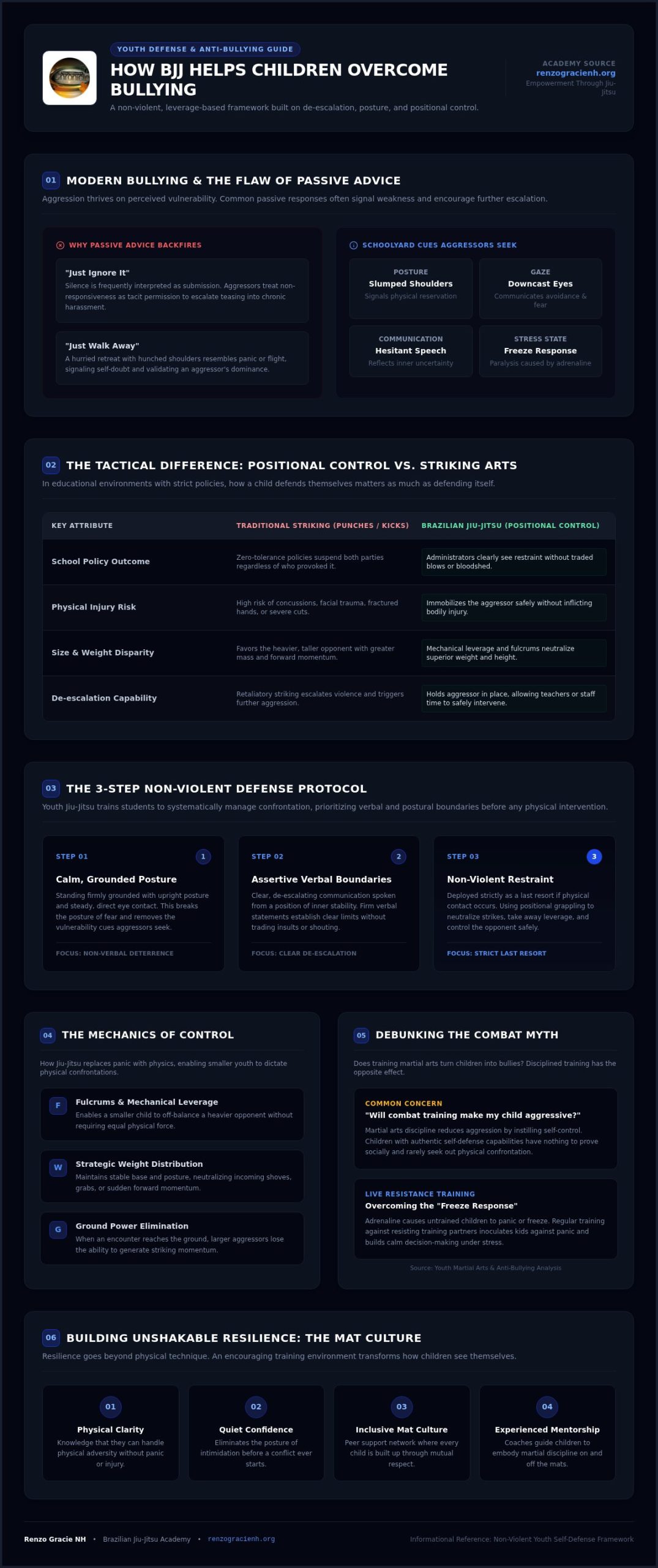
Unfortunately, passive avoidance rarely resolves intimidation. Instead, silence frequently reads as submission. Aggressors treat non-responsiveness as permission to escalate, turning casual teasing into chronic harassment. The resulting psychological toll extends far beyond school hallways, eroding a child’s academic focus and everyday social confidence. Understanding how BJJ helps children overcome bullying begins with recognizing that authentic safety requires calm competence rather than anxious passivity.

The Hidden Anatomy of Schoolyard Aggression

Aggressors rarely choose targets at random. They seek easy targets. Visible cues like slumped shoulders, downcast eyes, and hesitant speech immediately signal self-doubt. While overt physical shoves grab headlines, the everyday reality often involves quiet cruelty: excluding peers from cafeteria tables, whispering in hallways, or persistent digital slights. When a targeted child freezes, the aggressor’s social dominance gets validated in front of their peers, cementing a cycle of intimidation that becomes harder to break every day.

Why Telling Kids to ‘Just Walk Away’ Isn’t Always Enough

Walking away works only if done from a place of strength. A hurried retreat with hunched shoulders looks like flight, encouraging an aggressor to follow. Standing grounded, making direct eye contact, and stating a firm boundary changes the equation instantly. Real de-escalation demands inner stability. A child must know, deep down, that if an aggressor grabs their arm or pushes them to the floor, they can handle the physical challenge without getting hurt.

This grounded self-assurance is the core of Kids Jiu Jitsu New Hampshire youth development. Training provides children with physical clarity. They stop projecting panic. This single transformation illustrates how BJJ helps children overcome bullying: it eliminates the target painted by fear before physical conflict ever starts.

The BJJ Advantage: Non-Violent Positional Control Versus Striking Arts

Traditional martial arts often focus on kicking and punching. In modern schools, swinging a fist creates disaster. School zero-tolerance policies rarely distinguish between an aggressor and a defending victim; trading strikes usually leads to immediate suspension for both kids. This harsh reality shows why learning how BJJ helps children overcome bullying is so critical. Instead of trading blows, Brazilian Jiu-Jitsu relies on positional grappling and body control to stop confrontations peacefully.

Leverage Over Strength: Neutralizing Physical Size Disparities

Bullies rely on physical mass and forward momentum to intimidate smaller peers. Jiu-Jitsu neutralizes that advantage. By utilizing fulcrums, weight distribution, and leverage, a smaller child can quickly off-balance a heavier opponent. When an encounter moves to the ground, a larger aggressor loses their ability to generate striking power. Brazilian Jiu-Jitsu replaces panic with physics, enabling smaller youth to dictate physical encounters.

The Ethics of Control: Restraining Aggressors Without Harm

Striking creates lasting injury, including concussions and fractured bones. Positional grappling creates safety. According to the authoritative definition of bullying provided by StopBullying.gov, physical harassment involves unwanted aggressive behavior meant to display power. Holding an aggressor securely in place neutralizes that threat without inflicting bodily trauma. It gives teachers or supervisors time to intervene while keeping everyone safe.

Because there is no bloodshed or traded punches, school administrators can clearly see who defended themselves with restraint. For families seeking this protective skill set, training at Renzo Gracie NH provides a clear path toward safe, school-smart self-defense.

Live Resistance Training: Overcoming the Freeze Response

Adrenaline causes untrained children to freeze when attacked. BJJ eliminates that panic response through controlled live sparring, often called rolling. During each class, students practice their techniques against fully resisting training partners. Key benefits of this dynamic training include:

  • Nervous system conditioning: Regular exposure to close physical contact teaches the body to remain relaxed instead of going into shock.
  • Problem-solving under pressure: Children learn to breathe and think strategically even when pinned beneath an opponent.
  • Hallway composure: Because they face simulated physical pressure on the mats daily, sudden real-world confrontations lose their terrifying mystique.

This calm, practiced composure demonstrates how BJJ helps children overcome bullying: it replaces paralyzing fear with quiet, capable awareness.

Debunking the Combat Sport Myth: Does Training BJJ Make Children Aggressive?

A major fear holds many parents back from martial arts academies: the dread of accidental aggression. What if training turns your gentle child into a schoolyard bully? What if giving them physical leverage makes them eager to start fights? These valid parental concerns rest on a natural misunderstanding of how combat training interacts with a young person’s emotional wiring. Bullies do not lash out because they possess disciplined technique; they act out because of unmanaged insecurity and an urgent, anxious need to manufacture social dominance.

Brazilian Jiu-Jitsu works in reverse. Learning capable physical control removes the desperate urge to prove oneself. When a student steps onto the mats, taps out regularly, and works safely through complex physical puzzles with peers, ego takes a backseat. Respectful mat etiquette transforms raw impulse into humble accountability. This emotional maturation shows precisely how BJJ helps children overcome bullying: by eliminating the inner volatility that fuels both aggression and victimhood.

The Psychology of the Quietly Confident Child

Genuine capability creates stillness. Children who know they can protect themselves carry no urge to retaliate against minor insults, cafeteria posturing, or playground teasing. They feel secure. This inner stability changes how they interact with their peers:

  • Immunity to verbal taunts: Because their self-worth is tested and proven on the mat, cheap words fail to trigger desperate defensive reactions.
  • Emotional balance: Experiencing safe physical pressure during class teaches kids that discomfort is manageable, removing the panic behind explosive tempers.
  • Protecting others: Capable students rarely stay quiet during unfair moments; they routinely step up as calm, steady defenders of isolated classmates.

Dismantling the Victim Stance Through Posture and Gaze

Aggression seeks an easy target. Training actively dismantles the physical signals that bullies prey upon. Slumped posture gives way to relaxed, level shoulders; averted eyes transform into direct, calm eye contact. A child who moves with grounded composure communicates capability before a single word is spoken. That non-verbal boundary often ends harassment before it can begin.

Parents who want to reinforce this mutual respect and grounded poise can explore programs like Parent and Child Jiu Jitsu in Windham. Training side by side reinforces emotional balance at home, demonstrating how BJJ helps children overcome bullying by establishing shared family habits of quiet confidence and genuine composure.

How BJJ Helps Children Overcome Bullying Without Violence

The 3-Step Non-Violent Anti-Bully Protocol Taught in Youth Jiu-Jitsu

Self-defense begins long before hands make contact. In structured youth grappling, physical engagement is taught as an absolute last resort, reserved solely for moments when verbal communication fails and immediate physical safety is compromised. Rather than reacting blindly, students rely on a methodical escalating response model that neutralizes aggression safely. This structured discipline shows practically how BJJ helps children overcome bullying within strictly monitored school environments.

Step 1: Setting Clear Verbal Boundaries and Confident Distance

Every encounter begins with distance management. Students are trained to adopt a defensive ready stance: feet balanced, chin tucked, and open hands raised at chest height. This posture protects the head while signaling non-aggression to onlookers. From this position outside the peer’s reach, children use firm, audible scripts like “Stop, step back, I don’t want to fight you.” Speaking loudly establishes clear personal boundaries and immediately draws adult attention.

Step 2: Safe Clinch Entry to Neutralize Incoming Strikes

If an aggressor ignores verbal warnings and lunges forward, staying at arm’s length is dangerous. That middle zone is where punches land. Instead, children learn to close the distance immediately:

  • Cover the head: The child steps forward inside the swing with their forearms protecting the ears and temples.
  • Secure the body lock: Wrapping arms around the aggressor’s torso completely eliminates their ability to generate striking leverage.
  • Control head position: Tucking their forehead against the opponent’s chest prevents headbutts and destabilizes the aggressor’s center of gravity.

Step 3: Gentle Takedown and Positional Control Until Help Arrives

Once the clinch is secured, the objective is safe de-escalation on the floor. Students use low-impact trips or body-lock transitions that guide both bodies down without slamming. Rather than applying painful joint submissions, the child establishes a dominant position like the mount or knee-on-belly.

From this controlled position, the student negotiates calmly: “I will let you up if you stop pushing me.” Holding the aggressor securely prevents injuries to both parties while waiting for school staff to arrive. This controlled sequence illustrates exactly how BJJ helps children overcome bullying without violence. To see these safe de-escalation drills in person, explore youth martial arts training at an academy that prioritizes non-violent defense.

Building Unshakable Resilience at Renzo Gracie NH: What Parents Can Expect

Every child deserves an environment where they can build authentic strength without intimidation. At Renzo Gracie NH, families across Windham, Manchester, and Exeter discover a supportive training environment centered on character and personal progress. When looking at how BJJ helps children overcome bullying, the physical technique is only half the equation. The culture surrounding that technique matters just as much.

A Structured Youth Curriculum Led by Master Instruction

World-class instruction provides the foundation for safe growth. Led by Professor Kevin Landry, a 6th-degree black belt under Renzo Gracie with over 20 years of teaching experience in New Hampshire, our youth classes maintain an ego-free, disciplined atmosphere. The academy emphasizes hygiene, mutual respect, and safe technical practice. Classes are separated by age and developmental stage, ensuring children practice alongside peers of similar size and maturity rather than facing overwhelming physical gaps.

Overcoming Insecurity: How the Mat Community Nurtures Timid Kids

Shy or unathletic children often feel isolated in school hallways. On the mats, they find an inclusive community outside their school district. Advanced students actively mentor newcomers, replacing cliquish behavior with teamwork and encouragement. Every class presents structured challenges designed to build character:

  • Incremental victories: Mastering a simple escape or control hold teaches children that persistence overcomes initial difficulty.
  • Peer support: Training with respectful teammates provides a positive social circle completely separate from everyday schoolyard drama.
  • Quiet self-assurance: As physical competence grows, the anxious self-doubt that often attracts negative attention naturally disappears.

This steady, supportive community illustrates how BJJ helps children overcome bullying by building an internal sense of security that stays with them everywhere they go.

Your First Step: Experiencing the Free Introductory Class

Walking into a martial arts academy for the first time can feel intimidating for an anxious child. That is why the journey begins gently. During a complimentary introductory class, instructors take time to assess your child’s comfort level and introduce basic movements through fun, accessible partner drills. Beginners are never thrown into intense sparring sessions on day one.

Parents can watch the entire session from the sidelines, meet our coaching staff, and experience the supportive community firsthand. If you are ready to help your child develop real composure, explore a Try Jiu Jitsu Free in New Hampshire session today.

Transforming Bully Defense into Lifelong Confidence

Every child deserves to walk through school hallways without fear or hesitation. Real protection doesn’t come from teaching kids how to trade violent strikes; it stems from steady posture, clear vocal boundaries, and non-violent physical control. Learning how BJJ helps children overcome bullying reveals that authentic self-defense replaces anxious self-doubt with quiet composure. When your child knows they can neutralize aggression safely on the ground, their entire demeanor changes. Confrontation dissolves before it begins.

At Renzo Gracie NH, our dedicated youth curriculum is led by Professor Kevin Landry, a 6th-degree black belt under Renzo Gracie with over 20 years of experience teaching New Hampshire families. Across our welcoming academies in Windham, Manchester, and Exeter, we provide a family-centered mat culture where character, mutual respect, and personal safety come first. Give your child the internal resilience to stand tall, defuse hostility peacefully, and thrive in every environment. Empower your child with confidence and book your free introductory class today!

Frequently Asked Questions

Will learning Brazilian Jiu-Jitsu encourage my child to pick fights at school?

No, training actually reduces aggressive behavior. Brazilian Jiu-Jitsu teaches discipline, humility, and emotional regulation from day one. When children test their abilities safely on the mats, they feel no anxious urge to prove themselves through schoolyard conflict. Instructors at Renzo Gracie NH actively emphasize that martial arts are strictly for protection. Understanding how BJJ helps children overcome bullying means recognizing that real capability breeds calm patience, not hostility.

How can a smaller child defend themselves against a much larger bully using BJJ?

BJJ relies on mechanical leverage, body angles, and base rather than raw muscular power. When an encounter moves to the floor, a heavier child loses their striking leverage and momentum. Smaller practitioners use body locks, fulcrums, and weight distribution to control an opponent safely. This scientific framework allows smaller youth across New Hampshire academies to protect themselves against larger peers without needing superior physical size or brute force.

What should my child do if a bully tries to hit them before they can use grappling?

Children are trained to close the distance immediately while shielding their head. Standing at arm’s length leaves a child vulnerable to wild swings. Students learn a protective entry that covers the temples and jaw while stepping swiftly into a clinch. Once locked in an upper-body hold, the aggressor loses the space needed to generate striking momentum, keeping both students much safer until adults can intervene.

How quickly will my child start showing increased confidence after starting BJJ?

Most parents observe noticeable shifts in posture, vocal clarity, and eye contact within three to four weeks. As children master foundational movements and earn small technical victories, their internal self-doubt begins to fade. That newly discovered assurance shows up immediately in how they carry themselves. Seeing how BJJ helps children overcome bullying involves noticing how rapid postural changes dismantle the hesitant cues that aggressors target.

Will my child get in trouble at school for using Jiu-Jitsu in self-defense?

Positional grappling drastically minimizes the risk of disciplinary action under zero-tolerance school policies. Striking martial arts leave visible trauma, bruises, and fractured skin that administrators often penalize regardless of who initiated the fight. In contrast, holding an aggressor down creates clear visual evidence of restraint rather than violence. School staff and bystanders can plainly see that your child controlled the threat without throwing harmful punches.

Can a very shy or unathletic child succeed in youth Brazilian Jiu-Jitsu?

Absolutely. Jiu-Jitsu is uniquely suited for quiet, uncoordinated, or timid children. Unlike traditional team sports where athletic benchwarmers get overlooked, grappling allows every student to advance at their personal pace. At Renzo Gracie NH, coaches provide a patient, structured atmosphere that welcomes beginners gently. Over time, progressive drills develop natural balance, coordination, and genuine pride in kids who previously struggled with physical activities or social anxiety.

What makes Brazilian Jiu-Jitsu safer than striking martial arts like karate or taekwondo?

BJJ focuses entirely on controlled holds, leverage, and takedowns instead of high-velocity impacts. Striking disciplines carry ongoing risks of accidental concussions, dental trauma, and facial fractures during routine sparring. Jiu-Jitsu eliminates strikes entirely. Students practice techniques dynamically with resisting partners who can tap out at any moment to stop the drill. This controlled practice builds practical self-defense skills without subjecting developing minds to repeated head impacts.

Youth Jiu Jitsu Programs in Manchester: Building Confidence Through Lineage

What if the most effective way to stop a bully wasn’t a punch, but a newfound sense of quiet confidence? It’s a question many parents ask as they look for the right youth jiu jitsu programs Manchester has to offer. You want your child to be safe. You want them to stand tall. It’s natural to worry about aggressive environments, but true Brazilian Jiu-Jitsu is about leverage, patience, and respect rather than raw force.

Build discipline. Foster respect. We understand that you’re looking for more than just a hobby; you’re looking for a community that supports your family’s values. Discover how world-class instruction under a 6th-degree black belt helps Manchester children develop discipline, safety, and lifelong confidence. This article explores the prestigious Renzo Gracie lineage, our focus on character development, and how a free introductory class can be the first step toward your child’s transformation. From practical self-defense to improved self-esteem, see how we build leaders on and off the mats.

Key Takeaways

  • Understand the significance of the Renzo Gracie lineage and how learning from a 6th-degree black belt provides a foundation of excellence for your child.
  • Explore how youth jiu jitsu programs Manchester families choose utilize leverage and technique to manage conflicts safely without relying on aggressive striking.
  • Learn how the structured environment of the academy builds character, helping children develop the perseverance and focus needed to handle bullying and school challenges.
  • Discover the structure of a typical first class, from the welcoming atmosphere to the initial warm-ups, ensuring a smooth transition for new students.
  • See how specialized “Family Time” sessions create a supportive community where parents and children can train together and strengthen their bond.

Why Manchester Parents are Choosing Youth Jiu Jitsu

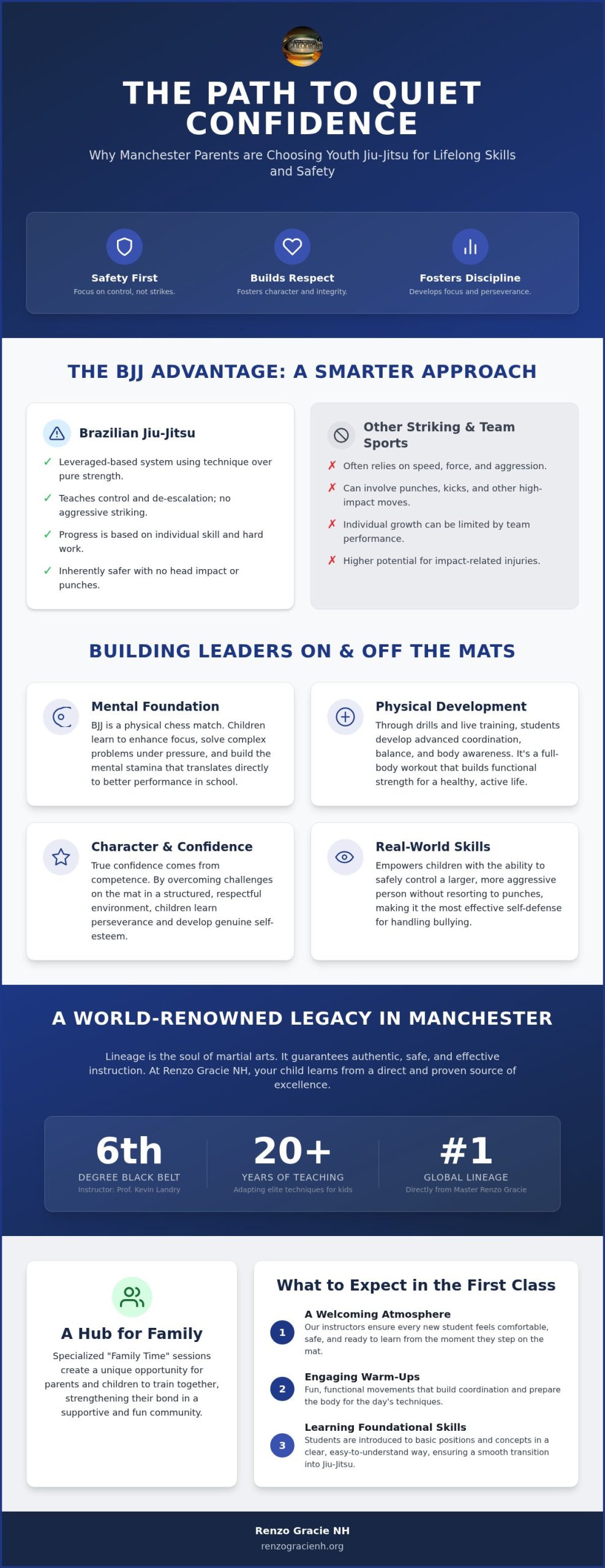
Parents in New Hampshire are looking for more than just physical activity. They want character. They want resilience. While traditional team sports like soccer or baseball offer camaraderie, many families find that Brazilian Jiu-Jitsu provides a unique path for individual development within a team setting. Unlike striking-based martial arts that rely on speed and force, BJJ is a leverage-based system. It teaches children how to control an opponent through technique and positioning. This makes it inherently safer for young bodies. There’s no head impact or aggressive striking. Instead, students learn to navigate physical challenges with calm, calculated movements. This shift toward safety and intelligence is a primary reason why youth jiu jitsu programs Manchester families trust are becoming the preferred choice for local after-school development.

The Physical and Mental Foundation

Build strength. Enhance focus. BJJ serves as a masterclass in body awareness. Through repetitive drills and controlled sparring, children develop advanced motor skills and coordination that carry over into every other aspect of their lives. We call this “disciplined confidence.” It isn’t about being the loudest in the room; it’s about knowing you can handle difficult situations. Manchester parents often report that this focus translates directly to the classroom. When a child learns to solve a complex physical puzzle on the mats, sitting through a math lesson or concentrating on a test becomes much easier. The mental stamina required to earn a new stripe on a belt builds a level of perseverance that few other activities can match.

Manchester’s Community for Young Athletes

The demand for high-quality youth jiu jitsu programs Manchester parents can rely on has never been higher. Our city is moving away from the outdated “tough guy” stereotypes often found in old-school martial arts gyms. We prioritize a safe, inclusive environment where every student feels valued. It’s about finding a local home for long-term growth. Our academy functions as a supportive partner for parents, reinforcing the same values of respect and perseverance taught at home. We move away from intimidating atmospheres and focus on the joy of personal progress. By fostering a culture of collective effort, we ensure that every child has the opportunity to evolve into a confident leader within their community.

  • Safety First: Focus on grappling and control rather than punches and kicks.
  • Individual Pace: Children progress based on their own hard work, not the performance of a team.
  • Real-World Skills: Practical self-defense that builds genuine self-esteem.
  • Inclusive Culture: A welcoming space for all skill levels and personalities.

The Renzo Gracie Legacy: Expert Instruction in NH

Lineage is the soul of martial arts. It represents a chain of knowledge passed from master to student over generations. At Renzo Gracie NH, this chain is led by Professor Kevin Landry, a 6th-degree black belt with over 20 years of teaching experience. Choosing between the youth jiu jitsu programs Manchester offers often comes down to the quality of the mentor. A gym’s size or the number of its locations matters far less than the expertise of the person standing on the mats with your child. Professor Landry brings the global prestige of the Renzo Gracie name directly to our local community, ensuring every student receives instruction rooted in a world-renowned legacy of excellence.

Lineage and Why It Matters

Authenticity creates safety. The Renzo Gracie philosophy focuses on efficiency and technical mastery rather than brute strength. This approach is perfect for children because it empowers them to handle larger peers through leverage and timing. Professor Landry’s two decades of experience allow him to adapt these high-level techniques for younger practitioners without losing their core effectiveness. It’s about building a foundation that lasts. Supporting this approach, research from Sacred Heart University indicates that the disciplined environment of martial arts often leads to better emotional regulation in youth than traditional team sports. We translate this academic benefit into daily practice, helping your child discover their own strength through a proven system.

A Supportive Mentorship Environment

Mentorship is a partnership. Our instructors act as authoritative guides who remain approachable and warm. We use a specific rhythm in our classes to maximize learning. Short, high-energy bursts. Calm, detailed instruction. This staccato-then-flow pace keeps energy high while ensuring technical details are understood. It’s a method that builds focus. We prioritize character development alongside physical skill. Respect is earned and given. Perseverance is celebrated. By training in an environment that values the individual’s journey, children learn that hard work leads to personal evolution. If you want to see how this mentorship shapes young leaders, consider starting with a Free Introductory Class to experience our community firsthand.

  • Expert Leadership: Led by a 6th-degree black belt with decades of experience.
  • Direct Lineage: Authentic techniques from the world-renowned Renzo Gracie family.
  • Tailored Teaching: Complex movements broken down into kid-friendly steps.
  • Character First: Focus on respect, discipline, and emotional growth.

Key Benefits of Manchester Youth Jiu Jitsu Programs

Confidence is built. It’s earned through consistent effort and tangible progress. The youth jiu jitsu programs Manchester families trust provide a specific framework for this growth. It isn’t about teaching children how to fight. It’s about teaching them how to avoid a fight entirely. By focusing on grappling and control, children gain the ability to neutralize a physical threat without resorting to aggressive striking. This distinction is vital for safety. It gives them the internal security to walk through school hallways with their heads held high, knowing they have the tools to stay safe.

Overcoming Bullying Without Violence

Stay calm. Stay safe. Bullying is a complex challenge that requires more than just physical skills. At Renzo Gracie NH, we prioritize a “de-escalation first” strategy. Students learn to manage their emotions under pressure. They practice maintaining safe distances and using clear, verbal boundaries. If physical contact becomes unavoidable, they use leverage to control the situation until an adult can intervene. This practical self-defense builds a level of self-esteem that often makes a child a less likely target. Bullies often look for vulnerability; our students project a quiet, disciplined confidence that discourages conflict before it starts.

Discipline for the Modern World

Focus is a superpower. We apply the same principles of precision and focus found in our Law Enforcement Jiu-Jitsu Training to our youth sessions. It’s a structured approach to personal responsibility. Children learn that every achievement is earned through hard work. Our belt system serves as a tangible map for their journey, where earning a new stripe requires perseverance and attention to detail. This mat discipline naturally flows into home and school life. A child who can focus on a complex technical sweep for twenty minutes is a child who can focus on their homework or follow through on their chores at home.

Social development happens naturally on the mats. Through partner-based drills, children learn to communicate and trust one another. They discover the value of collective effort. Training isn’t just about individual success; it’s about helping your teammates improve. This creates a supportive community where children learn to win with humility and lose with grace. It’s physical fitness that feels like play, building strength and vitality while fostering lifelong friendships.

  • Practical Control: Learn to neutralize threats without needing to punch or kick.
  • De-escalation Skills: Focus on verbal boundaries and emotional regulation.
  • Goal Setting: Tangible progress through a structured belt and stripe system.
  • Community Spirit: Partner drills that build trust and social confidence.

Youth Jiu Jitsu Programs in Manchester: Building Confidence Through Lineage

What to Expect in Your Child’s First BJJ Class

Walking into a martial arts academy for the first time can feel intimidating for both parents and children. We’ve built our environment to be the exact opposite. At Renzo Gracie NH, the focus is on a warm, professional welcome. When searching for youth jiu jitsu programs Manchester families often look for a place where their child feels seen and supported from the moment they step onto the mats. Our facility is designed to be a clean, modern, and safe home for your family’s athletic development. We move away from the aggressive atmosphere of traditional combat gyms and prioritize a culture of growth and mutual respect.

Every session follows a purposeful rhythm. We start with a dynamic warm-up designed to improve motor skills, balance, and coordination. Next, we move into the technical portion of the class. Here, students learn the leverage-based movements we’ve discussed, broken down into manageable, easy-to-follow steps. Safety is our absolute priority. Supervised rolling, or live practice, only occurs once students understand the fundamental movements and safety protocols. This ensures that every child can test their skills in a controlled, respectful setting where they feel secure to fail, learn, and eventually succeed.

Age-Appropriate Training Groups

We don’t believe in a one-size-fits-all approach. Younger children focus on movements that develop body awareness and basic control through engaging drills. As they grow into their teen years, the curriculum evolves to include more complex strategies and deeper technical analysis. This tailoring ensures the challenge level matches your child’s developmental stage. Every student progresses at their own pace. There’s no pressure to keep up with anyone else; the only goal is to be better than you were yesterday.

The Introductory Journey

Preparation is simple. For your first day, your child just needs comfortable athletic wear and a water bottle. We even provide a loaner uniform (Gi) for the duration of the trial class, so you don’t need to worry about purchasing gear before you know if the program is the right fit. You’ll have the chance to meet Professor Kevin Landry and our dedicated coaching staff, who are there to guide your family through every step. The best way to begin is by attending a free introductory class. This session allows your child to experience the mats without any pressure, helping them discover the joy of personal progress firsthand. Ready to see the difference for yourself? Book your first session today and start your child’s journey toward disciplined confidence.

  • Welcoming Atmosphere: A professional environment that reduces first-day anxiety.
  • Structured Learning: From dynamic warm-ups to supervised technical practice.
  • Loaner Gear: We provide the uniform for your trial class.
  • Expert Guidance: Direct interaction with Professor Landry and his team.

Renzo Gracie NH: A Hub for Family Martial Arts

Growth is a family affair. While many youth jiu jitsu programs Manchester provides focus exclusively on the child’s development, we believe the strongest foundation is built when the whole family is involved. At Renzo Gracie NH, we’ve cultivated a community hub where parents and children don’t just share a commute to the academy; they share the mats. Our specialized “Family Time” sessions represent a core differentiator in our approach. It’s a dedicated space where the distractions of daily life disappear, replaced by the shared focus of mastering a traditional craft together. We provide the environment; you provide the effort.

Joining our community in Windham and Manchester means more than just signing up for a class. You’re entering a prestigious lineage that prioritizes the well-being of the individual and the family unit above all else. This isn’t an intimidating combat gym. It’s a professional, clean, and modern facility where individuals of all ages and skill levels are welcomed with quiet authority and warm inclusivity. We move away from the aggressive atmosphere often associated with martial arts, focusing instead on the joy of personal progress and the strength found in collective effort.

Family Training Dynamics

Bond through action. Shared learning is one of the most powerful tools for connection available to modern parents. When you step onto the mats with your child, you’re modeling the very perseverance and discipline you want them to embody. They see you face a technical challenge, stay calm under pressure, and work toward a solution. This creates a unique language of mutual respect. For a deeper look at how this works, read about Parent and Child Jiu Jitsu in Windham. By training side-by-side, you strengthen family bonds while building a lifestyle centered on health and vitality.

Getting Started Today

Evolution starts now. We offer flexible membership options designed to make jiu-jitsu accessible for the whole family. Whether you’re interested in our Kids Jiu Jitsu Program or our Adult Jiu Jitsu Program, we ensure a steady progression from your first day to long-term mastery. The path is methodical and purposeful. You’ll be guided by expert mentors who remain accessible and friendly, ensuring you feel supported at every turn. We value hard work, but we prioritize your success.

Discover your potential. We invite you to experience our supportive partnership firsthand by booking a free introductory class. We’ll provide a loaner uniform and a safe, welcoming environment for your first session. Don’t just watch your child grow from the sidelines; join them on the mats and discover the transformative power of the Renzo Gracie legacy for yourself.

  • Family Time: Specialized sessions where parents and children train together.
  • Shared Goals: Build a common language of respect and achievement.
  • Community Focus: A supportive environment for families in Manchester and Windham.
  • Expert Mentorship: Direct access to a 6th-degree black belt and experienced coaching staff.

Empower Your Child’s Future with Disciplined Confidence

Build resilience. Foster respect. Choosing between the various youth jiu jitsu programs Manchester offers is a significant decision for your family’s future. You’ve discovered how a prestigious lineage and the expert guidance of 6th-degree black belt Kevin Landry create a foundation of safety and technical excellence. Our academy isn’t just a place to learn self-defense; it’s a supportive community where children learn to navigate life’s challenges with calm, calculated confidence. By prioritizing leverage over force and de-escalation over aggression, we provide your child with the tools to excel both on the mats and in the classroom.

The journey to personal mastery begins with a single step. We invite your family to join our inclusive environment and experience the transformative power of the Renzo Gracie legacy firsthand. Discover the joy of progress alongside your child in a space dedicated to your collective success. Book Your Child’s Free Introductory Class at Renzo Gracie NH Today! We’re excited to partner with you in building a stronger, more confident future for your child.

Frequently Asked Questions

Is Jiu Jitsu safe for young children in Manchester?

Yes, it’s safer than many other contact sports because it focuses on leverage and control rather than striking. At our Windham and Manchester locations, we prioritize a safe environment where children learn techniques at their own pace under expert supervision. There are no punches or kicks, which significantly reduces the risk of injury. Our instructors ensure that every student understands safety protocols before engaging in any supervised practice on the mats.

Will my child learn to be aggressive through BJJ?

No, your child will learn “disciplined confidence” rather than aggression. We teach students that their skills are for defense and control, not for starting conflicts. By providing a healthy outlet for energy and teaching emotional regulation, our program helps children stay calm under pressure. They learn respect for their training partners and understand that true strength comes from self-control and technical mastery rather than raw force or intimidation.

What age can my child start youth jiu jitsu programs?

Children can typically start our youth jiu jitsu programs Manchester families trust as early as five or six years old. At this developmental stage, the focus is on building motor skills, balance, and basic body awareness through engaging drills. We tailor the curriculum to match each age group’s physical and mental maturity. This ensures that every child, from young beginners to teenagers, progresses in a way that is both challenging and rewarding.

Do I need any special equipment for the first class?

You don’t need to purchase any special gear for your first visit. We provide a loaner uniform (Gi) for the duration of the free introductory class to ensure you have everything you need to experience the mats. Your child should simply wear comfortable athletic clothes and bring a water bottle. If they decide to continue their journey with us, we’ll guide you on how to acquire their own high-quality training equipment.

How many times a week should my child attend BJJ?

We usually recommend attending classes two to three times per week for consistent progress. This frequency allows children to retain techniques and build the “muscle memory” needed for long-term mastery without feeling overwhelmed. Consistency is more important than intensity. By making training a regular part of their lifestyle, students develop the perseverance and focus that translate directly from the mats into their academic and home lives.

Can parents train at the same time as their children?

Yes, we offer specialized “Family Time” sessions specifically designed for parents and children to train together. This is a core part of our mission to build a supportive community for the whole family. Training side-by-side allows you to model perseverance and discipline for your child while sharing the joy of personal progress. It’s a unique bonding experience that strengthens family connections through a shared commitment to health and vitality.

What makes Renzo Gracie NH different from other martial arts schools?

Our direct lineage to the world-renowned Renzo Gracie and the leadership of 6th-degree black belt Professor Kevin Landry set us apart in the Windham and Manchester area. We offer a professional, clean environment that avoids the aggressive atmosphere often found in combat gyms. Our expertise in Law Enforcement Jiu-Jitsu training informs our approach to discipline. We act as a supportive partner for families, prioritizing character development and community over mere competition.

How does BJJ help with school-related bullying?

Our youth jiu jitsu programs Manchester focus on a “de-escalation first” strategy that empowers children to handle bullying without violence. Students learn verbal boundaries and emotional regulation to stay calm in stressful situations. By mastering leverage-based control techniques, they gain the internal security to project confidence. This quiet strength often makes them less likely targets for bullies, as they no longer project the vulnerability that many aggressors look for in school.