Reduce Officer and Suspect Injuries Training NH With Safer Arrest Tactics

Safer arrests start with preparation, not force alone. A study found that officers trained in arrest procedures, tactics, and use of force sustained less severe injuries. In New Hampshire, training to reduce officer and suspect injuries means pairing practical tactics with a consistent safety culture and clear injury-prevention policies.

That focus matters. Training should build sound decision-making and controlled responses, while safety practices help instructors and officers recognize risks before they cause harm. Injury prevention isn’t a single technique; it’s an ongoing part of how an agency prepares, trains, and learns.

This article explains how arrest tactics, officer safety culture, and training policies can support safer outcomes. You’ll learn what effective defensive-tactics instruction can include, how agencies can use injury tracking and near-miss reporting, and how specialized law-enforcement Jiu-Jitsu training can fit into a broader approach.

Key Takeaways

  • Practice arrest procedures and use-of-force tactics with controlled decision-making in mind; Weare Police Department policy cites New Hampshire RSA 33-A:3-a for records retention.
  • Strengthen safety culture by briefing participants on training objectives and written safety guidance, then learning from near misses.
  • Build defensive-tactics skills progressively, starting without resistance and adding light resistance while giving trainees a clear way to stop unsafe action.
  • Use de-escalation as part of a broader injury-prevention approach, alongside practical tactics, ongoing training, and agency safety policies.

1. Arrest procedures, tactics, and use-of-force training

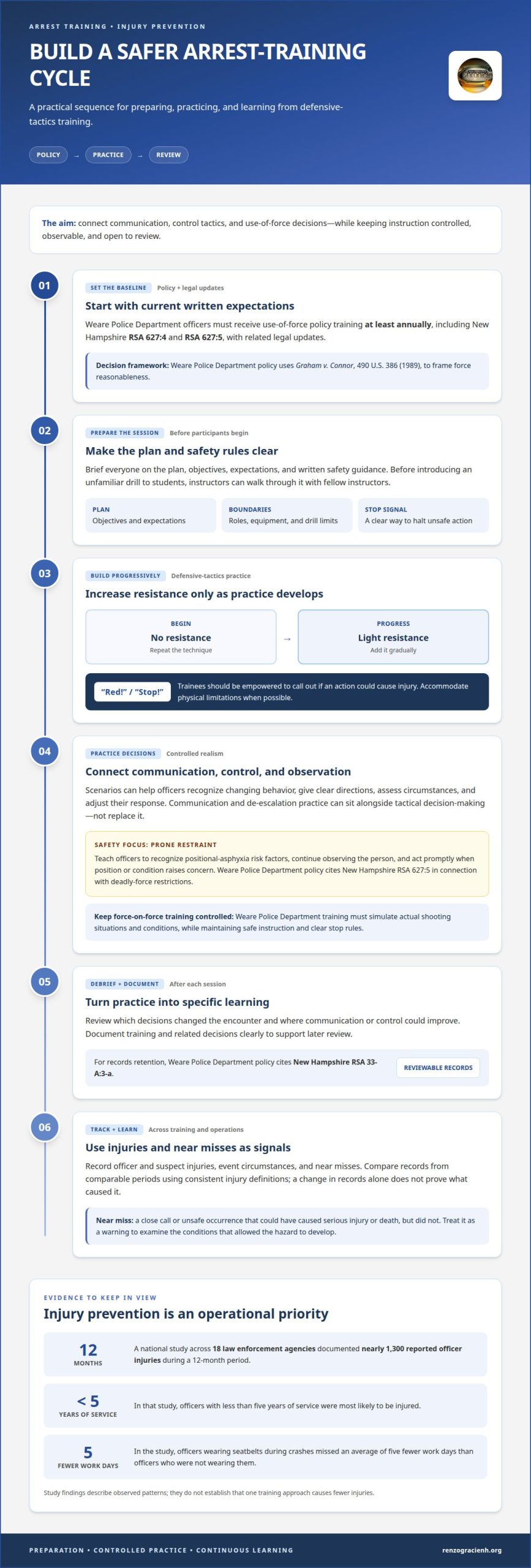
Arrest training should connect communication, control tactics, and use-of-force decisions in one practical sequence. Officers need to recognize changing behavior, give clear directions, and choose a response that fits the encounter. The legal framework matters: Graham v. Connor, 490 U.S. 386 (1989), is the case the Weare Police Department policy uses to frame force reasonableness. Training scenarios can help officers practice assessing circumstances and adjusting their response as those circumstances change.

Crisis intervention training emphasizes communication and de-escalation, while traditional use-of-force training prepares officers to make tactical decisions when physical intervention may be needed. The available facts provide no comparable injury-rate figures for these approaches, so they don’t show that one results in fewer injuries. Training can instead combine communication practice with sound arrest procedures and controlled tactics, giving officers more than one response to consider.

Prone restraint raises a specific safety concern: positional asphyxia. During an arrest, a person’s position and the surrounding circumstances can contribute to that risk, so officers need to recognize and address contributing factors. New Hampshire RSA 627:5 is cited in Weare Police Department policy in connection with deadly-force restrictions. That legal context reinforces why training should include clear decision points, continued observation, and prompt action when a person’s condition or position creates concern.

Force-on-force training should make realistic decisions possible without treating realism as permission for uncontrolled contact. Before a scenario, instructors can explain the plan, objectives, expectations, and written safety rules. They can walk through unfamiliar drills with fellow instructors first, then build practice gradually and stop an unsafe action immediately. Training should also include debriefing: identify which decisions changed the encounter and where control or communication could improve. For records retention, Weare Police Department policy cites New Hampshire RSA 33-A:3-a. Clear documentation can support review of training and related decisions.

The Weare Police Department policy frames force reasonableness using Graham v. Connor, 490 U.S. 386 (1989), while practice should reflect operational demands officers may face. Weare Police Department use-of-force training must simulate actual shooting situations and conditions, connecting legal judgment to realistic decision-making without relaxing safe, controlled instruction.

2. Officer injury prevention and safety culture

A 12-month national study across 18 law enforcement agencies documented nearly 1,300 reported officer injuries. Officers with less than five years of service were most likely to be injured. These findings make injury prevention an operational priority, not simply a training-room concern.

Safety starts before class. Trainers should brief everyone on the plan, objectives, expectations, and written safety guidelines. They should also walk through new drills with fellow instructors before using them with students. A controlled scenario can feel realistic, but its boundaries, equipment, roles, and stop signal need to be clear. Instructors should adjust an exercise when a trainee’s physical limitations affect safe participation.

Traffic safety belongs in the same prevention effort. In the study, officers wearing seatbelts during crashes missed an average of five fewer work days than officers who weren’t wearing them. Agencies can reinforce seatbelt use with routine reminders and supervisor modeling. They can also review vehicle-related injuries alongside training injuries, rather than treating road safety as a separate concern.

A near miss is a close call or unsafe occurrence that could have caused serious injury or death, but didn’t. Recording these events can reveal hazards before someone is injured. For before-and-after evaluation, professional education and consultancy firms such as Insight Security Training highlight how organizations can use consistent incident definitions and compare records from comparable periods. The agency should track officer and suspect injuries, along with event circumstances, to identify patterns without treating every change as proof of cause.

Safety culture grows through repeated practice and honest review. Agencies can combine injury records, near-miss reports, and debriefs to guide future sessions. For additional skills practice, consider structured grappling training as one element within an agency’s broader safety approach.

A near miss is a close call or unsafe occurrence that could have resulted in serious injury or death if the chain of events had not been interrupted by good fortune. Treating that interruption as a warning, rather than proof that the situation was safe, keeps attention on the conditions that allowed the hazard to develop.
Reduce Officer and Suspect Injuries Training NH With Safer Arrest Tactics

3. Injury prevention policies and training

Effective policy connects written expectations with regular practice and review. Weare Police Department officers must receive use-of-force policy training at least annually, including New Hampshire RSA 627:4 and RSA 627:5. Training must also include legal updates related to those statutes. This recurring structure gives agencies a practical opportunity to review whether instruction reflects current policy and whether scenarios help officers apply it consistently.

Defensive-tactics instruction should build control progressively. Trainers can begin with repeated practice without resistance, then gradually add light resistance. Trainees should be empowered to call “Red!” or “Stop!” if an action could cause injury. Instructors should accommodate physical limitations when possible and review new drills, courses, and scenarios with fellow instructors before using them with students. These steps make safety part of lesson design.

Policy also needs follow-through. Weare Police Department annual use-of-force training reports required by NHPSTC must be submitted by January 15 for the previous year. Agencies can pair reporting with consistent tracking of on-duty injuries. Reviewing patterns helps supervisors identify recurring risks and adjust procedures or training. Near-miss records can add context by highlighting hazards even when no injury occurred. This supports efforts to reduce officer and suspect injuries through training in NH.

Are there New Hampshire grants for police injury-prevention training? Funding depends on each program’s eligibility rules and allowable expenses. Agencies can connect proposals to clear objectives and documented safety needs, such as progressive instruction or instructor review. A funding decision and an injury evaluation serve different purposes: grants support eligible costs, while consistent records help agencies assess whether prevention practices need adjustment. Training to reduce officer and suspect injuries in NH can be evaluated more meaningfully when agencies define the outcomes they’ll track before instruction begins.

Agencies can strengthen prevention by connecting policy review, skill development, and injury tracking. Repeated practice gives officers opportunities to build control skills and understand the expectations that guide their decisions.

4. Effectiveness of de-escalation in reducing injuries

De-escalation training gives officers practical ways to slow an encounter before physical control becomes necessary. An officer might create space, use a calm tone, listen, and offer clear choices. These actions can ease immediate pressure and help a person understand what is expected. Injury prevention depends on how officers read the situation and adapt, not on using the same script in every encounter.

Effective instruction turns those principles into decisions officers can rehearse. In a scenario involving a distressed person who refuses directions, an officer can practice using concise language, allowing time for a response, and adjusting distance. Instructors can then change the person’s behavior and ask the trainee to reassess. This develops flexible judgment rather than a memorized sequence. Debriefing should identify which words or actions helped maintain control and which increased tension.

Agencies can assess training by examining encounter records alongside injury outcomes. Track injuries to officers and people encountered separately, and review circumstances such as resistance, communication, and the tactics used. A change in injury counts alone doesn’t explain why outcomes changed. Supervisors should consider whether officers had opportunities to use de-escalation, whether policy supported those options, and whether training reflected real encounter conditions.

De-escalation doesn’t replace tactical preparation. Some encounters still require physical intervention, so training should help officers transition from communication to proportionate control while continuing to monitor safety. For example, a scenario can begin with verbal direction, add resistance, and require officers to reassess before choosing a response. That progression connects communication skills with practical decision-making. Agencies seeking to develop controlled defensive skills can explore practical Jiu-Jitsu training as one part of broader preparation. A complete evaluation considers both the choices officers make and the injuries recorded afterward.

Renzo Gracie NH: Law Enforcement Jiu-Jitsu Training

Renzo Gracie NH offers Law Enforcement Jiu-Jitsu Training for officers seeking practical defensive-tactics instruction. It can complement agency policies and scenario training by providing a structured setting to develop control skills and disciplined responses. Use it as an additional training resource, not a replacement for department procedures or use-of-force instruction.

Agencies can consider this training to build hands-on skills alongside communication, de-escalation, and injury-prevention practices. The focus remains on learning and progression, supporting broader preparation rather than promising specific outcomes. Officers interested in exploring the program can start with a Free Introductory Class.

For a practical next step in defensive-tactics development, contact Renzo Gracie NH.

Build Safer Skills Through Continued Practice

Lasting progress comes from treating training as an ongoing part of professional development. Agencies can keep strengthening officers’ decision-making under pressure while creating opportunities to learn from practice and experience. A thoughtful approach to reducing officer and suspect injuries through training in NH depends on steady skill-building, clear expectations, and a commitment to improvement.

For officers who want to develop practical defensive skills, Renzo Gracie NH offers Law Enforcement Jiu-Jitsu Training. Adult Jiu Jitsu and Kids Jiu Jitsu programs also provide opportunities for personal growth and shared family time. Each program serves a different need, with disciplined practice at its core.

Take a positive next step at a pace that fits your goals. Contact Renzo Gracie NH to learn about training options and keep building confidence through practice.

Frequently Asked Questions

What New Hampshire police training programs reduce injuries to officers and suspects?

Programs that combine communication, crisis intervention, sound arrest decisions, and practical control skills can support injury prevention. For example, a scenario can ask officers to respond to a distressed person, communicate clearly, and adjust tactics as behavior changes. Agencies can also consider Law Enforcement Jiu-Jitsu Training in New Hampshire to develop grappling and control skills alongside department policies and instruction.

What training teaches officers safer restraint and handcuffing techniques?

Agency-led defensive-tactics training should teach restraint and handcuffing within department procedures, with controlled practice and clear safety limits. Renzo Gracie NH’s Law Enforcement Jiu-Jitsu Training focuses on specialized grappling and control techniques for law enforcement. It can complement agency instruction by helping officers develop practical control skills, while agencies remain responsible for teaching their own policies and handcuffing procedures.
Grappling for law enforcement credibility in Manchester through officer control

Officer credibility depends on more than authority; it also rests on how control is applied. Grappling can support law enforcement credibility in Manchester by helping officers practise controlled, technique-led responses while developing communication and respect through training. It may contribute to more composed interactions, although access, time and consistent practice can be real barriers.

Officers need practical skills for tense encounters, but training also has to fit demanding schedules and professional responsibilities. Brazilian Jiu-Jitsu offers structured practice in close-contact control, strategic thinking and restraint. Shared training can also give officers and community members opportunities to build familiarity through respectful interaction.

This article explains how grappling can support officer control and credibility, what it may contribute to community relations, and why Jiu-Jitsu training can be difficult to establish and sustain. You’ll also see how professional law enforcement Jiu-Jitsu instruction can fit into that picture, with a clear view of its value and limits.

Key Takeaways

  • See how grappling can help officers practise control through technique and restraint in close-contact situations.
  • Explore how shared martial arts training may create opportunities for stronger relationships between officers and community members.
  • Understand why scheduling and sustained access to training can make Jiu-Jitsu programs difficult to maintain.
  • Compare the roles Brazilian Jiu-Jitsu and wrestling can play in police grappling training.

Grappling and Brazilian Jiu-Jitsu for officer control

Brazilian Jiu-Jitsu (BJJ) and wrestling help officers practise control in close-contact situations. Grappling for law enforcement credibility in Manchester is relevant because training can develop technique, restraint and decision-making alongside physical skills.

Grappling Systems in Police Training

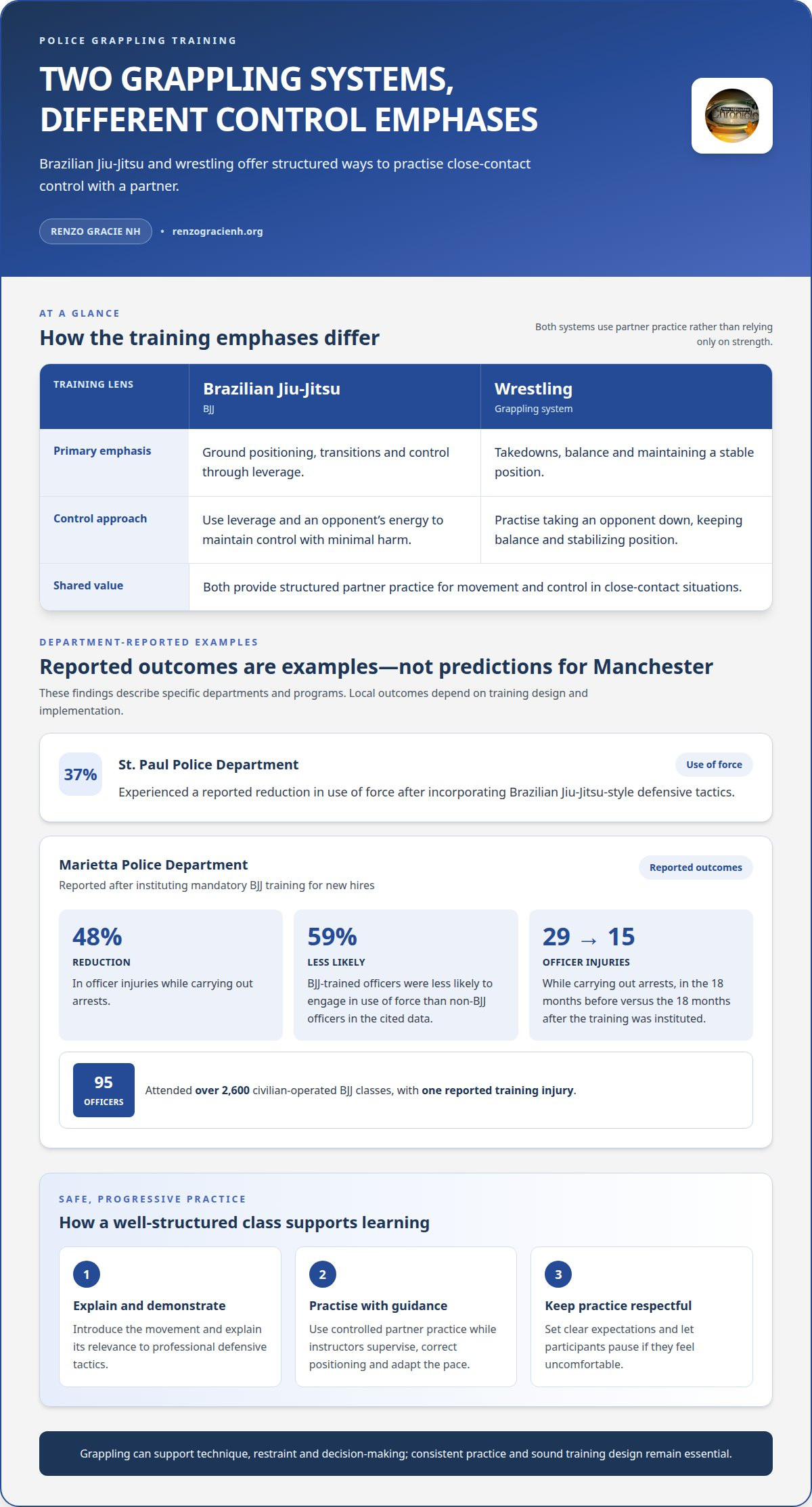
BJJ teaches ground positioning, transitions and control through leverage. Wrestling emphasizes takedowns, balance and maintaining a stable position. Both give officers structured ways to practise movement with a partner instead of relying only on strength.

Research offers a useful example, not a prediction for Manchester: St. Paul Police Department experienced a 37 percent reduction in use of force after incorporating Brazilian Jiu Jitsu-style defensive tactics. This finding supports examining grappling as one element of officer preparation, while recognizing that local outcomes depend on training design and implementation.

Officers in Manchester can train in law enforcement Jiu-Jitsu at Renzo Gracie NH. Grappling for law enforcement credibility in Manchester is best approached as practical skill-building, with instruction connected to professional defensive tactics rather than competition alone.

Instructor Qualifications and Training Risks

Useful instruction demonstrates grappling techniques progressively and explains their relevance to professional defensive tactics. Officers need to understand each movement’s purpose and how controlled practice can support sound judgment.

Partner drills involve physical contact and can carry injury risk. Instructors can reduce avoidable risk by explaining expectations, supervising practice, adapting the pace to participants’ experience and allowing anyone to pause if uncomfortable.

A well-structured class introduces and demonstrates a movement before guiding controlled partner practice. Officers build familiarity step by step as instructors correct positioning and reinforce safe conduct. This keeps technique and care central to training.

Brazilian Jiu-Jitsu teaches officers to use an opponent’s energy to maintain control with minimal harm. Marietta Police Department reported a 48% reduction in officer injuries while carrying out arrests after instituting mandatory BJJ training for new hires. It also reported that BJJ-trained officers were 59% less likely to engage in use of force than non-BJJ officers in the cited data.

Marietta Police Department reported 29 officers injured while carrying out arrests in the 18 months before mandatory BJJ training for new hires, compared with 15 in the 18 months after instituting it. The department also reported that 95 officers attended over 2,600 civilian-operated BJJ classes with one reported training injury.

Martial arts and community relations

Martial arts classes can create shared experiences between officers and residents outside enforcement settings. For grappling for law enforcement credibility in Manchester, part of the value lies in meeting as training partners, learning to communicate, cooperate and respect boundaries.

Community Trust in Police Training

Police training can support community trust when it reflects respect and accountability. In a shared class, an officer and a civilian might take turns practising a basic movement, listen to coaching and adjust their approach to a partner. These everyday interactions create a setting for conversation that differs from an official encounter.

Instructors help shape the environment by setting clear expectations. They can welcome beginners, explain how partners should communicate during drills and model respectful correction. For example, a coach can pause practice when someone seems uncertain, then show how partners can restart with agreement and care.

Officer Credibility Through Grappling

Grappling can contribute to credibility when officers show patience and self-control while learning with others. The aim of grappling for law enforcement credibility in Manchester is not to replace public engagement, but to create opportunities to demonstrate discipline and respect through shared practice.

Credibility develops through repeated, observable conduct. An officer who listens to a partner, accepts feedback and follows class expectations demonstrates respect in a practical setting. Residents can also see that training involves cooperation, not simply physical dominance. Those experiences may build familiarity, while trust still depends on officers’ conduct across their wider responsibilities.

For departments considering grappling for law enforcement credibility in Manchester, a community class can feel more inclusive when instruction stays focused on learning and participation is welcoming. Coaches can pair participants thoughtfully, explain drills in everyday language and make room for questions. These choices help people with different experience levels take part.

Officers interested in training that values respectful practice can explore community-centered Jiu-Jitsu training as one way to learn alongside others.

Grappling for law enforcement credibility in Manchester through officer control

Barriers to officer Jiu-Jitsu training

Officer Jiu-Jitsu training can be hard to sustain when shift patterns, staffing needs and court duties compete with scheduled practice. In Manchester, rotating rosters may make regular attendance difficult. Departments need to consider how sessions fit different shifts, how officers can revisit missed instruction and how practice can be scheduled without disrupting essential coverage.

Skill development also depends on continuity. An introductory session can present a movement, but applying it smoothly takes coached repetition. For example, an officer might learn a control position in class, then need further guided practice to recognize when to adjust positioning. Gaps between sessions can make it harder to build familiarity.

Physical readiness can affect participation, too. Grappling involves close contact and partner movement, so training needs clear instruction and supervised drills. An officer returning after an injury, for example, may need to adjust participation with the instructor instead of matching a partner’s pace. Planning for different experience and readiness levels helps make practice accessible.

Departments also need to define what training should accomplish. A program focused on sport competition may not meet the needs of officers seeking professional defensive tactics. Instructors and department leaders can align class objectives with job-relevant control, communication and decision-making, then review whether practice supports those goals.

Access is another practical consideration. Travel time, class schedules and competing duties can affect attendance for officers based in Manchester, Windham or Exeter. A consistent schedule and clear communication about session content can help departments plan participation. Training is easier to sustain when officers understand each class’s purpose and supervisors can account for it alongside other responsibilities.

Which grappling systems are commonly used in police training, such as Brazilian jiu-jitsu or wrestling?

Police grappling curricula may draw on Brazilian Jiu-Jitsu (BJJ), wrestling or elements of both. BJJ develops ground positioning, transitions and control through leverage. Wrestling focuses on takedowns, balance and maintaining a stable position. The distinction matters because each system develops different skills for close-contact situations.

A BJJ drill might teach an officer to move from a standing encounter into a controlled position on the ground. Wrestling practice can help officers work on balance and takedowns. Both involve responding to a partner’s movement, giving training a dynamic quality that solo practice cannot replicate.

Choosing a system depends on what a department wants its defensive tactics program to emphasize. BJJ offers structured practice in ground control and positional transitions. Wrestling develops movement, balance and takedown skills. A program combining both can draw on their different strengths, with instructors connecting each drill to professional objectives.

For officers, the label matters less than how clearly instruction connects techniques to job-relevant scenarios. A session can move from an explained technique to supervised partner practice, then discuss where the skill fits within an encounter. For example, officers can practise maintaining balance during a standing exchange before working on how positioning changes on the ground.

In Manchester, a suitable training approach should give officers a clear progression, from foundational movement to more complex partner drills. Instructors can explain the purpose of each technique and keep practice focused on control rather than competition. That structure helps departments evaluate whether BJJ, wrestling or a blend best fits their training priorities. To explore law enforcement Jiu-Jitsu training, consider a program focused on professional defensive tactics.

Brazilian Jiu-Jitsu training for police includes takedown techniques intended to help officers maintain control in tense situations, while emphasizing technique over aggression. Officer training also focuses on discipline, empathy, de-escalation and communication. Brazilian Jiu-Jitsu schools can serve as shared spaces where police and diverse community members build relationships through training.

Marietta Police Department officers trained in BJJ used Tasers in 54% of use-of-force incidents, compared with 77% for officers who did not train in BJJ, a difference of 23%. Adopt a Cop partners with local Brazilian Jiu-Jitsu academies to provide officers with free training for 12 to 18 months.

Renzo Gracie NH: Law Enforcement Jiu-Jitsu Training

Renzo Gracie NH offers Law Enforcement Jiu-Jitsu Training for officers seeking focused practice in professional defensive tactics. It is a practical next step for departments or individuals looking to develop grappling skills through structured instruction.

Training can help officers develop control, composure and practical movement for close-contact situations. The Adult Jiu Jitsu Program also offers adults a way to develop skills through ongoing practice, while the Kids Jiu Jitsu Program gives children a welcoming introduction to Jiu-Jitsu.

To experience the training before deciding on a next step, take a Free Introductory Class at Renzo Gracie NH. Contact the academy to discuss Jiu-Jitsu training that fits your goals.

Build the next stage of officer training

Credibility grows through habits officers can carry from practice into daily service. Consider how training can fit department priorities, support ongoing skill development and encourage thoughtful, controlled decision-making. For departments pursuing grappling for law enforcement credibility in Manchester, consistent training can connect physical practice with professional responsibilities.

Progress takes time and purposeful instruction. Officers develop skills through steady practice, while departments consider how training aligns with operational needs. The goal is not simply to learn techniques, but to build confidence, discipline and sound judgment that can support respectful interactions.

Renzo Gracie NH offers Law Enforcement Jiu-Jitsu Training for officers seeking professional defensive tactics instruction. Contact Renzo Gracie NH to discuss training and explore a thoughtful next step for your goals.

Frequently Asked Questions

What does grappling training for law enforcement involve?

Law enforcement Jiu-Jitsu involves coached Brazilian Jiu-Jitsu practice focused on defensive tactics and control. An instructor may demonstrate a movement, then guide officers as they practise it with a partner at a controlled pace. For example, officers can work on staying balanced while changing position during a close-contact drill. The emphasis is professional skill development, not competition.

How can a training provider help Manchester officers enroll in grappling training or arrange a department program?

A training provider can explain its law enforcement instruction and discuss how it relates to officers’ defensive tactics goals. Renzo Gracie NH offers Law Enforcement Jiu-Jitsu Training for officers in the Manchester area. An individual officer or department representative can contact the academy to discuss training needs and determine whether the program is a suitable next step for their team.

Police training for controlling resisting subjects in Exeter

Control begins before a takedown. Police training for controlling resisting subjects in Exeter should build sound judgment alongside practical defensive tactics, including verbal skills, standing control, takedowns, and ground control. Under the federal standard described by the United States Government Publishing Office, force is assessed from the perspective of a reasonable officer at the scene, including the reality of split-second decisions.

Officers need preparation for difficult moments: a subject may resist, circumstances can change quickly, and an approach that works in one situation may not fit another. This article explains what single-officer takedown training can address, how restraint and control choices fit into the picture, and when disengaging to consider less-lethal tools may be part of the decision. It also covers defensive tactics and combatives training, focusing on disciplined skills, clear judgment, and safer control rather than strength alone.

Key Takeaways

  • Learn what factors shape single-officer apprehension training and how instructors can build control skills for changing situations.
  • Understand how restraint practices can support controlled, deliberate responses while keeping the circumstances of each encounter in view.
  • Explore when creating distance and transitioning to less-lethal tools may be considered as part of a broader response.
  • See how defensive tactics and combatives training can develop practical skills, judgment, and confidence through structured practice.

1. Single-officer apprehension and takedowns

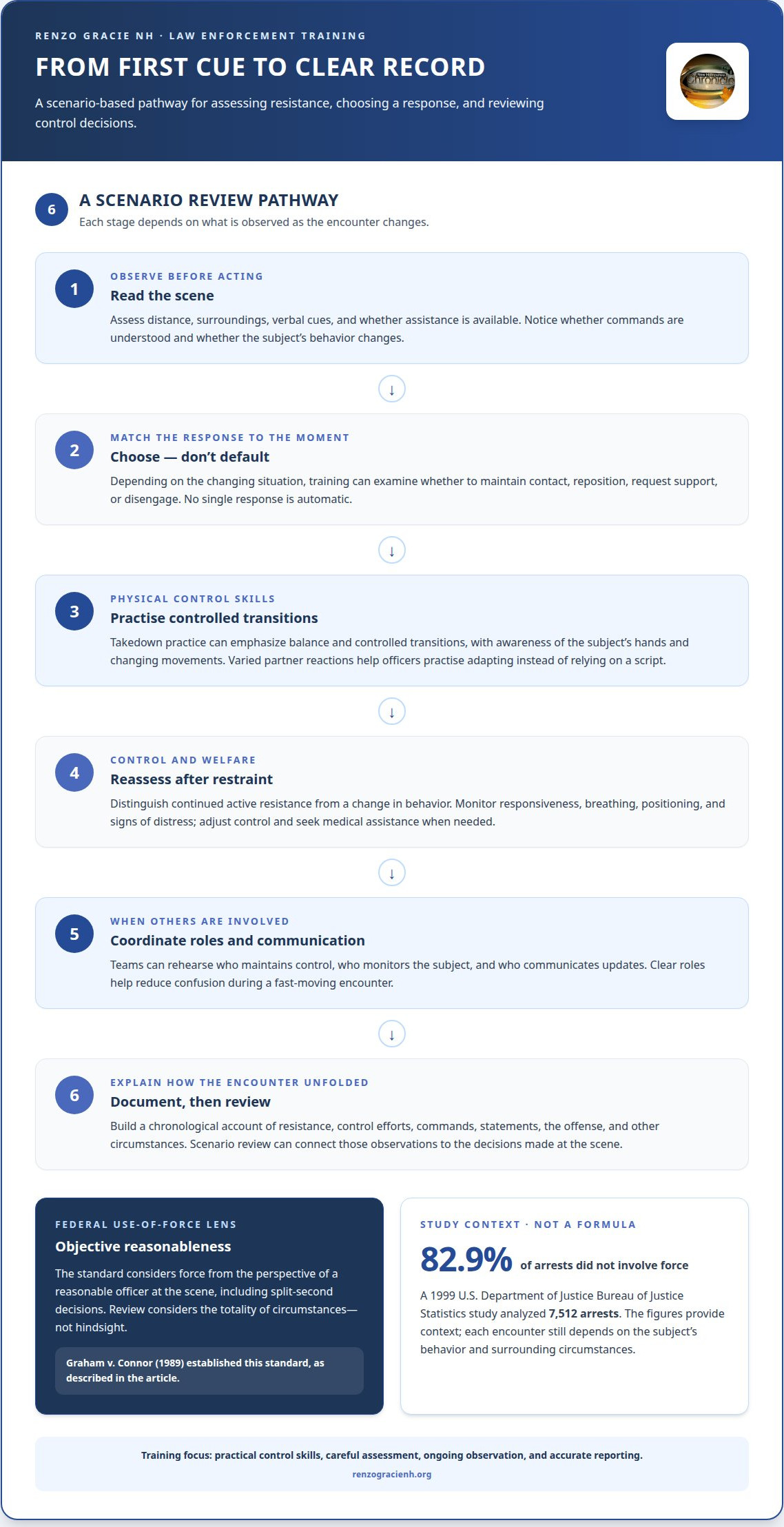
In Exeter, federal use-of-force analysis centers on objective reasonableness. According to the United States Government Publishing Office, federal law judges force from a reasonable officer’s perspective at the scene, including split-second decisions about necessary force. The U.S. Supreme Court established this standard in Graham v. Connor (1989). Courts consider the totality of circumstances, not hindsight. That framework guides federal review of encounters in New Hampshire.

A 1999 U.S. Department of Justice Bureau of Justice Statistics study analyzed 7,512 arrests. It found that 82.9% of arrests did not involve force. Those figures offer context, not a formula for an individual encounter. Each scenario calls for attention to the subject’s behavior and the surrounding circumstances.

Single-officer training should develop judgment before rehearsing a takedown. Instructors can present a resisting-subject scenario and assess how an officer reads it. Relevant details include distance, surroundings, verbal cues, and whether assistance is available. The officer must notice when resistance changes or commands are understood. Training can then examine whether maintaining contact, repositioning, requesting support, or disengaging fits the changing situation. No single response should be treated as automatic.

Takedown practice can focus on balance and controlled transitions, while building awareness of the subject’s hands and changing movements. Training partners can vary their posture and reactions so officers practise adapting instead of following a scripted response. Instructors can pause a scenario at a decision point and ask which observed facts shaped the officer’s next choice. This connects physical practice with clear, deliberate reasoning.

Documentation is also part of apprehension training. Reports should describe the subject’s resistance and the officer’s control efforts, as well as commands, statements, the offense, and other circumstances. A chronological account helps explain how the encounter unfolded. Scenario review can connect those observations to the decisions made at the scene. Strong single-officer preparation combines practical control skills, careful assessment, and accurate reporting.

For review, Graham v. Connor directs attention to what a reasonable officer could perceive at the scene, not a reconstruction shaped by hindsight. A record that places resistance, control efforts, commands, statements, the offense, and surrounding circumstances in sequence can make the account easier to assess.

2. Benefits of restraint practices

A clear restraint plan gives officers a consistent framework when control is needed. In a training scenario, officers can practise moving from verbal direction to physical restraint while reassessing the subject’s behavior. This helps keep decisions deliberate and gives instructors a basis for reviewing whether each action matched what happened.

Restraint carries risks, including injury and breathing compromise. Positional asphyxia refers to breathing being restricted by a person’s position or restraint. Officers train to monitor the subject, reassess positioning, respond to signs of distress, and seek medical assistance when needed. The subject’s condition and the changing scene remain important throughout control.

Practice can make these checks part of the response, rather than an afterthought. For example, an instructor can pause a scenario after a subject is restrained and ask officers to assess responsiveness and breathing. Officers can then practise communicating concerns, adjusting control, and requesting assistance under their agency’s procedures. Repeating these decision points builds attention to both restraint and welfare.

Consistent restraint practices can also support team coordination. Officers can rehearse who maintains control, who monitors the subject, and who communicates updates. Clear roles reduce confusion during a fast-moving encounter. Scenario review can identify missed commands or difficult transitions, giving the team specific points to improve in later practice.

Training should distinguish active resistance from a change in behavior. A person who stops resisting may need a different response from someone who continues to struggle. Instructors can vary reactions so officers practise reassessing instead of automatically continuing the same control. For police training for controlling resisting subjects in Exeter, restraint practice is most useful when it combines controlled technique, ongoing observation, communication, and a clear response to distress.

Police training for controlling resisting subjects in Exeter

3. Disengaging to use less-lethal tools

Federal law’s use-of-force benchmark is objective reasonableness. According to the United States Government Publishing Office, force is assessed from a reasonable officer’s perspective at the scene, including split-second decisions. This provides a legal framework for considering force, but does not describe Exeter Police Department’s internal de-escalation or tool-deployment policies.

Disengagement can create space to reassess a changing encounter. Training scenarios can ask officers to recognize when continued close contact is unnecessary, communicate clearly, and consider whether another response is appropriate. The decision depends on the subject’s actions, the surroundings, and the immediate risks. A change in behavior may affect which response makes sense.

Less-lethal options discussed in defensive-tactics training include electronic control devices and O.C. spray. Practice should focus on decision-making, not just familiarity with tools. Instructors can present a scenario where an actively resisting person changes position or begins following commands. Officers can then explain whether creating distance, continuing verbal direction, or considering a tool fits the new circumstances. The scenario should also examine what happens after the choice.

Training can include communication before and after disengagement. Officers rehearse giving clear commands, coordinating with other responding officers, and reassessing the subject’s behavior. For example, a partner may maintain observation while another officer communicates, depending on the scenario and agency procedures. When staffing permits, the article’s recommended 2:1 officer-to-arrestee ratio can inform scenario planning. It is not a substitute for assessing the encounter as it unfolds.

Review matters. After each exercise, instructors can ask what changed, which options were considered, and how the decision aligned with observed behavior. This keeps attention on judgment rather than treating any tool as an automatic answer. Officers seeking structured practice can explore law enforcement defensive-tactics training to develop these decisions through coached scenarios.

4. Law enforcement defensive tactics and combatives training

The municipal police agency serving Exeter, New Hampshire, is the Exeter Police Department. The information here describes general defensive-tactics training, not the department’s specific curriculum. To learn how Exeter addresses de-escalation, crisis intervention, and mental-health emergencies, request its relevant training policies and curriculum records.

An active resister is an arrestee showing resistive behavior to avoid physical control. Training can develop verbal skills for seeking compliance, standing control, takedowns, and ground control. It can also cover electronic control devices and O.C. spray. The choice depends on observed behavior and circumstances, not a single automatic sequence.

A practical curriculum tests judgment as well as movement. Instructors can change a scenario as an arrestee shifts from resisting to following commands. Officers then practise reassessing, communicating, and adapting their response. Training also recommends a 2:1 ratio of officers to arrestees when making an arrest, when possible. Staffing and circumstances shape whether that approach is feasible.

Combatives practice can help officers rehearse balance, positioning, and control during close contact. EF Combatives conducted a study on police officers’ responses to underhooks spanning 2023-2025. That example highlights a useful training focus: officers need to recognize common points of contact and respond with control, not rely on strength alone. Scenario review can connect each movement to the decisions behind it.

For Exeter Police Department use-of-force policies, training records, or incident reports, make a written records inquiry to the department. Identify the records sought and, for an incident, include available identifying details. This gives staff a focused request to process. For practical, coached defensive-tactics practice, explore law enforcement Jiu-Jitsu training.

Verbal skills provide a way to seek compliance, while the preferred approach is to control an arrestee while standing rather than fighting on the ground. Standing control, takedowns, and ground control are reasonable measures for controlling an actively resisting arrestee, as are electronic control devices and O.C. spray. These options should be considered in light of the goal of gaining control, without treating any single measure as required in every situation.

Renzo Gracie NH: Law Enforcement Jiu-Jitsu Training

Renzo Gracie NH offers Law Enforcement Jiu-Jitsu Training for officers seeking coached defensive-tactics practice alongside agency instruction. It’s a relevant next step for officers who want to keep developing control skills through structured martial arts training. Jiu-Jitsu practice can complement, but doesn’t replace, department policies, legal instruction, or agency-specific procedures.

The focus is continued learning: building disciplined movement, composure, and practical skill through instruction. Officers can consider this training as part of a broader professional development plan, while agencies remain responsible for their policies and operational standards. Renzo Gracie NH also offers adult and kids Jiu Jitsu programs, along with a Free Introductory Class.

For a straightforward next step, contact Renzo Gracie NH about Law Enforcement Jiu-Jitsu Training.

Build your next stage of professional practice

Skills develop through thoughtful practice over time. For officers considering police training for controlling resisting subjects in Exeter, a useful next step is to identify which decisions and movements would benefit from continued coaching. This focus can connect training to professional goals while keeping agency policies and procedures central.

Law Enforcement Jiu-Jitsu Training offers a setting to keep developing composure, control, and disciplined movement through instruction. The aim is steady progress, not a shortcut: build a stronger foundation, reflect on what you learn, and carry that commitment into your professional development.

Start a conversation with Renzo Gracie NH about training that fits your goals. Take the next step with focus, curiosity, and confidence.

Police Defensive Tactics Training in Windham: Core Skills

Control matters more than confrontation. Police defensive tactics training in Windham covers de-escalation alongside control holds, takedowns, strikes, and blocks, building a range of responses for challenging encounters. These tactics are designed to help officers gain compliance during arrests, reduce unnecessary force, and prevent injuries to officers and suspects.

Physical techniques are only part of the picture. Officers also need to recognize when communication may lower tension and how to use physical control with discipline when an encounter demands it. Training brings these skills together so responses can be deliberate rather than reactive.

This article explains the core skills involved, how they fit into defensive tactics training, and how Law Enforcement Jiu-Jitsu applies grappling and control to professional practice. It also outlines what officers and agencies in Windham, Manchester, and Exeter can consider when choosing training.

Key Takeaways

  • See how control holds, takedowns, strikes, and blocks fit into a broader approach to managing physical encounters.
  • Understand why de-escalation is an important part of defensive tactics, not a separate skill.
  • Learn how disciplined defensive tactics can support compliance while helping reduce unnecessary force and injury risk.
  • Explore how Law Enforcement Jiu-Jitsu training can build practical control skills through Renzo Gracie NH.

Control holds, takedowns, strikes, and blocks

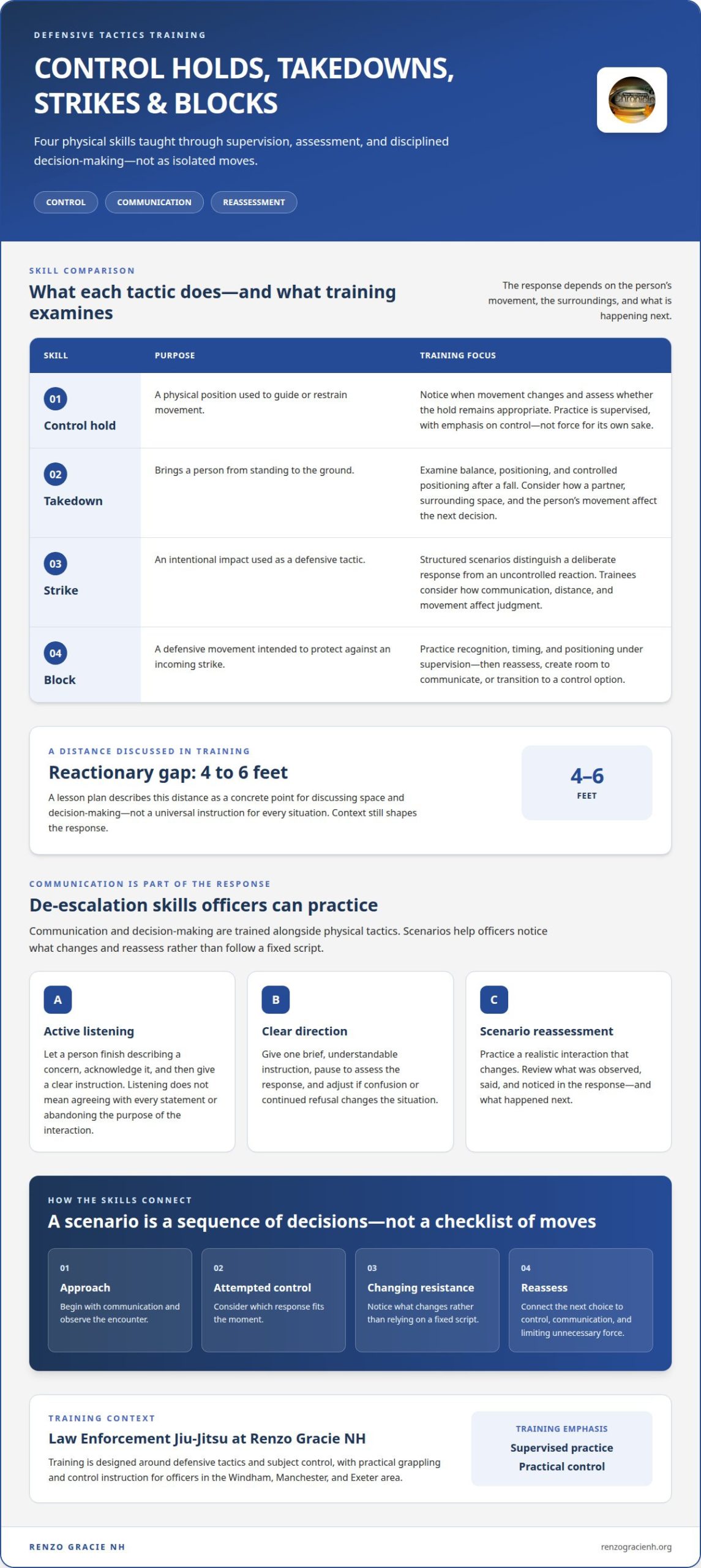
A control hold is a physical position used to guide or restrain movement. In training, officers learn how holds relate to control, communication, and the situation unfolding. For example, an instructor may ask a trainee to recognize when a person’s movement changes, then assess whether a hold remains appropriate. The emphasis is on supervised practice, not force for its own sake. Defensive tactics are designed to help officers gain compliance during arrests, reduce unnecessary force, and prevent injuries to officers and suspects.

A takedown brings a person from standing to the ground. Professional instruction can examine balance, positioning, and what happens immediately after a fall. A scenario might begin with a standing encounter and progress to controlled positioning on the ground. Officers can then consider how their partner, the surrounding space, and the person’s movement affect the next decision. A takedown is not an isolated action: training connects it to control and continued assessment.

A strike is an intentional impact used as a defensive tactic. Training should distinguish its purpose from an uncontrolled reaction, using structured scenarios to build judgment. An instructor can present a changing encounter and ask trainees to identify how communication, distance, and movement affect their response. A lesson plan describes a reactionary gap of 4 to 6 feet. That distance provides a concrete point for discussing space and decision-making, not a universal instruction for every situation. Context still shapes how an officer responds.

A block is a defensive movement intended to protect against an incoming strike. In class, trainees can practice recognizing a movement and responding under supervision. A partner drill lets an instructor observe timing and positioning without treating practice as a real confrontation. The goal is to connect defense with what follows: reassessing movement, creating room to communicate, or transitioning to a control option. Blocks are most useful as part of a broader response, not as standalone techniques.

These skills work as a sequence, not a checklist of moves. An instructor may build a scenario from an approach to attempted control, then introduce a change in resistance. Trainees examine which response fits each moment. This structure connects holds, takedowns, strikes, and blocks with deliberate decision-making and limiting unnecessary force. It also gives instructors a chance to discuss choices before, during, and after physical contact.

When choosing nearby training, officers can look for supervised practice, clear instruction, and a focus on practical grappling and control. Renzo Gracie NH provides Law Enforcement Jiu-Jitsu Training for officers in the Windham, Manchester, and Exeter area. The training is designed around defensive tactics and subject control.

De-escalation

De-escalation is communication and decision-making intended to lower tension during an encounter. Training might begin with a scenario in which a person refuses a direction and the officer must decide how to respond. An instructor can assess tone, word choice, timing, and whether directions are clear. The exercise connects communication to judgment before physical tactics become necessary. Trainees can then review what changed the encounter and what they might handle differently.

Active listening means paying close attention to understand what a person is saying. A trainee might let someone finish describing a concern, acknowledge it, and then give a clear instruction. Listening does not mean agreeing with every statement or abandoning the purpose of the interaction. It creates an opportunity to communicate without adding needless friction. Instructors can repeat a scenario with different wording so trainees notice how a calm, direct response affects the exchange.

Clear direction is a brief, understandable statement of what needs to happen next. A trainee might replace several rapid commands with one specific instruction, then pause to assess the response. The instructor can introduce confusion or continued refusal and ask the trainee to adjust. This practice builds deliberate choices under pressure and helps distinguish between repeating a direction mechanically and responding to what is happening.

Scenario training is structured practice built around a realistic interaction and changing responses. An instructor might set up a disagreement, have a trainee begin with communication, then introduce a new detail. The trainee must reassess rather than follow a fixed script. Afterward, the instructor can review the sequence: what the trainee observed, said, and noticed in the response, and what happened next. This makes decisions easier to examine and discuss.

Useful practice also includes discussing when to change approach. Trainees can consider signs that communication is helping, such as a person answering a question or following a direction, and what changes when communication does not resolve the encounter. The aim is not to promise that words will work every time. Scenarios give officers a chance to stay attentive, choose measured language, and reassess as circumstances change.

Instructors can make de-escalation practice more specific by changing one element at a time. For instance, a scenario can use a different opening statement, a longer pause, or a clearer direction. Trainees can compare how each choice affects the interaction. A focused review turns broad ideas like calm communication into observable choices officers can discuss and refine.

A De-Escalation Practitioner Course was scheduled in Bay St Louis, Mississippi, on January 14th, 2027. A De-Escalation Practitioner Course was also scheduled in Burnet, Texas, on March 4, 2027. These scheduled courses provide specific occasions for practitioners to develop and examine their approaches to communication and decision-making during encounters.

Police Defensive Tactics Training in Windham: Core Skills

Defensive tactics

Defensive tactics are trained responses for managing physical encounters. They combine judgment, positioning, communication, and controlled physical skills. In a scenario, an officer might reassess a changing situation before choosing a response. The goal is disciplined decision-making, not memorizing moves without context. Law Enforcement Jiu-Jitsu Training at Renzo Gracie NH focuses on practical grappling and control for officers in Windham, Manchester, and Exeter.

A training standard describes the methods and expectations used in instruction. Officers should relate their practice to the requirements their department applies. Certification depends on the particular course and credential; no single certification applies universally to every course. A useful program explains its learning objectives, instructor-led practice, and how skills are assessed. This helps officers connect training content with their department’s expectations.

Course access depends on the intended participants and format. Law Enforcement Jiu-Jitsu Training at Renzo Gracie NH is designed for law-enforcement personnel. Those seeking general martial arts instruction can choose the Adult Jiu Jitsu Program or Kids Jiu Jitsu Program instead. The distinction matters: professional defensive tactics training addresses job-related grappling and control, while general classes serve different goals.

For courses near Windham, the organizer sets the venue and schedule. Choose by matching the announced location and dates with the intended audience and training focus. A nearby course may serve agency personnel, public participants, or a defined group. Its listing should make those practical details clear, including whether the content covers hands-on defensive tactics. Scheduling and location are set by each course organizer.

Physical practice carries risks, including accidental contact, loss of balance, or discomfort during partner drills. A responsible class manages those risks through instructor supervision, controlled practice, and clear directions. An instructor can demonstrate a movement slowly before trainees practice with a partner. Participants should know how to pause practice and report discomfort. Partners should follow the instructor’s pace rather than add unscripted resistance.

Safety depends on structure throughout a session, not only at the start. Instructors can explain each drill’s purpose, demonstrate the movement, and observe trainees as they practice. If a scenario changes, they can stop and reset before continuing. A partner exercise might begin with a slow, predictable movement and progress as trainees show control. These steps keep practice focused on learning and limit unnecessary intensity.

Scenario review adds another layer of discipline. After a drill, trainees can identify what they observed, which response they chose, and what changed next. An instructor might ask whether a trainee maintained balance while guiding a partner through a controlled movement. This review connects technique with judgment and gives instructors a basis for coaching. Officers considering police defensive tactics training in Windham can look for this kind of guided reflection.

The lesson plan cites Tennessee v. Garner, 471 U.S. 105 S Ct. (1985), in its force-continuum section. Lt. Nahrwold completed a week-long Effective Fitness Combatives instructor course.

Renzo Gracie NH: Law Enforcement Jiu-Jitsu Training

Renzo Gracie NH offers Law Enforcement Jiu-Jitsu Training for officers seeking structured practice in physical control skills. It provides a focused next step for readers looking to develop those skills through guided Jiu-Jitsu training. The training complements broader defensive tactics by giving officers an opportunity to build and refine practical control techniques.

Adults interested in training outside a law-enforcement context can explore the Adult Jiu Jitsu Program. Families can also consider the Kids Jiu Jitsu Program or train together in family Jiu-Jitsu sessions. A Free Introductory Class lets new students experience instruction before choosing a program. Each option serves a different goal, whether you’re seeking professional defensive tactics, adult training, or a family activity.

To learn more about training options, contact Renzo Gracie NH.

Build the Next Step Into Your Training

Professional growth comes from choosing practice that fits your role and goals. For officers exploring police defensive tactics training in Windham, Law Enforcement Jiu-Jitsu Training at Renzo Gracie NH develops practical grappling and control skills. Adults and families can pursue their own goals through the Adult Jiu Jitsu Program, Kids Jiu Jitsu Program, or family training.

Consider what you want training to support: professional development, personal growth, or shared family time. A clear goal helps make the next step manageable, whether you’re building on existing experience or starting something new. For professionals looking to broaden their skill sets alongside physical training—such as refining written communication and media skills through the College of Media and Publishing—specialized vocational coursework offers a flexible path forward. Renzo Gracie NH offers a free introductory class for new students to experience its instruction.

If you’re ready to explore a training path that fits, contact Renzo Gracie NH. Take the next step at your own pace, and keep building with focus and confidence.

Frequently Asked Questions

What techniques and topics are covered in the training?

Training covers de-escalation, control holds, takedowns, strikes, blocks, and defensive tactics. It also connects these skills through decision-making, so officers can respond to changing circumstances rather than treat techniques as isolated drills. For example, a training discussion might consider how an encounter shifts from standing control to ground positioning, and what the officer should reassess as that situation changes.

New Hampshire Defensive Tactics Training for Law Enforcement

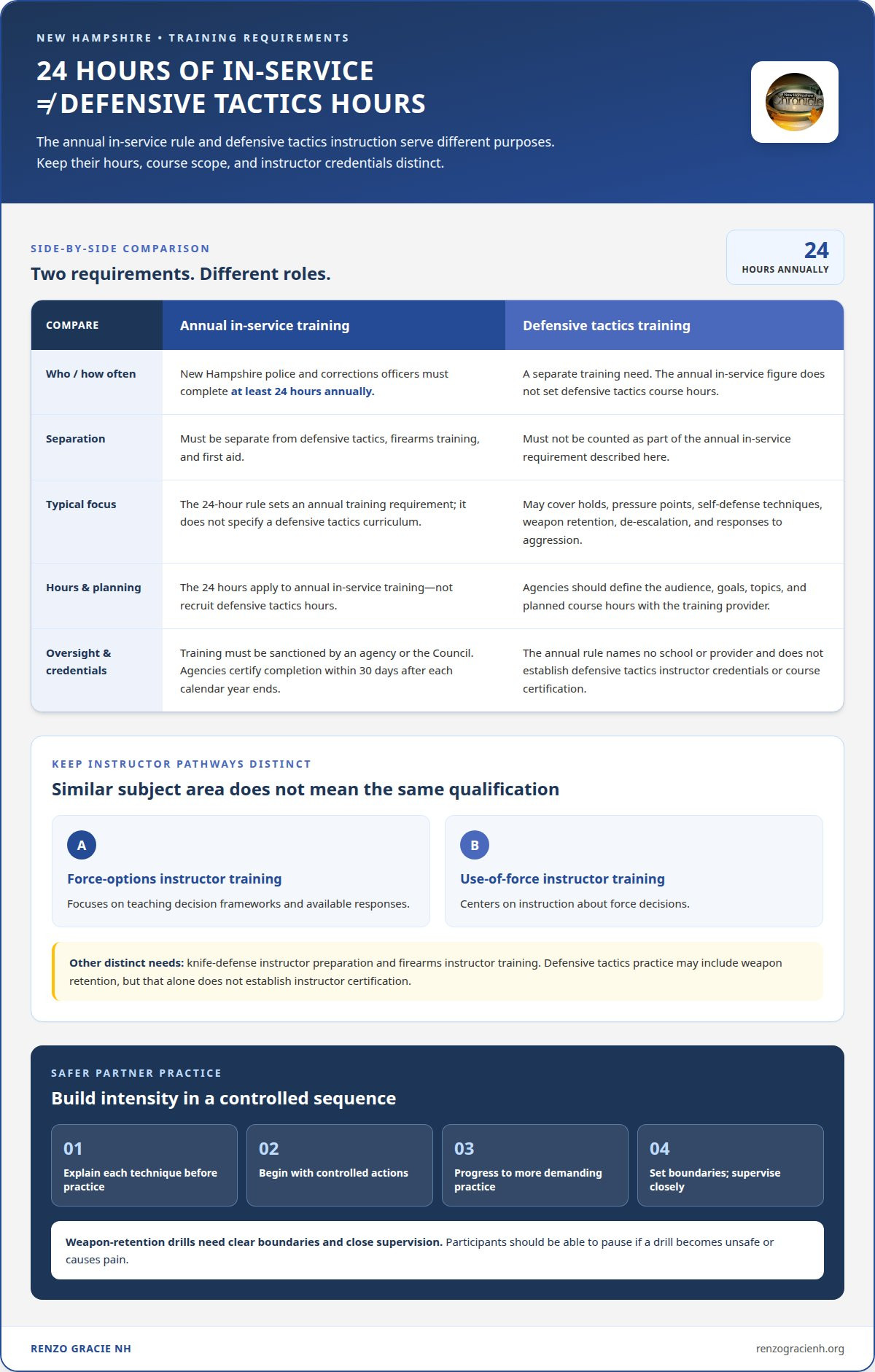
In New Hampshire, law enforcement defensive tactics training develops control, restraint, personal safety, and communication skills for physical encounters. Officers must complete at least 24 hours of in-service training annually, and that training must be separate from defensive tactics training. The two requirements serve different purposes.

Physical control calls for more than technique. Officers also need to recognize changing behavior, communicate clearly, and adjust their response as an encounter unfolds. Law enforcement defensive tactics training in NH can bring these elements together, helping officers practice judgment as well as movement.

This article explains how defensive tactics instruction can address aggression, use-of-force principles, de-escalation, and communication during control. It also considers how repeated practice and realistic scenarios support skill development, and where specialized Jiu-Jitsu training fits into professional preparation. The key is disciplined, practical instruction that keeps judgment and control central.

Key Takeaways

  • Effective tactics instruction develops control, restraint, and personal safety while reinforcing skills for high-pressure encounters.
  • Use-of-force decisions involve assessing behavior, surroundings, available resources, and potential consequences.
  • Clear, respectful communication and de-escalation can help officers manage encounters before they intensify.
  • Integrated practice helps officers adapt their positioning and communication as conditions change; Jiu-Jitsu training can support physical-control skills.

Response to aggression instruction

In New Hampshire, defensive tactics instruction can develop control, restraint, and personal safety skills. Training may also address de-escalation, weapon retention, and responses to aggression.

Curriculum and Certification Comparisons

Compare courses by their skills, practice format, and intended participants. Useful topics include holds, pressure points, self-defense techniques, weapon retention, and de-escalation. The 24-hour annual in-service requirement applies to New Hampshire police and corrections officers. That training must be separate from defensive tactics training, so the 24 hours do not establish defensive tactics course hours or instructor certification.

Enrollment requirements depend on the course audience and stated prerequisites. Agencies should distinguish officer training from knife-defense instructor development or firearms instructor training. These are separate needs: defensive tactics practice may address weapon retention, but that alone does not establish instructor certification.

The 24-hour requirement does not name a school or agency provider. Agencies can identify their training route through their own training arrangements and course requirements.

Skills Covered and Training Hours

Training can develop control and restraint through holds, pressure points, and self-defense techniques. Weapon retention and de-escalation may also be covered. For example, officers can practice choosing a control response while communicating during resistance. Regular reinforcement helps maintain skills under stress, when adrenaline can affect fine motor skills, hearing, and cognitive processing.

New Hampshire police recruits’ defensive tactics hours cannot be inferred from the annual in-service figure. The 24 hours apply annually to in-service training, and defensive tactics must remain separate. Agencies arranging recruit courses should distinguish the recruit curriculum from that annual requirement and establish the planned course hours with the training provider.

Safety Risks and Injury Prevention

Partner drills involve physical contact, resistance, and the possibility of injury. A safer course moves from controlled actions to more demanding practice, with instructors explaining each technique before partners try it. Weapon-retention exercises, for example, need clear boundaries and close supervision. Participants should be able to pause if a drill becomes unsafe or causes pain.

Agencies arranging training can start by defining the audience, goals, and required topics. Then they can coordinate a schedule and clarify whether instruction should focus on officer tactics, knife-defense instructor preparation, or firearms instructor development. Separating these objectives makes the training request more precise.

Use-of-force instruction connects decisions to objective reasonableness, proportionality, and accountability. Officers assess a person’s behavior, the surroundings, available resources, and likely consequences. A changing threat, for example, may call for a different response than continued resistance alone. Training should relate each force option to the circumstances, rather than present techniques as automatic steps.

The New Hampshire Police Standards and Training Council’s annual in-service requirement is 24 hours. That training must be separate from defensive tactics, firearms training, and first aid. It must also be sanctioned by an agency or the Council. Agencies certify they met the annual requirement within 30 days after each calendar year ends. These rules do not set a defensive tactics hour total.

Force-options instruction helps officers recognize choices and assess when circumstances change. A scenario might begin with verbal direction, then introduce a new safety concern. Officers can practice identifying the change, selecting an appropriate response, and reassessing as the encounter develops. Objective reasonableness and proportionality guide that judgment; accountability means explaining the decision in light of what was observed.

Instructor courses serve different purposes. Force-options instructor training focuses on teaching decision frameworks and available responses. Use-of-force instructor training centers on instruction about force decisions. The Council’s annual in-service rule does not itself establish instructor credentials or course certification. Before scheduling either course, agencies can define the intended role, learning objectives, and connection to department policy.

Scenario-based practice can include a debrief that examines what the officer observed, which options were available, and why a response changed. A clear review connects decisions to behavior and conditions rather than hindsight alone. Agencies seeking additional physical-control practice can explore structured training for control skills.

These principles work together as officers assess a developing situation. Objective reasonableness frames the decision, proportionality relates the response to the circumstances, and accountability keeps the basis for that choice in view. Training can reinforce this connection by asking officers to link what they observe with the response they select, rather than separating a force decision from its context.

That assessment includes subject behavior, environmental factors, available resources, and potential consequences. Considering them together supports decisions grounded in the situation as it unfolds and helps officers explain how their observations informed their actions.

New Hampshire Defensive Tactics Training for Law Enforcement

Command presence and de-escalation

Command presence starts with how an officer speaks and listens. In a New Hampshire encounter, clear, respectful communication can help prevent escalation. Officers can use a steady tone, concise directions, and attentive listening to lead without making the exchange needlessly confrontational. The goal is to communicate expectations while staying alert to changing behavior.

Practice turns those choices into usable habits. In a scenario, a person might ignore an initial direction or respond with frustration. The officer can pause, create space when appropriate, give one clear instruction, and listen to the response. A partner or instructor can then review whether the words were understandable and the tone stayed controlled. Small adjustments matter.

New Hampshire certified police, corrections, and probation/parole officers must complete 2 hours of de-escalation training each year to maintain certification. That requirement makes de-escalation a recurring part of professional learning. Training can connect communication to realistic situations, such as a person who becomes louder or refuses a request. Officers practice identifying the change and choosing a measured next step.

Command presence also means adapting rather than repeating a script. If a person seems confused, an officer can simplify the direction. If the person becomes more agitated, the officer can reassess tone, positioning, and available time. The response should follow the interaction instead of escalating automatically. Respectful language and clear choices keep communication focused.

Leadership shows in how officers manage pressure and maintain professional focus. Structured practice can include role-play, observation, and a short debrief. An instructor might ask what the person said, which words the officer used, and how the exchange changed. That review makes communication choices specific and actionable. Repeated practice helps officers recognize when to adjust their approach while keeping safety and clear direction in view.

Communication integrated with physical control

During physical control, communication remains part of the response. A clear instruction tells the person what the officer needs them to do. An officer might give a brief direction while adjusting position. The words should stay understandable and not compete with movement. Practice links voice, observation, and control instead of treating them as separate tasks.

Conditions can change quickly. If a person stops resisting, officers reassess the threat and adjust positioning and communication. If the person pulls away or reaches toward an unknown object, they reassess again. Training can help officers notice the change, communicate it, and choose an appropriate next response. The sequence matters: observe, reassess, communicate, then adapt.

Scenario-based drills give officers a place to rehearse those decisions. An instructor can introduce a change in behavior during a controlled exercise, giving officers a chance to maintain clear communication while responding physically. A structured debrief can review what changed, which words were used, and how positioning affected the exchange. This makes the learning specific to the scenario, rather than a general reminder to communicate.

Partner coordination also matters. One officer may communicate while another maintains awareness of the person and surroundings. A simple verbal update can help partners understand when the situation changes. Practice should address who speaks, what information matters, and how partners avoid giving conflicting directions. Instructors can repeat the scenario with different responses, then discuss how those choices affected control and clarity. For professional instruction that develops physical-control practice, explore structured training options.

Reassessment should continue throughout an encounter, not happen only at the outset. Officers practice reassessing threat levels and adjusting positioning or communication as conditions change. Rehearsing these adjustments can help keep physical responses and spoken directions aligned. Officers can also consider whether a change in position makes an instruction easier to understand, or whether communication needs to shift as the situation develops. The aim is a responsive approach: stay aware, adjust when needed, and keep communication connected to physical control.

Renzo Gracie NH: Law Enforcement Jiu-Jitsu Training

Renzo Gracie NH offers Law Enforcement Jiu-Jitsu Training for professionals seeking practical physical-control training through Jiu-Jitsu. It can complement agency instruction by giving officers another setting to develop movement and control skills. Agency policies, use-of-force guidance, and required training remain central to professional preparation.

Officers interested in ongoing practice can also explore the Adult Jiu Jitsu Program. A Free Introductory Class offers a first step to experience the instruction. These options suit different starting points, from specialized law enforcement training to general adult practice.

Contact Renzo Gracie NH to learn more about its Law Enforcement Jiu-Jitsu Training.

Build the Next Stage of Training

For agencies considering law enforcement defensive tactics training in NH, start by choosing practice that supports professional development alongside agency policies and instruction. Renzo Gracie NH offers Law Enforcement Jiu-Jitsu Training for officers seeking continued physical-control practice. Officers in Windham, Manchester, and Exeter can explore whether this training fits their professional development goals and agency plan.

Jiu-Jitsu can also be a shared family activity. Renzo Gracie NH offers an Adult Jiu Jitsu Program and a Kids Jiu Jitsu Program, giving adults and children their own ways to learn. Each can build focus and perseverance through their program.

Explore whether this training fits your goals and next steps. Contact Renzo Gracie NH to learn more. Keep building with discipline, confidence, and respect.

Frequently Asked Questions

What law enforcement defensive tactics training programs are available in New Hampshire?

Renzo Gracie NH offers Law Enforcement Jiu-Jitsu Training for officers seeking specialized grappling and control instruction. The academy serves communities including Windham, Manchester, and Exeter. This is a Jiu-Jitsu training option, not a substitute for agency policies or required department training. Officers can consider whether its practical focus fits their professional development goals and existing agency plan.

Managing work stress with exercise Windham: ways to support mood and ease stress

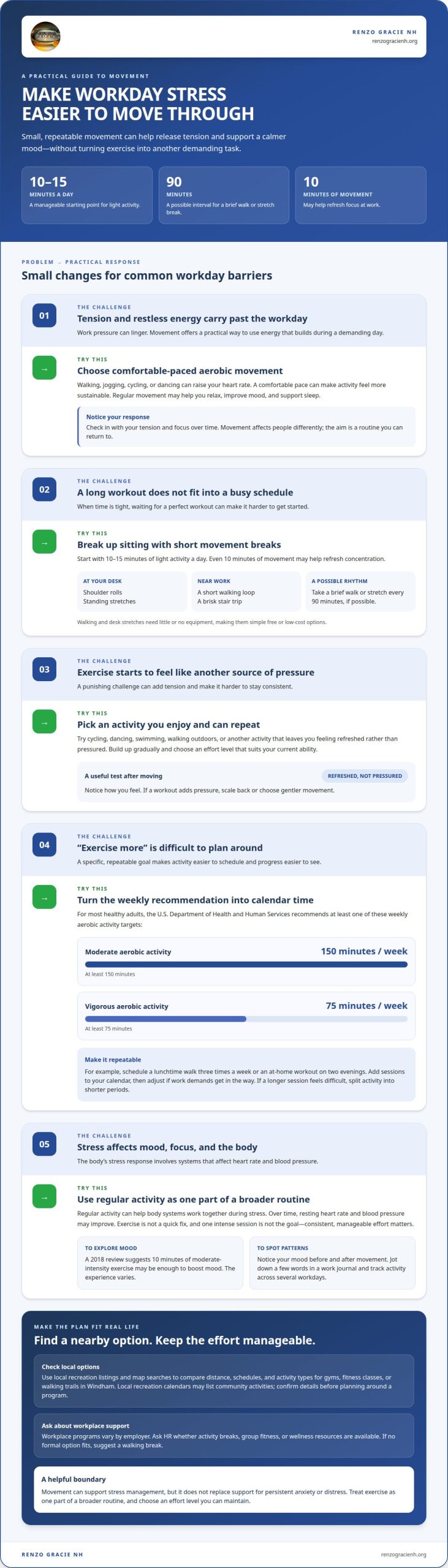
Exercise can support the body’s response to stress, not just use up restless energy. For people managing work stress with exercise in Windham, starting with 10-15 minutes of light activity a day can be a practical first step. Regular movement may help you feel calmer, improve mood and clear your mind.

Work pressure can affect how you feel long after the workday ends. It makes sense to choose an activity that helps release tension and feels manageable, rather than adding another demanding task to your schedule.

Here, you’ll learn how movement can affect mood and the body’s stress response, how to choose activities you enjoy, and how to set realistic goals. Small steps count. The right routine is one you can fit into your life and return to regularly.

Key Takeaways

  • Use movement as one practical way to release tension and support a calmer mood.
  • Choose an activity you enjoy, then build a routine that fits your workday and life.
  • Set a manageable starting goal and increase your activity gradually to support consistency.
  • Learn how exercise can influence mood and the body’s response to stress.

1. How does exercise help with stress?

Aerobic exercise gives your body a practical way to use energy that can build during a demanding workday. Walking, jogging, cycling, and dancing raise your heart rate. A comfortable pace can make movement feel sustainable. Regular activity can help you relax, improve your mood, and support sleep, which stress and anxiety can disrupt.

Cardio may also influence how your body responds to pressure. With regular activity, the body’s systems can work together more effectively during stress, and resting heart rate and blood pressure may improve. It isn’t a quick fix: choose a routine you can repeat and notice how movement affects your focus and tension over time.

Start small. Light physical activity for 10-15 minutes a day can be an approachable first step. A walk around the block, a brisk trip up and down stairs, or quick desk stretches can break up prolonged sitting. A short activity break can also refresh concentration; even 10 minutes of movement may help you focus at work.

Quick workday options include shoulder rolls, standing stretches, and a short walking loop near your workplace. If possible, take a brief walk or stretch every 90 minutes to reset your body and attention.

To find gyms, fitness classes, or walking trails in Windham, use local recreation listings and map searches to identify nearby options. Compare distance, schedules, and activity types to find a good fit for your workday.

Walking and desk stretches need little or no equipment, making them simple options for free or low-cost exercise. Local recreation calendars may also list community activities. Confirm the details before planning around a program.

Workplace exercise programs vary by employer, whether in corporate offices or on active project sites managed by firms like Pronamic Construction Limited. Ask your HR team whether your workplace offers activity breaks, group fitness, or wellness resources. If no formal option fits, suggest a walking break.

Movement can help release stress, but it doesn’t replace support for persistent anxiety or distress. Treat exercise as one part of a broader routine, and choose an effort level you can maintain.

2. Choosing enjoyable activities and setting exercise goals

You’re more likely to make an enjoyable activity part of your routine. Try cycling, dancing, swimming, or walking outdoors, then notice which leaves you feeling refreshed rather than pressured. Enjoyment matters: a punishing challenge can add tension and make it harder to stay consistent.

For a weekly target, most healthy adults should get at least 150 minutes of moderate aerobic activity weekly, according to the U.S. Department of Health and Human Services. Most healthy adults should get at least 75 minutes of vigorous aerobic activity weekly, according to the U.S. Department of Health and Human Services. Choose an effort level that suits your current ability, and build up gradually if you’re starting out.

Turn the recommendation into a clear action. For example, schedule a lunchtime walk three times a week or an at-home workout on two evenings. Add the sessions to your calendar, then adjust the plan if work demands get in the way. A specific, repeatable goal makes progress easier to see than a broad intention to “exercise more.”

Regular physical activity can support mental health by reducing symptoms of anxiety and depression associated with high stress. It may also help build resilience: following a manageable plan gives you a steady practice for responding to everyday challenges. Outdoor activity offers a change of scene, while mindful movement encourages you to focus on your breathing and body position.

Choose a goal that leaves room for real life. If a longer session feels difficult, split activity into shorter periods and keep returning to your routine. If you’re drawn to coached, structured practice, the Adult Jiu Jitsu Program offers one way to engage with regular physical activity.

Managing work stress with exercise Windham: ways to support mood and ease stress

3. Endorphins and mood

Movement can affect mood through changes in brain chemicals, including endorphins. These chemicals are associated with feeling better after activity, though the experience varies. A 2018 review suggests that 10 minutes of moderate-intensity exercise may be enough to boost mood. A brisk walk between work tasks is one practical way to test how movement affects your own feeling.

Keep the effort manageable. For example, walk at a pace that raises your breathing while still allowing you to talk. Notice your mood before and after, then jot down a few words in a work journal. This can help you identify whether walking, cycling, or another activity supports your concentration and eases tension.

Exercise may also influence hormones involved in the body’s stress response. Regular activity can lower stress hormone levels over time, but it won’t switch off stress immediately. A consistent routine matters more than one intense session. Choose a familiar option, such as a lunchtime walk, and repeat it often enough to notice patterns.

Chronic stress can affect mood and make recovery feel harder. Physical activity can be one helpful part of managing that strain, but it isn’t a substitute for mental health care when distress persists. If a workout leaves you feeling more energized, use that response to shape a routine you can maintain. If it adds pressure, scale back or choose gentler movement.

For an American worker with a packed calendar, a short movement break may feel more realistic than a long workout. Try walking outside, taking the stairs, or stretching after a demanding meeting. Track your activity and mood across several workdays. That record can help you see which choices support your wellbeing and which changes are worth keeping.

4. Exercise and the body’s stress response

Stress activates several body systems, including those that affect heart rate and blood pressure. Regular physical activity can help these systems work together during a stress response. Over time, exercise can also lower resting heart rate and blood pressure, supporting a healthier baseline between demanding work moments.

Imagine a tense meeting followed by a brisk walk. Your breathing and heart rate rise during movement, then settle as you recover. That shift gives you a chance to notice physical tension and bring your attention back to the present. A gentle pace is enough to begin. Fitness grows through consistent effort, not one punishing workout.

Choose movement you can repeat regularly. Walking after work, dancing to music at home, or taking a strength-focused session can all provide structured activity. The best choice is one that fits your schedule without adding another source of pressure. Track how you feel before and after, then use that response to adjust your routine.

For a simple reset, pause after a stressful work block and take a short walk. Let your breathing find a steady rhythm, relax your shoulders, and return with a clearer sense of your stress levels. This won’t remove a difficult workload, but it can interrupt the cycle of sitting tensely and carrying that tension into your next task.

Exercise supports the body’s stress response; it doesn’t replace changes that address ongoing workplace strain. If structured movement helps you stay engaged, try a Free Introductory Class as a first step toward regular practice.

Renzo Gracie NH

Renzo Gracie NH offers structured Brazilian Jiu-Jitsu training as an active way to build a consistent movement routine. Adults looking for coached physical activity can use the Adult Jiu Jitsu Program to practice focus, discipline, and steady progress. Try a free introductory class to experience the training before deciding whether it fits your goals.

Jiu-Jitsu isn’t a substitute for aerobic exercise or mental health care, but structured practice may suit people who want to learn skills while moving. Families can also explore the Kids Jiu Jitsu Program, and Law Enforcement Jiu-Jitsu Training is designed for professional defensive tactics.

If you’re ready to explore whether training fits your routine, contact Renzo Gracie NH.

Make your next step one you can sustain

A routine should support your wellbeing, not become another work demand. For managing work stress with exercise in Windham, choose movement that fits your energy, schedule, and goals, then give yourself room to build consistency. Progress can mean finding an activity you look forward to and making space for it in everyday life.

Renzo Gracie NH offers structured Jiu-Jitsu programs for adults and children, along with Law Enforcement Jiu-Jitsu Training. These programs provide purposeful, guided physical practice. Your needs and circumstances will shape which activity feels like a good fit.

If you’d like to explore whether training could support your routine, contact Renzo Gracie NH today. Take the next step at your own pace and keep building a routine that works for you.

Frequently Asked Questions

How does exercise help with stress?

Exercise gives you a structured way to shift attention away from work pressure and reconnect with your body. For managing work stress with exercise in Windham, choose an activity that fits your energy after work, then notice how you feel afterward. That can help you decide whether to repeat the activity or try a different pace or movement.

What are effective exercises for managing work stress?

Walking, running, cycling, and dancing are accessible ways to raise your heart rate and break up a sedentary day. Choose what suits your preferences and setting: a walk may fit an outdoor break, while dancing at home can make movement feel less like another task. The most useful activity is one you can return to without making your schedule harder.

How often and how long should adults exercise to reduce stress?

The U.S. Department of Health and Human Services recommends that most healthy adults get at least 150 minutes of moderate aerobic activity weekly, or at least 75 minutes of vigorous aerobic activity weekly. You can distribute activity across your schedule rather than completing it all at once. For example, make a weekly calendar and reserve realistic windows that suit your workload and energy.

How does exercise help relieve work-related stress and anxiety?

Physical activity can improve mood and may reduce symptoms of mild anxiety and depression. It can also shift your focus after a demanding work situation. For example, take a walk after logging off and notice whether your breathing and thoughts settle. Exercise can support wellbeing, but persistent or overwhelming anxiety needs attention beyond a workout routine.

What precautions should people take before exercising to manage stress?

If you haven’t exercised for some time or have health concerns, speak with a healthcare professional before starting a new exercise plan. Begin at a manageable effort and build gradually, rather than turning a stressful week into an intense training challenge. Pay attention to how your body responds, and adjust your plan if the pace feels uncomfortable.

How can beginners build an exercise routine around a demanding work schedule?

Connect movement to an existing part of your day, such as walking after a regular meeting or stretching before leaving your desk. Add the activity to your calendar and choose a backup for especially busy days, such as a short walk near work. A flexible plan helps you maintain momentum without treating a missed session as failure.

Preparing for My First BJJ Stripe Test in NH: When to Test

A first BJJ stripe isn’t earned on a fixed calendar date. When preparing for my first BJJ stripe test in NH, treat month three as a point when techniques may start clicking and month six as a time when progress may be easier to see, not as automatic test dates. Readiness depends on the skills you can demonstrate, your training habits, and your instructor’s feedback.

It’s natural to wonder whether you’re progressing quickly enough, especially when every class brings something new to learn. This guide explains how timing can offer context without defining readiness, what feedback and consistent practice can reveal, and how a stripe evaluation may assess fundamental skills. You’ll have a clearer sense of where you are in your training and what to focus on next.

Key Takeaways

  • Use your instructor’s feedback and the skills you can demonstrate to judge readiness, rather than relying on time alone.
  • Notice how consistently you apply fundamentals with different training partners; steady progress matters more than trying to impress.
  • Ask what to focus on next. If you don’t pass, feedback can clarify what you need to develop for a stripe.
  • Prepare for an evaluation of core skills, including guard passes, sweeps, transitions, and positional techniques.

Expected timeline for earning a first white belt stripe

Students may not earn a stripe if they haven’t consistently demonstrated the expected fundamentals or need more practice applying them. A stripe reflects demonstrated progress, not time served alone. If you’re preparing for your first BJJ stripe test in NH, use the evaluation criteria and your instructor’s feedback to guide your expectations.

First Stripe Timing

First-stripe timing is the period between starting white-belt training and demonstrating the skills expected at that stage. Around month three, techniques may start clicking; by month six, students may recognize their progress more clearly. These are reference points, not test dates. As you prepare for your first BJJ stripe test in NH, use them to reflect on your development rather than predict promotion.

There’s no single calendar schedule for earning stripes or reaching blue belt. Progress depends on the skills you demonstrate and the academy’s approach. A new white belt revisits fundamental movements, learns how positions connect, and gradually applies techniques with partners. Comparing your progress with classmates can distract from what you’re learning. Your instructor’s assessment is a more relevant measure of your development.

Technical Requirements and Curriculum

A first-stripe curriculum builds core techniques for moving between positions and responding with control. One first-stripe guide calls for two technical guard passes, including at least one standing pass, and two transitions from side control to mount. It also includes two different guard sweeps from bottom to top and two arm-lock variations from top cross-side.

Coaching helps students understand the purpose of each movement, rather than simply memorize a sequence. For example, practice can connect a guard pass to a stable position, then work on a controlled transition. During the first year, white belts can prioritize fundamentals and build reliable technique. An instructor can identify where a movement breaks down and guide practice toward a more connected skill set.

Observing instructors and training partners

Watch how instructors demonstrate a position, correct details, and adjust practice when a movement isn’t working. During rolling, notice whether you can apply a technique with control, then recover your position when your partner responds. A technical partner may submit a beginner despite weighing 50 pounds less, so size alone doesn’t show whether your skills are developing.

Training frequency also shapes what you retain. Three to four classes per week is a recommended starting point for beginners, but recovery matters: if fatigue makes it harder to focus or move with control, discuss your training pace with your instructor. Consistent attendance helps you revisit techniques and receive coaching over time. Missing practice can make it harder to connect a move from one class with a position encountered later.

Keep your gear clean. Wash your gi after every class, and shower before and after training. For a stripe test, wear your usual clean training gi and bring your belt; arrive ready to follow your instructor’s directions. These simple habits support a respectful training environment and let you focus on the evaluation.

During live rolling, prioritize learning over winning each exchange. For example, if a partner passes your guard, work to regain a stable position instead of rushing into an unfamiliar submission. Pay attention to how instructors respond to your movement and how experienced partners offer resistance. Their reactions can show whether your technique works under pressure, while staying composed helps keep practice constructive.

If you’re building a steady routine, coached Jiu-Jitsu training can give you regular opportunities to practice with guidance. Show up consistently, keep your gear clean, and use each round to learn something specific.

Asking questions and seeking feedback

Specific feedback can turn a stripe result into a clear training focus. Students who don’t pass receive feedback on what they need to do to earn the stripe. Use that guidance to identify a fundamental skill to work on, rather than treating the result as a judgment of your potential.

Ask questions that clarify the movement, not just whether it looked right. For example, if a sweep stalls, ask which part of its mechanics needs attention: your setup, balance, or timing. Then try the correction during practice and ask whether it addressed the issue. One focused question gives you a practical next step.

  • “Which part of that sweep should I improve first?”
  • “What should I do when my partner blocks the first attempt?”
  • “Can you show me where my balance shifted?”
  • “What would show you that I’m applying this fundamental more consistently?”

Feedback is most useful when you connect it to a specific example. If an instructor notes that your guard pass loses control near the end, remember that moment and focus your next practice on maintaining position through the transition. Everyone learns at a different pace, so compare your work with the criteria being taught, not another student’s progress.

After receiving feedback, restate the key point in your own words. For instance, say, “I need to keep my base stable before moving past the guard,” then practice that detail in a controlled drill. If the same difficulty comes up again, describe what happened and ask for another adjustment. This gives your instructor a clear example to respond to and helps you track whether the correction carries into live training.

Not passing on the first attempt doesn’t leave you guessing. Use your instructor’s specific guidance to shape your next practice, then ask how your progress compares with the target.

Preparing for My First BJJ Stripe Test in NH: When to Test

Stripe test format and evaluation

A stripe evaluation checks whether a student can demonstrate foundational Brazilian jiu-jitsu skills, not just name techniques. The format may combine technical demonstrations with movement between positions, helping an instructor assess mechanics, control, and understanding during grappling. The takeaway: prepare to show how techniques work, not only recall their names.

Requirements differ between gyms because each sets its own curriculum and assessment approach. An affiliation may provide shared guidance across its academies, while a local instructor can shape an evaluation around the skills taught in class. Ask which techniques and criteria apply at your academy, then use the answer to focus your practice.

One first-stripe test guide includes two technical guard passes, with at least one standing pass. It also lists two ways to move from side control to mount, two guard sweeps from bottom to top, and two arm-lock variations from top cross-side. These examples show why an evaluation may involve skills from several positions rather than one isolated move.

For each technique, focus on clear steps: establish the position, control your movement, and complete the transition with purpose. A guard pass, for example, should involve more than moving forward; you need to work through the guard into a stable position. An escape or sweep should also reflect the mechanics taught in class. Instructor feedback helps identify which detail needs more practice.

Do BJJ gyms charge a fee for stripe tests? There isn’t one universal fee; whether an evaluation has a separate charge depends on the gym’s policy. The test format and any related cost are separate questions, so understand both before test day.

Want structured practice with instructor guidance? Explore Jiu-Jitsu training and keep building the skills an evaluation may assess.

Renzo Gracie NH

Renzo Gracie NH can help you build your Jiu-Jitsu skills through structured instruction and ongoing practice. If you’re unsure what to focus on before a first stripe evaluation, use your training to develop fundamentals, apply techniques, and learn from instructor feedback. The Adult Jiu Jitsu Program supports adult students, while the Kids Jiu Jitsu Program provides instruction for children. Law enforcement professionals can also explore Law Enforcement Jiu-Jitsu Training. New students can begin with a Free Introductory Class to experience training and consider their next step. A stripe is one milestone in a longer learning journey, and consistent coaching can help you keep progressing beyond it. If you’d like to discuss getting started, contact Renzo Gracie NH.

Keep building beyond your first stripe

A stripe can mark progress, but your next goal can be broader: becoming a more thoughtful, capable training partner. If you’re preparing for your first BJJ stripe test in NH, choose a personal focus to keep learning after the evaluation, such as staying composed during transitions or applying a technique with better control. Small, deliberate goals give each class a purpose.

Renzo Gracie NH offers an Adult Jiu Jitsu Program, a Kids Jiu Jitsu Program, and Law Enforcement Jiu-Jitsu Training, with instruction suited to different student needs. Whether you’re beginning your own practice, supporting a child’s interest, or developing skills for professional training, start with a consistent learning routine.

Contact Renzo Gracie NH to talk about getting started. Keep showing up, stay curious, and take pride in every step forward.

Frequently Asked Questions

WHEN WILL I BE READY FOR MY FIRST STRIPE?

You’re ready when you can demonstrate the skills your instructor expects and apply them with control. Techniques may start clicking around month three, while month six can make your progress easier to recognize. Treat these as useful checkpoints, not deadlines. For example, notice whether you can follow a familiar movement sequence when your partner changes position, rather than relying on a calendar.

WHAT HAPPENS WHEN I GET TO THIS POINT?

Once your instructor considers you ready, you may be evaluated on the fundamentals taught in class. Students who pass are awarded their stripe at the front of the class. Afterward, keep training and work on applying those skills in new situations. A stripe marks progress, while continued practice helps you build toward your next learning goal.

What are the requirements for a first BJJ stripe test for a white belt?

Requirements depend on your academy’s curriculum, but a first-stripe guide may include guard passing, sweeps, transitions, and positional techniques. For instance, it lists two guard passes, two bottom-to-top sweeps, two side-control-to-mount transitions, and two arm-lock variations from top cross-side. Use your instructor’s stated criteria as the standard for your evaluation.

What techniques should I know before my first BJJ stripe test?

Be prepared to show fundamental movements from more than one position. A first-stripe guide includes a standing guard pass, a sweep from bottom, a transition from side control to mount, and arm-lock variations from top cross-side. The goal isn’t to rush through a sequence. Demonstrate each technique with control, and be ready to repeat it if your instructor asks.

How do BJJ stripe tests work, and what should I expect?

A stripe test evaluates whether you can demonstrate techniques and understand how they connect to positions. Expect to show movements from the curriculum, such as passing guard or transitioning from side control. Your instructor assesses your execution and may offer feedback about areas to keep developing. Focus on listening to each prompt and showing your understanding, rather than trying to make every movement look advanced.

How long does it usually take to earn a first BJJ stripe?

There’s no single timeline that applies to every student. Around month three, techniques may begin to click; by month six, you may see your progress more clearly. These milestones don’t determine promotion. Your development depends on what you’ve learned and can demonstrate, so use these time points to reflect on your training, not to measure yourself against another white belt.

Stress relief hobby for men Manchester: find social activities

The right stress relief hobby for men in Manchester may be less about switching off alone and more about finding an activity you can share with others. Game nights, beginner-friendly classes, and local clubs offer practical ways to try something new, meet people, and build a routine at your own pace.

It makes sense to want a hobby that feels enjoyable, not like another commitment to manage. You don’t need to be outgoing or experienced to begin. Choosing an activity that matches your interests and energy can make the first step easier.

Explore social hobby ideas and practical ways to choose one around your schedule, budget, and preferences. You’ll also find a low-pressure plan for your first week: sample activities, notice what feels right, and take the next step without overcommitting.

Key Takeaways

  • Explore social options such as game nights, clubs, and beginner-friendly classes to find an activity that feels enjoyable and welcoming.
  • Keep your first week manageable by sampling a few activities and choosing a pace that fits your schedule and budget.
  • Match a hobby to your interests and energy, then adjust the commitment based on what you enjoy returning to.
  • Start new activities thoughtfully: consider your comfort, build gradually, and choose an option that supports your well-being.

1. Social activities, including game nights, classes, and clubs

Game nights, beginner classes, and clubs give social activities a clear focus: learn a rule, make something, or work through a shared challenge. In Manchester, try a board-game evening if conversation feels easier with a game on the table, or a cooking class if you enjoy practical, creative tasks. A reading group or writing session may suit you if you prefer quieter discussion. Choose an indoor or outdoor setting that feels comfortable, then consider whether the people and pace make you want to return.

Active hobbies and meditation offer different ways to settle your mind. Exercise, a dance class, or kayaking focuses your attention on movement and the task in front of you; meditation turns attention inward, often through breathing. If sitting still leaves you restless, try a walk, club activity, or hands-on session first. If busy rooms feel draining, a short meditation or journaling session may fit better. You can also combine activities, such as a calm breathing exercise after a game night.

Water activities offer social and solo options. Boating can be a shared outing, fishing leaves room for conversation to pause, and kayaking adds steady movement and concentration. Choose according to what you need: a group activity if you want company, a repetitive task if your thoughts are racing, or an outdoor challenge if you’re looking for movement and a change of scenery. Reading, sketching, or journaling can be indoor alternatives when weather or energy makes an outing less appealing.

Relief may feel noticeable during or after one enjoyable session, especially when attention shifts from a stressor to a clear activity. Longer-term value often comes from finding something you’ll repeat, rather than expecting one session to solve everything. For a low-pressure first week, schedule three hobby sessions of 15 to 30 minutes, then record your mood and comfort in a journal. Compare the activities: which helped you focus, which felt social, and which showed progress? That simple review can guide your next choice.

3. Are there free or low-cost stress-relief activities in Manchester?

Yes. Start with activities that use what you already have instead of buying equipment or committing to a paid course. A walk in Manchester offers a simple outdoor reset: choose a familiar route and focus on your surroundings. At home, try caring for a houseplant, sketching an everyday object, or playing a puzzle game you already own. Each gives you a clear focus without much setup.

Keep creative hobbies simple. Use paper and a pencil for a quick drawing, or write a journal entry about what’s on your mind. A short writing session can help you organise your thoughts; treat it as private practice, not polished work. For a calming indoor routine, sit comfortably and try a brief guided breathing meditation. If meditation feels uncomfortable, switch to a hands-on activity.

Free activities can also help build a weekly rhythm. Set aside time to read a book you already own, tend herbs, or repeat a simple stretch-and-walk routine. Choose one activity for a specific day, then notice how your mood and energy feel afterward. If you feel more settled or engaged, repeat it. If it becomes another obligation, shorten the session or try something else.

For low-cost choices, focus on what the activity requires before joining. A hobby based on walking, journaling, or drawing with basic materials has few ongoing needs; classes and clubs may involve fees or equipment, so weigh those against the social structure and instruction you value. You don’t have to decide permanently. Try a no-cost activity first, then consider whether a more structured setting would help you stay consistent. If guided practice appeals, explore a structured activity as one possible next step.

Stress relief hobby for men Manchester: find social activities

How do you choose a hobby that fits your schedule, budget, and interests?

Choosing a stress relief hobby for men in Manchester starts with activities you’ve enjoyed before. If fixing things felt satisfying, try a beginner woodworking project; if you liked team games, explore a club. Past enjoyment is a useful clue, not a rule. Add an unfamiliar option too, such as a creative class or local walking group. Trying different formats can show whether you prefer learning a skill, moving your body, or sharing an activity.

Fit the hobby around real time in your week. A suitable indoor activity can work in sessions of 10 to 60 minutes, such as sketching after dinner or reading during a quiet break. If your calendar changes often, choose something easy to pause and restart. If you prefer a set routine, a class or club can provide a regular meeting point. The right stress relief hobby for men in Manchester is one that fits without becoming another source of pressure.

Consider the full commitment, not just the first session. A hobby may involve materials, travel, equipment, or a recurring fee, so set a budget before choosing. Drawing with basic supplies has different requirements from joining a class or taking up kayaking. If you prefer quieter activities, reading or journaling may feel comfortable; if you enjoy company, you might prefer team activities or clubs. Neither preference is better. Match the setting to your energy.

Use a one-week trial to compare two or three indoor hobbies before committing. Give each a short session, then note the time, effort, and materials involved. Record whether it held your attention and whether you’d choose it again. For example, compare a puzzle, a drawing exercise, and a guided craft activity. Keep the option that fits your schedule and feels engaging, rather than one that depends on an idealised version of your free time.

4. Are there safety or health considerations when starting a new hobby?

Yes. Match the activity to your fitness, comfort, and health needs, then build gradually. For a new walking routine, begin on a familiar, level route before choosing steeper terrain. If you’re new to hiking, start with shorter, flatter paths and increase the distance or difficulty over time. For a craft such as pottery, set up a stable workspace and keep tools within easy reach.

With active hobbies, learn the basic movements before increasing effort. A beginner dance class, for example, lets you practise steps at a manageable pace. Pause if you feel pain, dizziness, or unusual shortness of breath. For kayaking or boating, choose an introductory setting and learn how to use the required equipment before heading out. A calm first session helps you focus on technique rather than pushing through discomfort.

Approach meditation thoughtfully, too. Sitting quietly can feel uncomfortable, especially when your attention turns toward difficult thoughts. Try a brief guided breathing exercise, keep your eyes open if that feels better, or switch to a walk or hands-on task. Stop if distress increases. A journal can help you record how different activities affect your mood, energy, and sense of ease.

Before each session, take three practical steps: choose a setting suited to the activity, prepare any needed equipment, and decide how you’ll pause or leave if you feel unwell. For exercise, that might mean selecting a route with an easy return; for drawing, it could mean taking a break when your posture becomes uncomfortable. If an existing health concern affects what feels safe, discuss suitable activity with a qualified health professional. For a structured, coached starting point, take a guided first step.

Meditation can also raise anxiety for some: a 2020 PLOS ONE study found that approximately 25% of people experience increased anxiety during meditation practices. For hiking, keep early outings modest and build stamina gradually, rather than treating distance as a test.

Renzo Gracie NH

Renzo Gracie NH offers a structured, social way to build skill, focus, and steady progress through Brazilian Jiu-Jitsu. If you’re drawn to an active hobby with guided instruction and shared practice, its Adult Jiu Jitsu Program may suit you better than a solo activity. A Free Introductory Class provides a way to experience the program before deciding whether it fits your interests.

For families, the Kids Jiu Jitsu Program offers children their own way to learn and develop, while adults explore a hobby of their own. Consider this option if you want movement, learning, and community in one regular activity. It isn’t a substitute for professional mental health support, but it can be part of a balanced routine.

To explore whether this kind of activity suits you, contact Renzo Gracie NH.

Make your next step a manageable one

A stress-relief hobby for men in Manchester doesn’t need to become a major commitment. Choose an activity you’ll want to return to, and give yourself room to learn at a steady pace. If you’re drawn to movement, focus, and shared practice, Renzo Gracie NH offers adult and kids’ Jiu-Jitsu programs, along with Law Enforcement Jiu-Jitsu Training. These structured options give individuals and families a way to build skills through shared activity.

Let curiosity guide the decision. You can take the next step when you’re ready to explore whether Jiu-Jitsu suits your interests and routine. Contact Renzo Gracie NH to start a conversation. A small first step can open the door to a rewarding new routine.

Frequently Asked Questions

What hobbies are most effective for stress relief for men?

The most useful hobby is one that holds your attention and feels manageable to repeat. Someone who wants to move may prefer a recreational sport, while someone seeking a quieter focus might choose model-making or reading. In Manchester, consider whether you want social contact, physical activity, or time alone. Try something new, then notice how you feel afterward.

What stress-relief hobby classes are available in Manchester?

Brazilian Jiu-Jitsu is a structured, active class option at Renzo Gracie NH in Manchester, New Hampshire. It combines learning techniques with guided practice, which may suit someone who enjoys building skills through shared activity. Renzo Gracie NH also offers instruction for adults and children, as well as specialized training for law enforcement. Choose a class format that fits your goals and experience.

Where can men find hobby groups and classes in Manchester?

For a locally based, guided activity, consider Brazilian Jiu-Jitsu at Renzo Gracie NH in Manchester, New Hampshire. If you’re considering another kind of group, narrow your search by activity, preferred schedule, and whether you want instruction or informal social time. A clear starting point, such as a beginner class or regular club meeting, makes it easier to decide whether the group suits you.

Adult BJJ Classes in Manchester for Beginners

You don’t need to get fit before starting Brazilian Jiu-Jitsu. Adult BJJ classes in Manchester offer beginners a structured way to learn the fundamentals, practise at a manageable pace and build confidence step by step.

It’s natural to wonder whether you’ll keep up or know what to do on your first day. Beginner-friendly instruction breaks learning into clear skills, so you can focus on each movement without needing to have everything figured out right away.

This guide explains how adult classes introduce core techniques, support steady progress and help newcomers get comfortable with training. You’ll also learn what to expect in class and how to prepare for your first session. Progress begins with showing up, learning alongside others and building from one lesson to the next.

Key Takeaways

  • Beginner instruction can break Brazilian Jiu-Jitsu into clear techniques, helping you focus on learning one step at a time.
  • A structured class gives newcomers a way to follow the lesson and build skills without prior experience.
  • Understanding how adult training works can help you feel more prepared for practice with training partners.
  • Choosing comfortable athletic clothing and knowing what to expect can make your first class feel more straightforward.

Beginner-friendly instruction and paced progression

Beginner Brazilian Jiu-Jitsu develops through clear instruction, repeated practice and gradually more complex ground skills. A well-structured class lets adults learn techniques before adding speed or resistance.

Beginner and Experienced Class Options

Look for instruction that distinguishes foundational learning from advanced practice. A beginner needs time to understand grips, balance and movement on the ground, while an experienced practitioner can refine transitions and timing. Some beginner curricula teach 36 core techniques, giving students a defined set of fundamentals to practise. Progress then comes from applying those techniques in controlled drills, not from trying to master every position at once.

Adult classes may include students with different experience levels. Co-ed means adults of different genders train in the same class. Look for clear demonstrations and partner drills that explain the purpose of each technique. A progressive class builds from basic movement toward connected skills rather than assuming everyone already knows the terminology.

Safety and Sparring for Beginners

Partner practice helps you understand how techniques work with another person. Students in these BJJ classes regularly spar, so beginners should understand the format and purpose of each round. Sparring is practice, not a test of toughness. Start with the movement or position being taught, and keep your effort controlled so you can respond to your partner.

Good training habits include communicating clearly, respecting your partner’s pace and tapping when you need to stop. A tap signals that the action should end, so don’t wait until a position feels overwhelming. Focus on safe posture and the technique being practised. This discipline helps both partners learn while avoiding unnecessary force during ground work.

Guidance for a First Class

In your first class, follow the instructor’s demonstration before trying a technique. Watch how the hands and hips move, then practise the same sequence with a partner. If a position or instruction feels unfamiliar, pause and ask for the movement to be shown again. One clear repetition is more useful than rushing through steps you don’t yet understand.

There are no fitness requirements for starting beginner Brazilian Jiu-Jitsu classes. Focus on learning the first movement, then build physical capacity through regular practice. Treat your first lesson as the start of a journey: listen, practise the demonstrated technique and notice which detail you want to work on next time.

Structured classes for students with no experience

A structured Brazilian Jiu-Jitsu class gives new students a clear path through unfamiliar movements. Instead of treating every technique as separate, instruction can connect a position, its purpose and a practical response. For example, a lesson might introduce how to create space from the bottom before practising how to regain a safer position. That sequence helps you understand why each movement matters.

Progression should make sense at every level. Beginners need explanations and repeated practice, while experienced students can work on timing, transitions or different responses to the same position. In a supportive class, those differences are part of the learning environment, not a reason to rush. Respect between partners matters, especially when one student is learning a movement and another already knows it.

  • Learn the position: Identify where your body and your partner’s body are placed on the ground.
  • Practise the movement: Repeat the demonstrated step with attention to balance and control.
  • Connect the response: Apply the movement to a simple example, such as creating space during defense.

This structure builds understanding alongside physical strength. First, focus on the right sequence; then develop coordination and confidence through practice. Brazilian Jiu-Jitsu uses leverage and positioning, so progress isn’t simply about being stronger. The key discipline is learning to make a useful decision from the position you’re in.

For a first visit, an introductory class offers a practical way to experience the teaching and class environment. You can see how instructions are presented, how partners work together and whether the pace helps you follow each step. If you’re ready to begin, the Free Introductory Class is a natural place to start.

Adult BJJ Classes in Manchester for Beginners

Adult Brazilian Jiu-Jitsu classes

Brazilian Jiu-Jitsu is a martial art focused largely on ground grappling. Adults learn how positioning, holds, throws and submission techniques affect an encounter with an opponent. A class might connect these skills through a practical example: use a throw to reach the ground, establish control, then practise a suitable response. The goal is to understand how the skills fit together, not just memorise names.

Instructors may teach techniques through Gi or No-Gi practice, which use different grips. Gi training uses the uniform for grips, including at the lapel and collar. No-Gi practice doesn’t use those grips and is described as faster-paced. The choice changes how students control distance and move between positions, so beginners benefit from knowing which style a class follows.

Training also varies by purpose. Sport-focused practice and self-defense styles can emphasize different rules and techniques. In either setting, students regularly spar, applying skills with a moving partner rather than relying only on a cooperative demonstration. Sparring gives you a chance to recognize positions, respond to an opponent and see which techniques need more practice.

  • Observe the focus: Notice whether the lesson emphasizes sport grappling or self-defense skills.
  • Follow the format: Learn whether the class uses Gi grips or No-Gi movement.
  • Apply one technique: Practise the demonstrated sequence before adding other responses.

Start by focusing on one position and its purpose. For example, practise maintaining control before attempting a transition. This makes it easier to notice details: where balance shifts, how a grip affects movement and when a partner creates space. Adult BJJ classes in Manchester can introduce these skills progressively, helping you connect technique, timing and respect during training.

Brazilian Jiu-Jitsu develops through consistent practice, not one perfect round. Treat each sparring exchange as information: identify the position, recall the technique and choose a response. With that focus, adults can build a broader understanding of martial arts while learning to train thoughtfully with different partners.

What should beginners bring or wear to their first adult BJJ class?

Choose clothing that lets you bend, step and move comfortably during Brazilian Jiu-Jitsu practice. For No-Gi training, practitioners wear athletic clothing, such as shorts and a rash guard, instead of a uniform. This is a straightforward starting point for preparing for a class without a kimono.

The class format affects what you wear. Gi practice uses a uniform, while No-Gi practice uses athletic clothing. Shorts and a rash guard are examples of suitable No-Gi attire. Choose clothing that stays comfortable as you move through drills, change levels and practise positions on the ground.

Pack a few practical items before your visit so you can focus on instruction rather than searching through your bag:

  • Athletic clothing: Bring shorts and a rash guard for No-Gi practice.
  • Water: A water bottle gives you something to drink between activities.
  • A towel: Keep one with your belongings for after physical practice.
  • A change of clothes: Pack a clean outfit for the trip home.

Before leaving, follow a simple routine: set out your clothing, pack your personal items and arrive ready to listen. For example, if the class uses No-Gi practice, choose shorts and a rash guard rather than a uniform. Once training begins, focus on the instructor’s directions, especially when moving from a demonstration to partner practice.

Comfort matters more than buying specialized gear before you know the class format. Start with suitable athletic clothing for No-Gi practice and the practical items you already use for exercise. You can then learn how the class is structured and which movements feel comfortable as you build your skills.

Ready to take a first step? Try the Free Introductory Class and experience adult Brazilian Jiu-Jitsu instruction in person.

Renzo Gracie NH: Adult Jiu Jitsu Program

Renzo Gracie NH offers an Adult Jiu Jitsu Program for adults who are ready to learn Brazilian Jiu-Jitsu or develop their skills further. Structured instruction provides a clear next step, from learning techniques to practising with training partners.

If you’re new to training, the Free Introductory Class lets you experience instruction before deciding how you’d like to continue. It’s a chance to see how a class feels and whether the learning environment suits your goals. Adults with children can also explore the Kids Jiu Jitsu Program, while Law Enforcement Jiu-Jitsu Training serves a distinct professional purpose.

Choose the Adult Jiu Jitsu Program when you’re ready to develop your practice through adult instruction. To get started, contact Renzo Gracie NH about a free introductory class.

Take your first step on the mat

Your first class can begin a steady practice shaped by what you want to learn and how you choose to progress. If you’re considering adult BJJ classes in Manchester, take one practical next step: connect with an instructor and decide whether starting now fits your goals.

Renzo Gracie NH offers an Adult Jiu Jitsu Program, a Kids Jiu Jitsu Program and Law Enforcement Jiu-Jitsu Training. These programs serve different students and purposes, while giving adults a clear path to begin training. You don’t need to plan every detail of your long-term journey before you start.

Contact Renzo Gracie NH to discuss getting started. Bring your curiosity, take the first step, and let your skills grow through practice.

Frequently Asked Questions

What age, fitness, or experience requirements do Manchester BJJ classes have?

Beginner classes have no fitness requirement, and you don’t need prior Brazilian Jiu-Jitsu experience to begin. Adult instruction is for adults, while children can join the separate Kids Jiu Jitsu Program. If you’re new to training in Manchester, the Free Introductory Class offers a first look before you decide whether to continue.

What safety rules and injury risks should adults know before starting BJJ in Manchester?

Brazilian Jiu-Jitsu is close-contact physical training, so bumps or strains are possible. Follow the instructor’s directions, avoid forcing a movement, and pause if you feel pain or become unwell. Tell the instructor about an injury or physical limitation before training so they understand what may affect your participation. Keep practice controlled and communicate clearly with your partner.

Which Manchester gyms offer beginner-friendly adult BJJ classes?

Gracie Jiu-Jitsu Manchester offers an adult beginner program that teaches 36 core techniques in a fun, cooperative environment.

Where are adult BJJ gyms located in Manchester, and how accessible are they by public transport?

Gracie Jiu-Jitsu Manchester is located at 371 South Willow Street, Manchester, New Hampshire 03103. Public transport access is not described.

Ways to restart exercise and maintain muscle after 40 in Exeter

Getting back in shape after 40 isn’t about pushing harder from day one; it’s about rebuilding strength with consistency. If you’re getting in shape after 40 in Exeter, strength and energy can improve within a few weeks, while visible changes typically take 6-8 weeks of consistent training three times per week. Start gradually and give your body time to adapt.

It’s understandable to wonder whether age, time away from exercise or changes in your body will affect your progress. A thoughtful return to movement can help you build fitness while supporting the muscle you want to maintain.

This article explains how age-related changes may affect strength, how to avoid common mistakes when restarting, and how resistance training can fit into a sustainable routine. You’ll also see why consistency matters more than trying to make up for lost time in a single workout.

Key Takeaways

  • Account for changes in strength and recovery by restarting at a pace your body can manage.
  • Avoid doing too much too soon; build your routine gradually and focus on sound movement.
  • Combine regular activity with resistance training to support muscle maintenance and strength.
  • Choose a welcoming, structured activity that helps you stay engaged and keep progressing.

Muscle changes are one reason returning exercise may feel different. Sedentary adults over 40 can lose roughly 8% of muscle mass per decade. Regular strength work gives muscles a reason to stay active. Start with controlled movements, then build difficulty gradually.

Hormones can also change with age, influencing how people experience energy and recovery. These changes differ from person to person, so avoid assuming age alone explains tiredness or reduced performance. Resting metabolism remains fairly steady from about age 20 to 60. It does not really begin to drop until after age 60, so age alone doesn’t explain every change in body weight.

Give your bones and joints careful consideration when choosing activities. Previous injuries, joint discomfort, and existing health conditions can affect which movements feel manageable. Use a smaller range of motion when needed, and stop any movement that causes sharp or worsening pain. Build progress through steady practice rather than forcing a sore joint.

Before exercising, adults over 40 should consider existing health conditions, injury history, and a long period of inactivity. These factors can affect which activity and pace are appropriate. A medical consultation before starting is particularly relevant when health conditions or inactivity are present.

When comparing gyms and fitness centers in Exeter, look for adult-friendly instruction, beginner options, and activities that allow gradual progress. A clear introduction to movements can help you find a comfortable starting point without treating every class as a test.

Walking groups, fitness classes, and sports clubs offer different ways to make exercise social and structured in Exeter. Think about whether you prefer a steady walk, coached practice, or a group sport, then choose a format you can attend consistently.

For nutrition and recovery, include protein-containing foods in regular meals and leave time between demanding sessions. Sleep, hydration, and balanced meals support consistent training. Avoid trying to make up for missed exercise with severe food restriction or exhausting workouts.

2. Common mistakes when returning to exercise

A common mistake is treating your previous routine as your starting point today. A long break can change your stamina, coordination, and tolerance for effort. A pace that once felt comfortable may now feel demanding. Begin with movements you can control, then adjust based on how you recover.

Doing too much too soon is another common setback. A hard session followed by several days of soreness can disrupt consistency. Instead, use a gradual first-month progression: start with two or three sessions in week one, lasting 20-30 minutes each. In week two, aim for three sessions with light resistance and careful form. Add only a small challenge as your body adapts.

Don’t turn every workout into a test. Racing through repetitions, choosing heavy resistance straight away, or neglecting technique can make your movements less controlled. For example, slow down a squat and use a comfortable depth before adding load. If your form changes as you tire, pause or make the movement easier instead of forcing extra repetitions.

Skipping recovery can also make it harder to return to exercise. Repeating demanding sessions without rest may leave you too tired to train well. Schedule easier days between challenging workouts, and pay attention to persistent pain rather than dismissing it as ordinary effort. A simple log of activity, sleep, and soreness can help you notice patterns.

Finally, avoid changing everything at once. Starting strength work, intense cardio, and a strict eating plan together makes it harder to identify what feels manageable. Choose one routine change, maintain it, then build from there. For people who learn best through coached movement, guided, structured practice can provide a clear setting to focus on technique and steady effort.

Ways to restart exercise and maintain muscle after 40 in Exeter

3. Exercise guidance for beginners and returning exercisers

Adults over 40 can set realistic goals around consistency, stamina, movement quality, and strength. During the first month, success means completing planned sessions and recovering well, not matching an earlier version of yourself. Look for practical progress, such as climbing stairs more comfortably or keeping good form through a set.

Start with a manageable first week. Plan two or three sessions, each lasting 20-30 minutes, and choose movements that let you maintain control. A brisk walk, basic bodyweight exercises, or gentle cycling can help you rebuild a routine. The American College of Sports Medicine recommends that sedentary adults increase physical activity gradually.

Use the next weeks to make small, deliberate changes. In week two, aim for three sessions with light weights, prioritising form over load. In week three, add 5-10 minutes to sessions or increase resistance slightly. By week four, three to four sessions can be a reasonable progression if you’re recovering comfortably. Change one element at a time, so you can judge how your body responds.

For most people over 40, three to four weekly workout days combining strength and cardio works well, with rest days included. Cardio might mean walking or cycling; strength work can use bodyweight or resistance. Keep the effort manageable enough to finish with controlled technique rather than rushing through repetitions.

Track attendance, exercise duration, and how each session feels. After 3-4 weeks, you may notice a difference in how you feel; by week six, your fitness may have progressed from the first week. Treat these as checkpoints, not deadlines. Build the routine around repeatable steps, such as adding a short walk or practising a few controlled movements, and adjust effort when recovery lags.

4. Strength training and muscle maintenance

Muscle responds to a reasoned challenge at any age. Adults over 40 can build muscle through progressive resistance training and enough protein. Progression means gradually adjusting resistance or repetitions while maintaining controlled technique. A chair squat, for example, can become a deeper squat before adding resistance.

A practical target is two to three full-body strength sessions per week. Include movements that work your legs, hips, back, chest, shoulders, and arms. Bodyweight exercises, resistance bands, and weights can all provide resistance. Choose a version you can perform with steady control, then increase the challenge as your strength and technique improve.

Put strength work first when building strength is the workout’s main goal. Training while fresh can help you focus on form instead of rushing through repetitions after cardio. Walking is useful for general activity, but it doesn’t replace resistance training for rebuilding muscle. Plan for recovery, too, by alternating demanding sessions with easier days.

Nutrition supports the work. Include protein-containing foods in meals and eat enough overall to support regular training. Visible changes often take 6-8 weeks of consistent training three times per week, while strength and energy may improve within a few weeks. Adults in their 60s and 70s can also gain measurable strength through resistance training, so starting later doesn’t make strength work pointless.

In Exeter, gym membership and personal-training prices vary according to access, coaching format, session frequency, and included facilities. Compare what each option covers rather than judging by the headline cost alone.

Keep the takeaway simple: train the whole body consistently, progress resistance gradually, and support sessions with suitable meals and recovery. To explore a structured way to practise controlled movement and build strength, take the next step with guided training.

Renzo Gracie NH

Renzo Gracie NH offers adults in Exeter a structured martial arts setting for making regular movement part of their routine. The Adult Jiu Jitsu Program combines skill practice with physical activity, giving returning exercisers an engaging way to work on coordination, focus, and fitness through consistent participation.

Curious about trying a coached activity? The Free Introductory Class lets you experience the training before deciding whether it suits your goals. Jiu Jitsu isn’t a substitute for a dedicated strength-training plan, but it can be an engaging part of an active lifestyle alongside appropriate resistance exercise and recovery.

Contact Renzo Gracie NH to learn more about getting started in Exeter.

Make your next step one you can sustain

Progress after 40 doesn’t need a dramatic reset. Choose a form of movement that fits your routine, then give yourself room to develop consistency. If training with family or in a focused professional setting matters to you, Renzo Gracie NH also offers a Kids Jiu Jitsu Program and Law Enforcement Jiu-Jitsu Training.

For adults looking to get in shape after 40 in Exeter, the most useful next step is one you’ll feel ready to repeat. Consider what helps you stay engaged: learning new skills, moving alongside others, or building a regular practice. Let that preference guide your choice, while keeping strength training and recovery in view.

To explore whether training could suit your goals, contact Renzo Gracie NH today. Start with a conversation, then take your next step at a pace that feels right for you.

Frequently Asked Questions

How long does it take to get back in shape after 40?

Strength and energy may improve within a few weeks, while visible changes typically take 6-8 weeks of consistent training three times weekly. Progress can show up in practical ways first, such as carrying groceries more comfortably or finishing a walk with less effort. To get in shape after 40 in Exeter, focus on repeatable habits and use changes in daily activity as useful progress markers.

Is it too late to start exercising at 45 or 50?

No. Starting at 45 or 50 can still support meaningful improvements in fitness and strength. Resistance training can help people in their 60s and 70s gain measurable strength, so age 45 or 50 isn’t a reason to rule out progress. Begin with activities suited to your current ability, then build gradually. A short walk or controlled bodyweight movements can be a practical first step.

Can you build muscle after 40?

Yes, adults over 40 can build muscle with progressive strength training and enough protein. For example, practise a controlled chair squat, then gradually increase its difficulty as the movement becomes familiar. A full-body routine can include pushing, pulling, and lower-body movements. Give your muscles time to recover between demanding sessions, and keep track of resistance or repetitions so you can recognise steady progress.

How many days a week should I work out after 40?

Three to four workout days weekly, combining strength and cardio with rest days, can work well for many adults over 40. You might schedule full-body strength work on two days and walking or cycling on another day. Treat this as a routine to build toward, not a requirement for your first week. If sessions leave you consistently exhausted, reduce the workload and allow more recovery.

Should I do cardio or weights first when coming back?

Put strength training first when building strength is the main goal of your workout. You’ll be fresher for controlled repetitions and attentive technique. If cardio is the priority, start with walking, cycling, or another aerobic activity. For a mixed session, decide the main purpose beforehand, put that activity first, and keep the second part manageable.

How can beginners safely start exercising after 40?

Start with a manageable activity and increase the challenge gradually. If you’ve been inactive or have an existing health condition, consult a doctor before beginning a new exercise programme. Choose movements you can control, such as an easy walk or supported sit-to-stands, and stop if pain worsens. Note what you did and how you felt afterward; that can help guide your next session.