Trial Martial Arts Class in Manchester: What to Wear and Expect
Your first martial arts class calls for comfortable clothes, not a competition kit. For a trial martial arts class in Manchester, choose breathable workout gear that lets you move freely, and arrive ready to learn at your own pace.
It’s normal to wonder whether you’ll be expected to spar, what beginners do, or whether you need special equipment before stepping onto the mat. You don’t need martial arts experience to learn the basics and take part in a beginner-friendly first session.
This guide explains what to wear, how beginner training and sparring work, and what to expect when you arrive. You’ll also find practical guidance on Renzo Gracie NH’s Manchester classes, choosing a session, and registering for a free introductory class, so you can take the first step feeling prepared.
Key Takeaways
- Choose comfortable, breathable workout clothes that let you move freely, and learn what to bring before your first session.
- Understand how beginner instruction builds skills through cooperative practice and how sparring fits into training.
- Use the class schedule and registration steps to plan your trial visit in Manchester, New Hampshire.
- Explore how self-defense instruction develops practical skills through structured learning.
- Compare the trial options for children, teens, and adults to find a starting point that suits you or your family.
Cooperative beginner training and sparring policy
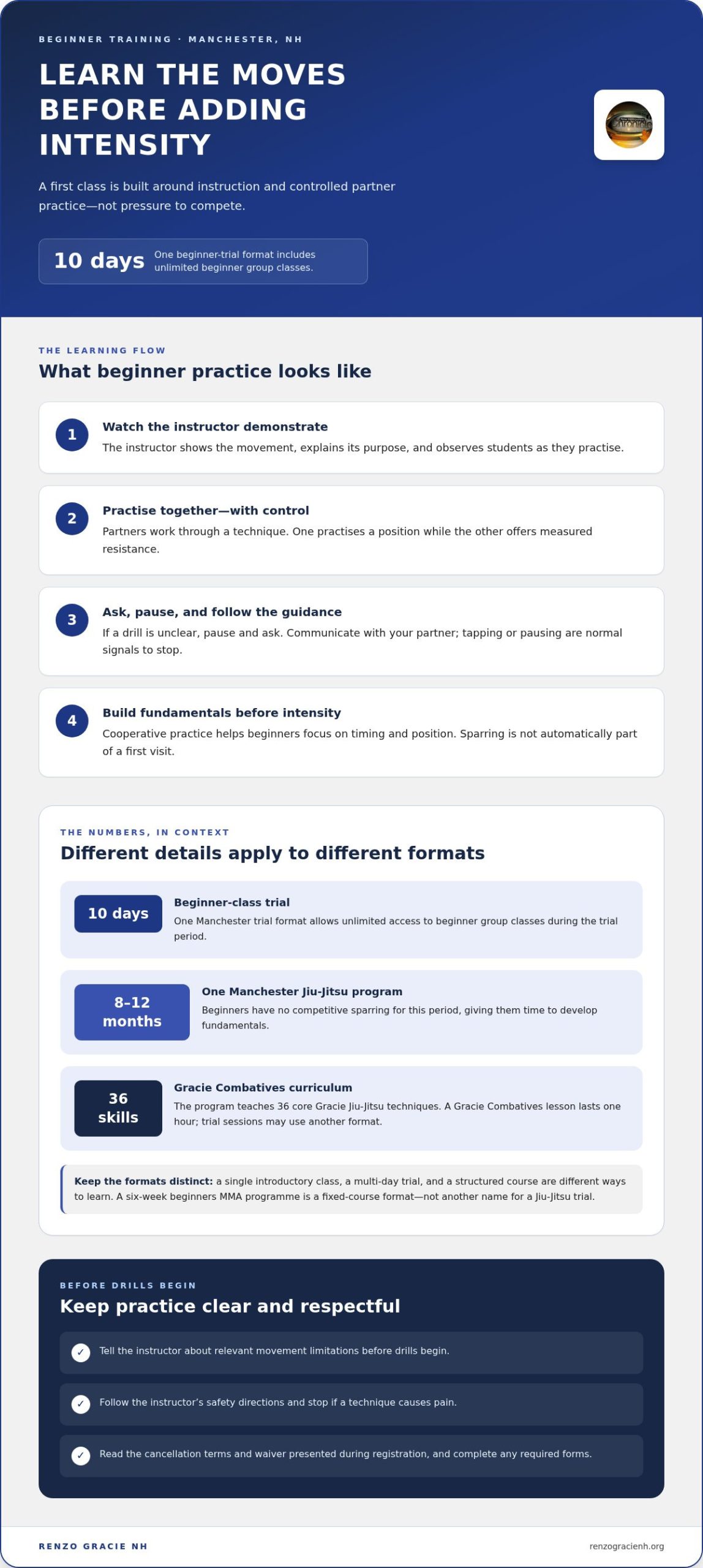
A first class should build useful skills through instruction and partner practice, not pressure to compete. In Manchester, one beginner-class trial format lasts 10 days and allows unlimited access to beginner group classes. That’s a trial period, not the length of one class. Use it to experience the teaching style and learn how students practise together.
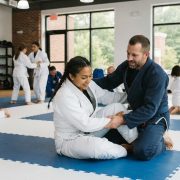
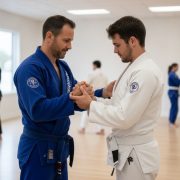
In cooperative training, partners practise a technique with control. One person might practise a position while the other offers measured resistance. The instructor demonstrates the movement, explains its purpose, and observes students as they practise. If a drill feels unclear, pause and ask for guidance. Respectful practice helps beginners focus on timing and position before adding intensity.
Sparring is not automatically part of a beginner’s first visit. At one Manchester Jiu-Jitsu program, beginners have no competitive sparring for 8-12 months. That gives students time to develop fundamentals before competition-style practice. Gracie Combatives teaches 36 core Gracie Jiu-Jitsu techniques; this shows how a beginner curriculum can organize learning around defined skills. A Gracie Combatives lesson lasts one hour, though a trial session may use another format.
What are the cancellation, waiver, and safety requirements for trial classes? Read the cancellation terms and waiver presented during registration, complete any required forms, and follow the instructor’s safety directions. Tell the instructor about relevant movement limitations before drills begin, and stop if a technique causes pain.
How long are trial classes, and what does a typical class include? A Gracie Combatives lesson lasts one hour, while trial sessions can differ. A beginner session may include a warm-up, a technique demonstration, guided partner drills, and time for questions.
A six-week beginners MMA programme is a fixed-course format, not another name for a Jiu-Jitsu trial. MMA can combine grappling with other fighting skills, while a Jiu-Jitsu class concentrates on its own curriculum. Before registering, identify whether you want a single introductory class, a multi-day trial, or a structured course. Those formats offer different ways to learn, so choose based on the practice you want to explore.
For a trial visit, arrive ready to listen, practise at a controlled pace, and communicate clearly with your partner. Ask how each drill should feel, follow the instructor’s demonstration, and treat tapping or pausing as normal signals to stop. A first class gives you a practical look at the training process without requiring competition experience.
Class schedule and registration
Start with the current schedule for the Manchester, New Hampshire academy you plan to visit. Check the class name, day, start time, and location. A beginner session may be listed separately from an open or advanced class. Choose a session that fits your routine and leaves time to arrive, change, and meet the instructor without rushing.
Compare the class description with your goal before registering. If you want to explore Brazilian Jiu-Jitsu, select a Jiu-Jitsu session rather than assuming every martial arts class teaches the same skills. Look for a beginner-friendly class. If several options fit, choose one you can attend consistently, rather than selecting only by its time.
Registration usually means providing basic details and selecting a class or introductory option. Read each field before submitting, especially the requested participant name, age group, and session choice. If registering a child, enter the child’s details where requested and have a parent or guardian available for arrival. Save the confirmation and note the class location.
Before you submit, use this quick preparation list:
- Choose: Select the class type and scheduled session that match your experience.
- Review: Read the registration instructions, waiver information, and cancellation terms presented during booking.
- Prepare: Set out comfortable training clothes and plan your route to the Manchester location.
These steps help prevent a common mix-up: arriving for the wrong class or overlooking a registration instruction. If the schedule separates beginner and experienced sessions, choose the beginner option. If it lists a free introductory class, select that option rather than registering for a regular class by mistake.
For a trial martial arts class in Manchester, treat the schedule as part of your preparation, not just a time slot. Read the details before booking, then check your confirmation for the selected session and arrival instructions. A structured registration process makes it easier to arrive ready to focus on learning. If you’re ready to begin, the Free Introductory Class is a starting point for experiencing guided training.
Manchester, New Hampshire training center location
Use Manchester, New Hampshire, when planning your first visit. Search results may also show places named Manchester elsewhere, so include the state in your map search. Compare the displayed street address with the address provided for your class. Matching the city and address helps prevent a trip to the wrong venue.
Before leaving, open the class details and identify the exact training location. Copy its street address into your navigation app rather than searching only for “martial arts” or “Jiu-Jitsu.” Broad searches may show multiple places. If the booking information names a building, entrance, or unit, include that detail in your route notes. A complete destination is more useful than a general business category.
Plan your trip around the route you’ll actually use. Drivers can review the map route and nearby streets before departure, while public transportation users can check the route and stop closest to the listed address. Either way, compare the final stop with the class location, then follow the walking directions to the correct entrance.
Manchester traffic can affect arrival time, so check your route shortly before setting out. Review the map’s current travel estimate and allow time for things it may not account for, such as finding the entrance or changing shoes. If someone else is driving, share the full address and class start time. Clear details make arrival easier to coordinate.
- Confirm the destination: Match Manchester, New Hampshire, and the full street address.
- Choose your route: Review driving, transit, or walking directions for the location.
- Plan arrival: Account for navigation, parking arrangements, and finding the entrance.
- Keep details handy: Save the address and class information on your phone.
For parents, students, or professionals arranging a visit, sharing the address early can simplify the day. Family members can use the same destination, while law enforcement professionals attending Jiu-Jitsu training can plan around work commitments. Use the training location, not a general mailing address, for navigation.
Once you reach the Manchester address, follow the entrance instructions in the class details. If the building has multiple doors, use the named entrance rather than assuming the first door leads to the training area. Saving the location, reviewing your route, and having the class information ready leaves your attention free to meet the instructor and begin.
Self-defense instruction
Brazilian Jiu-Jitsu self-defense instruction develops practical responses through coached movement and partner drills. A beginner might practise creating space, protecting their balance, or moving from the ground. The goal in class is to understand each step, not to test techniques in an uncontrolled situation. Clear demonstrations help students see where their hands, hips, and posture belong.
Gracie Combatives offers one example of a structured curriculum: it teaches 36 core Gracie Jiu-Jitsu techniques. A defined set of techniques gives beginners a learning path, rather than a collection of unrelated moves. In a lesson, an instructor can demonstrate a position, explain its purpose, and let students practise the sequence slowly. Repeating the steps helps connect the movement with its intended situation.
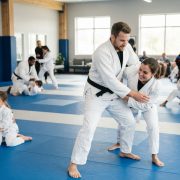
Pay attention to the problem each drill addresses. If a partner holds your wrist, for example, the instructor may show where to position your body before practising a response. Notice the starting position, direction of movement, and how the drill ends. Ask for another demonstration if a part feels confusing. Understanding the sequence matters more than moving quickly.
Good practice also involves communication. Partners can agree to move with control, pause when confused, and reset to the original position before trying again. If a drill begins with one person standing and another seated, for example, both should know when practice starts and stops. Following the instructor’s pace keeps the focus on technique and helps partners learn together.
During a trial class, notice how instruction moves from explanation to practice. Look for clear demonstrations, opportunities to ask questions, and corrections that clarify body position. If a technique includes several actions, break it into smaller steps: practise the first movement, reset, then add the next. This gives new students a manageable way to learn unfamiliar skills.
- Listen: Identify the situation the technique addresses.
- Watch: Follow the instructor’s demonstration from start to finish.
- Practise: Work through each movement at the pace directed.
- Review: Reset with your partner and repeat the sequence.
Self-defense training is a learning process, not a promise about how every real encounter will unfold. A class teaches movement and decision-making through structured practice, while students build familiarity over time. Focus first on remembering the position and sequence. As those details become clearer, ask how the same principle applies from another starting position.
Bring curiosity to the mat. In your first session, ask what a drill is designed to teach, then focus on one correction at a time. You’ll leave with a clearer picture of the curriculum and the skills you’d like to develop next.
Trial programs for kids, teens, and adults
Choose a trial based on the student’s age, experience, and reason for training. A child may want structured movement and a welcoming introduction to partner practice. A teenager may be curious about fitness, confidence, or martial arts. An adult may want practical skills or a new routine. These goals help families decide what to observe during a first visit.
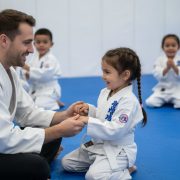
Age groups vary across martial arts programs. One children’s curriculum is designed for ages 3-12, illustrating how a program may define its intended range. Don’t assume that age band applies to every class. For a child, read the class description and note the age group it identifies. For a teen, look for instructions that distinguish youth sessions from adult training.
A trial helps families see how a class is taught, not just which techniques are covered. Watch how the instructor explains an exercise, organizes partner practice, and gives students time to follow directions. Notice whether a young beginner can understand the drill’s starting position before practising. Adults can look for clear demonstrations and a progression that makes unfamiliar movements easier to follow.
Before registering, compare the student’s needs with the session details. A parent might note a child’s previous martial arts experience and questions about class routines. A teen can identify whether they want to focus on fundamentals or general fitness. An adult can decide whether their main interest is self-defense, personal development, or consistent physical activity.
- For children: Check the intended age group and whether the class description suits a first-time student.
- For teens: Confirm that the session is intended for their age group and experience level.
- For adults: Choose a class aligned with the skills or training experience you want to explore.
Families attending together can prepare each participant individually. A child may need reassurance about where to wait and how partner drills work. A teen may want to understand the class structure before joining. An adult beginner can focus on listening to instructions and learning basic positions. Clear expectations help each person see whether the session matches their goals.
After the visit, discuss one useful observation rather than asking only whether the class felt easy. Ask which movement was new, how the instructor explained it, or what the student would like to practise again. Those answers help families compare their first impression with their goals and choose a suitable next step.
If you’re exploring Jiu-Jitsu as a family, find a class option for your age group and take the next step toward training together.
Renzo Gracie NH: Adult Jiu Jitsu Program
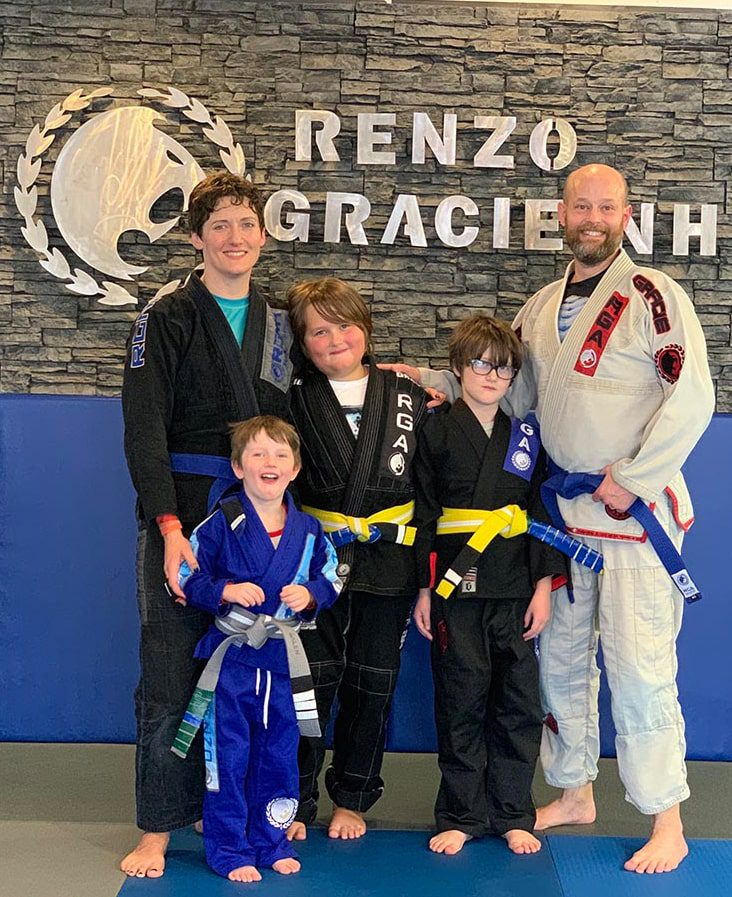
Renzo Gracie NH offers an Adult Jiu Jitsu Program for adults ready to build skills through structured training. After trying a class, consider this program if you want to continue learning Jiu-Jitsu and developing at a steady pace. Families can also explore the Kids Jiu Jitsu Program, while law enforcement professionals can learn about Law Enforcement Jiu-Jitsu Training.
A Free Introductory Class is a way to experience instruction before deciding on your next step. Think about what you want from training, such as learning fundamentals, practising with partners, or making Jiu-Jitsu part of your routine. That can help you choose the option that fits your goals.
For details or to arrange your next step, visit Renzo Gracie NH online.
Take Your Next Step on the Mat
Your first class doesn’t need to define your martial arts journey. Let it help you decide what you want to practise, what kind of instruction supports your learning, and whether you’d like to return. A trial martial arts class in Manchester can be a starting point for building confidence through steady effort, one skill at a time.
Renzo Gracie NH offers an Adult Jiu Jitsu Program and a Kids Jiu Jitsu Program for students ready to continue learning. Law enforcement professionals can explore Law Enforcement Jiu-Jitsu Training. These programs serve different goals, from family participation to professional defensive tactics.
Think about which direction fits you or your family, then take the next step when you’re ready. Contact Renzo Gracie NH about a trial and begin your training journey with focus, respect, and room to grow.
Frequently Asked Questions
What Should You Wear?
Wear secure clothing that lets you bend, turn, and practise movements on the mat. Leave jewelry and accessories at home so they don’t catch during partner drills. If your hair is long, tie it back before class. Choose comfortable clothes and bring a small bag to keep personal items together while you train.
Which martial arts schools in Manchester offer a free or trial class?
Renzo Gracie NH offers a Free Introductory Class for people beginning Brazilian Jiu-Jitsu. Its Manchester location is joined by academies in Windham and Exeter. Before comparing options, identify the martial art and class format you want. Renzo Gracie NH focuses on Jiu-Jitsu instruction, including adult and children’s programs, rather than offering every martial arts style.
How much does a trial martial arts class in Manchester cost?
Renzo Gracie NH’s Free Introductory Class lets you attend your first class at no cost. It’s a way to experience Jiu-Jitsu instruction before deciding whether ongoing training fits your goals. The free introductory class does not mean a continuing program is also free. Treat the trial and ongoing membership as separate decisions, and consider whether the instruction and training environment suit you.
What ages and skill levels are eligible for trial classes?
Renzo Gracie NH provides Jiu-Jitsu instruction for adults and children, with programs tailored to different ages and experience levels. No prior Jiu-Jitsu experience is needed to begin learning fundamentals. For a teen or child joining with a parent, select the appropriate youth or adult program during registration. This helps direct each student to a class suited to their stage of learning.
Do Manchester martial arts schools require booking or advance registration for a trial?
To visit Renzo Gracie NH, start by registering for the Free Introductory Class before travelling to a session. Registration connects your visit with the right class and gives you a chance to enter participant details carefully. Keep the selected session information handy for arrival. If booking for a child, make sure the registration details identify the child as the participant.
What should you wear and bring to a first martial arts class?
Choose secure, flexible clothing and pack water, a towel, and a change of shirt for after practice. Leave valuables and jewelry at home, and place your belongings in a small bag you can store neatly. You don’t need to buy a uniform to try a class. Follow the clothing instructions provided with registration, and arrive ready to listen and take part.
Are trial classes available for children, adults, or both?
Renzo Gracie NH’s Kids Jiu Jitsu Program and Adult Jiu Jitsu Program serve children and adults. Families can choose a suitable starting point for each participant rather than assuming everyone should join the same class. If you’re considering training together, explore family training. The academy also offers Law Enforcement Jiu-Jitsu Training for professionals seeking that instruction.
What martial arts styles can you try in Manchester?
You can try Brazilian Jiu-Jitsu, Gracie Jiu-Jitsu, MMA, and karate in Manchester.