Posts

Mother-Daughter Self-Defense in Manchester: Techniques and Practice

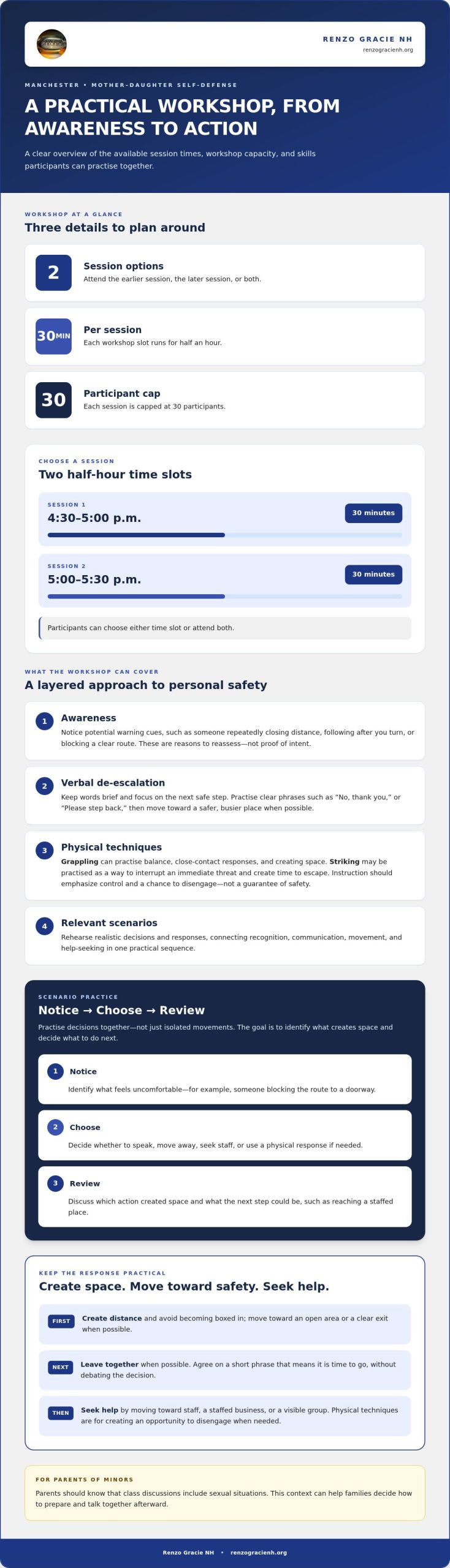
Practical preparation matters more than bravado. For mother-daughter self-defense in Manchester, participants can attend the 4:30 to 5 p.m. session, the 5 to 5:30 p.m. session, or both; each session is capped at 30 participants. Workshop instruction can include awareness, verbal de-escalation, physical techniques and scenarios relevant to participants.

It’s understandable to want more than a list of moves. Learning to notice potential risks, respond calmly, and practise practical actions together can help mothers and daughters build confidence at their own pace. Classes can support women of all ages, including beginners and those refreshing their skills.

This guide explains how threat recognition and de-escalation fit into personal safety, what physical techniques and scenario practice may involve, and what parents should know before a minor attends. It also covers how a supportive martial arts environment can help families develop focus and confidence through shared practice.

Key Takeaways

  • Build awareness by noticing potential risks early, then focus on creating distance, de-escalating when possible, and avoiding danger.
  • Practise physical responses as practical steps for situations where getting away or calming things down isn’t enough.
  • Use scenario exercises to rehearse decisions and responses in situations that feel relevant to you and your daughter.
  • Before a minor attends, know that class discussions include sexual situations; shared martial arts training can also offer an ongoing way to practise together.

Physical self-defense techniques

No single martial art is right for every mother and daughter. Look for instruction that combines physical responses with awareness, verbal de-escalation, and a clear opportunity to leave.

Grappling focuses on close contact, balance, and creating space. For example, a learner can practise maintaining a stable stance, using her arms to create distance, and moving toward an exit instead of staying engaged. In a supervised class, each person should be able to learn at a manageable pace and practise controlled movements with a partner.

Striking may be taught as a way to interrupt an immediate threat and create time to escape. For example, learners can practise a firm palm strike on a training pad, then step away and move toward safety. Instructor guidance matters: practise technique, distance, and control deliberately, without treating it as a contest or a guarantee of safety.

Escape Techniques

Escape practice should focus on breaking contact, creating space, and moving toward a safer place. For example, rehearse turning toward a clear exit after disengaging, rather than trying to control or pursue someone. When comparing instruction, look for repeated, supervised practice that connects a physical movement to a next step, such as leaving or calling for help.

Choosing a Martial Arts or Self-Defense Style

Choose based on what you want to practise together: grappling for close-contact situations, striking to create a chance to disengage, or a workshop that combines physical techniques with awareness and verbal de-escalation. The Manchester workshop covers strategies and tactics, psychological preparation, verbal de-escalation, physical techniques, and scenarios relevant to participants. Consider whether both learners can follow the instruction and practise comfortably at their own pace.

For mother-daughter self-defense in Manchester, the useful measure isn’t how many techniques a class demonstrates. It’s whether each person can remember a simple sequence: create space, move toward an exit, and seek help.

Recognizing and responding to potential threats

Threat recognition starts before physical contact. On a Manchester street or in a car park, notice if someone repeatedly closes the distance, follows after you turn, or blocks a clear route. These are cues to pause and reassess, not proof of intent. Identify exits, staffed places, nearby people, and whether your daughter is beside you. Agree on a simple phrase, such as “Let’s go now,” so you can leave together without a lengthy discussion.

If an interaction feels uncomfortable, keep your words brief and your attention on the next safe step. You might say, “No, thank you,” or “Please step back,” then move toward an open, busier place. Avoid getting drawn into an argument or explaining your decision. In practice, a mother and daughter can rehearse speaking clearly, turning away, and walking toward a chosen exit while staying together.

Distance and route choice matter. If someone approaches near a doorway, move toward an open area rather than letting yourself become boxed in. In a shop, approach staff; outdoors, head toward a visible group or staffed business. Keep your phone accessible, but don’t let looking at the screen distract you from your surroundings. Agree on a meeting point in advance in case you become separated.

The Manchester workshop covers recognizing, de-escalating, and avoiding dangerous situations, with physical self-defense when necessary. This puts physical responses in context: first notice a concern, then create distance or leave when possible. If someone blocks your path or makes contact, use the physical techniques taught in class to create an opportunity to disengage. Practise choices together, including when to speak, where to move, and how to seek help after reaching safety.
Mother-Daughter Self-Defense in Manchester: Techniques and Practice

Scenario-based practice

Scenario practice lets a mother and daughter rehearse decisions, not just isolated movements. The Manchester workshop includes scenarios relevant to participants, along with strategies, psychological preparation, verbal de-escalation, and physical techniques. A practice scenario might begin with an uncomfortable conversation in a public place, then give each learner a chance to choose a response. The aim is to connect recognition, communication, movement, and help-seeking in one usable sequence.

Useful scenarios feel realistic without requiring anyone to disclose personal experiences. For example, learners might practise what to do if a stranger keeps approaching after being asked to give space. One person can practise setting a brief verbal boundary while the other identifies an exit. Then they can switch roles, compare what felt clear, and repeat the sequence with a different route or response.

A simple rehearsal can follow three steps:

  • Notice: Identify the behaviour or setting that feels uncomfortable, such as someone blocking the route to a doorway.
  • Choose: Decide whether to speak, move away, seek staff, or use a physical response if needed.
  • Review: Discuss which action created space and what the next step should be, such as reaching a staffed place.

Rehearsals also help families coordinate. A mother and daughter can agree on a short phrase that means “leave now,” then practise responding without debating the decision. Scenarios can include staying together in a busy place or choosing where to regroup if separated. During instruction, each learner can identify which actions feel clear and repeat them calmly and with control.

Before a minor attends, parents should know that the classes will discuss sexual situations. This context can help families decide how to prepare and talk together afterward. Scenario work is most useful when it builds practical choices, respects each participant’s comfort, and focuses on leaving danger rather than winning a confrontation.

Which Manchester self-defense programs offer family or parent-child classes?

Manchester offers a self-defense workshop format designed for women of all ages, including mothers and daughters. Participants can attend one session or both: the first runs from 4:30 to 5 p.m., and the second from 5 to 5:30 p.m. Each session is capped at 30 participants, so families can choose the time that suits them.

These sessions suit beginners and people refreshing existing skills. Instruction covers strategies and tactics, psychological preparation, verbal de-escalation, physical techniques, and scenarios relevant to participants. For a mother and daughter, that mix offers more than practising moves: they can consider how to recognize concerns, communicate clearly, and respond together. Parents should know that sexual situations will be discussed before signing up a minor.

Another option is a workshop arranged for mother-daughter pairs. Personal Strength requires at least 4 interested pairs to arrange a workshop. That format may suit families who want to practise together as a group. The instructor has over 15 years of experience, and the workshop can include strategies, de-escalation, physical responses, and relevant scenarios.

Before choosing, compare the format with what you and your daughter want to learn:

  • Choose a scheduled session if attending one of the Manchester time slots fits your plans.
  • Consider both sessions if you want to take part in each scheduled class segment.
  • Explore a group workshop if you can gather the required mother-daughter pairs.
  • Discuss class content with your daughter beforehand, especially the discussion of sexual situations for minors.

For ongoing shared activity beyond a one-off workshop, families can also consider martial arts programs with instruction for adults and children. A free introductory class lets a parent and child experience the learning environment together. Match the option to your goal: focused self-defense instruction, or regular practice to build skills over time.

Renzo Gracie NH: Adult Jiu Jitsu Program

Renzo Gracie NH offers an Adult Jiu Jitsu Program for adults who want to continue developing martial arts skills beyond a self-defense workshop. Families can also explore the Kids Jiu Jitsu Program, giving parents and children a shared way to take part in structured practice. These programs offer ongoing learning rather than a substitute for a workshop focused specifically on threat awareness and response.

If you’re considering training together, a Free Introductory Class offers a first look at the learning environment. Choose the Adult Jiu Jitsu Program for your own practice, or explore the Kids Jiu Jitsu Program for your child. Visit Renzo Gracie NH to learn more.

Keep Building Confidence Through Practice

A workshop can start a conversation about personal safety; regular practice gives you and your daughter another way to keep learning together. For mother-daughter self-defense in Manchester, consider which next step fits your family: focused introductory learning, ongoing martial arts practice, or both at different times.

Renzo Gracie NH offers an Adult Jiu Jitsu Program and a Kids Jiu Jitsu Program, so adults and children can take part in structured training. It also offers Law Enforcement Jiu-Jitsu Training. These programs serve different needs, so choose the one that aligns with your goals and your daughter’s interest in continuing to practise. Shared effort can make learning a positive part of family life, while each person develops at her own pace.

If you’d like to explore training options, contact Renzo Gracie NH. Take the next step when it feels right, and keep building confidence together.

Frequently Asked Questions

What self-defense classes in Manchester are suitable for mothers and daughters?

A focused self-defense workshop suits mothers and daughters seeking practical safety instruction together. For longer-term learning, family martial arts training offers a recurring way to practise skills and build confidence. In Manchester, choose between a short, focused learning experience and ongoing training based on your shared goals, preferred pace, and interest in practising regularly.

How can I check a Manchester self-defense instructor’s qualifications and safety practices?

Ask about the instructor’s training and teaching experience, and how beginners are guided through partner practice. Look for clear demonstrations, controlled drills, and straightforward ways to pause or adjust an exercise. Notice whether the instructor explains boundaries before physical practice and responds respectfully when someone raises a concern. These details help you understand how instruction works before participating.

What should mothers and daughters expect in a beginner self-defense class?

Expect to learn at a beginner-friendly pace, with time to understand instructions before practising. Before class, discuss personal boundaries and agree that either person can speak up if an exercise feels uncomfortable. A mother and daughter may have different confidence levels, so focus on each person understanding the steps rather than keeping pace with each other. A simple question afterward can help you decide what to practise again.

What practical safety skills do Manchester self-defense classes teach?

Classes can help participants make decisions as well as practise physical responses. For example, you and your daughter can rehearse a shared cue for leaving a situation, decide where to move, and plan how to regroup if separated. These habits support awareness and communication in everyday settings, such as a busy shopping area. Talk through the choices together so you both know what the cue means.
BJJ classes for older adults in Windham

You’re not too old to start Brazilian Jiu-Jitsu: people can begin at 20, 40, or 70. BJJ for older adults in Windham can start with fundamentals and controlled practice, while hard rolling waits until you’re ready.

It’s understandable to wonder whether age, fitness, or experience will make your first class difficult. BJJ doesn’t have to start with intense sparring. Patient practice can help you learn at a steady pace and become more comfortable with movement and technique.

Here, you’ll learn how beginners can approach training safely, which class times may fit an older student, and how often to train. You’ll also see how Brazilian Jiu-Jitsu can build confidence and practical self-defense skills through technique, focus, and consistent progress.

Key Takeaways

  • You’re not too old to begin Brazilian Jiu-Jitsu; adults can start at different ages and progress at a pace that suits them.
  • Plan for two to three classes a week, and consider morning or midday sessions for a calmer, technique-focused start.
  • Build a steady foundation before adding more demanding drills; early training can focus on fundamentals without hard rolling.
  • Learn how movement, balance, and technique can support fitness while helping you develop practical self-defense skills.
  • Expect confidence to grow through patient practice, problem-solving, and small milestones along the way.

Which class times work best for older beginners?

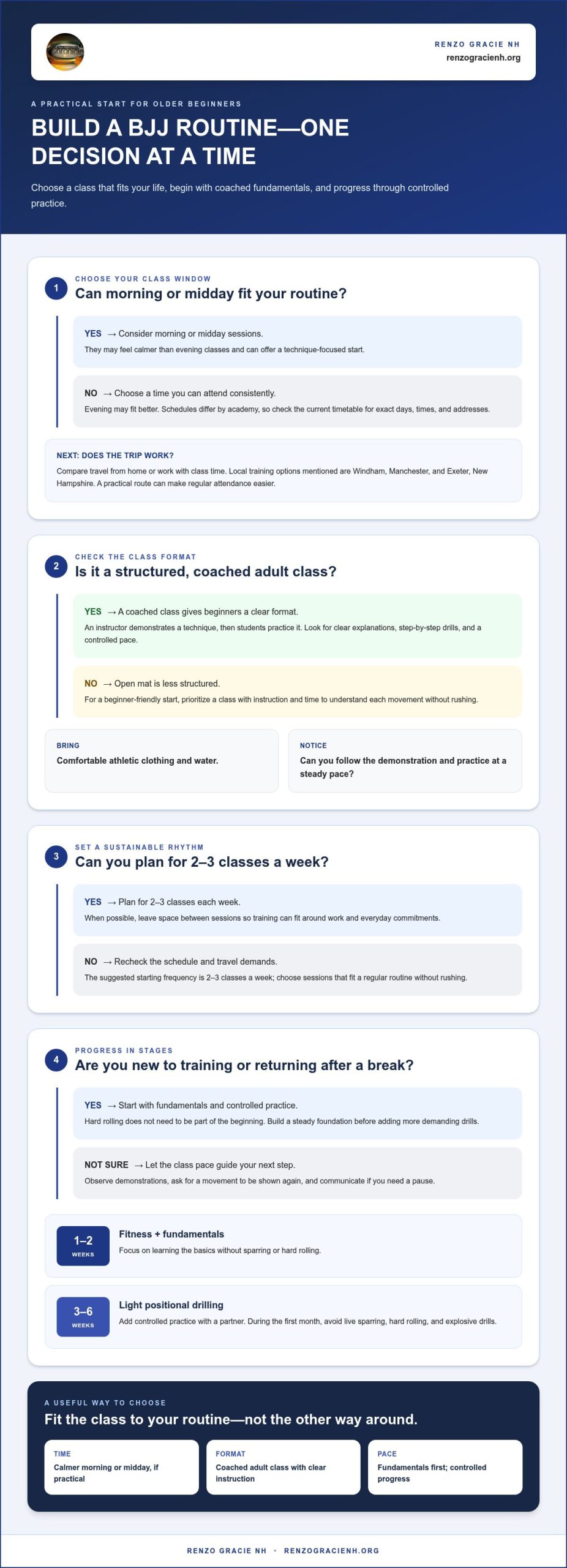
Morning and midday sessions may feel calmer than evening classes. The best time for an older beginner is one that fits a regular routine and allows you to arrive without rushing.

Class Schedules and Locations

For local training, focus on Windham, Manchester, and Exeter, New Hampshire. Compare the trip from home or work with the class time, and consider whether the route makes regular attendance practical. Morning and midday sessions are often calmer than evening classes, but schedules differ by academy. Use each school’s current timetable for exact days, times, and address details.

The suggested starting frequency is two to three classes a week. Choose sessions with space between them when possible, so you can fit practice around work and everyday commitments. Check travel time as well as the timetable; a convenient class is easier to keep in your routine.

Beginner-Friendly Adult Classes

Start with a structured adult class rather than open mat. In a coached session, an instructor demonstrates a technique before students practice it; open mat is less structured. Look for clear explanations, step-by-step drills, and a controlled pace that gives beginners time to understand each movement.

For your first class, wear comfortable athletic clothing and bring a water bottle. Notice whether demonstrations are easy to follow and whether you have time to practice each technique without rushing.

To choose between BJJ, judo, and other martial arts around Windham, compare the training focus and class format. Brazilian Jiu-Jitsu emphasizes grappling and ground positions, while judo focuses on throws and stand-up grappling. Consider which skills interest you and which schedule fits your routine.

Older beginners can ease into training with a staged approach. During the first month, avoid live sparring, hard rolling, and explosive drills. The first phase, weeks 1 to 2, focuses on fitness and fundamentals without sparring or hard rolling. Weeks 3 to 6 add light positional drilling with a controlled partner.

When reading reviews, look for specific comments about instructor explanations, how beginners are treated, and cleanliness in the training space. A review describing a class or facility offers more useful detail than a general rating alone. Consider those observations alongside location and schedule when choosing where to train.

For your first visit, allow time to find the training space and get ready. Comfortable athletic clothes and water are practical basics. The class gives you a chance to observe, listen, and learn the format before deciding whether it suits you.

Confidence and personal growth

Confidence in martial arts often grows through small, observable steps, not a sudden change in personality. You might first remember a position, then follow a partner drill, and later recognize when a familiar technique fits. Each step gives you something specific to build on. You’re learning how to respond, not proving you can overpower someone.

Brazilian Jiu-Jitsu asks you to solve movement problems while staying attentive to another person. For example, when a partner shifts their weight, you adjust your position and look for a safer angle. Practice encourages you to think ahead, remember sequences, and adapt when your partner changes their response. These are skills developed one decision at a time.

Progress can take patience. It may take about 6 months of training to start feeling like you know what to do. That doesn’t mean every class feels easy or that learning follows a fixed timetable. A useful measure is whether a technique or sequence feels more familiar than it did before. Small gains in focus and recall count.

Try a simple reflection after class. Write down one technique you remember, one part that challenged you, and one question for your next session. You might note that a movement made more sense after you practiced it slowly. This creates a clear record of what you’re learning, rather than a judgment of your ability.

Friendship can grow through the shared work of learning. Partners take turns practicing, respect each other’s pace, and repeat a sequence until it makes sense. If you forget a step, ask to see the movement again; if you need a pause, communicate that clearly. Respectful practice makes cooperation part of the lesson.

  • Choose one learning goal: remember a position or movement.
  • Notice one adjustment: identify how your partner’s movement changed your response.
  • Record one question: bring it into a later class.

Keep the focus on consistency and attention, not comparison with younger students or experienced teammates. BJJ for older adults in Windham can be a way to practice problem-solving, patience, and confidence alongside other students. If you’re ready to make that learning part of your routine, explore a structured place to train.

What is Brazilian Jiu-Jitsu?

Brazilian Jiu-Jitsu is a grappling martial art built around movement, positioning, and technique. In class, partners practice controlling positions and responding to changes on the mat.

Fitness Benefits

A Brazilian Jiu-Jitsu class combines learning techniques with active practice. For example, a student might move from a seated position, practice a controlled escape, then reset and repeat the sequence. This varied movement works the body in different ways rather than relying on one repeated motion. Grappling practice also engages muscles as students maintain posture and adjust their positions.

Mobility and Conditioning

Jiu-Jitsu movements involve stability, posture, and awareness of body mechanics. For example, students may shift their weight while maintaining balance during a partner drill. Classes also include movement, rolling, and grappling, which can challenge muscles and joints and involve mobility. The effort depends on the drill, its pace, and how actively a student participates.

Fitness develops through repeated actions, not just hard rounds. You might practice getting up from the mat, changing direction, or holding a stable position while a partner applies controlled pressure. Each movement calls for coordination and attention. Maintaining posture as you move also helps you understand how balance changes in different positions.

Conditioning in BJJ is part of learning technique. A sequence may require you to move, pause, listen to a correction, and repeat the movement with better control. This makes class physically active while keeping the focus on learning. Beginners can work on clean, deliberate movement instead of trying to match an experienced partner’s pace.

To understand how training feels, notice how often you move, which positions challenge your balance, and whether you can follow a technique while staying controlled. These observations can help you describe your current fitness and identify movements to practice. If turning from your side feels unfamiliar, for instance, you can work on that movement gradually.

Brazilian Jiu-Jitsu can support fitness by combining movement with practical problem-solving. The physical demands vary with each technique and drill, so focus on posture, coordination, and effort rather than treating every class as a test. The goal is purposeful practice: learn the movement, understand its mechanics, and build familiarity through repetition.

BJJ classes for older adults in Windham

Practical self-defense

Brazilian Jiu-Jitsu teaches grappling skills for situations where people are close together. Students practice recognizing positions, managing balance, and working toward an escape. Drills help you understand a technique and its limits, but real situations may not unfold like practice. Self-defense also involves noticing risk and choosing a safe opportunity to leave.

Technique matters because BJJ emphasizes leverage and position rather than relying on excessive physical strength. For example, you can learn to shift your weight and create space instead of pushing directly against a partner’s force. This gives beginners a problem to solve: identify what is restricting movement, then practice a controlled response. Repetition helps make the sequence more familiar.

Mat drills can include weight shifts, sweeps, and escapes from different positions. A sweep changes the balance between partners, while an escape helps a student move out of a position that limits movement. During instruction, break each action into smaller steps: notice your partner’s position, move with control, and reset when asked. This makes the learning process concrete.

Grappling practice also teaches awareness of distance and body position. If a partner shifts their weight, you can feel the change and adjust rather than relying on a memorized response. This practice develops attention to movement. It also highlights an important distinction: a technique practiced with a cooperative partner can’t guarantee how an unpredictable encounter will unfold.

For older beginners, controlled drills make it easier to focus on the mechanics of defense before adding pressure. You can practice moving from a restricted position, maintaining balance, and creating space. Hard rolling and live sparring aren’t required to understand a basic technique. Instructors demonstrate movements, guide slow repetitions, and help students notice how posture and timing affect the result.

Practical self-defense skills are best learned as options, not as a promise that one move solves every problem. In class, you might learn an escape, repeat it from both sides, then practice recognizing the position that calls for it. If a response feels unclear, pause and ask to see the movement again so you can focus on understanding.

  • Notice the position: identify what is limiting movement.
  • Use technique: practice a weight shift or escape with control.
  • Reset and repeat: refine the sequence before increasing pressure.

This step-by-step approach connects learning with practical defense while keeping training focused on skill. Through repetition, students build familiarity with positions, changes in balance, and controlled escapes. The value lies in understanding what a technique asks your body to do, then practicing that response attentively with a partner. Each drill develops awareness and decision-making alongside grappling fundamentals.

BJJ for older adults

People aged 20, 40, or 70 can start Brazilian Jiu-Jitsu. Age alone doesn’t define whether training is suitable; experience, current condition, and the way practice is introduced matter. An older beginner can start by learning positions and basic movement, then build skills through controlled partner drills. The practical takeaway is simple: begin with fundamentals, not a test of toughness.

For students over 40, the approach should leave room to learn before attempting hard rolling. During the first month, older beginners are advised to skip live sparring, hard rolling, and explosive drills. That creates space to learn how a movement works, understand a partner’s position, and practice at a manageable pace. If you have a serious injury, consult a doctor before training.

A gradual plan makes the early learning steps clear. The suggested first phase lasts weeks 1 to 2 and focuses on fitness and fundamentals without sparring or hard rolling. In weeks 3 to 6, the next phase adds light positional drilling with a controlled partner. Students can focus on one position at a time, such as practicing how to move from a restricted position.

The suggested third phase runs from weeks 7 to 12. It may include light structured rolling or controlled pad rounds if the trainee feels well. These are stages, not a demand to advance on a fixed date. A useful decision at each step is whether you can follow the technique, maintain control, and recover comfortably before adding a more demanding drill.

  • Start with fundamentals: learn positions and movement before sparring.
  • Build control: practice a technique slowly with a partner.
  • Progress deliberately: add challenge as your skills and comfort develop.

Brazilian Jiu-Jitsu also involves problem-solving and mental engagement. Remembering a sequence, noticing a partner’s weight shift, and choosing a response keep your mind involved alongside physical practice. Progress includes more than completing a drill: it also means recognizing the situation and understanding why a technique fits.

Make your first goal specific: learn one position, ask for a controlled repetition, and notice what changes your balance. Then build from that foundation instead of measuring yourself against younger students or experienced teammates. To put those fundamentals into practice, explore the Adult Jiu Jitsu Program.

Renzo Gracie NH: Adult Jiu Jitsu Program

Renzo Gracie NH offers an Adult Jiu Jitsu Program for adults ready to turn interest into structured training. If you’re considering BJJ for older adults in Windham, the free introductory class is a practical way to experience the instruction before building a routine.

Bring questions about learning the fundamentals, training at a steady pace, and developing grappling skills. Start with a practical first step, then decide how Brazilian Jiu-Jitsu fits your goals. Training is also a chance to build skills alongside a supportive community of students.

Visit renzogracienh.org to learn more about the Adult Jiu Jitsu Program or the Free Introductory Class.

Make your next step a steady one

Starting something new doesn’t require a perfect plan. Choose a manageable first step, then let your experience guide what comes next. If you’re exploring BJJ for older adults in Windham, consider what you want from training, such as learning practical skills, building confidence, or joining a regular activity. A clear personal goal can help you focus on your progress instead of comparing yourself with others.

Renzo Gracie NH offers an Adult Jiu Jitsu Program, a Kids Jiu Jitsu Program, and Law Enforcement Jiu-Jitsu Training. Each serves different students and goals, while the adult program is the place to explore your own training. Give yourself room to learn at your pace and take pride in each new skill.

Ready to take a first step? Contact Renzo Gracie NH and explore where your training can begin. Your progress starts with showing up.

Frequently Asked Questions

Are you too old to start martial arts?

No, age alone doesn’t prevent someone from beginning martial arts. People aged 20, 40, or 70 can start Brazilian Jiu-Jitsu, with training adjusted through fundamentals and controlled practice. Consider your goals, current abilities, and comfort with movement when choosing how to begin. For an older beginner, learning techniques carefully is a more useful starting point than trying to keep pace with experienced students.

Can I train with an old injury or joint problem?

An old injury or joint problem calls for thoughtful planning before training. If you have a serious injury, consult a doctor before starting. Be ready to describe which movements cause discomfort, such as turning, kneeling, or bearing weight through an arm. This helps you understand which movements need attention in class. Don’t treat discomfort as a challenge to push through; prioritize controlled movement and clear communication.

How often should an older adult train?

Two to three sessions a week is the suggested starting frequency for older beginners. For example, choose spaced-out days that leave time for rest between classes, rather than stacking sessions together. Keep the schedule manageable alongside work, family, and other physical activity. If you’re learning several techniques, consistency matters more than cramming practice into one demanding week. Track attendance and energy to see whether your routine feels sustainable.

Is 50 too old to start jiu-jitsu?

No, 50 isn’t too old to begin jiu-jitsu. People can start at different ages, including 40 and 70, and focus first on learning foundational movements. A new student at 50 can set a practical goal, such as remembering a position or moving with control during a drill. Progress comes from practicing skills deliberately, not from matching a younger student’s speed or experience.

Is BJJ safe for seniors and people over 40?

Brazilian Jiu-Jitsu includes physical contact, so how training is introduced matters. People over 40 can learn the art, while older beginners are advised to avoid live sparring, hard rolling, and explosive drills during their first month. Start with fundamentals and controlled practice. Serious injuries call for medical advice before training. Clear limits, careful movement, and attention to how each drill feels help guide participation.

What Happens During Your First BJJ Class?

A first class generally introduces basic movements and techniques through instruction and practice. You may watch a demonstration, try a movement, then repeat it with a partner at a controlled pace. As a beginner, focus on understanding the position rather than performing quickly. Comfortable athletic clothing and a water bottle are practical items to bring. Expect to learn gradually, with time to follow each step.

Do Windham-area BJJ gyms have beginner-friendly or age-specific programs for older adults?

In Windham, New Hampshire, Renzo Gracie NH offers adult Jiu-Jitsu instruction for different experience levels. Beginners can build a foundation through adult training without assuming a separate age-specific class. Adults in nearby Manchester and Exeter can also explore the academy’s adult program. Consider whether the instruction includes fundamentals and controlled practice suited to your experience and goals.

What should older adults expect at their first BJJ class?

Expect to listen, observe, and practice basic movements; no prior experience is needed. For instance, an instructor may demonstrate a position before students repeat it in a partner drill. Wear comfortable athletic clothing and bring water. Before class, think about what you want to learn, such as how a movement works or how to maintain balance. Renzo Gracie NH offers new students a free introductory class.

Martial Arts Academy in Manchester for Fitness and Self-Defense

A martial arts academy in Manchester should make training approachable, structured, and relevant to your goals. At Renzo Gracie NH, students in Manchester, Windham, and Exeter can explore Brazilian Jiu-Jitsu through programs for adults and children. You can start without prior experience and learn at a pace that suits you.

It’s natural to wonder whether you’ll keep up, what instruction feels like, or whether the training suits your age and fitness level. This guide explains what to look for in age-based programs, how instructors support new students, and how martial arts practice can develop strength, focus, and confidence.

You’ll also get a clearer picture of what to expect in a first class, from learning the basics to becoming familiar with the training environment. With practical expectations in place, you can decide which program makes sense for you or your family and take the next step with confidence.

Key Takeaways

  • Compare programs by age, experience, and personal goals to find a comfortable starting point for you or your family.
  • Look for a respectful class environment where instructors guide students through techniques and steady progress.
  • Learn how martial arts practice can support fitness while developing practical skills, focus, and confidence.
  • Set clear self-defense and fitness goals so you can choose training that fits what you want to work toward.
  • Prepare for a first class with comfortable sports clothing and a water bottle, then focus on learning the basics.

Class environment and instructor support

A good class environment makes instruction clear, respectful, and focused on learning. Compare age grouping, beginner guidance, class formats, and how instructors explain each drill.

Age Groups and Experience Levels

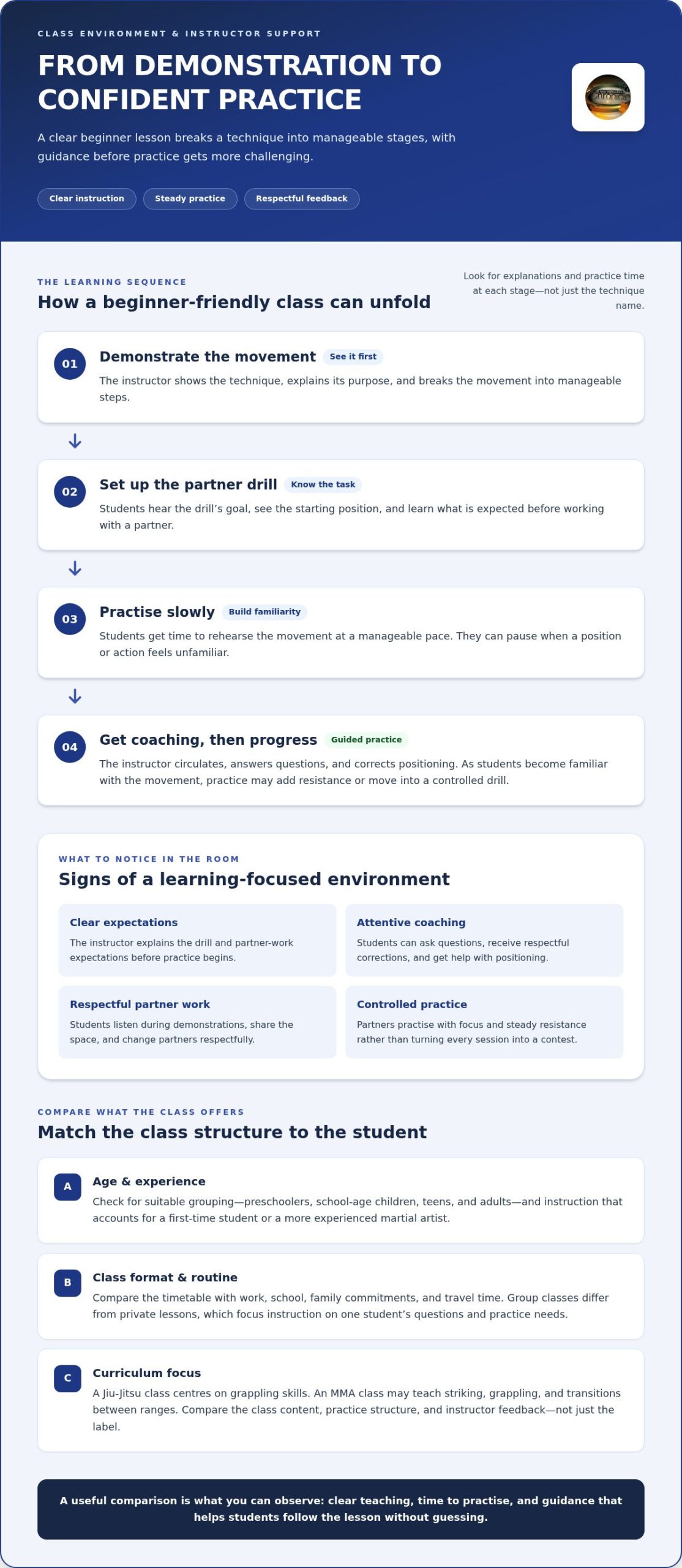
Age grouping shapes the pace, activities, and partner work in a class. Look for a clear distinction between preschoolers, school-age children, teens, and adults, with instruction suited to each group’s attention and physical development. Experience matters too: a first-time student and an experienced martial artist may need different explanations of the same technique. Before choosing, identify the student’s age and experience, then compare those needs with the class description.

Beginner-Friendly Training

Beginners benefit from demonstrations that break a technique into manageable steps. An instructor might show a movement, explain its purpose, then let students practise slowly before adding resistance. Look for clear directions, respectful corrections, and the chance to pause when a movement feels unfamiliar. These details help new students understand what to do without needing prior knowledge of martial arts terminology.

Instructor support also appears in how a class handles partner drills. A useful structure explains the drill’s goal, shows the starting position, and gives students time to practise before changing the task. Notice whether instructors circulate, answer questions, and correct positioning rather than leaving students to guess. In a Manchester class, these observable teaching habits offer a more practical basis for comparison than a school’s promotional language.

Class schedules affect whether training fits around work, school, and family routines. Compare the timetable with your regular commitments, including travel time and class format. Private lessons differ from group classes because they focus instruction on one student’s questions and practice needs. Consider whether that individual focus suits your goal, while keeping scheduling separate from the quality of group instruction.

Mixed martial arts classes and single-discipline classes can have different curriculum priorities. When comparing an MMA class, look for an explanation of how it teaches striking, grappling, and transitions between ranges. A Jiu-Jitsu class, by contrast, centres its instruction on grappling skills. Neither label alone explains how beginners are taught, so compare class content, practice structure, and instructor feedback.

Before deciding, observe how students share the training space and interact during drills. Respectful partner changes, attentive listening during demonstrations, and controlled practice are useful signs of a learning-focused environment. Notice whether the instructor explains expectations before partner work and whether students can follow the lesson without guessing. These details help families and adult beginners assess whether the setting supports confident participation.

Martial arts training for health and fitness

Martial arts practice combines movement, skill learning, and partner drills. To judge its fitness value, look at what each class asks students to do, such as moving continuously, practising balance, or repeating grappling sequences. Match those activities to your aims. Someone seeking an active routine may value sustained movement, while someone focused on coordination may pay closer attention to controlled technique practice.

Brazilian Jiu-Jitsu uses grappling, positional movement, and technique practice. A class might involve learning an escape, rehearsing it with a partner, then applying the movement during a controlled drill. These activities challenge students to coordinate their bodies and make decisions while moving. For a useful comparison, review how a class balances instruction, partner practice, and live training. The experience depends on more than the discipline’s name alone.

No-gi training is grappling practised without the traditional gi uniform. Clothing changes the grips available, so students work with different control points and adjust how they practise techniques. Compare gi and no-gi classes by their focus and format, not by assuming one is easier. Beginners can look for clear explanations of positions and enough time to learn movements before faster drills.

Student reviews can add detail about class experience, especially when they describe specific moments. Look for examples such as an instructor explaining a technique, adapting a drill, or helping a student understand partner practice. Separate personal impressions from verifiable details. A review saying “the class felt welcoming” reflects one person’s view; a description of how beginners were introduced to a drill gives more practical context for deciding what environment might suit you.

“Ninja Warrior training” may refer to obstacle-focused movement, but the phrase alone doesn’t define a class. Examine the activities described: do they involve balance, climbing, jumping, or navigating obstacles? Consider whether those tasks align with your fitness interests and comfort. This helps distinguish obstacle challenges from grappling-based martial arts, even when both involve physical effort and learning new movement patterns.

A training community is built through repeated practice with instructors and partners. Notice whether students take turns, listen during demonstrations, and help keep drills focused. For example, a partner can provide steady resistance while you practise a position, then switch roles. That shared structure supports learning without turning every session into a contest. If you want to experience a grappling-focused class, explore the introductory training option as a way to see how instruction and practice work together.

Martial arts programs for preschoolers, children, teens, and adults

Programs for different age groups can vary in lesson pace, movement, and partner practice. Compare the student’s interests and experience with the martial arts style and class format before choosing.

Programs Across Age Groups

Younger children may benefit from short activities built around listening, balance, and simple movement. Children can explore structured drills, while teens may value more complex technique practice and clear progression. Adult classes commonly focus on skill development, fitness, or self-defense goals. These are general considerations, not fixed age rules. Look at how each program adapts instruction and practice to the students attending.

For children interested in grappling, Renzo Gracie NH’s Kids Jiu Jitsu Program offers a discipline-specific path. Adults who want to learn grappling can consider the Adult Jiu Jitsu Program. Compare what a typical class teaches, how partner practice is introduced, and how instructors explain new techniques. Those details help families judge programs by the learning experience, not just the age group.

Adult Martial Arts

Adult martial arts can include different disciplines and training aims. An adult mixed martial arts class may combine striking and grappling; an adult karate class focuses on karate techniques and practice. These names describe different curricula, not interchangeable formats. Compare the skills taught, class structure, and amount of partner practice against your goals. If you’re seeking grappling instruction, look for a program centred on grappling.

Starting as an adult doesn’t require prior martial arts experience. First identify your main aim, such as learning a discipline, building a regular activity, or developing self-defense skills. Then compare the program description with that aim. Notice whether instructors explain techniques in stages and provide opportunities to practise them. A clear learning path helps you understand what each session involves.

Families comparing classes for children and teens can look beyond the age label. Consider whether lessons use suitable instructions, manageable drills, and respectful partner practice. A child learning a grappling position, for example, may need a different explanation from a teen refining that same position. Notice how instructors adapt the lesson and whether students understand the purpose of each activity.

Adults choosing between karate, mixed martial arts, and Jiu-Jitsu should compare their core techniques. Karate practice centres on its own striking and movement methods. Mixed martial arts training brings together multiple combat disciplines. Jiu-Jitsu emphasizes grappling and positional skills. These distinctions can help you narrow your options without assuming one style fits everyone. Match the class content to the skills you want to learn.

Program fit also depends on how students progress from one lesson to the next. Look for a sequence: an instructor introduces a technique, demonstrates it, and gives students time to practise. Families can compare children’s and adult class descriptions separately, even when everyone is interested in martial arts. Different structures may suit each learner’s goals, experience, and preferred pace.

Martial Arts Academy in Manchester for Fitness and Self-Defense

Self-defense and fitness goals

Self-defense and fitness can share a training space, but they call for different ways to assess progress. Someone prioritizing self-defense might focus on recognizing positions, practising escapes, and making decisions under pressure. Someone seeking a more active routine may value consistent movement and skill drills. Identify your main aim first, then compare class activities with it.

Practical self-defense instruction teaches skills in context, rather than as isolated movements. A student might learn how to create space from a close position, practise with a cooperative partner, then repeat the movement during a controlled drill. Notice how lessons progress from explanation to practice. Clear steps help you understand what a technique is designed to address.

Fitness goals also benefit from specific, observable markers. Rather than expecting a quick transformation, notice whether you can follow a drill with better coordination or complete a familiar sequence with greater control. A training journal can capture changes: record the techniques practised, what felt challenging, and one skill to revisit. These notes make personal progress easier to see over time.

Choose a class format that matches your preferred kind of effort. A technique-focused session gives time to understand movements, while partner drills add interaction and changing positions. Grappling practice, for example, may ask students to move between positions while maintaining balance and control. Ask what a typical class includes so you can judge whether its pace and activities support your goals.

Self-defense is not only a collection of techniques. Awareness, communication, and deciding how to respond are also useful parts of preparation. In a class, notice whether instructors explain the purpose of a drill and its limits. A scenario-based exercise, for example, can help students think through positioning and choices without treating practice as a real confrontation.

Fitness and self-defense goals can change as skills develop. A beginner may start by learning to move safely through a drill, then later focus on refining an escape or transition. Revisit your goal after experiencing the class format. If your priority is practical skill, look for relevant instruction; if it’s regular activity, consider whether the class structure keeps you engaged.

When comparing programs in Manchester, use a short decision process. Write down the skill you want to learn, identify class activities that support it, and compare those activities with your preferred training pace. Someone interested in grappling, for instance, can look for instruction that includes positional practice. A clear match between your aim and class content gives you a practical basis for choosing.

Set expectations around learning, not guaranteed outcomes. A class provides instruction and structured practice, while your progress depends on attendance, attention, and continued effort. After a session, note one technique you understood and one question you still have. That reflection turns broad ambitions into specific next steps for your fitness or self-defense journey.

Advice for first-time students

For safety, follow the instructor’s rules, practise within your comfort, and stop if you feel pain. Before training, consider injury risks such as strains or accidental contact, and understand what your insurance policy covers.

Prepare simple essentials. Renzo Gracie NH advises first-time students to wear comfortable clothes suitable for sports and bring a water bottle. Choose clothing that lets you move freely, without loose items that could catch during a drill. Keep your water nearby, and arrive ready to listen before joining the class.

Use your first session to learn the class routine, not to prove your ability. Notice where students wait, how the instructor demonstrates a movement, and when partners begin practising. If a technique feels unfamiliar, pause and ask for the steps again. For example, request a slower demonstration before trying a grappling movement with a partner.

Share relevant concerns before practice begins. Tell the instructor about an injury or movement limitation that could affect a drill, then follow directions for adapting or sitting out. During partner work, agree on the pace and use controlled movements. Stop if something feels wrong. Respectful communication helps both students stay focused on learning.

New students can make progress by setting one practical goal for each class. You might aim to remember a position, follow a warm-up sequence, or understand an instruction. After class, write down what you practised and any question to raise next time. This simple record helps turn an unfamiliar experience into a clear learning path.

Before choosing a regular schedule, consider how training fits your routine. Look at the class timetable, travel time, and other commitments, then choose a realistic pattern you can maintain. Consistency matters more than trying to do everything at once. If a class leaves you unsure about its pace or structure, note the activity that felt challenging and use that observation to guide your next session.

Insurance deserves the same practical attention as clothing and class preparation. Read your policy’s terms for sports or martial arts activity, including exclusions, conditions, and steps for reporting an injury. Keep the policy information accessible, and understand what it covers before taking part. Coverage varies by policy, so the wording of your own policy matters.

Want to experience a guided first session? Book a free introductory class and take your first step into training.

Renzo Gracie NH: Adult Jiu Jitsu Program

Renzo Gracie NH’s Adult Jiu Jitsu Program is for adults interested in learning grappling skills through structured martial arts training. It can suit goals such as skill development, fitness, or following a steady learning path. The Kids Jiu Jitsu Program offers children a related option, while Law Enforcement Jiu-Jitsu Training focuses on professional defensive tactics.

If you’re new to training, Renzo Gracie NH’s Free Introductory Class lets you experience instruction before deciding whether the program suits your goals. Come ready to learn, move at a comfortable pace, and get familiar with the class environment.

Contact Renzo Gracie NH to learn about taking the next step.

Take Your Next Step on the Mat

Choosing a martial arts academy in Manchester is a personal decision, shaped by the skills you want to build and the kind of practice you’ll enjoy returning to. Think about what you want to learn, then experience a class and notice how the instruction fits your goals. A first visit can turn a broad intention into a clearer path forward.

Renzo Gracie NH offers an Adult Jiu Jitsu Program, a Kids Jiu Jitsu Program, and Law Enforcement Jiu-Jitsu Training. These options serve different students and purposes, from adult skill-building to children’s training and professional defensive tactics. Consider which fits your needs, then get in touch to take the next step at your own pace.

Contact Renzo Gracie NH about classes and begin exploring a training path that feels right for you.

Frequently Asked Questions

What martial arts academies are in Manchester, New Hampshire?

Renzo Gracie NH serves Manchester, Windham, and Exeter with Brazilian Jiu-Jitsu programs for adults and children, plus specialized Law Enforcement Jiu-Jitsu Training. If you are seeking a premier martial arts academy in Manchester, New Hampshire, our facility provides expert instruction tailored to all skill levels. We focus on effective self-defense, physical fitness, and a supportive community atmosphere right here in the local area.

Where are martial arts academies located in Manchester and what are their opening hours?

Renzo Gracie NH serves Manchester, New Hampshire, Windham, and Exeter. Class times depend on the program and location, so compare the schedule with your work, school, or family routine. If you’re considering a martial arts academy in Manchester, check which scheduled class fits your commitments. Class schedules are the practical guide to when instruction takes place.

Do Manchester martial arts academies offer trial classes or beginner programs?

Renzo Gracie NH offers a Free Introductory Class, along with Jiu-Jitsu programs for adults and children. Use the session to experience the instruction and class format firsthand. Notice how techniques are demonstrated and how practice is introduced. That gives you useful context for deciding whether the program suits your interests before settling into a regular routine.

Which academies in Manchester are suitable for children and families?

Families in Manchester, New Hampshire can consider Renzo Gracie NH’s Kids Jiu Jitsu Program and family training in Jiu-Jitsu. Choose a dedicated children’s class or train together as a family, depending on your preferences. Discuss the child’s interests and comfort with martial arts before choosing. Those preferences can help your family decide which format feels like the best fit.

What qualifications and experience do instructors at Manchester academies have?

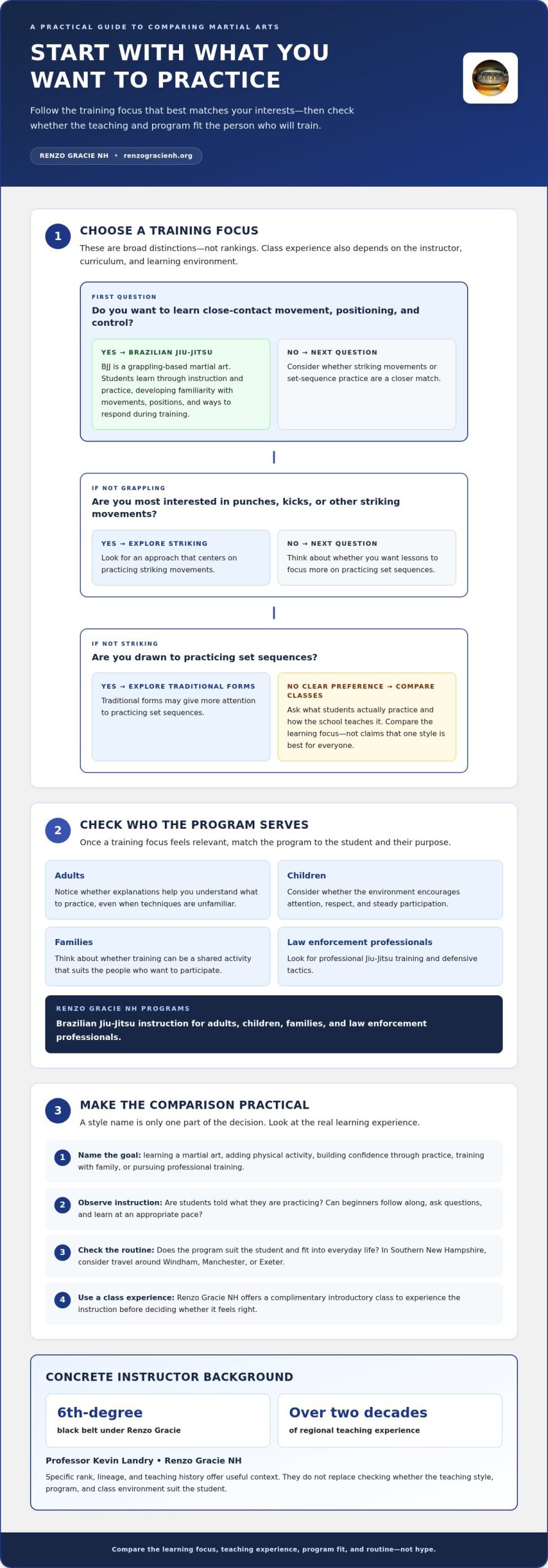
Professor Kevin Landry is a sixth-degree black belt under Renzo Gracie and has taught in the region for over two decades. To see how that experience translates into instruction, notice how the instructor demonstrates techniques, answers questions, and explains movements. These teaching details help beginners and families assess whether lessons are clear and suited to different levels of experience.

How do Manchester martial arts academies compare by class size, facilities, and reviews?

Compare how easily students can follow demonstrations and receive guidance during practice. Renzo Gracie NH describes its facilities as clean and state-of-the-art, and member testimonials from Matt Gall and Sue Kimball praise instructor Kevin Landry. Reviews reflect individual experiences, so focus on specific comments about instruction and student interactions. These details can help you assess the environment beyond a rating.

What should beginners bring and wear to their first martial arts class?

Wear comfortable sports clothing that allows free movement, and bring a water bottle. Choose clothing that won’t interfere with practice, then listen to the instructor’s directions as class begins. Set a simple aim for your first session, such as learning the routine or understanding one movement. This keeps your attention on becoming familiar with the class rather than mastering everything at once.

How much do martial arts classes and memberships cost in Manchester?

At Renzo Gracie NH, we offer transparent pricing options tailored to individuals and families looking for a top-tier martial arts academy in Manchester. There is no long-term contract or cancellation fee, making it easy to start your journey with confidence and flexibility.

Trial Martial Arts Class in Manchester: What to Wear and Expect

Your first martial arts class calls for comfortable clothes, not a competition kit. For a trial martial arts class in Manchester, choose breathable workout gear that lets you move freely, and arrive ready to learn at your own pace.

It’s normal to wonder whether you’ll be expected to spar, what beginners do, or whether you need special equipment before stepping onto the mat. You don’t need martial arts experience to learn the basics and take part in a beginner-friendly first session.

This guide explains what to wear, how beginner training and sparring work, and what to expect when you arrive. You’ll also find practical guidance on Renzo Gracie NH’s Manchester classes, choosing a session, and registering for a free introductory class, so you can take the first step feeling prepared.

Key Takeaways

  • Choose comfortable, breathable workout clothes that let you move freely, and learn what to bring before your first session.
  • Understand how beginner instruction builds skills through cooperative practice and how sparring fits into training.
  • Use the class schedule and registration steps to plan your trial visit in Manchester, New Hampshire.
  • Explore how self-defense instruction develops practical skills through structured learning.
  • Compare the trial options for children, teens, and adults to find a starting point that suits you or your family.

Cooperative beginner training and sparring policy

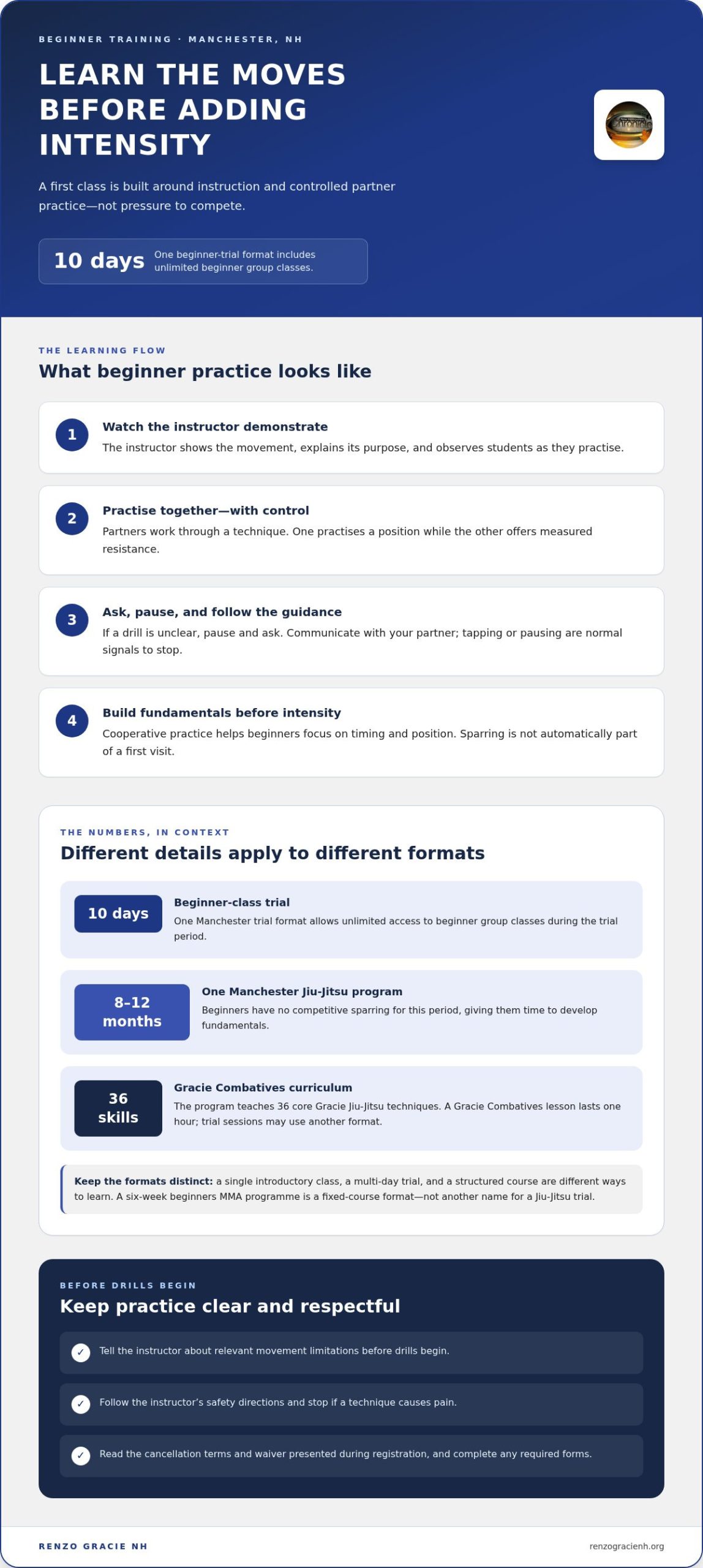
A first class should build useful skills through instruction and partner practice, not pressure to compete. In Manchester, one beginner-class trial format lasts 10 days and allows unlimited access to beginner group classes. That’s a trial period, not the length of one class. Use it to experience the teaching style and learn how students practise together.

In cooperative training, partners practise a technique with control. One person might practise a position while the other offers measured resistance. The instructor demonstrates the movement, explains its purpose, and observes students as they practise. If a drill feels unclear, pause and ask for guidance. Respectful practice helps beginners focus on timing and position before adding intensity.

Sparring is not automatically part of a beginner’s first visit. At one Manchester Jiu-Jitsu program, beginners have no competitive sparring for 8-12 months. That gives students time to develop fundamentals before competition-style practice. Gracie Combatives teaches 36 core Gracie Jiu-Jitsu techniques; this shows how a beginner curriculum can organize learning around defined skills. A Gracie Combatives lesson lasts one hour, though a trial session may use another format.

What are the cancellation, waiver, and safety requirements for trial classes? Read the cancellation terms and waiver presented during registration, complete any required forms, and follow the instructor’s safety directions. Tell the instructor about relevant movement limitations before drills begin, and stop if a technique causes pain.

How long are trial classes, and what does a typical class include? A Gracie Combatives lesson lasts one hour, while trial sessions can differ. A beginner session may include a warm-up, a technique demonstration, guided partner drills, and time for questions.

A six-week beginners MMA programme is a fixed-course format, not another name for a Jiu-Jitsu trial. MMA can combine grappling with other fighting skills, while a Jiu-Jitsu class concentrates on its own curriculum. Before registering, identify whether you want a single introductory class, a multi-day trial, or a structured course. Those formats offer different ways to learn, so choose based on the practice you want to explore.

For a trial visit, arrive ready to listen, practise at a controlled pace, and communicate clearly with your partner. Ask how each drill should feel, follow the instructor’s demonstration, and treat tapping or pausing as normal signals to stop. A first class gives you a practical look at the training process without requiring competition experience.

Class schedule and registration

Start with the current schedule for the Manchester, New Hampshire academy you plan to visit. Check the class name, day, start time, and location. A beginner session may be listed separately from an open or advanced class. Choose a session that fits your routine and leaves time to arrive, change, and meet the instructor without rushing.

Compare the class description with your goal before registering. If you want to explore Brazilian Jiu-Jitsu, select a Jiu-Jitsu session rather than assuming every martial arts class teaches the same skills. Look for a beginner-friendly class. If several options fit, choose one you can attend consistently, rather than selecting only by its time.

Registration usually means providing basic details and selecting a class or introductory option. Read each field before submitting, especially the requested participant name, age group, and session choice. If registering a child, enter the child’s details where requested and have a parent or guardian available for arrival. Save the confirmation and note the class location.

Before you submit, use this quick preparation list:

  • Choose: Select the class type and scheduled session that match your experience.
  • Review: Read the registration instructions, waiver information, and cancellation terms presented during booking.
  • Prepare: Set out comfortable training clothes and plan your route to the Manchester location.

These steps help prevent a common mix-up: arriving for the wrong class or overlooking a registration instruction. If the schedule separates beginner and experienced sessions, choose the beginner option. If it lists a free introductory class, select that option rather than registering for a regular class by mistake.

For a trial martial arts class in Manchester, treat the schedule as part of your preparation, not just a time slot. Read the details before booking, then check your confirmation for the selected session and arrival instructions. A structured registration process makes it easier to arrive ready to focus on learning. If you’re ready to begin, the Free Introductory Class is a starting point for experiencing guided training.

Manchester, New Hampshire training center location

Use Manchester, New Hampshire, when planning your first visit. Search results may also show places named Manchester elsewhere, so include the state in your map search. Compare the displayed street address with the address provided for your class. Matching the city and address helps prevent a trip to the wrong venue.

Before leaving, open the class details and identify the exact training location. Copy its street address into your navigation app rather than searching only for “martial arts” or “Jiu-Jitsu.” Broad searches may show multiple places. If the booking information names a building, entrance, or unit, include that detail in your route notes. A complete destination is more useful than a general business category.

Plan your trip around the route you’ll actually use. Drivers can review the map route and nearby streets before departure, while public transportation users can check the route and stop closest to the listed address. Either way, compare the final stop with the class location, then follow the walking directions to the correct entrance.

Manchester traffic can affect arrival time, so check your route shortly before setting out. Review the map’s current travel estimate and allow time for things it may not account for, such as finding the entrance or changing shoes. If someone else is driving, share the full address and class start time. Clear details make arrival easier to coordinate.

  • Confirm the destination: Match Manchester, New Hampshire, and the full street address.
  • Choose your route: Review driving, transit, or walking directions for the location.
  • Plan arrival: Account for navigation, parking arrangements, and finding the entrance.
  • Keep details handy: Save the address and class information on your phone.

For parents, students, or professionals arranging a visit, sharing the address early can simplify the day. Family members can use the same destination, while law enforcement professionals attending Jiu-Jitsu training can plan around work commitments. Use the training location, not a general mailing address, for navigation.

Once you reach the Manchester address, follow the entrance instructions in the class details. If the building has multiple doors, use the named entrance rather than assuming the first door leads to the training area. Saving the location, reviewing your route, and having the class information ready leaves your attention free to meet the instructor and begin.

Trial Martial Arts Class in Manchester: What to Wear and Expect

Self-defense instruction

Brazilian Jiu-Jitsu self-defense instruction develops practical responses through coached movement and partner drills. A beginner might practise creating space, protecting their balance, or moving from the ground. The goal in class is to understand each step, not to test techniques in an uncontrolled situation. Clear demonstrations help students see where their hands, hips, and posture belong.

Gracie Combatives offers one example of a structured curriculum: it teaches 36 core Gracie Jiu-Jitsu techniques. A defined set of techniques gives beginners a learning path, rather than a collection of unrelated moves. In a lesson, an instructor can demonstrate a position, explain its purpose, and let students practise the sequence slowly. Repeating the steps helps connect the movement with its intended situation.

Pay attention to the problem each drill addresses. If a partner holds your wrist, for example, the instructor may show where to position your body before practising a response. Notice the starting position, direction of movement, and how the drill ends. Ask for another demonstration if a part feels confusing. Understanding the sequence matters more than moving quickly.

Good practice also involves communication. Partners can agree to move with control, pause when confused, and reset to the original position before trying again. If a drill begins with one person standing and another seated, for example, both should know when practice starts and stops. Following the instructor’s pace keeps the focus on technique and helps partners learn together.

During a trial class, notice how instruction moves from explanation to practice. Look for clear demonstrations, opportunities to ask questions, and corrections that clarify body position. If a technique includes several actions, break it into smaller steps: practise the first movement, reset, then add the next. This gives new students a manageable way to learn unfamiliar skills.

  • Listen: Identify the situation the technique addresses.
  • Watch: Follow the instructor’s demonstration from start to finish.
  • Practise: Work through each movement at the pace directed.
  • Review: Reset with your partner and repeat the sequence.

Self-defense training is a learning process, not a promise about how every real encounter will unfold. A class teaches movement and decision-making through structured practice, while students build familiarity over time. Focus first on remembering the position and sequence. As those details become clearer, ask how the same principle applies from another starting position.

Bring curiosity to the mat. In your first session, ask what a drill is designed to teach, then focus on one correction at a time. You’ll leave with a clearer picture of the curriculum and the skills you’d like to develop next.

Trial programs for kids, teens, and adults

Choose a trial based on the student’s age, experience, and reason for training. A child may want structured movement and a welcoming introduction to partner practice. A teenager may be curious about fitness, confidence, or martial arts. An adult may want practical skills or a new routine. These goals help families decide what to observe during a first visit.

Age groups vary across martial arts programs. One children’s curriculum is designed for ages 3-12, illustrating how a program may define its intended range. Don’t assume that age band applies to every class. For a child, read the class description and note the age group it identifies. For a teen, look for instructions that distinguish youth sessions from adult training.

A trial helps families see how a class is taught, not just which techniques are covered. Watch how the instructor explains an exercise, organizes partner practice, and gives students time to follow directions. Notice whether a young beginner can understand the drill’s starting position before practising. Adults can look for clear demonstrations and a progression that makes unfamiliar movements easier to follow.

Before registering, compare the student’s needs with the session details. A parent might note a child’s previous martial arts experience and questions about class routines. A teen can identify whether they want to focus on fundamentals or general fitness. An adult can decide whether their main interest is self-defense, personal development, or consistent physical activity.

  • For children: Check the intended age group and whether the class description suits a first-time student.
  • For teens: Confirm that the session is intended for their age group and experience level.
  • For adults: Choose a class aligned with the skills or training experience you want to explore.

Families attending together can prepare each participant individually. A child may need reassurance about where to wait and how partner drills work. A teen may want to understand the class structure before joining. An adult beginner can focus on listening to instructions and learning basic positions. Clear expectations help each person see whether the session matches their goals.

After the visit, discuss one useful observation rather than asking only whether the class felt easy. Ask which movement was new, how the instructor explained it, or what the student would like to practise again. Those answers help families compare their first impression with their goals and choose a suitable next step.

If you’re exploring Jiu-Jitsu as a family, find a class option for your age group and take the next step toward training together.

Renzo Gracie NH: Adult Jiu Jitsu Program

Renzo Gracie NH offers an Adult Jiu Jitsu Program for adults ready to build skills through structured training. After trying a class, consider this program if you want to continue learning Jiu-Jitsu and developing at a steady pace. Families can also explore the Kids Jiu Jitsu Program, while law enforcement professionals can learn about Law Enforcement Jiu-Jitsu Training.

A Free Introductory Class is a way to experience instruction before deciding on your next step. Think about what you want from training, such as learning fundamentals, practising with partners, or making Jiu-Jitsu part of your routine. That can help you choose the option that fits your goals.

For details or to arrange your next step, visit Renzo Gracie NH online.

Take Your Next Step on the Mat

Your first class doesn’t need to define your martial arts journey. Let it help you decide what you want to practise, what kind of instruction supports your learning, and whether you’d like to return. A trial martial arts class in Manchester can be a starting point for building confidence through steady effort, one skill at a time.

Renzo Gracie NH offers an Adult Jiu Jitsu Program and a Kids Jiu Jitsu Program for students ready to continue learning. Law enforcement professionals can explore Law Enforcement Jiu-Jitsu Training. These programs serve different goals, from family participation to professional defensive tactics.

Think about which direction fits you or your family, then take the next step when you’re ready. Contact Renzo Gracie NH about a trial and begin your training journey with focus, respect, and room to grow.

Frequently Asked Questions

What Should You Wear?

Wear secure clothing that lets you bend, turn, and practise movements on the mat. Leave jewelry and accessories at home so they don’t catch during partner drills. If your hair is long, tie it back before class. Choose comfortable clothes and bring a small bag to keep personal items together while you train.

Which martial arts schools in Manchester offer a free or trial class?

Renzo Gracie NH offers a Free Introductory Class for people beginning Brazilian Jiu-Jitsu. Its Manchester location is joined by academies in Windham and Exeter. Before comparing options, identify the martial art and class format you want. Renzo Gracie NH focuses on Jiu-Jitsu instruction, including adult and children’s programs, rather than offering every martial arts style.

How much does a trial martial arts class in Manchester cost?

Renzo Gracie NH’s Free Introductory Class lets you attend your first class at no cost. It’s a way to experience Jiu-Jitsu instruction before deciding whether ongoing training fits your goals. The free introductory class does not mean a continuing program is also free. Treat the trial and ongoing membership as separate decisions, and consider whether the instruction and training environment suit you.

What ages and skill levels are eligible for trial classes?

Renzo Gracie NH provides Jiu-Jitsu instruction for adults and children, with programs tailored to different ages and experience levels. No prior Jiu-Jitsu experience is needed to begin learning fundamentals. For a teen or child joining with a parent, select the appropriate youth or adult program during registration. This helps direct each student to a class suited to their stage of learning.

Do Manchester martial arts schools require booking or advance registration for a trial?

To visit Renzo Gracie NH, start by registering for the Free Introductory Class before travelling to a session. Registration connects your visit with the right class and gives you a chance to enter participant details carefully. Keep the selected session information handy for arrival. If booking for a child, make sure the registration details identify the child as the participant.

What should you wear and bring to a first martial arts class?

Choose secure, flexible clothing and pack water, a towel, and a change of shirt for after practice. Leave valuables and jewelry at home, and place your belongings in a small bag you can store neatly. You don’t need to buy a uniform to try a class. Follow the clothing instructions provided with registration, and arrive ready to listen and take part.

Are trial classes available for children, adults, or both?

Renzo Gracie NH’s Kids Jiu Jitsu Program and Adult Jiu Jitsu Program serve children and adults. Families can choose a suitable starting point for each participant rather than assuming everyone should join the same class. If you’re considering training together, explore family training. The academy also offers Law Enforcement Jiu-Jitsu Training for professionals seeking that instruction.

What martial arts styles can you try in Manchester?

You can try Brazilian Jiu-Jitsu, Gracie Jiu-Jitsu, MMA, and karate in Manchester.

Martial Arts Fitness Classes in Windham, NH: Find Your Fit

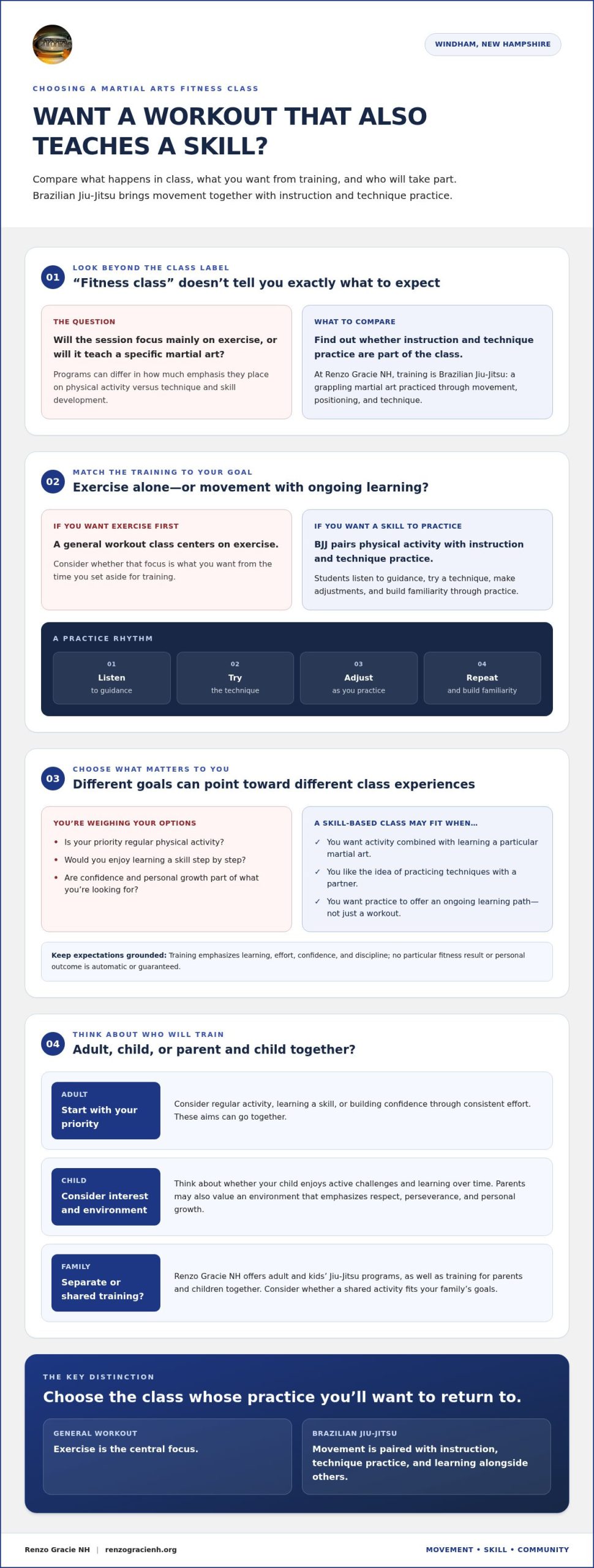
What makes a martial arts workout worth returning to: exercise alone, or movement paired with learning a skill? Choosing among martial arts fitness classes Windham NH can feel daunting when you’re unsure which style fits your goals or what to expect as a beginner. It helps to consider who will attend, what you want from training, and whether you’d enjoy learning a martial art as part of staying active.

This guide compares different training approaches and explains how Brazilian Jiu-Jitsu combines movement with skill development and practice in a community. At Renzo Gracie NH, adults and children can train in Jiu-Jitsu, and parents and kids can take part in family training together. You’ll find practical criteria for comparing classes, along with a look at the free introductory class, a way to experience the academy before deciding whether training fits your routine.

Key Takeaways

  • Martial arts fitness classes Windham NH vary in focus. Decide whether you want exercise, martial arts skills, or a combination.
  • Brazilian Jiu-Jitsu pairs instruction and technique practice with movement, concentration, and ongoing learning.
  • Narrow your options by considering your goals and who will train: an adult, a child, or a parent and child together.
  • Renzo Gracie NH offers adult, kids, and family Jiu-Jitsu training in a supportive, family-oriented academy.
  • A free introductory class gives new students a chance to experience training at Renzo Gracie NH.

Martial Arts Fitness Classes in Windham, NH: What Are You Looking For?

A search for martial arts fitness classes Windham NH can surface styles ranging from karate and striking-based programs to grappling arts. The phrase “fitness class” does not tell you exactly what happens in a session. In general, martial arts training combines physical activity with learning a particular art. Some programs place more emphasis on exercise, while others make technique and skill development central to practice.

To compare options, look beyond the intensity implied by a class description. Ask yourself what you’d most enjoy doing regularly: learning techniques step by step, practicing with a partner, developing confidence through consistent effort, or making an activity part of family time. These goals can overlap, but identifying your main priority helps you choose a class that feels engaging rather than simply demanding.

What does fitness-focused martial arts training involve?

Expect structured practice that involves movement and instruction, rather than an exercise routine with a martial arts label. Students learn and work on techniques, so the activity has a skill-building purpose as well as a physical one. The balance depends on the program. Physical activity is part of training, but no particular fitness result is automatic or guaranteed.

At Renzo Gracie NH, the martial art is Brazilian Jiu-Jitsu, often shortened to BJJ. It is a grappling-based martial art in which students learn to use positioning and technique during close-contact practice. Its history and development are outlined in this overview of Brazilian Jiu-Jitsu. When comparing classes, consider whether you want to learn and practice a specific martial art, rather than follow a general workout.

Which local class goals matter most to you?

Adults can start by deciding what they want from the time they set aside for training. Is your main priority regular physical activity, learning a skill, or building confidence through practice? These aims can go together. Naming the one that matters most gives you a useful way to compare skill-based training with a class focused mainly on exercise.

For a child, think about their interests and the kind of learning environment they enjoy. A child who likes active challenges may be drawn to practicing skills and learning over time. Parents may also value an atmosphere that emphasizes respect, perseverance, and personal growth. Look for a program where learning is part of the experience, not just physical effort.

Training can be a shared activity, too. Renzo Gracie NH offers Jiu-Jitsu training for parents and children together, alongside adult and kids’ programs. If family time is one of your goals, consider whether you prefer separate classes or a shared training experience. The most useful starting point is the option that fits who will participate and gives everyone a reason to keep learning.

How Brazilian Jiu-Jitsu Combines Movement, Skill, and Personal Growth

Brazilian Jiu-Jitsu is a grappling martial art where students learn to use movement, positioning, and technique during close-contact practice. Training brings physical activity together with instruction and repetition. Rather than moving through exercises without a learning goal, students work on techniques and become more familiar with how those skills fit together.

Each session involves attention as well as effort. Students listen to guidance, try a technique, and make adjustments as they practice. Returning to a skill and working through unfamiliar parts can call for concentration and perseverance. Respect is also part of learning with others. These are values emphasized in training, not guaranteed personal outcomes.

Why choose a skill-based martial art for fitness?

A skill-based class gives movement a purpose beyond completing a workout. If you’d enjoy learning something new while being active, consider whether that approach appeals to you. In Brazilian Jiu-Jitsu, instruction and practice create an ongoing path for developing skills. Classes also emphasize confidence and discipline, with opportunities for personal growth through effort rather than a promised result.

The learning focus can make each practice feel purposeful. You are not expected to understand everything at once. You can listen to an instruction, try it, and build familiarity over time. For someone comparing martial arts fitness classes Windham NH, this combination of movement and skill development may be a better fit than exercise alone.

How does a supportive training community shape the experience?

Learning alongside others can make a new activity feel more approachable. A supportive class environment gives beginners room to listen, practice, and find their footing without needing to arrive with experience. Renzo Gracie NH’s family-oriented approach emphasizes bonding, teamwork, respect, and fun, making shared effort part of the experience.

That kind of community can matter to adults starting a new practice, children learning alongside peers, and parents and children training together. Students practice with one another while instructors guide the class. Paying attention to a partner, being patient as a skill is repeated, and recognizing effort all contribute to a respectful group experience.

Renzo Gracie NH’s instruction is led by Professor Kevin Landry, a sixth-degree black belt under Renzo Gracie. To learn more about the academy, explore Jiu-Jitsu training at Renzo Gracie NH and consider whether a skill-based, community-centered practice fits your goals.

BJJ or a General Workout Class: Which Windham Option Fits Your Goal?

Different classes can all get you moving, but the focus of each one varies. A general workout centers on exercise, while a martial arts class also teaches a particular style. Brazilian Jiu-Jitsu (BJJ) makes learning its techniques central to training. There is no universal best choice: the right fit depends on what you want to do during class and what will keep you engaged.

Class type Central emphasis May suit someone who wants to
General workout class Exercise-focused activity Make movement and exercise the main purpose of the session
Karate or kickboxing program Learning and practicing a different martial art Explore the skills and training style of that specific art
Brazilian Jiu-Jitsu training Learning BJJ skills through instruction and practice Combine physical activity with ongoing skill development

Use the comparison as a starting point, not a ranking. Your preferred style, the class environment, and how training fits your routine all matter. Choose based on the activity you want to do and the kind of learning you want from it.

Is Brazilian Jiu-Jitsu the same as kickboxing?

No. They are distinct martial arts with different approaches. Brazilian Jiu-Jitsu centers on grappling skills, while kickboxing is a separate striking-based discipline. Renzo Gracie NH’s martial arts programs focus on Jiu-Jitsu, including adult and kids’ training. If you’re looking to learn BJJ, the academy’s focus is clear.

How can you match a class to your priorities?

Start with the experience you want, then consider who will train. These prompts can help you narrow down your options:

  • If exercise is your main priority, look for a format where physical activity is the central focus.
  • If you want to learn Brazilian Jiu-Jitsu, choose BJJ training, where instruction and practice focus on developing those skills.
  • If you’re choosing for a child, consider whether the style and learning environment match their interests.
  • If shared parent-child training matters, Renzo Gracie NH offers parents and children an opportunity to train together.

Then weigh practical considerations: the instruction and community you want, which location works for you, and whether you prefer exercise-focused activity or learning a martial art. For families in Windham, martial arts fitness classes Windham NH can mean different things depending on these priorities. A free introductory class at Renzo Gracie NH offers a way to experience its Jiu-Jitsu training. Explore Jiu-Jitsu training at Renzo Gracie NH as you decide whether skill-based practice suits your goals.

Martial Arts Fitness Classes in Windham, NH: Find Your Fit

How to Choose a Martial Arts Fitness Class Near Windham

A good choice depends on more than a search result. Think about what you want from training, who will attend, and what kind of practice feels motivating enough to become part of your routine. This decision path can help you compare martial arts fitness classes Windham NH with your priorities in mind.

  1. Set a goal. Decide whether you want regular physical activity, a chance to learn Brazilian Jiu-Jitsu, personal growth, or time to share an activity with family. You can have more than one goal. Choosing the main priority gives you a useful starting point.
  2. Choose who will train. Is the class for you as an adult, for your child, or for a parent and child together? The participants shape what matters, whether that is an adult learning experience, a child’s interests, or shared family time.
  3. Select a style. If learning BJJ skills is part of your goal, Brazilian Jiu-Jitsu training is a direct match. If you have a different martial art or exercise-focused activity in mind, keep that preference in view as you compare class formats.
  4. Consider the class and location. Think about the instruction, community, and kind of practice you want, along with which academy location is practical for regular visits. Renzo Gracie NH has locations in Windham, Exeter, and Manchester.

Start with your goal, experience, and training partner

You do not need to arrive with a list of skills. Renzo Gracie NH welcomes students with different experience levels, so beginners can approach training as a learning process. If you are an adult considering a first class, an adult beginner guide can help you think through what starting a new practice may involve. Families can decide whether they want separate training experiences or whether practicing together is part of the appeal.

Explore the class in person before deciding

Reading about a program can help you compare options, but visiting the academy gives you a direct sense of its instruction and community. Renzo Gracie NH offers new students a free introductory class, a way to experience the program before deciding whether to continue. Notice whether the style, setting, and learning focus align with your goals. You do not need to have everything figured out before your first visit.

If you’re ready to experience the academy, try a free introductory class and explore whether Jiu-Jitsu is a good fit for you or your family.

Try Brazilian Jiu-Jitsu Fitness Training at Renzo Gracie NH

If you’re comparing martial arts fitness classes Windham NH, consider whether you want movement paired with the opportunity to learn a skill. Renzo Gracie NH is a Brazilian Jiu-Jitsu academy offering training for adults and children, as well as family training for parents and children together. Classes combine physical activity with skill development in a supportive, family-oriented community that values personal growth and respect.

Instruction is led by Professor Kevin Landry, a sixth-degree black belt under Renzo Gracie. The academy’s clean, state-of-the-art facilities provide a dedicated setting for practice. For new students, the instruction, community, and training environment offer a practical way to explore whether BJJ fits their interests and goals.

Who can explore training at the Windham academy?

Adults can explore Jiu-Jitsu as a way to be active while learning a martial art in a community setting. You do not need to map out long-term goals before beginning. You can start by finding out whether you enjoy the practice and its learning-focused approach.

Children can take part in kids’ Jiu-Jitsu training, and parents and children who want to share an activity can train together. Family practice makes learning and movement something you experience side by side. Renzo Gracie NH also has academy locations in Exeter and Manchester, in addition to Windham, giving students another location option within the school.

Across its programs, the academy emphasizes a welcoming community where students learn with others and develop through practice. Training includes more than competition: it also emphasizes fitness, respect, perseverance, and personal growth through working at a skill over time. Each student’s experience is their own, while the shared training environment gives people a chance to learn together.

What is a simple next step for a new student?

Reading about Brazilian Jiu-Jitsu can explain the approach, but taking part in a class can help you picture the experience. Renzo Gracie NH offers new students a complimentary trial class, giving you a chance to experience the academy and its training. You can arrive with questions and consider whether the practice feels like a good fit for you or your family.

Start small. Trying a class does not require you to have everything figured out. It gives you a chance to explore Jiu-Jitsu and decide what you’d like to do next. Start with a free trial class and take your first step toward training at Renzo Gracie NH.

Take the First Step Toward a Practice That Fits

The best next step is not necessarily choosing a perfect fitness plan for the long term. It is finding out whether learning Brazilian Jiu-Jitsu feels engaging and realistic for your routine. As you explore martial arts fitness classes Windham NH, let curiosity guide you. You can begin without knowing every technique or having a complete plan for what comes next.

Consider what you want to explore first: getting active through skill-based practice, starting something new as an adult, or sharing a learning experience with your child. A first visit can turn those ideas into a clearer sense of what training involves. Take it one step at a time and give yourself room to learn.

Renzo Gracie NH welcomes new students to experience a free introductory class. Try a free introductory class and take a positive first step toward finding your fit.

Frequently Asked Questions

Is Brazilian Jiu-Jitsu a good option for fitness beginners?

It may suit you if you’re interested in physical activity with a skill to learn along the way. Renzo Gracie NH welcomes students with different experience levels and offers adult Jiu-Jitsu instruction. Rather than expecting a particular fitness result, consider whether learning and practicing BJJ appeals to you. A free introductory class lets you experience the academy and decide whether its approach fits your goals.

Do I need to be fit before starting a martial arts class?

You do not need to treat a particular fitness level as a prerequisite to exploring training at Renzo Gracie NH. The adult program teaches Brazilian Jiu-Jitsu, and students have different levels of experience. Focus on learning what the class involves rather than comparing yourself with others. Try a free introductory class, notice how the training environment feels, and decide whether you’d like to continue.

Does Renzo Gracie NH offer kickboxing fitness classes in Windham?

Renzo Gracie NH’s martial arts programs focus on Brazilian Jiu-Jitsu, with adult and kids’ instruction and family training. Kickboxing is a different, striking-based discipline. If you’re interested in learning BJJ, a complimentary introductory class offers a chance to experience the academy. Knowing which martial art you want to practice can help you choose a class that matches your goals.

Can parents and children train Jiu-Jitsu together near Windham?

Yes. Renzo Gracie NH offers joint Jiu-Jitsu training for parents and children, giving families the option to practice together. The academy’s family-oriented approach emphasizes bonding, teamwork, respect, and fun. Shared training can appeal to parents who want to take part in an activity alongside their child. Families can use a free trial class to experience the academy together.

What should I expect at my first Brazilian Jiu-Jitsu class?

Your first class is an opportunity to experience the academy and its Brazilian Jiu-Jitsu instruction. You do not need to arrive as an expert. Renzo Gracie NH offers a free trial class to new students. Approach the visit with curiosity and take time to get a feel for the setting and learning environment as you begin.

Where can I find Renzo Gracie NH martial arts classes near Windham?

Renzo Gracie NH has academy locations in Windham, Exeter, and Manchester. If you’re looking for martial arts fitness classes Windham NH, the Windham academy is the local option. The school focuses on Brazilian Jiu-Jitsu, with programs for adults and children as well as family training. New students can start with a free trial class to experience the academy and its approach to training.

Self-Defense for Exeter Third-Shift Workers: A Guide

The safest response to a tense moment may begin long before anyone gets close. For third-shift workers, self defense for third shift workers Exeter starts with practical choices about arriving, leaving, and staying alert when fewer people are around. Training can help, but it is only one part of a thoughtful safety plan.

It is understandable to feel less certain when a situation turns tense, especially after a long shift or when your schedule makes regular classes difficult. You deserve clear steps, not pressure to confront someone or rely on a single technique. A repeatable routine can help you decide when to create distance, de-escalate, leave, or get help.

This guide covers safety habits before, during, and after work, then explains what Brazilian Jiu-Jitsu can contribute. BJJ develops technique, control, fitness, and personal discipline through structured practice. It does not guarantee safety or replace awareness, workplace procedures, or emergency help. At Renzo Gracie NH, Professor Kevin Landry brings more than two decades of regional teaching experience. New students can begin with a complimentary introductory class. You will find practical guidance for building confidence at a pace that fits your life.

Key Takeaways

  • Build a repeatable safety routine around your workplace’s procedures, trusted contacts, and ways to request help.
  • Think of self defense for third shift workers Exeter as more than physical techniques: prevention, boundaries, de-escalation, and leaving all matter.
  • Compare workplace procedures, scenario-based instruction, and ongoing Brazilian Jiu-Jitsu practice by what each can help you prepare for.
  • Understand how BJJ’s structured grappling practice develops movement, balance, control, and calm decision-making without promising a particular outcome.
  • Explore adult Jiu-Jitsu as an ongoing way to build skills, with instruction from Professor Kevin Landry, who has taught in the region for more than two decades.

Why third-shift self-defense starts before you clock out in Exeter

Working late does not mean something bad will happen. Still, arriving or leaving when fewer people are around makes it sensible to think through your options in advance. A calm plan can reduce uncertainty when fatigue, a quiet parking area, or an unexpected interaction makes it harder to decide what to do.

Self-defense is broader than physical techniques. It includes noticing your surroundings, setting boundaries, de-escalating a tense exchange, creating distance, leaving when you can, and using physical skills only if needed. For people considering self defense for third shift workers Exeter, start by planning for everyday transitions rather than assuming every late shift is dangerous.

Which moments in a third shift deserve a plan?

Think through the shift from door to door: your commute, parking area, building entrances, breaks, handover, and trip home. In Exeter, as anywhere, your workplace layout and procedures matter more than assumptions about the town. Learn which entrances are available, who is on duty, and how staff can request assistance. A useful plan answers practical questions: Where will you go if your usual exit feels uncomfortable? Who can you contact? What is the established way to ask for support?

  • Before work, know where you intend to park and which entrance you will use.
  • During breaks, follow workplace guidance about where to go and how to reach coworkers.
  • At handover and clock-out, understand who remains on site and how to request support if a situation feels uncomfortable.

What does practical self-defense include?

Awareness and prevention can help you notice discomfort early. Stay attentive to your surroundings, keep a clear route to leave, and use workplace procedures. If an interaction becomes tense, a calm, direct boundary may help. Avoid escalating an argument. When there is a safe opportunity, move toward other people or a safer place and get help.

Physical skills are one layer, not the whole plan. Brazilian Jiu-Jitsu is a grappling martial art with techniques distinct from striking styles. Structured practice can develop movement, balance, and control, but it cannot predict how another person will act. Training supports judgment; it does not replace awareness, workplace procedures, or assistance.

Preparation can help you make considered choices, but it cannot guarantee personal safety. A useful plan gives you options before pressure rises: recognize when to disengage, know how to leave, and understand whom to contact. If you are unsure about a workplace procedure, seek clarity through the appropriate workplace channel before you need it. Planning ahead is not about expecting trouble. It is a practical way to feel more organized during the transitions that bookend a shift.

How Brazilian Jiu-Jitsu fits into a realistic self-defense skill set

Brazilian Jiu-Jitsu (BJJ) is a grappling martial art taught through structured instruction and practice with a training partner. Rather than focusing on strikes, it teaches students to work through close-contact positions, use body movement, and develop control. For someone exploring self defense for third shift workers Exeter, this can be one part of preparation, as long as training is viewed as skill-building rather than a promise about what will happen in a real encounter.

Training offers a coached setting to practise movement and balance while another person is close, with agreed boundaries. A beginner might focus first on staying stable, understanding how their position changes, and responding thoughtfully rather than reacting in a rush. Repeated practice gives students opportunities to work through physical problems with guidance. Progress is gradual; no single class creates mastery.

What can grappling practice help a beginner develop?

Close-contact practice gives students a chance to work on balance, coordination, and control of their own movement. BJJ also asks students to solve positional problems with guidance, then adjust as a partner moves. This is not a script for a workplace confrontation. It is a structured way to learn physical skills, listen to instruction, and build confidence through steady effort.

What are the limits of martial arts training?

A class cannot recreate every workplace encounter. Real situations may involve unfamiliar surroundings, other people, fatigue, or uncertainty about what is happening. The OSHA guidance on worker fatigue and shift work addresses fatigue as a concern for worker safety, a reminder that readiness involves more than physical training. If leaving is possible, prioritize creating distance, moving toward assistance, and following workplace procedures. No martial art can ensure a particular outcome or make confrontation advisable.

Brazilian Jiu-Jitsu is one layer in a broader safety plan, not a substitute for awareness, leaving, or getting help. That is the realistic role of grappling practice: it can give you experience moving and thinking during close contact, while your first priority remains avoiding or leaving an unsafe situation. Training can support judgment, but it cannot control another person’s choices.

For adults, consistent instruction provides a setting to build technique, control, fitness, and personal development over time. At Renzo Gracie NH, Professor Kevin Landry is a sixth-degree black belt under Renzo Gracie and has taught in the region for more than two decades. If you are curious about learning in a supportive environment, begin with a complimentary introductory class.

Comparing self-defense options for Exeter third-shift workers

No single approach covers every part of personal safety. Workplace procedures provide information tied to your actual site, scenario-based safety instruction can help you think through possible responses, and Brazilian Jiu-Jitsu (BJJ) offers ongoing, coached physical practice. For self defense for third shift workers Exeter, consider the different purpose of each rather than treating them as competing solutions.

Option Purpose and format Strengths Limitations
Workplace procedures Site-specific guidance, communication, and established ways to request support. Connects directly to your building, work routines, and available staff. Does not provide ongoing physical practice or control what happens outside the workplace.
Scenario-based safety instruction Guided discussion or practice for responding to possible situations. Can help you consider choices such as setting a boundary, de-escalating, or leaving. A practice scenario cannot account for every real-world detail or guarantee an outcome.
Ongoing BJJ practice Structured martial arts instruction with repeated grappling practice. Builds physical skills progressively through coached practice over time. Does not teach your workplace’s procedures or reproduce every encounter.

How do workplace safety steps differ from martial arts training?

Workplace guidance is rooted in the place where you work: whom to notify, how to communicate, and which procedures apply to your site. Make those details part of your preparation for arriving, changing tasks, or leaving. A martial arts class serves a different purpose. It gives you a setting to practise skills with instruction, but it cannot change your work environment or tell you which staff member is available during a shift.

When might a grappling-focused class suit your goals?

BJJ may suit you if you want progressive, coached practice that develops close-contact skills over time. That differs from a one-time information session, which may offer useful ideas but not the same repeated physical practice. Neither format is right for everyone, and neither should replace leaving a situation or seeking help when that is the safer choice.

BJJ alone is not a complete answer. You may face unfamiliar surroundings, other people, or circumstances that make physical engagement unsafe; grappling skills cannot remove those factors. Workplace procedures and communication address needs a class cannot, while ongoing training develops a different set of skills. These options can contribute to a more balanced plan without promising that any one method will prevent harm.

For professional defensive-tactics context, Renzo Gracie NH also publishes a law enforcement Jiu-Jitsu training guide. It addresses a specialized professional setting, distinct from a general workplace plan or an adult student’s regular BJJ practice. Start with the needs of your own shift, then decide which kind of learning would add useful support.

Self-Defense for Exeter Third-Shift Workers: A Guide

Build a before, during, and after-shift safety routine

A routine works best when it fits your actual commute and workplace, not an idealized schedule. Keep it simple enough to repeat, then adjust it when your route, shift, or worksite changes. For self defense for third shift workers Exeter, preparation means knowing your options and following the procedures that apply where you work.

Before work: prepare the route and communication

Before your shift, review how you will get there and whom you can contact at work. If it suits your circumstances, consider sharing your plans with someone you trust. Follow your employer’s established check-in and safety procedures rather than assuming a particular process is available.

  1. Review your commute. Think through your route, where you will park, and which entrance you are expected to use. Identify familiar, accessible places where you could seek assistance if your plans change.
  2. Know your workplace contacts. Understand who is on duty, how to reach them, and how to request support. If a procedure is unclear, raise the question through an appropriate workplace channel before you need the information.
  3. Set a communication plan. If it feels useful, tell a trusted person when your shift starts and when you expect to finish. Keep the arrangement realistic, and follow any workplace check-in process that applies.

During and after work: respond with priorities in order

While working, stay attentive to changes around you and use established communication channels. If an interaction feels uncomfortable, keep your words clear, create distance, and look for a safe opportunity to leave. Once away, seek assistance and report concerns through the appropriate workplace process.

  1. During breaks and handover, follow site procedures and keep track of how to reach a coworker or supervisor. Do not assume someone else knows you need support; communicate directly when appropriate.
  2. At clock-out, pause long enough to orient yourself. Follow your workplace’s exit procedures. If a situation feels unsafe, move toward assistance or a safer place instead of pressing on with your usual routine.
  3. After an unsettling event, get to a safer location first, then report what happened through the relevant workplace channel. Clear details can help the appropriate people understand the concern and respond according to site procedures.

Training can complement this routine without dictating your schedule. If changing shifts make a fixed habit difficult, focus on gradual, sustainable practice rather than expecting to train at the same time every week. Adults curious about structured skill-building can explore adult Jiu-Jitsu in New Hampshire. Regular practice develops skills over time, but it does not replace workplace procedures, awareness, or leaving when that is the safer choice.

To experience coached practice, try a complimentary introductory class and explore adult Jiu-Jitsu in a welcoming learning environment.

Explore adult Jiu-Jitsu training near Exeter as a next step

After building a shift safety routine, you may want to develop physical skills through regular instruction. Adult Brazilian Jiu-Jitsu at Renzo Gracie NH offers structured practice in technique, control, fitness, and personal development. It is general martial arts training, and it cannot replace awareness, workplace procedures, or getting help.

You do not need to arrive with experience. Beginners can learn the basics step by step, ask questions, and grow more comfortable with practice over time. The goal is not instant mastery. It is steady learning in a respectful environment, with progress built through instruction and repetition.

What can an adult beginner expect from training?

Training introduces techniques through coaching and structured practice. Students work on movement, control, and problem-solving while building fitness and focus. The learning process is gradual, so a first class is a chance to experience the environment and begin, not a test of what you already know. Professor Kevin Landry, a sixth-degree black belt under Renzo Gracie, has taught in the region for more than two decades.

How can training become a sustainable part of your routine?

With a changing work schedule, consistency does not mean forcing training into every week. Consider your sleep and recovery, then look for a manageable way to practise when your routine allows. A complimentary introductory class gives you a chance to experience instruction before deciding whether adult Jiu-Jitsu suits your goals and lifestyle.

If you are exploring self defense for third shift workers Exeter, think of training as one part of preparation, not a guarantee of safety or a reason to confront someone. It can help you build physical skills over time, while your shift plan still prioritizes awareness, distance, leaving when safe, and workplace support.

For details about getting started, see the guide to a free introductory Jiu-Jitsu class in New Hampshire. If you are ready to take a first step, try a complimentary Jiu-Jitsu class and experience the learning environment for yourself.

Take one steady step toward feeling more prepared

A safer, more confident routine does not have to come together all at once. Choose one useful change for your next shift, such as reviewing how to reach workplace support or making a plan for leaving work. Small steps are easier to keep and can turn uncertainty into a clearer sense of what you will do.

If you would also like to build physical skills, let curiosity guide your next move. Training can be part of your preparation, alongside awareness, good judgment, and workplace procedures. It is not a promise about what will happen in a real situation, but it can offer a supportive place to learn and grow at your own pace.

For anyone exploring self defense for third shift workers Exeter, beginning with a class can make training feel more approachable. Try a complimentary Jiu-Jitsu class and take a first step toward developing confidence, focus, and practical skills.

Frequently Asked Questions

Can Brazilian Jiu-Jitsu help third-shift workers with self-defense?

Yes. Brazilian Jiu-Jitsu can help develop grappling skills and comfort with close-contact movement, which may be one useful part of self-defense preparation. For self defense for third shift workers Exeter, view training alongside practical choices such as knowing whom to contact at work and when to leave. Class practice cannot reproduce every situation or guarantee how an encounter will unfold, so do not treat any technique as a complete safety plan.

What should I do if I feel unsafe leaving work at night?

If you feel unsafe, pause your usual exit routine and move toward a place where you can seek assistance, such as an occupied part of the building or a staffed area, if accessible. Tell an appropriate coworker or supervisor what concerns you and follow your workplace’s procedures for requesting help. If there is immediate danger, contact emergency services. You do not need to walk alone or confront someone to prove you are capable.

Is Jiu-Jitsu suitable for adults who have never trained before?

Yes. Adults can begin without prior martial arts experience and learn through coached instruction at a gradual pace. You do not need to know techniques before your first class. Focus on listening, asking questions, and learning the basic movements one step at a time. At Renzo Gracie NH, adult Jiu-Jitsu is available to people in Exeter, Windham, and Manchester who want to build skills, fitness, and personal discipline.

Is grappling better than striking for self-defense at work?

Neither approach is automatically better for every person or situation. Grappling focuses on close-contact control and positional problem-solving, while striking arts train different physical responses. A workplace encounter may involve space, obstacles, other people, or uncertainty, so choosing a style does not replace judgment. Consider what kind of practice you want, but prioritize prevention, creating distance, leaving safely, and following workplace procedures over physical engagement.

Can self-defense training guarantee that I will be safe on a night shift?

No. Training can help you practise skills and think through responses, but it cannot control another person’s actions, remove every hazard, or promise a specific result. Your safety plan should still include your workplace’s procedures, communication options, and a way to seek assistance. Treat martial arts as preparation, not protection you can count on in every circumstance. If a situation feels unsafe, prioritize getting away and seeking help.

How can I fit Jiu-Jitsu training around a third-shift schedule?

Start by considering your actual sleep and recovery needs rather than forcing a routine that leaves you exhausted. If your shifts rotate, look for a manageable pattern that can flex from week to week, and build consistency gradually. Missing a session during a demanding work stretch does not erase your progress. The aim is sustainable practice that supports your wellbeing, not an extra source of pressure.

Can I try a Jiu-Jitsu class near Exeter before joining?

Yes. New students can start with a complimentary introductory class at Renzo Gracie NH. It is a chance to experience the teaching environment and see how an introductory class feels before deciding whether to continue. The academy serves the Exeter, Windham, and Manchester area, making it a local next step for adults curious about Brazilian Jiu-Jitsu. You can begin as a newcomer without previous training experience.

Best NH Martial Arts School: Finding the Right Fit 2026

What if the best martial arts school isn’t the one with the most trophies, but the one you or your child feels ready to return to? Finding the best martial arts school New Hampshire has to offer means looking beyond a style name to the instruction, training experience, and fit with your goals.

It’s natural to have questions before starting. Martial arts programs can look very different, and beginners deserve an encouraging place to learn, ask questions, and progress at a comfortable pace. The right choice should suit your priorities, not just sound impressive.

This guide compares training approaches and offers practical ways to assess a school, from instructor experience and program fit to what an introductory class can show you. At Renzo Gracie NH, Professor Kevin Landry brings more than two decades of regional teaching experience and is a sixth-degree black belt under Renzo Gracie. The academy offers adult, kids’, family, and law enforcement Brazilian Jiu-Jitsu programs. A complimentary introductory class lets you experience the instruction before deciding whether it feels right for you or your family.

Key Takeaways

  • The best martial arts school New Hampshire offers for you depends on how well its training, community, and routine match your goals.
  • Compare martial arts by what students learn and practice, rather than assuming one approach is right for everyone.
  • Assess instructor background, program fit, learning culture, and how clearly the school explains next steps.
  • Start by naming your goal, identifying who will train, and finding a fitting program. Then use a class experience to help make your decision.
  • Renzo Gracie NH’s Brazilian Jiu-Jitsu programs serve adults, children, families, and law enforcement professionals.

What Makes a Martial Arts School the Right Fit in New Hampshire?

Choosing a martial arts school can feel difficult when programs and styles are hard to compare. One academy may emphasize a traditional discipline, while another focuses on a specific kind of training. A useful first step is to learn about the history and types of martial arts, then consider what you want your own experience to involve. The best martial arts school New Hampshire has for you isn’t automatically the one with the broadest claims or most familiar name. It’s the one whose instruction and programs suit your priorities and give you a setting where you can keep learning.

What should you expect from a quality martial arts school?

Look for instruction that explains what students are practicing and gives beginners a clear way to follow along. A respectful learning environment matters, too: students should be able to focus, ask questions, and learn at an appropriate pace. A structured curriculum can help students understand how foundational skills connect to more advanced learning. These are useful things to observe, not promises of a particular result.

When reviewing instructor experience, separate specific background from general promotional language. Rank, lineage, and teaching history are more informative when stated clearly. At Renzo Gracie NH, Professor Kevin Landry is a sixth-degree black belt under Renzo Gracie and has taught in the region for over two decades. Those details give prospective students concrete context about who leads the academy.

Which personal goals should guide your search?

Start with why you’re considering training. Are you looking to learn a martial art, add physical activity to your routine, build confidence through practice, share an activity with family, or pursue professional training? Different disciplines and programs emphasize different experiences, so one option won’t suit every person or purpose equally.

A good school fit brings your goals together with clear instruction, a respectful community, and a training routine you can realistically sustain. Use that definition to turn a vague search into practical questions: Does the program serve the person who plans to attend? Is the teaching understandable? Can training fit into everyday life?

  • For an adult beginner: Notice whether explanations help you understand what to practice, even when the techniques are unfamiliar.
  • For a child: Consider whether the environment encourages attention, respect, and steady participation.
  • For families: Think about whether training can be a shared activity that suits the people who want to participate.
  • For law enforcement professionals: Look for a program focused on professional Jiu-Jitsu training and defensive tactics.

Local fit matters in Southern New Hampshire, too. If you’re considering options around Windham, Manchester, or Exeter, account for travel and the routine you can maintain. Compare each program’s focus with the student’s goals and the experience of learning there, rather than searching for a universal winner. Renzo Gracie NH offers adult, children’s, family, and law enforcement Jiu-Jitsu training. The next step is to consider whether its Brazilian Jiu-Jitsu approach matches the experience you want.

How Brazilian Jiu-Jitsu Compares With Other Martial Arts Approaches

Martial arts differ in what students practice, how lessons are taught, and which skills receive the most attention. Some approaches emphasize striking movements, while grappling-based disciplines focus on close-contact movement, positioning, and control. Traditional forms may give more attention to practicing set sequences. These are broad distinctions, not rankings: the experience also depends on the instructor, curriculum, and class environment.

Could Brazilian Jiu-Jitsu match your goals?

Brazilian Jiu-Jitsu (BJJ) is a skill-based martial art centered on grappling. Students learn through instruction and practice, building familiarity with movements, positions, and ways to respond during training. It’s a focused discipline, not a universal answer for every student or goal. Choosing a style alone doesn’t guarantee a particular result.

Renzo Gracie NH focuses on Brazilian Jiu-Jitsu instruction, with programs for adults, children, families, and law enforcement professionals. The student and purpose may differ, but the academy’s central discipline is the same. Consider whether learning grappling through structured practice fits what you’re seeking.

How can you compare disciplines without relying on hype?

Start with what you want to learn, then look at how a school teaches it and what students practice during class. Promotional language can describe a school’s aims, but it isn’t evidence of a particular outcome. Compare the actual learning focus and experience rather than relying on claims that one style is best for everyone.

The right discipline is the one whose learning focus and teaching experience align with the student’s priorities. Use the questions below to make that comparison concrete.

Goal Questions to consider Relevant training focus
Learn grappling skills Do you want to practice close-contact movement and positioning? Brazilian Jiu-Jitsu’s grappling-based instruction and practice.
Explore striking skills Are you more interested in practicing punches, kicks, or other striking movements? Look for an approach that centers on striking practice.
Practice traditional forms Would you enjoy learning and repeating set movements or sequences? Consider an approach that emphasizes forms and their practice.
Find training for a specific student Is the program designed around an adult, child, family, or professional learner? Compare the intended student and purpose with the program’s stated focus.

For anyone searching for the best martial arts school New Hampshire can offer, this framework replaces sweeping promises with a clearer question: does the training match what you want to practice? Consider how the instruction is explained, whether the class experience feels appropriate, and whether the program serves the student. If Brazilian Jiu-Jitsu aligns with your priorities, explore Renzo Gracie NH’s Brazilian Jiu-Jitsu approach.

Which Criteria Help You Compare New Hampshire Martial Arts Schools?

Use consistent criteria when comparing schools. Whether you’re considering training near Windham, Manchester, or Exeter, assess each option in the same way instead of letting a convenient location or polished promotion make the decision for you. Convenience matters, but the program should also make sense for the student.

For each school, note what you can verify, what you experience, and what you still need to understand. Specific details about instructors, programs, and how to get started are more useful than broad promotional language.

How should you assess instructor experience and teaching approach?

Look for a clear account of who teaches and what relevant experience they bring. Rank and lineage provide context, while teaching history helps explain an instructor’s experience working with students. Neither guarantees a particular result or class experience. Weigh those details alongside what you observe about the instruction.

At Renzo Gracie NH, Professor Kevin Landry is a sixth-degree black belt under Renzo Gracie and has taught in the region for over two decades. These are concrete credentials to consider as you learn about the academy’s Brazilian Jiu-Jitsu instruction.

What signs of program fit matter beyond credentials?

Check whether the program is intended for the student and purpose you have in mind. An adult, a child, a family, and a law enforcement professional may be looking for different learning experiences. Consider whether the school explains its program clearly and describes an approach grounded in respect and support. Then use a class experience to understand the atmosphere firsthand.

For insight into the principles behind the academy’s approach, explore its Jiu Jitsu philosophy guide. A school’s stated philosophy can help you understand what it prioritizes. Your own experience helps you decide whether that approach resonates.

Use this checklist as you compare programs:

  • Instructor background: Can you identify the instructor’s rank, lineage, and relevant teaching experience from specific information?
  • Program fit: Is the program designed for the student’s age group and purpose, such as adult, children’s, family, or professional Jiu-Jitsu training?
  • Learning culture: Does the school describe how it values respect and support, and does the class experience feel appropriate to the student?
  • Next steps: Is it clear how a new student can experience the instruction before deciding whether to continue?

For each point, record “clear,” “partly clear,” or “unclear,” along with a note about what you observed. Apply the same standard to every school. Specific credentials are more useful than broad claims, and a shorter drive shouldn’t outweigh a program that doesn’t fit the student’s goals or learning needs.

This process makes “best” personal and meaningful. The best martial arts school New Hampshire offers for one student may not suit another. Compare instructor experience, program purpose, learning culture, and the class experience together, then use those criteria to guide your decision.

Best NH Martial Arts School: Finding the Right Fit 2026

Matching Martial Arts to Your Goals in Southern NH

Narrow your options by starting with the person who’ll train, not simply the nearest school. Whether you’re in Windham, Manchester, Exeter, or a nearby community, students have different goals and routines. Use these steps to connect those priorities with a suitable program.

  1. Name the goal. Decide what you hope to learn or make room for in your routine. You might want to begin a martial art, explore Jiu-Jitsu, find training for your child, share an activity as a family, or pursue professional training.
  2. Identify the student. Be clear about who plans to participate: an adult, a child, several family members, or a law enforcement professional. A child’s training needs may differ from a parent’s, even if both are interested in martial arts.
  3. Compare program fit. Match the student and purpose to the relevant program. Consider whether the training focus fits what you want to learn and whether the routine is practical for your life in Southern New Hampshire.
  4. Experience a class. A class gives you a chance to see the instruction and learning environment firsthand. Notice whether the teaching is understandable and whether the student can picture continuing to learn there.

Which program may fit adults, children, or families?

Adults exploring Jiu-Jitsu can start with the adult Jiu-Jitsu guide to learn about beginning. Parents considering a program for a child can use the children’s Jiu-Jitsu program guide as a starting point. If your goal is to train as a family, explore parent and child Jiu-Jitsu in Windham. These are distinct needs: family participation can be a shared goal, while an adult or child may also have individual reasons for training. Focus on who will participate and what they hope to learn.

What should law enforcement professionals prioritize?

For law enforcement professionals, Renzo Gracie NH offers dedicated Jiu-Jitsu training focused on grappling, control techniques, and professional defensive tactics. Consider whether that focus aligns with your professional learning priorities. Training should not be treated as a guarantee of a particular officer-safety outcome or department approval. The law enforcement Jiu-Jitsu training guide offers more context on the program.

Make your next step practical. Renzo Gracie NH offers a complimentary introductory class, so prospective students can experience the instruction and atmosphere before deciding whether the fit feels right. Book your complimentary introductory class.

Experience Renzo Gracie NH Before Choosing Your Martial Arts School

Program descriptions can narrow your options, but experiencing an academy firsthand can help you decide whether its instruction and atmosphere suit you. Renzo Gracie NH offers a complimentary introductory class, giving prospective students a chance to experience its Brazilian Jiu-Jitsu instruction before choosing whether to take another step.

The academy is led by Professor Kevin Landry, a sixth-degree black belt under Renzo Gracie who has taught in the region for over two decades. His rank and teaching experience offer useful context, but your own priorities matter too. Consider what you hope to learn, who will be training, and whether the class experience feels appropriate for that student.

What can a prospective student learn from an introductory class?

Use the class to notice how the instruction is presented and how the learning environment feels. Are the explanations clear enough to follow? Does the atmosphere feel welcoming? Can you picture yourself, your child, or your family learning in this setting? Focus on whether the experience aligns with the goals that brought you to martial arts.

Keep your judgment personal. A first visit is a chance to experience the academy’s Brazilian Jiu-Jitsu approach, not proof that one discipline or school suits every student. If you’re an adult beginner, consider whether the introduction helps you understand what learning Jiu-Jitsu could involve. If you’re exploring for a child or family, reflect on whether the atmosphere feels right for the people who would participate.

For more context before visiting, the guide to trying Jiu-Jitsu free in New Hampshire introduces the complimentary introductory experience. Use it alongside your own observations to form a clearer picture, rather than relying on a school description alone.

How can you take the next step?

After class, compare the experience with the priorities you identified earlier. Was the teaching clear? Did the atmosphere feel welcoming? Does Brazilian Jiu-Jitsu align with what you want to practice, and does the program fit the student? These questions can help you turn a first impression into a thoughtful decision without expecting one visit to answer every question about a long-term routine.

The best martial arts school New Hampshire has for you is the one that fits the student’s goals and feels like a place where learning can continue. If Renzo Gracie NH sounds like a fit, explore the complimentary introductory class and experience the academy for yourself.

Take the First Step Toward Training That Fits

Your next step doesn’t need to be a long-term decision. Treat it as a chance to explore: bring your goals into the room, experience the instruction, and notice whether the learning environment feels right. That firsthand perspective can help you choose with more confidence than a program description alone.

At Renzo Gracie NH, Professor Kevin Landry is a sixth-degree black belt under Renzo Gracie and brings more than two decades of regional teaching experience. The academy’s complimentary introductory class gives prospective students a practical way to experience its Brazilian Jiu-Jitsu instruction. The best martial arts school New Hampshire can offer is the one that aligns with what you want to learn and feels like a place where you can keep progressing.

Try a complimentary introductory Jiu-Jitsu class at Renzo Gracie NH and take that first step at your own pace. Your training can begin by simply showing up.

Frequently Asked Questions

How do I choose the best martial arts school in New Hampshire?

Choose a school by matching its instruction and program to the person who’ll train and the reason they want to begin. An adult seeking a new skill may prioritize a different program from a parent looking for a shared family activity. Consider how the school explains its teaching approach, whether the learning environment feels comfortable, and whether the routine works from your home or workplace in Windham, Manchester, Exeter, or nearby.

Is Brazilian Jiu-Jitsu a good martial art for beginners?

Brazilian Jiu-Jitsu can be a good starting point for someone interested in learning grappling through guided instruction and practice. Beginners don’t need to arrive knowing the techniques. Look for teaching that helps you understand what you’re learning and how to keep developing. If you’re new, notice whether explanations make sense and whether the class feels welcoming. Renzo Gracie NH offers adult Jiu-Jitsu training for people exploring the discipline.

Can adults and children train in Brazilian Jiu-Jitsu at the same academy?

Yes. Renzo Gracie NH has adult and kids’ Jiu-Jitsu programs at the same academy, so different family members can explore the discipline through programs intended for adults or children. That doesn’t necessarily mean everyone trains in the same class. If a parent and child each have individual goals, consider those separately and choose the program that fits each participant. Families can also explore the academy’s family-time option for shared participation.

What should I look for in a martial arts instructor?

Look for clear information about an instructor’s rank, lineage, and teaching experience, then consider how they communicate during instruction. A credential provides context, but it doesn’t guarantee that a particular teaching style will suit you. Notice whether explanations are understandable and whether the instructor’s approach supports focused learning. At Renzo Gracie NH, Professor Kevin Landry is a sixth-degree black belt under Renzo Gracie and has taught in the region for over two decades.

Is Brazilian Jiu-Jitsu suitable for families who want to train together?

It may suit families who want martial arts to be a shared activity while allowing adults and children to pursue their own training needs. Renzo Gracie NH offers family time alongside its adult and kids’ Jiu-Jitsu programs. Before choosing, talk as a family about what each person hopes to get from participating. One family member may be interested in learning a new skill, while another values having an activity to share.

What is the difference between Brazilian Jiu-Jitsu and other martial arts?

Brazilian Jiu-Jitsu centers on grappling, while other martial arts may emphasize different practices, such as striking techniques or set forms. The distinction is about what students learn and practice, not a universal ranking of styles. When comparing approaches, consider which skills interest you and what kind of instruction you’d like to experience. Renzo Gracie NH focuses on Brazilian Jiu-Jitsu, making it an option for students drawn to grappling.

Can law enforcement officers train in Jiu-Jitsu in New Hampshire?

Yes. Renzo Gracie NH offers Law Enforcement Jiu-Jitsu Training focused on grappling, control techniques, and professional defensive tactics. Officers can compare that focus with their professional learning priorities and decide whether it aligns with what they want to study. The program is designed for law enforcement professionals, but training isn’t a guarantee of a particular officer-safety outcome or department approval.

How to Start BJJ as an Adult: A Calm, Step-by-Step Guide

What if you don’t need to get fit or learn a martial art before stepping onto the mat? If you’re wondering how to start BJJ as an adult, the first step is simply showing up ready to learn. It’s understandable to worry about being older, out of shape, inexperienced, or unsure what a beginner class will involve. Brazilian Jiu-Jitsu is a skill you build over time, not a test you have to pass on day one.

This guide explains how to prepare for a first class, start at a manageable pace, and develop a routine that fits adult life. You’ll learn what to expect as a beginner, how to approach physical effort and safety, and why consistency matters more than arriving with experience. In Southern New Hampshire, Renzo Gracie NH offers adult instruction in a supportive learning environment. Instruction is led by Professor Kevin Landry, a sixth-degree black belt under Renzo Gracie who has taught in the region for over two decades. New students can begin with a complimentary introductory class.

Key Takeaways

  • Understand what BJJ involves and how to get comfortable with close-contact training one step at a time.
  • Learn a practical progression from basic movement and positions to connecting techniques through repetition.
  • See how to start BJJ as an adult without needing to match younger students or arrive already fit.
  • Build a flexible preparation and recovery routine around gradual conditioning, sleep, hydration, and rest.
  • Explore adult instruction at Renzo Gracie NH, led by Professor Kevin Landry, who has taught in the region for over two decades.

How to Start BJJ as an Adult When You Feel Out of Place

Walking into a close-contact martial art for the first time can feel unfamiliar. You may wonder where to stand, whether you’ll understand the movements, or what it will be like to train with someone you’ve just met. That uncertainty is normal. Brazilian Jiu-Jitsu (BJJ) is a grappling martial art built around positioning, control, and technique. The aim is to learn how to move and respond thoughtfully, not to arrive already knowing what to do. For a broader overview of its history and practice, see Brazilian Jiu-Jitsu.

You can begin without a martial arts background. You’ll learn foundational movements and concepts through instruction and practice. For your first class, focus on listening, trying each movement, and asking for clarification when you need it. Class format and intensity can vary, so don’t treat every session as a test. Concentrate on the task in front of you instead of trying to master everything at once.

Your starting point is your current fitness, not a standard you must meet before you’re allowed to learn. General conditioning can support training, but BJJ skills develop through practice on the mat. Repetition helps you coordinate your body, recognize positions, and apply techniques with more control. Begin within your comfort level, communicate about limitations, and give yourself room to learn.

Do adults need experience or athletic fitness before starting BJJ?

No prior experience is needed. Instructors introduce movements and concepts progressively, while students build familiarity through repetition. Fitness and skill are related, but they aren’t the same thing. Being winded during an unfamiliar activity doesn’t mean you’re failing to learn, and being fit doesn’t automatically make a new technique feel natural.

Use your first sessions to notice how your body responds. If a movement feels confusing, slow down and focus on its parts. If you feel unusually tired or uncomfortable, pause and communicate. Training isn’t a contest to push through every sensation. A steady, attentive approach gives you more opportunity to learn than trying to match someone else’s pace.

What does progress look like for a new adult student?

Early progress may be quieter than you expect. You might remember where to place your hands, move with better coordination, or recognize a basic position such as guard or mount. These are meaningful steps: they show that you’re connecting the instructor’s explanation with what you feel during practice.

Measure progress against your earlier sessions, not the reactions of experienced training partners. After class, try naming one movement you understand more clearly and one question you want to revisit. Attendance, recovery, prior experience, and individual circumstances all affect how quickly skills take shape, so there’s no universal timetable. Stay curious, rest when you need to, and let familiarity grow through consistent effort.

How Adult Beginners Learn BJJ: Build Skills Before Chasing Speed

Learning BJJ is less like memorizing a long routine and more like building a set of connected decisions. First, learn to move with control. Then make sense of positions, practice techniques that work from those positions, and repeat them until the pieces become more familiar. This gradual sequence is a practical answer to how to start BJJ as an adult: build understanding before worrying about speed.

  1. Learn movement. Practice shifting your weight, moving your hips, and changing direction without losing balance. These actions help you respond to what’s happening instead of relying on strength alone.
  2. Understand positions. Notice where you and your partner are in relation to each other. A position is a body arrangement that affects which movements are possible and who has control.
  3. Connect techniques. Once you understand a position, learn a useful action from there and consider what you might do if your partner responds. Start with the purpose of the movement, not a long chain of steps.
  4. Build consistency. Revisit familiar movements and positions over time. Repetition makes them easier to recognize, giving you more room to think before you react.

At first, you may need to pause and recall what comes next. That’s part of learning. With repetition, you can begin to recognize the position that calls for a movement instead of trying to react instantly to every change. The Renzo Gracie teaching philosophy offers context for an approach centered on the principles and technical development behind the art. Good instruction connects what a technique does with why it works, making the movement easier to understand and adapt.

Which foundational BJJ skills should beginners focus on first?

Pay attention to base, balance, posture, movement, and awareness. Base means having a stable foundation; posture is how you hold and orient your body. Awareness means noticing your position, your partner’s movement, and the space between you. These concepts can guide your practice even as individual techniques change. Understanding why a position matters is often more useful than trying to memorize a lengthy sequence without context.

How should beginners approach drills and sparring?

Drilling gives you a chance to practice a movement with attention and control. Focus on the instructor’s key details, move at a pace that lets you learn, and ask for clarification if a step doesn’t make sense. Slow repetitions are useful: they help you notice balance, timing, and where your body should be.

Live rounds have a different purpose. They add uncertainty, so you can practice recognizing positions and solving problems with a partner. They aren’t a test of toughness or a requirement to win. Speak up about pace and comfort, and listen when your partner or instructor communicates. Renzo Gracie NH’s adult Brazilian Jiu-Jitsu training provides a place to learn and practice in a supportive setting.

Adult BJJ Myths: Age, Fitness, and the Fear of Falling Behind

You don’t have to keep pace with younger students or match the experience of people who’ve trained for years. Starting as an adult means beginning from your own baseline and learning at a pace that lets you stay attentive. Some days you may need more time to understand a movement; on other days, a familiar position may make more sense. Neither experience means you don’t belong.

Adapting is part of training, not a failure to train. You can pause, ask for a slower pace, or explain a limitation to your instructor or partner. That’s different from ignoring fatigue, pain, or a movement that doesn’t feel right just to prove you’re tough. Controlled pace and clear communication matter more than proving toughness; they help you stay present and make training more sustainable.

Is it too late to start Brazilian Jiu-Jitsu as an adult?

There isn’t a single age when learning has to stop, but every student’s experience is individual. Age, past activity, recovery, and personal circumstances can shape what training feels like. Patience and repeatable fundamentals let you build familiarity without expecting instant results. Learn the movement in front of you, revisit it, and allow your understanding to develop over time.

If you’re considering how to start BJJ as an adult, the useful question isn’t whether you can keep up with someone else. It’s whether you can approach practice with attention, communicate what you need, and return when your circumstances allow. Progress can be gradual and doesn’t need to look identical from one person to the next.

Do you have to be fit, strong, or competitive to belong?

No. You can become more familiar with training as you build a routine; strength or athletic experience isn’t an entry requirement. You also don’t have to compete. Some students choose competition, while others focus on learning, personal development, or practicing with a community. Competition is a personal choice, not a required measure of commitment or progress.

Before training, share relevant limitations with your instructor, including movements you need to approach carefully. Clear, practical information helps others understand how to work with you. During practice, pay attention to your body and speak up if the pace or movement feels wrong. Adjusting your effort is a skill, too.

A sustainable start doesn’t depend on winning rounds or having every class feel easy. It can mean showing up, learning one detail, and leaving with enough energy to return when it fits your life. Give yourself permission to be new. Your training is yours to build, one considered step at a time.

How to Start BJJ as an Adult: A Calm, Step-by-Step Guide

A Practical Adult BJJ Starting Plan: Prepare, Train, and Recover

A sustainable start doesn’t require a perfect schedule or intense preparation. It takes a plan you can adjust as you learn how training fits into your life. If you’re deciding how to start BJJ as an adult, think in small steps: choose a realistic class rhythm, prepare for each session, and make time to recover before deciding whether to add more.

  1. Choose a manageable starting cadence. Look at your work, family, and other commitments, then choose a pace you can realistically maintain. There’s no universal weekly schedule for every adult. Consistency over time is more useful than an ambitious first week that makes training difficult to fit into your routine.
  2. Prepare with simple habits. Prioritize sleep, drink water regularly, and arrive ready to focus. If you want to work on general conditioning outside class, build gradually rather than piling on extra effort all at once. The goal is to support training, not exhaust yourself before it begins.
  3. Set a short process goal. Choose something you can work on, such as attending consistently when life allows, remembering one movement, or asking a question about a position. Process goals keep your attention on learning rather than a belt deadline or an outcome you can’t control.
  4. Review and adjust. After class, note your energy, soreness, and what you learned. Rest as needed, and use those observations to decide whether your current routine feels manageable before increasing it.

How can adults make a manageable training routine?

Start with a rhythm that respects your actual week, not an ideal version of it. A busy stretch at work or extra family responsibilities may call for a lighter routine; a more settled period may leave room for more practice. Before adding sessions, consider whether you’re recovering well and staying attentive during training. Scaling back is useful information, not a failure.

Sleep and hydration are straightforward parts of preparation and recovery. Make room for rest after training, too. Your body and schedule both need time to adjust to a new activity. For more related guidance, the adult BJJ beginner guide can help you explore the early stages of learning.

What mindset and habits help beginners keep learning?

Ask concise questions when an instruction or position is unclear. For example, ask where your weight should be or what the movement is meant to accomplish. A focused question gives you one detail to work with instead of leaving you to guess through the whole technique.

Measure progress against your own earlier effort. Perhaps you remembered a movement more easily or felt less unsure about what to do next. Those observations are more useful than comparing your pace with another student’s. Rest and adjustment belong in a sustainable practice; they help you return ready to learn.

A complimentary introductory class at Renzo Gracie NH is one way to experience adult Brazilian Jiu-Jitsu training.

Start Adult BJJ at Renzo Gracie NH: Take One Welcoming First Step

You don’t need to have every part of your training plan figured out before you begin. Once you understand that BJJ develops through steady practice, the next step is finding instruction where you can learn, ask questions, and build at your own pace. Renzo Gracie NH offers adult Brazilian Jiu-Jitsu instruction for different skill levels in a supportive training environment focused on technical development and personal growth.

Instruction is led by Professor Kevin Landry, a sixth-degree black belt under Renzo Gracie who has taught in the region for over two decades. For a beginner, clear explanations, respectful practice, and the ability to ask questions can make it easier to understand what to work on and turn confusion into useful feedback.

What can an adult beginner look for in supportive instruction?

Look for an environment where learning is treated as a process, not a test of athletic ability. You should be able to focus on the lesson, communicate about your comfort level, and work through techniques without feeling that you must already know the answers. At Renzo Gracie NH, adult instruction welcomes students at different skill levels, giving beginners room to develop foundational understanding as they train.

How can you take a low-pressure first step in Southern New Hampshire?

Renzo Gracie NH’s complimentary introductory class gives new students an opportunity to experience training before deciding on next steps. It can help you see what instruction feels like and consider how the environment fits your goals. For adults in Windham, Manchester, and Exeter, the academy offers a local starting point in Southern New Hampshire.

Keep your first visit simple. Arrive ready to listen, take the class one instruction at a time, and give yourself permission to be new. You don’t have to decide on a long-term commitment based on one session. Instead, notice whether the teaching helps you follow along, whether you feel comfortable asking questions, and what you’d like to learn next. Those observations can help you decide whether to continue.

If you’ve been wondering how to start BJJ as an adult, take the next step at a manageable pace. A free introductory class is a chance to experience adult Jiu-Jitsu training at Renzo Gracie NH.

Make Your First Step Count

You don’t need to map out months of training before you begin. Let your first class be a chance to experience the learning environment, notice how instruction feels, and decide what you’d like to explore next. There’s no need to arrive with a polished goal or a promise to keep going. Curiosity is enough to start.

If you’re still asking how to start BJJ as an adult, choose one manageable action: set aside time to try a class, then reflect on what felt welcoming, challenging, or worth learning more about. The right next step is one that suits your life and gives you room to grow at your own pace.

New students can experience training through a complimentary introductory class at Renzo Gracie NH. Explore a free introductory class and take your first step toward Brazilian Jiu-Jitsu in Windham, with the academy also serving adults in Manchester and Exeter.

Frequently Asked Questions

Can I start BJJ as an adult with no martial arts experience?

Yes, you can begin without prior martial arts experience. In your first classes, unfamiliar terms and movements may take time to absorb, so focus on one instruction at a time instead of trying to remember everything. For example, if an instructor explains a hand placement, practice that detail before worrying about the whole technique. Questions are part of learning, and your growing understanding is a better measure than comparing yourself with others.

Is 40 too old to start Brazilian Jiu-Jitsu?

No, age alone doesn’t decide whether you can begin. Your activity history, goals, and physical needs are individual, so tell the instructor about relevant limitations and follow guidance that fits your situation. You can train without competing, and there’s no need to treat another student’s pace as a standard. If you have a health concern or uncertainty about exercise, speak with a qualified healthcare professional before taking part.

Do I need to lose weight or get in shape before starting BJJ?

No, you don’t need to reach a target weight or fitness level first. A beginner class can introduce you to the effort and movements involved, and you can build familiarity over time. Choose a manageable pace, let the instructor know if you need to modify an activity, and notice how you feel afterward. If you have a medical condition or specific concerns about exercise, seek advice from a healthcare professional before beginning.

Do adults have to compete in Brazilian Jiu-Jitsu?

No, competition is optional. Adults can take part for the challenge of learning grappling, skill development, physical activity, or the structure of regular practice with others. If you’re not interested in tournaments, you can still set meaningful goals, such as understanding a position or improving a movement. Be clear about what you hope to get from training so you and your instructor can keep your focus aligned with your reasons for learning.

What should I wear to my first adult BJJ class?

Follow the clothing guidance provided for your introductory class, since requirements can vary by session. If you’re told to wear athletic clothing, choose clean, comfortable items that let you move freely and don’t have zippers, hard parts, or sharp accessories. Remove jewelry and trim your nails before class. You don’t need to purchase specialized equipment before you know what’s expected for your first session.

How often should a beginner train BJJ each week?

There’s no single weekly schedule that works for every adult. Choose a cadence that fits your commitments and leaves enough room for recovery, then see how it feels in practice. If you’re commuting from Windham, Manchester, or Exeter, account for travel time when planning a routine you can maintain. If your energy or soreness makes your current plan difficult, adjust before adding more sessions.

Is Brazilian Jiu-Jitsu safe for adult beginners?

BJJ is a physical, close-contact activity, so it isn’t risk-free. Follow the instructor’s directions, keep your partner informed about your comfort level, and stop if something feels wrong. Share relevant injuries or limitations before participating so the instructor understands what you need to be mindful of. If you have an injury, a medical condition, or uncertainty about exercise, consult an appropriate healthcare professional before training.

Adult BJJ Training in Manchester, NH: Find Your Fit in 2026

What if your first Brazilian Jiu-Jitsu class is less about keeping up and more about finding the right coach and pace? If you’re comparing options for adult BJJ training Manchester NH, you may be wondering what beginners do, whether your fitness or age will hold you back, and how to choose an academy from a few online posts.

You don’t need to arrive fit, experienced, or certain BJJ is for you. Start by finding out what a beginner class involves: how the instructor explains techniques, what partner practice looks like, and whether you can ask questions or pause when needed. Coaching and class culture matter as much as the schedule.

This guide explains what to expect in adult BJJ and gives you practical questions for comparing training options around Manchester, Windham, and Exeter. It also introduces Renzo Gracie NH, where Professor Kevin Landry, a sixth-degree black belt under Renzo Gracie with over two decades of regional teaching experience, leads instruction. A complimentary introductory class lets you experience the teaching and training environment before deciding what feels right.

Key Takeaways

  • Adult BJJ training Manchester NH can be a way to learn grappling skills, add movement to your routine, and connect with a training community.
  • Look for instruction that explains fundamentals, allows time for guided practice, and makes room for questions and feedback.
  • Before your first class, ask how beginners are supported and how to share your experience, comfort level, or relevant concerns.
  • Compare options in Manchester, Windham, and Exeter by confirming locations and class times, class format, beginner guidance, and trial options.
  • Renzo Gracie NH offers a complimentary introductory class, so you can experience the teaching and training environment firsthand.

Adult BJJ Training Near Manchester, NH: What to Look For

Brazilian Jiu-Jitsu (BJJ) is a grappling martial art that uses positioning, control, and technique to manage an opponent, often on the ground. Unlike striking-based martial arts, its central practice is not punches or kicks. For a neutral overview of its history and principles, see Brazilian Jiu-Jitsu.

Adults take up BJJ for different reasons: learning a physical skill, adding movement to their routine, developing confidence through practice, or joining a community. The right academy depends on your goals and how its instruction fits your needs. Class formats and beginner support vary, so don’t rely on a listing or social post alone. Ask how a class is organized and what a new student will do.

What happens in an adult Brazilian Jiu-Jitsu class?

A class may include an instructor’s explanation, partner practice of a technique, and supervised drills that help students connect the steps. The balance varies by academy and class. Don’t assume every session includes live sparring or follows the same format. Ask what to expect in your first class, how partners are selected, and whether you can observe or pause if you need clarification.

Which goals can adult BJJ training support?

With regular practice, students can work on grappling skills, coordination, movement, and steady personal progress. What you gain depends on attendance, your individual needs, and the instruction. Progress isn’t identical for everyone, and competition doesn’t have to be your goal. If you’re new to training, this adult beginners’ BJJ guide offers more context on getting started.

As you compare options for adult BJJ training Manchester NH, use your goals to guide the questions you ask:

  • Skill: How are fundamentals introduced and revisited?
  • Fitness and comfort: Can you tell the instructor about your experience and needs?
  • Community: How does the academy help new adult students feel included and supported?

Clear answers help you assess whether the training environment could fit your needs before you commit to a routine.

How Adult BJJ Training Builds Skills from Fundamentals to Practice

Skill-building in Brazilian Jiu-Jitsu often follows a learning loop: understand a position, practise its details, then try applying them in a suitable drill. For example, a coach might explain how to maintain balance and create space from a position before students repeat the movement with a partner. A drill may then add a response from the partner, helping students explore when and why to use the movement.

Consistent practice helps connect individual techniques into skills you can recognize and apply. Repetition makes movements more familiar, while instructor feedback can highlight adjustments to posture or timing. Over time, separate pieces of instruction may begin to fit together. The pace varies, and progress is personal. For a newer student, a useful measure may be better understanding or control, not whether they perform like a classmate with years of experience.

Why fundamentals matter for adult beginners

Core positions and basic movement provide a foundation for more complex techniques. Learning to stay balanced, create space, and move with control can make later lessons easier to follow. Academies may organize fundamentals differently, so ask how instructors introduce foundational material and whether beginners get help when a lesson builds on earlier skills. There’s no single curriculum or advancement timeline that applies everywhere.

How to think about drilling and live practice

In a cooperative drill, partners repeat a technique to understand its steps. More dynamic practice asks students to respond as a partner moves or resists, and the pace can vary. Ask how partners are matched, how instructors manage intensity, and what options beginners have if they’re not ready for a particular exercise. Sparring isn’t necessarily part of every class, and it may not be the right first step for every student.

Training goals can include learning new movement and building confidence through steady practice, but experiences differ. The University of Bath has announced research on BJJ’s mental health benefits; the announcement describes a study, not a guaranteed outcome for individual students. Ask what instruction looks like in practice, then decide whether the pace and guidance suit you.

If you’re exploring adult BJJ training Manchester NH, learn more about adult Jiu-Jitsu instruction at Renzo Gracie NH and consider how its approach aligns with your goals.

Worried Adult BJJ Will Be Too Intense? How to Judge the Training Fit

You don’t need prior martial arts experience to ask about starting Brazilian Jiu-Jitsu. Nor do you have to reach a particular fitness level before talking with an instructor. Adults begin with different backgrounds, needs, and comfort levels, so find out how a class welcomes newcomers and what choices you have during practice.

Training intensity and comfort can vary by class, partner, and activity. Before participating, tell the instructor about relevant concerns and ask what adjustments may be possible. If you have a health limitation, discuss it with a qualified health professional and the academy before deciding how to take part. You can also ask whether it’s possible to pause or observe an exercise rather than push through uncertainty.

Can adults start BJJ without being in shape?

People begin with different fitness levels, and there’s no single starting point that suits everyone. Ask whether instruction can be introduced gradually and explain any concerns that could affect your participation. You don’t need to prove your fitness before asking about a first class. A direct conversation helps you understand what to expect without relying on promises about results or assuming every student follows the same pace.

What makes a training environment feel supportive?

Look for observable signs, not just welcoming language in a listing. Do instructors explain techniques clearly and invite questions? Do partners communicate about pace and respect each other’s comfort? If you visit, ask whether you can watch a class or pause during an activity. The response to those questions can tell you more than a short social post.

Before choosing adult BJJ training Manchester NH, consider asking:

  • For beginners: How are new students introduced to class activities?
  • For comfort: What can I do if an exercise feels too intense or I need a break?
  • For partner work: How are partners matched, and how do students agree on pace?
  • For personal needs: Who should I speak with about a health limitation or concern?

Clear, respectful answers can help you judge whether the environment fits your needs. You’re not expected to know everything before you start. You can ask questions, set boundaries, and decide what feels manageable.

Adult BJJ Training in Manchester, NH: Find Your Fit in 2026

Compare Manchester-Area Adult BJJ Academies with These Questions

A short listing can help you find options, but it may not show what training will actually feel like. Ask the same questions of each academy, then compare the answers with your commute, the instructor’s experience, and how clearly staff communicate with prospective students. If you’re considering Manchester, Windham, or Exeter, verify each academy’s current location and adult schedule directly, since online details may change.

What to compare What to confirm Academy notes
Location and commute Where are adult classes held, and is the trip practical for your routine? Record address and travel time
Adult class times Which current classes are open to adults, and do the times work for you? Record confirmed days and times
Beginner guidance Can beginners join, and how are first classes introduced? Note the explanation
Class format What instruction, partner practice, or other activities should you expect? Note how the class is structured
Trial options Can you try a class, and what are the booking steps or participation requirements? Record confirmed details

Questions to ask before choosing an adult BJJ class

Get practical details before you visit: ask what to wear, what to bring, and whether there’s anything to know before participating. Find out how instructors pair students for practice and help partners agree on an appropriate pace. If you have a specific concern, ask who to speak with before class. Clear answers help you prepare and decide whether the setup feels comfortable.

How to assess coaching and academy culture

Look for evidence, not just promotional language. Do instructors explain techniques clearly, pay attention during practice, and make room for questions? Notice whether partners communicate respectfully and follow the instructor’s guidance. You can ask about the instructor’s experience and how lessons support students at different levels. Compare what you’re told with what you observe during a visit.

For adult BJJ training Manchester NH, a practical fit means a workable commute, suitable class times, thoughtful beginner guidance, and an atmosphere where you feel comfortable learning. Renzo Gracie NH offers a complimentary introductory class. Read the free introductory Jiu-Jitsu class guide to learn more, or explore training at Renzo Gracie NH as one option.

Try Adult BJJ Training at Renzo Gracie NH

Once you’ve compared class format, coaching, location, and training culture, an introductory class can help you experience an academy for yourself. Renzo Gracie NH offers adults a complimentary introductory class to explore Brazilian Jiu-Jitsu before deciding whether to continue.

Instruction is led by Professor Kevin Landry, a sixth-degree black belt under Renzo Gracie who has taught in the region for over two decades. His experience and lineage are useful context as you evaluate the guidance you’re looking for. Before visiting, confirm the current class location, schedule, booking steps, and participation requirements directly with Renzo Gracie NH.

What to learn during an introductory class

Notice how techniques are explained, how the class is structured, and how instructors respond to questions. Ask which adult classes suit your experience and goals, and what to expect as a new student. You don’t need to arrive with all the answers. Use the class to gather firsthand information and see whether the approach feels like a fit.

Before you go, contact the academy to confirm attendance details. Ask what to wear or bring, where to arrive, and whether you should take any steps before joining the class. Current details matter, so check directly rather than relying on an older online post.

Take your next step with confidence

A good choice should work for your day-to-day life, not just look appealing online. Consider whether the location is convenient, instruction is clear, the class format feels suitable, and students treat one another with respect. Weigh those observations against your goals and comfort level. You don’t need to commit to a long-term plan before you know what the training environment is like.

If you’re considering adult BJJ training Manchester NH, Renzo Gracie NH invites you to take a low-pressure first step and see how the academy feels in person. Learn about a free introductory Jiu-Jitsu class, then confirm current details with the academy before making plans. One visit can help you decide what to ask next and whether you’d like to continue exploring.

Take Your First Step Toward Training

Choosing adult BJJ training Manchester NH means looking beyond a nearby class. Look for clear instruction, beginner guidance, a class format that feels manageable, and a respectful training culture. Skill develops through practice at your own pace, not by measuring yourself against experienced classmates.

Renzo Gracie NH offers a complimentary introductory class, giving you a chance to experience the teaching and training environment before deciding what comes next. Professor Kevin Landry, a sixth-degree black belt under Renzo Gracie, has taught in the region for over two decades. His experience and lineage provide context as you evaluate the instruction, while your goals and comfort can guide your decision.

Before visiting, confirm the current location, adult class schedule, and introductory-class booking details directly with the academy. Renzo Gracie NH serves students in Windham, Manchester, and Exeter. Explore Renzo Gracie NH and take the first step. Bring your questions, stay curious, and give yourself room to grow.

Frequently Asked Questions

Is adult BJJ suitable for beginners?

Yes, adults can start BJJ as beginners, even without previous martial arts experience. Before joining, ask how the academy teaches foundational movements, explains class expectations, and makes room for questions. Find out whether new students can join the current adult schedule and which class may suit their experience. Training formats differ, so talk with the instructor about your goals and any concerns before taking part.

Can I start BJJ if I am not very fit?

You can ask an academy about starting at your current fitness level rather than assuming you must reach a particular level first. Tell the instructor about relevant limitations, then ask how training intensity and partner work are managed. Fitness and comfort vary from person to person, so there isn’t one standard starting point. For health-related concerns, consult a qualified professional and discuss practical participation questions with the academy.

What should I wear to my first adult BJJ class?

Check with the academy before choosing what to wear, because clothing requirements may depend on the class format. Ask whether you need a uniform, what’s appropriate for an introductory class, and whether you should bring water or anything else. Confirm the current guidance directly rather than buying equipment in advance or assuming every school has the same expectations. That check can help you arrive prepared and focus on learning.

How often should an adult train BJJ?

The right training frequency depends on your schedule, recovery, experience, and goals. Ask the instructor what adult class options are available and how you might build a routine that feels sustainable. You can begin with a manageable commitment, notice how your body and schedule respond, and adjust over time. There’s no single attendance pattern that suits every student, so choose a pace that supports consistent participation.

Is adult BJJ only for people who want to compete?

No, competition isn’t the only reason adults train Brazilian Jiu-Jitsu. Students may want to learn a skill, add movement to their routine, build confidence through practice, or join a community. Class expectations and programs differ by academy, so ask whether adult training supports recreational students as well as competitors. Look for instruction and a class environment that align with what you hope to gain.

How can I compare adult BJJ classes in Manchester, NH?

Compare current locations and class times, beginner guidance, instructor experience, class structure, and the atmosphere you observe during a visit. Ask the same questions at each academy, then consider the commute and how the schedule fits your routine. Online listings can help you discover adult BJJ training Manchester NH options, but confirm details directly with each school. Renzo Gracie NH serves Windham, Manchester, and Exeter, so verify current class information before planning a visit.

Does Renzo Gracie NH offer a free introductory class for adults?

Yes, Renzo Gracie NH offers new students a complimentary introductory class. Contact the academy to confirm the current booking process, location, schedule, and any preparation guidance before attending. Use the visit to ask about adult classes, beginner support, and how instruction is structured. Professor Kevin Landry, a sixth-degree black belt under Renzo Gracie who has taught in the region for over two decades, leads the instruction. Consider whether the teaching and environment fit your goals.

BJJ vs. Wrestling for Self-Defense: Which Builds More Practical Skills?

What if a useful self-defense skill is not a takedown or submission, but knowing when to stay standing and how to create a chance to get away? That’s the practical question behind BJJ vs wrestling for self defense, and the answer is not as simple as naming one style the winner.

Wrestling builds skills for takedowns, balance, and controlling where an encounter goes. Brazilian Jiu-Jitsu develops ground control, escapes, and submission awareness. Ground skills can feel risky outside a sport setting, and neither discipline can predict every real-world situation.

This comparison explains what each discipline can teach, where its limits matter, and how your goals and circumstances can guide your choice. It also covers what to look for in a training environment, including progressive instruction and safe practice. Rather than choosing by reputation, look for training that helps you build usable skills and make thoughtful decisions under pressure.

Key Takeaways

  • Compare wrestling’s emphasis on takedowns and staying upright with BJJ’s focus on ground control, escapes, and submission awareness.
  • Use the BJJ vs wrestling for self defense comparison to weigh each discipline’s strengths and limitations against your goals and circumstances.
  • Practical outcomes depend on coaching, practice quality, individual ability, and the situation, not just the style name.
  • When evaluating a school, ask how instructors teach safety, controlled practice, and skills that build progressively.
  • If you’re near Windham, Manchester, or Exeter, consider whether local adult BJJ instruction fits the skills you want to develop.

BJJ vs wrestling for self defense: what is the real difference?

Claims about which style “works better” can make the choice seem harder than it is. Brazilian Jiu-Jitsu (BJJ) and wrestling are both grappling disciplines, but they tend to emphasize different skills. Grappling broadly includes ways of controlling or overcoming an opponent through holds, takedowns, and ground techniques. The balance of those skills depends on the discipline and how it’s taught.

Self-defense also involves choices before and beyond physical techniques: noticing risks, setting boundaries, seeking help, and creating a chance to leave. Training can develop useful responses if a situation becomes physical, but no martial art can predict or control every circumstance. For BJJ vs wrestling for self defense, usefulness depends on your goals, the focus and quality of your practice, and the situation you may face.

What Brazilian Jiu-Jitsu trains

BJJ teaches practitioners to work for control, improve their position, and move between positions while grappling. On the ground, students practice escaping holds, regaining a more advantageous position, and applying submissions with controlled pressure so a partner can signal they want to stop. Training may also include standing situations, such as responding to a grab or moving into a takedown, though the amount of stand-up work varies by school.

Sport practice often centers on scoring, controlling an opponent, or submitting a resisting training partner within match rules. That practice builds grappling skills, but it is not the same as broader personal-safety preparation. Ask how a school addresses awareness, disengaging, and the limits of taking a conflict to the ground.

What wrestling trains

Wrestling commonly emphasizes takedowns, balance, movement, and controlling an opponent from standing or on the mat. Wrestlers learn to create opportunities to bring someone down and to resist being taken down. These skills may help a person stay upright or manage distance during a physical encounter. Wrestling does not typically center on submission holds in the way BJJ does.

Wrestling styles have different rules and techniques, so they shouldn’t be treated as identical. A class’s emphasis can also vary with the coach, curriculum, and practice format. Look beyond the style label: ask which skills students regularly drill and how they practice them safely.

Neither discipline is a universal answer. Someone seeking more experience with standing control may value wrestling’s emphasis on takedowns and balance. Someone wanting to learn ground escapes and positional control may be drawn to BJJ. Consider which skills you want to build, then explore how a particular school teaches them.

How BJJ and wrestling skills may apply when a conflict becomes physical

Grappling skills become relevant when people get close, grab one another, or lose balance. Training can help you recognize how to keep your footing, respond to pressure, or move out of a disadvantage. But a real confrontation is not a controlled match. The setting, other people nearby, and the chance to leave all matter. Neither BJJ nor wrestling can reliably predict what will happen or guarantee a particular result.

Outside supervised training, a practical priority is to avoid prolonged engagement if you can. Creating space, moving toward safety, and seeking help may matter more than winning a grappling exchange. Training is most useful when it supports sound decisions, not when it encourages someone to stay and fight.

Standing control, takedowns, and staying upright

Wrestling places substantial emphasis on takedowns: changing levels, moving for position, and bringing a resisting partner to the mat. It also develops balance and the ability to resist being taken down. Those skills may help someone stay upright or recover balance when grabbed. Organized wrestling includes different styles and rules; USA Wrestling is a useful starting point for learning about the sport’s organized disciplines.

BJJ may include standing entries and defensive work, but the amount varies by school and class format. Training rules shape what partners practice repeatedly. If staying upright is a priority, ask whether classes regularly include controlled standing situations rather than assuming every grappling program gives them equal attention.

Ground control, escapes, and submissions

If someone does end up on the ground, BJJ training commonly gives students practice moving between positions, escaping from underneath a partner, and defending against submissions. Repetition with a training partner helps students develop options under pressure, but a supervised practice round is not a reliable model of every real-world encounter.

Wrestling also develops ground control, including holding a partner in place or working for a pin under the rules of a given style. That emphasis differs from BJJ submission instruction. Either way, a ground exchange can limit movement and awareness of what’s happening around you. Outside the training room, getting free and leaving may be a more practical goal than maintaining control.

For BJJ vs wrestling for self defense, consider which skills you want to practice and how a school prepares students to use them thoughtfully. If you’re curious about building BJJ skills through guided practice, explore local Jiu-Jitsu training and ask how instruction progresses from basic movement to more challenging practice.

BJJ or wrestling for self-defense: compare strengths, limits, and trade-offs

Compare the skills each style tends to emphasize rather than asking which would always win. In the wider discussion of wrestling vs. BJJ for self-defense, you’ll find different opinions. A style label alone cannot account for the person training, the instructor, or the circumstances.

Area Wrestling Brazilian Jiu-Jitsu
Standing skills Often emphasizes takedowns, balance, movement, and resisting takedowns. May include standing entries and defense; the amount varies by school and training format.
Ground skills Can develop control and pinning skills within the rules of a wrestling style. Commonly practices positional control, transitions, escapes, and submission awareness.
Training focus Typically centers on bringing an opponent down and controlling them. Often includes learning to move between positions and respond to holds on the ground.
Important limit Training rules may not cover every self-defense concern or scenario. Ground-focused practice may not prepare someone for every standing or environmental risk.

These are general tendencies, not guarantees about every class. Coaching, practice quality, your abilities, and the situation all shape what you can apply. A sport setting also differs from an uncontrolled encounter. Multiple people, a weapon, striking, or hard surfaces can sharply change the risks. Prioritize avoiding danger and getting away whenever possible, rather than treating a physical confrontation as a match.

Which style may fit your primary training goal?

If you want to focus on takedown defense, balance, and standing control, wrestling practice may fit your goals. If you want to develop ground escapes, positional awareness, and recognition of submissions, BJJ may be a better match. For broader grappling development, explore whether cross-training is accessible, but don’t assume a school offers both. Ask what its classes actually cover.

What neither style can promise

Training can’t guarantee safety or a predictable outcome. Sport proficiency is only one part of personal safety; awareness, setting boundaries, de-escalation, and deciding when to leave matter too. No hypothetical matchup can settle which discipline is universally better. Choose based on the skills you want to build and the quality of instruction you can practice with consistently.

BJJ vs. Wrestling for Self-Defense: Which Builds More Practical Skills?

How to choose self-defense training that fits your situation

Start with your own goals, not a promise that one style prepares you for every situation. Think about what you want to develop: basic grappling confidence, fitness, standing control, ground escapes, or skills related to your work. Then look for instruction that supports steady progress in a respectful, structured, and safe environment.

Use this sequence to assess a school:

  • Clarify your goals. Decide which skills matter most and how often you can realistically train.
  • Observe a class. Notice whether instructors explain techniques clearly, supervise practice, and treat students with respect.
  • Try a class. Pay attention to how beginners are welcomed and whether you can ask questions or communicate your limits.
  • Assess the fit. Consider whether the teaching approach, training environment, and class expectations suit you well enough to attend consistently.

Consistent, thoughtful practice is more useful than a style label that promises too much. If you’re new to BJJ, the adult BJJ beginner guide can help you understand what starting training may involve.

Questions to ask before choosing a class

Ask how beginners learn fundamentals and progress to live, supervised practice. How do instructors manage intensity, pair training partners, and respond when someone needs to pause? Ask whether the curriculum fits your goals, whether that’s personal fitness, grappling skills, or professional development. Clear answers help you assess the learning environment beyond its style name.

When professional defensive-tactics training is relevant

Civilian training goals may differ from the needs of law-enforcement officers, whose occupational responsibilities and agency policies shape their training requirements. Officers can learn more about law-enforcement Jiu-Jitsu training while confirming any requirements directly with their agency. An academy program should not be treated as a substitute for agency instruction or standards.

If you’re weighing BJJ vs wrestling for self defense and want to explore BJJ instruction locally, ask about Renzo Gracie NH’s complimentary introductory class. Explore an introductory Jiu-Jitsu class and use the visit to see whether the instruction and training environment fit your goals.

Explore BJJ training near Windham, Manchester, and Exeter, New Hampshire

BJJ and wrestling develop different grappling skills, and neither is a universal winner for self-defense. Wrestling often emphasizes takedowns and staying upright; BJJ commonly focuses on ground positioning, escapes, and submission awareness. Your best fit depends on the skills you want to build and the instruction you can practice consistently.

For adults in Windham, Manchester, and Exeter, Renzo Gracie NH’s adult Jiu-Jitsu program offers a local way to explore BJJ. A first visit can show you how instruction works in practice, beyond what any style label promises.

What a first step at a BJJ academy can clarify

Before class, share your goals and any previous training with the instructor. Ask how beginners learn fundamentals, how practice progresses, and what students can do if they need to slow down or pause. During the visit, notice whether explanations are clear, practice is supervised, and students treat one another with respect.

An introductory class is a chance to experience the teaching approach and training culture, not a test of how quickly you can master a skill. Progress develops through consistent practice over time. Use the visit to decide whether the environment feels like a place where you can learn, ask questions, and keep building confidence.

Take the next step at Renzo Gracie NH

Renzo Gracie NH serves students across Windham, Manchester, and Exeter. Professor Kevin Landry, a sixth-degree black belt under Renzo Gracie, has taught in the region for over two decades. Adults can explore Brazilian Jiu-Jitsu through ongoing instruction. People with professional law-enforcement responsibilities may also want to learn about the academy’s specialized law-enforcement Jiu-Jitsu training and consider how it relates to their agency’s requirements.

If you’re weighing BJJ vs wrestling for self defense, an introductory class can help you experience BJJ instruction and ask questions in person. It won’t settle every comparison or replace ongoing practice, but it’s a practical way to learn more. Book a complimentary introductory class, and confirm current class details when you reach out.

Build practical skills through training that fits your goals

The answer to BJJ vs wrestling for self defense depends on which skills you want to develop and the quality of instruction you can practice consistently. Wrestling often emphasizes takedowns and staying upright, while Brazilian Jiu-Jitsu commonly builds ground control, escapes, and submission awareness. Neither prepares you for every situation, so awareness, sound decisions, and creating a chance to leave remain essential.

If you’re near Windham, Manchester, or Exeter, Renzo Gracie NH offers adult Jiu-Jitsu training led by Professor Kevin Landry, a sixth-degree black belt under Renzo Gracie who has taught in the region for over two decades. Specialized Jiu-Jitsu training is also available for law-enforcement professionals.

Curious whether BJJ is right for you? Try a complimentary introductory class at Renzo Gracie NH to meet the instructors, ask questions, and experience the training environment. Contact the academy to get started.

Frequently Asked Questions

Is BJJ or wrestling better for self-defense?

Neither is universally better for self-defense. Wrestling commonly emphasizes takedowns, balance, and control, while Brazilian Jiu-Jitsu often develops ground positioning, escapes, and submission awareness. The BJJ vs wrestling for self defense choice depends on your goals, the instruction you receive, and the circumstances. Neither guarantees safety. Awareness, de-escalation, and recognizing a safe opportunity to leave are also key parts of practical personal-safety planning.

Can wrestling help you defend yourself?

Wrestling can build balance, movement, takedown defense, and the ability to control another person’s position. These skills may help in some physical encounters, such as responding to a grab or working to stay upright. But wrestling practice alone doesn’t address every self-defense concern. Rules and coaching vary, and real situations are unpredictable. Treat wrestling as one way to develop skills, not as a guarantee or complete personal-safety plan.

Can BJJ help in a real-life self-defense situation?

BJJ can help students practice positional control, escapes, and responses to grappling pressure with a resisting partner. How those skills transfer depends on the student, the quality of practice, and the circumstances. A sport class can’t represent every real-world factor. Build skills and composure through ongoing training, while keeping awareness and de-escalation in mind. If it’s safe to do so, creating distance and leaving should take priority over continuing a confrontation.

Is BJJ effective if a confrontation stays standing?

BJJ is known for ground grappling, but some schools also teach standing positions, takedowns, and responses to someone closing distance. The amount of standing practice varies by academy, instructor, and class. Ask what the curriculum covers and how often students practice those situations in a controlled way. Don’t assume every BJJ program has the same focus, and remember that no standing technique can guarantee a particular outcome.

What is the main difference between BJJ and wrestling?

Both are grappling disciplines, but their training emphases often differ. Wrestling commonly focuses on takedowns, balance, positional control, and pins. BJJ commonly develops ground transitions, escapes, positional control, and submissions. Rules, coaching, and class format shape what students actually practice, so these are general distinctions rather than promises about every school. If you’re comparing programs, ask about the curriculum instead of relying on the style name alone.

Should I learn BJJ and wrestling for self-defense?

Training in both may broaden your grappling experience if suitable instruction is accessible and you have time to attend consistently. It isn’t essential for everyone, and adding more classes shouldn’t come at the expense of learning fundamentals well. Consider your goals, schedule, coaching quality, and whether practice is supervised and appropriately paced. Whatever you train, awareness, de-escalation, and avoiding danger remain important parts of personal safety.

How do I choose a BJJ class for practical self-defense in New Hampshire?

Look for qualified instruction, respectful training partners, progressive beginner teaching, and supervised practice suited to your experience. Ask whether classes include standing situations, escapes, and clear safety guidance. If you’re near Windham, Manchester, or Exeter, contact Renzo Gracie NH to ask about its adult Jiu-Jitsu program and complimentary introductory class. Confirm current class details directly, then use your visit to see whether the teaching approach and environment fit your goals.