Law Enforcement BJJ Training Exeter: Partnership and Fee Examples

A strong agency partnership starts with the training need, not a one-size-fits-all package. For law enforcement BJJ training in Exeter, the format and fee depend on how instruction is organised, including session structure and curriculum. Public agency examples can illustrate possible arrangements, but they are not a quote for local training.

It is reasonable to want clear details before deciding whether BJJ fits an agency’s defensive-tactics training. The curriculum should reflect officers’ work, with practical skills that support control and safer decision-making rather than simply copying sport competition.

This article explains how agencies can approach training partnerships and fees, what a law-enforcement curriculum may cover, and how officers can train. It also shows where BJJ fits into professional defensive-tactics development, so you can assess the format against your agency’s needs.

Key Takeaways

  • Compare agency training arrangements by looking at how sessions are structured and what the curriculum needs to address.
  • Explore how practical instruction can cover control, weapon retention, transitions to handcuffing, and disengagement.
  • Consider how officers can build training into their routines and connect practice to real-world defensive tactics.
  • Use the Exeter class schedule and location details to plan a suitable next step for individual or agency training.

Agency training partnerships and fees

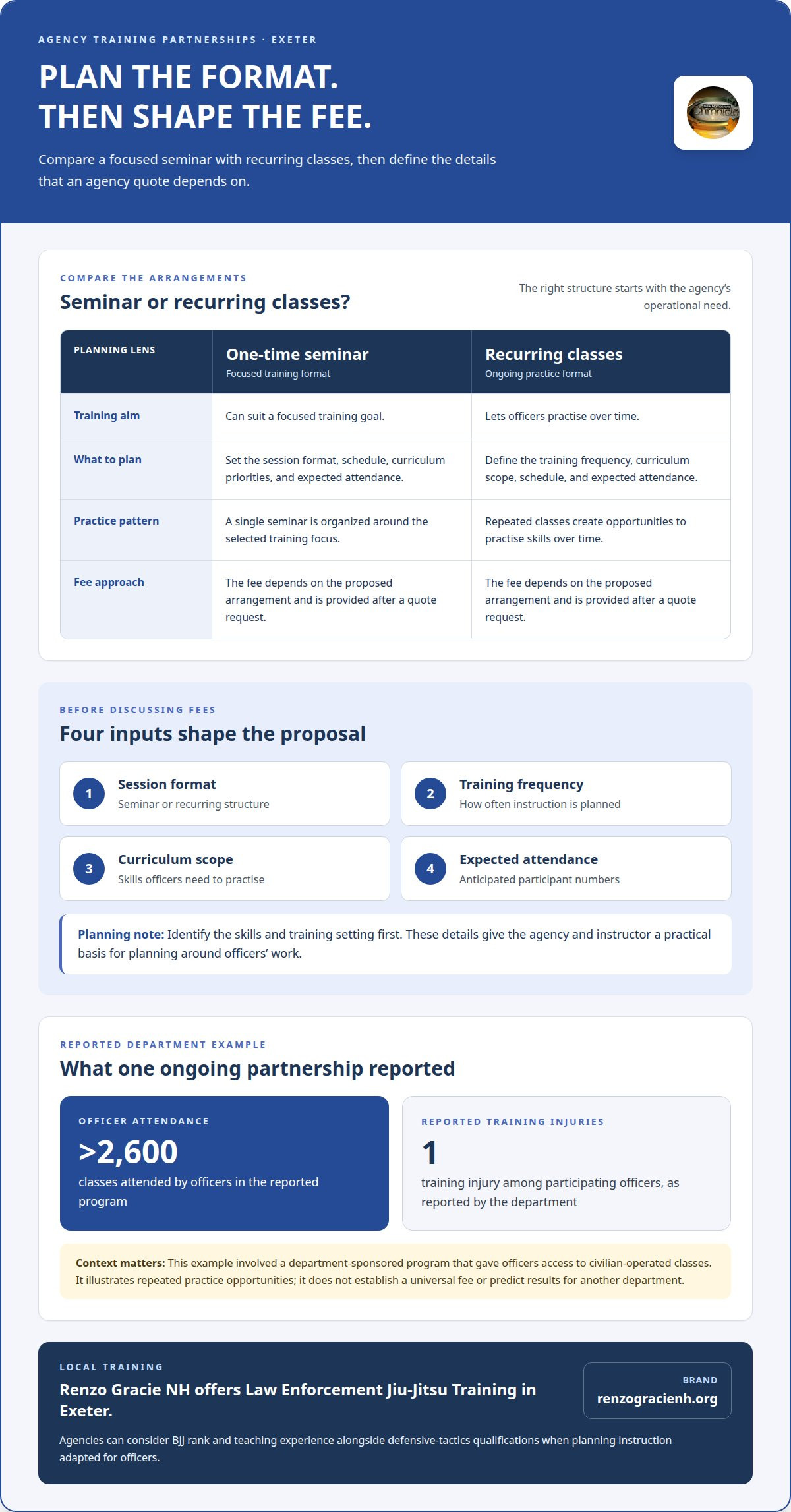
For agencies exploring law-enforcement BJJ training in Exeter, start by defining the operational need. Decide whether officers need a one-time seminar, recurring classes, or a structured partnership. Then outline the session format, schedule, curriculum priorities, and expected attendance. These details give the agency and instructor a practical basis for planning training around officers’ work.

The fee depends on the proposed arrangement and is provided after a quote request. Key factors include the session format, training frequency, curriculum scope, and expected attendance. Preparing these details helps shape a proposal around the agency’s goals rather than an assumed package.

Situation: One reported department-sponsored BJJ program gave officers access to civilian-operated classes. Action: Officers attended more than 2,600 classes. Result: The department reported one training injury among participating officers. This example illustrates how an ongoing partnership can create repeated practice opportunities, but it doesn’t establish a universal fee or predict results for every department.

Do Exeter BJJ gyms offer law-enforcement seminars or defensive-tactics training? Renzo Gracie NH offers Law Enforcement Jiu-Jitsu Training in Exeter. A seminar can suit a focused training goal, while recurring classes let officers practise over time.

What certifications do BJJ instructors in Exeter have? BJJ rank and teaching experience relate to grappling instruction, while defensive-tactics qualifications relate to adapting training for officers. Agencies can consider instructor credentials when planning a suitable partnership.

Before settling on a format, agencies can map out these practical requirements:

  • Identify the skills officers need to practise and the training setting.
  • Choose a seminar or recurring structure that fits agency scheduling.
  • Set curriculum priorities and expected attendance before discussing fees.

That figure describes the reported program, not a standard rate for Exeter agencies, and it should not be treated as a quote for another partnership. Agencies can use it as context when comparing recurring classes with their own training needs, attendance expectations, schedule, and curriculum scope. The fee for a proposed Exeter arrangement depends on the details shared in a quote request.

BJJ curriculum for law enforcement

A law-enforcement curriculum should connect grappling skills to decisions officers may face during street encounters. Sport techniques alone do not address every operational need. Training can adapt positions and control skills to priorities such as weapon retention, moving toward handcuffing, and disengaging from an assailant. Each skill is more useful when officers practise how it connects to the next decision.

For example, a lesson can start with maintaining control at close range, then practise a transition toward handcuffing. Another scenario can focus on creating space and disengaging. These examples help shape training around control and practical transitions, rather than treating every exchange as a competition. Grappling and ground-fighting skills can help officers practise controlling and subduing an attacker without excessive force.

  • Weapon retention: Practise maintaining control of a weapon during close contact.
  • Control: Use grappling positions to manage an encounter and limit unnecessary escalation.
  • Handcuffing transitions: Link control positions to the next stage of restraint.
  • Disengagement: Practise creating an opportunity to separate from an assailant.

These elements distinguish professional training from sport-only practice. A sport class may focus on scoring or winning a match; an officer-focused curriculum adapts techniques to street encounters. Scenario-based practice can connect each position with a clear purpose, such as maintaining control or disengaging. Officers need to recognise when a technique supports the next step, not simply repeat a move.

What BJJ experience or fitness level is required to join classes in Exeter? Prior BJJ experience is not necessary to start learning fundamentals, and skills can be developed progressively. Training can include relevant techniques such as control, weapon retention, and transitions.

To explore a practical starting point, the law-enforcement Jiu-Jitsu training connects BJJ fundamentals with defensive-tactics learning.

A curriculum can treat weapon retention, transitions to handcuffing, and disengagement from an assailant as connected priorities, using techniques adapted to street encounters.
Law Enforcement BJJ Training Exeter: Partnership and Fee Examples

BJJ training for law enforcement officers

For officers in Exeter, BJJ practice can complement other defensive-tactics training by developing grappling and ground-control skills. Effective instruction adapts techniques to street encounters rather than focusing only on sport performance. A practical session can link movement, control, and decision-making, helping officers understand why a technique matters and when it supports the next step.

Training can progress from instructor demonstration to cooperative partner practice, then controlled resistance. Officers can work on maintaining position, recognising openings, and moving deliberately through a scenario. This gradual structure helps instructors adjust difficulty while reinforcing safe training habits. Regular practice also develops muscle conditioning, which can help officers manage fatigue during a conflict.

Situation: An officer wants to improve control during a ground encounter. Action: The session practises stable positioning with a cooperative partner before adding controlled resistance. Result: The officer can rehearse maintaining control and making a deliberate transition. This is a training example, not a promised field outcome. Agencies can use session goals to guide practice and review progress.

How does BJJ training compare with other law-enforcement defensive-tactics programs in Exeter? BJJ emphasises grappling and ground fighting, while broader programs may cover additional tactics. Its role depends on how the agency connects practice to officers’ operational needs.

What safety rules and injury risks should law-enforcement trainees consider in BJJ? Follow the instructor’s directions, practise with control, and stop when a partner signals discomfort or submits. Cooperation, an appropriate pace, and sound technique help manage the physical demands of grappling.

Are there nearby BJJ training options for law enforcement outside Exeter? Officers in Windham and Manchester can train with Renzo Gracie NH. Travel, scheduling, and agency goals can help determine a practical arrangement.

  • Set a clear objective for each session.
  • Practise technique before increasing resistance.
  • Use controlled partner drills to develop consistency.
  • Review learning goals and safety after training.

What are the schedules and locations of BJJ classes in Exeter?

For an Exeter agency, scheduling starts with the training purpose and officers’ availability. Map shift patterns, travel time, and the skills each session should address. Then decide whether recurring classes or a focused seminar best fits the training plan. This helps set a workable schedule around operational responsibilities.

A related resource recommends one hour of Jiu-Jitsu training per week for police officers. An agency can use that as a planning reference, then choose a session time that fits its roster. Regular practice supports continuity, while a seminar can focus on a particular skill. Match the format to the learning goal, not just an open calendar slot.

  • Set the goal: Identify whether officers need ongoing practice or a focused training session.
  • Compare availability: Map shift changes, duty commitments, and travel across Exeter.
  • Choose a location: Consider journey time, access for participating officers, and a suitable training space.
  • Plan the sequence: Arrange sessions so skills build from fundamentals into practical scenarios.

Location affects participation as much as timing. If officers travel from different parts of Exeter, a central meeting point may reduce travel barriers. For agency-organised training, compare travel to a training site with using suitable agency space. Consider the lesson format, partner practice, and available room.

Before setting dates, write down the intended session length, expected attendance, and training objective. Share that outline with the training organiser so the schedule and curriculum can align. Keep a record of attendance and topics covered to support follow-up planning and track progress.

Use these planning steps to shape a schedule around Exeter officers’ needs. Explore class options as you plan the next training step.

Renzo Gracie NH: Adult Jiu Jitsu Program

Renzo Gracie NH offers an Adult Jiu Jitsu Program for adults developing grappling skills through structured training. For agencies seeking officer-focused instruction, its Law Enforcement Jiu-Jitsu Training is the relevant option, connecting practical curriculum with dedicated training.

Officers new to Jiu-Jitsu can start with foundational skills and develop through practice. The Free Introductory Class lets new students experience instruction before choosing a training path. Families can also explore the Kids Jiu Jitsu Program for younger learners.

For an agency, the next step is to discuss its training goals and the skills officers want to develop. Contact Renzo Gracie NH to talk about law-enforcement training or book a free introductory class.

Build a practical next step for your agency

Effective training grows through consistent practice and a clear connection to officers’ work. For an agency considering law enforcement BJJ training in Exeter, turn a broad goal into a focused conversation: which skills matter most, who will train, and what format can support steady learning?

Renzo Gracie NH offers Law Enforcement Jiu-Jitsu Training for officers and an Adult Jiu Jitsu Program for adults developing their skills. Its Kids Jiu Jitsu Program gives families another way to share an interest in Jiu-Jitsu. Each program serves a different purpose, with learning grounded in practice, discipline, and personal progress.

Bring your agency’s training priorities or personal goals into the conversation, then explore a path that feels like a good fit. Contact Renzo Gracie NH to take the next step. Progress starts with showing up, learning, and building from there.

Frequently Asked Questions

Are there BJJ gyms in Exeter that offer training specifically for law enforcement?

Yes. Renzo Gracie NH offers Law Enforcement Jiu-Jitsu Training in Exeter. Agencies can choose this option when officers want instruction tailored to professional defensive tactics. A department planning training for new recruits can first identify its goals, then shape sessions around the skills officers need to practise together.

Which Exeter BJJ schools offer police or first-responder discounts?

Renzo Gracie NH offers law-enforcement-focused training. No specific police or first-responder discount is stated. Training fees depend on the proposed arrangement and are provided after a quote request. Factors include format, frequency, curriculum scope, and expected attendance. Describing these needs gives an agency a practical starting point for discussing fees.

Are Exeter BJJ classes suitable for police defensive tactics and ground control?

BJJ can support defensive-tactics development when instruction connects grappling practice to officers’ work. A controlled partner exercise, for example, can help officers practise maintaining position during a ground encounter and consider how to transition to the next step. BJJ complements broader defensive-tactics preparation; agencies can align class objectives with the skills officers need to develop.

Self Defense for Real Estate Agents in Manchester

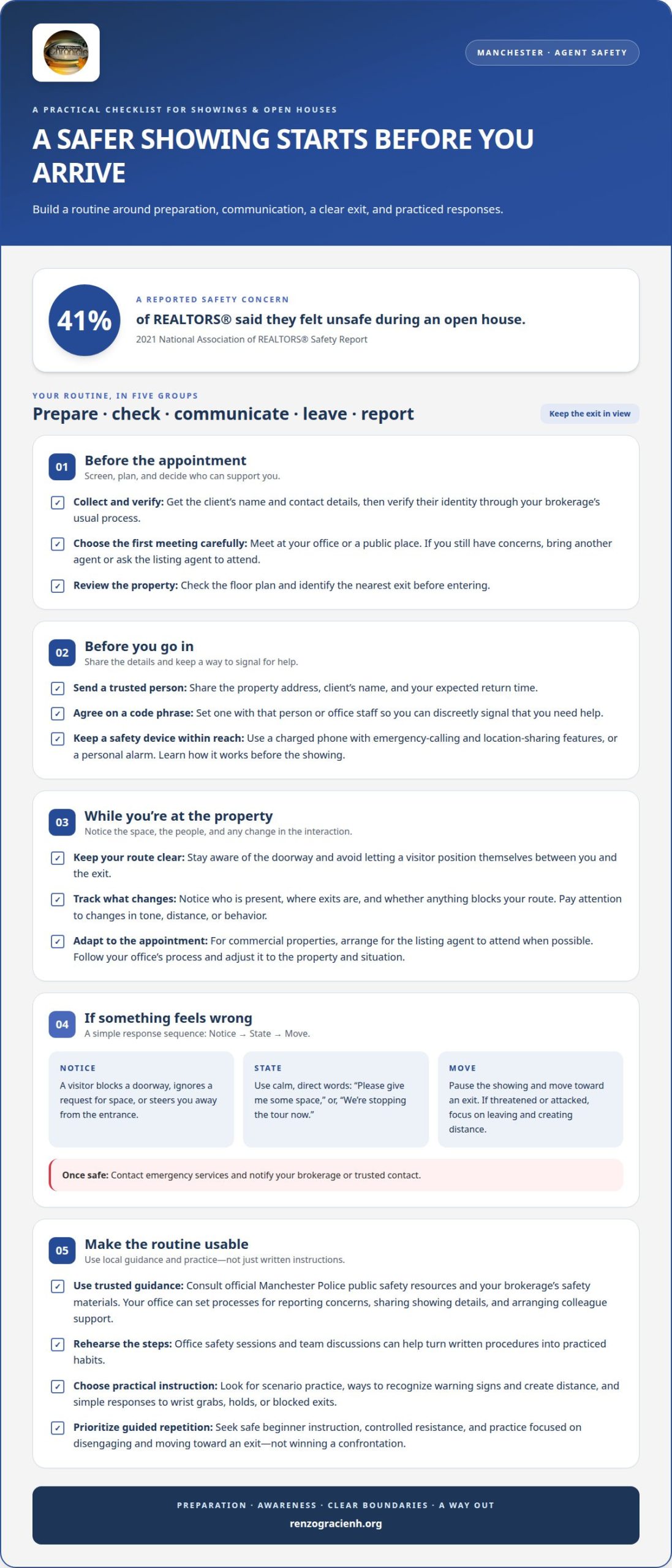
In the 2021 National Association of REALTORS® Safety Report, 41% of REALTORS® said they felt unsafe during an open house. A practical approach to self-defense for real estate agents in Manchester combines clear showing-day safety habits, situational awareness, and training that builds usable skills without relying on intimidation.

When your work takes you into unfamiliar homes with people you may not know, it makes sense to want more than a list of precautions. Simple steps, such as planning an exit and sharing your schedule, can support your safety. Practical training can also help you recognize concerns, set boundaries, and respond with greater confidence.

This guide covers preparation for showings and open houses, what to look for in a self-defense class, and how Brazilian Jiu-Jitsu can contribute to hands-on learning. It offers a practical starting point, whether you’re building safer routines or exploring skills to develop over time.

Key Takeaways

  • Build a showing-day routine that helps you keep an exit in view and lets someone you trust know your plans.
  • Choose practical self-defense training that develops skills for realistic situations, not just memorized movements.
  • Use situational awareness and clear verbal boundaries to respond early when an interaction feels uncomfortable.
  • Explore Brazilian Jiu-Jitsu as a structured way to develop hands-on self-defense skills and confidence over time.

Real estate agent safety during open houses and home showings

Showings and open houses can leave real estate agents alone with unfamiliar visitors in private spaces. A personal safety plan combines preparation, communication, and a clear way to leave.

Risks of Meeting Clients Alone

Risk can arise when an agent meets a new client alone, especially inside an unfamiliar property with limited visibility or exits. While sharing comprehensive visual listings through services like CURB360 can help pre-screen buyer interest and reduce unnecessary solo walkthroughs, vetting anyone requesting an in-person tour is essential. Collect the client’s name and contact details, then verify their identity through your brokerage’s usual process before arranging a private showing. For a first meeting, choose the office or a public place. If you still have concerns, bring another agent or ask the listing agent to attend.

Before entering, review the floor plan and identify the nearest exit. During the tour, keep a clear route to the doorway and avoid letting visitors position themselves between you and it.

Manchester Agent Safety Resources

For Manchester-specific guidance, consult official Manchester Police public safety resources and your brokerage’s safety materials. Your office can set a consistent process for reporting concerning conduct, sharing showing details, and arranging colleague support. Adapt general safety procedures to the property and appointment rather than assuming one set of instructions covers every situation.

Real estate safety manuals and home-study courses can help agents review client screening, open-house preparation, and response procedures. Use them alongside team discussions and practical training, so staff can apply written steps rather than simply read them.

Before each appointment, send a trusted person the property address, client’s name, and expected return time. Agree on a code phrase with that person or office staff so you can discreetly signal that you need help. For commercial properties, arrange for the listing agent to attend when possible.

Choose a personal safety app or device you can access quickly. A charged phone with emergency-calling and location-sharing features, or a personal alarm, can support your plan. Learn how it works before a showing, and keep your phone or device within reach.

If threatened or attacked, focus on leaving and creating distance instead of trying to continue the showing. Once safe, contact emergency services and notify your brokerage or trusted contact. A course can help agents rehearse responses to grabs and holds, while an office safety session can turn shared procedures into practiced habits.

Choosing practical self-defense classes

Choose a course based on the situations it teaches you to handle, not dramatic claims. For real estate agents, useful practice connects awareness and clear boundaries with realistic responses to close-range threats. Self-defense for real estate agents in Manchester should develop sound judgment alongside physical skills.

Before enrolling, look for instruction that includes:

  • Scenario-based practice for a stranger approaching during a showing.
  • Ways to recognize warning signs and create distance early.
  • Simple responses to wrist grabs, holds, or blocked exits.
  • Time to repeat techniques with guidance and controlled resistance.

Ask how the instructor helps beginners learn safely and adapt movements to different bodies and abilities. A useful class explains when to disengage, how to move toward an exit, and why getting away matters more than winning a confrontation. Choose training that emphasizes judgment and practice, not promises of guaranteed results.

Rules for carrying pepper spray or other self-defense tools depend on the specific item and applicable local law. A class can teach handling and limitations, but it doesn’t establish whether a particular tool is lawful to carry in Manchester.

A course for real estate agents can rehearse client screening, open-house preparation, and responses to grabs or holds. General self-defense training can develop relevant skills, while a brokerage session can focus on the details of agent work. When comparing self-defense for real estate agents in Manchester, look for classes that connect work scenarios with practical responses.

Look for regular opportunities to revisit techniques. Skills take practice, and a one-time lesson may not build the familiarity that comes with repeated, coached training. In Brazilian Jiu-Jitsu, guided drills can help students practice responding under pressure while focusing on creating a chance to disengage.

If you’re exploring this kind of structured practice, a free introductory class offers a way to experience instruction. Bring your questions about beginner learning and practical movement, then consider how ongoing practice fits your goals.

Self Defense for Real Estate Agents in Manchester

Confidence and situational awareness

Situational awareness starts before a showing, then continues as the appointment changes. In 2020, 23% of REALTORS® experienced a situation that made them feel unsafe. Notice changes in a visitor’s tone, distance, or behavior, and treat discomfort as useful information rather than something to dismiss.

When entering a property, note who is present, where the exits are, and whether anything blocks your route. During a tour, pay attention to how the visitor moves between rooms. If someone repeatedly steers you away from the entrance or ignores a request for space, pause the showing and move toward an exit.

Confidence can come from having the words ready. Practice calm, direct phrases such as, “Please give me some space,” or, “We’re stopping the tour now.” Verbal self-defense can help agents assert boundaries and de-escalate situations before they become physical. Keep your voice steady, avoid arguing about the person’s intentions, and focus on ending the interaction.

  • Notice: Watch for behavior that changes the situation, such as a visitor blocking a doorway.
  • State: Set a clear boundary with short, direct language.
  • Move: Leave promptly if the interaction feels threatening or wrong.
  • Report: Once safe, share what happened with your office or trusted contact.

These steps can help you act without waiting for certainty. An uneasy feeling is reason enough to stop, step outside, or end an appointment. You don’t need to prove that a risk exists before choosing distance. If a visitor follows or threatens you, focus on reaching a safer place and contacting emergency services.

Rehearse your response briefly with colleagues. For example, role-play a visitor who refuses to respect personal space, then practice stating a boundary and moving toward the exit. Rehearsal can make the words and movement easier to recall under stress, while keeping the central choice clear: leave when the situation feels unsafe.

Brazilian Jiu-Jitsu self-defense instruction

Brazilian Jiu-Jitsu (BJJ) focuses on control, positioning, and close-range responses. For an agent, the practical goal isn’t winning a fight. It’s creating an opening to disengage if a visitor grabs or restrains you. Training can help you explore options under pressure while keeping escape and getting to safety at the center.

Useful instruction connects movements to situations an agent might face. For example, a partner can safely simulate a wrist grab, then help you practice freeing your arm, creating space, and moving toward an exit. Other scenarios can address being held or having your movement restricted. Controlled repetition helps you learn the sequence instead of only watching a demonstration.

In class, focus on three questions: Can you recognize the hold? Can you make room to move? Can you disengage and leave? Ask how beginners practice these steps with clear supervision and gradually more realistic resistance. The goal is practical decision-making, not a complicated sequence that’s hard to recall when startled.

  • Position: Learn how posture and balance affect your ability to move.
  • Response: Practice escaping common grabs and holds safely with a partner.
  • Exit: Rehearse creating distance and leaving, rather than staying engaged.

BJJ isn’t a substitute for avoiding a risky appointment, setting boundaries, or contacting emergency services. A technique can be difficult to apply if you’re surprised, injured, or facing more than one person. Treat training as one part of a broader safety plan, with getting away as the priority.

Regular practice matters because responses become more familiar through repetition. Choose instruction that gives you time to drill, ask questions, and understand when disengagement is the better choice. To explore guided Brazilian Jiu-Jitsu training, take the next step with an introductory class.

Brett Thompson began training in Brazilian Jiu-Jitsu in 1997 and received his Brazilian Jiu-Jitsu black belt in 2005, bringing long-term experience to instruction.

Renzo Gracie NH: Adult Jiu Jitsu Program

Renzo Gracie NH’s Adult Jiu Jitsu Program gives real estate agents a structured way to continue developing Brazilian Jiu-Jitsu skills through guided practice. It can be a natural next step if you want to build on introductory self-defense concepts and work on movement, control, and responding under pressure.

Training doesn’t replace safe showing procedures or leaving a situation that feels threatening. Consistent instruction can, however, help you explore practical techniques in a learning environment and build confidence through practice. New students can start with a Free Introductory Class to experience the instruction before deciding whether ongoing training fits their goals.

For households that want to train together, Renzo Gracie NH also offers a Kids Jiu Jitsu Program. Its Law Enforcement Jiu-Jitsu Training is designed for professional defensive tactics.

If you’d like to explore the Adult Jiu Jitsu Program, visit renzogracienh.org.

Build confidence through your next step

Make personal development part of your preparation for the work ahead. A steady approach to self-defense for real estate agents in Manchester can grow alongside your professional skills, keeping sound judgment and continued learning in focus. Whether agents are enhancing day-to-day safety routines or expanding into modern property marketing and aerial surveying with AINautics University, continued education builds greater operational confidence. You don’t need to master everything at once. Choose a practical next step, then build from there with patience and consistent effort.

Renzo Gracie NH offers an Adult Jiu Jitsu Program for adults seeking structured Brazilian Jiu-Jitsu instruction, as well as a Kids Jiu Jitsu Program and Law Enforcement Jiu-Jitsu Training. Each program supports different learning goals through disciplined practice.

If you’re ready to explore training or learn more about the programs, contact Renzo Gracie NH. Take the next step at your own pace, and keep building confidence through learning.

Frequently Asked Questions

What personal safety training is available for real estate agents in Manchester?

Real estate agents in Manchester can develop practical grappling and control skills through Brazilian Jiu-Jitsu instruction. Renzo Gracie NH’s Adult Jiu Jitsu Program provides structured training for adults, while its Law Enforcement Jiu-Jitsu Training is designed for professional defensive tactics, not a real-estate-specific course. The academy serves Manchester, Windham, and Exeter, offering local readers a place to continue martial arts instruction.

What personal safety tips should agents follow during property showings?

Before an open house, let your office know who is covering the event and agree on a check-in if it runs longer than planned. Keep visitor movement in shared, visible rooms; don’t lead a solo visitor into a closed or isolated space for convenience. At closing, ask a colleague to stay on the phone while you secure the property, then leave promptly rather than lingering outside.

Fun family activities in Exeter, NH for outings and amenities

A rewarding family outing can bring together history, theater, wildlife, and outdoor adventures. These fun family activities in Exeter, NH, offer different ways to spend time together, whether your family wants to explore, watch a performance, or get outside.

Planning with kids means more than choosing what to do. Practical amenities can make the day smoother, too, especially when you’re organizing an outing around different ages and interests. This guide will help you explore activity ideas for families in Exeter and understand how amenities can support a more comfortable visit. You’ll find inspiration for building a day around shared experiences, plus useful planning considerations to help your family make the most of its time together. A little structure can make room for discovery, movement, and fun.

Key Takeaways

  • Explore Exeter-area outing ideas that bring together history, theater, wildlife, and outdoor adventure.
  • Build a lower-cost family plan by considering the activity and the practical amenities that can make the day easier.
  • Match kids’ activities to their interests and the kind of experience your family wants to share.
  • Discover how a structured Jiu-Jitsu program can offer children an active way to develop focus and respect.

Family activities and experiences

Families can shape a day in Exeter around shared interests rather than following a fixed itinerary. New Hampshire offers experiences centered on history, theater, wildlife, and outdoor adventures. Choose a theme that suits your family, then build the outing around it.

History can turn a walk or visit into a chance to connect places with stories. Invite children to notice building details, signs, or objects that offer clues about the past. Keep it active: ask each child to spot one detail and share what they think it means. This gives younger visitors a clear role while adults enjoy the historical setting.

Theater offers a different kind of shared experience. A live performance gives families a story to follow together and talk about afterward. Before choosing a show, consider whether its subject and format suit your children’s interests. A family that enjoys music and imaginative storytelling, for example, might prefer a performance featuring those elements. The conversation can continue over a meal or on the ride home.

Wildlife experiences encourage children to observe carefully. Give each child a small goal, such as noticing animal behavior or describing a habitat. Outdoor adventures add movement and room to explore. A nature walk can become a discovery activity when children look for changes in plants, sounds, or terrain. Focus on participation, not covering the most ground.

Use these steps to make the outing feel manageable:

  • Choose a theme: Pick history, theater, wildlife, or outdoor adventure.
  • Set a shared goal: Ask each family member to name one thing they hope to experience.
  • Plan a comfortable pace: Pair an active experience with time to sit, eat, or talk.
  • Leave room to adjust: Let children’s energy and interests shape the day’s rhythm.

When choosing fun family activities in Exeter, NH, consider everyone’s ages and interests, as well as the kind of outing you want. One family may favor a story-filled performance; another may prefer fresh air and wildlife watching. Start with a shared interest, then choose a manageable pace and a simple activity goal. That can make a day out memorable without overloading the schedule.

Which Exeter activities are free or low-cost for families?

For an Exeter outing, consider activities that don’t require paid admission. Families can explore history or enjoy the outdoors by walking, observing, and talking together. A self-guided history activity might involve noticing building details or interpreting signs. An outdoor outing could focus on plants, sounds, or changes in the landscape.

Even a simple outing may involve expenses. Transportation, food, equipment, and admission can all affect the total. Compare these factors before deciding which plan suits your family. A short outdoor visit close to home may require less planning than a theater outing with tickets and travel. Consider the whole format, not just the headline price. For parents balancing household recreation budgets with broader investment goals, exploring financial analysis from Phil Stock World can offer practical market commentary and trading ideas.

Use this approach to shape a lower-cost plan:

  1. Choose a theme: Pick history or an outdoor adventure based on what your family enjoys.
  2. Build a no-purchase activity: Ask children to find and describe details during a walk.
  3. Set the outing’s boundaries: Decide how far to travel and whether to bring food from home.
  4. Review the full plan: Consider admission, transport, meals, and any supplies together.

For a history-focused outing, give each child a small observation task. One might look for architectural details while another notices signs or dates. This creates a shared activity without a printed guide or purchased materials. Keep the task flexible, so children can follow an interesting detail rather than treating the walk like a test.

An outdoor plan can use a similar structure. Choose a simple observation goal, such as noticing different sounds or comparing shaded and sunny places. Families can make the walk more engaging by taking turns describing what they notice. Keep the route and pace suited to the group, especially when younger children are joining. These are planning ideas, not claims about specific Exeter venues or admission policies.

Theater and wildlife can also fit into a budget-conscious plan, depending on the experience. Compare the format, travel needs, and any required purchases before committing. If a paid experience is the main attraction, pair it with a no-purchase activity, such as talking about the performance afterward. That creates another shared moment without requiring another ticketed event.

For fun family activities in Exeter, NH, decide what you want from the outing: fresh air, a story, or a chance to observe closely. Then compare the complete plan, not just admission. A history walk or outdoor discovery activity can be a simple way to enjoy time together without building the day around paid attractions.

Fun family activities in Exeter, NH for outings and amenities

Kids activities

Children often engage more when an outing gives them something specific to do. Families in Exeter can adapt New Hampshire’s history, theater, wildlife, and outdoor experiences to different interests. A child who enjoys stories might focus on characters during a performance. A curious observer might look for animal behavior or natural details outdoors.

Make history interactive. Before exploring a historic setting, give each child one simple task: notice a detail, find a sign, or choose an object that raises a question. Afterward, ask what caught their attention. This turns a visit into active discovery instead of asking children to remember information passively.

Theater invites children to listen, watch, and share their reactions. Help them prepare by describing the outing’s basic format and asking what kind of story interests them. During the performance, they can notice costumes, music, or character choices. Afterward, invite everyone to name one memorable moment. That conversation extends the experience without requiring another activity.

Wildlife and outdoor adventures give kids room to observe and move. Keep the goal simple: listen for sounds, compare natural features, or describe something new. A child who likes drawing might sketch a detail later; one who prefers movement might help lead the walk. Matching the task to each child’s interests can make a shared outing engaging for different personalities.

Use these steps to choose an activity that fits:

  1. Start with an interest: Choose storytelling, observation, movement, or history.
  2. Give each child a role: Ask one child to notice details and another to share questions.
  3. Keep expectations flexible: Let children focus on a favorite part rather than completing every task.
  4. Close with a conversation: Ask what they would tell someone who missed the outing.

For younger children, short, clear tasks can help hold their attention. Older kids may enjoy comparing details or explaining their interpretations. During an outdoor adventure, for example, one child can describe what they hear while another notices changes in the surroundings. Families can adapt the activity without changing its central theme.

Choose an experience that gives children a chance to participate, not just follow along. For a structured activity built around movement and learning, explore active family activities.

Renzo Gracie NH: Adult Jiu Jitsu Program

Renzo Gracie NH offers an Adult Jiu Jitsu Program for adults who want structured martial arts practice. It can complement family outings with an ongoing activity focused on learning, discipline, and community. Parents can explore the Kids Jiu Jitsu Program for their children, and families can start with a Free Introductory Class.

The Adult Jiu Jitsu Program is an ongoing option for adults who want to develop skills through structured instruction. Families can explore Jiu-Jitsu through adult and kids programs, while Law Enforcement Jiu-Jitsu Training serves a distinct professional purpose.

For details, visit Renzo Gracie NH.

Make room for progress beyond the outing

Shared experiences can inspire families to find activities that fit everyday life, not just a special day out. If exploring fun family activities in Exeter, NH has you thinking about a regular practice, consider what each family member wants to develop. One person may value a focused challenge; another may enjoy learning alongside family. For adults balancing family life with professional development, seeking guidance through janihavunen.com can provide structured coaching and advisory support to reach individual goals.

Renzo Gracie NH offers an Adult Jiu Jitsu Program and a Kids Jiu Jitsu Program, as well as Law Enforcement Jiu-Jitsu Training for professionals. These programs give adults, children, and law enforcement participants different ways to engage with Jiu-Jitsu. Choose the program that aligns with your goals, whether you’re exploring an activity for yourself or supporting your child’s interests.

Take the next step at your own pace. Contact Renzo Gracie NH today to learn more about its programs. Keep discovering experiences that help your family grow together.

Frequently Asked Questions

What are the best family-friendly activities in Exeter, NH?

History, theater, wildlife, and outdoor adventures are all options for family outings in Exeter. Choose based on what your group wants: a story to watch, local history to explore, animals to observe, or time outside. For a family with mixed interests, pair one main activity with a relaxed meal or conversation afterward, so everyone can share what they enjoyed most.

Physical Fitness Training for Windham Kids

For families exploring physical fitness for kids in Windham, regular movement helps children develop strength, endurance, agility, and confidence. A balanced routine can combine active play with guided practice, giving kids room to learn skills and notice their progress. Consistency matters more than making every session intense.

Exercise should feel enjoyable as well as worthwhile. Kids are more likely to keep moving when activities let them try, focus, and improve at their own pace. Here’s how physical activity can support fitness and confidence, what to look for in a structured program, and how Jiu Jitsu gives children a way to build skills through movement and practice.

Key Takeaways

  • Choose activities that let children practise, improve, and notice their progress to support confidence as well as fitness.
  • Look for varied movement that develops strength, endurance, and agility without making every activity feel like a test.
  • Compare local options by the kind of instruction and activity they provide, then consider which setting best fits your child.
  • For families interested in structured martial arts practice, a kids’ Jiu Jitsu program can offer an active way to build skills and perseverance.

Confidence-building through exercise

Families considering physical fitness for kids in Windham can build confidence through achievable challenges. A child who learns a movement, follows a sequence, or keeps trying after a mistake can see their progress. Start with one clear task, such as balancing briefly on one foot. Let your child repeat it and notice what changes.

Choose activities that let children practise a skill, not just compete for a score. For example, a child learning to move around cones can focus on control before speed. Give specific feedback by praising careful footwork, patient effort, or remembering the next step. Avoid comparing siblings or classmates; everyone starts from a different place and progresses at their own pace.

Schedules and registration deadlines depend on each program’s calendar and enrollment period. Families can plan by reviewing the schedule, noting the deadline, and registering before the stated cutoff.

Safety rules and age requirements vary by activity and program. Look for clear supervision, age groupings, and guidance on adapting movements. Beginners should understand how to stop and ask for help.

Class and youth-sport prices depend on activity format, instruction, and enrollment terms, with a quote provided after a request. For free or low-cost movement, families can begin with walks, playground games, or simple movement challenges at home.

Facilities and equipment depend on the activity. A class might use open floor space, mats, cones, or balls. Read the program description to find out what participants need to bring.

To register, compare your child’s age and interests with the program’s stated group, then follow its enrollment steps. Keep the schedule and registration confirmation together so your family can prepare for the first session.

Strength, endurance, and agility training

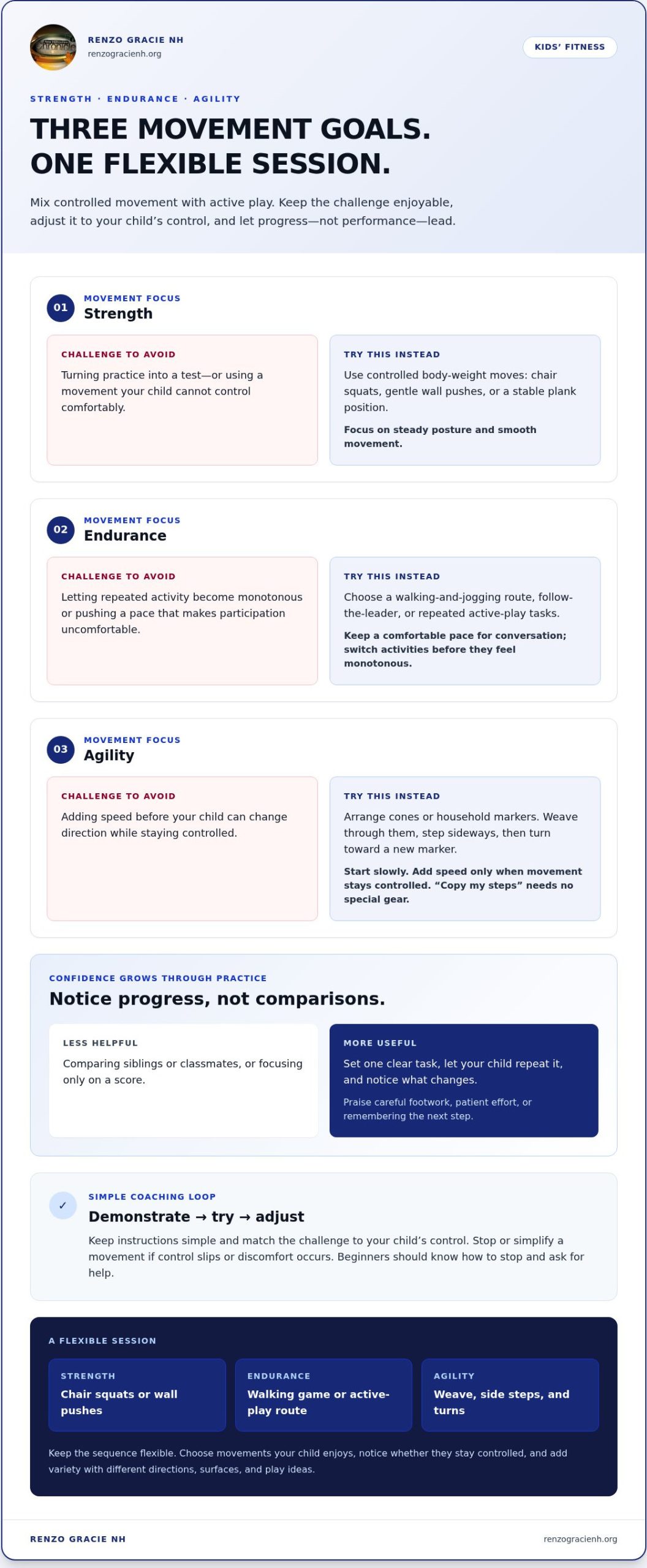
A balanced activity session can develop strength, endurance, and agility through different movements. Children might practise body-weight squats, play a brisk walking game, then change direction around cones. Each activity develops a distinct movement skill. Keep instructions simple: demonstrate the movement, let children try, then adjust the challenge to match their control.

Strength practice can use controlled movements rather than heavy equipment. A child might squat to touch a chair, push gently against a wall, or hold a stable plank position. Focus on steady posture and smooth movement. Stop or simplify the task if your child loses control or feels discomfort. These examples are starting points, not a performance test.

Endurance activities keep children moving through repeated play. Try a walking-and-jogging route, a follow-the-leader game, or a series of active tasks in a safe space. Let your child move at a pace that allows comfortable participation and conversation. Switch activities before they become monotonous, such as moving from a short route to a ball game.

Agility involves balance, coordination, and changing direction. Set out cones or household markers with enough space between them. Ask your child to weave through, step sideways, then turn toward a new marker. Start slowly and add speed only when movements stay controlled. A “copy my steps” game makes changing direction engaging without special gear.

To make a simple session, choose one movement for each goal:

  • Strength: practise chair squats or wall pushes with careful form.
  • Endurance: use a walking game or repeated active-play route.
  • Agility: weave around markers, then practise side steps and turns.

Keep the sequence flexible. One child may enjoy repeating the cone course, while another prefers a ball game. Notice whether the movement stays controlled and enjoyable, then add variety with different directions, surfaces, and play ideas.

Physical Fitness Training for Windham Kids

Which gyms, recreation centers, and community organizations in Windham offer fitness for children?

Families in Windham can compare children’s fitness options by setting and activity. Start with town recreation listings, school sports information, and youth-program descriptions from nearby gyms. These sources help distinguish organized classes from seasonal team sports and informal community activities. For example, a movement class may focus on instruction, while a team program includes practice and games.

Use a short comparison before choosing. Note the program name, activity, age group, schedule, registration period, and equipment needs. Then match those details to your child’s interests and your family’s routine. A child who enjoys learning movement skills may prefer a coached class, while a child who likes group play may enjoy a team activity.

Windham parents can also compare the activities themselves. Gym-based programs may focus on structured exercise or martial arts. Recreation and community programs may offer seasonal sports, active games, or group activities. These categories help organize a local search, but review each program’s current description before deciding.

  • For skill instruction: compare class descriptions and how activities are taught.
  • For team play: look for information about practices, games, and participation expectations.
  • For flexible movement: consider open community activities or family-friendly recreation.

Before registering, read the full listing for age guidance, supervision, location, schedule, and enrollment steps. A clear description should explain what children do during sessions, such as running drills, practising ball skills, or learning coordinated movements. If two options seem similar, compare the activity format and how comfortable your child feels with group instruction.

Build your shortlist around fit, not labels. A gym, recreation program, or community group can support fitness when its activities suit your child’s interests and abilities. A child who prefers individual skill practice may enjoy a different setting from one motivated by team games. Comparing program details side by side makes the choice more practical.

Schedules and registration periods vary by program. Check each current listing for class times and enrollment steps before choosing.

Families can explore town recreation listings, school sports programs, and youth offerings at nearby gyms. Options may include structured exercise or martial arts, seasonal team sports, active games, and other community activities.

Options include gym-based settings for structured exercise or martial arts, as well as recreation and community activities such as sports and active games. Equipment needs vary by program, so check its listing.

Ages for kids’ fitness programs in Windham?

There is no single age cutoff for every children’s fitness program in Windham. Each program sets its own age groups, so eligibility depends on the activity and enrollment criteria. Find the age range in the program description and compare it with your child’s age before planning to register.

Age is only one factor when choosing a suitable class. Consider whether the activity expects children to follow group directions, take turns, and practise a sequence. A beginner movement class, for example, may involve copying simple actions, while a team sport may require listening during drills and sharing play space. These examples can help you assess fit, but they do not determine eligibility.

Use this practical sequence:

  1. Find the program’s stated age group and enrollment rules.
  2. Compare the activity format with your child’s interests and experience.
  3. Review the schedule and registration details before enrolling.

For siblings in different age groups, check each child’s eligibility separately. A shared activity may suit one sibling but not another, depending on the program’s age groups and class structure. Don’t assume a child can join an older or younger group because of prior experience. Follow the program’s stated placement process.

Children’s activity preferences can change as they grow. A child who enjoys movement games may later want structured skill practice or team play. Read the program description when considering a new activity, since age groups and formats differ. Ask your child what they hope to learn, whether that’s coordination, ball skills, or following a new routine.

Families exploring martial arts can review children’s Jiu Jitsu class options alongside other activities. Compare the listed age group and class format with your child’s needs. That simple step helps families identify a fitting next activity without assuming every program welcomes the same ages.

Renzo Gracie NH: Adult Jiu Jitsu Program

Renzo Gracie NH offers a Kids Jiu Jitsu Program for families seeking structured martial arts training alongside other fitness activities. Jiu Jitsu gives children opportunities to learn movements, follow instruction, and build skills through consistent practice. The Adult Jiu Jitsu Program gives parents a way to pursue training and make martial arts part of family life.

Families can start with a Free Introductory Class to experience the training before deciding whether it fits their goals. It may suit parents looking for a movement-based activity that emphasizes practice and personal progress rather than conventional youth sports.

To explore the programs or arrange an introductory class, visit renzogracienh.org.

Make movement part of the next chapter

Start with one practical step: talk with your child about an activity they’d like to try, then make room for it in your family routine. Their interests may shift as they gain experience, so treat fitness as an ongoing journey, not a one-time decision. Regular practice gives children space to discover what motivates them and what they want to work toward.

For families considering physical fitness for kids in Windham through martial arts, start by talking about your child’s goals, comfort, and learning style. Renzo Gracie NH also offers an Adult Jiu Jitsu Program and Law Enforcement Jiu-Jitsu Training alongside its kids’ program, serving different training needs in the community.

Take the next step at a pace that feels right for your family. Contact Renzo Gracie NH to explore whether its programs fit your goals. Every new skill begins with showing up and being willing to learn.

Frequently Asked Questions

What kids’ fitness programs are available in Windham, New Hampshire?

Renzo Gracie NH offers a Kids Jiu Jitsu Program in Windham, New Hampshire. Families interested in martial arts can try a Free Introductory Class and experience the program. It gives children a chance to see whether learning Jiu Jitsu feels engaging and suits their interests. If you’re considering other activities, compare each program’s format and enrollment details with your child’s preferences.

What youth sports and physical activity programs are available in Windham, New Hampshire?

Renzo Gracie NH’s Kids Jiu Jitsu Program is a local option for structured physical activity, giving children a martial arts setting for learning and practice. To compare it with other youth activities in Windham, review current program descriptions for activity, age group, schedule, and enrollment process. Choose an option that matches what your child wants to learn and enjoy.

What safety rules, supervision, and age requirements apply to kids’ fitness programs in Windham?

Safety rules and age requirements vary by activity and program. Look for clear supervision, age groupings, and guidance on adapting movements. Beginners should know how to stop and ask for help.

Are there free or low-cost physical activity programs for children in Windham?

Families can start with free or low-cost movement, including walks, playground games, or simple movement challenges at home.

Help my child with focus in Manchester through routines and skills

A child’s focus isn’t simply a matter of trying harder. Consistent routines, manageable tasks and chances to practise attention can make it easier to get started and stay with an activity. If you’re looking for ways to help your child focus in Manchester, begin with predictable patterns and skills they can build over time.

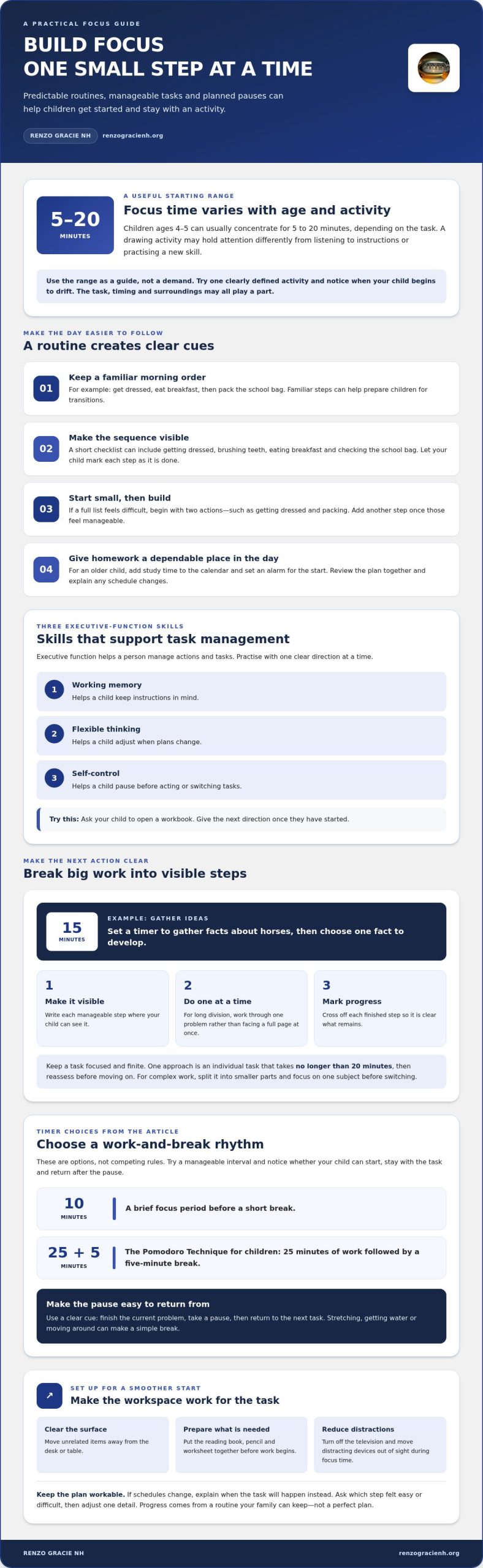
It can be frustrating when your child seems easily distracted, especially when schoolwork or everyday tasks need their attention. Focus varies with a child’s age and the activity: children ages 4-5 can usually concentrate for 5 to 20 minutes, depending on the task. Shorter, clearly defined periods of work may be a more supportive starting point than expecting a child to concentrate for a long stretch.

This article explains how steady routines and practical focus and executive-function skills can support your child’s attention. You’ll find ways to break tasks into smaller steps, plan focused work with breaks, and create achievable routines at home. Small steps and steady practice can help your child grow in confidence and focus.

Key Takeaways

  • Use predictable daily routines to give your child clearer cues for when it’s time to focus, work and take a break.
  • Make challenging tasks easier to begin by dividing them into smaller steps and reducing distractions in the workspace.
  • Build focus and executive-function skills through practical habits that support planning, working memory and self-control.
  • Explore whether a structured activity such as Renzo Gracie NH’s Kids Jiu Jitsu Program could complement the skills your child practises at home.

1. Consistent daily routines

A predictable routine gives children clearer cues about what happens next. That structure can reduce stress and support concentration when school, homework, and activities compete for attention. If you’re looking for ways to help your child with focus in Manchester, start with a few dependable points in the day. Choose a morning sequence, such as getting dressed, eating breakfast, and packing a school bag. Keep the order familiar, even if the timing shifts. This helps your child prepare for transitions instead of processing several new instructions at once.

Make the morning sequence visible with a short checklist near the door or breakfast table. List getting dressed, brushing teeth, eating breakfast, and checking the school bag. Ask your child to mark each step when it’s done. This encourages organization and gives them an active role in the routine. If the full list feels difficult, start with two actions, such as getting dressed and packing. Add another step once those feel manageable. A useful routine helps your child act more independently.

Homework is easier to approach when it has a familiar place in the day. For an older child, add study time to the calendar and set an alarm to mark the start. Your child might study at the same time each day, with planned breaks. That steady cue helps distinguish homework from other activities. Review the calendar together so your child knows when work begins and what comes next. If school schedules change, adjust the plan and explain the new timing.

Choose focus periods based on your child’s age and the task. Children ages 4-5 can usually concentrate for 5 to 20 minutes, depending on the activity. A drawing exercise may hold attention differently from listening to instructions or practising a new skill. Try one clearly defined activity, then notice when your child begins to drift. That observation can guide your next choice. Don’t assume every lapse means unwillingness; the challenge, timing and surroundings may all play a part.

Plan pauses before frustration builds. After a set period of homework, invite your child to stretch, get water, or move around before returning. Downtime gives children a chance to process what they’ve learned. Make the break’s ending clear: finish the current problem, take a pause, then return to the next task. If you’re wondering how to help your child focus in Manchester, a predictable restart can be as useful as a predictable beginning. Keep the pause simple so returning to work feels manageable.

Set up a familiar homework space as a cue that it’s time to work. Clear unrelated items from the desk or table, then put out only the materials needed for the current task. Turn off the television and move distracting devices out of sight during focus time. For example, place the reading book, pencil, and worksheet together before your child sits down. With fewer distractions, your child can begin without searching for materials or deciding what to do first.

Keep routines steady while making room for changes. If a school event disrupts the usual homework time, tell your child when the task will happen instead. At the end of the day, ask which step felt easy and which felt difficult. Use the answer to adjust one detail, such as preparing the school bag before bed or moving homework earlier. These small changes help your child build workable habits through practice. Progress comes from a routine your family can keep, not a perfect plan.

Help my child with focus in Manchester through routines and skills

With adhd

ADHD can affect attention, impulse control, and activity levels, making schoolwork and home tasks harder to manage. Inattention is a main symptom and may make concentration difficult at school and at home. A child may also hyperfocus on a favorite activity, then struggle to shift attention when it ends. Notice situations that create friction, such as starting homework, following several directions, or stopping a game. These examples can help you choose practical supports instead of relying on reminders to “try harder.”

Executive function refers to skills that help a person manage actions and tasks. Its three main skills are working memory, flexible thinking, and self-control. Working memory helps a child keep instructions in mind, while flexible thinking helps them adjust when plans change. Self-control helps them pause before acting or switching tasks. Practise these skills by giving one clear direction at a time. For example, ask your child to open a workbook, then give the next instruction once they’ve started.

Break a large assignment into visible, manageable steps. If a child needs to write facts about horses, set a 15-minute timer to gather ideas, then choose one fact to develop. A fourth grader facing long division can work through one problem at a time, rather than seeing a full page as one overwhelming task. Smaller steps make it easier to begin and create clear points of progress. Let your child cross off each finished step to see what remains.

Keep each homework task focused and finite. One approach is to choose an individual task that takes no longer than twenty minutes, then reassess before moving on. If an assignment is complex, divide it into smaller parts, such as reading a question, identifying the needed information, and writing one answer. Ask your child to work on one subject before switching to another. This limits competing demands and helps them focus on the next specific action.

Timers can make focus periods easier to understand, but choose a method that fits your child. A 10-minute timer offers a brief work period before a short break. The Pomodoro Technique for children uses 25-minute work periods followed by a five-minute break. These are options, not competing rules. Try a manageable interval, then notice whether your child can start, stay with the task and return after the pause. Use breaks for stretching, water or movement, rather than another demanding activity.

Practise attention away from homework, too. Read a short passage together, then ask your child to recall a detail or explain what happened. This gives them a low-pressure chance to practise patience and sustained attention. Before a challenging part of a task, take a few deep breaths together and name the first step. You can also make learning active by adding movement or a simple game. For example, have your child stand and stretch between completed problems.

Notice and reinforce specific efforts, such as starting a task, finishing a step, or returning after a break. A reward can recognize the action without expecting perfect concentration. Say, “You came back and finished the next problem,” so your child knows what they did well. If focus difficulties persist or your child seems unusually distracted, talk with their pediatrician. A professional ADHD evaluation takes a few hours. Share concrete examples from home and school to describe what you’re observing.

Read passages together and ask questions about what your child has read. This practice can encourage patience and sustained attention. Keep the questions connected to the passage, giving your child time to think and respond before moving on.

ADHD’s three main symptoms are inattention, impulsivity, and hyperactivity. Attention demands can continue throughout the day: school requires students to concentrate for long stretches, and older children may have activities that require even more focus. A child may concentrate intensely on a particular interest yet find it difficult to shift attention, making transitions challenging. When a task feels difficult to approach, make its smaller steps clear. Breaking challenging work into manageable pieces gives a child an approachable starting point. Completing those steps can build confidence and motivation, helping the child feel ready to continue. Make the next action clear and progress visible instead of presenting a large task all at once. These supports can help with schoolwork and other activities that require sustained focus. For older children and adolescents who need further guidance in group or social environments, programs like Social Skills Australia offer evidence-based training tailored to navigating life with ADHD.

Renzo Gracie NH: Adult Jiu Jitsu Program

Renzo Gracie NH offers a Kids Jiu Jitsu Program for families seeking structured martial arts practice alongside home routines. Learning and practising Jiu Jitsu involves following instruction, taking turns, and working through skills step by step. These activities give children opportunities to practise attention and perseverance in a group setting, though they don’t replace an ADHD evaluation or individualized support.

If your child is interested in trying a structured activity, the Free Introductory Class is a way to experience the program. Parents can consider whether the class suits their child’s interests and needs. Adults who want to train can also join Renzo Gracie NH’s Adult Jiu Jitsu Program.

Contact Renzo Gracie NH or visit renzogracienh.org to learn more.

Choose a supportive next step

Progress can begin with one practical choice: notice which settings help your child feel ready to participate, then build from there. A steady home routine and a structured activity can complement each other, giving your child different opportunities to practise attention, patience, and persistence. Focus on their experience, including what they enjoy and what feels challenging, rather than expecting every day to look the same.

If you’re looking for ways to help your child focus in Manchester, consider whether a welcoming group activity could complement the skills you’re building at home. Renzo Gracie NH’s Kids Jiu Jitsu Program may suit a child interested in learning through martial arts. The next step is one your family can approach with confidence and realistic expectations.

Contact Renzo Gracie NH to learn more, and keep encouraging your child’s progress one step at a time.

Frequently Asked Questions

Why Can’t My Child Focus?

A child may have trouble focusing when a task feels confusing, uninteresting, or demanding, or takes place amid distractions. Attention can also vary with rest and setting: a child might manage a hands-on activity but lose track during a long verbal explanation. Note when focus is hardest, including the subject, time, and surroundings. If difficulties persist across settings, discuss your observations with your child’s pediatrician.

What practical strategies help a child improve focus at home and school?

Coordinate simple, consistent cues with your child’s teacher. For example, ask whether the teacher can give a brief transition notice before independent work, then use a similar cue at home before starting a chore. Agree on one neutral reminder, such as “What’s your next step?” instead of repeating several directions. Afterward, notice together which cue helped your child return to the task, and share that observation between home and school.

Mother-Daughter Self-Defense in Manchester: Techniques and Practice

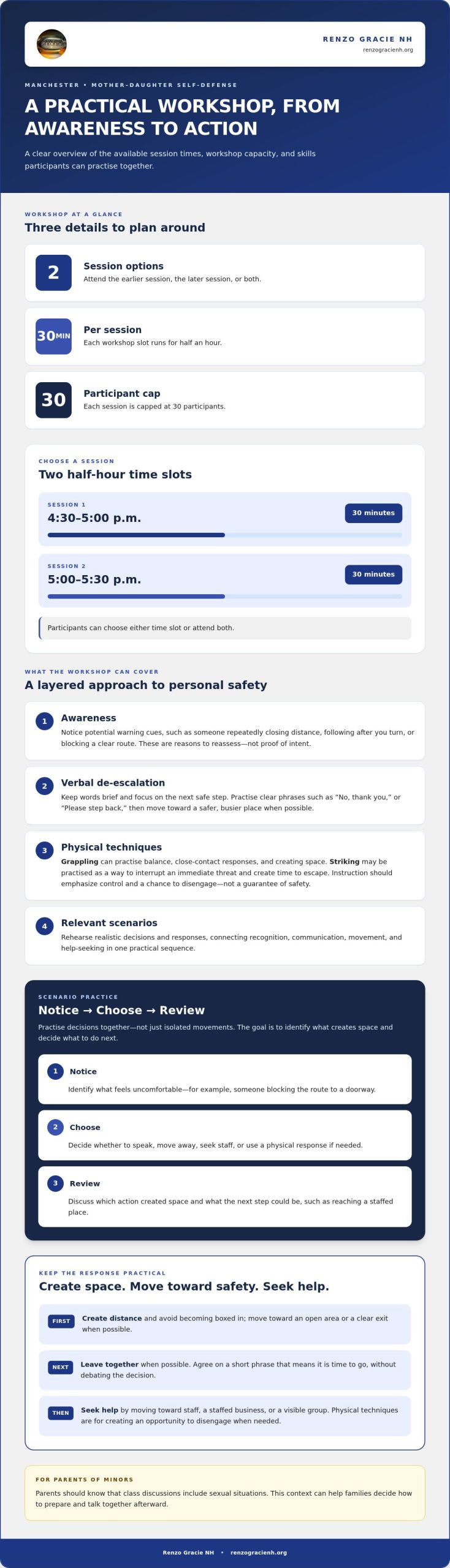
Practical preparation matters more than bravado. For mother-daughter self-defense in Manchester, participants can attend the 4:30 to 5 p.m. session, the 5 to 5:30 p.m. session, or both; each session is capped at 30 participants. Workshop instruction can include awareness, verbal de-escalation, physical techniques and scenarios relevant to participants.

It’s understandable to want more than a list of moves. Learning to notice potential risks, respond calmly, and practise practical actions together can help mothers and daughters build confidence at their own pace. Classes can support women of all ages, including beginners and those refreshing their skills.

This guide explains how threat recognition and de-escalation fit into personal safety, what physical techniques and scenario practice may involve, and what parents should know before a minor attends. It also covers how a supportive martial arts environment can help families develop focus and confidence through shared practice.

Key Takeaways

  • Build awareness by noticing potential risks early, then focus on creating distance, de-escalating when possible, and avoiding danger.
  • Practise physical responses as practical steps for situations where getting away or calming things down isn’t enough.
  • Use scenario exercises to rehearse decisions and responses in situations that feel relevant to you and your daughter.
  • Before a minor attends, know that class discussions include sexual situations; shared martial arts training can also offer an ongoing way to practise together.

Physical self-defense techniques

No single martial art is right for every mother and daughter. Look for instruction that combines physical responses with awareness, verbal de-escalation, and a clear opportunity to leave.

Grappling focuses on close contact, balance, and creating space. For example, a learner can practise maintaining a stable stance, using her arms to create distance, and moving toward an exit instead of staying engaged. In a supervised class, each person should be able to learn at a manageable pace and practise controlled movements with a partner.

Striking may be taught as a way to interrupt an immediate threat and create time to escape. For example, learners can practise a firm palm strike on a training pad, then step away and move toward safety. Instructor guidance matters: practise technique, distance, and control deliberately, without treating it as a contest or a guarantee of safety.

Escape Techniques

Escape practice should focus on breaking contact, creating space, and moving toward a safer place. For example, rehearse turning toward a clear exit after disengaging, rather than trying to control or pursue someone. When comparing instruction, look for repeated, supervised practice that connects a physical movement to a next step, such as leaving or calling for help.

Choosing a Martial Arts or Self-Defense Style

Choose based on what you want to practise together: grappling for close-contact situations, striking to create a chance to disengage, or a workshop that combines physical techniques with awareness and verbal de-escalation. The Manchester workshop covers strategies and tactics, psychological preparation, verbal de-escalation, physical techniques, and scenarios relevant to participants. Consider whether both learners can follow the instruction and practise comfortably at their own pace.

For mother-daughter self-defense in Manchester, the useful measure isn’t how many techniques a class demonstrates. It’s whether each person can remember a simple sequence: create space, move toward an exit, and seek help.

Recognizing and responding to potential threats

Threat recognition starts before physical contact. On a Manchester street or in a car park, notice if someone repeatedly closes the distance, follows after you turn, or blocks a clear route. These are cues to pause and reassess, not proof of intent. Identify exits, staffed places, nearby people, and whether your daughter is beside you. Agree on a simple phrase, such as “Let’s go now,” so you can leave together without a lengthy discussion.

If an interaction feels uncomfortable, keep your words brief and your attention on the next safe step. You might say, “No, thank you,” or “Please step back,” then move toward an open, busier place. Avoid getting drawn into an argument or explaining your decision. In practice, a mother and daughter can rehearse speaking clearly, turning away, and walking toward a chosen exit while staying together.

Distance and route choice matter. If someone approaches near a doorway, move toward an open area rather than letting yourself become boxed in. In a shop, approach staff; outdoors, head toward a visible group or staffed business. Keep your phone accessible, but don’t let looking at the screen distract you from your surroundings. Agree on a meeting point in advance in case you become separated.

The Manchester workshop covers recognizing, de-escalating, and avoiding dangerous situations, with physical self-defense when necessary. This puts physical responses in context: first notice a concern, then create distance or leave when possible. If someone blocks your path or makes contact, use the physical techniques taught in class to create an opportunity to disengage. Practise choices together, including when to speak, where to move, and how to seek help after reaching safety.

Mother-Daughter Self-Defense in Manchester: Techniques and Practice

Scenario-based practice

Scenario practice lets a mother and daughter rehearse decisions, not just isolated movements. The Manchester workshop includes scenarios relevant to participants, along with strategies, psychological preparation, verbal de-escalation, and physical techniques. A practice scenario might begin with an uncomfortable conversation in a public place, then give each learner a chance to choose a response. The aim is to connect recognition, communication, movement, and help-seeking in one usable sequence.

Useful scenarios feel realistic without requiring anyone to disclose personal experiences. For example, learners might practise what to do if a stranger keeps approaching after being asked to give space. One person can practise setting a brief verbal boundary while the other identifies an exit. Then they can switch roles, compare what felt clear, and repeat the sequence with a different route or response.

A simple rehearsal can follow three steps:

  • Notice: Identify the behaviour or setting that feels uncomfortable, such as someone blocking the route to a doorway.
  • Choose: Decide whether to speak, move away, seek staff, or use a physical response if needed.
  • Review: Discuss which action created space and what the next step should be, such as reaching a staffed place.

Rehearsals also help families coordinate. A mother and daughter can agree on a short phrase that means “leave now,” then practise responding without debating the decision. Scenarios can include staying together in a busy place or choosing where to regroup if separated. During instruction, each learner can identify which actions feel clear and repeat them calmly and with control.

Before a minor attends, parents should know that the classes will discuss sexual situations. This context can help families decide how to prepare and talk together afterward. Scenario work is most useful when it builds practical choices, respects each participant’s comfort, and focuses on leaving danger rather than winning a confrontation.

Which Manchester self-defense programs offer family or parent-child classes?

Manchester offers a self-defense workshop format designed for women of all ages, including mothers and daughters. Participants can attend one session or both: the first runs from 4:30 to 5 p.m., and the second from 5 to 5:30 p.m. Each session is capped at 30 participants, so families can choose the time that suits them.

These sessions suit beginners and people refreshing existing skills. Instruction covers strategies and tactics, psychological preparation, verbal de-escalation, physical techniques, and scenarios relevant to participants. For a mother and daughter, that mix offers more than practising moves: they can consider how to recognize concerns, communicate clearly, and respond together. Parents should know that sexual situations will be discussed before signing up a minor.

Another option is a workshop arranged for mother-daughter pairs. Personal Strength requires at least 4 interested pairs to arrange a workshop. That format may suit families who want to practise together as a group. The instructor has over 15 years of experience, and the workshop can include strategies, de-escalation, physical responses, and relevant scenarios.

Before choosing, compare the format with what you and your daughter want to learn:

  • Choose a scheduled session if attending one of the Manchester time slots fits your plans.
  • Consider both sessions if you want to take part in each scheduled class segment.
  • Explore a group workshop if you can gather the required mother-daughter pairs.
  • Discuss class content with your daughter beforehand, especially the discussion of sexual situations for minors.

For ongoing shared activity beyond a one-off workshop, families can also consider martial arts programs with instruction for adults and children. A free introductory class lets a parent and child experience the learning environment together. Match the option to your goal: focused self-defense instruction, or regular practice to build skills over time.

Renzo Gracie NH: Adult Jiu Jitsu Program

Renzo Gracie NH offers an Adult Jiu Jitsu Program for adults who want to continue developing martial arts skills beyond a self-defense workshop. Families can also explore the Kids Jiu Jitsu Program, giving parents and children a shared way to take part in structured practice. These programs offer ongoing learning rather than a substitute for a workshop focused specifically on threat awareness and response.

If you’re considering training together, a Free Introductory Class offers a first look at the learning environment. Choose the Adult Jiu Jitsu Program for your own practice, or explore the Kids Jiu Jitsu Program for your child. Visit Renzo Gracie NH to learn more.

Keep Building Confidence Through Practice

A workshop can start a conversation about personal safety; regular practice gives you and your daughter another way to keep learning together. For mother-daughter self-defense in Manchester, consider which next step fits your family: focused introductory learning, ongoing martial arts practice, or both at different times.

Renzo Gracie NH offers an Adult Jiu Jitsu Program and a Kids Jiu Jitsu Program, so adults and children can take part in structured training. It also offers Law Enforcement Jiu-Jitsu Training. These programs serve different needs, so choose the one that aligns with your goals and your daughter’s interest in continuing to practise. Shared effort can make learning a positive part of family life, while each person develops at her own pace.

If you’d like to explore training options, contact Renzo Gracie NH. Take the next step when it feels right, and keep building confidence together.

Frequently Asked Questions

What self-defense classes in Manchester are suitable for mothers and daughters?

A focused self-defense workshop suits mothers and daughters seeking practical safety instruction together. For longer-term learning, family martial arts training offers a recurring way to practise skills and build confidence. In Manchester, choose between a short, focused learning experience and ongoing training based on your shared goals, preferred pace, and interest in practising regularly.

How can I check a Manchester self-defense instructor’s qualifications and safety practices?

Ask about the instructor’s training and teaching experience, and how beginners are guided through partner practice. Look for clear demonstrations, controlled drills, and straightforward ways to pause or adjust an exercise. Notice whether the instructor explains boundaries before physical practice and responds respectfully when someone raises a concern. These details help you understand how instruction works before participating.

What should mothers and daughters expect in a beginner self-defense class?

Expect to learn at a beginner-friendly pace, with time to understand instructions before practising. Before class, discuss personal boundaries and agree that either person can speak up if an exercise feels uncomfortable. A mother and daughter may have different confidence levels, so focus on each person understanding the steps rather than keeping pace with each other. A simple question afterward can help you decide what to practise again.

What practical safety skills do Manchester self-defense classes teach?

Classes can help participants make decisions as well as practise physical responses. For example, you and your daughter can rehearse a shared cue for leaving a situation, decide where to move, and plan how to regroup if separated. These habits support awareness and communication in everyday settings, such as a busy shopping area. Talk through the choices together so you both know what the cue means.

What to Wear to First BJJ Class: Gym Clothes or Gi

You don’t need a gi to take your first step on the mats. For what to wear to your first BJJ class, clean athletic clothes are usually enough, especially a fitted top and pocketless shorts. Choose comfortable gear that stays in place and won’t snag or restrict movement.

It’s natural to wonder whether you need special equipment before you begin. You can learn the basics without arriving fully kitted out. Knowing a few simple clothing and mat-etiquette rules can help you feel more comfortable in class.

This guide covers what to wear for gi and no-gi training, what to wear under a rash guard, and why footwear stays off the mats. You’ll also find practical tips for keeping your gear clean, so you can focus on learning, moving, and settling into class.

Key Takeaways

  • Start in clean, fitted athletic clothes if you don’t have a gi, and avoid garments with pockets, zippers, or hard fasteners.
  • Train barefoot on the mats, but wear easy-to-remove footwear when walking off them.
  • Wash your gi or no-gi gear after every class, and arrive with trimmed nails and any cuts covered.
  • Wear a rash guard directly against your skin; choose close-fitting shorts, and follow your academy’s rules for spats and layers.

1. Can I wear regular gym clothes for jiu jitsu?

Yes. For what to wear to your first BJJ class, clean athletic clothes usually work, and you don’t need to own a gi before starting. Choose a fitted workout shirt and pocketless shorts that stay in place when you bend, stretch, and move on the mat. Compression layers can be practical because loose clothing may snag or tear during grappling.

Under a BJJ gi, wear athletic underwear or compression shorts beneath the trousers. A fitted athletic T-shirt works under the jacket if you don’t have a rash guard. Women can wear a supportive sports bra. Some academies require a rash guard under the gi jacket, so the required layers depend on the school’s uniform rules.

Some academies lend newcomers a gi for a first class. Ask whether trial students can borrow one or should bring their own, since arrangements vary. If you plan to buy a gi later, check the academy’s uniform rules first. Some schools limit colors or patches.

For a no-gi class, wear a close-fitting shirt and athletic shorts without pockets. A rash guard should fit snugly without restricting breathing or shoulder movement. Avoid loose T-shirts, open pockets, zippers, buttons, belt loops, and hard metal details. Fingers and toes can catch in openings, while fasteners can hurt a training partner or damage the mats.

Remove jewelry, including rings, necklaces, and earrings, before class. Tie long hair back securely, and choose clothes that provide comfortable coverage when bending and rolling. These BJJ clothing tips are specific to Brazilian Jiu-Jitsu. Other martial arts may have different training formats and equipment needs, so follow the clothing instructions for your class.

A common beginner mistake is wearing baggy gym clothes or shorts with pockets. Another is assuming every gi class supplies a uniform or allows every color. Keep your first outfit simple: fitted athletic layers, pocketless shorts for no-gi, and no jewelry. That’s practical gear for learning without buying a full kit first.

2. Footwear and mat etiquette

Brazilian Jiu-Jitsu is practiced barefoot on the mats. Leave shoes and socks at the edge, even if you wear clean indoor sneakers. Socks can slide during movement, and footwear doesn’t belong on the training surface. Follow the same rule during instruction, drills, and partner practice.

Wear footwear whenever you walk off the mats. For example, put on slides before visiting the restroom, then remove them before returning to the training area. Slides or flip-flops are handy because they’re easy to take on and off. Keep them beside the mat, out of classmates’ way.

Choose footwear that stays on your feet while walking between the mat and changing area. Avoid going barefoot through shared spaces and then returning directly to training. The simple routine is to step off the mat, put on footwear, walk where needed, and remove it at the mat edge. This also makes the mat boundary clear to everyone in class.

Before class, make sure your feet are clean and your toenails are trimmed. Short nails help prevent accidental scratches during close movement. Remove jewelry, including necklaces, before training, since a chain can catch during a scramble. A fitted rash guard or athletic top should stay secure, without loose ties or dangling details near fingers and toes.

Don’t bring outdoor shoes onto the mat, even for a quick demonstration. Keep a dedicated pair of slides in your gym bag, and place them where they’re easy to reach. If you’re unsure where footwear belongs, watch how classmates enter and leave the mat, then follow the instructor’s direction. These small habits show respect for shared training space and help class move smoothly.

What to Wear to First BJJ Class: Gym Clothes or Gi

3. Training hygiene and gear washing

Clean gear is part of being a considerate training partner. Arrive in a freshly washed uniform or clean no-gi clothes, not yesterday’s sweaty kit. Wash your gi and no-gi gear after every training session. Clean clothing also feels more comfortable during close-contact drills, when fabric stays against your skin and your partner’s.

Before class, trim your fingernails and toenails short. Check both hands and feet, since a rough nail can scratch someone during a grip or scramble. Tie long hair back securely, and remove earrings and other jewelry before stepping onto the mat. Bring a water bottle for class, and pack a towel if you want one for sweat.

Be open about cuts and skin concerns. Cover cuts with waterproof bandages, then tell the instructor about skin issues before training. Don’t hide a rash beneath a long-sleeved top or gi jacket. The instructor needs to know so they can guide you appropriately. Clean, intact clothing doesn’t replace addressing a skin concern before close-contact practice.

After class, put your uniform or no-gi clothes straight into the laundry instead of leaving damp gear in a closed gym bag. Wash the gi jacket, pants, belt, rash guard, and shorts you wore that session. Let everything dry fully before packing it again. Reusing damp clothing can be uncomfortable for you and your training partners.

If you train often, having extra rash guard sets can make laundry easier and help you avoid reusing damp gear. For your first class, one clean set is enough if you wash it afterward. Build a simple routine: pack clean clothes, water, and a towel; cover cuts; trim nails; then wash everything you wore on the mat.

4. Should I wear a shirt under a rash guard?

For no-gi grappling, wear a rash guard directly against your skin, not over another shirt. Choose a close-fitting short- or long-sleeved top that lets your shoulders move freely and doesn’t restrict breathing. If you don’t own a rash guard, a fitted athletic T-shirt may work for a first class if the class permits it.

Keep your layers simple. An extra shirt under a rash guard can bunch up, shift out of place, and make movement uncomfortable. Women can wear a supportive sports bra beneath the rash guard or athletic top. Choose a top that stays secure during bends, reaches, and partner drills.

For shorts, choose board shorts or compression shorts without pockets, zippers, sharp buttons, or exposed metal. Fingers and toes can catch in pockets, while hard fasteners can scratch a training partner or damage the mats. Pocketless grappling shorts should fit securely without loose fabric that twists during movement.

Spats are optional for no-gi training, but academy rules vary. Some schools require shorts over spats, so follow the class dress code. Before leaving home, check the waistband, seams, and closures, and remove anything that could snag. Footwear stays off the mat, so changing shoes won’t replace suitable training clothes.

For a simple first-class outfit, pair a fitted athletic top with pocketless shorts. If you already own a rash guard, wear it as your base layer. Choose clothing that covers you comfortably and stays in place, then follow the academy’s format and clothing rules. Ready to put your gear to use? Explore a beginner jiu jitsu class.

Renzo Gracie NH: Adult Jiu Jitsu Program

Renzo Gracie NH’s Adult Jiu Jitsu Program offers a structured way for adults to learn Brazilian Jiu-Jitsu. New students can begin with a Free Introductory Class, without first assembling a full uniform or equipment kit. Wear the simple, comfortable clothing described here and build your skills through instruction and practice.

Jiu-Jitsu can also be a shared family activity. Renzo Gracie NH offers a Kids Jiu Jitsu Program alongside its adult program, as well as family training for parents and children. Law enforcement professionals can take part in the academy’s Law Enforcement Jiu-Jitsu Training, designed for professional defensive tactics.

To take the next step, contact Renzo Gracie NH about its Free Introductory Class.

Take Your First Step on the Mats

Choosing what to wear to your first BJJ class is one small part of getting started. The bigger step is deciding to learn, meet training partners, and build confidence through practice. You don’t need to know every move before you begin. Curiosity and a willingness to learn are a strong foundation.

Renzo Gracie NH offers an Adult Jiu Jitsu Program, a Kids Jiu Jitsu Program, and Law Enforcement Jiu-Jitsu Training for professional defensive tactics. Each program gives students a place to learn Brazilian Jiu-Jitsu through instruction suited to its focus.

If you’re ready to explore training, contact Renzo Gracie NH. Take the first step at your own pace, and give yourself room to grow with every class.

Frequently Asked Questions

Can I wear regular gym clothes for jiu jitsu?

Yes, regular athletic clothes can work for a first class, especially if it’s a no-gi session. Choose clothes you can move in, and bring clean gear rather than wearing your training outfit from the street. At Renzo Gracie NH in Windham, Manchester, or Exeter, the class format determines whether gym clothes or a gi is appropriate.

Do I need to buy a belt for my first class?

No, you usually don’t need to buy a belt before your first class. You may be able to wear athletic clothes for a no-gi session, while gi training follows the academy’s uniform policy. If you buy a beginner gi later, check whether it includes a belt and confirm the required uniform color and fit before purchasing.

What should I wear to Jiu-Jitsu women’s classes?

Wear a supportive sports bra beneath a close-fitting rash guard or athletic top, along with secure training bottoms. A fitted layer can provide comfortable coverage through bends and movement without shifting around. Avoid spaghetti straps, tank tops, and crop tops if they don’t meet the class clothing rules. Choose clothing that stays in place during partner drills.

How Much Does a Gi Cost?

The price can vary with the weave, construction, and included pieces, so compare what comes in the package. A traditional gi has a jacket, pants, and belt. Look for reinforced stitching at the collar and lapels, which take substantial stress during grips and grappling. For academies and clubs outfitting students at scale, JAGUAR PRO GEAR – WHOLESALE – JAGUAR PROGEAR offers bulk Brazilian Jiu-Jitsu gis and combat sports equipment.

Is expensive gear better for beginners?

Not necessarily. For beginners, the key is gear that fits comfortably, allows movement, and meets the academy’s uniform rules. Before choosing a gi, inspect the collar and lapel stitching, check that the sleeves and pants allow movement, and see whether a belt is included. A higher price alone doesn’t tell you whether it suits your training.

Should I wear a shirt under a rash guard?

No. A rash guard is worn directly against the skin, so an extra shirt underneath can bunch up during movement. For a first no-gi session without a rash guard, a fitted athletic T-shirt can serve as your top layer. Women can wear a supportive sports bra beneath the rash guard or fitted athletic top for secure coverage.

Martial Arts Classes for Families in Exeter

A first class doesn’t have to start with experience. Martial arts for families in Exeter can be a welcoming starting point for children, teens, and adults, and complete beginners can join without prior experience. The right class gives each family member room to learn at a comfortable pace.

It’s natural to want an activity that builds skills as well as confidence and focus. This guide explores what families can expect from martial arts classes in Exeter, with a closer look at kids’ Brazilian Jiu-Jitsu and how structured practice can support young learners. You’ll also learn what to consider when choosing a class and what a first step into training can look like.

Key Takeaways

  • Compare classes by age group and learning approach to find a comfortable entry point for each family member.
  • Look for structured practice that gives children opportunities to work on focus, respect, and steady progress.
  • Explore how kids’ Brazilian Jiu-Jitsu introduces young learners to martial arts through guided practice.
  • Consider a free introductory class as a practical first step toward trying training for yourself or your child.

Martial arts classes for children, teens, and adults

Martial arts for families in Exeter can include Brazilian Jiu-Jitsu, with options for children and adults. Complete beginners can start without previous experience, learning basic movements through instructor-led practice. Classes may group students by age, so family members can develop skills at a pace that suits them.

Children’s classes introduce movement and partner practice, while adults can work toward their own fitness and learning goals. Brazilian Jiu-Jitsu is one style families can explore. To find a suitable school, consider the age groups taught, how instructors guide beginners, and whether family members can train together or attend separate classes.

Families exploring martial arts for families in Exeter can also make the first visit easier with a little planning. A free introductory class offers a chance to experience instruction before choosing whether to continue. Plan the route and parking before leaving, and allow time to arrive without rushing. Compare class locations and schedules with the family’s usual school, work, and travel routines.

Beginner Brazilian Jiu-Jitsu for Children

Beginner Brazilian Jiu-Jitsu introduces children to movement, technique, and partner practice through guided instruction. During a Little Heroes trial class, arrive 15 minutes early so staff can size a gi to borrow. Children should wear a light T-shirt and gym shorts under the gi, and bring water. These simple steps help families prepare for the class.

Family Class Safety and Equipment

Follow the instructor’s directions, practise techniques with control, and treat training partners respectfully. For the Little Heroes trial, children wear the borrowed gi over a light T-shirt and gym shorts and bring water. Listen to the instructor’s guidance on equipment and practice throughout class.

A separate consideration when comparing activities is how uncommon professional league selection is for children who play team sports. The page states that an average of 168 children are drafted into professional leagues for every 1 million U.S. children ages 8-12 who play team sports, and gives the proportion of children drafted into professional leagues as 0.00016%. These figures provide context, but families can choose classes for learning, enjoyment, and fitness rather than professional outcomes.

Confidence, discipline, and focus

A structured class gives children and adults clear tasks to practise and improve. Remembering a movement sequence or following a partner drill makes progress easier to see.

Fitness and Confidence Benefits

Martial arts combines movement, technique, and focus, so students can develop fitness while learning. A beginner might practise a basic movement, repeat it, and apply the instructor’s feedback. That visible progress can build confidence through effort rather than comparison with others.

For children, discipline can mean listening to instructions, taking turns, and focusing on the next drill. Adults may value the concentration needed to learn a technique after a busy day. Look for classes where instructors explain activities clearly and students have time to practise at a manageable pace.

Personal Growth and Self-Defense

Self-belief grows through repeated chances to try, adjust, and keep going. A student struggling to remember a sequence, for example, can practise each movement separately before joining the full drill. This process supports patience and perseverance in training, at school, and at work.

Self-defense instruction can introduce practical skills alongside awareness, control, and respect for training partners. It cannot promise that a student will prevent every threat. Look for responsible teaching that emphasizes controlled practice, and make sure beginners understand how to follow directions before attempting unfamiliar movements.

To explore a structured approach to Brazilian Jiu-Jitsu, families can review Brazilian Jiu-Jitsu training as one possible next step.

Martial Arts Classes for Families in Exeter

Instruction for different ages and skill levels

Good instruction gives students a clear next step, whether they’re new or experienced. In Exeter, families can look for classes that support age-appropriate learning and individual progress.

Watch how instructors demonstrate a skill, explain it, and guide practice. A child learning a movement might practise it slowly before using it in a partner drill. Teens and adults may be ready for more complex sequences, but beginners still need clear explanations and time to build skills gradually.

When choosing a martial arts school in Exeter, look for age-appropriate teaching, respectful communication, and support for different skill levels. Notice whether instructions are clear and students receive useful feedback during class.

An instructor needs to know both the technique and how to teach it. Look for information about their martial arts background and experience with the age group your family member would join. Effective teaching breaks challenging movements into smaller steps instead of expecting students to master them immediately.

Consider background checks separately when evaluating a school. Review its stated screening practices rather than assuming a title or training history explains them. Also notice how instructors supervise practice, help students who need support, and set expectations for respectful behavior. These details offer practical insight into the learning environment.

Families hoping to share martial arts as family time can compare class arrangements alongside teaching style. Some family members may train in age-specific classes while building skills within the same school community. Consider each person’s goals, comfort level, and preferred pace, then choose instruction that supports steady learning and character development without treating beginners as though they should already know the movements.

Kids’ Brazilian Jiu-Jitsu

Brazilian Jiu-Jitsu teaches grappling, positioning, and control, often with practice on the ground. Children can explore these ideas through guided movement and partner drills, such as moving from one position to another. The focus is on learning technique, not relying on size or strength alone.

Good teaching breaks unfamiliar movements into manageable steps. An instructor might demonstrate a movement, have students practise it slowly, then offer feedback. Children learn to listen, take turns, and work respectfully with partners. Parents can look for clear explanations and practice suited to the group’s age and experience.

New students don’t need to know the techniques before they arrive. They can follow demonstrations, learn class routines, and ask for help when a movement feels unfamiliar. Progress comes through repetition: a child may learn a position first, then practise moving between positions. This gradual approach gives beginners a clear starting point.

Before choosing a program, consider what your child wants from an academy. A child who enjoys movement and problem-solving may like learning how position and timing affect a partner drill. Consider whether the class supports respectful practice and steady participation to help decide if the teaching approach suits your child.

Brazilian Jiu-Jitsu can offer children a structured way to develop skills, focus, and confidence through practice with other members. The clearest takeaway is to look beyond the style’s name: notice how instructors explain techniques, guide partner work, and help beginners participate. To explore a kids’ Brazilian Jiu-Jitsu class, take the next step and arrange an introduction.

Renzo Gracie NH: Adult Jiu Jitsu Program

Renzo Gracie NH is a next step for Exeter adults who want to begin Brazilian Jiu-Jitsu through a dedicated Adult Jiu Jitsu Program. Families can also explore the Kids Jiu Jitsu Program, making it possible for adults and children to pursue training within the same academy community. A Free Introductory Class offers a practical way to experience instruction before deciding whether to continue. The right time to start is when you’re ready to learn, practise consistently, and build skills at your own pace. The academy also provides Law Enforcement Jiu-Jitsu Training for that professional audience. For a welcoming first step, visit Renzo Gracie NH to learn about its introductory class.

Take the First Step Toward Training Together

Choosing martial arts for families in Exeter can start a shared routine while each person follows individual goals and progress. Decide what matters most to your household, whether that’s a new challenge for an adult, a positive activity for a child, or training connected to professional duties. Then explore the class that fits and experience what getting started is like.

Renzo Gracie NH offers an Adult Jiu Jitsu Program, a Kids Jiu Jitsu Program, and Law Enforcement Jiu-Jitsu Training. Each offers a different starting point, so the whole family doesn’t need to follow the same path. Begin by showing up, learning, and returning to practise.

If you’re ready to explore your next step, contact Renzo Gracie NH. Start at your own pace, and let each class be an opportunity to grow.

Frequently Asked Questions

What are the age requirements for family martial arts classes in Exeter?

Exeter programs include separate Jiu-Jitsu instruction for children and adults, rather than one age cutoff for every student. A child would begin with the Kids Jiu Jitsu Program, while an adult can choose the Adult Jiu Jitsu Program. New students can use the free introductory class to experience the instruction and see which program fits their stage of life.

What are the class schedules and locations for Exeter family martial arts schools?

Renzo Gracie NH has academy locations in Exeter, Windham, and Manchester, New Hampshire, with classes on varied days and at varied times. Choose a location that fits your regular travel and school or work routines. Consider the drive and find a class time your family can attend consistently.

Choosing a BJJ open mat in Manchester NH: Gyms, access and safety

Two gyms in Manchester, New Hampshire, run public open mats, including Renzo Gracie NH. For anyone looking for a BJJ open mat in Manchester, NH, this offers a local way to explore training, but access and sparring expectations can differ from regular classes.

It’s reasonable to want a clear picture before stepping onto the mat. You’ll want to know whether visitors can participate, how beginners can approach rolling thoughtfully, and what gym reviews can and can’t tell you about the experience.

This guide compares Manchester gyms with open mats, explains public and members-only access, and outlines questions to consider about sparring and reviews. Use the practical decision points to choose a setting that feels comfortable and supports steady progress.

Key Takeaways

  • Compare the seven listed Manchester jiu-jitsu gyms by location and open-mat access to narrow down your options.
  • Two Manchester gyms run public open mats, while five are members-only; understand the access difference before planning a visit.
  • Beginners can build skills without competitive sparring in the Gracie Combatives beginner program, before progressing to advanced-program sparring.
  • Use review counts alongside ratings: Manchester gyms average 4.8 out of 5 across 900 Google ratings, while Renzo Gracie NH has a 5.0 rating from nine reviews.
  • Explore the Adult Jiu Jitsu Program or Free Introductory Class if you want a structured way to start training.

Gym location in Manchester, New Hampshire

Manchester has seven listed jiu-jitsu gyms, giving beginners several local options to compare. For a BJJ open mat in Manchester, NH, start by identifying each academy’s location and whether visitors can attend its open mat. The citywide count provides a useful shortlist, but location alone doesn’t show who can train or what a session involves.

One precise location in the listings is Gracie Jiu-Jitsu Manchester, at 371 South Willow Street, Manchester, New Hampshire 03103. Use that full address as a reference point when comparing other Manchester academies. It also helps distinguish a listing for a gym from a listing for an open mat, which is a specific training session rather than a general description of the school.

Make the comparison practical. Note each gym’s name, address, and open-mat access policy. Then consider how the trip fits your schedule and whether the available information answers your main question: can visitors join? A nearby location may suit a regular routine, while another option may better match your training preferences. Address is only one part of the decision.

Option or detail Location information What to compare
Manchester jiu-jitsu gyms Seven listed in the city Address and open-mat access
Gracie Jiu-Jitsu Manchester 371 South Willow Street Exact location and session details
Other listed academies Manchester, New Hampshire Travel fit and visitor access

Use the table to make a useful comparison instead of choosing by name alone. The seven-gym count describes the local list, not the number of gyms with public open mats. Keep location and access as separate criteria. A convenient gym may hold members-only sessions, while another listing may offer a public session that better fits your plans.

Before setting out, match the academy’s name to its address and the specific open-mat information you’re using. For example, keep “Gracie Jiu-Jitsu Manchester” paired with 371 South Willow Street, rather than relying on a broad city search. This simple step reduces mix-ups between similarly named listings and gives you a clear starting point for comparing Manchester options.

Balance location with the session’s access rules and your training goals. If two locations seem equally practical, prioritize the one with clearer information about the visitor experience. This turns Manchester’s seven listed gyms into a more manageable shortlist without assuming every academy has the same schedule or entry policy.

Public versus members-only open mats

Manchester has seven listed jiu-jitsu gyms, but open-mat access varies by academy. Five gyms are members-only, while two run public open mats. That distinction matters if you’re new to training, visiting from another city, or comparing a drop-in with regular membership.

A public open mat is intended to welcome nonmembers, while a members-only session is reserved for people affiliated with that gym. Public access doesn’t necessarily mean every visitor can join in every circumstance. Entry procedures, participation expectations, or other conditions may still apply. Treat “public” as an access category, not a promise of an informal walk-in.

Do local BJJ gyms require advance registration or a waiver for open mat? There’s no single registration or waiver rule for all Manchester gyms. Public or members-only status describes who may attend, not what paperwork or advance steps a particular session requires.

Use this simple comparison before choosing a session:

  • Public: The gym runs an open mat for nonmembers, subject to its session rules.
  • Members-only: The open mat is limited to people affiliated with that academy.
  • Registration: This is a separate process from deciding whether the session is public.
  • Waiver: This is also a separate requirement, not something the public label answers.

If you’re visiting Manchester and want to train once, the two public sessions are the relevant starting point. If you already belong to a local academy, a members-only open mat may suit you. Match your situation to the access category instead of assuming every open mat welcomes outside visitors.

Keep the local numbers in perspective: five members-only gyms and two gyms with public open mats account for the seven listed academies. Those figures help narrow the field, but they don’t explain each session’s format, pace, or suitability for beginners. Access and training style are separate decisions. A public session may welcome visitors without being designed as a beginner class.

To compare options, first decide whether you need visitor access or a session for existing members. Next, consider whether you want open practice or a structured introduction to training. That distinction can keep a first visit focused and comfortable. For a broader view of training options, explore Manchester jiu-jitsu training.

Beginner safety and sparring

An open mat can involve live grappling, so beginners should understand the session before joining. Manchester gyms may differ in access, format, and partner expectations. A public session doesn’t mean every participant has the same experience level. Training safely is a shared responsibility: communicate clearly, choose controlled practice, and stop if something feels wrong.

What belt ranks and experience levels are welcome at Manchester NH open mats? There’s no single belt-rank threshold for every Manchester gym. Each academy’s access policy and session format shape who can participate, so beginners should distinguish a public open mat from a beginner class.

For a new student, the difference between drilling and sparring matters. Drilling means practicing a technique with a cooperative partner; sparring means trying skills against active resistance. A beginner curriculum with no competitive sparring provides a route to build foundational skills before live competition. In the Gracie beginner pathway, students train in beginner programs for 8 to 12 months before moving to advanced-program sparring.

That progression is a useful example, not a universal timetable for every Manchester academy. Open mats may be less structured than classes, so don’t assume they include an instructor-led introduction. If you’re new, tell your partner your experience level before starting. Agree on a controlled pace, and tap early when you need to stop or reset.

  • Before pairing: Share your experience level and ask how the round will work.
  • During practice: Keep movements controlled and respond promptly to a partner’s tap.
  • If unsure: Sit out a round and observe how participants communicate and reset.

These steps help beginners make deliberate choices without treating every round as a test. For example, a newcomer can observe first, then choose a partner who agrees to controlled, technical practice. A higher belt doesn’t automatically mean a suitable match; pace, communication, and willingness to adapt matter too.

Manchester’s public-open-mat count shows where visitors may have access, not how intense each session will be. Keep those questions separate. First find out whether visitors can attend, then consider whether the format suits your current skills. A beginner class is often a clearer starting point for learning fundamentals, while an open mat may suit someone ready to practice with less structure.

Good training requires respect on both sides. Communicate before each round, avoid forcing a position, and stop if either partner needs a break. These habits help beginners build awareness while protecting the cooperative spirit that makes shared practice valuable.

Choosing a BJJ open mat in Manchester NH: Gyms, access and safety

Gym ratings and review counts

Manchester jiu-jitsu gyms average 4.8 out of 5 across 900 Google ratings for seven reviewed academies. That citywide figure offers context, not a prediction of your own experience. A gym’s score combines different opinions and may reflect classes, communication, atmosphere, or other parts of training. For open-mat decisions, read individual comments for details about the sessions you plan to attend.

Review volume changes how you should interpret a rating. One Manchester academy in the listings has a 5.0 rating from nine reviews. That score is perfect, but its review count is much smaller than the citywide total. Compare both figures: the rating shows how reviewers scored the gym, while the count tells you how many reviews contribute to that snapshot.

Google review volume also matters for annual Top 10 eligibility. A gym needs at least 40 Google reviews to qualify. Qualification is a threshold, not proof that an academy is the right fit, and it doesn’t tell you whether an open mat welcomes visitors. Use the number as one comparison point, then look for comments about the details that matter to you.

Try a focused reading method before drawing conclusions:

  • Start with the count: Note whether the gym has a small or substantial pool of reviews.
  • Read for open-mat detail: Look for mentions of visitor access, training pace, and partner interactions.
  • Compare recurring themes: Separate repeated observations from a single reviewer’s personal experience.
  • Match reviews to your goal: A comment about beginner instruction may matter more than one about competition.

A high score alone won’t tell you whether a first-time visitor can join a particular session. A detailed comment about open-mat access may be more useful for that question, even if it doesn’t discuss the gym’s overall rating. Reviews are most valuable when they address the decision you’re making.

Keep the seven-academy comparison in view, but avoid treating the 4.8 average as a ranking. The average combines ratings across reviewed gyms; it doesn’t show how each academy compares individually. Likewise, the 40-review eligibility threshold doesn’t measure instruction quality or beginner suitability. Those require separate evidence, such as specific review descriptions and the gym’s open-mat access information.

Before choosing, note each candidate’s Google rating and review count, then check whether reviews mention open mats. Compare the same criteria across Manchester gyms. A clear account of the visitor experience can tell you more than a decimal score, while a broader set of reviews gives useful context for interpreting that score.

Manchester gyms offering open mats

Two Manchester gyms run public open mats, giving visitors local options for shared practice. Compare the session format, timing, and travel distance before choosing.

Gi Open Mats

The two public open mats in Manchester confirm visitor access, but that count doesn’t show whether sessions use gi, no-gi, or both. A gi session uses a jiu-jitsu uniform, while no-gi practice uses different clothing and grips.

Match your equipment to the session format instead of assuming both public options use the same setup. If you train in both formats, consider which one better supports the techniques you want to practice.

Open-Mat Schedules and Times

Manchester’s public-open-mat count doesn’t establish a shared schedule or session time. Each academy sets its own timetable, so compare the day and start time with your routine and travel plans.

Keep the academy, session day, start time, and format together in your notes. This helps distinguish an open mat from a regular class when comparing Manchester listings.

Are there nearby BJJ open mats in Windham or Exeter if Manchester options are limited? Windham and Exeter are useful nearby areas to include in a broader search, but the local open-mat count here covers Manchester. Compare access and format in each town separately rather than assuming Manchester’s details apply.

Start with Manchester’s two public sessions, then widen your search to Windham or Exeter if the location or timing doesn’t suit you. A nearby academy may be easier to reach, but proximity alone doesn’t show whether visitors can attend. Consider access, format, and travel as separate decision points.

Use this comparison before planning a visit:

  • Location: Compare Manchester with Windham and Exeter based on your travel routine.
  • Access: Separate public sessions from members-only open mats.
  • Format: Identify whether the session uses gi, no-gi, or both.
  • Timing: Match the session day and start time to your schedule.

Choose the session that fits your experience, equipment, and routine. If you want to explore a local training option, view Manchester jiu-jitsu training.

Two gyms in Manchester, New Hampshire, run public open mats. Treat that as a starting point, not a guarantee that either session will suit every visitor. Before setting out, confirm directly with the gym that nonmembers can attend and ask whether advance notice is expected. Find out what experience level is appropriate, whether visitors can join the full session, and what equipment to bring. These questions clarify practical expectations without assuming the gyms follow the same policy.

If one option doesn’t match your needs, compare the other using the same questions. A brief check before traveling can help you avoid arriving with the wrong expectations and choose a session that fits your training goals.

Renzo Gracie NH: Adult Jiu Jitsu Program

Renzo Gracie NH offers an Adult Jiu Jitsu Program for people ready to build skills through structured training. If an open mat feels too unstructured as a first step, a class can provide a clearer introduction to learning and practicing Brazilian Jiu-Jitsu. A Free Introductory Class lets new students experience instruction, while families can explore the Kids Jiu Jitsu Program and law-enforcement professionals can consider Law Enforcement Jiu-Jitsu Training.

Choose the path that fits your experience and goals. If you’re interested in learning in a guided setting before joining open practice, start with the introductory class. For details about training, visit Renzo Gracie NH online.

Take Your Next Step on the Mat

Your first open mat can be a starting point, not a test of how much you already know. Choose a training path that lets you build confidence and technique at a steady pace. If you’re exploring a BJJ open mat in Manchester, NH, consider whether guided instruction would help you prepare for shared practice.

Renzo Gracie NH offers an Adult Jiu Jitsu Program, a Kids Jiu Jitsu Program, and Law Enforcement Jiu-Jitsu Training. Each provides a way for a different group to develop through jiu-jitsu. Choose the option that fits your goals, whether you’re starting as an adult, looking for a program for your child, or seeking professional defensive tactics training.

Ready to take a practical next step? Contact Renzo Gracie NH to learn more about training. Progress begins with showing up, staying curious, and building skill one step at a time.

Frequently Asked Questions

Where can a beginner try BJJ in Manchester?

Beginners can start with a structured class rather than joining live practice right away. Renzo Gracie NH offers a Free Introductory Class, giving newcomers a way to experience instruction before choosing their next step. Adults interested in continuing can explore the Adult Jiu Jitsu Program. On your first visit, focus on learning basic movement and communication, then decide whether an open mat suits your experience.

Which Brazilian Jiu-Jitsu gyms in Manchester, NH offer open mat sessions?

Two Manchester gyms run public open mats, and Renzo Gracie NH is one named option. The available local information doesn’t identify the other gym by name, so use public access to guide your comparison rather than assuming every academy hosts visitors. Compare each session’s format with your experience and goals. A gym’s regular class schedule isn’t the same as an open mat.

Are Manchester NH BJJ open mats open to visitors or drop-ins?

Some Manchester sessions welcome visitors, while others are reserved for members. The local count includes two gyms with public open mats and five members-only gyms. If you’re visiting from another academy, choose a public session and understand its participation expectations. Public access describes who may attend; it doesn’t mean the session is a beginner class or that every participant is new.

What rules, etiquette, and sparring expectations apply at local BJJ open mats?

Follow your partner’s pace, communicate your experience, and stop when either person needs a reset. Beginners should distinguish technical practice from competitive sparring before joining a round. The Gracie Combatives beginner program has no competitive sparring, with students training in beginner programs for 8 to 12 months before advanced-program sparring. Open mats can differ, so approach each round with control and respect.

Where are the BJJ gyms offering open mat in Manchester, NH, and what are their contact details?

Gracie Jiu-Jitsu Manchester is located at 371 South Willow Street, Manchester, New Hampshire 03103, and Renzo Gracie NH offers open mat in Manchester. For contact details, use Renzo Gracie NH’s official website. When planning a visit, keep the academy name and street address together, then use the gym’s contact channel for location-specific directions or session information. That helps avoid confusing similarly named listings.

Gi and no-gi jiu jitsu in Windham: Which style should you choose

Brazilian Jiu-Jitsu is a grappling martial art focused on controlling an opponent and using technique to create opportunities to submit them. Choosing gi and no-gi jiu jitsu in Windham depends on the training experience you want: gi practice uses a uniform for grips, while no-gi is practised in athletic clothing and relies more on body control. Both styles build practical grappling skills.

The uniform changes how a round feels. In gi, grips on the sleeves, collar, and pants shape the pace and techniques. Without those grips, no-gi encourages a quicker, more adaptable approach. Neither style is automatically the better choice for every beginner.

If you’re new, you may wonder which style will feel more comfortable or whether you need to choose just one. This guide explains Brazilian Jiu-Jitsu, compares gi and no-gi training, and offers practical ways to decide where to begin. You’ll also learn how to try a first class and take a useful next step.

Key Takeaways

  • Brazilian Jiu-Jitsu uses grappling, control, and technique, making it a skill-building practice for beginners as well as experienced students.
  • Gi training uses uniform grips, while no-gi relies more on body control and movement; each style develops different strengths.
  • Choose a starting style based on what you want to practice, then consider trying both to broaden your grappling skills.
  • A free introductory class offers a practical way to experience training and see how the learning environment feels.
  • Compare the styles by clothing, grip opportunities, pace, and the techniques you’re most interested in learning.

What is Brazilian Jiu-Jitsu?

Brazilian Jiu-Jitsu (BJJ) is a grappling martial art focused on position, control, and submissions. In Windham, choosing a class means comparing uniform-based gi training with no-gi, then finding sessions that fit your routine.

BJJ traces its family tradition to 1925 and brothers Carlos and Hélio Gracie. Students practise movement, escapes, and control with a training partner, building skills through guided instruction and practice. Beginners can expect to learn techniques progressively; it may take about 6 months to start feeling more familiar with what to do in training.

Windham gyms can be compared by instructor experience, student reviews, and the classes listed on their schedules. Look for clear information about beginner instruction and whether classes are offered in gi, no-gi, or both; those details show how each program fits your goals.

The schedule is the practical way to see when each format is taught. “Gi” and “no-gi” describe training styles, not an academy’s timetable, so check the listed classes rather than assuming every program teaches both.

Children can begin at age 4, and adults can also train Brazilian Jiu-Jitsu. Beginners and experienced students can work on appropriate techniques at their own pace, while the learning environment and class structure help determine which session suits each student.

New students should learn to tap, communicate discomfort, and follow the instructor’s guidance during partner practice. Strains, bruises, and joint stress can occur, especially when someone resists a position or moves beyond their control. Careful practice and respectful partners help reduce avoidable risks.

Gi Jiu-Jitsu Classes

Gi classes use a uniform, giving students fabric grips to practise during drills and sparring. This changes how they manage distance and practise escapes compared with no-gi, where those grips aren’t available. For beginners, gi training offers clear opportunities to practise grip control alongside core grappling positions. Check the schedule to see when gi classes take place.

No-Gi Jiu-Jitsu Classes

No-gi classes are practised without the traditional uniform, so students focus on controlling the body rather than gripping sleeves or collars. The format changes the available grips and the pace of transitions, making it a useful comparison with gi training. Beginners can experience the style in a free introductory class and follow the instructor’s guidance.

Trial and introductory classes give newcomers a way to experience instruction before choosing a regular program. An introductory class is offered free, and membership pricing depends on the program and enrollment details; the price is provided after a quote request. Ask about the factors that shape the quote, such as the selected program and enrollment arrangement.

Option Clothing Grip focus Useful comparison
Gi Traditional uniform Fabric grips Practise control using uniform grips
No-gi Training clothes Body control Practise without uniform grips

Choose the format that matches your interests and routine, then try a free introductory class to experience the training before deciding on regular practice.

Choosing a style as a beginner

Your first choice doesn’t have to define your entire Jiu-Jitsu journey. For beginners exploring gi and no-gi jiu jitsu in Windham, a useful starting point is a style that suits your interests, comfort, and routine.

Start with what you want to learn. Gi practice lets students use uniform grips, while no-gi asks them to control movement without holding sleeves or collars. Those differences shape how techniques feel, but both formats teach grappling fundamentals. Beginning with the style that appeals to you can make your first steps feel more straightforward.

Use these questions to make a practical choice:

  • What kind of practice sounds engaging? If working through detailed grips interests you, consider gi. If you’re curious about movement and adapting without uniform grips, try no-gi.
  • What fits your routine? Compare class schedules with your work, school, or family commitments. A style you can attend consistently is more useful than one that looks appealing but clashes with your week.
  • How do you want to learn? Think about whether you’d rather explore grips and position changes or focus on controlling a partner’s body without relying on clothing.
  • Are you open to both? Training in gi and no-gi can build a more well-rounded grappling skill set. You can start with one format, then add the other as your understanding develops.

You don’t have to treat the choice as permanent. You might prefer gi after trying it, then discover that no-gi offers a different challenge. Trying both gives you a direct comparison: notice which explanations make sense, which drills hold your attention, and how each format fits your goals.

After class, jot down a few observations. Did you enjoy working through grip sequences, practising movement without fabric grips, or seeing how a technique connects to a position? These details can help you choose your next session based on experience rather than assumptions.

Consistency matters more than choosing a style that sounds impressive. If you’re new, focus first on understanding instructions, practising control, and becoming comfortable with partner drills. A free introductory class can provide a low-pressure way to experience a session and decide what to explore next. Try an introductory class as a practical first step.

Free trial membership

A free introductory class lets you experience Brazilian Jiu-Jitsu before deciding whether regular training suits you. Use the session to understand the class structure, follow instruction, and notice how gi and no-gi practice differ. You don’t need to arrive with techniques memorized. Focus on each part of the class and consider what questions will guide your next step.

Make the visit useful with a few simple actions:

  1. Choose a goal. Decide whether you want to see how BJJ works, compare gi and no-gi, or explore training for yourself or your child. A clear goal helps you pay attention to the right details.
  2. Ask which format the class covers. Gi practice uses grips on the uniform; no-gi practice relies on controlling the body without those grips. Knowing the format beforehand helps you understand the movements being taught.
  3. Follow the instructor’s directions. Watch how a technique is demonstrated, then focus on the key movement during practice. If a step is confusing, ask for clarification rather than guessing or forcing the motion.
  4. Reflect after class. Note what felt engaging, what you learned, and whether the class pace suited you. For example, you might enjoy the problem-solving involved in controlling position or want to experience the other format.

A trial visit can also help families consider children’s training. Children can begin Brazilian Jiu-Jitsu at age 4, and an introductory class gives a parent and child a chance to see how instruction feels. Consider whether the child can follow directions, take part in the activities, and feel comfortable learning alongside others. Those observations are more useful than expecting a beginner to understand every technique immediately.

For adults, a first visit can clarify practical questions about class routines and learning expectations. Ask how instruction introduces core movements, how students practise with partners, and which sessions cover gi or no-gi. These questions help you match your goals with a format and schedule that support regular attendance.

Afterward, compare your notes rather than judging the experience by one unfamiliar movement. If you’re still deciding between formats, use a later session to experience the other style. A free introductory class is a practical first step toward seeing how Brazilian Jiu-Jitsu works in person.

Gi and no-gi jiu jitsu in Windham: Which style should you choose

Gi and no-gi differences

Gi and no-gi differ in the grips available, the techniques emphasized, and the feel of practice. Gi training uses grips on sleeves, collars, and pants, including grip fighting and collar chokes. No-gi removes those uniform grips and emphasizes underhooks, overhooks, and body control. Competition rules vary by ruleset, so techniques and permitted actions depend on the event.

For gi, wear a Brazilian Jiu-Jitsu uniform, commonly called a gi. No-gi classes use athletic training clothes instead, without the traditional jacket and pants. A fitted shirt and shorts allow movement without relying on fabric grips. Follow the instructor’s clothing guidance for either session.

These equipment differences change how students solve familiar grappling problems. In gi, a sleeve grip can help control a partner’s arm, while a collar grip can support a choke technique. In no-gi, students work to control the arm or upper body directly. The goal may involve similar positions, but the path to them changes.

The pace and skills emphasized also differ. Gi develops precision and patience as students manage grips and work through grip fighting. No-gi emphasizes speed and adaptability, with underhooks, overhooks, and body control playing a central role. These are different training emphases, not a measure of which style is harder or more effective.

  • Grip options: Gi offers grips on sleeves, collars, and pants. No-gi relies on body control and positions such as underhooks or overhooks.
  • Common technique focus: Gi includes grip fighting and collar chokes. No-gi training builds control without using uniform fabric.
  • Training qualities: Gi practice develops precision and patience. No-gi encourages speed and adaptability.
  • Clothing: Gi uses a martial arts uniform. No-gi uses athletic clothing suitable for grappling practice.

A useful beginner comparison is to practise the same goal in both formats. For example, try controlling an opponent’s arm with a gi sleeve grip, then explore how body positioning replaces that grip in no-gi. Notice the instructor’s explanation, the available controls, and how each approach feels in practice.

You don’t need to master techniques before joining a class. Start by learning how grips or body positions work, then build one movement at a time. If you want well-rounded grappling skills, training in both gi and no-gi gives you experience with different control methods. Choose based on your interests and the classes that fit your routine.

Gi jiu-jitsu

Gi training uses a Brazilian Jiu-Jitsu uniform, giving students grips on the sleeves, collar, and pants. These grips change how partners manage distance and control movement. A sleeve grip, for example, can help limit an opponent’s arm; a collar grip can help set up a collar choke. Learning to use and remove grips is central to gi practice.

Grip fighting is a skill in its own right. Instead of grabbing fabric at random, students learn to make deliberate choices: establish a useful grip, prevent an opponent from controlling their uniform, then use the position to advance or defend. Each choice affects what happens next. The process rewards precision and patience, since rushing can surrender control or create an opening for the other person.

For a beginner, one useful way to understand the gi is to follow a single sequence:

  1. Notice the grip. Identify whether your partner holds a sleeve, collar, or pant leg.
  2. Understand its purpose. Consider how that grip may limit movement or help control distance.
  3. Practise a response. Follow the instructor’s technique for clearing, changing, or using the grip.
  4. Connect the movement. Apply the grip or escape within the position being taught.

This sequence makes a busy exchange easier to read. A collar grip, for instance, isn’t just a hold to memorize. It’s a control point that can connect to a defensive response, a position change, or a collar choke. Understanding those connections helps explain why hand placement and timing matter.

Gi training gives students several ways to control a partner. Sleeve, collar, and pant grips each affect movement differently, so students practise adapting their choices to the position. A grip that helps maintain control may need to change when a partner moves. Paying attention to those shifts makes practice more purposeful.

Because uniform grips affect the available techniques, gi sessions feel different from no-gi practice. Students use fabric as part of the problem-solving process rather than relying only on direct body control. This can appeal to learners who enjoy careful transitions and tactical decisions. It doesn’t make gi automatically the better starting point: interest and class fit matter, too.

On your first visit, focus on following the grip sequence rather than trying to remember every technique. Ask for a demonstration if a sleeve or collar position is unclear, then practise the movement at a controlled pace. To experience Brazilian Jiu-Jitsu in person, start with a free introductory class.

Renzo Gracie NH: Adult Jiu Jitsu Program

Renzo Gracie NH offers an Adult Jiu Jitsu Program for adults who want to build grappling skills through structured martial arts training. If you’re comparing gi and no-gi, a free introductory class offers a practical first step and a chance to experience Brazilian Jiu-Jitsu in person.

Training can support progress in technique, focus, and confidence, whether you’re new to the sport or returning after time away. Families can explore the Kids Jiu Jitsu Program, and law enforcement professionals can take part in specialized Law Enforcement Jiu-Jitsu Training.

Choose a starting point that fits your goals, then explore the Free Introductory Class. Visit renzogracienh.org to learn more or get in touch with Renzo Gracie NH.

Take Your First Step on the Mat

Your next step doesn’t need to be a permanent choice between styles. Explore gi and no-gi jiu jitsu in Windham to discover how you learn best: notice what interests you, build comfort with the fundamentals, and let your goals shape your practice. Progress starts with showing up ready to learn.

Renzo Gracie NH offers an Adult Jiu Jitsu Program, a Kids Jiu Jitsu Program, and Law Enforcement Jiu-Jitsu Training for students with different goals. To get started, book a free introductory class and experience the training for yourself.

Contact Renzo Gracie NH to learn more and decide what starting your training could look like. You don’t need to have everything figured out before you begin. Bring your curiosity, take one step, and keep building from there.

Frequently Asked Questions

Gi vs No-Gi Jiu-Jitsu: What’s the Difference?

Gi uses a uniform that creates grip options; no-gi uses athletic clothing and relies on direct body control. This changes how you approach familiar situations. For example, a gi student might work to clear a sleeve grip, while a no-gi student focuses on breaking an underhook. When comparing classes, notice how clothing changes the available controls rather than expecting both formats to feel identical.

Which Should You Choose – Gi or No-Gi?

Choose the format that matches your interests and the classes you can attend consistently. Gi may suit you if you enjoy deliberate grip exchanges; no-gi may appeal if you’re drawn to movement without uniform grips. You can also train in both over time. For gi and no-gi jiu jitsu in Windham, base your first choice on the techniques you want to learn and the class times that fit your routine.

Which Should a Beginner Start With?

Beginners can start with either format, learning basic positions and following instruction in their first classes. Choose based on what you want to experience, such as grip problem-solving in gi or controlling movement without clothing grips in no-gi. You don’t need prior grappling experience. Keep your first goal simple: understand the lesson, practise the movements carefully, and notice what you’d like to explore next.

What are the gi and no-gi class schedules at Windham jiu-jitsu gyms?

Class times vary by program and format, so use the schedule to find gi or no-gi sessions that fit your routine. Renzo Gracie NH offers adult and kids’ Jiu-Jitsu programs, with classes on varied days and at varied times at its Windham, Exeter, and Manchester locations. Before planning your week, identify the sessions that suit your age group and preferred style. This can help you build a regular training rhythm around work, school, or family commitments.

How much do gi and no-gi jiu-jitsu classes cost in Windham?

Class pricing depends on the program and enrollment details, and is provided after a quote request. The cost factors include which program you choose and the enrollment arrangement. Gi and no-gi describe training formats, so focus first on which class fits your goals and routine. Renzo Gracie NH also offers a free introductory class, giving new students a way to experience instruction before deciding about ongoing training.

Do Windham jiu-jitsu gyms offer trial classes or drop-in options?

Renzo Gracie NH offers new students a free introductory class to experience its curriculum without commitment. The class gives you a chance to take part in instruction and see how a session feels before deciding about continued training. A drop-in usually means attending an individual regular class, which differs from an introductory visit. The free introductory class is a clear starting point for a first experience.

How do Windham jiu-jitsu gyms compare by instructors, reviews, and class offerings?

Compare instructor experience, student reviews, and schedules. Look for clear beginner instruction and check whether each gym lists gi classes, no-gi classes, or both.