Preparing for My First BJJ Stripe Test in NH: When to Test

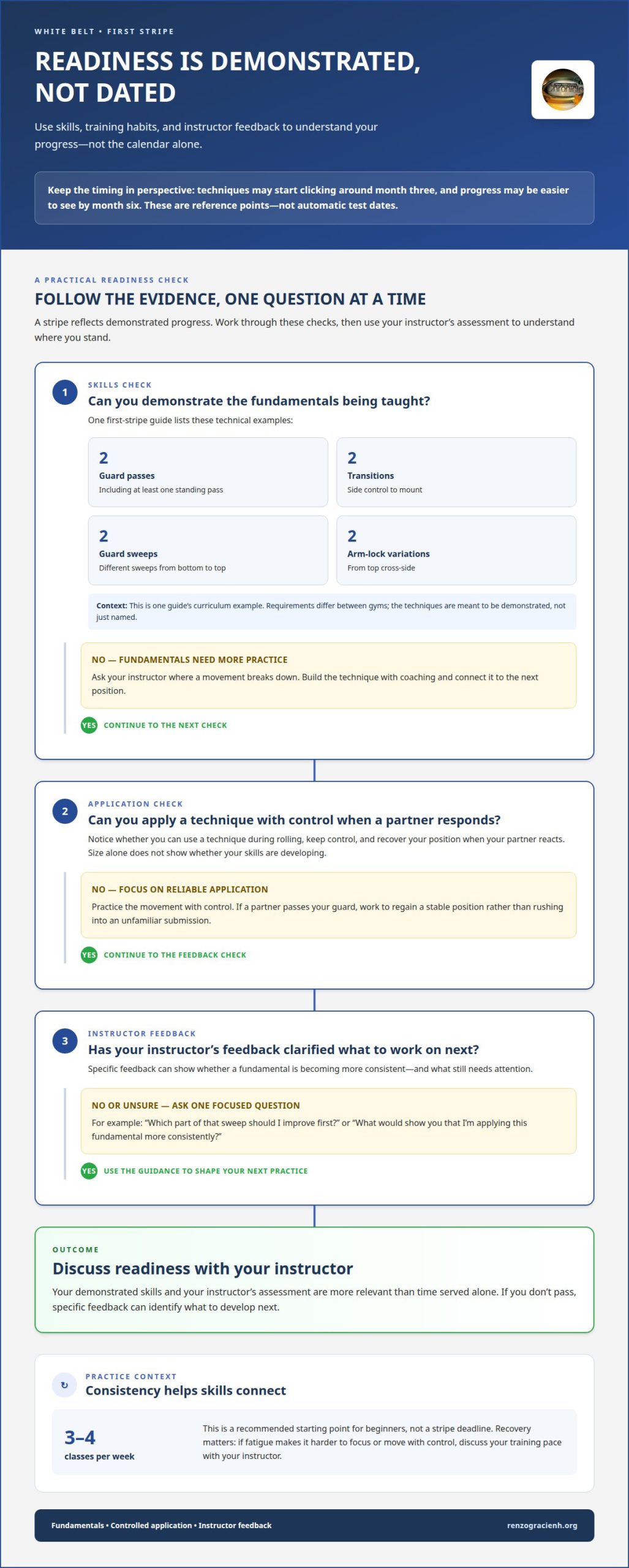
A first BJJ stripe isn’t earned on a fixed calendar date. When preparing for my first BJJ stripe test in NH, treat month three as a point when techniques may start clicking and month six as a time when progress may be easier to see, not as automatic test dates. Readiness depends on the skills you can demonstrate, your training habits, and your instructor’s feedback.

It’s natural to wonder whether you’re progressing quickly enough, especially when every class brings something new to learn. This guide explains how timing can offer context without defining readiness, what feedback and consistent practice can reveal, and how a stripe evaluation may assess fundamental skills. You’ll have a clearer sense of where you are in your training and what to focus on next.

Key Takeaways

  • Use your instructor’s feedback and the skills you can demonstrate to judge readiness, rather than relying on time alone.
  • Notice how consistently you apply fundamentals with different training partners; steady progress matters more than trying to impress.
  • Ask what to focus on next. If you don’t pass, feedback can clarify what you need to develop for a stripe.
  • Prepare for an evaluation of core skills, including guard passes, sweeps, transitions, and positional techniques.

Expected timeline for earning a first white belt stripe

Students may not earn a stripe if they haven’t consistently demonstrated the expected fundamentals or need more practice applying them. A stripe reflects demonstrated progress, not time served alone. If you’re preparing for your first BJJ stripe test in NH, use the evaluation criteria and your instructor’s feedback to guide your expectations.

First Stripe Timing

First-stripe timing is the period between starting white-belt training and demonstrating the skills expected at that stage. Around month three, techniques may start clicking; by month six, students may recognize their progress more clearly. These are reference points, not test dates. As you prepare for your first BJJ stripe test in NH, use them to reflect on your development rather than predict promotion.

There’s no single calendar schedule for earning stripes or reaching blue belt. Progress depends on the skills you demonstrate and the academy’s approach. A new white belt revisits fundamental movements, learns how positions connect, and gradually applies techniques with partners. Comparing your progress with classmates can distract from what you’re learning. Your instructor’s assessment is a more relevant measure of your development.

Technical Requirements and Curriculum

A first-stripe curriculum builds core techniques for moving between positions and responding with control. One first-stripe guide calls for two technical guard passes, including at least one standing pass, and two transitions from side control to mount. It also includes two different guard sweeps from bottom to top and two arm-lock variations from top cross-side.

Coaching helps students understand the purpose of each movement, rather than simply memorize a sequence. For example, practice can connect a guard pass to a stable position, then work on a controlled transition. During the first year, white belts can prioritize fundamentals and build reliable technique. An instructor can identify where a movement breaks down and guide practice toward a more connected skill set.

Observing instructors and training partners

Watch how instructors demonstrate a position, correct details, and adjust practice when a movement isn’t working. During rolling, notice whether you can apply a technique with control, then recover your position when your partner responds. A technical partner may submit a beginner despite weighing 50 pounds less, so size alone doesn’t show whether your skills are developing.

Training frequency also shapes what you retain. Three to four classes per week is a recommended starting point for beginners, but recovery matters: if fatigue makes it harder to focus or move with control, discuss your training pace with your instructor. Consistent attendance helps you revisit techniques and receive coaching over time. Missing practice can make it harder to connect a move from one class with a position encountered later.

Keep your gear clean. Wash your gi after every class, and shower before and after training. For a stripe test, wear your usual clean training gi and bring your belt; arrive ready to follow your instructor’s directions. These simple habits support a respectful training environment and let you focus on the evaluation.

During live rolling, prioritize learning over winning each exchange. For example, if a partner passes your guard, work to regain a stable position instead of rushing into an unfamiliar submission. Pay attention to how instructors respond to your movement and how experienced partners offer resistance. Their reactions can show whether your technique works under pressure, while staying composed helps keep practice constructive.

If you’re building a steady routine, coached Jiu-Jitsu training can give you regular opportunities to practice with guidance. Show up consistently, keep your gear clean, and use each round to learn something specific.

Asking questions and seeking feedback

Specific feedback can turn a stripe result into a clear training focus. Students who don’t pass receive feedback on what they need to do to earn the stripe. Use that guidance to identify a fundamental skill to work on, rather than treating the result as a judgment of your potential.

Ask questions that clarify the movement, not just whether it looked right. For example, if a sweep stalls, ask which part of its mechanics needs attention: your setup, balance, or timing. Then try the correction during practice and ask whether it addressed the issue. One focused question gives you a practical next step.

  • “Which part of that sweep should I improve first?”
  • “What should I do when my partner blocks the first attempt?”
  • “Can you show me where my balance shifted?”
  • “What would show you that I’m applying this fundamental more consistently?”

Feedback is most useful when you connect it to a specific example. If an instructor notes that your guard pass loses control near the end, remember that moment and focus your next practice on maintaining position through the transition. Everyone learns at a different pace, so compare your work with the criteria being taught, not another student’s progress.

After receiving feedback, restate the key point in your own words. For instance, say, “I need to keep my base stable before moving past the guard,” then practice that detail in a controlled drill. If the same difficulty comes up again, describe what happened and ask for another adjustment. This gives your instructor a clear example to respond to and helps you track whether the correction carries into live training.

Not passing on the first attempt doesn’t leave you guessing. Use your instructor’s specific guidance to shape your next practice, then ask how your progress compares with the target.
Preparing for My First BJJ Stripe Test in NH: When to Test

Stripe test format and evaluation

A stripe evaluation checks whether a student can demonstrate foundational Brazilian jiu-jitsu skills, not just name techniques. The format may combine technical demonstrations with movement between positions, helping an instructor assess mechanics, control, and understanding during grappling. The takeaway: prepare to show how techniques work, not only recall their names.

Requirements differ between gyms because each sets its own curriculum and assessment approach. An affiliation may provide shared guidance across its academies, while a local instructor can shape an evaluation around the skills taught in class. Ask which techniques and criteria apply at your academy, then use the answer to focus your practice.

One first-stripe test guide includes two technical guard passes, with at least one standing pass. It also lists two ways to move from side control to mount, two guard sweeps from bottom to top, and two arm-lock variations from top cross-side. These examples show why an evaluation may involve skills from several positions rather than one isolated move.

For each technique, focus on clear steps: establish the position, control your movement, and complete the transition with purpose. A guard pass, for example, should involve more than moving forward; you need to work through the guard into a stable position. An escape or sweep should also reflect the mechanics taught in class. Instructor feedback helps identify which detail needs more practice.

Do BJJ gyms charge a fee for stripe tests? There isn’t one universal fee; whether an evaluation has a separate charge depends on the gym’s policy. The test format and any related cost are separate questions, so understand both before test day.

Want structured practice with instructor guidance? Explore Jiu-Jitsu training and keep building the skills an evaluation may assess.

Renzo Gracie NH

Renzo Gracie NH can help you build your Jiu-Jitsu skills through structured instruction and ongoing practice. If you’re unsure what to focus on before a first stripe evaluation, use your training to develop fundamentals, apply techniques, and learn from instructor feedback. The Adult Jiu Jitsu Program supports adult students, while the Kids Jiu Jitsu Program provides instruction for children. Law enforcement professionals can also explore Law Enforcement Jiu-Jitsu Training. New students can begin with a Free Introductory Class to experience training and consider their next step. A stripe is one milestone in a longer learning journey, and consistent coaching can help you keep progressing beyond it. If you’d like to discuss getting started, contact Renzo Gracie NH.

Keep building beyond your first stripe

A stripe can mark progress, but your next goal can be broader: becoming a more thoughtful, capable training partner. If you’re preparing for your first BJJ stripe test in NH, choose a personal focus to keep learning after the evaluation, such as staying composed during transitions or applying a technique with better control. Small, deliberate goals give each class a purpose.

Renzo Gracie NH offers an Adult Jiu Jitsu Program, a Kids Jiu Jitsu Program, and Law Enforcement Jiu-Jitsu Training, with instruction suited to different student needs. Whether you’re beginning your own practice, supporting a child’s interest, or developing skills for professional training, start with a consistent learning routine.

Contact Renzo Gracie NH to talk about getting started. Keep showing up, stay curious, and take pride in every step forward.

Frequently Asked Questions

WHEN WILL I BE READY FOR MY FIRST STRIPE?

You’re ready when you can demonstrate the skills your instructor expects and apply them with control. Techniques may start clicking around month three, while month six can make your progress easier to recognize. Treat these as useful checkpoints, not deadlines. For example, notice whether you can follow a familiar movement sequence when your partner changes position, rather than relying on a calendar.

WHAT HAPPENS WHEN I GET TO THIS POINT?

Once your instructor considers you ready, you may be evaluated on the fundamentals taught in class. Students who pass are awarded their stripe at the front of the class. Afterward, keep training and work on applying those skills in new situations. A stripe marks progress, while continued practice helps you build toward your next learning goal.

What are the requirements for a first BJJ stripe test for a white belt?

Requirements depend on your academy’s curriculum, but a first-stripe guide may include guard passing, sweeps, transitions, and positional techniques. For instance, it lists two guard passes, two bottom-to-top sweeps, two side-control-to-mount transitions, and two arm-lock variations from top cross-side. Use your instructor’s stated criteria as the standard for your evaluation.

What techniques should I know before my first BJJ stripe test?

Be prepared to show fundamental movements from more than one position. A first-stripe guide includes a standing guard pass, a sweep from bottom, a transition from side control to mount, and arm-lock variations from top cross-side. The goal isn’t to rush through a sequence. Demonstrate each technique with control, and be ready to repeat it if your instructor asks.

How do BJJ stripe tests work, and what should I expect?

A stripe test evaluates whether you can demonstrate techniques and understand how they connect to positions. Expect to show movements from the curriculum, such as passing guard or transitioning from side control. Your instructor assesses your execution and may offer feedback about areas to keep developing. Focus on listening to each prompt and showing your understanding, rather than trying to make every movement look advanced.

How long does it usually take to earn a first BJJ stripe?

There’s no single timeline that applies to every student. Around month three, techniques may begin to click; by month six, you may see your progress more clearly. These milestones don’t determine promotion. Your development depends on what you’ve learned and can demonstrate, so use these time points to reflect on your training, not to measure yourself against another white belt.
Stress relief hobby for men Manchester: find social activities

The right stress relief hobby for men in Manchester may be less about switching off alone and more about finding an activity you can share with others. Game nights, beginner-friendly classes, and local clubs offer practical ways to try something new, meet people, and build a routine at your own pace.

It makes sense to want a hobby that feels enjoyable, not like another commitment to manage. You don’t need to be outgoing or experienced to begin. Choosing an activity that matches your interests and energy can make the first step easier.

Explore social hobby ideas and practical ways to choose one around your schedule, budget, and preferences. You’ll also find a low-pressure plan for your first week: sample activities, notice what feels right, and take the next step without overcommitting.

Key Takeaways

  • Explore social options such as game nights, clubs, and beginner-friendly classes to find an activity that feels enjoyable and welcoming.
  • Keep your first week manageable by sampling a few activities and choosing a pace that fits your schedule and budget.
  • Match a hobby to your interests and energy, then adjust the commitment based on what you enjoy returning to.
  • Start new activities thoughtfully: consider your comfort, build gradually, and choose an option that supports your well-being.

1. Social activities, including game nights, classes, and clubs

Game nights, beginner classes, and clubs give social activities a clear focus: learn a rule, make something, or work through a shared challenge. In Manchester, try a board-game evening if conversation feels easier with a game on the table, or a cooking class if you enjoy practical, creative tasks. A reading group or writing session may suit you if you prefer quieter discussion. Choose an indoor or outdoor setting that feels comfortable, then consider whether the people and pace make you want to return.

Active hobbies and meditation offer different ways to settle your mind. Exercise, a dance class, or kayaking focuses your attention on movement and the task in front of you; meditation turns attention inward, often through breathing. If sitting still leaves you restless, try a walk, club activity, or hands-on session first. If busy rooms feel draining, a short meditation or journaling session may fit better. You can also combine activities, such as a calm breathing exercise after a game night.

Water activities offer social and solo options. Boating can be a shared outing, fishing leaves room for conversation to pause, and kayaking adds steady movement and concentration. Choose according to what you need: a group activity if you want company, a repetitive task if your thoughts are racing, or an outdoor challenge if you’re looking for movement and a change of scenery. Reading, sketching, or journaling can be indoor alternatives when weather or energy makes an outing less appealing.

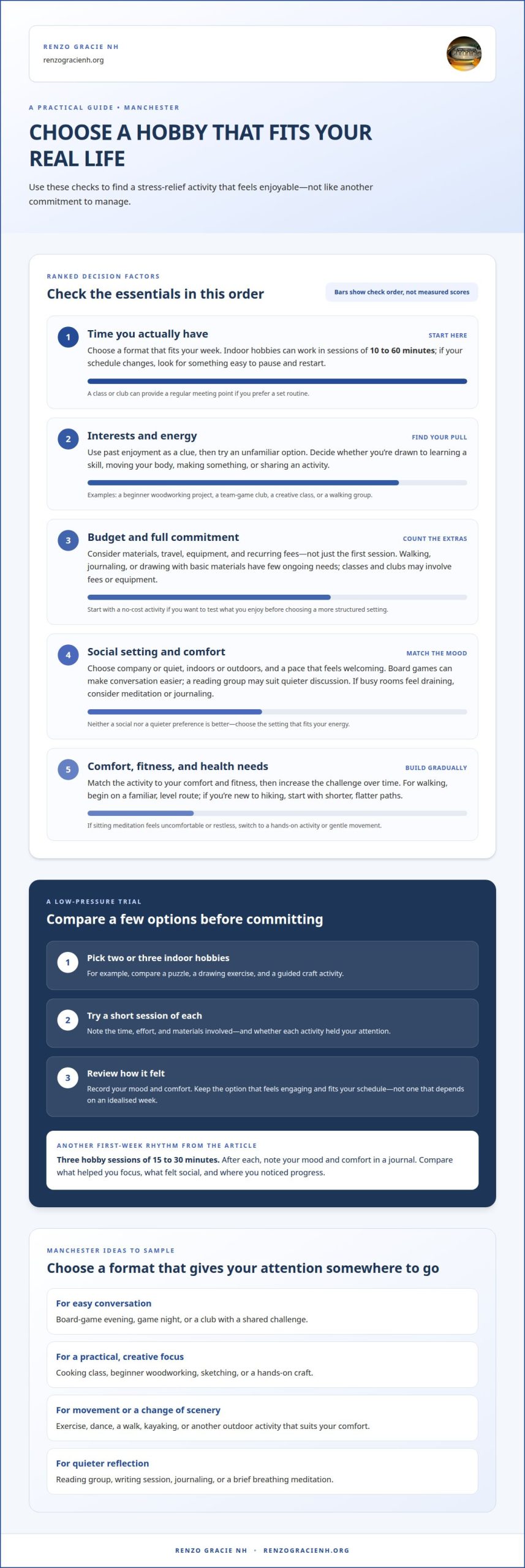
Relief may feel noticeable during or after one enjoyable session, especially when attention shifts from a stressor to a clear activity. Longer-term value often comes from finding something you’ll repeat, rather than expecting one session to solve everything. For a low-pressure first week, schedule three hobby sessions of 15 to 30 minutes, then record your mood and comfort in a journal. Compare the activities: which helped you focus, which felt social, and which showed progress? That simple review can guide your next choice.

3. Are there free or low-cost stress-relief activities in Manchester?

Yes. Start with activities that use what you already have instead of buying equipment or committing to a paid course. A walk in Manchester offers a simple outdoor reset: choose a familiar route and focus on your surroundings. At home, try caring for a houseplant, sketching an everyday object, or playing a puzzle game you already own. Each gives you a clear focus without much setup.

Keep creative hobbies simple. Use paper and a pencil for a quick drawing, or write a journal entry about what’s on your mind. A short writing session can help you organise your thoughts; treat it as private practice, not polished work. For a calming indoor routine, sit comfortably and try a brief guided breathing meditation. If meditation feels uncomfortable, switch to a hands-on activity.

Free activities can also help build a weekly rhythm. Set aside time to read a book you already own, tend herbs, or repeat a simple stretch-and-walk routine. Choose one activity for a specific day, then notice how your mood and energy feel afterward. If you feel more settled or engaged, repeat it. If it becomes another obligation, shorten the session or try something else.

For low-cost choices, focus on what the activity requires before joining. A hobby based on walking, journaling, or drawing with basic materials has few ongoing needs; classes and clubs may involve fees or equipment, so weigh those against the social structure and instruction you value. You don’t have to decide permanently. Try a no-cost activity first, then consider whether a more structured setting would help you stay consistent. If guided practice appeals, explore a structured activity as one possible next step.

Stress relief hobby for men Manchester: find social activities

How do you choose a hobby that fits your schedule, budget, and interests?

Choosing a stress relief hobby for men in Manchester starts with activities you’ve enjoyed before. If fixing things felt satisfying, try a beginner woodworking project; if you liked team games, explore a club. Past enjoyment is a useful clue, not a rule. Add an unfamiliar option too, such as a creative class or local walking group. Trying different formats can show whether you prefer learning a skill, moving your body, or sharing an activity.

Fit the hobby around real time in your week. A suitable indoor activity can work in sessions of 10 to 60 minutes, such as sketching after dinner or reading during a quiet break. If your calendar changes often, choose something easy to pause and restart. If you prefer a set routine, a class or club can provide a regular meeting point. The right stress relief hobby for men in Manchester is one that fits without becoming another source of pressure.

Consider the full commitment, not just the first session. A hobby may involve materials, travel, equipment, or a recurring fee, so set a budget before choosing. Drawing with basic supplies has different requirements from joining a class or taking up kayaking. If you prefer quieter activities, reading or journaling may feel comfortable; if you enjoy company, you might prefer team activities or clubs. Neither preference is better. Match the setting to your energy.

Use a one-week trial to compare two or three indoor hobbies before committing. Give each a short session, then note the time, effort, and materials involved. Record whether it held your attention and whether you’d choose it again. For example, compare a puzzle, a drawing exercise, and a guided craft activity. Keep the option that fits your schedule and feels engaging, rather than one that depends on an idealised version of your free time.

4. Are there safety or health considerations when starting a new hobby?

Yes. Match the activity to your fitness, comfort, and health needs, then build gradually. For a new walking routine, begin on a familiar, level route before choosing steeper terrain. If you’re new to hiking, start with shorter, flatter paths and increase the distance or difficulty over time. For a craft such as pottery, set up a stable workspace and keep tools within easy reach.

With active hobbies, learn the basic movements before increasing effort. A beginner dance class, for example, lets you practise steps at a manageable pace. Pause if you feel pain, dizziness, or unusual shortness of breath. For kayaking or boating, choose an introductory setting and learn how to use the required equipment before heading out. A calm first session helps you focus on technique rather than pushing through discomfort.

Approach meditation thoughtfully, too. Sitting quietly can feel uncomfortable, especially when your attention turns toward difficult thoughts. Try a brief guided breathing exercise, keep your eyes open if that feels better, or switch to a walk or hands-on task. Stop if distress increases. A journal can help you record how different activities affect your mood, energy, and sense of ease.

Before each session, take three practical steps: choose a setting suited to the activity, prepare any needed equipment, and decide how you’ll pause or leave if you feel unwell. For exercise, that might mean selecting a route with an easy return; for drawing, it could mean taking a break when your posture becomes uncomfortable. If an existing health concern affects what feels safe, discuss suitable activity with a qualified health professional. For a structured, coached starting point, take a guided first step.

Meditation can also raise anxiety for some: a 2020 PLOS ONE study found that approximately 25% of people experience increased anxiety during meditation practices. For hiking, keep early outings modest and build stamina gradually, rather than treating distance as a test.

Renzo Gracie NH

Renzo Gracie NH offers a structured, social way to build skill, focus, and steady progress through Brazilian Jiu-Jitsu. If you’re drawn to an active hobby with guided instruction and shared practice, its Adult Jiu Jitsu Program may suit you better than a solo activity. A Free Introductory Class provides a way to experience the program before deciding whether it fits your interests.

For families, the Kids Jiu Jitsu Program offers children their own way to learn and develop, while adults explore a hobby of their own. Consider this option if you want movement, learning, and community in one regular activity. It isn’t a substitute for professional mental health support, but it can be part of a balanced routine.

To explore whether this kind of activity suits you, contact Renzo Gracie NH.

Make your next step a manageable one

A stress-relief hobby for men in Manchester doesn’t need to become a major commitment. Choose an activity you’ll want to return to, and give yourself room to learn at a steady pace. If you’re drawn to movement, focus, and shared practice, Renzo Gracie NH offers adult and kids’ Jiu-Jitsu programs, along with Law Enforcement Jiu-Jitsu Training. These structured options give individuals and families a way to build skills through shared activity.

Let curiosity guide the decision. You can take the next step when you’re ready to explore whether Jiu-Jitsu suits your interests and routine. Contact Renzo Gracie NH to start a conversation. A small first step can open the door to a rewarding new routine.

Frequently Asked Questions

What hobbies are most effective for stress relief for men?

The most useful hobby is one that holds your attention and feels manageable to repeat. Someone who wants to move may prefer a recreational sport, while someone seeking a quieter focus might choose model-making or reading. In Manchester, consider whether you want social contact, physical activity, or time alone. Try something new, then notice how you feel afterward.

What stress-relief hobby classes are available in Manchester?

Brazilian Jiu-Jitsu is a structured, active class option at Renzo Gracie NH in Manchester, New Hampshire. It combines learning techniques with guided practice, which may suit someone who enjoys building skills through shared activity. Renzo Gracie NH also offers instruction for adults and children, as well as specialized training for law enforcement. Choose a class format that fits your goals and experience.

Where can men find hobby groups and classes in Manchester?

For a locally based, guided activity, consider Brazilian Jiu-Jitsu at Renzo Gracie NH in Manchester, New Hampshire. If you’re considering another kind of group, narrow your search by activity, preferred schedule, and whether you want instruction or informal social time. A clear starting point, such as a beginner class or regular club meeting, makes it easier to decide whether the group suits you.

Adult BJJ Classes in Manchester for Beginners

You don’t need to get fit before starting Brazilian Jiu-Jitsu. Adult BJJ classes in Manchester offer beginners a structured way to learn the fundamentals, practise at a manageable pace and build confidence step by step.

It’s natural to wonder whether you’ll keep up or know what to do on your first day. Beginner-friendly instruction breaks learning into clear skills, so you can focus on each movement without needing to have everything figured out right away.

This guide explains how adult classes introduce core techniques, support steady progress and help newcomers get comfortable with training. You’ll also learn what to expect in class and how to prepare for your first session. Progress begins with showing up, learning alongside others and building from one lesson to the next.

Key Takeaways

  • Beginner instruction can break Brazilian Jiu-Jitsu into clear techniques, helping you focus on learning one step at a time.
  • A structured class gives newcomers a way to follow the lesson and build skills without prior experience.
  • Understanding how adult training works can help you feel more prepared for practice with training partners.
  • Choosing comfortable athletic clothing and knowing what to expect can make your first class feel more straightforward.

Beginner-friendly instruction and paced progression

Beginner Brazilian Jiu-Jitsu develops through clear instruction, repeated practice and gradually more complex ground skills. A well-structured class lets adults learn techniques before adding speed or resistance.

Beginner and Experienced Class Options

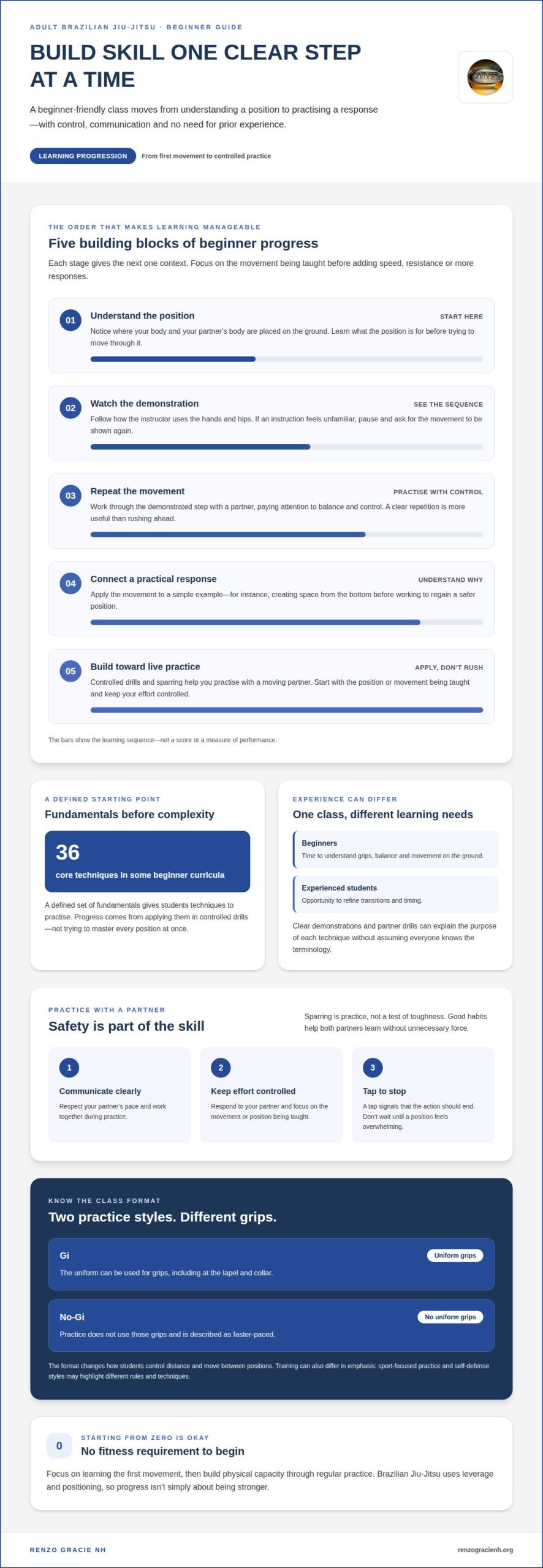
Look for instruction that distinguishes foundational learning from advanced practice. A beginner needs time to understand grips, balance and movement on the ground, while an experienced practitioner can refine transitions and timing. Some beginner curricula teach 36 core techniques, giving students a defined set of fundamentals to practise. Progress then comes from applying those techniques in controlled drills, not from trying to master every position at once.

Adult classes may include students with different experience levels. Co-ed means adults of different genders train in the same class. Look for clear demonstrations and partner drills that explain the purpose of each technique. A progressive class builds from basic movement toward connected skills rather than assuming everyone already knows the terminology.

Safety and Sparring for Beginners

Partner practice helps you understand how techniques work with another person. Students in these BJJ classes regularly spar, so beginners should understand the format and purpose of each round. Sparring is practice, not a test of toughness. Start with the movement or position being taught, and keep your effort controlled so you can respond to your partner.

Good training habits include communicating clearly, respecting your partner’s pace and tapping when you need to stop. A tap signals that the action should end, so don’t wait until a position feels overwhelming. Focus on safe posture and the technique being practised. This discipline helps both partners learn while avoiding unnecessary force during ground work.

Guidance for a First Class

In your first class, follow the instructor’s demonstration before trying a technique. Watch how the hands and hips move, then practise the same sequence with a partner. If a position or instruction feels unfamiliar, pause and ask for the movement to be shown again. One clear repetition is more useful than rushing through steps you don’t yet understand.

There are no fitness requirements for starting beginner Brazilian Jiu-Jitsu classes. Focus on learning the first movement, then build physical capacity through regular practice. Treat your first lesson as the start of a journey: listen, practise the demonstrated technique and notice which detail you want to work on next time.

Structured classes for students with no experience

A structured Brazilian Jiu-Jitsu class gives new students a clear path through unfamiliar movements. Instead of treating every technique as separate, instruction can connect a position, its purpose and a practical response. For example, a lesson might introduce how to create space from the bottom before practising how to regain a safer position. That sequence helps you understand why each movement matters.

Progression should make sense at every level. Beginners need explanations and repeated practice, while experienced students can work on timing, transitions or different responses to the same position. In a supportive class, those differences are part of the learning environment, not a reason to rush. Respect between partners matters, especially when one student is learning a movement and another already knows it.

  • Learn the position: Identify where your body and your partner’s body are placed on the ground.
  • Practise the movement: Repeat the demonstrated step with attention to balance and control.
  • Connect the response: Apply the movement to a simple example, such as creating space during defense.

This structure builds understanding alongside physical strength. First, focus on the right sequence; then develop coordination and confidence through practice. Brazilian Jiu-Jitsu uses leverage and positioning, so progress isn’t simply about being stronger. The key discipline is learning to make a useful decision from the position you’re in.

For a first visit, an introductory class offers a practical way to experience the teaching and class environment. You can see how instructions are presented, how partners work together and whether the pace helps you follow each step. If you’re ready to begin, the Free Introductory Class is a natural place to start.

Adult BJJ Classes in Manchester for Beginners

Adult Brazilian Jiu-Jitsu classes

Brazilian Jiu-Jitsu is a martial art focused largely on ground grappling. Adults learn how positioning, holds, throws and submission techniques affect an encounter with an opponent. A class might connect these skills through a practical example: use a throw to reach the ground, establish control, then practise a suitable response. The goal is to understand how the skills fit together, not just memorise names.

Instructors may teach techniques through Gi or No-Gi practice, which use different grips. Gi training uses the uniform for grips, including at the lapel and collar. No-Gi practice doesn’t use those grips and is described as faster-paced. The choice changes how students control distance and move between positions, so beginners benefit from knowing which style a class follows.

Training also varies by purpose. Sport-focused practice and self-defense styles can emphasize different rules and techniques. In either setting, students regularly spar, applying skills with a moving partner rather than relying only on a cooperative demonstration. Sparring gives you a chance to recognize positions, respond to an opponent and see which techniques need more practice.

  • Observe the focus: Notice whether the lesson emphasizes sport grappling or self-defense skills.
  • Follow the format: Learn whether the class uses Gi grips or No-Gi movement.
  • Apply one technique: Practise the demonstrated sequence before adding other responses.

Start by focusing on one position and its purpose. For example, practise maintaining control before attempting a transition. This makes it easier to notice details: where balance shifts, how a grip affects movement and when a partner creates space. Adult BJJ classes in Manchester can introduce these skills progressively, helping you connect technique, timing and respect during training.

Brazilian Jiu-Jitsu develops through consistent practice, not one perfect round. Treat each sparring exchange as information: identify the position, recall the technique and choose a response. With that focus, adults can build a broader understanding of martial arts while learning to train thoughtfully with different partners.

What should beginners bring or wear to their first adult BJJ class?

Choose clothing that lets you bend, step and move comfortably during Brazilian Jiu-Jitsu practice. For No-Gi training, practitioners wear athletic clothing, such as shorts and a rash guard, instead of a uniform. This is a straightforward starting point for preparing for a class without a kimono.

The class format affects what you wear. Gi practice uses a uniform, while No-Gi practice uses athletic clothing. Shorts and a rash guard are examples of suitable No-Gi attire. Choose clothing that stays comfortable as you move through drills, change levels and practise positions on the ground.

Pack a few practical items before your visit so you can focus on instruction rather than searching through your bag:

  • Athletic clothing: Bring shorts and a rash guard for No-Gi practice.
  • Water: A water bottle gives you something to drink between activities.
  • A towel: Keep one with your belongings for after physical practice.
  • A change of clothes: Pack a clean outfit for the trip home.

Before leaving, follow a simple routine: set out your clothing, pack your personal items and arrive ready to listen. For example, if the class uses No-Gi practice, choose shorts and a rash guard rather than a uniform. Once training begins, focus on the instructor’s directions, especially when moving from a demonstration to partner practice.

Comfort matters more than buying specialized gear before you know the class format. Start with suitable athletic clothing for No-Gi practice and the practical items you already use for exercise. You can then learn how the class is structured and which movements feel comfortable as you build your skills.

Ready to take a first step? Try the Free Introductory Class and experience adult Brazilian Jiu-Jitsu instruction in person.

Renzo Gracie NH: Adult Jiu Jitsu Program

Renzo Gracie NH offers an Adult Jiu Jitsu Program for adults who are ready to learn Brazilian Jiu-Jitsu or develop their skills further. Structured instruction provides a clear next step, from learning techniques to practising with training partners.

If you’re new to training, the Free Introductory Class lets you experience instruction before deciding how you’d like to continue. It’s a chance to see how a class feels and whether the learning environment suits your goals. Adults with children can also explore the Kids Jiu Jitsu Program, while Law Enforcement Jiu-Jitsu Training serves a distinct professional purpose.

Choose the Adult Jiu Jitsu Program when you’re ready to develop your practice through adult instruction. To get started, contact Renzo Gracie NH about a free introductory class.

Take your first step on the mat

Your first class can begin a steady practice shaped by what you want to learn and how you choose to progress. If you’re considering adult BJJ classes in Manchester, take one practical next step: connect with an instructor and decide whether starting now fits your goals.

Renzo Gracie NH offers an Adult Jiu Jitsu Program, a Kids Jiu Jitsu Program and Law Enforcement Jiu-Jitsu Training. These programs serve different students and purposes, while giving adults a clear path to begin training. You don’t need to plan every detail of your long-term journey before you start.

Contact Renzo Gracie NH to discuss getting started. Bring your curiosity, take the first step, and let your skills grow through practice.

Frequently Asked Questions

What age, fitness, or experience requirements do Manchester BJJ classes have?

Beginner classes have no fitness requirement, and you don’t need prior Brazilian Jiu-Jitsu experience to begin. Adult instruction is for adults, while children can join the separate Kids Jiu Jitsu Program. If you’re new to training in Manchester, the Free Introductory Class offers a first look before you decide whether to continue.

What safety rules and injury risks should adults know before starting BJJ in Manchester?

Brazilian Jiu-Jitsu is close-contact physical training, so bumps or strains are possible. Follow the instructor’s directions, avoid forcing a movement, and pause if you feel pain or become unwell. Tell the instructor about an injury or physical limitation before training so they understand what may affect your participation. Keep practice controlled and communicate clearly with your partner.

Which Manchester gyms offer beginner-friendly adult BJJ classes?

Gracie Jiu-Jitsu Manchester offers an adult beginner program that teaches 36 core techniques in a fun, cooperative environment.

Where are adult BJJ gyms located in Manchester, and how accessible are they by public transport?

Gracie Jiu-Jitsu Manchester is located at 371 South Willow Street, Manchester, New Hampshire 03103. Public transport access is not described.

Ways to restart exercise and maintain muscle after 40 in Exeter

Getting back in shape after 40 isn’t about pushing harder from day one; it’s about rebuilding strength with consistency. If you’re getting in shape after 40 in Exeter, strength and energy can improve within a few weeks, while visible changes typically take 6-8 weeks of consistent training three times per week. Start gradually and give your body time to adapt.

It’s understandable to wonder whether age, time away from exercise or changes in your body will affect your progress. A thoughtful return to movement can help you build fitness while supporting the muscle you want to maintain.

This article explains how age-related changes may affect strength, how to avoid common mistakes when restarting, and how resistance training can fit into a sustainable routine. You’ll also see why consistency matters more than trying to make up for lost time in a single workout.

Key Takeaways

  • Account for changes in strength and recovery by restarting at a pace your body can manage.
  • Avoid doing too much too soon; build your routine gradually and focus on sound movement.
  • Combine regular activity with resistance training to support muscle maintenance and strength.
  • Choose a welcoming, structured activity that helps you stay engaged and keep progressing.

Muscle changes are one reason returning exercise may feel different. Sedentary adults over 40 can lose roughly 8% of muscle mass per decade. Regular strength work gives muscles a reason to stay active. Start with controlled movements, then build difficulty gradually.

Hormones can also change with age, influencing how people experience energy and recovery. These changes differ from person to person, so avoid assuming age alone explains tiredness or reduced performance. Resting metabolism remains fairly steady from about age 20 to 60. It does not really begin to drop until after age 60, so age alone doesn’t explain every change in body weight.

Give your bones and joints careful consideration when choosing activities. Previous injuries, joint discomfort, and existing health conditions can affect which movements feel manageable. Use a smaller range of motion when needed, and stop any movement that causes sharp or worsening pain. Build progress through steady practice rather than forcing a sore joint.

Before exercising, adults over 40 should consider existing health conditions, injury history, and a long period of inactivity. These factors can affect which activity and pace are appropriate. A medical consultation before starting is particularly relevant when health conditions or inactivity are present.

When comparing gyms and fitness centers in Exeter, look for adult-friendly instruction, beginner options, and activities that allow gradual progress. A clear introduction to movements can help you find a comfortable starting point without treating every class as a test.

Walking groups, fitness classes, and sports clubs offer different ways to make exercise social and structured in Exeter. Think about whether you prefer a steady walk, coached practice, or a group sport, then choose a format you can attend consistently.

For nutrition and recovery, include protein-containing foods in regular meals and leave time between demanding sessions. Sleep, hydration, and balanced meals support consistent training. Avoid trying to make up for missed exercise with severe food restriction or exhausting workouts.

2. Common mistakes when returning to exercise

A common mistake is treating your previous routine as your starting point today. A long break can change your stamina, coordination, and tolerance for effort. A pace that once felt comfortable may now feel demanding. Begin with movements you can control, then adjust based on how you recover.

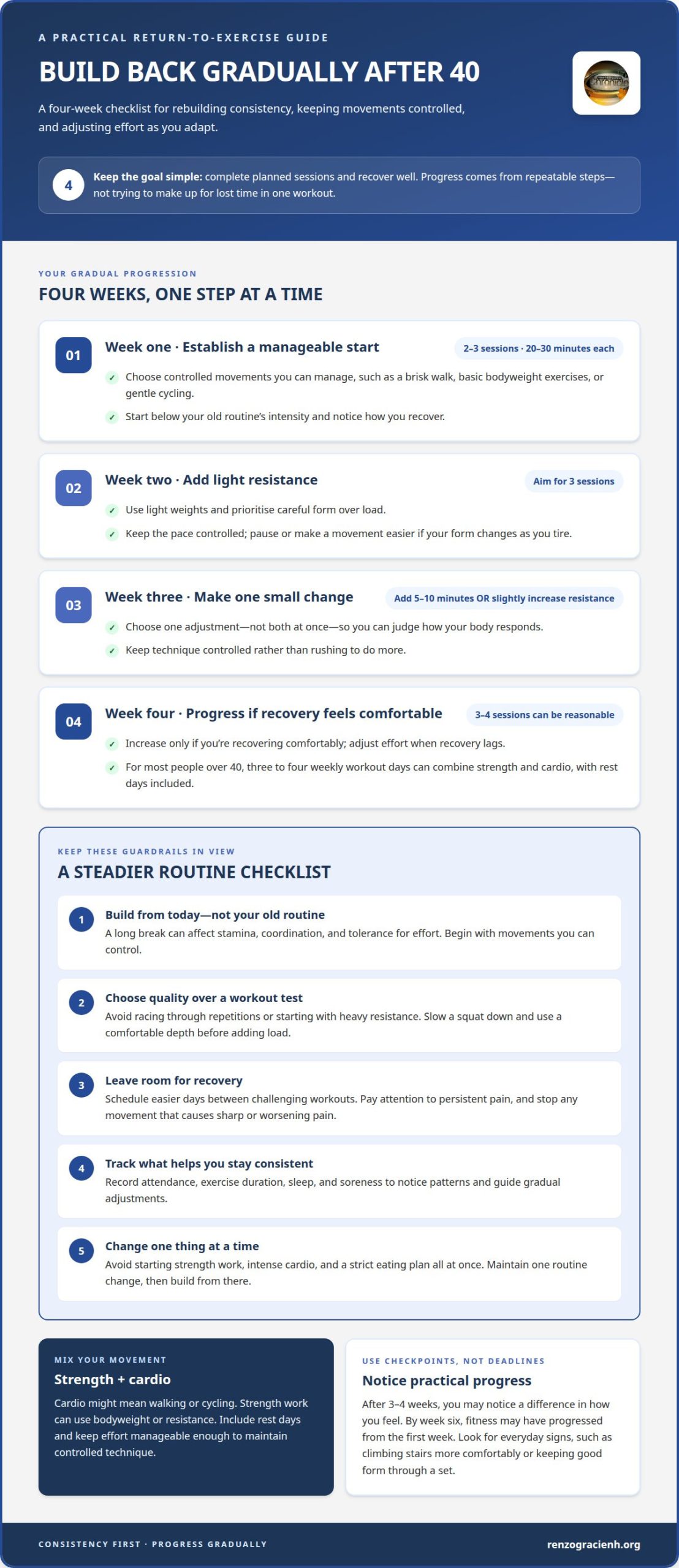
Doing too much too soon is another common setback. A hard session followed by several days of soreness can disrupt consistency. Instead, use a gradual first-month progression: start with two or three sessions in week one, lasting 20-30 minutes each. In week two, aim for three sessions with light resistance and careful form. Add only a small challenge as your body adapts.

Don’t turn every workout into a test. Racing through repetitions, choosing heavy resistance straight away, or neglecting technique can make your movements less controlled. For example, slow down a squat and use a comfortable depth before adding load. If your form changes as you tire, pause or make the movement easier instead of forcing extra repetitions.

Skipping recovery can also make it harder to return to exercise. Repeating demanding sessions without rest may leave you too tired to train well. Schedule easier days between challenging workouts, and pay attention to persistent pain rather than dismissing it as ordinary effort. A simple log of activity, sleep, and soreness can help you notice patterns.

Finally, avoid changing everything at once. Starting strength work, intense cardio, and a strict eating plan together makes it harder to identify what feels manageable. Choose one routine change, maintain it, then build from there. For people who learn best through coached movement, guided, structured practice can provide a clear setting to focus on technique and steady effort.

Ways to restart exercise and maintain muscle after 40 in Exeter

3. Exercise guidance for beginners and returning exercisers

Adults over 40 can set realistic goals around consistency, stamina, movement quality, and strength. During the first month, success means completing planned sessions and recovering well, not matching an earlier version of yourself. Look for practical progress, such as climbing stairs more comfortably or keeping good form through a set.

Start with a manageable first week. Plan two or three sessions, each lasting 20-30 minutes, and choose movements that let you maintain control. A brisk walk, basic bodyweight exercises, or gentle cycling can help you rebuild a routine. The American College of Sports Medicine recommends that sedentary adults increase physical activity gradually.

Use the next weeks to make small, deliberate changes. In week two, aim for three sessions with light weights, prioritising form over load. In week three, add 5-10 minutes to sessions or increase resistance slightly. By week four, three to four sessions can be a reasonable progression if you’re recovering comfortably. Change one element at a time, so you can judge how your body responds.

For most people over 40, three to four weekly workout days combining strength and cardio works well, with rest days included. Cardio might mean walking or cycling; strength work can use bodyweight or resistance. Keep the effort manageable enough to finish with controlled technique rather than rushing through repetitions.

Track attendance, exercise duration, and how each session feels. After 3-4 weeks, you may notice a difference in how you feel; by week six, your fitness may have progressed from the first week. Treat these as checkpoints, not deadlines. Build the routine around repeatable steps, such as adding a short walk or practising a few controlled movements, and adjust effort when recovery lags.

4. Strength training and muscle maintenance

Muscle responds to a reasoned challenge at any age. Adults over 40 can build muscle through progressive resistance training and enough protein. Progression means gradually adjusting resistance or repetitions while maintaining controlled technique. A chair squat, for example, can become a deeper squat before adding resistance.

A practical target is two to three full-body strength sessions per week. Include movements that work your legs, hips, back, chest, shoulders, and arms. Bodyweight exercises, resistance bands, and weights can all provide resistance. Choose a version you can perform with steady control, then increase the challenge as your strength and technique improve.

Put strength work first when building strength is the workout’s main goal. Training while fresh can help you focus on form instead of rushing through repetitions after cardio. Walking is useful for general activity, but it doesn’t replace resistance training for rebuilding muscle. Plan for recovery, too, by alternating demanding sessions with easier days.

Nutrition supports the work. Include protein-containing foods in meals and eat enough overall to support regular training. Visible changes often take 6-8 weeks of consistent training three times per week, while strength and energy may improve within a few weeks. Adults in their 60s and 70s can also gain measurable strength through resistance training, so starting later doesn’t make strength work pointless.

In Exeter, gym membership and personal-training prices vary according to access, coaching format, session frequency, and included facilities. Compare what each option covers rather than judging by the headline cost alone.

Keep the takeaway simple: train the whole body consistently, progress resistance gradually, and support sessions with suitable meals and recovery. To explore a structured way to practise controlled movement and build strength, take the next step with guided training.

Renzo Gracie NH

Renzo Gracie NH offers adults in Exeter a structured martial arts setting for making regular movement part of their routine. The Adult Jiu Jitsu Program combines skill practice with physical activity, giving returning exercisers an engaging way to work on coordination, focus, and fitness through consistent participation.

Curious about trying a coached activity? The Free Introductory Class lets you experience the training before deciding whether it suits your goals. Jiu Jitsu isn’t a substitute for a dedicated strength-training plan, but it can be an engaging part of an active lifestyle alongside appropriate resistance exercise and recovery.

Contact Renzo Gracie NH to learn more about getting started in Exeter.

Make your next step one you can sustain

Progress after 40 doesn’t need a dramatic reset. Choose a form of movement that fits your routine, then give yourself room to develop consistency. If training with family or in a focused professional setting matters to you, Renzo Gracie NH also offers a Kids Jiu Jitsu Program and Law Enforcement Jiu-Jitsu Training.

For adults looking to get in shape after 40 in Exeter, the most useful next step is one you’ll feel ready to repeat. Consider what helps you stay engaged: learning new skills, moving alongside others, or building a regular practice. Let that preference guide your choice, while keeping strength training and recovery in view.

To explore whether training could suit your goals, contact Renzo Gracie NH today. Start with a conversation, then take your next step at a pace that feels right for you.

Frequently Asked Questions

How long does it take to get back in shape after 40?

Strength and energy may improve within a few weeks, while visible changes typically take 6-8 weeks of consistent training three times weekly. Progress can show up in practical ways first, such as carrying groceries more comfortably or finishing a walk with less effort. To get in shape after 40 in Exeter, focus on repeatable habits and use changes in daily activity as useful progress markers.

Is it too late to start exercising at 45 or 50?

No. Starting at 45 or 50 can still support meaningful improvements in fitness and strength. Resistance training can help people in their 60s and 70s gain measurable strength, so age 45 or 50 isn’t a reason to rule out progress. Begin with activities suited to your current ability, then build gradually. A short walk or controlled bodyweight movements can be a practical first step.

Can you build muscle after 40?

Yes, adults over 40 can build muscle with progressive strength training and enough protein. For example, practise a controlled chair squat, then gradually increase its difficulty as the movement becomes familiar. A full-body routine can include pushing, pulling, and lower-body movements. Give your muscles time to recover between demanding sessions, and keep track of resistance or repetitions so you can recognise steady progress.

How many days a week should I work out after 40?

Three to four workout days weekly, combining strength and cardio with rest days, can work well for many adults over 40. You might schedule full-body strength work on two days and walking or cycling on another day. Treat this as a routine to build toward, not a requirement for your first week. If sessions leave you consistently exhausted, reduce the workload and allow more recovery.

Should I do cardio or weights first when coming back?

Put strength training first when building strength is the main goal of your workout. You’ll be fresher for controlled repetitions and attentive technique. If cardio is the priority, start with walking, cycling, or another aerobic activity. For a mixed session, decide the main purpose beforehand, put that activity first, and keep the second part manageable.

How can beginners safely start exercising after 40?

Start with a manageable activity and increase the challenge gradually. If you’ve been inactive or have an existing health condition, consult a doctor before beginning a new exercise programme. Choose movements you can control, such as an easy walk or supported sit-to-stands, and stop if pain worsens. Note what you did and how you felt afterward; that can help guide your next session.

Boring Workout Alternatives in Windham, NH for Beginners

A workout doesn’t have to feel like a chore to help you build strength and consistency. If you’re looking for boring workout alternatives in Windham, NH, try activity-based exercise that gives you a skill to learn, progress to work toward, or other people to move with, rather than repeating the same routine alone.

It’s normal to want exercise that feels engaging, especially when you’re just starting out and aren’t sure what suits you. Look for an activity you can approach at your own pace and return to regularly, with guidance that helps you understand the movements and build confidence.

This article explores beginner-friendly ways to make exercise more engaging, what to consider when choosing an activity in Windham, and how coaching can support your progress. You’ll also learn how structured martial arts training offers a skill-focused way to get moving, even if you have no experience.

Key Takeaways

  • Choose an activity with a skill or progression to make movement feel more engaging than repeating the same routine.
  • Look for beginner-friendly coaching that helps you learn movements and build confidence at a manageable pace.
  • Consider how a family’s interests and comfort levels can shape a shared approach to staying active.
  • Explore whether structured Jiu Jitsu training, including adult or kids’ programs, fits your goals and preferred way to move.

Beginner-friendly workout access

For beginners exploring boring workout alternatives in Windham, NH, access means more than finding a place to exercise. Choose an activity that fits your starting point, schedule, comfort level, and learning style. A structured class, a neighborhood walk, or a home routine can each offer a different entry point. Ask yourself which option makes it easiest to show up, understand what to do, and keep going without feeling overwhelmed.

Start by naming one practical goal. You might want to move more during the week, learn a physical skill, or enjoy exercising with other people. That goal helps narrow your options. If you enjoy learning, for example, you may prefer a coached class with clear instruction. If you want fresh air, try a walk around your neighborhood. If you value privacy, simple bodyweight movements at home may be a comfortable start.

Next, compare how each activity is structured. A repeatable format can make it easier to plan each session. Look for a clear beginning, a few activities to focus on, and a way to notice your progress. In a dance-based workout, that might mean learning a sequence. In a martial arts class, it could mean practicing a movement with more control. In a walking routine, progress might be following a familiar route more regularly. These are examples of different experiences, not fitness standards you need to meet.

For a first visit to a coached activity, make the process manageable with three decisions:

  • Choose a goal: Pick one reason for starting, such as learning, social connection, or steady movement.
  • Identify your comfort level: Decide whether you prefer independent practice, group instruction, or direct coaching.
  • Notice the teaching style: Look for explanations and demonstrations that make the next movement understandable.

This simple framework keeps the decision focused and helps you explain what you need, such as a slower introduction or time to learn one movement at a time.

Consider practical details before settling into a routine. Travel time affects how easily an activity fits into your day, and class times matter when work, school, or family plans shape your schedule. Think about whether you enjoy group settings, too. You may appreciate learning alongside others, or prefer to start with a solo walk. The best match is the one whose structure works with your everyday life.

Keep your first commitment simple. Choose one activity to try, note what felt clear or confusing, and use that experience to guide your next decision. If a class feels complex, ask for an explanation of the basic movement during instruction. If a home routine feels repetitive, change the activity rather than assuming exercise itself has to be dull. In Windham, NH, a good beginner option offers a clear next step and room to build confidence.

Boring Workout Alternatives in Windham, NH for Beginners

Are there family-friendly or low-impact workout alternatives in Windham, NH?

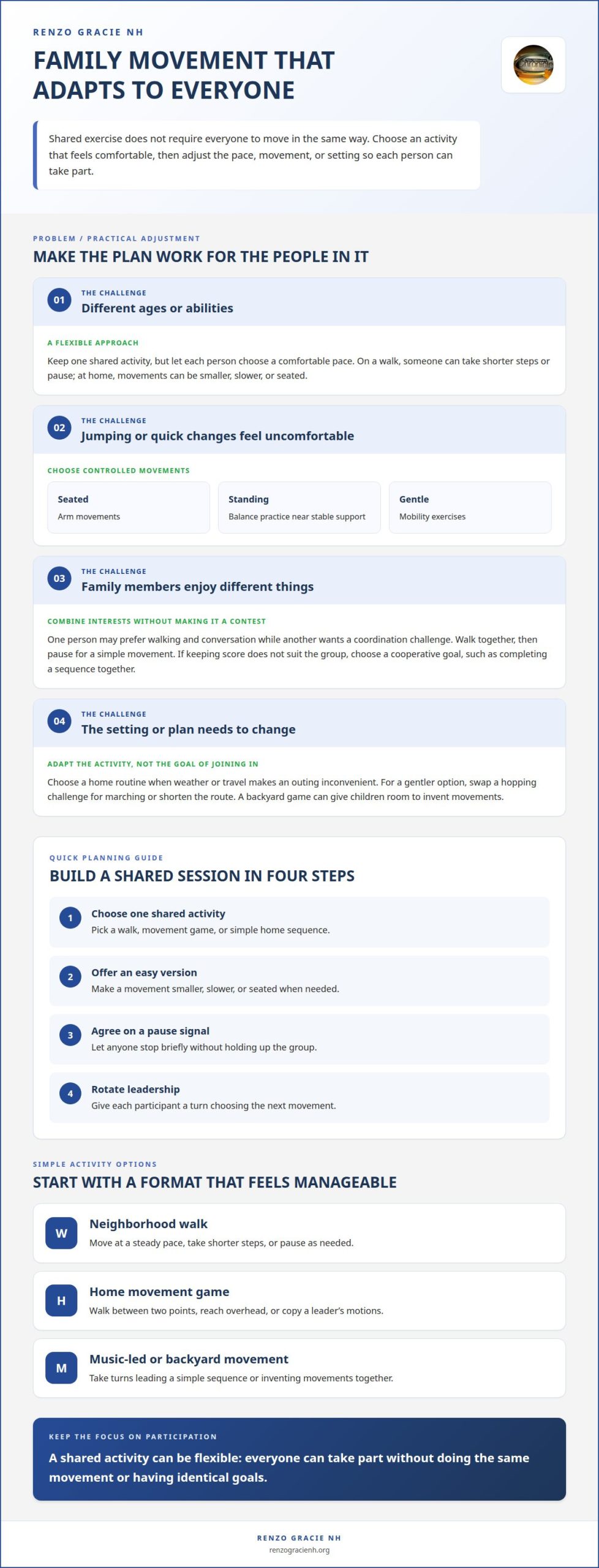
Yes. Families in Windham can choose activities that make movement feel shared, playful, and flexible. A neighborhood walk, a backyard movement game, or music-led movement at home can include people of different ages without requiring matching abilities. Lower-impact options can also suit those who prefer controlled movements to jumping or quick changes of direction. Choose a format where everyone can participate comfortably and take breaks as needed.

Start with activities that let everyone move at their own pace. On a family walk, one person might set a steady pace while another takes shorter steps or pauses. At home, a simple movement game could involve walking between two points, reaching overhead, or copying a leader’s motions. These activities need little setup and are easy to adjust by changing the pace, distance, or movement.

For a lower-impact session, choose movements that keep the effort controlled. A beginner might try seated arm movements, standing balance practice near stable support, or gentle mobility exercises. Family members can take turns leading a short sequence of simple actions, such as reaching, stepping in place, or slowly changing direction. This adds variety without making speed or competition the goal.

Use this quick planning process before starting a shared activity:

  • Choose one shared activity: Pick a walk, movement game, or simple home sequence.
  • Offer an easy version: Make a movement smaller, slower, or seated when needed.
  • Agree on a pause signal: Let anyone stop briefly without holding up the group.
  • Rotate leadership: Give each participant a turn choosing the next movement.

These steps keep the activity flexible. For example, a child can suggest marching while an adult does the movement seated or at a slower pace.

Family members don’t need identical goals to exercise together. One person may enjoy practicing coordination, while another prefers walking and conversation. A shared session can include both: walk together, then pause for a simple movement challenge. If someone dislikes keeping score, set a cooperative goal, such as completing a sequence together. The activity stays social without turning different abilities into a contest.

Think about the setting, too. A home routine works when the weather or travel makes an outdoor plan inconvenient. A neighborhood walk offers a change of scenery, while a backyard game gives children room to invent movements. Keep the plan easy to adapt: swap a hopping challenge for marching, or shorten the route if someone wants a gentler outing. Everyone can take part without doing the same movement.

For a coached activity, families can look for instruction that breaks new movements into clear steps. Demonstrations, simple explanations, and time to practice help beginners understand what to do. Martial arts may appeal to family members who enjoy learning skills together, though it involves physical practice and may not feel low-impact to everyone. Choose the activity based on each participant’s comfort, interests, and preferred pace.

Make the first shared session manageable: choose one activity, agree on simple ways to adapt it, and focus on taking part together. For a family-oriented approach to movement and connection, explore family time as part of your routine.

Renzo Gracie NH

Renzo Gracie NH offers structured Jiu Jitsu training for people who want exercise built around learning a skill. Coaching gives beginners clear instruction as they develop focus, movement, and confidence. The Adult Jiu Jitsu Program and Kids Jiu Jitsu Program serve individuals and families interested in martial arts.

Jiu Jitsu involves physical practice, so it may not suit someone specifically seeking a low-impact activity. If you want a skill-based alternative to repetitive workouts, a Free Introductory Class lets you experience the instruction before deciding whether it fits your goals. Renzo Gracie NH also offers Law Enforcement Jiu-Jitsu Training for law enforcement professionals.

If you’re considering coached martial arts as an engaging way to move, contact Renzo Gracie NH to discuss the next step.

Choose a Next Step That Keeps You Moving

A new routine doesn’t need a perfect plan. Start by noticing what makes you want to return: learning a skill, sharing an activity, or having an instructor guide your practice. That preference can help you find an exercise experience that feels more engaging than repeating movements without a clear purpose.

If you’re exploring boring workout alternatives in Windham, NH, consider whether coached martial arts suits your interests. Jiu Jitsu is a physical activity, so it may not match everyone’s preference for gentle movement. But if you’re curious about skill-based training, an introductory class can help you experience the learning environment and decide whether it fits your goals.

Give yourself room to learn at your own pace. A first step can simply be gathering details and choosing whether you’d like to try an unfamiliar activity. Contact Renzo Gracie NH to discuss getting started. Keep moving toward an activity that feels meaningful, and let each new skill build momentum.

Frequently Asked Questions

What are fun alternatives to a boring gym workout in Windham, NH?

Try an activity that gives you something to learn, such as Brazilian Jiu-Jitsu, or make movement social with a family walk or music-led activity at home. For a skill-based option, Jiu Jitsu combines guided practice with learning techniques, giving each session a focus beyond repeating exercises. Choose an activity that matches your interests and energy, then notice whether you’d look forward to doing it again.

What fitness activities near Windham, NH are suitable for beginners?

Beginner-friendly options include walking, simple movement at home, and coached activities that teach skills step by step. Adults interested in martial arts can try the Adult Jiu Jitsu Program at Renzo Gracie NH, with locations in Windham, Exeter, and Manchester. A Free Introductory Class lets you experience the instruction and decide whether this style of movement fits. If you prefer gentle, low-impact exercise, a walk or basic home routine may be a more comfortable starting point.

How to Start Jiu-Jitsu If You’re Not Flexible

You can start Brazilian Jiu-Jitsu without being flexible. If you’re wondering, “I’m not flexible, can I do jiu-jitsu?” the answer is yes: flexibility isn’t a prerequisite for your first class. You can develop useful mobility as you learn.

It’s understandable to worry that stiff hips, tight hamstrings, or limited range of motion will make class difficult. Jiu-Jitsu uses leverage, timing, and strategy, not flexibility alone, and beginners can learn movements at a pace that suits them.

This guide explains how to approach class when you feel stiff, which mobility habits can support training, and how to stretch comfortably before and after practice. You’ll also learn why functional movement matters more than forcing your body into a pose. Start where you are, focus on steady progress, and let your skills develop with you.

Key Takeaways

  • Use class warm-ups and technique practice to build body awareness while you learn.
  • Focus mobility work on the hips, hamstrings, back, and shoulders instead of forcing deep stretches.
  • Learn when dynamic movement and held stretches fit best around training.
  • Choose steady, comfortable progress over trying to match another student’s range of motion.

How Do I Deal with a Lack of Flexibility at Jiu Jitsu Classes?

Start with controlled movement, not forced stretches. Limited flexibility alone doesn’t identify a specific injury. Pay attention to pain and avoid forcing uncomfortable positions.

  1. Build Mobility Through BJJ Training

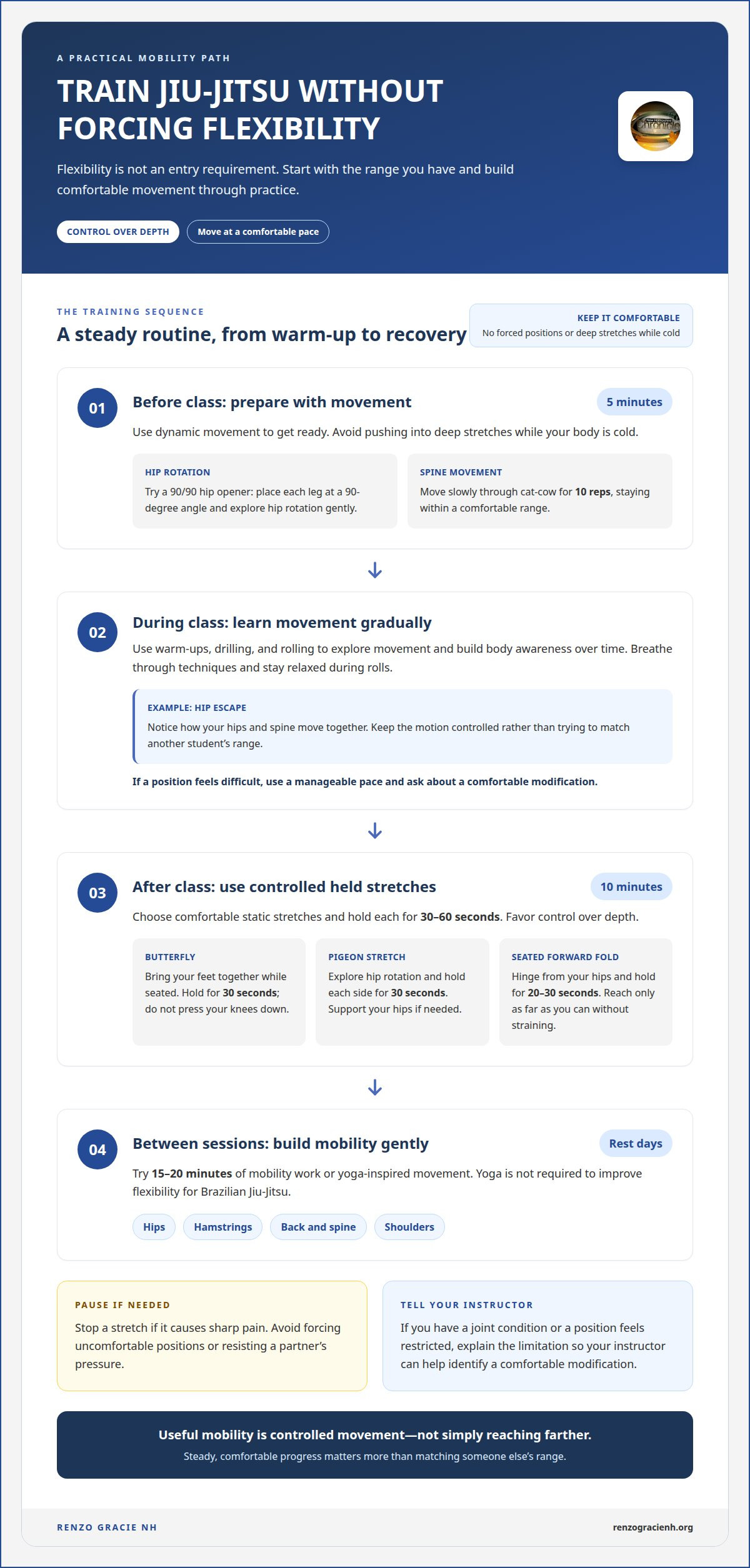
    Use warm-ups, drilling, and rolling to explore movement gradually. These parts of class can support mobility and body awareness over time. During a hip escape, for example, notice how your hips and spine move together. Breathe through each technique and stay relaxed during rolls. Don’t force a position to match another student’s range.

  2. Use BJJ-Specific Stretches and Drills

    Prepare with dynamic movement before class, then use controlled stretches afterward. A 90/90 hip opener places each leg at a 90-degree angle and encourages hip rotation. Try cat-cow slowly for 10 reps to move your spine through a comfortable range. Spend 5 minutes on dynamic movement before class, rather than pushing into deep stretches while cold.

  3. Work on Spine and Shoulder Mobility

    Add gentle spine and shoulder movement to your practice. Cat-cow gives your back a slow, deliberate motion; shoulder circles can help you notice stiffness before drilling. Keep both movements controlled and within a comfortable range. On rest days, try 15-20 minutes of mobility work or yoga-inspired movement. Yoga isn’t required to improve flexibility for Brazilian Jiu-Jitsu.

  4. Understand Flexibility Benefits and Injury Risks

    Build mobility for smoother transitions, comfortable positions, and better awareness of your body’s limits. Flexibility can support movement, but forcing a stretch or resisting a partner’s pressure can make a position uncomfortable. After class, spend 10 minutes on static stretching, holding each stretch for 30-60 seconds. Stop a stretch if it causes sharp pain, and favor control over depth.

Hip, hamstring, back, shoulder, and spine mobility

Use a short sequence that targets the areas you use during grappling. Move within a comfortable range and keep each position controlled.

  1. Stretch Tight Hips and Lower Back

    Begin with a butterfly stretch, bringing your feet together while sitting. Hold for 30 seconds, then repeat without pressing your knees downward. For hip rotation, add a pigeon stretch and hold each side for 30 seconds. Keep your hips supported if the floor position feels uncomfortable.

    Next, try slow pelvic tilts while lying on your back. Gently rock your pelvis, then return to neutral without forcing your lower back flat. This gives you a small, controlled movement to explore before trying larger stretches. Notice whether one side feels tighter, and keep both sides within a comfortable range. Avoid bouncing or pulling hard on your knees.

  2. Use Hamstring and Lower-Back Stretches

    Sit tall for a seated forward fold, then hinge from your hips. Hold for 20-30 seconds and keep your back straight. Reach only as far as you can without rounding sharply or straining. A gentler version is bending one knee while extending the other leg, then switching sides.

    For spine and shoulder mobility, add slow seated trunk rotations. Turn your chest comfortably to one side, return to center, and repeat on the other. Pair each turn with relaxed shoulder rolls, keeping your neck easy. These movements let you explore rotation without forcing an end position. A brief routine can focus on hips, hamstrings, and lower back, then add these upper-body motions. Apply the sequence around Brazilian Jiu-Jitsu practice as a way to build familiarity with the movements.

Whether beginners need flexibility to start Brazilian Jiu-Jitsu

Start Brazilian Jiu-Jitsu without waiting to become more flexible. If you’re asking, “I’m not flexible, can I do jiu jitsu?” the answer is yes: flexibility isn’t an entry requirement. Judo and wrestling use different techniques, but beginners in each can learn without arriving with a particular range of motion.

If you have a joint condition, tell your instructor which positions are difficult. They can help identify comfortable modifications for practice.

  1. Start Without Requiring Flexibility

    Join class with the movement range you have now. If “I’m not flexible, can I do jiu jitsu?” is holding you back, focus on learning one position at a time. For example, practice where your hands go during a guard entry before adding the full movement. Don’t force a leg or shoulder into a painful position.

  2. Follow Warm-Ups and Beginner-Friendly Instruction

    Follow the warm-up at a manageable pace, then break unfamiliar techniques into smaller actions. During a technical stand-up, learn the hand placement and foot position separately before linking them. Instructors can modify positions when a movement is difficult. Use those adjustments instead of trying to copy your partner’s exact movement.

  3. Train Flexibility as a Beginner

    Set aside 10-15 minutes daily for gentle flexibility work. Choose movements that relate to class, such as hip rotations or a comfortable hamstring stretch. Keep your breathing steady, and adjust the position if you feel strain. Consistent practice can help you explore movement without making the session a test of how far you can stretch.

  4. Consider Limited Motion and Joint Conditions

    Describe specific limitations before a drill begins. For example, explain that a shoulder position feels restricted or turning your hip is uncomfortable. Your instructor can suggest a modified technique or starting position. Practice within a range you can control, and pause if discomfort changes how you move.

How to Start Jiu-Jitsu If You’re Not Flexible

Functional flexibility versus static stretching

Use both movement and held stretches, but give them different purposes. In Brazilian Jiu-Jitsu, moving with control matters as much as reaching a position.

  1. Practice functional flexibility through the movements you use in class. For example, move between seated guard and a technical stand-up with control. Functional flexibility means accessing a useful range while moving, not simply reaching farther in a stationary pose. Keep your balance and breathing steady. If a transition feels restricted, reduce its range and focus on smooth movement rather than forcing the finish.
  2. Use dynamic movement to prepare for training. Controlled leg swings, hip rotations, and shoulder circles take your joints through changing positions. Keep each repetition deliberate, without bouncing or sudden pulls. Before drilling a guard recovery, for instance, rehearse the hip turn at an easy pace. The aim is to feel ready to move, not tired from intense stretching.
  3. Set aside static stretching for after class or a separate mobility session. Static stretching means holding a position for 30 seconds or more. A seated hamstring stretch is one example: settle into mild tension, breathe calmly, and release without yanking. Choose a position that targets the area you want to work. Stop short of sharp pain, and don’t treat a deeper reach as proof of better training.
  4. Match the stretch to your goal. If you’re preparing to drill, choose controlled movement; if you’re cooling down, a comfortable held stretch may suit you. You can combine both approaches in your routine rather than expecting one stretch to improve every movement. During an introductory class, notice which movements feel easier after warming up, then discuss suitable options with the instructor.

Put the approach into practice in a Free Introductory Class and learn how movement fits into training.

Renzo Gracie NH

Renzo Gracie NH gives adults a place to begin Brazilian Jiu-Jitsu without waiting to become flexible first. The Adult Jiu Jitsu Program is a next step if you want to learn techniques, build movement skills, and develop at your own pace. A Free Introductory Class lets you experience training and see how the movements feel before deciding what comes next.

Bring questions about limited mobility or positions that feel difficult. You can start with the range of motion you have and build familiarity as you learn. Children interested in training can join the Kids Jiu Jitsu Program. Contact Renzo Gracie NH in Windham, Exeter, or Manchester to talk about getting started.

Take Your First Step on the Mats

Your starting point isn’t a flexibility test. It’s a chance to learn how your body moves, ask questions, and discover which techniques feel comfortable. If you’re wondering, “Can I do jiu-jitsu if I’m not flexible?” let that question lead to a first step, not a reason to wait. Progress comes from showing up, staying curious, and practicing with care.

Renzo Gracie NH welcomes people exploring training for themselves or their family, as well as professionals seeking Law Enforcement Jiu-Jitsu Training. With locations in Windham, Exeter, and Manchester, you can choose a path that fits your goals and begin with an open mind. You don’t need to arrive with every movement mastered. Start with what you can do today, and let each class help you build confidence and skill.

Contact Renzo Gracie NH to get started. Your first step can be a steady one.

Frequently Asked Questions

Do you need flexibility to start Brazilian jiu-jitsu?

No, you can begin Brazilian Jiu-Jitsu without being flexible first. A useful first goal is learning the shape and purpose of a technique, not matching an advanced student’s range. For example, during guard practice, focus on where your hands and feet belong. As you gain familiarity, explore adjustments that suit your movement comfortably.

Can beginners with limited flexibility do BJJ safely?

Beginners with limited flexibility can take part by moving at a controlled pace and communicating clearly with their training partner. Agree to slow down during a new drill, and reset if a position feels strained. For instance, ask your partner to pause while you adjust your leg placement. Choose control over speed as you learn each movement.

How can inflexible beginners adapt BJJ positions and techniques?

Adapt a position by changing your angle, stance, or starting point rather than forcing your body into place. If a guard position feels restricted, practice the entry in smaller parts and ask your instructor to show a variation. Keep the technique’s purpose in mind, such as creating space or recovering balance, while finding a comfortable way to perform it.

What stretches or mobility exercises help BJJ beginners?

Choose movements that address the areas you notice during class, then keep each repetition smooth. For example, practice controlled hip rotations before drilling guard movement, or use gentle shoulder rolls before working on frames. Add a stretch only if it feels comfortable, and avoid bouncing or forcing a deeper range. A simple routine you can repeat consistently is easier to follow.

Does BJJ improve flexibility over time?

Brazilian Jiu-Jitsu training can support mobility and body awareness over time. Warm-ups, drilling, and rolling expose you to varied positions and transitions, helping you learn how your body moves. Notice everyday changes, such as feeling more comfortable turning your hips during a drill. Pair practice with gentle mobility work, and focus on controlled movement rather than chasing a specific range.

Should I tell my BJJ coach that I am not flexible?

Yes, tell your instructor which movements feel restricted or uncomfortable before practice begins. Specific details help, such as “my shoulder feels tight when I reach overhead” or “I struggle to rotate my hips.” Your instructor can then suggest a modification or demonstrate a different entry. Sharing a limitation is practical information that helps you participate with clearer direction.

How to Help My Child Make Friends in Exeter with Gentle Support

Friendship doesn’t have a fixed starting line: many children begin making friends around age 3, when they start preschool. If you’re wondering how to help your child make friends in Exeter, start with gentle opportunities to connect and let your child’s comfort guide the pace. Small steps count.

It’s natural to worry when your child seems shy, lonely, or caught up in a disagreement, but they don’t need to be popular to build meaningful friendships. This guide explains how to help your child make friends in Exeter by respecting their social limits, responding with empathy when they feel lonely, and handling friendship conflicts calmly. You’ll also learn what to expect as friendships develop and how shared activities can help children spend time with peers and grow at their own pace.

Key Takeaways

  • Respect your child’s need for quiet or smaller groups, and offer gentle chances to connect without pressure to be popular.
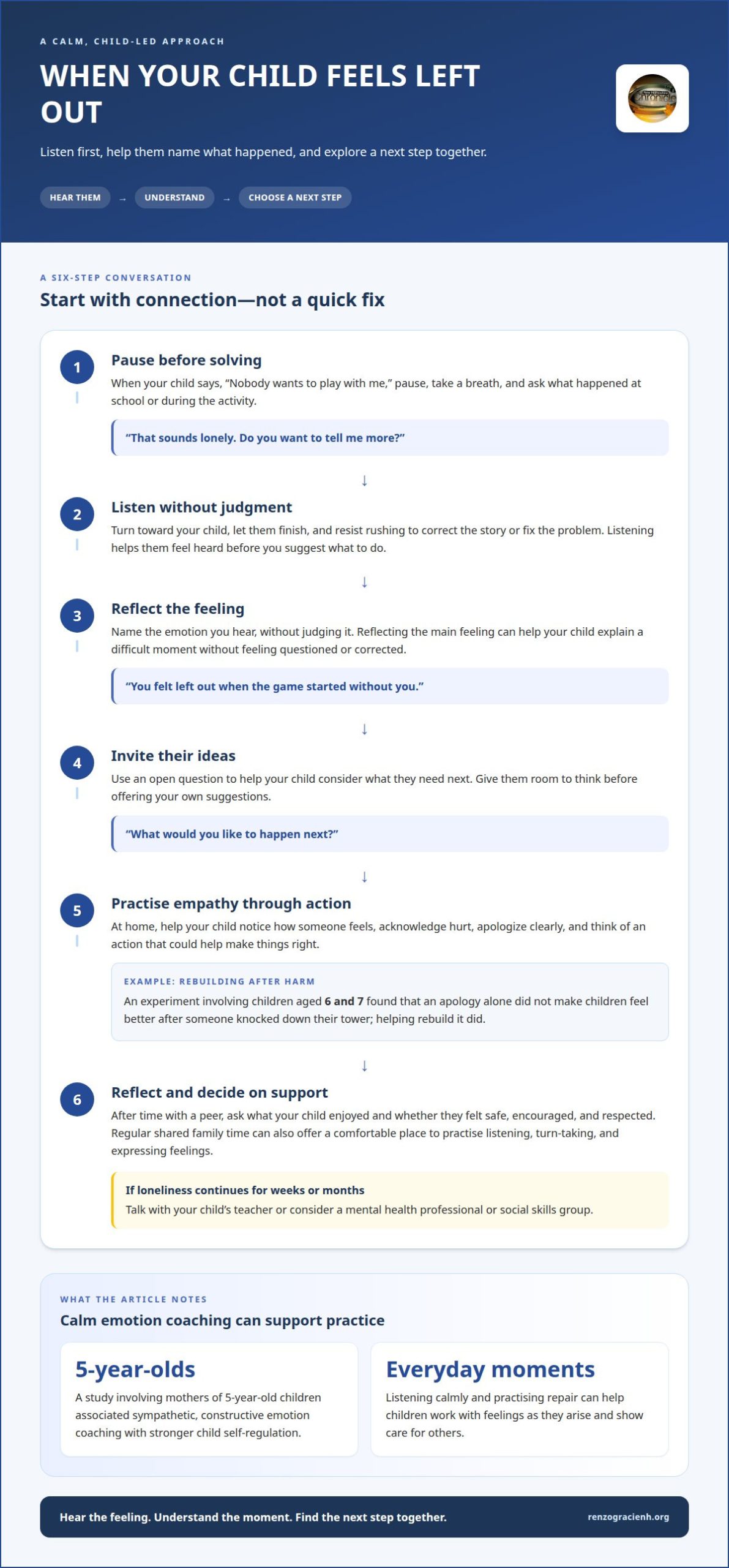
  • When loneliness comes up, listen without judgment and acknowledge your child’s feelings before helping them consider a next step.
  • For everyday friendship disagreements, coach your child to express feelings and suggest solutions; step in when safety is at risk.
  • Many children begin making friends around age 3, but friendships develop at different paces and don’t follow a single timetable.

1. Respecting introverted children’s social limits

Quiet time or small groups don’t automatically mean a child is avoiding peers. Some children are content with one or two close friends rather than being popular across a class. One enjoyable activity a week may provide enough social contact. Follow your child’s cues: notice when they seem engaged and when they need space.

Build confidence through small, specific steps. Praise an effort, such as saying hello or sharing a toy, instead of judging behavior as “good” or “bad.” At home, practise taking turns in a game, sharing materials, and starting a simple conversation. These moments give children a chance to practise social skills before unfamiliar situations arise.

If a child feels anxious, introduce social situations gradually. Try greeting one familiar peer before joining a larger group, and practise taking a slow breath together beforehand. A simple phrase, such as “Can I play too?”, gives your child words to use when they want to connect. Keep the first step manageable, then build from there.

Social isolation can be harder for children with learning disabilities, including autism, especially when activities are difficult to join. Ask what gets in the way: unclear rules, a noisy setting, or a fast-moving game. A teacher can help identify inclusive activities and practical ways to participate, rather than treating a child’s differences as unwillingness.

To find playgroups and family events in Exeter, ask your child’s teacher about peer connections and local activities. You can also check community event calendars and parent groups, then choose something that matches your child’s interests.

Exeter libraries, community centers, and parks are useful places to look for children’s activities, such as story sessions, play meetups, and community events. Schedules vary, so check each venue’s current calendar or ask staff what’s planned.

If your child is struggling to make friends at school, ask the teacher about a buddy system, inclusive group activities, or lessons that support self-esteem. If bullying is involved, raise the concern with school staff so they can address it and support your child’s safety.

2. Responding empathetically to a child’s loneliness

When your child says, “Nobody wants to play with me,” resist rushing to solve the problem. Pause, breathe, and ask what happened at school or during an activity. Try, “That sounds lonely. Do you want to tell me more?” Naming feelings without judging them helps your child feel heard before you suggest a next step.

Active listening can make the conversation more supportive. Turn toward your child, let them finish, and reflect the main feeling: “You felt left out when the game started without you.” Then ask an open question, such as, “What would you like to happen next?” This helps children explain difficult moments without feeling questioned or corrected.

Parents can model empathy through everyday responses. If a sibling looks upset after losing a game, help your child notice the feeling and ask what might help. A study involving mothers of 5-year-old children associated sympathetic, constructive emotion coaching with stronger child self-regulation. Calm listening can help children practise managing feelings as they arise.

Empathy also grows through action. In an experiment involving children aged 6 and 7, an apology alone did not make children feel better after someone knocked down their tower; helping rebuild it did. Practise repair at home: acknowledge the hurt, apologize clearly, then ask what action could make things right. These steps can build resilience and care for others.

Friendship questions can help children reflect on whether they feel safe, encouraged, and respected with a peer. For example, after a playdate, ask what they enjoyed and whether they felt included. If loneliness continues for weeks or months, talk with the child’s teacher or consider a mental health professional or social skills group. Regular shared family time can also give children a comfortable setting to practise listening, turn-taking, and expressing feelings.

How to Help My Child Make Friends in Exeter with Gentle Support

3. Avoiding overreaction to friendship conflicts

A disagreement over a game can feel enormous to a child, but not every clash means a friendship is over. First, hear each child’s account without assigning blame. Ask, “What happened just before you felt upset?” This gives your child room to describe the situation and helps you distinguish a passing argument from repeated exclusion or intimidation.

Role-play gives children a safe way to practise handling conflict before tensions rise. Use a familiar example, such as two friends wanting the same ball. Let your child try saying, “I’m frustrated. Can we take turns?” Then switch roles so they can practise listening to the other person’s feelings, too. Keep the tone calm and focus on talking, not winning.

For a real disagreement, help your child name the problem, express their feelings, and suggest a fair next step. They might agree to choose the next game together or take turns picking teams. Encourage them to listen to the other child’s idea and accept that some problems require compromise. These skills help children make friends and build respectful relationships.

Repair matters after someone has caused harm. Research described on children’s forgiveness reports that children as young as 4 years are more likely to forgive a peer who actively apologizes. A useful apology names the action and its impact; then the child can help fix what happened. If a friend’s drawing was torn, offering to help replace or repair it shows care beyond words.

Unless a child is in danger or facing very serious bullying, give them a chance to work through ordinary disagreements with your guidance nearby. Step in when there are threats, repeated targeting, or a risk of harm, and involve school staff when needed. Afterward, ask what helped and what they might try next time. A short reflection turns a difficult moment into practice for future social situations.

When children begin making friends

Many children begin making friends around age 3, when they start preschool. That’s a starting point, not a deadline. Some children first show friendship through playing alongside a peer, while others seek conversation or shared games. Watch for your child’s own ways of showing interest, rather than expecting one particular behavior.

Friendships often change as children grow. For pre-teens aged 8-13, relationships can become deeper and more meaningful. A child might move from enjoying a classmate’s company during play to sharing worries or choosing to spend time together. These shifts reflect learning and growing trust, not a timetable every child follows at the same pace.

If you’re wondering how to help your child make friends in Exeter, look for small signs they’re ready: mentioning another child, asking to join a game, or enjoying a shared activity. Suggest a low-pressure opportunity based on that interest, such as inviting a familiar classmate to play a favorite game. Keep the plan simple, then listen to what felt positive or difficult.

If your child seems anxious, avoid turning every interaction into a test of whether they made a friend. Ask what they enjoyed, what felt uncomfortable, and whether they’d like to try again. A positive step might be staying near a group, exchanging a few words, or watching before joining. Each can build confidence without demanding an instant friendship.

If your child continues to struggle, ask their teacher about their interactions with peers. A teacher may notice who shares your child’s interests or where joining in feels easier. For pre-teens, ask whether they feel encouraged, safe, and respected in a friendship. These questions focus on connection and wellbeing, not popularity.

There’s no single age when every child should have a close friend. If you’re considering how to help your child make friends in Exeter, a shared activity can be a gentle next step. Explore a structured activity together and let your child’s interest guide the choice.

Renzo Gracie NH

Renzo Gracie NH offers a Kids Jiu Jitsu Program for families looking for a structured activity where children can learn alongside peers. Shared practice and a clear curriculum provide opportunities to build respect, focus, and confidence through regular participation. It may suit children who enjoy movement and learning in a group, but it isn’t a substitute for support with serious anxiety, bullying, or ongoing loneliness.

A parent can explore the program through a Free Introductory Class and see whether the setting feels comfortable for their child. Family training can also make participation a shared experience. Every child has their own pace, so consider whether the activity suits their interests and helps them feel at ease. Contact Renzo Gracie NH to learn more.

Keep building connection, one step at a time

Your child doesn’t need a perfect social plan. Choose a next step that feels manageable to them: trying an activity they enjoy, practising a greeting, or taking time to settle into a group. Notice what sparks their interest, then let that guide your support. Progress may mean joining in or simply feeling more comfortable around peers.

If you’re considering how to help your child make friends in Exeter, focus on connection rather than a deadline. Ask what kind of shared activity appeals to them, and listen to what they say about the experience. A structured group activity can provide a natural way to practise cooperation and get to know others through a common interest.

Renzo Gracie NH can help families explore whether Jiu Jitsu is a good fit for their child’s interests. Contact Renzo Gracie NH to discuss a next step. Keep the pace gentle, celebrate each effort, and let your child grow into connection in their own way.

Frequently Asked Questions

What are practical ways to help a child make friends?

Choose an activity your child already enjoys, then help them find a peer who shares that interest. Before they meet, agree on a simple opening line and a backup activity, such as drawing or building a puzzle together. Afterward, ask which part felt easiest. This helps you shape the next opportunity around your child’s experience, rather than treating every meeting as a test.

What activities and clubs for children are available in Exeter, New Hampshire?

This article focuses on Exeter, New Hampshire, in the United States. For local options, look at school and community listings for sports, arts, music, and youth activities. To narrow the choices, consider what your child enjoys and whether the activity gives them a shared task with other children. A common interest can make starting a conversation feel more natural.

Are there Exeter sports clubs, arts groups, or youth organizations for children?

Around Exeter, explore sports teams, art groups, music activities, and youth organizations. Rather than choosing by activity name alone, consider how children participate: a team drill, shared art project, or group service task gives peers something to do together. School notices and community calendars can help you find local opportunities and understand what each involves.

What should parents do if a child is shy or anxious about making friends?

Let your child help choose a manageable first step, such as attending a group activity with someone familiar. Agree on a quiet break or a signal to leave if they feel overwhelmed, then talk afterward about what they noticed. If shyness or anxiety significantly affects daily life, a school counselor or behavioral therapist may offer additional support tailored to your child.

A roundup of places and activities for energetic kids in Manchester this winter

For winter activities for energetic kids in Manchester, families can combine easy at-home movement games with visits to local recreation facilities. Manchester Parks & Rec has two ice arenas, offering an indoor option when cold weather makes outdoor play less appealing. At home, a simple obstacle course can turn familiar household items into opportunities to climb, crawl, and move.

When children have energy to spare, the plan doesn’t need to be complicated. A few simple activities can make an indoor afternoon more active, while a change of scene can bring fresh momentum to the day. Here are ideas for young children, from household games to Manchester winter outings, with practical ways to keep play simple and enjoyable. Choose what suits your child’s mood, space, and energy, then make room for movement.

Key Takeaways

  • Turn familiar household items into simple indoor movement games that keep young children engaged.
  • Match activities to your child’s age, interests, and energy level for a more enjoyable outing.
  • Explore Manchester’s public recreation options and plan winter days around places that encourage active play.
  • Consider the Kids Jiu Jitsu Program for a structured way to build movement, focus, and confidence.

3. What are the best indoor winter activities for energetic kids in Manchester?

Manchester Parks & Rec has two ice arenas, giving families local indoor options for winter recreation. A visit offers a change from playing at home and makes the outing feel distinct from an indoor afternoon. With younger children, focus on movement and simple play rather than packing the day with too many activities.

At home, build an obstacle course from familiar items: a tunnel, an ottoman, a tricycle, a hula hoop, and a laundry basket filled with play balls. A tunnel can also hold about 50 small balls for a crawl-through challenge. Invite children to move through the course at their own pace, then change the order or task to keep the route interesting. Keep the setup simple; too many instructions or obstacles can frustrate young children.

Before play begins, check the floor and landing areas. Place pillows around a low mattress, which can be used for bouncing, climbing, and sliding. Cushion hard surfaces along the obstacle route with pillows or other baby-proofing materials. Clear away items that don’t belong in the game, and stay close as children move between obstacles.

For a quick hallway game, tape different sizes of colored construction paper to the floor. Ask children to match toys to the corresponding colors, then add a timer if they enjoy a challenge. Change the toy pile or call out one color at a time to vary the task without rebuilding the game. This activity combines movement, sorting, and listening.

Not every indoor activity needs to be high energy from start to finish. Some children’s board games take as little as 20 minutes, making one a handy transition after a movement game. A shared book can unfold over days or weeks, offering a quieter activity when children need a pause. A homemade snowglobe also gives little hands a creative task, using a couple of teaspoons of glitter and a few drops of glycerin.

For winter activities for energetic kids in Manchester, pair a visit to a local ice arena with a simple home game on another day. At home, choose a movement challenge and a calmer activity, such as color matching followed by a book. This gives young children room to move, focus, and reset without overplanning the day.

When an outing suits the family better than a home setup, local indoor play spaces and community centers offer engaging alternatives to keep little ones moving. It offers another option to consider alongside arena visits, especially when children are keen for a change from familiar activities. Keep the visit flexible and let their interest guide how long they spend exploring.

Simple indoor obstacle courses can help keep young children from feeling frustrated. Make the route easy to understand, and change just one part when you want to add a challenge. That keeps the movement going without making the setup complicated.

A roundup of places and activities for energetic kids in Manchester this winter

4. Which Manchester activities are suitable for toddlers, school-age children, and teens?

Choose activities with a pace and instructions that suit your child’s age. Manchester Parks & Rec has two ice arenas, providing local indoor options for winter outings. At home, movement games are easy to adapt: toddlers can copy one simple action, while older children can follow a longer sequence or try a challenge. Keep the goal clear and adjust the activity if their attention or energy shifts.

For toddlers, choose movements that are easy to copy and repeat. Try “follow the leader” across a clear room: clap, march, reach up, then turn around. A familiar song can cue each action and help toddlers understand when to start and stop. Rolling a soft ball back and forth adds another simple game. Keep instructions short and offer one choice at a time, such as marching or reaching. The goal is participation, not perfect movements.

School-age children often enjoy a clear mission. Set up a household scavenger hunt with clues such as “find something round” or “bring back a red toy,” then invite them to move between rooms at a lively pace. Or try a movement sequence: touch the floor, take several steps, reach overhead, and repeat. Let your child invent a new action after each round. Taking that small role keeps the game fresh and gives children a chance to listen, remember, and take turns.

For teens, offer more choice and ownership. They could create a short dance routine to a favorite song, then teach it to a sibling or parent. A timed household challenge can also work: choose actions such as marching in place, side steps, and arm reaches, then repeat the sequence with smoother transitions. Focus on movement and personal progress rather than comparing siblings or expecting a particular performance. Teens may be more engaged when they choose the music and shape the challenge.

For a family outing, consider Manchester’s ice arenas as an indoor winter destination, and plan around the youngest child’s attention span. Set a simple goal, such as watching the action together or taking turns choosing what to focus on. At home, toddlers may need repetition, school-age children may enjoy a mission, and teens may prefer to design their own routine. These adjustments can help make a winter day engaging for everyone.

Mattress-based play adds another kind of movement at home. Place pillows around the mattress to cushion the area, and invite children to help set them up. Keep the play suited to their age and abilities.

Color sorting gives children a simple goal between movement games. Ask them to match toys to the right colors, adding a timer if they want an extra challenge. Children can focus on matching alone or take on the timed version.

3. What winter events and school-holiday programs for kids are happening in Manchester?

When planning winter activities in Manchester, distinguish a one-day community event from a recurring activity. A holiday event suits families looking for a single outing, while a regular program can give children movement throughout school break. Choose the format first, then plan around your child’s age, interests, and energy. This keeps the day practical without assuming every activity is a scheduled event.

For toddlers, make a short outing the main event. Pair a family walk with a simple destination, such as a playground when conditions allow, or plan a winter-themed afternoon at home. A “winter colors” hunt can ask children to find something blue, white, or silver and bring each discovery back to one spot. Keep the steps familiar: choose a theme, look together, then finish with a quiet snack or story.

School-age children often enjoy activities with a clear purpose. Plan a holiday activity day around a project, such as making a paper snowflake display, followed by an active game and a shared lunch. If a Manchester community event is on your calendar, make it the main outing and add one nearby activity rather than filling the day. Children can help choose the project or decide what comes next.

For teens, invite them to shape the plan. They might choose a winter craft, organize a family game afternoon, or pick a movement challenge for everyone to try. Helping set the pace may also make them more interested in joining younger siblings. Give them a useful role, such as choosing music or explaining the rules, while keeping the activity comfortable for the whole group.

During school breaks, a recurring activity can add structure between special outings. Renzo Gracie NH’s Kids Jiu Jitsu Program offers families a structured option centered on movement and learning. It may suit a child who wants a regular activity beyond one-off holiday plans. For families interested in an active, guided option, explore the kids activity program.

Plan a simple Manchester holiday day with one main activity and a flexible backup. For example, start with a community event or family project, and keep a home game ready in case plans change. Toddlers benefit from familiar routines, school-age children can take on a project, and teens can help lead. This approach makes winter days easier to adapt to each child without expecting every day to follow the same schedule.

Manchester community events can make easy one-day family outings, while Renzo Gracie NH’s Kids Jiu Jitsu Program offers a recurring, guided activity during school breaks. Other options include family walks, playground visits when conditions allow, indoor winter-themed activities, and holiday project days.

Renzo Gracie NH: Kids Jiu Jitsu Program

Renzo Gracie NH offers a Kids Jiu Jitsu Program for families looking for a structured activity beyond occasional winter outings. Through the martial arts curriculum, children can develop movement, focus, respect, and perseverance while learning in a supportive community. It can suit a child who enjoys active challenges and would benefit from a consistent setting for learning and progress.

Families can begin with a Free Introductory Class to experience the program. Jiu Jitsu may not suit every child’s interests, so consider whether they’re curious about learning a martial art before choosing this next step. For an active option that supports growth through practice, contact Renzo Gracie NH to learn more.

Make room for movement all winter

A winter routine doesn’t need to be elaborate. Let your child’s interests guide what comes next, whether they enjoy inventing games, joining family outings, or learning a new skill. The best winter activities for energetic kids in Manchester are ones your family can return to and adapt as children grow.

For families considering martial arts, Renzo Gracie NH offers Kids Jiu Jitsu and Adult Jiu Jitsu programs, as well as Law Enforcement Jiu-Jitsu Training. The Kids Jiu Jitsu Program offers a structured activity for children interested in movement and learning through practice. Choose a next step that feels right for your family.

Contact Renzo Gracie NH to discuss the Kids Jiu Jitsu Program. A new season can be a chance to build confidence, focus, and shared momentum, one practice at a time.

After School Martial Arts for Kids in Windham

After-school martial arts in Windham can give children and teens a structured way to practice discipline, focus, confidence, self-control, and respect. They build these habits by learning skills, listening to instructors, working with others, and persevering when a move takes practice. It offers more than physical activity.

Families often want an after-school activity that supports growth as well as movement. Martial arts can offer both: students practice skills while developing perseverance, coordination, and respect for others. The right fit depends on a child’s interests, so it helps to understand what training involves and how it may fit into everyday life. Renzo Gracie NH offers a Kids Jiu Jitsu Program in Windham, Manchester, and Exeter, with a welcoming, family-oriented approach. Here’s what to consider when choosing a class and how training can support children’s development.

Key Takeaways

  • See how repeatable routines and gradual skill goals can help children practice persistence beyond class.
  • Learn how partner drills and instructor guidance give kids opportunities to practice emotional control and respectful interaction.
  • Use your child’s interests and individual needs to judge whether martial arts is a comfortable, motivating fit.
  • Discover how a kids’ Jiu Jitsu program and a free introductory class can help families explore a first step.

Discipline and focus

In martial arts training, discipline starts with small, repeatable actions. A child listens to an instruction, watches a movement, then practices it with care. That sequence encourages children to pause, pay attention, and follow through rather than rushing ahead. For example, returning to a ready position after practicing a technique gives focus a clear task. Repeating this process makes concentration part of the training routine, not just a reminder from an adult.

Technique also gives discipline a practical purpose. Children learn that a movement has steps, and that control matters as much as completing it. They may need to adjust their balance, try again, or slow down to follow the instructor’s direction. This kind of structured practice can help children develop concentration and mental clarity. It can also help them notice how their minds and bodies work together, such as staying attentive to posture while practicing a movement. Each repetition becomes an opportunity to listen and respond thoughtfully.

Progress takes persistence. A new skill may feel unfamiliar at first, and children build determination by returning to it rather than expecting instant mastery. Working toward higher belt levels or improving a particular skill can give practice a meaningful goal. The useful lesson is the process: notice what needs adjustment, apply the instruction, and try again. That approach can help children stay engaged when schoolwork or another challenging task also requires patience. Progress can be gradual, but every focused attempt helps make the next one more purposeful.

Regular attendance adds another useful routine. Setting aside time for training, arriving prepared, and remembering what to bring can help children practice responsibility and time management. Parents can support this habit by connecting class days with a simple preparation step, such as packing needed items beforehand. In Windham, families can look for clear instruction and progress built through practice. Discipline grows through manageable actions: listen, practice carefully, respond to feedback, and keep going.

Confidence, self-control, and respect

Confidence grows through participation, while self-control and respect shape how children use their skills. At Renzo Gracie NH, students practice individually and with others in a supportive, family-oriented environment.

Building Confidence

Students can build confidence by learning a technique, practicing it, and noticing their progress. A child who hesitates to try a movement may feel more assured after following an instructor’s example and completing the attempt. Small successes matter because they show that effort can lead to improvement. Look for instruction that recognizes learning and persistence, not only who performs a skill first or best.

Practicing Self-Control and Respect

Self-control means pausing, listening, and responding thoughtfully, especially when practicing with a partner. Children learn that their actions affect others, making respect part of training. An instructor’s guidance can help students manage frustration when a movement feels difficult and reset before trying again. Notice whether respectful interaction and controlled practice are part of the learning experience.

Martial arts can give children a structured way to work through frustration and strong emotions. For example, a student finding a technique challenging can pause, listen to feedback, and try again. That process offers practice in managing emotions rather than reacting immediately. The same pause-and-respond habit can be useful beyond class, such as during a disagreement or a difficult task.

Training with peers adds a social dimension. Taking turns, listening to an instructor, and cooperating during practice give children opportunities to build teamwork and camaraderie. Respect is visible in everyday choices, such as allowing a partner space to practice and paying attention when someone else receives guidance. A welcoming setting helps students participate without treating every interaction as a contest. Families can explore a supportive martial arts environment as they consider what kind of experience would suit their child.

Progress also gives children reasons to trust their own effort. When they remember a technique or approach a new challenge with greater composure, they can recognize a specific change in themselves. Encourage children to describe what they practiced, what felt challenging, and how they responded. This keeps confidence grounded in real actions while reinforcing self-control and consideration for others.

After School Martial Arts for Kids in Windham

Kids martial arts in Windham

For families in Windham, New Hampshire, a kids’ martial arts class can combine movement, skill practice, and character-building. The key is choosing an activity and schedule that suit the child’s interests and the family’s after-school routine.

Windham Program Options

Compare the actual experience offered: a scheduled martial arts class teaches skills, while a full after-school program may also involve care or transportation. These are different arrangements. Before deciding, map out when the school day ends, travel needs, class timing, and pickup plans. A child who enjoys partner activities may prefer guided practice, while another may feel more comfortable starting with basic movements.

Safety, Credentials, and Class Ratios

Safety policies, instructor credentials, and student-to-instructor ratios vary by program; there is no single ratio that describes every Windham class. Look for clear instruction, age-appropriate practice, and active supervision during partner drills. For example, an instructor should explain how students take turns and control their movements before practice begins. These details help families understand how a class is organized.

Do Windham martial arts programs provide school pickup, transportation, or extended care? Martial arts instruction alone doesn’t mean those services are included. Pickup, transportation, and extended care are separate logistics, so families should distinguish them from class participation when planning an after-school routine.

Consider what a child wants to develop. Martial arts practice can help children build strength, endurance, flexibility, and coordination through repeated movement and technique practice. It can also emphasize avoiding confrontations and using nonviolent conflict resolution. For example, a child can learn to step back, communicate calmly, and seek help rather than turn a disagreement into a physical challenge. A good fit starts with the child’s interests and comfort; enthusiasm for learning makes it easier to stay engaged and practice consistently.

Which martial arts schools in Windham, Maine offer after-school programs?

While some searchers look for options in Maine, this section focuses on Windham, New Hampshire, as well as the surrounding area. Families in Windham, Manchester, or Exeter, New Hampshire can consider how after school martial arts Windham fits their child’s interests and their family’s daily routine.

Start by distinguishing martial arts instruction from a full after-school arrangement. A scheduled class does not automatically include school pickup, transportation, or extended care. Plan for those logistics, especially if school, home, and training are in different communities.

Use these practical points to assess whether a class fits your family:

  • Location: Consider travel between your child’s school, home, and the training location.
  • Program format: Clarify whether you’re considering martial arts instruction or a broader care arrangement.
  • Child’s interests: Think about whether your child enjoys learning movement skills and practicing with others.
  • Class structure: Look for clear instruction and active guidance during activities such as partner practice.

These distinctions help families in Windham, Manchester, and Exeter make a practical choice without assuming that a class also provides transportation or care. The child’s interest, travel needs, and family schedule all shape whether training fits comfortably into the week.

For families considering training in Windham, New Hampshire, explore a local martial arts option and consider how its location fits your routine.

Karate training emphasizes discipline, self-control, and concentration, which may help children develop focus for studying and classroom attention. For a family weighing an after-school class, these qualities can be part of the reason to consider karate alongside the child’s interests and routine. Ask what children practice and how the instruction reflects those aims, rather than assuming that every class will suit every child. The potential benefit is related to training, not a replacement for checking the program’s format and fit.

Martial arts often emphasize mindfulness and the connection between the mind and body, which may help children develop concentration and mental clarity. Families can consider whether this aspect of practice appeals to their child and ask how it appears during instruction. These possible outcomes may help inform a decision, but they do not establish that a class includes pickup, transportation, or extended care. Keeping the distinction between instruction and after-school arrangements clear can help families decide whether training works with the child’s interests and the family’s schedule.

Renzo Gracie NH: Kids Jiu Jitsu Program

Renzo Gracie NH offers a Kids Jiu Jitsu Program for families seeking structured martial arts training for children. Jiu Jitsu gives students an opportunity to learn techniques, practice with others, and develop discipline, confidence, and respect through continued participation. It can be a fit for a child who enjoys movement and learning practical skills in a guided setting.

A Free Introductory Class lets your child experience the training before you decide whether it feels like a good fit. Families who want to train together can also explore the Adult Jiu Jitsu Program. Choose the option that matches your family’s interests and the experience you want to share.

Contact Renzo Gracie NH to learn more about the Kids Jiu Jitsu Program and book a Free Introductory Class.

Choose a First Step That Fits Your Child

Turn your interest into a manageable plan. Talk with your child about what they would like to learn, then consider how a class could fit their after-school routine. A welcoming place to start gives them room to learn at their own pace.

For families exploring after-school martial arts in Windham, a first class can make the experience more familiar and help you decide whether the training feels right for your child. Renzo Gracie NH offers a Free Introductory Class so families can experience the setting before choosing what comes next.

Contact Renzo Gracie NH about classes and take the next step when your family is ready. Every student begins somewhere, and steady progress starts with showing up willing to learn.

Frequently Asked Questions

What ages can enroll in after-school martial arts classes in Windham?

Children and teens can explore martial arts; readiness depends on their interest and ability to follow instruction, take turns, and participate respectfully. Renzo Gracie NH offers a Kids Jiu Jitsu Program for young students in the Windham, Manchester, and Exeter area. Families can use the Free Introductory Class to see whether the training environment feels comfortable for their child.

Which martial arts styles do after-school programs in Windham teach?

One option mentioned is a kids’ Jiu Jitsu program.

How can families register for an after-school martial arts program in Windham, and are trial classes available?

A Free Introductory Class gives families a chance to experience the program.

Ways to talk about team sports and explore other activities

A child’s dislike of team sports is a reason to listen, not push harder. If you’re wondering what to do when your child dislikes team sports in Exeter, start by asking what feels difficult and take their answer seriously. Explore other ways to stay active together: the Centers for Disease Control and Prevention recommends 60 minutes or more of physical activity each day for children.

It’s natural to hope your child will enjoy the teamwork and fun you see in a sport, but pressure can make it harder for them to explain what’s wrong. This guide will help you talk through their concerns, notice when team dynamics may be affecting their experience, and consider other sports or activities that could suit them better. You’ll find practical ways to ease expectations and support your child’s next step, whether that means trying a different team, choosing an individual activity, or taking a break from organised sport.

Key Takeaways

  • Listen without rushing to fix things, and ask your child what feels difficult about the team.
  • Look for ongoing patterns in their mood, willingness to attend, and interactions with teammates before deciding what to change.
  • Explore a different sport, individual activity, or enjoyable way to move if team play isn’t a good fit.
  • Ease pressure by focusing on effort and enjoyment, then involve your child in choosing the next step.

1. Pressure from parents, peers, coaches, and opponents

Competitive pressure can turn a child’s ordinary mistake into a source of dread. Some children fear being scolded or laughed at after a missed shot, especially when parents, peers, coaches, and opponents are watching. Most children may not be ready for the increased pressure of competitive sports until they are 11 or 12 years old. That doesn’t mean every child should wait, but it does make their comfort and readiness worth considering.

Elite youth sports can mean more training, travel, and expectations. A schedule with out-of-state tournaments every weekend for four months, each lasting four days, shows how commitments can overwhelm family life and a child’s enjoyment. Avoid adding pressure with sideline instructions, constant corrections, or reminders about time and money spent. Instead, recognize a specific effort, such as encouraging a teammate or trying again after a mistake.

Stage fright can appear before practice or a game, not just during competition. Notice whether your child’s mood changes, sleep suffers, or they become reluctant to attend. An aggressive coach may also make a sport feel unsafe or unpleasant. Ask what happens before, during, and after the activity, and look for a pattern rather than treating one difficult game as proof.

What risks come from pressuring a child to continue a sport they dislike? Pressure can increase dread, reduce enjoyment, and make them less willing to attend. Ongoing stress may also affect mood and sleep. If social behavior is part of the problem, tell your child you plan to speak with the coach, then describe what you’ve observed and ask to work together.

If competition is the main strain, consider a recreational or noncompetitive league where winning matters less. Some YMCA youth programs offer leagues that don’t keep score. Ask whether a lower-pressure setting appeals to your child, and listen before deciding together. If they dread attending or attempts to improve the situation haven’t helped, leaving the team is a reasonable option.

2. Staying physically active without team sports

Leaving a team doesn’t mean your child has to stop moving. Children should get 60 minutes or more of physical activity daily, even if they don’t enjoy team sports, according to the Centers for Disease Control and Prevention. That movement can come from several enjoyable activities rather than one organized sport.

For individual options, consider swimming, running, cycling, tennis, golf, or gymnastics. Ask which activity sounds appealing, then try an introductory session or a relaxed practice together. A child who dislikes crowded matches may enjoy focusing on an individual skill, such as swimming laps or practising a tennis serve. Keep the first choice flexible: finding a good fit can take several tries.

Free play is another practical way to build movement into everyday life. Riding bikes, playing tag, jumping rope, or dancing at home can make activity feel less like another scheduled commitment. Take a walk or hike together, or let your child choose a family game. A change of pace between sports seasons can give them room to discover what they enjoy.

What are the benefits of individual sports and non-sport activities for children? They let children move at a comfortable pace, practise skills, and choose activities that suit their interests. Hiking, cycling, and dance can also make movement part of family life without team competition. Programs like Bushi Ban Child Care demonstrate how youth martial arts and fitness can offer structured, confidence-building movement without the stress of competitive team sports.

Support your child’s choice by agreeing on an activity to try, then ask what they liked or disliked afterward. If they choose swimming, help make time for practice; if they prefer dancing, encourage them to keep exploring it. The goal is a sustainable routine, not replacing one unwanted commitment with another. For a child curious about skill-based movement, structured physical training is another option to explore.

Ways to talk about team sports and explore other activities

3. Finding out whether a different sport might appeal

Disliking one sport doesn’t mean a child dislikes every sport. Basketball may feel too fast, while soccer’s constant group play may not suit them. Ask which parts felt uncomfortable: the pace, rules, coach, teammates, or pressure during games. Their answer can guide what to try next, rather than making quitting feel like the end of being active.

Sometimes the sport is right, but the setting isn’t. A child who dislikes a school team might prefer a recreational group or a travel team. Talk through what would change, including practice expectations, coaching style, competition, and how teammates interact. If they want to continue the sport, let them help choose the team or league. If they’d rather switch, respect that preference.

A different sport can offer a fresh experience of movement and competition. A child who found soccer overwhelming might enjoy golf’s individual focus, gymnastics’ skill practice, or shorter track and field events. Before deciding, consider what they liked: running, learning a technique, working toward a personal goal, or playing alongside others without constant team pressure. Match those interests to an activity.

If you’re wondering what to do when your child dislikes team sports in Exeter, start by choosing an option together, such as gymnastics or a recreational basketball team. Agree to talk afterward about how it felt. Ask what they enjoyed and what they would change. Their response can help distinguish first-day nerves from a poor fit. Exploration works best when your child can speak honestly.

A practical response to what to do when your child dislikes team sports in Exeter is to make room for a thoughtful trial, not a forced commitment. Children may need several tries to find an activity that feels right. Notice whether they want to return. If they enjoy practice but dislike game pressure, consider a less competitive setting. If the sport itself holds little appeal, try another activity that supports enjoyment and growth.

4. Talking with a child about why they dislike team sports

Choose a calm moment, not the car ride home after a tough game. Start with an open question: “What’s the hardest part of playing with the team?” Then listen without correcting details or immediately proposing a solution. Ask whether your child wants help or simply wants to talk. This gives them room to explain what matters most.

If “I don’t like it” is all they can say, try specific prompts. Ask whether they dislike the sport, the coach’s instructions, team pressure, or time away from school friends. A child might enjoy soccer drills but dread being left out during games. Reflect their answer plainly: “It sounds like choosing teams makes practice uncomfortable.”

Check directly and gently for bullying by teammates or abuse by a coach or another adult. Ask what happened, who was involved, and whether it has happened before. Look for repeated exclusion or targeting rather than deciding that one bad day proves a pattern. Help your child name behaviors like being mocked, ignored, or deliberately left out. If bullying or an adult’s conduct is involved, take the concern seriously and focus first on your child’s safety.

If social stress seems persistent, let your child know before speaking with the coach. Share specific observations and ask to work together on a practical response. Avoid confronting other parents while upset or identifying children publicly. Addressing team dynamics can take time, so agree with your child on what changes they hope to see and when you’ll talk again.

Finally, discuss options without making the decision for them. You might ask whether they want to try a different team, change sports, or leave. Explain possible alternatives, then let your child make the final choice after you’ve listened. For guidance exploring a supportive activity, take a next step toward a positive activity.

Renzo Gracie NH: Adult Jiu Jitsu Program

Renzo Gracie NH offers an Adult Jiu Jitsu Program for adults who want to build skills through martial arts rather than team sports. For a child interested in trying a different kind of physical activity, the Kids Jiu Jitsu Program offers another option. Jiu Jitsu may suit families looking for structured instruction and personal progress, rather than a team season or game-day competition.

Parents and children can each explore a program suited to them, and the Free Introductory Class offers a way to experience the training. Choose an activity based on your child’s interest and comfort, not pressure to replace one sport immediately. To explore Jiu Jitsu in Exeter, contact Renzo Gracie NH.

Let your child’s interests shape the next step

Your child’s next activity doesn’t need to settle every question at once. Start with their reasons, then choose a manageable way to explore what feels motivating, whether that means returning to a team or trying something different. The aim is to help them build confidence in making choices about movement and commitment.

If you’re considering what to do when your child dislikes team sports in Exeter, Renzo Gracie NH offers a Kids Jiu Jitsu Program alongside its Adult Jiu Jitsu Program. The academy also provides Law Enforcement Jiu-Jitsu Training. These options serve different participants, so focus on the activity that fits your family’s interests.

Take the next step at your pace. Contact Renzo Gracie NH to explore its programs, and encourage your child to keep discovering ways to grow.

Frequently Asked Questions

What are good alternatives to team sports for children in Exeter?

Good alternatives include activities where children can move without depending on a team roster, such as family cycling, hiking, dance, or playing catch together. In Exeter, start with what your child already enjoys: a nature walk may suit a child curious about exploring, while dancing at home may appeal to someone who likes music. Let them help choose so the activity feels like theirs.

What individual sports and activities are available for children in Exeter?

Children can explore individual sports such as swimming, tennis, golf, running, and gymnastics, as well as activities like cycling or dance. These options vary in pace and setting: tennis involves an opponent, while running can focus on personal progress. Families in Exeter can use a child’s interests to narrow the choices, then find a relaxed way to try an activity without making it a long-term commitment.

Are there Exeter clubs or classes for children who dislike competition?

Renzo Gracie NH offers a Kids Jiu Jitsu Program in Exeter for families considering structured martial arts instruction instead of a traditional team sport. Jiu Jitsu is a different activity and may appeal to a child curious about learning techniques and developing skills. It isn’t the same as a noncompetitive club, and children’s preferences vary, so discuss what kind of class environment would feel comfortable.

How can parents find out why a child dislikes team sports?

Ask about a specific moment instead of relying only on “Why don’t you like it?” For example, “What was happening just before you wanted to leave practice?” can help a child describe a teammate interaction, confusing instruction, or frustration with a skill. Give them time to answer, then ask whether they’d like you to listen, help solve it, or talk together later.

How can parents support a child who wants to quit a team sport?

Talk through the decision without assuming continued participation is the default. Ask what they want to stop, what they might miss, and whether a change would help, such as leaving the team or stepping away from the sport. If they choose to quit, agree on a calm, respectful way to tell the coach. Then let your child help decide what comes next.

Are there inclusive or beginner-friendly sports programs for children in Exeter?

Renzo Gracie NH’s Kids Jiu Jitsu Program offers instruction for children across experience levels, and the Free Introductory Class gives new students a way to experience the activity. This can help a child who feels unsure about starting something unfamiliar. Talk with your child about what would make a first class feel manageable, such as knowing what to expect and having your support.