Posts

De-Escalation Techniques for Law Enforcement NH: Integrating BJJ and Verbal Tactics

The most effective weapon in a high-stress encounter isn’t found in a holster. It is the disciplined confidence that allows an officer to remain calm when a situation turns volatile. You face immense pressure every day. Between the fear of excessive force litigation and the physiological tunnel vision of a crisis, the stakes couldn’t be higher. We understand that maintaining control is about more than just compliance; it’s about coming home safe. Mastering de-escalation techniques for law enforcement NH requires a shift in perspective. It means moving from a reactive mindset to one of tactical patience and steady resolve.

You can transform how you handle conflict by bridging the gap between verbal communication and physical subject control. This article explores how integrating Brazilian Jiu-Jitsu with proven communication strategies creates a foundation for safer outcomes. We’ll show you how to build the physical confidence necessary to avoid over-reliance on weapons while staying fully compliant with the New Hampshire Police Standards and Training Council’s annual mandates. You’ll discover practical ways to resolve tension without injury, ensuring both officer safety and community trust. Let’s explore the path toward professional mastery and personal growth.

Key Takeaways

  • Learn how to meet the latest 2026 New Hampshire policing mandates by viewing de-escalation as a proactive tactical choice rather than just a policy requirement.
  • Discover how building physical confidence through Brazilian Jiu-Jitsu allows you to maintain “Tactical Patience” and resolve conflicts verbally without fear.
  • Understand the critical synergy between verbal communication and physical subject control to close the “Action vs. Reaction” gap in the field.
  • Master effective de-escalation techniques for law enforcement NH that utilize non-aggressive postures to keep both officers and subjects safe.
  • Explore the specialized Law Enforcement Jiu-Jitsu (LEJJ) program led by 6th-degree black belt Kevin Landry, tailored for professional defensive tactics.

De-Escalation in New Hampshire: Meeting Modern Policing Standards

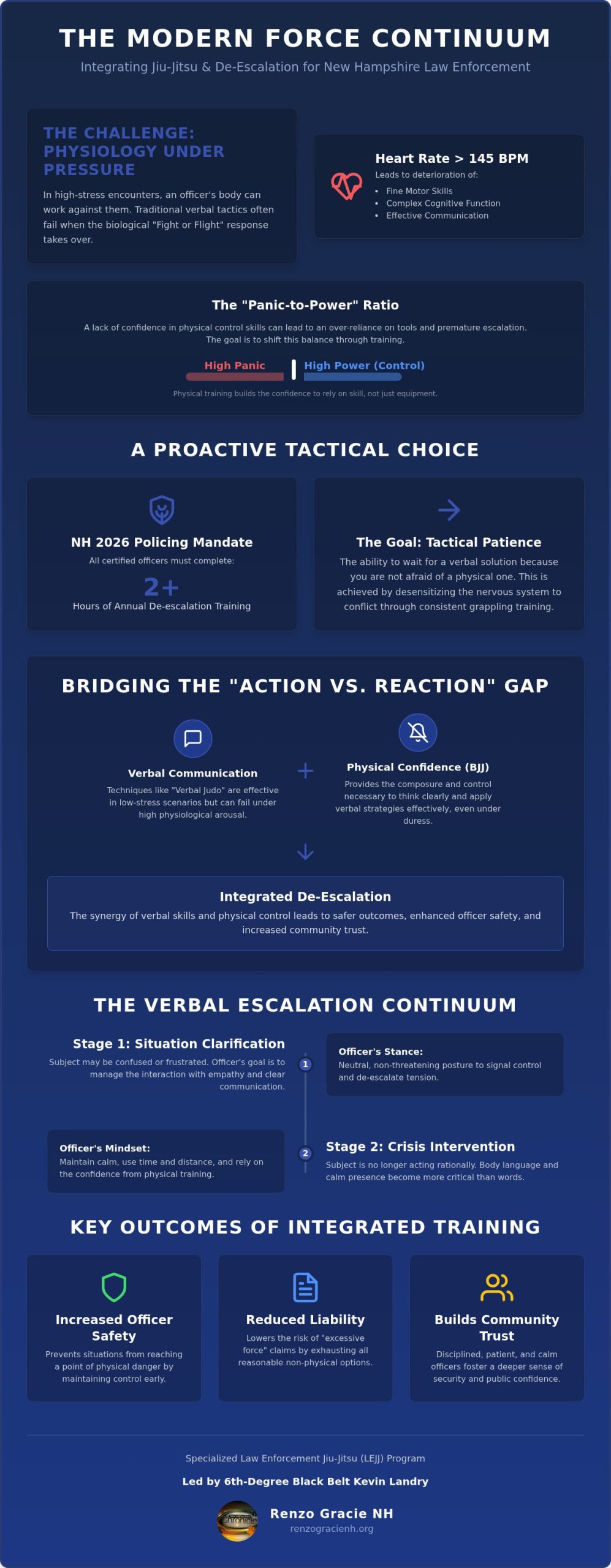
De-escalation isn’t a passive retreat or a sign of weakness. It’s a proactive tactical choice. In the high-pressure environment of active patrol, choosing to lower the temperature of an encounter is often the most courageous and professional action an officer can take. Effective De-escalation involves using time, distance, and communication to stabilize a situation before it requires physical force. As of August 2026, the New Hampshire Police Standards and Training Council (PSTC) requires all certified officers to complete at least two hours of annual training focused on these skills. This mandate reflects a broader commitment to modern policing standards that prioritize the preservation of life and the safety of everyone involved.

Many officers find that traditional “Verbal Judo” models fall short when a subject’s arousal level spikes. When adrenaline surges and tunnel vision sets in, complex verbal scripts often vanish. You need more than just words. You need a foundation that allows you to think clearly while under physical threat. This is where the modern force continuum evolves. It’s no longer just a linear ladder of escalating violence. Instead, it’s a dynamic framework where de-escalation remains the central hub, guiding every decision from your initial presence to the moment physical control becomes necessary.

The Verbal Escalation Continuum in NH

NH training bodies identify clear stages of verbal aggression that you encounter daily. It begins with “Situation Clarification,” where a citizen might simply be confused or frustrated by an interaction. If not managed with empathy, this can quickly transition into “Crisis Intervention,” where the subject is no longer acting rationally. During these shifts, your body language speaks louder than your voice. Maintaining a neutral, non-threatening posture is a core component of successful community policing. It signals that you are in control of yourself, which helps the subject regain control of their own emotions.

Regulatory Pressures and Community Trust

Implementing robust de-escalation techniques for law enforcement NH is a powerful way to reduce department liability. By exhausting all reasonable non-physical options, you significantly lower the risk of “excessive force” claims that can damage a career or a department’s reputation. This commitment to professional growth builds lasting trust in communities like Manchester and Exeter. When residents see officers who are disciplined, patient, and calm, they feel a deeper sense of security. De-escalation is a strategic tool designed to maximize officer safety by preventing a situation from ever reaching the point of physical danger.

The Psychology of Calm: Why Physical Confidence Prevents Escalation

When your heart rate climbs above 145 beats per minute, fine motor skills and complex cognitive functions begin to deteriorate. This is the physiological reality of the “Fight or Flight” response. For an officer on a high-arousal call, this biological surge makes it nearly impossible to access the empathetic, rational parts of the brain needed for effective communication. If you feel physically vulnerable, your body prioritizes survival over dialogue. This often leads to a high “Panic-to-Power” ratio, where a lack of confidence in one’s physical control leads to an over-reliance on tools or early escalation.

Building true proficiency in de-escalation techniques for law enforcement NH starts with managing these internal chemical spikes. Consistent grappling training helps desensitize the nervous system to physical proximity and conflict. By reducing cortisol and adrenaline spikes through controlled exposure, you gain “Tactical Patience.” This is the ability to wait for a verbal solution because you aren’t afraid of a physical one. This level of preparedness aligns with the standards highlighted in the Law Enforcement De-Escalation Training Act of 2022 (LEDTA), which emphasizes using the least amount of force necessary to safely resolve a situation.

Officer Presence and Tactical Confidence

True confidence is quiet. It doesn’t need to be aggressive or intimidating to be effective. When you possess the skills to control a subject through grappling, your stance naturally becomes less threatening and more stable. Fear-based policing often manifests as a rigid, aggressive posture that unintentionally signals a threat to the subject. This cycle of mutual fear is what drives rapid escalation. By focusing on physical preparedness, you support your own mental wellness, ensuring you arrive at every call with a clear head and a steady hand.

The Link Between Grappling and Verbal Clarity

A subject can sense when an officer’s body stiffens. This physical tension is a universal signal for an impending fight, which often causes the subject to escalate in response. By applying Brazilian Jiu-Jitsu “Flow” concepts, you learn to remain adaptable and relaxed even when a situation is unpredictable. This physical relaxation keeps your mind open to verbal solutions. If you are interested in developing this level of professional poise, exploring Law Enforcement Jiu-Jitsu Training is a vital step. You’ll find that when you master your body, you master the room. It is much easier to lead a community toward peace when you are already at peace with your own capabilities.

Comparing De-Escalation Models: Verbal Judo vs. Brazilian Jiu-Jitsu

Traditional de-escalation models often rely on a critical assumption: the subject is willing and able to listen. Verbal-only strategies, like the classic Verbal Judo approach, are excellent for managing compliant or slightly agitated individuals. However, these models can falter when a subject is experiencing a severe mental health crisis or is under the influence of narcotics. In these moments, logic disappears. Relying solely on “Command Presence” can even backfire. A rigid, authoritative stance may be perceived as a challenge, unintentionally triggering a physical confrontation that neither party wants. True mastery of de-escalation techniques for law enforcement NH requires an integrated model that blends verbal skills with the physical confidence of Brazilian Jiu-Jitsu.

The “Action vs. Reaction” gap is a constant danger in the field. If an officer only has verbal tools, they are forced to react to a subject’s physical aggression after it has already begun. This delay often leads to higher levels of force than necessary. By integrating grappling, you close this gap. You gain a “fail-safe” that allows you to stay in the conversation longer because you know exactly how to protect yourself if the dialogue fails. This proactive approach is a cornerstone of Gracie Survival Tactics (GST), which teaches officers how to maintain a safe distance and control a subject without immediately resorting to weapons or striking.

The KODIAK Model vs. Tactical Grappling

Many NH departments utilize the KODIAK model, which emphasizes four stages: Safety, Relationship, Calmness, and Solution. While these stages are vital, the “Safety” component is often the hardest to maintain. When you lack physical control skills, your primary way to ensure safety is often to draw a tool, which immediately escalates the scene’s tension. Tactical grappling provides a middle ground. It allows you to fulfill the “Safety” stage through superior positioning and clinch work. This physical stability makes it much easier to transition back to verbal negotiation, as you aren’t fighting for your own survival while trying to find a solution.

Reducing the Need for Striking

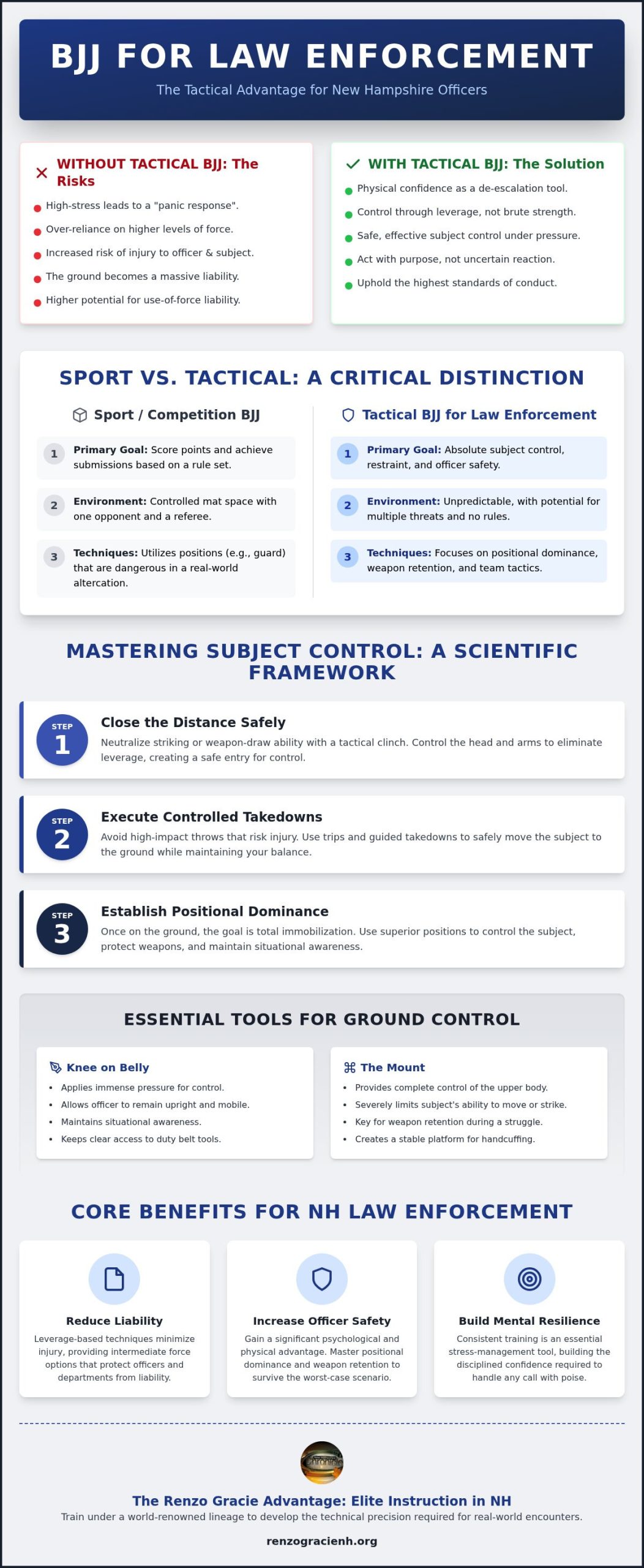
Brazilian Jiu-Jitsu is known as the “gentle art” because it focuses on leverage and control rather than impact. In modern policing, the liability difference between a strike and a controlled takedown is massive. Strikes often lead to broken bones, lacerations, and high-profile use-of-force reviews. A controlled clinch or a guided takedown, however, allows for subject control with a significantly lower risk of injury. The primary goal of Law Enforcement Jiu-Jitsu (LEJJ) is to minimize injury to both the officer and the subject during every encounter. This focus on preservation of life aligns perfectly with current NH use-of-force policies and community expectations.

De-Escalation Techniques for Law Enforcement NH: Integrating BJJ and Verbal Tactics

5 Essential BJJ-Based De-Escalation Techniques for NH Officers

True de-escalation is the art of giving a subject every opportunity to comply while ensuring they never have the opportunity to harm you. Integrating physical mechanics into your daily routine is the key to this tactical confidence. It is about being prepared, not aggressive. By utilizing these de-escalation techniques for law enforcement NH, you create a buffer of safety that benefits everyone involved. These skills allow you to remain calm and professional even when a situation becomes volatile. When you understand the mechanics of balance and leverage, you don’t need to shout to be heard. You lead through disciplined presence.

Distance Management and the Interview Stance

Distance is your best friend. In Brazilian Jiu-Jitsu, we teach that if a subject can’t touch you, they can’t hurt you. Maintaining a “Reactionary Gap” of six to eight feet gives you the time necessary to process information and react to sudden movements. To support this, you should adopt the “Interview Stance,” often called “The Fence.” This involves keeping your feet staggered for balance while your hands remain open and at chest level. It is a non-threatening posture that signals a willingness to talk, yet it places your hands in the perfect position to block a strike or initiate a clinch if the situation turns physical. This tactical space reduces the subject’s anxiety while keeping you ready for anything.

The Clinch and Subject Control

When verbal negotiation fails, you need a way to stop aggression without resorting to striking. The “Seatbelt Clinch” is a fundamental BJJ technique that allows you to neutralize a subject’s movement by controlling their torso and arms. This position minimizes the subject’s ability to reach for weapons or throw punches. Transitioning from a verbal refusal to a physical control position should be a smooth, guided movement rather than an explosive collision. This reduces the risk of injury for both parties. Whether you are working a busy night in Manchester or a local call in Exeter, these skills provide the tactical patience you need while waiting for backup to arrive. You stay in control without escalating the violence.

Mastering these movements requires consistent practice and professional guidance. You can build the confidence to handle any encounter by training with experts who understand the unique needs of your profession. Start your journey toward tactical mastery by enrolling in our Law Enforcement Jiu-Jitsu Training at Renzo Gracie NH today.

  • Distance Management: Using the reactionary gap to buy time and maintain calm.
  • The Interview Stance: An open-handed, de-escalatory posture that is ready for defense.
  • The Seatbelt Clinch: Neutralizing a subject’s upper body to prevent strikes.
  • Guided Takedowns: Using leverage to bring a subject to the ground safely.
  • Subject Control (The Pin): Maintaining a dominant, safe position until backup arrives.

Advancing Law Enforcement Jiu-Jitsu Training at Renzo Gracie NH

Classroom learning provides the theory, but the mat provides the mastery. At Renzo Gracie NH, we believe that true tactical confidence is built through consistent, high-quality practice. Our specialized Law Enforcement Jiu-Jitsu (LEJJ) program in Windham is designed to bridge the gap between policy and performance. Led by Professor Kevin Landry, a 6th-degree black belt with over 20 years of teaching experience in New Hampshire, our academy offers a level of expertise that is rare in the region. We provide a professional yet inclusive environment where officers from all backgrounds can evolve their skills. You don’t just learn a set of moves here. You join a community dedicated to excellence and personal growth. We invite you to experience this firsthand by attending a free introductory class to see how our curriculum fits your professional needs.

Tailored Curriculum for Professional Defensive Tactics

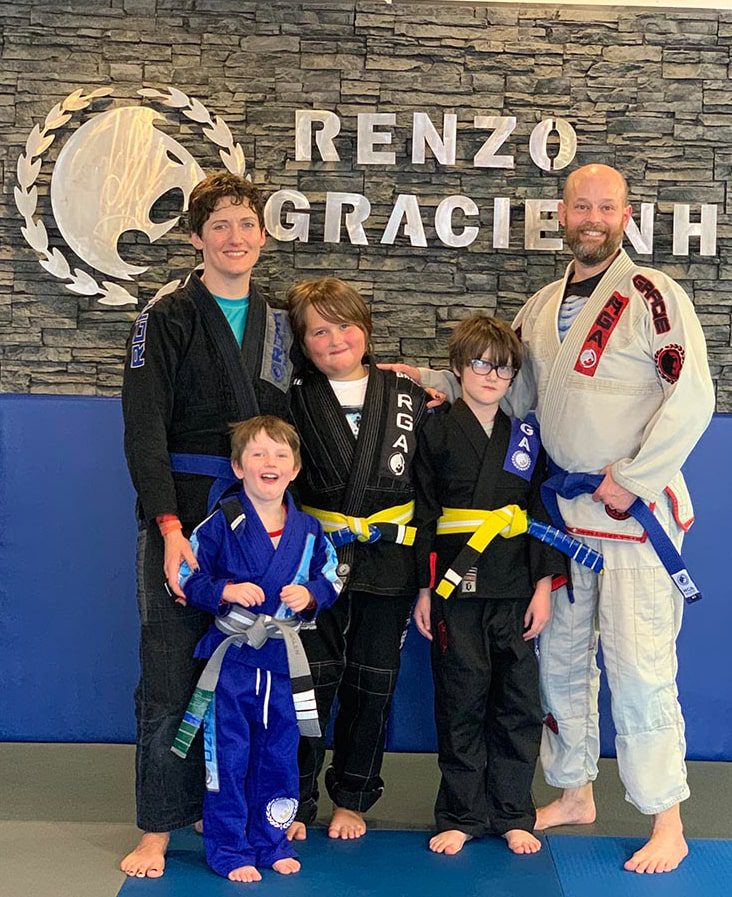
One-off seminars often fail because they don’t allow for the development of muscle memory. Mastery of de-escalation techniques for law enforcement NH requires recurring mat time to ensure that your reactions are instinctive and calm under pressure. Our LEJJ curriculum is specifically tailored for the modern officer. We focus on critical areas such as subject control, weapon retention, and ground survival. These aren’t just sport techniques; they are life-saving defensive tactics designed for the street. By training regularly, you ensure that your body knows what to do even when your mind is under extreme stress. Many of our officers also find that training becomes a family affair. If you’re interested in bringing the same level of discipline and focus to your household, explore our Kids Jiu Jitsu New Hampshire program for your children.

Join the NH Law Enforcement BJJ Community

Training with fellow officers creates a unique bond of trust and mutual respect. Our academy serves as a hub for the NH law enforcement community, providing a safe and structured environment to sharpen your skills. We understand the unique pressures of the job. Our sessions are designed to build vitality and resilience, helping you manage the physical and mental toll of patrol work. Whether you are looking for an individual membership or a department-wide training solution, we offer flexible options for agencies across Southern New Hampshire, including Manchester and Exeter. We are your supportive partner in professional development. Take the next step in your tactical journey and discover the empowerment that comes with disciplined practice. Contact Renzo Gracie NH today to schedule your LEJJ session and start building the confidence that keeps our communities safe.

Empower Your Patrol with Tactical Confidence

True mastery in the field isn’t just about what you say; it’s about the quiet confidence you project when you know you can handle any situation. By integrating specialized de-escalation techniques for law enforcement NH, you move beyond basic compliance and into a space of professional excellence. You’ve seen how physical preparedness through Brazilian Jiu-Jitsu allows for greater verbal clarity and a reduced reliance on weapons. This synergy protects you, the subject, and the community you serve. It transforms your approach from reactive to proactive, ensuring you remain the expert in the room during every encounter.

At Renzo Gracie NH, we are proud to offer a specialized LEJJ curriculum that carries the prestigious legacy of the Renzo Gracie Association. Under the guidance of 6th-degree black belt Kevin Landry, who brings over 20 years of NH instructional experience, you’ll develop the essential subject control skills needed for modern policing. We invite you to start your Law Enforcement Jiu-Jitsu journey with a free intro class at Renzo Gracie NH today. Building these skills is a marathon, not a sprint. We’re here to be your supportive partner every step of the way. Stay safe, stay focused, and keep growing.

Frequently Asked Questions

What are the 4 pillars of de-escalation for law enforcement?

The four pillars of de-escalation are time, distance, cover, and communication. By maximizing these elements, you create the space needed to avoid a physical confrontation. Time allows for better decision-making; distance creates a safety buffer; cover provides protection; and communication serves to build rapport or gain compliance. Mastering these pillars ensures that you use the least amount of force necessary while maintaining absolute control over the scene’s progression and outcome.

Is de-escalation training mandatory for police officers in New Hampshire?

Yes, de-escalation training is mandatory for all certified police, corrections, and probation officers in the state. According to the New Hampshire Police Standards and Training Council (PSTC), officers must complete at least two hours of annual de-escalation training. This is part of the broader 24-hour annual in-service requirement. Staying current with de-escalation techniques for law enforcement NH is essential for maintaining certification and meeting modern community policing standards.

How does Brazilian Jiu-Jitsu help with de-escalation?

Brazilian Jiu-Jitsu provides the physical confidence needed to remain calm during high-stress encounters. When you know you can control a subject through grappling, you’re less likely to experience the panic that leads to premature escalation or an over-reliance on weapons. This “tactical poise” allows you to stay in the verbal negotiation phase longer. It bridges the gap between words and force, providing a safe middle ground for subject control and officer safety.

What is the “tactical patience” concept in de-escalation?

Tactical patience is the ability to slow down an encounter and wait for a peaceful resolution. It’s built on the foundation of being physically prepared for any outcome. If you aren’t afraid of a physical confrontation, you don’t feel the need to rush to a “win” or force immediate compliance through aggression. This mindset allows you to use time as a tool, effectively lowering the emotional temperature of a crisis before taking action.

Can BJJ techniques reduce the risk of excessive force lawsuits?

Yes, BJJ techniques significantly reduce liability by prioritizing control over impact. Traditional defensive tactics often rely on strikes, which frequently lead to injuries like broken bones or lacerations. These injuries often trigger “excessive force” litigation. In contrast, BJJ focuses on leverage, clinch work, and safe takedowns. By using de-escalation techniques for law enforcement NH that emphasize subject control without injury, departments can lower their risk of high-profile lawsuits and community backlash.

What are the most common verbal de-escalation triggers to avoid?

Common triggers include using sarcasm, ordering a subject to “calm down,” or needlessly challenging their authority. Phrases that sound dismissive or condescending often escalate a subject’s arousal level rather than lowering it. You should also avoid invading a subject’s personal space too early, as this can trigger a defensive “fight” response. Instead, focus on active listening and empathetic responses that validate the subject’s feelings without necessarily agreeing with their actions or demands.

Does Renzo Gracie NH offer private training for police departments?

Renzo Gracie NH offers specialized Law Enforcement Jiu-Jitsu (LEJJ) training for both individual officers and entire departments. Our curriculum is led by Professor Kevin Landry, a 6th-degree black belt with over two decades of experience teaching in New Hampshire. We can tailor sessions to meet the specific needs of your agency, focusing on ground survival, weapon retention, and subject control. These professional sessions are designed to build the muscle memory required for safe, effective de-escalation.

How often should officers practice de-escalation and defensive tactics?

While state mandates require two hours annually, true proficiency requires consistent practice. Perishable skills like grappling and high-stress communication fade without regular use. We recommend that officers engage in mat time at least once or twice a week to maintain their “tactical edge.” Regular training ensures that your de-escalation responses are instinctive rather than forced. This consistent effort builds the long-term vitality and resilience needed for a successful career in law enforcement.

Use of Force Continuum Training NH: Bridging the Gap with Tactical BJJ

A policy manual won’t help you when a subject resists on the cold asphalt. Only muscle memory and disciplined technique can do that. You understand the immense pressure of split-second decisions where every move is scrutinized. The fear of litigation or a career-ending mistake weighs heavy during high-stress encounters. It’s a weight you shouldn’t have to carry alone. Many officers feel a lack of confidence in outdated “empty-hand” control techniques that fail to account for how the human body actually reacts under adrenaline.

You’ll master the decision-making framework of the Use of Force Continuum and discover how tactical Jiu-Jitsu provides the physical skills necessary for safe subject control. Our comprehensive look at use of force continuum training NH will show you how to reduce reliance on higher levels of force by gaining practical, ground-based skills. We’ll explore how to bridge the gap between verbal commands and physical control with the quiet authority that comes from elite-level preparation. It’s about evolving your capabilities to ensure both officer safety and professional integrity.

Key Takeaways

  • Understand the 2026 landscape of policing and how modern use of force continuum training NH prioritizes de-escalation while maintaining officer safety.
  • Master the art of leverage. Learn why Brazilian Jiu-Jitsu is the premier tool for controlling resisting subjects regardless of your size or strength.
  • Bridge the gap between words and action. Discover how to navigate the OODA loop to make faster, more accurate decisions during high-stress physical transitions.
  • Protect your career and your community. Gain insights into the specific “Empty-Hand” techniques that reduce the risk of injury and litigation during an arrest.
  • Evolve through expert mentorship. See how training under a world-class instructor builds the disciplined confidence needed for professional subject control.

Understanding the Use of Force Continuum in New Hampshire Law Enforcement

Clear guidelines. Disciplined safety. The Use of Force Continuum serves as a vital roadmap for every interaction between an officer and a citizen. In 2026, the New Hampshire policing environment places a heavy emphasis on de-escalation and proportionality. This framework isn’t merely a set of rules; it’s a dynamic decision-making tool. Comprehensive use of force continuum training NH prepares you to handle high-stakes moments with both clarity and restraint. Missteps in Southern NH carry heavy weight. They can lead to legal scrutiny, civil litigation, or a fundamental breakdown in community trust. You must understand how to balance your safety with the ethical requirement to use the least amount of force necessary.

The Standard Levels of Force Explained

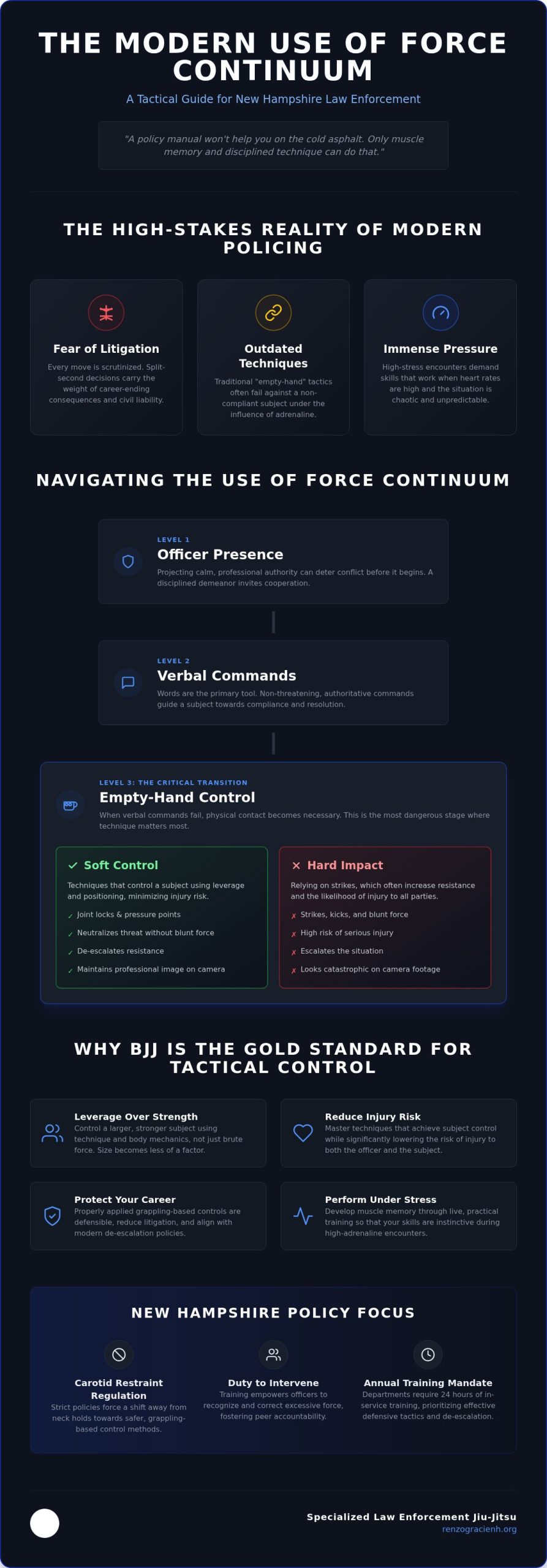
It starts with presence. Your posture matters. A professional demeanor and “disciplined confidence” often deter conflict before it even begins. It’s about projecting an aura of calm authority that invites cooperation. From there, you move to verbalization. Words are your primary tool. Use non-threatening yet authoritative commands to steer a subject toward compliance. Effective communication often resolves resistance without a single hand being laid. Finally, you reach empty-hand control. This is the most dangerous transition. When verbal commands fail, physical contact becomes the reality. You’ll need “soft” techniques like joint locks or pressure points to gain control without causing injury. Avoiding “hard” techniques like strikes is essential for maintaining the de-escalation goals of modern NH policing.

New Hampshire Specific Policy Nuances

NH policies have tightened significantly. Current standards strictly regulate carotid restraints and neck holds, making them tools of last resort. This change forces a shift toward grappling-based control that preserves life. The “Duty to Intervene” is a standard you must uphold. Proper training empowers you to intervene when a colleague’s actions exceed policy, fostering a culture of peer accountability. Local departments in Manchester and Exeter are already evolving their use of force continuum training NH programs to meet the 24-hour annual in-service training requirements. They are integrating defensive tactics that prioritize subject safety and officer longevity. This evolution ensures that every encounter remains as safe as possible for everyone involved. By focusing on these nuances, you protect your career and your community simultaneously.

The Critical Role of Empty-Hand Control in Modern Policing

Theory meets reality at the point of contact. While verbalization is the goal, physical intervention is often unavoidable. Data from the Durham Police Department in 2025 showed that while use of force incidents were rare, accounting for only 0.12% of calls, they remain the most scrutinized moments of an officer’s career. Empty-hand control is the stage where most injuries occur. It’s the “danger zone” of the continuum. Traditional defensive tactics often rely on compliant partners in a sterile gym. When a subject truly resists, these static moves fail. Effective use of force continuum training NH must account for the chaotic, high-stress physiological responses that happen during a real-world struggle. You need skills that work when your heart rate is 160 beats per minute.

Soft Control vs. Hard Impact

Strikes escalate. Control de-escalates. There is no such thing as a one-size-fits-all compliance hold that works on everyone. Relying on “hard” techniques like strikes or kicks often increases the subject’s resistance and heightens the risk of injury for both parties. It also looks catastrophic on body-worn camera footage. Modern policing demands a professional image. “Soft” techniques, such as joint isolates and dominant positioning, allow you to neutralize a threat without resorting to blunt force. This approach maintains public trust while keeping you safe. Instructors who graduate from the Use of Force Instructor Training Program emphasize that the goal is always the minimum amount of force necessary to achieve a lawful objective. Discovering these transitions is easier when you have a supportive partner in Law Enforcement Jiu-Jitsu Training to guide your progress.

Avoiding Positional Asphyxia and Serious Injury

Safety is a two-way street. Every reputable use of force continuum training NH program now emphasizes the prevention of medical emergencies during arrests. You must control the subject without obstructing their ability to breathe. This is where weight distribution and leverage become more important than raw strength. If you rely on pinning a subject’s chest to the ground with your full weight, you risk positional asphyxia. Tactical Jiu-Jitsu teaches you to use your hips and limbs to create wedges. These wedges provide control while keeping the subject’s airway clear. Safe subject control during the soft control phase requires the application of mechanical leverage to isolate limbs and stabilize the torso while maintaining constant monitoring of the subject’s airway and physical state. By evolving your technique, you find that you don’t need to be the biggest person in the room to be the most effective. It’s about building a foundation of technical excellence that protects everyone involved in the encounter.

Why Brazilian Jiu-Jitsu is the Gold Standard for Tactical Control

Leverage changes everything. It’s the great equalizer for New Hampshire officers who may find themselves outsized by a resisting subject. Brazilian Jiu-Jitsu (BJJ) isn’t about raw power; it’s about the efficient application of physics. By focusing on mechanical advantages, BJJ allows any officer to maintain control without relying on brute force. This technical proficiency is a cornerstone of modern use of force continuum training NH. It provides a “Human Chess” approach where you stay three steps ahead of a subject’s resistance. You don’t react to their movement; you anticipate and neutralize it.

Staying calm is a skill. When you train against live, controlled resistance, you develop a level of psychological resilience that static drills simply cannot provide. This “calm under fire” is what prevents the panic response that often leads to excessive force. By closing the gap in your grappling skills, you effectively reduce the need to jump to higher levels of force, such as Tasers or lethal options. You become a more capable, confident professional who can resolve conflicts with minimal injury. It’s an evolution from being a “fighter” to being a technician of human movement.

The Science of Grappling and Subject Control

Ground fighting is a “Zero-G” environment. Once the struggle goes to the floor, traditional balance and striking mechanics vanish. BJJ teaches you how to navigate this space by controlling the subject’s hips and shoulders. If you control the levers, you control the body. This limits their mobility and prevents them from reaching for weapons or escaping. We emphasize “position before cuffing.” You must secure a dominant, stable position before attempting to apply restraints. Attempting to cuff a flailing subject is a recipe for injury. By stabilizing the torso first, you ensure the transition to handcuffs is safe and methodical. This disciplined approach is what separates world-class instruction from basic defensive tactics.

BJJ and De-escalation: A Surprising Connection

Confidence breeds patience. When you know you possess the physical skills to handle a situation if it turns physical, you can afford to use verbal de-escalation for longer. You don’t feel the need to “win” the encounter through immediate escalation because you aren’t afraid of the alternative. This is the heart of a supportive partnership between an officer and their community. Our Law Enforcement Jiu Jitsu Training focuses on this exact evolution. It’s about building the disciplined confidence required to stay in the “verbalization” phase as long as possible. If the situation does escalate, your use of force continuum training NH ensures you have the technical foundation to resolve it with the least amount of force necessary. You protect the subject’s well-being while ensuring your own safety and professional integrity.

Use of Force Continuum Training NH: Bridging the Gap with Tactical BJJ

Training for High-Stress Transitions: From Verbalization to Physical Control

Speed is life. Decisions happen in milliseconds. The OODA Loop, which stands for Observe, Orient, Decide, and Act, isn’t just a military concept; it’s the mental engine behind every encounter. Static training often fails because it doesn’t prepare you for the “lag” that occurs when a situation shifts from words to resistance. Effective use of force continuum training NH must bridge this gap by moving beyond simple definitions into dynamic, scenario-based practice. You need muscle memory that takes over when the adrenaline hits. It’s about building a bridge between your mind and your body so that your response is automatic and precise.

Realism matters. You can’t train exclusively in a t-shirt and shorts if you work in a 20-pound duty belt and ballistic vest. Integrating your actual gear into defensive tactics ensures your movements remain fluid and your weapon retention is secure during a struggle. Training with your equipment allows you to discover how your vest limits certain ranges of motion or how your belt affects your center of gravity on the ground. This level of detail is what creates a truly professional standard of readiness.

The 4-Step Methodology for Tactical Training

  • Step 1: Technical Acquisition. Learn the mechanics of a control hold in a sterile environment to build the foundation of the movement.
  • Step 2: Resistance Integration. Apply the move against a partner who is 20 to 50 percent resisting. This teaches you to adjust for real-world movement and weight shifts.
  • Step 3: Scenario-Based Drills. Start from a verbal encounter and transition to physical control based on the partner’s cues, forcing you to navigate the continuum in real-time.
  • Step 4: Stress Inoculation. Train under fatigue. Mimic the physiological state of a real struggle to ensure your technique holds up when you’re exhausted and under pressure.

Maintaining the ‘Disciplined Confidence’ Mindset

Confidence isn’t arrogance. It’s the quiet knowledge that you are prepared for the worst while hoping for the best. Consistent mat time builds the mental fortitude NH officers need to remain professional under extreme duress. You evolve from a reactive state to a proactive one. When a subject ignores a final verbal command, you close the distance with a level-headed entry, utilizing a clinch to neutralize their hips and secure a dominant position while keeping your hands free to manage your equipment. This transition is a technical skill, not a brawl. It requires the guidance of an authoritative mentor who understands the unique legal and physical challenges of the job. If you’re ready to evolve your skills, explore our Law Enforcement Jiu-Jitsu Training and join a community dedicated to professional excellence.

Specialized Law Enforcement Jiu-Jitsu at Renzo Gracie NH

Legacy matters. Excellence is earned. At Renzo Gracie NH, we provide a world-class standard for effective grappling that is rooted in one of the most prestigious lineages in martial arts. Professor Kevin Landry, a 6th-degree black belt under Renzo Gracie, leads our program with over two decades of teaching experience in the New Hampshire region. His approach is methodical and purposeful. He understands that for law enforcement, a technique is only as good as its safety and legal defensibility. This specialized instruction ensures that your use of force continuum training NH is not just a checkbox, but a transformative set of skills that protects your career and your community.

Expert mentorship makes the difference. Professor Landry’s curriculum focuses on practical grappling and control techniques designed to improve officer safety in compliance with modern standards. You’ll discover how to navigate the “Empty-Hand” stage of the continuum with a level of technical precision that reduces the need for higher levels of force. It’s about building a foundation of “disciplined confidence” that allows you to remain a calm, authoritative guide in the most chaotic moments of your shift.

A Supportive Environment for First Responders

You aren’t training in a vacuum. You’re training alongside peers. Our academy serves as a supportive partner for first responders from Windham, Manchester, Exeter, and throughout Southern NH. We recognize the unique stresses of the job. Training with others who share your professional background creates a sense of collective effort and mutual respect. We also understand that your schedule is rarely a standard nine-to-five. Our flexible scheduling options are designed to accommodate the irregular hours of shift work, ensuring you can maintain consistent progress without sacrificing your personal life. We prioritize the well-being of the individual and the family unit, helping you find the balance needed for a sustainable career.

Your Path to Mastery in Defensive Tactics

The journey begins with a single step. When you arrive for your first specialized session, you’ll find an environment that is professional, serious, and welcoming. We don’t focus on ego or competition; we focus on growth and technical acquisition. You’ll learn how to apply BJJ principles to real-world subject control, emphasizing character development traits like perseverance and focus. This isn’t just about physical attributes like strength. It’s about evolving into a more capable version of yourself. Every class is an opportunity to refine your decision-making under pressure and build the mental fortitude required for modern policing. Ready to elevate your skills? Try a Free Introductory Class at Renzo Gracie NH today and experience the difference that elite use of force continuum training NH can make in your professional life.

Master the Transition to Professional Control

Expertise is a journey. You’ve seen how the right technical foundation transforms the way you navigate the Use of Force Continuum. By mastering leverage and dominant positioning, you ensure that every encounter remains as safe as possible for both you and the subject. This isn’t just about learning moves; it’s about building the disciplined confidence to stay calm when the pressure rises. Comprehensive use of force continuum training NH bridges the gap between verbal commands and physical intervention, protecting your career and your community through technical excellence.

Take the next step with a supportive partner who understands the unique demands of your profession. Professor Kevin Landry brings over 20 years of regional experience and the authority of a 6th-degree black belt to every session. Our specialized LE-focused curriculum is designed for the modern officer who values safety, respect, and perseverance. You don’t have to train alone. Join a community of first responders dedicated to evolving their skills and maintaining the highest standards of the badge. Claim Your Free Introductory Law Enforcement BJJ Class at Renzo Gracie NH today. We look forward to helping you discover your full potential on and off the mats.

Frequently Asked Questions

What is the Use of Force Continuum and why is it important for NH officers?

It’s a decision-making framework. This standard provides guidelines as to how much force is appropriate against a resisting subject in specific situations. It’s critical for NH officers because it ensures legal compliance and safety. By following this roadmap, you maintain professional integrity while navigating high-stress encounters. It serves as the foundation for de-escalation, helping you protect both yourself and the community you serve.

Is BJJ training compliant with New Hampshire Police Standards and Training Council guidelines?

Yes, it is. Brazilian Jiu-Jitsu principles are recognized as effective defensive tactics that align with modern subject control standards. Modern use of force continuum training NH integrates these grappling skills to meet state-mandated de-escalation requirements. We recommend checking the 2026 NHPSTC stance on specific BJJ-based tactics to ensure your department’s policy remains current. This training builds the disciplined confidence needed to satisfy rigorous state oversight.

How often should an officer train in BJJ to maintain effective defensive tactics?

Consistency builds mastery. We recommend training at least twice a week to maintain the muscle memory needed for high-stress transitions. This steady momentum allows you to move from technical acquisition to real-world application. Short, purposeful sessions ensure your responses stay automatic even when you’re exhausted on shift. It’s about a consistent lifestyle of growth rather than occasional, intense bursts of effort.

Can BJJ help reduce department liability and use-of-force complaints?

Superior control reduces risk. By providing officers with effective “Empty-Hand” skills, BJJ minimizes the need for “hard” techniques like strikes that often lead to injuries. When you can control a subject through leverage and positioning, you naturally reduce use-of-force complaints. This technical proficiency protects the department from litigation and preserves public trust. It’s a proactive way to ensure every encounter is handled with professional restraint.

Do I need to be in ‘fighting shape’ to start Law Enforcement Jiu-Jitsu training?

You don’t. Our program is welcoming to individuals of all skill and fitness levels. We focus on technical leverage rather than raw strength or conditioning. You’ll build your conditioning and strength as you progress through the curriculum at your own pace. We prioritize your personal success in a supportive environment, ensuring you feel confident and capable from your very first introductory session.

How does BJJ training address the risk of positional asphyxia?

We prioritize airway safety. Our training teaches you to use wedges and limb isolates instead of pinning a subject’s chest with your full weight. This mechanical approach allows for dominant control without obstructing the subject’s ability to breathe. By focusing on hip control and weight distribution, you can stabilize a resisting subject safely. It’s a technical evolution that directly addresses one of the most dangerous risks in modern policing.

What makes Renzo Gracie NH different from other martial arts schools for police?

Lineage and experience. We offer specialized Law Enforcement Jiu-Jitsu Training led by Professor Kevin Landry, a 6th-degree black belt with over two decades of regional experience. We aren’t just a combat sports gym; we are a supportive partner for the first responder community. Our curriculum is tailored for the legal and physical realities of the job, focusing on character development, respect, and the safety of the family unit.

Are there specific classes for law enforcement officers in the Manchester or Windham area?

We serve Southern NH. Our academy provides specialized sessions for officers from Windham, Manchester, and Exeter. We offer flexible scheduling to accommodate the unique stresses of shift work. This ensures you can receive elite use of force continuum training NH without sacrificing your essential family time. We strive to be a convenient, reliable part of your professional development and your balanced lifestyle.

Modern Police Jiu Jitsu Training in NH: Safe and Effective Defensive Tactics

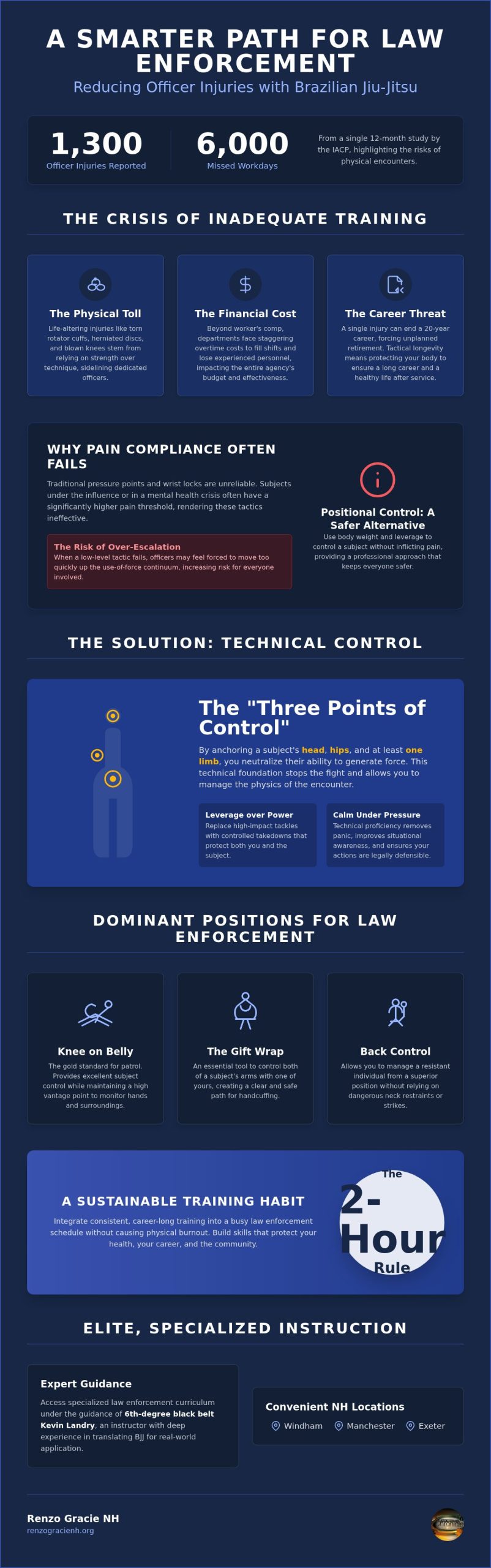
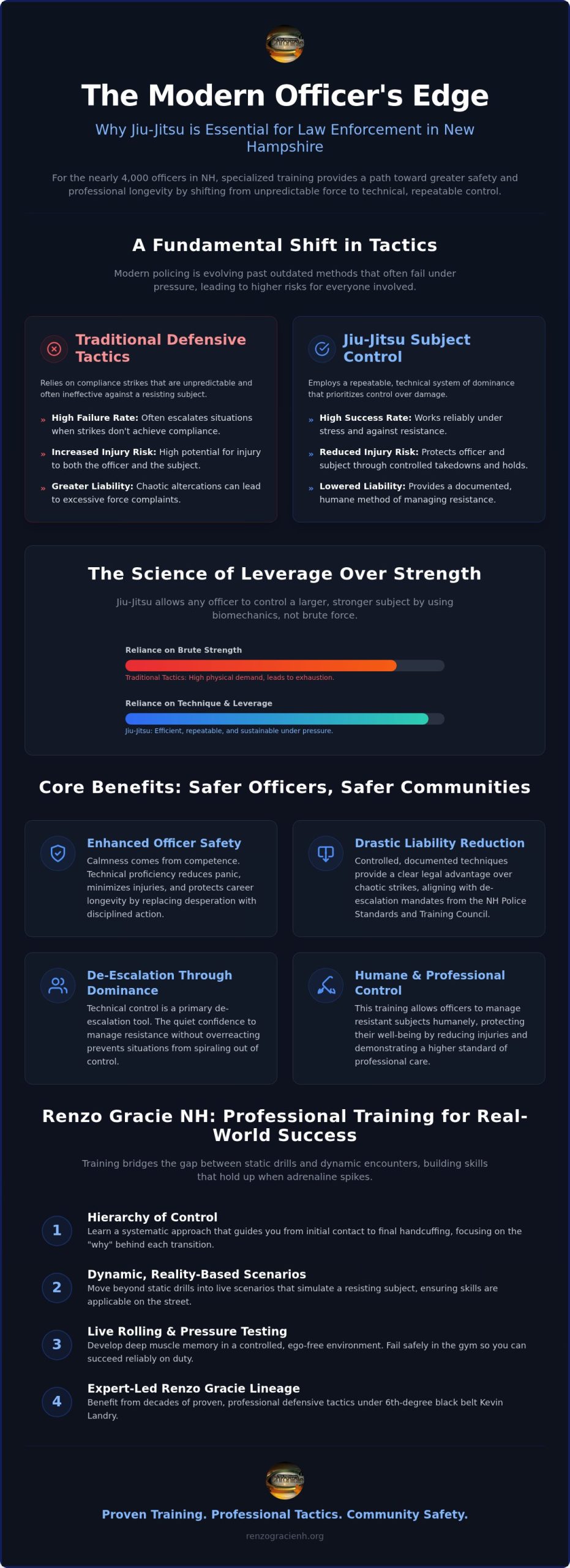
What if the most effective tool for de-escalation isn’t on your duty belt, but in your ability to control a situation with technical precision? Control the chaos. Protect the community. Stay safe. You understand the bone-deep exhaustion of a physical altercation and the heavy burden of avoiding excessive force complaints. This is why specialized police jiu jitsu training NH has become a vital resource for the nearly 4,000 law enforcement officers across our state. Traditional, static defensive tactics often feel insufficient when the adrenaline hits and a subject truly resists.

This article shows how technical grappling proficiency offers a path toward greater safety and professional longevity. You’ll discover how the Renzo Gracie lineage, led by 6th-degree black belt Kevin Landry, empowers officers with the skills to manage resistant subjects humanely. We will explore the shift toward technical control, the impact on officer confidence, and how these methods align with the evolving standards of the New Hampshire Police Standards and Training Council. Build your skills, evolve your tactics, and gain the disciplined confidence needed to serve your community with excellence.

Key Takeaways

  • Understand why technical subject control is replacing outdated striking methods to significantly reduce liability and injury for both officers and the public.
  • Discover how the science of leverage allows you to maintain dominance over larger subjects without relying on brute strength or reaching physical exhaustion.
  • Explore how specialized police jiu jitsu training NH provides a supportive, ego-free environment where you can build technical proficiency that holds up under pressure.
  • Learn why technical dominance is a primary de-escalation tool, providing the quiet confidence required to manage resistance without overreacting.
  • Benefit from the expertise of the Renzo Gracie lineage to ensure your training is grounded in decades of proven, professional defensive tactics.

Why Brazilian Jiu Jitsu is Essential for NH Law Enforcement Officers

Control is the goal. Damage is the failure. Modern policing in the Granite State is evolving toward evidence-based methods that prioritize subject control over chaotic physical force. For years, traditional defensive tactics relied on compliance strikes that often fail during high-stress encounters. These strikes require a level of cooperation that a resisting subject rarely provides. By choosing specialized police jiu jitsu training NH, officers move away from unpredictable striking and toward a repeatable, technical system of dominance. Brazilian Jiu-Jitsu offers this path. It focuses on the science of leverage, allowing a smaller officer to safely manage a larger individual without relying on brute strength. This shift isn’t just about winning a fight; it’s about professional subject control that protects lives.

The Reality of Ground Encounters

Gravity wins. Most physical altercations eventually move to the ground, whether by accident or design. For an officer, being grounded without a technical plan is a significant liability. It’s a high-stakes environment where traditional tools are harder to reach and your mobility is restricted. Building a foundation of survival and recovery is essential. You learn to protect your space, manage the weight of a subject, and transition back to a position of safety. Under the guidance of experts like Professor Kevin Landry, a 6th-degree black belt, officers discover how to apply these principles in real-world scenarios. This technical foundation ensures you aren’t just reacting to the ground but owning the space to keep everyone safe.

Officer Safety and Liability Reduction

Calmness comes from competence. When you possess technical proficiency, the panic response that leads to excessive force begins to fade. You don’t need to overreact when you know exactly how to neutralize resistance. This is the core benefit of police jiu jitsu training NH. It provides a legal advantage by replacing chaotic strikes with documented, controlled takedowns. Consistent pressure testing in a supportive academy environment prepares you to handle stress with a clear head. This reduces injuries for both the officer and the subject, protecting your career longevity and your community simultaneously. These skills directly support the annual de-escalation training requirements mandated by the New Hampshire Police Standards and Training Council. Technical dominance is the ultimate de-escalation tool, allowing you to act with quiet authority rather than desperation.

Mastering the Science of Leverage and Subject Control Training

Leverage. Precision. Control. These three pillars form the foundation of the Renzo Gracie curriculum. In the field, you don’t always get to choose your opponent’s size or strength. This is why police jiu jitsu training NH focuses on the science of biomechanics over raw power. We teach a specific Hierarchy of Control that guides an officer from the initial contact to the final handcuffing. This isn’t about memorizing a list of moves. It’s about understanding the “why” behind every transition. You learn to use your body as a tool for stabilization rather than just a source of impact.

Static drills have their place, but they don’t prepare you for a subject who is fighting back. We bridge this gap by moving into dynamic, reality-based scenarios. You’ll practice under controlled pressure to ensure your skills don’t evaporate when the adrenaline spikes. Live rolling is a core component of our training. It builds the deep muscle memory required to stay calm while a subject tries to escape or resist. This disciplined environment allows you to fail safely in the gym so you can succeed reliably on the street. If you’re ready to see how these tactics apply to your daily work, you can start with a free introductory class to experience the training firsthand.

Clinch Work and Takedown Defense

Closing the distance is often the most dangerous phase of an encounter. You must enter the clinch while simultaneously protecting your duty belt and neutralizing the subject’s ability to throw strikes. Our training emphasizes safe entries that prioritize your safety and the subject’s well-being. We focus on takedowns that allow for a controlled descent. By protecting the subject’s head and neck during the transition to the ground, you significantly reduce the risk of accidental injury. This technical precision is supported by research on martial arts in American policing, which highlights how grappling skills can lead to more professional outcomes in the field.

Ground Control and Subject Restraint

The ground is where most fights are won or lost. Maintaining a dominant top position is vital while you wait for backup or prepare to transition to cuffs. We teach you how to use your weight and positioning to pin a subject effectively without causing unnecessary pain. Joint manipulation serves as a subtle, effective way to gain compliance. It’s about precision, not force. You’ll learn to manage the ‘scramble’ and prevent escapes by staying one step ahead of the subject’s movements. This disciplined approach ensures that every action you take is purposeful and defensible. By focusing on subject restraint rather than damage, you uphold the highest standards of the profession while keeping yourself out of harm’s way.

De-escalation Through Technical Dominance: The BJJ Advantage

Confidence is the ultimate de-escalation tool. When you don’t fear a physical encounter, you don’t rush to end it with excessive force. An untrained officer is often a scared officer, and fear is the primary driver of overreaction to resistance. Technical dominance changes this dynamic entirely. It provides you with a “calm in the storm” mindset that allows you to think clearly when things get physical. By maintaining this mental clarity, your verbal commands remain the priority, even as you work to secure a subject.

Mat time builds mental acuity. By engaging in consistent police jiu jitsu training NH, you develop a level of comfort in uncomfortable positions that few others possess. You learn to breathe through the pressure and solve problems while someone is actively resisting your efforts. This psychological edge is a core benefit of the Renzo Gracie lineage. It’s supported by research on the benefits of BJJ for law enforcement, which indicates that regular practitioners show improved decision-making and reduced injuries during use-of-force incidents. You aren’t just building a stronger body; you’re building a more resilient mind.

Reducing the ‘Fear Response’

Desensitize the response. Regular training removes the novelty of conflict, making physical resistance feel like just another day at the office. When physical contact is no longer a shock to your system, you can maintain clear, professional communication with the subject throughout the encounter. You aren’t fighting for your life; you are professionally managing a situation. This allows for a seamless transition from physical control back to verbal de-escalation the moment the subject stops resisting, ensuring the encounter ends as safely as possible.

Safe Subject Control for NH Departments

Professionalism matters. Every technique taught at Renzo Gracie NH is designed to align with New Hampshire use-of-force standards and look professional on body camera footage. We focus on “department-friendly” tactics that emphasize control over damage, protecting both the officer and the agency from liability. BJJ techniques prioritize subject safety during high-stress arrests by using mechanical advantage to pin and restrain rather than impact to incapacitate. By focusing on subject well-being through technical proficiency, you uphold the highest standards of Granite State law enforcement while ensuring your own safety and career longevity.

Modern Police Jiu Jitsu Training in NH: Safe and Effective Defensive Tactics

What to Expect in a Professional Law Enforcement BJJ Session

Step onto the mat. Leave the ego at the door. At Renzo Gracie NH, we foster a welcoming environment where professional growth is the primary objective. This isn’t a “tough guy” competition. It’s a structured laboratory for tactical excellence. Our sessions for police jiu jitsu training NH are designed specifically for the unique demands of Granite State law enforcement. We understand that your body is your most important tool, so our safety protocols ensure you return to your next shift uninjured and ready to serve. You’ll find a community of peers dedicated to the same high standards of discipline and respect.

The Training Progression

Every session follows a methodical path toward mastery. We move from high-level concepts to practical, resisted application. This structured flow ensures that every officer, regardless of their starting point, can develop reliable skills. The typical progression includes:

  • Step 1: Functional Warm-ups. We focus on functional movement and mobility that mirror real-world physical encounters.
  • Step 2: Technical Instruction. Professor Kevin Landry or our expert staff provide deep dives into positions relevant to subject control and restraint.
  • Step 3: Positional Drilling. You’ll practice techniques against varying levels of resistance to build the muscle memory required for high-stress situations.
  • Step 4: Scenario Application. We conclude with reality-based debriefing to connect mat skills to street performance and legal standards.

Gear and Preparation for Officers

Training for the street requires more than just a standard gym outfit. We adapt our curriculum to account for the presence of a duty belt and protective gear. While we utilize traditional Gis for foundational skill building, we also incorporate “soft gear” sessions that mimic your daily uniform. This transition is vital. It allows you to understand how your holster, radio, and vest change your center of gravity and range of motion. We frequently use “blue guns” and specialized training belts to ensure firearm retention remains a priority during physical control.

Stay hydrated. Prioritize recovery. Being a tactical athlete requires a disciplined approach to physical maintenance. We provide guidance on hydration and recovery strategies to help you stay peak-performing throughout your career. This professional approach is why so many agencies trust us for their police jiu jitsu training NH. Ready to experience this professional environment for yourself? You can sign up for a free introductory class to see our Law Enforcement Jiu-Jitsu Training in action.

Renzo Gracie NH: Expert-Led Tactical Training for New Hampshire Officers

Expertise matters. When you choose Renzo Gracie NH, you are training under the direct guidance of Professor Kevin Landry, a 6th-degree black belt with over two decades of teaching experience in the region. This isn’t just another gym. It’s a professional hub where Granite State officers gather to refine their skills and share collective knowledge. We prioritize your career longevity by offering a program that balances technical intensity with a supportive atmosphere. With convenient locations in Windham, Manchester, and Exeter, we ensure that elite-level police jiu jitsu training NH is accessible to agencies across the southern part of the state. Our academy serves as a bridge, connecting the prestigious lineage of the Gracie family with the modern needs of local departments.

Our commitment extends beyond the mat. We believe that better-trained officers create safer communities. By providing you with the tools to manage subject resistance humanely, we help bridge the gap between law enforcement and the public. This focus on character development, respect, and perseverance is what sets our academy apart. You’ll find a disciplined environment that values hard work but always prioritizes the individual’s well-being. This creates a sense of steady progression, mirroring the journey of a student moving from their first day to long-term mastery of defensive tactics.

Why Lineage Matters in Tactical Training

Lineage isn’t just a name. It’s a guarantee of quality. The Renzo Gracie name represents a global gold standard of effective, reality-based BJJ. NH departments need a curriculum they can trust to be defensible and effective under pressure. Our instructors don’t just teach sport techniques; they understand the specific legal and physical landscape of New Hampshire policing. This local expertise ensures that every drill and every transition is relevant to your shift. You’re learning from mentors who carry the weight of a prestigious lineage while remaining humble, accessible guides for every student.

Join the Renzo Gracie NH Community

Take the first step toward evolution. We offer a free introductory class to help you discover how this training can transform your tactical approach. Shift work is demanding, and we respect your time. Our flexible scheduling is designed to accommodate the reality of the 24/7 nature of your profession. You can explore our specific Law Enforcement Jiu Jitsu Training curriculum to see how our modules align with your professional goals. Join a community of dedicated professionals and build the disciplined confidence you need to serve with excellence. We are your supportive partner in this journey, focusing on personal progress and the strength found in our collective effort to improve public safety through technical proficiency.

Elevate Your Tactical Foundation and Career Longevity

Technical subject control is more than just a skill; it’s a professional necessity. You’ve discovered how the science of leverage replaces the unpredictability of striking, allowing for a more humane and effective approach to policing. By mastering these tactics, you significantly reduce the risk of injury for yourself and the subjects you encounter. This technical dominance provides the quiet confidence required to remain calm during the most stressful shifts. It’s about protecting your career and your community with disciplined precision and expert-led guidance.

Renzo Gracie NH stands as your supportive partner in this evolution. With over 20 years of local NH experience and specialized 6th-degree black belt instruction under Professor Kevin Landry, we offer a curriculum specifically tailored for Granite State professionals. Our police jiu jitsu training NH focuses on real-world outcomes that hold up on body cameras and in courtrooms. Take the next step in your professional development today. Start your journey with a Free Introductory Class at Renzo Gracie NH and discover the difference that elite, lineage-based instruction makes. We look forward to welcoming you to our community and supporting your continued growth.

Frequently Asked Questions

Is Jiu-Jitsu training safe for older officers or those with previous injuries?

Yes, our training is highly adaptable for officers at any stage of their career. We prioritize a supportive environment that focuses on technical precision over brute athleticism. Instructors at Renzo Gracie NH work with you to modify movements, ensuring you build skills without aggravating old injuries. It’s about longevity. You’ll learn to use leverage to protect your body while staying effective in the field.

How often should a police officer train BJJ to maintain proficiency?

Training two to three times per week is ideal for building and maintaining reliable muscle memory. Consistency is the key to ensuring these techniques become a second nature response under high stress. While your schedule is demanding, even one focused session a week provides a significant advantage over no training at all. We offer flexible class times to accommodate the reality of NH shift work.

Does BJJ training count toward state-mandated defensive tactics hours in NH?

Official credit depends on your specific agency’s training coordinator and their policies for in-service hours. While the NH Police Standards and Training Council (PSTC) mandates 24 hours of annual in-service training, individual agencies often have discretion regarding supplemental defensive tactics. Many departments recognize the value of our specialized police jiu jitsu training NH as a way to exceed basic safety standards and reduce liability.

Can I train in my duty gear or a training version of it?

Yes, we encourage officers to incorporate training versions of their gear to ensure real-world applicability. We utilize “soft gear” and blue guns during specific scenario-based drills to help you understand how your belt and vest affect your mobility. This practice ensures your weapon retention and movement remain sharp. It’s vital to know how your gear reacts before you’re in a real-world scramble.

How does BJJ help with de-escalation during a real-world encounter?

BJJ provides the technical dominance needed to stay calm when a subject resists. When you aren’t afraid of a physical encounter, you don’t feel forced to use higher levels of force prematurely. This “calm in the storm” allows you to prioritize verbal commands and clear thinking. Technical proficiency is the ultimate de-escalation tool, giving you the confidence to manage a situation humanely and professionally.

Is there a specific program for law enforcement at Renzo Gracie NH?

Yes, we offer a dedicated Law Enforcement Jiu-Jitsu Training program led by 6th-degree black belt Professor Kevin Landry. This curriculum is specifically designed to address subject control, weapon retention, and de-escalation. Unlike sport-focused classes, these sessions prioritize the legal and physical realities of policing in the Granite State. Many agencies trust us for their police jiu jitsu training NH because of our professional, expert-led environment.

What is the difference between sport BJJ and police defensive tactics training?

Sport BJJ focuses on winning matches through points or submissions, while police training focuses on subject control and officer safety. Our tactical curriculum emphasizes weapon retention, staying on your feet, and safely transitioning to handcuffs. We move away from high-risk sport moves and focus on “department-friendly” techniques. These methods are designed to look professional on body cameras while effectively neutralizing resistance without causing unnecessary damage.

Can my department set up a private group training session?

Absolutely, we frequently partner with local agencies to host private workshops or department-wide training sessions. These private groups allow us to tailor the curriculum to your agency’s specific needs and use-of-force policies. It’s a great way to build collective proficiency and foster a culture of safety within your team. Contact us directly to discuss scheduling and curriculum options for your specific New Hampshire department.