Posts

Law Enforcement BJJ Training Exeter: Partnership and Fee Examples

A strong agency partnership starts with the training need, not a one-size-fits-all package. For law enforcement BJJ training in Exeter, the format and fee depend on how instruction is organised, including session structure and curriculum. Public agency examples can illustrate possible arrangements, but they are not a quote for local training.

It is reasonable to want clear details before deciding whether BJJ fits an agency’s defensive-tactics training. The curriculum should reflect officers’ work, with practical skills that support control and safer decision-making rather than simply copying sport competition.

This article explains how agencies can approach training partnerships and fees, what a law-enforcement curriculum may cover, and how officers can train. It also shows where BJJ fits into professional defensive-tactics development, so you can assess the format against your agency’s needs.

Key Takeaways

  • Compare agency training arrangements by looking at how sessions are structured and what the curriculum needs to address.
  • Explore how practical instruction can cover control, weapon retention, transitions to handcuffing, and disengagement.
  • Consider how officers can build training into their routines and connect practice to real-world defensive tactics.
  • Use the Exeter class schedule and location details to plan a suitable next step for individual or agency training.

Agency training partnerships and fees

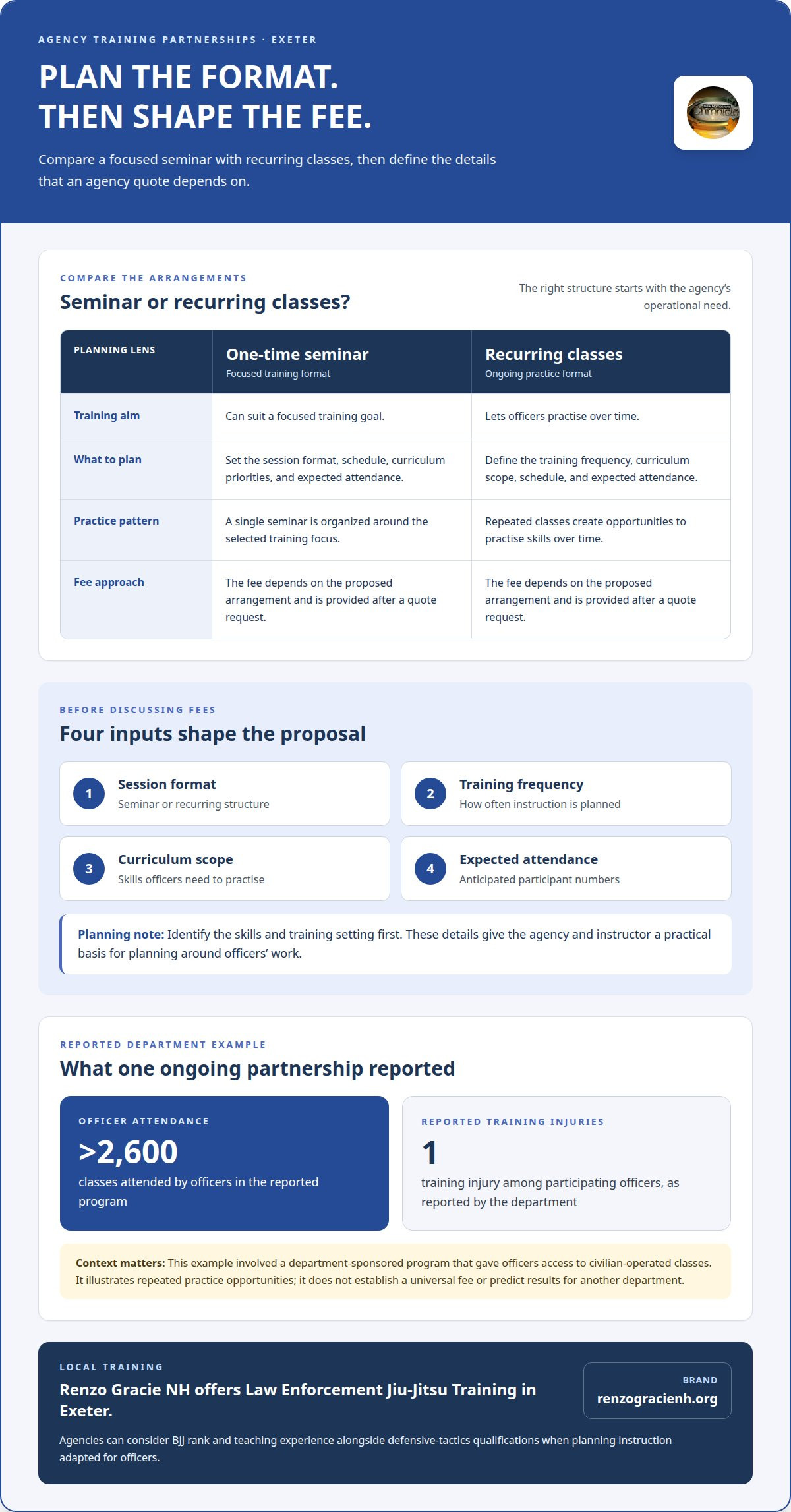
For agencies exploring law-enforcement BJJ training in Exeter, start by defining the operational need. Decide whether officers need a one-time seminar, recurring classes, or a structured partnership. Then outline the session format, schedule, curriculum priorities, and expected attendance. These details give the agency and instructor a practical basis for planning training around officers’ work.

The fee depends on the proposed arrangement and is provided after a quote request. Key factors include the session format, training frequency, curriculum scope, and expected attendance. Preparing these details helps shape a proposal around the agency’s goals rather than an assumed package.

Situation: One reported department-sponsored BJJ program gave officers access to civilian-operated classes. Action: Officers attended more than 2,600 classes. Result: The department reported one training injury among participating officers. This example illustrates how an ongoing partnership can create repeated practice opportunities, but it doesn’t establish a universal fee or predict results for every department.

Do Exeter BJJ gyms offer law-enforcement seminars or defensive-tactics training? Renzo Gracie NH offers Law Enforcement Jiu-Jitsu Training in Exeter. A seminar can suit a focused training goal, while recurring classes let officers practise over time.

What certifications do BJJ instructors in Exeter have? BJJ rank and teaching experience relate to grappling instruction, while defensive-tactics qualifications relate to adapting training for officers. Agencies can consider instructor credentials when planning a suitable partnership.

Before settling on a format, agencies can map out these practical requirements:

  • Identify the skills officers need to practise and the training setting.
  • Choose a seminar or recurring structure that fits agency scheduling.
  • Set curriculum priorities and expected attendance before discussing fees.

That figure describes the reported program, not a standard rate for Exeter agencies, and it should not be treated as a quote for another partnership. Agencies can use it as context when comparing recurring classes with their own training needs, attendance expectations, schedule, and curriculum scope. The fee for a proposed Exeter arrangement depends on the details shared in a quote request.

BJJ curriculum for law enforcement

A law-enforcement curriculum should connect grappling skills to decisions officers may face during street encounters. Sport techniques alone do not address every operational need. Training can adapt positions and control skills to priorities such as weapon retention, moving toward handcuffing, and disengaging from an assailant. Each skill is more useful when officers practise how it connects to the next decision.

For example, a lesson can start with maintaining control at close range, then practise a transition toward handcuffing. Another scenario can focus on creating space and disengaging. These examples help shape training around control and practical transitions, rather than treating every exchange as a competition. Grappling and ground-fighting skills can help officers practise controlling and subduing an attacker without excessive force.

  • Weapon retention: Practise maintaining control of a weapon during close contact.
  • Control: Use grappling positions to manage an encounter and limit unnecessary escalation.
  • Handcuffing transitions: Link control positions to the next stage of restraint.
  • Disengagement: Practise creating an opportunity to separate from an assailant.

These elements distinguish professional training from sport-only practice. A sport class may focus on scoring or winning a match; an officer-focused curriculum adapts techniques to street encounters. Scenario-based practice can connect each position with a clear purpose, such as maintaining control or disengaging. Officers need to recognise when a technique supports the next step, not simply repeat a move.

What BJJ experience or fitness level is required to join classes in Exeter? Prior BJJ experience is not necessary to start learning fundamentals, and skills can be developed progressively. Training can include relevant techniques such as control, weapon retention, and transitions.

To explore a practical starting point, the law-enforcement Jiu-Jitsu training connects BJJ fundamentals with defensive-tactics learning.

A curriculum can treat weapon retention, transitions to handcuffing, and disengagement from an assailant as connected priorities, using techniques adapted to street encounters.
Law Enforcement BJJ Training Exeter: Partnership and Fee Examples

BJJ training for law enforcement officers

For officers in Exeter, BJJ practice can complement other defensive-tactics training by developing grappling and ground-control skills. Effective instruction adapts techniques to street encounters rather than focusing only on sport performance. A practical session can link movement, control, and decision-making, helping officers understand why a technique matters and when it supports the next step.

Training can progress from instructor demonstration to cooperative partner practice, then controlled resistance. Officers can work on maintaining position, recognising openings, and moving deliberately through a scenario. This gradual structure helps instructors adjust difficulty while reinforcing safe training habits. Regular practice also develops muscle conditioning, which can help officers manage fatigue during a conflict.

Situation: An officer wants to improve control during a ground encounter. Action: The session practises stable positioning with a cooperative partner before adding controlled resistance. Result: The officer can rehearse maintaining control and making a deliberate transition. This is a training example, not a promised field outcome. Agencies can use session goals to guide practice and review progress.

How does BJJ training compare with other law-enforcement defensive-tactics programs in Exeter? BJJ emphasises grappling and ground fighting, while broader programs may cover additional tactics. Its role depends on how the agency connects practice to officers’ operational needs.

What safety rules and injury risks should law-enforcement trainees consider in BJJ? Follow the instructor’s directions, practise with control, and stop when a partner signals discomfort or submits. Cooperation, an appropriate pace, and sound technique help manage the physical demands of grappling.

Are there nearby BJJ training options for law enforcement outside Exeter? Officers in Windham and Manchester can train with Renzo Gracie NH. Travel, scheduling, and agency goals can help determine a practical arrangement.

  • Set a clear objective for each session.
  • Practise technique before increasing resistance.
  • Use controlled partner drills to develop consistency.
  • Review learning goals and safety after training.

What are the schedules and locations of BJJ classes in Exeter?

For an Exeter agency, scheduling starts with the training purpose and officers’ availability. Map shift patterns, travel time, and the skills each session should address. Then decide whether recurring classes or a focused seminar best fits the training plan. This helps set a workable schedule around operational responsibilities.

A related resource recommends one hour of Jiu-Jitsu training per week for police officers. An agency can use that as a planning reference, then choose a session time that fits its roster. Regular practice supports continuity, while a seminar can focus on a particular skill. Match the format to the learning goal, not just an open calendar slot.

  • Set the goal: Identify whether officers need ongoing practice or a focused training session.
  • Compare availability: Map shift changes, duty commitments, and travel across Exeter.
  • Choose a location: Consider journey time, access for participating officers, and a suitable training space.
  • Plan the sequence: Arrange sessions so skills build from fundamentals into practical scenarios.

Location affects participation as much as timing. If officers travel from different parts of Exeter, a central meeting point may reduce travel barriers. For agency-organised training, compare travel to a training site with using suitable agency space. Consider the lesson format, partner practice, and available room.

Before setting dates, write down the intended session length, expected attendance, and training objective. Share that outline with the training organiser so the schedule and curriculum can align. Keep a record of attendance and topics covered to support follow-up planning and track progress.

Use these planning steps to shape a schedule around Exeter officers’ needs. Explore class options as you plan the next training step.

Renzo Gracie NH: Adult Jiu Jitsu Program

Renzo Gracie NH offers an Adult Jiu Jitsu Program for adults developing grappling skills through structured training. For agencies seeking officer-focused instruction, its Law Enforcement Jiu-Jitsu Training is the relevant option, connecting practical curriculum with dedicated training.

Officers new to Jiu-Jitsu can start with foundational skills and develop through practice. The Free Introductory Class lets new students experience instruction before choosing a training path. Families can also explore the Kids Jiu Jitsu Program for younger learners.

For an agency, the next step is to discuss its training goals and the skills officers want to develop. Contact Renzo Gracie NH to talk about law-enforcement training or book a free introductory class.

Build a practical next step for your agency

Effective training grows through consistent practice and a clear connection to officers’ work. For an agency considering law enforcement BJJ training in Exeter, turn a broad goal into a focused conversation: which skills matter most, who will train, and what format can support steady learning?

Renzo Gracie NH offers Law Enforcement Jiu-Jitsu Training for officers and an Adult Jiu Jitsu Program for adults developing their skills. Its Kids Jiu Jitsu Program gives families another way to share an interest in Jiu-Jitsu. Each program serves a different purpose, with learning grounded in practice, discipline, and personal progress.

Bring your agency’s training priorities or personal goals into the conversation, then explore a path that feels like a good fit. Contact Renzo Gracie NH to take the next step. Progress starts with showing up, learning, and building from there.

Frequently Asked Questions

Are there BJJ gyms in Exeter that offer training specifically for law enforcement?

Yes. Renzo Gracie NH offers Law Enforcement Jiu-Jitsu Training in Exeter. Agencies can choose this option when officers want instruction tailored to professional defensive tactics. A department planning training for new recruits can first identify its goals, then shape sessions around the skills officers need to practise together.

Which Exeter BJJ schools offer police or first-responder discounts?

Renzo Gracie NH offers law-enforcement-focused training. No specific police or first-responder discount is stated. Training fees depend on the proposed arrangement and are provided after a quote request. Factors include format, frequency, curriculum scope, and expected attendance. Describing these needs gives an agency a practical starting point for discussing fees.

Are Exeter BJJ classes suitable for police defensive tactics and ground control?

BJJ can support defensive-tactics development when instruction connects grappling practice to officers’ work. A controlled partner exercise, for example, can help officers practise maintaining position during a ground encounter and consider how to transition to the next step. BJJ complements broader defensive-tactics preparation; agencies can align class objectives with the skills officers need to develop.

Competitive BJJ Training Exeter: Elite Preparation and Championship Lineage

Grinding through casual open mats will never prepare you for the relentless pace of a real tournament match. You already know the frustration. You push hard to simulate real pressure, but uncontrolled rounds without professional oversight often lead to stalled progress or unnecessary injuries instead of podium finishes. Finding dedicated competitive BJJ training Exeter athletes can trust means seeking out more than just random sparring partners. It means training with clear intention.

Championship performance requires disciplined lineage, tactical rounds, and an ego-free room where teammates sharpen one another safely. In this guide, you’ll discover how direct championship-level lineage, structured competition camps, and focused positional sparring elevate your competitive Brazilian Jiu-Jitsu game in Exeter. We’ll break down the exact training blueprint needed to condition your body, dial in your tournament strategy under seasoned black belt supervision, and bring home gold at regional IBJJF, AJP, and New England submission grappling tournaments.

Key Takeaways

  • Understand why tournament readiness demands deliberate positional rounds, technical precision, and ruleset mastery rather than unstructured rolling.
  • Discover how periodized training camps systematically sharpen your game across standing takedowns, guard passing sequences, and high-pressure defense.
  • Learn the essential criteria for selecting the best competitive BJJ training Exeter has to offer, from verified coaching lineage to a safe, ego-free room.
  • Master physical and mental periodization strategies that help you taper training volume, build explosive stamina, and execute your game plan under pressure.
  • Explore how mastering core fundamentals under seasoned black belt mentorship paves the way to podium finishes across regional competition circuits.

What Defines True Competitive BJJ Training in the Exeter Area?

Stepping onto the mats for tournament preparation is entirely different from sweating through a casual workout. While hobbyist classes focus on fundamental mechanics and stress relief, true tournament readiness requires systematic pressure testing, precise scoring tactics, and absolute rulebook mastery. For grapplers right here in Rockingham County, finding high-caliber Brazilian jiu-jitsu training tailored to podium performance can be challenging. Many local gyms cater almost exclusively to casual fitness, while web searches often confuse our Seacoast community with overseas academies in the UK. True competitive BJJ training Exeter practitioners rely on bridges that gap by combining rigorous athletic standards with disciplined safety.

Hobbyist Rolling vs. Dedicated Competition Preparation

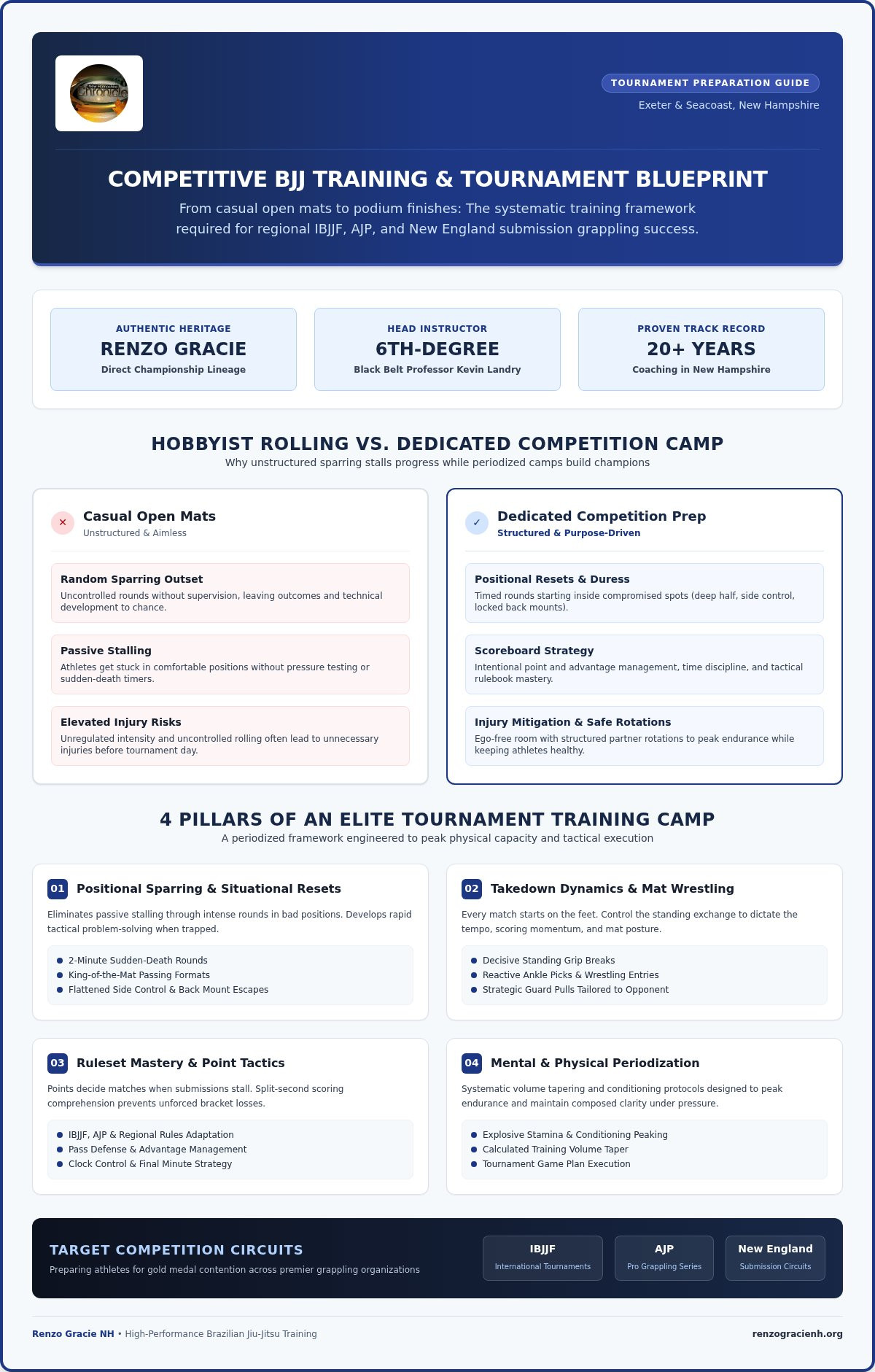
Casual open mats often leave outcomes to chance. Competitors don’t have that luxury. Dedicated tournament preparation swaps aimless rolling for intense, timed rounds that mirror real match conditions.

  • Positional Resets: Sparring starts in high-stress scenarios like deep half guard or back control to sharpen problem-solving under duress.
  • Scoreboard Strategy: Athletes train around points, advantages, and time management rather than just hunting for submissions.
  • Injury Mitigation: Structured partner rotations ensure you build tournament endurance while keeping everyone healthy for competition day.

This systematic intensity builds championship composure. You learn to embrace discomfort while preserving your teammates for the long haul.

Direct Pedigree: The Renzo Gracie Lineage Advantage

Technique evolves rapidly at the elite level. That’s why elite competitive BJJ training Exeter competitors choose traces directly back to authentic grappling royalty. Under the leadership of Professor Kevin Landry, a 6th-degree black belt under Master Renzo Gracie with over 20 years of coaching experience in New Hampshire, athletes tap into an unbroken chain of proven combat systems.

Renzo Gracie battle-tested methods have produced world champions across every major grappling stage. Learning under multi-decade coaching ensures you don’t waste months troubleshooting outdated mechanics. You absorb refined counter-strategies, relentless pressure passing, and sharp submission defense proven against the highest caliber opposition in the sport.

Essential Components of an Elite Tournament Training Camp

Random sparring produces random outcomes. Championship grapplers don’t leave their podium aspirations to chance; they rely on structured, periodized training camps that peak physical stamina and sharpen tactical timing. Quality competitive BJJ training Exeter athletes seek out bridges the gap between raw athleticism and mat IQ. By applying athletic principles backed by the worldwide authority on strength and conditioning, a dedicated camp systematically builds capacity across standing wrestling, dynamic guard passing, and high-stakes submission escapes under physical exhaustion.

Positional Sparring and Situational Reset Drills

Elite camps strip away passive stalling through targeted positional work. Rounds begin directly inside compromised spots like flattened side control or locked back mounts with only two minutes on the clock. Athletes cycle through intense king-of-the-mat formats where the top player must pass or submit to stay in. This forces competitors to react with explosive clarity when facing sudden-death pressure on tournament mats.

Takedown Proficiency and Mat Wrestling Dynamics

Every match begins on the feet. Control the standing exchange, and you control the pace of the entire fight. Competitors practice decisive grip breaks, reactive ankle picks, and safe guard pulls tailored to opponent tendencies. While building dynamic wrestling habits demands dedicated mat time, mastering the basics within a structured Adult Jiu Jitsu Program gives athletes the baseline posture and leverage required to launch aggressive takedown entries safely.

Ruleset Mastery: IBJJF, ADCC, and Local New England Circuits

Points win matches when submissions stall. High-level competitive BJJ training Exeter competitors depend on demands a thorough understanding of scoring criteria across IBJJF, AJP, and local New England submission grappling brackets. A split-second decision can cost you gold if you don’t know the rulebook. Camp sessions drill specific point-management tactics: defending the guard pass for three seconds, hunting advantages in overtime, and eliminating disqualifications from illegal grips or unintended knee reaping.

Dialing in these technical parameters ensures you enter the arena confident and fully prepared. If you’re ready to test your preparation against focused, supportive training partners, exploring the competition room at Renzo Gracie NH is your logical next step.

Evaluating BJJ Academies Near Exeter for Serious Competitors

Finding the right gym shapes your athletic trajectory. While many local facilities offer general fitness or introductory martial arts, serious competitors need an environment that actively cultivates tournament readiness. Geography counts, but convenience should never eclipse quality. Choosing the right academy for competitive BJJ training Exeter athletes depend on requires a careful audit of coaching depth, partner variety, and everyday mat culture. If an academy lacks seasoned upper belts or direct tournament insight, your tactical development will hit a ceiling fast.

Coaching Pedigree and Active Corner Support

Tournament preparation extends well beyond weekday drilling. You need seasoned guidance when stepping out under arena lights. An experienced coach who understands match pacing, ruleset intricacies, and corner strategy provides an immediate tactical advantage during chaotic resets.

With over 20 years of continuous coaching experience in New Hampshire, Professor Kevin Landry brings veteran precision to every competitor’s game plan. That caliber of mentorship allows instructors to diagnose subtle mechanical flaws before they cost you points on the scoreboard. Unaccredited martial arts gyms simply can’t match the strategic insight that stems from decades of developing champions under genuine master lineage.

Mat Culture: High Intensity Balanced with Team Safety

A championship room demands relentless work, but reckless training destroys longevity. Dangerous gym egos lead to unnecessary injuries that sideline competitors weeks before tournament day. Elite competitors understand the vital difference between high-paced, technical rounds and out-of-control aggression.

Partner trust is everything. In a premier facility, teammates push your conditioning to the threshold while actively safeguarding each other’s physical well-being. This balance between fierce commitment and mutual respect sits at the heart of the Renzo Gracie teaching philosophy. It builds a supportive room where athletes solve high-pressure problems with confidence, sharpen their competitive edge, and stay healthy enough to claim the podium.

Competitive BJJ Training Exeter: Elite Preparation and Championship Lineage

Mental and Physical Periodization: Preparing for Tournament Day

Matches are won long before you step onto the center mat. While physical technique builds your foundation, disciplined periodization ensures your central nervous system, gas tank, and mental focus peak at the exact right moment. Many grapplers make the mistake of redlining their bodies right up until weigh-ins, only to hit the competition mats feeling drained, tight, and mentally fried. Serious competitive BJJ training Exeter competitors rely on balances raw physical output with tactical tapering and stress management, giving you the stamina needed to execute your game plan under extreme pressure.

Managing the 6-Week Competition Taper

Peak performance demands a gradual reduction in rolling volume paired with a sharp increase in intensity. A proven taper cycle prevents systemic fatigue and keeps athletes healthy:

  • Weeks 6 to 4: High-volume drilling, long sparring rounds, and relentless situational resets to build aerobic capacity.
  • Weeks 3 to 2: Short, explosive competition rounds mirroring official match lengths, zeroing in on primary submissions and grip battles.
  • Tournament Week: Controlled drilling, technical flow rolls, and strict hydration monitoring to make weight safely without draining muscle glycogen.

Give your body 48 to 72 hours of complete rest from hard rolling before tournament check-in. This brief window allows micro-tears in muscle tissue to heal fully, ensuring you arrive on the scale feeling energized, sharp, and physically explosive.

Overcoming Adrenaline Dumps and Competition Anxiety

The dreaded adrenaline dump is the ultimate equalizer on tournament mats. Heart racing, tunnel vision setting in, and forearms locking up within sixty seconds can derail months of hard training. Premier competitive BJJ training Exeter grapplers depend on solves this through simulated competition rounds in the gym. Referees, scoreboards, and cheering teammates recreate arena chaos, teaching your brain to treat intense competitive stress as familiar territory.

Athletes practice rhythmic nasal breathing between exchanges to regulate heart rates and maintain tactical clarity. If you want to build this mental resilience and test your readiness within an empowering environment, schedule your free introductory session to experience structured martial arts training firsthand.

Take the step toward reaching your full athletic potential today. Join the competition team at Renzo Gracie NH and prepare to dominate your next tournament bracket with confidence.

Starting Your Competitive BJJ Journey at Renzo Gracie NH

Stepping onto the mats to prepare for serious competition can feel daunting without the right guide. Renzo Gracie NH welcomes motivated athletes across Exeter, Windham, and Manchester who are ready to test their limits. While generic gyms throw new arrivals directly into chaotic rounds, our academy provides a clear progression track. Driven practitioners seeking elite competitive BJJ training Exeter offers find an environment where world-class fundamentals lay the groundwork for tournament success.

The Athlete Onboarding and Skill Assessment Process

Every competitive journey begins with an honest evaluation of where you stand. Our seasoned instructors take the time to assess your current conditioning, movement mechanics, and specific tournament goals before you dive into advanced training blocks. You won’t be tossed into deep water without the necessary tools.

Fundamentals come first. New competitors spend focused time developing defensive posture, hip mobility, and positional awareness within structured drills. This methodical foundation prevents injuries and builds the structural durability required for high-intensity camp sparring. Younger athletes can build that same technical foundation early through our dedicated kids jiu jitsu programs, instilling discipline, agility, and sportsmanship from an early age.

Joining the Renzo Gracie NH Competition Community

Behind every gold medalist stands an unshakeable team. When you enter our competition community, you gain training partners who hold you accountable while celebrating your growth. Teammates challenge your limits during tough rounds and cheer you on from the sidelines when tournament day arrives.

Mat leadership makes all the difference. Our black belt coaching staff provides active, matside corner guidance at local New England grappling circuits and major national championships. Having seasoned mentors calling out adjustments in real time turns tense scrambles into decisive victories. If you’re ready to experience premier competitive BJJ training Exeter grapplers use to reach the podium, take the first step by booking a complimentary introductory class at Renzo Gracie NH today.

Step Onto the Podium With Proven Mentorship

Standing on the competition podium isn’t a matter of luck. It’s the direct result of structured positional drilling, intelligent camp periodization, and an ego-free room where athletes push each other safely. Securing meaningful competitive BJJ training Exeter grapplers trust means choosing an environment where tactical strategy and team culture build you up rather than wear you down.

At Renzo Gracie NH, your growth is backed by direct affiliation with the world-renowned Renzo Gracie Association. Guided by Professor Kevin Landry, a 6th-degree black belt with over 20 years of continuous coaching experience in southern New Hampshire, you gain access to decades of battle-tested championship instruction. Whether your sights are set on local New England submission grappling brackets or international IBJJF gold, you don’t have to walk that path alone. Claim your free introductory class at Renzo Gracie NH today, step onto the mats with purpose, and discover what disciplined teamwork can do for your game.

Frequently Asked Questions

How does competitive BJJ training differ from regular Brazilian Jiu-Jitsu classes?

Competitive training focuses on timed rounds, ruleset point scoring, and situational sparring rather than general mechanics and conditioning. Regular classes emphasize fundamental techniques, self-defense, and steady skill development. Competition sessions introduce high-pressure positional resets under fatigue, strategy against common tournament guards, and clock management. This deliberate approach bridges the gap between casual practice and confident podium performance.

Do I need prior martial arts experience to join competition training near Exeter?

No prior martial arts experience is required to begin your journey toward competition. Every competitor starts with core mechanics in the Adult Jiu Jitsu Program. You build defensive posture, basic escapes, and positional control before advancing into high-intensity sparring blocks. This structured ramp-up ensures you develop reliable technique and mat durability without burning out or risking injury.

What local and national tournament circuits do New Hampshire grapplers contest?

New Hampshire grapplers regularly compete in regional circuits like United Grappling alongside major international promotions such as the IBJJF and AJP. Regional events throughout New England offer competitive divisions across all age and belt categories. Dedicated competitive BJJ training Exeter athletes undergo prepares them for both points-based brackets and submission-focused formats, ensuring seamless adaptation to any tournament stage.

How does Professor Kevin Landry structure tournament preparation at Renzo Gracie NH?

Professor Kevin Landry structures camps using periodized training cycles that balance intense situational sparring with tactical refinement. With over two decades of coaching in New Hampshire and a 6th-degree black belt under Renzo Gracie, he designs targeted training blocks. Sessions drill guard passing sequences, dynamic wrestling entries, and points strategy under simulated tournament conditions, followed by tailored recovery phases before competition day.

How many days per week should I train if I plan to compete in BJJ tournaments?

Most active competitors see optimal results training between three to five days per week during a dedicated camp. Consistency matters far more than extreme volume. A balanced weekly routine combines two technical instructional sessions, two high-intensity competition sparring classes, and active recovery. This schedule develops muscular endurance, sharpens tactical timing, and protects your body from overtraining before you step on the scale.

Is competitive BJJ training safe for working adults and older grapplers?

Yes, competitive training is safe for working professionals and Masters-division grapplers when guided by structured coaching. Elite competitive BJJ training Exeter academies run eliminates dangerous gym egos. Positional drills and matched training partners ensure you push cardio thresholds without reckless collisions. Teammates respect the tap immediately, allowing career-focused adults to pursue gold medals and show up healthy for work on Monday.

How do I start training for tournaments with Renzo Gracie NH?

Starting your training begins by booking a free introductory class to discuss your athletic goals with our coaching team. Instructors assess your baseline movement and walk you through foundational principles in a welcoming setting. From there, you’ll join structured classes, build mat awareness, and seamlessly integrate into competition training as your skills and confidence grow across our Exeter, Windham, and Manchester community.