Law Enforcement BJJ Training Exeter: Partnership and Fee Examples
A strong agency partnership starts with the training need, not a one-size-fits-all package. For law enforcement BJJ training in Exeter, the format and fee depend on how instruction is organised, including session structure and curriculum. Public agency examples can illustrate possible arrangements, but they are not a quote for local training.
It is reasonable to want clear details before deciding whether BJJ fits an agency’s defensive-tactics training. The curriculum should reflect officers’ work, with practical skills that support control and safer decision-making rather than simply copying sport competition.
This article explains how agencies can approach training partnerships and fees, what a law-enforcement curriculum may cover, and how officers can train. It also shows where BJJ fits into professional defensive-tactics development, so you can assess the format against your agency’s needs.
Key Takeaways
- Compare agency training arrangements by looking at how sessions are structured and what the curriculum needs to address.
- Explore how practical instruction can cover control, weapon retention, transitions to handcuffing, and disengagement.
- Consider how officers can build training into their routines and connect practice to real-world defensive tactics.
- Use the Exeter class schedule and location details to plan a suitable next step for individual or agency training.
Agency training partnerships and fees
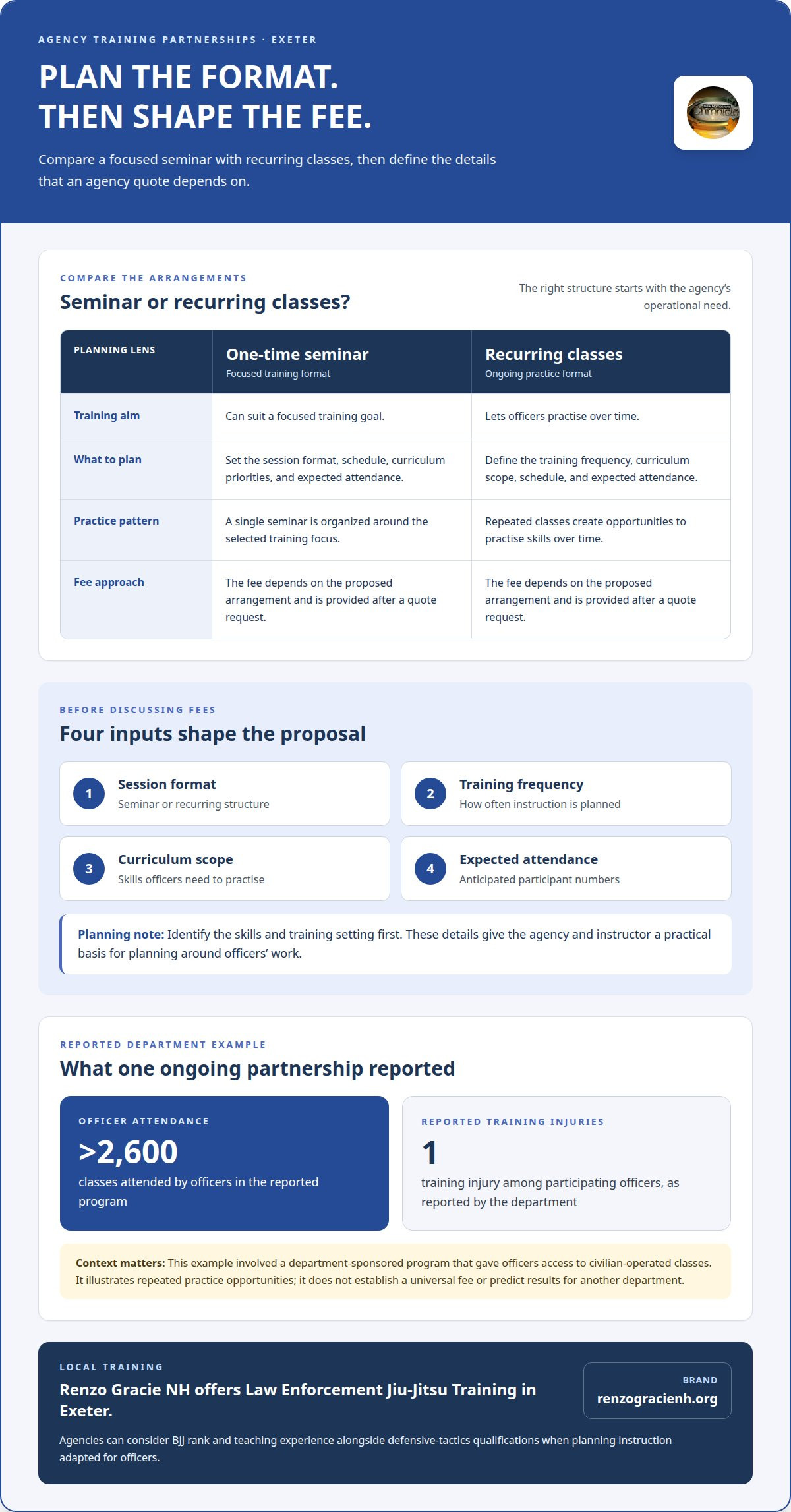
For agencies exploring law-enforcement BJJ training in Exeter, start by defining the operational need. Decide whether officers need a one-time seminar, recurring classes, or a structured partnership. Then outline the session format, schedule, curriculum priorities, and expected attendance. These details give the agency and instructor a practical basis for planning training around officers’ work.
The fee depends on the proposed arrangement and is provided after a quote request. Key factors include the session format, training frequency, curriculum scope, and expected attendance. Preparing these details helps shape a proposal around the agency’s goals rather than an assumed package.
Situation: One reported department-sponsored BJJ program gave officers access to civilian-operated classes. Action: Officers attended more than 2,600 classes. Result: The department reported one training injury among participating officers. This example illustrates how an ongoing partnership can create repeated practice opportunities, but it doesn’t establish a universal fee or predict results for every department.
Do Exeter BJJ gyms offer law-enforcement seminars or defensive-tactics training? Renzo Gracie NH offers Law Enforcement Jiu-Jitsu Training in Exeter. A seminar can suit a focused training goal, while recurring classes let officers practise over time.
What certifications do BJJ instructors in Exeter have? BJJ rank and teaching experience relate to grappling instruction, while defensive-tactics qualifications relate to adapting training for officers. Agencies can consider instructor credentials when planning a suitable partnership.
Before settling on a format, agencies can map out these practical requirements:
- Identify the skills officers need to practise and the training setting.
- Choose a seminar or recurring structure that fits agency scheduling.
- Set curriculum priorities and expected attendance before discussing fees.
That figure describes the reported program, not a standard rate for Exeter agencies, and it should not be treated as a quote for another partnership. Agencies can use it as context when comparing recurring classes with their own training needs, attendance expectations, schedule, and curriculum scope. The fee for a proposed Exeter arrangement depends on the details shared in a quote request.
BJJ curriculum for law enforcement
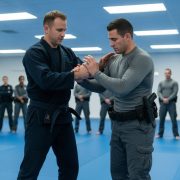
A law-enforcement curriculum should connect grappling skills to decisions officers may face during street encounters. Sport techniques alone do not address every operational need. Training can adapt positions and control skills to priorities such as weapon retention, moving toward handcuffing, and disengaging from an assailant. Each skill is more useful when officers practise how it connects to the next decision.
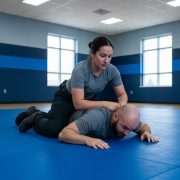
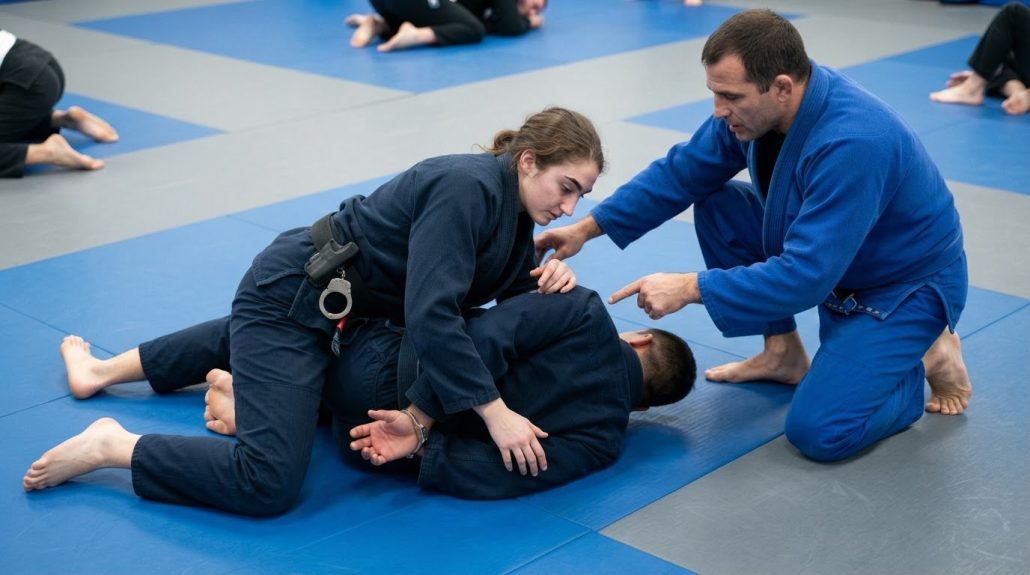
For example, a lesson can start with maintaining control at close range, then practise a transition toward handcuffing. Another scenario can focus on creating space and disengaging. These examples help shape training around control and practical transitions, rather than treating every exchange as a competition. Grappling and ground-fighting skills can help officers practise controlling and subduing an attacker without excessive force.
- Weapon retention: Practise maintaining control of a weapon during close contact.
- Control: Use grappling positions to manage an encounter and limit unnecessary escalation.
- Handcuffing transitions: Link control positions to the next stage of restraint.
- Disengagement: Practise creating an opportunity to separate from an assailant.
These elements distinguish professional training from sport-only practice. A sport class may focus on scoring or winning a match; an officer-focused curriculum adapts techniques to street encounters. Scenario-based practice can connect each position with a clear purpose, such as maintaining control or disengaging. Officers need to recognise when a technique supports the next step, not simply repeat a move.
What BJJ experience or fitness level is required to join classes in Exeter? Prior BJJ experience is not necessary to start learning fundamentals, and skills can be developed progressively. Training can include relevant techniques such as control, weapon retention, and transitions.
To explore a practical starting point, the law-enforcement Jiu-Jitsu training connects BJJ fundamentals with defensive-tactics learning.
A curriculum can treat weapon retention, transitions to handcuffing, and disengagement from an assailant as connected priorities, using techniques adapted to street encounters.
BJJ training for law enforcement officers
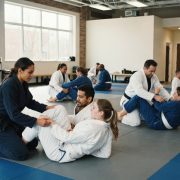
For officers in Exeter, BJJ practice can complement other defensive-tactics training by developing grappling and ground-control skills. Effective instruction adapts techniques to street encounters rather than focusing only on sport performance. A practical session can link movement, control, and decision-making, helping officers understand why a technique matters and when it supports the next step.
Training can progress from instructor demonstration to cooperative partner practice, then controlled resistance. Officers can work on maintaining position, recognising openings, and moving deliberately through a scenario. This gradual structure helps instructors adjust difficulty while reinforcing safe training habits. Regular practice also develops muscle conditioning, which can help officers manage fatigue during a conflict.
Situation: An officer wants to improve control during a ground encounter. Action: The session practises stable positioning with a cooperative partner before adding controlled resistance. Result: The officer can rehearse maintaining control and making a deliberate transition. This is a training example, not a promised field outcome. Agencies can use session goals to guide practice and review progress.
How does BJJ training compare with other law-enforcement defensive-tactics programs in Exeter? BJJ emphasises grappling and ground fighting, while broader programs may cover additional tactics. Its role depends on how the agency connects practice to officers’ operational needs.
What safety rules and injury risks should law-enforcement trainees consider in BJJ? Follow the instructor’s directions, practise with control, and stop when a partner signals discomfort or submits. Cooperation, an appropriate pace, and sound technique help manage the physical demands of grappling.
Are there nearby BJJ training options for law enforcement outside Exeter? Officers in Windham and Manchester can train with Renzo Gracie NH. Travel, scheduling, and agency goals can help determine a practical arrangement.
- Set a clear objective for each session.
- Practise technique before increasing resistance.
- Use controlled partner drills to develop consistency.
- Review learning goals and safety after training.
What are the schedules and locations of BJJ classes in Exeter?
For an Exeter agency, scheduling starts with the training purpose and officers’ availability. Map shift patterns, travel time, and the skills each session should address. Then decide whether recurring classes or a focused seminar best fits the training plan. This helps set a workable schedule around operational responsibilities.
A related resource recommends one hour of Jiu-Jitsu training per week for police officers. An agency can use that as a planning reference, then choose a session time that fits its roster. Regular practice supports continuity, while a seminar can focus on a particular skill. Match the format to the learning goal, not just an open calendar slot.
- Set the goal: Identify whether officers need ongoing practice or a focused training session.
- Compare availability: Map shift changes, duty commitments, and travel across Exeter.
- Choose a location: Consider journey time, access for participating officers, and a suitable training space.
- Plan the sequence: Arrange sessions so skills build from fundamentals into practical scenarios.
Location affects participation as much as timing. If officers travel from different parts of Exeter, a central meeting point may reduce travel barriers. For agency-organised training, compare travel to a training site with using suitable agency space. Consider the lesson format, partner practice, and available room.
Before setting dates, write down the intended session length, expected attendance, and training objective. Share that outline with the training organiser so the schedule and curriculum can align. Keep a record of attendance and topics covered to support follow-up planning and track progress.
Use these planning steps to shape a schedule around Exeter officers’ needs. Explore class options as you plan the next training step.
Renzo Gracie NH: Adult Jiu Jitsu Program
Renzo Gracie NH offers an Adult Jiu Jitsu Program for adults developing grappling skills through structured training. For agencies seeking officer-focused instruction, its Law Enforcement Jiu-Jitsu Training is the relevant option, connecting practical curriculum with dedicated training.
Officers new to Jiu-Jitsu can start with foundational skills and develop through practice. The Free Introductory Class lets new students experience instruction before choosing a training path. Families can also explore the Kids Jiu Jitsu Program for younger learners.
For an agency, the next step is to discuss its training goals and the skills officers want to develop. Contact Renzo Gracie NH to talk about law-enforcement training or book a free introductory class.
Build a practical next step for your agency
Effective training grows through consistent practice and a clear connection to officers’ work. For an agency considering law enforcement BJJ training in Exeter, turn a broad goal into a focused conversation: which skills matter most, who will train, and what format can support steady learning?
Renzo Gracie NH offers Law Enforcement Jiu-Jitsu Training for officers and an Adult Jiu Jitsu Program for adults developing their skills. Its Kids Jiu Jitsu Program gives families another way to share an interest in Jiu-Jitsu. Each program serves a different purpose, with learning grounded in practice, discipline, and personal progress.
Bring your agency’s training priorities or personal goals into the conversation, then explore a path that feels like a good fit. Contact Renzo Gracie NH to take the next step. Progress starts with showing up, learning, and building from there.
Frequently Asked Questions
Are there BJJ gyms in Exeter that offer training specifically for law enforcement?
Yes. Renzo Gracie NH offers Law Enforcement Jiu-Jitsu Training in Exeter. Agencies can choose this option when officers want instruction tailored to professional defensive tactics. A department planning training for new recruits can first identify its goals, then shape sessions around the skills officers need to practise together.
Which Exeter BJJ schools offer police or first-responder discounts?
Renzo Gracie NH offers law-enforcement-focused training. No specific police or first-responder discount is stated. Training fees depend on the proposed arrangement and are provided after a quote request. Factors include format, frequency, curriculum scope, and expected attendance. Describing these needs gives an agency a practical starting point for discussing fees.
Are Exeter BJJ classes suitable for police defensive tactics and ground control?
BJJ can support defensive-tactics development when instruction connects grappling practice to officers’ work. A controlled partner exercise, for example, can help officers practise maintaining position during a ground encounter and consider how to transition to the next step. BJJ complements broader defensive-tactics preparation; agencies can align class objectives with the skills officers need to develop.