Posts

Social Skills for Shy Kids in Windham: Parent’s Guide

What if helping a shy child connect starts with less pressure, not more? If your child hangs back from group activities, it’s natural to want to help while also wondering whether encouragement might feel overwhelming. Building social skills for shy kids Windham parents can support often begins with small, familiar chances to listen, take turns, and join in at a comfortable pace.

This guide offers practical ways to make everyday communication more manageable and help your child explore peer activities without expecting them to become outgoing overnight. You’ll learn how to notice their comfort level, encourage low-pressure practice, and consider whether a structured activity could be a good fit. Brazilian Jiu-Jitsu brings children together around shared practice, with opportunities to listen, take turns, and interact as they learn. At Renzo Gracie NH in Windham, children can explore Jiu-Jitsu in a supportive setting. Small steps count.

Key Takeaways

  • Quietness is a temperament, not a flaw to fix. Social skills can be practiced without asking a child to become more outgoing.
  • For building social skills for shy kids Windham parents can start with one manageable interaction and adjust to the child’s comfort.
  • Compare informal play, small-group activities, and structured classes to find the right balance of predictability and peer interaction for your child.
  • Use a simple plan: notice what feels comfortable, choose one skill to practice, then reflect and adjust without setting a deadline for change.
  • Shared tasks in children’s Brazilian Jiu-Jitsu offer opportunities to listen, take turns, and interact with peers. Each child’s experience is individual.

What Does Building Social Skills Mean for a Shy Child in Windham?

Social skills are learnable behaviors that help children communicate, connect, and take part with other people. They include listening, taking turns, joining play, expressing needs, and noticing how others respond. These abilities develop through everyday experience, not by changing a child’s personality. The Social skills overview describes the broad range of behaviors involved in interacting with others. For parents, a practical starting point is to identify specific actions a child can try.

A quiet temperament isn’t a problem to solve. A child may prefer observing before joining in, enjoy one-on-one conversation more than a busy group, or need time to warm up to unfamiliar people. The aim of building social skills for shy kids Windham parents support is not to make a child louder or constantly sociable. It’s to help them communicate and participate in ways that feel manageable and true to who they are.

Comfort can change with the setting, the people present, how familiar an activity feels, and the size of the group. A child who speaks freely with cousins might be quiet at a new club, then become more engaged after watching for a while. Notice these differences without treating any one moment as a measure of ability. They can help you identify where your child feels comfortable enough to practice.

How can parents tell when a child feels socially hesitant?

Look for observable moments: your child waits near a game before joining, answers quietly in a new group, or checks your face before speaking to someone unfamiliar. These can be ordinary signs of caution. Notice whether your child settles after observing or remains distressed, and whether the same difficulty appears in familiar and unfamiliar settings. Rather than labeling the behavior, identify situations where connection already comes more easily, such as chatting with one trusted friend or playing alongside a sibling.

Which social skills can children practise in everyday moments?

Everyday interactions offer small, low-pressure practice. Before a playdate, you might rehearse a greeting or the words, “Can I join?” At dinner, model listening and responding by asking a question about someone’s day. Keep the focus on one skill at a time, then give your child room to try it without demanding a perfect performance.

Children can also practice saying, “I need help,” or “I don’t want to do that,” so they can ask for support and set boundaries. A short pause in conversation is normal; you can show that nobody has to rush to fill every silence. For parents in Windham, Manchester, and Exeter, building social skills for shy kids can start with these ordinary exchanges at home, then grow through familiar activities at the child’s pace.

How Low-Pressure Practice Helps Shy Kids Build Social Confidence

Social confidence can grow through small experiences that feel manageable, not through pressure to perform. A child might first watch a game, then stand nearby, and later ask to take a turn. That gradual path gives them room to understand what’s happening and choose how to participate. Building social skills for shy kids Windham families can support means valuing each step, even when it looks modest from the outside.

Repeated, low-pressure practice gives children chances to rehearse social behaviors and become more familiar with using them. Familiarity doesn’t mean every interaction will feel easy, and it doesn’t require a child to become more outgoing. Progress might simply mean trying a greeting or staying with an activity a little longer.

Your role is to prepare and encourage, not to speak for your child or decide that they must join. Model a phrase, explain what to expect, then leave space for them to respond in their own way. The New York State Department of Health’s Understanding Social-Emotional Development in Children discusses how interactions with caregivers contribute to children’s social-emotional development. Everyday exchanges can offer a calm place to practice.

How can parents make a first interaction feel manageable?

Choose an activity your child already knows, then agree on one small, clear goal. At a familiar playground, that might mean watching a game and asking, “Can I have a turn next?” Before visiting, practice the words casually, without turning them into a test. Once there, let your child observe first if that helps them settle. They can decide when to try the phrase or choose another small step.

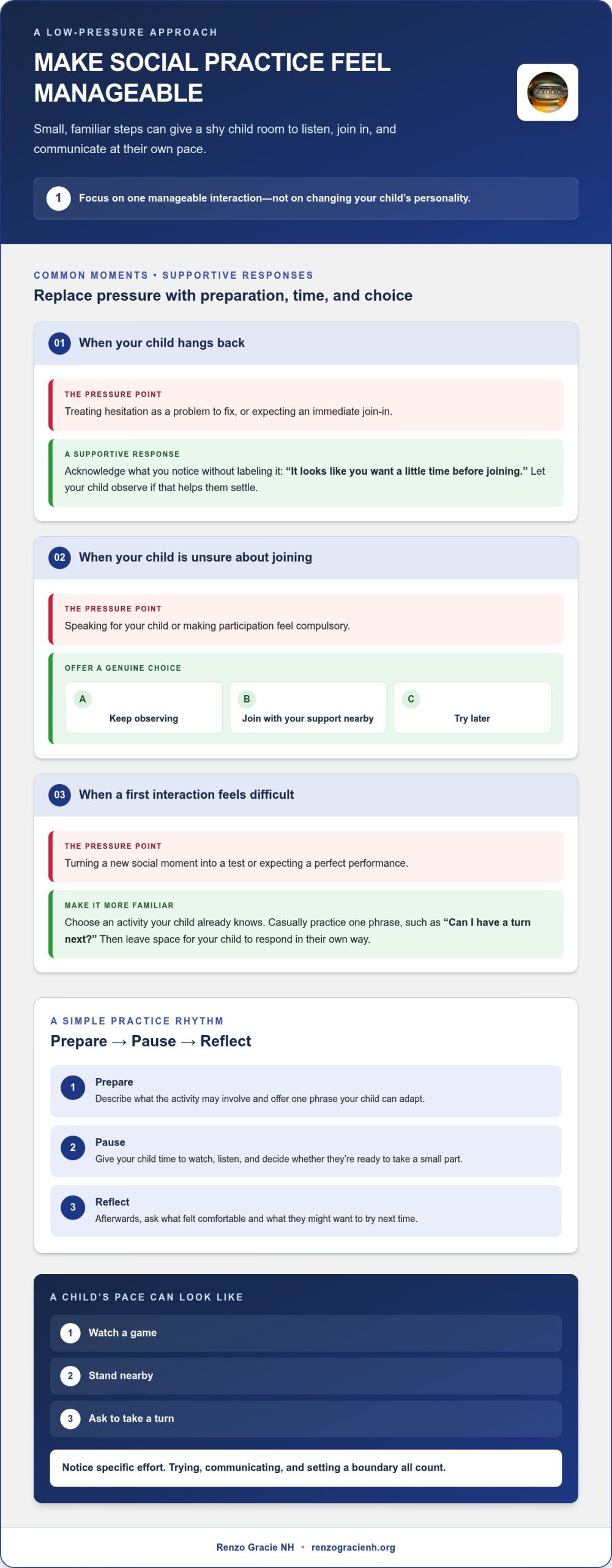
A simple progression can keep practice supportive:

  • Prepare: Describe what the activity may involve and offer one phrase your child can adapt.
  • Pause: Give them time to watch, listen, and decide whether they’re ready to take a small part.
  • Reflect: Afterwards, ask what felt comfortable and what they might want to try next time.

How should adults respond when a child hangs back?

Start by acknowledging what you notice without attaching a label: “It looks like you want a little time before joining.” Then offer a genuine choice: keep observing, join with your support nearby, or try later. This respects the child’s feelings while keeping participation possible. Avoid speaking on their behalf unless they need help, and don’t make praise depend on being bold or chatty.

Notice specific effort instead: “You waited, then asked for a turn,” or “You told me you needed help.” These observations show that trying, communicating, and setting a boundary all count. A structured children’s Brazilian Jiu-Jitsu class is one shared activity to explore at the child’s pace. At Renzo Gracie NH, children learn alongside others in a supportive setting. Let your child’s experience guide the next step.

Which Activities Give Shy Children Helpful Ways to Practise Social Skills?

Different activities offer different kinds of social practice. Informal play can feel flexible and familiar; a small-group activity may give children a shared focus; a structured class can make the sequence of activities easier to anticipate. None is automatically the best choice. For building social skills for shy kids, families in Windham, Manchester, and Exeter can consider their child’s interests, comfort, and response to each setting, then start with an approachable option.

What can informal play and small groups offer?

Familiar play gives children chances to interact without making conversation the main event. Building a game together, sharing materials, or taking turns on the swings can prompt a child to initiate, respond, and negotiate naturally. A smaller or familiar group may feel more manageable for some children, while others enjoy the energy of a larger activity. Watch your child’s cues rather than assuming one group size suits everyone.

Setting Social practice Possible considerations
Informal play with a familiar peer Greeting, sharing, taking turns, and suggesting what to play Flexible and familiar, though the interaction may change direction quickly
Small-group activity Listening, waiting, contributing an idea, and cooperating around a shared task A shared focus can ease conversation, but comfort depends on the group and activity
Structured class Following instructions, taking turns, and interacting during organized practice A clear routine may help some children; a new setting or activity can take time to get used to

How can a structured class support social practice?

A class with planned instruction and shared activities may give children a clear reason to listen and take part. The activity itself provides a focus, so interaction doesn’t have to rely on spontaneous conversation. A child can observe first, follow along, and engage at a comfortable pace as they become familiar with the setting.

Brazilian Jiu-Jitsu is one option, not a guaranteed route to social confidence or a substitute for every child’s preferred activity. It includes partner practice, which creates opportunities to take turns, pay attention to another person, and work through a shared task. Renzo Gracie NH offers kids’ Jiu-Jitsu instruction in New Hampshire in a supportive environment. New students can try a complimentary introductory class, giving families a chance to experience the setting together.

After any activity, notice more than whether your child spoke a lot. Did they seem curious, settle in after watching, or want to return? Their comfort and interest can help guide the next choice. The best fit is a setting where they can participate without feeling pushed, whether that’s a familiar playdate, a small group, or structured practice.
Social Skills for Shy Kids in Windham: Parent's Guide

Step-by-Step Social Skills Plan for Your Child’s Pace

A simple plan keeps practice focused on what your child is ready to try, rather than on a deadline or a checklist of social milestones. Families in Windham, Manchester, and Exeter can use ordinary moments at home, on the playground, or during a familiar family gathering. Start with observation, agree on one small action, and let your child’s response shape what comes next. Keep the aim clear: offer practice, not pressure.

  • 1. Notice comfort. Pay attention to where your child seems at ease, who they naturally engage with, and what happens just before they hang back. This helps you choose a setting that feels familiar enough for practice.
  • 2. Choose one skill. Ask your child what feels manageable. It might be greeting a peer, taking a turn, asking one question, or telling someone they need help. One goal is plenty.
  • 3. Practice together. Try the words at home through a short role-play, or model the interaction yourself. Keep it casual and give your child room to adapt the phrase to their own voice.
  • 4. Reflect without grading. After the moment, ask what felt comfortable, tricky, or enjoyable. Listen without turning the answer into a review of whether they “did it right.”
  • 5. Adjust the next chance. Repeat the same small step in a familiar setting, make it easier, or pause and try another time. Let your child’s feedback and observed comfort guide the pace.

How do you choose a realistic first social goal?

Make the goal small enough that your child can picture doing it. Ask, “What would feel okay to try?” If they aren’t sure, offer a few options, such as saying hello, asking to take a turn, or asking one question about a game. Agree that observing first is also allowed. The goal can change if the setting feels different than expected.

How can parents review progress without adding pressure?

Choose a calm moment afterward and ask open questions: “What part felt easiest?” or “Was there anything you’d like to do differently next time?” Recognize an attempt, a request for help, or a clear boundary, even if a conversation didn’t follow. If your child says the interaction felt too hard, treat that as useful feedback and make the next opportunity more manageable.

Progress is a child’s willingness to try a manageable step, not how popular, talkative, or instantly comfortable they seem. That’s a helpful measure for building social skills for shy kids in Windham without comparing one child’s pace to another’s.

A shared activity may be a useful next step if your child is interested in learning through movement and practice with others. Renzo Gracie NH’s complimentary introductory class lets families experience children’s Brazilian Jiu-Jitsu instruction together.

How Renzo Gracie NH Can Give Shy Kids a Supportive Place to Practise

A structured activity can be a useful next step when a child enjoys learning through movement or shared tasks. At Renzo Gracie NH, children’s Brazilian Jiu-Jitsu instruction takes place in a community-oriented setting. Partner practice gives students a shared activity and opportunities to listen, take turns, and work alongside someone else. Each child’s experience is individual; participation doesn’t guarantee friendships or a particular social outcome.

For families thinking about building social skills for shy kids in Windham, fit matters more than whether a child appears outgoing on the first day. Consider whether your child shows interest in the activity, feels respected in the environment, and can approach participation at a comfortable pace. Technical development, fitness, and personal growth are part of the instruction’s aims. Respect and supportive participation help shape the experience.

What can families expect from a children’s Jiu-Jitsu setting?

Brazilian Jiu-Jitsu is a martial art, so children learn physical techniques as well as practice alongside others. Shared instruction and partner work give a child a task to focus on, rather than requiring them to start a conversation without a reason. This may suit a child who prefers doing an activity together before talking more freely. A parent and child Jiu-Jitsu guide for Windham also explores how training can create shared family time.

How can a family take a comfortable first step?

Before trying an activity, talk with your child about what interests them and what feels uncertain. They may wonder what the class will be like, whether they’ll know anyone, or what happens if they feel nervous. Listen without dismissing the concern. You can explain that trying something new doesn’t require immediate confidence, and that asking for help or taking time to get comfortable is okay.

During an introduction, stay attentive to your child’s cues. If they’re hesitant, help them put a concern into words so they can get support from the instructor. Observing before joining may also feel like a manageable first step, depending on the child and the setting. Afterwards, ask what they noticed: Did the activity interest them? Did they feel comfortable enough to try part of it? Their answers can help you decide whether to continue, pause, or revisit the idea later.

A complimentary introductory class gives new students a chance to experience children’s Jiu-Jitsu instruction without making the first visit a test of confidence. Keep the focus on what your child notices and how they feel about the activity.

Keep the Next Step Small and Child-Led

Social confidence doesn’t need to look like being the first to speak or joining every group. A child’s next step might be choosing one activity, knowing they can take time to settle in, or sharing afterward what they liked. Let their interests help guide the choice. For building social skills for shy kids, Windham families can keep progress personal: focus on what feels possible for this child, not how their participation compares with someone else’s.

That approach leaves room for curiosity to grow. If your child shows interest in Brazilian Jiu-Jitsu, explore the activity together and let them decide what they’re comfortable trying. Professor Kevin Landry has taught in the region for over two decades and teaches children at Renzo Gracie NH.

A first visit can be a chance to explore, not a test your child has to pass. Let your child’s experience shape what comes next.

Frequently Asked Questions

Is shyness the same as social anxiety in children?

No. Shyness can describe a child’s cautious or reserved response in some social situations, while social anxiety involves more intense, ongoing fear or distress that can interfere with daily life. A child’s quietness alone doesn’t establish a diagnosis. If social situations consistently cause significant distress or keep your child from activities they want to do, discuss what you’re noticing with a pediatrician or qualified mental health professional.

Can shy kids make friends without becoming more outgoing?

Yes. Friendship doesn’t require a big personality or a wide circle of peers. A child may feel happiest connecting with one classmate through a shared interest, such as drawing, building, or playing a favorite game. You can support that connection by making space for unhurried time together and letting your child choose how much they want to talk. Quiet companionship can be meaningful, too.

How can I help my child join a group without forcing them?

Plan the arrival together rather than pushing for immediate participation. Before a gathering, agree on a comfortable first step, such as staying near you while they get used to the room. You might also choose a signal your child can use if they need a pause. Avoid announcing that they’re shy to the group; let them decide what they want to share about themselves.

What social skills should shy children practise first?

Start with a skill that would help in a situation your child wants to handle. That could be asking an adult for help finding a game, saying “No thanks” when they don’t want to join, or responding when another child speaks to them. For building social skills for shy kids, Windham parents can choose one useful phrase to practice at home, then let the child adapt it in their own words.

Can Brazilian Jiu-Jitsu help a shy child practise interacting with peers?

It can offer opportunities to practice interaction through a shared physical activity, including listening to instruction and working with a partner. Whether it feels like a good fit depends on the child’s interest and comfort with the setting and activity. Brazilian Jiu-Jitsu isn’t a guaranteed way to make friends or change a child’s temperament. Families in Windham, Manchester, and Exeter can consider how their child responds to the experience.

How long does it take for a shy child to feel more comfortable socially?

There’s no set timeline. Comfort may vary with the people, activity, and setting, and a child may feel at ease one day but hesitant the next. Instead of tracking a deadline, notice whether they’re beginning to approach an activity, communicate what they need, or recover more comfortably after an uncertain moment. If concern persists or grows, consider discussing it with a qualified professional.

Should I tell an instructor that my child is shy before a first class?

Yes, if you think the context will help the instructor welcome your child thoughtfully. Share specific observations rather than a label: for example, your child may need time to watch before joining or feel more comfortable when instructions are clear. You can also tell your child what you plan to share and invite them to add their own thoughts. That helps make the first class a more informed experience.

Ready to explore a shared activity at your child’s pace? Book a complimentary introductory class at Renzo Gracie NH and let your child’s experience guide the next step.
Non-Athletic Kids’ Activities in Manchester: Parent Guide

What if your child doesn’t need to become more athletic to find an activity they enjoy? If you’re searching for activities for non-athletic child Manchester families can explore, start with your child’s interests, not their ability to keep up with a team. A welcoming setting and the chance to learn at their own pace can make trying something new feel more manageable.

It’s understandable to worry that sports might feel too competitive or intimidating, or that avoiding them means missing out on movement and connection. But children can explore creative and skill-based activities, as well as structured movement such as Brazilian Jiu-Jitsu.

This guide focuses on Manchester, New Hampshire, and nearby Windham and Exeter. You’ll find activity ideas, ways to try something without pressure, and practical signs to look for when choosing a setting. At Renzo Gracie NH, children’s Jiu-Jitsu instruction emphasizes technical learning, personal development, and a safe environment. New students can experience the setting in a complimentary introductory class.

Key Takeaways

  • Start with your child’s interests and comfort level, rather than treating “non-athletic” as a fixed label.
  • Explore creative, nature-based, building, and movement activities to find options that suit your child.
  • Compare activities by structure, movement, group setting, and competition level to identify a comfortable fit.
  • Use a simple four-step approach to explore activities for non-athletic child Manchester families can consider, from discussing interests to reflecting after a first try.
  • Consider kids’ Brazilian Jiu-Jitsu as one structured movement option focused on technical learning and personal development.

Activities for a Non-Athletic Child in Manchester: Start With the Child, Not the Label

“Non-athletic” can sound like a fixed description, but it may simply reflect a child’s current interests or confidence. A child who avoids team sports may still enjoy moving, learning physical skills, or being active in a setting that feels comfortable. For families in Manchester, Windham, and Exeter, the goal is not to push a child into a particular mould. It’s to find an inviting place to begin.

What parents may mean by “non-athletic”

Low interest in competition isn’t the same as limited coordination, stamina, or physical ability. A child might feel self-conscious, dislike unfamiliar settings, or worry about making mistakes in front of others. Notice what they enjoy and what feels difficult without turning today’s hesitation into a permanent label. Understanding child development can help put changing interests and confidence into perspective.

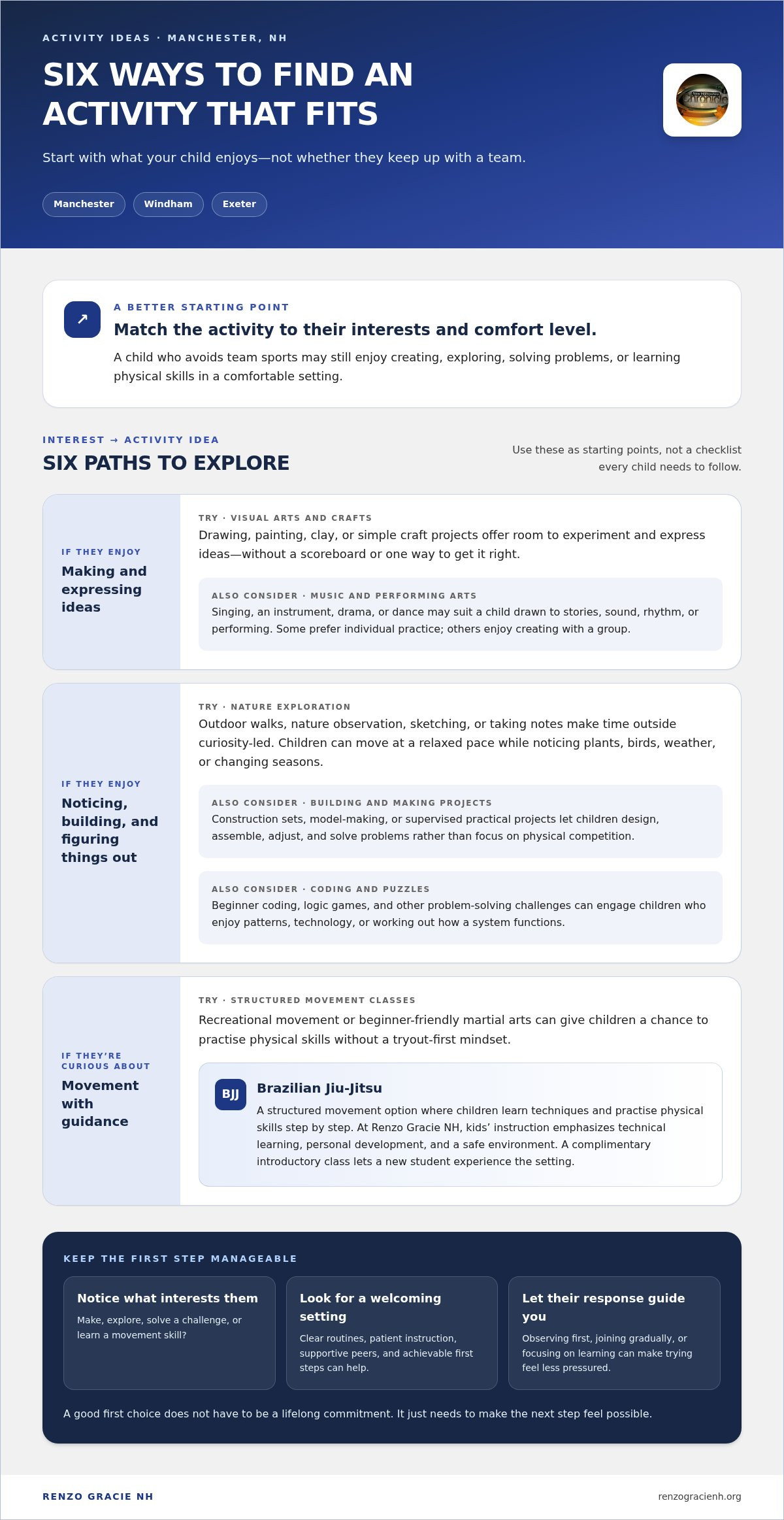
Try specific, low-pressure questions: Would you rather make something, explore outside, solve a challenge, or learn a movement skill? Their answers can point toward creative activities, nature exploration, building projects, or structured movement. Each offers a different way to participate, from expressing ideas to practising coordination or spending time with others.

What makes an activity feel welcoming

Look for clear routines, patient instruction, supportive peers, and achievable first steps. Some children settle more easily when they know what to expect; others prefer choice and room to explore. An environment where mistakes are treated as part of learning can make trying something new feel less intimidating. No single activity suits every child, so let their response guide you.

A low-pressure activity is one a hesitant child can try without being pushed to perform, compete, or commit before they feel ready. That might mean observing first, joining in gradually, or focusing on learning rather than winning.

Movement doesn’t have to begin with a traditional team sport. Brazilian Jiu-Jitsu is a structured movement activity where children learn techniques and practise physical skills. At Renzo Gracie NH, kids’ instruction for different ages and skill levels emphasizes technical learning, personal development, and a safe environment. A complimentary introductory class lets a new student experience the setting.

When comparing activities for non-athletic child Manchester families might consider, begin with fit. Does the format interest your child? Does the pace feel manageable? A good first choice doesn’t need to be a lifelong commitment. It just needs to make the next step feel possible.

Six Activity Ideas for Non-Athletic Children Around Manchester

Families in Manchester, Windham, and Exeter can look beyond traditional team sports when exploring a child’s interests. These ideas range from quiet, hands-on pursuits to structured movement. Use them as starting points, not a checklist every child needs to follow.

  • Visual arts and crafts: Drawing, painting, clay, or simple craft projects give children who enjoy making things a chance to experiment and express ideas. There’s no scoreboard or single way to get it right.
  • Music and performing arts: Singing, learning an instrument, drama, or dance may appeal to children who enjoy stories, sound, rhythm, or performing. Some prefer individual practice; others like creating alongside a group.
  • Nature exploration: Outdoor walks, nature observation, or sketching and taking notes can turn time outside into a curiosity-led activity. Children can move at a relaxed pace while noticing plants, birds, weather, or changing seasons.
  • Building and making projects: Construction sets, model-making, or supervised practical projects can suit children who like designing, assembling, and seeing how things work. The focus is on trying, adjusting, and solving problems rather than physical competition.
  • Coding and puzzles: Beginner coding activities, logic games, and educational STEM platforms like Maker & Coder can engage children who enjoy patterns, technology, or figuring out how a system works. Choose a format that leaves room to ask questions and experiment.
  • Structured movement classes: Recreational movement or beginner-friendly martial arts can help children practise physical skills without a tryout-first mindset. Brazilian Jiu-Jitsu introduces guided movement and technique step by step. Children can begin learning without arriving with competition experience.

For each option, consider your child’s age, interests, and access needs alongside the activity’s format. Would they prefer a small creative task, time outdoors, a clear sequence to follow, or room to explore? An activity can be worthwhile even if it isn’t athletic in the usual sense: creating, problem-solving, moving, and connecting all offer ways to learn and participate.

For families curious about movement, Renzo Gracie NH’s kids’ Brazilian Jiu-Jitsu program emphasizes technical learning, fitness, and personal development in a safe environment. A complimentary introductory class gives a new student a chance to experience the setting. Explore the kids’ Brazilian Jiu-Jitsu program as one of several activities for non-athletic child Manchester families might consider.

How to Compare Activities When Your Child Is Hesitant

Compare how an activity may feel to your child, not just how it looks on paper. Consider what holds their interest, whether they’re comfortable in groups, if they like clear instructions, how much movement is involved, and whether competition is central. These questions help Manchester-area families shortlist options without assuming one format will suit every child.

Factor Questions to consider Possible fit
Interest What does your child enjoy doing already? Creative projects for makers; movement or practical challenges for active explorers.
Group setting Would they prefer working alone, with a few peers, or in a class? Individual projects, small-group activities, or instructor-led classes.
Structure Do they like knowing what happens next? A predictable routine may reassure some children; open-ended tasks may suit others.
Movement Would they enjoy gentle movement, active practice, or a mostly seated activity? Choose a level and style that feels approachable to them.
Competition Does winning motivate them, or make participation feel stressful? Look for an emphasis on learning and personal progress if competition is off-putting.

Which activity format may fit your child?

An individual creative project offers space to focus quietly. A small-group activity provides company without making the whole class feel like an audience, while an instructor-led class offers guidance and shared routines. A predictable format may comfort a child who likes knowing what comes next; another may be more engaged when there’s room to make choices. Preferences can shift after trying an activity, so treat the first impression as useful information, not a final verdict.

Does martial arts have to be aggressive or competitive?

Not necessarily. Brazilian Jiu-Jitsu can be taught as guided technical practice, with children learning movements and techniques through instruction. At Renzo Gracie NH, kids’ instruction emphasizes technical learning, fitness, personal development, and a safe environment. Respect and control are part of practising with others, and children can develop skills at their own pace. The key question is whether the teaching environment helps your child feel comfortable enough to participate, not whether martial arts matches a stereotype.

The right activity is one your child can approach with interest and growing comfort, not one that asks them to prove they’re athletic. Use the comparison as a conversation starter, then let your child’s response help guide the next step.

Non-Athletic Kids' Activities in Manchester: Parent Guide

A Low-Pressure Four-Step Plan for Trying a New Activity

A new activity can feel like a big leap when your child is unsure. Make the first step smaller. This approach can help families in Manchester, Windham, and Exeter explore activities their children may enjoy while giving the child a say in what happens next.

  1. Talk about interests. Start with what your child likes doing, not what you think they should try. Ask whether they’d rather make something, solve a puzzle, spend time outdoors, or learn a movement skill. Keep the conversation curious, not persuasive.
  2. Shortlist a few options. Choose activities that match those interests and compare the setting, pace, and level of structure. Explain what a first visit might involve, then let your child ask questions or help choose.
  3. Try an introduction. Agree on a manageable first goal, such as watching, joining in for part of the session, or learning one new movement. Renzo Gracie NH offers new students a complimentary introductory class for children’s Brazilian Jiu-Jitsu. It gives a child a chance to experience a guided movement class without treating the first visit as a test of toughness or talent.
  4. Reflect and decide together. Afterward, ask what felt fun, unfamiliar, comfortable, or challenging. Find out whether your child would like to return, try a little more, or explore a different kind of activity.

Prepare for the first visit without adding pressure

Explain the activity in plain language and be honest about what your child may see or do. Let them know it’s okay to feel nervous and that they don’t need to impress anyone. A small goal gives the visit a gentle focus while leaving room to observe and get comfortable at their own pace.

Review the experience together

Uncertainty in a first session doesn’t always mean an activity is a poor fit. A new room, unfamiliar people, or instructions to learn can take time to get used to. Notice whether these are ordinary first-session nerves or a persistent sense that the environment doesn’t suit your child. Trying an activity more than once can give you a fuller picture while still taking your child’s feedback seriously.

Observe your child’s response before deciding whether an activity is the right fit. Interest, comfort, and willingness to return can guide the next step, whether that means continuing, pausing, or choosing another category. To explore a first step into movement, book a complimentary introductory class.

Manchester Families: Consider Kids’ Brazilian Jiu-Jitsu as One Welcoming Option

Not every child wants to join a team or compete. For families in Manchester, Windham, and Exeter exploring activities for non-athletic child Manchester searches may bring to mind, kids’ Brazilian Jiu-Jitsu is one structured movement option. At Renzo Gracie NH, children learn techniques and develop physical skills in an environment that emphasizes personal development and safety. The program is for children of different ages and skill levels.

What children can experience in a kids’ Jiu-Jitsu class

Instruction offers a clear framework for learning: listen, practise guided movement, and work on techniques step by step. For a child who prefers knowing what to expect, structured teaching can make a new activity easier to understand. The focus is on learning, not arriving with a particular level of fitness or confidence.

Practice also gives children opportunities to work on focus, persistence, respect, and cooperation. These are skills they can practise as they learn and interact with others, not guaranteed outcomes. Progress looks different for each child. One may enjoy mastering a movement; another may need time to get familiar with the class setting. The aim is learning at an individual pace, not pressure to perform.

Families interested in how Jiu-Jitsu can contribute to a child’s development can also read Kids Jiu Jitsu New Hampshire: Empowering Your Child Through Brazilian Jiu Jitsu. It offers another perspective on the experience and the personal growth that instruction is designed to support.

A first step for Manchester-area families

Renzo Gracie NH serves families in Manchester, Windham, Exeter, and nearby New Hampshire communities. A complimentary introductory class gives a new student a chance to experience the setting and see how a guided movement activity feels. Keep the first visit simple: your child can notice the routine, get familiar with the learning environment, and decide how they feel about trying it.

Brazilian Jiu-Jitsu won’t be the right answer for every child, but it can offer a purposeful alternative to a conventional team-sport format. It combines movement, technical learning, and personal development. If your child is curious, explore a complimentary introductory class and take that first step together.

Choose a First Step That Feels Right for Your Child

The right activity doesn’t depend on a child already seeing themselves as athletic. Start with their interests, then consider how the setting, structure, and pace feel. Creative projects, outdoor exploration, problem-solving, and guided movement all offer ways to learn, connect, and grow. Let your child’s response to trying something new help shape what comes next.

For families exploring activities for non-athletic child Manchester options, kids’ Brazilian Jiu-Jitsu is one structured movement choice. Renzo Gracie NH offers instruction for different ages and skill levels, emphasizing technical learning, personal development, and a safe environment. New students can begin with a complimentary introductory class to experience the setting before deciding whether to continue.

Explore a complimentary introductory class for your child at Renzo Gracie NH, and take the next step at a pace that feels comfortable for your family.

Frequently Asked Questions

What activities are good for a child who does not like sports?

Children who dislike team sports may enjoy art, music, crafts, building projects, nature exploration, or a beginner-friendly movement class. Start with interests they already show, such as drawing, solving puzzles, or spending time outdoors, then consider whether they prefer individual activities or learning with a group. Families searching for activities for non-athletic child Manchester options can use a low-pressure introduction to see what feels enjoyable. Preferences may change over time.

How can I encourage my child to try an activity without pressuring them?

Offer a few choices and explain what a first visit might involve. Let your child help choose, then agree on a small goal, such as observing the class or trying one new skill. Afterward, ask what felt interesting or comfortable. One hesitant session doesn’t have to settle the question. Give your child room to consider another try, take a pause, or explore a different kind of activity.

Can a non-athletic child enjoy martial arts?

Yes. A child doesn’t need to identify as athletic to explore Brazilian Jiu-Jitsu. It involves learning techniques through guided practice, with skills developing over time. The class structure and the child’s comfort are important parts of the experience. Renzo Gracie NH offers kids’ instruction for different ages and skill levels, and a complimentary introductory class lets a new student experience the setting before deciding whether it feels like a good fit.

Is Brazilian Jiu-Jitsu aggressive for children?

Brazilian Jiu-Jitsu is a grappling martial art, but children’s instruction at Renzo Gracie NH emphasizes technique, personal development, and a safe environment. Children respond differently to physical activities, so notice whether your child seems comfortable with the teaching environment and talk together afterward about what felt enjoyable, unfamiliar, or challenging.

How do I know if an activity is a good fit for my child?

Look beyond whether your child succeeds straight away. Notice whether they feel welcomed, understand what to do, and show curiosity about returning. Ask what they enjoyed and what felt difficult. A good fit may offer a workable balance of structure, challenge, and choice. If your child remains uncomfortable after trying it, take their feedback seriously and consider another activity or format.

What activities can Manchester, NH families try for a child who is not sporty?

Families can explore creative classes, hands-on projects, nature activities, and beginner-friendly movement programs. Renzo Gracie NH serves families in Windham, Manchester, and Exeter with kids’ Brazilian Jiu-Jitsu instruction. The best starting point depends on a child’s interests and comfort. A complimentary introductory class gives Manchester-area families a chance to experience the academy and consider whether this structured movement activity suits their child.

Alternatives to Team Sports for Kids in Windham

What if belonging matters more than winning? If you’re looking for an alternative to team sports for kids Windham families can explore activities that keep children moving and connected without making team performance the focus. A child who dislikes tryouts, rigid positions, or the pressure of competition may still enjoy learning alongside others and working toward personal goals.

The right fit depends on your child’s interests and temperament. Art can encourage creativity and self-expression; music and theater build performance skills and collaboration; dance offers movement and shared practice. Kids’ Jiu-Jitsu brings together fitness, technical learning, focus, and individual progress in a structured group setting. Each activity offers a different balance of physical effort, social connection, and commitment.

This guide compares options for families in Windham, Manchester, and Exeter, with practical ways to weigh those differences. You’ll also learn how Renzo Gracie NH’s kids’ program combines personal growth with shared practice. New students can start with a complimentary introductory class. Rather than force a team-sport fit, begin with what helps your child feel curious, capable, and ready to learn.

Key Takeaways

  • An alternative to team sports for kids Windham families consider can still offer movement, skill-building, and connection without team-game results at the center.
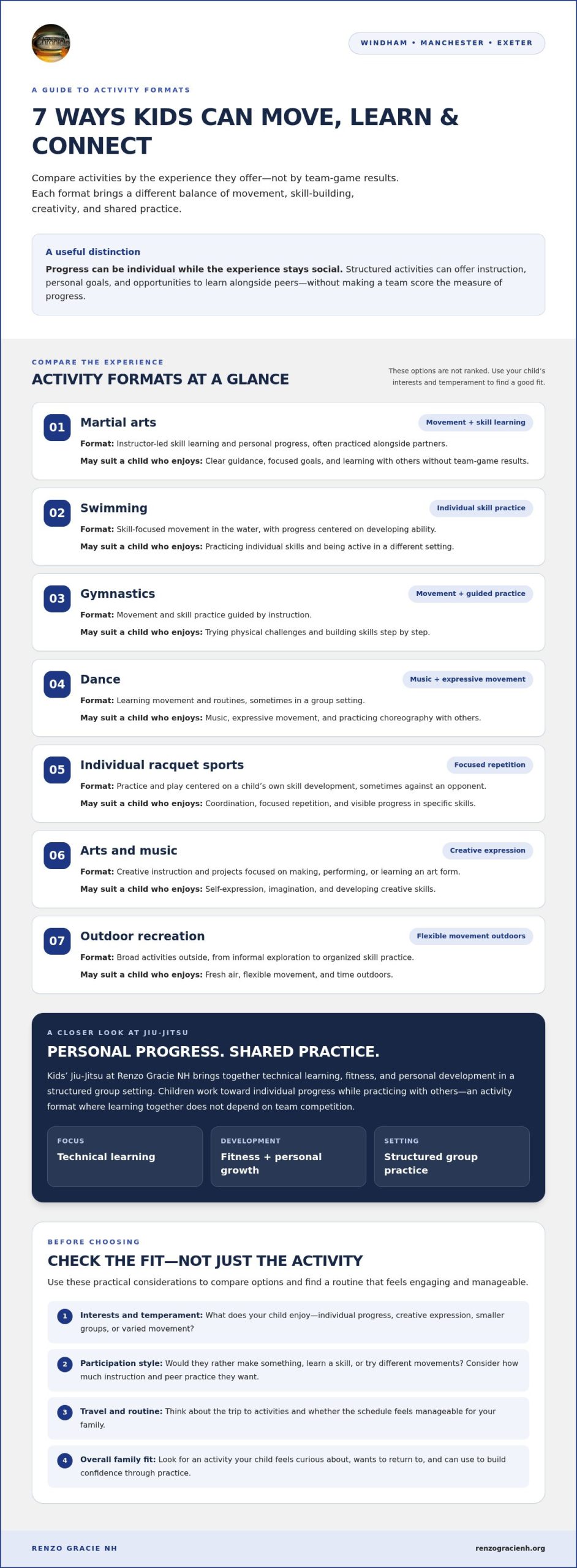
  • Compare martial arts, swimming, gymnastics, dance, racquet sports, and arts activities by the experience each offers and the interests it may suit.
  • Jiu-Jitsu develops individual skills through instruction and practice with peers, so children can learn together without team competition.
  • Use a simple selection process to weigh your child’s preferences, travel, routine, participation style, and overall family fit.
  • Kids’ Jiu-Jitsu at Renzo Gracie NH emphasizes technical learning, fitness, and personal development. New students can try a complimentary introductory class.

Why Windham Families Seek Team Sports Alternatives

Children don’t all enjoy competition in the same way. One may love the energy of a game and working toward a shared score, while another would rather learn at their own pace, create something, or move without the pressure of a crowd. A child’s response can also depend on the sport, the group, and how practice is organized. Disliking one team sport doesn’t necessarily mean they dislike movement, instruction, or spending time with other kids.

A team-sport alternative is an organized activity that isn’t centered on team-game results. It can still involve practice, goals, and peers. The broader Youth sports overview describes how participation can support physical and emotional well-being as well as social connection. Families can look for those opportunities in different formats, choosing what feels engaging and manageable for their child.

For parents comparing an alternative to team sports for kids Windham, the goal isn’t to find the most impressive activity or fill every afternoon. Look for a good match: something the child wants to return to, that fits the family’s routine, and that gives them room to build confidence through practice.

What might a child want beyond team competition?

Start with what your child enjoys, not just what they’re trying to avoid. They may prefer individual progress, smaller groups, creative expression, or varied movement. Some children feel more at ease when an instructor explains a skill and they can work toward a personal goal, rather than waiting for game day or worrying about a team result.

Ask open questions such as, “Which parts of practice do you like?” or “Would you rather make something, learn a skill, or try different movements?” Their answers can help you compare activities without deciding for them. Keep the conversation practical, too. A routine that feels interesting and manageable is easier to fit into family life.

What can a structured activity still offer?

Individual progress doesn’t mean practicing alone. Regular instruction gives children a routine, guidance as they learn, and opportunities for encouragement from instructors and peers. In activities such as martial arts, a child can work on personal skills while learning alongside training partners. The shared experience can build connection without making a team score the measure of progress.

The format can be individual; the experience can still be shared. That distinction helps families look beyond “team or no team” and focus on whether an activity offers the right balance of instruction, movement, social contact, and personal goals.

Team-Sport Alternatives for Kids Near Windham: Compare Activity Types

There’s more than one way for a child to move, learn, and connect with peers. Compare the activity’s format with what your child enjoys, then consider options in Windham and nearby Manchester or Exeter. The table can help you narrow the choice by the experience each activity typically involves and the interests it may suit.

Activity Format and typical experience May suit a child who enjoys
Martial arts Instructor-led skill learning and personal progress, often practiced alongside partners. Clear guidance, focused goals, and learning with others without team-game results.
Swimming Skill-focused movement in the water, with progress centered on developing ability. Practicing individual skills and being active in a different setting.
Gymnastics Movement and skill practice guided by instruction. Trying physical challenges and building skills step by step.
Dance Learning movement and routines, sometimes in a group setting. Music, expressive movement, and practicing choreography with others.
Individual racquet sports Practice and play centered on a child’s own skill development, sometimes against an opponent. Coordination, focused repetition, and visible progress in specific skills.
Arts and music Creative instruction and projects focused on making, performing, or learning an art form. Self-expression, imagination, and developing creative skills.
Outdoor recreation Broad activities outside, from informal exploration to organized skill practice. Fresh air, flexible movement, and time outdoors.

Movement-based options beyond team games

Martial arts combine instruction and personal skill development with shared practice. In kids’ Jiu-Jitsu at Renzo Gracie NH, children work on technical learning, fitness, and personal development in a structured setting. Each child works toward individual progress while practicing with others. Families exploring an alternative to team sports for kids Windham can compare this format with swimming and gymnastics, which also emphasize learning movement skills rather than team-game results. Dance may appeal to children drawn to music and expressive movement, while racquet sports may suit those who like focused practice and developing specific skills.

Creative and outdoor activities for different interests

Arts and music offer a creative path for children more interested in drawing, making, playing an instrument, or performing than in sports. Outdoor recreation brings movement and exploration without necessarily involving a formal team structure. These options differ in physical activity, creative focus, routine, and social interaction. If instructor-led movement and shared practice sound like a promising fit, explore kids’ Jiu-Jitsu at Renzo Gracie NH as a local option.

Alternatives to Team Sports for Kids in Windham

Is Jiu-Jitsu a Social Alternative to Team Sports for Kids?

Yes. An activity doesn’t need teams or a shared scoreboard to help a child learn alongside peers. Brazilian Jiu-Jitsu combines individual skill development with instruction and practice partners, creating a shared class experience while each student works on personal progress. That may suit a child who wants connection but doesn’t enjoy team-game pressure.

How Brazilian Jiu-Jitsu combines individual progress and group learning

In a structured martial arts class, students receive instruction, practice movement skills, and learn with others. At Renzo Gracie NH, kids’ instruction emphasizes technical learning, fitness, and personal development. These are built through practice over time, not instant results or promises.

In Jiu-Jitsu, progress is measured by the skills a student develops, not a team’s position on a scoreboard. Training partners make learning interactive, while each child’s development remains personal. That balance can offer a sense of community without making winning or team performance the focus.

What parents should consider about fit and comfort

Jiu-Jitsu involves learning movement skills with an instructor and training partners, so consider whether your child feels comfortable with physical contact and shared practice. A child may need time to get used to a new routine, listen to instruction, and participate in a structured class. Their curiosity and comfort matter more than whether the activity sounds like a good fit on paper.

Talk with your child about what they’d like to try and what feels manageable. If they’re interested but unsure, a complimentary introductory class at Renzo Gracie NH lets your family experience the class before deciding whether it feels right. It’s one way to explore an alternative to team sports for kids Windham that brings together personal goals, guided learning, and shared practice.

How to Choose a Kids’ Activity in Windham That Fits Your Child

The best choice isn’t always the most familiar activity. Connect your child’s interests with a routine your family can sustain, and treat a first visit as a chance to learn rather than a test they need to pass.

  1. Ask your child. Find out what they’d like to try and what they want less of, such as game-day pressure or a crowded practice.
  2. Identify their preferences. Do they enjoy individual goals, creative practice, movement, or learning with peers? Consider their comfort with competition, physical contact, performing, and structured instruction.
  3. Compare activity formats. Look at how much time is spent moving, creating, listening to instruction, or practicing with others. A child who prefers guided skill-building may enjoy a different format than one drawn to open-ended creative activities.
  4. Try a class or introductory experience. Decide what you hope to learn: whether your child feels comfortable, understands the activity, and shows interest in participating again.
  5. Reflect together. Ask what felt fun, challenging, or uncomfortable. One first impression is useful information, not a fixed label about your child’s personality or abilities.

Match the activity to your child’s preferences

Think beyond “sports or no sports.” A child may want plenty of movement but prefer personal goals to team competition, or enjoy working with peers but feel uneasy about performing in front of an audience. Preferences can also change with experience. Listen closely, and let your child’s responses guide the next choice rather than deciding that one activity defines what they will or won’t enjoy.

Practical fit matters too. Consider travel from Windham, how an activity fits around school and family routines, and whether its participation style feels manageable. A promising option should work for the child and the household, not just sound appealing in theory.

Make the first experience low-pressure

Before a trial, agree on a modest goal: notice how the class is taught, whether your child feels welcomed, and whether they’re curious to return. Don’t expect immediate mastery. New routines and skills take time, and a child may need space to decide how they feel afterward.

For families considering Jiu-Jitsu, Renzo Gracie NH offers a complimentary introductory class for new students. Book a complimentary kids’ Jiu-Jitsu introductory class and use the experience to see whether the setting feels right for your child.

Try Kids’ Jiu-Jitsu at Renzo Gracie NH in Windham

For families comparing team sports with martial arts, Renzo Gracie NH offers a structured Brazilian Jiu-Jitsu program for children in Windham, with additional locations in Manchester and Exeter. It’s a local option for kids who prefer developing their own skills while learning alongside other students, rather than focusing on team-game results.

What kids can explore through Jiu-Jitsu

Children’s instruction emphasizes technical learning, fitness, and personal development. Through guided practice, students can explore movement, learn techniques, and work toward individual progress in a shared class setting. The focus is on learning and growth, with each child progressing through practice at their own pace.

Professor Kevin Landry, the academy’s owner and instructor, is a sixth-degree black belt under Renzo Gracie and has taught in the region for over two decades. His experience informs instruction in a program designed around children’s learning and development.

Jiu-Jitsu is a partner-based activity, so it includes physical contact as students practice with others. That’s an important part of deciding whether the format fits your child. If family participation is part of what you’re looking for, Renzo Gracie NH also has family Jiu-Jitsu options to explore.

Take a simple first step in Windham

A first class can help your family get a feel for the instruction and environment, without expecting your child to master new skills right away. Notice whether they seem comfortable taking part, respond to the structure, and show interest in trying again. Their impressions matter; the goal is to discover a good fit, not force one.

If you’re considering an alternative to team sports for kids Windham families can explore, start with a complimentary introductory class for your child at Renzo Gracie NH.

Find an Activity That Helps Your Child Grow

The right activity is one your child feels curious about and comfortable returning to. Swimming, dance, creative pursuits, and martial arts all offer different ways to develop skills and connect with others. An alternative to team sports for kids Windham families explore can still provide structure and shared learning without making game results the goal.

Kids’ Brazilian Jiu-Jitsu at Renzo Gracie NH emphasizes technical learning, fitness, and personal development in a structured setting. With locations in Windham, Manchester, and Exeter, families can explore an option close to home. Owner and instructor Professor Kevin Landry has taught in the region for over two decades.

A first class is a simple way to see how your child responds to the activity and its routine. Renzo Gracie NH offers a complimentary introductory class for new students. Book your child’s free introductory Jiu-Jitsu class and let them discover whether the mat feels like a place to learn, move, and grow.

Frequently Asked Questions

Is Brazilian Jiu-Jitsu a good alternative to team sports for kids?

It can suit children who enjoy learning movement skills and making individual progress in a structured group setting. Brazilian Jiu-Jitsu isn’t a team game, but students learn from instructors and practice alongside others. Whether it suits your child depends on their interests and comfort with partner practice. An introductory class lets your family experience the format before deciding if it feels right.

Can kids make friends in an activity that is not a team sport?

Yes. Team competition is only one way children can spend time with peers. Group classes, shared practice, and learning alongside other students create opportunities for connection. The experience varies by activity and child, so notice whether your child seems comfortable participating and interested in returning. Social connection doesn’t have to depend on team performance.

What are some alternatives to team sports for kids in Windham?

Families can compare martial arts, swimming, gymnastics, dance, individual racquet sports, creative activities, and outdoor recreation. Each offers a different mix of movement, instruction, personal goals, and group participation. In Windham, Manchester, and Exeter, consider travel and the fit with your child’s interests and family routine as you narrow down options.

Is Jiu-Jitsu safe for children who are new to martial arts?

A child’s comfort, the class environment, and appropriate instruction all matter when trying a new physical activity. Brazilian Jiu-Jitsu involves partner practice, so consider whether your child is comfortable learning movement skills with others. An introductory class gives your family a chance to experience the setting and observe your child’s response before deciding about ongoing participation. Their comfort and willingness to take part are important considerations.

How do I know which activity will suit my child?

Start by asking what your child enjoys and what they’d like to try. Compare options by activity style, structure, social setting, travel from Windham, and fit with your family’s routine. After an introductory experience, notice whether your child seemed engaged and comfortable and whether they want to return. Their response can guide your next step without treating one experience as a final verdict.

Can a child try Jiu-Jitsu before joining Renzo Gracie NH?

Yes. Renzo Gracie NH offers new students a complimentary introductory class, so families can experience Brazilian Jiu-Jitsu before deciding whether to continue. The class gives you a chance to see how your child responds to the structured group activity and its instruction. Keep the first visit low-pressure: focus on their comfort, interest, and curiosity about learning more. Renzo Gracie NH serves families in Windham, Manchester, and Exeter.

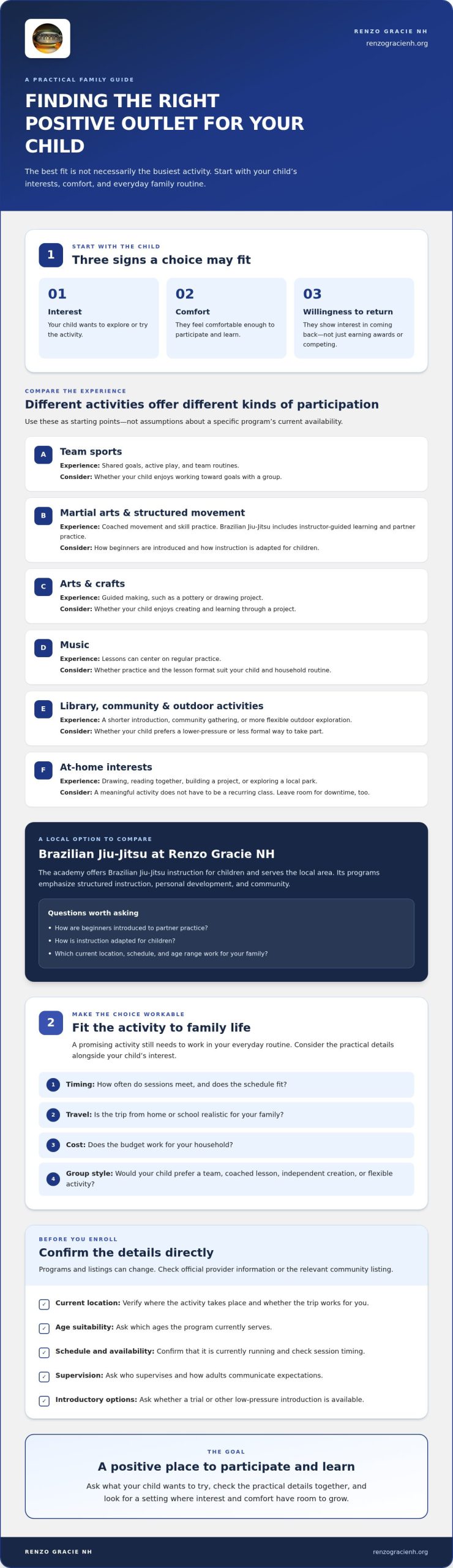
Positive Outlets for Kids in Exeter, NH: A 2026 Family Guide

The busiest schedule isn’t always the best fit. The right positive outlets for kids Exeter families consider should match a child’s interests, comfort, and everyday routine. Sports, creative classes, music, and martial arts offer different experiences, so it helps to compare what each involves before choosing.

A child who enjoys teamwork may thrive in a different setting from one who prefers making things or learning at their own pace. Even an appealing activity needs to work with your family’s schedule, travel, and budget. Start by asking what your child wants to try, then look at the practical details together.

This guide compares activities near Exeter by the experience they offer and the children they may suit. Options range from team sports and arts programs to music lessons and kids’ Brazilian Jiu-Jitsu, which includes structured instruction and group participation. Use the questions throughout to check current schedules, age ranges, location, supervision, and introductory opportunities before signing up. The goal isn’t to find the most popular activity. It’s to find a positive place where your child wants to participate and learn.

Key Takeaways

  • Use your child’s interests, comfort, and willingness to return as practical signs of a good activity fit.
  • Compare creative classes, music, sports, and structured movement without assuming one type suits every child.
  • Consider group style, travel, timing, and family routine alongside the activity itself.
  • Among the positive outlets for kids Exeter families can explore, Brazilian Jiu-Jitsu at Renzo Gracie NH is one option to compare with others.
  • Before enrolling, ask providers about current location, age suitability, schedule, supervision, and trial arrangements.

What makes a positive outlet for kids in Exeter?

A positive outlet is a constructive, age-appropriate way for a child to explore an interest, practice skills, and spend time in an encouraging setting. It could be a recurring class, a seasonal team, a club, a one-time workshop, or an activity at home or outdoors. Regular sessions can help a child settle into a routine, while an occasional outing can be a lower-pressure way to try something new.

There’s no single best choice. One child may enjoy clear instruction and group goals; another may prefer creating independently or joining in now and then. The Positive Youth Development approach centers young people’s strengths and potential. In everyday terms, notice whether your child enjoys the experience, feels comfortable enough to participate, and is willing to return. Awards and competition aren’t the only signs of progress.

How to recognize an activity that supports a child

Look for clear expectations, adults who communicate respectfully, and room for children to learn at different paces. A supportive setting can offer a challenge without making a child feel they must keep up with others. Ask what your child hopes to try, learn, or experience. Their answers can help you narrow the options and identify any concerns to discuss with the provider.

For families searching “positive outlets for kids Exeter,” the goal isn’t to choose based on reputation alone. Look for a setting where your child’s interest and comfort have room to grow.

Why local fit matters for Exeter families

Even a promising program needs to work in everyday life. Consider the actual trip from home or school, how often sessions meet, and whether the timing fits your routine. A listing in a nearby town doesn’t automatically mean the location or travel time will be convenient.

Check the provider’s official information or the relevant community-program listing. Confirm where the activity takes place, whether it’s currently running, and which ages it serves. Exeter-area families considering children’s Brazilian Jiu-Jitsu should verify the current training location that works for them, along with the schedule and age suitability. Checking these details first can help you decide whether the activity is realistic for your family.

Positive activities for kids near Exeter: options worth comparing

Families looking for positive outlets for kids Exeter offers can compare different experiences rather than assuming every child needs a scheduled class. The categories below are options to investigate, not a guarantee that a particular program is currently running or available nearby. Confirm each provider’s location, current offerings, and age eligibility through official information before making plans.

Movement, martial arts, and team activities

Youth sports may suit children who enjoy shared goals, active play, and team routines. Martial arts offer coached movement and skill practice, while outdoor recreation can give kids more room to explore at a less formal pace. Consider whether your child prefers a coach-led lesson, a team environment, or flexible outdoor activity.

Brazilian Jiu-Jitsu is one structured movement option to explore. It combines instructor-guided learning with partner practice, so parents can ask how beginners are introduced to activities and how instruction is adapted for children. Renzo Gracie NH offers Brazilian Jiu-Jitsu instruction for children and serves the local area. Families should confirm the current location that suits Exeter, the children’s schedule, and age suitability. The academy’s programs emphasize structured instruction, personal development, and community.

Creative, community, and interest-led activities

For a child drawn to making, performing, or discovering, check official local listings for arts and crafts, music, library activities, and community programs. A pottery or drawing class may involve a guided project; music lessons can center on regular practice; a library event or community gathering may offer a shorter introduction. Confirm dates and enrollment details directly instead of assuming a listing from another season still applies in 2026.

Some children prefer flexibility. Drawing at home, reading together, building a project, or exploring a local park can be meaningful without a recurring class. Leave room for downtime, too. The American Academy of Child and Adolescent Psychiatry offers guidance on striking the right balance between activities and a child’s other needs.

As you compare options, consider both what your child is likely to enjoy and what your household can sustain. If structured Brazilian Jiu-Jitsu is on your list, review Renzo Gracie NH’s children’s program information, then confirm the current location and details before planning a visit.

How to compare kids’ activities in Exeter by personality and priorities

A directory can help you find possibilities, but your child’s temperament and your family’s routine determine what belongs on the shortlist. Use this comparison as a starting point, then verify details directly with each provider. “Not listed” means the current schedule or trial arrangement needs checking, not necessarily that an option is unavailable.

Activity type Child interest Group setting Schedule Trial availability
Brazilian Jiu-Jitsu Coached movement and learning through practice Instructor-led, with partner practice Confirm current class times and location Ask the provider
Team sports Active play and shared goals Team-based, with coaching Check season and weekly commitment Ask about a trial or introductory option
Arts or music Creating, performing, or building a skill Class-based or individual instruction Confirm session dates and frequency Ask whether a first visit is possible
Outdoor or community activities Exploring, socializing, or flexible recreation May be guided, group-based, or informal Check event details or plan your own pace Depends on the activity

Fit means a match between a child’s interest, comfort, practical access, and a supportive setting. Keep that in mind as you compare positive outlets for kids Exeter families are considering.

Match the activity to your child’s interests

For a child who seeks movement, compare coached classes, team sports, and outdoor options. A child who enjoys quieter or creative pursuits may prefer arts, music, reading, or a community activity. Invite your child to help shortlist possibilities, then confirm age suitability, supervision, logistics, and whether the activity is a good match.

Compare structure, social setting, and commitment

Ask whether the experience is instructor-led, team-based, drop-in, or independently paced. Compare travel time, schedule, equipment needs, and trial opportunities using current details. Structured coaching provides guidance and a planned learning environment; open-ended recreation can allow more flexibility. Neither is automatically better. Consider what helps your child feel ready to participate and what your family can sustain.

Martial arts can differ in format and atmosphere, and Brazilian Jiu-Jitsu shouldn’t be treated as a synonym for aggression. It’s a coached activity that includes partner practice. Parents can ask how instructors explain expectations, supervise practice, and support beginners. Families considering this option can read this guide to kids’ Jiu-Jitsu, then confirm the current class location, schedule, age suitability, and introductory-class details directly with the academy.

Positive Outlets for Kids in Exeter, NH: A 2026 Family Guide

What Exeter parents should check before signing up

A promising activity should make sense on paper and feel workable in person. Contact the provider to confirm the current location, age suitability, schedule, supervision arrangements, and whether a trial or introductory visit is available. Listings can help you discover options, but they may not reflect current program details.

Use this checklist to guide the conversation:

  • Who leads the sessions? Ask who works with children and how expectations are explained.
  • How are beginners welcomed? Find out what a first session involves and how a child can join at their own pace.
  • What should we bring? Confirm clothing, equipment, or supplies directly with the provider.
  • What’s the commitment? Ask about attendance expectations, session frequency, and whether make-up options are available.
  • Can a caregiver observe? Check whether a parent can watch or accompany the child during an introductory visit.

Pay attention to more than the answers. Notice whether staff communicate clearly, respond respectfully to questions, and help children understand what to do. These observations can help you assess the setting without assuming policies or standards that you haven’t confirmed.

Use a trial to assess real-world fit

If a provider offers a trial or introductory visit, use it to see how the activity feels for your child. Afterward, ask what was enjoyable, confusing, or uncomfortable. A child may need time to warm up, so consider their perspective alongside what you observed instead of judging the experience by one moment alone.

Then test the practical side. Consider the actual commute, session timing, and how the activity fits around school, rest, and other family commitments. A good experience that’s difficult to reach or sustain may not work for your household. Families who value learning together may also find this overview of parent-and-child Jiu-Jitsu useful; confirm current location and arrangements with the provider.

As you compare positive outlets for kids Exeter families can consider, check the details before committing. Families interested in Brazilian Jiu-Jitsu can ask Renzo Gracie NH about a complimentary introductory class and verify the suitable location, age range, schedule, and visit arrangements directly.

Consider Renzo Gracie NH among Exeter-area kids’ outlets

For families comparing positive outlets for kids Exeter offers, Renzo Gracie NH is one option if a child is interested in structured Brazilian Jiu-Jitsu. The academy provides instruction for children and adults, with an emphasis on personal development and community. It won’t be the right fit for every child, but it may suit a young learner who enjoys active practice, clear instruction, and learning alongside others.

Instruction is led by Professor Kevin Landry, a sixth-degree black belt under Renzo Gracie who has taught in the region for over two decades. Parents can ask the team what a child’s first experience involves and whether the teaching approach and group setting feel right for their family. As with any activity, consider the practical details as well as your child’s interest.

What families can explore through kids’ Brazilian Jiu-Jitsu

Brazilian Jiu-Jitsu offers coached movement, skill development, and structured group participation. Children practice with partners as part of learning, so parents can ask how beginners are introduced to activities and how expectations are communicated. These are experiences to explore, not promised results. Each child’s response depends on their interests, comfort, and willingness to participate.

Family participation may also be worth discussing if shared training time matters to your household. Renzo Gracie NH offers instruction for children and adults; ask the academy what family training could look like in practice. This overview of parent-and-child Jiu-Jitsu provides additional context for families considering that approach.

Choose a simple next step near Exeter

Before planning a visit, contact the academy to confirm which current location best suits your household. Check the children’s class schedule, age suitability, travel time, and what an introductory visit involves. Renzo Gracie NH offers a complimentary introductory class for new students. Confirm current arrangements directly rather than relying on older listings or assumptions about availability.

A first visit can help you see whether the setting feels welcoming and the activity interests your child. Afterward, ask what they enjoyed, what questions they still have, and whether they’d like to return. Explore Renzo Gracie NH and ask about a first visit, the suitable location for Exeter-area families, and current introductory-class details.

Choose an activity your child is ready to explore

The best positive outlets for kids Exeter families can consider aren’t necessarily the most competitive or structured. Start with what interests your child, then weigh their comfort, the setting, and the practical fit for your household. Before signing up, confirm current age requirements, schedules, locations, and introductory arrangements directly with the provider.

If structured Brazilian Jiu-Jitsu is on your shortlist, Renzo Gracie NH is one option to explore. Professor Kevin Landry, a sixth-degree black belt under Renzo Gracie, has taught in the region for over two decades. Exeter-area families should ask which current location is suitable and verify the children’s class schedule and introductory-class details.

Explore Renzo Gracie NH and ask about a complimentary introductory class to learn whether a first visit could suit your family. Every child’s interests are different. Take the next step at a pace that feels right, and give your child room to discover what they enjoy.

Frequently Asked Questions

What are positive outlets for kids in Exeter, NH?

Positive outlets are constructive, age-appropriate ways for children to explore interests, practice skills, and connect with others. Exeter-area families can investigate youth sports, arts and music, library or community activities, outdoor recreation, and structured movement such as Brazilian Jiu-Jitsu. Programs and locations can change, so check official listings and confirm availability, age suitability, and travel details with each provider in Exeter, Windham, or Manchester.

Which activities help children build skills and stay engaged?

Activities that invite children to participate and practice at a comfortable pace can support skill development and ongoing interest. A team sport may appeal to a child who enjoys shared goals, while music or art can suit someone drawn to creative practice. Coached activities such as Brazilian Jiu-Jitsu include guided movement and partner practice. For families in Exeter, Windham, and Manchester, the right choice depends on the child’s interests and the program’s current details.

How do I choose an extracurricular activity that fits my child?

Start by asking what your child hopes to try, learn, or experience, then shortlist options together. Compare the setting, group format, schedule, travel time, and whether a first visit is possible. Notice whether your child seems comfortable and interested, not just whether an activity sounds impressive. Exeter-area families should confirm current program details directly, including age eligibility and location, before deciding whether the commitment works for their household.

Is Brazilian Jiu-Jitsu a good activity for kids?

Brazilian Jiu-Jitsu may suit children who enjoy active, instructor-led learning and partner practice, but it isn’t the right fit for every child. Ask how the program explains expectations and introduces beginners to sessions. Check the children’s class structure, age suitability, and introductory arrangements. Families in Exeter, Windham, or Manchester can use a visit to assess whether the setting feels comfortable for their child.

Can children try a martial arts class before enrolling?

Renzo Gracie NH offers new students a complimentary introductory class, including families considering the kids’ Brazilian Jiu-Jitsu program. Contact the academy to confirm current arrangements, which location suits your household, the appropriate age range, and what a first visit involves. Families from Exeter, Windham, and Manchester can use the visit to ask questions and see whether the instruction and setting feel like a promising fit before making a commitment.

What should I ask before signing my child up for an activity?

Ask who leads sessions, how beginners are welcomed, what children should bring, and how often the activity meets. Confirm the current location, age eligibility, supervision arrangements, attendance expectations, equipment needs, and whether a parent can observe or accompany a child during an introductory visit. For programs around Exeter, Windham, and Manchester, verify details directly with the provider rather than relying on an older listing or assuming a nearby location is convenient.

Does Renzo Gracie NH offer kids’ Jiu-Jitsu near Exeter?

Yes. Renzo Gracie NH offers Brazilian Jiu-Jitsu instruction for children and serves the Exeter, Windham, and Manchester area. Professor Kevin Landry, the owner and instructor, is a sixth-degree black belt under Renzo Gracie and has taught in the region for over two decades. Exeter families should contact the academy to confirm the most suitable current location, children’s class schedule, age suitability, and introductory-class details.

Best After School Activities in Windham, NH: A Guide to Youth Enrichment

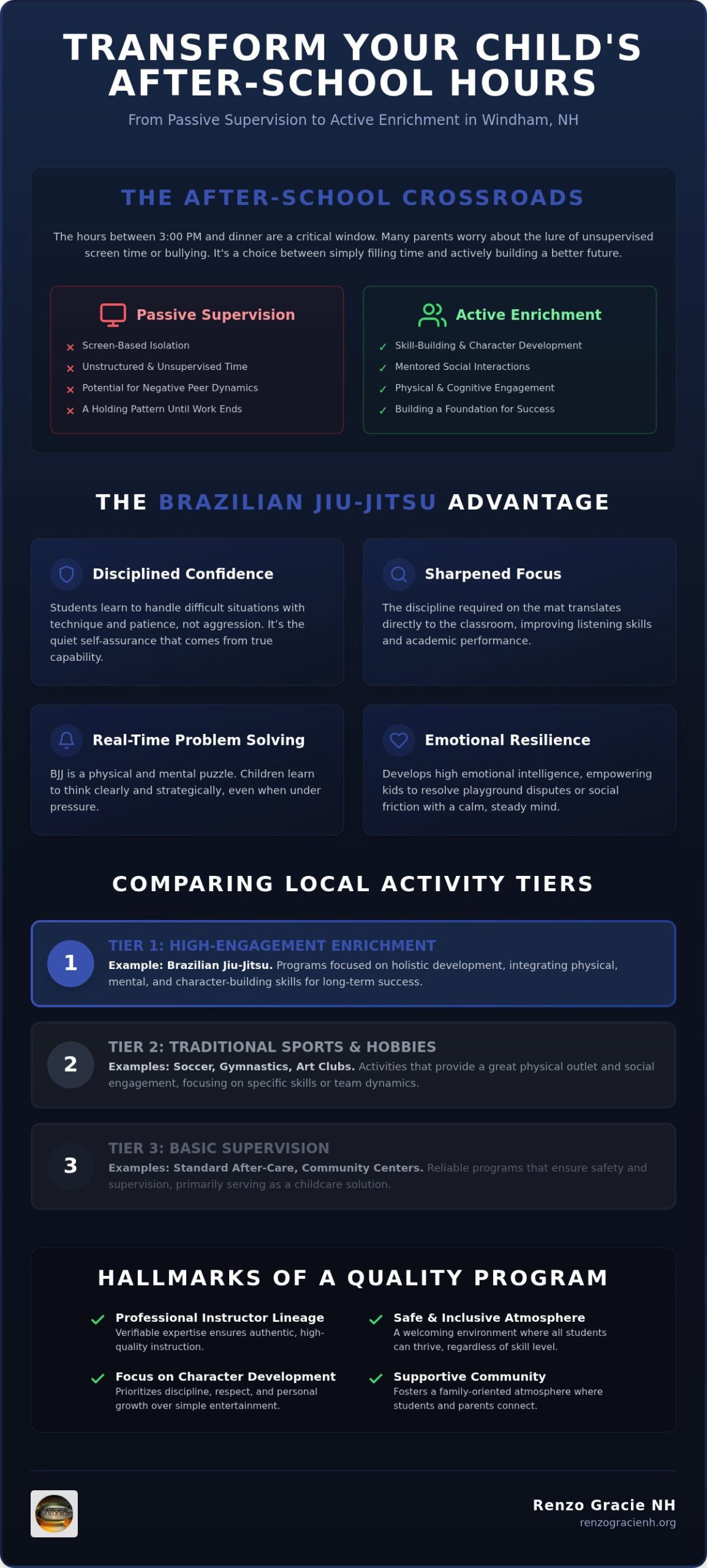
What if the hours between 3:00 p.m. and dinner weren’t just a gap to fill, but the most transformative part of your child’s day? Finding the right after school activities Windham NH offers can feel like a balancing act between safety and growth. You want your child active. You want them engaged. Many parents worry about the lure of unsupervised screen time or the rising concerns of bullying in traditional settings. It’s a common struggle for local families who are seeking more than just a holding pen until the workday ends.

We believe those afternoon hours are the perfect time to build character. Discover how to transform your child’s after-school experience from simple supervision into a journey of confidence, discipline, and physical fitness. This guide explores the most impactful enrichment programs in the area, highlighting options that foster a supportive community for the whole family. We’ll preview how specialized training can improve school focus and give your child the tools to handle social conflict with grace. Let’s find the path that turns potential into progress and builds a foundation for a lifetime of success.

Key Takeaways

  • Learn how to distinguish between passive supervision and active enrichment when evaluating the various after school activities Windham NH has to offer your family.
  • Discover why Brazilian Jiu-Jitsu builds “disciplined confidence” and improves school performance by sharpening a child’s focus and listening skills.
  • Compare traditional team sports and common hobbies to high-engagement programs that prioritize character development over simple entertainment.
  • Identify the essential criteria for a quality program, from verifying professional instructor lineage to ensuring a safe, inclusive atmosphere for all skill levels.
  • Explore how specialized family programs allow parents and children to build a supportive community while progressing together toward personal goals.

The hours between the final school bell and the family dinner table represent a precious window. Too often, this time is viewed simply as a logistical hurdle for working parents to clear. You might wonder what are after-school activities supposed to accomplish beyond keeping a child safe and supervised. While basic care is a necessity, the real transformation happens when we move toward active enrichment. We define enrichment as purposeful activity that builds cognitive, physical, and emotional resilience. This distinction is vital. It’s the difference between a child waiting for the clock to strike 5:00 p.m. and a student actively evolving into a more confident version of themselves.

This “after-school gap” is the most critical time for social development. It’s the period when children navigate peer dynamics outside the rigid, grade-focused structure of a classroom. Without a plan, these hours often default to screen-based isolation or unsupervised wandering. By choosing high-quality after school activities Windham NH families provide their children with a structured environment where social interactions are mentored rather than just monitored. It’s about building a foundation of character during the time when children are most receptive to new influences.

The Shift from Supervision to Skill-Building

Families in Southern New Hampshire are moving away from traditional daycare models. They want more for their children. They want results. The rise of specialized youth programs reflects a growing desire for activities that serve as a physical outlet while balancing academic demands. A child who has spent six hours at a desk doesn’t need more sedentary time. They need to move. They need to build. Specialized programs allow them to burn energy while simultaneously learning the value of perseverance. It’s a balanced approach that respects the need for homework time while prioritizing the physical vitality that kids crave.

Top Categories of Activities in Windham

The local landscape is rich with diverse options. Windham offers a variety of paths, ranging from school-sponsored initiatives to elite private academies. Understanding these categories helps you align an activity with your child’s specific needs.

  • Athletic Programs: This includes local soccer leagues, gymnastics at centers like Gym-Ken, and martial arts academies such as Renzo Gracie NH. These programs focus on physical coordination and team dynamics.
  • Creative and STEM Clubs: Options like the “Nintendo Club” or theater set design offer social engagement for children with specific hobbies.
  • Community Initiatives: Programs through the YMCA or the Windham Academy provide reliable, standardized care with a focus on community building.

Each of these categories serves a purpose in the community. However, the most effective after school activities Windham NH offers are those that integrate physical movement with long-term character development. When an activity challenges the body and the mind, the child returns home not just tired, but truly fulfilled.

Why Brazilian Jiu-Jitsu is the Superior Choice for Youth Development

Many after school activities Windham NH offers focus on keeping children busy. We focus on building them up. Brazilian Jiu-Jitsu (BJJ) stands apart because it serves as a mental laboratory as much as a physical one. It’s a journey of transformation. Students don’t just learn to move their bodies; they learn to master their minds. This results in what we call “disciplined confidence.” It’s the quiet self-assurance that comes from knowing you can handle difficult situations through technique and patience rather than aggression. It is empowerment in its purest form.

The mat is a place for real-time problem-solving. When children “roll” or practice live techniques, they’re constantly faced with physical and mental puzzles. How do I escape this position? How do I stay calm when I am stuck? This environment creates high levels of emotional intelligence. They learn to think clearly while their heart rate is up, which is a skill that translates to every other area of life. They learn to resolve playground disputes or social friction with a calm, steady mind.

Developing Focus and Discipline

The lessons learned on the mat translate directly to the classroom environment. Our kids jiu jitsu New Hampshire pillar uses a structured curriculum to establish a reliable routine. Children thrive when they know exactly what’s expected of them. By following a clear path, they develop the “listening muscles” needed for academic success. Research from the Harvard Graduate School of Education highlights that programs emphasizing social and emotional benefits are key to long-term success. Achieving goals through our belt ranking system teaches them that hard work leads to tangible rewards. It’s about earning progress through perseverance and showing up every day.

Physical Fitness Without the “Couch Time”

Combat the sedentary habits that often take over unsupervised hours. Many after school activities Windham NH provides are stationary, but BJJ requires constant, full-body engagement. It builds functional strength, core stability, and coordination. This isn’t just about burning off energy; it’s about developing a lifelong love for vitality and health. Children discover the joy of what their bodies can achieve. They evolve from passive observers into active participants in their own physical growth. If you’re ready to see this growth firsthand, you can explore our supportive community and start your child’s journey toward mastery today.

Enrichment vs. Entertainment: Comparing Your Options

Choosing the right after school activities Windham NH provides is more than just checking a box. It’s a strategic decision. You’re selecting the environment that will shape your child’s habits. Many local options offer entertainment, which keeps kids occupied and quiet. True enrichment, however, demands engagement and growth. Character-based activities yield a lifelong return on investment by forging resilience and integrity, while hobby-based pursuits often remain limited to temporary amusement.

BJJ vs. Traditional Team Sports

This focus on enrichment is shared by leading programs across the country, such as Bushi Ban Child Care, which uses martial arts and fitness to transform after-school hours into a period of active personal development.

Traditional sports like soccer or baseball are staples of childhood. They offer great exercise. But they also come with a common frustration: the bench. In many team settings, a child’s participation is limited by their current skill level or the coach’s desire to win. In Brazilian Jiu-Jitsu, there is no bench-warming. Every child is active every minute of class. They are constantly moving, learning, and interacting. This creates a unique environment where individual progress happens within a supportive, team-like community.

This structure builds personal accountability. In a team sport, a child might rely on a star player to carry the weight. On the mat, the child is responsible for their own movement and their own defense. They learn that their success is a direct result of their own effort. Additionally, martial arts offers year-round consistency. Unlike seasonal sports that stop and start, BJJ provides a steady, reliable path for development that doesn’t disappear when the weather changes. Progress remains a constant part of their lifestyle.

The Screen Time Alternative

We face a modern challenge: the “Nintendo Club” dilemma. Many after school activities Windham NH families encounter are centered around hobbies like gaming or trading cards. While these are fun, they often serve as extensions of the digital distractions children already face. High-energy activities like Jiu-Jitsu replace “couch time” with technical proficiency and real-world social interaction. It’s a necessary shift. Physical engagement helps reduce the dopamine-seeking behavior associated with video games by providing a more fulfilling, natural sense of achievement.

We encourage real-world connections. Instead of a digital avatar, children interact with peers in a safe, controlled environment. They learn to read body language. They learn to communicate clearly. They build friendships based on mutual respect and shared hard work. By choosing an active path, you’re helping your child trade passive consumption for active creation of their own skills and confidence.

Best After School Activities in Windham, NH: A Guide to Youth Enrichment

Preparing Your Child for Success: What to Look For

Identifying the right environment requires looking past glossy brochures and simple convenience. When searching for after school activities Windham NH, parents must prioritize safety and professional standards above all else. It isn’t enough to find a place that keeps kids busy; you need a facility that offers a clear path for long-term development. Assessing the “culture” of a school is your first step. Is it a competition factory where only the best get attention, or is it a growth center? A true growth center prioritizes the student’s personal evolution, ensuring that every child feels seen, supported, and challenged regardless of their initial skill level.

The Importance of Instructor Lineage

Lineage is your guarantee of technical quality and safety. In martial arts, the instructor’s background dictates the accuracy of every lesson taught to your child. At Renzo Gracie NH, led by 6th-degree black belt Kevin Landry, we provide instruction rooted in a prestigious global tradition. This level of expertise ensures that children aren’t just mimicking movements. They are learning the mechanics of a Renzo Gracie teaching philosophy that has been refined over decades to be effective and safe. You’re choosing a mentor. A great instructor serves as a role model who demonstrates respect and perseverance in every interaction, helping your child evolve into a leader.

Structure provides a sense of security for new students. A structured martial arts curriculum NH ensures that your child isn’t overwhelmed on their first day. It allows them to build skills incrementally, which fosters a sense of accomplishment and prevents the frustration that leads to quitting. This methodical approach is what separates professional academies from casual after-school clubs.

Real-World Skills: Bullying Prevention

Confidence is the best defense against social conflict. Most parents cite bullying as a primary concern when looking at after school activities Windham NH offers. We address this by teaching children how to de-escalate situations without resorting to violence. It’s about grace under pressure. When a child knows they have the tools to protect themselves, they no longer feel the need to prove themselves through aggression. They carry themselves with a steady, quiet confidence that often prevents bullying before it even starts. They learn to handle conflict with a calm mind, making them less likely to be targeted and more likely to stand up for others in a respectful way.

Are you ready to see how a supportive environment can transform your child’s perspective? We invite you to book a free introductory class and join a community dedicated to your family’s growth and success.

The Renzo Gracie NH Experience: Family, Growth, and Community

Choosing a program is about choosing a community. Renzo Gracie NH serves as more than just a training facility; it is a hub for family growth. Led by Professor Kevin Landry, a 6th-degree black belt with over 20 years of teaching experience in the region, our academy brings a prestigious lineage directly to the Windham area. We don’t just teach techniques. We mentor individuals. This long-standing presence in Southern New Hampshire has allowed us to refine a curriculum that balances the rigors of traditional Jiu-Jitsu with a warm, inclusive atmosphere. We prioritize the well-being of the individual and the family unit above all else.

Unique to our approach is the emphasis on collective effort. Many after school activities Windham NH provides are solitary experiences for the child. Parents often find themselves sitting in the car or relegated to the sidelines. We offer “Family Time” sessions because we believe growth shouldn’t happen in isolation. These sessions allow parents and kids to share the mat, learning and evolving together. It strengthens the family bond through shared challenges and mutual respect. You aren’t just observing their progress; you are an active part of it.

A Legacy of Excellence in Southern NH

Our roots run deep. As part of the world-renowned Renzo Gracie Association, we maintain a professional environment tailored specifically for the needs of local families. We focus on “Disciplined Confidence.” This isn’t about being the most aggressive person in the room. It’s about the strength found in character and the joy of personal progress. Every student is treated with respect, ensuring the mat remains a safe space for everyone to test their limits and build vitality. We operate as a supportive partner in your child’s development, providing a consistent and reliable foundation for their lifestyle.

Your First Step: The Introductory Class

Walking into a martial arts academy for the first time can feel intimidating. We understand that. That’s why we’ve removed the pressure. When you walk through our doors, you’re met with a friendly, supportive team ready to guide you through the process. We introduce beginners to the basics of BJJ safely and methodically. There are no expectations of prior fitness or knowledge. We build a partnership between parents and instructors from day one, ensuring a transparent and encouraging path for every student.

If you’ve been searching for a way to transform those afternoon hours into something meaningful, now is the time to act. You can try jiu jitsu free New Hampshire and see the difference a supportive community makes. Discover a place where your child can thrive and your family can grow together. It is time to move beyond standard after school activities Windham NH offers and start a journey of true empowerment.

Empower Your Child’s Future Today

We’ve explored how the right choice in after-school hours can replace passive screen time with active character building. Brazilian Jiu-Jitsu offers a unique path where discipline and confidence are earned through steady effort rather than just taught. By prioritizing professional lineage and a growth-centric culture, you provide your child with a resilient foundation that supports their success both in the classroom and in life. Selecting from the available after school activities Windham NH provides is a significant decision for any family. It’s a choice that defines their social development and physical vitality.

At Renzo Gracie NH, led by 6th-degree black belt Kevin Landry, we are proud to offer a family-first environment backed by the world-renowned Renzo Gracie Association. It’s time to move toward a more purposeful afternoon. Our academy provides the structured mentorship needed to turn those hours into a journey of mastery and self-discovery. Claim Your Free Introductory Class at Renzo Gracie NH Today! We look forward to welcoming you into our community and helping your child discover their true potential.

Frequently Asked Questions

What are the best after school activities for building confidence in Windham?

High-quality enrichment programs that prioritize personal development over simple entertainment are best for building lasting self-assurance. Brazilian Jiu-Jitsu stands out among after school activities Windham NH offers because it focuses on “disciplined confidence.” Students learn to overcome physical puzzles on the mat, which translates into real-world resilience. This process transforms a child’s self-image from a passive observer to an active achiever, helping them navigate social challenges with a steady mind.

Is Brazilian Jiu-Jitsu safe for children as an after-school activity?

Brazilian Jiu-Jitsu is exceptionally safe when taught by experienced professionals in a structured environment. At Renzo Gracie NH, Professor Kevin Landry utilizes his 20 plus years of teaching experience to ensure all techniques are practiced with control. Unlike striking-based sports, our curriculum focuses on grappling and leverage. This non-intimidating atmosphere prioritizes the child’s well-being, allowing them to build strength and vitality without the risks associated with more aggressive contact sports.

How does jiu jitsu help kids with bullying in New Hampshire schools?

Jiu-jitsu empowers children to handle social conflict with grace and composure. It provides them with the physical tools to protect themselves, which ironically reduces the need to ever use them. By knowing they can defend themselves, students carry a quiet confidence that naturally de-escalates potential bullying. This is a vital component of the enrichment programs local families choose to ensure their children are prepared for playground dynamics in Windham and Manchester schools.

What is the right age for a child to start martial arts in Windham?

Most children are ready to begin their journey in our Kids Jiu Jitsu Program as soon as they start elementary school. At this stage, they can follow a structured martial arts curriculum and begin developing the “listening muscles” needed for both the mat and the classroom. Starting early allows them to build a foundation of respect and perseverance that serves them throughout their entire academic career in the Southern New Hampshire area.

Do I need to be in shape to join a family jiu jitsu class?

You don’t need to be in peak physical condition to begin your journey in a family jiu jitsu class. Our programs are designed to meet you at your current skill and fitness level. The focus is on personal progress and the joy of collective effort rather than intense competition. “Family time” sessions are a supportive space where parents and children evolve together, improving their health and vitality through consistent, purposeful movement.

How does BJJ compare to traditional after-school care at the YMCA?

While traditional care at the YMCA provides reliable supervision, BJJ offers an enrichment-based alternative focused on skill-building. Standardized after-school care often centers on keeping kids busy until parents finish work. In contrast, the after school activities Windham NH students find at our academy prioritize character development and cognitive resilience. We trade “couch time” for technical proficiency, ensuring that every minute spent at the academy contributes to your child’s long-term growth.

What should my child wear to their first introductory BJJ class?

For a free introductory class, your child should wear comfortable athletic clothing without zippers or buttons. A simple t-shirt and shorts or leggings are perfect for their first day on the mat. We provide a welcoming environment where beginners can learn the basics safely. This initial session is designed to be non-intimidating, allowing both parents and children to experience our supportive community and professional instruction before making any long-term commitment.

Are there family memberships available for martial arts in Southern NH?

We offer specialized programs designed to bring families together through martial arts in Southern New Hampshire. Our academy emphasizes community building, providing opportunities for parents and children to train in a shared environment. These programs are tailored to the needs of local families who value hard work and discipline. By engaging in “Family time,” you can transform your individual fitness goals into a shared journey of empowerment, health, and personal success.

Family Fitness Activities in New Hampshire: Why Shared Skill-Building Trumps the Traditional Gym

What if your child’s sports practice wasn’t something you watched from the sidelines, but a skill you mastered alongside them? For many parents searching for family fitness activities New Hampshire offers, the reality is often a series of separate schedules and spectator benches. You drop the kids at their practice then rush to squeeze in a lonely workout later. It’s a cycle that leaves families feeling disconnected and bored with repetitive treadmill routines. With only about 20 percent of youth meeting daily activity guidelines, the need for a more engaging approach to health is clear.

We agree that your time is precious. You shouldn’t have to choose between your own fitness and your family’s development. This article shows you how to transform exercise from a logistical chore into a genuine bonding experience through structured martial arts. We will explore how shared skill-building in Southern New Hampshire creates a lifelong hobby that builds discipline and functional fitness. Build strength. Gain focus. Discover how to move past the traditional gym model and find a supportive environment where every member of the family can thrive together.

Key Takeaways

  • Learn why the best family fitness activities New Hampshire offers focus on active participation together rather than sitting on the sidelines or working out in separate rooms.
  • Discover how Brazilian Jiu-Jitsu acts as “human chess,” providing a level playing field where parents and children build unbreakable trust through shared challenges.
  • Compare the ROI of traditional gym memberships against the long-term value of expert mentorship and a supportive community in a specialized academy.
  • Identify the essential steps to starting your family’s fitness journey, from defining core goals to finding a dedicated youth program.
  • Explore how training under a 6th-degree black belt provides a legacy of excellence that translates into personal growth and confidence for the whole family.

Rethinking Family Fitness Activities in New Hampshire

For many, searching for family fitness activities New Hampshire offers leads to a familiar sight: a sprawling health club with a pool and a row of treadmills. But proximity isn’t the same as connection. True family fitness is a shared journey toward physical and mental resilience. It’s about moving beyond the standard definition of physical fitness as mere bodily health and seeing it as a foundation for family culture. Move together. Grow together.

Burning calories is temporary. Building culture is permanent. Traditional gyms often focus on the former, offering a revolving door of classes that rarely result in long-term family bonds. In contrast, martial arts schools in Southern New Hampshire provide a structured environment where every member of the family works toward a common goal. You aren’t just sweating; you’re evolving. This shift from spectator sports to participatory growth is why more families are seeking active lifestyle alternatives to the “lone wolf” gym routine. They want to transform their time together into something that builds character alongside muscle.

The ‘Gym Daycare’ Trap vs. Active Engagement

Dropping a child at a gym daycare while you lift weights in another room creates a physical and emotional disconnect. It’s a logistical solution, not a lifestyle one. This setup sends a message that fitness is a solitary chore to be checked off separately. When parents and children participate together, they model healthy behavior in real time. You stop being a spectator in your child’s development. You become a partner. Transitioning from “watching from the sidelines” to “participating on the mat” transforms the workout into a lesson in mutual respect and perseverance. Children don’t just hear you talk about discipline; they see you practice it.

Finding More Than a Facility in Southern NH

In towns like Windham, Manchester, and Exeter, families are looking for more than just a place to park their cars and run on a belt. They want a community. A facility might have the newest machines, but it lacks the soul of an academy led by an expert mentor. Legacy matters. Instruction matters. When you choose a path focused on skill-building, you aren’t just paying for access to equipment. You’re investing in a mentor who guides your family through the highs and lows of personal evolution. A dedicated youth jiu jitsu program creates a space where kids build confidence while parents sharpen their own skills. It’s about finding a supportive partner in your family’s journey toward strength and vitality.

The Case for Brazilian Jiu-Jitsu as the Ultimate Family Activity

Brazilian Jiu-Jitsu is more than just grappling. It is human chess. This discipline levels the playing field, allowing a child and an adult to engage in the same complex problem-solving exercise. Shared struggle on the mat builds unbreakable trust. When you and your child navigate a difficult technique together, you aren’t just exercising. You’re communicating. This connection is far deeper than what you’ll find in most family fitness activities New Hampshire offers. Work hard. Grow closer. The mat becomes a place where the hierarchy of parent and child shifts into a partnership of two students seeking mastery.

The physical rewards are substantial and immediate. BJJ develops explosive core strength, increased flexibility, and functional movement patterns that protect the body. Mentally, the practice demands total focus. It’s a much-needed reprieve from digital distractions. According to the Physical Activity Guidelines for Americans, consistent muscle-strengthening and aerobic activity are vital for all age groups. However, 2020 data shows only about 24.2 percent of adults meet these recommended standards. BJJ provides a comprehensive solution by combining strength, cardio, and cognitive challenge in a single session.

Building Character Beyond the Mat

Character is forged through resistance. For children, a Kids Jiu Jitsu New Hampshire program offers a unique path to confidence. They learn to handle pressure without resorting to aggression. This is the ultimate tool for overcoming bullying. If a child knows they can control a situation physically, they rarely feel the need to prove it through conflict. These lessons in perseverance translate directly to the classroom. You learn to stay calm when things get difficult. You learn that failure is just a data point on the way to success.

Stress Relief for Parents, Empowerment for Kids

For parents, the academy becomes a sanctuary. Using martial arts for stress relief is highly effective because it requires 100 percent of your mental bandwidth. You can’t worry about work emails while you’re focused on technical mastery. You discover vitality through movement rather than the boredom of repetitive cardio. As we move through 2026, the trend toward skill-based fitness continues to grow. It’s an investment in your health and your family’s future. If you’re ready to see how this fits your lifestyle, consider starting with our Adult Jiu Jitsu Program to experience the discipline firsthand.

Comparing NH Family Fitness Options: Martial Arts vs. Traditional Gyms

Traditional gyms often feel like a collection of individuals sharing a zip code. You wear headphones. You avoid eye contact. This “lone wolf” experience is the opposite of what most families need to stay motivated. When evaluating family fitness activities New Hampshire provides, consider the value of the community. A martial arts academy is built on collective effort. You aren’t just a number on a membership roster; you’re a member of a team. The ROI of your membership shifts from mere access to equipment to direct access to world-class mentorship. It’s a transition from being a customer to being a student.

Many parents worry about the “intimidation factor” of a combat sports environment. This is a common misconception. Reputable academies are cleaner, more professional, and more welcoming than many high-traffic health clubs. Safety standards are rigorous. Instruction is tailored to the age and skill level of the participant. You aren’t thrown into the deep end. You are guided through every step. This methodical approach ensures that families can train together without the fear of injury or burnout. Train hard. Connect deeply.

Instruction Quality: The Mentor Factor

The quality of your guide determines the depth of your progress. Learning from a 6th-degree black belt like Kevin Landry changes the entire experience. It’s not just about sport; it’s about mastery. A structured martial arts curriculum removes the guesswork from fitness. You know exactly what you are working on and why. This clarity builds discipline. Because the coaching staff has deep roots in law enforcement and professional defense, the techniques taught are grounded in reality. It is functional movement with a purpose. Professional defensive tactics knowledge trickles down to enhance family safety. You don’t just get fit; you become more capable in the real world.

Social Proof and Community Bonds

The academy serves as a sanctuary for local families. Whether you are at the Windham, Manchester, or Exeter location, the social atmosphere is supportive and inclusive. It’s a “third place” where you can escape the pressures of daily life and focus on personal evolution. Families in Southern NH are finding that the social cohesion of the mat keeps them coming back long after the novelty of a treadmill has worn off. NH success stories highlight families who transformed their health together. They didn’t just lose weight. They found a tribe. The atmosphere in these Southern NH hubs is one of calm, steady momentum. It is a shared lifestyle that builds a legacy of health across generations.

Family Fitness Activities in New Hampshire: Why Shared Skill-Building Trumps the Traditional Gym

How to Start Your Family Fitness Journey in Southern NH

Start with intentionality. Identify your family’s core fitness goals before you step through the door. Are you seeking a shared hobby, or is the primary objective building your child’s confidence and discipline? Once the “why” is clear, research academies that feature a dedicated youth jiu jitsu program. This ensures that the instruction is specialized and age-appropriate, rather than a watered-down version of an adult class. Professional guidance makes the difference between a temporary interest and a lifelong passion.

Don’t just look at a website. Schedule a tour to observe the “Family time” and class culture firsthand. A healthy academy is visible in the way students support one another. Finally, take the leap with a free introductory class. This is the most effective way to experience the discipline without any upfront commitment. When comparing family fitness activities New Hampshire has to offer, the quality of the introductory experience is often the deciding factor. It’s a risk-free entry point for families exploring new ways to grow together.

What to Look for in a Family-Friendly Academy

Cleanliness is non-negotiable. A professional academy should feel modern, clean, and welcoming from the moment you walk in. Look for class schedules that respect your time. Locations in Windham and Exeter prioritize blocks that align with school and work hours, making it easier to maintain a consistent routine. The environment must be supportive and non-ego-driven. You are looking for a community leader who acts as a partner in your family’s success, moving away from any intimidating atmosphere. Focus on growth. Build strength. Choose a facility that values the individual progress of every family member.

Preparing for Your First Class

Wear comfortable athletic clothing and bring a water bottle. There’s no need for specialized gear on your first day. Managing expectations is the most important part of the preparation. Remember that it’s about progress, not perfection. You won’t master every movement immediately, and that’s okay. Every expert student once had their first day on the mat. View your first class as a discovery session where you explore your family’s potential together. If you’re ready to see the difference for yourself, explore our Adult Jiu Jitsu Program and start your journey today.

Renzo Gracie NH: Your Partner in Family Evolution

Renzo Gracie NH brings a world-renowned legacy directly to the Southern New Hampshire community. Led by Professor Kevin Landry, a 6th-degree black belt with over two decades of local teaching experience, our academy offers more than just a place to sweat. We provide a clear path to mastery. When exploring family fitness activities New Hampshire families often look for reputable instruction that spans generations. Our “Family time” philosophy is rooted in the belief that training together accelerates personal growth and strengthens the family unit. You aren’t just joining a gym facility. You’re joining a prestigious lineage focused on empowerment, positivity, and collective effort.

Mentorship is the cornerstone of our approach. We move away from the intimidating atmosphere often found in combat sports and instead project a sense of disciplined confidence. Our communication is methodical and purposeful, ensuring that every student feels guided from their first day to long-term mastery. Whether you are training in Windham, Manchester, or Exeter, you’ll find a consistent and reliable environment. It is a shared lifestyle that prioritizes the well-being and personal success of the individual and the family unit above all else. Build strength. Discover focus. Evolve together.

A Supportive Environment for All Ages

We offer a space where every age group finds its place. Our programs are meticulously tailored to meet the specific needs of our members, ranging from specialized law enforcement training to our engaging youth programs. We celebrate the “small wins” that happen every day on the mat. Whether it’s a child finding the courage to lead a warm-up or an adult finally mastering a technical sweep, these moments are the building blocks of long-term mastery. Our environment remains disciplined yet warm and welcoming. It is a place for genuine personal evolution rather than just ego-driven competition. We invite you to join the Renzo Gracie NH family to experience this supportive culture firsthand.

Next Steps: Claim Your Free Intro Session

Taking the first step toward a new lifestyle is simple. We’ve streamlined the sign-up process to ensure families in the region can begin their journey without stress. When you walk through our doors for the first time, you’ll meet a professional staff dedicated to your family’s success. You’ll see a clean, modern academy where respect and focus are the standard. The journey from your first day to long-term mastery is a methodical and purposeful progression. We guide you through the techniques at a pace that ensures confidence. Don’t wait for a better time to invest in your family’s physical and mental resilience. Start your family’s journey with a free introductory class and discover your potential together.

Empower Your Family’s Future on the Mat

Choosing the right path for your family’s health is a decision that shapes your collective future. We’ve explored how moving beyond the standard health club model allows for deeper connection and mutual respect. By prioritizing shared skill-building over passive co-location, you transform a routine workout into a legacy of resilience. Brazilian Jiu-Jitsu offers a unique experience that engages every generation through technical mastery and functional movement. It’s about building character while building strength.

When you look for family fitness activities New Hampshire families can truly enjoy together, the quality of mentorship is the deciding factor. Our academy provides 6th-Degree Black Belt instruction under the world-renowned Renzo Gracie lineage. We offer a supportive, family-first community where every member is encouraged to evolve. Don’t settle for a facility when you can join a partnership. Your journey toward mastery begins with a single step. We look forward to seeing you on the mats soon.

Claim Your Free Introductory Family Class at Renzo Gracie NH Today

Frequently Asked Questions

What are the best family fitness activities in New Hampshire for beginners?

Participatory growth activities like Brazilian Jiu-Jitsu are among the best family fitness activities New Hampshire offers for beginners. Unlike traditional gyms where members work out in isolation, BJJ provides a structured environment for shared learning. It is a “human chess” game that engages the mind and body simultaneously. Beginners start with foundational movements that build confidence. You don’t need previous experience to begin your journey toward mastery.

Is Brazilian Jiu-Jitsu safe for young children?

Brazilian Jiu-Jitsu is exceptionally safe for young children when supervised by professional instructors. The discipline focuses on leverage and technique rather than striking or high-impact collisions. This approach minimizes the risk of injury while maximizing physical development. Children learn functional movement patterns that protect their bodies. Our staff prioritizes safety and age-appropriate instruction to ensure every child feels empowered and secure on the mat.

Do parents and kids train in the same class at Renzo Gracie NH?

We provide dedicated “Family time” blocks where parents and children share the mat in a supportive environment. These sessions allow you to model healthy behavior and discipline in real time. While some technical drills are separated to ensure age-appropriate learning, the shared space fosters a unique sense of community. It’s an opportunity to grow closer through mutual challenge. You become partners in each other’s progress.

How much does a family martial arts membership cost in Southern NH?

Membership investment depends on the size of your family and your long-term goals. We prioritize providing high-quality instruction and a supportive community rather than transactional pricing models. To find the best fit for your lifestyle, we suggest attending a free introductory class. This allows you to meet the coaching staff and discuss a plan that works for your specific family unit without any upfront commitment.

What should we bring to our first free introductory class?

You only need to bring comfortable athletic clothing and a water bottle to your first session. We provide the necessary environment for your discovery. There is no need for specialized gear or a uniform during your initial visit. Focus on the experience of learning something new together. We handle the logistical details so you can concentrate on your family’s first steps toward physical and mental resilience.

Can BJJ help my child with bullying issues in school?

BJJ is a powerful tool for overcoming bullying because it builds confidence through genuine skill. A child who understands how to control a situation physically rarely feels the need to prove it through aggression. This disciplined confidence often deters bullies before a conflict even begins. It teaches children to stay calm under pressure. These lessons in perseverance translate directly from the academy to the classroom and beyond.

How often should a family train to see fitness results?

Most families see significant progress by training two to three times per week. This frequency builds the calm, steady momentum needed for both physical fitness and technical retention. Consistency is more important than intensity. By making the academy a regular part of your lifestyle, you ensure that health and discipline become permanent family traits. Every session is a purposeful step toward long-term mastery.

Is Professor Kevin Landry involved in the daily classes?

Professor Kevin Landry is deeply involved in the daily operations and instructional quality of our academies. As a 6th-degree black belt under Renzo Gracie, he sets the standard for excellence across our Windham, Manchester, and Exeter locations. His two decades of teaching experience ensure that every family receives world-class mentorship. You aren’t just joining a facility; you are learning from a dedicated community leader and expert mentor.

10 Surprising Jiu Jitsu Benefits for Kids: 2026 Guide

70% of children quit organized sports by the age of 13. It is a staggering statistic that often stems from a lack of genuine engagement or a high-pressure environment that stops being fun. You want more for your child. You see the struggle with screen time addiction and the quiet worry about schoolyard bullying. Understanding the specific jiu jitsu benefits for children can help you decide if this “analog” escape is the right fit for your family’s lifestyle.

We believe martial arts should be a supportive partnership in your child’s journey toward maturity. This 2026 guide explores how Brazilian Jiu-Jitsu serves as a physical laboratory for character development. Discover how a structured, non-violent curriculum transforms confidence and physical health while teaching kids to solve high-pressure problems with a cool head. We will preview ten surprising advantages that help your child build resilience, improve school focus, and master practical self-defense skills without ever learning to be a bully. It is time to trade the screen for the mat and watch your child evolve.

Key Takeaways

  • Learn why Brazilian Jiu-Jitsu is considered “human chess” and how it sharpens your child’s strategic thinking through a unique action-reaction feedback loop.
  • Discover the non-violent nature of grappling, which allows children to neutralize conflict and maintain control without relying on punches or kicks.
  • Explore the significant jiu jitsu benefits for children regarding discipline, focusing on how the rituals of the mat translate into better behavior and respect at school.
  • Understand the “Family Time” advantage and how training together in a supportive, professional environment strengthens the bond between you and your child.
  • Identify the critical safety, cleanliness, and culture markers to look for when selecting the right academy for your family’s needs.

Beyond the Mat: Why Jiu Jitsu Benefits for Children Matter in 2026

Screens dominate. Attention spans shrink. Digital noise is constant. Brazilian jiu-jitsu offers a necessary reset for the modern child. It is a grappling-based martial art that prioritizes leverage and technique over raw athletic power. For a child, this means they don’t have to be the biggest or strongest person in the room to succeed. They learn to move their bodies with purpose. This shift from digital “likes” to physical mastery is one of the primary jiu jitsu benefits for children. It grounds them in the present moment while teaching them that real progress takes time.

With 70% of children quitting organized sports by age 13, parents in Southern New Hampshire are looking for alternatives that offer more than just a season of play. They see the value in a discipline that focuses on the individual within a community. In places like Windham and Manchester, families are seeking “Quiet Confidence.” This is the ability to be secure in one’s skills without needing to act aggressively or seek attention. It is a disciplined strength that carries over into every part of life. It’s about being ready, not being loud. Families across the region are discovering that kids jiu jitsu New Hampshire programs offer exactly this kind of character-building environment for their children.

The Shift from Participation Trophies to Earned Success

Progress requires patience. In our academy, success isn’t handed out; it’s built. The belt and stripe system teaches kids that long-term persistence is the only way to advance. They learn that “failing” to escape a hold in a safe, controlled environment isn’t a defeat. It’s a data point. This process builds real-world resilience. Earning a stripe through consistent effort feels better than receiving a trophy just for showing up. It creates a sense of genuine pride that can’t be manufactured. They learn to value the work itself.

Jiu-Jitsu as a ‘Physical Laboratory’ for Social Growth

Mats are social spaces. Every class requires mandatory partnership and mutual respect. Children learn to navigate physical boundaries safely while working toward a common goal with their peers. This interaction fosters a unique bond between training partners. They aren’t just teammates; they are fellow problem solvers. By understanding how to respect a partner’s “tap” or physical space, kids develop deep-seated social skills that are often lost in digital-only interactions. They discover how to communicate with clarity and empathy. It is where lasting friendships are forged through shared effort.

The Cognitive ‘Human Chess’ of Brazilian Jiu-Jitsu

Brazilian Jiu-Jitsu is often called “Human Chess.” It is a fitting title. While many sports rely on raw speed or brute force, BJJ demands strategy. Every movement requires a plan. A child on the mats isn’t just exercising; they’re solving a physical puzzle in real time. This simultaneous physical and mental engagement is what sets grappling apart from traditional team sports. It forces the brain to stay active while the body works, creating a unique synergy that sharpens the mind as much as the muscles.

The secret lies in the “Action-Reaction” feedback loop. In jiu-jitsu, every action has an immediate physical consequence. If a partner pushes, the child must decide whether to pull, pivot, or frame. This constant stream of information requires intense focus. There is no room for digital distractions or wandering thoughts. This level of concentration is supported by scientific research on martial arts benefits, which highlights significant improvements in motor skills and self-confidence through disciplined practice. These cognitive jiu jitsu benefits for children are foundational for long term success.

We see a marked improvement in “Executive Function” among our students. This is the mental ability to plan, focus attention, and juggle multiple tasks successfully. On the mat, a child must anticipate their partner’s next move while executing their own. They learn to manage their energy and time. It is about making logical choices when the stakes feel high. Families interested in seeing this mental growth firsthand can start with a free introductory class at one of our locations.

Improving Proprioception and Body Awareness

Proprioception is the sense of self-movement and body position. It is how we know where our limbs are without looking at them. We develop this through “animal crawls” and technical drills. Bear crawls, crab walks, and shrimp movements improve coordination in ways that running or jumping cannot. This physical balance on the mat often leads to emotional balance off it. When a child understands how to control their body, they feel more in control of their world.

Developing Critical Problem-Solving Under Pressure

Think. Breathe. Move. We teach children to avoid panic when they find themselves in a difficult position. The “3-second rule” encourages them to pause and make a logical choice rather than reacting with fear. This ability to think clearly in high-stress moments is a life skill. Whether it is a difficult math test or a social conflict on the playground, the logic learned on the mats applies everywhere. They learn that every problem has a solution if they stay calm enough to find it.

Non-Violent Self-Defense: The Anti-Bullying Advantage

Safety is the priority. When parents consider martial arts for their kids, they often worry about teaching them to be aggressive. Brazilian Jiu-Jitsu flips this script. Unlike striking-based arts like karate or boxing, BJJ focuses on grappling. This distinction is vital for school environments. If a child is forced to defend themselves, they don’t need to throw a punch or a kick that could cause injury or lead to school suspension. Instead, they learn to control the situation. They use holds and pins to neutralize a conflict until an adult arrives. This non-violent approach is a cornerstone of the jiu jitsu benefits for children that we emphasize in our curriculum.

Knowing how to fight often removes the need to do so. It is a paradox of the mats. When a child knows they can handle a physical confrontation, their body language changes. They walk with their head up. They look people in the eye. This psychological “Bully-Proof” shield is powered by genuine self-esteem. Bullies typically look for easy targets who appear uncertain or afraid. A jiu-jitsu student projects a quiet authority that signals they aren’t an easy mark. They become secure without being aggressive. It is about having the tools but choosing peace.

The Power of Leverage Over Force

Size doesn’t have to dictate the outcome. We teach smaller children how to use leverage to neutralize larger opponents safely. By understanding weight distribution and body mechanics, a child who isn’t naturally “athletic” can still find success. They learn that a well-placed hip or a specific grip is more powerful than raw muscle. This empowering realization helps kids realize they aren’t helpless. You can read more about How BJJ Helps Children Overcome Bullying to understand the science behind these techniques.

Verbal Assertiveness and Situational Awareness

Words are the first line of defense. We don’t just teach physical moves; we teach “The Voice.” This involves using clear, assertive language to set boundaries before any physical contact occurs. Children learn to identify “red flag” behaviors in social settings. We role-play de-escalation scenarios in a controlled environment so they can practice staying calm. Key skills include:

  • Maintaining direct eye contact to project confidence.
  • Establishing a safe physical distance to prevent surprises.
  • Using a firm, level tone that avoids escalation.

This situational awareness ensures they are rarely caught off guard. It builds the confidence to handle social friction with maturity and grace. One of the most lasting jiu jitsu benefits for children is this ability to navigate the world with a calm, observant mind.

10 Surprising Jiu Jitsu Benefits for Kids: 2026 Guide

Character Development: Respect, Discipline, and Focus

Every class begins and ends with a bow. It isn’t just a tradition. It is a signal. This ritual marks the transition from the noisy outside world to a space of mutual respect. Children learn to acknowledge their instructors, their training partners, and the mats themselves. This structured environment provides a predictable framework where kids feel safe to push their limits. These foundational jiu jitsu benefits for children create a standard of behavior that carries far beyond our academy walls. Respect becomes a habit rather than a requirement.

Discipline is a muscle. It grows stronger with every session. When a child practices showing up, tying their belt, and following a complex series of movements, they are training their brain to handle difficult tasks. We often hear from parents that this “mat focus” translates directly to better classroom behavior. A child who can focus on a technical sweep for ten minutes finds it much easier to focus on a math assignment or a reading list. This same discipline helps at home with chores and following through on family commitments. They learn that consistency is the key to progress.

The Role of the Instructor as an Authoritative Mentor

Children respond to authority that is earned. A black belt represents years of grit and dedication. At Renzo Gracie NH, our students train under the quiet authority of Professor Kevin Landry, a 6th-degree black belt with a direct lineage to the legendary Renzo Gracie. This level of expertise creates a unique mentorship dynamic. Kids don’t just follow rules because they are told to; they follow them because they respect the person leading the class. They see a model of disciplined confidence they want to emulate in their own lives.

Delayed Gratification in an Instant-World

We live in a world of instant feedback. Apps give immediate rewards, and social media provides constant validation. The jiu-jitsu mat offers a different lesson. There are no participation trophies here. Success is earned through persistence. The road to the next belt is long, which is exactly why it is valuable. We use a stripe system to celebrate small wins and keep motivation high. This teaches children the value of delayed gratification. They learn that the most meaningful achievements require patience and a refusal to quit when things get tough.

Ready to see your child develop this level of grit and character? You can sign up for a free introductory class at any of our New Hampshire locations to see our community in action.

Choosing the Right Kids Jiu Jitsu Program in New Hampshire

Selecting a martial arts home for your family is a significant decision. It is about more than just finding a convenient schedule. You are choosing a community that will help shape your child’s character. When you visit a local academy, look for three pillars: cleanliness, safety, and culture. The mats should be pristine. The instructors should be attentive. Most importantly, the atmosphere should feel welcoming rather than intimidating. This environment is essential to unlocking the full jiu jitsu benefits for children, ensuring they feel secure enough to take risks and grow.

Structure is the foundation of success. A quality program doesn’t just offer “organized chaos.” It provides a curriculum tailored to specific age groups. Ask to see the lesson plans. A professional academy will have a clear path for progression that balances technical skill with fun, engaging drills. In New Hampshire, where long winters often lead to increased screen time, having a structured “analog” escape is vital. It gives your child a productive outlet for their energy while building the executive function skills they need for school. We believe in being a supportive partner in this process, prioritizing your child’s well-being over competition trophies. Parents researching the best kids jiu jitsu New Hampshire programs will find that a structured curriculum focused on individual growth is the hallmark of a truly exceptional academy.

Don’t overlook the “Family Time” advantage. Training doesn’t have to be a solo activity for your child. Some of the strongest bonds are formed when families share the mat. We offer specialized sessions that allow you to experience the journey alongside your child. It turns a weekly chore into a shared lifestyle of health and discipline. Before you commit, always insist on a trial period. A free introductory class is the best way to see if the academy’s rhythm matches your family’s needs.

The Renzo Gracie NH Legacy in Windham and Beyond

Our roots run deep in the Granite State. With locations in Windham, Manchester, and Exeter, we provide a prestigious lineage that is accessible to everyone. We focus on personal progress and collective effort rather than just creating elite competitors. This inclusive approach makes our academy a true community hub. For a deeper look at how we structure our classes, explore our Youth Martial Arts Program New Hampshire guide.

Getting Started: Your Child’s First Class

First-day jitters are normal. We make the transition easy. For the first session, your child just needs comfortable athletic gear and a water bottle. We handle the rest. Our instructors are experts at making new students feel at home from the moment they step onto the mat. They will be introduced to the basic movements and the “Human Chess” logic of grappling in a way that feels like play. It is the first step toward a lifetime of confidence. You can Book a Free Introductory Class at Renzo Gracie NH today to begin your child’s transformation.

Empower Your Child’s Future on the Mats

Your child’s journey toward maturity doesn’t have to be a solo struggle against screen time or social pressure. We’ve seen how Brazilian Jiu-Jitsu acts as a physical laboratory where kids learn to solve high-pressure problems with a cool head. By focusing on leverage over force, they gain the skills to neutralize conflict without aggression. These jiu jitsu benefits for children provide a lasting foundation of discipline and respect that carries directly into their schoolwork and home life.

At Renzo Gracie NH, we prioritize the success of the family unit above all else. Led by 6th-degree black belt Kevin Landry, our supportive community is designed to be a place for growth rather than just competition. With convenient locations in Windham, Manchester, and Exeter, we’re ready to help your child discover their own potential in a safe, professional environment. It is time to trade digital distractions for the strength found in collective effort. You can start your child’s journey with a free intro class and watch them evolve into a more confident, focused version of themselves. We look forward to welcoming your family into our academy.

Frequently Asked Questions

Is Jiu-Jitsu too rough for a small child?

Jiu-Jitsu is fundamentally safe because it focuses on control rather than impact. Our instructors prioritize a non-violent environment where kids learn to move their bodies with precision. We don’t use strikes or kicks. Instead, children learn to neutralize situations through leverage and weight distribution. It is a disciplined approach that ensures every student feels secure. They build strength without the risks associated with high-impact sports.

What is the best age for a child to start Jiu-Jitsu?

Most children are ready to begin their journey between the ages of four and six. At this stage, they have developed the motor skills and social maturity needed for a structured class. We offer specialized kids jiu-jitsu programs tailored to different developmental levels. Every child is unique. We recommend a free introductory class to see if your child feels comfortable and engaged with our teaching rhythm.

How does BJJ help with a child’s focus in school?

The intense concentration required on the mats translates directly to the classroom. This is one of the most significant jiu jitsu benefits for children. Students must solve physical puzzles in real time, which sharpens their executive function and ability to plan. They learn to ignore distractions and stay present. This mental grit helps them tackle difficult homework assignments and stay focused during long school days.

Will my child learn to be aggressive or a bully?

Jiu-Jitsu actually decreases aggression by building genuine self-esteem. A child who knows they can defend themselves rarely feels the need to prove it. Our curriculum emphasizes respect, humility, and de-escalation. We teach students that their skills are for protection, not for intimidation. This quiet confidence acts as a shield. It helps them navigate social friction without ever becoming a bully themselves.

How often should my child attend classes to see benefits?

Attending classes two to three times per week provides the best balance for growth. Consistency is the key to mastery. This frequency allows children to retain what they learn while still having time for school and other family activities. It builds a steady momentum. They see their progress through our stripe system, which keeps them motivated to keep showing up and working hard.

Do I need to buy a lot of expensive equipment to start?

You don’t need a significant investment to get started. For the first few sessions, comfortable athletic clothing is usually enough. Once your child decides to continue, the primary requirement is a traditional uniform, or Gi. We don’t require a long list of expensive pads or gear. We keep things simple so the focus stays on the quality of instruction and the growth of the student.

What makes the Renzo Gracie lineage different for kids?

The Renzo Gracie lineage offers a world-class curriculum delivered with a supportive, community-focused touch. Training under a 6th-degree black belt like Kevin Landry ensures your child receives the highest level of technical instruction. We move away from the intimidating atmosphere of competition-only gyms. Our approach is professional yet warm. We focus on the individual success of every student within our prestigious family-oriented environment.

Can parents train at the same time as their children?

We offer specialized “Family Time” sessions so parents and children can grow together. These classes strengthen the bond between family members through shared effort and mutual learning. It turns exercise into a collective lifestyle. While we have separate programs for different age groups, our community atmosphere ensures the whole family feels at home. Training together is a powerful way to model discipline for your children.

The Life-Changing Benefits of Family Martial Arts in NH: A Guide for 2026

What if the hour you usually spend scrolling on your phone in a waiting room became the most productive hour of your family’s week? For many parents in Southern New Hampshire, the “drop-off” culture of youth sports feels like another chore that adds to the disconnect. You want your children to be safe, focused, and confident, but you also need to prioritize your own health. Discovering the benefits of family martial arts NH schools provide can bridge this gap; it transforms a simple hobby into a shared language of resilience. It’s about more than just physical technique. It’s about building a legacy of strength together.

We know you want the best for your kids while reclaiming your own vitality. It’s frustrating to watch them drift toward screens or struggle with focus. Real growth. Shared sweat. Unbreakable bonds. This guide explores how training in Brazilian Jiu-Jitsu at a community-focused academy creates a unique environment where parents and children evolve side-by-side. You’ll learn how to replace anxiety about bullying with practical self-defense and turn individual fitness into a collective family victory. We’ll break down why 2026 is the year to step onto the mat, especially with state regulations ensuring high standards for registered schools, and find a supportive partner in your journey toward disciplined confidence.

Key Takeaways

  • Stop watching from the sidelines. Transform passive waiting time into an active, cooperative learning experience that strengthens your entire family unit.
  • Explore the unique physical and mental benefits of family martial arts NH programs, where children and parents build resilience and mutual respect through shared challenges.
  • Prioritize safety and practical skill. Brazilian Jiu-Jitsu offers a non-striking, leverage-based philosophy that empowers every family member regardless of their size or strength.
  • Choose the right environment for growth. Learn how to evaluate an academy’s lineage and community atmosphere to ensure a supportive and professional training experience.
  • Start your journey with confidence. Discover how a world-class curriculum and expert mentorship can turn martial arts into a lifelong path of character development and vitality.

Why Families in Southern NH are Choosing Martial Arts Together in 2026

The bleachers at youth sports games are often silent, filled with parents staring at phone screens while their children run drills. In 2026, a significant shift is happening across Southern New Hampshire. Families in Windham, Manchester, and Exeter are trading passive observation for active participation. They’re realizing that the benefits of family martial arts NH programs extend far beyond physical fitness; they offer a rare chance to grow together. When you step onto the mat with your child, you’re not just a spectator in their life. You’re a partner in their progress.

To understand this shift, we first look at the foundation. A basic understanding of what are martial arts reveals a tradition rooted in character development and self-mastery. In a family setting, this becomes a cooperative learning environment. It’s a space where a 40-year-old professional and a 7-year-old student are both beginners, learning to navigate challenges with grace. This creates a powerful psychological dynamic. When a child sees their parent struggle with a new technique and persevere, they learn that vulnerability is a prerequisite for growth. It’s a living lesson in resilience that no lecture can replace.

Breaking the ‘Drop-Off’ Culture

Watching from the sidelines creates a barrier. It turns your child’s hobby into a performance and your time into a commute. By joining the class, you turn “mat time” into a dedicated, distraction-free family zone. There are no notifications or emails on the mat. There is only the task at hand. This shared focus improves communication at home because you finally have a common goal to discuss over dinner. You’re both working through the same curriculum, making the benefits of family martial arts NH academies a catalyst for deeper household connection. It replaces the “how was practice?” question with a shared “remember when we learned that sweep?” conversation.

This commitment to communication and discipline often naturally extends to the care of family pets, who also thrive on clear structure. For those who want to ensure their dogs are just as well-behaved as their kids, you can learn more about I Wuff You Dog Training to find professional behavior consulting that fits your family’s lifestyle.

Building a Local Community in Southern NH

The Manchester-Exeter corridor is more than just a series of towns; it’s a community of families looking for substance. Martial arts academies serve as social hubs where like-minded parents meet. These are people who value discipline, respect, and hard work. The academy fosters local friendships that go beyond the training floor. It provides a supportive network where families encourage one another, creating a sense of belonging that is often missing in digital-heavy environments. You aren’t just joining a gym; you’re joining a tribe that prioritizes the success of every member. The jiu jitsu community New Hampshire has cultivated is built on this same foundation of quiet authority and genuine inclusivity. This local bond creates a safer, more connected environment for everyone involved.

The Core Benefits: Strengthening Bonds Through Shared Resilience

Shared struggle creates deep connection. When a family faces the physical and mental hurdles of a training session, they develop a unique form of grit. This is one of the primary benefits of family martial arts NH programs. You aren’t just exercising in the same room; you’re solving problems together. Brazilian Jiu-Jitsu is often called “human chess” because every movement requires a strategic response. For a child, seeing their parent pause, think, and adjust to a technical challenge is a masterclass in problem-solving. It moves the relationship from one of authority to one of shared discovery.

Respect is earned on the mat. Children witness their parents putting in the work, sweating, and occasionally failing before succeeding. Conversely, parents see the quiet perseverance in their children as they master a complex guard pass. This mutual observation builds a bridge of understanding that is difficult to find elsewhere. It is a full-body workout that bypasses the boredom of a treadmill. You’re too busy learning and laughing to realize you’ve burned hundreds of calories. Strength grows. Vitality returns. The family unit evolves into a team.

Emotional Intelligence and Stress Relief

Frustration is a natural part of learning. Managing that heat on the mat helps families develop better emotional control at home. Scientific studies highlight the mental health benefits for children who engage in structured martial arts, including improved focus and reduced anxiety. Brazilian Jiu-Jitsu uniquely lowers cortisol levels through controlled physical contact and rhythmic movement. This provides essential stress relief for Southern New Hampshire families, especially during the demanding winter months when outdoor activity is limited. You leave the stress of the day on the mats and bring a calmer, more focused version of yourself back to the dinner table.

The Shared Journey of Belt Progression

The journey is long. The rewards are permanent. Following the BJJ belt progression New Hampshire families use provides a clear timeline for growth. It isn’t just about the next color; it’s about the milestones reached as a team. Celebrating a stripe or a new belt together turns a personal achievement into a family legacy. It gives you a multi-year project to work on, ensuring you stay connected as your children grow into young adults. If you’re ready to see how this path can transform your household, you can explore our programs designed for every family member.

Brazilian Jiu-Jitsu vs. Traditional Arts: Why BJJ is the Ultimate Family Tool

Not all martial arts are created equal. While many traditional styles focus on high-impact striking, Brazilian Jiu-Jitsu (BJJ) takes a different path. It is a grappling-based art. This distinction is vital for parents concerned about physical safety. By removing punches and kicks from the equation, BJJ eliminates the risk of repetitive head trauma. It’s a safer, more sustainable way for families to train together. One of the primary benefits of family martial arts NH residents value is this focus on control rather than impact. You’re learning to neutralize a threat without necessarily causing harm.

Strength doesn’t dictate success on the mat. BJJ is built on the principle of leverage. This allows a smaller individual to defend themselves against a much larger opponent. For a child or a parent who might not feel naturally “athletic,” this is incredibly empowering. It levels the playing field. You aren’t competing to see who is the strongest; you’re collaborating to see who can apply the technique most effectively. This cooperative spirit turns every session into a shared victory. Training with each other, rather than just against each other, fosters a deep sense of partnership within the family unit.

Safety First: The BJJ Environment

The mat is a laboratory for boundaries. Because BJJ is a “live” art, students practice techniques against resisting partners in a controlled way. The foundation of this is the “tap out.” It is a universal signal to stop. This culture teaches children about consent and body autonomy from day one. They learn that they have a voice and that they must listen when others speak. It minimizes injury risk while maximizing physical engagement. You get the intensity of a real confrontation with the safety of a supportive community. It is a disciplined environment where growth happens through mutual trust.

Practical Self-Defense for the Modern NH Family

Confidence is the best defense against a bully. When a child knows they can handle a physical encounter, they carry themselves with a quiet authority. This “Bullyproof” mindset often prevents conflict before it starts. Programs like parent and child jiu jitsu Windham sessions focus on these real-world scenarios. You aren’t just learning “moves” for a trophy. You’re building a realistic sense of security. The benefits of family martial arts NH schools provide mean that you and your child are both equipped with the tools to stay safe in the real world, replacing anxiety with prepared confidence.

The Life-Changing Benefits of Family Martial Arts in NH: A Guide for 2026

What to Look for in a Family-Friendly Academy in New Hampshire

Choosing a martial arts school is a long term commitment to your family’s growth. It’s about finding a supportive partner in your journey toward disciplined confidence. In Southern New Hampshire, the options are diverse, but the quality of instruction varies significantly. To truly unlock the benefits of family martial arts NH residents deserve, you must look beyond the nearest storefront. You are looking for a community that values character as much as technique. A place where your child feels safe and you feel challenged.

Safety is the first priority. In New Hampshire, all martial arts schools must register annually with the Consumer Protection and Antitrust Bureau under statute N.H. R.S.A. § 358-S. This regulation provides you with essential rights, such as month to month membership options. Beyond legal compliance, the “vibe” of the academy tells the real story. Is it a high pressure “fight club” or a welcoming community school? A family friendly academy should project quiet authority and warm inclusivity. It should be a space where the joy of personal progress outshines the desire for mere competition.

Instructor Expertise and Lineage

The lineage is the lifeblood of a school. Training under a high degree black belt, such as a 6th degree black belt under the Renzo Gracie legacy, ensures technical accuracy and a proven pedagogical approach. Professor Kevin Landry brings over 20 years of local teaching experience to the Manchester-Exeter corridor. This depth of knowledge means that safety protocols are refined and instruction is tailored to different age groups. When interviewing instructors, ask about their philosophy on family training. An expert mentor will prioritize the well-being and success of the family unit above all else.

Evaluating Family Jiu Jitsu Classes NH

Look for clean, professional facilities in Windham, Manchester, or Exeter that reflect a standard of excellence. A successful kids’ program must balance discipline with fun, ensuring that children stay engaged while learning respect and perseverance. The value of a structured martial arts curriculum NH families can follow is found in its clarity. A clear, age appropriate path for growth ensures long term retention and steady progression. If you want to experience this environment firsthand, you can book a free introductory class to see how our community supports your goals.

Start Your Family Journey at Renzo Gracie NH

Your journey begins with expert guidance. Professor Kevin Landry leads our academy with the quiet authority of a 6th-degree black belt. He is one of the few instructors in the region with a direct lineage to Renzo Gracie, bringing world-class expertise to our local mats. For over two decades, he has helped families discover the benefits of family martial arts NH programs provide. He isn’t just a teacher. He is an authoritative mentor who remains a friendly and accessible guide for every student who walks through our doors.

Our philosophy is centered on transformation. We use the art of Brazilian Jiu-Jitsu to build character, resilience, and respect. We prioritize the well-being and personal success of the family unit above all else. It is a modern, professional approach to a traditional craft. You won’t find an intimidating or aggressive atmosphere here. Instead, you’ll find a supportive partner in your growth. We focus on the joy of personal progress. Strength. Vitality. Focus. These are the traits we cultivate on the mat and carry back into the Southern New Hampshire community.

Expect a structured experience from day one. Your first family session moves methodically from high-level inspiration to practical application. It starts with functional warm-ups designed for all ages and skill levels. You then transition into technical drills that emphasize leverage and strategic problem-solving. You aren’t just learning physical moves; you’re learning to think under pressure. It is a steady progression that mirrors the journey of a student moving toward mastery. You’ll join a community that celebrates every milestone, from the first stripe to the advanced ranks.

A Legacy of Excellence in Windham

The Renzo Gracie name is synonymous with quality in the martial arts world. We bring that prestigious legacy to Windham, Manchester, and Exeter to serve our local families. We carefully tailor our youth martial arts program New Hampshire parents trust to ensure maximum impact for children and adults alike. Our approach is one of steady momentum. We provide a consistent and reliable environment where your family can evolve together, building a shared language of discipline that lasts a lifetime.

Your First Step: The Free Introductory Class

We believe in removing the friction from your first experience. That’s why we invite you to Try jiu jitsu free New Hampshire and see the difference our community makes. To prepare, simply bring comfortable athletic wear and a bottle of water. We handle the rest. This is your opportunity to test the vibe of our academy and meet our instructors without any initial commitment. Book your family’s introductory session today. Discover how training together can build unbreakable bonds and a new level of confident vitality for your entire household.

Build Your Family’s Legacy on the Mat

At Renzo Gracie NH, we provide the expert mentorship your family deserves. Led by 6th-Degree Black Belt Kevin Landry with over 20 years of local teaching excellence, our academy offers the world-renowned Renzo Gracie curriculum in a non-intimidating environment. We focus on character, discipline, and the joy of collective progress. You aren’t just joining a gym; you’re entering a supportive community dedicated to your long-term success. Book Your Family’s Free Introductory BJJ Class at Renzo Gracie NH Today! We look forward to seeing you on the mat and helping you discover your potential together.

Frequently Asked Questions

Is Brazilian Jiu-Jitsu safe for young children?

Yes, Brazilian Jiu-Jitsu is exceptionally safe for young children because it eliminates striking. By focusing on grappling and leverage, kids learn to control opponents without the risk of head trauma from punches or kicks. Our instructors prioritize a “tap out” culture that teaches children to respect boundaries and communicate clearly. This creates a secure environment where physical engagement is high but injury risk is minimized.

What is the best age for a child to start martial arts in NH?

Most children are ready to begin structured training around the age of five or six. At this stage, they’ve developed the motor skills and attention span necessary to follow technical drills. However, every child is different. We focus on maturity and the ability to engage with peers. Starting early helps kids build a foundation of discipline and focus that serves them well in school and beyond.

Do I need to be in shape to start family BJJ classes?

You don’t need to be in peak physical condition to begin your journey. One of the major benefits of family martial arts NH programs offer is that the training itself builds your fitness. We welcome all skill levels and body types, focusing on personal progress rather than comparison. You’ll find that your strength and vitality improve naturally as you master the techniques alongside your children.

How often should a family train together to see benefits?

Consistency is more important than intensity for long term success. We recommend families train two to three times per week to see significant progress in both skill and fitness. This schedule allows for steady growth without causing burnout. It also ensures that “mat time” becomes a reliable part of your family’s routine, fostering stronger bonds through regular shared effort and shared goals.

Can martial arts really help my child with bullying?

Martial arts training provides children with the confidence to prevent conflict before it starts. Most bullying situations are de-escalated through a child’s posture and self-assuredness. If a physical confrontation becomes unavoidable, Brazilian Jiu-Jitsu provides non-violent tools to neutralize a threat safely. This “Bullyproof” mindset is a core part of the benefits of family martial arts NH academies provide to the local community.

What makes Renzo Gracie NH different from other local martial arts schools?

Our academy is defined by a world-class legacy and local expertise. Professor Kevin Landry is a 6th-degree black belt under Renzo Gracie with over 20 years of teaching experience in Southern New Hampshire. Unlike generic gyms, we offer a structured, professional curriculum in a supportive, non-intimidating environment. We prioritize the personal success of the family unit and maintain high standards of technical accuracy.

Are there specific family membership options available?

We prioritize family time and offer programs designed for parents and children to train in a community setting. While we don’t list specific pricing online, we follow New Hampshire statute N.H. R.S.A. § 358-S, which ensures your right to month-to-month membership options. Many local families find that training together is a cost-effective way to combine fitness, child development, and quality time. For a broader look at what the local BJJ scene offers in 2026, the New Hampshire jiu jitsu community resource guide is an excellent starting point.

How long does it take to see progress in BJJ?

Physical and mental benefits, such as reduced stress and improved focus, often appear after your very first session. Technical proficiency is a steady progression that develops over months of consistent practice. Most students see a noticeable improvement in their coordination and problem-solving abilities within the first 90 days. We celebrate every small victory, from mastering a basic guard pass to earning your first stripe.