10 Surprising Jiu Jitsu Benefits for Kids: 2026 Guide
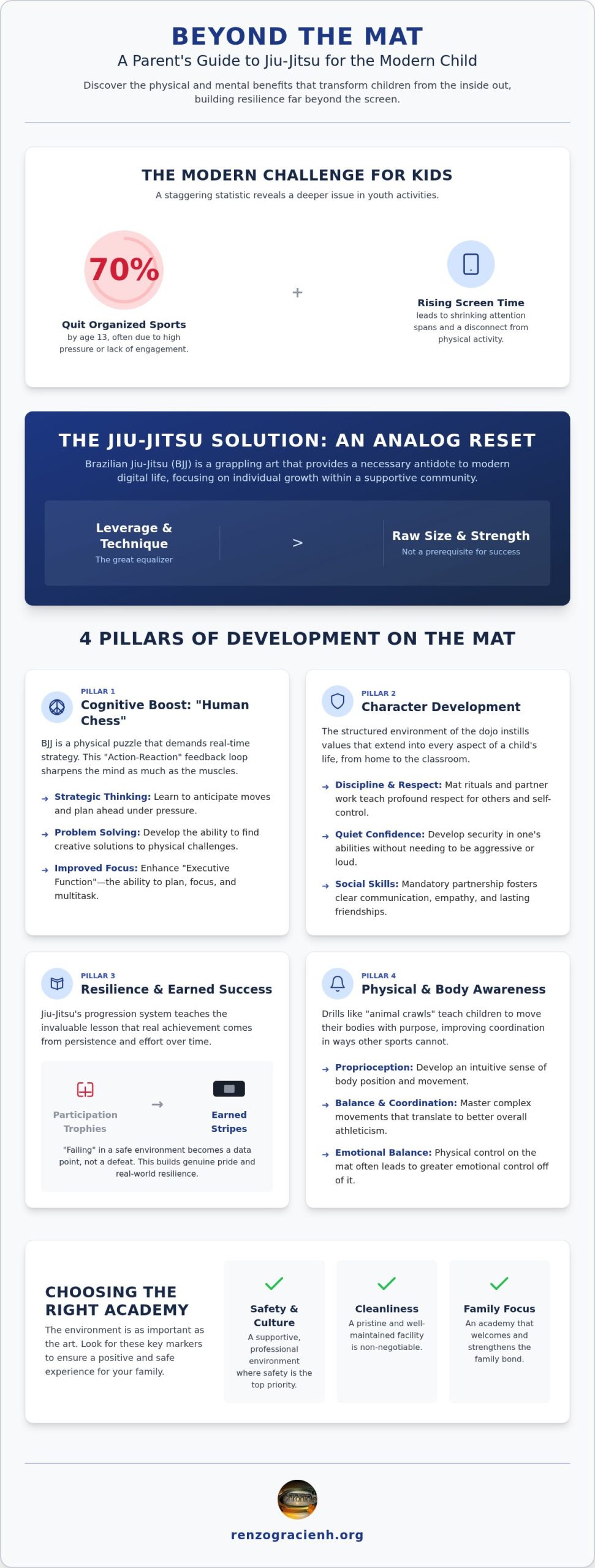
70% of children quit organized sports by the age of 13. It is a staggering statistic that often stems from a lack of genuine engagement or a high-pressure environment that stops being fun. You want more for your child. You see the struggle with screen time addiction and the quiet worry about schoolyard bullying. Understanding the specific jiu jitsu benefits for children can help you decide if this “analog” escape is the right fit for your family’s lifestyle.
We believe martial arts should be a supportive partnership in your child’s journey toward maturity. This 2026 guide explores how Brazilian Jiu-Jitsu serves as a physical laboratory for character development. Discover how a structured, non-violent curriculum transforms confidence and physical health while teaching kids to solve high-pressure problems with a cool head. We will preview ten surprising advantages that help your child build resilience, improve school focus, and master practical self-defense skills without ever learning to be a bully. It is time to trade the screen for the mat and watch your child evolve.
Key Takeaways
- Learn why Brazilian Jiu-Jitsu is considered “human chess” and how it sharpens your child’s strategic thinking through a unique action-reaction feedback loop.
- Discover the non-violent nature of grappling, which allows children to neutralize conflict and maintain control without relying on punches or kicks.
- Explore the significant jiu jitsu benefits for children regarding discipline, focusing on how the rituals of the mat translate into better behavior and respect at school.
- Understand the “Family Time” advantage and how training together in a supportive, professional environment strengthens the bond between you and your child.
- Identify the critical safety, cleanliness, and culture markers to look for when selecting the right academy for your family’s needs.
Beyond the Mat: Why Jiu Jitsu Benefits for Children Matter in 2026
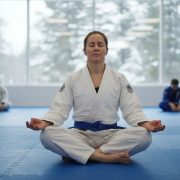
Screens dominate. Attention spans shrink. Digital noise is constant. Brazilian jiu-jitsu offers a necessary reset for the modern child. It is a grappling-based martial art that prioritizes leverage and technique over raw athletic power. For a child, this means they don’t have to be the biggest or strongest person in the room to succeed. They learn to move their bodies with purpose. This shift from digital “likes” to physical mastery is one of the primary jiu jitsu benefits for children. It grounds them in the present moment while teaching them that real progress takes time.
With 70% of children quitting organized sports by age 13, parents in Southern New Hampshire are looking for alternatives that offer more than just a season of play. They see the value in a discipline that focuses on the individual within a community. In places like Windham and Manchester, families are seeking “Quiet Confidence.” This is the ability to be secure in one’s skills without needing to act aggressively or seek attention. It is a disciplined strength that carries over into every part of life. It’s about being ready, not being loud. Families across the region are discovering that kids jiu jitsu New Hampshire programs offer exactly this kind of character-building environment for their children.
The Shift from Participation Trophies to Earned Success
Progress requires patience. In our academy, success isn’t handed out; it’s built. The belt and stripe system teaches kids that long-term persistence is the only way to advance. They learn that “failing” to escape a hold in a safe, controlled environment isn’t a defeat. It’s a data point. This process builds real-world resilience. Earning a stripe through consistent effort feels better than receiving a trophy just for showing up. It creates a sense of genuine pride that can’t be manufactured. They learn to value the work itself.
Jiu-Jitsu as a ‘Physical Laboratory’ for Social Growth
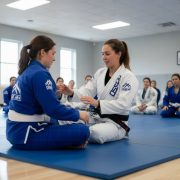
Mats are social spaces. Every class requires mandatory partnership and mutual respect. Children learn to navigate physical boundaries safely while working toward a common goal with their peers. This interaction fosters a unique bond between training partners. They aren’t just teammates; they are fellow problem solvers. By understanding how to respect a partner’s “tap” or physical space, kids develop deep-seated social skills that are often lost in digital-only interactions. They discover how to communicate with clarity and empathy. It is where lasting friendships are forged through shared effort.
The Cognitive ‘Human Chess’ of Brazilian Jiu-Jitsu
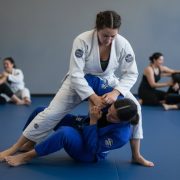
Brazilian Jiu-Jitsu is often called “Human Chess.” It is a fitting title. While many sports rely on raw speed or brute force, BJJ demands strategy. Every movement requires a plan. A child on the mats isn’t just exercising; they’re solving a physical puzzle in real time. This simultaneous physical and mental engagement is what sets grappling apart from traditional team sports. It forces the brain to stay active while the body works, creating a unique synergy that sharpens the mind as much as the muscles.
The secret lies in the “Action-Reaction” feedback loop. In jiu-jitsu, every action has an immediate physical consequence. If a partner pushes, the child must decide whether to pull, pivot, or frame. This constant stream of information requires intense focus. There is no room for digital distractions or wandering thoughts. This level of concentration is supported by scientific research on martial arts benefits, which highlights significant improvements in motor skills and self-confidence through disciplined practice. These cognitive jiu jitsu benefits for children are foundational for long term success.
We see a marked improvement in “Executive Function” among our students. This is the mental ability to plan, focus attention, and juggle multiple tasks successfully. On the mat, a child must anticipate their partner’s next move while executing their own. They learn to manage their energy and time. It is about making logical choices when the stakes feel high. Families interested in seeing this mental growth firsthand can start with a free introductory class at one of our locations.
Improving Proprioception and Body Awareness
Proprioception is the sense of self-movement and body position. It is how we know where our limbs are without looking at them. We develop this through “animal crawls” and technical drills. Bear crawls, crab walks, and shrimp movements improve coordination in ways that running or jumping cannot. This physical balance on the mat often leads to emotional balance off it. When a child understands how to control their body, they feel more in control of their world.
Developing Critical Problem-Solving Under Pressure
Think. Breathe. Move. We teach children to avoid panic when they find themselves in a difficult position. The “3-second rule” encourages them to pause and make a logical choice rather than reacting with fear. This ability to think clearly in high-stress moments is a life skill. Whether it is a difficult math test or a social conflict on the playground, the logic learned on the mats applies everywhere. They learn that every problem has a solution if they stay calm enough to find it.
Non-Violent Self-Defense: The Anti-Bullying Advantage
Safety is the priority. When parents consider martial arts for their kids, they often worry about teaching them to be aggressive. Brazilian Jiu-Jitsu flips this script. Unlike striking-based arts like karate or boxing, BJJ focuses on grappling. This distinction is vital for school environments. If a child is forced to defend themselves, they don’t need to throw a punch or a kick that could cause injury or lead to school suspension. Instead, they learn to control the situation. They use holds and pins to neutralize a conflict until an adult arrives. This non-violent approach is a cornerstone of the jiu jitsu benefits for children that we emphasize in our curriculum.
Knowing how to fight often removes the need to do so. It is a paradox of the mats. When a child knows they can handle a physical confrontation, their body language changes. They walk with their head up. They look people in the eye. This psychological “Bully-Proof” shield is powered by genuine self-esteem. Bullies typically look for easy targets who appear uncertain or afraid. A jiu-jitsu student projects a quiet authority that signals they aren’t an easy mark. They become secure without being aggressive. It is about having the tools but choosing peace.
The Power of Leverage Over Force
Size doesn’t have to dictate the outcome. We teach smaller children how to use leverage to neutralize larger opponents safely. By understanding weight distribution and body mechanics, a child who isn’t naturally “athletic” can still find success. They learn that a well-placed hip or a specific grip is more powerful than raw muscle. This empowering realization helps kids realize they aren’t helpless. You can read more about How BJJ Helps Children Overcome Bullying to understand the science behind these techniques.
Verbal Assertiveness and Situational Awareness
Words are the first line of defense. We don’t just teach physical moves; we teach “The Voice.” This involves using clear, assertive language to set boundaries before any physical contact occurs. Children learn to identify “red flag” behaviors in social settings. We role-play de-escalation scenarios in a controlled environment so they can practice staying calm. Key skills include:
- Maintaining direct eye contact to project confidence.
- Establishing a safe physical distance to prevent surprises.
- Using a firm, level tone that avoids escalation.
This situational awareness ensures they are rarely caught off guard. It builds the confidence to handle social friction with maturity and grace. One of the most lasting jiu jitsu benefits for children is this ability to navigate the world with a calm, observant mind.
Character Development: Respect, Discipline, and Focus
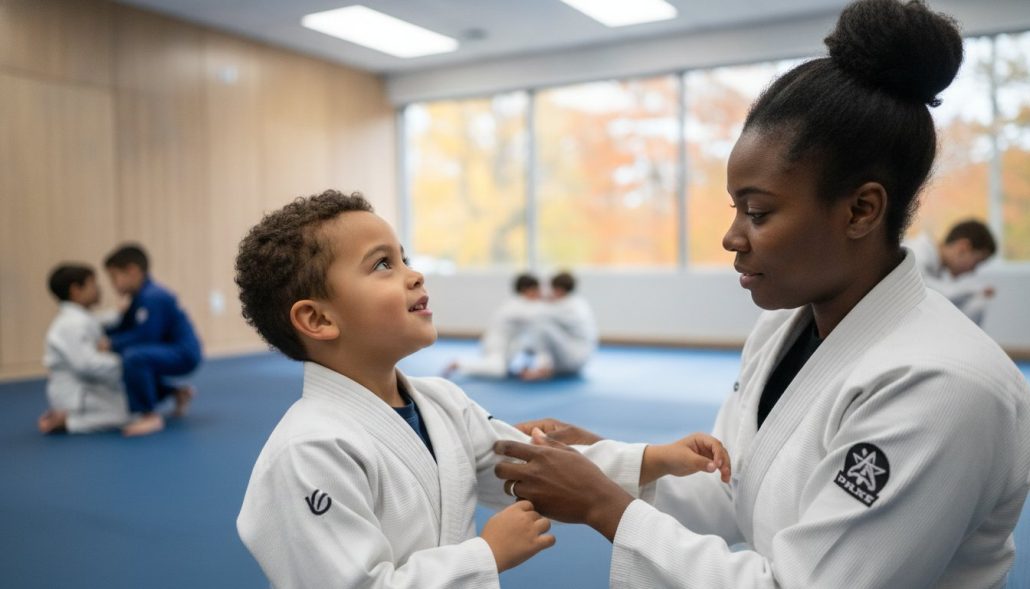
Every class begins and ends with a bow. It isn’t just a tradition. It is a signal. This ritual marks the transition from the noisy outside world to a space of mutual respect. Children learn to acknowledge their instructors, their training partners, and the mats themselves. This structured environment provides a predictable framework where kids feel safe to push their limits. These foundational jiu jitsu benefits for children create a standard of behavior that carries far beyond our academy walls. Respect becomes a habit rather than a requirement.
Discipline is a muscle. It grows stronger with every session. When a child practices showing up, tying their belt, and following a complex series of movements, they are training their brain to handle difficult tasks. We often hear from parents that this “mat focus” translates directly to better classroom behavior. A child who can focus on a technical sweep for ten minutes finds it much easier to focus on a math assignment or a reading list. This same discipline helps at home with chores and following through on family commitments. They learn that consistency is the key to progress.
The Role of the Instructor as an Authoritative Mentor
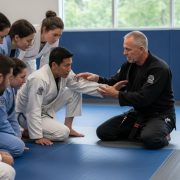
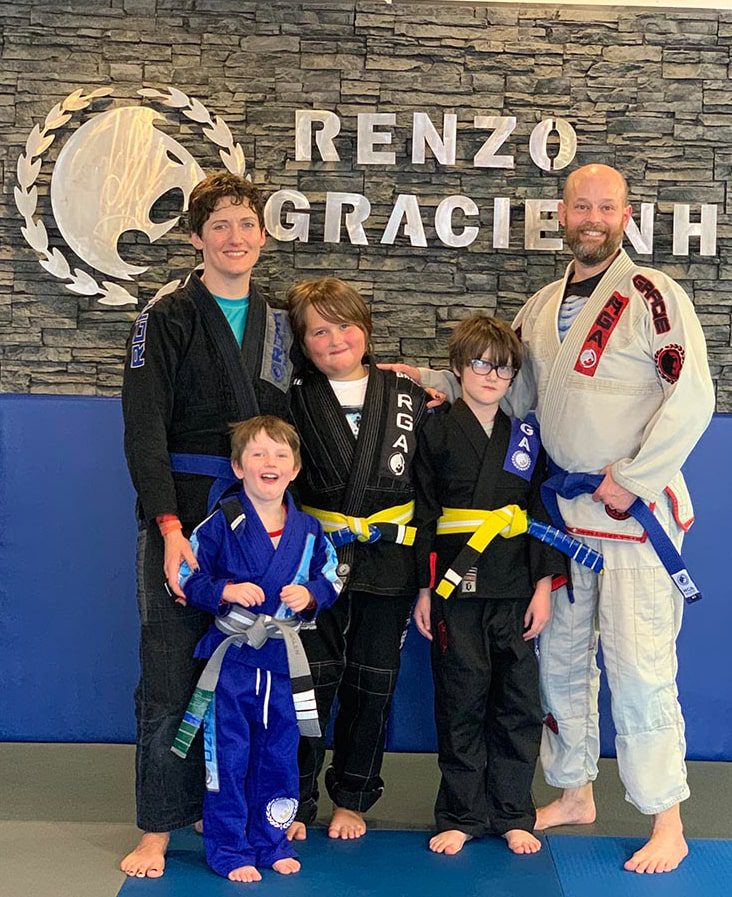
Children respond to authority that is earned. A black belt represents years of grit and dedication. At Renzo Gracie NH, our students train under the quiet authority of Professor Kevin Landry, a 6th-degree black belt with a direct lineage to the legendary Renzo Gracie. This level of expertise creates a unique mentorship dynamic. Kids don’t just follow rules because they are told to; they follow them because they respect the person leading the class. They see a model of disciplined confidence they want to emulate in their own lives.
Delayed Gratification in an Instant-World
We live in a world of instant feedback. Apps give immediate rewards, and social media provides constant validation. The jiu-jitsu mat offers a different lesson. There are no participation trophies here. Success is earned through persistence. The road to the next belt is long, which is exactly why it is valuable. We use a stripe system to celebrate small wins and keep motivation high. This teaches children the value of delayed gratification. They learn that the most meaningful achievements require patience and a refusal to quit when things get tough.
Ready to see your child develop this level of grit and character? You can sign up for a free introductory class at any of our New Hampshire locations to see our community in action.
Choosing the Right Kids Jiu Jitsu Program in New Hampshire
Selecting a martial arts home for your family is a significant decision. It is about more than just finding a convenient schedule. You are choosing a community that will help shape your child’s character. When you visit a local academy, look for three pillars: cleanliness, safety, and culture. The mats should be pristine. The instructors should be attentive. Most importantly, the atmosphere should feel welcoming rather than intimidating. This environment is essential to unlocking the full jiu jitsu benefits for children, ensuring they feel secure enough to take risks and grow.
Structure is the foundation of success. A quality program doesn’t just offer “organized chaos.” It provides a curriculum tailored to specific age groups. Ask to see the lesson plans. A professional academy will have a clear path for progression that balances technical skill with fun, engaging drills. In New Hampshire, where long winters often lead to increased screen time, having a structured “analog” escape is vital. It gives your child a productive outlet for their energy while building the executive function skills they need for school. We believe in being a supportive partner in this process, prioritizing your child’s well-being over competition trophies. Parents researching the best kids jiu jitsu New Hampshire programs will find that a structured curriculum focused on individual growth is the hallmark of a truly exceptional academy.
Don’t overlook the “Family Time” advantage. Training doesn’t have to be a solo activity for your child. Some of the strongest bonds are formed when families share the mat. We offer specialized sessions that allow you to experience the journey alongside your child. It turns a weekly chore into a shared lifestyle of health and discipline. Before you commit, always insist on a trial period. A free introductory class is the best way to see if the academy’s rhythm matches your family’s needs.
The Renzo Gracie NH Legacy in Windham and Beyond
Our roots run deep in the Granite State. With locations in Windham, Manchester, and Exeter, we provide a prestigious lineage that is accessible to everyone. We focus on personal progress and collective effort rather than just creating elite competitors. This inclusive approach makes our academy a true community hub. For a deeper look at how we structure our classes, explore our Youth Martial Arts Program New Hampshire guide.
Getting Started: Your Child’s First Class
First-day jitters are normal. We make the transition easy. For the first session, your child just needs comfortable athletic gear and a water bottle. We handle the rest. Our instructors are experts at making new students feel at home from the moment they step onto the mat. They will be introduced to the basic movements and the “Human Chess” logic of grappling in a way that feels like play. It is the first step toward a lifetime of confidence. You can Book a Free Introductory Class at Renzo Gracie NH today to begin your child’s transformation.
Empower Your Child’s Future on the Mats
Your child’s journey toward maturity doesn’t have to be a solo struggle against screen time or social pressure. We’ve seen how Brazilian Jiu-Jitsu acts as a physical laboratory where kids learn to solve high-pressure problems with a cool head. By focusing on leverage over force, they gain the skills to neutralize conflict without aggression. These jiu jitsu benefits for children provide a lasting foundation of discipline and respect that carries directly into their schoolwork and home life.
At Renzo Gracie NH, we prioritize the success of the family unit above all else. Led by 6th-degree black belt Kevin Landry, our supportive community is designed to be a place for growth rather than just competition. With convenient locations in Windham, Manchester, and Exeter, we’re ready to help your child discover their own potential in a safe, professional environment. It is time to trade digital distractions for the strength found in collective effort. You can start your child’s journey with a free intro class and watch them evolve into a more confident, focused version of themselves. We look forward to welcoming your family into our academy.
Frequently Asked Questions
Is Jiu-Jitsu too rough for a small child?
Jiu-Jitsu is fundamentally safe because it focuses on control rather than impact. Our instructors prioritize a non-violent environment where kids learn to move their bodies with precision. We don’t use strikes or kicks. Instead, children learn to neutralize situations through leverage and weight distribution. It is a disciplined approach that ensures every student feels secure. They build strength without the risks associated with high-impact sports.
What is the best age for a child to start Jiu-Jitsu?
Most children are ready to begin their journey between the ages of four and six. At this stage, they have developed the motor skills and social maturity needed for a structured class. We offer specialized kids jiu-jitsu programs tailored to different developmental levels. Every child is unique. We recommend a free introductory class to see if your child feels comfortable and engaged with our teaching rhythm.
How does BJJ help with a child’s focus in school?
The intense concentration required on the mats translates directly to the classroom. This is one of the most significant jiu jitsu benefits for children. Students must solve physical puzzles in real time, which sharpens their executive function and ability to plan. They learn to ignore distractions and stay present. This mental grit helps them tackle difficult homework assignments and stay focused during long school days.
Will my child learn to be aggressive or a bully?
Jiu-Jitsu actually decreases aggression by building genuine self-esteem. A child who knows they can defend themselves rarely feels the need to prove it. Our curriculum emphasizes respect, humility, and de-escalation. We teach students that their skills are for protection, not for intimidation. This quiet confidence acts as a shield. It helps them navigate social friction without ever becoming a bully themselves.
How often should my child attend classes to see benefits?
Attending classes two to three times per week provides the best balance for growth. Consistency is the key to mastery. This frequency allows children to retain what they learn while still having time for school and other family activities. It builds a steady momentum. They see their progress through our stripe system, which keeps them motivated to keep showing up and working hard.
Do I need to buy a lot of expensive equipment to start?
You don’t need a significant investment to get started. For the first few sessions, comfortable athletic clothing is usually enough. Once your child decides to continue, the primary requirement is a traditional uniform, or Gi. We don’t require a long list of expensive pads or gear. We keep things simple so the focus stays on the quality of instruction and the growth of the student.
What makes the Renzo Gracie lineage different for kids?
The Renzo Gracie lineage offers a world-class curriculum delivered with a supportive, community-focused touch. Training under a 6th-degree black belt like Kevin Landry ensures your child receives the highest level of technical instruction. We move away from the intimidating atmosphere of competition-only gyms. Our approach is professional yet warm. We focus on the individual success of every student within our prestigious family-oriented environment.
Can parents train at the same time as their children?
We offer specialized “Family Time” sessions so parents and children can grow together. These classes strengthen the bond between family members through shared effort and mutual learning. It turns exercise into a collective lifestyle. While we have separate programs for different age groups, our community atmosphere ensures the whole family feels at home. Training together is a powerful way to model discipline for your children.