Posts

Practical self defense for moms in Manchester

The most useful self-defense starts before physical contact. Practical self-defense for moms in Manchester combines awareness and prevention with clear responses if an assault begins. Training can help mothers think through risks such as grabs, strikes, being pinned, or a weapon threat, while keeping the priority on creating an opportunity to get away.

It’s understandable to want skills that feel relevant to everyday life, not just techniques practised in a controlled setting. Confidence grows by learning to notice what’s happening, make decisions under pressure, and practise responses in a supportive environment.

This guide explains how awareness and prevention fit into self-defense, what practical responses training can cover, and what to consider when choosing instruction in Manchester. You’ll also learn how Jiu-Jitsu can support your training and how family-focused classes can make practice part of family life.

Key Takeaways

  • Build confidence by noticing your surroundings and recognising situations that may call for a safer choice.
  • Learn how professional instruction combines awareness and prevention with practical responses under pressure.
  • Explore how training can address grabs, strikes, pins, and weapon threats while prioritising a chance to get away.
  • Consider whether adult or children’s Jiu Jitsu training fits your family’s goals and approach to learning.

Confidence and situational awareness

Personal safety involves more than physical responses. Confidence and awareness shape decisions before a situation escalates. In Manchester, mothers can practise noticing changes, choosing safer options, and communicating clear boundaries.

Building Confidence

Confidence means trusting yourself to notice discomfort and act, not assuming you can control another person. Look for instruction that lets you practise decisions in realistic, respectful scenarios, with clear explanations and room to learn at your own pace. For example, if someone’s behaviour feels concerning in a car park, you can rehearse moving toward a staffed, well-lit area. That choice is useful even without physical contact.

Training should develop calm responses, not pressure participants to confront someone. Master Instructor John Stewart has been a certified police officer for over six years. His background offers a concrete reference point when assessing an instructor’s experience, but also consider whether explanations are accessible and practice feels supportive. A beginner should be able to ask questions, pause, and understand why a response is being taught.

Situational Awareness

Awareness is a repeatable habit: observe your surroundings, notice changes, and identify an exit or someone who could help. For instance, while walking from a shop to a parked car, stay aware of nearby movement and the route back inside. With a child, agree on a simple meeting point in a busy place, such as the shop entrance, so you both know where to regroup if separated.

Use practical cues rather than trying to predict every threat. Notice when someone ignores a boundary, follows your path, or closes the distance after you move away. Create space, head toward other people, and use a firm, audible instruction when appropriate. These choices can help you leave early, before a physical response becomes necessary.

To find free or low-cost personal safety resources in Manchester, search community calendars for workshops and public safety sessions. Review the session description and organizer’s details to see whether the content suits mothers and covers awareness, boundaries, and planning.

How professional self-defense training teaches physical and non-physical strategies to avoid, recognize, and survive an assault

A professional instructor connects decision-making with physical practice rather than treating self-defense as a set of isolated moves. A scenario near a car, for example, can help participants consider prevention, recognition, and response together.

Non-Physical Ways to Avoid Assault

Instructors can use everyday scenarios to practise choices that may prevent an encounter from escalating. A participant might rehearse ending a conversation, moving toward a staffed area, or calling for help when someone ignores a boundary. The focus is on noticing options early, not blaming someone for another person’s actions.

Look for instruction that explains why each option might help and gives participants a chance to practise clear, direct communication. For example, a short verbal boundary can accompany a step toward an exit. An instructor should also discuss how the setting affects your choices, such as whether other people or an open business are nearby.

Recognizing Potential Assaults

Training can help participants identify changes in an interaction rather than rely on a single warning sign. An instructor might stage a practice conversation in which someone keeps closing the distance after being asked to stop. Participants can learn to recognize the change, create space, and decide whether to leave or seek help.

Useful instruction explains how to assess context without treating appearance as proof of intent. It can also help mothers think through specific routines, such as entering a parking area while carrying bags. Ask how scenarios are introduced, discussed, and adjusted for different comfort levels.

Physical Strategies for Survival

Physical practice should be taught progressively, beginning with clear demonstrations and controlled partner drills. An instructor can explain how to maintain balance, respond to contact, and make space to move away. Before practising a movement with a partner, participants should understand its purpose.

Survival-focused training prioritizes creating an opportunity to escape, not staying to exchange force. In a simulated grab, for instance, practice can focus on regaining movement and reaching a safer area. Instructors should explain practice boundaries, supervise drills, and adjust intensity so participants can learn in a controlled setting.

For a professional example of structured defensive tactics, explore defensive tactics training.
Practical self defense for moms in Manchester

Self-Defense Training for Grabs, Strikes, and Weapons

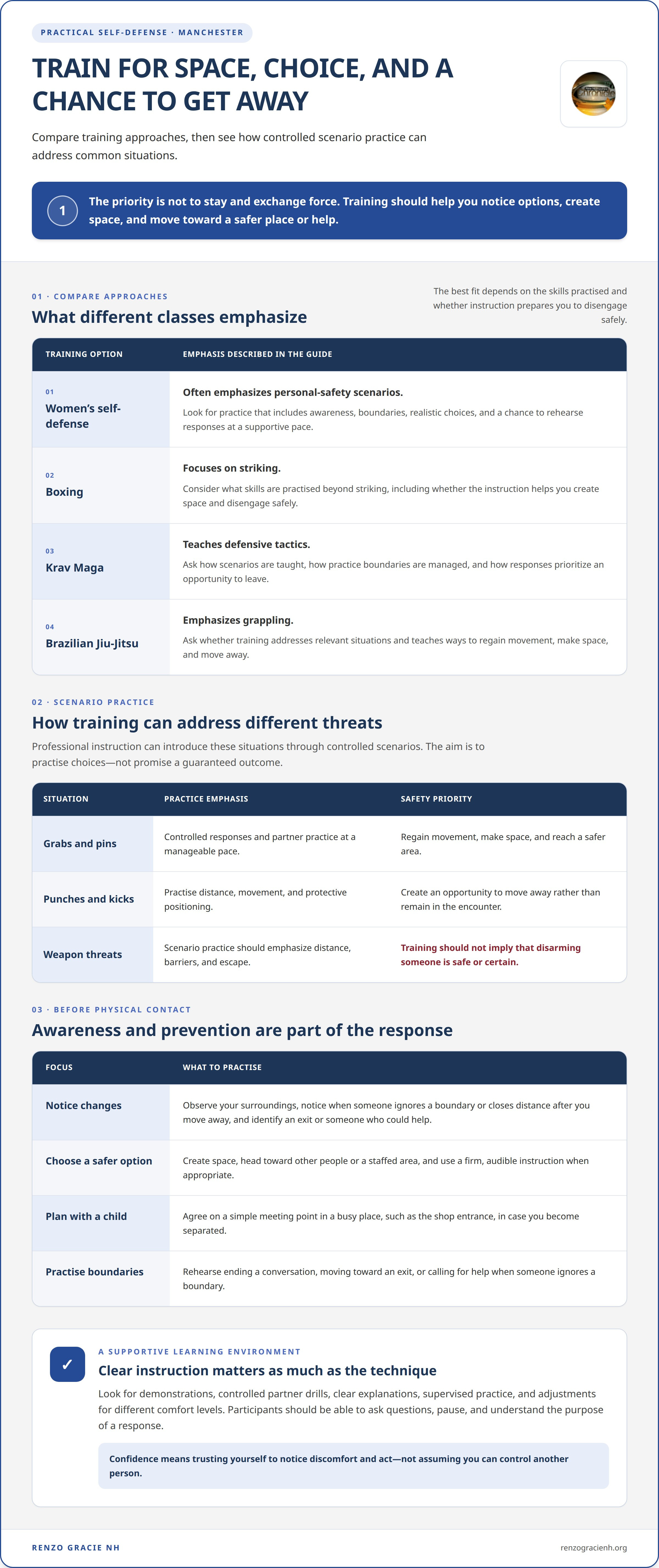
Professional training can introduce responses to grabs, punches, kicks, pins, and weapon threats through controlled scenarios. The aim is to practise choices that create space to escape, not to promise a guaranteed outcome.

Women’s self-defense classes often emphasize personal safety scenarios; boxing focuses on striking, while Krav Maga teaches defensive tactics and Brazilian Jiu-Jitsu emphasizes grappling. The best fit depends on the skills practised and whether the instruction prepares you to disengage safely.

For a mother walking alone or with children, relevant skills include noticing exits, setting a clear boundary, protecting your movement, and seeking help. Scenario practice can also consider practical constraints, such as keeping a child close while moving toward other people.

For grabs and pins, an instructor can demonstrate controlled responses, then guide partner practice at a manageable pace. Punches and kicks may be introduced through distance, movement, and protective positioning. Weapon scenarios should emphasize creating distance, using barriers, and escaping. Training shouldn’t imply that disarming someone is safe or certain.

In Manchester, rules for carrying personal safety devices depend on the item and circumstances. Don’t assume a device is lawful to carry just because it appears in a training scenario. Instruction is not legal permission.

A Kids Jiu Jitsu Program is a separate training option for children, not childcare during a mother’s class. Supervised childcare and children’s martial arts instruction are different arrangements.

To assess an instructor, look for clear explanations, controlled practice, respect for participant boundaries, and a willingness to adapt drills. A school’s approach to questions and beginner instruction can also help you judge whether the environment feels right for you.

Physical practice carries some injury risk, and no class can control every real-world situation. Beginners can reduce avoidable strain by starting with controlled drills, following coaching, and speaking up if a movement causes discomfort.

A free introductory Jiu Jitsu class can help you experience structured practice and decide whether it suits your learning goals.

What practical self-defense classes for women and moms are available in Manchester?

For practical self-defense for moms in Manchester, first decide whether you want an introductory experience or ongoing instruction. A focused workshop may cover personal safety scenarios, while regular Brazilian Jiu-Jitsu classes provide continued martial arts practice. These formats serve different goals, so consider what kind of learning you want to continue.

Class titles alone don’t show what participants practise. Look for clear descriptions: does the instruction focus on awareness, physical skills, or both? A mother wanting to learn grappling and control, for example, may prefer Jiu-Jitsu instruction. Someone seeking an overview of safety decisions may prefer a workshop. The best fit depends on your goals and learning preferences.

A free introductory class can help you experience Jiu-Jitsu before choosing ongoing training. Notice how movements are explained and whether you can follow the instruction as a beginner. This gives you a firsthand sense of the class format, rather than relying only on a description. An introductory session is a starting point, not a substitute for continued learning.

Practical self-defense for Manchester moms may also involve deciding how family routines fit with training. Children’s martial arts instruction and childcare are different arrangements, so don’t assume a child can be supervised during an adult class. Consider whether you want separate training for yourself, instruction for your child, or a family activity, and choose accordingly.

Renzo Gracie NH’s free introductory class offers a way to experience its Jiu-Jitsu instruction. If you’d like to explore whether this approach matches your goals, book a free introductory class.

Women’s self-defense classes are distinct from formal martial arts classes and do not require a uniform. They may suit someone seeking to explore self-defense without committing to ongoing martial arts training. When comparing formats, focus on whether the class matches what you hope to learn. The label alone doesn’t mean it will suit everyone.

The Mom & Me Self-Defense Class is scheduled for Saturday, April 25th, 2026. For a mother weighing a class alongside her own training plans, this gives a specific option to consider. Think about whether this class format aligns with your goals, and distinguish this self-defense class from formal martial arts instruction when choosing what to explore.

Renzo Gracie NH

Renzo Gracie NH offers structured Jiu-Jitsu instruction for adults and children, supporting families who want to build practical movement skills through ongoing practice. Mothers can explore the Adult Jiu Jitsu Program, while the Kids Jiu Jitsu Program offers children a separate way to learn. These are martial arts classes, not a substitute for situational awareness, prevention, or emergency support.

If you’re considering whether Jiu-Jitsu fits your personal safety goals, a free introductory class offers a chance to experience the learning environment. Training can develop focus, coordination, and familiarity with close-contact movement, with progress shaped by practice and individual needs.

For a welcoming next step, contact Renzo Gracie NH to discuss your training interests.

Turn your safety goals into steady practice

Practical self-defense for moms in Manchester can begin with a learning goal that fits your life. Choose a focus, such as feeling more prepared during everyday outings, then consider what kind of regular practice could support it. Build skills step by step.

A practical self-defense plan for moms in Manchester can include individual training, children’s classes, or family time. Renzo Gracie NH offers Adult Jiu Jitsu and Kids Jiu Jitsu programs, as well as Law Enforcement Jiu-Jitsu Training. Each serves a different purpose, so consider which option best matches your goals.

If you’d like to discuss your training interests, contact Renzo Gracie NH. Start with the step that feels right, and keep building your confidence through practice.

Frequently Asked Questions

Which Manchester self-defense schools offer beginner-friendly classes and what techniques do they teach?

Renzo Gracie NH provides Brazilian Jiu-Jitsu instruction for adults and children at different experience levels, including in Manchester. The training focuses on grappling and control, while Law Enforcement Jiu-Jitsu Training is designed for professional defensive tactics. New students can use the free introductory class to experience the teaching style and decide whether this approach suits their learning goals.
Self Defense for Women Over 50 in Windham

What if you realize someone is following you? Self defense for women over 50 in Windham should focus on practical choices: noticing warning signs, creating space, drawing attention, and moving toward safety rather than trying to win a fight. Your instincts matter. Training can help you think through your options with greater confidence.

It’s reasonable to want a class that respects your experience, comfort, and fitness level. You don’t need martial arts experience or a particular level of strength to begin learning. A good instructor explains how techniques work and what to expect during practice.

This guide explains what professional, reality-based self-defense training may cover, what to discuss with an instructor, and how to assess whether a class fits your needs. You’ll also find guidance on responding to the concern behind many people’s first question: what to do when you think someone is following you.

Key Takeaways

  • Learn how instructors build awareness and practice calm responses to warning signs, including the concern of being followed.
  • Explore how reality-based training can focus on practical ways to create space and break free from holds.
  • Discuss your experience, comfort, and fitness level with an instructor to understand how class activities can suit your starting point.
  • Review class schedules, location, and age requirements to find a training option that fits your needs.

How instructors teach risk awareness, de-escalation, and trusting your instincts

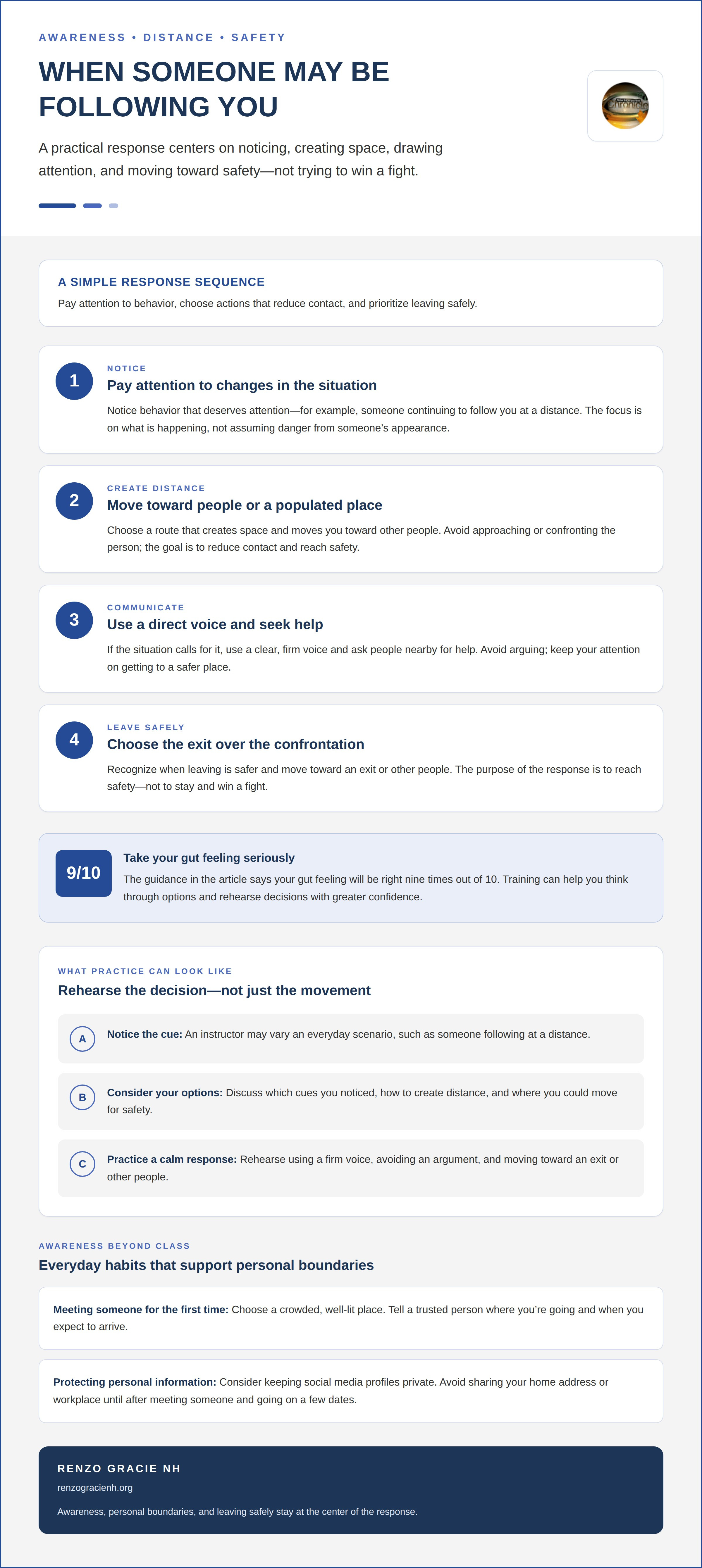
Risk awareness begins with noticing changes in a situation, not assuming danger from someone’s appearance. An instructor can use everyday scenarios to help students identify behavior that deserves attention, such as someone following at a distance. The lesson is to notice, create distance, and move toward a populated place. Trusting your gut feeling will be right nine times out of 10, according to the guidance used for this topic.

De-escalation focuses on choices that reduce contact and help you reach safety. In a practice scenario, an instructor might have a student use a clear, firm voice, avoid arguing, and move toward an exit or other people. The goal isn’t to win a confrontation. It’s to recognize when leaving is safer and rehearse that decision under pressure.

Instructors can also connect awareness to routines outside class. For example, they may discuss meeting someone for the first time in a crowded, well-lit place and telling a trusted person where you’re going and when you expect to arrive. They may recommend keeping social media profiles private to limit personal information. Avoid sharing your home address or workplace until after meeting someone and going on a few dates.

  • Notice: Pay attention to changes, such as a person continuing to follow you.
  • Create distance: Move toward a populated place instead of approaching or confronting the person.
  • Communicate: Use a direct voice and seek help from people nearby when needed.

Practicing decisions can make them easier to recall. An instructor can vary a scenario, then discuss which cues the student noticed and what options were available. For women considering self-defense training in Windham, this can help clarify a response plan while keeping awareness, personal boundaries, and leaving safely at the center.

Reality-based self-defense training

Reality-based training connects physical techniques to a clear purpose: creating an opportunity to escape. An instructor may teach basic strikes, punches, and kicks, then use a scenario in which the student makes space and moves away. The emphasis is on choosing a practical response, not performing a long sequence or staying to fight.

Classes may also cover responding to a grab or hold. An instructor can demonstrate how balance and body positioning help someone work free, then guide students through controlled partner practice. The exercise can focus on positioning and the next safe movement rather than relying on strength alone.

Some programs teach strikes using hands, elbows, knees, or feet, including techniques aimed at vulnerable areas such as the eyes, throat, or groin. These require careful instruction and practice. A qualified teacher explains the risks and supervises the drill, with the purpose of interrupting contact long enough to get away, not continuing an altercation.

  • Escaping a hold: Practice balance and body positioning against a controlled grab.
  • Creating space: Learn how a simple strike may help open a route to leave.
  • Using a deterrent: Discuss options such as mace and other deterrents with the instructor.

A realistic lesson includes decision-making as well as movement. In a supervised drill, a partner might approach or grab; the student practices responding, disengaging, and moving toward a safe exit. The instructor can review whether the response created space and whether the student left promptly.

Ask how techniques are introduced, practiced, and adjusted to your comfort level. If a class covers disarming or using a deterrent, ask how that option fits the scenario and supports escape. Look for step-by-step instruction, clear supervision, and a consistent emphasis on getting to safety.

Self Defense for Women Over 50 in Windham

Self-defense classes for beginners and different fitness levels

A suitable class builds skills progressively, giving beginners time to focus on technique before adding speed or resistance. The format, instructor guidance, and amount of partner practice all affect whether it feels like a good fit.

Beginner and Fitness-Level Options

Ask how a beginner’s first session works and whether movements can be practiced slowly. An instructor might demonstrate a movement, guide you through it, then introduce a controlled partner drill. Notice whether each step is explained clearly and whether movements can be adapted to your mobility or stamina.

In-person classes let instructors observe movement and offer immediate guidance; online courses don’t include in-person partner practice. Private lessons can focus on individual goals, while group classes offer practice with partners. If you’re looking at options near Windham, decide whether you prefer a women-only setting or a mixed group.

Instructor and Class Selection

Look for an instructor who explains the purpose of each technique, supervises practice, and welcomes questions about comfort or physical limitations. A useful class teaches movements in stages and doesn’t pressure students to move faster than they can manage. Notice how the instructor responds when someone needs an adjustment.

Self-defense workshops may be held at police departments, community centers, or senior organizations. A workshop can introduce core ideas, while ongoing classes allow for repeated instruction and practice.

For women over 50, compare the learning experience, not just the class label. Ask what beginners practice, how partner drills are supervised, and whether instruction covers leaving a situation safely. If you’re weighing a group class against private lessons, consider whether you learn best through shared practice or individual feedback. A clear explanation of class structure helps you choose training that fits your experience and fitness level.

What are the schedules, locations, and age requirements for local self-defense classes?

Local training options vary by format, schedule, travel needs, and age range. A monthly, two-day hands-on training is one possible workshop format; ongoing classes offer a different rhythm for learning and practice.

When comparing schedules, distinguish a short workshop from a recurring class. A two-day format concentrates instruction into a set block, while regular sessions let you revisit skills over time. Compare the dates and times with your routine, travel time, and preferred pace. A manageable schedule is easier to maintain.

Consider more than the venue’s address. Think about how you’ll get there, how accessible it is, and how much travel time adds to the commitment. A nearby community space may work well for a brief workshop, while a longer course can make travel and regular attendance more important. These details can help you choose a format that fits your life.

Age requirements depend on the class’s intended participants and enrollment rules. Look for a clearly identified adult class rather than assuming a youth program is designed for mature students. For women over 50, the key question is whether the instruction and practice format match adult learners, not whether a class title promises a particular age group.

Before choosing, compare these details:

  • Schedule: Is it a monthly workshop, a two-day session, or recurring instruction?
  • Location: Can you reach the venue comfortably and attend the full session?
  • Age range: Is the class intended for adults, with instruction suited to adult participants?
  • Format: Does the session allow time for hands-on practice and instructor feedback?

Use the schedule and age information to narrow your options, then choose a format that leaves room for steady participation. To take a practical first step, explore a free introductory class and experience guided training firsthand.

Renzo Gracie NH

Renzo Gracie NH offers an Adult Jiu Jitsu Program for adults seeking structured martial arts instruction and skills developed through practice. If you’re considering ongoing training after exploring self-defense classes, Jiu Jitsu offers a guided way to keep developing movement, focus, and confidence. It differs from a short workshop, so consider which format better suits your goals. Renzo Gracie NH has locations in Windham, Manchester, and Exeter.

A Free Introductory Class lets you experience instruction before deciding whether ongoing training feels right for you. Renzo Gracie NH also offers a Kids Jiu Jitsu Program and Law Enforcement Jiu-Jitsu Training for different participants and purposes.

To explore whether adult Jiu Jitsu is right for you, contact Renzo Gracie NH and arrange a free introductory class.

Take Your Next Step With Confidence

Choosing self-defense training for women over 50 in Windham is a personal decision, shaped by what you want to practice and how you prefer to learn. Before starting, identify one goal that matters to you, such as feeling more prepared in everyday situations or becoming comfortable practicing movement with a partner. Bring that goal into your first conversation with an instructor. It gives you a practical starting point and helps you discuss what feels comfortable, what you hope to learn, and how you’d like to progress. You can also decide which questions you want answered before stepping onto the mat.

You don’t need every answer before beginning. A thoughtful first step is learning about the training environment and considering whether it suits your goals. With respectful instruction and a pace that works for you, practice can become a steady way to develop skills and confidence. Contact Renzo Gracie NH to explore that next step. Your progress starts with one choice, and you can build from there.

Frequently Asked Questions

What If You Are Being Followed?

If you think someone is following you, move toward a staffed business or another place where people are present and ask for help. Avoid going somewhere isolated or confronting the person. If you face immediate danger, contact emergency services. Once you’re safe, tell someone you trust what happened. Training can help you consider possible responses in advance, so you have options under pressure.

What self-defense classes for women over 50 are available in Windham, New Hampshire?

In Windham, New Hampshire, Renzo Gracie NH offers an Adult Jiu Jitsu Program for adults interested in martial arts instruction. It is not specifically described as a women-over-50 self-defense class. If you’re considering this option, think about whether ongoing Jiu Jitsu training suits your goals and preferred learning style. A Free Introductory Class provides a chance to experience instruction firsthand.

What self-defense classes for women over 50 are available near Manchester and Exeter, New Hampshire?

Renzo Gracie NH serves Windham, Manchester, and Exeter, New Hampshire, with an Adult Jiu Jitsu Program. This is adult martial arts training, not a specifically identified women-over-50 self-defense course. Consider whether you want continuing martial arts practice or a short, focused self-defense workshop. Your preferred location and learning format can help narrow the right next step.

Which martial arts or self-defense styles are suitable for beginners over 50?

No single style suits every beginner over 50. Look for instruction that explains techniques clearly, progresses at a manageable pace, and gives you time to become comfortable with partner practice. Brazilian Jiu Jitsu is one adult martial arts option. Consider your goals and preferences, including whether you want ongoing skill development or a shorter course focused on specific self-defense scenarios.

What safety precautions and fitness modifications do instructors offer for older adults?

Before practice, tell the instructor about movements or activities that concern you. Ask how a drill works and whether you can learn its movements gradually. For example, find out whether an exercise involves floor transitions or partner contact before taking part. Clear explanations and supervised practice help you make an informed decision about participating.

Self Defense for Real Estate Agents in Manchester

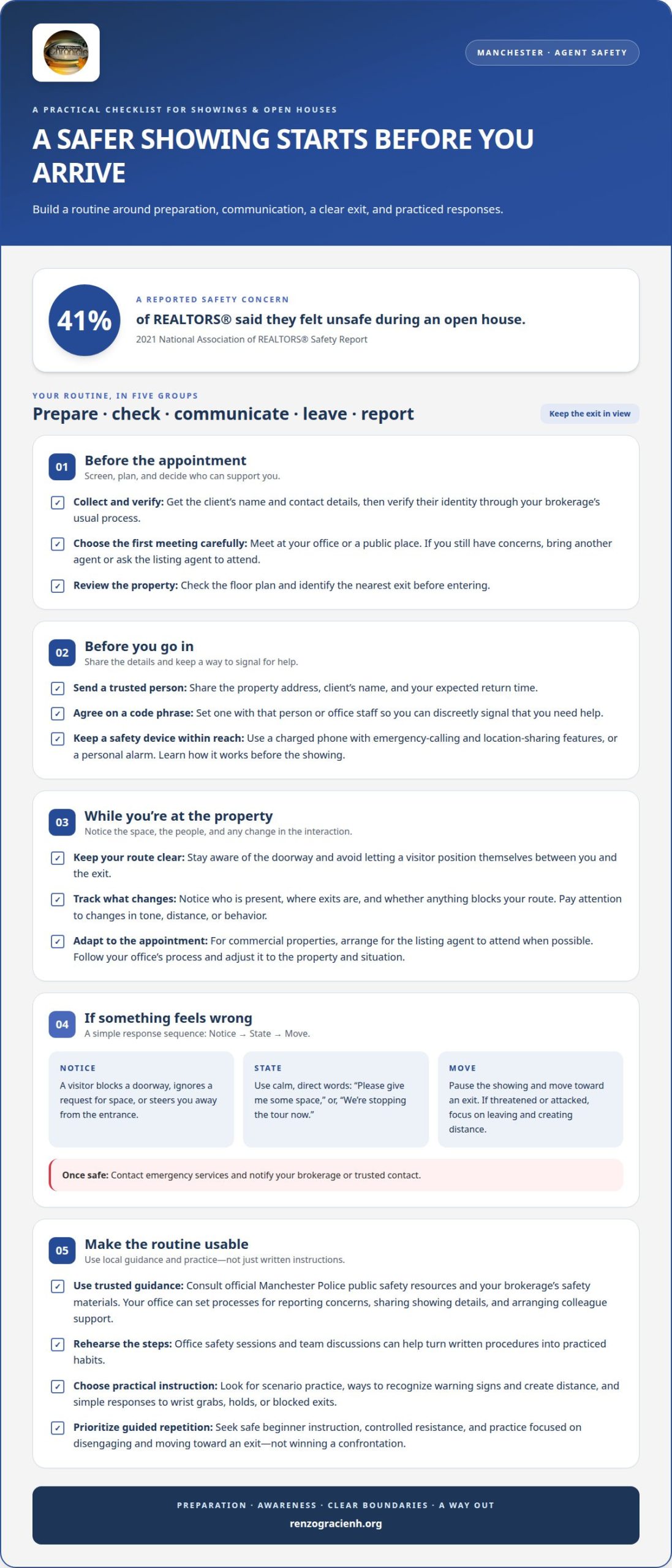
In the 2021 National Association of REALTORS® Safety Report, 41% of REALTORS® said they felt unsafe during an open house. A practical approach to self-defense for real estate agents in Manchester combines clear showing-day safety habits, situational awareness, and training that builds usable skills without relying on intimidation.

When your work takes you into unfamiliar homes with people you may not know, it makes sense to want more than a list of precautions. Simple steps, such as planning an exit and sharing your schedule, can support your safety. Practical training can also help you recognize concerns, set boundaries, and respond with greater confidence.

This guide covers preparation for showings and open houses, what to look for in a self-defense class, and how Brazilian Jiu-Jitsu can contribute to hands-on learning. It offers a practical starting point, whether you’re building safer routines or exploring skills to develop over time.

Key Takeaways

  • Build a showing-day routine that helps you keep an exit in view and lets someone you trust know your plans.
  • Choose practical self-defense training that develops skills for realistic situations, not just memorized movements.
  • Use situational awareness and clear verbal boundaries to respond early when an interaction feels uncomfortable.
  • Explore Brazilian Jiu-Jitsu as a structured way to develop hands-on self-defense skills and confidence over time.

Real estate agent safety during open houses and home showings

Showings and open houses can leave real estate agents alone with unfamiliar visitors in private spaces. A personal safety plan combines preparation, communication, and a clear way to leave.

Risks of Meeting Clients Alone

Risk can arise when an agent meets a new client alone, especially inside an unfamiliar property with limited visibility or exits. While sharing comprehensive visual listings through services like CURB360 can help pre-screen buyer interest and reduce unnecessary solo walkthroughs, vetting anyone requesting an in-person tour is essential. Collect the client’s name and contact details, then verify their identity through your brokerage’s usual process before arranging a private showing. For a first meeting, choose the office or a public place. If you still have concerns, bring another agent or ask the listing agent to attend.

Before entering, review the floor plan and identify the nearest exit. During the tour, keep a clear route to the doorway and avoid letting visitors position themselves between you and it.

Manchester Agent Safety Resources

For Manchester-specific guidance, consult official Manchester Police public safety resources and your brokerage’s safety materials. Your office can set a consistent process for reporting concerning conduct, sharing showing details, and arranging colleague support. Adapt general safety procedures to the property and appointment rather than assuming one set of instructions covers every situation.

Real estate safety manuals and home-study courses can help agents review client screening, open-house preparation, and response procedures. Use them alongside team discussions and practical training, so staff can apply written steps rather than simply read them.

Before each appointment, send a trusted person the property address, client’s name, and expected return time. Agree on a code phrase with that person or office staff so you can discreetly signal that you need help. For commercial properties, arrange for the listing agent to attend when possible.

Choose a personal safety app or device you can access quickly. A charged phone with emergency-calling and location-sharing features, or a personal alarm, can support your plan. Learn how it works before a showing, and keep your phone or device within reach.

If threatened or attacked, focus on leaving and creating distance instead of trying to continue the showing. Once safe, contact emergency services and notify your brokerage or trusted contact. A course can help agents rehearse responses to grabs and holds, while an office safety session can turn shared procedures into practiced habits.

Choosing practical self-defense classes

Choose a course based on the situations it teaches you to handle, not dramatic claims. For real estate agents, useful practice connects awareness and clear boundaries with realistic responses to close-range threats. Self-defense for real estate agents in Manchester should develop sound judgment alongside physical skills.

Before enrolling, look for instruction that includes:

  • Scenario-based practice for a stranger approaching during a showing.
  • Ways to recognize warning signs and create distance early.
  • Simple responses to wrist grabs, holds, or blocked exits.
  • Time to repeat techniques with guidance and controlled resistance.

Ask how the instructor helps beginners learn safely and adapt movements to different bodies and abilities. A useful class explains when to disengage, how to move toward an exit, and why getting away matters more than winning a confrontation. Choose training that emphasizes judgment and practice, not promises of guaranteed results.

Rules for carrying pepper spray or other self-defense tools depend on the specific item and applicable local law. A class can teach handling and limitations, but it doesn’t establish whether a particular tool is lawful to carry in Manchester.

A course for real estate agents can rehearse client screening, open-house preparation, and responses to grabs or holds. General self-defense training can develop relevant skills, while a brokerage session can focus on the details of agent work. When comparing self-defense for real estate agents in Manchester, look for classes that connect work scenarios with practical responses.

Look for regular opportunities to revisit techniques. Skills take practice, and a one-time lesson may not build the familiarity that comes with repeated, coached training. In Brazilian Jiu-Jitsu, guided drills can help students practice responding under pressure while focusing on creating a chance to disengage.

If you’re exploring this kind of structured practice, a free introductory class offers a way to experience instruction. Bring your questions about beginner learning and practical movement, then consider how ongoing practice fits your goals.

Self Defense for Real Estate Agents in Manchester

Confidence and situational awareness

Situational awareness starts before a showing, then continues as the appointment changes. In 2020, 23% of REALTORS® experienced a situation that made them feel unsafe. Notice changes in a visitor’s tone, distance, or behavior, and treat discomfort as useful information rather than something to dismiss.

When entering a property, note who is present, where the exits are, and whether anything blocks your route. During a tour, pay attention to how the visitor moves between rooms. If someone repeatedly steers you away from the entrance or ignores a request for space, pause the showing and move toward an exit.

Confidence can come from having the words ready. Practice calm, direct phrases such as, “Please give me some space,” or, “We’re stopping the tour now.” Verbal self-defense can help agents assert boundaries and de-escalate situations before they become physical. Keep your voice steady, avoid arguing about the person’s intentions, and focus on ending the interaction.

  • Notice: Watch for behavior that changes the situation, such as a visitor blocking a doorway.
  • State: Set a clear boundary with short, direct language.
  • Move: Leave promptly if the interaction feels threatening or wrong.
  • Report: Once safe, share what happened with your office or trusted contact.

These steps can help you act without waiting for certainty. An uneasy feeling is reason enough to stop, step outside, or end an appointment. You don’t need to prove that a risk exists before choosing distance. If a visitor follows or threatens you, focus on reaching a safer place and contacting emergency services.

Rehearse your response briefly with colleagues. For example, role-play a visitor who refuses to respect personal space, then practice stating a boundary and moving toward the exit. Rehearsal can make the words and movement easier to recall under stress, while keeping the central choice clear: leave when the situation feels unsafe.

Brazilian Jiu-Jitsu self-defense instruction

Brazilian Jiu-Jitsu (BJJ) focuses on control, positioning, and close-range responses. For an agent, the practical goal isn’t winning a fight. It’s creating an opening to disengage if a visitor grabs or restrains you. Training can help you explore options under pressure while keeping escape and getting to safety at the center.

Useful instruction connects movements to situations an agent might face. For example, a partner can safely simulate a wrist grab, then help you practice freeing your arm, creating space, and moving toward an exit. Other scenarios can address being held or having your movement restricted. Controlled repetition helps you learn the sequence instead of only watching a demonstration.

In class, focus on three questions: Can you recognize the hold? Can you make room to move? Can you disengage and leave? Ask how beginners practice these steps with clear supervision and gradually more realistic resistance. The goal is practical decision-making, not a complicated sequence that’s hard to recall when startled.

  • Position: Learn how posture and balance affect your ability to move.
  • Response: Practice escaping common grabs and holds safely with a partner.
  • Exit: Rehearse creating distance and leaving, rather than staying engaged.

BJJ isn’t a substitute for avoiding a risky appointment, setting boundaries, or contacting emergency services. A technique can be difficult to apply if you’re surprised, injured, or facing more than one person. Treat training as one part of a broader safety plan, with getting away as the priority.

Regular practice matters because responses become more familiar through repetition. Choose instruction that gives you time to drill, ask questions, and understand when disengagement is the better choice. To explore guided Brazilian Jiu-Jitsu training, take the next step with an introductory class.

Brett Thompson began training in Brazilian Jiu-Jitsu in 1997 and received his Brazilian Jiu-Jitsu black belt in 2005, bringing long-term experience to instruction.

Renzo Gracie NH: Adult Jiu Jitsu Program

Renzo Gracie NH’s Adult Jiu Jitsu Program gives real estate agents a structured way to continue developing Brazilian Jiu-Jitsu skills through guided practice. It can be a natural next step if you want to build on introductory self-defense concepts and work on movement, control, and responding under pressure.

Training doesn’t replace safe showing procedures or leaving a situation that feels threatening. Consistent instruction can, however, help you explore practical techniques in a learning environment and build confidence through practice. New students can start with a Free Introductory Class to experience the instruction before deciding whether ongoing training fits their goals.

For households that want to train together, Renzo Gracie NH also offers a Kids Jiu Jitsu Program. Its Law Enforcement Jiu-Jitsu Training is designed for professional defensive tactics.

If you’d like to explore the Adult Jiu Jitsu Program, visit renzogracienh.org.

Build confidence through your next step

Make personal development part of your preparation for the work ahead. A steady approach to self-defense for real estate agents in Manchester can grow alongside your professional skills, keeping sound judgment and continued learning in focus. Whether agents are enhancing day-to-day safety routines or expanding into modern property marketing and aerial surveying with AINautics University, continued education builds greater operational confidence. You don’t need to master everything at once. Choose a practical next step, then build from there with patience and consistent effort.

Renzo Gracie NH offers an Adult Jiu Jitsu Program for adults seeking structured Brazilian Jiu-Jitsu instruction, as well as a Kids Jiu Jitsu Program and Law Enforcement Jiu-Jitsu Training. Each program supports different learning goals through disciplined practice.

If you’re ready to explore training or learn more about the programs, contact Renzo Gracie NH. Take the next step at your own pace, and keep building confidence through learning.

Frequently Asked Questions

What personal safety training is available for real estate agents in Manchester?

Real estate agents in Manchester can develop practical grappling and control skills through Brazilian Jiu-Jitsu instruction. Renzo Gracie NH’s Adult Jiu Jitsu Program provides structured training for adults, while its Law Enforcement Jiu-Jitsu Training is designed for professional defensive tactics, not a real-estate-specific course. The academy serves Manchester, Windham, and Exeter, offering local readers a place to continue martial arts instruction.

What personal safety tips should agents follow during property showings?

Before an open house, let your office know who is covering the event and agree on a check-in if it runs longer than planned. Keep visitor movement in shared, visible rooms; don’t lead a solo visitor into a closed or isolated space for convenience. At closing, ask a colleague to stay on the phone while you secure the property, then leave promptly rather than lingering outside.