Law Enforcement Defensive Tactics in Windham: The BJJ Advantage for Modern Policing
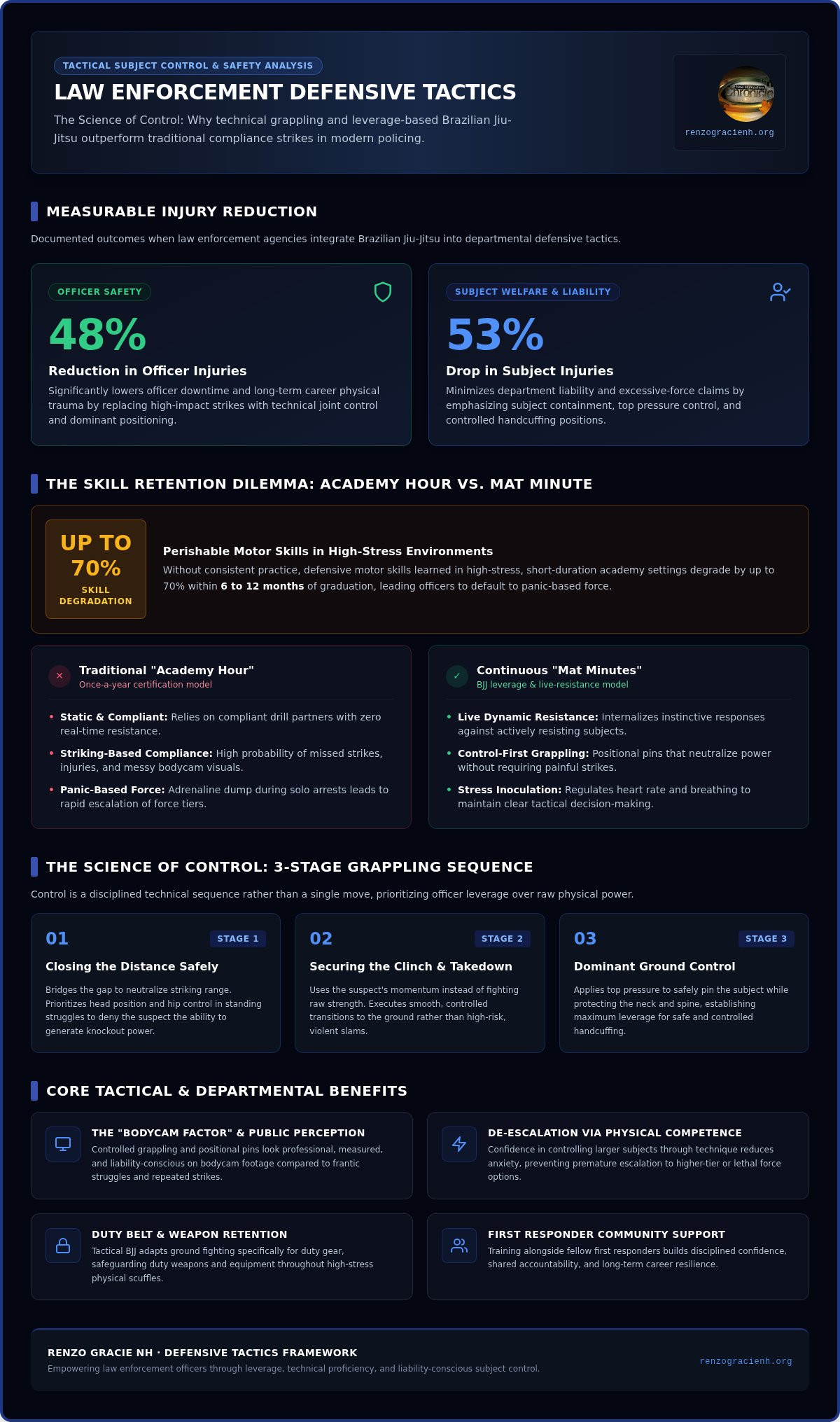
Statistics show that agencies integrating Brazilian Jiu-Jitsu see a 48% reduction in officer injuries and a 53% drop in subject injuries. These aren’t just numbers. They represent lives protected. Careers saved. When looking for law enforcement defensive tactics Windham officers can rely on, the focus must shift toward technical control. You’ve likely felt that surge of adrenaline during a solo arrest, wondering if your once-a-year training will hold up when it counts. It’s a common concern. Many officers worry that ineffective striking tactics might lead to messy encounters or bad bodycam footage.
It’s time to evolve. Discover how specialized training provides New Hampshire officers with the most effective, liability-conscious subject control available in 2026. By focusing on “control-first” grappling rather than “compliance-through-pain” strikes, you can gain the confidence to handle larger subjects without injury. This guide explores how technical proficiency reduces the need for higher levels of force while connecting you with a supportive community of fellow first responders dedicated to safety and professional growth.
Key Takeaways
- Learn why consistent “mat minutes” outperform once-a-year certifications for maintaining the perishable skills required in high-stress situations.
- Understand the mechanics of leverage that empower you to gain dominant positional control over larger subjects while minimizing the risk of injury.
- Discover the critical adjustments needed to adapt grappling for the street, including weapon retention strategies while wearing a full duty belt.
- Identify the specific standards for law enforcement defensive tactics Windham officers should look for to ensure training is both effective and liability-conscious.
- Explore how a supportive community and access to multiple training locations can help you build the disciplined confidence needed for a long, safe career.
The Evolution of Law Enforcement Defensive Tactics: Why Traditional Training is Failing
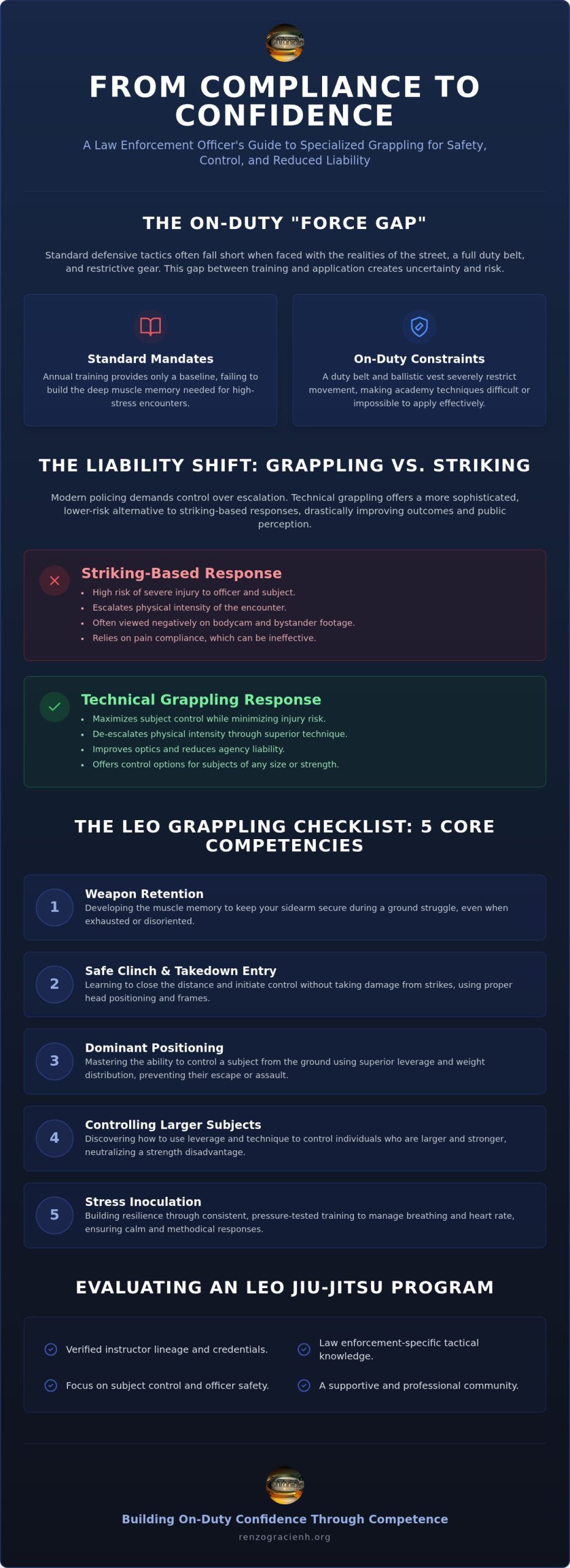
Modern defensive tactics are the specialized techniques used by officers to maximize control and minimize injury during high-pressure encounters. In 2026, the landscape of policing has shifted away from striking-based compliance toward grappling-based control. This evolution is driven by a need for safer outcomes and reduced liability. When exploring law enforcement defensive tactics Windham agencies are increasingly recognizing that traditional, once-a-year certifications simply aren’t enough to ensure officer safety.
There is a massive difference between an “Academy Hour” and a “Mat Minute.” Academy training often focuses on static blocks of instruction where partners are compliant. Real-world resistance is rarely compliant. True proficiency comes from the volume of practice. Regular mat time allows for the internalization of Brazilian Jiu-Jitsu principles of leverage and control, ensuring that when a situation turns physical, the response is instinctive. Without this consistent practice, officers often fall back on “panic-based force,” which increases the risk of injury for everyone involved and heightens departmental liability.
The Crisis of Skill Retention in Police Work
Motor skills learned in a high-stress, short-duration academy setting have a notoriously short half-life. Research suggests that without consistent practice, these perishable skills can degrade by up to 70% within six to twelve months of graduation. When training relies on compliance, it fails the moment a suspect fights back. Brazilian Jiu-Jitsu solves this by teaching officers to be comfortable in the uncomfortable. By training against live resistance, you learn to manage your breathing and heart rate. This prevents the adrenaline dump that leads to poor decision-making during a solo arrest.
De-escalation Through Physical Competence
An officer’s ability to remain calm is directly linked to their level of physical skill. If you know you can control a larger subject through technique, you’re less likely to escalate to higher-tier force options prematurely. Technical proficiency provides a wider range of non-lethal tools that are both effective and visually professional. There is also the “Bodycam Factor” to consider. In the modern era, public perception is vital. Controlled grappling and positional pins look significantly better on camera than repeated strikes or frantic struggles. Adopting these law enforcement defensive tactics Windham first responders can rely on helps build community trust while ensuring you return home safely after every shift.
The Science of Control: How Brazilian Jiu-Jitsu Enhances Officer Safety
Brazilian Jiu-Jitsu is built on the principle of leverage. It’s often called the “Gentle Art” because it prioritizes efficiency over raw power. For a patrol officer, this means being able to control a larger, stronger subject without relying on high-impact strikes that often lead to injury. When implementing law enforcement defensive tactics Windham officers must understand that control is a sequence, not a single move. The science of this control breaks down into three distinct stages: closing the distance, securing the clinch, and achieving dominant ground control. Each stage requires specific technical knowledge to ensure the officer remains safe and the subject remains contained.
Traditional training often ignores the nuances of these transitions. An FBI Law Enforcement Bulletin analysis on training methodology underscores that static drills fail under high stress. You need motor skills that hold up when the heart rate spikes. Technical proficiency allows you to manage the “weight of the world” by using top pressure to safely pin a subject. It’s about protecting the neck and spine while achieving the necessary leverage for a controlled handcuffing position.
Closing the Distance Safely
Entering the clinch is often the most dangerous moment of a physical encounter. You need techniques that allow you to bridge the gap without taking damage from strikes. By prioritizing head position and hip control in a standing struggle, you neutralize a suspect’s ability to generate power. You aren’t just fighting their strength. You’re using their momentum. A controlled takedown isn’t about a violent slam; it’s a smooth transition that keeps you in a dominant position while ensuring the subject’s safety during the descent.
Subject Control on the Ground
Once the encounter hits the pavement, the priority is “Position Before Handcuffing.” Rushing to get the cuffs on during a scramble often leads to lost control and increased risk. BJJ teaches positions like Knee on Belly and Mount, which serve as superior surveillance and control platforms. These positions allow you to scan the environment for weapons or third-party threats while maintaining a secure pin. Applying these specialized law enforcement defensive tactics Windham professionals can rely on ensures that subject control remains technical and liability-conscious. Most importantly, these techniques emphasize weight distribution that controls the subject’s hips and shoulders without compressing the chest or airway. This technical approach directly mitigates the risk of positional asphyxia, ensuring you remain within modern use-of-force standards.
If you’re interested in refining these skills, you can learn more about our Law Enforcement Jiu-Jitsu Training programs designed specifically for the needs of first responders.
Sport BJJ vs. Tactical Application: Adapting Grappling for the Duty Belt
A duty belt isn’t just a piece of equipment; it’s a 20 to 30 pound variable that fundamentally changes how your body moves. While sport Brazilian Jiu-Jitsu is the foundation, tactical application requires a different lens. You can’t simply “roll” the same way when you have a sidearm, radio, and spare magazines strapped to your waist. In a sport setting, certain moves might be considered illegal or “dirty,” yet for law enforcement defensive tactics Windham officers, these same techniques are essential for survival. For instance, pulling guard is a common sport tactic, but in policing, it’s a never-event. Being on the bottom against a suspect exposes your gear and limits your ability to disengage or transition to other tools.
Adapting your skills means understanding how your gear interacts with the ground. Training in “Full Kit” is a critical part of the transition from the gym to the street. It helps you identify where your holster creates a pivot point or where your radio might snag during a transition. According to the National Institute of Justice use-of-force continuum, empty-hand soft control is a vital tier of de-escalation. By refining these grappling skills to account for your professional gear, you ensure that your response remains within legal standards while maximizing your personal safety.
Weapon Retention and Awareness
Weapon retention is the most critical difference between sport and street. During ground transitions, you must maintain a constant “strong side” awareness, ensuring your holster is never easily accessible to the subject. We teach techniques to pin a subject’s hands effectively while simultaneously shielding your equipment. Using a deep underhook isn’t just about winning a grappling exchange; it’s a tactical necessity that prevents the subject from reaching for the tools on your belt.
Tactical Guard Passing and Get-Ups
If you find yourself on the ground, the “Tactical Stand-Up” is the most important move you can master. It allows you to create space and regain your feet while maintaining a defensive posture. When passing a suspect’s guard, your focus must remain on the waistband. You need to see their hands at all times to check for concealed weapons. At Renzo Gracie NH, we emphasize “Top Control” specifically for first responders. Staying on top allows for better environmental awareness, easier communication via radio, and a much safer path to a successful arrest. Consistent practice ensures these adaptations become second nature, giving you the disciplined confidence to handle high-stress encounters with professional poise.
Choosing a Training Academy in Windham: What Officers Should Look For
Selecting the right training environment is a career-defining decision. It’s about finding a partner in your professional development who understands the unique pressures of the job. When searching for law enforcement defensive tactics Windham first responders need more than just a local gym. You need a facility that respects your time, your safety, and your specific tactical requirements. The Renzo Gracie teaching philosophy provides this foundation by focusing on technical efficiency and real-world applicability rather than just sport competition. This lineage ensures you are learning from a system proven to work under the highest levels of stress.
Flexibility is non-negotiable. Policing isn’t a nine-to-five profession. Whether you are working first, second, or third shift rotations, your academy should offer a schedule that accommodates your lifestyle. Proximity also plays a major role in consistency. Having access to Jiu Jitsu for beginners adults NH across three locations in Windham, Manchester, and Exeter under a single membership allows you to train wherever your shift or home life takes you. This convenience removes the barriers to entry and helps you maintain the “mat minutes” necessary for skill retention.
The Value of a Specialized LEO Curriculum
Does the academy offer a dedicated law enforcement jiu jitsu training program? This is a vital question to ask. There is a fundamental difference between “rolling for points” in a tournament and “rolling for control” on the street. A specialized curriculum focuses on pinning, weapon retention, and environmental awareness rather than flashy sport techniques. Peer-to-peer training is another significant benefit. Training alongside other officers creates a shared language and a supportive community where everyone understands the liability and safety concerns inherent in law enforcement defensive tactics Windham deployments.
Assessing the Facility and Instructors
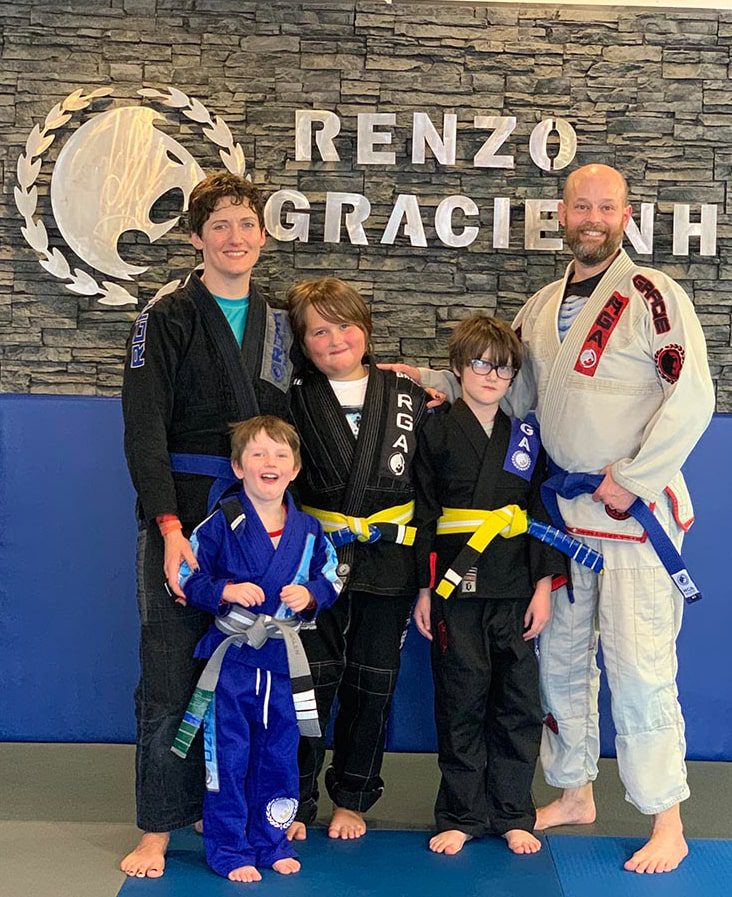
Cleanliness and professionalism are indicators of a high-quality academy. A well-maintained facility prevents common issues like “mat staph” and reduces the risk of unnecessary injury. You should also look for “Master Level” instruction. Professor Kevin Landry is a 6th-degree black belt with over 20 years of teaching experience. This level of expertise means your training is guided by someone who understands the deepest nuances of the art. Beyond the technical skills, ensure the academy fosters a “Family” and “Community” atmosphere. You want a place where egos are left at the door and every student is invested in the growth of their training partners.
Ready to experience the difference that professional instruction makes? Sign up for your Free Introductory Class today and start building the skills that will protect you and your community.
Start Your Tactical Training Journey at Renzo Gracie NH
Taking the leap from theoretical knowledge to physical mastery is the most significant step in an officer’s career. At our Windham facility, we provide a specialized environment where the theory of law enforcement defensive tactics Windham becomes practical, life-saving skill. Our program is built specifically for the needs of modern policing. We understand that your training must be as dynamic as the calls you answer. By joining our community, you gain access to a network of first responders who value discipline, mutual respect, and, above all, the safety of every officer on the street.
One of the greatest benefits we offer is the “One Membership, Three Locations” advantage. New Hampshire first responders often live in one town and work in another. With locations in Windham, Manchester, and Exeter, you can maintain your training consistency regardless of your commute or shift assignment. This accessibility ensures that you never have to miss a session due to logistics, helping you keep your skills sharp and your confidence high.
The Renzo Gracie NH Difference
We pride ourselves on a unique approach that blends traditional Gracie Jiu-Jitsu with modern tactical requirements. It isn’t enough to just learn grappling; you must learn grappling that works while wearing 30 pounds of gear. Professor Kevin Landry, a 6th-degree black belt with over 20 years of teaching experience, has been instrumental in shaping the local training landscape. His expertise ensures that every technique taught is vetted for real-world application. Local officers who train here frequently report a transformation in their field performance. They describe a newfound ability to stay calm during physical altercations, relying on technical proficiency rather than adrenaline.
Take the First Step: Your Free Introductory Class
It’s natural to feel a bit of hesitation before your first jiu jitsu class. We’ve designed our introductory session to be entirely no-commitment and stress-free. You don’t need any special gear for day one. Simply show up in comfortable athletic wear, and we will guide you through the basics of movement and control. You’ll see firsthand how our law enforcement defensive tactics Windham curriculum prioritizes your safety and professional growth.
Our instructors are here to act as supportive mentors, helping you evolve at a pace that suits your current fitness level. There is no ego on our mats, only a collective effort to ensure everyone returns home safely at the end of their watch. Don’t leave your safety to chance or outdated academy drills. Book your free intro class at Renzo Gracie NH today and join a lineage of excellence that empowers you to lead with confidence.
Empower Your Career with Technical Mastery
The landscape of modern policing demands a shift toward technical, liability-conscious subject control. By prioritizing leverage over raw strength, you can achieve dominant positions that protect both yourself and the community. Effective law enforcement defensive tactics Windham officers rely on are forged through consistent practice and specialized instruction. You’ve seen how once-a-year training fails under stress. It’s time to build the muscle memory that holds up when it matters most.
Our program offers a specialized LEO-focused curriculum led by 6th-degree black belt Professor Kevin Landry. One membership. Three locations. You can train in Windham, Manchester, or Exeter depending on where your shift takes you. This flexibility ensures your professional growth doesn’t take a backseat to your schedule. Experience the disciplined confidence that comes from knowing you can control a situation without resorting to higher levels of force. You deserve the best tools for the job.
Claim Your Free Introductory Law Enforcement BJJ Class in Windham and join a community dedicated to excellence and officer safety. We’ll see you on the mats.
Frequently Asked Questions
Is Brazilian Jiu-Jitsu effective for law enforcement officers who aren’t ‘athletes’?
Brazilian Jiu-Jitsu is highly effective for officers of all fitness levels because it relies on leverage rather than raw athleticism. You don’t need to be a professional athlete to master these techniques. The system is designed to allow a smaller person to control a larger, more aggressive subject through technical proficiency. This makes it an ideal foundation for law enforcement defensive tactics Windham officers can use regardless of their body type or age.
How does BJJ training help reduce use-of-force liability for my department?
BJJ training reduces department liability by providing officers with soft control options that look better on camera and cause fewer injuries. Instead of relying on strikes or impact weapons, you learn to use positional dominance to secure a subject. This technical approach aligns with modern use-of-force standards. It minimizes the risk of excessive force claims by ensuring control is achieved through mechanical advantage rather than pain compliance.
Do I need to wear a traditional ‘gi’ for law enforcement defensive tactics training?
While traditional BJJ often involves a gi, our specialized law enforcement training focuses on practical application. This often includes no-gi sessions or training in gear that simulates your daily work attire. The goal is to ensure your skills translate to the street where you’ll be wearing a duty belt and professional uniform. We prioritize techniques that remain effective regardless of what you or the suspect are wearing.
Can BJJ training help with weapon retention during a physical struggle?
Weapon retention is a core component of tactical grappling. BJJ teaches you how to manage distance and secure a suspect’s hands while maintaining awareness of your own equipment. By mastering hip positioning and the underhook, you create a physical barrier between the suspect and your sidearm. These skills are vital during a ground struggle where your holster might otherwise be exposed to a suspect’s reach.
Is the training at Renzo Gracie NH suitable for older officers or those with prior injuries?
Our environment at Renzo Gracie NH is supportive and welcoming to officers of all ages, including those managing prior injuries. We focus on technical efficiency which reduces the physical toll on your body. Professor Kevin Landry’s 20 plus years of experience ensures that training is conducted safely and methodically. We prioritize longevity so you can stay on the job and remain healthy for your family.
How often should an officer train to maintain proficiency in defensive tactics?
Consistency is the most important factor in maintaining your perishable skills. Training two to three times per week is generally recommended to move beyond basic familiarity into instinctive muscle memory. This regular mat time ensures that your response to a physical threat is calm and technical. Frequent practice helps you stay comfortable in high-stress situations, which is a key goal of law enforcement defensive tactics Windham training.
Does BJJ training count toward New Hampshire POST in-service credits?
Officers should verify current POST certification status for specific in-service credits, as requirements can shift. However, the technical skills gained through BJJ directly support the mandatory annual use-of-force reviews required by NH standards. Even when not used for formal credit, the proficiency gained is invaluable for meeting the physical demands and safety standards of New Hampshire policing. Regular training ensures you exceed basic state requirements.
What makes the Renzo Gracie curriculum different from other martial arts?
The Renzo Gracie curriculum stands out because of its prestigious lineage and its focus on real-world applicability. We don’t just teach sport techniques; we teach a system of control designed for survival. Under the guidance of a 6th-degree black belt, you learn a disciplined approach that values respect and perseverance. Our three locations in Windham, Manchester, and Exeter provide a community-oriented environment specifically tailored for the first responder lifestyle.