Posts

Social Skills for Shy Kids in Windham: Parent’s Guide

What if helping a shy child connect starts with less pressure, not more? If your child hangs back from group activities, it’s natural to want to help while also wondering whether encouragement might feel overwhelming. Building social skills for shy kids Windham parents can support often begins with small, familiar chances to listen, take turns, and join in at a comfortable pace.

This guide offers practical ways to make everyday communication more manageable and help your child explore peer activities without expecting them to become outgoing overnight. You’ll learn how to notice their comfort level, encourage low-pressure practice, and consider whether a structured activity could be a good fit. Brazilian Jiu-Jitsu brings children together around shared practice, with opportunities to listen, take turns, and interact as they learn. At Renzo Gracie NH in Windham, children can explore Jiu-Jitsu in a supportive setting. Small steps count.

Key Takeaways

  • Quietness is a temperament, not a flaw to fix. Social skills can be practiced without asking a child to become more outgoing.
  • For building social skills for shy kids Windham parents can start with one manageable interaction and adjust to the child’s comfort.
  • Compare informal play, small-group activities, and structured classes to find the right balance of predictability and peer interaction for your child.
  • Use a simple plan: notice what feels comfortable, choose one skill to practice, then reflect and adjust without setting a deadline for change.
  • Shared tasks in children’s Brazilian Jiu-Jitsu offer opportunities to listen, take turns, and interact with peers. Each child’s experience is individual.

What Does Building Social Skills Mean for a Shy Child in Windham?

Social skills are learnable behaviors that help children communicate, connect, and take part with other people. They include listening, taking turns, joining play, expressing needs, and noticing how others respond. These abilities develop through everyday experience, not by changing a child’s personality. The Social skills overview describes the broad range of behaviors involved in interacting with others. For parents, a practical starting point is to identify specific actions a child can try.

A quiet temperament isn’t a problem to solve. A child may prefer observing before joining in, enjoy one-on-one conversation more than a busy group, or need time to warm up to unfamiliar people. The aim of building social skills for shy kids Windham parents support is not to make a child louder or constantly sociable. It’s to help them communicate and participate in ways that feel manageable and true to who they are.

Comfort can change with the setting, the people present, how familiar an activity feels, and the size of the group. A child who speaks freely with cousins might be quiet at a new club, then become more engaged after watching for a while. Notice these differences without treating any one moment as a measure of ability. They can help you identify where your child feels comfortable enough to practice.

How can parents tell when a child feels socially hesitant?

Look for observable moments: your child waits near a game before joining, answers quietly in a new group, or checks your face before speaking to someone unfamiliar. These can be ordinary signs of caution. Notice whether your child settles after observing or remains distressed, and whether the same difficulty appears in familiar and unfamiliar settings. Rather than labeling the behavior, identify situations where connection already comes more easily, such as chatting with one trusted friend or playing alongside a sibling.

Which social skills can children practise in everyday moments?

Everyday interactions offer small, low-pressure practice. Before a playdate, you might rehearse a greeting or the words, “Can I join?” At dinner, model listening and responding by asking a question about someone’s day. Keep the focus on one skill at a time, then give your child room to try it without demanding a perfect performance.

Children can also practice saying, “I need help,” or “I don’t want to do that,” so they can ask for support and set boundaries. A short pause in conversation is normal; you can show that nobody has to rush to fill every silence. For parents in Windham, Manchester, and Exeter, building social skills for shy kids can start with these ordinary exchanges at home, then grow through familiar activities at the child’s pace.

How Low-Pressure Practice Helps Shy Kids Build Social Confidence

Social confidence can grow through small experiences that feel manageable, not through pressure to perform. A child might first watch a game, then stand nearby, and later ask to take a turn. That gradual path gives them room to understand what’s happening and choose how to participate. Building social skills for shy kids Windham families can support means valuing each step, even when it looks modest from the outside.

Repeated, low-pressure practice gives children chances to rehearse social behaviors and become more familiar with using them. Familiarity doesn’t mean every interaction will feel easy, and it doesn’t require a child to become more outgoing. Progress might simply mean trying a greeting or staying with an activity a little longer.

Your role is to prepare and encourage, not to speak for your child or decide that they must join. Model a phrase, explain what to expect, then leave space for them to respond in their own way. The New York State Department of Health’s Understanding Social-Emotional Development in Children discusses how interactions with caregivers contribute to children’s social-emotional development. Everyday exchanges can offer a calm place to practice.

How can parents make a first interaction feel manageable?

Choose an activity your child already knows, then agree on one small, clear goal. At a familiar playground, that might mean watching a game and asking, “Can I have a turn next?” Before visiting, practice the words casually, without turning them into a test. Once there, let your child observe first if that helps them settle. They can decide when to try the phrase or choose another small step.

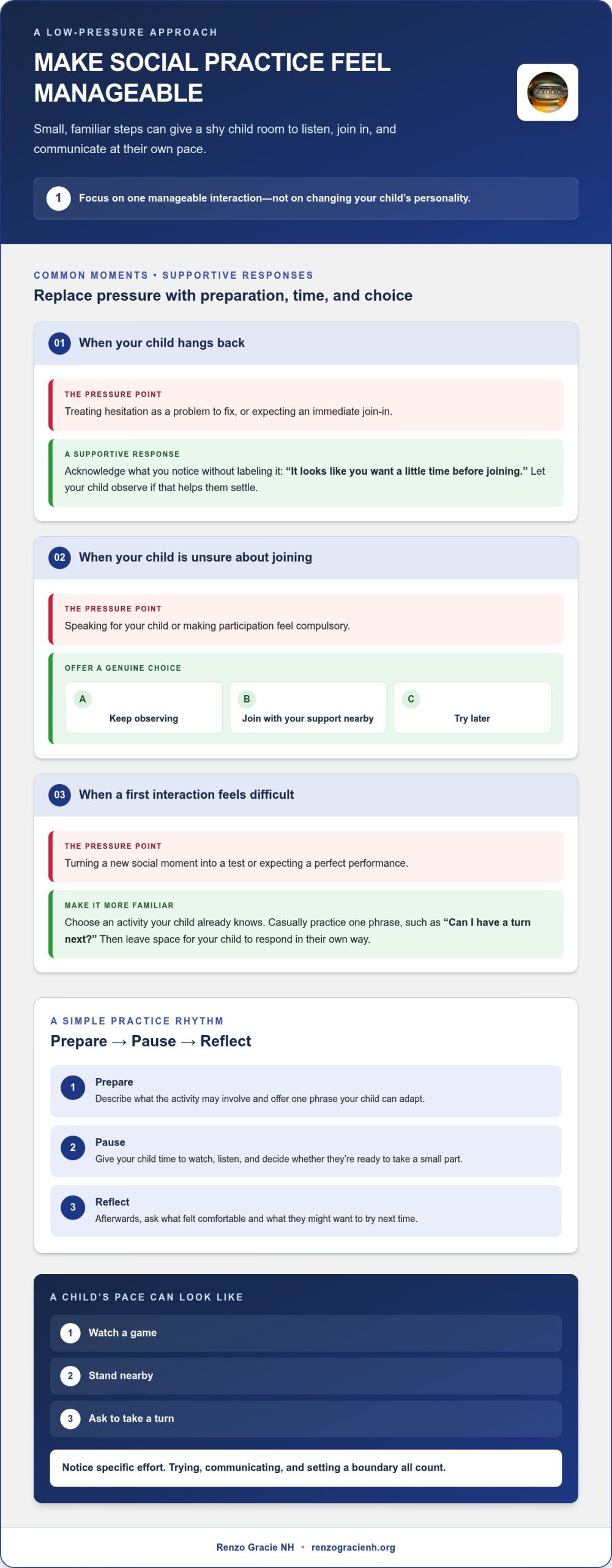
A simple progression can keep practice supportive:

  • Prepare: Describe what the activity may involve and offer one phrase your child can adapt.
  • Pause: Give them time to watch, listen, and decide whether they’re ready to take a small part.
  • Reflect: Afterwards, ask what felt comfortable and what they might want to try next time.

How should adults respond when a child hangs back?

Start by acknowledging what you notice without attaching a label: “It looks like you want a little time before joining.” Then offer a genuine choice: keep observing, join with your support nearby, or try later. This respects the child’s feelings while keeping participation possible. Avoid speaking on their behalf unless they need help, and don’t make praise depend on being bold or chatty.

Notice specific effort instead: “You waited, then asked for a turn,” or “You told me you needed help.” These observations show that trying, communicating, and setting a boundary all count. A structured children’s Brazilian Jiu-Jitsu class is one shared activity to explore at the child’s pace. At Renzo Gracie NH, children learn alongside others in a supportive setting. Let your child’s experience guide the next step.

Which Activities Give Shy Children Helpful Ways to Practise Social Skills?

Different activities offer different kinds of social practice. Informal play can feel flexible and familiar; a small-group activity may give children a shared focus; a structured class can make the sequence of activities easier to anticipate. None is automatically the best choice. For building social skills for shy kids, families in Windham, Manchester, and Exeter can consider their child’s interests, comfort, and response to each setting, then start with an approachable option.

What can informal play and small groups offer?

Familiar play gives children chances to interact without making conversation the main event. Building a game together, sharing materials, or taking turns on the swings can prompt a child to initiate, respond, and negotiate naturally. A smaller or familiar group may feel more manageable for some children, while others enjoy the energy of a larger activity. Watch your child’s cues rather than assuming one group size suits everyone.

Setting Social practice Possible considerations
Informal play with a familiar peer Greeting, sharing, taking turns, and suggesting what to play Flexible and familiar, though the interaction may change direction quickly
Small-group activity Listening, waiting, contributing an idea, and cooperating around a shared task A shared focus can ease conversation, but comfort depends on the group and activity
Structured class Following instructions, taking turns, and interacting during organized practice A clear routine may help some children; a new setting or activity can take time to get used to

How can a structured class support social practice?

A class with planned instruction and shared activities may give children a clear reason to listen and take part. The activity itself provides a focus, so interaction doesn’t have to rely on spontaneous conversation. A child can observe first, follow along, and engage at a comfortable pace as they become familiar with the setting.

Brazilian Jiu-Jitsu is one option, not a guaranteed route to social confidence or a substitute for every child’s preferred activity. It includes partner practice, which creates opportunities to take turns, pay attention to another person, and work through a shared task. Renzo Gracie NH offers kids’ Jiu-Jitsu instruction in New Hampshire in a supportive environment. New students can try a complimentary introductory class, giving families a chance to experience the setting together.

After any activity, notice more than whether your child spoke a lot. Did they seem curious, settle in after watching, or want to return? Their comfort and interest can help guide the next choice. The best fit is a setting where they can participate without feeling pushed, whether that’s a familiar playdate, a small group, or structured practice.
Social Skills for Shy Kids in Windham: Parent's Guide

Step-by-Step Social Skills Plan for Your Child’s Pace

A simple plan keeps practice focused on what your child is ready to try, rather than on a deadline or a checklist of social milestones. Families in Windham, Manchester, and Exeter can use ordinary moments at home, on the playground, or during a familiar family gathering. Start with observation, agree on one small action, and let your child’s response shape what comes next. Keep the aim clear: offer practice, not pressure.

  • 1. Notice comfort. Pay attention to where your child seems at ease, who they naturally engage with, and what happens just before they hang back. This helps you choose a setting that feels familiar enough for practice.
  • 2. Choose one skill. Ask your child what feels manageable. It might be greeting a peer, taking a turn, asking one question, or telling someone they need help. One goal is plenty.
  • 3. Practice together. Try the words at home through a short role-play, or model the interaction yourself. Keep it casual and give your child room to adapt the phrase to their own voice.
  • 4. Reflect without grading. After the moment, ask what felt comfortable, tricky, or enjoyable. Listen without turning the answer into a review of whether they “did it right.”
  • 5. Adjust the next chance. Repeat the same small step in a familiar setting, make it easier, or pause and try another time. Let your child’s feedback and observed comfort guide the pace.

How do you choose a realistic first social goal?

Make the goal small enough that your child can picture doing it. Ask, “What would feel okay to try?” If they aren’t sure, offer a few options, such as saying hello, asking to take a turn, or asking one question about a game. Agree that observing first is also allowed. The goal can change if the setting feels different than expected.

How can parents review progress without adding pressure?

Choose a calm moment afterward and ask open questions: “What part felt easiest?” or “Was there anything you’d like to do differently next time?” Recognize an attempt, a request for help, or a clear boundary, even if a conversation didn’t follow. If your child says the interaction felt too hard, treat that as useful feedback and make the next opportunity more manageable.

Progress is a child’s willingness to try a manageable step, not how popular, talkative, or instantly comfortable they seem. That’s a helpful measure for building social skills for shy kids in Windham without comparing one child’s pace to another’s.

A shared activity may be a useful next step if your child is interested in learning through movement and practice with others. Renzo Gracie NH’s complimentary introductory class lets families experience children’s Brazilian Jiu-Jitsu instruction together.

How Renzo Gracie NH Can Give Shy Kids a Supportive Place to Practise

A structured activity can be a useful next step when a child enjoys learning through movement or shared tasks. At Renzo Gracie NH, children’s Brazilian Jiu-Jitsu instruction takes place in a community-oriented setting. Partner practice gives students a shared activity and opportunities to listen, take turns, and work alongside someone else. Each child’s experience is individual; participation doesn’t guarantee friendships or a particular social outcome.

For families thinking about building social skills for shy kids in Windham, fit matters more than whether a child appears outgoing on the first day. Consider whether your child shows interest in the activity, feels respected in the environment, and can approach participation at a comfortable pace. Technical development, fitness, and personal growth are part of the instruction’s aims. Respect and supportive participation help shape the experience.

What can families expect from a children’s Jiu-Jitsu setting?

Brazilian Jiu-Jitsu is a martial art, so children learn physical techniques as well as practice alongside others. Shared instruction and partner work give a child a task to focus on, rather than requiring them to start a conversation without a reason. This may suit a child who prefers doing an activity together before talking more freely. A parent and child Jiu-Jitsu guide for Windham also explores how training can create shared family time.

How can a family take a comfortable first step?

Before trying an activity, talk with your child about what interests them and what feels uncertain. They may wonder what the class will be like, whether they’ll know anyone, or what happens if they feel nervous. Listen without dismissing the concern. You can explain that trying something new doesn’t require immediate confidence, and that asking for help or taking time to get comfortable is okay.

During an introduction, stay attentive to your child’s cues. If they’re hesitant, help them put a concern into words so they can get support from the instructor. Observing before joining may also feel like a manageable first step, depending on the child and the setting. Afterwards, ask what they noticed: Did the activity interest them? Did they feel comfortable enough to try part of it? Their answers can help you decide whether to continue, pause, or revisit the idea later.

A complimentary introductory class gives new students a chance to experience children’s Jiu-Jitsu instruction without making the first visit a test of confidence. Keep the focus on what your child notices and how they feel about the activity.

Keep the Next Step Small and Child-Led

Social confidence doesn’t need to look like being the first to speak or joining every group. A child’s next step might be choosing one activity, knowing they can take time to settle in, or sharing afterward what they liked. Let their interests help guide the choice. For building social skills for shy kids, Windham families can keep progress personal: focus on what feels possible for this child, not how their participation compares with someone else’s.

That approach leaves room for curiosity to grow. If your child shows interest in Brazilian Jiu-Jitsu, explore the activity together and let them decide what they’re comfortable trying. Professor Kevin Landry has taught in the region for over two decades and teaches children at Renzo Gracie NH.

A first visit can be a chance to explore, not a test your child has to pass. Let your child’s experience shape what comes next.

Frequently Asked Questions

Is shyness the same as social anxiety in children?

No. Shyness can describe a child’s cautious or reserved response in some social situations, while social anxiety involves more intense, ongoing fear or distress that can interfere with daily life. A child’s quietness alone doesn’t establish a diagnosis. If social situations consistently cause significant distress or keep your child from activities they want to do, discuss what you’re noticing with a pediatrician or qualified mental health professional.

Can shy kids make friends without becoming more outgoing?

Yes. Friendship doesn’t require a big personality or a wide circle of peers. A child may feel happiest connecting with one classmate through a shared interest, such as drawing, building, or playing a favorite game. You can support that connection by making space for unhurried time together and letting your child choose how much they want to talk. Quiet companionship can be meaningful, too.

How can I help my child join a group without forcing them?

Plan the arrival together rather than pushing for immediate participation. Before a gathering, agree on a comfortable first step, such as staying near you while they get used to the room. You might also choose a signal your child can use if they need a pause. Avoid announcing that they’re shy to the group; let them decide what they want to share about themselves.

What social skills should shy children practise first?

Start with a skill that would help in a situation your child wants to handle. That could be asking an adult for help finding a game, saying “No thanks” when they don’t want to join, or responding when another child speaks to them. For building social skills for shy kids, Windham parents can choose one useful phrase to practice at home, then let the child adapt it in their own words.

Can Brazilian Jiu-Jitsu help a shy child practise interacting with peers?

It can offer opportunities to practice interaction through a shared physical activity, including listening to instruction and working with a partner. Whether it feels like a good fit depends on the child’s interest and comfort with the setting and activity. Brazilian Jiu-Jitsu isn’t a guaranteed way to make friends or change a child’s temperament. Families in Windham, Manchester, and Exeter can consider how their child responds to the experience.

How long does it take for a shy child to feel more comfortable socially?

There’s no set timeline. Comfort may vary with the people, activity, and setting, and a child may feel at ease one day but hesitant the next. Instead of tracking a deadline, notice whether they’re beginning to approach an activity, communicate what they need, or recover more comfortably after an uncertain moment. If concern persists or grows, consider discussing it with a qualified professional.

Should I tell an instructor that my child is shy before a first class?

Yes, if you think the context will help the instructor welcome your child thoughtfully. Share specific observations rather than a label: for example, your child may need time to watch before joining or feel more comfortable when instructions are clear. You can also tell your child what you plan to share and invite them to add their own thoughts. That helps make the first class a more informed experience.

Ready to explore a shared activity at your child’s pace? Book a complimentary introductory class at Renzo Gracie NH and let your child’s experience guide the next step.
Building Confidence in Manchester Kids: A Parent’s Guide

Confidence isn’t a personality trait; it’s a byproduct of competence earned through structured, supportive struggle. Stand tall. Speak up. Find strength. These are the building blocks of a resilient child, yet finding the right environment to help build confidence in kids Manchester can feel like a daunting task for any parent. You likely worry about the impact of bullying or the exclusionary nature of traditional competitive sports. You want your child to feel safe, but you don’t want to encourage aggression.

It’s a delicate balance. You want a supportive community where your child feels they belong while learning to navigate life’s challenges with poise. This guide shows you how structured martial arts training transforms self-esteem through discipline and respect. We’ll explore how Renzo Gracie NH uses a prestigious lineage and a warm, inclusive atmosphere to help children evolve into their best selves. Discover how practical self-defense skills, a focus on family values, and a community of mentors create a foundation for lasting success.

Key Takeaways

  • Learn why structured martial arts is a powerful tool to build confidence in kids Manchester by replacing social anxiety with earned competence.
  • Discover how Brazilian Jiu-Jitsu functions as a physical puzzle, teaching children to solve problems under pressure and develop grit.
  • Understand the philosophy of discipline and respect that ensures martial arts training builds character rather than encouraging aggression.
  • Get practical tips on how to reframe “failures” as lessons at home to support your child’s growth and resilience.
  • Explore the Renzo Gracie NH difference, where a prestigious lineage meets a professional, family-friendly environment designed for transformation.

Why Building Confidence in Kids is a Top Priority for Manchester Parents

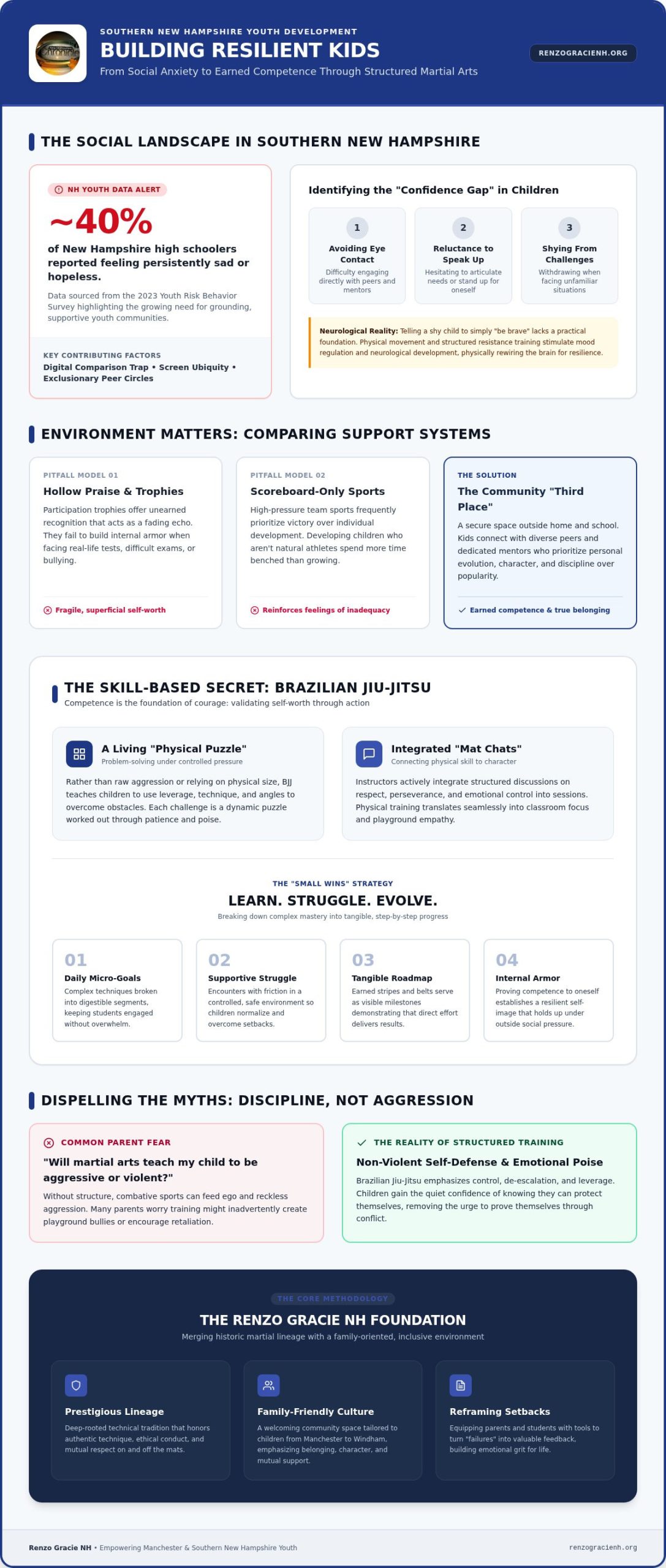
The world has changed. Screens are everywhere, and social media creates a relentless comparison trap for our youth. In New Hampshire, recent data from the 2023 Youth Risk Behavior Survey highlights a sobering reality: approximately 40% of high schoolers reported feeling persistently sad or hopeless. This isn’t just a statistic; it’s a call to action for every parent trying to build confidence in kids Manchester. Genuine self-worth isn’t found in a digital like or a participation trophy. It’s earned through effort, persistence, and the courage to try again after a setback. Participation trophies are hollow. They don’t provide the internal armor a child needs to face a bully or a difficult exam.

Many families are now moving away from high-pressure team sports. While these activities have value, they often prioritize the scoreboard over the individual. A child who isn’t a natural athlete might spend more time on the bench than on the field, which can unintentionally reinforce feelings of inadequacy. Instead, parents are seeking programs that emphasize individual growth and personal evolution. They want an environment where their child is seen, heard, and challenged to grow at their own pace.

The Social Landscape for Youth in Southern New Hampshire

Social anxiety is rising in local elementary and middle schools. From Manchester to Windham, children often feel the weight of social circles that can be exclusionary or high-pressure. To counter this, kids need a “third place.” They need a community outside of home and school where they feel a true sense of belonging. Community-based programs provide this anchor. They offer a space where a child can develop a stable sense of self-esteem by interacting with diverse peers and mentors who value character over popularity. When a child feels they belong to something bigger than themselves, their resilience naturally grows.

Identifying the “Confidence Gap” in Your Child

How do you know if your child is struggling? Look for the signs. They might avoid eye contact, hesitate to speak up, or shy away from new experiences. Simply telling a shy child to “be brave” rarely works because it lacks a practical foundation. True confidence requires a neurological shift. Physical movement and structured training regulate mood and stimulate neurological development. When a child learns to move their body with purpose, their brain begins to rewire for resilience. This is why we focus on movement as a tool for life. To build confidence in kids Manchester, we must give them the physical and mental tools to stand tall in any situation.

The Skill-Based Secret: How Brazilian Jiu-Jitsu Builds Lasting Self-Esteem

Competence is the foundation of courage. When a child masters a difficult technique, they prove their own worth to themselves through action rather than words. This internal validation is the most effective way to build confidence in kids Manchester. Brazilian Jiu-Jitsu (BJJ) functions as a series of physical puzzles. A child learns to navigate these challenges under mild, controlled pressure, using leverage and technique to overcome obstacles. This process transforms how they view their own capabilities.

Our kids jiu jitsu New Hampshire program prioritizes technical mastery because understanding the “how” and “why” builds a deep sense of self-belief. We don’t just teach movements; we teach problem-solving. During our “mat chats,” instructors integrate essential life lessons regarding respect and perseverance into the physical training. This ensures that the lessons learned on the mat translate directly to the classroom and the playground. You can explore our curriculum to see how we balance physical skill with character development.

The “Small Wins” Strategy

Learn. Struggle. Evolve. We break down complex movements into small, achievable daily goals to keep students motivated and engaged. Earning stripes and belts serves as a tangible roadmap for their progress, teaching the immense value of long-term persistence. This structured advancement helps children see that hard work leads to real results. Earned success is an internal lighthouse, while empty praise is just a fading echo.

Non-Violent Self-Defense: The Ultimate Safety Net

One of the most effective ways to build confidence in kids Manchester is to provide them with a safety net that doesn’t rely on aggression. BJJ focuses on controlling a situation without throwing a single punch or kick. This ability to neutralize a conflict through grappling gives a child immense psychological power. When the fear of physical confrontation is removed, the need to act out of aggression disappears. Instead, children become more peaceful and patient. They gain the quiet authority to stand their ground with words, knowing they have the skills to protect themselves if it ever becomes necessary.

Dispelling the Myths: Why Martial Arts Focuses on Discipline, Not Aggression

Violence is not the goal. Control is. A common concern for parents is that martial arts might turn their child into a bully or encourage aggressive behavior. The reality is quite the opposite. When we work to build confidence in kids Manchester, we focus heavily on emotional regulation and restraint. A child who knows they can handle themselves doesn’t feel the need to posture or intimidate others. They move with a quiet assurance that makes conflict less likely, not more.

The Renzo Gracie philosophy is built on respect for your partners and instructors above all else. This isn’t about fighting; it’s about mutual growth. The mat provides a controlled environment where every session requires intense focus and discipline. By learning to navigate physical pressure without panic, children reduce impulsive behaviors in their daily lives. They learn to breathe, think, and react with purpose rather than emotion. This disciplined confidence is what allows a child to walk away from a confrontation rather than escalating it.

The Role of the Professor and Mentors

Leadership starts at the top. Professor Kevin Landry, a 6th-degree black belt under Renzo Gracie, brings over two decades of teaching experience to the Manchester, Windham, and Exeter region. This depth of expertise allows him to set a calm, authoritative tone that filters down through every mentor and student. In our classes, mentors use a “Lead by Example” approach. They show boys and girls that true strength is found in patience and perseverance. Having positive role models who value character over combat helps children understand that martial arts is a path toward becoming a better person, not just a better athlete.

Safety Standards and the Training Environment

Safety is the foundation of our academy. Brazilian Jiu-Jitsu is widely regarded as one of the safest martial arts for children because it lacks striking. There are no punches or kicks; instead, the focus is on leverage, positioning, and control. This significantly reduces the risk of injury while still providing a rigorous physical workout. A vital lesson in our curriculum is the concept of “tapping out.” This simple act is a lesson in mutual respect and safety. It is a contract between training partners that ensures everyone remains protected. We maintain a professional and welcoming atmosphere where even the most timid children feel safe to explore their limits. To build confidence in kids Manchester, we provide a space where the fear of getting hurt is replaced by the joy of personal progress.

Building Confidence in Manchester Kids: A Parent's Guide

A Parent’s Guide to Raising Resilient Children in Southern New Hampshire

Resilience starts at home. To build confidence in kids Manchester, parents must bridge the gap between the academy and everyday life. It isn’t enough to just drop them off at the mat; you must become a partner in their personal evolution. When your child faces a setback, reframe the conversation. Instead of focusing on the “loss,” discuss the lesson learned. This shift in mindset transforms a moment of frustration into a building block for future success. Every struggle is just data for the next attempt.

Consistency is the engine of progress. Show up. Stay the course. Evolve. While it’s tempting to skip a session when schedules get busy, showing up is 90% of the battle. Discipline is forged in the moments when we choose to honor our commitments even when we feel tired. To avoid burnout, ensure your child has a balanced schedule that allows them to fully engage with their training without feeling overwhelmed. If you’re unsure how your child will react to the environment, you can try jiu jitsu free New Hampshire to see how the program fits into your family’s routine.

Supporting Your Child’s BJJ Journey

Challenges on the mat are opportunities in disguise. When your child struggles with a new technique, offer support rather than immediate solutions. We recommend the “Five-Minute Rule” for the ride home: wait five minutes before discussing the class to allow your child to process their experience. This prevents them from feeling critiqued during a vulnerable moment. Celebrate progress that isn’t tied to the color of their belt. Acknowledge their focus, their willingness to help a partner, and their perseverance through a difficult drill. These are the traits that matter most in the long run.

Integrating BJJ into a Healthy Manchester Lifestyle

Growth is a collective effort. By connecting with other parents in the Manchester and Windham community, you create a supportive network that reinforces the values taught at the academy. You’ll likely notice that the focus and discipline learned during training translate directly to improved school performance and better concentration. For families looking to bond, our “Family Time” sessions offer a unique opportunity to grow and learn together on the mat. Ready to begin your journey? Schedule your first class today and join our thriving Southern New Hampshire community.

The Renzo Gracie NH Difference: Empowering Manchester’s Youth

Excellence is a choice. When you select a martial arts academy, you aren’t just choosing a place for your child to exercise; you’re choosing a prestigious lineage. The Renzo Gracie name carries a global reputation for technical brilliance and character development. By joining an academy with such deep roots, your child becomes part of a world-class association that values excellence in every detail. We maintain a clean, professional, and family-friendly facility that reflects these high standards. It’s an environment where children feel safe to push their boundaries and discover what they’re truly capable of. To build confidence in kids Manchester, we ensure every student receives instruction tailored to their specific age and skill level, ensuring the curriculum is always engaging and age-appropriate.

Joining our Kids Jiu Jitsu Program provides long-term benefits that extend far beyond physical fitness. Students develop a sense of identity and pride by being part of a team that pursues mastery. This steady progression mirrors the journey of life, teaching them that consistent effort leads to significant transformation. We provide the tools for them to evolve into leaders who are both physically capable and mentally resilient.

A Legacy of Excellence in Windham

History matters. Professor Kevin Landry, a 6th-degree black belt, has spent over two decades teaching in the Southern New Hampshire region, fostering a community that spans generations. While generic franchise gyms often prioritize high-volume memberships, our focus remains on the individual student and the family unit. We prioritize “Family Time” sessions to create a local community of support that extends far beyond the mat. This deep commitment to the Manchester and Windham area is why families choose Renzo Gracie NH when they want a supportive partner in their child’s development.

Your Child’s First Step to Confidence

Start today. The path to resilience begins with a single step. During your child’s Free Introductory Class, we focus on making them feel comfortable and welcome from the moment they walk through the door. We introduce new students to the group gradually, ensuring they aren’t overwhelmed by the new environment. They’ll meet their instructors, learn the basic movements, and begin to understand the rhythm of a class. It’s a low-pressure way to see how we build confidence in kids Manchester through disciplined, supportive training. Start your child’s journey toward confidence today!

Empower Your Child’s Future Today

Resilience is a skill. It’s built through consistent effort, expert mentorship, and a community that values character above all else. We’ve seen how Brazilian Jiu-Jitsu provides a safe, non-aggressive roadmap for children to evolve into their best selves. By replacing social anxiety with earned competence, your child gains the tools to navigate life’s challenges with poise. To build confidence in kids Manchester, you need a partner who combines world-class standards with deep local roots.

Renzo Gracie NH offers the prestige of a world-renowned lineage led by a 6th-degree black belt. With over 20 years of local teaching experience, Professor Kevin Landry provides the stable, authoritative guidance your child needs to thrive. This isn’t just about physical training; it’s about joining a legacy of excellence that prioritizes your family’s success. Your child’s transformation starts with a single step on the mat. Book your child’s Free Introductory Class at Renzo Gracie NH! We’re ready to help your child stand tall, speak up, and discover their true potential.

Frequently Asked Questions

Is my child too young to start Jiu-Jitsu in Manchester?

Start early. Our Little Gracies program welcomes children as young as 3 to 5 years old to begin their journey. We focus on movement, coordination, and building basic social skills through age-appropriate activities. Starting young helps build confidence in kids Manchester by establishing a foundation of physical literacy before they enter elementary school. Every child progresses at their own pace in a supportive, low-pressure environment designed for early success and personal evolution.

Will martial arts make my child more aggressive or likely to fight?

Quite the opposite. Brazilian Jiu-Jitsu is a defensive art that prioritizes control and leverage over striking or aggression. Our curriculum emphasizes non-violent conflict resolution and emotional regulation. When a child knows they can protect themselves, the need to prove it through fighting disappears. We cultivate a sense of disciplined confidence that allows students to remain calm and peaceful even when faced with high-pressure social situations or potential conflict in their daily lives.

How many times a week should my child attend classes to see results?

Consistency drives progress. We generally recommend that children attend classes two to three times per week to see steady improvement in their skills and self-esteem. This frequency allows them to retain new techniques while maintaining a healthy balance with schoolwork and other activities. Showing up regularly is the most important factor in their evolution. It helps them build a reliable routine and fosters a deep sense of belonging within our local Manchester and Windham community.

What if my child is very shy or has never done sports before?

Welcome home. Many of our most successful students started as shy individuals with no prior athletic experience. We specialize in introducing new students to the group without overwhelming them. Our instructors act as supportive mentors who guide each child through their first steps with patience and warmth. We focus on personal progress rather than competition, ensuring that even the most timid children feel safe to discover their inner strength and gradually find their unique voice.

Do I need to buy a lot of expensive equipment to get started?

Getting started is simple. You don’t need a significant investment in equipment to begin your child’s training journey. For the free introductory class, comfortable athletic wear is all that’s required. Once they join the Kids Jiu Jitsu Program, a standard uniform, or gi, is the primary piece of equipment needed. We prioritize accessibility for families in the Manchester area, ensuring that the focus remains on personal growth and learning rather than expensive gear or hidden costs.

How does BJJ help with focus and schoolwork?

Focus is a muscle. Training requires intense concentration to master complex physical puzzles and technical movements. This level of mental engagement translates directly to the classroom. Students learn the value of perseverance and the importance of paying attention to detail, which helps improve their academic performance and study habits. By practicing these skills on the mat, they develop the mental discipline necessary to build confidence in kids Manchester and excel in their schoolwork and daily responsibilities.

Can parents watch the classes at Renzo Gracie NH?

Absolutely. We encourage parents to stay and watch their children train in our clean and professional facility. Transparency is a core part of our family-friendly atmosphere. Seeing your child’s progress firsthand allows you to become a supportive partner in their development. It also helps you connect with other local families in the Windham and Manchester region. We believe that building a strong community of parents is just as important as the training itself for long-term success.

What makes Renzo Gracie NH different from other Manchester martial arts schools?

Lineage and leadership. We are led by Professor Kevin Landry, a 6th-degree black belt with over two decades of local teaching experience. Unlike generic franchise gyms, we offer the prestigious Renzo Gracie lineage and a curriculum focused strictly on Brazilian Jiu-Jitsu. We don’t offer Muay Thai, Kickboxing, or Yoga. Our focus is entirely on providing world-class BJJ instruction in a supportive, ego-free environment that prioritizes the well-being and personal growth of every individual student and family unit.

Choosing the Best Kids Jiu Jitsu in Exeter NH: A Parent’s 2026 Buying Guide

What if the most effective way to protect your child isn’t teaching them how to throw a punch, but how to carry themselves with a quiet, unshakeable confidence? It’s a common worry for parents. You want your child to be resilient. You want them to stand tall. Yet, the thought of an aggressive, “fight club” environment is a major red flag for most families. This is why choosing the right kids jiu jitsu Exeter NH program is such a vital decision for your child’s development. You need a space that fosters growth. You need a program that fits your schedule without becoming another activity they eventually quit.

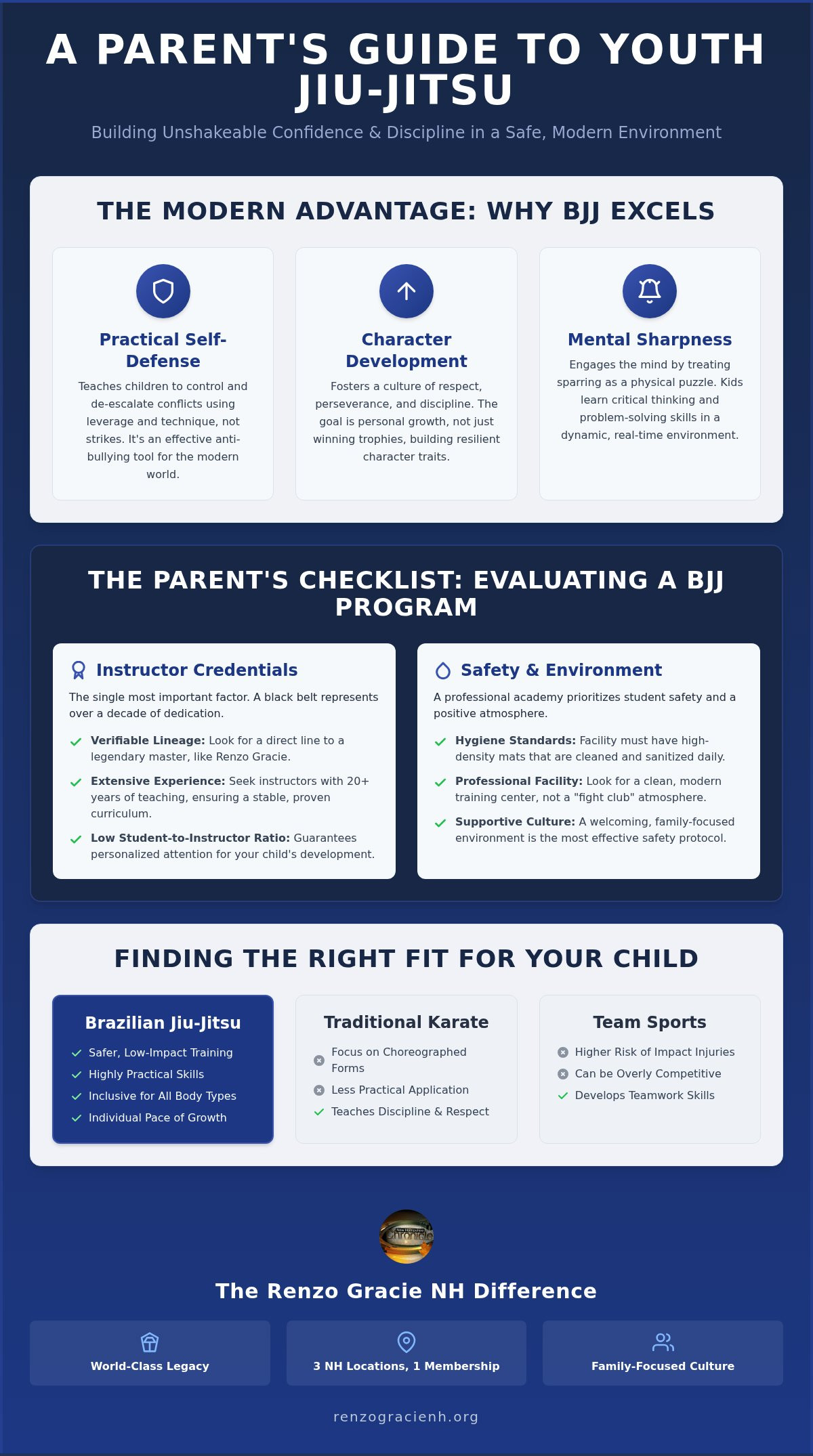
Discover their potential. Build their focus. We understand that you’re looking for more than just a hobby; you’re looking for a supportive partner in your child’s journey. In this 2026 buying guide, you’ll discover how to evaluate youth martial arts programs to ensure your child builds unshakeable confidence and discipline in a safe, professional environment. We will examine the key factors that separate elite academies from the rest, including the importance of instructor lineage and the long-term benefits of a family-focused culture.

Key Takeaways

  • The modern shift. Understand why Brazilian Jiu Jitsu is replacing traditional striking arts as the premier youth activity for practical self-defense.
  • Safety first. Learn how to evaluate kids jiu jitsu Exeter NH programs by prioritizing instructor lineage and professional facility standards.
  • Individual growth. Discover how grappling-based programs offer a safer, more inclusive environment compared to high-impact team sports or traditional karate.
  • Unmatched access. Explore the Renzo Gracie legacy and the convenience of using one membership across three premier New Hampshire locations.
  • Take the first step. Learn how to prepare your child for their free introductory class to ensure they start their journey with confidence.

Why Kids Jiu Jitsu is the Premier Youth Activity in Exeter NH

Exeter is more than a historic town; it’s a growing hub for elite youth development. Parents here are discerning. They want activities that provide a real return on investment in their child’s character. While traditional team sports offer community, many local families are discovering that kids jiu jitsu Exeter NH programs offer a unique blend of individual accountability and group support. This isn’t just about physical activity. It’s about preparing for life.

The transition from traditional karate to Brazilian jiu-jitsu is a major trend across the Seacoast region. Why the change? Parents are prioritizing practical skills over choreographed forms. In BJJ, there are no “make-believe” movements. Every technique is tested in a safe, controlled environment. This creates a level of self-assurance that traditional martial arts often struggle to replicate. Your child learns to solve physical puzzles in real-time. They build a sharp, analytical mind that translates directly to their performance in the classroom.

Character Over Competition

Growth is the goal. At Renzo Gracie NH, we focus on personal evolution rather than just winning trophies. We move away from the high-pressure, “ego-driven” atmosphere found in many competitive gyms. Instead, we foster a culture of disciplined confidence. Every child progresses at their own pace; they are encouraged to be better than they were yesterday, not better than the student next to them. The Renzo Gracie curriculum emphasizes respect and perseverance as the foundation of every session. This approach ensures that the lessons of the mat, such as staying calm under pressure and respecting peers, become permanent parts of their personality.

Practical Self-Defense for the Modern World

Safety is a priority. For many parents, the biggest draw of kids jiu jitsu Exeter NH is its effectiveness as an anti-bullying tool. Unlike striking-based arts, BJJ empowers children to neutralize a conflict without throwing a single punch or kick. It’s about control. It’s about de-escalation. By learning how to manage distance and secure a hold, children gain the calm authority needed to set boundaries and handle confrontation without unnecessary violence. Brazilian Jiu-Jitsu utilizes technical leverage and body mechanics instead of raw strength to ensure a smaller child can safely control a larger aggressor. This technical advantage gives them the confidence to stand their ground, knowing they have the skills to stay safe.

The Parent’s Checklist: Evaluating a Youth BJJ Program

The Importance of Instructor Credentials

Lineage is the backbone of quality in Brazilian Jiu Jitsu. A black belt in this discipline represents a decade or more of rigorous study and testing. When you evaluate an academy, look for a leader like Professor Kevin Landry, a 6th-degree black belt under the legendary Renzo Gracie. This level of expertise ensures that techniques are taught with precision and safety. An instructor with 20+ years of local teaching experience provides a stable, proven learning environment that newer schools simply cannot match. Beyond the belt, consider the student-to-instructor ratio. Personalized attention is vital for young beginners; they need a guide who can adjust the pace of learning to their specific needs. A high-level mentor understands the nuances of child psychology as well as the mechanics of a sweep.

Safety Protocols and Environment

Hygiene is a non-negotiable. Professional standards aren’t optional; they are the foundation of a safe training environment. A premier facility will feature state-of-the-art, high-density mats that are cleaned and sanitized daily. Look for a clean, professional space that feels more like a modern training center than a “fight club.” The atmosphere should be welcoming and family-oriented. A supportive culture is the most effective safety protocol you can find. It ensures that students look out for one another, preventing injuries and promoting long-term growth. This sense of community is central to Kids Jiu Jitsu New Hampshire: Empowering Your Child Through Brazilian Jiu Jitsu. When children feel safe and respected, they are more willing to take the risks necessary for personal progress.

Experience the difference yourself. A free introductory class allows your family to feel the energy of our academy and meet our instructors before making a commitment. This firsthand experience is the best way to ensure the program aligns with your family’s values and schedule.

BJJ vs. Other Youth Activities: Finding the Right Fit

The search for the perfect after-school activity often leads to a crossroads: team sports or individual pursuits? Many parents find themselves stuck in the ‘trophy culture’ trap, where participation medals replace genuine growth. While soccer and baseball offer value, they often leave children on the sidelines. In a premier kids jiu jitsu Exeter NH program, there is no bench. Every child is active. Every child is learning. According to search data from the last 20 years, interest in Brazilian Jiu-Jitsu has increased by over 104%, while traditional arts like Karate and Taekwondo have seen a decline. Parents are making the switch because they want results that last beyond a single season.

Safety is the primary concern. Unlike striking arts such as Karate or Muay Thai, grappling allows children to practice at full speed without the risk of head impact or repetitive trauma. It’s a technical path to physical literacy. By focusing on leverage and control, BJJ builds incredible core strength and agility. These physical attributes don’t just stay on the mat; they complement every other athletic pursuit your child might explore, from gymnastics to football. It’s about building a versatile, resilient body.

The Psychological Advantage

Focus is a superpower. In an age of digital distraction, the rhythm of a BJJ class mirrors the way the brain actually learns. We utilize a staccato-then-flow approach. We start with quick, high-energy movements before transitioning into deep, technical problem-solving. This rhythm builds a level of concentration that carries over into school and home life. The Gracie Jiu Jitsu philosophy isn’t about creating fighters; it’s about creating resilient individuals who can navigate life’s challenges with a calm, focused mind. They learn that every problem has a technical solution if they stay patient and keep moving.

Year-Round Consistency

Seasons change; discipline shouldn’t. One of the greatest benefits of kids jiu jitsu Exeter NH is its year-round consistency. Unlike seasonal sports that stop and start, a structured curriculum keeps children engaged through every belt level, ensuring they never lose their momentum. This steady progression is a cornerstone of family life in Exeter. It also provides unique family time opportunities. When children see their parents valuing hard work and consistency, they are more likely to mirror those traits. Training becomes a shared journey of personal evolution rather than just another item on a busy schedule.

Choosing the Best Kids Jiu Jitsu in Exeter NH: A Parent’s 2026 Buying Guide

Preparing Your Child for Their First Class: A Guide

The first step onto the mat is a pivotal moment. It’s the beginning of a transformation. For many families, starting kids jiu jitsu Exeter NH is an exciting but slightly nerve-wracking transition. Preparation is the key to a positive experience. Before you even leave the house, set the right expectations. Remind your child that this isn’t about winning or losing; it’s about the joy of learning something new. We focus on progress, not perfection. By framing the first class as an exploration, you remove the pressure and allow them to focus on the fun of movement and the warmth of a new community.

Arrive early. Giving your child ten to fifteen minutes to acclimate to the environment makes a world of difference. They can watch the end of a previous session, meet the instructors, and get comfortable with the feel of the mats. For the first session, comfortable athletic gear like a t-shirt and shorts is perfect. As they progress, they’ll transition into the traditional ‘Gi,’ which symbolizes their commitment to the craft. This ritual of dressing for success helps build a sense of belonging and discipline from day one.

Overcoming First-Day Nerves

It’s natural to feel a bit anxious. New social environments can be intimidating for children. Our instructors act as authoritative mentors, greeting every new student with a blend of professional guidance and genuine warmth. We ensure they feel seen and supported from the moment they walk through the door. To help with the transition, talk to your child about the supportive partner culture they are about to join. You can even explore our guide on how to Try Jiu Jitsu Free in New Hampshire: Your Path to Confidence and Skill to better understand the journey ahead.

What to Bring and What to Expect

Preparation leads to confidence. Pack a water bottle, a clean change of clothes, and a positive attitude. The introductory class format is designed with a ‘safety first, fun always’ philosophy. Students start with basic coordination movements before being introduced to fundamental grappling concepts. At Renzo Gracie NH, our free introductory class allows your child to experience the curriculum firsthand in a low-pressure environment tailored to their age and skill level. It’s a methodical, purposeful introduction to a lifestyle of strength and vitality.

Ready to see your child thrive? Schedule your free introductory class today and discover why families across the Seacoast trust us with their child’s development.

The Renzo Gracie NH Difference: Legacy in Exeter

Lineage matters. It is the invisible thread that connects a student to decades of proven technique and martial arts philosophy. When you choose kids jiu jitsu Exeter NH at Renzo Gracie NH, you aren’t just joining a local school; you are entering the world’s most prestigious BJJ association. Professor Kevin Landry, a 6th-degree black belt under Renzo Gracie, brings over 20 years of teaching expertise to the Seacoast region. This isn’t a hobbyist operation. It is a legacy of building leaders. Our community in Exeter has grown into a family where parents and children evolve together, supported by an environment that values character as much as technical mastery. Parents stay for years because they see the real-world results of a program built on respect and excellence.

The Power of Three Locations

Flexibility is essential for the modern family. Life doesn’t always happen in one town, and your child’s development shouldn’t be limited by a commute. With a single membership, your family gains access to our premier academies in Exeter, Windham, and Manchester. Train in Exeter today. Visit Manchester tomorrow. This unique structure provides a larger network of training partners and diverse community events while ensuring consistent, high-quality instruction across every mat in our network. It’s about making consistency easier for you. You receive the same elite curriculum and supportive culture regardless of which location fits your schedule on any given day.

Start Your Child’s Journey Today

The first step is often the hardest, but it’s also the most rewarding. We invite you to experience the Renzo Gracie NH difference without any initial commitment. Our Free Introductory Class serves as a risk-free start for your child to discover their own potential. They’ll meet their mentors. They’ll step onto the mats. They’ll begin the journey toward unshakeable confidence. Join our community of empowered families in Exeter NH and see firsthand how the joy of personal progress can transform your child’s life. Discover the strength found in collective effort and the quiet authority that comes from true skill. Your child’s evolution begins with a single session.

Empower Your Child’s Future on the Mat

Your child’s potential is limitless. Choosing the right kids jiu jitsu Exeter NH program is about more than just finding a physical activity; it’s about providing a foundation of respect and resilience that lasts a lifetime. You’ve learned how to evaluate instructor lineage and the vital importance of a professional, family-oriented environment. You now understand why a grappling-based curriculum offers a safer, more effective path to self-defense than traditional striking arts. It’s a journey of personal evolution that starts with a single step onto the mat.

We are ready to support your family’s goals. Led by 6th-degree black belt Kevin Landry, our team brings over 20 years of local teaching excellence to every session. With one membership providing access to three convenient NH locations, fitting world-class instruction into your busy schedule has never been easier. Book Your Child’s Free Introductory Class at Renzo Gracie NH Today!

Watch them grow. Watch them lead. We look forward to welcoming you into our community and helping your child discover the joy of personal progress and disciplined confidence. The mats are waiting.

Frequently Asked Questions

Is Jiu Jitsu safe for my child?

Yes, Brazilian Jiu Jitsu is remarkably safe for children because it removes striking from the equation entirely. Our classes operate in a highly controlled environment where a safety-first curriculum is the standard. Students learn to use technical leverage rather than raw force. This approach prevents injuries and ensures that every session remains a positive experience for your child’s physical development. It’s about control, not impact.

What age can my child start BJJ in Exeter?

Children typically begin their journey in kids jiu jitsu Exeter NH between the ages of 4 and 5. At this stage, the focus is on fundamental movement patterns and basic discipline rather than complex submissions. We prioritize coordination and social skills. This early exposure builds a strong foundation for more advanced technical training as they grow. We ensure the environment is welcoming for even the youngest practitioners.

Does my child need to be athletic to start?

No prior athletic experience is required for a child to excel on the mats. Brazilian Jiu Jitsu is specifically designed to build athleticism, strength, and coordination from the ground up. We meet every student at their current level. Through consistent practice, children discover their own physical potential and evolve into confident athletes at their own pace. The art itself is the tool for transformation.

How often should my child attend classes?

Attending classes 2 to 3 times per week is the ideal frequency for most families. This schedule provides enough repetition for consistent progress and skill retention without overwhelming a busy child. Consistency is the key to mastery. A steady rhythm helps students build a strong connection with their peers and instructors while maintaining steady momentum through the belt levels. It’s about steady, sustainable growth.

Will Jiu Jitsu make my child more aggressive?

Jiu Jitsu actually reduces aggressive tendencies by providing a healthy outlet for energy and building deep self-confidence. Children who know they can defend themselves rarely feel the need to prove it through conflict. Our curriculum teaches the discipline to avoid confrontation and use physical skills only as a last resort for defense. They learn to handle pressure with calm authority rather than reacting with anger.

What makes Renzo Gracie NH different from other Exeter gyms?

The Renzo Gracie NH difference is rooted in our world-class lineage and family-first culture. Led by 6th-degree black belt Kevin Landry, we offer a level of technical expertise that is rare in the region. Our unique structure provides one membership with access to three premier New Hampshire academies. We prioritize the success of the entire family unit above all else. This creates a supportive environment where every student can thrive.

BJJ for Child Confidence and Discipline: A New Hampshire Case Study in Character Development

Imagine your teenager standing a little taller, meeting your eyes when they speak, and handling life’s pressures with a calm, steady focus. It’s a transformation many parents in our community are searching for. If you’ve been looking into jiu jitsu for teenagers NH, you probably want more than just a physical hobby. You want a character lab where your child learns to navigate resistance without losing their cool.

We understand you might worry about martial arts encouraging aggression or that your child might feel out of place. It’s a common concern. At Renzo Gracie NH, led by 6th-degree black belt Kevin Landry, we believe the mat is a place for growth rather than just competition. This article discovers how our structured curriculum transforms Southern New Hampshire students from shy or unfocused individuals into resilient leaders. We’ll explore how the gentle art improves grades, stops bullying through confidence, and builds a supportive community for your whole family across Windham, Manchester, and Exeter.

Key Takeaways

  • Discover how the Gracie philosophy empowers every student. We use leverage instead of brute strength to ensure even the smallest teenager feels capable and confident on the mats.
  • Build mental fortitude through “pressure testing.” This unique training helps teenagers desensitize themselves to social and academic stress while sharpening their focus for better performance at school.
  • Explore why jiu jitsu for teenagers NH provides more individual accountability than traditional team sports. Every student stays active and engaged rather than waiting for their turn on a bench.
  • Follow a local case study of transformation. Learn how structured character building helped a shy student evolve from avoiding eye contact to leading peers with tenacity.
  • Simplify your family’s schedule with one membership for three convenient locations. Our programs in Windham, Manchester, and Exeter offer consistent, professional instruction to fit your lifestyle.

The Foundation of Jiu Jitsu for Teenagers in NH: Building More Than Muscle

Character development is often discussed in abstract terms, but on the mats, it becomes a physical reality. For a modern teenager, character isn’t just about being “good.” It’s about building the internal grit to face a challenge without backing down. We don’t just teach kids how to move; we teach them how to think. This is why jiu jitsu for teenagers NH has become such a vital resource for families in Windham, Manchester, and Exeter. It offers a structured path where progress is visible, measurable, and entirely earned.

The core of our approach is rooted in the Gracie Philosophy. This system is built on the revolutionary idea that a smaller, weaker person can successfully defend themselves against a bigger, stronger assailant by using proper technique and leverage. The Foundation of Jiu Jitsu lies in this very principle of efficiency over effort. For a teenager who might feel physically behind their peers or lacks natural athleticism, this realization is life-changing. They discover that their mind is their most powerful weapon.

Many Southern NH parents come to us because they’re tired of the “bench time” culture found in traditional team sports. In those environments, the most athletic kids play while the others watch from the sidelines. Our academy operates differently. Every student is on the mat. Every student is engaged. Every student receives direct mentorship from Professor Kevin Landry or our experienced staff. This isn’t a “fight club” for aggressive kids; it’s a supportive community where we partner with parents to raise resilient young adults.

What is the ‘Character Lab’?

The mat is a safe space to fail. In a world of participation trophies, jiu jitsu for teenagers NH is refreshingly honest. You can’t fake a technical escape or a successful sweep. When a student earns a stripe on their belt, they know they’ve truly mastered a skill. This builds an authentic sense of achievement that can’t be bought or given away. They learn to recover from a mistake, adjust their strategy, and try again until they succeed.

Empowerment Through Technical Proficiency

True confidence isn’t about being loud or acting tough. It’s about preparation. When a teenager understands the mechanics of body control, their social anxiety begins to fade. They develop “Disciplined Confidence.” This is the ability to stay calm under pressure because they know they have the tools to handle the situation. Realizing they can control a larger opponent on the mat translates into controlling their own reactions during a difficult school test or a tense social conflict.

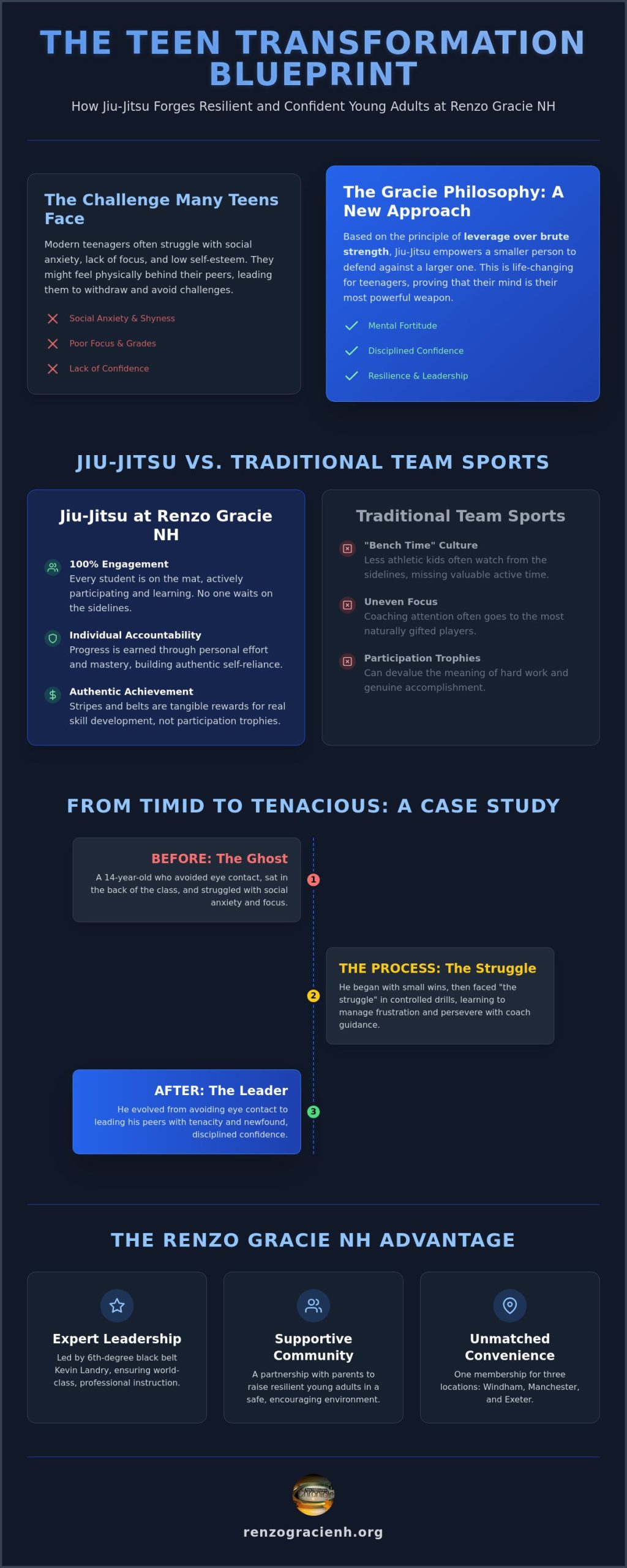
From Timid to Tenacious: A Case Study in Transformation

Meet Liam. He is a fourteen year old from the Windham area who, six months ago, was essentially a ghost in his own life. He sat in the back of his classroom with his hood up. He avoided eye contact with teachers and struggled to stay focused on his assignments. His parents were deeply concerned about his growing social anxiety and lack of direction. Like many families looking into jiu jitsu for teenagers NH, they weren’t searching for a hobby; they were searching for a way to help their son find his voice and stand his ground.

Phase 1: The First Step onto the Mats

Liam’s journey began with a try jiu jitsu free New Hampshire introductory class. He was visibly nervous. His shoulders were hunched, and he barely spoke above a whisper. Our instructors recognize this hesitation as the first major hurdle. We greeted him with the warmth of a supportive partner rather than the intensity of a drill sergeant. During that first hour, Liam achieved a vital small win. He mastered the opening bow and the basic mechanics of a technical stand-up. It was a simple movement, but for a teenager who felt physically awkward, it was a revelation of what his body could actually do.

Phase 2: Building Resilience Through ‘The Struggle’

The first thirty days were about overcoming the anxiety of a new environment. By the three month mark, the focus shifted to “the struggle.” Liam participated in drills where he had to escape a controlled position while a partner provided resistance. He was pinned. He felt frustrated. However, our coaches guided him through that frustration without letting him give up. Research suggests that this type of structured physical challenge builds confidence and discipline by teaching students to stay calm under pressure. Liam eventually realized that being on the bottom wasn’t a defeat. It was simply a problem that required a technical solution.

Phase 3: The Leadership Transition

At the six month milestone, Liam earned his first stripe. The transformation was undeniable. He stood taller. He spoke with a clear, steady voice. During a recent class in Exeter, we watched Liam quietly guide a newer student through a complex sweep technique. He had transitioned from a student who was afraid to be noticed to a mentor who was eager to lead. This “quiet authority” followed him home. His parents reported improved grades and a newfound ability to handle social pressure at school. If you are ready to see your child develop this kind of resilience, you can learn more about our community-focused approach and our commitment to character development.

How BJJ Drills Build Mental Fortitude and Focus

Brazilian Jiu-Jitsu is often described as “human chess.” It’s a fitting title. While the physical benefits of the sport are undeniable, the neurological impact is where the true transformation happens for a young person. When a student steps onto the mat, they aren’t just exercising. They’re computing. Mastering jiu jitsu for teenagers NH requires a high level of executive function. Students must memorize complex movement sequences, coordinate their limbs in three-dimensional space, and recall those techniques while under the physical resistance of a partner. This mental heavy lifting sharpens focus in a way that traditional gym classes simply cannot match.

This process is part of a deliberate “pressure testing” environment. By facing controlled physical stress on the mats, teenagers gradually desensitize themselves to the types of social and academic stress that typically cause them to shut down. They learn that a heavy situation isn’t a reason to panic. It’s a reason to breathe. Our youth martial arts program New Hampshire is built on this foundation of resilience. We provide a healthy physical outlet that actually reduces aggression. When a teenager has a safe place to exert their energy and test their limits, they don’t feel the need to prove themselves through posturing or conflict outside the academy.

Problem-Solving Under Pressure

In our curriculum, we emphasize the mantra “position before submission.” This teaches teenagers a vital life lesson: think before you act. They learn to secure their environment and stabilize their position before trying to solve the final problem. This mental discipline translates directly to the real world. Whether they’re facing a difficult test question or a tense interaction with a bully, they’ve practiced the art of “pausing.” They don’t just react with emotion. They analyze, adjust, and execute a plan based on the tools they’ve earned through hard work.

The Social Hierarchy of Respect

Respect isn’t just a rule at Renzo Gracie NH; it’s a practiced skill. Every class begins and ends with the ritual of bowing, a gesture that acknowledges the shared effort and mutual safety of the group. The dynamic between higher belts and lower belts creates a natural mentorship structure. Older or more experienced students learn to protect and guide their peers, while newer students learn the value of listening and following instructions. This social structure helps teenagers from Manchester and Windham schools thrive. They carry this sense of order and “quiet authority” back into their classrooms and family lives, becoming leaders who lead through example rather than ego.

BJJ for Child Confidence and Discipline: A New Hampshire Case Study in Character Development

Why Southern NH Parents Choose Jiu Jitsu Over Other Activities

Southern New Hampshire parents face a crowded calendar of seasonal sports. Soccer in the fall. Hockey in the winter. Baseball in the spring. While these activities offer value, they often come with significant “bench time” where only the top athletes get meaningful experience. This is one of the primary reasons families are turning to jiu jitsu for teenagers NH. In our academy, nobody sits on the sidelines. Every student is active. Every student is learning. Every student is progressing at their own pace. This constant engagement ensures that your teenager is always building skill rather than waiting for their turn to participate.

Unlike traditional martial arts that often focus on forms or “katas” performed against the air, Brazilian Jiu-Jitsu utilizes live resistance. This means students practice their moves against a partner who is actively trying to counter them. This “pressure testing” ensures that the skills learned are functional and reliable. It builds a level of practical confidence that simply cannot be developed through non-contact drills. For parents, this means knowing their child possesses real-world tools that work when they matter most. If you want a deeper look at the specific jiu jitsu benefits for children that go beyond the physical, our 2026 guide explores ten surprising advantages that help kids build resilience, improve school focus, and master practical self-defense skills.

Individual Growth in a Team Setting

Success on the mats is a personal journey, but it requires a supportive community to achieve. Your teenager isn’t competing against their teammates for a starting spot; they are working with them to sharpen their skills. This environment fosters a unique bond where individual accountability meets collective effort. For those in the Seacoast area, our kids jiu jitsu Exeter NH guide provides deeper insight into how we tailor this experience for local families. We focus on personal progress, ensuring every teen feels the joy of their own evolution.

The ‘Bully-Proof’ Advantage for NH Schools

Bullying is a significant concern for parents across the state. Research indicates that 28% of U.S. students in grades 6-12 report being bullied, a statistic that highlights the need for effective intervention. Jiu-Jitsu offers the most practical self-defense because it focuses on non-violent control. We teach teenagers how to neutralize a situation using leverage and positioning rather than strikes. Alongside these physical moves, we emphasize verbal de-escalation skills. True confidence is the ability to walk away from a fight because you know you could win it. By removing the fear of the unknown, we empower students to handle conflict with a calm, level head. Learn how jiu jitsu for child social skills NH builds the emotional maturity to de-escalate conflict before it starts.

Beyond the character benefits, BJJ provides a consistent anchor for the family. New Hampshire winters are long and often limit outdoor activity, making indoor training essential for physical health. Our facilities in Windham, Manchester, and Exeter offer a year-round outlet for energy and growth. We prioritize family time, offering a clean and professional environment where parents can see their children evolve into leaders. If you are ready to see the difference a structured curriculum can make, schedule your free introductory class today and join our community.

Starting the Journey: Character Development at Renzo Gracie NH

Starting a new journey can feel overwhelming for both the parent and the teenager. It’s a big step. At Renzo Gracie NH, we’ve spent more than 20 years refining a process that makes this transition as smooth as possible. Led by Professor Kevin Landry, a 6th-degree black belt, our academy has become a cornerstone of the Southern New Hampshire community. We don’t just teach techniques. We build a legacy of respect and resilience that lasts a lifetime. When you choose jiu jitsu for teenagers NH at our academy, you are joining a lineage of quality and safety that has supported thousands of local families.

We understand that modern family life is a balancing act. Between school, work, and social commitments, finding time for high-quality extracurriculars can be difficult. That’s why we offer the convenience of “One Membership, Three Locations.” Whether you are closer to Windham, Manchester, or Exeter, your teenager has access to the same elite level of instruction. This flexibility ensures that your child’s character development doesn’t have to pause just because your schedule changes. We are your supportive partner in raising a confident, focused young adult.

Our NH Locations: Windham, Manchester, and Exeter

Each of our state-of-the-art facilities is designed with a professional, clean, and welcoming atmosphere. We’ve moved away from the intimidating “tough guy” gym vibe to create a space where every student feels they belong. The curriculum is identical across all three academies. If your teenager attends a class in Manchester on Tuesday and Windham on Thursday, they won’t miss a beat. Our schedules are built specifically for busy New Hampshire parents, offering evening sessions that fit into your daily routine without causing unnecessary stress.

Your Invitation: The Free Introductory Class

The first day at a new gym is often the most nerve-wracking part of the process. We’ve designed our introductory experience to remove that anxiety. There is zero commitment required to walk through our doors and try the program. Your teenager’s first class is focused entirely on assessment, comfort, and safety. We take the time to introduce them to the basic movements, ensure they feel supported by their peers, and help them understand the flow of a typical session. It’s a low-pressure environment where they can discover the joy of personal progress firsthand.

You’ve seen how jiu jitsu can transform a shy student into a tenacious leader and how it provides a mental edge that team sports often lack. Now it’s time to see that transformation in your own child. We invite you to visit one of our locations and experience the Renzo Gracie NH difference. Our doors are open, and our community is ready to welcome you. Schedule your teenager’s free character-building session today and take the first step toward a more confident future.

Empower Your Teenager’s Future Today

Transformation doesn’t happen by accident. It’s built on the mats through consistent effort, expert guidance, and a supportive community. You’ve seen how Brazilian Jiu-Jitsu serves as a character lab where teenagers learn to navigate resistance with a calm and steady mind. By choosing jiu jitsu for teenagers NH, you’re giving your child the tools to handle school stress, social pressure, and physical challenges with quiet authority. They’ll stop sitting on the sidelines and start leading from the front.

At Renzo Gracie NH, we partner with you to raise resilient kids. Led by 6th-degree black belt Kevin Landry, our specialized youth character development curriculum is available at three convenient locations in Windham, Manchester, and Exeter. We focus on the individual success of every student within a family friendly environment. It’s time to see your child stand taller and speak clearer. Book your teenager’s Free Introductory Class at Renzo Gracie NH today! We can’t wait to welcome your family into our community and begin this evolution together.

Frequently Asked Questions

Will Jiu-Jitsu make my teenager more aggressive or prone to fighting?

Brazilian Jiu-Jitsu actually reduces aggression by providing a safe and structured physical outlet for energy. When a teenager understands their own capability, they no longer feel the need to prove themselves through posturing or conflict. We teach that true strength is found in self-control. This “quiet authority” allows them to de-escalate situations because they aren’t acting out of fear or insecurity. It’s about being prepared, not being aggressive.

My teenager is very shy and uncoordinated. Can they still do BJJ?

Every student begins their journey at a different physical starting point. Jiu-Jitsu is specifically designed to empower smaller or less athletic individuals through the use of leverage and technique. As they master movement sequences, their coordination improves naturally. Our supportive environment helps shy teenagers find their voice by celebrating small, earned wins on the mats. It’s a place where they can evolve at their own pace without the pressure of a bench-time culture.

How often should my teen attend classes to see character changes?

Most families find that attending classes two to three times per week is the ideal rhythm for seeing consistent growth. This frequency allows the teenager to build muscle memory and reinforce the character-building lessons of discipline and perseverance. While every child’s journey is unique, this steady momentum helps them integrate the “character lab” mindset into their daily school and home life. Consistency creates the steady progression needed for long-term mastery and confidence.

What is the difference between Jiu-Jitsu and Karate for teenagers in NH?

The primary difference lies in the application of technique. While Karate often focuses on striking and pre-arranged forms, jiu jitsu for teenagers NH emphasizes grappling and non-violent control through live resistance training. This means students practice their moves against a partner who is actively moving. This “pressure testing” ensures that the skills are practical and functional for real-world self-defense. It provides a more realistic sense of what works under stress compared to non-contact drills.

Is Jiu-Jitsu safe for teenagers? What about injuries?

Safety is our absolute priority at Renzo Gracie NH. Brazilian Jiu-Jitsu is known as “the gentle art” because it lacks the high-impact striking found in other combat sports. We focus on controlled movements and technical proficiency under the direct supervision of Professor Kevin Landry and our experienced staff. While any physical activity carries a small risk, our structured curriculum and focus on mutual respect significantly minimize the chance of injury compared to traditional high-impact team sports.

How does the ‘Bully Prevention’ program at Renzo Gracie NH actually work?

Our program works by giving teenagers the confidence to handle conflict without resorting to violence. We teach specific techniques to neutralize an aggressor using leverage and positioning, allowing the student to stay safe while controlling the situation. This physical capability is paired with verbal de-escalation training. When a teenager knows they can protect themselves, they can speak clearly and set boundaries. They become “bully-proof” because they no longer project the vulnerability that bullies often target in others. Explore how developing jiu jitsu for child social skills in NH helps children build the emotional maturity and quiet confidence to overcome bullying for good.

Can parents train at the same time as their teenagers?

We prioritize family time and offer schedules that allow parents and teenagers to train during overlapping or adjacent time slots. While classes are separated by age to ensure optimal instruction, the shared experience of training under the same roof builds a powerful bond. Many Southern New Hampshire families find that jiu jitsu for teenagers NH becomes a consistent part of their lifestyle. It’s an opportunity for the whole family to grow, stay active, and support each other together.