How BJJ Helps Children Overcome Bullying Without Violence
What if the most effective way to stop a bully isn’t throwing a punch, but knowing how to stay completely calm? If you’ve watched your child withdraw into anxiety, avoid school, or shrink under daily harassment, your instinct is to protect them immediately. Yet, traditional combat sports that teach striking carry real risks of school suspension and retaliatory violence. Understanding how BJJ helps children overcome bullying offers a proven, peaceful alternative. It changes the dynamic entirely from trading blows to controlling the situation.
You already know that fighting back with fists only invites more trouble. In this guide, you’ll discover how Brazilian Jiu-Jitsu empowers children with quiet confidence, firm verbal boundaries, and non-violent restraint skills to defuse threats safely. We’ll explore why technical leverage neutralizes raw physical size, how assertive posture stops confrontation before it starts, and how an encouraging mat culture helps every child build lasting resilience.
Key Takeaways
- Discover why traditional advice like “just ignore it” often backfires and how practical boundaries restore your child’s sense of safety.
- Learn how BJJ helps children overcome bullying by relying on mechanical leverage and non-violent holds rather than dangerous strikes.
- Understand the psychological reasons why disciplined martial arts training reduces aggression instead of turning quiet kids into bullies.
- Master the three-step defense model that emphasizes calm posture, assertive de-escalation, and non-violent restraint as a strict last resort.
- Explore how an inclusive mat community and experienced mentorship build lasting mental resilience and quiet self-belief.
Understanding Modern Bullying: Why Passive Advice Often Leaves Children Vulnerable
Bullying thrives in isolation. It relies on an asymmetric dynamic of power, targeting perceived weakness, hesitation, and fear. According to established scholarship and a comprehensive definition of bullying, the behavior requires an imbalance of physical or social power repeated over time. When parents notice their child withdrawing into silence, the common instinct is to preach non-engagement. “Just ignore them,” adults advise. “Don’t give them a reaction.”
Unfortunately, passive avoidance rarely resolves intimidation. Instead, silence frequently reads as submission. Aggressors treat non-responsiveness as permission to escalate, turning casual teasing into chronic harassment. The resulting psychological toll extends far beyond school hallways, eroding a child’s academic focus and everyday social confidence. Understanding how BJJ helps children overcome bullying begins with recognizing that authentic safety requires calm competence rather than anxious passivity.
The Hidden Anatomy of Schoolyard Aggression
Aggressors rarely choose targets at random. They seek easy targets. Visible cues like slumped shoulders, downcast eyes, and hesitant speech immediately signal self-doubt. While overt physical shoves grab headlines, the everyday reality often involves quiet cruelty: excluding peers from cafeteria tables, whispering in hallways, or persistent digital slights. When a targeted child freezes, the aggressor’s social dominance gets validated in front of their peers, cementing a cycle of intimidation that becomes harder to break every day.
Why Telling Kids to ‘Just Walk Away’ Isn’t Always Enough
Walking away works only if done from a place of strength. A hurried retreat with hunched shoulders looks like flight, encouraging an aggressor to follow. Standing grounded, making direct eye contact, and stating a firm boundary changes the equation instantly. Real de-escalation demands inner stability. A child must know, deep down, that if an aggressor grabs their arm or pushes them to the floor, they can handle the physical challenge without getting hurt.
This grounded self-assurance is the core of Kids Jiu Jitsu New Hampshire youth development. Training provides children with physical clarity. They stop projecting panic. This single transformation illustrates how BJJ helps children overcome bullying: it eliminates the target painted by fear before physical conflict ever starts.
The BJJ Advantage: Non-Violent Positional Control Versus Striking Arts
Traditional martial arts often focus on kicking and punching. In modern schools, swinging a fist creates disaster. School zero-tolerance policies rarely distinguish between an aggressor and a defending victim; trading strikes usually leads to immediate suspension for both kids. This harsh reality shows why learning how BJJ helps children overcome bullying is so critical. Instead of trading blows, Brazilian Jiu-Jitsu relies on positional grappling and body control to stop confrontations peacefully.
Leverage Over Strength: Neutralizing Physical Size Disparities
Bullies rely on physical mass and forward momentum to intimidate smaller peers. Jiu-Jitsu neutralizes that advantage. By utilizing fulcrums, weight distribution, and leverage, a smaller child can quickly off-balance a heavier opponent. When an encounter moves to the ground, a larger aggressor loses their ability to generate striking power. Brazilian Jiu-Jitsu replaces panic with physics, enabling smaller youth to dictate physical encounters.
The Ethics of Control: Restraining Aggressors Without Harm
Striking creates lasting injury, including concussions and fractured bones. Positional grappling creates safety. According to the authoritative definition of bullying provided by StopBullying.gov, physical harassment involves unwanted aggressive behavior meant to display power. Holding an aggressor securely in place neutralizes that threat without inflicting bodily trauma. It gives teachers or supervisors time to intervene while keeping everyone safe.
Because there is no bloodshed or traded punches, school administrators can clearly see who defended themselves with restraint. For families seeking this protective skill set, training at Renzo Gracie NH provides a clear path toward safe, school-smart self-defense.
Live Resistance Training: Overcoming the Freeze Response
Adrenaline causes untrained children to freeze when attacked. BJJ eliminates that panic response through controlled live sparring, often called rolling. During each class, students practice their techniques against fully resisting training partners. Key benefits of this dynamic training include:
- Nervous system conditioning: Regular exposure to close physical contact teaches the body to remain relaxed instead of going into shock.
- Problem-solving under pressure: Children learn to breathe and think strategically even when pinned beneath an opponent.
- Hallway composure: Because they face simulated physical pressure on the mats daily, sudden real-world confrontations lose their terrifying mystique.
This calm, practiced composure demonstrates how BJJ helps children overcome bullying: it replaces paralyzing fear with quiet, capable awareness.
Debunking the Combat Sport Myth: Does Training BJJ Make Children Aggressive?
A major fear holds many parents back from martial arts academies: the dread of accidental aggression. What if training turns your gentle child into a schoolyard bully? What if giving them physical leverage makes them eager to start fights? These valid parental concerns rest on a natural misunderstanding of how combat training interacts with a young person’s emotional wiring. Bullies do not lash out because they possess disciplined technique; they act out because of unmanaged insecurity and an urgent, anxious need to manufacture social dominance.
Brazilian Jiu-Jitsu works in reverse. Learning capable physical control removes the desperate urge to prove oneself. When a student steps onto the mats, taps out regularly, and works safely through complex physical puzzles with peers, ego takes a backseat. Respectful mat etiquette transforms raw impulse into humble accountability. This emotional maturation shows precisely how BJJ helps children overcome bullying: by eliminating the inner volatility that fuels both aggression and victimhood.
The Psychology of the Quietly Confident Child
Genuine capability creates stillness. Children who know they can protect themselves carry no urge to retaliate against minor insults, cafeteria posturing, or playground teasing. They feel secure. This inner stability changes how they interact with their peers:
- Immunity to verbal taunts: Because their self-worth is tested and proven on the mat, cheap words fail to trigger desperate defensive reactions.
- Emotional balance: Experiencing safe physical pressure during class teaches kids that discomfort is manageable, removing the panic behind explosive tempers.
- Protecting others: Capable students rarely stay quiet during unfair moments; they routinely step up as calm, steady defenders of isolated classmates.
Dismantling the Victim Stance Through Posture and Gaze
Aggression seeks an easy target. Training actively dismantles the physical signals that bullies prey upon. Slumped posture gives way to relaxed, level shoulders; averted eyes transform into direct, calm eye contact. A child who moves with grounded composure communicates capability before a single word is spoken. That non-verbal boundary often ends harassment before it can begin.
Parents who want to reinforce this mutual respect and grounded poise can explore programs like Parent and Child Jiu Jitsu in Windham. Training side by side reinforces emotional balance at home, demonstrating how BJJ helps children overcome bullying by establishing shared family habits of quiet confidence and genuine composure.
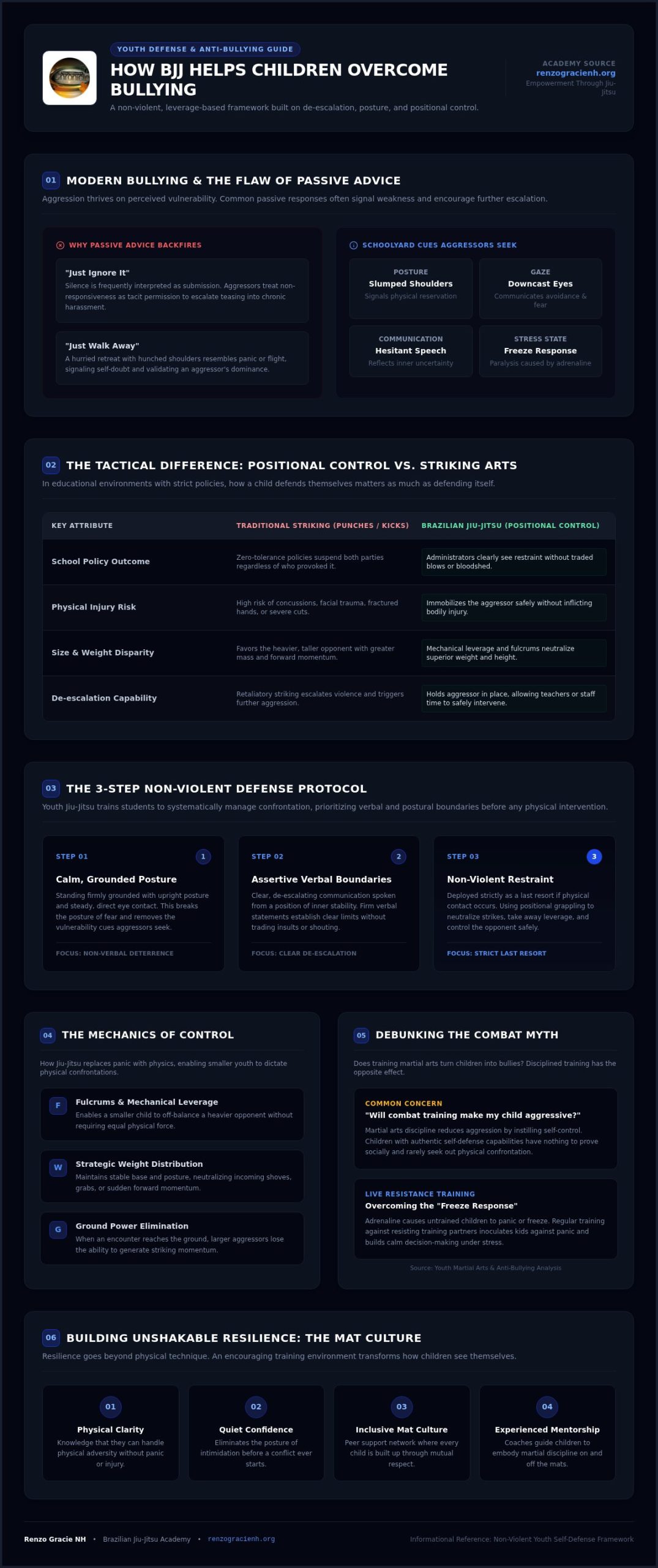
The 3-Step Non-Violent Anti-Bully Protocol Taught in Youth Jiu-Jitsu
Self-defense begins long before hands make contact. In structured youth grappling, physical engagement is taught as an absolute last resort, reserved solely for moments when verbal communication fails and immediate physical safety is compromised. Rather than reacting blindly, students rely on a methodical escalating response model that neutralizes aggression safely. This structured discipline shows practically how BJJ helps children overcome bullying within strictly monitored school environments.
Step 1: Setting Clear Verbal Boundaries and Confident Distance
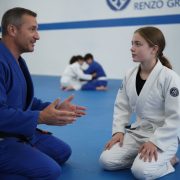
Every encounter begins with distance management. Students are trained to adopt a defensive ready stance: feet balanced, chin tucked, and open hands raised at chest height. This posture protects the head while signaling non-aggression to onlookers. From this position outside the peer’s reach, children use firm, audible scripts like “Stop, step back, I don’t want to fight you.” Speaking loudly establishes clear personal boundaries and immediately draws adult attention.
Step 2: Safe Clinch Entry to Neutralize Incoming Strikes
If an aggressor ignores verbal warnings and lunges forward, staying at arm’s length is dangerous. That middle zone is where punches land. Instead, children learn to close the distance immediately:
- Cover the head: The child steps forward inside the swing with their forearms protecting the ears and temples.
- Secure the body lock: Wrapping arms around the aggressor’s torso completely eliminates their ability to generate striking leverage.
- Control head position: Tucking their forehead against the opponent’s chest prevents headbutts and destabilizes the aggressor’s center of gravity.
Step 3: Gentle Takedown and Positional Control Until Help Arrives
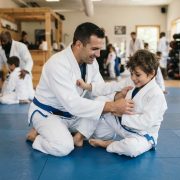
Once the clinch is secured, the objective is safe de-escalation on the floor. Students use low-impact trips or body-lock transitions that guide both bodies down without slamming. Rather than applying painful joint submissions, the child establishes a dominant position like the mount or knee-on-belly.
From this controlled position, the student negotiates calmly: “I will let you up if you stop pushing me.” Holding the aggressor securely prevents injuries to both parties while waiting for school staff to arrive. This controlled sequence illustrates exactly how BJJ helps children overcome bullying without violence. To see these safe de-escalation drills in person, explore youth martial arts training at an academy that prioritizes non-violent defense.
Building Unshakable Resilience at Renzo Gracie NH: What Parents Can Expect
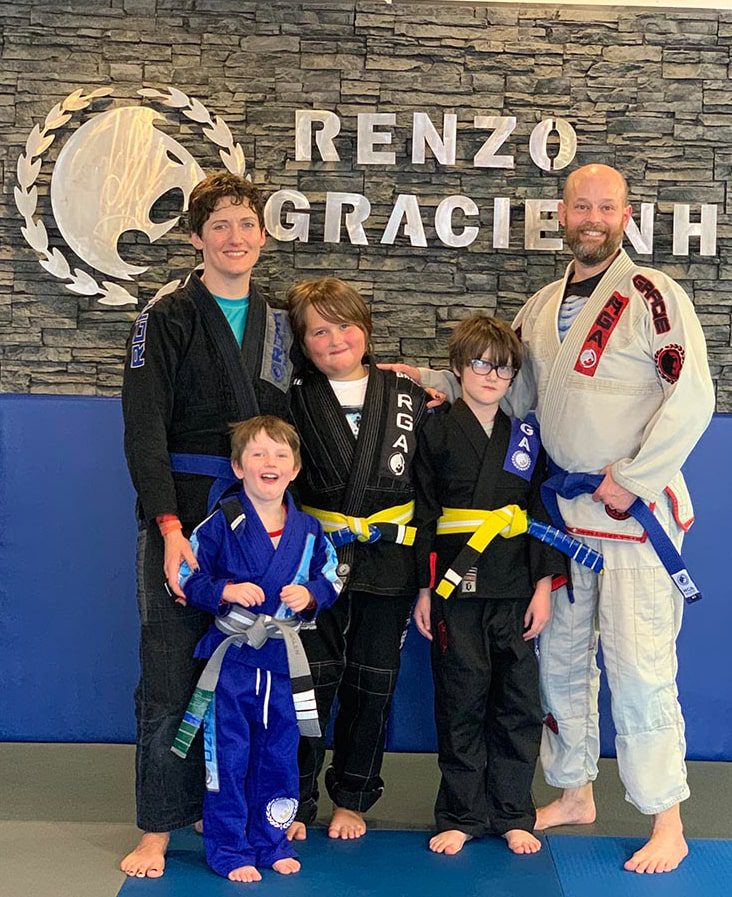
Every child deserves an environment where they can build authentic strength without intimidation. At Renzo Gracie NH, families across Windham, Manchester, and Exeter discover a supportive training environment centered on character and personal progress. When looking at how BJJ helps children overcome bullying, the physical technique is only half the equation. The culture surrounding that technique matters just as much.
A Structured Youth Curriculum Led by Master Instruction
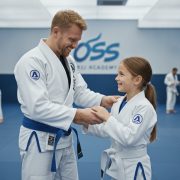
World-class instruction provides the foundation for safe growth. Led by Professor Kevin Landry, a 6th-degree black belt under Renzo Gracie with over 20 years of teaching experience in New Hampshire, our youth classes maintain an ego-free, disciplined atmosphere. The academy emphasizes hygiene, mutual respect, and safe technical practice. Classes are separated by age and developmental stage, ensuring children practice alongside peers of similar size and maturity rather than facing overwhelming physical gaps.
Overcoming Insecurity: How the Mat Community Nurtures Timid Kids
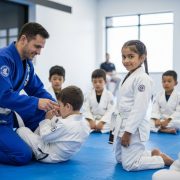
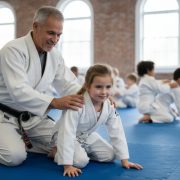
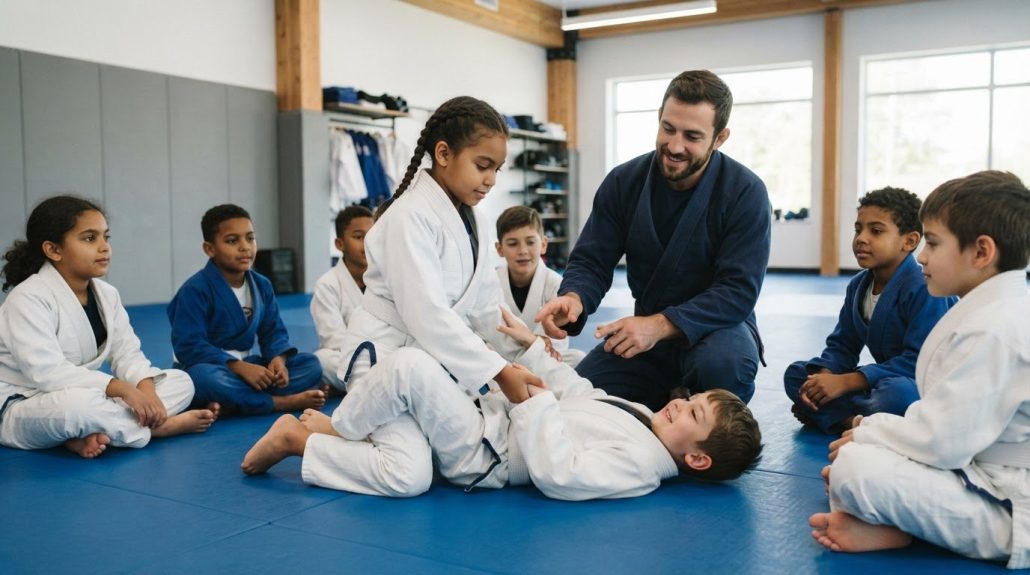
Shy or unathletic children often feel isolated in school hallways. On the mats, they find an inclusive community outside their school district. Advanced students actively mentor newcomers, replacing cliquish behavior with teamwork and encouragement. Every class presents structured challenges designed to build character:
- Incremental victories: Mastering a simple escape or control hold teaches children that persistence overcomes initial difficulty.
- Peer support: Training with respectful teammates provides a positive social circle completely separate from everyday schoolyard drama.
- Quiet self-assurance: As physical competence grows, the anxious self-doubt that often attracts negative attention naturally disappears.
This steady, supportive community illustrates how BJJ helps children overcome bullying by building an internal sense of security that stays with them everywhere they go.
Your First Step: Experiencing the Free Introductory Class
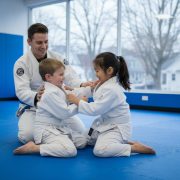
Walking into a martial arts academy for the first time can feel intimidating for an anxious child. That is why the journey begins gently. During a complimentary introductory class, instructors take time to assess your child’s comfort level and introduce basic movements through fun, accessible partner drills. Beginners are never thrown into intense sparring sessions on day one.
Parents can watch the entire session from the sidelines, meet our coaching staff, and experience the supportive community firsthand. If you are ready to help your child develop real composure, explore a Try Jiu Jitsu Free in New Hampshire session today.
Transforming Bully Defense into Lifelong Confidence
Every child deserves to walk through school hallways without fear or hesitation. Real protection doesn’t come from teaching kids how to trade violent strikes; it stems from steady posture, clear vocal boundaries, and non-violent physical control. Learning how BJJ helps children overcome bullying reveals that authentic self-defense replaces anxious self-doubt with quiet composure. When your child knows they can neutralize aggression safely on the ground, their entire demeanor changes. Confrontation dissolves before it begins.
At Renzo Gracie NH, our dedicated youth curriculum is led by Professor Kevin Landry, a 6th-degree black belt under Renzo Gracie with over 20 years of experience teaching New Hampshire families. Across our welcoming academies in Windham, Manchester, and Exeter, we provide a family-centered mat culture where character, mutual respect, and personal safety come first. Give your child the internal resilience to stand tall, defuse hostility peacefully, and thrive in every environment. Empower your child with confidence and book your free introductory class today!
Frequently Asked Questions
Will learning Brazilian Jiu-Jitsu encourage my child to pick fights at school?
No, training actually reduces aggressive behavior. Brazilian Jiu-Jitsu teaches discipline, humility, and emotional regulation from day one. When children test their abilities safely on the mats, they feel no anxious urge to prove themselves through schoolyard conflict. Instructors at Renzo Gracie NH actively emphasize that martial arts are strictly for protection. Understanding how BJJ helps children overcome bullying means recognizing that real capability breeds calm patience, not hostility.
How can a smaller child defend themselves against a much larger bully using BJJ?
BJJ relies on mechanical leverage, body angles, and base rather than raw muscular power. When an encounter moves to the floor, a heavier child loses their striking leverage and momentum. Smaller practitioners use body locks, fulcrums, and weight distribution to control an opponent safely. This scientific framework allows smaller youth across New Hampshire academies to protect themselves against larger peers without needing superior physical size or brute force.
What should my child do if a bully tries to hit them before they can use grappling?
Children are trained to close the distance immediately while shielding their head. Standing at arm’s length leaves a child vulnerable to wild swings. Students learn a protective entry that covers the temples and jaw while stepping swiftly into a clinch. Once locked in an upper-body hold, the aggressor loses the space needed to generate striking momentum, keeping both students much safer until adults can intervene.
How quickly will my child start showing increased confidence after starting BJJ?
Most parents observe noticeable shifts in posture, vocal clarity, and eye contact within three to four weeks. As children master foundational movements and earn small technical victories, their internal self-doubt begins to fade. That newly discovered assurance shows up immediately in how they carry themselves. Seeing how BJJ helps children overcome bullying involves noticing how rapid postural changes dismantle the hesitant cues that aggressors target.
Will my child get in trouble at school for using Jiu-Jitsu in self-defense?
Positional grappling drastically minimizes the risk of disciplinary action under zero-tolerance school policies. Striking martial arts leave visible trauma, bruises, and fractured skin that administrators often penalize regardless of who initiated the fight. In contrast, holding an aggressor down creates clear visual evidence of restraint rather than violence. School staff and bystanders can plainly see that your child controlled the threat without throwing harmful punches.
Can a very shy or unathletic child succeed in youth Brazilian Jiu-Jitsu?
Absolutely. Jiu-Jitsu is uniquely suited for quiet, uncoordinated, or timid children. Unlike traditional team sports where athletic benchwarmers get overlooked, grappling allows every student to advance at their personal pace. At Renzo Gracie NH, coaches provide a patient, structured atmosphere that welcomes beginners gently. Over time, progressive drills develop natural balance, coordination, and genuine pride in kids who previously struggled with physical activities or social anxiety.
What makes Brazilian Jiu-Jitsu safer than striking martial arts like karate or taekwondo?
BJJ focuses entirely on controlled holds, leverage, and takedowns instead of high-velocity impacts. Striking disciplines carry ongoing risks of accidental concussions, dental trauma, and facial fractures during routine sparring. Jiu-Jitsu eliminates strikes entirely. Students practice techniques dynamically with resisting partners who can tap out at any moment to stop the drill. This controlled practice builds practical self-defense skills without subjecting developing minds to repeated head impacts.