Posts

BJJ classes for older adults in Windham

You’re not too old to start Brazilian Jiu-Jitsu: people can begin at 20, 40, or 70. BJJ for older adults in Windham can start with fundamentals and controlled practice, while hard rolling waits until you’re ready.

It’s understandable to wonder whether age, fitness, or experience will make your first class difficult. BJJ doesn’t have to start with intense sparring. Patient practice can help you learn at a steady pace and become more comfortable with movement and technique.

Here, you’ll learn how beginners can approach training safely, which class times may fit an older student, and how often to train. You’ll also see how Brazilian Jiu-Jitsu can build confidence and practical self-defense skills through technique, focus, and consistent progress.

Key Takeaways

  • You’re not too old to begin Brazilian Jiu-Jitsu; adults can start at different ages and progress at a pace that suits them.
  • Plan for two to three classes a week, and consider morning or midday sessions for a calmer, technique-focused start.
  • Build a steady foundation before adding more demanding drills; early training can focus on fundamentals without hard rolling.
  • Learn how movement, balance, and technique can support fitness while helping you develop practical self-defense skills.
  • Expect confidence to grow through patient practice, problem-solving, and small milestones along the way.

Which class times work best for older beginners?

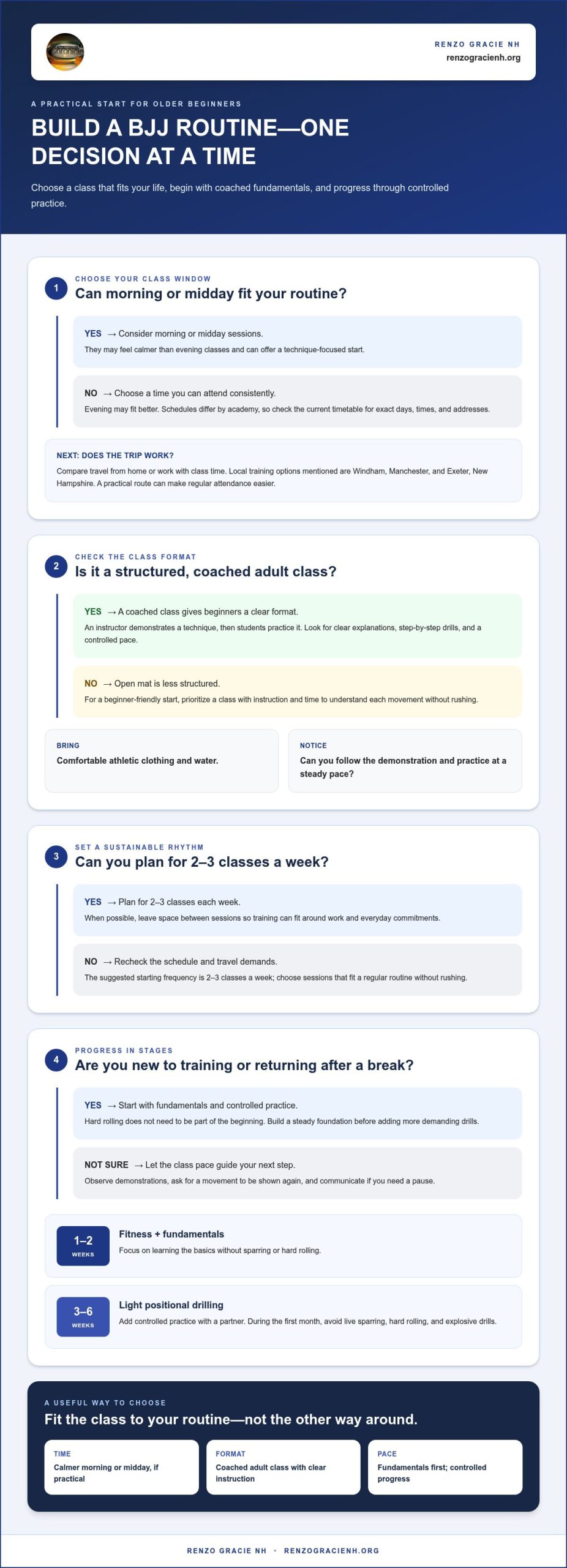
Morning and midday sessions may feel calmer than evening classes. The best time for an older beginner is one that fits a regular routine and allows you to arrive without rushing.

Class Schedules and Locations

For local training, focus on Windham, Manchester, and Exeter, New Hampshire. Compare the trip from home or work with the class time, and consider whether the route makes regular attendance practical. Morning and midday sessions are often calmer than evening classes, but schedules differ by academy. Use each school’s current timetable for exact days, times, and address details.

The suggested starting frequency is two to three classes a week. Choose sessions with space between them when possible, so you can fit practice around work and everyday commitments. Check travel time as well as the timetable; a convenient class is easier to keep in your routine.

Beginner-Friendly Adult Classes

Start with a structured adult class rather than open mat. In a coached session, an instructor demonstrates a technique before students practice it; open mat is less structured. Look for clear explanations, step-by-step drills, and a controlled pace that gives beginners time to understand each movement.

For your first class, wear comfortable athletic clothing and bring a water bottle. Notice whether demonstrations are easy to follow and whether you have time to practice each technique without rushing.

To choose between BJJ, judo, and other martial arts around Windham, compare the training focus and class format. Brazilian Jiu-Jitsu emphasizes grappling and ground positions, while judo focuses on throws and stand-up grappling. Consider which skills interest you and which schedule fits your routine.

Older beginners can ease into training with a staged approach. During the first month, avoid live sparring, hard rolling, and explosive drills. The first phase, weeks 1 to 2, focuses on fitness and fundamentals without sparring or hard rolling. Weeks 3 to 6 add light positional drilling with a controlled partner.

When reading reviews, look for specific comments about instructor explanations, how beginners are treated, and cleanliness in the training space. A review describing a class or facility offers more useful detail than a general rating alone. Consider those observations alongside location and schedule when choosing where to train.

For your first visit, allow time to find the training space and get ready. Comfortable athletic clothes and water are practical basics. The class gives you a chance to observe, listen, and learn the format before deciding whether it suits you.

Confidence and personal growth

Confidence in martial arts often grows through small, observable steps, not a sudden change in personality. You might first remember a position, then follow a partner drill, and later recognize when a familiar technique fits. Each step gives you something specific to build on. You’re learning how to respond, not proving you can overpower someone.

Brazilian Jiu-Jitsu asks you to solve movement problems while staying attentive to another person. For example, when a partner shifts their weight, you adjust your position and look for a safer angle. Practice encourages you to think ahead, remember sequences, and adapt when your partner changes their response. These are skills developed one decision at a time.

Progress can take patience. It may take about 6 months of training to start feeling like you know what to do. That doesn’t mean every class feels easy or that learning follows a fixed timetable. A useful measure is whether a technique or sequence feels more familiar than it did before. Small gains in focus and recall count.

Try a simple reflection after class. Write down one technique you remember, one part that challenged you, and one question for your next session. You might note that a movement made more sense after you practiced it slowly. This creates a clear record of what you’re learning, rather than a judgment of your ability.

Friendship can grow through the shared work of learning. Partners take turns practicing, respect each other’s pace, and repeat a sequence until it makes sense. If you forget a step, ask to see the movement again; if you need a pause, communicate that clearly. Respectful practice makes cooperation part of the lesson.

  • Choose one learning goal: remember a position or movement.
  • Notice one adjustment: identify how your partner’s movement changed your response.
  • Record one question: bring it into a later class.

Keep the focus on consistency and attention, not comparison with younger students or experienced teammates. BJJ for older adults in Windham can be a way to practice problem-solving, patience, and confidence alongside other students. If you’re ready to make that learning part of your routine, explore a structured place to train.

What is Brazilian Jiu-Jitsu?

Brazilian Jiu-Jitsu is a grappling martial art built around movement, positioning, and technique. In class, partners practice controlling positions and responding to changes on the mat.

Fitness Benefits

A Brazilian Jiu-Jitsu class combines learning techniques with active practice. For example, a student might move from a seated position, practice a controlled escape, then reset and repeat the sequence. This varied movement works the body in different ways rather than relying on one repeated motion. Grappling practice also engages muscles as students maintain posture and adjust their positions.

Mobility and Conditioning

Jiu-Jitsu movements involve stability, posture, and awareness of body mechanics. For example, students may shift their weight while maintaining balance during a partner drill. Classes also include movement, rolling, and grappling, which can challenge muscles and joints and involve mobility. The effort depends on the drill, its pace, and how actively a student participates.

Fitness develops through repeated actions, not just hard rounds. You might practice getting up from the mat, changing direction, or holding a stable position while a partner applies controlled pressure. Each movement calls for coordination and attention. Maintaining posture as you move also helps you understand how balance changes in different positions.

Conditioning in BJJ is part of learning technique. A sequence may require you to move, pause, listen to a correction, and repeat the movement with better control. This makes class physically active while keeping the focus on learning. Beginners can work on clean, deliberate movement instead of trying to match an experienced partner’s pace.

To understand how training feels, notice how often you move, which positions challenge your balance, and whether you can follow a technique while staying controlled. These observations can help you describe your current fitness and identify movements to practice. If turning from your side feels unfamiliar, for instance, you can work on that movement gradually.

Brazilian Jiu-Jitsu can support fitness by combining movement with practical problem-solving. The physical demands vary with each technique and drill, so focus on posture, coordination, and effort rather than treating every class as a test. The goal is purposeful practice: learn the movement, understand its mechanics, and build familiarity through repetition.
BJJ classes for older adults in Windham

Practical self-defense

Brazilian Jiu-Jitsu teaches grappling skills for situations where people are close together. Students practice recognizing positions, managing balance, and working toward an escape. Drills help you understand a technique and its limits, but real situations may not unfold like practice. Self-defense also involves noticing risk and choosing a safe opportunity to leave.

Technique matters because BJJ emphasizes leverage and position rather than relying on excessive physical strength. For example, you can learn to shift your weight and create space instead of pushing directly against a partner’s force. This gives beginners a problem to solve: identify what is restricting movement, then practice a controlled response. Repetition helps make the sequence more familiar.

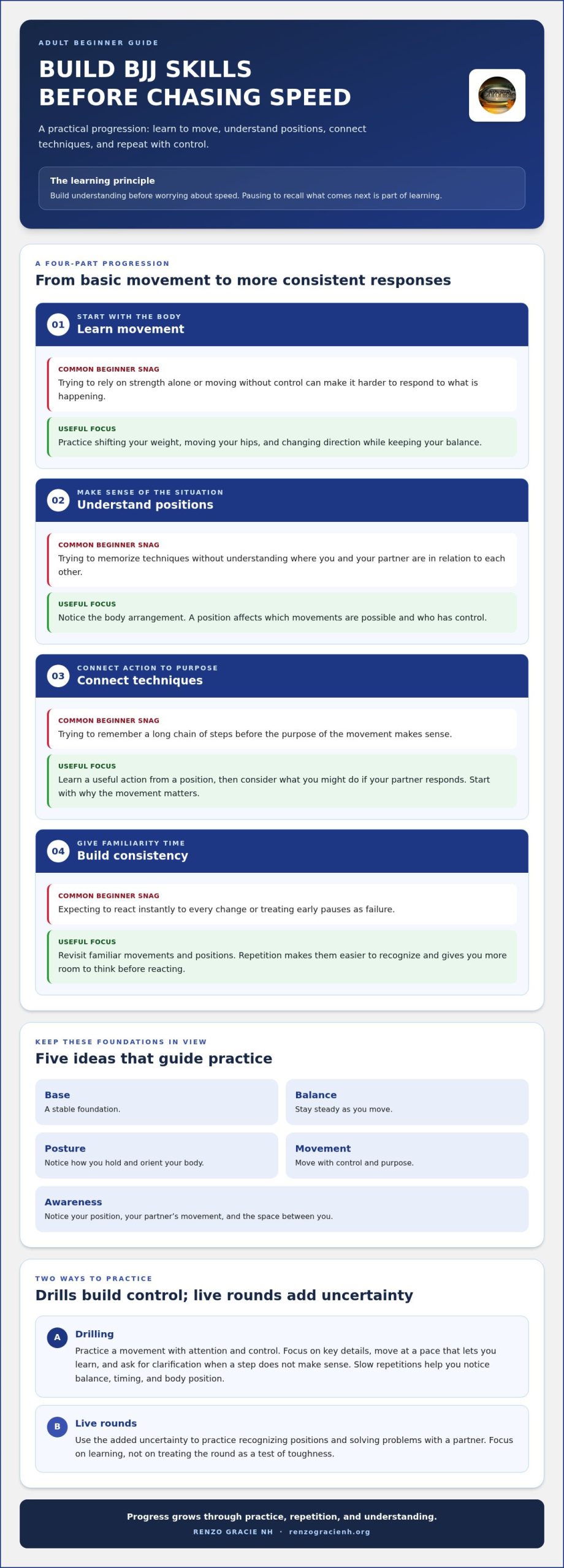
Mat drills can include weight shifts, sweeps, and escapes from different positions. A sweep changes the balance between partners, while an escape helps a student move out of a position that limits movement. During instruction, break each action into smaller steps: notice your partner’s position, move with control, and reset when asked. This makes the learning process concrete.

Grappling practice also teaches awareness of distance and body position. If a partner shifts their weight, you can feel the change and adjust rather than relying on a memorized response. This practice develops attention to movement. It also highlights an important distinction: a technique practiced with a cooperative partner can’t guarantee how an unpredictable encounter will unfold.

For older beginners, controlled drills make it easier to focus on the mechanics of defense before adding pressure. You can practice moving from a restricted position, maintaining balance, and creating space. Hard rolling and live sparring aren’t required to understand a basic technique. Instructors demonstrate movements, guide slow repetitions, and help students notice how posture and timing affect the result.

Practical self-defense skills are best learned as options, not as a promise that one move solves every problem. In class, you might learn an escape, repeat it from both sides, then practice recognizing the position that calls for it. If a response feels unclear, pause and ask to see the movement again so you can focus on understanding.

  • Notice the position: identify what is limiting movement.
  • Use technique: practice a weight shift or escape with control.
  • Reset and repeat: refine the sequence before increasing pressure.

This step-by-step approach connects learning with practical defense while keeping training focused on skill. Through repetition, students build familiarity with positions, changes in balance, and controlled escapes. The value lies in understanding what a technique asks your body to do, then practicing that response attentively with a partner. Each drill develops awareness and decision-making alongside grappling fundamentals.

BJJ for older adults

People aged 20, 40, or 70 can start Brazilian Jiu-Jitsu. Age alone doesn’t define whether training is suitable; experience, current condition, and the way practice is introduced matter. An older beginner can start by learning positions and basic movement, then build skills through controlled partner drills. The practical takeaway is simple: begin with fundamentals, not a test of toughness.

For students over 40, the approach should leave room to learn before attempting hard rolling. During the first month, older beginners are advised to skip live sparring, hard rolling, and explosive drills. That creates space to learn how a movement works, understand a partner’s position, and practice at a manageable pace. If you have a serious injury, consult a doctor before training.

A gradual plan makes the early learning steps clear. The suggested first phase lasts weeks 1 to 2 and focuses on fitness and fundamentals without sparring or hard rolling. In weeks 3 to 6, the next phase adds light positional drilling with a controlled partner. Students can focus on one position at a time, such as practicing how to move from a restricted position.

The suggested third phase runs from weeks 7 to 12. It may include light structured rolling or controlled pad rounds if the trainee feels well. These are stages, not a demand to advance on a fixed date. A useful decision at each step is whether you can follow the technique, maintain control, and recover comfortably before adding a more demanding drill.

  • Start with fundamentals: learn positions and movement before sparring.
  • Build control: practice a technique slowly with a partner.
  • Progress deliberately: add challenge as your skills and comfort develop.

Brazilian Jiu-Jitsu also involves problem-solving and mental engagement. Remembering a sequence, noticing a partner’s weight shift, and choosing a response keep your mind involved alongside physical practice. Progress includes more than completing a drill: it also means recognizing the situation and understanding why a technique fits.

Make your first goal specific: learn one position, ask for a controlled repetition, and notice what changes your balance. Then build from that foundation instead of measuring yourself against younger students or experienced teammates. To put those fundamentals into practice, explore the Adult Jiu Jitsu Program.

Renzo Gracie NH: Adult Jiu Jitsu Program

Renzo Gracie NH offers an Adult Jiu Jitsu Program for adults ready to turn interest into structured training. If you’re considering BJJ for older adults in Windham, the free introductory class is a practical way to experience the instruction before building a routine.

Bring questions about learning the fundamentals, training at a steady pace, and developing grappling skills. Start with a practical first step, then decide how Brazilian Jiu-Jitsu fits your goals. Training is also a chance to build skills alongside a supportive community of students.

Visit renzogracienh.org to learn more about the Adult Jiu Jitsu Program or the Free Introductory Class.

Make your next step a steady one

Starting something new doesn’t require a perfect plan. Choose a manageable first step, then let your experience guide what comes next. If you’re exploring BJJ for older adults in Windham, consider what you want from training, such as learning practical skills, building confidence, or joining a regular activity. A clear personal goal can help you focus on your progress instead of comparing yourself with others.

Renzo Gracie NH offers an Adult Jiu Jitsu Program, a Kids Jiu Jitsu Program, and Law Enforcement Jiu-Jitsu Training. Each serves different students and goals, while the adult program is the place to explore your own training. Give yourself room to learn at your pace and take pride in each new skill.

Ready to take a first step? Contact Renzo Gracie NH and explore where your training can begin. Your progress starts with showing up.

Frequently Asked Questions

Are you too old to start martial arts?

No, age alone doesn’t prevent someone from beginning martial arts. People aged 20, 40, or 70 can start Brazilian Jiu-Jitsu, with training adjusted through fundamentals and controlled practice. Consider your goals, current abilities, and comfort with movement when choosing how to begin. For an older beginner, learning techniques carefully is a more useful starting point than trying to keep pace with experienced students.

Can I train with an old injury or joint problem?

An old injury or joint problem calls for thoughtful planning before training. If you have a serious injury, consult a doctor before starting. Be ready to describe which movements cause discomfort, such as turning, kneeling, or bearing weight through an arm. This helps you understand which movements need attention in class. Don’t treat discomfort as a challenge to push through; prioritize controlled movement and clear communication.

How often should an older adult train?

Two to three sessions a week is the suggested starting frequency for older beginners. For example, choose spaced-out days that leave time for rest between classes, rather than stacking sessions together. Keep the schedule manageable alongside work, family, and other physical activity. If you’re learning several techniques, consistency matters more than cramming practice into one demanding week. Track attendance and energy to see whether your routine feels sustainable.

Is 50 too old to start jiu-jitsu?

No, 50 isn’t too old to begin jiu-jitsu. People can start at different ages, including 40 and 70, and focus first on learning foundational movements. A new student at 50 can set a practical goal, such as remembering a position or moving with control during a drill. Progress comes from practicing skills deliberately, not from matching a younger student’s speed or experience.

Is BJJ safe for seniors and people over 40?

Brazilian Jiu-Jitsu includes physical contact, so how training is introduced matters. People over 40 can learn the art, while older beginners are advised to avoid live sparring, hard rolling, and explosive drills during their first month. Start with fundamentals and controlled practice. Serious injuries call for medical advice before training. Clear limits, careful movement, and attention to how each drill feels help guide participation.

What Happens During Your First BJJ Class?

A first class generally introduces basic movements and techniques through instruction and practice. You may watch a demonstration, try a movement, then repeat it with a partner at a controlled pace. As a beginner, focus on understanding the position rather than performing quickly. Comfortable athletic clothing and a water bottle are practical items to bring. Expect to learn gradually, with time to follow each step.

Do Windham-area BJJ gyms have beginner-friendly or age-specific programs for older adults?

In Windham, New Hampshire, Renzo Gracie NH offers adult Jiu-Jitsu instruction for different experience levels. Beginners can build a foundation through adult training without assuming a separate age-specific class. Adults in nearby Manchester and Exeter can also explore the academy’s adult program. Consider whether the instruction includes fundamentals and controlled practice suited to your experience and goals.

What should older adults expect at their first BJJ class?

Expect to listen, observe, and practice basic movements; no prior experience is needed. For instance, an instructor may demonstrate a position before students repeat it in a partner drill. Wear comfortable athletic clothing and bring water. Before class, think about what you want to learn, such as how a movement works or how to maintain balance. Renzo Gracie NH offers new students a free introductory class.
Martial Arts Academy in Manchester for Fitness and Self-Defense

A martial arts academy in Manchester should make training approachable, structured, and relevant to your goals. At Renzo Gracie NH, students in Manchester, Windham, and Exeter can explore Brazilian Jiu-Jitsu through programs for adults and children. You can start without prior experience and learn at a pace that suits you.

It’s natural to wonder whether you’ll keep up, what instruction feels like, or whether the training suits your age and fitness level. This guide explains what to look for in age-based programs, how instructors support new students, and how martial arts practice can develop strength, focus, and confidence.

You’ll also get a clearer picture of what to expect in a first class, from learning the basics to becoming familiar with the training environment. With practical expectations in place, you can decide which program makes sense for you or your family and take the next step with confidence.

Key Takeaways

  • Compare programs by age, experience, and personal goals to find a comfortable starting point for you or your family.
  • Look for a respectful class environment where instructors guide students through techniques and steady progress.
  • Learn how martial arts practice can support fitness while developing practical skills, focus, and confidence.
  • Set clear self-defense and fitness goals so you can choose training that fits what you want to work toward.
  • Prepare for a first class with comfortable sports clothing and a water bottle, then focus on learning the basics.

Class environment and instructor support

A good class environment makes instruction clear, respectful, and focused on learning. Compare age grouping, beginner guidance, class formats, and how instructors explain each drill.

Age Groups and Experience Levels

Age grouping shapes the pace, activities, and partner work in a class. Look for a clear distinction between preschoolers, school-age children, teens, and adults, with instruction suited to each group’s attention and physical development. Experience matters too: a first-time student and an experienced martial artist may need different explanations of the same technique. Before choosing, identify the student’s age and experience, then compare those needs with the class description.

Beginner-Friendly Training

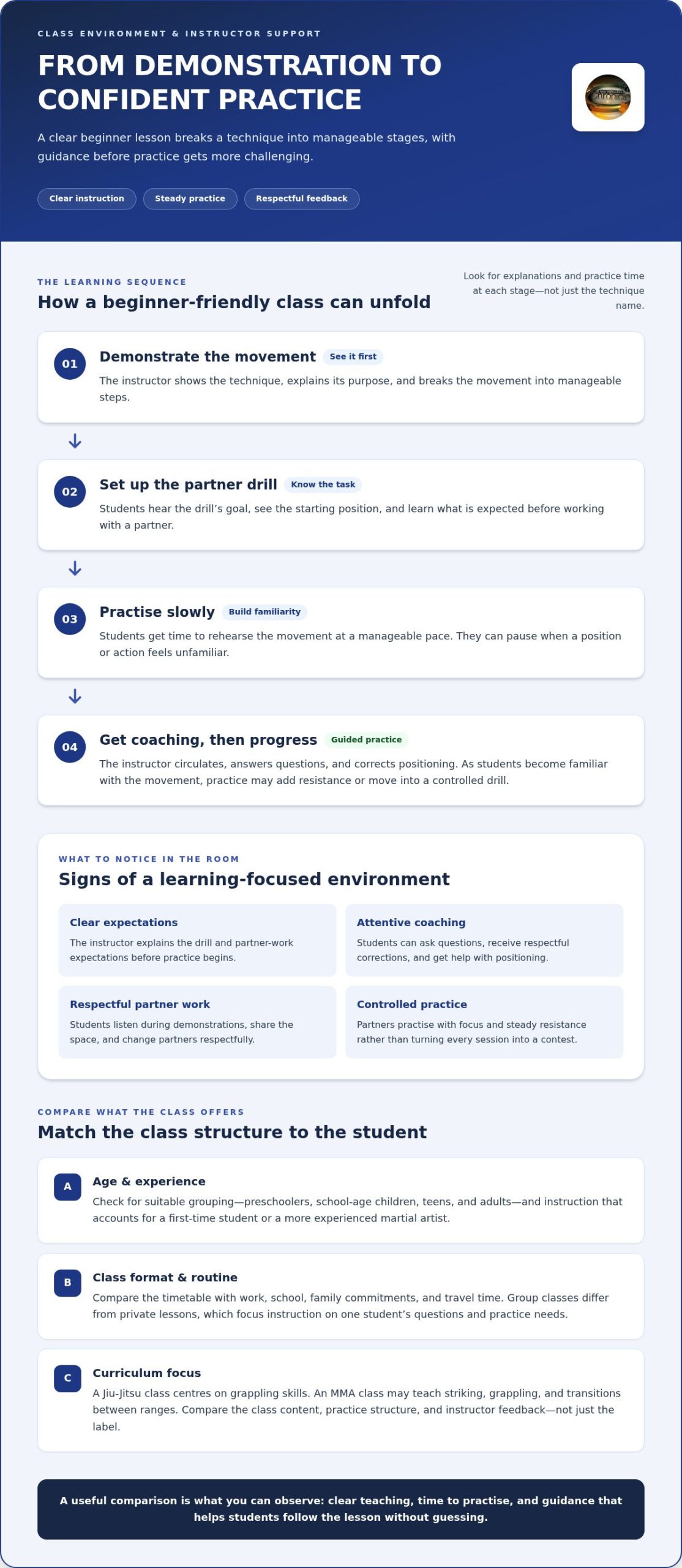
Beginners benefit from demonstrations that break a technique into manageable steps. An instructor might show a movement, explain its purpose, then let students practise slowly before adding resistance. Look for clear directions, respectful corrections, and the chance to pause when a movement feels unfamiliar. These details help new students understand what to do without needing prior knowledge of martial arts terminology.

Instructor support also appears in how a class handles partner drills. A useful structure explains the drill’s goal, shows the starting position, and gives students time to practise before changing the task. Notice whether instructors circulate, answer questions, and correct positioning rather than leaving students to guess. In a Manchester class, these observable teaching habits offer a more practical basis for comparison than a school’s promotional language.

Class schedules affect whether training fits around work, school, and family routines. Compare the timetable with your regular commitments, including travel time and class format. Private lessons differ from group classes because they focus instruction on one student’s questions and practice needs. Consider whether that individual focus suits your goal, while keeping scheduling separate from the quality of group instruction.

Mixed martial arts classes and single-discipline classes can have different curriculum priorities. When comparing an MMA class, look for an explanation of how it teaches striking, grappling, and transitions between ranges. A Jiu-Jitsu class, by contrast, centres its instruction on grappling skills. Neither label alone explains how beginners are taught, so compare class content, practice structure, and instructor feedback.

Before deciding, observe how students share the training space and interact during drills. Respectful partner changes, attentive listening during demonstrations, and controlled practice are useful signs of a learning-focused environment. Notice whether the instructor explains expectations before partner work and whether students can follow the lesson without guessing. These details help families and adult beginners assess whether the setting supports confident participation.

Martial arts training for health and fitness

Martial arts practice combines movement, skill learning, and partner drills. To judge its fitness value, look at what each class asks students to do, such as moving continuously, practising balance, or repeating grappling sequences. Match those activities to your aims. Someone seeking an active routine may value sustained movement, while someone focused on coordination may pay closer attention to controlled technique practice.

Brazilian Jiu-Jitsu uses grappling, positional movement, and technique practice. A class might involve learning an escape, rehearsing it with a partner, then applying the movement during a controlled drill. These activities challenge students to coordinate their bodies and make decisions while moving. For a useful comparison, review how a class balances instruction, partner practice, and live training. The experience depends on more than the discipline’s name alone.

No-gi training is grappling practised without the traditional gi uniform. Clothing changes the grips available, so students work with different control points and adjust how they practise techniques. Compare gi and no-gi classes by their focus and format, not by assuming one is easier. Beginners can look for clear explanations of positions and enough time to learn movements before faster drills.

Student reviews can add detail about class experience, especially when they describe specific moments. Look for examples such as an instructor explaining a technique, adapting a drill, or helping a student understand partner practice. Separate personal impressions from verifiable details. A review saying “the class felt welcoming” reflects one person’s view; a description of how beginners were introduced to a drill gives more practical context for deciding what environment might suit you.

“Ninja Warrior training” may refer to obstacle-focused movement, but the phrase alone doesn’t define a class. Examine the activities described: do they involve balance, climbing, jumping, or navigating obstacles? Consider whether those tasks align with your fitness interests and comfort. This helps distinguish obstacle challenges from grappling-based martial arts, even when both involve physical effort and learning new movement patterns.

A training community is built through repeated practice with instructors and partners. Notice whether students take turns, listen during demonstrations, and help keep drills focused. For example, a partner can provide steady resistance while you practise a position, then switch roles. That shared structure supports learning without turning every session into a contest. If you want to experience a grappling-focused class, explore the introductory training option as a way to see how instruction and practice work together.

Martial arts programs for preschoolers, children, teens, and adults

Programs for different age groups can vary in lesson pace, movement, and partner practice. Compare the student’s interests and experience with the martial arts style and class format before choosing.

Programs Across Age Groups

Younger children may benefit from short activities built around listening, balance, and simple movement. Children can explore structured drills, while teens may value more complex technique practice and clear progression. Adult classes commonly focus on skill development, fitness, or self-defense goals. These are general considerations, not fixed age rules. Look at how each program adapts instruction and practice to the students attending.

For children interested in grappling, Renzo Gracie NH’s Kids Jiu Jitsu Program offers a discipline-specific path. Adults who want to learn grappling can consider the Adult Jiu Jitsu Program. Compare what a typical class teaches, how partner practice is introduced, and how instructors explain new techniques. Those details help families judge programs by the learning experience, not just the age group.

Adult Martial Arts

Adult martial arts can include different disciplines and training aims. An adult mixed martial arts class may combine striking and grappling; an adult karate class focuses on karate techniques and practice. These names describe different curricula, not interchangeable formats. Compare the skills taught, class structure, and amount of partner practice against your goals. If you’re seeking grappling instruction, look for a program centred on grappling.

Starting as an adult doesn’t require prior martial arts experience. First identify your main aim, such as learning a discipline, building a regular activity, or developing self-defense skills. Then compare the program description with that aim. Notice whether instructors explain techniques in stages and provide opportunities to practise them. A clear learning path helps you understand what each session involves.

Families comparing classes for children and teens can look beyond the age label. Consider whether lessons use suitable instructions, manageable drills, and respectful partner practice. A child learning a grappling position, for example, may need a different explanation from a teen refining that same position. Notice how instructors adapt the lesson and whether students understand the purpose of each activity.

Adults choosing between karate, mixed martial arts, and Jiu-Jitsu should compare their core techniques. Karate practice centres on its own striking and movement methods. Mixed martial arts training brings together multiple combat disciplines. Jiu-Jitsu emphasizes grappling and positional skills. These distinctions can help you narrow your options without assuming one style fits everyone. Match the class content to the skills you want to learn.

Program fit also depends on how students progress from one lesson to the next. Look for a sequence: an instructor introduces a technique, demonstrates it, and gives students time to practise. Families can compare children’s and adult class descriptions separately, even when everyone is interested in martial arts. Different structures may suit each learner’s goals, experience, and preferred pace.

Martial Arts Academy in Manchester for Fitness and Self-Defense

Self-defense and fitness goals

Self-defense and fitness can share a training space, but they call for different ways to assess progress. Someone prioritizing self-defense might focus on recognizing positions, practising escapes, and making decisions under pressure. Someone seeking a more active routine may value consistent movement and skill drills. Identify your main aim first, then compare class activities with it.

Practical self-defense instruction teaches skills in context, rather than as isolated movements. A student might learn how to create space from a close position, practise with a cooperative partner, then repeat the movement during a controlled drill. Notice how lessons progress from explanation to practice. Clear steps help you understand what a technique is designed to address.

Fitness goals also benefit from specific, observable markers. Rather than expecting a quick transformation, notice whether you can follow a drill with better coordination or complete a familiar sequence with greater control. A training journal can capture changes: record the techniques practised, what felt challenging, and one skill to revisit. These notes make personal progress easier to see over time.

Choose a class format that matches your preferred kind of effort. A technique-focused session gives time to understand movements, while partner drills add interaction and changing positions. Grappling practice, for example, may ask students to move between positions while maintaining balance and control. Ask what a typical class includes so you can judge whether its pace and activities support your goals.

Self-defense is not only a collection of techniques. Awareness, communication, and deciding how to respond are also useful parts of preparation. In a class, notice whether instructors explain the purpose of a drill and its limits. A scenario-based exercise, for example, can help students think through positioning and choices without treating practice as a real confrontation.

Fitness and self-defense goals can change as skills develop. A beginner may start by learning to move safely through a drill, then later focus on refining an escape or transition. Revisit your goal after experiencing the class format. If your priority is practical skill, look for relevant instruction; if it’s regular activity, consider whether the class structure keeps you engaged.

When comparing programs in Manchester, use a short decision process. Write down the skill you want to learn, identify class activities that support it, and compare those activities with your preferred training pace. Someone interested in grappling, for instance, can look for instruction that includes positional practice. A clear match between your aim and class content gives you a practical basis for choosing.

Set expectations around learning, not guaranteed outcomes. A class provides instruction and structured practice, while your progress depends on attendance, attention, and continued effort. After a session, note one technique you understood and one question you still have. That reflection turns broad ambitions into specific next steps for your fitness or self-defense journey.

Advice for first-time students

For safety, follow the instructor’s rules, practise within your comfort, and stop if you feel pain. Before training, consider injury risks such as strains or accidental contact, and understand what your insurance policy covers.

Prepare simple essentials. Renzo Gracie NH advises first-time students to wear comfortable clothes suitable for sports and bring a water bottle. Choose clothing that lets you move freely, without loose items that could catch during a drill. Keep your water nearby, and arrive ready to listen before joining the class.

Use your first session to learn the class routine, not to prove your ability. Notice where students wait, how the instructor demonstrates a movement, and when partners begin practising. If a technique feels unfamiliar, pause and ask for the steps again. For example, request a slower demonstration before trying a grappling movement with a partner.

Share relevant concerns before practice begins. Tell the instructor about an injury or movement limitation that could affect a drill, then follow directions for adapting or sitting out. During partner work, agree on the pace and use controlled movements. Stop if something feels wrong. Respectful communication helps both students stay focused on learning.

New students can make progress by setting one practical goal for each class. You might aim to remember a position, follow a warm-up sequence, or understand an instruction. After class, write down what you practised and any question to raise next time. This simple record helps turn an unfamiliar experience into a clear learning path.

Before choosing a regular schedule, consider how training fits your routine. Look at the class timetable, travel time, and other commitments, then choose a realistic pattern you can maintain. Consistency matters more than trying to do everything at once. If a class leaves you unsure about its pace or structure, note the activity that felt challenging and use that observation to guide your next session.

Insurance deserves the same practical attention as clothing and class preparation. Read your policy’s terms for sports or martial arts activity, including exclusions, conditions, and steps for reporting an injury. Keep the policy information accessible, and understand what it covers before taking part. Coverage varies by policy, so the wording of your own policy matters.

Want to experience a guided first session? Book a free introductory class and take your first step into training.

Renzo Gracie NH: Adult Jiu Jitsu Program

Renzo Gracie NH’s Adult Jiu Jitsu Program is for adults interested in learning grappling skills through structured martial arts training. It can suit goals such as skill development, fitness, or following a steady learning path. The Kids Jiu Jitsu Program offers children a related option, while Law Enforcement Jiu-Jitsu Training focuses on professional defensive tactics.

If you’re new to training, Renzo Gracie NH’s Free Introductory Class lets you experience instruction before deciding whether the program suits your goals. Come ready to learn, move at a comfortable pace, and get familiar with the class environment.

Contact Renzo Gracie NH to learn about taking the next step.

Take Your Next Step on the Mat

Choosing a martial arts academy in Manchester is a personal decision, shaped by the skills you want to build and the kind of practice you’ll enjoy returning to. Think about what you want to learn, then experience a class and notice how the instruction fits your goals. A first visit can turn a broad intention into a clearer path forward.

Renzo Gracie NH offers an Adult Jiu Jitsu Program, a Kids Jiu Jitsu Program, and Law Enforcement Jiu-Jitsu Training. These options serve different students and purposes, from adult skill-building to children’s training and professional defensive tactics. Consider which fits your needs, then get in touch to take the next step at your own pace.

Contact Renzo Gracie NH about classes and begin exploring a training path that feels right for you.

Frequently Asked Questions

What martial arts academies are in Manchester, New Hampshire?

Renzo Gracie NH serves Manchester, Windham, and Exeter with Brazilian Jiu-Jitsu programs for adults and children, plus specialized Law Enforcement Jiu-Jitsu Training. If you are seeking a premier martial arts academy in Manchester, New Hampshire, our facility provides expert instruction tailored to all skill levels. We focus on effective self-defense, physical fitness, and a supportive community atmosphere right here in the local area.

Where are martial arts academies located in Manchester and what are their opening hours?

Renzo Gracie NH serves Manchester, New Hampshire, Windham, and Exeter. Class times depend on the program and location, so compare the schedule with your work, school, or family routine. If you’re considering a martial arts academy in Manchester, check which scheduled class fits your commitments. Class schedules are the practical guide to when instruction takes place.

Do Manchester martial arts academies offer trial classes or beginner programs?

Renzo Gracie NH offers a Free Introductory Class, along with Jiu-Jitsu programs for adults and children. Use the session to experience the instruction and class format firsthand. Notice how techniques are demonstrated and how practice is introduced. That gives you useful context for deciding whether the program suits your interests before settling into a regular routine.

Which academies in Manchester are suitable for children and families?

Families in Manchester, New Hampshire can consider Renzo Gracie NH’s Kids Jiu Jitsu Program and family training in Jiu-Jitsu. Choose a dedicated children’s class or train together as a family, depending on your preferences. Discuss the child’s interests and comfort with martial arts before choosing. Those preferences can help your family decide which format feels like the best fit.

What qualifications and experience do instructors at Manchester academies have?

Professor Kevin Landry is a sixth-degree black belt under Renzo Gracie and has taught in the region for over two decades. To see how that experience translates into instruction, notice how the instructor demonstrates techniques, answers questions, and explains movements. These teaching details help beginners and families assess whether lessons are clear and suited to different levels of experience.

How do Manchester martial arts academies compare by class size, facilities, and reviews?

Compare how easily students can follow demonstrations and receive guidance during practice. Renzo Gracie NH describes its facilities as clean and state-of-the-art, and member testimonials from Matt Gall and Sue Kimball praise instructor Kevin Landry. Reviews reflect individual experiences, so focus on specific comments about instruction and student interactions. These details can help you assess the environment beyond a rating.

What should beginners bring and wear to their first martial arts class?

Wear comfortable sports clothing that allows free movement, and bring a water bottle. Choose clothing that won’t interfere with practice, then listen to the instructor’s directions as class begins. Set a simple aim for your first session, such as learning the routine or understanding one movement. This keeps your attention on becoming familiar with the class rather than mastering everything at once.

How much do martial arts classes and memberships cost in Manchester?

At Renzo Gracie NH, we offer transparent pricing options tailored to individuals and families looking for a top-tier martial arts academy in Manchester. There is no long-term contract or cancellation fee, making it easy to start your journey with confidence and flexibility.

Self-Defense for Exeter Third-Shift Workers: A Guide

The safest response to a tense moment may begin long before anyone gets close. For third-shift workers, self defense for third shift workers Exeter starts with practical choices about arriving, leaving, and staying alert when fewer people are around. Training can help, but it is only one part of a thoughtful safety plan.

It is understandable to feel less certain when a situation turns tense, especially after a long shift or when your schedule makes regular classes difficult. You deserve clear steps, not pressure to confront someone or rely on a single technique. A repeatable routine can help you decide when to create distance, de-escalate, leave, or get help.

This guide covers safety habits before, during, and after work, then explains what Brazilian Jiu-Jitsu can contribute. BJJ develops technique, control, fitness, and personal discipline through structured practice. It does not guarantee safety or replace awareness, workplace procedures, or emergency help. At Renzo Gracie NH, Professor Kevin Landry brings more than two decades of regional teaching experience. New students can begin with a complimentary introductory class. You will find practical guidance for building confidence at a pace that fits your life.

Key Takeaways

  • Build a repeatable safety routine around your workplace’s procedures, trusted contacts, and ways to request help.
  • Think of self defense for third shift workers Exeter as more than physical techniques: prevention, boundaries, de-escalation, and leaving all matter.
  • Compare workplace procedures, scenario-based instruction, and ongoing Brazilian Jiu-Jitsu practice by what each can help you prepare for.
  • Understand how BJJ’s structured grappling practice develops movement, balance, control, and calm decision-making without promising a particular outcome.
  • Explore adult Jiu-Jitsu as an ongoing way to build skills, with instruction from Professor Kevin Landry, who has taught in the region for more than two decades.

Why third-shift self-defense starts before you clock out in Exeter

Working late does not mean something bad will happen. Still, arriving or leaving when fewer people are around makes it sensible to think through your options in advance. A calm plan can reduce uncertainty when fatigue, a quiet parking area, or an unexpected interaction makes it harder to decide what to do.

Self-defense is broader than physical techniques. It includes noticing your surroundings, setting boundaries, de-escalating a tense exchange, creating distance, leaving when you can, and using physical skills only if needed. For people considering self defense for third shift workers Exeter, start by planning for everyday transitions rather than assuming every late shift is dangerous.

Which moments in a third shift deserve a plan?

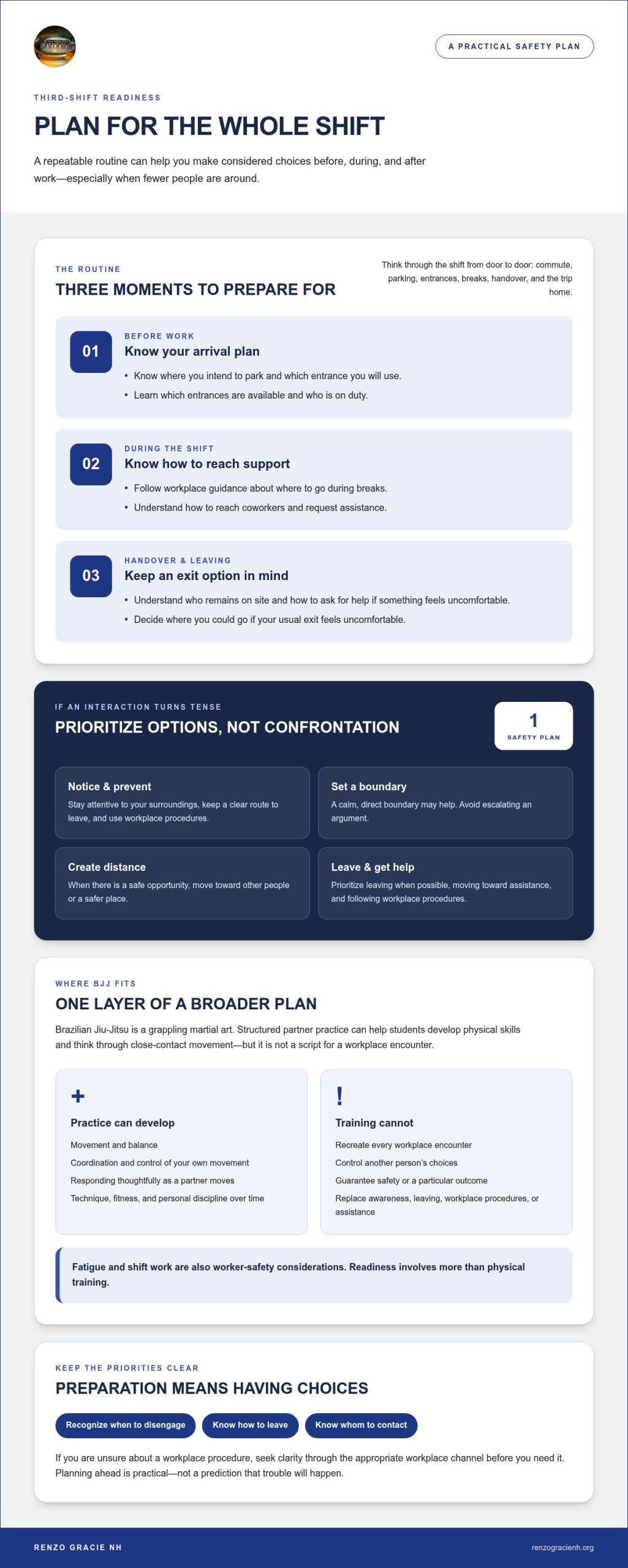
Think through the shift from door to door: your commute, parking area, building entrances, breaks, handover, and trip home. In Exeter, as anywhere, your workplace layout and procedures matter more than assumptions about the town. Learn which entrances are available, who is on duty, and how staff can request assistance. A useful plan answers practical questions: Where will you go if your usual exit feels uncomfortable? Who can you contact? What is the established way to ask for support?

  • Before work, know where you intend to park and which entrance you will use.
  • During breaks, follow workplace guidance about where to go and how to reach coworkers.
  • At handover and clock-out, understand who remains on site and how to request support if a situation feels uncomfortable.

What does practical self-defense include?

Awareness and prevention can help you notice discomfort early. Stay attentive to your surroundings, keep a clear route to leave, and use workplace procedures. If an interaction becomes tense, a calm, direct boundary may help. Avoid escalating an argument. When there is a safe opportunity, move toward other people or a safer place and get help.

Physical skills are one layer, not the whole plan. Brazilian Jiu-Jitsu is a grappling martial art with techniques distinct from striking styles. Structured practice can develop movement, balance, and control, but it cannot predict how another person will act. Training supports judgment; it does not replace awareness, workplace procedures, or assistance.

Preparation can help you make considered choices, but it cannot guarantee personal safety. A useful plan gives you options before pressure rises: recognize when to disengage, know how to leave, and understand whom to contact. If you are unsure about a workplace procedure, seek clarity through the appropriate workplace channel before you need it. Planning ahead is not about expecting trouble. It is a practical way to feel more organized during the transitions that bookend a shift.

How Brazilian Jiu-Jitsu fits into a realistic self-defense skill set

Brazilian Jiu-Jitsu (BJJ) is a grappling martial art taught through structured instruction and practice with a training partner. Rather than focusing on strikes, it teaches students to work through close-contact positions, use body movement, and develop control. For someone exploring self defense for third shift workers Exeter, this can be one part of preparation, as long as training is viewed as skill-building rather than a promise about what will happen in a real encounter.

Training offers a coached setting to practise movement and balance while another person is close, with agreed boundaries. A beginner might focus first on staying stable, understanding how their position changes, and responding thoughtfully rather than reacting in a rush. Repeated practice gives students opportunities to work through physical problems with guidance. Progress is gradual; no single class creates mastery.

What can grappling practice help a beginner develop?

Close-contact practice gives students a chance to work on balance, coordination, and control of their own movement. BJJ also asks students to solve positional problems with guidance, then adjust as a partner moves. This is not a script for a workplace confrontation. It is a structured way to learn physical skills, listen to instruction, and build confidence through steady effort.

What are the limits of martial arts training?

A class cannot recreate every workplace encounter. Real situations may involve unfamiliar surroundings, other people, fatigue, or uncertainty about what is happening. The OSHA guidance on worker fatigue and shift work addresses fatigue as a concern for worker safety, a reminder that readiness involves more than physical training. If leaving is possible, prioritize creating distance, moving toward assistance, and following workplace procedures. No martial art can ensure a particular outcome or make confrontation advisable.

Brazilian Jiu-Jitsu is one layer in a broader safety plan, not a substitute for awareness, leaving, or getting help. That is the realistic role of grappling practice: it can give you experience moving and thinking during close contact, while your first priority remains avoiding or leaving an unsafe situation. Training can support judgment, but it cannot control another person’s choices.

For adults, consistent instruction provides a setting to build technique, control, fitness, and personal development over time. At Renzo Gracie NH, Professor Kevin Landry is a sixth-degree black belt under Renzo Gracie and has taught in the region for more than two decades. If you are curious about learning in a supportive environment, begin with a complimentary introductory class.

Comparing self-defense options for Exeter third-shift workers

No single approach covers every part of personal safety. Workplace procedures provide information tied to your actual site, scenario-based safety instruction can help you think through possible responses, and Brazilian Jiu-Jitsu (BJJ) offers ongoing, coached physical practice. For self defense for third shift workers Exeter, consider the different purpose of each rather than treating them as competing solutions.

Option Purpose and format Strengths Limitations
Workplace procedures Site-specific guidance, communication, and established ways to request support. Connects directly to your building, work routines, and available staff. Does not provide ongoing physical practice or control what happens outside the workplace.
Scenario-based safety instruction Guided discussion or practice for responding to possible situations. Can help you consider choices such as setting a boundary, de-escalating, or leaving. A practice scenario cannot account for every real-world detail or guarantee an outcome.
Ongoing BJJ practice Structured martial arts instruction with repeated grappling practice. Builds physical skills progressively through coached practice over time. Does not teach your workplace’s procedures or reproduce every encounter.

How do workplace safety steps differ from martial arts training?

Workplace guidance is rooted in the place where you work: whom to notify, how to communicate, and which procedures apply to your site. Make those details part of your preparation for arriving, changing tasks, or leaving. A martial arts class serves a different purpose. It gives you a setting to practise skills with instruction, but it cannot change your work environment or tell you which staff member is available during a shift.

When might a grappling-focused class suit your goals?

BJJ may suit you if you want progressive, coached practice that develops close-contact skills over time. That differs from a one-time information session, which may offer useful ideas but not the same repeated physical practice. Neither format is right for everyone, and neither should replace leaving a situation or seeking help when that is the safer choice.

BJJ alone is not a complete answer. You may face unfamiliar surroundings, other people, or circumstances that make physical engagement unsafe; grappling skills cannot remove those factors. Workplace procedures and communication address needs a class cannot, while ongoing training develops a different set of skills. These options can contribute to a more balanced plan without promising that any one method will prevent harm.

For professional defensive-tactics context, Renzo Gracie NH also publishes a law enforcement Jiu-Jitsu training guide. It addresses a specialized professional setting, distinct from a general workplace plan or an adult student’s regular BJJ practice. Start with the needs of your own shift, then decide which kind of learning would add useful support.

Self-Defense for Exeter Third-Shift Workers: A Guide

Build a before, during, and after-shift safety routine

A routine works best when it fits your actual commute and workplace, not an idealized schedule. Keep it simple enough to repeat, then adjust it when your route, shift, or worksite changes. For self defense for third shift workers Exeter, preparation means knowing your options and following the procedures that apply where you work.

Before work: prepare the route and communication

Before your shift, review how you will get there and whom you can contact at work. If it suits your circumstances, consider sharing your plans with someone you trust. Follow your employer’s established check-in and safety procedures rather than assuming a particular process is available.

  1. Review your commute. Think through your route, where you will park, and which entrance you are expected to use. Identify familiar, accessible places where you could seek assistance if your plans change.
  2. Know your workplace contacts. Understand who is on duty, how to reach them, and how to request support. If a procedure is unclear, raise the question through an appropriate workplace channel before you need the information.
  3. Set a communication plan. If it feels useful, tell a trusted person when your shift starts and when you expect to finish. Keep the arrangement realistic, and follow any workplace check-in process that applies.

During and after work: respond with priorities in order

While working, stay attentive to changes around you and use established communication channels. If an interaction feels uncomfortable, keep your words clear, create distance, and look for a safe opportunity to leave. Once away, seek assistance and report concerns through the appropriate workplace process.

  1. During breaks and handover, follow site procedures and keep track of how to reach a coworker or supervisor. Do not assume someone else knows you need support; communicate directly when appropriate.
  2. At clock-out, pause long enough to orient yourself. Follow your workplace’s exit procedures. If a situation feels unsafe, move toward assistance or a safer place instead of pressing on with your usual routine.
  3. After an unsettling event, get to a safer location first, then report what happened through the relevant workplace channel. Clear details can help the appropriate people understand the concern and respond according to site procedures.

Training can complement this routine without dictating your schedule. If changing shifts make a fixed habit difficult, focus on gradual, sustainable practice rather than expecting to train at the same time every week. Adults curious about structured skill-building can explore adult Jiu-Jitsu in New Hampshire. Regular practice develops skills over time, but it does not replace workplace procedures, awareness, or leaving when that is the safer choice.

To experience coached practice, try a complimentary introductory class and explore adult Jiu-Jitsu in a welcoming learning environment.

Explore adult Jiu-Jitsu training near Exeter as a next step

After building a shift safety routine, you may want to develop physical skills through regular instruction. Adult Brazilian Jiu-Jitsu at Renzo Gracie NH offers structured practice in technique, control, fitness, and personal development. It is general martial arts training, and it cannot replace awareness, workplace procedures, or getting help.

You do not need to arrive with experience. Beginners can learn the basics step by step, ask questions, and grow more comfortable with practice over time. The goal is not instant mastery. It is steady learning in a respectful environment, with progress built through instruction and repetition.

What can an adult beginner expect from training?

Training introduces techniques through coaching and structured practice. Students work on movement, control, and problem-solving while building fitness and focus. The learning process is gradual, so a first class is a chance to experience the environment and begin, not a test of what you already know. Professor Kevin Landry, a sixth-degree black belt under Renzo Gracie, has taught in the region for more than two decades.

How can training become a sustainable part of your routine?

With a changing work schedule, consistency does not mean forcing training into every week. Consider your sleep and recovery, then look for a manageable way to practise when your routine allows. A complimentary introductory class gives you a chance to experience instruction before deciding whether adult Jiu-Jitsu suits your goals and lifestyle.

If you are exploring self defense for third shift workers Exeter, think of training as one part of preparation, not a guarantee of safety or a reason to confront someone. It can help you build physical skills over time, while your shift plan still prioritizes awareness, distance, leaving when safe, and workplace support.

For details about getting started, see the guide to a free introductory Jiu-Jitsu class in New Hampshire. If you are ready to take a first step, try a complimentary Jiu-Jitsu class and experience the learning environment for yourself.

Take one steady step toward feeling more prepared

A safer, more confident routine does not have to come together all at once. Choose one useful change for your next shift, such as reviewing how to reach workplace support or making a plan for leaving work. Small steps are easier to keep and can turn uncertainty into a clearer sense of what you will do.

If you would also like to build physical skills, let curiosity guide your next move. Training can be part of your preparation, alongside awareness, good judgment, and workplace procedures. It is not a promise about what will happen in a real situation, but it can offer a supportive place to learn and grow at your own pace.

For anyone exploring self defense for third shift workers Exeter, beginning with a class can make training feel more approachable. Try a complimentary Jiu-Jitsu class and take a first step toward developing confidence, focus, and practical skills.

Frequently Asked Questions

Can Brazilian Jiu-Jitsu help third-shift workers with self-defense?

Yes. Brazilian Jiu-Jitsu can help develop grappling skills and comfort with close-contact movement, which may be one useful part of self-defense preparation. For self defense for third shift workers Exeter, view training alongside practical choices such as knowing whom to contact at work and when to leave. Class practice cannot reproduce every situation or guarantee how an encounter will unfold, so do not treat any technique as a complete safety plan.

What should I do if I feel unsafe leaving work at night?

If you feel unsafe, pause your usual exit routine and move toward a place where you can seek assistance, such as an occupied part of the building or a staffed area, if accessible. Tell an appropriate coworker or supervisor what concerns you and follow your workplace’s procedures for requesting help. If there is immediate danger, contact emergency services. You do not need to walk alone or confront someone to prove you are capable.

Is Jiu-Jitsu suitable for adults who have never trained before?

Yes. Adults can begin without prior martial arts experience and learn through coached instruction at a gradual pace. You do not need to know techniques before your first class. Focus on listening, asking questions, and learning the basic movements one step at a time. At Renzo Gracie NH, adult Jiu-Jitsu is available to people in Exeter, Windham, and Manchester who want to build skills, fitness, and personal discipline.

Is grappling better than striking for self-defense at work?

Neither approach is automatically better for every person or situation. Grappling focuses on close-contact control and positional problem-solving, while striking arts train different physical responses. A workplace encounter may involve space, obstacles, other people, or uncertainty, so choosing a style does not replace judgment. Consider what kind of practice you want, but prioritize prevention, creating distance, leaving safely, and following workplace procedures over physical engagement.

Can self-defense training guarantee that I will be safe on a night shift?

No. Training can help you practise skills and think through responses, but it cannot control another person’s actions, remove every hazard, or promise a specific result. Your safety plan should still include your workplace’s procedures, communication options, and a way to seek assistance. Treat martial arts as preparation, not protection you can count on in every circumstance. If a situation feels unsafe, prioritize getting away and seeking help.

How can I fit Jiu-Jitsu training around a third-shift schedule?

Start by considering your actual sleep and recovery needs rather than forcing a routine that leaves you exhausted. If your shifts rotate, look for a manageable pattern that can flex from week to week, and build consistency gradually. Missing a session during a demanding work stretch does not erase your progress. The aim is sustainable practice that supports your wellbeing, not an extra source of pressure.

Can I try a Jiu-Jitsu class near Exeter before joining?

Yes. New students can start with a complimentary introductory class at Renzo Gracie NH. It is a chance to experience the teaching environment and see how an introductory class feels before deciding whether to continue. The academy serves the Exeter, Windham, and Manchester area, making it a local next step for adults curious about Brazilian Jiu-Jitsu. You can begin as a newcomer without previous training experience.

Best NH Martial Arts School: Finding the Right Fit 2026

What if the best martial arts school isn’t the one with the most trophies, but the one you or your child feels ready to return to? Finding the best martial arts school New Hampshire has to offer means looking beyond a style name to the instruction, training experience, and fit with your goals.

It’s natural to have questions before starting. Martial arts programs can look very different, and beginners deserve an encouraging place to learn, ask questions, and progress at a comfortable pace. The right choice should suit your priorities, not just sound impressive.

This guide compares training approaches and offers practical ways to assess a school, from instructor experience and program fit to what an introductory class can show you. At Renzo Gracie NH, Professor Kevin Landry brings more than two decades of regional teaching experience and is a sixth-degree black belt under Renzo Gracie. The academy offers adult, kids’, family, and law enforcement Brazilian Jiu-Jitsu programs. A complimentary introductory class lets you experience the instruction before deciding whether it feels right for you or your family.

Key Takeaways

  • The best martial arts school New Hampshire offers for you depends on how well its training, community, and routine match your goals.
  • Compare martial arts by what students learn and practice, rather than assuming one approach is right for everyone.
  • Assess instructor background, program fit, learning culture, and how clearly the school explains next steps.
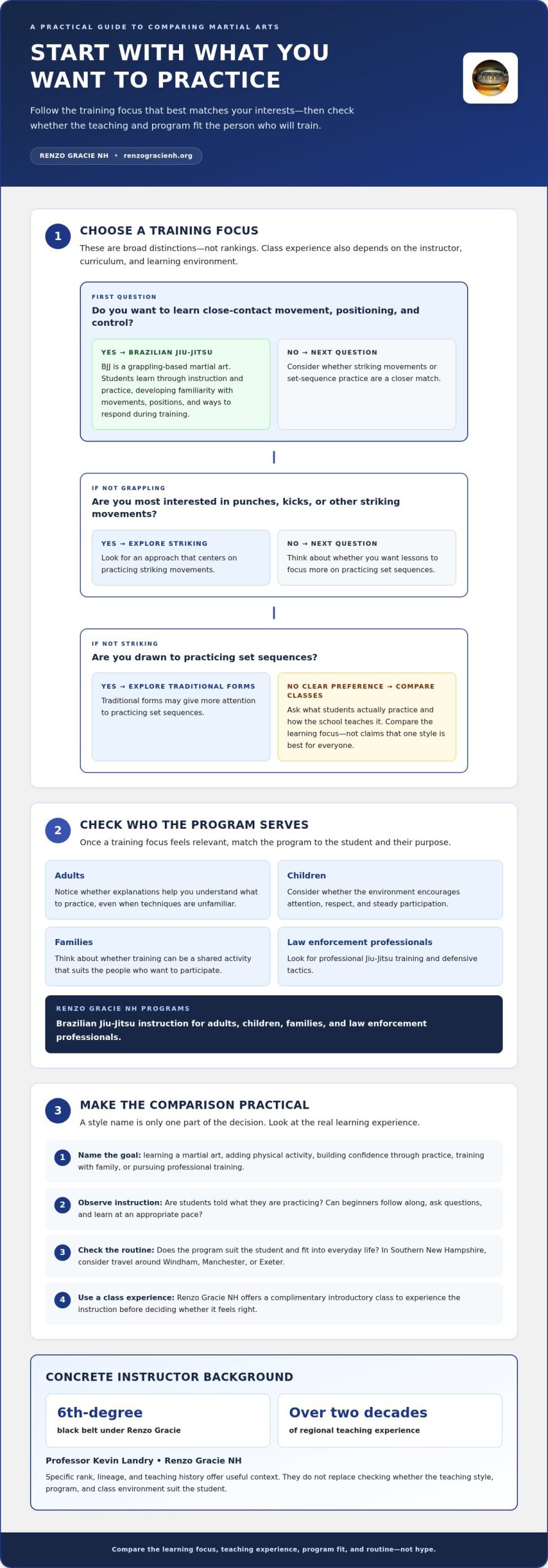
  • Start by naming your goal, identifying who will train, and finding a fitting program. Then use a class experience to help make your decision.
  • Renzo Gracie NH’s Brazilian Jiu-Jitsu programs serve adults, children, families, and law enforcement professionals.

What Makes a Martial Arts School the Right Fit in New Hampshire?

Choosing a martial arts school can feel difficult when programs and styles are hard to compare. One academy may emphasize a traditional discipline, while another focuses on a specific kind of training. A useful first step is to learn about the history and types of martial arts, then consider what you want your own experience to involve. The best martial arts school New Hampshire has for you isn’t automatically the one with the broadest claims or most familiar name. It’s the one whose instruction and programs suit your priorities and give you a setting where you can keep learning.

What should you expect from a quality martial arts school?

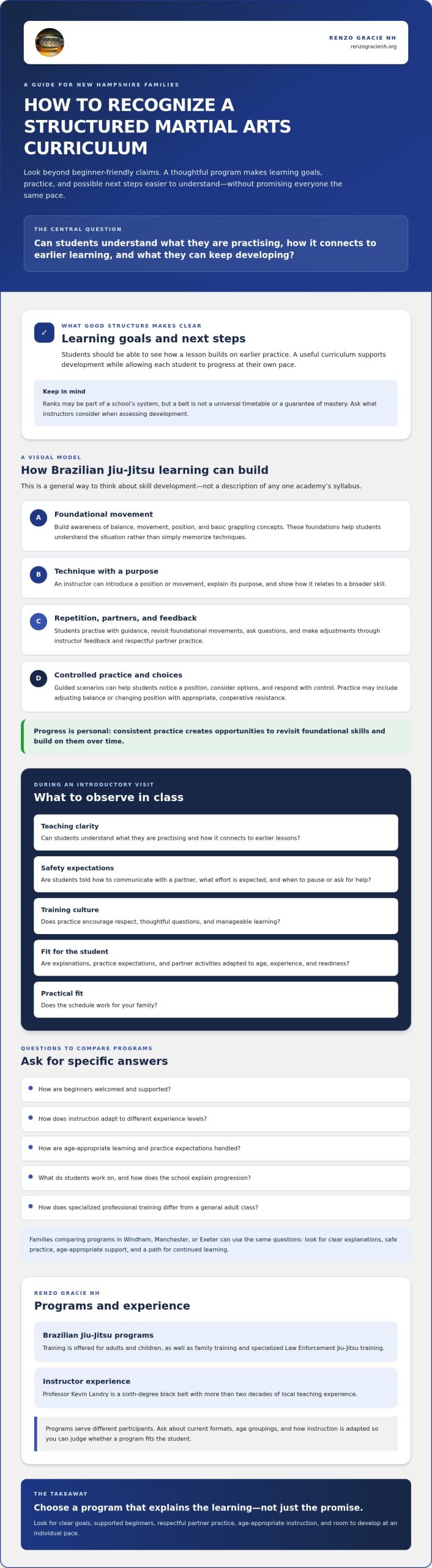
Look for instruction that explains what students are practicing and gives beginners a clear way to follow along. A respectful learning environment matters, too: students should be able to focus, ask questions, and learn at an appropriate pace. A structured curriculum can help students understand how foundational skills connect to more advanced learning. These are useful things to observe, not promises of a particular result.

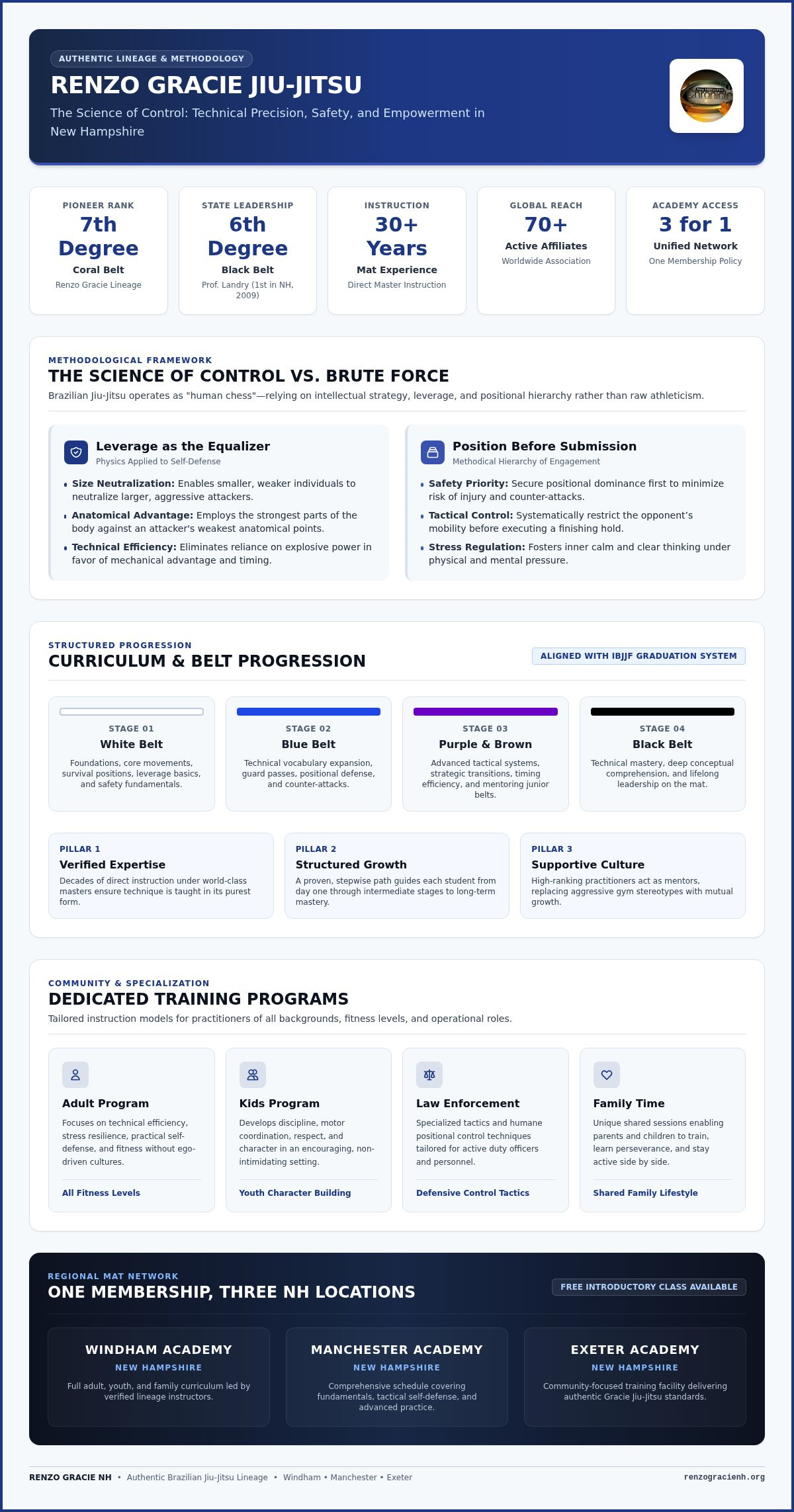
When reviewing instructor experience, separate specific background from general promotional language. Rank, lineage, and teaching history are more informative when stated clearly. At Renzo Gracie NH, Professor Kevin Landry is a sixth-degree black belt under Renzo Gracie and has taught in the region for over two decades. Those details give prospective students concrete context about who leads the academy.

Which personal goals should guide your search?

Start with why you’re considering training. Are you looking to learn a martial art, add physical activity to your routine, build confidence through practice, share an activity with family, or pursue professional training? Different disciplines and programs emphasize different experiences, so one option won’t suit every person or purpose equally.

A good school fit brings your goals together with clear instruction, a respectful community, and a training routine you can realistically sustain. Use that definition to turn a vague search into practical questions: Does the program serve the person who plans to attend? Is the teaching understandable? Can training fit into everyday life?

  • For an adult beginner: Notice whether explanations help you understand what to practice, even when the techniques are unfamiliar.
  • For a child: Consider whether the environment encourages attention, respect, and steady participation.
  • For families: Think about whether training can be a shared activity that suits the people who want to participate.
  • For law enforcement professionals: Look for a program focused on professional Jiu-Jitsu training and defensive tactics.

Local fit matters in Southern New Hampshire, too. If you’re considering options around Windham, Manchester, or Exeter, account for travel and the routine you can maintain. Compare each program’s focus with the student’s goals and the experience of learning there, rather than searching for a universal winner. Renzo Gracie NH offers adult, children’s, family, and law enforcement Jiu-Jitsu training. The next step is to consider whether its Brazilian Jiu-Jitsu approach matches the experience you want.

How Brazilian Jiu-Jitsu Compares With Other Martial Arts Approaches

Martial arts differ in what students practice, how lessons are taught, and which skills receive the most attention. Some approaches emphasize striking movements, while grappling-based disciplines focus on close-contact movement, positioning, and control. Traditional forms may give more attention to practicing set sequences. These are broad distinctions, not rankings: the experience also depends on the instructor, curriculum, and class environment.

Could Brazilian Jiu-Jitsu match your goals?

Brazilian Jiu-Jitsu (BJJ) is a skill-based martial art centered on grappling. Students learn through instruction and practice, building familiarity with movements, positions, and ways to respond during training. It’s a focused discipline, not a universal answer for every student or goal. Choosing a style alone doesn’t guarantee a particular result.

Renzo Gracie NH focuses on Brazilian Jiu-Jitsu instruction, with programs for adults, children, families, and law enforcement professionals. The student and purpose may differ, but the academy’s central discipline is the same. Consider whether learning grappling through structured practice fits what you’re seeking.

How can you compare disciplines without relying on hype?

Start with what you want to learn, then look at how a school teaches it and what students practice during class. Promotional language can describe a school’s aims, but it isn’t evidence of a particular outcome. Compare the actual learning focus and experience rather than relying on claims that one style is best for everyone.

The right discipline is the one whose learning focus and teaching experience align with the student’s priorities. Use the questions below to make that comparison concrete.

Goal Questions to consider Relevant training focus
Learn grappling skills Do you want to practice close-contact movement and positioning? Brazilian Jiu-Jitsu’s grappling-based instruction and practice.
Explore striking skills Are you more interested in practicing punches, kicks, or other striking movements? Look for an approach that centers on striking practice.
Practice traditional forms Would you enjoy learning and repeating set movements or sequences? Consider an approach that emphasizes forms and their practice.
Find training for a specific student Is the program designed around an adult, child, family, or professional learner? Compare the intended student and purpose with the program’s stated focus.

For anyone searching for the best martial arts school New Hampshire can offer, this framework replaces sweeping promises with a clearer question: does the training match what you want to practice? Consider how the instruction is explained, whether the class experience feels appropriate, and whether the program serves the student. If Brazilian Jiu-Jitsu aligns with your priorities, explore Renzo Gracie NH’s Brazilian Jiu-Jitsu approach.

Which Criteria Help You Compare New Hampshire Martial Arts Schools?

Use consistent criteria when comparing schools. Whether you’re considering training near Windham, Manchester, or Exeter, assess each option in the same way instead of letting a convenient location or polished promotion make the decision for you. Convenience matters, but the program should also make sense for the student.

For each school, note what you can verify, what you experience, and what you still need to understand. Specific details about instructors, programs, and how to get started are more useful than broad promotional language.

How should you assess instructor experience and teaching approach?

Look for a clear account of who teaches and what relevant experience they bring. Rank and lineage provide context, while teaching history helps explain an instructor’s experience working with students. Neither guarantees a particular result or class experience. Weigh those details alongside what you observe about the instruction.

At Renzo Gracie NH, Professor Kevin Landry is a sixth-degree black belt under Renzo Gracie and has taught in the region for over two decades. These are concrete credentials to consider as you learn about the academy’s Brazilian Jiu-Jitsu instruction.

What signs of program fit matter beyond credentials?

Check whether the program is intended for the student and purpose you have in mind. An adult, a child, a family, and a law enforcement professional may be looking for different learning experiences. Consider whether the school explains its program clearly and describes an approach grounded in respect and support. Then use a class experience to understand the atmosphere firsthand.

For insight into the principles behind the academy’s approach, explore its Jiu Jitsu philosophy guide. A school’s stated philosophy can help you understand what it prioritizes. Your own experience helps you decide whether that approach resonates.

Use this checklist as you compare programs:

  • Instructor background: Can you identify the instructor’s rank, lineage, and relevant teaching experience from specific information?
  • Program fit: Is the program designed for the student’s age group and purpose, such as adult, children’s, family, or professional Jiu-Jitsu training?
  • Learning culture: Does the school describe how it values respect and support, and does the class experience feel appropriate to the student?
  • Next steps: Is it clear how a new student can experience the instruction before deciding whether to continue?

For each point, record “clear,” “partly clear,” or “unclear,” along with a note about what you observed. Apply the same standard to every school. Specific credentials are more useful than broad claims, and a shorter drive shouldn’t outweigh a program that doesn’t fit the student’s goals or learning needs.

This process makes “best” personal and meaningful. The best martial arts school New Hampshire offers for one student may not suit another. Compare instructor experience, program purpose, learning culture, and the class experience together, then use those criteria to guide your decision.

Best NH Martial Arts School: Finding the Right Fit 2026

Matching Martial Arts to Your Goals in Southern NH

Narrow your options by starting with the person who’ll train, not simply the nearest school. Whether you’re in Windham, Manchester, Exeter, or a nearby community, students have different goals and routines. Use these steps to connect those priorities with a suitable program.

  1. Name the goal. Decide what you hope to learn or make room for in your routine. You might want to begin a martial art, explore Jiu-Jitsu, find training for your child, share an activity as a family, or pursue professional training.
  2. Identify the student. Be clear about who plans to participate: an adult, a child, several family members, or a law enforcement professional. A child’s training needs may differ from a parent’s, even if both are interested in martial arts.
  3. Compare program fit. Match the student and purpose to the relevant program. Consider whether the training focus fits what you want to learn and whether the routine is practical for your life in Southern New Hampshire.
  4. Experience a class. A class gives you a chance to see the instruction and learning environment firsthand. Notice whether the teaching is understandable and whether the student can picture continuing to learn there.

Which program may fit adults, children, or families?

Adults exploring Jiu-Jitsu can start with the adult Jiu-Jitsu guide to learn about beginning. Parents considering a program for a child can use the children’s Jiu-Jitsu program guide as a starting point. If your goal is to train as a family, explore parent and child Jiu-Jitsu in Windham. These are distinct needs: family participation can be a shared goal, while an adult or child may also have individual reasons for training. Focus on who will participate and what they hope to learn.

What should law enforcement professionals prioritize?

For law enforcement professionals, Renzo Gracie NH offers dedicated Jiu-Jitsu training focused on grappling, control techniques, and professional defensive tactics. Consider whether that focus aligns with your professional learning priorities. Training should not be treated as a guarantee of a particular officer-safety outcome or department approval. The law enforcement Jiu-Jitsu training guide offers more context on the program.

Make your next step practical. Renzo Gracie NH offers a complimentary introductory class, so prospective students can experience the instruction and atmosphere before deciding whether the fit feels right. Book your complimentary introductory class.

Experience Renzo Gracie NH Before Choosing Your Martial Arts School

Program descriptions can narrow your options, but experiencing an academy firsthand can help you decide whether its instruction and atmosphere suit you. Renzo Gracie NH offers a complimentary introductory class, giving prospective students a chance to experience its Brazilian Jiu-Jitsu instruction before choosing whether to take another step.

The academy is led by Professor Kevin Landry, a sixth-degree black belt under Renzo Gracie who has taught in the region for over two decades. His rank and teaching experience offer useful context, but your own priorities matter too. Consider what you hope to learn, who will be training, and whether the class experience feels appropriate for that student.

What can a prospective student learn from an introductory class?

Use the class to notice how the instruction is presented and how the learning environment feels. Are the explanations clear enough to follow? Does the atmosphere feel welcoming? Can you picture yourself, your child, or your family learning in this setting? Focus on whether the experience aligns with the goals that brought you to martial arts.

Keep your judgment personal. A first visit is a chance to experience the academy’s Brazilian Jiu-Jitsu approach, not proof that one discipline or school suits every student. If you’re an adult beginner, consider whether the introduction helps you understand what learning Jiu-Jitsu could involve. If you’re exploring for a child or family, reflect on whether the atmosphere feels right for the people who would participate.

For more context before visiting, the guide to trying Jiu-Jitsu free in New Hampshire introduces the complimentary introductory experience. Use it alongside your own observations to form a clearer picture, rather than relying on a school description alone.

How can you take the next step?

After class, compare the experience with the priorities you identified earlier. Was the teaching clear? Did the atmosphere feel welcoming? Does Brazilian Jiu-Jitsu align with what you want to practice, and does the program fit the student? These questions can help you turn a first impression into a thoughtful decision without expecting one visit to answer every question about a long-term routine.

The best martial arts school New Hampshire has for you is the one that fits the student’s goals and feels like a place where learning can continue. If Renzo Gracie NH sounds like a fit, explore the complimentary introductory class and experience the academy for yourself.

Take the First Step Toward Training That Fits

Your next step doesn’t need to be a long-term decision. Treat it as a chance to explore: bring your goals into the room, experience the instruction, and notice whether the learning environment feels right. That firsthand perspective can help you choose with more confidence than a program description alone.

At Renzo Gracie NH, Professor Kevin Landry is a sixth-degree black belt under Renzo Gracie and brings more than two decades of regional teaching experience. The academy’s complimentary introductory class gives prospective students a practical way to experience its Brazilian Jiu-Jitsu instruction. The best martial arts school New Hampshire can offer is the one that aligns with what you want to learn and feels like a place where you can keep progressing.

Try a complimentary introductory Jiu-Jitsu class at Renzo Gracie NH and take that first step at your own pace. Your training can begin by simply showing up.

Frequently Asked Questions

How do I choose the best martial arts school in New Hampshire?

Choose a school by matching its instruction and program to the person who’ll train and the reason they want to begin. An adult seeking a new skill may prioritize a different program from a parent looking for a shared family activity. Consider how the school explains its teaching approach, whether the learning environment feels comfortable, and whether the routine works from your home or workplace in Windham, Manchester, Exeter, or nearby.

Is Brazilian Jiu-Jitsu a good martial art for beginners?

Brazilian Jiu-Jitsu can be a good starting point for someone interested in learning grappling through guided instruction and practice. Beginners don’t need to arrive knowing the techniques. Look for teaching that helps you understand what you’re learning and how to keep developing. If you’re new, notice whether explanations make sense and whether the class feels welcoming. Renzo Gracie NH offers adult Jiu-Jitsu training for people exploring the discipline.

Can adults and children train in Brazilian Jiu-Jitsu at the same academy?

Yes. Renzo Gracie NH has adult and kids’ Jiu-Jitsu programs at the same academy, so different family members can explore the discipline through programs intended for adults or children. That doesn’t necessarily mean everyone trains in the same class. If a parent and child each have individual goals, consider those separately and choose the program that fits each participant. Families can also explore the academy’s family-time option for shared participation.

What should I look for in a martial arts instructor?

Look for clear information about an instructor’s rank, lineage, and teaching experience, then consider how they communicate during instruction. A credential provides context, but it doesn’t guarantee that a particular teaching style will suit you. Notice whether explanations are understandable and whether the instructor’s approach supports focused learning. At Renzo Gracie NH, Professor Kevin Landry is a sixth-degree black belt under Renzo Gracie and has taught in the region for over two decades.

Is Brazilian Jiu-Jitsu suitable for families who want to train together?

It may suit families who want martial arts to be a shared activity while allowing adults and children to pursue their own training needs. Renzo Gracie NH offers family time alongside its adult and kids’ Jiu-Jitsu programs. Before choosing, talk as a family about what each person hopes to get from participating. One family member may be interested in learning a new skill, while another values having an activity to share.

What is the difference between Brazilian Jiu-Jitsu and other martial arts?

Brazilian Jiu-Jitsu centers on grappling, while other martial arts may emphasize different practices, such as striking techniques or set forms. The distinction is about what students learn and practice, not a universal ranking of styles. When comparing approaches, consider which skills interest you and what kind of instruction you’d like to experience. Renzo Gracie NH focuses on Brazilian Jiu-Jitsu, making it an option for students drawn to grappling.

Can law enforcement officers train in Jiu-Jitsu in New Hampshire?

Yes. Renzo Gracie NH offers Law Enforcement Jiu-Jitsu Training focused on grappling, control techniques, and professional defensive tactics. Officers can compare that focus with their professional learning priorities and decide whether it aligns with what they want to study. The program is designed for law enforcement professionals, but training isn’t a guarantee of a particular officer-safety outcome or department approval.

How to Start BJJ as an Adult: A Calm, Step-by-Step Guide

What if you don’t need to get fit or learn a martial art before stepping onto the mat? If you’re wondering how to start BJJ as an adult, the first step is simply showing up ready to learn. It’s understandable to worry about being older, out of shape, inexperienced, or unsure what a beginner class will involve. Brazilian Jiu-Jitsu is a skill you build over time, not a test you have to pass on day one.

This guide explains how to prepare for a first class, start at a manageable pace, and develop a routine that fits adult life. You’ll learn what to expect as a beginner, how to approach physical effort and safety, and why consistency matters more than arriving with experience. In Southern New Hampshire, Renzo Gracie NH offers adult instruction in a supportive learning environment. Instruction is led by Professor Kevin Landry, a sixth-degree black belt under Renzo Gracie who has taught in the region for over two decades. New students can begin with a complimentary introductory class.

Key Takeaways

  • Understand what BJJ involves and how to get comfortable with close-contact training one step at a time.
  • Learn a practical progression from basic movement and positions to connecting techniques through repetition.
  • See how to start BJJ as an adult without needing to match younger students or arrive already fit.
  • Build a flexible preparation and recovery routine around gradual conditioning, sleep, hydration, and rest.
  • Explore adult instruction at Renzo Gracie NH, led by Professor Kevin Landry, who has taught in the region for over two decades.

How to Start BJJ as an Adult When You Feel Out of Place

Walking into a close-contact martial art for the first time can feel unfamiliar. You may wonder where to stand, whether you’ll understand the movements, or what it will be like to train with someone you’ve just met. That uncertainty is normal. Brazilian Jiu-Jitsu (BJJ) is a grappling martial art built around positioning, control, and technique. The aim is to learn how to move and respond thoughtfully, not to arrive already knowing what to do. For a broader overview of its history and practice, see Brazilian Jiu-Jitsu.

You can begin without a martial arts background. You’ll learn foundational movements and concepts through instruction and practice. For your first class, focus on listening, trying each movement, and asking for clarification when you need it. Class format and intensity can vary, so don’t treat every session as a test. Concentrate on the task in front of you instead of trying to master everything at once.

Your starting point is your current fitness, not a standard you must meet before you’re allowed to learn. General conditioning can support training, but BJJ skills develop through practice on the mat. Repetition helps you coordinate your body, recognize positions, and apply techniques with more control. Begin within your comfort level, communicate about limitations, and give yourself room to learn.

Do adults need experience or athletic fitness before starting BJJ?

No prior experience is needed. Instructors introduce movements and concepts progressively, while students build familiarity through repetition. Fitness and skill are related, but they aren’t the same thing. Being winded during an unfamiliar activity doesn’t mean you’re failing to learn, and being fit doesn’t automatically make a new technique feel natural.

Use your first sessions to notice how your body responds. If a movement feels confusing, slow down and focus on its parts. If you feel unusually tired or uncomfortable, pause and communicate. Training isn’t a contest to push through every sensation. A steady, attentive approach gives you more opportunity to learn than trying to match someone else’s pace.

What does progress look like for a new adult student?

Early progress may be quieter than you expect. You might remember where to place your hands, move with better coordination, or recognize a basic position such as guard or mount. These are meaningful steps: they show that you’re connecting the instructor’s explanation with what you feel during practice.

Measure progress against your earlier sessions, not the reactions of experienced training partners. After class, try naming one movement you understand more clearly and one question you want to revisit. Attendance, recovery, prior experience, and individual circumstances all affect how quickly skills take shape, so there’s no universal timetable. Stay curious, rest when you need to, and let familiarity grow through consistent effort.

How Adult Beginners Learn BJJ: Build Skills Before Chasing Speed

Learning BJJ is less like memorizing a long routine and more like building a set of connected decisions. First, learn to move with control. Then make sense of positions, practice techniques that work from those positions, and repeat them until the pieces become more familiar. This gradual sequence is a practical answer to how to start BJJ as an adult: build understanding before worrying about speed.

  1. Learn movement. Practice shifting your weight, moving your hips, and changing direction without losing balance. These actions help you respond to what’s happening instead of relying on strength alone.
  2. Understand positions. Notice where you and your partner are in relation to each other. A position is a body arrangement that affects which movements are possible and who has control.
  3. Connect techniques. Once you understand a position, learn a useful action from there and consider what you might do if your partner responds. Start with the purpose of the movement, not a long chain of steps.
  4. Build consistency. Revisit familiar movements and positions over time. Repetition makes them easier to recognize, giving you more room to think before you react.

At first, you may need to pause and recall what comes next. That’s part of learning. With repetition, you can begin to recognize the position that calls for a movement instead of trying to react instantly to every change. The Renzo Gracie teaching philosophy offers context for an approach centered on the principles and technical development behind the art. Good instruction connects what a technique does with why it works, making the movement easier to understand and adapt.

Which foundational BJJ skills should beginners focus on first?

Pay attention to base, balance, posture, movement, and awareness. Base means having a stable foundation; posture is how you hold and orient your body. Awareness means noticing your position, your partner’s movement, and the space between you. These concepts can guide your practice even as individual techniques change. Understanding why a position matters is often more useful than trying to memorize a lengthy sequence without context.

How should beginners approach drills and sparring?

Drilling gives you a chance to practice a movement with attention and control. Focus on the instructor’s key details, move at a pace that lets you learn, and ask for clarification if a step doesn’t make sense. Slow repetitions are useful: they help you notice balance, timing, and where your body should be.

Live rounds have a different purpose. They add uncertainty, so you can practice recognizing positions and solving problems with a partner. They aren’t a test of toughness or a requirement to win. Speak up about pace and comfort, and listen when your partner or instructor communicates. Renzo Gracie NH’s adult Brazilian Jiu-Jitsu training provides a place to learn and practice in a supportive setting.

Adult BJJ Myths: Age, Fitness, and the Fear of Falling Behind

You don’t have to keep pace with younger students or match the experience of people who’ve trained for years. Starting as an adult means beginning from your own baseline and learning at a pace that lets you stay attentive. Some days you may need more time to understand a movement; on other days, a familiar position may make more sense. Neither experience means you don’t belong.

Adapting is part of training, not a failure to train. You can pause, ask for a slower pace, or explain a limitation to your instructor or partner. That’s different from ignoring fatigue, pain, or a movement that doesn’t feel right just to prove you’re tough. Controlled pace and clear communication matter more than proving toughness; they help you stay present and make training more sustainable.

Is it too late to start Brazilian Jiu-Jitsu as an adult?

There isn’t a single age when learning has to stop, but every student’s experience is individual. Age, past activity, recovery, and personal circumstances can shape what training feels like. Patience and repeatable fundamentals let you build familiarity without expecting instant results. Learn the movement in front of you, revisit it, and allow your understanding to develop over time.

If you’re considering how to start BJJ as an adult, the useful question isn’t whether you can keep up with someone else. It’s whether you can approach practice with attention, communicate what you need, and return when your circumstances allow. Progress can be gradual and doesn’t need to look identical from one person to the next.

Do you have to be fit, strong, or competitive to belong?

No. You can become more familiar with training as you build a routine; strength or athletic experience isn’t an entry requirement. You also don’t have to compete. Some students choose competition, while others focus on learning, personal development, or practicing with a community. Competition is a personal choice, not a required measure of commitment or progress.

Before training, share relevant limitations with your instructor, including movements you need to approach carefully. Clear, practical information helps others understand how to work with you. During practice, pay attention to your body and speak up if the pace or movement feels wrong. Adjusting your effort is a skill, too.

A sustainable start doesn’t depend on winning rounds or having every class feel easy. It can mean showing up, learning one detail, and leaving with enough energy to return when it fits your life. Give yourself permission to be new. Your training is yours to build, one considered step at a time.

How to Start BJJ as an Adult: A Calm, Step-by-Step Guide

A Practical Adult BJJ Starting Plan: Prepare, Train, and Recover

A sustainable start doesn’t require a perfect schedule or intense preparation. It takes a plan you can adjust as you learn how training fits into your life. If you’re deciding how to start BJJ as an adult, think in small steps: choose a realistic class rhythm, prepare for each session, and make time to recover before deciding whether to add more.

  1. Choose a manageable starting cadence. Look at your work, family, and other commitments, then choose a pace you can realistically maintain. There’s no universal weekly schedule for every adult. Consistency over time is more useful than an ambitious first week that makes training difficult to fit into your routine.
  2. Prepare with simple habits. Prioritize sleep, drink water regularly, and arrive ready to focus. If you want to work on general conditioning outside class, build gradually rather than piling on extra effort all at once. The goal is to support training, not exhaust yourself before it begins.
  3. Set a short process goal. Choose something you can work on, such as attending consistently when life allows, remembering one movement, or asking a question about a position. Process goals keep your attention on learning rather than a belt deadline or an outcome you can’t control.
  4. Review and adjust. After class, note your energy, soreness, and what you learned. Rest as needed, and use those observations to decide whether your current routine feels manageable before increasing it.

How can adults make a manageable training routine?

Start with a rhythm that respects your actual week, not an ideal version of it. A busy stretch at work or extra family responsibilities may call for a lighter routine; a more settled period may leave room for more practice. Before adding sessions, consider whether you’re recovering well and staying attentive during training. Scaling back is useful information, not a failure.

Sleep and hydration are straightforward parts of preparation and recovery. Make room for rest after training, too. Your body and schedule both need time to adjust to a new activity. For more related guidance, the adult BJJ beginner guide can help you explore the early stages of learning.

What mindset and habits help beginners keep learning?

Ask concise questions when an instruction or position is unclear. For example, ask where your weight should be or what the movement is meant to accomplish. A focused question gives you one detail to work with instead of leaving you to guess through the whole technique.

Measure progress against your own earlier effort. Perhaps you remembered a movement more easily or felt less unsure about what to do next. Those observations are more useful than comparing your pace with another student’s. Rest and adjustment belong in a sustainable practice; they help you return ready to learn.

A complimentary introductory class at Renzo Gracie NH is one way to experience adult Brazilian Jiu-Jitsu training.

Start Adult BJJ at Renzo Gracie NH: Take One Welcoming First Step

You don’t need to have every part of your training plan figured out before you begin. Once you understand that BJJ develops through steady practice, the next step is finding instruction where you can learn, ask questions, and build at your own pace. Renzo Gracie NH offers adult Brazilian Jiu-Jitsu instruction for different skill levels in a supportive training environment focused on technical development and personal growth.

Instruction is led by Professor Kevin Landry, a sixth-degree black belt under Renzo Gracie who has taught in the region for over two decades. For a beginner, clear explanations, respectful practice, and the ability to ask questions can make it easier to understand what to work on and turn confusion into useful feedback.

What can an adult beginner look for in supportive instruction?

Look for an environment where learning is treated as a process, not a test of athletic ability. You should be able to focus on the lesson, communicate about your comfort level, and work through techniques without feeling that you must already know the answers. At Renzo Gracie NH, adult instruction welcomes students at different skill levels, giving beginners room to develop foundational understanding as they train.

How can you take a low-pressure first step in Southern New Hampshire?

Renzo Gracie NH’s complimentary introductory class gives new students an opportunity to experience training before deciding on next steps. It can help you see what instruction feels like and consider how the environment fits your goals. For adults in Windham, Manchester, and Exeter, the academy offers a local starting point in Southern New Hampshire.

Keep your first visit simple. Arrive ready to listen, take the class one instruction at a time, and give yourself permission to be new. You don’t have to decide on a long-term commitment based on one session. Instead, notice whether the teaching helps you follow along, whether you feel comfortable asking questions, and what you’d like to learn next. Those observations can help you decide whether to continue.

If you’ve been wondering how to start BJJ as an adult, take the next step at a manageable pace. A free introductory class is a chance to experience adult Jiu-Jitsu training at Renzo Gracie NH.

Make Your First Step Count

You don’t need to map out months of training before you begin. Let your first class be a chance to experience the learning environment, notice how instruction feels, and decide what you’d like to explore next. There’s no need to arrive with a polished goal or a promise to keep going. Curiosity is enough to start.

If you’re still asking how to start BJJ as an adult, choose one manageable action: set aside time to try a class, then reflect on what felt welcoming, challenging, or worth learning more about. The right next step is one that suits your life and gives you room to grow at your own pace.

New students can experience training through a complimentary introductory class at Renzo Gracie NH. Explore a free introductory class and take your first step toward Brazilian Jiu-Jitsu in Windham, with the academy also serving adults in Manchester and Exeter.

Frequently Asked Questions

Can I start BJJ as an adult with no martial arts experience?

Yes, you can begin without prior martial arts experience. In your first classes, unfamiliar terms and movements may take time to absorb, so focus on one instruction at a time instead of trying to remember everything. For example, if an instructor explains a hand placement, practice that detail before worrying about the whole technique. Questions are part of learning, and your growing understanding is a better measure than comparing yourself with others.

Is 40 too old to start Brazilian Jiu-Jitsu?

No, age alone doesn’t decide whether you can begin. Your activity history, goals, and physical needs are individual, so tell the instructor about relevant limitations and follow guidance that fits your situation. You can train without competing, and there’s no need to treat another student’s pace as a standard. If you have a health concern or uncertainty about exercise, speak with a qualified healthcare professional before taking part.

Do I need to lose weight or get in shape before starting BJJ?

No, you don’t need to reach a target weight or fitness level first. A beginner class can introduce you to the effort and movements involved, and you can build familiarity over time. Choose a manageable pace, let the instructor know if you need to modify an activity, and notice how you feel afterward. If you have a medical condition or specific concerns about exercise, seek advice from a healthcare professional before beginning.

Do adults have to compete in Brazilian Jiu-Jitsu?

No, competition is optional. Adults can take part for the challenge of learning grappling, skill development, physical activity, or the structure of regular practice with others. If you’re not interested in tournaments, you can still set meaningful goals, such as understanding a position or improving a movement. Be clear about what you hope to get from training so you and your instructor can keep your focus aligned with your reasons for learning.

What should I wear to my first adult BJJ class?

Follow the clothing guidance provided for your introductory class, since requirements can vary by session. If you’re told to wear athletic clothing, choose clean, comfortable items that let you move freely and don’t have zippers, hard parts, or sharp accessories. Remove jewelry and trim your nails before class. You don’t need to purchase specialized equipment before you know what’s expected for your first session.

How often should a beginner train BJJ each week?

There’s no single weekly schedule that works for every adult. Choose a cadence that fits your commitments and leaves enough room for recovery, then see how it feels in practice. If you’re commuting from Windham, Manchester, or Exeter, account for travel time when planning a routine you can maintain. If your energy or soreness makes your current plan difficult, adjust before adding more sessions.

Is Brazilian Jiu-Jitsu safe for adult beginners?

BJJ is a physical, close-contact activity, so it isn’t risk-free. Follow the instructor’s directions, keep your partner informed about your comfort level, and stop if something feels wrong. Share relevant injuries or limitations before participating so the instructor understands what you need to be mindful of. If you have an injury, a medical condition, or uncertainty about exercise, consult an appropriate healthcare professional before training.

Structured Martial Arts Curriculum in NH: How to Choose in 2026

What if the clearest sign of a good martial arts school isn’t the style it advertises, but how well it explains what students will learn next? Program descriptions can sound alike, so families searching for a structured martial arts curriculum NH schools offer should look beyond beginner-friendly claims and ask how instruction builds over time.

A welcoming first class is a good start, but you’ll also want to know whether instruction suits the student’s age and experience, how beginners are supported, and what they can work toward next. A thoughtful curriculum makes learning easier to follow, from foundational skills to greater focus, confidence, and perseverance.

This guide explains what progression can look like and gives you practical questions for comparing New Hampshire programs. You’ll learn what to observe in an introductory class, how to assess age-appropriate instruction, and which details to confirm before signing up. Whether you’re considering training in Windham, Manchester, or Exeter, the goal is to find an encouraging program with a path forward for you or your family.

Key Takeaways

  • A structured martial arts curriculum NH families can evaluate should make learning goals and next steps clear without promising a fixed belt timeline.
  • In Brazilian Jiu-Jitsu, repetition, partner practice, and instructor feedback can help students reinforce foundational skills over time.
  • Compare local programs by asking how instructors welcome beginners, adapt instruction to different experience levels, and support age-appropriate learning.
  • Use an introductory visit to observe teaching clarity, safety expectations, training culture, and whether the schedule works for your family.
  • Renzo Gracie NH offers adult and kids Jiu-Jitsu programs. Professor Kevin Landry, a sixth-degree black belt, has more than two decades of local teaching experience.

What Does a Structured Martial Arts Curriculum in NH Actually Include?

A structured curriculum organizes instruction around clear learning goals, with practice that builds over time. Students should be able to understand what they’re practising, how it connects to earlier lessons, and what they can continue developing. That does not mean every student follows the same pace or should be promised a particular belt timeline.

In Brazilian Jiu-Jitsu, learning can involve technique, body movement, problem-solving, and respectful practice with a partner. A class might introduce a position or movement, explain its purpose, and give students a chance to practise it with guidance. The goal isn’t identical outcomes for everyone. Useful structure helps instructors support learning and safe practice while recognizing that each student develops at their own pace.

What makes martial arts instruction feel progressive?

Progress often comes from revisiting foundational movements as students gain familiarity and control. An instructor might demonstrate a technique, guide students through repetition, then offer a manageable practice situation where they can explore when or how to use it. That sequence lets students ask questions, receive feedback, and connect the movement to a broader skill.

Ranks may be one part of a school’s progression system, but they don’t tell the whole story. A belt is not a universal timetable or a guarantee of mastery. Ask each school how it explains its own progression and what instructors consider when assessing development. Clear answers should help you understand what students work on, not promise how quickly anyone will advance.

How can a curriculum support different ages and goals?

Age-appropriate instruction involves more than choosing which techniques to teach. Instructors can adjust explanations, practice expectations, and partner activities to suit students’ ages, experience, and readiness. Children may benefit from clear guidance that encourages listening, respect, and perseverance. Adults may have different goals and starting points. Specialized professional training is a distinct context, so ask how it differs from a general adult class.

Renzo Gracie NH offers Brazilian Jiu-Jitsu training for adults and children, as well as family training and specialized Law Enforcement Jiu-Jitsu training. These programs serve different participants, so ask about current formats, age groupings, and how instruction is adapted. Specific answers make it easier to judge whether a program fits your needs, rather than relying on a description alone.

How Brazilian Jiu-Jitsu Skills Can Build Step by Step in NH

Brazilian Jiu-Jitsu learning can move from body awareness to controlled practice, then to making choices in changing situations. This is a general way to think about skill development, not a description of any one academy’s syllabus. In a structured martial arts curriculum NH students may encounter, the purpose is to connect practice with learning goals while recognizing that individuals progress at different rates.

From foundational movement to controlled practice

Early practice may focus on balance, movement, position, and basic grappling concepts. These foundations help students notice where their bodies and their partners are, rather than trying to memorize techniques without understanding the situation.

Coached partner drills can give each movement a clear purpose. An instructor demonstrates, students practise with guidance, and feedback helps them make adjustments. Beginners should know how to communicate with a partner, what level of effort is expected, and when to pause or ask for help. Clear expectations make practice more manageable and respectful for everyone.

Consistent practice gives students opportunities to revisit foundational skills and build on them over time.

How practice can develop decision-making

Once students become familiar with basic movements, instructors may introduce guided scenarios that ask them to notice a position, consider their options, and respond with control. The emphasis is on thoughtful problem-solving, not simply reacting quickly. For example, a student might practise adjusting their balance or changing position while a partner offers appropriate, cooperative resistance.

These exercises can give learners practice staying composed when a situation feels unfamiliar, but they can’t guarantee how someone will respond in every real-world conflict. Technique practice should take place in supervised, controlled training, with instructors making expectations and boundaries clear. For children, calm, step-by-step instruction can support focus and self-management. Understood.org discusses how martial arts can emphasize self-control and concentration.

Look for feedback that explains what to adjust and why, rather than treating repetition as a test of who can move fastest. Students may need different amounts of practice before a skill feels familiar, and schools may use different ways to assess progress. Ask how instructors support beginners and adapt practice as experience grows. To explore local Brazilian Jiu-Jitsu training, learn more about Renzo Gracie NH.

How to Evaluate a Martial Arts Curriculum in Windham, Manchester, or Exeter

School descriptions often use similar language, so compare what instructors teach and how they guide learners. Use the questions below to assess a structured martial arts curriculum NH programs describe. Confirm current classes, age groupings, schedules, and other details directly with each school, whether you’re looking in Windham, Manchester, or Exeter.

What to compare Questions to ask or observe
Beginner onboarding What should a new student expect during the first few classes? Are instructions and partner expectations explained before practice?
Age fit Which programs are currently available for the student’s age and goals? Do instructors adjust explanations and activities for different learners?
Instruction Can you follow the instructor’s explanations? Do they demonstrate, check understanding, and offer useful feedback?
Progression How does the school explain progress? What support is available when a student finds a skill challenging?
Training culture Do students treat partners with respect? Does the class balance discipline with encouragement and attention to safety?

Questions to ask during a school visit

Ask how instructors guide beginners when they share a learning environment with more experienced students. A useful answer should explain how new students receive appropriate instruction, rather than leaving them to work things out alone. Ask how instructors help students through challenges and communicate progress. Confirm which programs are currently available for the learner’s age and goals, because program names alone don’t explain how a class is taught.

Signs the learning environment may fit your goals

If the school allows it, watch a class or use an introductory visit to notice whether coaching is clear, respectful, and attentive. Look for considerate partner interactions, instructors who respond to questions, and opportunities for beginners to learn without pressure to keep up at any cost. A positive training culture can be disciplined and focused while still making students feel welcome.

Separate what you can verify from promotional language. Ask what a first class involves, how students practise and receive feedback, which age groups are currently served, and what schedules are available. Then compare the answers. If a school highlights a particular outcome, ask how instruction supports it rather than assuming every student will have the same experience.

Consider the practical journey, too. A program that looks appealing on paper needs to fit your household’s routine. Compare travel to Windham, Manchester, and Exeter with class times confirmed by each school. The right fit brings together an appropriate teaching approach, a respectful student culture, and workable logistics.

Structured Martial Arts Curriculum in NH: How to Choose in 2026

A Practical Checklist for Choosing Structured Martial Arts Classes in NH

A first visit can tell you more than a program description. Use this checklist to assess whether the instruction, class culture, and practical details fit the student, whether they’re an adult, a child, or a family exploring training together.

What to notice in a first class

Before you visit, ask what a new student should expect and confirm the current class format, schedule, and any preparation needed. During the visit, notice whether the instructor explains drills clearly, demonstrates what students should do, and sets expectations. Observe how partners are paired and whether practice is supervised. Afterward, ask the prospective student how comfortable they felt, what questions they still have, and whether they’d like to learn more.

  • Teaching clarity: Could a beginner follow the explanation and understand the purpose of the practice?
  • Safety expectations: Were students shown how to practise respectfully and seek guidance?
  • Curriculum answers: Can instructors explain how learners build skills and receive feedback without promising identical results or timelines?
  • Schedule practicality: Do the confirmed class times and travel work with your household’s routine?

Adults considering Brazilian Jiu-Jitsu can use this guide to starting adult Jiu-Jitsu in NH to prepare questions. Parents can also review information about kids Jiu-Jitsu in New Hampshire, then confirm current program details directly with the academy.

How to compare programs for a family

Adult and child goals may differ, so ask how instructors account for each learner’s age and experience. Don’t assume family members train in the same class or format. If you hope to practise together, ask whether parent-child training is currently available and what participation involves. For family-specific context, see this guide to parent and child Jiu-Jitsu in Windham.

Compare your notes. A structured martial arts curriculum NH families can evaluate with confidence should come with clear answers about learning, supervision, and fit, not just appealing promises. To explore the academy’s Brazilian Jiu-Jitsu training and introductory class, find out how to experience Renzo Gracie NH.

Explore Renzo Gracie NH’s Brazilian Jiu-Jitsu Programs and Next Steps

Choosing a school is easier when you can connect its teaching approach to your own goals. Renzo Gracie NH is a Brazilian Jiu-Jitsu academy offering training for adults and children, family training, and specialized Law Enforcement Jiu-Jitsu training for professional defensive tactics. The academy is owned and operated by Professor Kevin Landry, a sixth-degree black belt under Renzo Gracie who has taught in the region for more than two decades.

That experience gives you useful context, but your next step is to ask how instruction and progression work for the person who plans to attend. A structured martial arts curriculum NH students can grow with should be understandable to newcomers. Instructors should be able to explain class expectations and how students receive guidance as they learn.

What to ask Renzo Gracie NH about its curriculum

Bring a few direct questions to your introductory visit. Ask which current class may suit your age, experience, and goals, and how instructors help students understand their progress. You can also ask what partner practice involves, how students are guided to train safely, and what support is available when a new skill feels challenging.

Confirm current schedules, age groupings, class formats, and program details with the academy rather than assuming they’re available or unchanged. If you’re exploring professional defensive tactics, ask specifically about the current law-enforcement training program and whether it fits your needs.

Take a low-pressure first step in New Hampshire

A complimentary introductory class gives new students a chance to experience instruction and decide whether the environment feels like a good fit. Use the visit to notice how directions are explained, how questions are handled, and how instructors guide partner practice. You don’t need to arrive with all the answers. Start by sharing what you hope to learn.

Before you go, note your questions about class fit, learning progression, and practical expectations. Afterward, consider whether the instruction felt clear and welcoming, and whether you can picture continuing to learn there. You can read more about the complimentary Jiu-Jitsu introductory class as you consider a first visit.

Every student’s path is personal. If you’re ready to explore your options, explore Renzo Gracie NH and ask about a suitable starting point for you or your family.

Take Your Next Step Toward Steady Progress

A strong martial arts program makes learning goals clear, builds skills through purposeful practice, and adapts instruction to students’ ages and experience. As you compare a structured martial arts curriculum NH schools offer, look beyond polished descriptions. Ask how instructors explain progress, guide safe practice, and help beginners find their footing.

Renzo Gracie NH teaches Brazilian Jiu-Jitsu to adults and children, and offers family training and specialized Law Enforcement Jiu-Jitsu training. Professor Kevin Landry, a sixth-degree black belt under Renzo Gracie, has taught in the region for more than two decades. New students can experience the instruction and ask about program fit in a complimentary introductory class.

Try a complimentary introductory class and discover whether Renzo Gracie NH is the right fit. Bring your questions, notice how the teaching feels, and take the next step at a pace that works for you.

Frequently Asked Questions

What should a structured martial arts curriculum include?

A structured martial arts curriculum should have clear learning goals, planned instruction, and practice that builds skills progressively. In Brazilian Jiu-Jitsu, that may mean connecting movement and positioning with technique, partner practice, and problem-solving. Instructors should explain how students develop and receive feedback, while keeping practice respectful and safe. Progress doesn’t have to follow a fixed timeline, and students shouldn’t be promised identical outcomes.

How do beginners progress in Brazilian Jiu-Jitsu?

Beginners often start by learning basic movement, balance, positioning, and grappling concepts, then reinforce them through coached repetition and partner drills. As they gain familiarity, instructors may introduce guided practice that helps students recognize options and apply skills with control. Progress depends on the individual and the school’s approach, so ask how instructors support new students and explain development. There’s no universal timetable for learning or promotion.

Can children and adults follow the same martial arts curriculum?

Children and adults may learn the same martial art, but instruction and expectations should suit each learner’s age, experience, and goals. Instructors can adapt explanations, practice activities, and partner guidance so students can participate appropriately. Renzo Gracie NH offers Brazilian Jiu-Jitsu programs for adults and children, but don’t assume they share a class or format. Ask the academy which current program best fits each family member.

How can I compare martial arts programs in New Hampshire?

Compare how schools welcome beginners, explain instruction, support safe partner practice, and communicate progress. Visit or ask questions at programs in Windham, Manchester, Exeter, or nearby communities, and confirm current age groupings, class formats, and schedules directly. Notice whether instructors adapt practice for different experience levels and whether the training culture feels respectful and encouraging. Clear answers about what students can expect are more useful than broad promotional promises.

Is Brazilian Jiu-Jitsu suitable for someone with no martial arts experience?

Brazilian Jiu-Jitsu can be a starting point for people with no previous martial arts experience. Beginners can ask how the school introduces foundational movement, explains partner expectations, and supports students who need time to become comfortable. You don’t need to know what to do on day one. Contact the academy to confirm which current class suits your experience and goals before attending.

What should I expect from a first martial arts class at Renzo Gracie NH?

New students can begin with a complimentary introductory class at Renzo Gracie NH. Contact the academy beforehand to confirm the current format, schedule, and what to bring, since those details may change. During your visit, notice whether instructions are clear, partner practice is guided, and you feel comfortable asking questions. The class is an opportunity to experience the environment and ask how the program may fit your goals.

Does Renzo Gracie NH offer family martial arts training?

Yes. Renzo Gracie NH offers family training alongside Brazilian Jiu-Jitsu programs for adults and children. Ask the academy how current family training is organized, whether family members participate together, and which options suit your ages and goals. Don’t assume every class is shared. For families in Windham, Manchester, Exeter, and surrounding communities, confirming the format and schedule directly can help you decide whether training fits your routine.

Renzo Gracie Jiu Jitsu: The Legacy, Philosophy, and Training in NH

What if the most effective way to find inner calm was through a “science of control” on the mats? Most newcomers worry that martial arts schools are filled with aggressive “meathead” cultures or high injury risks. You want practical skills without the ego. We believe training should be a path to empowerment, not a source of intimidation. By choosing renzo gracie jiu jitsu, you’re stepping into a legacy that values technical precision and mutual respect above all else. It’s a sophisticated system designed for everyone.

You’re about to discover the world-renowned Renzo Gracie Jiu Jitsu lineage and how its unique philosophy of discipline is taught right here in New Hampshire. We’ll look at the prestigious history of this art and how Professor Kevin Landry implements it across our Exeter, Windham, and Manchester locations. You’ll learn about our supportive environment, our dedicated programs for kids and adults, and why our “One Membership, Three Locations” policy makes elite training accessible. Let’s explore how this practice builds strength, focus, and a true sense of community.

Key Takeaways

  • Learn how renzo gracie jiu jitsu prioritizes technical efficiency and leverage, making it accessible for practitioners of all sizes and fitness levels.
  • Understand the “Science of Control” philosophy that focuses on positional mastery to ensure safety and effectiveness in every session.
  • Discover how specialized programs for adults, kids, and law enforcement professionals build character alongside practical self-defense skills.
  • Explore the unique benefits of “Family Time” sessions that allow parents and children to grow together in a supportive, community-focused environment.
  • Identify the simple steps to start your training journey with a free introductory class at our Windham, Manchester, or Exeter academies.

The Renzo Gracie Lineage: A Legacy of Excellence on the Mat

The history of martial arts changed forever when the Gracie family introduced Brazilian Jiu-Jitsu to the world. It wasn’t just a new way to fight; it was a fundamental shift in how we understand human movement and self-defense. The renzo gracie jiu jitsu methodology emphasizes technical efficiency over raw power. This approach ensures that a smaller, weaker person can successfully defend themselves against a larger attacker by using leverage and timing. It’s about working smarter, using physics to neutralize aggression.

Who is Renzo Gracie?

A 7th-degree coral belt and pioneer in mixed martial arts, Renzo Gracie didn’t just inherit a legacy; he evolved it. He moved the art forward by blending traditional roots with a modern, analytical approach to coaching. His philosophy centers on being a “supportive partner” to everyone on the mat. This creates a culture where students aren’t just training partners but a collective unit striving for personal growth. Today, the Renzo Gracie Association spans more than 70 active affiliate academies worldwide, each maintaining these high standards of instruction and community.

Bringing the Legacy to New Hampshire

Lineage matters. It acts as a seal of quality, ensuring the techniques you learn are both authentic and effective. In New Hampshire, this prestigious connection is led by Professor Kevin Landry. As a 6th-degree black belt under Renzo himself, Professor Landry was the first to receive this rank in the state back in 2009. He brings over 30 years of mat experience to our communities in Windham, Manchester, and Exeter. Choosing an academy with a direct link to the source ensures you’re learning renzo gracie jiu jitsu in its purest form.

Why does this lineage benefit you as a student?

  • Verified Expertise: You’re learning from instructors who have spent decades training directly under world-class masters.
  • Structured Growth: The curriculum follows a proven path from your first day as a white belt to long-term mastery.
  • Community Support: You join a global network of practitioners who share values of respect and perseverance.

For over two decades, Professor Landry has been building a culture of disciplined confidence across the region. It’s a legacy of excellence that prioritizes your safety and individual progress. When you step onto the mats here, you aren’t just joining a gym. You’re becoming part of a history that spans generations and continues to evolve every day.

The Science of Control: Why the Renzo Gracie System Works

Brazilian Jiu-Jitsu is frequently described as “human chess.” It represents a tactical system where intellectual strategy and technical precision triumph over raw athleticism. The renzo gracie jiu jitsu method teaches you to prioritize positional dominance before attempting a submission. This “position before submission” rule ensures you remain safe while neutralizing a threat. It’s a methodical approach to self-defense that builds both physical skill and mental resilience.

Technical Proficiency Over Power

Leverage is the ultimate equalizer on the mat. It allows a smaller student to control a much larger opponent by using the strongest parts of their body against the weakest points of an attacker’s frame. To ensure consistent progress, we utilize a structured curriculum that guides you through every stage of development. This progression is aligned with the global standards of the IBJJF belt graduation system, providing a clear roadmap from your first day as a white belt through to long-term mastery. The Renzo Gracie teaching philosophy maintains a perfect balance between the deep roots of tradition and the effectiveness of modern innovation.

A Supportive Environment for All Ages

Forget the “tough guy” stereotypes often found in combat sports gyms. Our academies project a sense of quiet authority rather than aggressive bravado. We’ve built a culture where the highest-ranking students act as the most helpful mentors to those just starting out. This community-driven approach is why so many families choose to train together. It creates a shared lifestyle of health and perseverance. When everyone is invested in each other’s success, the results are transformative for the entire group.

Beyond the physical mechanics, mastering the mechanics of renzo gracie jiu jitsu provides a sense of empowerment. You learn to stay calm under pressure. This focus translates directly to everyday life, helping professionals and students alike manage stress with a steady mind. It isn’t just about what happens during a training session. It’s about the person you become through the process of evolving your skills. If you’re ready to see this community in action, you can explore our program details to see which of our New Hampshire locations works best for you.

Training Programs: From Fundamentals to Specialized Tactics

Training in renzo gracie jiu jitsu provides more than just physical exercise. It offers a structured path toward self-mastery for every member of the family. Whether you want to improve your physical health or learn essential life skills, our programs are designed to meet you where you are. We focus on the individual’s growth within a supportive group setting, ensuring that every student feels valued and challenged in equal measure.

Adult and Kids Jiu Jitsu NH

Get fit. Stay safe. Evolve daily. Our jiu jitsu for beginners adults NH program is the perfect entry point for those seeking a functional workout that delivers real-world results. You won’t find the boring repetition of a traditional gym here. Instead, you’ll engage in a “staccato-then-flow” rhythm where high-energy drills are followed by deep technical instruction. This keeps the mind sharp and the body active, allowing you to develop fitness and self-defense skills simultaneously.

For younger students, our kids jiu jitsu New Hampshire classes emphasize respect and resilience. We don’t just teach children how to grapple; we teach them how to handle difficult situations with poise. Bullying prevention is a core pillar of our youth curriculum. By learning to control an opponent without the need for striking, kids gain a sense of quiet authority that helps them navigate the challenges of school and life with confidence. It’s about building character on and off the mats.

Law Enforcement Defensive Tactics

Officer safety is paramount. Our specialized law enforcement jiu jitsu training provides NH officers with the tools they need to manage subjects safely and effectively. In cities like Manchester and towns like Windham, police officers face unpredictable situations every day. We focus on positional control and subject management techniques that prioritize de-escalation and professional safety. These are practical, real-world grappling skills designed for the unique demands of modern law enforcement, focusing on control rather than impact.

We believe the family that trains together grows together. Our “Family Time” sessions are a unique way to bond while building a shared lifestyle of health. Parents and children share the mat, learning the same principles of perseverance and focus. It turns a solo hobby into a collective journey, reinforcing the values of the renzo gracie jiu jitsu system within the home. This shared experience creates lasting memories and a common language of discipline and respect.

Renzo Gracie Jiu Jitsu: The Legacy, Philosophy, and Training in NH

Why Choose Renzo Gracie NH for Your Family?

Southern New Hampshire families often look for activities that offer more than just physical exercise. They seek a community where values like respect and perseverance are reinforced. Practicing renzo gracie jiu jitsu together allows parents and children to align their goals in a way that few other activities can. Renzo Gracie NH serves as this vital hub for families in Exeter, Manchester, and Windham. We believe that the academy should be an extension of the home. Here, the mats become a place where every family member can find their own path to personal evolution. It’s a supportive environment that replaces the typical “gym” atmosphere with one of mutual growth and quiet authority.

Strengthening Bonds on the Mat

Training shouldn’t be a spectator sport for parents. Watching from the sidelines is fine, but participating creates a much deeper connection. We offer specialized parent and child jiu jitsu Windham sessions to bridge the generational gap. Imagine the impact of learning a complex technical system alongside your son or daughter. You both face the same challenges. You both celebrate the same milestones. This shared journey moves the family dynamic away from individual screen time and toward a unified pursuit of vitality. It’s about building a shared lifestyle of health that lasts a lifetime.

Overcoming Challenges Together

The world can be a difficult place for a growing child. They face social pressures and the reality of bullying. Our renzo gracie jiu jitsu curriculum provides them with a “science of control” to navigate these issues safely. We teach kids that true strength lies in de-escalation and positional dominance rather than aggression. They discover their own potential through the discipline of the mat. This process builds a level of confidence that is visible in their posture and their focus at school.

When parents and children train in the same system, they develop a common language of respect. The lessons learned during a tough session, like how to stay calm under pressure, become part of the family’s daily toolkit. This isn’t just about martial arts. It’s about the long-term impact on how your family interacts and overcomes obstacles as a team. If you’re looking for a way to strengthen your family unit while gaining practical skills, book a free introductory class for your family and see how we can help you grow together.

Starting Your Journey: The Path to Mastery in New Hampshire

Begin today. The hardest part is walking through the door. We’ve made the first step simple so you can focus on your evolution. To get started, you can Try Jiu Jitsu free in New Hampshire at any of our three academies. This introductory session is designed to remove the mystery and show you exactly how renzo gracie jiu jitsu fits into your lifestyle. Whether you choose our Windham, Manchester, or Exeter location, you’ll find a professional environment that prioritizes your safety and individual progress. You don’t have to be an athlete to start. You just need the willingness to learn.

Your First Class: No Ego, Just Growth

Show up. Suit up. Step forward. Your first session is a guided introduction to the fundamentals of movement and control. You’ll work directly with an instructor or a senior student who acts as a supportive partner, ensuring you understand the basic mechanics of leverage without feeling overwhelmed. Wear comfortable athletic clothing like shorts and a t-shirt; we’ll handle the rest. We focus on building a foundation of disciplined confidence from the very first minute. You don’t need to be in peak physical condition to start your journey; the mats are where you build your fitness, not where you prove it. It’s a low-pressure way to experience the “science of control” firsthand.

Joining the Renzo Gracie NH Community

Flexible training. Proven results. Once you’ve completed your intro session, choosing a membership is the next step toward long-term mastery. Our “One Membership, Three Locations” policy gives you the flexibility to train in Windham, Manchester, or Exeter on a single plan. This is perfect for commuters or families who need a schedule that adapts to their busy lives. You’ll have access to the combined expertise of our coaching staff, all under the guidance of Professor Kevin Landry. His 6th-degree black belt pedigree ensures that every class you attend maintains the high standards of the global Renzo Gracie Association.

Progression is a steady climb. You’ll move from the white belt fundamentals program into more advanced technical systems at a pace that respects your individual development. Along the way, you’ll find a community that celebrates your small wins and supports you through every challenge. This is an invitation to evolve through the world’s most effective martial art. By joining our community, you aren’t just signing up for a class. You’re committing to a lifestyle of vitality, respect, and constant improvement. We’re here to guide you every step of the way.

Step Onto the Mat and Evolve Your Potential

Begin your evolution. Embracing the renzo gracie jiu jitsu lifestyle is about more than just learning to grapple; it’s a commitment to personal growth and family vitality. You’ve discovered how the “Science of Control” prioritizes technical mastery and safety over raw strength. Our academies in Windham, Manchester, and Exeter provide a professional, welcoming home for students of every skill level. We move away from the intimidating gym culture to focus on your individual success and the strength found in our collective effort.

Under the expert guidance of 6th-degree black belt Professor Kevin Landry, you’ll gain access to a prestigious world-class pedigree. As a direct Renzo Gracie Association affiliate, we take pride in offering specialized programs for adults, kids, and law enforcement professionals. We focus on building character, resilience, and practical self-defense skills within a supportive community. It’s about the joy of daily progress and the steady momentum of your personal journey. Your path to mastery starts with a single step forward. Are you ready to discover your true potential in a safe, family-oriented environment? Claim Your Free Introductory Jiu Jitsu Class in NH Today! and experience the transformative power of our training firsthand. We look forward to seeing you on the mats soon.

Frequently Asked Questions

Is Renzo Gracie Jiu Jitsu suitable for beginners with no experience?

Yes, absolutely. Most of our students start with zero background in martial arts. We specialize in introducing new practitioners to the art through a structured fundamentals curriculum. This ensures you learn the basic mechanics of control and leverage in a safe, ego-free environment. Whether you’re in Manchester or Windham, our instructors guide you through every movement. It’s a supportive journey designed to build your confidence and focus from your very first day on the mats.

What is the difference between Renzo Gracie Jiu Jitsu and other BJJ styles?

The Renzo Gracie system focuses on technical efficiency and the “science of control” rather than raw athleticism. While some styles prioritize sport competition, our lineage emphasizes positional dominance and real-world self-defense. This approach makes renzo gracie jiu jitsu effective for everyone, regardless of size or strength. By prioritizing leverage and timing, we ensure that students can successfully manage larger opponents while minimizing the risk of injury during training sessions.

Do I need to be in shape before I start training BJJ in NH?

No, you don’t need to be in peak condition to begin. You train to get in shape; you don’t get in shape to train. Our classes in Exeter and Manchester are designed to build your vitality and strength as you learn. The “staccato-then-flow” rhythm of our sessions ensures that you get a functional workout that adapts to your current fitness level. You’ll discover that your endurance improves naturally as you master the techniques.

Are there age limits for the adult or kids Jiu Jitsu programs?

We welcome practitioners of almost any age. Our kids program typically starts around age five, focusing on respect and bullying prevention. For adults, there is no upper age limit. Many of our students in Windham and the surrounding areas start training well into their 40s or 50s. We believe jiu jitsu is a lifelong journey of personal evolution. Our instructors adjust the pace to ensure every individual trains safely according to their capabilities.

How does the Law Enforcement Jiu-Jitsu training differ from standard classes?

Our specialized law enforcement jiu jitsu training focuses strictly on subject control and defensive tactics. Unlike standard classes that might include sport-specific transitions, these sessions prioritize officer safety and de-escalation. We teach techniques designed to manage a subject effectively without the need for striking. This professional curriculum is tailored to the unique legal and physical requirements faced by officers in Manchester and throughout Southern New Hampshire. It’s about practical, real-world professional safety and subject management.

What should I bring to my first free introductory class at Renzo Gracie NH?

You just need comfortable athletic wear and a positive attitude. We recommend wearing a t-shirt and shorts or leggings without zippers or pockets. Bring a water bottle to stay hydrated during the session. When you arrive at our Exeter or Windham academies, our staff will guide you through the check-in process. We provide all the necessary guidance for your first experience. It’s a low-pressure way to see if our community is the right fit.

How often should I train BJJ to see real progress?

Most students see consistent growth by training two to three times per week. This frequency allows you to retain technical details while giving your body time to recover. Consistency is the key to mastering renzo gracie jiu jitsu over the long term. Our flexible schedule across three locations makes it easier to maintain a steady momentum. As you progress, you might find yourself wanting to spend more time on the mats to refine your skills and build strength.

Can parents and children really train together in the same session?

Yes, our “Family Time” sessions are specifically designed for this purpose. These classes allow parents and children to share the mat and learn together in a supportive environment. It’s a unique bonding experience that builds a shared lifestyle of health and perseverance. By training together in Windham or Manchester, families develop a common language of respect and focus. It turns a typical after-school activity into a collective pursuit of excellence for the entire household.

Adult Martial Arts in Exeter, NH: 2026 Stress Relief Guide

Nearly 27% of adults in New Hampshire report experiencing persistent symptoms of mental fatigue and anxiety. It’s a heavy burden to carry through your workday and back home to your family. You likely feel the weight of this stress every time you step into a crowded, uninspired gym on Portsmouth Avenue. If you’re tired of the repetitive treadmill cycle, adult martial arts Exeter NH offers a transformative alternative that builds both physical vitality and mental resilience.

It’s completely normal to feel hesitant about stepping onto the mats for the first time. Most people worry about the “combat” aspect or feel they aren’t athletic enough to start. We understand that concern. Our program is designed to replace that intimidation with a supportive, ego-free community where your growth is the priority. Focus. Breathe. Prevail. You’ll discover how Brazilian Jiu-Jitsu acts as “human chess,” forcing a level of presence that naturally clears your mind of work emails and daily chores.

In this guide, we’ll explore how sustainable stress management and practical self-defense come together in a safe, professional environment. You’ll see why local professionals are choosing to reclaim their mental bandwidth through skill-based training. Let’s look at how you can swap boredom for breakthrough results right here in the Seacoast region.

Key Takeaways

  • Learn how the “flow state” in Jiu-Jitsu serves as a powerful mental reset by demanding absolute focus and silencing the noise of daily stress.
  • Discover why adult martial arts Exeter NH has become the preferred choice for those seeking a supportive community over the isolation of traditional gyms.
  • Explore the critical role of instructor lineage and how training with an expert like Professor Kevin Landry ensures a safe, ego-free learning environment.
  • Understand the science behind “forced mindfulness” and why engaging your body and mind simultaneously leads to sustainable physical fitness and mental clarity.
  • Gain insights into choosing a program that balances high-level technical instruction with a welcoming, family-oriented atmosphere for long-term success.

Top Stress Relief Activities for Adults in Exeter, NH

Living in the Seacoast region brings a unique set of pressures. Professionals in Exeter often balance high-stakes careers with busy family lives, leading to a persistent state of mental fatigue. While the town offers beautiful scenery, many residents find that traditional relaxation isn’t enough to quiet a racing mind. This has led to a surge in demand for more robust mental health outlets. You need something that demands your full attention.

You might start your search for calm by walking the serene Exeter River trails or exploring the historic Phillips Exeter Academy grounds. These are excellent for a quick breath of fresh air. However, for many, these quiet moments are quickly interrupted by notifications or mental to-do lists. This is where the shift toward “active meditation” begins. Local yoga and meditation studios offer valuable tools, but a growing number of adults are discovering that adult martial arts Exeter NH provides a more intense, effective way to disconnect from daily stressors.

The Problem with Passive Relaxation

We often mistake distraction for recovery. Collapsing on the couch after a long day at the office might feel like a break, but it rarely lowers cortisol levels. In fact, passive relaxation often allows the mind to continue ruminating on work problems. True recovery requires a shift in focus. Exeter’s fast-paced environment demands a high level of performance, which can quickly lead to burnout if you don’t have a reliable way to reset your nervous system. You need to engage the body to quiet the mind.

Why Active Engagement Wins

Engagement is the antidote to anxiety. When you learn a complex new skill, your brain has no room for outside worries. This is the psychological concept of flow, where you become completely absorbed in the present moment. In a Brazilian Jiu-Jitsu class, you aren’t just exercising; you’re solving physical puzzles. You’re forced to be present. You’re forced to breathe.

Build strength. Find focus. Connect with others. The social aspect of training acts as a powerful buffer against work-related stress. You transition from “work brain” to “mat brain” almost instantly. It’s a supportive environment where the weight of the world is replaced by the challenge of the technique. This active engagement doesn’t just tire your body; it rejuvenates your spirit. You leave the mats feeling lighter, even after a hard session. It’s a sustainable way to manage the demands of modern life in New Hampshire.

The Science of Flow State: How Jiu-Jitsu Resets the Mind

Flow state isn’t a luxury reserved for professional athletes. It’s a biological necessity for the modern professional. In a world of constant notifications and fragmented attention, your brain rarely gets a chance to fully reset. Adult martial arts Exeter NH provides a dedicated space to trigger this deep mental recovery. When you step onto the mats, the noise of the outside world fades. Focus. Breathe. Reset. This is “forced mindfulness” in its most practical form.

The transition is chemical. Intense physical engagement triggers a specific neurological response. According to experts on exercise and stress management, rhythmic, complex movement helps the body regulate the production of cortisol while boosting endorphins. It’s more than just a workout; it’s a systematic way to flush out the accumulated stress of a long work week. You don’t just leave the academy tired; you leave feeling mentally refreshed and clear-headed. To further explore how specialized environments can support this recovery, wellness centers like SoulfulWaves illustrate the role of advanced technology in facilitating deep restoration.

Brazilian Jiu-Jitsu is often called “human chess” because it requires total cognitive and physical synchronization. You can’t think about your unread emails or an upcoming presentation when you’re focused on safely navigating a training partner’s control. Every movement is a problem to be solved in real-time. This level of absorption silences external anxieties by demanding absolute presence. By prioritizing technical precision over raw strength, practitioners cultivate a disciplined confidence that allows them to face professional and personal adversity with a calm, focused mind.

This mental engagement is the reason so many adults find Jiu-Jitsu more addictive than a standard gym routine. You aren’t just burning calories; you’re evolving. If you want to see how this mental puzzle can change your perspective, you can explore the basics during a free introductory class at our Exeter facility.

Long-term Neurological Benefits

The resilience you build on the mat doesn’t stay in the academy. It follows you back to the office. Training teaches you to maintain composure under pressure and to find solutions when you feel stuck. You learn to regulate your breathing during physical struggle, a skill that translates directly to staying calm during a difficult boardroom meeting. This growth mindset is built through incremental progress. Every session reinforces the idea that challenges are simply puzzles waiting for a technical solution. Over time, this neurological conditioning creates a lasting sense of vitality and mental toughness that helps you thrive in all areas of life.

Martial Arts vs. Traditional Exeter Gyms: A Comparison

Most adults start a new gym membership with high hopes but find themselves staring at a screen on a treadmill just three weeks later. It’s lonely. It’s repetitive. According to the IHRSA Global Fitness Industry Report, over 50% of adults who begin solitary, self-directed gym memberships drop out within the first six months. This isn’t a failure of will; it’s a failure of engagement. When you choose adult martial arts Exeter NH, you’re trading that isolation for a structured, community-driven experience that keeps you coming back.

The difference lies in the “supportive partner” atmosphere of a dedicated academy. In a commercial gym, you’re often just a barcode at the door, left to navigate complex equipment on your own. At Renzo Gracie NH, you’re part of a collective effort. You train with partners who share your goals, providing a level of accountability that solo lifting simply can’t match. This social connection acts as a powerful buffer against the stress of a demanding career, making your workout the highlight of your day rather than another chore on your list.

Engagement and Retention

Traditional workouts require you to be your own trainer, which only adds to your daily mental load. You have to plan the sets, track the reps, and find the motivation to push through the boredom. In a Jiu-Jitsu curriculum, the path is already laid out for you. You just show up and learn. The “gamified” nature of the sport, where you earn stripes and master new technical puzzles, creates a steady sense of progression. This constant evolution is why students stay for years instead of months. It’s a modern, clean approach to a traditional craft that prioritizes your personal success.

Holistic Results for Professionals

True fitness goes beyond the number on a scale. While traditional gyms focus on isolated muscle groups, Jiu-Jitsu builds functional strength that you actually use in daily life. You’re developing vitality, flexibility, and coordination in every session. A 60-minute class offers high-intensity full-body conditioning that is far more efficient for a busy professional than wandering between weight machines. You’re building skill and health simultaneously. If you’re curious about why so many of your neighbors are making the move, check out Jiu Jitsu for Fitness: Why Adults in NH are Switching. You’ll find that the confidence gained on the mats translates directly to a more composed, disciplined version of yourself in the office and at home.

Adult Martial Arts in Exeter, NH: 2026 Stress Relief Guide

Choosing the Right Adult Martial Arts Program in Exeter

Lineage matters. It’s the foundation of your training. In the world of adult martial arts Exeter NH, you want an instructor who carries a prestigious legacy. Professor Kevin Landry is a 6th-degree black belt with over 20 years of regional experience. This level of expertise ensures that the techniques you learn are both practical and safe. When you train under a veteran leader, you aren’t just learning moves; you’re inheriting a system of disciplined confidence that has been refined over decades. This authority provides the peace of mind you need to focus on your personal evolution.

Avoid the “meathead” vibe. A professional academy should feel like a community, not a fight club. You’re looking for a supportive partner in your wellness journey. This means finding an environment that prioritizes safety protocols to prevent injury. Clean mats, background-checked instructors, and controlled drilling are essential. A beginner-specific curriculum is also a non-negotiable requirement. You shouldn’t be thrown into the deep end on day one. Instead, you need a structured path that builds your skills incrementally, ensuring you stay healthy and motivated for the long term.

Evaluating the Atmosphere

Walk through the door and trust your intuition. What do you see? A professional school values facility maintenance and cleanliness as much as technical skill. Red flags include aggressive attitudes, unguided sparring for new students, or a lack of clear instruction. You want an environment that values character development, such as respect and perseverance, over raw aggression. If the focus is purely on competition medals rather than individual progress, it might not be the right fit for a busy professional. Look for a place where the students are helpful and the instructors are accessible guides.

The First Class Experience

The best way to judge a program is to participate. Most reputable schools offer a free introductory class to let you test the waters without pressure. Wear comfortable athletic gear. Bring a water bottle. During the session, observe the instruction style. Does the teacher explain the “why” behind the movement? You should feel energized by the challenge but reassured by the thorough explanation. Gauge if the pace matches your learning style. A great academy will meet you where you are, whether you’re an athlete or a total beginner. It’s about the joy of progress. Ready to start? You can schedule your first visit and experience our supportive Exeter community firsthand.

Renzo Gracie NH: A Supportive Exeter Community

At Renzo Gracie NH, we believe that the highest level of instruction should be paired with the warmest level of support. Our academy is more than just a place to sweat; it’s a hub for personal transformation. By choosing adult martial arts Exeter NH at our facility, you’re joining a prestigious lineage that values respect and perseverance above all else. Professor Kevin Landry, a 6th-degree black belt with over 20 years of teaching experience in the New Hampshire region, leads our community with a sense of quiet authority. This means you get elite-level technical knowledge without the intimidating atmosphere often found in traditional combat sports. We project a sense of disciplined confidence that is welcoming to everyone.

Our mats are a place for growth. We prioritize an ego-free environment where every student is treated with the same level of care. This commitment to a supportive atmosphere is what makes us a leader in adult martial arts Exeter NH. We integrate fitness, practical self-defense, and stress relief into every session, ensuring that you leave the academy stronger and more focused than when you arrived. It’s about the joy of personal progress and the strength found in collective effort. You’ll find that our modern, clean approach respects the traditions of the craft while remaining accessible to the modern professional.

A Program for Every Adult

Whether you’re stepping onto the mat for the first time or you’re a seasoned practitioner, we have a path for you. Our curriculum is structured to ensure that beginners feel guided and safe while advanced students continue to find new challenges. We also take great pride in providing specialized law enforcement jiu jitsu training for local NH officers, focusing on practical defensive tactics that prioritize safety. Beyond individual goals, we emphasize our “Family Time” philosophy. We understand that your schedule is tight, which is why we offer programs that allow families to integrate martial arts into their lifestyle, fostering growth for both parents and children in a shared environment.

Start Your Stress-Free Journey Today

Don’t let another month of uninspired workouts or high stress hold you back. Discover your potential. Evolve your fitness. Join our community. We invite you to experience the Renzo Gracie NH difference firsthand by signing up for a complimentary introductory session. This is your chance to meet our instructors, see our professional facility, and feel the supportive energy of our students. Martial arts is a journey that is open to everyone, regardless of your current age or fitness level. It’s about the steady momentum of moving from your first day to long-term mastery. We’re ready to be your supportive partner in this next chapter of your life.

Take the First Step Toward a Stronger, Calmer You

Reclaiming your mental bandwidth shouldn’t feel like another chore on your to-do list. By choosing adult martial arts Exeter NH, you’re stepping into a space where stress naturally dissolves through focused, technical movement. You’ve seen how the “flow state” of Jiu-Jitsu provides a mental reset that traditional gyms simply can’t match. It’s time to trade the isolation of the treadmill for a community that values your personal growth and physical vitality.

At Renzo Gracie NH, you’ll train under the guidance of a 6th-Degree Black Belt in an official Renzo Gracie affiliate academy. Our ego-free environment ensures that you can learn practical self-defense at your own pace, supported by a partner who is invested in your success. Don’t let daily burnout dictate your lifestyle. Discover the empowerment that comes with disciplined confidence and a supportive network of peers right here in the Seacoast region.

Claim Your Free Introductory Class at Renzo Gracie NH Today!

We’re ready to welcome you to the mats. Whether your goal is sustainable stress management or learning a new skill, we’ll be your partner every step of the way. Your journey toward a more focused and resilient life starts with a single session.

Frequently Asked Questions

Is BJJ good for stress relief?

Yes, Brazilian Jiu-Jitsu is excellent for stress relief because it demands your absolute focus. When you’re on the mat, your mind can’t wander to work deadlines or household chores. This intense presence triggers a mental reset similar to active meditation. Many practitioners in the Seacoast area find that adult martial arts Exeter NH provides the perfect escape from daily pressures, leaving them refreshed and mentally clear after every session.

Can I start adult martial arts in Exeter if I am out of shape?

You don’t need to be an athlete to begin your journey. Many of our students start exactly where you are, using the classes as their primary way to build fitness and vitality. The curriculum at Renzo Gracie NH is designed to meet you at your current level. You’ll build strength and coordination incrementally in a supportive, ego-free environment. It’s about personal progress, not comparing yourself to others on day one.

What should I look for in an Exeter martial arts school?

Priority should be given to instructor lineage and safety standards. Look for a school led by a high-level black belt, such as Professor Kevin Landry, who brings over 20 years of experience to the mats. Verify that the facility is clean and that the culture is welcoming rather than aggressive. A professional academy will offer a clear, beginner-friendly curriculum and prioritize the well-being of every student over competition results.

Is Brazilian Jiu-Jitsu dangerous for older adults?

Brazilian Jiu-Jitsu is remarkably safe for older adults when practiced in a controlled environment. Because the art focuses on leverage and technique rather than raw explosive power, it places less impact on the joints than many other sports. Our instructors emphasize safety protocols and technical proficiency. You’ll learn how to control your movements and your partner’s, ensuring a productive workout that builds longevity and physical confidence without unnecessary risk.

How many times a week should a beginner train for stress relief?

Training two to three times per week is the ideal frequency for most beginners seeking stress relief. This schedule allows your body to recover while keeping the technical details fresh in your mind. Consistency is the key to experiencing the long-term mental health benefits of the sport. By establishing a steady rhythm, you’ll find that the mats become a reliable sanctuary where you can consistently decompress and recharge your mental bandwidth.

Do I need to compete if I join a martial arts program?

Competition is entirely optional and is not a requirement for advancement. While some students enjoy testing their skills in tournaments, the majority of our members train for fitness, self-defense, and the supportive community. We prioritize your personal success and well-being above all else. Whether you want to earn your next belt or simply find a better way to manage stress, your goals are respected and supported by everyone in the academy.

What is the difference between BJJ and other martial arts for adults?

Brazilian Jiu-Jitsu differs from many other arts by focusing on ground-based grappling and control rather than striking. It’s often called “human chess” because it relies on leverage and technical puzzles to neutralize an opponent. This makes it a highly effective form of self-defense for smaller individuals. Unlike solitary gym routines, adult martial arts Exeter NH provides a social, engaging experience that builds functional strength you can actually use in your daily life. To ensure you have the best experience on the mats, sourcing high-quality apparel from The Fight Club can help you stay comfortable and focused on your technique.

Starting your journey is simple and requires no long-term commitment. You can sign up for a free introductory class by visiting our website or stopping by our Exeter location. This complimentary session allows you to meet our instructors, see the facility, and experience the curriculum firsthand. We provide a welcoming, low-pressure environment where you can discover if Jiu-Jitsu is the right fit for your lifestyle and wellness goals.

Adult Jiu Jitsu Classes in Manchester NH: Transform Your Fitness and Confidence

The most effective stress relief isn’t found on a treadmill; it’s found on the mats. Most adults in Manchester feel trapped in a cycle of repetitive gym routines and rising work pressure. You want to feel strong and capable, yet the idea of walking into a high-intensity combat sports environment can feel overwhelming. We understand that feeling. It’s why our adult jiu jitsu classes Manchester NH are designed to be a sanctuary for growth rather than a place for ego.

Discover how the world-renowned Renzo Gracie curriculum transforms your approach to health. You’ll gain elite self-defense skills while achieving a level of functional fitness that standard weightlifting simply can’t match. This article explores our unique approach to training, where technical mastery meets a supportive community of like-minded professionals. We’ll show you how to build lasting confidence, shed stress, and join a team that values your personal progress above all else. It’s time to evolve. Your journey toward a stronger, more confident self starts with a single step onto the mat.

Key Takeaways

  • Swap repetitive treadmill sessions for “human chess” to build total-body functional fitness and mental clarity simultaneously.
  • Experience the prestige of the Renzo Gracie lineage through adult jiu jitsu classes Manchester NH led by a 6th-degree black belt.
  • Overcome the fear of injury or intimidation by joining an inclusive, ego-free culture designed specifically for adult learners.
  • Preview the simple, step-by-step process of your free introductory class to ensure you feel prepared and comfortable from day one.
  • See how the same techniques taught to law enforcement officers provide you with reliable, real-world self-defense skills.

Why Manchester Adults are Trading the Treadmill for Jiu Jitsu

Staring at a gym wall while running in place isn’t just boring; it’s a recipe for burnout. Many adults in New Hampshire find that traditional fitness routines eventually lead to a physical and mental plateau. You show up, you move the weights, and you leave without feeling truly changed. Our adult jiu jitsu classes Manchester NH offer a radical departure from the solitary grind. Instead of counting down the minutes on a timer, you’ll find yourself lost in the technical depth of Brazilian jiu-jitsu. It’s a workout that demands your full attention and rewards you with a profound sense of accomplishment.

The transition from a standard gym to the mats is about more than just sweat. It’s about community. You’ll move beyond the “headphones-on” culture of big-box gyms and join a supportive network of local Manchester professionals. This environment fosters a unique bond. You aren’t just a face in a crowd; you’re a partner in progress. Everyone on the mat is working toward the same goal of self-improvement, creating an atmosphere of disciplined confidence that carries over into your professional and personal life.

The Mental Health Benefits of “Human Chess”

Jiu-jitsu is frequently described as “human chess” for a good reason. Every session presents a series of physical puzzles that require immediate, tactical solutions. This level of engagement forces a total “mental reset.” It’s impossible to worry about a stressful work project or a growing to-do list when you’re focused on technical leverage and movement. This creates a form of active meditation. You leave the academy with a clear mind and a significant dopamine hit from mastering new skills. Over time, this problem-solving mindset builds a deep, internal confidence that helps you handle real-world confrontations with calm and clarity.

Functional Fitness vs. Traditional Cardio

Standard weightlifting often focuses on isolated muscles, but jiu-jitsu builds a body that works as a single, cohesive unit. This is true functional fitness. The movements engage muscle groups that traditional routines often miss, particularly in the core, hips, and grip. It’s an efficient way to transform your physique. Consider the following benefits of training on the mats:

  • High Caloric Burn: Depending on intensity, a single session can burn between 800 and 1,000 calories, making it more efficient than most moderate cardio.
  • Improved Mobility: Controlled, technical movements help increase your range of motion and support long-term joint health.
  • Total-Body Endurance: You’ll develop cardiovascular stamina that translates to everyday energy and vitality.

By focusing on technique rather than brute force, you build strength that is actually useful. You don’t just look fit; you become capable. This focus on leverage ensures that individuals of all sizes can excel, proving that consistency and intelligence always beat raw power.

The Renzo Gracie Legacy: World-Class BJJ in Southern New Hampshire

Prestige matters. Technical precision saves lives. Many local fitness centers offer generic martial arts programs, but few can claim a direct connection to the pioneers of the sport. Renzo Gracie Jiu Jitsu is a world-renowned system that revolutionized modern combat by proving that technical leverage always beats brute force. When you join our adult jiu jitsu classes Manchester NH, you aren’t just signing up for a workout. You’re stepping into a lineage of excellence that prioritizes technical authenticity above all else. This heritage ensures that every move you learn is effective, efficient, and safe.

Lineage acts as a form of quality control. In the martial arts world, training under a master with direct ties to the Gracie family means you’re learning the “pure” form of the art. This leads to faster progress because the curriculum is structured and proven. It also results in fewer injuries. High technical standards mean that students learn to control their bodies and their partners with care. This creates a professional atmosphere where you can push your limits without fear of unnecessary harm.

Meet Professor Kevin Landry

Experience is the ultimate teacher. Professor Kevin Landry is a 6th-degree black belt under Renzo Gracie, a rank that designates him as a “Master” within the international BJJ community. With over 20 years of teaching experience in the Manchester, Windham, and Exeter regions, he has dedicated his life to sharing the transformative power of this art. He doesn’t just teach techniques; he fosters a culture of respect and perseverance. His commitment to maintaining a clean, professional, and state-of-the-art facility ensures that our academy remains a welcoming space for everyone from local professionals to families. It’s this level of authority that makes our program a leader in the region.

The Philosophy of Technical Leverage

The core principle of BJJ is simple: a smaller, weaker person can successfully defend themselves against a larger, stronger attacker. This isn’t a theory; it’s a proven reality. The Renzo Gracie teaching philosophy focuses on empowerment through knowledge and leverage rather than raw athleticism. You don’t need to be a professional athlete to start your journey. In fact, the technique creates the athlete over time as you develop core strength and coordination.

This focus on intelligence over aggression is why BJJ is highly regarded for real-world applications and self-defense. It provides practical tools that work under pressure, whether you are a civilian or a law enforcement officer. When you train here, you learn a system of movement refined over generations to be the most effective defensive tool in the world. If you’re ready to experience this level of instruction, we invite you to connect with our instructors and see the difference that world-class lineage makes.

Safety and Inclusion: Is Manchester BJJ Right for You?

The most common hesitation we hear from new students is a simple one: “I don’t want to get hurt.” It’s a valid concern. Walking into a martial arts academy for the first time can feel intimidating if you imagine a room full of aggressive competitors. However, our adult jiu jitsu classes Manchester NH are built on a foundation of safety and mutual respect. We prioritize the longevity of our students because the goal isn’t to win a single round; it’s to ensure you can return to the mat tomorrow, next month, and ten years from now.

Our academy operates with a strict “Ego-Free” policy. This means the mats are a laboratory for learning rather than a stage for dominance. You’ll find that our instructors and senior students are your greatest allies in this journey. We foster a supportive environment where asking questions is encouraged and mistakes are viewed as essential steps toward mastery. Whether you are a local professional or a stay-at-home parent, you’ll find a community that values your personal evolution. This inclusive culture ensures that everyone, regardless of their starting point, feels welcome and capable.

It’s also a myth that jiu-jitsu is only for the young. Many of our most dedicated practitioners didn’t start until their 40s or 50s. These students often find that the controlled, technical nature of the Renzo Gracie curriculum is exactly what they need to stay vital and mobile as they age. Because we emphasize technique over athleticism, you don’t need to be in peak physical condition to begin. The program meets you where you are and helps you build the strength and flexibility you need at a sustainable pace.

Injury Prevention and Training Standards

Safety is a deliberate practice here. We follow mandatory safety protocols that include a “tap early, tap often” culture. This ensures that training partners respect each other’s physical limits at all times. For those just starting, our program for jiu jitsu for beginners adults NH focuses heavily on foundational movements before advancing to more complex techniques. This structured approach allows your body to adapt safely. Additionally, we maintain a professional, sanitized environment with medical-grade cleaning for all mat surfaces to ensure the health of our entire community.

A Community for the Whole Family

Life is busy, and we believe your training should support your lifestyle, not complicate it. One of the unique benefits of our program is that a single membership grants you access to our adult jiu jitsu classes Manchester NH as well as our locations in Windham and Exeter. This flexibility makes it easier to stay consistent. We also emphasize “Family Time.” It’s common to see parents training in the adult program while their children participate in our kids’ classes. This shared journey builds a unique bond and creates a family culture where everyone is working toward a better version of themselves.

Adult Jiu Jitsu Classes in Manchester NH: Transform Your Fitness and Confidence

What to Expect in Your Free Introductory Class

The first step is often the hardest. We make it simple. Your journey begins by booking a free introductory class online or through a quick phone call. This initial contact allows us to understand your goals and prepare for your arrival. When you first walk into our academy for your adult jiu jitsu classes Manchester NH, you’ll be greeted by our staff and given a tour of the facility. You aren’t just thrown into the deep end. Instead, you’ll meet the instructors who will guide you through your first movements in a low-pressure environment. It’s a structured process designed to build your confidence from the moment you step through the door.

What to Wear and Bring

You don’t need a special uniform to start. For your first session, we recommend comfortable athletic wear such as a t-shirt and shorts or leggings. Avoid clothing with zippers or buttons that could scratch the mats or your training partners. Hydration is key, so please bring a water bottle to keep in the designated area. One of the most important pieces of gym etiquette is that we never wear shoes on the mat. This practice keeps our training surface clean and safe for everyone. It’s a small detail that reflects our commitment to a professional, high-standard environment.

The First 60 Minutes

We value your time and your safety. Your first hour is structured to give you a clear picture of how we train without overwhelming you. The session typically follows a methodical progression:

  • Arrival and Tour: Meet the team and get comfortable with the facility layout.
  • Foundational Intro: Learn your first basic movements in a one-on-one or small group setting.
  • Technical Breakdown: Observe an instructor demonstrating how leverage creates an advantage.
  • Integration: Participate in or observe a beginner-level class to see the community in action.
  • Q&A: Discuss your fitness goals and choose a membership that fits your lifestyle.

Crucially, there is no “sparring” or live fighting in your first class. We prioritize your understanding of foundational movements first. Our instructors tailor the pace to your current fitness level, ensuring you feel challenged but never out of your depth. After the session, we’ll sit down to answer any questions you have about our adult jiu jitsu classes Manchester NH. Ready to start? Book your first session today and discover what you’re capable of achieving in a supportive environment.

Beyond the Mat: Real-World Applications and Self-Defense

Real confidence isn’t about looking for a fight. It’s about knowing you can handle one. While the fitness benefits of our adult jiu jitsu classes Manchester NH are undeniable, the primary purpose of the art has always been survival. When you understand how to control a larger opponent through leverage, your entire demeanor changes. You carry yourself with a sense of disciplined confidence. This physical assurance naturally leads to better de-escalation skills in your daily life. Because you know you are capable of defending yourself, you feel less pressure to prove it, allowing you to handle verbal confrontations with a calm and level head.

The “Renzo Gracie” difference lies in the efficacy of the techniques. These aren’t theoretical movements. They are skills tested at the highest levels of professional combat and security. Our curriculum focuses on subject control, teaching you how to neutralize a threat without necessarily causing harm. This nuanced approach is vital for anyone looking for practical self-defense. You learn to manage distance, achieve dominant positions, and apply submissions that end a conflict efficiently. It’s about having a reliable toolkit that works when you need it most.

Law Enforcement-Grade Tactics for Civilians

There is a reason why elite agencies around the world prioritize this style of training. Many modern departments rely on law enforcement jiu jitsu training because it emphasizes control and positioning over dangerous striking. At our academy, we adapt these same professional-grade tactics for civilian safety. We teach you how to stay safe in high-stress situations by utilizing technical leverage rather than raw power. BJJ is a system of leverage that allows a smaller defender to control a larger attacker. This focus on intelligence over aggression makes it the most effective defensive system for adults of all sizes and strengths.

Manchester, Windham, and Exeter: One Community

Growth requires consistency, and consistency requires convenience. We know that Manchester adults lead busy lives. That’s why our program is built for maximum flexibility. One membership grants you full access to our adult jiu jitsu classes Manchester NH as well as our sister locations in Windham and Exeter. You can train near your office during the lunch hour or join a session near your home in the evening. This multi-location approach ensures that your progress never has to take a backseat to your schedule.

You aren’t just joining a gym; you’re joining a community of local professionals who value hard work and mutual respect. Our instructors are supportive partners in your evolution, helping you move from your first day to long-term mastery. The journey toward a more capable and confident version of yourself is waiting. It’s time to discover what you can achieve when you have the right mentors and a world-class system behind you. Book your free trial today and start your evolution.

Step Onto the Mat and Start Your Evolution

Transformation begins with a single choice. You’ve discovered how jiu-jitsu offers a total mental and physical reset that traditional gyms simply can’t match. It’s time to trade the boredom of the treadmill for the technical depth of our adult jiu jitsu classes Manchester NH. This isn’t just about learning self-defense; it’s about joining a supportive community that values your personal growth and disciplined confidence.

Our program is led by 6th-degree black belt Professor Kevin Landry, providing you with world-class instruction in state-of-the-art, sanitized facilities. We understand your schedule is busy. That’s why one membership grants you access to all three of our locations in Manchester, Windham, and Exeter. You have the tools, the lineage, and the environment you need to succeed. Take the first step toward a stronger, more capable version of yourself today.

Claim Your Free Introductory Jiu Jitsu Class in Manchester!

Your journey is waiting. We’ll see you on the mats.

Frequently Asked Questions

Is Jiu Jitsu safe for adults over 40 in Manchester?

Yes, it’s safe because our program focuses on technical leverage rather than raw athleticism. Many of our most dedicated students start in their 40s or 50s. We utilize a structured curriculum that respects physical limits and emphasizes longevity. The “tap early, tap often” culture ensures you can train without injury. It’s about personal progress, not competing with younger athletes. You’ll build flexibility and core strength at a sustainable pace.

Do I need to be in shape before I start BJJ classes?

You don’t need to be in shape to start; the classes will get you in shape. We meet you at your current fitness level and help you evolve. Our adult jiu jitsu classes Manchester NH focus on technique first, which naturally builds functional endurance and strength over time. Many people find that jiu-jitsu is more effective than traditional cardio because it engages every muscle group while keeping your mind focused.

What is the difference between BJJ and other martial arts like Karate?

The primary difference is that jiu-jitsu focuses on ground-based grappling and leverage rather than standing strikes. While arts like Karate emphasize punches and kicks, BJJ teaches you how to control a larger opponent through positioning and submissions. It’s a system designed to neutralize threats without needing to rely on brute power. This makes it a highly practical choice for real-world self-defense and law enforcement applications where control is the priority.

How many times a week should a beginner train Jiu Jitsu?

Beginners typically find that training two to three times a week is the ideal balance for progress and recovery. This frequency allows your body to adapt to new movements while giving you enough time to process the technical information. Consistency is more important than intensity. As you become more comfortable, you might choose to add more sessions. Our multi-location membership makes it easy to fit these classes into a busy schedule.

Will I have to spar or fight on my first day?

No, you won’t be required to spar or engage in live fighting during your first class. We prioritize your safety and foundational understanding above all else. Your first session is about orientation, meeting the team, and learning basic movements in a controlled environment. We only introduce live training once you’ve built a solid base of technique and understand how to protect yourself and your partners on the mat.

Are there separate classes for beginners and advanced students?

Yes, we offer a structured curriculum that separates foundational learning from advanced training. Beginners start in a dedicated environment where they can focus on basic positions and escapes without the pressure of keeping up with senior students. This ensures a safe, ego-free atmosphere where you can learn at your own pace. As you master the basics, you’ll naturally transition into more complex technical sessions alongside our community of experienced practitioners.

What equipment do I need to buy for my first month?

You don’t need to buy any specialized equipment for your first few sessions. Comfortable athletic wear like a t-shirt and shorts or leggings is all that’s required to get started. Once you decide to commit to regular training, you’ll eventually need a traditional uniform. We recommend bringing a water bottle and a positive attitude. Our staff will guide you through any future gear needs as you progress through your first month.

Can my whole family train at Renzo Gracie NH?

Absolutely, we take pride in being a family-oriented academy. While you participate in our adult jiu jitsu classes Manchester NH, your children can join our specialized kids’ program. We believe that families who train together grow stronger together. Our environment is designed to be welcoming for all ages, fostering respect and perseverance across generations. It’s a great way to spend productive time together while everyone works on their own personal development.

Grappling for Self Defense NH: The Ultimate Adult Readiness Checklist

What would you do if a physical confrontation didn’t look like a choreographed movie scene? Most real-world altercations don’t stay standing for long, and that is exactly why finding the right grappling for self defense NH is the most practical step you can take for your personal safety. It’s completely normal to feel a sense of hesitation when looking at the sea of BJJ, Karate, and Krav Maga options in Southern New Hampshire. You want to feel capable and protected without the fear of getting injured during your very first week of training.

We understand that your goal isn’t just to learn a hobby; it’s to build a foundation of disciplined confidence. This article breaks down why grappling is the most effective tool for neutralizing threats while staying within the bounds of New Hampshire’s self-defense laws. We’ll provide a clear path from your first day to total proficiency, including a comprehensive checklist to ensure you find a supportive community that values your individual progress. You’re about to see how a structured, ego-free environment can transform your sense of security and vitality.

Key Takeaways

  • Most physical altercations eventually move to the ground. You’ll learn how grappling provides a proportional response that allows you to neutralize threats without causing unnecessary harm.
  • Mastering five essential skills is the priority. From takedown defense to the guard, these techniques ensure you can stay on your feet or recover safely if you’re knocked down.
  • Quality instruction matters for your safety. Use our checklist to vet grappling for self defense NH by looking for prestigious instructor lineage and an ego-free academy culture.
  • Training should build you up, not wear you down. Discover how a supportive community of like-minded adults helps you gain strength and vitality while prioritizing injury prevention.
  • Taking the first step is simple. We provide a clear guide on how to research local programs and schedule a free introductory class to experience the training environment firsthand.

Why Grappling is the Foundation of Adult Self-Defense in NH

Control the chaos. Real fights are messy. They often end up in a frantic tangle on the pavement, which is why grappling for self defense NH serves as the most practical tool in your arsenal. Most physical altercations don’t look like professional boxing matches. They are close-quarters struggles where balance is lost and bodies collide. Understanding how to navigate this environment provides a level of security that striking alone cannot offer.

Grappling serves as the foundation of self-defense because it addresses the most common outcome of a fight: the clinch and the ground. Striking-based arts often fail under the extreme stress of a larger, aggressive attacker. If you can’t keep someone away, you must know how to handle them when they are on top of you. This is where technical leverage replaces raw power. It builds a sense of disciplined confidence that stays with you long after you leave the mats.

You don’t always want to cause injury. Sometimes you just need to stop the threat. Grappling allows for a proportional response. You can restrain an aggressor, control their movements, and wait for help without ever escalating to permanent harm. This is vital for your safety and your legal standing. It gives you a volume knob for your defense rather than just a single, violent on-off switch.

The Science of Control vs. Chaos

Leverage beats muscle. This is the heart of our Adult Jiu Jitsu Program. By using your body’s strongest mechanics against an opponent’s weakest points, you can neutralize a much larger threat. Distance management is your first rule of protection. If you control the space, you control the danger. This technical advantage builds deep psychological resilience. You stay calm because you have a proven plan for the worst-case scenario.

Grappling vs. Other Martial Arts in New Hampshire

Many adults compare BJJ to Krav Maga or Karate. While some systems focus on aggressive fragments, BJJ provides a deep, evolving technical system. It is the “gentle art” because it emphasizes efficiency over impact. Choosing grappling for self defense NH allows you to invest in a skill that respects your body’s longevity. You can train into your 40s and 50s without the repeated trauma of striking. It is a path of personal growth that prioritizes your long-term vitality and the success of your family unit. Beyond self-defense, many students are also surprised to discover how effectively consistent training supports BJJ for weight loss in NH, making it a complete investment in your health and fitness.

The Adult Self-Defense Checklist: 5 Essential Grappling Skills

Real readiness requires a plan. While many schools teach you how to “fight,” effective grappling for self defense NH focuses on a specific checklist of skills designed to keep you safe in unpredictable situations. You don’t need a thousand moves. You need five core competencies that work when the adrenaline hits. This structured approach moves you from a place of vulnerability to one of disciplined confidence.

  • Takedown Defense: This is your ability to stay on your feet when you choose to. By neutralizing an attacker’s attempt to tackle or pull you down, you maintain the option to escape or control the distance.
  • The Guard: If you are knocked down, the Guard is your primary survival tool. It allows you to use your legs as a barrier to keep an attacker away while you look for an opening to stand back up.
  • Positional Dominance: Safety comes from structure. You’ll learn how to achieve positions where you are protected and your attacker is physically unable to cause harm, such as the mount or back control.
  • Submission Escapes: You must know how to get out of dangerous holds. Clearing your neck from a headlock or protecting your joints from a grab is essential for surviving a worst-case scenario.
  • De-escalation through Posture: Your physical presence speaks first. By carrying yourself with the “quiet authority” that comes from training, you often avoid the fight entirely before a single hand is raised.

The Technical Core of Brazilian Jiu-Jitsu

Master the clinch. Most real-world altercations happen at a distance where someone can grab your clothing or hair. Learning to enter the clinch safely allows you to use leverage points on the human body, such as the hips and shoulders, to off-balance a larger person. The Guard is a versatile defensive shield used when you are on your back to prevent an attacker from advancing while keeping your vital organs protected. If you are interested in seeing these mechanics in action, consider exploring our Adult Jiu Jitsu Program to see how we prioritize your safety from day one.

Mental Readiness and Situational Awareness

Stay calm under fire. One of the greatest challenges in a physical confrontation is the “adrenaline dump,” which can cloud your judgment and drain your energy. Controlled sparring, or “rolling,” teaches you to manage this biological response in a safe, supportive environment. This practice leads to better decision-making under pressure, allowing you to remain focused on the checklist of safety rather than panicking. Research has documented the psychological benefits of martial arts, showing how this type of training builds resilience and emotional stability that carries over into your professional and family life. You aren’t just learning to move; you are evolving how you think.

Evaluating Self-Defense Schools in Southern New Hampshire

Choosing where to train is a major decision. It’s about your safety and your family’s future. When searching for grappling for self defense NH, you shouldn’t settle for the nearest facility with flashy equipment. Look deeper. Lineage is your first indicator of quality. Professor Kevin Landry is a 6th-degree black belt under the legendary Renzo Gracie, bringing over 20 years of teaching experience to the New Hampshire region. This prestigious heritage ensures that the techniques you learn are battle-tested, historically grounded, and refined for modern safety.

Culture over flash. A state-of-the-art building is useless if the atmosphere is intimidating or exclusionary. You need a supportive community where students help each other grow. Research from the University of Washington shows that engaging in this kind of disciplined practice boosts their self-esteem and assertiveness. This transformation happens best in an environment that prioritizes your success over a “win” in the practice room. A school that values your well-being will always produce better results than one focused solely on trophies.

What to Look for in a BJJ Academy Culture

An “ego-free” environment is non-negotiable for adult learners. You have a job and a family; you can’t afford unnecessary injuries from a reckless training partner. Look for cleanliness and professionalism when you walk through the door. A well-run school reflects a disciplined mind. Observe the mats during a class. Do you see other adults and families? A diverse student body is a sign of a healthy, inclusive community. Accessibility matters too, so look for academies with established roots in Windham, Manchester, or Exeter to ensure your training fits your lifestyle.

Questions to Ask the Head Instructor

Don’t be afraid to interview your future mentor. Ask how they handle beginner safety. A quality program has a clear, structured curriculum for those just starting out rather than throwing you to the wolves on day one. Inquire about their focus. Is it purely for sport competition, or do they prioritize real-world protection? If you are a first responder, ask if they offer specialized Law Enforcement Jiu-Jitsu Training. A professional academy will have a methodical, purposeful path for your evolution from a beginner to a proficient practitioner.

Grappling for Self Defense NH: The Ultimate Adult Readiness Checklist

Preparing for Your First Session: A Readiness Guide

Take the leap. Starting a new discipline is a bold act of self-improvement. When you begin your journey into grappling for self defense NH, you aren’t just joining a gym; you are entering a community dedicated to your personal growth. The transition from your daily routine to the mats should be a smooth, rewarding experience. Follow this simple checklist to ensure you arrive prepared and ready to evolve.

  • Step 1: Research Beginner Programs. Look for academies that offer a dedicated curriculum specifically for adults who are new to the sport. This ensures you aren’t thrown into advanced classes before you’ve mastered the basics.
  • Step 2: Schedule Your Session. Most reputable schools offer a way to experience the environment firsthand. You can schedule a Free Introductory Class to meet our instructors and see if our culture fits your goals.
  • Step 3: Choose Proper Attire. Wear comfortable athletic clothing, such as a t-shirt and shorts or leggings. It’s vital to avoid items with zippers, buttons, or pockets, as these can cause scratches or get caught during training.
  • Step 4: Arrive Early. Give yourself at least 15 minutes to settle in. This time allows you to meet the team, sign any necessary paperwork, and acclimate to the facility’s layout without feeling rushed.
  • Step 5: Focus on Your Breath. Your first day isn’t about “winning” or proving your strength. It’s about learning to stay calm and move efficiently. Focus on your breathing to manage the natural adrenaline that comes with a new experience.

Overcoming First-Day Anxiety

Everyone was a beginner once. Every black belt in our academy remembers their very first day and the slight nerves that came with it. At Renzo Gracie NH, we foster a supportive, inclusive environment where every student is a partner in your success. Your first class is simply about “feeling the mat” and understanding the basic rhythm of the movements. There is no pressure to master complex techniques immediately; the goal is steady, purposeful progress. Many of our students also discover that the mental benefits extend far beyond the mats, and exploring BJJ for mental health in NH can help you understand how this practice reduces stress and builds emotional resilience in your daily life.

Essential Gear for Beginners

Understand the options. You will likely see students training in a traditional Gi (a heavy cotton uniform) or No-Gi (shorts and a rash guard). Don’t feel pressured to buy specialized gear right away. A mouthguard is the only small investment we recommend early on for your own comfort and safety. Our academy supports new students by providing trial equipment, allowing you to focus on your transformation rather than gear lists. We prioritize your well-being and ease of entry above all else.

Start Your Transformation at Renzo Gracie NH

Transformation begins with a single decision. Choosing grappling for self defense NH is about more than just technique; it is about who you become in the process. At Renzo Gracie NH, you train under the direct guidance of Professor Kevin Landry. As a 6th-degree black belt with over 20 years of experience teaching in the New Hampshire region, he brings a level of expertise that is rare to find. You aren’t just learning moves. You are joining a world-renowned legacy that prioritizes your personal success and safety.

Legacy matters. The Renzo Gracie Association’s curriculum is recognized globally for its technical depth and real-world effectiveness. We offer flexible schedules across our Southern New Hampshire locations, including Windham, Manchester, and Exeter, to fit the busy lives of modern professionals. Our academy stands apart because of our unique focus on the family unit. We provide dedicated Family time on the mats, allowing parents and children to grow together in a supportive and disciplined environment. Students are also consistently impressed by how training serves as an engaging, community-driven approach to BJJ for weight loss in NH, delivering real fitness results without the monotony of a traditional gym.

Why Windham and Manchester Choose Renzo Gracie NH

Community is our foundation. We are committed to building a safe, inclusive space where every student feels welcome regardless of their starting point. This focus on practical, high-level application is a hallmark of our law enforcement jiu jitsu training, which provides defensive tactics that are equally relevant for any adult seeking reliable protection. Our curriculum is designed to grow alongside you. You’ll follow a methodical path for advancement that guides you from your very first white belt session through every stage of long-term mastery.

Your Next Step: The Free Introductory Class

Start your evolution. There is no commitment and no pressure. We offer a free trial as an opportunity for you to discover our “quiet authority” and professional culture firsthand. During your first 60 minutes, you will meet our instructors, see our clean facility, and get a true feel for the training rhythm. It is a place for personal progress and empowerment. Schedule your free introductory class today! and experience the strength found in collective effort. This is your path to a more confident, vital lifestyle.

Build Your Foundation for Real-World Security

Take the lead. You have explored the technical checklist and the reality of real-world protection. Now, it is time to move from preparation into progress. Committing to grappling for self defense NH is the most direct way to secure your safety while enhancing your physical vitality. It is a journey that replaces vulnerability with disciplined confidence and connects you with a community that values your growth.

Expertise makes the difference. At Renzo Gracie NH, we combine 6th-degree black belt instruction with over 20 years of local experience to guide you through every stage of your evolution. From our inclusive family programs to specialized Law Enforcement Jiu-Jitsu Training, we provide the quiet authority and supportive partner you need to succeed. You don’t have to navigate this path alone. We are here to ensure your training is safe, professional, and purpose-driven.

Claim Your Free Introductory Class at Renzo Gracie NH and experience our professional, ego-free environment firsthand. We are ready to help you discover your true potential on the mats. Step forward today and start your transformation.

Frequently Asked Questions

Is grappling effective for self-defense if I’m smaller than my attacker?

Yes, grappling is specifically designed to empower a smaller person to neutralize a larger threat. By utilizing mechanical leverage and weight distribution, you can control an opponent’s movement regardless of their size. This technical focus is the heart of grappling for self defense NH. It allows you to stay safe and effective without relying on raw strength or athletic explosiveness.

What is the difference between Brazilian Jiu-Jitsu and other self-defense arts?

Brazilian Jiu-Jitsu differs from other arts by prioritizing ground control and submissions over striking. While arts like Karate or Krav Maga often focus on impactful hits, BJJ teaches you to close the distance and neutralize an aggressor through leverage. This approach provides a “volume knob” for your defense. You can choose to restrain someone gently or apply more pressure if the situation escalates.

How long does it take to learn basic self-defense skills in BJJ?

You can begin to grasp the fundamental mechanics of self-defense within your first few months of consistent training. While mastery is a lifelong pursuit, the initial weeks focus on essential survival skills like escaping headlocks and managing distance. Most students report a significant increase in their situational confidence after attending just a dozen classes. Steady, purposeful practice builds a foundation that stays with you forever.

Do I need to be in shape to start grappling for self-defense?

No, you don’t need to be in a certain physical condition to begin your journey. The training itself is the tool that builds your strength, flexibility, and vitality. We welcome individuals of all fitness levels and adjust the pace to match your current abilities. You’ll find that your endurance improves naturally as you focus on learning the techniques in our supportive community environment; additionally, for those seeking to maximize their cardiovascular performance, Pipman (פיפמן) provides expert coaching in endurance disciplines like triathlons and swimming.

Are there age limits for starting BJJ at Renzo Gracie NH?

There are no upper age limits for starting your practice at Renzo Gracie NH. Our Adult Jiu Jitsu Program is home to students in their 40s, 50s, and beyond who prioritize longevity and health. We emphasize a “gentle art” approach that respects your body’s limits while challenging you to evolve. Training is about personal progress and the joy of moving well at any stage of life.

Is grappling for self-defense safe for adults with no prior experience?

Yes, our academy is specifically structured to be safe for adults with zero prior experience. We maintain an ego-free environment where safety is the highest priority for every student and instructor. Beginners start with fundamental movements that minimize risk while building a strong technical base. You are never “thrown to the wolves”; instead, you are guided through a methodical path of growth.

What should I wear to my first self-defense grappling class?

You should wear comfortable, breathable athletic clothing like a t-shirt and shorts or leggings. Ensure your gear has no zippers, buttons, or pockets, as these can cause minor injuries or get caught during practice. This simple preparation is a key part of grappling for self defense NH readiness. If you decide to continue, our team will guide you on choosing a traditional Gi or specialized No-Gi attire.

How does BJJ help with de-escalation in a real-world situation?

BJJ aids de-escalation by providing the disciplined confidence needed to stay calm under pressure. When you know you can survive a physical confrontation, you’re less likely to react with fear or unnecessary aggression. This “quiet authority” allows you to use posture and clear communication to resolve conflicts before they turn physical. You gain the ability to control the situation without having to use force unless absolutely necessary.