Posts

Best NH Martial Arts School: Finding the Right Fit 2026

What if the best martial arts school isn’t the one with the most trophies, but the one you or your child feels ready to return to? Finding the best martial arts school New Hampshire has to offer means looking beyond a style name to the instruction, training experience, and fit with your goals.

It’s natural to have questions before starting. Martial arts programs can look very different, and beginners deserve an encouraging place to learn, ask questions, and progress at a comfortable pace. The right choice should suit your priorities, not just sound impressive.

This guide compares training approaches and offers practical ways to assess a school, from instructor experience and program fit to what an introductory class can show you. At Renzo Gracie NH, Professor Kevin Landry brings more than two decades of regional teaching experience and is a sixth-degree black belt under Renzo Gracie. The academy offers adult, kids’, family, and law enforcement Brazilian Jiu-Jitsu programs. A complimentary introductory class lets you experience the instruction before deciding whether it feels right for you or your family.

Key Takeaways

  • The best martial arts school New Hampshire offers for you depends on how well its training, community, and routine match your goals.
  • Compare martial arts by what students learn and practice, rather than assuming one approach is right for everyone.
  • Assess instructor background, program fit, learning culture, and how clearly the school explains next steps.
  • Start by naming your goal, identifying who will train, and finding a fitting program. Then use a class experience to help make your decision.
  • Renzo Gracie NH’s Brazilian Jiu-Jitsu programs serve adults, children, families, and law enforcement professionals.

What Makes a Martial Arts School the Right Fit in New Hampshire?

Choosing a martial arts school can feel difficult when programs and styles are hard to compare. One academy may emphasize a traditional discipline, while another focuses on a specific kind of training. A useful first step is to learn about the history and types of martial arts, then consider what you want your own experience to involve. The best martial arts school New Hampshire has for you isn’t automatically the one with the broadest claims or most familiar name. It’s the one whose instruction and programs suit your priorities and give you a setting where you can keep learning.

What should you expect from a quality martial arts school?

Look for instruction that explains what students are practicing and gives beginners a clear way to follow along. A respectful learning environment matters, too: students should be able to focus, ask questions, and learn at an appropriate pace. A structured curriculum can help students understand how foundational skills connect to more advanced learning. These are useful things to observe, not promises of a particular result.

When reviewing instructor experience, separate specific background from general promotional language. Rank, lineage, and teaching history are more informative when stated clearly. At Renzo Gracie NH, Professor Kevin Landry is a sixth-degree black belt under Renzo Gracie and has taught in the region for over two decades. Those details give prospective students concrete context about who leads the academy.

Which personal goals should guide your search?

Start with why you’re considering training. Are you looking to learn a martial art, add physical activity to your routine, build confidence through practice, share an activity with family, or pursue professional training? Different disciplines and programs emphasize different experiences, so one option won’t suit every person or purpose equally.

A good school fit brings your goals together with clear instruction, a respectful community, and a training routine you can realistically sustain. Use that definition to turn a vague search into practical questions: Does the program serve the person who plans to attend? Is the teaching understandable? Can training fit into everyday life?

  • For an adult beginner: Notice whether explanations help you understand what to practice, even when the techniques are unfamiliar.
  • For a child: Consider whether the environment encourages attention, respect, and steady participation.
  • For families: Think about whether training can be a shared activity that suits the people who want to participate.
  • For law enforcement professionals: Look for a program focused on professional Jiu-Jitsu training and defensive tactics.

Local fit matters in Southern New Hampshire, too. If you’re considering options around Windham, Manchester, or Exeter, account for travel and the routine you can maintain. Compare each program’s focus with the student’s goals and the experience of learning there, rather than searching for a universal winner. Renzo Gracie NH offers adult, children’s, family, and law enforcement Jiu-Jitsu training. The next step is to consider whether its Brazilian Jiu-Jitsu approach matches the experience you want.

How Brazilian Jiu-Jitsu Compares With Other Martial Arts Approaches

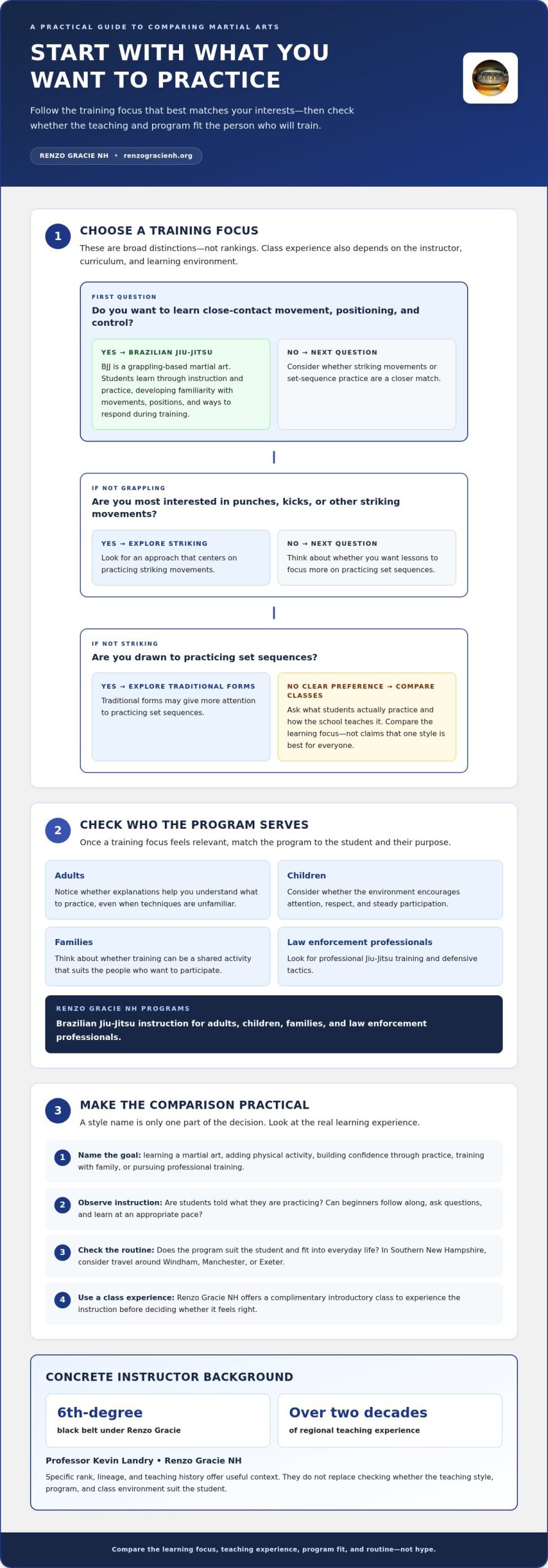
Martial arts differ in what students practice, how lessons are taught, and which skills receive the most attention. Some approaches emphasize striking movements, while grappling-based disciplines focus on close-contact movement, positioning, and control. Traditional forms may give more attention to practicing set sequences. These are broad distinctions, not rankings: the experience also depends on the instructor, curriculum, and class environment.

Could Brazilian Jiu-Jitsu match your goals?

Brazilian Jiu-Jitsu (BJJ) is a skill-based martial art centered on grappling. Students learn through instruction and practice, building familiarity with movements, positions, and ways to respond during training. It’s a focused discipline, not a universal answer for every student or goal. Choosing a style alone doesn’t guarantee a particular result.

Renzo Gracie NH focuses on Brazilian Jiu-Jitsu instruction, with programs for adults, children, families, and law enforcement professionals. The student and purpose may differ, but the academy’s central discipline is the same. Consider whether learning grappling through structured practice fits what you’re seeking.

How can you compare disciplines without relying on hype?

Start with what you want to learn, then look at how a school teaches it and what students practice during class. Promotional language can describe a school’s aims, but it isn’t evidence of a particular outcome. Compare the actual learning focus and experience rather than relying on claims that one style is best for everyone.

The right discipline is the one whose learning focus and teaching experience align with the student’s priorities. Use the questions below to make that comparison concrete.

Goal Questions to consider Relevant training focus
Learn grappling skills Do you want to practice close-contact movement and positioning? Brazilian Jiu-Jitsu’s grappling-based instruction and practice.
Explore striking skills Are you more interested in practicing punches, kicks, or other striking movements? Look for an approach that centers on striking practice.
Practice traditional forms Would you enjoy learning and repeating set movements or sequences? Consider an approach that emphasizes forms and their practice.
Find training for a specific student Is the program designed around an adult, child, family, or professional learner? Compare the intended student and purpose with the program’s stated focus.

For anyone searching for the best martial arts school New Hampshire can offer, this framework replaces sweeping promises with a clearer question: does the training match what you want to practice? Consider how the instruction is explained, whether the class experience feels appropriate, and whether the program serves the student. If Brazilian Jiu-Jitsu aligns with your priorities, explore Renzo Gracie NH’s Brazilian Jiu-Jitsu approach.

Which Criteria Help You Compare New Hampshire Martial Arts Schools?

Use consistent criteria when comparing schools. Whether you’re considering training near Windham, Manchester, or Exeter, assess each option in the same way instead of letting a convenient location or polished promotion make the decision for you. Convenience matters, but the program should also make sense for the student.

For each school, note what you can verify, what you experience, and what you still need to understand. Specific details about instructors, programs, and how to get started are more useful than broad promotional language.

How should you assess instructor experience and teaching approach?

Look for a clear account of who teaches and what relevant experience they bring. Rank and lineage provide context, while teaching history helps explain an instructor’s experience working with students. Neither guarantees a particular result or class experience. Weigh those details alongside what you observe about the instruction.

At Renzo Gracie NH, Professor Kevin Landry is a sixth-degree black belt under Renzo Gracie and has taught in the region for over two decades. These are concrete credentials to consider as you learn about the academy’s Brazilian Jiu-Jitsu instruction.

What signs of program fit matter beyond credentials?

Check whether the program is intended for the student and purpose you have in mind. An adult, a child, a family, and a law enforcement professional may be looking for different learning experiences. Consider whether the school explains its program clearly and describes an approach grounded in respect and support. Then use a class experience to understand the atmosphere firsthand.

For insight into the principles behind the academy’s approach, explore its Jiu Jitsu philosophy guide. A school’s stated philosophy can help you understand what it prioritizes. Your own experience helps you decide whether that approach resonates.

Use this checklist as you compare programs:

  • Instructor background: Can you identify the instructor’s rank, lineage, and relevant teaching experience from specific information?
  • Program fit: Is the program designed for the student’s age group and purpose, such as adult, children’s, family, or professional Jiu-Jitsu training?
  • Learning culture: Does the school describe how it values respect and support, and does the class experience feel appropriate to the student?
  • Next steps: Is it clear how a new student can experience the instruction before deciding whether to continue?

For each point, record “clear,” “partly clear,” or “unclear,” along with a note about what you observed. Apply the same standard to every school. Specific credentials are more useful than broad claims, and a shorter drive shouldn’t outweigh a program that doesn’t fit the student’s goals or learning needs.

This process makes “best” personal and meaningful. The best martial arts school New Hampshire offers for one student may not suit another. Compare instructor experience, program purpose, learning culture, and the class experience together, then use those criteria to guide your decision.
Best NH Martial Arts School: Finding the Right Fit 2026

Matching Martial Arts to Your Goals in Southern NH

Narrow your options by starting with the person who’ll train, not simply the nearest school. Whether you’re in Windham, Manchester, Exeter, or a nearby community, students have different goals and routines. Use these steps to connect those priorities with a suitable program.

  1. Name the goal. Decide what you hope to learn or make room for in your routine. You might want to begin a martial art, explore Jiu-Jitsu, find training for your child, share an activity as a family, or pursue professional training.
  2. Identify the student. Be clear about who plans to participate: an adult, a child, several family members, or a law enforcement professional. A child’s training needs may differ from a parent’s, even if both are interested in martial arts.
  3. Compare program fit. Match the student and purpose to the relevant program. Consider whether the training focus fits what you want to learn and whether the routine is practical for your life in Southern New Hampshire.
  4. Experience a class. A class gives you a chance to see the instruction and learning environment firsthand. Notice whether the teaching is understandable and whether the student can picture continuing to learn there.

Which program may fit adults, children, or families?

Adults exploring Jiu-Jitsu can start with the adult Jiu-Jitsu guide to learn about beginning. Parents considering a program for a child can use the children’s Jiu-Jitsu program guide as a starting point. If your goal is to train as a family, explore parent and child Jiu-Jitsu in Windham. These are distinct needs: family participation can be a shared goal, while an adult or child may also have individual reasons for training. Focus on who will participate and what they hope to learn.

What should law enforcement professionals prioritize?

For law enforcement professionals, Renzo Gracie NH offers dedicated Jiu-Jitsu training focused on grappling, control techniques, and professional defensive tactics. Consider whether that focus aligns with your professional learning priorities. Training should not be treated as a guarantee of a particular officer-safety outcome or department approval. The law enforcement Jiu-Jitsu training guide offers more context on the program.

Make your next step practical. Renzo Gracie NH offers a complimentary introductory class, so prospective students can experience the instruction and atmosphere before deciding whether the fit feels right. Book your complimentary introductory class.

Experience Renzo Gracie NH Before Choosing Your Martial Arts School

Program descriptions can narrow your options, but experiencing an academy firsthand can help you decide whether its instruction and atmosphere suit you. Renzo Gracie NH offers a complimentary introductory class, giving prospective students a chance to experience its Brazilian Jiu-Jitsu instruction before choosing whether to take another step.

The academy is led by Professor Kevin Landry, a sixth-degree black belt under Renzo Gracie who has taught in the region for over two decades. His rank and teaching experience offer useful context, but your own priorities matter too. Consider what you hope to learn, who will be training, and whether the class experience feels appropriate for that student.

What can a prospective student learn from an introductory class?

Use the class to notice how the instruction is presented and how the learning environment feels. Are the explanations clear enough to follow? Does the atmosphere feel welcoming? Can you picture yourself, your child, or your family learning in this setting? Focus on whether the experience aligns with the goals that brought you to martial arts.

Keep your judgment personal. A first visit is a chance to experience the academy’s Brazilian Jiu-Jitsu approach, not proof that one discipline or school suits every student. If you’re an adult beginner, consider whether the introduction helps you understand what learning Jiu-Jitsu could involve. If you’re exploring for a child or family, reflect on whether the atmosphere feels right for the people who would participate.

For more context before visiting, the guide to trying Jiu-Jitsu free in New Hampshire introduces the complimentary introductory experience. Use it alongside your own observations to form a clearer picture, rather than relying on a school description alone.

How can you take the next step?

After class, compare the experience with the priorities you identified earlier. Was the teaching clear? Did the atmosphere feel welcoming? Does Brazilian Jiu-Jitsu align with what you want to practice, and does the program fit the student? These questions can help you turn a first impression into a thoughtful decision without expecting one visit to answer every question about a long-term routine.

The best martial arts school New Hampshire has for you is the one that fits the student’s goals and feels like a place where learning can continue. If Renzo Gracie NH sounds like a fit, explore the complimentary introductory class and experience the academy for yourself.

Take the First Step Toward Training That Fits

Your next step doesn’t need to be a long-term decision. Treat it as a chance to explore: bring your goals into the room, experience the instruction, and notice whether the learning environment feels right. That firsthand perspective can help you choose with more confidence than a program description alone.

At Renzo Gracie NH, Professor Kevin Landry is a sixth-degree black belt under Renzo Gracie and brings more than two decades of regional teaching experience. The academy’s complimentary introductory class gives prospective students a practical way to experience its Brazilian Jiu-Jitsu instruction. The best martial arts school New Hampshire can offer is the one that aligns with what you want to learn and feels like a place where you can keep progressing.

Try a complimentary introductory Jiu-Jitsu class at Renzo Gracie NH and take that first step at your own pace. Your training can begin by simply showing up.

Frequently Asked Questions

How do I choose the best martial arts school in New Hampshire?

Choose a school by matching its instruction and program to the person who’ll train and the reason they want to begin. An adult seeking a new skill may prioritize a different program from a parent looking for a shared family activity. Consider how the school explains its teaching approach, whether the learning environment feels comfortable, and whether the routine works from your home or workplace in Windham, Manchester, Exeter, or nearby.

Is Brazilian Jiu-Jitsu a good martial art for beginners?

Brazilian Jiu-Jitsu can be a good starting point for someone interested in learning grappling through guided instruction and practice. Beginners don’t need to arrive knowing the techniques. Look for teaching that helps you understand what you’re learning and how to keep developing. If you’re new, notice whether explanations make sense and whether the class feels welcoming. Renzo Gracie NH offers adult Jiu-Jitsu training for people exploring the discipline.

Can adults and children train in Brazilian Jiu-Jitsu at the same academy?

Yes. Renzo Gracie NH has adult and kids’ Jiu-Jitsu programs at the same academy, so different family members can explore the discipline through programs intended for adults or children. That doesn’t necessarily mean everyone trains in the same class. If a parent and child each have individual goals, consider those separately and choose the program that fits each participant. Families can also explore the academy’s family-time option for shared participation.

What should I look for in a martial arts instructor?

Look for clear information about an instructor’s rank, lineage, and teaching experience, then consider how they communicate during instruction. A credential provides context, but it doesn’t guarantee that a particular teaching style will suit you. Notice whether explanations are understandable and whether the instructor’s approach supports focused learning. At Renzo Gracie NH, Professor Kevin Landry is a sixth-degree black belt under Renzo Gracie and has taught in the region for over two decades.

Is Brazilian Jiu-Jitsu suitable for families who want to train together?

It may suit families who want martial arts to be a shared activity while allowing adults and children to pursue their own training needs. Renzo Gracie NH offers family time alongside its adult and kids’ Jiu-Jitsu programs. Before choosing, talk as a family about what each person hopes to get from participating. One family member may be interested in learning a new skill, while another values having an activity to share.

What is the difference between Brazilian Jiu-Jitsu and other martial arts?

Brazilian Jiu-Jitsu centers on grappling, while other martial arts may emphasize different practices, such as striking techniques or set forms. The distinction is about what students learn and practice, not a universal ranking of styles. When comparing approaches, consider which skills interest you and what kind of instruction you’d like to experience. Renzo Gracie NH focuses on Brazilian Jiu-Jitsu, making it an option for students drawn to grappling.

Can law enforcement officers train in Jiu-Jitsu in New Hampshire?

Yes. Renzo Gracie NH offers Law Enforcement Jiu-Jitsu Training focused on grappling, control techniques, and professional defensive tactics. Officers can compare that focus with their professional learning priorities and decide whether it aligns with what they want to study. The program is designed for law enforcement professionals, but training isn’t a guarantee of a particular officer-safety outcome or department approval.

How to Start BJJ as an Adult: A Calm, Step-by-Step Guide

What if you don’t need to get fit or learn a martial art before stepping onto the mat? If you’re wondering how to start BJJ as an adult, the first step is simply showing up ready to learn. It’s understandable to worry about being older, out of shape, inexperienced, or unsure what a beginner class will involve. Brazilian Jiu-Jitsu is a skill you build over time, not a test you have to pass on day one.

This guide explains how to prepare for a first class, start at a manageable pace, and develop a routine that fits adult life. You’ll learn what to expect as a beginner, how to approach physical effort and safety, and why consistency matters more than arriving with experience. In Southern New Hampshire, Renzo Gracie NH offers adult instruction in a supportive learning environment. Instruction is led by Professor Kevin Landry, a sixth-degree black belt under Renzo Gracie who has taught in the region for over two decades. New students can begin with a complimentary introductory class.

Key Takeaways

  • Understand what BJJ involves and how to get comfortable with close-contact training one step at a time.
  • Learn a practical progression from basic movement and positions to connecting techniques through repetition.
  • See how to start BJJ as an adult without needing to match younger students or arrive already fit.
  • Build a flexible preparation and recovery routine around gradual conditioning, sleep, hydration, and rest.
  • Explore adult instruction at Renzo Gracie NH, led by Professor Kevin Landry, who has taught in the region for over two decades.

How to Start BJJ as an Adult When You Feel Out of Place

Walking into a close-contact martial art for the first time can feel unfamiliar. You may wonder where to stand, whether you’ll understand the movements, or what it will be like to train with someone you’ve just met. That uncertainty is normal. Brazilian Jiu-Jitsu (BJJ) is a grappling martial art built around positioning, control, and technique. The aim is to learn how to move and respond thoughtfully, not to arrive already knowing what to do. For a broader overview of its history and practice, see Brazilian Jiu-Jitsu.

You can begin without a martial arts background. You’ll learn foundational movements and concepts through instruction and practice. For your first class, focus on listening, trying each movement, and asking for clarification when you need it. Class format and intensity can vary, so don’t treat every session as a test. Concentrate on the task in front of you instead of trying to master everything at once.

Your starting point is your current fitness, not a standard you must meet before you’re allowed to learn. General conditioning can support training, but BJJ skills develop through practice on the mat. Repetition helps you coordinate your body, recognize positions, and apply techniques with more control. Begin within your comfort level, communicate about limitations, and give yourself room to learn.

Do adults need experience or athletic fitness before starting BJJ?

No prior experience is needed. Instructors introduce movements and concepts progressively, while students build familiarity through repetition. Fitness and skill are related, but they aren’t the same thing. Being winded during an unfamiliar activity doesn’t mean you’re failing to learn, and being fit doesn’t automatically make a new technique feel natural.

Use your first sessions to notice how your body responds. If a movement feels confusing, slow down and focus on its parts. If you feel unusually tired or uncomfortable, pause and communicate. Training isn’t a contest to push through every sensation. A steady, attentive approach gives you more opportunity to learn than trying to match someone else’s pace.

What does progress look like for a new adult student?

Early progress may be quieter than you expect. You might remember where to place your hands, move with better coordination, or recognize a basic position such as guard or mount. These are meaningful steps: they show that you’re connecting the instructor’s explanation with what you feel during practice.

Measure progress against your earlier sessions, not the reactions of experienced training partners. After class, try naming one movement you understand more clearly and one question you want to revisit. Attendance, recovery, prior experience, and individual circumstances all affect how quickly skills take shape, so there’s no universal timetable. Stay curious, rest when you need to, and let familiarity grow through consistent effort.

How Adult Beginners Learn BJJ: Build Skills Before Chasing Speed

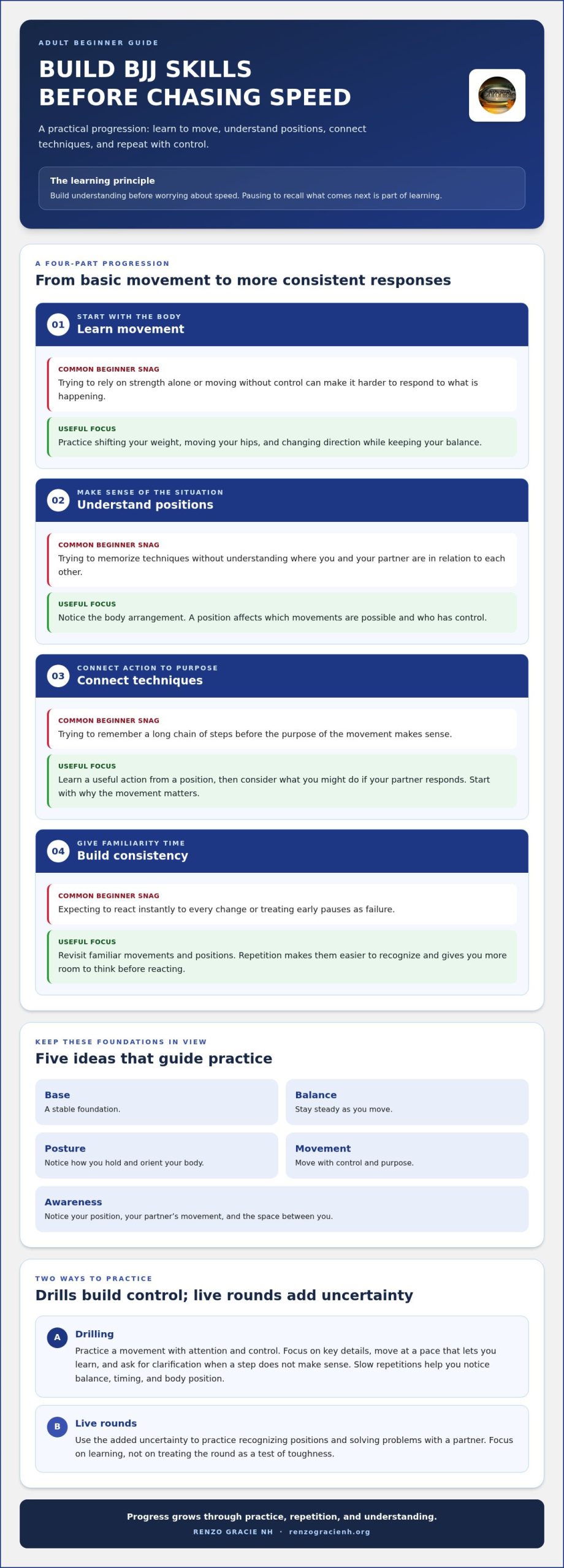
Learning BJJ is less like memorizing a long routine and more like building a set of connected decisions. First, learn to move with control. Then make sense of positions, practice techniques that work from those positions, and repeat them until the pieces become more familiar. This gradual sequence is a practical answer to how to start BJJ as an adult: build understanding before worrying about speed.

  1. Learn movement. Practice shifting your weight, moving your hips, and changing direction without losing balance. These actions help you respond to what’s happening instead of relying on strength alone.
  2. Understand positions. Notice where you and your partner are in relation to each other. A position is a body arrangement that affects which movements are possible and who has control.
  3. Connect techniques. Once you understand a position, learn a useful action from there and consider what you might do if your partner responds. Start with the purpose of the movement, not a long chain of steps.
  4. Build consistency. Revisit familiar movements and positions over time. Repetition makes them easier to recognize, giving you more room to think before you react.

At first, you may need to pause and recall what comes next. That’s part of learning. With repetition, you can begin to recognize the position that calls for a movement instead of trying to react instantly to every change. The Renzo Gracie teaching philosophy offers context for an approach centered on the principles and technical development behind the art. Good instruction connects what a technique does with why it works, making the movement easier to understand and adapt.

Which foundational BJJ skills should beginners focus on first?

Pay attention to base, balance, posture, movement, and awareness. Base means having a stable foundation; posture is how you hold and orient your body. Awareness means noticing your position, your partner’s movement, and the space between you. These concepts can guide your practice even as individual techniques change. Understanding why a position matters is often more useful than trying to memorize a lengthy sequence without context.

How should beginners approach drills and sparring?

Drilling gives you a chance to practice a movement with attention and control. Focus on the instructor’s key details, move at a pace that lets you learn, and ask for clarification if a step doesn’t make sense. Slow repetitions are useful: they help you notice balance, timing, and where your body should be.

Live rounds have a different purpose. They add uncertainty, so you can practice recognizing positions and solving problems with a partner. They aren’t a test of toughness or a requirement to win. Speak up about pace and comfort, and listen when your partner or instructor communicates. Renzo Gracie NH’s adult Brazilian Jiu-Jitsu training provides a place to learn and practice in a supportive setting.

Adult BJJ Myths: Age, Fitness, and the Fear of Falling Behind

You don’t have to keep pace with younger students or match the experience of people who’ve trained for years. Starting as an adult means beginning from your own baseline and learning at a pace that lets you stay attentive. Some days you may need more time to understand a movement; on other days, a familiar position may make more sense. Neither experience means you don’t belong.

Adapting is part of training, not a failure to train. You can pause, ask for a slower pace, or explain a limitation to your instructor or partner. That’s different from ignoring fatigue, pain, or a movement that doesn’t feel right just to prove you’re tough. Controlled pace and clear communication matter more than proving toughness; they help you stay present and make training more sustainable.

Is it too late to start Brazilian Jiu-Jitsu as an adult?

There isn’t a single age when learning has to stop, but every student’s experience is individual. Age, past activity, recovery, and personal circumstances can shape what training feels like. Patience and repeatable fundamentals let you build familiarity without expecting instant results. Learn the movement in front of you, revisit it, and allow your understanding to develop over time.

If you’re considering how to start BJJ as an adult, the useful question isn’t whether you can keep up with someone else. It’s whether you can approach practice with attention, communicate what you need, and return when your circumstances allow. Progress can be gradual and doesn’t need to look identical from one person to the next.

Do you have to be fit, strong, or competitive to belong?

No. You can become more familiar with training as you build a routine; strength or athletic experience isn’t an entry requirement. You also don’t have to compete. Some students choose competition, while others focus on learning, personal development, or practicing with a community. Competition is a personal choice, not a required measure of commitment or progress.

Before training, share relevant limitations with your instructor, including movements you need to approach carefully. Clear, practical information helps others understand how to work with you. During practice, pay attention to your body and speak up if the pace or movement feels wrong. Adjusting your effort is a skill, too.

A sustainable start doesn’t depend on winning rounds or having every class feel easy. It can mean showing up, learning one detail, and leaving with enough energy to return when it fits your life. Give yourself permission to be new. Your training is yours to build, one considered step at a time.

How to Start BJJ as an Adult: A Calm, Step-by-Step Guide

A Practical Adult BJJ Starting Plan: Prepare, Train, and Recover

A sustainable start doesn’t require a perfect schedule or intense preparation. It takes a plan you can adjust as you learn how training fits into your life. If you’re deciding how to start BJJ as an adult, think in small steps: choose a realistic class rhythm, prepare for each session, and make time to recover before deciding whether to add more.

  1. Choose a manageable starting cadence. Look at your work, family, and other commitments, then choose a pace you can realistically maintain. There’s no universal weekly schedule for every adult. Consistency over time is more useful than an ambitious first week that makes training difficult to fit into your routine.
  2. Prepare with simple habits. Prioritize sleep, drink water regularly, and arrive ready to focus. If you want to work on general conditioning outside class, build gradually rather than piling on extra effort all at once. The goal is to support training, not exhaust yourself before it begins.
  3. Set a short process goal. Choose something you can work on, such as attending consistently when life allows, remembering one movement, or asking a question about a position. Process goals keep your attention on learning rather than a belt deadline or an outcome you can’t control.
  4. Review and adjust. After class, note your energy, soreness, and what you learned. Rest as needed, and use those observations to decide whether your current routine feels manageable before increasing it.

How can adults make a manageable training routine?

Start with a rhythm that respects your actual week, not an ideal version of it. A busy stretch at work or extra family responsibilities may call for a lighter routine; a more settled period may leave room for more practice. Before adding sessions, consider whether you’re recovering well and staying attentive during training. Scaling back is useful information, not a failure.

Sleep and hydration are straightforward parts of preparation and recovery. Make room for rest after training, too. Your body and schedule both need time to adjust to a new activity. For more related guidance, the adult BJJ beginner guide can help you explore the early stages of learning.

What mindset and habits help beginners keep learning?

Ask concise questions when an instruction or position is unclear. For example, ask where your weight should be or what the movement is meant to accomplish. A focused question gives you one detail to work with instead of leaving you to guess through the whole technique.

Measure progress against your own earlier effort. Perhaps you remembered a movement more easily or felt less unsure about what to do next. Those observations are more useful than comparing your pace with another student’s. Rest and adjustment belong in a sustainable practice; they help you return ready to learn.

A complimentary introductory class at Renzo Gracie NH is one way to experience adult Brazilian Jiu-Jitsu training.

Start Adult BJJ at Renzo Gracie NH: Take One Welcoming First Step

You don’t need to have every part of your training plan figured out before you begin. Once you understand that BJJ develops through steady practice, the next step is finding instruction where you can learn, ask questions, and build at your own pace. Renzo Gracie NH offers adult Brazilian Jiu-Jitsu instruction for different skill levels in a supportive training environment focused on technical development and personal growth.

Instruction is led by Professor Kevin Landry, a sixth-degree black belt under Renzo Gracie who has taught in the region for over two decades. For a beginner, clear explanations, respectful practice, and the ability to ask questions can make it easier to understand what to work on and turn confusion into useful feedback.

What can an adult beginner look for in supportive instruction?

Look for an environment where learning is treated as a process, not a test of athletic ability. You should be able to focus on the lesson, communicate about your comfort level, and work through techniques without feeling that you must already know the answers. At Renzo Gracie NH, adult instruction welcomes students at different skill levels, giving beginners room to develop foundational understanding as they train.

How can you take a low-pressure first step in Southern New Hampshire?

Renzo Gracie NH’s complimentary introductory class gives new students an opportunity to experience training before deciding on next steps. It can help you see what instruction feels like and consider how the environment fits your goals. For adults in Windham, Manchester, and Exeter, the academy offers a local starting point in Southern New Hampshire.

Keep your first visit simple. Arrive ready to listen, take the class one instruction at a time, and give yourself permission to be new. You don’t have to decide on a long-term commitment based on one session. Instead, notice whether the teaching helps you follow along, whether you feel comfortable asking questions, and what you’d like to learn next. Those observations can help you decide whether to continue.

If you’ve been wondering how to start BJJ as an adult, take the next step at a manageable pace. A free introductory class is a chance to experience adult Jiu-Jitsu training at Renzo Gracie NH.

Make Your First Step Count

You don’t need to map out months of training before you begin. Let your first class be a chance to experience the learning environment, notice how instruction feels, and decide what you’d like to explore next. There’s no need to arrive with a polished goal or a promise to keep going. Curiosity is enough to start.

If you’re still asking how to start BJJ as an adult, choose one manageable action: set aside time to try a class, then reflect on what felt welcoming, challenging, or worth learning more about. The right next step is one that suits your life and gives you room to grow at your own pace.

New students can experience training through a complimentary introductory class at Renzo Gracie NH. Explore a free introductory class and take your first step toward Brazilian Jiu-Jitsu in Windham, with the academy also serving adults in Manchester and Exeter.

Frequently Asked Questions

Can I start BJJ as an adult with no martial arts experience?

Yes, you can begin without prior martial arts experience. In your first classes, unfamiliar terms and movements may take time to absorb, so focus on one instruction at a time instead of trying to remember everything. For example, if an instructor explains a hand placement, practice that detail before worrying about the whole technique. Questions are part of learning, and your growing understanding is a better measure than comparing yourself with others.

Is 40 too old to start Brazilian Jiu-Jitsu?

No, age alone doesn’t decide whether you can begin. Your activity history, goals, and physical needs are individual, so tell the instructor about relevant limitations and follow guidance that fits your situation. You can train without competing, and there’s no need to treat another student’s pace as a standard. If you have a health concern or uncertainty about exercise, speak with a qualified healthcare professional before taking part.

Do I need to lose weight or get in shape before starting BJJ?

No, you don’t need to reach a target weight or fitness level first. A beginner class can introduce you to the effort and movements involved, and you can build familiarity over time. Choose a manageable pace, let the instructor know if you need to modify an activity, and notice how you feel afterward. If you have a medical condition or specific concerns about exercise, seek advice from a healthcare professional before beginning.

Do adults have to compete in Brazilian Jiu-Jitsu?

No, competition is optional. Adults can take part for the challenge of learning grappling, skill development, physical activity, or the structure of regular practice with others. If you’re not interested in tournaments, you can still set meaningful goals, such as understanding a position or improving a movement. Be clear about what you hope to get from training so you and your instructor can keep your focus aligned with your reasons for learning.

What should I wear to my first adult BJJ class?

Follow the clothing guidance provided for your introductory class, since requirements can vary by session. If you’re told to wear athletic clothing, choose clean, comfortable items that let you move freely and don’t have zippers, hard parts, or sharp accessories. Remove jewelry and trim your nails before class. You don’t need to purchase specialized equipment before you know what’s expected for your first session.

How often should a beginner train BJJ each week?

There’s no single weekly schedule that works for every adult. Choose a cadence that fits your commitments and leaves enough room for recovery, then see how it feels in practice. If you’re commuting from Windham, Manchester, or Exeter, account for travel time when planning a routine you can maintain. If your energy or soreness makes your current plan difficult, adjust before adding more sessions.

Is Brazilian Jiu-Jitsu safe for adult beginners?

BJJ is a physical, close-contact activity, so it isn’t risk-free. Follow the instructor’s directions, keep your partner informed about your comfort level, and stop if something feels wrong. Share relevant injuries or limitations before participating so the instructor understands what you need to be mindful of. If you have an injury, a medical condition, or uncertainty about exercise, consult an appropriate healthcare professional before training.

7 Couple Hobbies to Try in Windham, NH

The best hobby for a couple isn’t necessarily one you already share. It might be a new challenge you discover side by side. If you’re searching for a “hobby for couples to do together Windham,” you’ll find ideas beyond another evening of screens or errands, from creative projects and outdoor outings to Brazilian Jiu-Jitsu.

Choosing can be tricky when one partner wants to get moving and the other prefers a relaxed pace. Starting something new shouldn’t feel like a test of skill or a commitment you’re not ready to make. Look for an activity you can both approach at your own level, with room to enjoy the experience and decide whether you want to continue.

This guide compares seven couple hobbies around Windham by atmosphere, activity level, and how you can try them together. You’ll find ideas for making art, cooking, exploring local trails, volunteering, and building skills through Brazilian Jiu-Jitsu. At Renzo Gracie NH, a complimentary introductory class is a low-pressure way to experience the practice before deciding whether it belongs in your routine.

Key Takeaways

  • Choose a hobby that invites both partners to participate, not just spend time in the same room.
  • Compare hiking, cooking, gardening, photography, board games, volunteering, and Brazilian Jiu-Jitsu to find a shared experience that fits your interests.
  • Use activity level, setting, learning, and interaction to decide which hobby for couples to do together Windham feels right for you.
  • Start with a realistic trial: share preferences, shortlist ideas, try one, then talk about what you enjoyed.
  • Explore adult Brazilian Jiu-Jitsu as a structured way to build skills and personal growth together, whatever your starting experience.

How to choose a hobby for couples to do together in Windham

Finding something both partners genuinely look forward to can be harder than it sounds. One person may want fresh air and movement, while the other prefers making, learning, or a quieter activity. A useful shared hobby gives you something to participate in together, whether you’re working toward a small goal, making decisions as a team, or simply enjoying the same experience. It’s different from sitting near each other while doing separate things.

If you’re searching for a hobby for couples to do together Windham, compare the practical fit as carefully as the activity itself. Consider shared interests, preferred energy level, comfort with a learning curve, available time, and whether you’d rather be indoors or outside. You don’t need identical fitness levels or existing skills to begin. In adult Brazilian Jiu-Jitsu, instruction serves different skill levels, so beginners can focus on learning at their own pace.

What makes a hobby work for both partners?

Start by naming what you want from your time together: learning something, getting moving, making something, or exploring. Then each partner can suggest an activity they’d honestly be willing to try. The aim isn’t to win a debate or find a perfect match on the first attempt. Choose a manageable trial and notice whether the experience feels enjoyable for both of you.

Keep the first try low-pressure. Afterward, compare notes: Did you like the pace? Was there enough interaction? Would you do it again, or change something about the plan? A hobby can take shape over time, and a trial that doesn’t stick still helps you understand what suits you both.

Which local factors matter when choosing a shared activity?

Windham’s location in Southern New Hampshire makes travel time a useful part of the decision. The town’s setting and community context are outlined in this overview of Windham, New Hampshire. Think about how far you’re both comfortable going and whether the trip still feels worthwhile after a busy day. A nearby activity may be easier to repeat; a longer drive might feel more like a planned date. Couples in Manchester and Exeter can use the same approach when weighing travel against how often they want to take part.

Setting matters, too. Indoor hobbies can offer a more predictable routine, while outdoor plans depend on season, weather, and daylight. Neither is automatically better. Match the setting to what helps you both unwind and show up consistently.

Finally, check the real-life fit against work, family responsibilities, and other weekly commitments. You might prefer a short activity you can repeat, or an occasional longer outing that feels special. Be realistic about the time and energy you can give it; a hobby should add connection, not become another source of pressure.

A shared hobby creates recurring time to connect by giving couples something to learn, do, and enjoy side by side. Choose a first step that feels welcoming to both of you, then let the experience guide what comes next.

Seven couple hobby ideas near Windham, from creative projects to Brazilian Jiu-Jitsu

The best shared activity depends on what you want from your time together: fresh air, a finished project, an easy conversation starter, or a new skill to develop. For a hobby for couples to do together Windham, consider how you’ll participate as a pair, not just whether the activity sounds appealing in theory. These seven ideas offer different ways to connect, and you don’t need to start as an expert.

Creative, relaxed, and outdoor hobbies to explore together

Some hobbies invite you to build something; others make space for conversation or a change of scenery. Think about whether you’d rather plan a project, play, or get outside, then choose an idea that suits both your energy and interests.

  • Cooking: Choose a recipe neither of you has mastered, divide the preparation, and taste the results together. It suits couples who enjoy making decisions as a team and sharing a meal. To keep it collaborative, agree on the recipe and split tasks before you start.
  • Gardening: Plan what to grow, care for it, and notice progress over time. This can suit partners who like hands-on projects and don’t mind that the reward comes gradually. Decide together how much ongoing care you want before choosing a project.
  • Photography: Head out with a camera or phone and look for different ways to capture the same subject. It’s a creative choice for couples who enjoy exploring and comparing what catches each person’s eye. Pick a theme, such as textures or colors, to give the outing a shared focus.
  • Board games: Set aside an evening for a cooperative game or friendly competition. This is an easygoing option for partners who like conversation, strategy, or a playful challenge at home. Choose a game that fits the time and mood you have, rather than turning the evening into a rules-reading marathon.
  • Walking or hiking: Take a route that matches your comfort and energy, then enjoy the scenery and unhurried conversation. These flexible outdoor activities appeal to couples who want to move together without turning every outing into a workout. Agree on a comfortable pace and distance before setting out.
  • Volunteering: Find a shared cause and contribute time toward a meaningful goal. It may suit couples who feel connected by helping others and want their time together to benefit the wider community. Talk about the kind of cause or task that matters to both of you.

Cooking and gardening create visible progress; photography encourages creative discovery, while board games make room for relaxed interaction. Walks and hikes bring movement and conversation, and volunteering centers the experience on contributing together. For couples drawn to outdoor sports that nurture both technical skill and spiritual well-being, exploring resources like golffromtheheart.golf offers another pathway to connect. The strongest fit depends on what you both want to share and how much time you want the activity to take.

Brazilian Jiu-Jitsu as an active hobby for couples

Brazilian Jiu-Jitsu offers a more structured way to move and learn. Through adult instruction, partners can develop movement and grappling skills, practice patience, and recognize each other’s progress. The focus can be learning and personal growth, not competition. Adult classes serve different skill levels, so prior martial arts experience isn’t required to begin.

At Renzo Gracie NH, new students can start with a complimentary introductory class. It gives you a chance to experience the practice before deciding whether it suits you both. For a clearer picture of the first steps, explore this guide to Jiu-Jitsu for beginners adults in New Hampshire.

In short, choose a hobby for the experience you want to share: creating, playing, exploring, contributing, or learning a physical skill. If structured movement sounds appealing, you can try a complimentary introductory class as a low-pressure first step.

How to compare couple hobbies by energy, commitment, and connection

Seven good ideas can still leave you wondering which one to try first. Compare the energy each requires, where you’ll do it, how much there is to learn, and how you’ll interact. Commitment matters, too: some hobbies work as occasional plans, while structured instruction asks you to make room for ongoing learning. Use the table as a guide, not a scorecard, and think about what a typical week allows.

Hobby Activity level Setting Learning Interaction Commitment
Cooking Low Indoors Flexible Collaborative Occasional or recurring
Gardening Low to moderate Outdoors or indoors Gradual Shared project Ongoing care
Photography Low to moderate Indoors or outdoors Self-paced Creative exchange Flexible
Board games Low Indoors Varies by game Conversation or friendly play Easy to schedule casually
Walking or hiking Moderate, adjustable Outdoors Minimal to gradual Conversation and movement Flexible
Volunteering Varies Depends on activity Task-specific Working toward a shared purpose Depends on the commitment
Brazilian Jiu-Jitsu Active Indoor instruction Structured skill-building Learning and encouragement More structured than a casual pastime

Which hobby suits a relaxed date night or an active routine?

Cooking and board games can fit a quieter evening, while walking, hiking, and Brazilian Jiu-Jitsu bring more movement. Gardening and photography can shift between relaxed and active depending on the project or outing. Outdoor plans also change with New Hampshire weather and seasons, so consider whether you’d enjoy adapting or would rather have an indoor option. Most of all, choose something both partners feel comfortable repeating.

If you’re searching for a hobby for couples to do together Windham, start by agreeing on one shared priority: low-key time, regular movement, learning a skill, or contributing to a cause. You don’t need to match on every preference. One partner might favor activity while the other values a calm pace; look for an option that makes room for both, or alternate between different kinds of plans.

Can couples with different experience levels learn together?

Yes. A difference in fitness or experience doesn’t rule out trying an active hobby. Beginner-friendly instruction can help newcomers build skills progressively, while patience and encouragement keep the focus on each person’s effort. In Brazilian Jiu-Jitsu, adult instruction serves different skill levels. Partners don’t need to progress identically; they can share the experience while recognizing individual milestones.

Brazilian Jiu-Jitsu is more structured than a casual drop-in pastime, so it suits couples who want guided learning rather than just an occasional activity. A complimentary introductory class at Renzo Gracie NH offers a low-pressure way to experience it. If structured movement feels like a promising fit, explore the complimentary introductory class as a first step.

7 Couple Hobbies to Try in Windham, NH

A practical plan for trying a new hobby together in Windham

A good idea becomes easier to act on when you agree how you’ll test it. Treat the first attempt as exploration, not a promise to keep going. That takes pressure off both partners and makes it simpler to be honest about what felt fun, awkward, tiring, or worth repeating. For a hobby for couples to do together Windham, choose a trial that fits your real schedules and both comfort levels.

A four-step way to choose and test an activity

  1. Share preferences. Separately name the energy level, setting, and kind of shared experience you’d enjoy. One person might want movement and fresh air; the other might prefer a hands-on project or relaxed conversation.
  2. Shortlist together. Compare your answers and pick one activity you’re both willing to try. It doesn’t need to be each person’s first choice. Aim for a reasonable overlap, such as a short walk, a recipe to make at home, or an introductory class.
  3. Choose a first step. Decide what “trying it” actually means, then select a day that doesn’t compete with major work or family commitments. Keep the trial manageable, and agree beforehand that you can stop or choose something different afterward.
  4. Talk it over. Once you’ve tried it, discuss what you enjoyed, what felt uncomfortable, and whether you’d like another go. If only one part worked, adjust the plan rather than treating the experience as a failure.

This simple process turns vague plans into a shared decision. It also gives both partners a voice before the activity begins, which can help prevent one person from feeling carried along by the other’s enthusiasm. If you’re choosing between two ideas, try the one that is easier to schedule first, then save the other for another occasion.

How to make a first Brazilian Jiu-Jitsu experience feel approachable

Trying a new physical skill can feel daunting if one partner is less athletic or has less experience. Adult Brazilian Jiu-Jitsu instruction at Renzo Gracie NH serves different skill levels, so beginners don’t need to arrive with a martial arts background. The first goal can simply be to listen, learn, and get comfortable with the experience. Respect, patience, and attention to personal progress matter more than comparing how quickly each partner picks things up.

A complimentary introductory class offers a way to experience instruction without making a longer-term decision first. You can try Jiu-Jitsu free in New Hampshire as a first step, then discuss what you each thought. To understand the principles behind the practice, explore Renzo Gracie’s Jiu-Jitsu teaching philosophy.

Curious whether this active, skills-based hobby suits you both? Book a complimentary introductory class and use the experience to decide what comes next.

Try Brazilian Jiu-Jitsu together at Renzo Gracie NH

If you and your partner want a hobby that combines movement with focused learning, Brazilian Jiu-Jitsu is one option to explore in Windham. Renzo Gracie NH offers adult instruction for different skill levels, making it possible to begin without prior martial arts experience. Rather than relying on competition as the goal, you can approach practice as a chance to develop technical skills and concentration through steady effort.

Instruction is led by Professor Kevin Landry, a sixth-degree black belt under Renzo Gracie who has taught in the region for over two decades. His experience gives the program a strong foundation, while the academy’s emphasis on personal development and community supports students as they learn. Each partner can focus on their own progress, even if one has more experience or feels more comfortable with physical activity at first.

What couples can gain from learning a skill together

Learning side by side can give couples a fresh way to encourage one another. You might notice a technique that once felt unfamiliar becoming easier with practice, or recognize the patience it takes to keep working through a challenge. Those small milestones matter. Structured instruction gives each person room to develop at an individual pace, while shared practice creates natural moments to listen, learn, and acknowledge effort.

There’s no need to compare progress or arrive with the same strengths. One partner may feel at home with movement while the other is learning how to feel comfortable in a new setting. Respectful encouragement can help both stay focused on their own development. The value is in the learning experience, not a promise of a particular fitness, self-defense, relationship, or competitive result.

Take the first step with a complimentary introductory class

A first class is an opportunity to experience the academy’s instruction before deciding whether ongoing training fits your routine. You can arrive as a beginner, pay attention to how the learning environment feels, and talk together afterward about what stood out. Treat it as a chance to explore, not a commitment to continue. That makes it easier to discover whether Brazilian Jiu-Jitsu feels like an activity you’d both enjoy pursuing.

If you’re looking for a hobby for couples to do together Windham that brings movement, skill-building, and personal progress into the mix, consider taking that first step. Come discover whether learning Brazilian Jiu-Jitsu feels like the right fit for you as a couple. Try a complimentary introductory class.

Make your next shared hobby a new skill

The right hobby doesn’t have to be something you both already know how to do. It can be a chance to learn, encourage each other, and make progress at your own pace. If you’re still deciding on a hobby for couples to do together Windham, Brazilian Jiu-Jitsu offers an active way to start building a skill side by side.

At Renzo Gracie NH, adult instruction is guided by Professor Kevin Landry, a sixth-degree black belt under Renzo Gracie who has taught in the region for over two decades. New students can begin with a complimentary introductory class, making it easier to experience the instruction before deciding whether to continue. Come curious, not already experienced. Your first step is simply finding out how the practice feels for you both.

Ready to explore? Try a complimentary introductory class at Renzo Gracie NH and discover whether learning together feels like the right fit. Every shared skill begins with a first step.

Frequently Asked Questions

What are fun hobbies for couples to do together in Windham, NH?

Fun options include walking or hiking, cooking, gardening, photography, board games, volunteering, and Brazilian Jiu-Jitsu. Couples in Windham, Manchester, and Exeter can start with the kind of experience they want, such as an easy evening at home or a more active outing. For outdoor plans, choose a distance and pace that suit both partners; for indoor activities, pick a shared project or game that gives you something to talk about.

Is Brazilian Jiu-Jitsu a good hobby for couples?

Brazilian Jiu-Jitsu can suit couples who enjoy active learning and want a structured challenge to explore together. It involves developing technical skills through instruction, so the experience is different from simply attending an event side by side. Partners can encourage each other while focusing on their own learning. It may be a good fit if you both enjoy trying new skills, staying engaged, and celebrating small signs of progress.

Can beginners try Brazilian Jiu-Jitsu together?

Yes. Adults can begin Brazilian Jiu-Jitsu without prior martial arts experience, and instruction serves different skill levels. For a first visit, focus on listening and getting familiar with the learning environment rather than trying to master techniques immediately. You and your partner can each notice what feels comfortable and ask yourselves afterward whether you’d like to continue exploring the practice.

Do couples need the same fitness level to start a hobby together?

No. A shared hobby doesn’t require matching fitness levels or identical experience. For a walk, for example, you can choose a comfortable pace and distance; for a skill-based activity, each person can focus on learning from their own starting point. Discuss comfort and energy before choosing, then treat encouragement as part of the shared experience rather than comparing who learns or moves faster.

What indoor hobbies can couples try together near Windham?

Cooking, board games, photography projects, and indoor gardening can all make enjoyable at-home activities. Try choosing a recipe to prepare as a team, learning a new game, or photographing ordinary objects from different angles. Couples looking for guided indoor learning can also explore Brazilian Jiu-Jitsu instruction at Renzo Gracie NH, serving the Windham area and nearby communities including Manchester and Exeter.

How can couples choose a hobby when they have different interests?

Look for one shared priority instead of demanding that you like the same activities. You might both want more time to talk, a creative project, or a chance to learn something new, even if your favorite hobbies differ. Each partner can name one activity they’d genuinely try, then choose an option that feels acceptable to both. After the trial, decide together whether to repeat it or pick another idea.

Can couples try a Jiu-Jitsu class before committing to training?

Yes. New students at Renzo Gracie NH can attend a complimentary introductory class to experience the instruction before deciding about ongoing training. It’s a practical way for couples to see how the activity feels in person, especially if one or both are new to martial arts. Try a complimentary introductory class at Renzo Gracie NH, then talk about what you found interesting and whether you’d like to take another step.

Jiu Jitsu for Fitness Adults: Build Strength, Conditioning, and Confidence

What if getting fitter felt less like repeating the same workout and more like learning a skill? For adults looking for a fresh approach, jiu jitsu for fitness adults combines movement, problem-solving, and physical effort in one engaging practice.

It’s understandable to wonder whether you need to get in shape before stepping onto the mat, or whether training will feel intimidating and overly competitive. You don’t need to be an athlete to begin. Adult Brazilian Jiu-Jitsu can be learned progressively, with instructors and training partners helping you develop at a manageable pace.

This article explains the strength, conditioning, coordination, and focus a class can involve, so you can decide whether the experience fits your preferences and goals. You’ll also learn how to approach practice sustainably, from starting with fundamentals to building consistency over time. At Renzo Gracie NH, adult instruction is tailored to different skill levels, with a focus on technical development and personal growth in a supportive environment. A complimentary introductory class offers a welcoming first step.

Key Takeaways

  • Jiu jitsu for fitness adults offers a skill-based alternative to repetitive workouts, blending movement, learning, and interaction.
  • Adult Brazilian Jiu-Jitsu involves balance, coordination, and sustained effort, while engaging the mind through problem-solving.
  • Compare Jiu-Jitsu with running and solo gym sessions to identify the training style and social setting you’re most likely to enjoy.
  • Build a sustainable routine by choosing a manageable schedule, reflecting on how training feels, and allowing time for recovery.
  • Renzo Gracie NH offers adult instruction for different skill levels, with a focus on technical development, fitness, and personal growth.

Why Jiu-Jitsu for Fitness Appeals to Adults Who Want More Than Repetitive Workouts

If repeating the same workout leaves you mentally checking out, you may be looking for exercise that gives you something to learn as well as a reason to move. Brazilian Jiu-Jitsu is a grappling martial art in which practitioners use technique and positional movement to control or escape positions with a partner. The appeal of jiu jitsu for fitness adults isn’t one-size-fits-all, but combining physical practice with skill development can offer a different kind of motivation.

In class, students learn techniques, practise movements, and work with training partners to apply skills in a controlled setting. Instead of simply counting repetitions, you pay attention to positioning, timing, and your partner’s movements. That gives you a mental task to focus on alongside the physical effort. To learn more about the art’s roots and principles, see Brazilian Jiu-Jitsu on Wikipedia.

What makes Jiu-Jitsu different from a standard workout?

Brazilian Jiu-Jitsu is active, skill-based training that uses movement and technique with a partner. A conventional gym session may focus on repeating selected movements or working independently toward a personal target. Jiu-Jitsu also uses repetition, but with a learning purpose: refining a movement, understanding a position, or exploring how a technique works with another person.

Neither format is inherently better. Some people enjoy the freedom of solo exercise; others find that instruction, partner interaction, and developing skills make it easier to stay curious and engaged. A class may also ask you to adjust your movement as the situation changes, rather than follow a fixed sequence. Training can support personal fitness goals, but the experience and results vary by person. It doesn’t guarantee a particular change in strength, conditioning, or body composition.

Who might enjoy adult Jiu-Jitsu for fitness?

Adult Jiu-Jitsu may suit people who want physical activity with a clear learning path: you practise, receive instruction, and gradually build familiarity with techniques. It may also appeal if you prefer exercising around others or find that learning a physical skill makes regular activity feel more purposeful.

Preferences differ. You don’t need to be highly competitive or share the same goals as your training partners. Some adults are drawn to the technical challenge; others value the shared practice and the chance to work toward personal fitness goals. Renzo Gracie NH offers adult Brazilian Jiu-Jitsu instruction tailored to different skill levels, with an emphasis on technical development, fitness, and personal growth in a supportive environment. A complimentary introductory class lets new students experience the practice and decide whether it feels like a good fit.

How Brazilian Jiu-Jitsu Challenges the Body and Mind During Adult Training

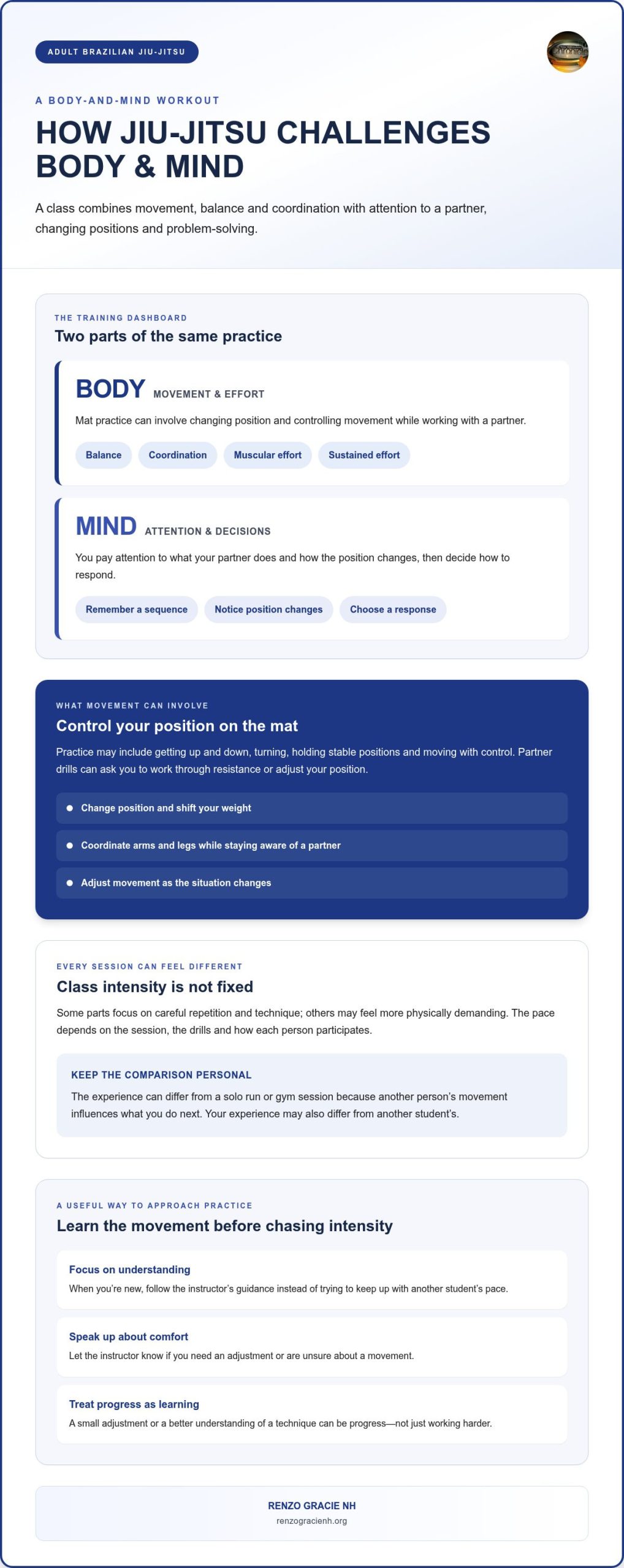
A Jiu-Jitsu class asks you to do more than follow a set of movements. You may shift your weight, change position, maintain your balance, and coordinate your arms and legs while paying attention to a partner. These demands can make practice feel like a full-body effort, though the experience varies from student to student and class to class. The pace depends on the session, the drills, and how each person participates.

Which physical abilities can practice involve?

Movement on the mat may involve getting up and down, turning, holding stable positions, and moving with control. Balance and coordination matter as you practise techniques, while partner drills can call for muscular effort as you work through resistance or adjust your position. Sustained effort can feel different from a solo run or gym session because another person’s movement influences what you do next.

Some parts of class focus on careful repetition and technique; others may feel more physically demanding. Don’t assume every session will have the same intensity, or that your experience will match someone else’s. If you’re new, focus on understanding the movement and following the instructor’s guidance instead of trying to keep up with another student’s pace.

Pay attention to your comfort level throughout practice. Let the instructor know if you need an adjustment or are unsure about a movement, and follow their direction as you learn. Clear communication helps the instructor guide your participation and gives you a practical way to build familiarity with training over time.

How does skill learning shape the workout?

There’s a mental task alongside the physical one. You may need to remember a sequence, notice how a position changes, and choose how to respond to your partner. If a technique doesn’t work as expected, you can listen to instruction, make a small adjustment, and try again. Progress can come from understanding a detail, not simply working harder.

Skill-based training measures progress through learning and applying techniques, not intensity alone. That distinction matters when considering jiu jitsu for fitness adults: effort is part of the experience, but so are attention and problem-solving. The goal in class isn’t to treat every moment as a test of endurance. Steady participation, careful practice, and thoughtful responses all contribute to learning.

If you’d like to experience adult instruction, start with a complimentary introductory Jiu-Jitsu class. Use that first session to listen, learn the movements, and share your comfort level with the instructor. Starting attentively is a strong foundation for deciding whether this training suits you.

Is Jiu-Jitsu a Better Fitness Fit Than Gym Workouts, Running, or Other Activities?

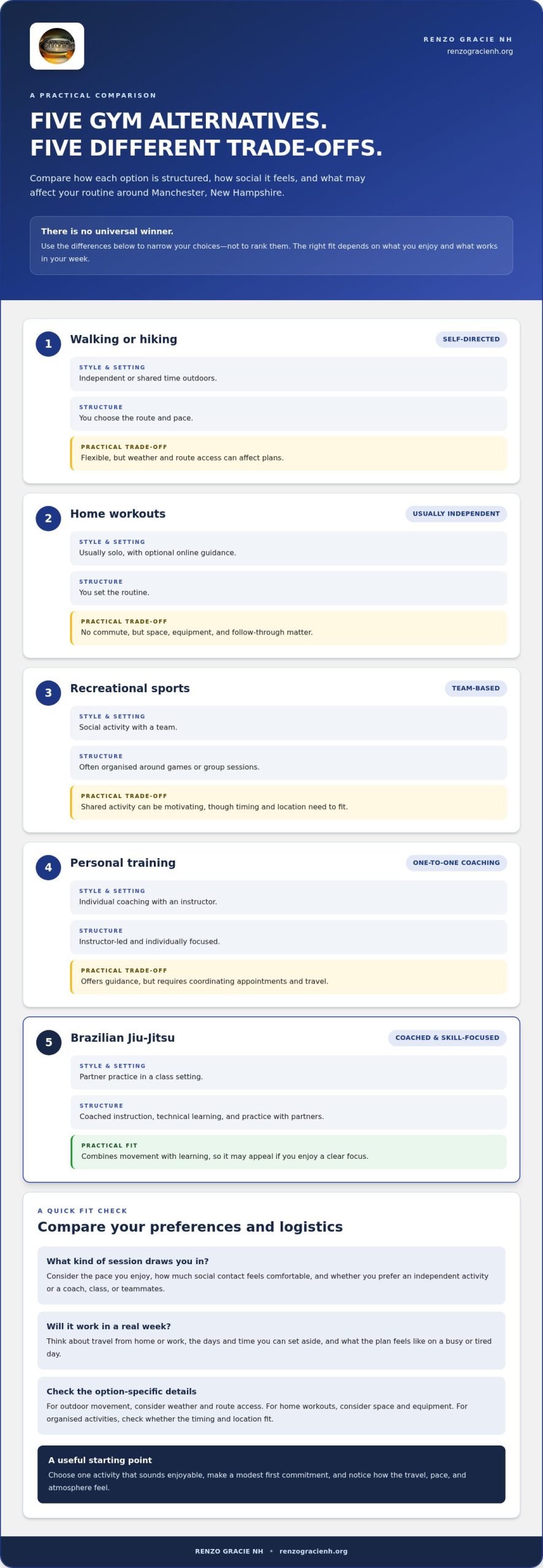
There’s no universal winner in a fitness comparison. The useful question is which activity matches what helps you show up: learning a skill, training with other people, exercising independently, or fitting movement around a busy week. Jiu-Jitsu stands out for partner practice and technical learning, while a gym session or run may suit someone who prefers to set their own pace and exercise without physical contact.

Use this comparison as a starting point, not a ranking. Each activity’s experience depends on the setting, the instruction, and what you enjoy.

Activity Typical experience May appeal if you value
Brazilian Jiu-Jitsu Instructor-led skill practice and movement with partners Learning techniques, interaction, and a shared training environment
Solo gym session Independent exercise using equipment or chosen movements Control over your routine, pace, and workout focus
Running Self-paced movement, often done alone or with others A straightforward activity that can be adapted to your preferred route and pace

When might Jiu-Jitsu suit your fitness preferences?

Jiu-Jitsu may fit adults who enjoy coaching, learning through practice, and sharing an activity with training partners. It gives you structure and a skill to work on beyond completing a set of exercises. Partner-based practice involves close physical interaction, though, so it may be less appealing if you strongly prefer solo exercise or aren’t comfortable with contact. Your preferences matter; a routine should feel engaging, not forced.

How should you compare training options fairly?

Consider practical details alongside the activity itself. Is the location accessible? Can you fit sessions into your week? Do you enjoy the environment enough to return? Think about whether you want instruction, independent control, social interaction, or a mix. Also consider your personal goals without choosing based on promises of a specific result.

It doesn’t have to be an either-or decision. Depending on your interests and schedule, Jiu-Jitsu can sit alongside running or independent gym sessions. Each activity can serve a different purpose in a broader routine, and you can adjust the mix as your circumstances change.

The best fitness routine is one you can sustain and genuinely want to return to. For jiu jitsu for fitness adults, consider whether the learning, partner interaction, and class format suit you as much as the physical effort. Choose based on fit, then give yourself room to build consistency at a manageable pace.

Jiu Jitsu for Fitness Adults: Build Strength, Conditioning, and Confidence

How Adults Can Build a Sustainable Jiu-Jitsu Fitness Routine

A sustainable routine isn’t built by doing as much as possible right away. Start with a realistic plan that fits your goals, responsibilities, and experience, then adjust as you learn what works. With jiu jitsu for fitness adults, the aim is steady participation, not rushing toward a particular physical result or measuring your progress against someone else’s.

Use this simple sequence to get started:

  1. Identify your reason for training. You might want a more engaging way to move, enjoy learning a practical skill, or value the structure of instructor-led classes. Choose a goal that feels meaningful to you.
  2. Choose a manageable attendance pattern. Look at your existing commitments and choose a schedule you can realistically repeat. A plan that fits your week is more useful than an ambitious one that quickly becomes difficult to maintain.
  3. Attend and focus on learning. Give yourself time to follow instruction, practise fundamentals, and become familiar with the class environment.
  4. Reflect after class. Consider how the session felt, what you learned, and whether the schedule worked alongside the rest of your life.
  5. Adjust thoughtfully. Keep what’s working, and make changes if your energy, responsibilities, or comfort level call for them.

How can beginners set realistic expectations?

Familiarity, comfort, and technique develop through repeated practice, but the pace is personal. One session might bring a new movement into focus; another may simply help you feel more at ease following class. Notice your effort, enjoyment, and learning rather than judging progress by comparison. There’s no fixed timeline for fitness or skill changes, and steady attendance matters more than chasing rapid results.

If you’d like more context before stepping on the mat, this adult beginner Jiu-Jitsu guide covers useful starting fundamentals.

How can adults make training fit everyday life?

Build around your real week. Decide which class times you can regularly reach before settling on an attendance pattern, and leave room for work, family, and rest. Tell your instructor about your experience and comfort level so they can guide your participation. Rest days and schedule adjustments aren’t setbacks; they’re sensible parts of making practice sustainable.

Pay attention to how you feel. Don’t push through discomfort to prove commitment, and ease back when you need to. If you have health concerns or are unsure whether vigorous activity is appropriate for you, seek guidance from a qualified medical professional before starting.

Ready to take a manageable first step? Book your complimentary introductory Jiu-Jitsu class and experience adult instruction in a supportive setting.

Explore Adult Jiu-Jitsu for Fitness at Renzo Gracie NH

Exploring jiu jitsu for fitness adults can feel like a big step, especially if you’re new to martial arts. Renzo Gracie NH offers adult Brazilian Jiu-Jitsu instruction for different skill levels, emphasizing technical proficiency, fitness, and personal development. The focus is on learning and making progress in a supportive environment, not on arriving with experience or a competition goal.

Instruction is led by Professor Kevin Landry, a sixth-degree black belt under Renzo Gracie who has taught in the region for more than two decades. Students receive guidance from an experienced instructor, and adults can begin at a level that suits their experience. Each student can focus on developing their own technique and confidence over time.

What can adults look for in a welcoming training environment?

A positive learning environment pairs knowledgeable instruction with clear guidance and respect for students’ different backgrounds. New practitioners may need time to learn basic positions and movements; more experienced students may be ready to refine details. Thoughtful instruction can help make practice purposeful and approachable at either stage.

Community matters, too. Training with others creates opportunities to learn through shared practice, while personal development comes from staying attentive, persevering through challenges, and recognising small steps forward. Fitness is part of the academy’s emphasis, but adults can have different goals and follow different paths. A supportive setting makes room for individual growth.

What is a low-pressure next step for local adults?

A complimentary introductory class gives new students a chance to experience instruction before deciding whether adult Jiu-Jitsu feels right for them. Arrive ready to listen and learn. Share your experience level, comfort, and fitness interests with the instructor so the conversation starts with what matters to you.

Curiosity is enough for a first visit. You don’t need to prove you’re fit or know techniques in advance; the introductory class is an opportunity to get a feel for the practice and decide whether it suits your interests. For more about taking that first step, explore trying Jiu-Jitsu free in New Hampshire.

Adults in Windham, Manchester, and Exeter can take that first step at Renzo Gracie NH. Book your complimentary introductory class and experience adult Jiu-Jitsu instruction in person.

Make Your Next Fitness Step a Learning Experience

A lasting routine doesn’t have to begin with a dramatic commitment. Start with curiosity: consider what kind of movement keeps you engaged, what you hope to learn, and whether training with others feels motivating. If jiu jitsu for fitness adults sounds like a fit, let your first class be an opportunity to experience it, not a test you need to pass.

You can arrive as you are, listen to the instructor, and take time to decide how the practice feels. You don’t need to have every goal mapped out beforehand. Sometimes a new direction becomes clearer only after you try it.

Book your complimentary introductory Jiu-Jitsu class at Renzo Gracie NH and take a welcoming first step toward a more engaging fitness routine. Keep your pace realistic, stay open to learning, and give yourself room to grow.

Frequently Asked Questions

Do I need to be fit before starting Jiu-Jitsu?

No, you don’t need to reach a certain fitness level before beginning. Tell the instructor you’re new, and focus on understanding directions and movements rather than matching a more experienced student’s pace. You can pause to listen or watch a demonstration if you need to reset. With jiu jitsu for fitness adults, your starting point is individual, so pay attention to your comfort and follow the instructor’s guidance.

Can adults lose weight by training Brazilian Jiu-Jitsu?

Brazilian Jiu-Jitsu may be one part of a routine that supports weight management, but training alone can’t guarantee weight loss. Changes depend on individual factors and broader habits, including eating patterns and other activity. Rather than expecting a specific result by a set date, focus on consistent participation and what you’re learning. If weight change is a health goal, a qualified health professional can help you consider an appropriate approach.

How many times a week should an adult train Jiu-Jitsu for fitness?

There isn’t one ideal number for every adult. A practical starting point might be one or two sessions a week, if that fits your schedule and leaves time to recover. Notice how you feel between classes, then adjust your attendance as you gain experience. Adults in Windham, Manchester, and Exeter can use an introductory class to get a feel for the practice before planning a regular routine.

Is Brazilian Jiu-Jitsu too intense for older adults?

Not necessarily; age alone doesn’t determine how training will feel. Start with fundamentals, move at a pace that feels manageable, and give yourself time to recover between sessions. Let the instructor know about your experience and comfort level so you can follow their guidance. If you have health concerns or aren’t sure whether vigorous activity is appropriate, consult a qualified medical professional before starting.

Does adult Jiu-Jitsu training involve sparring?

Brazilian Jiu-Jitsu practice can include partner drills and live sparring, but class formats and intensity can vary. Don’t assume every session will involve the same amount of sparring, especially if you’re new. Follow the instructor’s directions, understand how to signal that you need to stop, and communicate your experience level. Focus on learning the class structure and techniques rather than treating training as a competition.

Can I combine Jiu-Jitsu with other workouts?

Yes, you can combine Jiu-Jitsu with other activities if the overall routine fits your schedule and recovery needs. For example, you might attend class on some days and do a lighter solo workout on another, rather than stacking demanding sessions back-to-back. Pay attention to how you feel during training and in daily life, and adjust if you need more recovery. Seek medical guidance before vigorous activity if you have health concerns.

Fitness for Adults Who Hate the Gym in Manchester: 5 Enjoyable Alternatives

What if getting fit had less to do with finding the perfect gym and more to do with finding an activity you enjoy? If you’re searching for fitness for adults who hate the gym Manchester, New Hampshire, offers alternatives to repetitive machines and routines that are hard to stick with.

A traditional gym can feel intimidating or leave you watching the clock. Walking outdoors, learning a skill, or joining a coached class can give your movement a clearer purpose and make it easier to fit into a busy week.

This guide compares five options: walking and hiking, home workouts, recreational sports, personal training, and adult Brazilian Jiu-Jitsu. Each suits different preferences for structure, social contact, and flexibility. Instructor-led Jiu-Jitsu adds technical learning and partner practice to physical activity. New students at Renzo Gracie NH can try a complimentary introductory class. Start with the option that sounds enjoyable, not the one you think you’re supposed to choose.

Key Takeaways

  • Fitness for adults who hate the gym Manchester can mean choosing movement that fits your personality, rather than forcing yourself through a routine you dislike.
  • Compare walking or hiking, home workouts, recreational sports, personal training, and Brazilian Jiu-Jitsu by their structure, social feel, and practical fit.
  • Use a preference-and-logistics check to choose an activity you can realistically make room for in your week.
  • Adult Brazilian Jiu-Jitsu offers coached skill development and partner practice as an alternative to repetitive gym workouts.
  • At Renzo Gracie NH, Professor Kevin Landry is a sixth-degree black belt under Renzo Gracie and has more than two decades of regional teaching experience.

Why gym-free fitness can work better for Manchester adults who need motivation

Conventional gym workouts don’t suit every personality or routine. Repeating sets on machines can feel dull, and travelling across town for a workout may be hard to maintain during a busy week. If that sounds familiar, it doesn’t mean exercise isn’t for you. For fitness for adults who hate the gym Manchester, a better starting point may be an activity that feels meaningful, manageable, or simply more enjoyable.

Gym-free fitness means choosing active pursuits outside a traditional gym. That could be walking a local route, playing a sport, following a home workout, or learning a physical skill in a coached class. Physical fitness includes more than one kind of movement, as this overview of the benefits of physical fitness explains. The practical question is which format you can realistically return to.

Motivation-first fitness means choosing an activity you’re more likely to repeat, rather than chasing someone else’s idea of the perfect workout. Enjoyment, convenience, and repeatability are useful criteria, not promises that any one activity will suit everyone. Your preferences can change, too. Start with a workable first step, then use the experience to decide what to do next.

What makes an activity easier to stick with?

A clear goal can give a session direction: finish a walk, learn a movement, or practise a technique. Visible skill progression can make effort feel rewarding because you’re building competence as well as moving your body. The format matters, too. Some people prefer an independent activity; others are more engaged by a coach, class, or teammates.

There’s no single best workout for every adult. Consider the pace you enjoy, how much social contact feels comfortable, and whether you want a planned session, flexible movement, or even playful recreation—group jumping and active gatherings at places like Cool Springz illustrate how social events can make staying active feel fun rather than a chore. These preferences help narrow your choices without turning exercise into another test you have to pass.

What Manchester-area adults should consider before choosing

Make the logistics concrete. How long will it take to travel from home or work? Which days have room in your schedule, and how much time can you set aside? Outdoor walking or running may appeal, but weather can affect your plans. A home session removes travel, while a coached activity gives you a set place and structure.

Travel and routines differ across Manchester and nearby communities, including Windham and Exeter. Choose based on where you spend your week and the time you can realistically spare. Consider what happens on a tired or busy day: will the plan still feel practical? If you’re curious about starting Brazilian Jiu-Jitsu, this adult beginner Jiu-Jitsu guide explains what learning the sport involves.

Keep your first commitment modest and specific. Pick one activity, decide when you’ll try it, and notice how the travel, pace, and atmosphere feel. That gives you useful information before you build a longer-term routine. A good fit isn’t necessarily the most intense option; it’s one that works with your real life.

Five gym alternatives to compare around Manchester

There’s no universal winner among gym alternatives. The right choice depends on what you enjoy, how much structure helps you follow through, and what fits your week in Manchester, New Hampshire. Use this comparison to spot the trade-offs, then focus on the options that suit your preferences. The WHO guidelines on physical activity offer broader context for making movement part of everyday life, but your route there can be personal.

Activity Style and social setting Structure Practical trade-off
Walking or hiking Independent or shared time outdoors Self-directed route and pace Flexible, but weather and route access can affect plans
Home workouts Usually independent, with optional online guidance You set the routine No commute, but space, equipment, and follow-through matter
Recreational sports Team-based and social Often organised around games or group sessions Shared activity can be motivating, though timing and location need to fit
Personal training One-to-one coaching Instructor-led and individually focused Offers guidance, but requires coordinating appointments and travel
Brazilian Jiu-Jitsu Partner practice in a class setting Coached, technical, and skill-focused Combines movement with learning, so it may appeal if you enjoy a clear focus

Compare activities by how enjoyable and repeatable they feel in your actual routine, not by assuming one is best for everyone. One option may offer flexibility and solitude; another may provide a coach or group to organise the session. Use the table to narrow your choices, not rank them.

Independent options: walking and home workouts

Walking and exercising at home let you choose when to move and how much structure to use. You can take a local walk when time allows or set aside a clear space at home for bodyweight movements. The freedom is useful, but you’ll need to create your own reminder, plan, and way to track progress. Think about Manchester-area weather, your indoor space, any equipment you’d need, and whether you prefer exercising alone.

Group options: recreational sports and Brazilian Jiu-Jitsu

Recreational sports centre on shared play and team interaction; Brazilian Jiu-Jitsu combines coached instruction with partner practice. In an adult class, students learn techniques and practise with partners, making movement part of a developing skill rather than a set of standalone exercises. Renzo Gracie NH offers adult Brazilian Jiu-Jitsu instruction in a local class setting, with an emphasis on technical development and personal growth.

If coached, skill-focused movement sounds more engaging than exercising alone, explore adult Brazilian Jiu-Jitsu at Renzo Gracie NH as one option. Consider whether the class format and travel fit your routine in Manchester, Windham, or Exeter.

Is Brazilian Jiu-Jitsu a good fit if you dislike gyms?

It’s fair to feel unsure. Brazilian Jiu-Jitsu is a martial art, and close partner practice can sound intimidating if you’re new to exercise or unfamiliar with the sport. You don’t need to arrive with athletic experience or a competitive mindset. Adult training is a chance to learn a physical skill through instruction and guided practice, rather than trying to stay motivated through another set of repetitive exercises.

The focus is different. In a conventional gym routine, you might choose movements and count repetitions; in Jiu-Jitsu, you learn techniques and practise them with a partner. There’s a learning curve, and comfort with partner-based activity matters. It isn’t the right match for everyone or a guaranteed route to a particular fitness result. For fitness for adults who hate the gym Manchester, it’s an option to consider if skill-building makes movement more engaging.

What an adult beginner can expect from the training approach

Instruction centres on understanding and practising techniques, not proving you’re already fit. New students become familiar with movements through continued participation. The aim is to learn step by step, with guidance, rather than arrive knowing what to do. For more context on the values behind the approach, read about the Renzo Gracie teaching philosophy.

Brazilian Jiu-Jitsu involves working with another person, so it differs from a solo walk or home workout. Partners practise the techniques being taught. You’ll need to pay attention, try unfamiliar movements, and give yourself time to get used to the format. That process may appeal if you enjoy learning through practice; it may feel less appealing if you want an activity with no close interaction.

Reasons it may suit some gym-averse adults, and reasons it may not

Jiu-Jitsu may suit you if you like coaching, shared practice, and steady personal development. A class gives you a skill to focus on, while partner drills make the learning active. If you strongly prefer solitude or feel uncomfortable with partner-based movement, walking or independent exercise may be a better match. Neither preference is a weakness. They’re useful clues for choosing an activity you’ll want to return to.

Try the setting, not just the idea of martial arts. Renzo Gracie NH offers a complimentary introductory class for new students, so you can experience the environment before deciding whether it feels right. Notice whether the instruction is clear, whether you’re comfortable with shared practice, and whether learning techniques holds your attention. You don’t have to decide on a long-term routine on day one. A first experience can help you make a more informed choice.

Fitness for Adults Who Hate the Gym in Manchester: 5 Enjoyable Alternatives

How to choose a fitness alternative you can keep doing

The best choice isn’t necessarily the most ambitious one. It’s an activity that feels interesting enough to try and practical enough to fit around work, travel, and the rest of your week. For fitness for adults who hate the gym Manchester, use a simple process to move from browsing options to making a realistic choice.

Choose by preference, check the logistics, try the experience, then decide whether you want to return.

  1. Identify what you enjoy. Do you prefer independent movement, a team setting, or instruction from a coach? Consider whether learning a specific skill sounds appealing or whether you’d rather move without a lesson plan. Your preferred pace and level of social contact can narrow the field.
  2. Compare the practical details. Include travel time, not just the activity itself. Set the total time against your actual week, not an idealised calendar. An option that fits around work may be more realistic than one that requires a complicated trip or a time slot you often struggle to protect.
  3. Test one option. Choose a first step that feels manageable. In a class, notice how the instruction and group environment feel; for an independent activity, see whether you can make space for it at home or outdoors. You’re gathering information, not proving your ability.
  4. Reassess honestly. After trying it, ask whether you felt comfortable, whether the activity held your interest, and whether you’d be willing to return. Instant mastery isn’t the measure of a useful first experience. If it didn’t fit, use that information to adjust the activity or try a different format.

Match the activity to your preferred pace and social setting

Some people like the freedom of independent movement; others feel energised by team play or prefer an instructor to guide each session. Ask yourself whether learning a skill sounds rewarding or whether you’d rather keep movement unstructured. Set a modest first goal, such as trying an activity once before deciding what a sustainable routine might look like.

Try a beginner-friendly first step in the Manchester area

If coached practice interests you, Renzo Gracie NH offers new students a complimentary introductory class in Brazilian Jiu-Jitsu. It’s a chance to experience the learning environment without needing to demonstrate mastery on your first visit. The academy serves Windham, Manchester, and Exeter, so consider how the trip fits into your week as well as whether the class suits your interests.

Keep the decision personal. A realistic option you’re curious to revisit is a stronger starting point than a demanding plan that looks good on paper. Explore adult Brazilian Jiu-Jitsu at Renzo Gracie NH as one possible next step.

Explore adult Brazilian Jiu-Jitsu at Renzo Gracie NH

If a workout feels more engaging when you’re learning something, adult Brazilian Jiu-Jitsu at Renzo Gracie NH may be worth exploring. The program brings together coached instruction, partner practice, and technical development, giving each class a skill-building focus rather than a conventional gym routine. For adults looking for fitness for adults who hate the gym Manchester, it offers a different way to make movement part of a routine: learn, practise, and develop at a steady pace in a supportive community.

A supportive place to start learning

You don’t need to arrive as an experienced athlete or have competition in mind. Adult instruction welcomes people at different experience levels, including those who are new to training. Classes focus on learning techniques through guided practice, with personal growth and respect at the heart of the process. Progress starts with getting familiar with the movements and building your understanding over time.

Professor Kevin Landry is a sixth-degree black belt under Renzo Gracie and has taught in the region for more than two decades. His experience informs an approach grounded in technical instruction and steady learning. The aim isn’t to pressure every student toward competition; it’s to support individual development in a shared training environment. If you’re curious about what beginning involves, the adult beginner Jiu-Jitsu guide can help you understand the learning journey.

If skill-focused movement and supportive coaching sound more appealing than repeating the same gym routine, explore adult Brazilian Jiu-Jitsu at Renzo Gracie NH.

Take the next step from Manchester

Renzo Gracie NH serves Windham, Manchester, and Exeter, New Hampshire. Consider the travel involved and how an activity fits into your week when deciding whether it’s practical as well as interesting. The academy offers new students a complimentary introductory class, where you can experience the learning environment and see how coached Jiu-Jitsu feels before making a decision.

You don’t need to have everything figured out before taking a first step. An introductory class gives you the chance to experience the instruction and decide whether learning with a coach and practising alongside others feels like a kind of fitness you’d look forward to returning to.

Make your next step a small one

You don’t need to settle on a lifelong routine before you begin. Choose one activity that sparks your interest, make room for a first experience, and notice how it feels afterward. Did the session hold your attention? Could you picture fitting it into an ordinary week? Those answers can guide your next move better than pressure to follow a plan that doesn’t suit you.

Finding fitness for adults who hate the gym Manchester is less about forcing yourself to enjoy traditional workouts and more about giving a different kind of movement a fair try. If learning a skill with supportive instruction appeals to you, Brazilian Jiu-Jitsu could be a rewarding place to start. Renzo Gracie NH offers new students a complimentary introductory class, so you can experience the environment before deciding what feels right.

Try a complimentary introductory class at Renzo Gracie NH and take that first step at your own pace. The activity you look forward to may be closer than you think.

Frequently Asked Questions

Can I start Brazilian Jiu-Jitsu if I am out of shape?

You can explore beginner training without arriving fit or experienced. Learning takes place progressively, and you can focus on understanding each instruction rather than comparing yourself with others. Before taking part, tell the instructor about relevant concerns or limitations so they understand what you’re comfortable with. If you’re in Manchester, Windham, or Exeter, an introductory class lets you experience the activity and teaching environment as a starting point.

Is Brazilian Jiu-Jitsu too intense for someone who hates the gym?

It depends on what you dislike about gyms and which activities appeal to you. Jiu-Jitsu involves instruction and partner practice, rather than exercising alone on machines, so the experience is different. If you enjoy learning with other people, that shared focus may suit you. If you’d rather keep movement solitary and flexible, walking or home exercise may be a better match. Consider the format, not just the words “martial arts.”

Do I need martial arts experience before trying an adult class?

No prior martial arts experience is needed to try a beginner class. An introductory session lets you see how the environment works and get a feel for the instruction. You don’t need to assume you’ll spar or keep pace with experienced students. Bring up questions or concerns with the instructor, including anything that could affect your comfort, so you understand what to expect and can decide how you’d like to proceed.

Can Brazilian Jiu-Jitsu help me stay motivated to exercise?

It may, if learning techniques, receiving guidance, and practising with others keeps your interest. That structure can feel different from planning a workout by yourself, but it won’t guarantee consistency; motivation varies from person to person. If you’re exploring fitness for adults who hate the gym Manchester, consider whether the learning process appeals to you and whether travel and class attendance could fit an ordinary week before making a longer-term commitment.

How many times a week should a beginner exercise?

There’s no single weekly frequency that suits every beginner. Your available time, previous experience, health, and recovery all matter, so start by considering what feels realistic rather than adopting someone else’s schedule. Think about how an activity would fit around work and family commitments, then adjust based on how you feel. If you have individual health concerns or questions about exercise, speak with a qualified healthcare professional for guidance.

What should I wear to a first Brazilian Jiu-Jitsu class?

Follow the clothing guidance provided for your introductory class. If you’re asked to choose your own clothes, wear something comfortable that lets you move easily and won’t distract you during instruction. You can also prepare practical questions about what to bring or expect. Arrive ready to listen, learn, and speak up if anything is unclear.

Is Brazilian Jiu-Jitsu only for people who want to compete?

No, competition doesn’t have to be your reason for training. Adults may be interested in learning a new skill, staying active, or developing alongside other students without setting competition as a goal. Personal progress can mean becoming more familiar with a technique or feeling more at ease with the class format. People bring different motivations to training, so you can explore Jiu-Jitsu for learning and community without assuming you need to compete.

Martial Arts for Stress Relief: A Practical Guide for Adults

What if stress relief came from focused practice, not fighting harder? When work and daily demands keep your mind switched on, another repetitive workout may not appeal, and stepping into a combat-sport setting can feel intimidating. Yet martial arts for stress relief adults can approach at their own pace may offer a structured way to move, concentrate, and make steady progress.

It’s reasonable to wonder whether training can help you manage stress, and whether you need to be fit or experienced before you begin. You don’t. Brazilian Jiu-Jitsu asks you to focus on movement, technique, and the moment in front of you. Practice can build fitness and confidence over time, but it isn’t a treatment for stress-related or mental health conditions. It may become one meaningful part of a balanced routine.

This guide explains how martial arts may support stress management, what to look for in a welcoming training environment, and how to start without rushing. At Renzo Gracie NH, adults of different skill levels can learn in a supportive setting, with a complimentary introductory class as a low-pressure first step.

Key Takeaways

  • Set realistic expectations: martial arts may support wellbeing, but it isn’t a guaranteed stress remedy or a substitute for mental health care.
  • Compare solo exercise with group training to find the routine and level of interaction that suit you.
  • Use a simple try-and-reflect plan to explore martial arts for stress relief adults can sustain, adjusting effort to your comfort and recovery.
  • Brazilian Jiu-Jitsu is grappling-based skill practice, and participation doesn’t require a goal of competing.
  • Learn what structured adult Brazilian Jiu-Jitsu looks like at Renzo Gracie NH, led by Professor Kevin Landry, a sixth-degree black belt under Renzo Gracie.

Can Martial Arts Help Adults Manage Stress? Start With Realistic Expectations

Work can end for the day while your mind keeps replaying deadlines, decisions, and unfinished tasks. An activity that creates a clear break may help, but stress relief isn’t automatic, and no single routine suits everyone. The question behind “martial arts for stress relief adults” is best answered with realistic expectations: training may support wellbeing, but results depend on your experience and circumstances.

A class gives you a set time to move, listen, and practise a skill alongside other people. Following an instructor’s directions gives your attention something specific to return to, such as learning a movement or adjusting your balance. That focus may help some students feel more present during training. Enjoyment, consistency, class intensity, health, and personal circumstances all shape the experience. A challenging session may energize one person and feel like too much for another.

Martial arts can complement, but not replace, mental health care. The Martial arts therapy overview discusses martial arts as a complementary approach, not a substitute for appropriate professional support. Think of training as one possible part of caring for your wellbeing, not a treatment or a promise that distress will go away.

What adults may gain from a structured martial arts class

Structure can make it easier to get started when motivation is low. Instead of planning every part of a workout yourself, you follow instruction and practise one skill at a time. Shared practice also brings interaction with instructors and classmates, which may feel encouraging if you enjoy learning with others. These are potential supports, not guaranteed emotional or physical outcomes. Progress might simply mean becoming more familiar with a movement or feeling more at ease in class.

Notice how the routine feels during and after training. Do you enjoy having a task to concentrate on? Is the pace manageable? Those observations are more useful than expecting every class to leave you calm, energized, or confident. If the session feels too demanding, adjust your effort or allow time to recover so the activity remains sustainable.

When stress may need support beyond exercise

Exercise can be one piece of self-care, but persistent or overwhelming distress deserves attention beyond a training routine. If stress is affecting sleep, relationships, work, or your ability to manage daily life, consider speaking with a qualified mental health professional or healthcare provider. Reaching out isn’t a sign that you’ve failed to cope. It’s a practical way to get support that fits your needs.

You can still explore martial arts if it feels appropriate. Keep expectations flexible, choose a manageable pace, and treat practice as an addition to your broader wellbeing plan. If you already have care or guidance, training doesn’t need to replace it. Let your comfort and needs guide the decision.

How Martial Arts Training Can Create Focus, Movement, and Connection

A martial arts class gives the session a clear shape: listen to an instructor, practise a movement, then try it again with guidance. In Brazilian Jiu-Jitsu, that might mean learning to move from one position to another or respond to a partner’s movement. The task is specific and immediate, giving your attention somewhere to land while you’re on the mat.

Three possible benefits are worth separating: focus from learning, movement from physical practice, and connection from shared training. They may contribute to a sense of wellbeing, but they aren’t medical effects or guaranteed stress relief. Your experience depends on your preferences, comfort, and the pace of instruction.

Focused practice: one task at a time

Skill practice asks you to listen, remember a sequence, and make small adjustments. If a technique feels unfamiliar, you can try it, receive a correction, and practise again. That cycle gives the class a clear focus without requiring you to master everything at once. Progress comes through repetition and patience, not an instant transformation.

The physical side matters too. Classes involve movement and active participation, while you can adjust effort to suit your comfort and experience. A beginner’s goal might be as simple as following the instruction and getting a feel for a new movement. Some people enjoy combining mental attention with physical activity; others prefer a different routine. Either response is valid.

Training with other people can build connection

Partner practice makes learning interactive. You take turns practising a movement, pay attention to your partner, and respond to the instructor’s feedback. Ideally, this is cooperation rather than a contest: each person helps create a respectful space to learn, make mistakes, and improve. Shared effort can make a class feel welcoming, especially when students are encouraged to learn at different levels.

That interaction may offer a sense of belonging if you value learning alongside others, but community isn’t a guaranteed cure for loneliness or distress. Some adults enjoy a group setting; others need time to feel comfortable. Notice whether the atmosphere supports respectful practice and whether you feel able to ask questions and learn at your own pace.

These elements can work together without promising a particular result. A focused task occupies your attention, movement makes training active, and a partner turns practice into a shared experience. The appeal of martial arts for stress relief adults can sustain may come from that steady combination, not from fighting harder or expecting every class to change how they feel.

To experience guided practice firsthand, explore adult Brazilian Jiu-Jitsu training at Renzo Gracie NH, where instruction supports skill development and personal progress.

Brazilian Jiu-Jitsu or Solo Exercise: Which Stress-Relief Routine Fits You?

A solo walk, a strength workout, and a Brazilian Jiu-Jitsu class all involve movement, but they ask different things of you. A class follows an instructor’s plan and includes interaction; exercising alone lets you set the pace and choose what to do. Neither is automatically better for stress management. The right fit depends on what helps you show up and feel comfortable.

What makes Brazilian Jiu-Jitsu different from solo workouts?

Brazilian Jiu-Jitsu is grappling-based skill practice. Students learn coached movements and practise them with a partner, responding to another person rather than following a fixed solo routine. That adds an interactive, problem-solving element to exercise. You don’t need to compete: you can approach training as a way to learn and practise, with participation focused on your own goals.

Solo exercise offers a different kind of flexibility. You might walk a familiar route or follow your own strength routine without coordinating with a class or partner. Use this comparison to consider which setting feels more motivating and manageable:

Fit factor Brazilian Jiu-Jitsu class Solo exercise
Structure Instructor-led skills and practice You choose the activity and pace
Interaction Partner practice and group learning Usually independent
Variety New movements and problem-solving Depends on the routine you choose
Good fit if you prefer Guidance and shared practice Independence and control

Choose a routine that suits your comfort and schedule

Think about the kind of structure you’re most likely to return to. If you enjoy guided learning and don’t mind practising with a partner, a martial arts class may hold your interest. If you prefer quiet movement or full control over your pace, solo exercise may suit you better. You can also combine them, choosing different activities on different days according to your energy and schedule.

Partner practice may feel unfamiliar at first. Notice how the instruction, pace, and shared practice feel as you learn. A supportive beginner setting can help you approach new movements gradually. For a closer look at what starting can involve, explore this adult beginner Jiu-Jitsu guide.

The best routine is one you can attend consistently and safely. For adults considering martial arts for stress relief, personal fit matters more than choosing the activity that sounds most intense. Start with what feels manageable, then consider whether it’s enjoyable enough to become part of your life.

Martial Arts for Stress Relief: A Practical Guide for Adults

How to Try Martial Arts for Stress Relief Without Overcommitting

You don’t need to commit to a demanding routine to find out whether martial arts suits you. Treat the first step as an experiment: set a simple intention, try an introductory class, and notice how the experience fits your life. A measured approach helps you explore martial arts for stress relief adults can sustain without expecting quick results or pushing past your comfort.

Set a personal goal and a realistic first step

Start with a reason that matters to you. You might want to learn a new skill, add regular movement to your week, or try a focused group activity. Then decide what would make your first month feel worthwhile. That could mean showing up for a class, learning a basic movement, or simply feeling more familiar with the training environment. Keep the goal personal; there’s no universal schedule or timeline for progress.

Use this five-step plan to begin:

  1. Identify your goal. Choose one practical reason for trying a class.
  2. Choose a beginner-friendly setting. Look for clear instruction and an atmosphere where newcomers can learn at their own pace.
  3. Try one class. Focus on listening and experiencing the basics, rather than judging your ability.
  4. Reflect afterward. Consider what felt engaging, challenging, or uncomfortable, and how you felt after the session.
  5. Decide what comes next. Continue, adjust your approach, or take more time before choosing.

Make a first class feel more approachable

Being new is reason enough to ask for guidance. Tell the instructor you’re a beginner and share any comfort concerns that could affect your participation. If a movement feels unfamiliar, ask for clarification rather than forcing your way through it. Listening, observing a demonstration, and practising fundamentals are meaningful parts of learning, even if everything doesn’t click on the first attempt.

A complimentary introductory class at Renzo Gracie NH gives adults a low-pressure way to experience Brazilian Jiu-Jitsu instruction. Read more about the free introductory Jiu-Jitsu class in New Hampshire as you consider your first visit.

Keep your starting pace manageable, and adjust your effort based on how you feel during practice and how well you recover afterward. Soreness, nerves, or difficulty with an unfamiliar movement are useful reasons to speak up and talk with the instructor. If you have individual health concerns, follow advice from a qualified professional about what activity is appropriate for you.

When you’re ready to try it, explore a complimentary introductory class and experience adult Brazilian Jiu-Jitsu in a supportive setting.

Explore Adult Brazilian Jiu-Jitsu at Renzo Gracie NH

A practical approach to martial arts for stress relief adults can sustain begins with a good fit: clear instruction, steady skill development, and a training environment where newcomers can learn without pressure to prove themselves. Renzo Gracie NH offers adult Brazilian Jiu-Jitsu instruction for different skill levels, with an emphasis on personal development and supportive practice. Training can provide structure and a new skill to work on, though each person’s experience is their own.

A supportive place to build skills at your own pace

Brazilian Jiu-Jitsu develops through practice. Students work on movements and techniques over time, building familiarity step by step rather than needing to know everything on day one. That process can give adults a meaningful focus as they learn, while respecting that people arrive with different backgrounds, comfort levels, and reasons for training.

Respect and encouragement matter in a learning environment. Partner practice is an opportunity to develop skills together, not a demand to compete or show toughness. Students can concentrate on understanding instruction, practising fundamentals, and making progress at a manageable pace. Consistency can help learning develop, but there are no guaranteed results for stress, fitness, confidence, or mental health.

Instruction is led by Professor Kevin Landry, a sixth-degree black belt under Renzo Gracie who has taught in the region for over two decades. His experience provides a foundation for adult students as they work through the discipline’s techniques and principles. Whether you’re new to Brazilian Jiu-Jitsu or have experience in another setting, learning and personal development remain central to practice.

Take a first step with a complimentary introductory class

Reading about a class can only tell you so much. A complimentary introductory class lets you experience the teaching environment firsthand and decide how the instruction and practice feel. Approach the first visit as an opportunity to observe, learn, and get familiar with Brazilian Jiu-Jitsu. You don’t need prior experience or a long-term commitment already decided.

Renzo Gracie NH serves adults in Windham, Manchester, and Exeter, New Hampshire. If you’re in one of these communities and curious about adding structured skill practice to your routine, try an introductory class and see how the environment feels. Start at a welcoming pace, then decide what you’d like to do next.

Choose a First Step That Fits Your Life

You don’t need to decide today whether martial arts will become a long-term routine. Let curiosity lead: try a class, notice how the instruction and pace feel, and give yourself room to make an informed choice. For adults exploring martial arts for stress relief, the most useful next step is one that feels manageable and supports steady participation, without expecting a guaranteed change in how you feel.

At Renzo Gracie NH, adult Brazilian Jiu-Jitsu is taught by Professor Kevin Landry, a sixth-degree black belt under Renzo Gracie with over two decades of teaching experience in the region. A complimentary introductory class lets new students experience the training environment firsthand, without needing to have everything figured out before stepping onto the mat.

Ready to explore at your own pace? Try a complimentary introductory Jiu-Jitsu class at Renzo Gracie NH in Windham, serving students from Windham, Manchester, and Exeter. Take the first step toward learning something new.

Frequently Asked Questions

Can martial arts help adults manage stress?

Yes, martial arts may help adults manage stress as a structured activity, but the experience varies and training isn’t a treatment. The phrase “martial arts for stress relief adults” is best understood as a search for a routine, not a promise of a particular result. After class, notice whether you feel engaged, fatigued, or unsettled. That check-in can help you decide whether the activity suits you.

Is Brazilian Jiu-Jitsu a good martial art for stress relief?

Brazilian Jiu-Jitsu may suit adults who enjoy learning through movement and problem-solving, though it won’t be everyone’s preferred activity. Consider whether you leave class interested in practising again, rather than judging the session by whether you felt instantly relaxed. If close partner contact or grappling feels uncomfortable, that preference matters. A solo activity may be a better personal fit.

Can I start martial arts as an adult with no experience?

Yes. You can begin without prior martial arts experience; introductory instruction helps you learn basic movements, terminology, and class expectations. You don’t need to arrive already fit or know the techniques. Adults in Windham, Manchester, and Exeter can start with an introductory class, listen closely, and ask for clarification when a direction is unfamiliar. Focus on learning how class works, not keeping up with experienced students.

How often should adults train martial arts for stress relief?

There’s no single weekly schedule that suits every adult. Consider your existing commitments and recovery needs, then choose a pace you can maintain without making training another source of pressure. Keep a brief note of attendance, energy, and soreness over time. If you routinely skip because the plan feels too demanding, scale back and reassess rather than treating missed sessions as a failure.

What happens if martial arts training feels too intense?

If a session feels too intense, pause and tell the instructor what you’re experiencing. You can ask to see a technique again, take a break, or reduce your effort. Speaking up is part of training responsibly. Unfamiliar movements may feel awkward, but pain or concerning symptoms shouldn’t be ignored. For persistent pain, injury, or individual health concerns, stop and follow advice from a qualified healthcare professional.

Does martial arts replace therapy or medical care for anxiety?

No. Martial arts may be one part of a broader wellbeing routine, but it doesn’t diagnose or treat anxiety and can’t replace therapy, medical care, or prescribed treatment. If anxiety is disrupting sleep, work, relationships, or daily tasks, speak with a qualified mental health professional or healthcare provider. Continue any existing care as advised, and consider training only as an additional activity that fits your needs.

Is Brazilian Jiu-Jitsu competitive, or can adults train without competing?

Adults can practise Brazilian Jiu-Jitsu without making competition a goal. Training can focus on learning techniques, understanding positions, and developing skills at your own pace, rather than preparing for a tournament. If you’re unsure what to expect, share your personal goals with the instructor early. That conversation can help you understand how class practice relates to what you hope to learn.

BJJ for Child Confidence and Discipline: What Parents Should Know

Could a grappling sport help your child grow in confidence without encouraging aggression? It’s a fair question, especially if your child is shy, energetic, or unsure about trying something new. BJJ for child confidence and discipline is less about winning and more about practising focus, respect, patience, and problem-solving with others.

Progress often shows up in small moments before it appears in a belt: listening to an instructor, trying again after a difficult drill, or feeling more comfortable joining in. These changes aren’t guaranteed, and competition results aren’t the only measure of growth. A supportive, structured environment matters, too.

This article explains what children practise in Brazilian Jiu-Jitsu, what realistic signs of growing confidence and discipline can look like, and how you can support your child’s learning without pressure. At Renzo Gracie NH, children can experience training in a complimentary introductory class. The academy serves families in Windham, Manchester, and Exeter, and a first visit can simply be a chance to see how the setting feels.

Key Takeaways

  • BJJ for child confidence and discipline is best understood through everyday practice: trying, listening, learning from mistakes, and showing respect.
  • Look for observable signs of progress, such as joining warm-ups, accepting coaching, or returning to a challenging activity, rather than relying only on belts or competition results.
  • Support your child by asking about effort and learning, and make room for frustration without pressuring them to prove toughness.
  • A structured, encouraging training environment helps children practise skills with guidance and respect for their partners.
  • Families in Windham, Manchester, and Exeter can explore children’s instruction at Renzo Gracie NH, where Professor Kevin Landry brings over two decades of regional teaching experience.

How BJJ can support a child’s confidence and discipline

Brazilian Jiu-Jitsu can give children opportunities to practise confidence and discipline, but it can’t promise a particular personality change or outcome. In a structured class, children learn skills through guided movement and partner practice. Brazilian Jiu-Jitsu is a grappling martial art; Brazilian Jiu-Jitsu on Wikipedia offers background on its history and principles.

For parents, the distinction matters. Confidence is the willingness to try, ask questions, and recover from a mistake; discipline is the practice of listening, following routines, showing respect, and persisting. These skills can support each other, but they aren’t the same. A child might eagerly attempt a new movement and still need reminders to wait their turn. That’s a chance to practise, not a contradiction.

What confidence can look like on the mat

Confidence doesn’t have to be loud. One child may gradually join a warm-up; another may watch an unfamiliar movement first, then try it, or ask an instructor for help when a step feels confusing. Each is a practical sign of willingness to participate and learn.

Children express confidence in different ways and at different paces. It isn’t measured by winning, being outgoing, or never feeling nervous. A child can hesitate, make a mistake, and still build confidence by choosing to try again when ready.

What discipline means in a children’s BJJ class

Following instructions, practising a routine, and paying attention to the next step give children a chance to exercise focus and self-management. Repetition is part of learning: listen, practise, notice what needs adjusting, and try again. These habits take time, and children may need guidance along the way.

Partner practice adds another layer. Taking turns, listening to a partner, and using controlled movement help children practise patience and respect while learning together. The goal isn’t to move carelessly or overpower someone. Training should be guided and appropriate to the child.

Discipline also isn’t unquestioning obedience or punishment. Children should be able to ask for clarification, communicate discomfort, and learn why class expectations matter. BJJ for child confidence and discipline is about practising useful choices in a supportive setting, not expecting instant changes beyond the mat.

How Brazilian Jiu-Jitsu practice builds confidence and discipline step by step

Growth comes through practice, not a sudden transformation. A child learning a new movement can follow a simple cycle: listen to an explanation, try the movement, adjust with guidance, repeat it, and notice what felt different. Each turn through that cycle gives them a chance to focus, respond to feedback, and take another step.

Brazilian Jiu-Jitsu is skills practice, not a shortcut to confidence. Techniques involve solving movement problems, such as how to create space, find balance, or respond to a partner’s position. The emphasis is on learning and applying technique, not simply relying on physical dominance. A child who doesn’t get a movement right immediately can still make progress by noticing one detail and trying again.

Small challenges help children practise persistence

Unfamiliar movements can take time to understand. Breaking a skill into manageable parts and repeating it gives a child room to learn without needing to master everything at once. A coach can help treat a mistake as useful feedback: perhaps the child needs to adjust a hand position or listen to the instruction again. That approach can encourage curiosity instead of making one imperfect attempt feel like failure.

Children respond to challenges in different ways. Some may be ready to try again right away; others may need a pause or more guidance. The aim is to support learning at a suitable pace, not to push every child toward the same response.

Partner practice gives respect and self-control a real context

Practising with a partner makes cooperation part of the learning. Children take turns, pay attention to each other, and use controlled movement as they work through a technique. They learn that training depends on a partner’s participation and comfort, not just their own effort.

Partner work needs appropriate supervision. Instructors guide practice so it’s suitable for the children learning, with clear expectations around respect and control. These habits can be practised on the mat, but they don’t guarantee that conflict will disappear or prevent bullying.

For parents exploring BJJ for child confidence and discipline, the useful question isn’t whether one class will change a child. Consider whether the learning process gives them supportive opportunities to listen, work through difficulty, and practise with respect. Families can learn more about children’s Brazilian Jiu-Jitsu instruction at Renzo Gracie NH.

What a child’s BJJ progress may look like: and what it cannot promise

Progress in Brazilian Jiu-Jitsu doesn’t follow one timetable, and it isn’t always easy to spot from the sidelines. A child might first watch before joining in, then take part in a warm-up, accept a coach’s suggestion, or return to an activity after finding it difficult. These are observable signs of participation and learning, not proof of a guaranteed change in personality.

Confidence doesn’t have to mean becoming outspoken, winning rounds, or never feeling nervous. For one child, it may look like asking a question; for another, it may mean calmly saying they need a break. Temperament, comfort, attendance, and individual experiences all shape how progress appears. Compare your child with their own earlier behaviour, not with other students.

Signs of progress parents can notice over time

Look for small shifts in participation, focus, respectful communication, and willingness to try. The table offers examples of behaviours that may emerge over time. These are possibilities, not a checklist every child should meet on a set schedule.

Stage Observable behaviours
Early Watches or joins part of a warm-up; follows a familiar instruction with support.
Developing Takes part more readily; listens to coaching or communicates a question, concern, or need for a break.
Ongoing Returns to an activity after difficulty; shows focus, respectful communication, or more willingness to try an unfamiliar task.

A child expressing discomfort is also communicating meaningfully, not failing at discipline. Notice the effort behind a behaviour and ask what felt manageable or challenging, rather than measuring progress by belts or competition results alone.

Does BJJ make children aggressive or confident overnight?

No class can guarantee a change in behaviour or self-esteem. Training should involve supervised skill practice with clear expectations, not encouragement to start fights. The purpose is to learn within a structured setting and treat partners with care. BJJ for child confidence and discipline is a practice opportunity, not an instant fix or a promise that conflict will disappear.

If your child seems worried, frustrated, or uncomfortable, talk calmly with them about what they’re experiencing. You can also share concerns with their instructors so the conversation stays focused on your child’s comfort and learning. Progress is personal, so give it room to take its own shape.

BJJ for Child Confidence and Discipline: What Parents Should Know

How parents can reinforce confidence and discipline beyond BJJ class

A few thoughtful questions after class can help your child notice their own effort without turning training into a performance review. Keep the conversation relaxed and let them choose what to share. You might ask, “What felt challenging today?” or “Was there anything you understood better after trying it again?”

Specific praise can make effort visible: “You listened carefully to that instruction,” or “I noticed you gave your partner room to try.” This recognizes focus and consideration, not just a result. Avoid comparing your child with a sibling or classmate, and don’t use training as punishment. Those approaches can make practice feel like a test instead of a place to learn.

Praise effort and reflection rather than winning

Children don’t need to win a round to have something worth celebrating. Notice a respectful choice, a question asked, or an attempt made after a difficult moment. If your child isn’t ready to talk, don’t press for a lesson or a positive takeaway. A quiet ride home can be enough; you can check in another time.

Respond supportively when a child feels nervous or frustrated

New activities can take time to feel familiar. If your child seems frustrated, start by listening rather than urging them to tough it out. Try, “What part felt hard?” or “Was there something you enjoyed?” This makes room for an honest answer, including mixed feelings. Avoid framing fear or discomfort as weakness, and don’t require a child to prove they’re brave by pushing past what feels manageable.

To notice gradual change, keep a few simple observations over time: whether your child joins in, asks for help, communicates a boundary, or seems comfortable returning. These notes aren’t a scorecard. They can help you see patterns and talk with your child or instructor if something concerns you.

For more information about the kids BJJ program in New Hampshire, explore the children’s program details. If sharing an activity as a family feels like a good fit, learn about parent and child Jiu-Jitsu. Families ready to take a first step can book a complimentary introductory class and let their child experience the training without pressure to make a long-term commitment.

Explore children’s BJJ at Renzo Gracie NH in Windham and nearby communities

For families considering BJJ for child confidence and discipline, a supportive place to learn matters. Renzo Gracie NH offers children’s Brazilian Jiu-Jitsu instruction in a structured setting focused on personal development. Children have room to learn and practise without treating confidence or discipline as guaranteed results.

Instruction is led by Professor Kevin Landry, a sixth-degree black belt under Renzo Gracie who has taught in the region for over two decades. His experience and the academy’s community-minded approach give families a local setting to explore the habits discussed in this guide. Renzo Gracie NH serves families in Windham, Manchester, and Exeter.

A supportive local setting for children learning BJJ

Structure can help make a new activity feel more approachable. Children have instruction to follow, skills to practise, and expectations around learning respectfully with others. An encouraging environment gives them space to engage at their own pace, while parents can notice individual effort rather than expect a particular outcome.

Explore the kids Jiu-Jitsu guide for New Hampshire families to learn more about children’s training at Renzo Gracie NH and how it may fit your family.

A low-pressure first step for parents and children

Reading about a class can only tell you so much. A complimentary introductory class gives a new student the opportunity to experience training and gives parents a chance to see how their child responds to the setting. There’s no need to decide in advance what the experience should prove. Treat it as a first look and a chance to learn together.

For more information about what to expect, read how to try Jiu-Jitsu free in New Hampshire. If your family is ready to take that first step, you’re warmly invited to book a free introductory class and let your child experience the academy for themselves.

Take a thoughtful first step with your child

BJJ for child confidence and discipline is best viewed as practice, not a promise of instant change. Children can work on listening, trying unfamiliar skills, respecting partners, and finding their way through mistakes. Progress may be quiet: joining in, asking for help, or choosing to try again. Parents can support that learning by praising effort and keeping conversations open, without comparing their child with others or expecting a particular outcome.

At Renzo Gracie NH, children learn in a structured, supportive setting. Professor Kevin Landry, a sixth-degree black belt under Renzo Gracie, has taught in the region for over two decades. New students can begin with a complimentary introductory class, a low-pressure opportunity to experience training and see how it feels.

Book a complimentary introductory class and take the first step at your child’s pace. Every small effort can be a meaningful part of learning, and your family can discover together whether Jiu-Jitsu feels like a good fit.

Frequently Asked Questions

Can BJJ help a shy child become more confident?

Brazilian Jiu-Jitsu can give a shy child chances to practise participating, trying unfamiliar movements, and asking for help, but it can’t guarantee a change in temperament or self-esteem. Confidence may show quietly, such as joining a warm-up after watching or returning to an activity after a pause. Let your child progress at their own pace, and recognize effort rather than expecting them to become outgoing or fearless.

Does Brazilian Jiu-Jitsu teach children discipline?

BJJ gives children opportunities to practise habits associated with discipline, including listening to instructions, following class routines, taking turns, and showing respect to training partners. Repeating skills can also help them practise focus and persistence. These are learning opportunities, not automatic results. A supportive class should allow children to ask questions and communicate discomfort; discipline isn’t unquestioning obedience or punishment.

Will BJJ make my child aggressive?

BJJ training shouldn’t encourage children to start fights. Brazilian Jiu-Jitsu is a grappling martial art, and children practise skills within a structured class with guidance and expectations around respect and control. No activity can promise how a child will behave in every situation. Talk with your child about using skills responsibly, and share any concerns about their experience with their instructor.

At what age can a child start Brazilian Jiu-Jitsu?

Renzo Gracie NH’s Kids Jiu-Jitsu program is for children ages 3 and up. The academy also has a Little Gracies program for ages 3 to 5. Age alone doesn’t show whether a child feels ready, so consider their comfort with trying a new activity and following simple instruction. A complimentary introductory class can help your family experience the setting before deciding on next steps.

How long does it take for a child to build confidence through BJJ?

There’s no set timeline, and BJJ can’t guarantee that a child will become more confident. Progress depends on the child, their comfort, attendance, and individual experiences. Rather than waiting for a dramatic change, notice small signs over time: participating more readily, asking questions, accepting coaching, or returning to a challenge. Compare your child’s progress with their own earlier experience, not with classmates.

What should parents look for in a kids’ BJJ class?

Look for clear instruction, age-appropriate and supervised practice, and consistent expectations for respect and controlled movement with partners. Notice whether your child has room to ask questions, express discomfort, and learn without pressure to win. A structured, encouraging environment can support learning, though no class can promise a particular outcome. At Renzo Gracie NH, children’s instruction is offered in Windham, Manchester, and Exeter.

Can parents train BJJ with their child at Renzo Gracie NH?

Yes. Renzo Gracie NH offers family training so parents and children can engage in Jiu-Jitsu together. Shared training can give families time to learn alongside one another, while each person develops at their own pace. The academy serves families in Windham, Manchester, and Exeter. New students can begin with a complimentary introductory class to experience training before choosing their next step.

Non-Athletic Kids’ Activities in Manchester: Parent Guide

What if your child doesn’t need to become more athletic to find an activity they enjoy? If you’re searching for activities for non-athletic child Manchester families can explore, start with your child’s interests, not their ability to keep up with a team. A welcoming setting and the chance to learn at their own pace can make trying something new feel more manageable.

It’s understandable to worry that sports might feel too competitive or intimidating, or that avoiding them means missing out on movement and connection. But children can explore creative and skill-based activities, as well as structured movement such as Brazilian Jiu-Jitsu.

This guide focuses on Manchester, New Hampshire, and nearby Windham and Exeter. You’ll find activity ideas, ways to try something without pressure, and practical signs to look for when choosing a setting. At Renzo Gracie NH, children’s Jiu-Jitsu instruction emphasizes technical learning, personal development, and a safe environment. New students can experience the setting in a complimentary introductory class.

Key Takeaways

  • Start with your child’s interests and comfort level, rather than treating “non-athletic” as a fixed label.
  • Explore creative, nature-based, building, and movement activities to find options that suit your child.
  • Compare activities by structure, movement, group setting, and competition level to identify a comfortable fit.
  • Use a simple four-step approach to explore activities for non-athletic child Manchester families can consider, from discussing interests to reflecting after a first try.
  • Consider kids’ Brazilian Jiu-Jitsu as one structured movement option focused on technical learning and personal development.

Activities for a Non-Athletic Child in Manchester: Start With the Child, Not the Label

“Non-athletic” can sound like a fixed description, but it may simply reflect a child’s current interests or confidence. A child who avoids team sports may still enjoy moving, learning physical skills, or being active in a setting that feels comfortable. For families in Manchester, Windham, and Exeter, the goal is not to push a child into a particular mould. It’s to find an inviting place to begin.

What parents may mean by “non-athletic”

Low interest in competition isn’t the same as limited coordination, stamina, or physical ability. A child might feel self-conscious, dislike unfamiliar settings, or worry about making mistakes in front of others. Notice what they enjoy and what feels difficult without turning today’s hesitation into a permanent label. Understanding child development can help put changing interests and confidence into perspective.

Try specific, low-pressure questions: Would you rather make something, explore outside, solve a challenge, or learn a movement skill? Their answers can point toward creative activities, nature exploration, building projects, or structured movement. Each offers a different way to participate, from expressing ideas to practising coordination or spending time with others.

What makes an activity feel welcoming

Look for clear routines, patient instruction, supportive peers, and achievable first steps. Some children settle more easily when they know what to expect; others prefer choice and room to explore. An environment where mistakes are treated as part of learning can make trying something new feel less intimidating. No single activity suits every child, so let their response guide you.

A low-pressure activity is one a hesitant child can try without being pushed to perform, compete, or commit before they feel ready. That might mean observing first, joining in gradually, or focusing on learning rather than winning.

Movement doesn’t have to begin with a traditional team sport. Brazilian Jiu-Jitsu is a structured movement activity where children learn techniques and practise physical skills. At Renzo Gracie NH, kids’ instruction for different ages and skill levels emphasizes technical learning, personal development, and a safe environment. A complimentary introductory class lets a new student experience the setting.

When comparing activities for non-athletic child Manchester families might consider, begin with fit. Does the format interest your child? Does the pace feel manageable? A good first choice doesn’t need to be a lifelong commitment. It just needs to make the next step feel possible.

Six Activity Ideas for Non-Athletic Children Around Manchester

Families in Manchester, Windham, and Exeter can look beyond traditional team sports when exploring a child’s interests. These ideas range from quiet, hands-on pursuits to structured movement. Use them as starting points, not a checklist every child needs to follow.

  • Visual arts and crafts: Drawing, painting, clay, or simple craft projects give children who enjoy making things a chance to experiment and express ideas. There’s no scoreboard or single way to get it right.
  • Music and performing arts: Singing, learning an instrument, drama, or dance may appeal to children who enjoy stories, sound, rhythm, or performing. Some prefer individual practice; others like creating alongside a group.
  • Nature exploration: Outdoor walks, nature observation, or sketching and taking notes can turn time outside into a curiosity-led activity. Children can move at a relaxed pace while noticing plants, birds, weather, or changing seasons.
  • Building and making projects: Construction sets, model-making, or supervised practical projects can suit children who like designing, assembling, and seeing how things work. The focus is on trying, adjusting, and solving problems rather than physical competition.
  • Coding and puzzles: Beginner coding activities, logic games, and educational STEM platforms like Maker & Coder can engage children who enjoy patterns, technology, or figuring out how a system works. Choose a format that leaves room to ask questions and experiment.
  • Structured movement classes: Recreational movement or beginner-friendly martial arts can help children practise physical skills without a tryout-first mindset. Brazilian Jiu-Jitsu introduces guided movement and technique step by step. Children can begin learning without arriving with competition experience.

For each option, consider your child’s age, interests, and access needs alongside the activity’s format. Would they prefer a small creative task, time outdoors, a clear sequence to follow, or room to explore? An activity can be worthwhile even if it isn’t athletic in the usual sense: creating, problem-solving, moving, and connecting all offer ways to learn and participate.

For families curious about movement, Renzo Gracie NH’s kids’ Brazilian Jiu-Jitsu program emphasizes technical learning, fitness, and personal development in a safe environment. A complimentary introductory class gives a new student a chance to experience the setting. Explore the kids’ Brazilian Jiu-Jitsu program as one of several activities for non-athletic child Manchester families might consider.

How to Compare Activities When Your Child Is Hesitant

Compare how an activity may feel to your child, not just how it looks on paper. Consider what holds their interest, whether they’re comfortable in groups, if they like clear instructions, how much movement is involved, and whether competition is central. These questions help Manchester-area families shortlist options without assuming one format will suit every child.

Factor Questions to consider Possible fit
Interest What does your child enjoy doing already? Creative projects for makers; movement or practical challenges for active explorers.
Group setting Would they prefer working alone, with a few peers, or in a class? Individual projects, small-group activities, or instructor-led classes.
Structure Do they like knowing what happens next? A predictable routine may reassure some children; open-ended tasks may suit others.
Movement Would they enjoy gentle movement, active practice, or a mostly seated activity? Choose a level and style that feels approachable to them.
Competition Does winning motivate them, or make participation feel stressful? Look for an emphasis on learning and personal progress if competition is off-putting.

Which activity format may fit your child?

An individual creative project offers space to focus quietly. A small-group activity provides company without making the whole class feel like an audience, while an instructor-led class offers guidance and shared routines. A predictable format may comfort a child who likes knowing what comes next; another may be more engaged when there’s room to make choices. Preferences can shift after trying an activity, so treat the first impression as useful information, not a final verdict.

Does martial arts have to be aggressive or competitive?

Not necessarily. Brazilian Jiu-Jitsu can be taught as guided technical practice, with children learning movements and techniques through instruction. At Renzo Gracie NH, kids’ instruction emphasizes technical learning, fitness, personal development, and a safe environment. Respect and control are part of practising with others, and children can develop skills at their own pace. The key question is whether the teaching environment helps your child feel comfortable enough to participate, not whether martial arts matches a stereotype.

The right activity is one your child can approach with interest and growing comfort, not one that asks them to prove they’re athletic. Use the comparison as a conversation starter, then let your child’s response help guide the next step.

Non-Athletic Kids' Activities in Manchester: Parent Guide

A Low-Pressure Four-Step Plan for Trying a New Activity

A new activity can feel like a big leap when your child is unsure. Make the first step smaller. This approach can help families in Manchester, Windham, and Exeter explore activities their children may enjoy while giving the child a say in what happens next.

  1. Talk about interests. Start with what your child likes doing, not what you think they should try. Ask whether they’d rather make something, solve a puzzle, spend time outdoors, or learn a movement skill. Keep the conversation curious, not persuasive.
  2. Shortlist a few options. Choose activities that match those interests and compare the setting, pace, and level of structure. Explain what a first visit might involve, then let your child ask questions or help choose.
  3. Try an introduction. Agree on a manageable first goal, such as watching, joining in for part of the session, or learning one new movement. Renzo Gracie NH offers new students a complimentary introductory class for children’s Brazilian Jiu-Jitsu. It gives a child a chance to experience a guided movement class without treating the first visit as a test of toughness or talent.
  4. Reflect and decide together. Afterward, ask what felt fun, unfamiliar, comfortable, or challenging. Find out whether your child would like to return, try a little more, or explore a different kind of activity.

Prepare for the first visit without adding pressure

Explain the activity in plain language and be honest about what your child may see or do. Let them know it’s okay to feel nervous and that they don’t need to impress anyone. A small goal gives the visit a gentle focus while leaving room to observe and get comfortable at their own pace.

Review the experience together

Uncertainty in a first session doesn’t always mean an activity is a poor fit. A new room, unfamiliar people, or instructions to learn can take time to get used to. Notice whether these are ordinary first-session nerves or a persistent sense that the environment doesn’t suit your child. Trying an activity more than once can give you a fuller picture while still taking your child’s feedback seriously.

Observe your child’s response before deciding whether an activity is the right fit. Interest, comfort, and willingness to return can guide the next step, whether that means continuing, pausing, or choosing another category. To explore a first step into movement, book a complimentary introductory class.

Manchester Families: Consider Kids’ Brazilian Jiu-Jitsu as One Welcoming Option

Not every child wants to join a team or compete. For families in Manchester, Windham, and Exeter exploring activities for non-athletic child Manchester searches may bring to mind, kids’ Brazilian Jiu-Jitsu is one structured movement option. At Renzo Gracie NH, children learn techniques and develop physical skills in an environment that emphasizes personal development and safety. The program is for children of different ages and skill levels.

What children can experience in a kids’ Jiu-Jitsu class

Instruction offers a clear framework for learning: listen, practise guided movement, and work on techniques step by step. For a child who prefers knowing what to expect, structured teaching can make a new activity easier to understand. The focus is on learning, not arriving with a particular level of fitness or confidence.

Practice also gives children opportunities to work on focus, persistence, respect, and cooperation. These are skills they can practise as they learn and interact with others, not guaranteed outcomes. Progress looks different for each child. One may enjoy mastering a movement; another may need time to get familiar with the class setting. The aim is learning at an individual pace, not pressure to perform.

Families interested in how Jiu-Jitsu can contribute to a child’s development can also read Kids Jiu Jitsu New Hampshire: Empowering Your Child Through Brazilian Jiu Jitsu. It offers another perspective on the experience and the personal growth that instruction is designed to support.

A first step for Manchester-area families

Renzo Gracie NH serves families in Manchester, Windham, Exeter, and nearby New Hampshire communities. A complimentary introductory class gives a new student a chance to experience the setting and see how a guided movement activity feels. Keep the first visit simple: your child can notice the routine, get familiar with the learning environment, and decide how they feel about trying it.

Brazilian Jiu-Jitsu won’t be the right answer for every child, but it can offer a purposeful alternative to a conventional team-sport format. It combines movement, technical learning, and personal development. If your child is curious, explore a complimentary introductory class and take that first step together.

Choose a First Step That Feels Right for Your Child

The right activity doesn’t depend on a child already seeing themselves as athletic. Start with their interests, then consider how the setting, structure, and pace feel. Creative projects, outdoor exploration, problem-solving, and guided movement all offer ways to learn, connect, and grow. Let your child’s response to trying something new help shape what comes next.

For families exploring activities for non-athletic child Manchester options, kids’ Brazilian Jiu-Jitsu is one structured movement choice. Renzo Gracie NH offers instruction for different ages and skill levels, emphasizing technical learning, personal development, and a safe environment. New students can begin with a complimentary introductory class to experience the setting before deciding whether to continue.

Explore a complimentary introductory class for your child at Renzo Gracie NH, and take the next step at a pace that feels comfortable for your family.

Frequently Asked Questions

What activities are good for a child who does not like sports?

Children who dislike team sports may enjoy art, music, crafts, building projects, nature exploration, or a beginner-friendly movement class. Start with interests they already show, such as drawing, solving puzzles, or spending time outdoors, then consider whether they prefer individual activities or learning with a group. Families searching for activities for non-athletic child Manchester options can use a low-pressure introduction to see what feels enjoyable. Preferences may change over time.

How can I encourage my child to try an activity without pressuring them?

Offer a few choices and explain what a first visit might involve. Let your child help choose, then agree on a small goal, such as observing the class or trying one new skill. Afterward, ask what felt interesting or comfortable. One hesitant session doesn’t have to settle the question. Give your child room to consider another try, take a pause, or explore a different kind of activity.

Can a non-athletic child enjoy martial arts?

Yes. A child doesn’t need to identify as athletic to explore Brazilian Jiu-Jitsu. It involves learning techniques through guided practice, with skills developing over time. The class structure and the child’s comfort are important parts of the experience. Renzo Gracie NH offers kids’ instruction for different ages and skill levels, and a complimentary introductory class lets a new student experience the setting before deciding whether it feels like a good fit.

Is Brazilian Jiu-Jitsu aggressive for children?

Brazilian Jiu-Jitsu is a grappling martial art, but children’s instruction at Renzo Gracie NH emphasizes technique, personal development, and a safe environment. Children respond differently to physical activities, so notice whether your child seems comfortable with the teaching environment and talk together afterward about what felt enjoyable, unfamiliar, or challenging.

How do I know if an activity is a good fit for my child?

Look beyond whether your child succeeds straight away. Notice whether they feel welcomed, understand what to do, and show curiosity about returning. Ask what they enjoyed and what felt difficult. A good fit may offer a workable balance of structure, challenge, and choice. If your child remains uncomfortable after trying it, take their feedback seriously and consider another activity or format.

What activities can Manchester, NH families try for a child who is not sporty?

Families can explore creative classes, hands-on projects, nature activities, and beginner-friendly movement programs. Renzo Gracie NH serves families in Windham, Manchester, and Exeter with kids’ Brazilian Jiu-Jitsu instruction. The best starting point depends on a child’s interests and comfort. A complimentary introductory class gives Manchester-area families a chance to experience the academy and consider whether this structured movement activity suits their child.

Law Enforcement Subject Control Training: Practical Guide

Choosing subject control training law enforcement officers can use in professional practice means looking beyond a list of techniques. Does the training help participants notice changes, make decisions, and practise control skills in a supervised setting? Grappling practice can develop useful skills, but applying them in a professional context takes structured instruction that keeps safety and judgment in focus.

That distinction matters. Officers with different backgrounds and experience levels need room to learn, practise, and improve without assuming one technique or outcome fits every encounter. Effective training connects movement with decision-making. It gives participants opportunities to work through changing practice situations while respecting the demands of professional work.

This guide explains what structured subject-control practice can develop and what to look for when assessing whether instruction suits your needs. It also explores how Brazilian Jiu-Jitsu can support grappling, control, and decision-making through consistent practice. For officers in Windham, Manchester, and Exeter, Renzo Gracie NH offers specialized Law Enforcement Jiu-Jitsu training led by Professor Kevin Landry, a sixth-degree black belt under Renzo Gracie who has taught in the region for over two decades. Read on to learn how to assess training and take a practical next step.

Key Takeaways

  • Understand what structured subject-control practice can help develop, and why it complements rather than replaces policy, legal instruction, and sound judgment.
  • See how coached Brazilian Jiu-Jitsu practice can build grappling skills through progressive, controlled training with active partners.
  • Assess subject control training law enforcement programs by looking at coaching, progression, supervision, safety, and professional relevance.
  • Prepare to train with clear goals, instructor guidance, and a plan to share relevant experience or limitations privately.
  • Explore specialized Law Enforcement Jiu-Jitsu training at Renzo Gracie NH, led by Professor Kevin Landry, a sixth-degree black belt with over two decades of regional teaching experience.

What Subject Control Training for Law Enforcement Is Designed to Develop

Subject control training is supervised practice in managing physical encounters and developing skills to guide, stabilize, or restrain a person when appropriate. It isn’t a single technique or named system. Its purpose is to help officers practise movement, control, communication, and decision-making in a structured setting. When assessing subject control training law enforcement officers can apply in practice, focus on the quality and relevance of the practice, not the number of techniques covered.

Training can support professional development, but it doesn’t replace department policy, legal instruction, or sound judgment. Officers must operate within their agency’s rules and applicable requirements. A general overview of the Use of Force Continuum can provide context for how force options are discussed, but it isn’t a substitute for an officer’s department-specific direction.

Professional defensive-tactics development also has a different purpose from general fitness, sport competition, or academy certification. Fitness may improve conditioning, while competition tests performance within its own rules. Neither, by itself, establishes readiness for professional encounters. Subject-control practice develops skills in a coached environment and helps participants consider how those skills relate to an officer’s role.

How subject control training differs from general martial arts

Professional context shapes training goals, communication, and practice scenarios. Brazilian Jiu-Jitsu offers grappling-based practice in which partners work through changing positions and learn to manage balance, space, and control. That can be a useful foundation for skill development, but it doesn’t cover every situation an officer may face. Sport rules and competition success aren’t proof of operational readiness. Training needs to be understood alongside policy and professional judgment.

Who may benefit from professional control training?

Sworn officers can use structured practice to develop or revisit physical control skills. Beginners may need time to learn basic movement and get comfortable training with a partner. Experienced practitioners may focus on refining skills or working toward new learning goals. Training coordinators and agencies can assess whether instruction supports their development priorities. Individual departments determine the policies and training requirements that apply to their personnel.

How Brazilian Jiu-Jitsu Practice Can Build Subject Control Skills

Brazilian Jiu-Jitsu gives students a structured way to practise grappling with an active partner rather than repeating movements in isolation. As partners shift position or respond differently, students practise noticing changes, adjusting their balance, and staying composed. That can support physical control skills as well as communication and decision-making. Practice won’t make every encounter predictable, but coaching and clear safety expectations give learners a way to work through changing conditions.

A review in The Sport Journal on the utility of martial arts in American policing examines research on martial arts, including Brazilian Jiu-Jitsu, in law enforcement. The practical takeaway is to treat grappling as a method of practice, not a guarantee of a particular outcome. Subject control training law enforcement officers take part in should connect physical skills to professional context and sound judgment.

From fundamentals to adaptable practice

Learning can progress in stages. Students first work to understand a movement or position, then practise it with instructor guidance, and later apply the idea in controlled partner drills. Foundational movement and positioning create a base for more complex practice. As a partner offers measured resistance, the student must notice what changes and adapt instead of relying on a memorized sequence.

Resistance-based practice differs from rehearsing alone because a partner’s changing responses require the learner to observe, adjust, and make decisions in the moment. That doesn’t mean training should become a test of force or speed. Instructor direction and an agreed pace help keep practice purposeful and controlled.

Safety, judgment, and professional context

Good practice needs supervision, clear expectations, and communication between partners. Students should know how to pause or ask for guidance, and instructors should be able to adjust practice for different experience levels. Composure matters, too: physical skill is only one part of responding thoughtfully under pressure.

For officers, grappling practice must remain connected to professional responsibilities. Training should reinforce communication and decision-making, not frame force as the first resort. Agency policy and applicable law govern officers’ actions. Martial arts practice cannot replace either. Officers in Windham, Manchester, and Exeter can explore Law Enforcement Jiu-Jitsu training at Renzo Gracie NH, where Professor Kevin Landry brings more than two decades of regional teaching experience.

How to Evaluate Subject Control Training for Law Enforcement

A useful program should make its teaching approach clear. Look for details you can assess, such as the instructor’s experience, how skills are introduced, and how practice is supervised. Claims about confidence or performance may sound appealing, but they don’t tell you whether the curriculum is structured or relevant to your agency’s needs.

Use these criteria to guide a practical evaluation. They’re prompts for assessing instruction, not a ranking system or a promise of results.

Area What to look for What to verify
Coaching Clear explanations, demonstrations, and room for questions. Who leads instruction and what relevant experience they bring.
Progression Skills build from foundational movements toward more complex practice. How the program describes its learning sequence.
Supervised practice Students have coached opportunities to practise and receive feedback. How instruction is supervised and how students get guidance.
Safety Controlled practice, clear expectations, and respect for training partners. How the instructor communicates safety expectations and manages practice.
Professional relevance Training acknowledges the demands and context of law enforcement work. How the program describes its relevance, without treating practice as a substitute for policy.

Look for structure, not guarantees

A well-organized academy can explain how instruction works, how students progress, and how practice is guided. It should welcome participants with varied experience and make it possible to ask questions without pressure. These are qualities you can observe. Claims that a method guarantees control or prepares every officer for every encounter aren’t a reliable way to assess instruction.

When comparing subject control training law enforcement officers may consider, separate specific details from broad promotional claims. Instructor background, teaching experience, and a clearly explained training structure are concrete points to consider. Promised outcomes don’t prove that a program suits a particular officer or agency.

Consider safety and agency fit

Consider whether instructors emphasize controlled practice and care for training partners, and whether they explain how physical skills relate to responsible professional conduct. Applying skills in practice is an ongoing learning process, not automatic readiness for every situation. An agency should assess how the training relates to its goals and aligns with existing policy. Department approval and policy alignment are agency-specific decisions.

Quick checklist: “Can I understand who teaches, how skills progress, how practice is supervised, what safety expectations apply, and how my agency will assess relevance and policy alignment?”

Law Enforcement Subject Control Training: Practical Guide

How Officers Can Prepare for Subject Control Training

You don’t need a grappling background to arrive ready to learn. Approach subject control training with curiosity, consistency, and a willingness to follow coaching. Preparation isn’t about proving what you already know. It’s about setting a clear learning goal and participating responsibly.

Before the first session

Start with a practical goal, such as becoming more comfortable with grappling fundamentals or gaining experience in structured partner practice. Keep it focused. A specific goal gives you something useful to reflect on afterward without expecting mastery from one session.

  • Share relevant information privately. Let the instructor know about your previous training experience and any physical limitations that may affect participation. This helps them guide your learning appropriately.
  • Understand safety expectations. Listen to the instructor’s guidance, follow the agreed pace, and speak up if you’re unsure how to participate safely.
  • Follow gear guidance. Wear or bring the training gear the academy requests. Don’t assume equipment from another activity is appropriate.
  • Keep agency guidance in view. Treat practice as skill development, not permission to create or use new procedures. Your department’s policy and applicable law continue to govern your professional actions.

During and after practice

Stay engaged with the coaching. If a movement, drill, or safety expectation isn’t clear, pause and ask for clarification rather than guessing. Good learning depends on communication, patience, and respect for your training partner. Beginners and experienced practitioners alike benefit from being coachable.

After practice, take a few minutes to reflect. What felt unfamiliar? Which fundamentals would you like to revisit? Note questions for a future session or for discussion through the appropriate channels at your agency. This simple habit helps turn a single class into an ongoing learning process.

Training can support professional development, but it doesn’t establish instant mastery or automatically prepare anyone for every encounter. Use what you learn as a starting point for continued practice, and keep agency guidance central when considering how it relates to your role.

Ready to build grappling fundamentals through coached practice? Explore Law Enforcement Jiu-Jitsu training at Renzo Gracie NH.

Explore Law Enforcement Jiu-Jitsu Training in Southern New Hampshire

For officers in Windham, Manchester, and Exeter, Renzo Gracie NH offers a local way to explore Brazilian Jiu-Jitsu through specialized Law Enforcement Jiu-Jitsu training. The instruction connects coached grappling practice with professional defensive-tactics development, giving officers a structured setting to continue learning. It supports ongoing education and does not replace agency training, policy, or sound professional judgment.

What makes Renzo Gracie NH relevant to officers

Renzo Gracie NH is owned and operated by Professor Kevin Landry, a sixth-degree black belt under Renzo Gracie who has taught in the region for over two decades. His experience informs the academy’s specialized instruction. Students can build familiarity with grappling and control through practice while developing at an individual pace in a disciplined, supportive environment. Training can contribute to ongoing skill development, but it can’t promise a particular result or prepare someone for every situation.

Learn more about the academy’s law enforcement Jiu-Jitsu training overview to understand how this instruction relates to officers’ professional development.

A practical next step for New Hampshire officers

A first class can help you experience the instruction and decide how Brazilian Jiu-Jitsu practice fits your learning goals. Renzo Gracie NH offers new students a complimentary introductory class, providing a low-pressure opportunity to step onto the mat, learn, and get a feel for the training environment. You don’t need prior grappling experience. A willingness to listen, practise, and ask questions is a useful place to start.

For more background on the principles behind the academy’s approach, explore the Renzo Gracie teaching philosophy. Whether you’re beginning or adding to years of practice, progress comes through consistent learning. Keep professional judgment central, and align skills development with your agency’s policies and guidance.

Build Skills Through Consistent, Responsible Practice

Effective subject control training law enforcement officers can use is about more than memorizing techniques. Look for coached, progressive practice that develops grappling, communication, and composure while keeping safety and professional context in view. Agency policy, applicable law, and sound judgment must continue to guide officers’ actions.

Brazilian Jiu-Jitsu offers a structured way to practise with active partners and learn through steady repetition. The right starting point isn’t prior experience. It’s a willingness to listen, ask questions, and keep learning.

Renzo Gracie NH offers specialized Law Enforcement Jiu-Jitsu training led by Professor Kevin Landry, a sixth-degree black belt under Renzo Gracie who has taught in the region for over two decades. Officers in Windham, Manchester, and Exeter can explore Law Enforcement Jiu-Jitsu training as a practical next step. Build at your own pace, stay aligned with your agency’s guidance, and keep moving forward with purpose.

Frequently Asked Questions

What is subject control training for law enforcement?

Subject control training for law enforcement is supervised professional skills development for managing physical encounters. It can include communication, controlled partner practice, and reflection on how decisions relate to professional responsibilities. Training isn’t legal authorization, a replacement for department instruction, or a guarantee of any outcome. Programs differ, so officers should understand the instructor’s approach and learning goals while keeping agency policy central.

How can Brazilian Jiu-Jitsu help with subject control training?

Brazilian Jiu-Jitsu can provide coached grappling practice that builds familiarity with balance, positioning, and adapting as a partner responds. Progressive instruction lets students explore movement and control in a supervised setting, with safety expectations guiding practice. This can support skill development, but it doesn’t make every encounter predictable or replace department training. The value is in continued learning, not in assuming practice guarantees a particular result.

Is Jiu-Jitsu training appropriate for law enforcement officers with no grappling experience?

Yes. Officers new to grappling can learn foundational movements through progressive instruction, though each person develops at a different pace. Tell the instructor privately about relevant experience and any physical limitations that could affect participation. Follow the class’s safety guidance, ask questions, and focus on learning rather than keeping up with more experienced partners. A beginner mindset and consistent practice can help make training productive from the start.

What should a law enforcement subject control training program include?

A useful program should make its learning goals clear and offer knowledgeable instruction, progressive practice, supervised drills, partner-safety expectations, and opportunities to ask questions. For subject control training law enforcement officers consider, relevance depends on the officer’s role and agency requirements. Departments should assess the program against their policies and training priorities. A general checklist can guide that review, but it can’t replace agency-level evaluation or approval.

Can Jiu-Jitsu training replace department defensive tactics training?

No. Jiu-Jitsu should be treated as additional coached grappling practice, not a replacement for department instruction, policy, legal education, or required qualifications. It can support ongoing skill development, but agencies determine which training applies to their officers and how outside practice fits their requirements. Keep professional decisions grounded in department guidance and applicable law. Training on the mat doesn’t authorize new procedures or guarantee readiness for every encounter.

How should officers prepare for their first subject control training session?

Before your first session, choose a realistic learning goal, follow the academy’s guidance on what to wear or bring, and privately share relevant experience or physical limitations with the instructor. Pay close attention to safety directions, and ask for clarification if a movement or drill is unclear. Treat the session as an introduction to structured practice. It isn’t proof of operational readiness or mastery, but it can help you identify what to keep learning.

Where can New Hampshire officers find law enforcement Jiu-Jitsu training?

Renzo Gracie NH offers specialized Law Enforcement Jiu-Jitsu training for officers interested in grappling and subject-control practice. Officers in Windham, Manchester, and Exeter can explore the academy as a local training option. New students can experience the instruction through a complimentary introductory class. Take that first step to learn, ask questions, and see how coached Jiu-Jitsu practice can support ongoing development alongside agency guidance.

Structured Martial Arts Curriculum in NH: How to Choose in 2026

What if the clearest sign of a good martial arts school isn’t the style it advertises, but how well it explains what students will learn next? Program descriptions can sound alike, so families searching for a structured martial arts curriculum NH schools offer should look beyond beginner-friendly claims and ask how instruction builds over time.

A welcoming first class is a good start, but you’ll also want to know whether instruction suits the student’s age and experience, how beginners are supported, and what they can work toward next. A thoughtful curriculum makes learning easier to follow, from foundational skills to greater focus, confidence, and perseverance.

This guide explains what progression can look like and gives you practical questions for comparing New Hampshire programs. You’ll learn what to observe in an introductory class, how to assess age-appropriate instruction, and which details to confirm before signing up. Whether you’re considering training in Windham, Manchester, or Exeter, the goal is to find an encouraging program with a path forward for you or your family.

Key Takeaways

  • A structured martial arts curriculum NH families can evaluate should make learning goals and next steps clear without promising a fixed belt timeline.
  • In Brazilian Jiu-Jitsu, repetition, partner practice, and instructor feedback can help students reinforce foundational skills over time.
  • Compare local programs by asking how instructors welcome beginners, adapt instruction to different experience levels, and support age-appropriate learning.
  • Use an introductory visit to observe teaching clarity, safety expectations, training culture, and whether the schedule works for your family.
  • Renzo Gracie NH offers adult and kids Jiu-Jitsu programs. Professor Kevin Landry, a sixth-degree black belt, has more than two decades of local teaching experience.

What Does a Structured Martial Arts Curriculum in NH Actually Include?

A structured curriculum organizes instruction around clear learning goals, with practice that builds over time. Students should be able to understand what they’re practising, how it connects to earlier lessons, and what they can continue developing. That does not mean every student follows the same pace or should be promised a particular belt timeline.

In Brazilian Jiu-Jitsu, learning can involve technique, body movement, problem-solving, and respectful practice with a partner. A class might introduce a position or movement, explain its purpose, and give students a chance to practise it with guidance. The goal isn’t identical outcomes for everyone. Useful structure helps instructors support learning and safe practice while recognizing that each student develops at their own pace.

What makes martial arts instruction feel progressive?

Progress often comes from revisiting foundational movements as students gain familiarity and control. An instructor might demonstrate a technique, guide students through repetition, then offer a manageable practice situation where they can explore when or how to use it. That sequence lets students ask questions, receive feedback, and connect the movement to a broader skill.

Ranks may be one part of a school’s progression system, but they don’t tell the whole story. A belt is not a universal timetable or a guarantee of mastery. Ask each school how it explains its own progression and what instructors consider when assessing development. Clear answers should help you understand what students work on, not promise how quickly anyone will advance.

How can a curriculum support different ages and goals?

Age-appropriate instruction involves more than choosing which techniques to teach. Instructors can adjust explanations, practice expectations, and partner activities to suit students’ ages, experience, and readiness. Children may benefit from clear guidance that encourages listening, respect, and perseverance. Adults may have different goals and starting points. Specialized professional training is a distinct context, so ask how it differs from a general adult class.

Renzo Gracie NH offers Brazilian Jiu-Jitsu training for adults and children, as well as family training and specialized Law Enforcement Jiu-Jitsu training. These programs serve different participants, so ask about current formats, age groupings, and how instruction is adapted. Specific answers make it easier to judge whether a program fits your needs, rather than relying on a description alone.

How Brazilian Jiu-Jitsu Skills Can Build Step by Step in NH

Brazilian Jiu-Jitsu learning can move from body awareness to controlled practice, then to making choices in changing situations. This is a general way to think about skill development, not a description of any one academy’s syllabus. In a structured martial arts curriculum NH students may encounter, the purpose is to connect practice with learning goals while recognizing that individuals progress at different rates.

From foundational movement to controlled practice

Early practice may focus on balance, movement, position, and basic grappling concepts. These foundations help students notice where their bodies and their partners are, rather than trying to memorize techniques without understanding the situation.

Coached partner drills can give each movement a clear purpose. An instructor demonstrates, students practise with guidance, and feedback helps them make adjustments. Beginners should know how to communicate with a partner, what level of effort is expected, and when to pause or ask for help. Clear expectations make practice more manageable and respectful for everyone.

Consistent practice gives students opportunities to revisit foundational skills and build on them over time.

How practice can develop decision-making

Once students become familiar with basic movements, instructors may introduce guided scenarios that ask them to notice a position, consider their options, and respond with control. The emphasis is on thoughtful problem-solving, not simply reacting quickly. For example, a student might practise adjusting their balance or changing position while a partner offers appropriate, cooperative resistance.

These exercises can give learners practice staying composed when a situation feels unfamiliar, but they can’t guarantee how someone will respond in every real-world conflict. Technique practice should take place in supervised, controlled training, with instructors making expectations and boundaries clear. For children, calm, step-by-step instruction can support focus and self-management. Understood.org discusses how martial arts can emphasize self-control and concentration.

Look for feedback that explains what to adjust and why, rather than treating repetition as a test of who can move fastest. Students may need different amounts of practice before a skill feels familiar, and schools may use different ways to assess progress. Ask how instructors support beginners and adapt practice as experience grows. To explore local Brazilian Jiu-Jitsu training, learn more about Renzo Gracie NH.

How to Evaluate a Martial Arts Curriculum in Windham, Manchester, or Exeter

School descriptions often use similar language, so compare what instructors teach and how they guide learners. Use the questions below to assess a structured martial arts curriculum NH programs describe. Confirm current classes, age groupings, schedules, and other details directly with each school, whether you’re looking in Windham, Manchester, or Exeter.

What to compare Questions to ask or observe
Beginner onboarding What should a new student expect during the first few classes? Are instructions and partner expectations explained before practice?
Age fit Which programs are currently available for the student’s age and goals? Do instructors adjust explanations and activities for different learners?
Instruction Can you follow the instructor’s explanations? Do they demonstrate, check understanding, and offer useful feedback?
Progression How does the school explain progress? What support is available when a student finds a skill challenging?
Training culture Do students treat partners with respect? Does the class balance discipline with encouragement and attention to safety?

Questions to ask during a school visit

Ask how instructors guide beginners when they share a learning environment with more experienced students. A useful answer should explain how new students receive appropriate instruction, rather than leaving them to work things out alone. Ask how instructors help students through challenges and communicate progress. Confirm which programs are currently available for the learner’s age and goals, because program names alone don’t explain how a class is taught.

Signs the learning environment may fit your goals

If the school allows it, watch a class or use an introductory visit to notice whether coaching is clear, respectful, and attentive. Look for considerate partner interactions, instructors who respond to questions, and opportunities for beginners to learn without pressure to keep up at any cost. A positive training culture can be disciplined and focused while still making students feel welcome.

Separate what you can verify from promotional language. Ask what a first class involves, how students practise and receive feedback, which age groups are currently served, and what schedules are available. Then compare the answers. If a school highlights a particular outcome, ask how instruction supports it rather than assuming every student will have the same experience.

Consider the practical journey, too. A program that looks appealing on paper needs to fit your household’s routine. Compare travel to Windham, Manchester, and Exeter with class times confirmed by each school. The right fit brings together an appropriate teaching approach, a respectful student culture, and workable logistics.

Structured Martial Arts Curriculum in NH: How to Choose in 2026

A Practical Checklist for Choosing Structured Martial Arts Classes in NH

A first visit can tell you more than a program description. Use this checklist to assess whether the instruction, class culture, and practical details fit the student, whether they’re an adult, a child, or a family exploring training together.

What to notice in a first class

Before you visit, ask what a new student should expect and confirm the current class format, schedule, and any preparation needed. During the visit, notice whether the instructor explains drills clearly, demonstrates what students should do, and sets expectations. Observe how partners are paired and whether practice is supervised. Afterward, ask the prospective student how comfortable they felt, what questions they still have, and whether they’d like to learn more.

  • Teaching clarity: Could a beginner follow the explanation and understand the purpose of the practice?
  • Safety expectations: Were students shown how to practise respectfully and seek guidance?
  • Curriculum answers: Can instructors explain how learners build skills and receive feedback without promising identical results or timelines?
  • Schedule practicality: Do the confirmed class times and travel work with your household’s routine?

Adults considering Brazilian Jiu-Jitsu can use this guide to starting adult Jiu-Jitsu in NH to prepare questions. Parents can also review information about kids Jiu-Jitsu in New Hampshire, then confirm current program details directly with the academy.

How to compare programs for a family

Adult and child goals may differ, so ask how instructors account for each learner’s age and experience. Don’t assume family members train in the same class or format. If you hope to practise together, ask whether parent-child training is currently available and what participation involves. For family-specific context, see this guide to parent and child Jiu-Jitsu in Windham.

Compare your notes. A structured martial arts curriculum NH families can evaluate with confidence should come with clear answers about learning, supervision, and fit, not just appealing promises. To explore the academy’s Brazilian Jiu-Jitsu training and introductory class, find out how to experience Renzo Gracie NH.

Explore Renzo Gracie NH’s Brazilian Jiu-Jitsu Programs and Next Steps

Choosing a school is easier when you can connect its teaching approach to your own goals. Renzo Gracie NH is a Brazilian Jiu-Jitsu academy offering training for adults and children, family training, and specialized Law Enforcement Jiu-Jitsu training for professional defensive tactics. The academy is owned and operated by Professor Kevin Landry, a sixth-degree black belt under Renzo Gracie who has taught in the region for more than two decades.

That experience gives you useful context, but your next step is to ask how instruction and progression work for the person who plans to attend. A structured martial arts curriculum NH students can grow with should be understandable to newcomers. Instructors should be able to explain class expectations and how students receive guidance as they learn.

What to ask Renzo Gracie NH about its curriculum

Bring a few direct questions to your introductory visit. Ask which current class may suit your age, experience, and goals, and how instructors help students understand their progress. You can also ask what partner practice involves, how students are guided to train safely, and what support is available when a new skill feels challenging.

Confirm current schedules, age groupings, class formats, and program details with the academy rather than assuming they’re available or unchanged. If you’re exploring professional defensive tactics, ask specifically about the current law-enforcement training program and whether it fits your needs.

Take a low-pressure first step in New Hampshire

A complimentary introductory class gives new students a chance to experience instruction and decide whether the environment feels like a good fit. Use the visit to notice how directions are explained, how questions are handled, and how instructors guide partner practice. You don’t need to arrive with all the answers. Start by sharing what you hope to learn.

Before you go, note your questions about class fit, learning progression, and practical expectations. Afterward, consider whether the instruction felt clear and welcoming, and whether you can picture continuing to learn there. You can read more about the complimentary Jiu-Jitsu introductory class as you consider a first visit.

Every student’s path is personal. If you’re ready to explore your options, explore Renzo Gracie NH and ask about a suitable starting point for you or your family.

Take Your Next Step Toward Steady Progress

A strong martial arts program makes learning goals clear, builds skills through purposeful practice, and adapts instruction to students’ ages and experience. As you compare a structured martial arts curriculum NH schools offer, look beyond polished descriptions. Ask how instructors explain progress, guide safe practice, and help beginners find their footing.

Renzo Gracie NH teaches Brazilian Jiu-Jitsu to adults and children, and offers family training and specialized Law Enforcement Jiu-Jitsu training. Professor Kevin Landry, a sixth-degree black belt under Renzo Gracie, has taught in the region for more than two decades. New students can experience the instruction and ask about program fit in a complimentary introductory class.

Try a complimentary introductory class and discover whether Renzo Gracie NH is the right fit. Bring your questions, notice how the teaching feels, and take the next step at a pace that works for you.

Frequently Asked Questions

What should a structured martial arts curriculum include?

A structured martial arts curriculum should have clear learning goals, planned instruction, and practice that builds skills progressively. In Brazilian Jiu-Jitsu, that may mean connecting movement and positioning with technique, partner practice, and problem-solving. Instructors should explain how students develop and receive feedback, while keeping practice respectful and safe. Progress doesn’t have to follow a fixed timeline, and students shouldn’t be promised identical outcomes.

How do beginners progress in Brazilian Jiu-Jitsu?

Beginners often start by learning basic movement, balance, positioning, and grappling concepts, then reinforce them through coached repetition and partner drills. As they gain familiarity, instructors may introduce guided practice that helps students recognize options and apply skills with control. Progress depends on the individual and the school’s approach, so ask how instructors support new students and explain development. There’s no universal timetable for learning or promotion.

Can children and adults follow the same martial arts curriculum?

Children and adults may learn the same martial art, but instruction and expectations should suit each learner’s age, experience, and goals. Instructors can adapt explanations, practice activities, and partner guidance so students can participate appropriately. Renzo Gracie NH offers Brazilian Jiu-Jitsu programs for adults and children, but don’t assume they share a class or format. Ask the academy which current program best fits each family member.

How can I compare martial arts programs in New Hampshire?

Compare how schools welcome beginners, explain instruction, support safe partner practice, and communicate progress. Visit or ask questions at programs in Windham, Manchester, Exeter, or nearby communities, and confirm current age groupings, class formats, and schedules directly. Notice whether instructors adapt practice for different experience levels and whether the training culture feels respectful and encouraging. Clear answers about what students can expect are more useful than broad promotional promises.

Is Brazilian Jiu-Jitsu suitable for someone with no martial arts experience?

Brazilian Jiu-Jitsu can be a starting point for people with no previous martial arts experience. Beginners can ask how the school introduces foundational movement, explains partner expectations, and supports students who need time to become comfortable. You don’t need to know what to do on day one. Contact the academy to confirm which current class suits your experience and goals before attending.

What should I expect from a first martial arts class at Renzo Gracie NH?

New students can begin with a complimentary introductory class at Renzo Gracie NH. Contact the academy beforehand to confirm the current format, schedule, and what to bring, since those details may change. During your visit, notice whether instructions are clear, partner practice is guided, and you feel comfortable asking questions. The class is an opportunity to experience the environment and ask how the program may fit your goals.

Does Renzo Gracie NH offer family martial arts training?

Yes. Renzo Gracie NH offers family training alongside Brazilian Jiu-Jitsu programs for adults and children. Ask the academy how current family training is organized, whether family members participate together, and which options suit your ages and goals. Don’t assume every class is shared. For families in Windham, Manchester, Exeter, and surrounding communities, confirming the format and schedule directly can help you decide whether training fits your routine.