BJJ for Child Confidence and Discipline: What Parents Should Know
Could a grappling sport help your child grow in confidence without encouraging aggression? It’s a fair question, especially if your child is shy, energetic, or unsure about trying something new. BJJ for child confidence and discipline is less about winning and more about practising focus, respect, patience, and problem-solving with others.
Progress often shows up in small moments before it appears in a belt: listening to an instructor, trying again after a difficult drill, or feeling more comfortable joining in. These changes aren’t guaranteed, and competition results aren’t the only measure of growth. A supportive, structured environment matters, too.
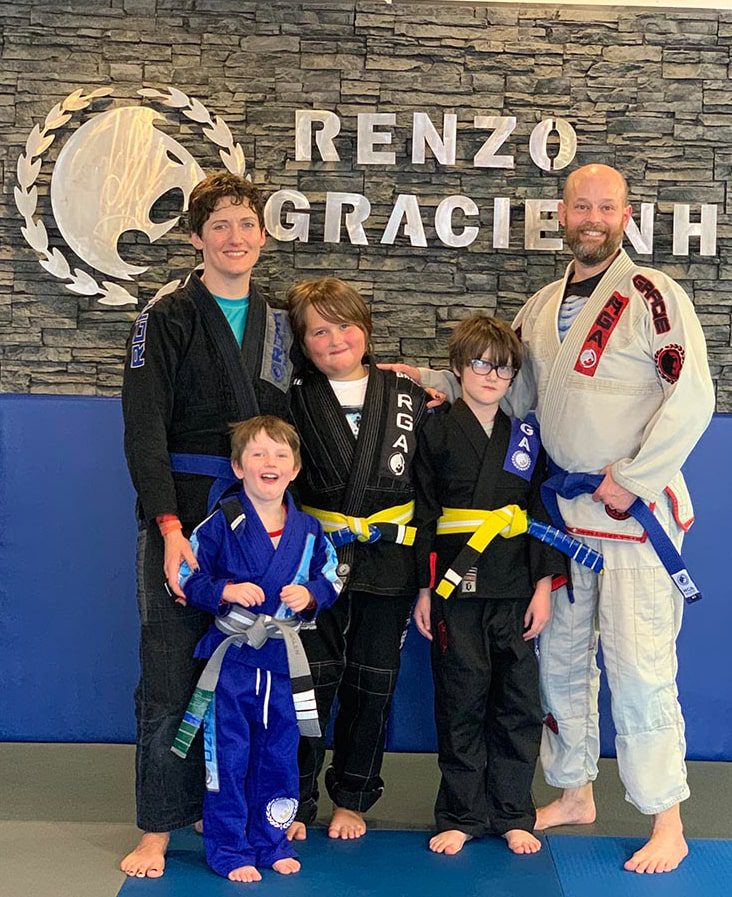
This article explains what children practise in Brazilian Jiu-Jitsu, what realistic signs of growing confidence and discipline can look like, and how you can support your child’s learning without pressure. At Renzo Gracie NH, children can experience training in a complimentary introductory class. The academy serves families in Windham, Manchester, and Exeter, and a first visit can simply be a chance to see how the setting feels.
Key Takeaways
- BJJ for child confidence and discipline is best understood through everyday practice: trying, listening, learning from mistakes, and showing respect.
- Look for observable signs of progress, such as joining warm-ups, accepting coaching, or returning to a challenging activity, rather than relying only on belts or competition results.
- Support your child by asking about effort and learning, and make room for frustration without pressuring them to prove toughness.
- A structured, encouraging training environment helps children practise skills with guidance and respect for their partners.
- Families in Windham, Manchester, and Exeter can explore children’s instruction at Renzo Gracie NH, where Professor Kevin Landry brings over two decades of regional teaching experience.
How BJJ can support a child’s confidence and discipline
Brazilian Jiu-Jitsu can give children opportunities to practise confidence and discipline, but it can’t promise a particular personality change or outcome. In a structured class, children learn skills through guided movement and partner practice. Brazilian Jiu-Jitsu is a grappling martial art; Brazilian Jiu-Jitsu on Wikipedia offers background on its history and principles.
For parents, the distinction matters. Confidence is the willingness to try, ask questions, and recover from a mistake; discipline is the practice of listening, following routines, showing respect, and persisting. These skills can support each other, but they aren’t the same. A child might eagerly attempt a new movement and still need reminders to wait their turn. That’s a chance to practise, not a contradiction.
What confidence can look like on the mat
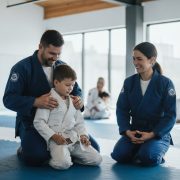
Confidence doesn’t have to be loud. One child may gradually join a warm-up; another may watch an unfamiliar movement first, then try it, or ask an instructor for help when a step feels confusing. Each is a practical sign of willingness to participate and learn.
Children express confidence in different ways and at different paces. It isn’t measured by winning, being outgoing, or never feeling nervous. A child can hesitate, make a mistake, and still build confidence by choosing to try again when ready.
What discipline means in a children’s BJJ class
Following instructions, practising a routine, and paying attention to the next step give children a chance to exercise focus and self-management. Repetition is part of learning: listen, practise, notice what needs adjusting, and try again. These habits take time, and children may need guidance along the way.
Partner practice adds another layer. Taking turns, listening to a partner, and using controlled movement help children practise patience and respect while learning together. The goal isn’t to move carelessly or overpower someone. Training should be guided and appropriate to the child.
Discipline also isn’t unquestioning obedience or punishment. Children should be able to ask for clarification, communicate discomfort, and learn why class expectations matter. BJJ for child confidence and discipline is about practising useful choices in a supportive setting, not expecting instant changes beyond the mat.
How Brazilian Jiu-Jitsu practice builds confidence and discipline step by step
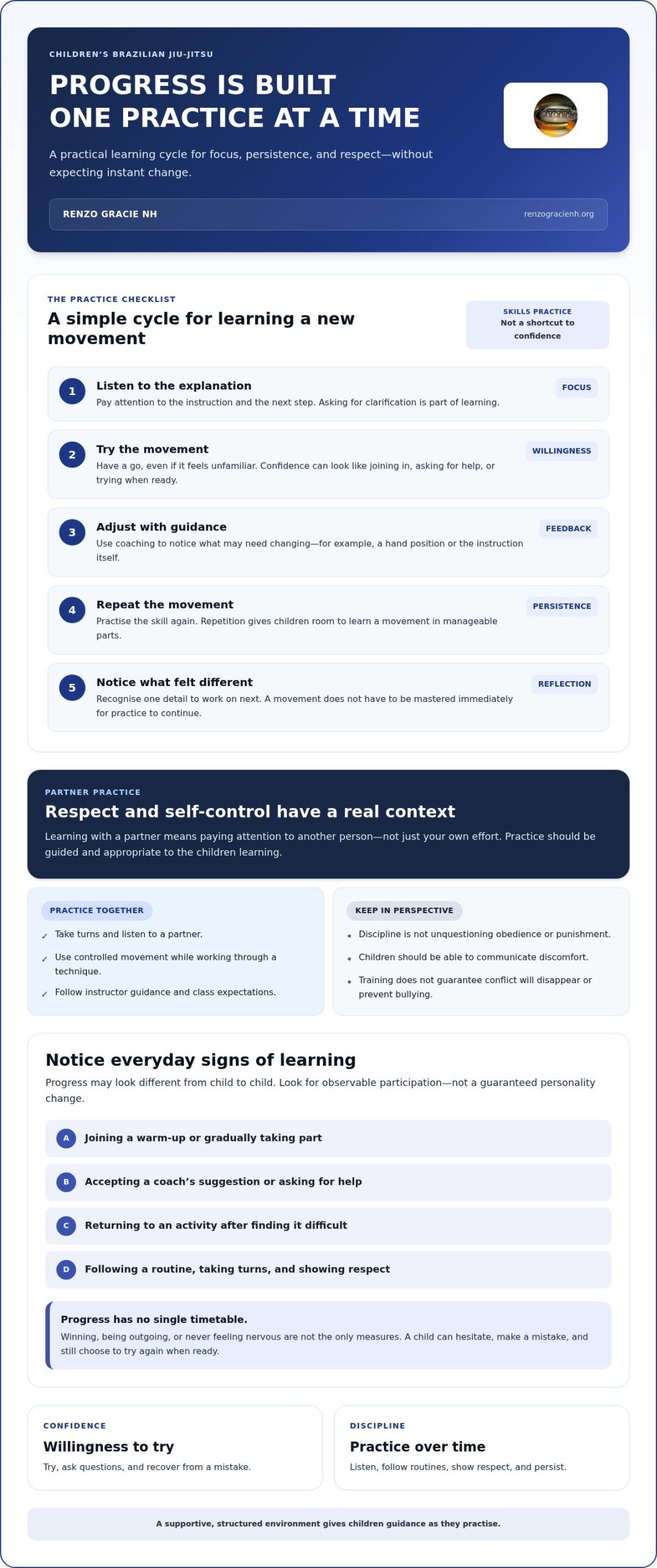
Growth comes through practice, not a sudden transformation. A child learning a new movement can follow a simple cycle: listen to an explanation, try the movement, adjust with guidance, repeat it, and notice what felt different. Each turn through that cycle gives them a chance to focus, respond to feedback, and take another step.
Brazilian Jiu-Jitsu is skills practice, not a shortcut to confidence. Techniques involve solving movement problems, such as how to create space, find balance, or respond to a partner’s position. The emphasis is on learning and applying technique, not simply relying on physical dominance. A child who doesn’t get a movement right immediately can still make progress by noticing one detail and trying again.
Small challenges help children practise persistence
Unfamiliar movements can take time to understand. Breaking a skill into manageable parts and repeating it gives a child room to learn without needing to master everything at once. A coach can help treat a mistake as useful feedback: perhaps the child needs to adjust a hand position or listen to the instruction again. That approach can encourage curiosity instead of making one imperfect attempt feel like failure.
Children respond to challenges in different ways. Some may be ready to try again right away; others may need a pause or more guidance. The aim is to support learning at a suitable pace, not to push every child toward the same response.
Partner practice gives respect and self-control a real context
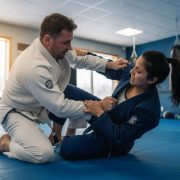
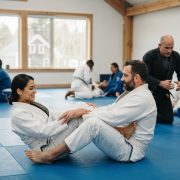
Practising with a partner makes cooperation part of the learning. Children take turns, pay attention to each other, and use controlled movement as they work through a technique. They learn that training depends on a partner’s participation and comfort, not just their own effort.
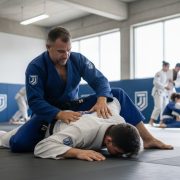
Partner work needs appropriate supervision. Instructors guide practice so it’s suitable for the children learning, with clear expectations around respect and control. These habits can be practised on the mat, but they don’t guarantee that conflict will disappear or prevent bullying.
For parents exploring BJJ for child confidence and discipline, the useful question isn’t whether one class will change a child. Consider whether the learning process gives them supportive opportunities to listen, work through difficulty, and practise with respect. Families can learn more about children’s Brazilian Jiu-Jitsu instruction at Renzo Gracie NH.
What a child’s BJJ progress may look like: and what it cannot promise
Progress in Brazilian Jiu-Jitsu doesn’t follow one timetable, and it isn’t always easy to spot from the sidelines. A child might first watch before joining in, then take part in a warm-up, accept a coach’s suggestion, or return to an activity after finding it difficult. These are observable signs of participation and learning, not proof of a guaranteed change in personality.
Confidence doesn’t have to mean becoming outspoken, winning rounds, or never feeling nervous. For one child, it may look like asking a question; for another, it may mean calmly saying they need a break. Temperament, comfort, attendance, and individual experiences all shape how progress appears. Compare your child with their own earlier behaviour, not with other students.
Signs of progress parents can notice over time
Look for small shifts in participation, focus, respectful communication, and willingness to try. The table offers examples of behaviours that may emerge over time. These are possibilities, not a checklist every child should meet on a set schedule.
| Stage | Observable behaviours |
|---|---|
| Early | Watches or joins part of a warm-up; follows a familiar instruction with support. |
| Developing | Takes part more readily; listens to coaching or communicates a question, concern, or need for a break. |
| Ongoing | Returns to an activity after difficulty; shows focus, respectful communication, or more willingness to try an unfamiliar task. |
A child expressing discomfort is also communicating meaningfully, not failing at discipline. Notice the effort behind a behaviour and ask what felt manageable or challenging, rather than measuring progress by belts or competition results alone.
Does BJJ make children aggressive or confident overnight?
No class can guarantee a change in behaviour or self-esteem. Training should involve supervised skill practice with clear expectations, not encouragement to start fights. The purpose is to learn within a structured setting and treat partners with care. BJJ for child confidence and discipline is a practice opportunity, not an instant fix or a promise that conflict will disappear.
If your child seems worried, frustrated, or uncomfortable, talk calmly with them about what they’re experiencing. You can also share concerns with their instructors so the conversation stays focused on your child’s comfort and learning. Progress is personal, so give it room to take its own shape.
How parents can reinforce confidence and discipline beyond BJJ class
A few thoughtful questions after class can help your child notice their own effort without turning training into a performance review. Keep the conversation relaxed and let them choose what to share. You might ask, “What felt challenging today?” or “Was there anything you understood better after trying it again?”
Specific praise can make effort visible: “You listened carefully to that instruction,” or “I noticed you gave your partner room to try.” This recognizes focus and consideration, not just a result. Avoid comparing your child with a sibling or classmate, and don’t use training as punishment. Those approaches can make practice feel like a test instead of a place to learn.
Praise effort and reflection rather than winning
Children don’t need to win a round to have something worth celebrating. Notice a respectful choice, a question asked, or an attempt made after a difficult moment. If your child isn’t ready to talk, don’t press for a lesson or a positive takeaway. A quiet ride home can be enough; you can check in another time.
Respond supportively when a child feels nervous or frustrated
New activities can take time to feel familiar. If your child seems frustrated, start by listening rather than urging them to tough it out. Try, “What part felt hard?” or “Was there something you enjoyed?” This makes room for an honest answer, including mixed feelings. Avoid framing fear or discomfort as weakness, and don’t require a child to prove they’re brave by pushing past what feels manageable.
To notice gradual change, keep a few simple observations over time: whether your child joins in, asks for help, communicates a boundary, or seems comfortable returning. These notes aren’t a scorecard. They can help you see patterns and talk with your child or instructor if something concerns you.
For more information about the kids BJJ program in New Hampshire, explore the children’s program details. If sharing an activity as a family feels like a good fit, learn about parent and child Jiu-Jitsu. Families ready to take a first step can book a complimentary introductory class and let their child experience the training without pressure to make a long-term commitment.
Explore children’s BJJ at Renzo Gracie NH in Windham and nearby communities
For families considering BJJ for child confidence and discipline, a supportive place to learn matters. Renzo Gracie NH offers children’s Brazilian Jiu-Jitsu instruction in a structured setting focused on personal development. Children have room to learn and practise without treating confidence or discipline as guaranteed results.
Instruction is led by Professor Kevin Landry, a sixth-degree black belt under Renzo Gracie who has taught in the region for over two decades. His experience and the academy’s community-minded approach give families a local setting to explore the habits discussed in this guide. Renzo Gracie NH serves families in Windham, Manchester, and Exeter.
A supportive local setting for children learning BJJ
Structure can help make a new activity feel more approachable. Children have instruction to follow, skills to practise, and expectations around learning respectfully with others. An encouraging environment gives them space to engage at their own pace, while parents can notice individual effort rather than expect a particular outcome.
Explore the kids Jiu-Jitsu guide for New Hampshire families to learn more about children’s training at Renzo Gracie NH and how it may fit your family.
A low-pressure first step for parents and children
Reading about a class can only tell you so much. A complimentary introductory class gives a new student the opportunity to experience training and gives parents a chance to see how their child responds to the setting. There’s no need to decide in advance what the experience should prove. Treat it as a first look and a chance to learn together.
For more information about what to expect, read how to try Jiu-Jitsu free in New Hampshire. If your family is ready to take that first step, you’re warmly invited to book a free introductory class and let your child experience the academy for themselves.
Take a thoughtful first step with your child
BJJ for child confidence and discipline is best viewed as practice, not a promise of instant change. Children can work on listening, trying unfamiliar skills, respecting partners, and finding their way through mistakes. Progress may be quiet: joining in, asking for help, or choosing to try again. Parents can support that learning by praising effort and keeping conversations open, without comparing their child with others or expecting a particular outcome.
At Renzo Gracie NH, children learn in a structured, supportive setting. Professor Kevin Landry, a sixth-degree black belt under Renzo Gracie, has taught in the region for over two decades. New students can begin with a complimentary introductory class, a low-pressure opportunity to experience training and see how it feels.
Book a complimentary introductory class and take the first step at your child’s pace. Every small effort can be a meaningful part of learning, and your family can discover together whether Jiu-Jitsu feels like a good fit.
Frequently Asked Questions
Can BJJ help a shy child become more confident?
Brazilian Jiu-Jitsu can give a shy child chances to practise participating, trying unfamiliar movements, and asking for help, but it can’t guarantee a change in temperament or self-esteem. Confidence may show quietly, such as joining a warm-up after watching or returning to an activity after a pause. Let your child progress at their own pace, and recognize effort rather than expecting them to become outgoing or fearless.
Does Brazilian Jiu-Jitsu teach children discipline?
BJJ gives children opportunities to practise habits associated with discipline, including listening to instructions, following class routines, taking turns, and showing respect to training partners. Repeating skills can also help them practise focus and persistence. These are learning opportunities, not automatic results. A supportive class should allow children to ask questions and communicate discomfort; discipline isn’t unquestioning obedience or punishment.
Will BJJ make my child aggressive?
BJJ training shouldn’t encourage children to start fights. Brazilian Jiu-Jitsu is a grappling martial art, and children practise skills within a structured class with guidance and expectations around respect and control. No activity can promise how a child will behave in every situation. Talk with your child about using skills responsibly, and share any concerns about their experience with their instructor.
At what age can a child start Brazilian Jiu-Jitsu?
Renzo Gracie NH’s Kids Jiu-Jitsu program is for children ages 3 and up. The academy also has a Little Gracies program for ages 3 to 5. Age alone doesn’t show whether a child feels ready, so consider their comfort with trying a new activity and following simple instruction. A complimentary introductory class can help your family experience the setting before deciding on next steps.
How long does it take for a child to build confidence through BJJ?
There’s no set timeline, and BJJ can’t guarantee that a child will become more confident. Progress depends on the child, their comfort, attendance, and individual experiences. Rather than waiting for a dramatic change, notice small signs over time: participating more readily, asking questions, accepting coaching, or returning to a challenge. Compare your child’s progress with their own earlier experience, not with classmates.
What should parents look for in a kids’ BJJ class?
Look for clear instruction, age-appropriate and supervised practice, and consistent expectations for respect and controlled movement with partners. Notice whether your child has room to ask questions, express discomfort, and learn without pressure to win. A structured, encouraging environment can support learning, though no class can promise a particular outcome. At Renzo Gracie NH, children’s instruction is offered in Windham, Manchester, and Exeter.
Can parents train BJJ with their child at Renzo Gracie NH?
Yes. Renzo Gracie NH offers family training so parents and children can engage in Jiu-Jitsu together. Shared training can give families time to learn alongside one another, while each person develops at their own pace. The academy serves families in Windham, Manchester, and Exeter. New students can begin with a complimentary introductory class to experience training before choosing their next step.