How to Start BJJ as an Adult: A Calm, Step-by-Step Guide
What if you don’t need to get fit or learn a martial art before stepping onto the mat? If you’re wondering how to start BJJ as an adult, the first step is simply showing up ready to learn. It’s understandable to worry about being older, out of shape, inexperienced, or unsure what a beginner class will involve. Brazilian Jiu-Jitsu is a skill you build over time, not a test you have to pass on day one.
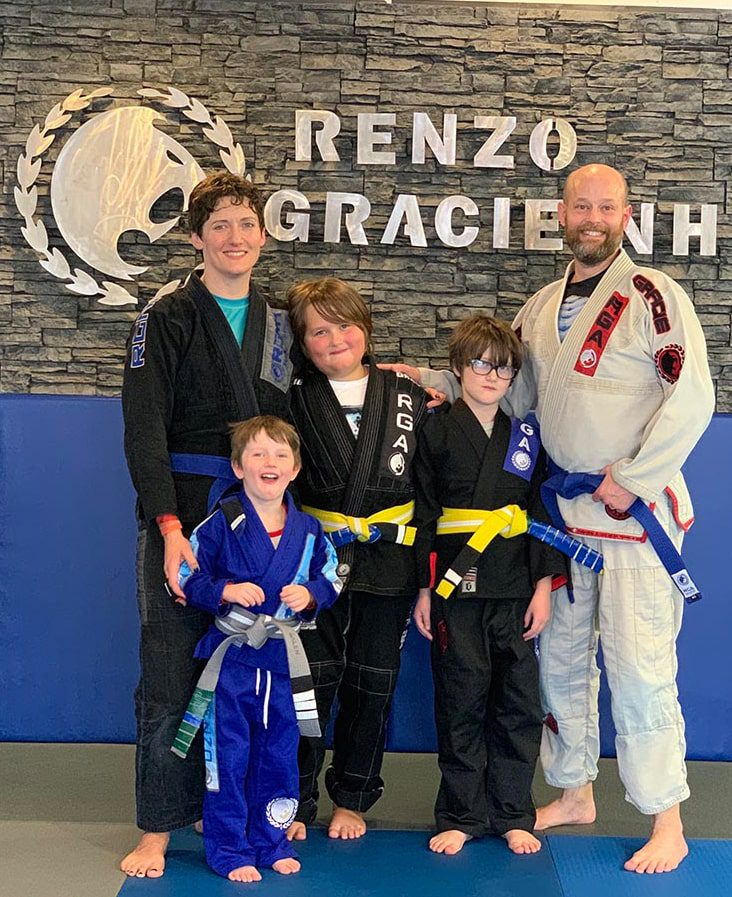
This guide explains how to prepare for a first class, start at a manageable pace, and develop a routine that fits adult life. You’ll learn what to expect as a beginner, how to approach physical effort and safety, and why consistency matters more than arriving with experience. In Southern New Hampshire, Renzo Gracie NH offers adult instruction in a supportive learning environment. Instruction is led by Professor Kevin Landry, a sixth-degree black belt under Renzo Gracie who has taught in the region for over two decades. New students can begin with a complimentary introductory class.
Key Takeaways
- Understand what BJJ involves and how to get comfortable with close-contact training one step at a time.
- Learn a practical progression from basic movement and positions to connecting techniques through repetition.
- See how to start BJJ as an adult without needing to match younger students or arrive already fit.
- Build a flexible preparation and recovery routine around gradual conditioning, sleep, hydration, and rest.
- Explore adult instruction at Renzo Gracie NH, led by Professor Kevin Landry, who has taught in the region for over two decades.
How to Start BJJ as an Adult When You Feel Out of Place
Walking into a close-contact martial art for the first time can feel unfamiliar. You may wonder where to stand, whether you’ll understand the movements, or what it will be like to train with someone you’ve just met. That uncertainty is normal. Brazilian Jiu-Jitsu (BJJ) is a grappling martial art built around positioning, control, and technique. The aim is to learn how to move and respond thoughtfully, not to arrive already knowing what to do. For a broader overview of its history and practice, see Brazilian Jiu-Jitsu.
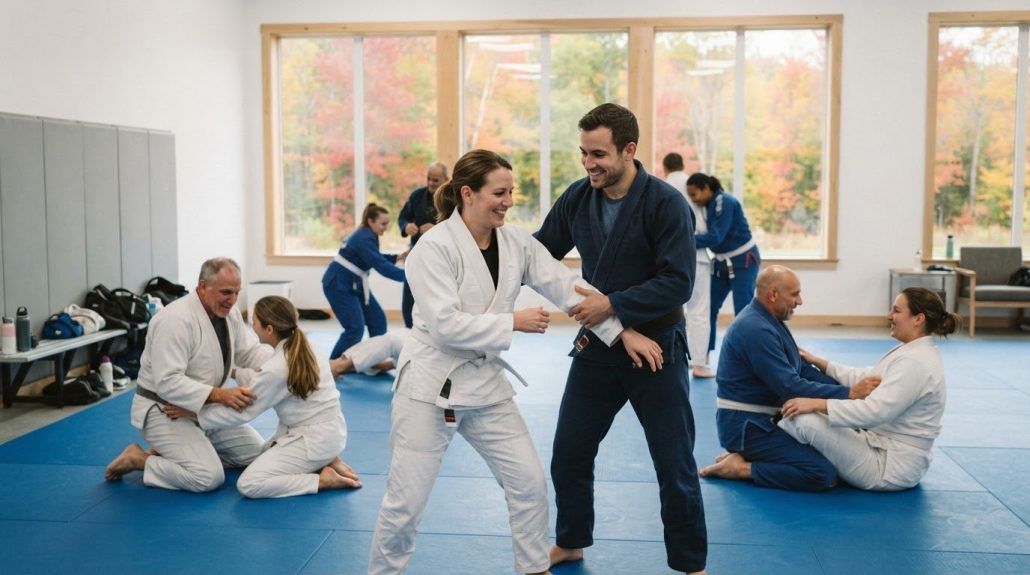
You can begin without a martial arts background. You’ll learn foundational movements and concepts through instruction and practice. For your first class, focus on listening, trying each movement, and asking for clarification when you need it. Class format and intensity can vary, so don’t treat every session as a test. Concentrate on the task in front of you instead of trying to master everything at once.
Your starting point is your current fitness, not a standard you must meet before you’re allowed to learn. General conditioning can support training, but BJJ skills develop through practice on the mat. Repetition helps you coordinate your body, recognize positions, and apply techniques with more control. Begin within your comfort level, communicate about limitations, and give yourself room to learn.
Do adults need experience or athletic fitness before starting BJJ?
No prior experience is needed. Instructors introduce movements and concepts progressively, while students build familiarity through repetition. Fitness and skill are related, but they aren’t the same thing. Being winded during an unfamiliar activity doesn’t mean you’re failing to learn, and being fit doesn’t automatically make a new technique feel natural.
Use your first sessions to notice how your body responds. If a movement feels confusing, slow down and focus on its parts. If you feel unusually tired or uncomfortable, pause and communicate. Training isn’t a contest to push through every sensation. A steady, attentive approach gives you more opportunity to learn than trying to match someone else’s pace.
What does progress look like for a new adult student?
Early progress may be quieter than you expect. You might remember where to place your hands, move with better coordination, or recognize a basic position such as guard or mount. These are meaningful steps: they show that you’re connecting the instructor’s explanation with what you feel during practice.
Measure progress against your earlier sessions, not the reactions of experienced training partners. After class, try naming one movement you understand more clearly and one question you want to revisit. Attendance, recovery, prior experience, and individual circumstances all affect how quickly skills take shape, so there’s no universal timetable. Stay curious, rest when you need to, and let familiarity grow through consistent effort.
How Adult Beginners Learn BJJ: Build Skills Before Chasing Speed
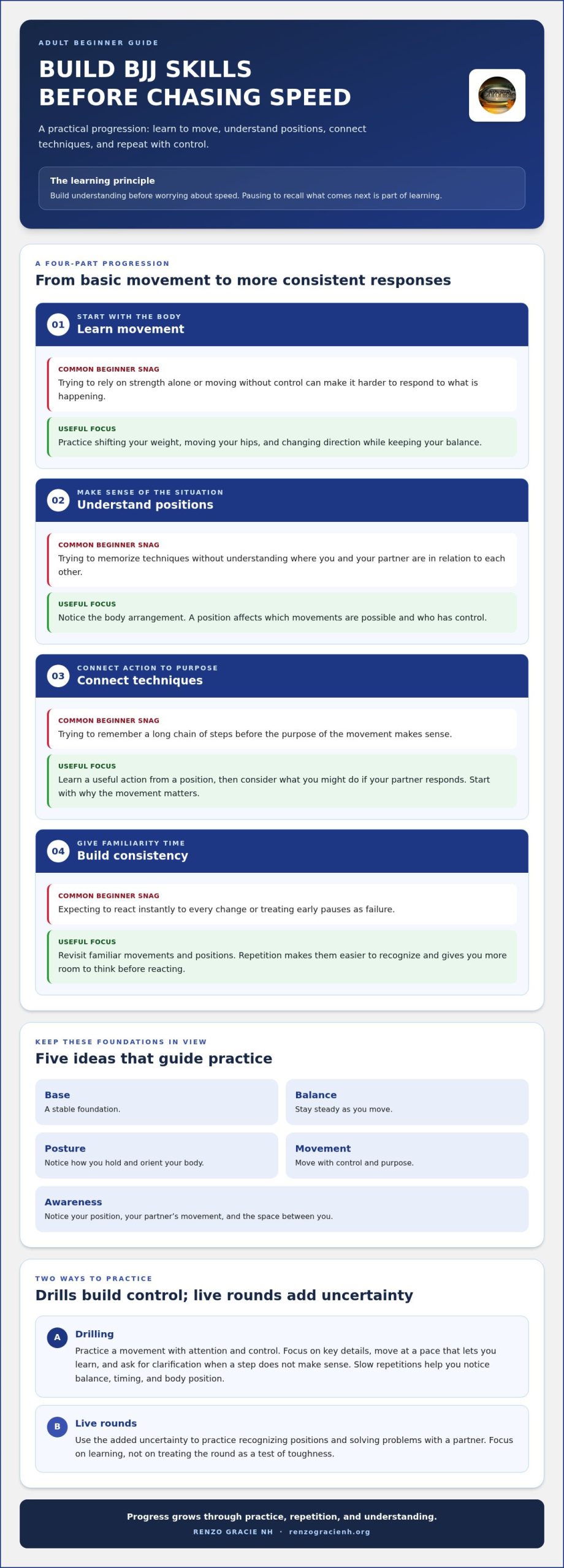
Learning BJJ is less like memorizing a long routine and more like building a set of connected decisions. First, learn to move with control. Then make sense of positions, practice techniques that work from those positions, and repeat them until the pieces become more familiar. This gradual sequence is a practical answer to how to start BJJ as an adult: build understanding before worrying about speed.
- Learn movement. Practice shifting your weight, moving your hips, and changing direction without losing balance. These actions help you respond to what’s happening instead of relying on strength alone.
- Understand positions. Notice where you and your partner are in relation to each other. A position is a body arrangement that affects which movements are possible and who has control.
- Connect techniques. Once you understand a position, learn a useful action from there and consider what you might do if your partner responds. Start with the purpose of the movement, not a long chain of steps.
- Build consistency. Revisit familiar movements and positions over time. Repetition makes them easier to recognize, giving you more room to think before you react.
At first, you may need to pause and recall what comes next. That’s part of learning. With repetition, you can begin to recognize the position that calls for a movement instead of trying to react instantly to every change. The Renzo Gracie teaching philosophy offers context for an approach centered on the principles and technical development behind the art. Good instruction connects what a technique does with why it works, making the movement easier to understand and adapt.
Which foundational BJJ skills should beginners focus on first?
Pay attention to base, balance, posture, movement, and awareness. Base means having a stable foundation; posture is how you hold and orient your body. Awareness means noticing your position, your partner’s movement, and the space between you. These concepts can guide your practice even as individual techniques change. Understanding why a position matters is often more useful than trying to memorize a lengthy sequence without context.
How should beginners approach drills and sparring?
Drilling gives you a chance to practice a movement with attention and control. Focus on the instructor’s key details, move at a pace that lets you learn, and ask for clarification if a step doesn’t make sense. Slow repetitions are useful: they help you notice balance, timing, and where your body should be.
Live rounds have a different purpose. They add uncertainty, so you can practice recognizing positions and solving problems with a partner. They aren’t a test of toughness or a requirement to win. Speak up about pace and comfort, and listen when your partner or instructor communicates. Renzo Gracie NH’s adult Brazilian Jiu-Jitsu training provides a place to learn and practice in a supportive setting.
Adult BJJ Myths: Age, Fitness, and the Fear of Falling Behind
You don’t have to keep pace with younger students or match the experience of people who’ve trained for years. Starting as an adult means beginning from your own baseline and learning at a pace that lets you stay attentive. Some days you may need more time to understand a movement; on other days, a familiar position may make more sense. Neither experience means you don’t belong.
Adapting is part of training, not a failure to train. You can pause, ask for a slower pace, or explain a limitation to your instructor or partner. That’s different from ignoring fatigue, pain, or a movement that doesn’t feel right just to prove you’re tough. Controlled pace and clear communication matter more than proving toughness; they help you stay present and make training more sustainable.
Is it too late to start Brazilian Jiu-Jitsu as an adult?
There isn’t a single age when learning has to stop, but every student’s experience is individual. Age, past activity, recovery, and personal circumstances can shape what training feels like. Patience and repeatable fundamentals let you build familiarity without expecting instant results. Learn the movement in front of you, revisit it, and allow your understanding to develop over time.
If you’re considering how to start BJJ as an adult, the useful question isn’t whether you can keep up with someone else. It’s whether you can approach practice with attention, communicate what you need, and return when your circumstances allow. Progress can be gradual and doesn’t need to look identical from one person to the next.
Do you have to be fit, strong, or competitive to belong?
No. You can become more familiar with training as you build a routine; strength or athletic experience isn’t an entry requirement. You also don’t have to compete. Some students choose competition, while others focus on learning, personal development, or practicing with a community. Competition is a personal choice, not a required measure of commitment or progress.
Before training, share relevant limitations with your instructor, including movements you need to approach carefully. Clear, practical information helps others understand how to work with you. During practice, pay attention to your body and speak up if the pace or movement feels wrong. Adjusting your effort is a skill, too.
A sustainable start doesn’t depend on winning rounds or having every class feel easy. It can mean showing up, learning one detail, and leaving with enough energy to return when it fits your life. Give yourself permission to be new. Your training is yours to build, one considered step at a time.
A Practical Adult BJJ Starting Plan: Prepare, Train, and Recover
A sustainable start doesn’t require a perfect schedule or intense preparation. It takes a plan you can adjust as you learn how training fits into your life. If you’re deciding how to start BJJ as an adult, think in small steps: choose a realistic class rhythm, prepare for each session, and make time to recover before deciding whether to add more.
- Choose a manageable starting cadence. Look at your work, family, and other commitments, then choose a pace you can realistically maintain. There’s no universal weekly schedule for every adult. Consistency over time is more useful than an ambitious first week that makes training difficult to fit into your routine.
- Prepare with simple habits. Prioritize sleep, drink water regularly, and arrive ready to focus. If you want to work on general conditioning outside class, build gradually rather than piling on extra effort all at once. The goal is to support training, not exhaust yourself before it begins.
- Set a short process goal. Choose something you can work on, such as attending consistently when life allows, remembering one movement, or asking a question about a position. Process goals keep your attention on learning rather than a belt deadline or an outcome you can’t control.
- Review and adjust. After class, note your energy, soreness, and what you learned. Rest as needed, and use those observations to decide whether your current routine feels manageable before increasing it.
How can adults make a manageable training routine?
Start with a rhythm that respects your actual week, not an ideal version of it. A busy stretch at work or extra family responsibilities may call for a lighter routine; a more settled period may leave room for more practice. Before adding sessions, consider whether you’re recovering well and staying attentive during training. Scaling back is useful information, not a failure.
Sleep and hydration are straightforward parts of preparation and recovery. Make room for rest after training, too. Your body and schedule both need time to adjust to a new activity. For more related guidance, the adult BJJ beginner guide can help you explore the early stages of learning.
What mindset and habits help beginners keep learning?
Ask concise questions when an instruction or position is unclear. For example, ask where your weight should be or what the movement is meant to accomplish. A focused question gives you one detail to work with instead of leaving you to guess through the whole technique.
Measure progress against your own earlier effort. Perhaps you remembered a movement more easily or felt less unsure about what to do next. Those observations are more useful than comparing your pace with another student’s. Rest and adjustment belong in a sustainable practice; they help you return ready to learn.
A complimentary introductory class at Renzo Gracie NH is one way to experience adult Brazilian Jiu-Jitsu training.
Start Adult BJJ at Renzo Gracie NH: Take One Welcoming First Step
You don’t need to have every part of your training plan figured out before you begin. Once you understand that BJJ develops through steady practice, the next step is finding instruction where you can learn, ask questions, and build at your own pace. Renzo Gracie NH offers adult Brazilian Jiu-Jitsu instruction for different skill levels in a supportive training environment focused on technical development and personal growth.
Instruction is led by Professor Kevin Landry, a sixth-degree black belt under Renzo Gracie who has taught in the region for over two decades. For a beginner, clear explanations, respectful practice, and the ability to ask questions can make it easier to understand what to work on and turn confusion into useful feedback.
What can an adult beginner look for in supportive instruction?
Look for an environment where learning is treated as a process, not a test of athletic ability. You should be able to focus on the lesson, communicate about your comfort level, and work through techniques without feeling that you must already know the answers. At Renzo Gracie NH, adult instruction welcomes students at different skill levels, giving beginners room to develop foundational understanding as they train.
Pay attention to how you feel asking for clarification. A question such as “Where should my weight be?” or “What is this position helping me do?” can make an unfamiliar movement easier to follow. You don’t have to ask everything at once. Small moments of understanding add up, and a supportive training community can make it easier to keep showing up and learning with others.
How can you take a low-pressure first step in Southern New Hampshire?
Renzo Gracie NH’s complimentary introductory class gives new students an opportunity to experience training before deciding on next steps. It can help you see what instruction feels like and consider how the environment fits your goals. For adults in Windham, Manchester, and Exeter, the academy offers a local starting point in Southern New Hampshire.
Keep your first visit simple. Arrive ready to listen, take the class one instruction at a time, and give yourself permission to be new. You don’t have to decide on a long-term commitment based on one session. Instead, notice whether the teaching helps you follow along, whether you feel comfortable asking questions, and what you’d like to learn next. Those observations can help you decide whether to continue.
If you’ve been wondering how to start BJJ as an adult, take the next step at a manageable pace. A free introductory class is a chance to experience adult Jiu-Jitsu training at Renzo Gracie NH.
Make Your First Step Count
You don’t need to map out months of training before you begin. Let your first class be a chance to experience the learning environment, notice how instruction feels, and decide what you’d like to explore next. There’s no need to arrive with a polished goal or a promise to keep going. Curiosity is enough to start.
If you’re still asking how to start BJJ as an adult, choose one manageable action: set aside time to try a class, then reflect on what felt welcoming, challenging, or worth learning more about. The right next step is one that suits your life and gives you room to grow at your own pace.
New students can experience training through a complimentary introductory class at Renzo Gracie NH. Explore a free introductory class and take your first step toward Brazilian Jiu-Jitsu in Windham, with the academy also serving adults in Manchester and Exeter.
Frequently Asked Questions
Can I start BJJ as an adult with no martial arts experience?
Yes, you can begin without prior martial arts experience. In your first classes, unfamiliar terms and movements may take time to absorb, so focus on one instruction at a time instead of trying to remember everything. For example, if an instructor explains a hand placement, practice that detail before worrying about the whole technique. Questions are part of learning, and your growing understanding is a better measure than comparing yourself with others.
Is 40 too old to start Brazilian Jiu-Jitsu?
No, age alone doesn’t decide whether you can begin. Your activity history, goals, and physical needs are individual, so tell the instructor about relevant limitations and follow guidance that fits your situation. You can train without competing, and there’s no need to treat another student’s pace as a standard. If you have a health concern or uncertainty about exercise, speak with a qualified healthcare professional before taking part.
Do I need to lose weight or get in shape before starting BJJ?
No, you don’t need to reach a target weight or fitness level first. A beginner class can introduce you to the effort and movements involved, and you can build familiarity over time. Choose a manageable pace, let the instructor know if you need to modify an activity, and notice how you feel afterward. If you have a medical condition or specific concerns about exercise, seek advice from a healthcare professional before beginning.
Do adults have to compete in Brazilian Jiu-Jitsu?
No, competition is optional. Adults can take part for the challenge of learning grappling, skill development, physical activity, or the structure of regular practice with others. If you’re not interested in tournaments, you can still set meaningful goals, such as understanding a position or improving a movement. Be clear about what you hope to get from training so you and your instructor can keep your focus aligned with your reasons for learning.
What should I wear to my first adult BJJ class?
Follow the clothing guidance provided for your introductory class, since requirements can vary by session. If you’re told to wear athletic clothing, choose clean, comfortable items that let you move freely and don’t have zippers, hard parts, or sharp accessories. Remove jewelry and trim your nails before class. You don’t need to purchase specialized equipment before you know what’s expected for your first session.
How often should a beginner train BJJ each week?
There’s no single weekly schedule that works for every adult. Choose a cadence that fits your commitments and leaves enough room for recovery, then see how it feels in practice. If you’re commuting from Windham, Manchester, or Exeter, account for travel time when planning a routine you can maintain. If your energy or soreness makes your current plan difficult, adjust before adding more sessions.
Is Brazilian Jiu-Jitsu safe for adult beginners?
BJJ is a physical, close-contact activity, so it isn’t risk-free. Follow the instructor’s directions, keep your partner informed about your comfort level, and stop if something feels wrong. Share relevant injuries or limitations before participating so the instructor understands what you need to be mindful of. If you have an injury, a medical condition, or uncertainty about exercise, consult an appropriate healthcare professional before training.